EP0913599A2 - Energieabsorbierend wirksames Bauelement für Fahrzeuge - Google Patents
Energieabsorbierend wirksames Bauelement für Fahrzeuge Download PDFInfo
- Publication number
- EP0913599A2 EP0913599A2 EP98117353A EP98117353A EP0913599A2 EP 0913599 A2 EP0913599 A2 EP 0913599A2 EP 98117353 A EP98117353 A EP 98117353A EP 98117353 A EP98117353 A EP 98117353A EP 0913599 A2 EP0913599 A2 EP 0913599A2
- Authority
- EP
- European Patent Office
- Prior art keywords
- forming
- component according
- section
- profile
- displacement path
- Prior art date
- Legal status (The legal status is an assumption and is not a legal conclusion. Google has not performed a legal analysis and makes no representation as to the accuracy of the status listed.)
- Withdrawn
Links
Images


Classifications
-
- B—PERFORMING OPERATIONS; TRANSPORTING
- B62—LAND VEHICLES FOR TRAVELLING OTHERWISE THAN ON RAILS
- B62D—MOTOR VEHICLES; TRAILERS
- B62D21/00—Understructures, i.e. chassis frame on which a vehicle body may be mounted
- B62D21/15—Understructures, i.e. chassis frame on which a vehicle body may be mounted having impact absorbing means, e.g. a frame designed to permanently or temporarily change shape or dimension upon impact with another body
- B62D21/152—Front or rear frames
-
- B—PERFORMING OPERATIONS; TRANSPORTING
- B62—LAND VEHICLES FOR TRAVELLING OTHERWISE THAN ON RAILS
- B62D—MOTOR VEHICLES; TRAILERS
- B62D1/00—Steering controls, i.e. means for initiating a change of direction of the vehicle
- B62D1/02—Steering controls, i.e. means for initiating a change of direction of the vehicle vehicle-mounted
- B62D1/16—Steering columns
- B62D1/18—Steering columns yieldable or adjustable, e.g. tiltable
- B62D1/19—Steering columns yieldable or adjustable, e.g. tiltable incorporating energy-absorbing arrangements, e.g. by being yieldable or collapsible
- B62D1/192—Yieldable or collapsible columns
-
- F—MECHANICAL ENGINEERING; LIGHTING; HEATING; WEAPONS; BLASTING
- F16—ENGINEERING ELEMENTS AND UNITS; GENERAL MEASURES FOR PRODUCING AND MAINTAINING EFFECTIVE FUNCTIONING OF MACHINES OR INSTALLATIONS; THERMAL INSULATION IN GENERAL
- F16F—SPRINGS; SHOCK-ABSORBERS; MEANS FOR DAMPING VIBRATION
- F16F7/00—Vibration-dampers; Shock-absorbers
- F16F7/12—Vibration-dampers; Shock-absorbers using plastic deformation of members
- F16F7/125—Units with a telescopic-like action as one member moves into, or out of a second member
- F16F7/126—Units with a telescopic-like action as one member moves into, or out of a second member against the action of shear pins; one member having protuberances, e.g. dimples, ball bearings which cause the other member to deform
Definitions
- the invention relates to a component according to the preamble of claim 1.
- Energy-absorbing components are in automotive engineering in different functional relationships have already become known. Its purpose is to convert kinetic energy in the event of a collision to bind, with the aim of preventing vehicle occupants from injury to protect and also collision-related harmful effects limit on the vehicle.
- the physical principle of energy absorption can be metallic, for example, in a plastic deformation Structural elements exist, so that the components mentioned must be replaced after a collision.
- An energy-absorbing component is known from DE 43 00 284, which is intended to support the bumper of a motor vehicle is.
- the component consists of two telescopically guided and mutually coaxial hollow profiles, at least one Make a forming profile, for example formed by a constriction is provided, by which in the case of a relative movement of the hollow profiles to each other the inner hollow profile a plastic deformation experiences.
- the constriction is caused by an external bead-like depression penetrating both hollow profiles manufactured, which is filled by a weld, so that the forming profile receives the required rigidity.
- the bumper can be attached, whereas the outer hollow profile is firmly connected to the chassis frame.
- Essentials this component is essentially one via the deformation path constant forming force. The manufacture of this component is, however, comparatively complex.
- From DE 195 29 370 is another, for fastening the bumper a certain component known vehicle, its principle of operation is based on two, coaxially guided hollow profiles, again a forming profile is provided, through which a relative displacement the hollow profiles are only possible with plastic deformation is.
- the forming profile is spherical by at least one arrangement Shaped body, each in one, both hollow profiles penetrating indentations are used from the outside and whose radial position is fixed on the outside by a retaining ring.
- a relative movement of the hollow bodies in their axial direction leads to this way to form a longitudinal groove-like deformation of the inner Hollow body, namely along a structurally predetermined Deformation path.
- the bumper can in turn be attached to the inner hollow profile be attached, whereas the outer hollow profile and said Retaining ring are attached to the vehicle frame.
- a first forming profile is made spherical by an arrangement Shaped body formed by means of an existing plastic Guide cage in the space between the outer and the inner Hollow profile are held and the relative movement of the Hollow profiles in the inside of the outer hollow profile on the one hand and the outside of the inner hollow profile, on the other hand, at the same time longitudinal groove-like Create deformations.
- Another forming profile is through a conical taper of the outer hollow profile is formed, the is characterized on the inside by ramp-like approaches that work together are determined with the moldings.
- Eventually a further forming profile through a conical expansion of the inner Hollow profile formed, which on the, said ramp parts opposite end of the component is located.
- all the forming sections are exclusive are formed by the outside of hollow profiles, so that forming profiles, through which in connection with the forming section Energy absorption is only possible on the outside with the hollow profiles engage.
- Each forming section works with one to this adapted forming profile together, which during the forming process is held stationary with respect to the forming section, so that the plastic deformation of the forming section by a relative movement the same can be represented compared to the forming profile.
- the geometric and material relationships of the forming profile and Forming section can be used in conjunction with the length dimensioning of this assigned sections of the entire displacement path dimensioned depending on the kinetic energy to be converted become.
- To increase the energy turnover along a section it can also be provided with several forming sections, which forming profiles are assigned.
- the distribution of the forming sections and forming profiles along the entire displacement path is in dimensioned in each case in such a way that - along the entire displacement path seen - there is an increase in the forming forces to be applied.
- There is a placement of the forming profiles also conceivable on the inside of the hollow profiles - for assembly reasons and for the use of the In nenraums of the hollow profiles, however, an outside arrangement of Forming profiles given preference.
- the second subsection assigned forming section is formed in this sense, results one - seen in the direction of the entire displacement path - increasing or progressive characteristics of energy conversion, according to which in the first section for energy conversion, for example constant, relatively low effort and in the subsequent second section requires an increased effort is.
- the characteristic of the force absorption during the length change of the component can in this way meet the needs of the load case be adjusted.
- the part to be expended can be located within a section of the displacement path Forming force must be constant, but this is not necessary and it also comes, for example, progressive or otherwise increasing characteristic.
- the subject matter of the invention further developed that by multiplying the partial nested hollow profiles a further gradation of Energy absorption along the maximum displacement path is possible.
- the successive forming sections differ in terms of the number of nested, during the forming process to be deformed simultaneously along the respectively assigned section Hollow profiles and - related to this - by the forming forces to be assigned to each section.
- at least two forming sections are assigned to the entire displacement path. These forming sections can correspond to the characteristics of the Claims 4 and 5 successively come into engagement with the forming section. This means that the second - seen in the direction of displacement Forming profile only comes into engagement after the first forming profile has reached the end of its area of intervention. However, it can the areas of engagement of both forming profiles - along the displacement path seen - at least partially overlap each other, so that during at least part of the total displacement both forming profiles are effective.
- claims 8 to 15 are based on alternative techniques Varying the energy absorption capacity or for adjusting the Characteristic of the forming forces to be absorbed.
- the individual Forming sections assigned to forming sections or forming profiles can have an identical size, for example.
- To increase the shaping force to be transmitted through the shaped body can be the shaped body the forming profiles, which - in the direction of the entire displacement path - Assigned successive sections of the same are compared to the shaped bodies of the forming profiles of each previous section be sized so that also this way the forming force to be assigned to the individual section is variable.
- the goal can be the individual sections to stagger the deforming forces assigned in such a way that - seen along the displacement path - an increasing or progressive character of the forming forces to be applied, the constructively influenced quantitatively in the manner set out above is.
- the wall thicknesses of the hollow profiles and their materials can be varied. An increased wall thickness and similarly a different material with others Deformation properties can act as a means of increasing energy absorption be used. In each of these cases results a graded according to the number of deformation sections Characteristic of energy absorption.
- the wall thickness profile of the individual hollow profile with the Provided that this, for example, in the direction of the entire Displacement increases steadily, so that along the individual forming section there is a continuous increase in the forming force.
- forming sections can also be assigned Forming profiles, however, can also be designed such that at least in sections - viewed in the direction of the displacement path - there is a decrease in the forming forces to be applied.
- claims 16 and 17 relate to the arrangement of the shaped bodies directed. According to this, they are located radially on the outside open, preferably at the ends of the respective hollow profile of the Guide tube located indentations and are in this means special retaining rings held. Easy assembly of the molded body is given in this way, since the retaining rings from the ends of the hollow profiles or the guide tube can be pushed forth, whereby the Shaped bodies are fixed in the recesses assigned to them.
- the retaining rings are with ring stops provided for the positive overlap of the end faces of the hollow profile or the guide tube are determined. These ring stops form, among other things, a deferral for the retaining rings. In this way, they facilitate the assembly of the invention Component.
- claims 19 and 20 are based on the constructive determination of the sections of the displacement path directed.
- Each section is structurally determined by means of special stop bars or through the ring stops of the retaining rings.
- the end of the section a displacement path is thus characterized by a Concerns of the abutment webs or ring abutments mentioned on corresponding, in relation to these movable elements of each other part.
- the hollow profiles can be made according to the features of claim 21 a plastically deformable material, e.g. Steel, an aluminum alloy or consist of plastic, which in the required here Extent must be plastically deformable.
- the preferably spherical Moldings consist in any case of a higher strength Material, e.g. Steel, an aluminum alloy, ceramic or plastic.
- the hardening behavior of the hollow profiles mentioned can metallic materials particularly advantageous for setting a progressive force characteristic are used. This measure can the other material and geometric At least support measures.
- claims 23 and 25 are based on variants of the force absorption characteristic a section of the displacement path directed. Basically, this is also an approximately steady one Course of the forming forces to be achieved.
- the inventive, designed length-adjustable under energy absorption Component is preferably used in the context of a steering column, namely the steering protection tube. It is interchangeable in the Steering column built in and allows due to its above Condition of a kinetic conversion adapted to the load case Energy. It also stands out due to the arrangement of the Molded bodies and their securing as well as the formation of the individual Forming sections assigned to partial sections of the displacement path through a constructively particularly simple structure, which is the realization a progressive or any other one that can be predetermined characteristic of the Force absorption enables.
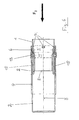
- the component according to the invention consists of two, in cross section circular and coaxially arranged and partially guided Hollow sections 1, 2, which are an integral part of a Support structure, a holding device or other functional element a vehicle structure, for example a steering protection tube form, within which a not shown in the drawing Steering shaft is guided.
- the component is for power transmission set up in the direction of its axis 3, the hollow profiles 1, 2 however after exceeding a constructively predetermined force Energy absorption in a manner to be described in more detail below to be pushed together.
- the aim is to use this component in the Vehicle collision irreversibly convert kinetic energy damage to people, but also the vehicle in general to mitigate.
- the hollow profile 2 is on its one, the hollow profile 1 facing End with two spherical caps, diametrically opposite each other, indentations extending radially inward from the outside 4 provided, in each of which a spherical shaped body 5 is recorded.
- the indentations 4 on the outside symmetrically covering retaining ring 6, the molded body 5 in their Receiving position in the indentations 4 kept essentially free of play.
- the radially inward indentations 4 of the hollow profile 2 are adapted and record the latter.
- the indentations 7 form in Connection with the indentations 4 an axial locking of the part nested hollow profiles 2, 4.
- the fastening part 10 can with the guide tube 9 - how indicated in the drawing - be welded.
- each incorporating another spherical Shaped body 12 serve.
- These extend radially inward Indentations 11 are in appropriately designed indentations of the hollow profile 2 and the molded body 12 by means of a retaining ring which covers these radially on the outside symmetrically 13 held in their recesses 11 essentially free of play.
- the hollow profile 2 is opposite axially positively secured the chassis frame.
- the guide tube 9 and the hollow profiles 1, 2 can be made of an aluminum alloy exist, whereas the molded body 2 and this fixing retaining rings 6, 13 made of steel or a metal with comparable Strength properties exist.
- the systems of the indentations 4, 11 each form forming sections 5 ', 12 ', in the case of a power transmission in the direction of axis 3 after Type of plastic deformation can be claimed.
- the arrangements fixed by the retaining rings 6, 13 form of shaped bodies each forming profiles that with the forming sections 5 ', 12' are radially on the outside in the forming engagement.
- the maximum displacement by which the component can be changed in length is additively composed of two sections, namely one first subsection, which corresponds to the displacement of the hollow profile 1 corresponds to the hollow profile 2 and a second section, which the displacement of the hollow profile 2 relative to the guide tube 9 corresponds.
- the forming section 5 ' is also part of the first section the forming profile formed by the molded body 5 and the second Sub-section of the forming section 12 ′ with the through the molded body 12 associated formed profile.
- the retaining rings 6, 13 shown in FIGS. 4 to 6 are each of the a free end of the hollow profile 2 and the guide tube 9 pushed onto this and on the front of the hollow profile 2 or the guide tube 9 facing side with a radial provided inwardly extending ring stop 6 ', 13', on which the respective end of the hollow profile 2 or the guide tube 9 concerns.
- the displacement of the hollow profile 1 relative to the hollow profile 2 in denotes the present stop webs of uniform circumferential distribution, through partial punching and radially inward bending of a wall section are easy to manufacture. Basically however, other forms of attack can also be considered which the mentioned displacement can be limited.
- the forming profiles are dimensioned such that a force F 0 can be transmitted via the hollow profile 1 to the hollow profile 2 and to the guide tube 9 connected to the body, without a relative movement between the hollow profiles 1, 2 or the hollow profile 2 and the guide tube 9 takes place.
- the first shaping section 5 'takes effect.
- the load with this force F 1 leads to a relative movement of the hollow profile 2 with respect to the hollow profile 1, as a result of which the indentations 7 are extended in a groove-like manner, such a movement being continued in accordance with the further load with a force F 1 until the end of the defined by the stop webs 14 section of the displacement path.
- the movement along this section is associated with a uniformly applied force, which is thus irreversibly converted into forming energy.
- the component is: a further relative movement, for example of the guide tube 9 the hollow profile 2 initially secured.
- the end of this section of the displacement path is characterized in that the Shaped body 12 formed forming profile at the end 8 of the hollow profile. 1 is present.
- the component can advantageously at all points in a motor vehicle are used where there is a risk of injury in the event of a collision for people or significant damage to property is expected and at which the kinetic energy to be implemented in the event of a collision is controlled Way to be absorbed.
- this component in the frame of the steering column, for example of the steering protection tube use.
Landscapes
- Engineering & Computer Science (AREA)
- Mechanical Engineering (AREA)
- Chemical & Material Sciences (AREA)
- Combustion & Propulsion (AREA)
- Transportation (AREA)
- General Engineering & Computer Science (AREA)
- Organic Insulating Materials (AREA)
- Polymers With Sulfur, Phosphorus Or Metals In The Main Chain (AREA)
- Steering Controls (AREA)
- Vibration Dampers (AREA)
Abstract
Description
Claims (25)
- Unter Energieabsorption nach Maßgabe eines definierten Verschiebeweges längenveränderbares, für den Fahrzeugbau bestimmtes und zur Übertragung von Kräften in Richtung seiner Achse (3) eingerichtetes Bauelement, mit wenigstens zwei, zur Energieabsorption durch plastische Verformung eingerichteten, jeweils nach Durchlaufen definierter Teilabschnitte des gesamten Verschiebeweges wirksam werdenden Umformabschnitten (5', 12'), wobei zur plastischen Verformung jedem Umformabschnitt (5',12') wenigstens ein Umformprofil zugeordnet ist, auf dessen Relativbewegung gegenüber dem Umformabschnitt die Energieabsorption beruht, wobei den Umformabschnitten (5',12') unterschiedliche Umformkräfte zugeordnet sind, wobei wenigstens zwei, zumindest teilweise ineinandergeführte Hohlprofile (1,2) vorgesehen sind, und wobei ein erster, einem ersten Teilabschnitt des Verschiebeweges zugeordneter Umformabschnitt (5') durch die Außenseite eines ersten Hohlprofils (1) gebildet ist,
dadurch gekennzeichnet,daß ein zweiter und sämtliche weiteren Umformabschnitte ausschließlich durch die Außenseiten von Hohlprofilen (1,2) gebildet wird/werden unddaß jedes Umformprofil ausschließlich mit der Außenseite des jeweiligen Umformabschnitts (5',12') im Umformeingriff steht. - Bauelement nach Anspruch 1,
dadurch gekennzeichnet,daß zumindest ein zweiter Umformabschnitt (12') durch eine ineinandergesteckte Anordnung des ersten und eines zweiten Hohlprofils (2) gebildet ist. - Bauelement nach Anspruch 1 oder 2,
dadurch gekennzeichnet,daß ein dritter bzw. nter Umformabschnitt durch eine ineinandergesteckte Anordnung des ersten bis dritten Hohlprofils bzw. des ersten bis nten Hohlprofils gebildet ist. - Bauelement nach einen der Ansprüche 1 bis 3,
dadurch gekennzeichnet,daß - entlang des gesamten Verschiebeweges gesehen - die Umformabschnitte mit der Maßgabe angeordnet sind, daß sie nacheinander mit dem wenigstens einen, ihnen zugeordneten Umformprofil in Eingriff gelangen. - Bauelement nach einen der Ansprüche 1 oder 3,
dadurch gekennzeichnet,daß - entlang des gesamten Verschiebeweges gesehen - die Umformabschnitte mit der Maßgabe angeordnet sind, daß sie mit dem wenigstens einen, ihnen zugeordneten Umformprofil zumindest teilweise gleichzeitig in Eingriff gelangen. - Bauelement nach einem der vorangegangenen Ansprüche 1 bis 5,
dadurch gekennzeichnet,daß jedes Umformprofil durch wenigstens einen Formkörper (5, 12) gebildet ist, der während der plastischen Verformung des zugeordneten Umformabschnitts (5',12') gegenüber diesem ortsfest gehalten ist. - Bauelement nach Anspruch 6,
dadurch gekennzeichnet,daß ein Umformprofil durch wenigstens eine, in einer zu der Achse (3) der Hohlprofile senkrechten Ebene plazierten Anordnung mehrerer Formkörper (5,12) gebildet ist. - Bauelement nach Anspruch 6 oder 7,
dadurch gekennzeichnetdaß die Formkörper (5,12) sämtlicher Umformprofile eine gleiche Größe aufweisen. - Bauelement nach einem der Ansprüche 6 bis 8,
dadurch gekennzeichnet,daß sämtliche Umformprofile die gleiche Anzahl an Formkörpern (5,12) aufweisen. - Bauelement nach einem der Ansprüche 1 bis 9,
dadurch gekennzeichnet,daß die Umformabschnitte (5',12') nebst zugeordneter Umformprofile entlang des Verschiebeweges mit der Maßgabe angeordnet sind, daß sich - vom Anfangspunkt des gesamten Verschiebeweges an gesehen - eine Zunahme der aufzuwendenden Umformkräfte ergibt. - Bauelement nach einem der Ansprüche 1 bis 9,
dadurch gekennzeichnet,daß die Umformabschnitte nebst zugehöriger Umformprofile entlang des Verschiebewagens mit der Maßgabe angeordnet sind, daß sich - vom Anfangspunkt des Verschiebewagens an gesehen - eine Abnahme der aufzunehmenden Umformkräfte ergibt. - Bauelement nach einem der Ansprüche 6 bis 8 oder 10,
dadurch gekennzeichnet,daß die Umformprofile - in Richtung des gesamten Verschiebeweges gesehen - eine zunehmende Zahl an Formkörpern aufweisen. - Bauelement nach einem der Ansprüche 1 bis 10 oder 12,
dadurch gekennzeichnet,daß die Wanddicken der Hohlprofile - in Richtung des gesamten Verschiebeweges gesehen - zunehmend ausgebildet sind. - Bauelement nach einem der vorangegangenen Ansprüche 1 bis 10 oder 12, 13,
dadurch gekennzeichnetdaß die Werkstoffe der Hohlprofile - in Richtung des gesamten Verschiebeweges gesehen - nach Maßgabe zunehmender Umformkräfte gewählt sind. - Bauelement nach einem der vorangegangenen Ansprüche 1 bis 10 oder 12 bis 14,
dadurch gekennzeichnet,daß der Wanddickenverlauf wenigstens eines Hohlprofils - in Richtung des gesamten Verschiebeweges gesehen - einen zunehmenden Verlauf aufweist. - Bauelement nach einem der Ansprüche 6 bis 15,
dadurch gekennzeichnet,daß die Formkörper (5,12) in entsprechend bemessene, radial außenseitig offene Einformungen entweder eines Hohlprofils (2) oder eines Führungsrohres (9) eingesetzt und in diesen Einformungen mittels Halteringen (6,13) im wesentlichen spielfrei gehalten sind. - Bauelement nach Anspruch 16, dadurch gekennzeichnet,daß sich die Einformungen jeweils vorzugsweise an den Enden des Hohlprofils (2) bzw. des Führungsrohres (9) befinden unddaß die Halteringe (6,13) von den Enden her auf das Hohlprofil (2) bzw. das Führungsrohr (9) aufschiebbar sind.
- Bauelement nach Anspruch 17,
dadurch gekennzeichnet,daß die Halteringe (6,13) mit Ringanschlägen (6',13') zum formschlüssigen Übergreifen der Stirnseiten des Hohlprofils (2) bzw. des Führungsrohres (9) versehen sind. - Bauelement nach einem der Ansprüche 1 bis 18,
dadurch gekennzeichnet,daß ein erster Teilabschnitt des gesamten Verschiebeweges einseitig durch Anschlagstege (14) des Hohlprofils (1) begrenzt ist, welche zum Zusammenwirken mit den, dem ersten Umformabschnitt (5') zugeordneten Umformprofil bestimmt und angeordnet sind. - Bauelement nach Anspruch 19,
dadurch gekennzeichnet,daß ein zweiter und jeder weitere Teilabschnitt des Verschiebeweges einseitig durch Ringanschläge (13') der Halteringe (13) begrenzt ist. - Bauelement nach einem der vorangegangenen Ansprüche 3 bis 20,
dadurch gekennzeichnet,daß die Hohlprofile (1,2) und das Führungsrohr (9) aus einem plastisch verformbaren Werkstoff wie z.B. Stahl, Aluminium oder Kunststoff bestehen unddaß die Halteringe (6,13) und die Formkörper (5,12) aus einem im Vergleich zum Werkstoff der Hohlprofile höherfesten Werkstoff wie z.B. Stahl, Aluminium, Keramik oder Kunststoff bestehen. - Bauelement nach einem der vorangegangenen Ansprüche 1 bis 21,
gekennzeichnet durch eine Verwendung als integraler Bestandteil der Lenksäule eines Kraftfahrzeugs, insbesondere des Lenkungsschutzrohres. - Bauelement nach einem der Ansprüche 1 bis 22,
dadurch gekennzeichnet,daß der Umformabschnitt zumindest eines Teilabschnitts des gesamten Verschiebeweges mit der Maßgabe ausgestaltet ist, daß sich entlang dieses Teilabschnitts ein konstanter Verlauf der aufzuwendenden Umformkräfte ergibt. - Bauelement nach einem der vorangegangenen Ansprüche 1 bis 10 oder 12 bis 23,
dadurch gekennzeichnet,daß der Umformabschnitt zumindest eines Teilabschnitts des Verschiebeweges mit der Maßgabe ausgestaltet ist, daß sich entlang dieses Teilabschnitts ein ansteigender Verlauf der aufzuwendenden Umformkräfte ergibt. - Bauelement nach einem der vorangegangenen Ansprüche 1 bis 9, 11 oder 16 bis 23,
dadurch gekennzeichnet,daß der Umformabschnitt zumindest eines Teilabschnitts des Verschiebeweges mit der Maßgabe ausgestaltet ist, daß sich entlang dieses Teilabschnitts ein abfallender Verlauf der aufzuwendenden Umformkräfte ergibt.
Applications Claiming Priority (2)
| Application Number | Priority Date | Filing Date | Title |
|---|---|---|---|
| DE29719362U | 1997-10-31 | ||
| DE29719362U DE29719362U1 (de) | 1997-10-31 | 1997-10-31 | Energieabsorbierend wirksames Bauelement für Kraftfahrzeuge |
Publications (2)
| Publication Number | Publication Date |
|---|---|
| EP0913599A2 true EP0913599A2 (de) | 1999-05-06 |
| EP0913599A3 EP0913599A3 (de) | 2000-05-31 |
Family
ID=8048001
Family Applications (1)
| Application Number | Title | Priority Date | Filing Date |
|---|---|---|---|
| EP98117353A Withdrawn EP0913599A3 (de) | 1997-10-31 | 1998-09-14 | Energieabsorbierend wirksames Bauelement für Fahrzeuge |
Country Status (2)
| Country | Link |
|---|---|
| EP (1) | EP0913599A3 (de) |
| DE (1) | DE29719362U1 (de) |
Cited By (1)
| Publication number | Priority date | Publication date | Assignee | Title |
|---|---|---|---|---|
| WO2007031226A1 (de) * | 2005-09-14 | 2007-03-22 | Gm Global Technology Operations, Inc. | Vorrichtung zur aufpralldämpfung |
Families Citing this family (7)
| Publication number | Priority date | Publication date | Assignee | Title |
|---|---|---|---|---|
| DE10064250B4 (de) * | 2000-02-26 | 2013-12-24 | Volkswagen Ag | Einrichtung mit einer axial deformierbaren Lenksäule eines Kraftfahrzeugs |
| GB2368894B (en) * | 2000-11-14 | 2005-07-20 | Nastech Europ Ltd | Steering column assembly for a vehicle |
| DE10154608B4 (de) * | 2001-11-07 | 2004-10-21 | Suspa Holding Gmbh | Lenksäulendämpfer |
| DE102004059545A1 (de) * | 2004-12-09 | 2006-06-14 | Zf Friedrichshafen Ag | Energieaufnahmeeinrichtung |
| DE202005005488U1 (de) * | 2005-04-07 | 2006-09-07 | Dura Automotive Gmbh | Vorrichtung zur Aufnahme von Aufprallenergie |
| DE102006058043B4 (de) * | 2006-12-07 | 2012-11-15 | Autoliv Development Ab | Stoßfängeranordnung |
| DE102010031591A1 (de) * | 2010-07-21 | 2012-01-26 | Robert Bosch Gmbh | Crashstruktur mit einstellbarer Steifigkeit für ein Deformationselement für ein Fahrzeug |
Family Cites Families (3)
| Publication number | Priority date | Publication date | Assignee | Title |
|---|---|---|---|---|
| US3757601A (en) * | 1972-06-22 | 1973-09-11 | Gen Motors Corp | Collapsible steering column assembly |
| DE4300284C2 (de) * | 1992-07-08 | 2003-10-09 | Suspa Holding Gmbh | Pralldämpfer |
| DE19529370A1 (de) * | 1995-01-28 | 1996-08-01 | Heidemann Werke | Pralldämpfer |
-
1997
- 1997-10-31 DE DE29719362U patent/DE29719362U1/de not_active Expired - Lifetime
-
1998
- 1998-09-14 EP EP98117353A patent/EP0913599A3/de not_active Withdrawn
Cited By (2)
| Publication number | Priority date | Publication date | Assignee | Title |
|---|---|---|---|---|
| WO2007031226A1 (de) * | 2005-09-14 | 2007-03-22 | Gm Global Technology Operations, Inc. | Vorrichtung zur aufpralldämpfung |
| US7762595B2 (en) | 2005-09-14 | 2010-07-27 | Gm Global Technology Operations, Inc. | Impact damping device |
Also Published As
| Publication number | Publication date |
|---|---|
| DE29719362U1 (de) | 1998-01-22 |
| EP0913599A3 (de) | 2000-05-31 |
Similar Documents
| Publication | Publication Date | Title |
|---|---|---|
| EP1759958B1 (de) | Crashrelevantes Bauteil einer Fahrzeugstruktur oder eines Fahrwerks eines Kraftfahrzeugs | |
| EP0943525B1 (de) | Lenksäulenanordnung für ein Kraftfahrzeug | |
| EP3631219B1 (de) | Lenkwelle für ein kraftfahrzeug | |
| DE102016222795A1 (de) | Lenkwelle für ein Kraftfahrzeug | |
| EP3297889B1 (de) | Lenksäule für ein kraftfahrzeug und energieabsorptionseinrichtung | |
| EP3353040B1 (de) | Einstellbare lenksaeule fuer ein kraftfahrzeug | |
| WO2019038455A1 (de) | Fahrzeugsitzkonsole | |
| WO2022194697A1 (de) | Hebel für einen fahrzeugsitz | |
| DE2460598A1 (de) | Stossdaempfungsvorrichtung | |
| EP1541424B1 (de) | Crashelement in Form eines Hohlprofils | |
| DE19752887A1 (de) | Universalgelenkwelle eines Lenksystems zum Absorbieren und Abfangen von Stoßenergie bei einem Zusammenstoß | |
| DE10015294C2 (de) | Reversibles Deformationselement | |
| DE69818830T2 (de) | Verbesserungen in verbindung mit lenkeinrichtungen | |
| DE29719362U1 (de) | Energieabsorbierend wirksames Bauelement für Kraftfahrzeuge | |
| DE19933734B4 (de) | Strukturbauteil für eine Fahrzeugkarosserie | |
| EP3313712B1 (de) | Axialkugelgelenk | |
| DE102008000936A1 (de) | Radaufhängung für ein Fahrzeug und Verbindungselement für eine solche Radaufhängung | |
| DE102009046894A1 (de) | Lenkerelement mit Überlastsicherung | |
| DE102017213312A1 (de) | Fahrzeugsitzkonsole | |
| WO2002018816A1 (de) | Vorrichtung zur absorption von stossenergie | |
| DE102014001232B4 (de) | Trägerprofil für eine Fahrzeugkarosserie mit unterschiedlichen Versagensmodi | |
| DE102017208391A1 (de) | Teleskopierbare Lenkwelle für ein Kraftfahrzeug | |
| DE102011017014B4 (de) | Lenksäulenanordnung | |
| DE10005665A1 (de) | Querbelastbarer Verbund aus Strukturteil und Deformationselement | |
| DE10154608B4 (de) | Lenksäulendämpfer |
Legal Events
| Date | Code | Title | Description |
|---|---|---|---|
| PUAI | Public reference made under article 153(3) epc to a published international application that has entered the european phase |
Free format text: ORIGINAL CODE: 0009012 |
|
| AK | Designated contracting states |
Kind code of ref document: A2 Designated state(s): DE FR GB IT |
|
| AX | Request for extension of the european patent |
Free format text: AL;LT;LV;MK;RO;SI |
|
| PUAL | Search report despatched |
Free format text: ORIGINAL CODE: 0009013 |
|
| AK | Designated contracting states |
Kind code of ref document: A3 Designated state(s): AT BE CH CY DE DK ES FI FR GB GR IE IT LI LU MC NL PT SE |
|
| AX | Request for extension of the european patent |
Free format text: AL;LT;LV;MK;RO;SI |
|
| 17P | Request for examination filed |
Effective date: 20001012 |
|
| AKX | Designation fees paid |
Free format text: DE FR GB IT |
|
| STAA | Information on the status of an ep patent application or granted ep patent |
Free format text: STATUS: THE APPLICATION HAS BEEN WITHDRAWN |
|
| 18W | Application withdrawn |
Withdrawal date: 20010620 |