EP0913687A1 - Procédé et dispositif pour la détection de substances peu volatiles - Google Patents
Procédé et dispositif pour la détection de substances peu volatiles Download PDFInfo
- Publication number
- EP0913687A1 EP0913687A1 EP98119670A EP98119670A EP0913687A1 EP 0913687 A1 EP0913687 A1 EP 0913687A1 EP 98119670 A EP98119670 A EP 98119670A EP 98119670 A EP98119670 A EP 98119670A EP 0913687 A1 EP0913687 A1 EP 0913687A1
- Authority
- EP
- European Patent Office
- Prior art keywords
- electrolyte
- determined
- measuring
- sensor element
- electrode
- Prior art date
- Legal status (The legal status is an assumption and is not a legal conclusion. Google has not performed a legal analysis and makes no representation as to the accuracy of the status listed.)
- Granted
Links
Images



Classifications
-
- G—PHYSICS
- G01—MEASURING; TESTING
- G01N—INVESTIGATING OR ANALYSING MATERIALS BY DETERMINING THEIR CHEMICAL OR PHYSICAL PROPERTIES
- G01N33/00—Investigating or analysing materials by specific methods not covered by groups G01N1/00 - G01N31/00
- G01N33/0004—Gaseous mixtures, e.g. polluted air
- G01N33/0009—General constructional details of gas analysers, e.g. portable test equipment
- G01N33/0027—General constructional details of gas analysers, e.g. portable test equipment concerning the detector
- G01N33/0036—General constructional details of gas analysers, e.g. portable test equipment concerning the detector specially adapted to detect a particular component
- G01N33/0057—Warfare agents or explosives
-
- G—PHYSICS
- G01—MEASURING; TESTING
- G01N—INVESTIGATING OR ANALYSING MATERIALS BY DETERMINING THEIR CHEMICAL OR PHYSICAL PROPERTIES
- G01N27/00—Investigating or analysing materials by the use of electric, electrochemical, or magnetic means
- G01N27/26—Investigating or analysing materials by the use of electric, electrochemical, or magnetic means by investigating electrochemical variables; by using electrolysis or electrophoresis
- G01N27/403—Cells and electrode assemblies
- G01N27/404—Cells with anode, cathode and cell electrolyte on the same side of a permeable membrane which separates them from the sample fluid, e.g. Clark-type oxygen sensors
- G01N27/4045—Cells with anode, cathode and cell electrolyte on the same side of a permeable membrane which separates them from the sample fluid, e.g. Clark-type oxygen sensors for gases other than oxygen
Definitions
- the invention relates to a method for detection low volatility substances, especially nitrotoluene, Trinitrotoluene, dinitrotoluene or derivatives of Nitrotoluenes and chemical warfare agents such as Clark, Lewisit, Lost, Sarin, Soman, Tabun or the like in Soils, liquids and gases, whereby an electrode arrangement, the at least one working electrode and one Has counter electrode with the substances to be tested brought into contact via an electrolyte and to the Working electrode a voltage is applied, its value with an essentially identical start and end value at least within a given period is increased and decreased once, the amperage during this at least one measurement cycle depending is determined by the applied voltage.
- an electrode arrangement, the at least one working electrode and one Has counter electrode with the substances to be tested brought into contact via an electrolyte and to the Working electrode a voltage is applied, its value with an essentially identical start and end value at least within a given period is increased and decreased once, the amperage during this at least one measurement cycle depending is determined by the applied voltage.
- the invention relates to a device for detection low volatility substances, especially nitrotoluene, Trinitrotoluene, dinitrotoluene or derivatives of Nitrotoluenes and chemical warfare agents such as Clark, Lewisit, Lost, Sarin, Soman, Tabun or the like in Soils, liquids and gases with one sensor element at least one working and one counter electrode, which are connected to an adjustable voltage source and are in contact with an electrolyte.
- gaseous, non-volatile substances proof, mostly potentiostatic (amperometric) Measuring systems used, mostly on one porous, large electrode a potential is specified.
- potentiostatic (amperometric) Measuring systems used mostly on one porous, large electrode a potential is specified.
- electrochemical oxidation or reduction then the quantitative verification of the existing ones takes place Substances about the size of the flowing current.
- Qualitative detection is preferably done by means of gas chromatography or high pressure liquid chromatography (HPLC) or other methods where the electrochemical systems mentioned as detectors be used.
- the electrodes are through a membrane or polymer layer separated from the gas space, whereupon the substance to be detected by a permeable Diffuses through the membrane and then in internal electrolytes in contact with the electrodes is solved. The respective substance is detected then by electrochemical oxidation or reduction the working electrode. As already mentioned, a fixed potential is given on the working electrode.
- a disadvantage of such processes as gas chromatography is that they are relatively time consuming and expensive are. If soils or liquids are examined, so must first be sampled and sent to a designated one Be brought to the analysis site.
- TNT trinitrotoluene
- Explosives e.g. in baggage and passenger control in air travel
- Finding mines from plastic-coated mines is one Detection of such as fast and uncomplicated as possible Mines essential.
- a TNT Solid that releases small amounts of steam to the environment delivers.
- the voltage values for each of the working electrodes occurring cathodic and anodic Current peaks for reduction and oxidation of the redox pairs provide a qualitative measure of the contamination contained From the quotient of the current of the anodic current maximum and the measured current in the the so-called double layer area then becomes the TNT content certainly.
- the TNT content or that of other substances per se be determined, however, the sensitivity of detection to be desired especially at very low steam pressures left.
- a membrane for the determination of gaseous substances must be used through which a flow cell of the electrolytic solution is separated.
- the invention is therefore based on the object Method and an apparatus of the aforementioned Kind to further develop that electrochemical actionable substances even at very small concentrations or steam pressure qualitatively and quantitatively reliable are detectable.
- this object is achieved by a Process of the type mentioned solved in that several measurement cycles are run through, the differences of the Current strength of successive measuring cycles determined and if a cathodic current maximum occurs, the associated one Voltage value determined, kept constant and the Current strength is determined.
- a device according to the invention is characterized in that the electrolyte in Form a thin layer on the one to be examined End face of the sensor element coming into contact with substance is applied.
- the required electrolyte in a thin layer on the End face of the sensor element is applied and not as in the prior art, the sensor element in one Electrolyte is immersed. By the thickness of the electrolyte layer can then influence the detection time be taken.
- the method according to the invention and the device according to the invention it is possible various non-volatile substances too reliably detectable in low concentrations.
- the determined or determined values regarding current level, Differences and potential can be optical or be output acoustically.
- the acoustic signals depending on the determined concentration of each substance may be different. This is particularly so when approaching a mine due to the now increasing TNT concentration advantageous.
- Electrolyte is not only quick to apply, but adheres reliably to the end face of the sensor element.
- a sensor element can also be simple and quickly for the determination of gaseous substances in a gas space can be introduced.
- Membranes are not more needed to separate gas space and electrolyte.
- the electrolytes can be (Sulfuric acid, perchloric acid, etc.) also mixtures inorganic and organic compounds (acetone / acid, Ethanol / sulfuric acid, hexane-1-sulfonate / sulfuric acid etc.) and purely organic compounds (acetone, ethanol etc.) are used.
- the choice of the respective electrolyte depends on the required sensitivity and selectivity when carrying out the method according to the invention and can therefore be specifically designed for the Substance can be optimized.
- At least the working and / or counter electrode microelectrodes are. It is then preferably even Ultramicroelectrodes. This makes it possible to Measurements with a simple two-electrode arrangement perform.
- the counter electrode also serves as Reference electrode. This makes this simple structure possible that due to the flowing on the microelectrodes low currents the potential of the counter electrode remains almost constant during a measuring cycle.
- the working electrode is essentially enclosed in a ring by the counter electrode.
- the counter electrode is essentially in the electrolyte non-polarizable, since it is in contact with the electrolyte standing area of the counter electrode is just much larger than that of the working electrode.
- the sensor elements can also have several working electrodes be equipped and / or a separate Reference electrode must also be installed.
- the electrodes arranged isolated from each other within a measuring probe are.
- the electrolyte layer is then on the bottom or face of the probe attached.
- the measuring probe made of glass or a pourable substance, such as araldite or the like then this substance can already be used as an isolator between serve the electrodes.
- a flow probe can be arranged below the sensor element or the measuring probe.
- the flow cell is designed such that it is on the sensor element can be screwed on.
- the ones to be proven Substances can be measured selectively and reliably become.
- Further developments see a seal between Measuring probe and flow cell.
- To the gas at the probe conveying is preferably a pump device intended.
- a membrane as in the prior art is in the inventive device for determination gaseous substances are no longer necessary.
- the sensor element or the measuring probe with a control and Evaluation electronics is connected.
- a control and Evaluation electronics is connected.
- An output unit for concentration display is preferred provided so that this directly when measuring can be read. It is also possible to change the values not only output optically, but also acoustically, where, for example, an alarm unit to output a Alarm signal when a given concentration value is exceeded can be provided, the acoustic Signals preferably differ depending on the concentration are.
- the inventive method and the inventive Devices can thus be implemented electrochemically Substances even with very low vapor pressures be proven qualitatively and quantitatively.
- By the Use of different electrode materials and Electrolytes in the measuring probe or the sensor element can different substances can be detected selectively. Because of the sensitivity and selectivity of the sun given measuring system there are applications in the different areas, for example the environmental and Personal protection, in which polluting chemical substances are to be detected in low concentrations. For example the detection of TNT from the Gas phase.
- the method and the device according to the invention in addition to, for example Search of mines that contain TNT, also for explosives detection or contaminated during remediation Surfaces can be used reliably and quickly. Further are a number of other substances, e.g. Warfare agents like Sarin, Clark I, Lewisit, Soman, Tabun and Lost etc., Drugs and substances with higher vapor pressures, detectable.
- a sensor element shown in FIG. 1 or one Measuring probe 1 points in the illustrated embodiment a counter and reference electrode 2 and a working electrode 3 on.
- the working electrode 3 has a smaller one Diameter as the counter and reference electrode 2 and is of this by one as well as the space surrounding insulator 4 separated and insulated.
- At the The underside or end face of the measuring probe 1 is an electrolyte film 5 applied.
- Whose contact surface with the Counter and reference electrode 2 is due to their Diameter significantly larger than that with the working electrode 3.
- This is the opposite and Reference electrode 2 essentially non-polarizable, so that with this constellation with two electrodes in the Probe 1 can get by.
- the counter electrode 2 takes over thus the function of the reference or reference electrode.
- the counter and reference electrode 2 and the working electrode 3 are with a common voltage source 6 connected, the voltage of which can be variably regulated. Of Another is an amperometer 7 for measuring the current intended.
- Fig. 2 In the embodiment shown in Fig. 2 is the sensor element 1 with its working electrode 3 above a flow or measuring cell 9 arranged by accordingly by means of a pump, not shown the direction shown by the arrows Gas containing substance to be detected is pumped. There is between the measuring cell 9 and the electrode 3 another seal 8 is provided.
- FIGS. 3a-c are different arrangements and designs of counter, reference and working electrode shown.
- the Counter electrode 2 ' which also serves as a reference electrode serves, ring-shaped and surrounds the pen-shaped Working electrode 3 'completely.
- Fig. 3b are shown within the ring-shaped counter / reference electrode 2 'several working electrodes 12 arranged.
- the one shown in Fig. 3c Embodiment is the working electrode 22 between the counter electrode 23 and the separate reference electrode 21 arranged within the insulator 4 'of the measuring probe 20.
- Such an insulator 4 ' is of course also with the measuring probe 10 in Fig. 3b and the measuring probe 1 'in Fig. 3a provided.
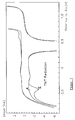
- the potential run is now correspondingly stopped at -300 mV and then at a fixed voltage the current level, as shown in Fig. 6, in Dependence on the measuring time determined. Like Fig. 6 can be seen occurs among these potentiostatic Conditions already after a response time of 0.5 sec an almost constant current value. Using this current value can then determine and report the concentration of the TNT the current intensity is hardly anymore changes.
- the thickness of the electrolyte layer can influence the detection time can be taken so that, for example for a thick film, a constant current value at a constant Potential only occurs after 40 sec.
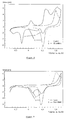
- the current-voltage curve was used at 20 ° C for TNT, which has a vapor pressure of 0.057 at 81 ° C mbar has been added.
- Hexane-1-sulfonate was used as the electrolyte used in sulfuric acid, and in the working electrode it was a gold electrode.
- the potential or the voltage of the working electrode became triangular with respect to the potential of the reference electrode varies over time to a cyclic voltammogram to obtain.
- the current-voltage curve for this concrete example is shown in Fig. 7.
- the potential range when recording this curve is between -600 mV and -250 mV. In this area the Course of the curve on the formation of a cathodic Current peaks (negative sign) evaluated. As the two different measurement curves 1 and 2 in FIG. 7 show, there is no 1 at the beginning of the first measuring cycle typical current peak recognizable. This is only forming after several measurement cycles, as by the Curve 2 shown. In this potential area typically reduced TNT. The associated potential value provides the qualitative information about the presence of TNT and the current level a quantitative Concentration information. Now to determine whether such a cathodic current peak is present the differences in the current values of the successive Measuring cycles are determined and can be optical or acoustic be issued. Now occurs as shown in Fig. 7 is a cathodic current peak in the potential range, this stops the potential flow at this potential and furthermore at constant potential or constant voltage measured the current level as this in Fig. 6 is shown for another sample.
Landscapes
- Chemical & Material Sciences (AREA)
- Life Sciences & Earth Sciences (AREA)
- Engineering & Computer Science (AREA)
- Health & Medical Sciences (AREA)
- Medicinal Chemistry (AREA)
- Food Science & Technology (AREA)
- Combustion & Propulsion (AREA)
- Physics & Mathematics (AREA)
- Analytical Chemistry (AREA)
- Biochemistry (AREA)
- General Health & Medical Sciences (AREA)
- General Physics & Mathematics (AREA)
- Immunology (AREA)
- Pathology (AREA)
- Investigating Or Analyzing Materials By The Use Of Electric Means (AREA)
Applications Claiming Priority (2)
| Application Number | Priority Date | Filing Date | Title |
|---|---|---|---|
| DE19748124A DE19748124C1 (de) | 1997-10-31 | 1997-10-31 | Verfahren und Vorrichtung zur Detektion schwerflüchtiger Substanzen |
| DE19748124 | 1997-10-31 |
Publications (2)
| Publication Number | Publication Date |
|---|---|
| EP0913687A1 true EP0913687A1 (fr) | 1999-05-06 |
| EP0913687B1 EP0913687B1 (fr) | 2004-12-29 |
Family
ID=7847199
Family Applications (1)
| Application Number | Title | Priority Date | Filing Date |
|---|---|---|---|
| EP98119670A Expired - Lifetime EP0913687B1 (fr) | 1997-10-31 | 1998-10-17 | Procédé et dispositif pour la détection de substances peu volatiles |
Country Status (3)
| Country | Link |
|---|---|
| US (1) | US6521119B2 (fr) |
| EP (1) | EP0913687B1 (fr) |
| DE (2) | DE19748124C1 (fr) |
Families Citing this family (3)
| Publication number | Priority date | Publication date | Assignee | Title |
|---|---|---|---|---|
| US20070131566A1 (en) * | 2005-09-07 | 2007-06-14 | Medis Technologies Ltd. | Electrochemical method and system for detection of trace explosives |
| US9797814B2 (en) | 2011-06-12 | 2017-10-24 | Adi Mottes | Probe for in situ monitoring the electrical conductivity of soil solutions |
| CN109884276B (zh) * | 2019-03-27 | 2024-05-10 | 中国科学院地理科学与资源研究所 | 分层土壤湿度同步测量装置 |
Citations (7)
| Publication number | Priority date | Publication date | Assignee | Title |
|---|---|---|---|---|
| US4146437A (en) * | 1975-12-31 | 1979-03-27 | The Curators Of The University Of Missouri | Method for evaluating a system for electrodeposition of metals |
| DE2904886A1 (de) * | 1979-02-09 | 1980-08-14 | Eppendorf Geraetebau Netheler | Zelle zur polarographischen analyse |
| DE4109909A1 (de) * | 1990-03-30 | 1991-10-02 | Kajaani Electronics | Elektrodensystem fuer voltametrische messungen |
| EP0531745A2 (fr) * | 1991-08-28 | 1993-03-17 | Honeywell Ag | Capteur électrochimique |
| DE4223228A1 (de) * | 1992-07-15 | 1994-01-20 | Prominent Dosiertechnik Gmbh | Verfahren zur Bestimmung von Persäuren |
| EP0665431A2 (fr) * | 1994-01-14 | 1995-08-02 | Fraunhofer-Gesellschaft Zur Förderung Der Angewandten Forschung E.V. | Appareil et procédé pour la détection de nitrotoluène |
| US5518590A (en) * | 1994-06-21 | 1996-05-21 | Pennzoil Products Company | Electrochemical sensors for motor oils and other lubricants |
-
1997
- 1997-10-31 DE DE19748124A patent/DE19748124C1/de not_active Expired - Fee Related
-
1998
- 1998-10-17 DE DE59812446T patent/DE59812446D1/de not_active Expired - Lifetime
- 1998-10-17 EP EP98119670A patent/EP0913687B1/fr not_active Expired - Lifetime
-
2001
- 2001-04-04 US US09/824,704 patent/US6521119B2/en not_active Expired - Lifetime
Patent Citations (8)
| Publication number | Priority date | Publication date | Assignee | Title |
|---|---|---|---|---|
| US4146437A (en) * | 1975-12-31 | 1979-03-27 | The Curators Of The University Of Missouri | Method for evaluating a system for electrodeposition of metals |
| US4146437B1 (fr) * | 1975-12-31 | 1987-07-14 | ||
| DE2904886A1 (de) * | 1979-02-09 | 1980-08-14 | Eppendorf Geraetebau Netheler | Zelle zur polarographischen analyse |
| DE4109909A1 (de) * | 1990-03-30 | 1991-10-02 | Kajaani Electronics | Elektrodensystem fuer voltametrische messungen |
| EP0531745A2 (fr) * | 1991-08-28 | 1993-03-17 | Honeywell Ag | Capteur électrochimique |
| DE4223228A1 (de) * | 1992-07-15 | 1994-01-20 | Prominent Dosiertechnik Gmbh | Verfahren zur Bestimmung von Persäuren |
| EP0665431A2 (fr) * | 1994-01-14 | 1995-08-02 | Fraunhofer-Gesellschaft Zur Förderung Der Angewandten Forschung E.V. | Appareil et procédé pour la détection de nitrotoluène |
| US5518590A (en) * | 1994-06-21 | 1996-05-21 | Pennzoil Products Company | Electrochemical sensors for motor oils and other lubricants |
Non-Patent Citations (1)
| Title |
|---|
| FINE D A ET AL: "VOLTAMETRIC ANALYSIS OF ORDNANCE MATERIALS PART 1. DETECTION AND QUANTITATION OF NITRATE ESTERS AND VARIOUS NITRO COMPOUNDS IN WATER BY VOLTAMMETRY", REPORT NWC-TP-6505, vol. 6505, 1 April 1984 (1984-04-01), pages 3 - 25, XP002013655 * |
Also Published As
| Publication number | Publication date |
|---|---|
| US6521119B2 (en) | 2003-02-18 |
| DE19748124C1 (de) | 1999-03-18 |
| DE59812446D1 (de) | 2005-02-03 |
| EP0913687B1 (fr) | 2004-12-29 |
| US20010027927A1 (en) | 2001-10-11 |
Similar Documents
| Publication | Publication Date | Title |
|---|---|---|
| Izadyar et al. | Ion transfer stripping voltammetry for the detection of nanomolar levels of fluoxetine, citalopram, and sertraline in tap and river water samples | |
| Kamal et al. | Rhodamine-dimethyliminocinnamyl based electrochemical sensors for selective detection of iron (II) | |
| Fang et al. | Quantitation of dopamine, serotonin and adenosine content in a tissue punch from a brain slice using capillary electrophoresis with fast-scan cyclic voltammetry detection | |
| DE2155935B2 (de) | Vorrichtung zum Nachweisen und zur quantitativen Bestimmung gasförmiger Verunreinigungen in einem Gasgemisch | |
| DE2009937A1 (de) | Elektrochemische Zelle zur Bestimmung des Ammoniakgehalts | |
| WO1996034275A1 (fr) | Procede et dispositif de detection en continu d'au moins une substance dans un melange gazeux ou liquide au moyen d'un electrode de detection | |
| DE19532799A1 (de) | Verfahren und Einrichtung zur Feststellung toxischer Gase | |
| DE19622931A1 (de) | Elektrochemischer Mehrgassensor | |
| DE1932581A1 (de) | Verfahren und Anordnung zur Bestimmung des Glukose-Gehaltes von biologischen Fluessigkeiten | |
| DE10048240B4 (de) | Gassensorelement und Verfahren zur Bestimmung der Konzentration einer Gaskomponente in einem Gasgemisch | |
| Blaedel et al. | Study of the steady-state current at tubular electrodes in the micromolar concentration region | |
| Melo et al. | Square wave adsorptive stripping voltammetry determination of chlorpyriphos in irrigation agricultural water | |
| Ortuño et al. | Sensing and characterization of neurotransmitter 2-phenylethylamine based on facilitated ion transfer at solvent polymeric membranes using different electrochemical techniques | |
| Wang et al. | Amperometric detection of three purine alkaloids following their separation by micellar electrokinetic capillary chromatography | |
| DE19748124C1 (de) | Verfahren und Vorrichtung zur Detektion schwerflüchtiger Substanzen | |
| Wang et al. | Separation and determination of the active ingredients in tablets of composite sulphonamides by capillary zone electrophoresis with amperometric detection | |
| EP0665431A2 (fr) | Appareil et procédé pour la détection de nitrotoluène | |
| DE102015122454A1 (de) | Verfahren und eine Vorrichtung zur Herstellung einer Referenzelektrode | |
| DE102015010427A1 (de) | Verfahren zur Prüfung einer Reinheit von Wasserstoff, Wasserstoff-Leitungssystem, Wasserstoff-Versorgungseinrichtung, und Kraftfahrzeug mit einem Wasserstoff-Leitungssystem | |
| DE602005005504T2 (de) | Coulometrischer Wasserdampfsensor | |
| EP0735364A2 (fr) | Procédé et dispositif pour mesurer la concentration d'un gaz A dans un mélange gazeux | |
| Groom et al. | Application of sodium dodecyl sulfate micellar electrokinetic chromatography (SDS MEKC) for the rapid measurement of aqueous phase 2, 4, 6-trinitrotoluene metabolites in anaerobic sludge: a comparison with LC/MS | |
| DE3709430C2 (fr) | ||
| DE102012004756A1 (de) | Gasanalysator | |
| DE102016124625A1 (de) | Verfahren zur Herstellung einer Elektrodenbaugruppe |
Legal Events
| Date | Code | Title | Description |
|---|---|---|---|
| PUAI | Public reference made under article 153(3) epc to a published international application that has entered the european phase |
Free format text: ORIGINAL CODE: 0009012 |
|
| AK | Designated contracting states |
Kind code of ref document: A1 Designated state(s): DE FR GB IT NL SE |
|
| AX | Request for extension of the european patent |
Free format text: AL;LT;LV;MK;RO;SI |
|
| 17P | Request for examination filed |
Effective date: 19990827 |
|
| AKX | Designation fees paid |
Free format text: DE FR GB IT NL SE |
|
| 17Q | First examination report despatched |
Effective date: 20020715 |
|
| RAP1 | Party data changed (applicant data changed or rights of an application transferred) |
Owner name: FRAUNHOFER-GESELLSCHAFT ZUR FOERDERUNG DERANGEWAND |
|
| RTI1 | Title (correction) |
Free format text: METHOD AND DEVICE FOR DETECTING LOW VOLATILE SUBSTANCES |
|
| GRAP | Despatch of communication of intention to grant a patent |
Free format text: ORIGINAL CODE: EPIDOSNIGR1 |
|
| RTI1 | Title (correction) |
Free format text: METHOD AND DEVICE FOR DETECTING LOW VOLATILE SUBSTANCES |
|
| GRAS | Grant fee paid |
Free format text: ORIGINAL CODE: EPIDOSNIGR3 |
|
| GRAA | (expected) grant |
Free format text: ORIGINAL CODE: 0009210 |
|
| AK | Designated contracting states |
Kind code of ref document: B1 Designated state(s): DE FR GB IT NL SE |
|
| PG25 | Lapsed in a contracting state [announced via postgrant information from national office to epo] |
Ref country code: NL Free format text: LAPSE BECAUSE OF FAILURE TO SUBMIT A TRANSLATION OF THE DESCRIPTION OR TO PAY THE FEE WITHIN THE PRESCRIBED TIME-LIMIT Effective date: 20041229 Ref country code: IT Free format text: LAPSE BECAUSE OF FAILURE TO SUBMIT A TRANSLATION OF THE DESCRIPTION OR TO PAY THE FEE WITHIN THE PRESCRIBED TIME-LIMIT;WARNING: LAPSES OF ITALIAN PATENTS WITH EFFECTIVE DATE BEFORE 2007 MAY HAVE OCCURRED AT ANY TIME BEFORE 2007. THE CORRECT EFFECTIVE DATE MAY BE DIFFERENT FROM THE ONE RECORDED. Effective date: 20041229 Ref country code: GB Free format text: LAPSE BECAUSE OF FAILURE TO SUBMIT A TRANSLATION OF THE DESCRIPTION OR TO PAY THE FEE WITHIN THE PRESCRIBED TIME-LIMIT Effective date: 20041229 Ref country code: FR Free format text: LAPSE BECAUSE OF FAILURE TO SUBMIT A TRANSLATION OF THE DESCRIPTION OR TO PAY THE FEE WITHIN THE PRESCRIBED TIME-LIMIT Effective date: 20041229 |
|
| REG | Reference to a national code |
Ref country code: GB Ref legal event code: FG4D Free format text: NOT ENGLISH |
|
| REF | Corresponds to: |
Ref document number: 59812446 Country of ref document: DE Date of ref document: 20050203 Kind code of ref document: P |
|
| PG25 | Lapsed in a contracting state [announced via postgrant information from national office to epo] |
Ref country code: SE Free format text: LAPSE BECAUSE OF FAILURE TO SUBMIT A TRANSLATION OF THE DESCRIPTION OR TO PAY THE FEE WITHIN THE PRESCRIBED TIME-LIMIT Effective date: 20050329 |
|
| NLV1 | Nl: lapsed or annulled due to failure to fulfill the requirements of art. 29p and 29m of the patents act | ||
| GBV | Gb: ep patent (uk) treated as always having been void in accordance with gb section 77(7)/1977 [no translation filed] |
Effective date: 20041229 |
|
| PLBE | No opposition filed within time limit |
Free format text: ORIGINAL CODE: 0009261 |
|
| STAA | Information on the status of an ep patent application or granted ep patent |
Free format text: STATUS: NO OPPOSITION FILED WITHIN TIME LIMIT |
|
| 26N | No opposition filed |
Effective date: 20050930 |
|
| EN | Fr: translation not filed | ||
| PGFP | Annual fee paid to national office [announced via postgrant information from national office to epo] |
Ref country code: DE Payment date: 20141024 Year of fee payment: 17 |
|
| REG | Reference to a national code |
Ref country code: DE Ref legal event code: R119 Ref document number: 59812446 Country of ref document: DE |
|
| PG25 | Lapsed in a contracting state [announced via postgrant information from national office to epo] |
Ref country code: DE Free format text: LAPSE BECAUSE OF NON-PAYMENT OF DUE FEES Effective date: 20160503 |