EP0914924A2 - An der Vorderseite montiertes Anschnittventil - Google Patents
An der Vorderseite montiertes Anschnittventil Download PDFInfo
- Publication number
- EP0914924A2 EP0914924A2 EP99102351A EP99102351A EP0914924A2 EP 0914924 A2 EP0914924 A2 EP 0914924A2 EP 99102351 A EP99102351 A EP 99102351A EP 99102351 A EP99102351 A EP 99102351A EP 0914924 A2 EP0914924 A2 EP 0914924A2
- Authority
- EP
- European Patent Office
- Prior art keywords
- hot runner
- housing
- piston
- gated system
- manifold
- Prior art date
- Legal status (The legal status is an assumption and is not a legal conclusion. Google has not performed a legal analysis and makes no representation as to the accuracy of the status listed.)
- Withdrawn
Links
Images


Classifications
-
- B—PERFORMING OPERATIONS; TRANSPORTING
- B29—WORKING OF PLASTICS; WORKING OF SUBSTANCES IN A PLASTIC STATE IN GENERAL
- B29C—SHAPING OR JOINING OF PLASTICS; SHAPING OF MATERIAL IN A PLASTIC STATE, NOT OTHERWISE PROVIDED FOR; AFTER-TREATMENT OF THE SHAPED PRODUCTS, e.g. REPAIRING
- B29C45/00—Injection moulding, i.e. forcing the required volume of moulding material through a nozzle into a closed mould; Apparatus therefor
- B29C45/17—Component parts, details or accessories; Auxiliary operations
- B29C45/26—Moulds
- B29C45/32—Moulds having several axially spaced mould cavities, i.e. for making several separated articles
- B29C45/322—Runner systems for distributing the moulding material to the stacked mould cavities
-
- B—PERFORMING OPERATIONS; TRANSPORTING
- B29—WORKING OF PLASTICS; WORKING OF SUBSTANCES IN A PLASTIC STATE IN GENERAL
- B29C—SHAPING OR JOINING OF PLASTICS; SHAPING OF MATERIAL IN A PLASTIC STATE, NOT OTHERWISE PROVIDED FOR; AFTER-TREATMENT OF THE SHAPED PRODUCTS, e.g. REPAIRING
- B29C45/00—Injection moulding, i.e. forcing the required volume of moulding material through a nozzle into a closed mould; Apparatus therefor
- B29C45/17—Component parts, details or accessories; Auxiliary operations
- B29C45/26—Moulds
- B29C45/27—Sprue channels ; Runner channels or runner nozzles
- B29C45/28—Closure devices therefor
- B29C45/2806—Closure devices therefor consisting of needle valve systems
- B29C45/281—Drive means therefor
-
- B—PERFORMING OPERATIONS; TRANSPORTING
- B29—WORKING OF PLASTICS; WORKING OF SUBSTANCES IN A PLASTIC STATE IN GENERAL
- B29C—SHAPING OR JOINING OF PLASTICS; SHAPING OF MATERIAL IN A PLASTIC STATE, NOT OTHERWISE PROVIDED FOR; AFTER-TREATMENT OF THE SHAPED PRODUCTS, e.g. REPAIRING
- B29C45/00—Injection moulding, i.e. forcing the required volume of moulding material through a nozzle into a closed mould; Apparatus therefor
- B29C45/17—Component parts, details or accessories; Auxiliary operations
- B29C45/26—Moulds
- B29C45/27—Sprue channels ; Runner channels or runner nozzles
- B29C2045/277—Spacer means or pressure pads between manifold and mould plates
-
- B—PERFORMING OPERATIONS; TRANSPORTING
- B29—WORKING OF PLASTICS; WORKING OF SUBSTANCES IN A PLASTIC STATE IN GENERAL
- B29C—SHAPING OR JOINING OF PLASTICS; SHAPING OF MATERIAL IN A PLASTIC STATE, NOT OTHERWISE PROVIDED FOR; AFTER-TREATMENT OF THE SHAPED PRODUCTS, e.g. REPAIRING
- B29C45/00—Injection moulding, i.e. forcing the required volume of moulding material through a nozzle into a closed mould; Apparatus therefor
- B29C45/17—Component parts, details or accessories; Auxiliary operations
- B29C45/26—Moulds
- B29C45/27—Sprue channels ; Runner channels or runner nozzles
- B29C2045/2779—Nozzles with a plurality of outlets
-
- B—PERFORMING OPERATIONS; TRANSPORTING
- B29—WORKING OF PLASTICS; WORKING OF SUBSTANCES IN A PLASTIC STATE IN GENERAL
- B29C—SHAPING OR JOINING OF PLASTICS; SHAPING OF MATERIAL IN A PLASTIC STATE, NOT OTHERWISE PROVIDED FOR; AFTER-TREATMENT OF THE SHAPED PRODUCTS, e.g. REPAIRING
- B29C45/00—Injection moulding, i.e. forcing the required volume of moulding material through a nozzle into a closed mould; Apparatus therefor
- B29C45/17—Component parts, details or accessories; Auxiliary operations
- B29C45/26—Moulds
- B29C45/27—Sprue channels ; Runner channels or runner nozzles
- B29C45/28—Closure devices therefor
- B29C45/2806—Closure devices therefor consisting of needle valve systems
- B29C45/281—Drive means therefor
- B29C2045/2827—Needle valves driven by an annular piston mounted around the nozzle
Definitions
- This invention relates to hot runner valves, and more particularly, to hot runner valves designed for cooling the motive mechanism thereof during the operation of the valve.
- Hot runner systems can be categorized into two types with respect to the method of closing off the mold cavity injection gate. These types include a thermally closed gate and a mechanically closed gate.
- This invention relates to mechanical or valve gate closing mechanisms for use in multi-cavity or high cavitation molds and molding systems as well as single cavity molds.
- a valve gated actuating mechanism is a unitized device which is attached to a valve stem or other commonly known gate closing component. Accordingly, valve stem actuation devices typically consume a considerable amount of space within a mold platen. As a result of such large space consumption, molds are formed which are too large for typical injection molding machine, resulting in increased expense due to the necessity to use larger and more materials for producing a larger mold to accommodate the mechanism.
- valve gated hot runner system is desired for a multi-level or stack mold.
- Most valve gated actuation mechanisms assume a large space which would be better used for an opposing injection nozzle housing arrangement.
- mechanically actuated closed gate mechanisms and a typical thermally activated closed gate mechanisms.
- the mechanically closed gate is generally significantly larger than the thermally closed gate. Accordingly, it would be beneficial in the art to design a mechanically actuated closed gate system of a size comparable to thermally closed gate systems.
- German patent 1,133,880 shows a nozzle suitable for attachment to the end of an injection molding machine extruder.
- the actuating mechanism used to move the valve stem in reciprocating fashion is shown as an annular piston, where a pressurized fluid is employed as the motive force.
- a pressurized fluid is employed as the motive force.
- pressurized fluid leakage can lead to, wasting energy or fluid substance; creating undesirable noise; fire hazards; and undesirable cooling effects on the hot melt conveying components adjacent to it.
- the resilient seals for this nozzle design must be of very high temperature capability.
- U.S. Patent No. 4,082,226 shows another gate valve actuating mechanism.
- An annular piston of complex and bulky design is used, which includes many parts requiring high manufacturing expense and laborious assembly time.
- the piston seals must withstand very high temperature to provide prolonged service next to the hot medial portion of the nozzle.
- the very bulky piston design because of its ratio of height to diameter, is prone to cocking and jamming should one of the piston posts 50 show resistance to slide due to sticking or friction.
- the valve stem 66 must hit the outlet bore 71 to stop travel of the stem. Such contact can lead to undesirable wear and possibly the damage of the bore and front nozzle portion.
- U.S. Patent No. 4,443,178 shows a compact method of actuating a valve stem using a spring, as shown in FIG. 8.
- this method relies on plastic pressure to push the valve stem back and the spring pressure is not readily adjustable with respect to force or time desired of the stem to close the gate.
- a pressurized piston is far superior in its ability to readily vary stem force as well as permit actuation of the stem while pressure still exists in the system or delay closing of the stem even after pressure has been released.
- U.S. Patent No. 4,832,593 shows a design similar to the aforementioned patent, but where the motive means, in this case an air piston, is not annular in shape.
- the piston is solid and is positioned on the center axis and directly behind the nozzle housing. Because the piston resides within the heated body used to convey plastic melt to the nozzle housing, it requires a cast iron piston ring as a sealing device to withstand the high temperatures. Such metal-on-metal dynamic seals inherently do not provide 100% sealing efficiency and thereby are not capable of allowing maximum supply pressure to act on the piston face. Also, it can be seen from FIG. 1 that the nozzle body is necessarily much larger in diameter than the nozzle itself and the axial length of the nozzle and nozzle body together is extended, due to the internal space required to provide the piston assembly.
- the primary object of this invention is to provide a space efficient mechanically actuated valve gated system.
- Another object of this invention is to provide a mechanically actuated valve gated system which is self-cooling so as to reduce wear of heat sensitive parts.
- Yet another object of this invention is to provide a mechanically actuated valve gated system which functions to alleviate weld lines.
- Still another object of this invention is to provide a mechanically actuated self-cooling valve gated system having a motive means coaxially positioned relative the nozzle housing for acquiring a space efficient design.
- Still another object of this invention is to provide a valve gated system which is particularly useful for stack mold arrangements due to the space efficient design thereof.
- the piston is substantially cylindrical having a wall with an inner diameter adjacent the nozzle housing.
- the wall includes an opening therein adapted to engage a stop for terminating the piston stroke.
- the piston stroke is of a distance which substantially removes the valve stem from the flow path of the molding material such that weld lines are not formed.
- This embodiment also includes means for creating a seal between the piston and the manifold plate, wherein the means for cooling is also adapted to cool the means for creating a seal.
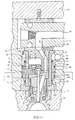
- FIG. 1 is an overhead and cross-sectional view of the valve gated system of the present invention.
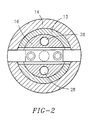
- FIG. 2 is a cross-sectional view taken through line 2-2 of FIG. 1.
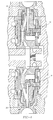
- FIG. 3 is an overhead and cross-sectional view of the valve gated system of the present invention shown in the open position.
- FIG. 4 is an overhead and cross-sectional view of the valve gated system of the present invention used in a stack mold arrangement.
- FIG. 5 is an overhead, cross-sectional and cutaway view of another embodiment for cooling the valve gated system of the present invention.
- FIG. 1 an overhead cross-sectional view of the hot runner gate valve system of the present invention, designated generally as 10.
- the valve gated system 10 generally includes a valve stem 12, a sleeve 13, a cylindrical piston 14 and a nozzle housing 16.
- System 10 is adapted to be positioned within a mold plate, as manifold plate 18, sandwiched between manifold backup plate 20 and mold plate 22.
- Manifold plate 18 includes a bore 24 therein for receiving valve gated system 10 of the present invention. Bore 24 has a diameter for slidably engaging the outer surface of cylindrical piston 14. The inner surface of cylindrical piston 14 slidably engages the outer surface of cylindrical sleeve 13, and nozzle housing 16 is positioned coaxially within sleeve 13. Nozzle housing 16 extends outwardly from surface 26 of manifold plate 18 adjacent mold plate 22, extending partially into mold plate 22.
- nozzle housing 16 is essentially an elongated rod shaped member having a base portion 23 adapted to be fastened inside manifold plate 18.
- Nozzle housing 16 may desirably be a one piece cast part, but may also if desired by of more than one piece.
- Nozzle housing 16 includes at least one channel 28, preferably two as shown in FIG. 2, extending therethrough and in communication with melt flow channel 30 located in hot runner manifold 31.
- Channel 28 extends substantially the length of nozzle housing 16 and converges with channel 32, which runs longitudinally in nozzle housing 16, and guides valve stem 12.
- Channel 28 and valve stem channel 32 converge toward the end of nozzle 16 adjacent mold plate 22. With valve stem 12 in the closed position as shown in FIG.
- valve stem 12 blocks the flow of molding material through channel 28 and into valve stem channel 32.
- valve stem 12 in the retracted position as shown in FIG. 3, molding material is allowed to flow through channel 28 into valve stem channel 32 which also leads into mold plate 22.
- valve stem channel 32 extends to a position relatively close to injection gate orifice 33, thereby assuring a true center location of the valve stem in the gate and avoiding undue wear caused by valve stem bending or flexing during the closing of the valve stem.
- valve stem 12 in a reciprocating manner for opening and closing the flow path of the molding material from channel 28 into valve stem channel 32 is accomplished via the sliding movement of piston 14 against sleeve 13.
- Piston 14 is set into motion by the use of pressurized air directed into ports 34 and 36 which extend through mold manifold plate 18 in fluid communication with the outer surface of cylindrical piston 14.
- An annular space 38 is located between bore 24 and sleeve 13 for the movement therein of piston 14.
- the piston is necessarily not entirely cylindrical in shape.
- the piston is essentially annular in shape, including a first and second wall thickness wherein the first wall thickness at the ends of piston 14 is substantially half the width of the annular space 38 and at the middle portion of piston 14, the wall is substantially equivalent in width to the annular space such that the central portion slidably engages bore 24.
- the differing widths form walls 39a and 39b on which the fluid or air can be directed. Accordingly, when pressurized air is directed into ports 34 and 36, the air is directed into the annular space not occupied by piston 14. In order to place the valve gated system in the closed position as shown in FIG. 1, air is directed into port 34 against wall 39a and in order to place the valve gated system in the open position as shown in FIG. 3, air is directed into port 36 against valve 39b.
- the piston is of annular design, it cannot achieve the same force as a solid piston under equal air pressures, for a given outside diameter. Consequently, to achieve an equivalent force, the air pressure must be increased.
- the outside diameter of the annular piston can be increased in size to provide the equivalent force under the same air pressures used for solid pistons. Such an increase in diameter will not cause the piston to become prohibitively large or space consuming, typically requiring an increase in outside diameter of only approximately one third the diameter of a solid piston. In comparison to the prior art of the assembly of the present invention, as a whole, remains substantially more compact.
- Piston 14 also includes a series of seals 40a and 40b, and 42a and 42b, wherein seals 40a and 40b are positioned between the outer surface of piston 14 and bore 24 and seals 42a and 42b are positioned between the inner surface of piston 14 and sleeve 13.
- the seals function to allow pressure build-up in annular space 38 on each end of piston 14 for moving the same through the annular space for opening and closing the valve gated system. Due to the construction of sleeve 13 and other cooling features discussed below, seals 40a and 40b and seals 42a and 42b can be typical O-ring seals, not requiring special materials for withstanding high temperatures.
- Valve stem 12 is reciprocated through nozzle housing 16 via a mechanical attachment between piston 14 and valve stem 12. That is, a cross bar 44 extends from piston 14 inwardly through an opening 46 in sleeve 13 and into a cavity 48 in nozzle housing 16. Upon the movement of piston 14 through annular space 38, cross bar 44 is also moved through opening 46 and cavity 48 and due to the connection of bar 44 with valve stem 12, valve stem 12 is moved with the movement of piston 14. Within cavity 48, a cap 50 is attached to cross bar 44 and is adapted to engage a back wall 52 (See FIG. 1) upon a complete opening stroke of the piston, as shown in FIG. 3. Referring back to FIG.
- piston 14 is limited to a stroke of a "A” which is essentially the size of opening 46 and the length of the space between cap 50 and back wall 52. Stroke "A" is designed at a distance such that valve stem 12 is moved substantially out of the flow stream of channel or channels 28 so that a weld seam is avoided.
- Sleeve 13 coaxially positioned relative to nozzle housing 16, functions to guide piston 14 adjacent nozzle housing 16 and also functions to align nozzle housing 16 centrally within bore 24 through mold manifold plate 18.
- sleeve 13 is formed from a material having low thermal conductivity properties, such as ceramic.
- heat generated in nozzle housing 16 of system 10 can be maintained confined to the nozzle housing area. That is, because the material comprising the sleeve will not conduct heat well, heat is not transferred from nozzle housing 16 to the outside area which includes piston 14, seals 40 and 42, and annular space 38. Because of this property of sleeve 13, seals 40 and 42, as discussed above, can be constructed from a material which does not have to be substantially heat resistant.
- the piston seals 40 and 42 will operate at lower temperatures and perform over a longer period of time.
- a temperature drop of 28°C (50°F) may be sufficient to allow a the seal to operate for such an extended period.
- the sleeve is constructed from materials such as, for example, ceramic or titanium alloy. These materials possess a thermal conductivity of much less than 15 kcal/m hr °C (10 BTU/ft hr °F), typical of steels generally used, thereby reducing the temperature of the seals to suitable values.
- valve stem channel 32 During the processing of certain molding materials or plastics through the hot runner valve gated system 10 of the instant invention, minute amounts of plastic processing byproducts may make their up the valve stem channel 32.
- a drainage channel 54 has been provided which leads to a free air space such as the one between hot runner manifold 31 and manifold plate 18. At this space, the byproducts have ample room to collect before requiring a periodic clean out. In addition, the byproducts are prevented from progressing further up the valve stem bore and impeding the operation of piston 14 and bar 44.
- FIG. 4 An advantageous application of the system 10, described above, is shown in FIG. 4 for use with a stack mold design.
- the simplicity of this design in comparison to the prior art discussed above can be readily appreciated by reviewing the figures of the present invention.
- the savings in space offered by the compact design of the system of the instant invention allows a stack mold to fit into tight capacities, allowing greater flexibility and efficiency on the production floor of the molder.
- the novel design allows closer spacing of the molding cavities as compared to the prior art.
- the cavities may be spaced at a pitch slightly greater than the overall diameter of the nozzle housing assembly itself.
- FIG. 5 Another embodiment of the invention is shown in FIG. 5, wherein the means for maintaining the means for reciprocating in a cooled state include cooling channels.
- the cooling channels are placed between the mold manifold plate and sleeve 213. Accordingly, at various points along the length of nozzle housing 216, a coolant is introduced into a port 271 through a channel 272 and into an annular space 238 between manifold plate 218 and sleeve 213. The fluid is removed from the other side of nozzle housing 216 through channel 274. In this manner, a more direct cooling of seals 276 can be achieved.
- the system is preferably installed into manifold plate 18 from the front, i.e., the side defined by front surface 26. That is, the nozzle assembly can be inserted from surface 26 of manifold plate 18.
- the portion of the nozzle assembly adjacent front surface 26 may desirably be of two pieces, but may also if desired by a one piece part. This feature provides for easier maintenance when required, as plates 18 and 20 do not have to be separated for access or removal of the nozzle assembly from the rear surface. Accordingly, with this design, the manifold can remain between the mold plates and not be disassembled.
- pressurized air is introduced into port 36 against wall 39b of piston 14.
- the pressurized air functions to move the piston 14 through the annular space 38 until cap 50 collides with the wall 52 of cavity 48 in nozzle housing 16.
- valve stem 12 is retracted from gate orifice 33, as shown in FIG. 3 and molding material can be introduced through channel or channels 28 and into the end of valve stem channel 32. Accordingly, the molding material is directed into valve gate orifice 33 and into the mold. Because the molding material must flow smoothly through channel or channels 28 nozzle housing 16 is heated for maintaining viscosity.
- Sleeve 13 constructed from the low thermal conductivity material, functions to confine that heat produced in nozzle housing 16 to the area surrounding nozzle housing 16 and does not conduct the heat outwardly to piston 14. Accordingly, seals 42a and 42b do not become warmed by the heat and have a longer life span. In addition, special and expensive seals which can withstand high temperatures do not have to be used. If along with using sleeve 13, the embodiment of FIG. 5 is used, wherein coolant is passed through cooling channels, the coolant is circulated through the channels during and prior to the introduction of the molding material into the nozzle housing for maintaining the piston and seals at a relatively cool temperature.
- the primary advantage of this invention is that a space efficient mechanically actuated valve gated system is provided.
- a mechanically actuated valve gated system is provided which is designed for being self-cooling so as to reduce wear of heat sensitive parts.
- a mechanically actuated valve gated system is provided which functions to alleviate weld lines.
- a mechanically actuated valve gated system is provided having a motive means coaxially positioned with the nozzle housing for acquiring a space efficient design.
- a valve gated system is provided which is particularly useful for stack mold arrangements due to the space efficient design of the system.
Landscapes
- Engineering & Computer Science (AREA)
- Manufacturing & Machinery (AREA)
- Mechanical Engineering (AREA)
- Moulds For Moulding Plastics Or The Like (AREA)
- Water Treatment By Sorption (AREA)
- Massaging Devices (AREA)
- Fuel-Injection Apparatus (AREA)
Applications Claiming Priority (3)
| Application Number | Priority Date | Filing Date | Title |
|---|---|---|---|
| US346376 | 1994-11-29 | ||
| US08/346,376 US5533882A (en) | 1994-11-29 | 1994-11-29 | Hot runner valve gated system |
| EP95810739A EP0714748B1 (de) | 1994-11-29 | 1995-11-27 | An der Vorderseite montiertes Anschnittventil |
Related Parent Applications (1)
| Application Number | Title | Priority Date | Filing Date |
|---|---|---|---|
| EP95810739A Division EP0714748B1 (de) | 1994-11-29 | 1995-11-27 | An der Vorderseite montiertes Anschnittventil |
Publications (2)
| Publication Number | Publication Date |
|---|---|
| EP0914924A2 true EP0914924A2 (de) | 1999-05-12 |
| EP0914924A3 EP0914924A3 (de) | 2001-03-28 |
Family
ID=23359106
Family Applications (2)
| Application Number | Title | Priority Date | Filing Date |
|---|---|---|---|
| EP99102351A Withdrawn EP0914924A3 (de) | 1994-11-29 | 1995-11-27 | An der Vorderseite montiertes Anschnittventil |
| EP95810739A Expired - Lifetime EP0714748B1 (de) | 1994-11-29 | 1995-11-27 | An der Vorderseite montiertes Anschnittventil |
Family Applications After (1)
| Application Number | Title | Priority Date | Filing Date |
|---|---|---|---|
| EP95810739A Expired - Lifetime EP0714748B1 (de) | 1994-11-29 | 1995-11-27 | An der Vorderseite montiertes Anschnittventil |
Country Status (7)
| Country | Link |
|---|---|
| US (1) | US5533882A (de) |
| EP (2) | EP0914924A3 (de) |
| JP (1) | JP2748968B2 (de) |
| AT (1) | ATE192067T1 (de) |
| BR (1) | BR9505313A (de) |
| DE (1) | DE69516488T2 (de) |
| MX (1) | MX9504917A (de) |
Cited By (3)
| Publication number | Priority date | Publication date | Assignee | Title |
|---|---|---|---|---|
| WO2007017428A1 (en) * | 2005-08-05 | 2007-02-15 | S.I.P.A. Società Industrializzazione Progettazione E Automazione S.P.A. | Injection system |
| US7678304B2 (en) | 2004-03-30 | 2010-03-16 | S.I.P.A. Societa Industrializzazione Progettazione E. Automazione S.P.A. | Apparatus for blow moulding of plastic objects |
| US7700029B2 (en) | 2004-03-02 | 2010-04-20 | S.I.P.A. Societa Industrializzazione Progettazione E Automazione S.P.A. | Device and method for conditioning plastic objects |
Families Citing this family (25)
| Publication number | Priority date | Publication date | Assignee | Title |
|---|---|---|---|---|
| US5798130A (en) * | 1995-09-05 | 1998-08-25 | John W. Von Holdt | Adjustable mold gate |
| JP3028407B2 (ja) * | 1996-05-20 | 2000-04-04 | 株式会社吉野工業所 | 射出成形型用バルブゲート装置 |
| US5916605A (en) * | 1996-09-27 | 1999-06-29 | Dynisco Hotrunners, Inc. | Valve actuated injection molding apparatus |
| US6309207B1 (en) * | 1998-06-10 | 2001-10-30 | Husky Injection Molding Systems Ltd. | Injection molding nozzle assembly |
| US5972258A (en) * | 1997-10-20 | 1999-10-26 | Husky Injection Molding Systems Ltd. | Method of using a multiple gating nozzle |
| DE19757412C1 (de) * | 1997-12-23 | 1999-02-25 | Knauer Systec Eng Gmbh | Nadelverschluß-Spritzgußwerkzeug |
| KR200173586Y1 (ko) * | 1998-04-06 | 2000-03-02 | 유영희 | 피스톤에 수지채널을 가지는 밸브노즐 |
| US5980234A (en) * | 1998-04-29 | 1999-11-09 | R & D Tool & Engineering Co., | Blow mold apparatus for minimal gate |
| CA2248553A1 (en) | 1998-09-30 | 2000-03-30 | Jobst Ulrich Gellert | Injection molding nozzle screwed into mounting base |
| US6318990B1 (en) | 1998-10-16 | 2001-11-20 | Mold-Masters Limited | Injection molding nozzle apparatus |
| US6159000A (en) * | 1999-03-12 | 2000-12-12 | Husky Injection Molding Systems Ltd. | Valve gated injection molding device |
| US6220851B1 (en) | 1999-04-19 | 2001-04-24 | Husky Injection Molding Systems Ltd. | Detachable nozzle body |
| US6755641B1 (en) * | 2000-09-01 | 2004-06-29 | Mold-Masters Limited | Stack injection molding apparatus with separately actuated arrays of valve gates |
| DE60328263D1 (de) * | 2002-02-04 | 2009-08-20 | Mold Masters 2007 Ltd | Thermische abdichtung zwischen verteiler und düse |
| US7014455B2 (en) * | 2002-03-14 | 2006-03-21 | Mold-Masters Limited | Valve-gated injection molding system with side-mounted actuator |
| DE10392533B4 (de) * | 2002-04-12 | 2014-07-03 | Mold-Masters (2007) Limited | Spritzgießvorrichtung mit einem Formangussöffnungseinsatz mit Wärmesperre |
| US6780003B2 (en) * | 2002-08-02 | 2004-08-24 | Mold-Masters Limited | Removable heater for a hot runner nozzle |
| US20050181090A1 (en) * | 2002-12-06 | 2005-08-18 | Mold-Masters Limited | Injection molding nozzle with embedded and removable heaters |
| DE202006008744U1 (de) * | 2006-05-31 | 2007-10-11 | Günther Heisskanaltechnik Gmbh | Spritzgießvorrichtung |
| US7854876B2 (en) | 2007-05-25 | 2010-12-21 | Ecovision Technologies, Llc | Apparatus and methods for modular preform mold system |
| US7771189B2 (en) * | 2008-03-03 | 2010-08-10 | R&D Tool & Engineering Co. | Injection molding apparatus with replaceable gate insert |
| US8047836B2 (en) | 2010-04-06 | 2011-11-01 | Mold Hotrunner Solutions Inc. | Nozzle valve gate apparatus with wiper seal |
| US7997895B1 (en) | 2010-04-06 | 2011-08-16 | Mold Hotrunner Solutions Inc. | Injection apparatus for injection molding of thermoplastic parts |
| US9272455B2 (en) | 2014-04-30 | 2016-03-01 | Mold-Masters (2007) Limited | Hot runner system sealing arrangement |
| DE102022128795A1 (de) * | 2022-10-29 | 2024-05-02 | Günther Heisskanaltechnik Gmbh | Kaltkanalsystem für ein Spritzgusssystem und Spritzgusssystem |
Family Cites Families (8)
| Publication number | Priority date | Publication date | Assignee | Title |
|---|---|---|---|---|
| US3553788A (en) * | 1968-09-10 | 1971-01-12 | Ladislao Wladyslaw Putkowski | Hot runner system for plastic injection molds |
| US4212626A (en) * | 1978-12-18 | 1980-07-15 | Gellert Jobst U | Stack injection molding melt transfer system |
| CA1174820A (en) * | 1982-02-24 | 1984-09-25 | William J. Wiles | Injection molding valve pin direct pneumatic actuator |
| US4657496A (en) * | 1984-06-04 | 1987-04-14 | Gifu Husky Co., Ltd. | Hot-runner mold for injection molding |
| CA1259156A (en) * | 1986-10-31 | 1989-09-12 | Harald H. Schmidt | Fluid cooled hydraulic actuating mechanism for single cavity injection molding |
| DE3843037C1 (de) * | 1988-12-21 | 1990-05-31 | Fa. Otto Maenner, 7836 Bahlingen, De | |
| US5080570A (en) * | 1990-03-14 | 1992-01-14 | Nitrojection Corporation | Miniaturized for gas-assisted injection molding |
| CA2115613C (en) * | 1994-02-14 | 2002-02-12 | Jobst Ulrich Gellert | Injection molding valve member sealing bushing with thin collar portion |
-
1994
- 1994-11-29 US US08/346,376 patent/US5533882A/en not_active Expired - Fee Related
-
1995
- 1995-11-27 DE DE69516488T patent/DE69516488T2/de not_active Expired - Fee Related
- 1995-11-27 EP EP99102351A patent/EP0914924A3/de not_active Withdrawn
- 1995-11-27 BR BR9505313A patent/BR9505313A/pt unknown
- 1995-11-27 MX MX9504917A patent/MX9504917A/es not_active IP Right Cessation
- 1995-11-27 AT AT95810739T patent/ATE192067T1/de not_active IP Right Cessation
- 1995-11-27 EP EP95810739A patent/EP0714748B1/de not_active Expired - Lifetime
- 1995-11-29 JP JP7311319A patent/JP2748968B2/ja not_active Expired - Lifetime
Cited By (5)
| Publication number | Priority date | Publication date | Assignee | Title |
|---|---|---|---|---|
| US7700029B2 (en) | 2004-03-02 | 2010-04-20 | S.I.P.A. Societa Industrializzazione Progettazione E Automazione S.P.A. | Device and method for conditioning plastic objects |
| US7678304B2 (en) | 2004-03-30 | 2010-03-16 | S.I.P.A. Societa Industrializzazione Progettazione E. Automazione S.P.A. | Apparatus for blow moulding of plastic objects |
| WO2007017428A1 (en) * | 2005-08-05 | 2007-02-15 | S.I.P.A. Società Industrializzazione Progettazione E Automazione S.P.A. | Injection system |
| US7841856B2 (en) | 2005-08-05 | 2010-11-30 | S.I.P.A. Societa Industrializzazione Progettazione E Automazione S.P.A. | Injection system having a closing rod provided with a cleaning device |
| CN101237979B (zh) * | 2005-08-05 | 2012-05-30 | S.I.P.A.社会工业化计划与自动化股份公司 | 注塑系统 |
Also Published As
| Publication number | Publication date |
|---|---|
| US5533882A (en) | 1996-07-09 |
| EP0714748A1 (de) | 1996-06-05 |
| DE69516488T2 (de) | 2000-12-14 |
| DE69516488D1 (de) | 2000-05-31 |
| JPH08207087A (ja) | 1996-08-13 |
| ATE192067T1 (de) | 2000-05-15 |
| EP0714748B1 (de) | 2000-04-26 |
| EP0914924A3 (de) | 2001-03-28 |
| MX9504917A (es) | 1997-06-28 |
| BR9505313A (pt) | 1997-10-21 |
| JP2748968B2 (ja) | 1998-05-13 |
Similar Documents
| Publication | Publication Date | Title |
|---|---|---|
| EP0714748B1 (de) | An der Vorderseite montiertes Anschnittventil | |
| CA2010855C (en) | Injection molding system having spring biased nozzles | |
| US4173448A (en) | Actuating mechanism for gate valve of injection nozzle | |
| CA2115613C (en) | Injection molding valve member sealing bushing with thin collar portion | |
| EP0407683B1 (de) | Pneumatischer Betätigungsmechanismus zum Spritzgiessen | |
| US4932858A (en) | Injection molding system having dual feed bushing seated in manifold | |
| US4268240A (en) | Actuating mechanism for gate valve of injection nozzle | |
| CA1253310A (en) | Fluid cooled hydraulic actuating mechanism for injection molding | |
| US6159000A (en) | Valve gated injection molding device | |
| US11254038B2 (en) | Injection unit, with closure pin, for the injection moulding of plastic material, with capacity to recover thermal dilatations and avoid leakage of the plastic material | |
| US4698013A (en) | Mechanism for valve gated injection molding with resilient retaining ring | |
| US5849343A (en) | Injection molding apparatus with a one-piece gate insert locating a cylindrical valve member | |
| AU774050B2 (en) | Improved hot runner valve gate piston assembly | |
| US8449287B2 (en) | Valve pin for accommodating side loading | |
| US4919606A (en) | Injection molding rack and pinion valve pin actuating mechanism | |
| US5288225A (en) | Pressure balanced valve stem | |
| US8985997B2 (en) | Valve bushing for an injection molding apparatus | |
| JPH04216916A (ja) | ホットランナ形射出成形機における弁軸ゲートの冷却構造 | |
| EP1466715A1 (de) | Heisskanaldüse mit Schmelzeabdichtung | |
| CA1303314C (en) | Injection molding rack and pinion valve pin actuating mechanism | |
| US7320590B2 (en) | Manifold plug for an injection molding apparatus | |
| KR100368470B1 (ko) | 하나의 매니 폴더에 장착된 한쌍의 핫런너 밸브장치 | |
| KR20230002155U (ko) | 다이캐스팅용 금형 유압실린더를 포함하는 냉각수 자킷 |
Legal Events
| Date | Code | Title | Description |
|---|---|---|---|
| PUAI | Public reference made under article 153(3) epc to a published international application that has entered the european phase |
Free format text: ORIGINAL CODE: 0009012 |
|
| AC | Divisional application: reference to earlier application |
Ref document number: 714748 Country of ref document: EP |
|
| AK | Designated contracting states |
Kind code of ref document: A2 Designated state(s): AT BE CH DE FR GB IT LI NL |
|
| PUAL | Search report despatched |
Free format text: ORIGINAL CODE: 0009013 |
|
| AK | Designated contracting states |
Kind code of ref document: A3 Designated state(s): AT BE CH DE FR GB IT LI NL |
|
| 17P | Request for examination filed |
Effective date: 20010503 |
|
| STAA | Information on the status of an ep patent application or granted ep patent |
Free format text: STATUS: THE APPLICATION IS DEEMED TO BE WITHDRAWN |
|
| 18D | Application deemed to be withdrawn |
Effective date: 20040601 |