EP0915084A2 - Process for the preparation of substituted guanidine derivatives - Google Patents
Process for the preparation of substituted guanidine derivatives Download PDFInfo
- Publication number
- EP0915084A2 EP0915084A2 EP98119420A EP98119420A EP0915084A2 EP 0915084 A2 EP0915084 A2 EP 0915084A2 EP 98119420 A EP98119420 A EP 98119420A EP 98119420 A EP98119420 A EP 98119420A EP 0915084 A2 EP0915084 A2 EP 0915084A2
- Authority
- EP
- European Patent Office
- Prior art keywords
- alkyl
- cycloalkyl
- alkenyl
- preparation
- guanidine derivatives
- Prior art date
- Legal status (The legal status is an assumption and is not a legal conclusion. Google has not performed a legal analysis and makes no representation as to the accuracy of the status listed.)
- Granted
Links
- 238000000034 method Methods 0.000 title claims abstract description 19
- 150000002357 guanidines Chemical class 0.000 title claims abstract description 11
- 238000002360 preparation method Methods 0.000 title claims abstract description 11
- 229940083094 guanine derivative acting on arteriolar smooth muscle Drugs 0.000 title claims abstract description 10
- 150000003839 salts Chemical class 0.000 claims abstract description 18
- 150000003335 secondary amines Chemical class 0.000 claims abstract description 10
- 150000003141 primary amines Chemical class 0.000 claims abstract description 9
- 229910052794 bromium Inorganic materials 0.000 claims abstract description 6
- 229910052801 chlorine Inorganic materials 0.000 claims abstract description 5
- 229910052731 fluorine Inorganic materials 0.000 claims abstract description 5
- 125000001424 substituent group Chemical group 0.000 claims abstract description 3
- 125000006552 (C3-C8) cycloalkyl group Chemical group 0.000 claims description 19
- 125000006374 C2-C10 alkenyl group Chemical group 0.000 claims description 19
- 125000000217 alkyl group Chemical group 0.000 claims description 15
- 229910052799 carbon Inorganic materials 0.000 claims description 15
- MVXMNHYVCLMLDD-UHFFFAOYSA-N 4-methoxynaphthalene-1-carbaldehyde Chemical compound C1=CC=C2C(OC)=CC=C(C=O)C2=C1 MVXMNHYVCLMLDD-UHFFFAOYSA-N 0.000 claims description 12
- 125000002947 alkylene group Chemical group 0.000 claims description 11
- 229910052739 hydrogen Inorganic materials 0.000 claims description 11
- 150000001412 amines Chemical class 0.000 claims description 10
- 125000003118 aryl group Chemical group 0.000 claims description 10
- 239000011575 calcium Substances 0.000 claims description 8
- FUQFHOLPJJETAP-UHFFFAOYSA-N carbamimidoyl chloride;hydron;chloride Chemical compound Cl.NC(Cl)=N FUQFHOLPJJETAP-UHFFFAOYSA-N 0.000 claims description 8
- GBXQPDCOMJJCMJ-UHFFFAOYSA-M trimethyl-[6-(trimethylazaniumyl)hexyl]azanium;bromide Chemical compound [Br-].C[N+](C)(C)CCCCCC[N+](C)(C)C GBXQPDCOMJJCMJ-UHFFFAOYSA-M 0.000 claims description 8
- 229910052700 potassium Inorganic materials 0.000 claims description 7
- 229910052791 calcium Inorganic materials 0.000 claims description 6
- 229910052744 lithium Inorganic materials 0.000 claims description 6
- 229910052708 sodium Inorganic materials 0.000 claims description 6
- 229910052760 oxygen Inorganic materials 0.000 claims description 4
- KXDHJXZQYSOELW-UHFFFAOYSA-N Carbamic acid Chemical class NC(O)=O KXDHJXZQYSOELW-UHFFFAOYSA-N 0.000 claims description 3
- 150000001408 amides Chemical class 0.000 claims description 3
- 150000001875 compounds Chemical class 0.000 claims description 3
- 150000002148 esters Chemical class 0.000 claims description 3
- 229920001281 polyalkylene Polymers 0.000 claims description 3
- 229920000768 polyamine Polymers 0.000 claims description 3
- 125000005263 alkylenediamine group Chemical group 0.000 claims description 2
- 150000002825 nitriles Chemical class 0.000 claims description 2
- IIACRCGMVDHOTQ-UHFFFAOYSA-N sulfamic acid Chemical class NS(O)(=O)=O IIACRCGMVDHOTQ-UHFFFAOYSA-N 0.000 claims description 2
- 238000002955 isolation Methods 0.000 claims 1
- -1 1-methylpentyl Chemical group 0.000 description 73
- VEXZGXHMUGYJMC-UHFFFAOYSA-N Hydrochloric acid Chemical compound Cl VEXZGXHMUGYJMC-UHFFFAOYSA-N 0.000 description 13
- LYCAIKOWRPUZTN-UHFFFAOYSA-N Ethylene glycol Chemical compound OCCO LYCAIKOWRPUZTN-UHFFFAOYSA-N 0.000 description 12
- 238000006243 chemical reaction Methods 0.000 description 11
- ZRALSGWEFCBTJO-UHFFFAOYSA-N Guanidine Chemical class NC(N)=N ZRALSGWEFCBTJO-UHFFFAOYSA-N 0.000 description 10
- CVSVTCORWBXHQV-UHFFFAOYSA-N creatine Chemical compound NC(=[NH2+])N(C)CC([O-])=O CVSVTCORWBXHQV-UHFFFAOYSA-N 0.000 description 10
- DNIAPMSPPWPWGF-UHFFFAOYSA-N Propylene glycol Chemical compound CC(O)CO DNIAPMSPPWPWGF-UHFFFAOYSA-N 0.000 description 9
- 125000003837 (C1-C20) alkyl group Chemical group 0.000 description 7
- 238000004519 manufacturing process Methods 0.000 description 7
- 239000004721 Polyphenylene oxide Substances 0.000 description 6
- HEMHJVSKTPXQMS-UHFFFAOYSA-M Sodium hydroxide Chemical compound [OH-].[Na+] HEMHJVSKTPXQMS-UHFFFAOYSA-M 0.000 description 6
- 125000004432 carbon atom Chemical group C* 0.000 description 6
- 229920000570 polyether Polymers 0.000 description 6
- 229920000642 polymer Polymers 0.000 description 6
- 239000011734 sodium Substances 0.000 description 6
- 238000003786 synthesis reaction Methods 0.000 description 6
- XLYOFNOQVPJJNP-UHFFFAOYSA-N water Substances O XLYOFNOQVPJJNP-UHFFFAOYSA-N 0.000 description 6
- XZMCDFZZKTWFGF-UHFFFAOYSA-N Cyanamide Chemical compound NC#N XZMCDFZZKTWFGF-UHFFFAOYSA-N 0.000 description 5
- 229920001400 block copolymer Polymers 0.000 description 5
- 229960003624 creatine Drugs 0.000 description 5
- 239000006046 creatine Substances 0.000 description 5
- 150000004985 diamines Chemical class 0.000 description 5
- 125000000959 isobutyl group Chemical group [H]C([H])([H])C([H])(C([H])([H])[H])C([H])([H])* 0.000 description 5
- 125000001972 isopentyl group Chemical group [H]C([H])([H])C([H])(C([H])([H])[H])C([H])([H])C([H])([H])* 0.000 description 5
- 125000001449 isopropyl group Chemical group [H]C([H])([H])C([H])(*)C([H])([H])[H] 0.000 description 5
- 125000002496 methyl group Chemical group [H]C([H])([H])* 0.000 description 5
- 239000000203 mixture Substances 0.000 description 5
- 125000004108 n-butyl group Chemical group [H]C([H])([H])C([H])([H])C([H])([H])C([H])([H])* 0.000 description 5
- ZQXSMRAEXCEDJD-UHFFFAOYSA-N n-ethenylformamide Chemical compound C=CNC=O ZQXSMRAEXCEDJD-UHFFFAOYSA-N 0.000 description 5
- 125000000740 n-pentyl group Chemical group [H]C([H])([H])C([H])([H])C([H])([H])C([H])([H])C([H])([H])* 0.000 description 5
- 125000004123 n-propyl group Chemical group [H]C([H])([H])C([H])([H])C([H])([H])* 0.000 description 5
- 125000001971 neopentyl group Chemical group [H]C([*])([H])C(C([H])([H])[H])(C([H])([H])[H])C([H])([H])[H] 0.000 description 5
- 239000000243 solution Substances 0.000 description 5
- 125000001973 tert-pentyl group Chemical group [H]C([H])([H])C([H])([H])C(*)(C([H])([H])[H])C([H])([H])[H] 0.000 description 5
- QGZKDVFQNNGYKY-UHFFFAOYSA-N Ammonia Chemical compound N QGZKDVFQNNGYKY-UHFFFAOYSA-N 0.000 description 4
- NBIIXXVUZAFLBC-UHFFFAOYSA-N Phosphoric acid Chemical compound OP(O)(O)=O NBIIXXVUZAFLBC-UHFFFAOYSA-N 0.000 description 4
- 108010077895 Sarcosine Proteins 0.000 description 4
- QAOWNCQODCNURD-UHFFFAOYSA-N Sulfuric acid Chemical compound OS(O)(=O)=O QAOWNCQODCNURD-UHFFFAOYSA-N 0.000 description 4
- 125000003277 amino group Chemical group 0.000 description 4
- 230000015572 biosynthetic process Effects 0.000 description 4
- 239000006227 byproduct Substances 0.000 description 4
- 229920001577 copolymer Polymers 0.000 description 4
- 239000000047 product Substances 0.000 description 4
- FSYKKLYZXJSNPZ-UHFFFAOYSA-N sarcosine Chemical compound C[NH2+]CC([O-])=O FSYKKLYZXJSNPZ-UHFFFAOYSA-N 0.000 description 4
- 125000002914 sec-butyl group Chemical group [H]C([H])([H])C([H])([H])C([H])(*)C([H])([H])[H] 0.000 description 4
- 125000005919 1,2,2-trimethylpropyl group Chemical group 0.000 description 3
- 125000005918 1,2-dimethylbutyl group Chemical group 0.000 description 3
- 125000006218 1-ethylbutyl group Chemical group [H]C([H])([H])C([H])([H])C([H])([H])C([H])(*)C([H])([H])C([H])([H])[H] 0.000 description 3
- 125000006176 2-ethylbutyl group Chemical group [H]C([H])([H])C([H])([H])C([H])(C([H])([H])*)C([H])([H])C([H])([H])[H] 0.000 description 3
- 125000004493 2-methylbut-1-yl group Chemical group CC(C*)CC 0.000 description 3
- 125000005916 2-methylpentyl group Chemical group 0.000 description 3
- 125000003542 3-methylbutan-2-yl group Chemical group [H]C([H])([H])C([H])(*)C([H])(C([H])([H])[H])C([H])([H])[H] 0.000 description 3
- 125000005917 3-methylpentyl group Chemical group 0.000 description 3
- WKBOTKDWSSQWDR-UHFFFAOYSA-N Bromine atom Chemical compound [Br] WKBOTKDWSSQWDR-UHFFFAOYSA-N 0.000 description 3
- OKTJSMMVPCPJKN-UHFFFAOYSA-N Carbon Chemical compound [C] OKTJSMMVPCPJKN-UHFFFAOYSA-N 0.000 description 3
- KWYUFKZDYYNOTN-UHFFFAOYSA-M Potassium hydroxide Chemical compound [OH-].[K+] KWYUFKZDYYNOTN-UHFFFAOYSA-M 0.000 description 3
- 239000002253 acid Substances 0.000 description 3
- 239000007864 aqueous solution Substances 0.000 description 3
- GDTBXPJZTBHREO-UHFFFAOYSA-N bromine Substances BrBr GDTBXPJZTBHREO-UHFFFAOYSA-N 0.000 description 3
- MYFXBBAEXORJNB-UHFFFAOYSA-N calcium cyanamide Chemical compound [Ca+2].[N-]=C=[N-] MYFXBBAEXORJNB-UHFFFAOYSA-N 0.000 description 3
- 239000000460 chlorine Substances 0.000 description 3
- 238000001816 cooling Methods 0.000 description 3
- 125000001495 ethyl group Chemical group [H]C([H])([H])C([H])([H])* 0.000 description 3
- 230000007062 hydrolysis Effects 0.000 description 3
- 238000006460 hydrolysis reaction Methods 0.000 description 3
- 125000004491 isohexyl group Chemical group C(CCC(C)C)* 0.000 description 3
- 125000001280 n-hexyl group Chemical group C(CCCCC)* 0.000 description 3
- 125000003538 pentan-3-yl group Chemical group [H]C([H])([H])C([H])([H])C([H])(*)C([H])([H])C([H])([H])[H] 0.000 description 3
- 238000000746 purification Methods 0.000 description 3
- 125000003548 sec-pentyl group Chemical group [H]C([H])([H])C([H])([H])C([H])([H])C([H])(*)C([H])([H])[H] 0.000 description 3
- 125000000999 tert-butyl group Chemical group [H]C([H])([H])C(*)(C([H])([H])[H])C([H])([H])[H] 0.000 description 3
- PUPZLCDOIYMWBV-UHFFFAOYSA-N (+/-)-1,3-Butanediol Chemical compound CC(O)CCO PUPZLCDOIYMWBV-UHFFFAOYSA-N 0.000 description 2
- ILROLYQPRYHHFG-UHFFFAOYSA-N 1-$l^{1}-oxidanylprop-2-en-1-one Chemical group [O]C(=O)C=C ILROLYQPRYHHFG-UHFFFAOYSA-N 0.000 description 2
- KDSNLYIMUZNERS-UHFFFAOYSA-N 2-methylpropanamine Chemical compound CC(C)CN KDSNLYIMUZNERS-UHFFFAOYSA-N 0.000 description 2
- 125000003143 4-hydroxybenzyl group Chemical group [H]C([*])([H])C1=C([H])C([H])=C(O[H])C([H])=C1[H] 0.000 description 2
- PAYRUJLWNCNPSJ-UHFFFAOYSA-N Aniline Chemical compound NC1=CC=CC=C1 PAYRUJLWNCNPSJ-UHFFFAOYSA-N 0.000 description 2
- IJGRMHOSHXDMSA-UHFFFAOYSA-N Atomic nitrogen Chemical group N#N IJGRMHOSHXDMSA-UHFFFAOYSA-N 0.000 description 2
- ZAMOUSCENKQFHK-UHFFFAOYSA-N Chlorine atom Chemical compound [Cl] ZAMOUSCENKQFHK-UHFFFAOYSA-N 0.000 description 2
- QUSNBJAOOMFDIB-UHFFFAOYSA-N Ethylamine Chemical compound CCN QUSNBJAOOMFDIB-UHFFFAOYSA-N 0.000 description 2
- PXGOKWXKJXAPGV-UHFFFAOYSA-N Fluorine Chemical compound FF PXGOKWXKJXAPGV-UHFFFAOYSA-N 0.000 description 2
- DHMQDGOQFOQNFH-UHFFFAOYSA-N Glycine Chemical compound NCC(O)=O DHMQDGOQFOQNFH-UHFFFAOYSA-N 0.000 description 2
- WMFOQBRAJBCJND-UHFFFAOYSA-M Lithium hydroxide Chemical compound [Li+].[OH-] WMFOQBRAJBCJND-UHFFFAOYSA-M 0.000 description 2
- BAVYZALUXZFZLV-UHFFFAOYSA-N Methylamine Chemical compound NC BAVYZALUXZFZLV-UHFFFAOYSA-N 0.000 description 2
- 229920002873 Polyethylenimine Polymers 0.000 description 2
- WYURNTSHIVDZCO-UHFFFAOYSA-N Tetrahydrofuran Chemical compound C1CCOC1 WYURNTSHIVDZCO-UHFFFAOYSA-N 0.000 description 2
- XTXRWKRVRITETP-UHFFFAOYSA-N Vinyl acetate Chemical compound CC(=O)OC=C XTXRWKRVRITETP-UHFFFAOYSA-N 0.000 description 2
- 229910000147 aluminium phosphate Inorganic materials 0.000 description 2
- 229910021529 ammonia Inorganic materials 0.000 description 2
- RWZYAGGXGHYGMB-UHFFFAOYSA-N anthranilic acid Chemical compound NC1=CC=CC=C1C(O)=O RWZYAGGXGHYGMB-UHFFFAOYSA-N 0.000 description 2
- 125000003710 aryl alkyl group Chemical group 0.000 description 2
- 125000001797 benzyl group Chemical group [H]C1=C([H])C([H])=C(C([H])=C1[H])C([H])([H])* 0.000 description 2
- WGQKYBSKWIADBV-UHFFFAOYSA-N benzylamine Chemical compound NCC1=CC=CC=C1 WGQKYBSKWIADBV-UHFFFAOYSA-N 0.000 description 2
- HQABUPZFAYXKJW-UHFFFAOYSA-N butan-1-amine Chemical compound CCCCN HQABUPZFAYXKJW-UHFFFAOYSA-N 0.000 description 2
- 239000007795 chemical reaction product Substances 0.000 description 2
- 125000004122 cyclic group Chemical group 0.000 description 2
- GFJVXXWOPWLRNU-UHFFFAOYSA-N ethenyl formate Chemical compound C=COC=O GFJVXXWOPWLRNU-UHFFFAOYSA-N 0.000 description 2
- 239000011737 fluorine Substances 0.000 description 2
- 229910052736 halogen Inorganic materials 0.000 description 2
- 150000002367 halogens Chemical class 0.000 description 2
- NAQMVNRVTILPCV-UHFFFAOYSA-N hexane-1,6-diamine Chemical compound NCCCCCCN NAQMVNRVTILPCV-UHFFFAOYSA-N 0.000 description 2
- 125000004051 hexyl group Chemical group [H]C([H])([H])C([H])([H])C([H])([H])C([H])([H])C([H])([H])C([H])([H])* 0.000 description 2
- 125000002887 hydroxy group Chemical group [H]O* 0.000 description 2
- 125000006301 indolyl methyl group Chemical group 0.000 description 2
- 239000000463 material Substances 0.000 description 2
- 125000001624 naphthyl group Chemical group 0.000 description 2
- 125000001997 phenyl group Chemical group [H]C1=C([H])C([H])=C(*)C([H])=C1[H] 0.000 description 2
- 229920001515 polyalkylene glycol Polymers 0.000 description 2
- 229920001223 polyethylene glycol Polymers 0.000 description 2
- 229920000909 polytetrahydrofuran Polymers 0.000 description 2
- 125000002924 primary amino group Chemical group [H]N([H])* 0.000 description 2
- WGYKZJWCGVVSQN-UHFFFAOYSA-N propylamine Chemical compound CCCN WGYKZJWCGVVSQN-UHFFFAOYSA-N 0.000 description 2
- 239000011541 reaction mixture Substances 0.000 description 2
- 229940043230 sarcosine Drugs 0.000 description 2
- 229940048098 sodium sarcosinate Drugs 0.000 description 2
- ZUFONQSOSYEWCN-UHFFFAOYSA-M sodium;2-(methylamino)acetate Chemical compound [Na+].CNCC([O-])=O ZUFONQSOSYEWCN-UHFFFAOYSA-M 0.000 description 2
- 239000000126 substance Substances 0.000 description 2
- XOAAWQZATWQOTB-UHFFFAOYSA-N taurine Chemical compound NCCS(O)(=O)=O XOAAWQZATWQOTB-UHFFFAOYSA-N 0.000 description 2
- 229920003169 water-soluble polymer Polymers 0.000 description 2
- 125000004169 (C1-C6) alkyl group Chemical group 0.000 description 1
- VXNZUUAINFGPBY-UHFFFAOYSA-N 1-Butene Chemical group CCC=C VXNZUUAINFGPBY-UHFFFAOYSA-N 0.000 description 1
- 125000004973 1-butenyl group Chemical group C(=CCC)* 0.000 description 1
- AFFLGGQVNFXPEV-UHFFFAOYSA-N 1-decene Chemical group CCCCCCCCC=C AFFLGGQVNFXPEV-UHFFFAOYSA-N 0.000 description 1
- 125000006433 1-ethyl cyclopropyl group Chemical group [H]C([H])([H])C([H])([H])C1(*)C([H])([H])C1([H])[H] 0.000 description 1
- 125000004827 1-ethylpropylene group Chemical group [H]C([H])([H])C([H])([H])C([H])([*:1])C([H])([H])C([H])([H])[*:2] 0.000 description 1
- 125000006039 1-hexenyl group Chemical group 0.000 description 1
- 125000006432 1-methyl cyclopropyl group Chemical group [H]C([H])([H])C1(*)C([H])([H])C1([H])[H] 0.000 description 1
- 125000004806 1-methylethylene group Chemical group [H]C([H])([H])C([H])([*:1])C([H])([H])[*:2] 0.000 description 1
- 125000006023 1-pentenyl group Chemical group 0.000 description 1
- VILCJCGEZXAXTO-UHFFFAOYSA-N 2,2,2-tetramine Chemical compound NCCNCCNCCN VILCJCGEZXAXTO-UHFFFAOYSA-N 0.000 description 1
- 125000004825 2,2-dimethylpropylene group Chemical group [H]C([H])([H])C(C([H])([H])[H])(C([H])([H])[*:1])C([H])([H])[*:2] 0.000 description 1
- SMZOUWXMTYCWNB-UHFFFAOYSA-N 2-(2-methoxy-5-methylphenyl)ethanamine Chemical compound COC1=CC=C(C)C=C1CCN SMZOUWXMTYCWNB-UHFFFAOYSA-N 0.000 description 1
- NIXOWILDQLNWCW-UHFFFAOYSA-N 2-Propenoic acid Natural products OC(=O)C=C NIXOWILDQLNWCW-UHFFFAOYSA-N 0.000 description 1
- MEJYXFHCRXAUIL-UHFFFAOYSA-N 2-[carbamimidoyl(methyl)amino]acetic acid;hydrate Chemical compound O.NC(=N)N(C)CC(O)=O MEJYXFHCRXAUIL-UHFFFAOYSA-N 0.000 description 1
- 125000004974 2-butenyl group Chemical group C(C=CC)* 0.000 description 1
- 125000006040 2-hexenyl group Chemical group 0.000 description 1
- 125000006026 2-methyl-1-butenyl group Chemical group 0.000 description 1
- 125000006029 2-methyl-2-butenyl group Chemical group 0.000 description 1
- 125000006024 2-pentenyl group Chemical group 0.000 description 1
- BMYNFMYTOJXKLE-UHFFFAOYSA-N 3-azaniumyl-2-hydroxypropanoate Chemical compound NCC(O)C(O)=O BMYNFMYTOJXKLE-UHFFFAOYSA-N 0.000 description 1
- 125000006027 3-methyl-1-butenyl group Chemical group 0.000 description 1
- NLHHRLWOUZZQLW-UHFFFAOYSA-N Acrylonitrile Chemical compound C=CC#N NLHHRLWOUZZQLW-UHFFFAOYSA-N 0.000 description 1
- VVJKKWFAADXIJK-UHFFFAOYSA-N Allylamine Chemical group NCC=C VVJKKWFAADXIJK-UHFFFAOYSA-N 0.000 description 1
- 239000004475 Arginine Substances 0.000 description 1
- RPNUMPOLZDHAAY-UHFFFAOYSA-N Diethylenetriamine Chemical compound NCCNCCN RPNUMPOLZDHAAY-UHFFFAOYSA-N 0.000 description 1
- KCXVZYZYPLLWCC-UHFFFAOYSA-N EDTA Chemical compound OC(=O)CN(CC(O)=O)CCN(CC(O)=O)CC(O)=O KCXVZYZYPLLWCC-UHFFFAOYSA-N 0.000 description 1
- IMROMDMJAWUWLK-UHFFFAOYSA-N Ethenol Chemical group OC=C IMROMDMJAWUWLK-UHFFFAOYSA-N 0.000 description 1
- IAYPIBMASNFSPL-UHFFFAOYSA-N Ethylene oxide Chemical compound C1CO1 IAYPIBMASNFSPL-UHFFFAOYSA-N 0.000 description 1
- PIICEJLVQHRZGT-UHFFFAOYSA-N Ethylenediamine Chemical compound NCCN PIICEJLVQHRZGT-UHFFFAOYSA-N 0.000 description 1
- 239000004471 Glycine Substances 0.000 description 1
- UFHFLCQGNIYNRP-UHFFFAOYSA-N Hydrogen Chemical compound [H][H] UFHFLCQGNIYNRP-UHFFFAOYSA-N 0.000 description 1
- XUJNEKJLAYXESH-REOHCLBHSA-N L-Cysteine Chemical compound SC[C@H](N)C(O)=O XUJNEKJLAYXESH-REOHCLBHSA-N 0.000 description 1
- ONIBWKKTOPOVIA-BYPYZUCNSA-N L-Proline Chemical compound OC(=O)[C@@H]1CCCN1 ONIBWKKTOPOVIA-BYPYZUCNSA-N 0.000 description 1
- QNAYBMKLOCPYGJ-REOHCLBHSA-N L-alanine Chemical compound C[C@H](N)C(O)=O QNAYBMKLOCPYGJ-REOHCLBHSA-N 0.000 description 1
- ODKSFYDXXFIFQN-BYPYZUCNSA-P L-argininium(2+) Chemical compound NC(=[NH2+])NCCC[C@H]([NH3+])C(O)=O ODKSFYDXXFIFQN-BYPYZUCNSA-P 0.000 description 1
- CKLJMWTZIZZHCS-REOHCLBHSA-N L-aspartic acid Chemical compound OC(=O)[C@@H](N)CC(O)=O CKLJMWTZIZZHCS-REOHCLBHSA-N 0.000 description 1
- ROHFNLRQFUQHCH-YFKPBYRVSA-N L-leucine Chemical compound CC(C)C[C@H](N)C(O)=O ROHFNLRQFUQHCH-YFKPBYRVSA-N 0.000 description 1
- KDXKERNSBIXSRK-YFKPBYRVSA-N L-lysine Chemical compound NCCCC[C@H](N)C(O)=O KDXKERNSBIXSRK-YFKPBYRVSA-N 0.000 description 1
- FFEARJCKVFRZRR-BYPYZUCNSA-N L-methionine Chemical compound CSCC[C@H](N)C(O)=O FFEARJCKVFRZRR-BYPYZUCNSA-N 0.000 description 1
- COLNVLDHVKWLRT-QMMMGPOBSA-N L-phenylalanine Chemical compound OC(=O)[C@@H](N)CC1=CC=CC=C1 COLNVLDHVKWLRT-QMMMGPOBSA-N 0.000 description 1
- KZSNJWFQEVHDMF-BYPYZUCNSA-N L-valine Chemical compound CC(C)[C@H](N)C(O)=O KZSNJWFQEVHDMF-BYPYZUCNSA-N 0.000 description 1
- ROHFNLRQFUQHCH-UHFFFAOYSA-N Leucine Natural products CC(C)CC(N)C(O)=O ROHFNLRQFUQHCH-UHFFFAOYSA-N 0.000 description 1
- 239000004472 Lysine Substances 0.000 description 1
- KDXKERNSBIXSRK-UHFFFAOYSA-N Lysine Natural products NCCCCC(N)C(O)=O KDXKERNSBIXSRK-UHFFFAOYSA-N 0.000 description 1
- CERQOIWHTDAKMF-UHFFFAOYSA-N Methacrylic acid Chemical compound CC(=C)C(O)=O CERQOIWHTDAKMF-UHFFFAOYSA-N 0.000 description 1
- WHNWPMSKXPGLAX-UHFFFAOYSA-N N-Vinyl-2-pyrrolidone Chemical compound C=CN1CCCC1=O WHNWPMSKXPGLAX-UHFFFAOYSA-N 0.000 description 1
- ONIBWKKTOPOVIA-UHFFFAOYSA-N Proline Natural products OC(=O)C1CCCN1 ONIBWKKTOPOVIA-UHFFFAOYSA-N 0.000 description 1
- OFOBLEOULBTSOW-UHFFFAOYSA-N Propanedioic acid Natural products OC(=O)CC(O)=O OFOBLEOULBTSOW-UHFFFAOYSA-N 0.000 description 1
- GOOHAUXETOMSMM-UHFFFAOYSA-N Propylene oxide Chemical compound CC1CO1 GOOHAUXETOMSMM-UHFFFAOYSA-N 0.000 description 1
- NINIDFKCEFEMDL-UHFFFAOYSA-N Sulfur Chemical group [S] NINIDFKCEFEMDL-UHFFFAOYSA-N 0.000 description 1
- KZSNJWFQEVHDMF-UHFFFAOYSA-N Valine Natural products CC(C)C(N)C(O)=O KZSNJWFQEVHDMF-UHFFFAOYSA-N 0.000 description 1
- 150000007513 acids Chemical class 0.000 description 1
- 235000004279 alanine Nutrition 0.000 description 1
- 125000001931 aliphatic group Chemical group 0.000 description 1
- 239000002168 alkylating agent Substances 0.000 description 1
- 229940100198 alkylating agent Drugs 0.000 description 1
- 230000029936 alkylation Effects 0.000 description 1
- 238000005804 alkylation reaction Methods 0.000 description 1
- IYABWNGZIDDRAK-UHFFFAOYSA-N allene Chemical group C=C=C IYABWNGZIDDRAK-UHFFFAOYSA-N 0.000 description 1
- 235000001014 amino acid Nutrition 0.000 description 1
- 150000001413 amino acids Chemical class 0.000 description 1
- ODKSFYDXXFIFQN-UHFFFAOYSA-N arginine Natural products OC(=O)C(N)CCCNC(N)=N ODKSFYDXXFIFQN-UHFFFAOYSA-N 0.000 description 1
- 235000003704 aspartic acid Nutrition 0.000 description 1
- QVGXLLKOCUKJST-UHFFFAOYSA-N atomic oxygen Chemical compound [O] QVGXLLKOCUKJST-UHFFFAOYSA-N 0.000 description 1
- OQFSQFPPLPISGP-UHFFFAOYSA-N beta-carboxyaspartic acid Natural products OC(=O)C(N)C(C(O)=O)C(O)=O OQFSQFPPLPISGP-UHFFFAOYSA-N 0.000 description 1
- 239000003139 biocide Substances 0.000 description 1
- VOWZMDUIGSNERP-UHFFFAOYSA-N carbamimidoyl iodide Chemical class NC(I)=N VOWZMDUIGSNERP-UHFFFAOYSA-N 0.000 description 1
- 150000001735 carboxylic acids Chemical class 0.000 description 1
- 239000008139 complexing agent Substances 0.000 description 1
- 238000007334 copolymerization reaction Methods 0.000 description 1
- 229960004826 creatine monohydrate Drugs 0.000 description 1
- 238000002425 crystallisation Methods 0.000 description 1
- 230000008025 crystallization Effects 0.000 description 1
- 125000001995 cyclobutyl group Chemical group [H]C1([H])C([H])([H])C([H])(*)C1([H])[H] 0.000 description 1
- 125000000582 cycloheptyl group Chemical group [H]C1([H])C([H])([H])C([H])([H])C([H])([H])C([H])(*)C([H])([H])C1([H])[H] 0.000 description 1
- 125000000113 cyclohexyl group Chemical group [H]C1([H])C([H])([H])C([H])([H])C([H])(*)C([H])([H])C1([H])[H] 0.000 description 1
- 125000000640 cyclooctyl group Chemical group [H]C1([H])C([H])([H])C([H])([H])C([H])([H])C([H])(*)C([H])([H])C([H])([H])C1([H])[H] 0.000 description 1
- 125000001511 cyclopentyl group Chemical group [H]C1([H])C([H])([H])C([H])([H])C([H])(*)C1([H])[H] 0.000 description 1
- 125000001559 cyclopropyl group Chemical group [H]C1([H])C([H])([H])C1([H])* 0.000 description 1
- 235000018417 cysteine Nutrition 0.000 description 1
- XUJNEKJLAYXESH-UHFFFAOYSA-N cysteine Natural products SCC(N)C(O)=O XUJNEKJLAYXESH-UHFFFAOYSA-N 0.000 description 1
- 235000015872 dietary supplement Nutrition 0.000 description 1
- VAYGXNSJCAHWJZ-UHFFFAOYSA-N dimethyl sulfate Chemical compound COS(=O)(=O)OC VAYGXNSJCAHWJZ-UHFFFAOYSA-N 0.000 description 1
- 238000004821 distillation Methods 0.000 description 1
- 238000009826 distribution Methods 0.000 description 1
- UYMKPFRHYYNDTL-UHFFFAOYSA-N ethenamine Chemical group NC=C UYMKPFRHYYNDTL-UHFFFAOYSA-N 0.000 description 1
- 238000000605 extraction Methods 0.000 description 1
- 239000000706 filtrate Substances 0.000 description 1
- 235000013305 food Nutrition 0.000 description 1
- 150000002334 glycols Chemical class 0.000 description 1
- 229910001385 heavy metal Inorganic materials 0.000 description 1
- 125000003187 heptyl group Chemical group [H]C([*])([H])C([H])([H])C([H])([H])C([H])([H])C([H])([H])C([H])([H])C([H])([H])[H] 0.000 description 1
- 125000005842 heteroatom Chemical group 0.000 description 1
- 238000004128 high performance liquid chromatography Methods 0.000 description 1
- 229920001519 homopolymer Polymers 0.000 description 1
- 239000001257 hydrogen Substances 0.000 description 1
- IXCSERBJSXMMFS-UHFFFAOYSA-N hydrogen chloride Substances Cl.Cl IXCSERBJSXMMFS-UHFFFAOYSA-N 0.000 description 1
- 229910000041 hydrogen chloride Inorganic materials 0.000 description 1
- XMBWDFGMSWQBCA-UHFFFAOYSA-N hydrogen iodide Chemical compound I XMBWDFGMSWQBCA-UHFFFAOYSA-N 0.000 description 1
- 229940071870 hydroiodic acid Drugs 0.000 description 1
- KJYHVLBOJRGXMP-UHFFFAOYSA-N hydron;methyl carbamimidate;methyl sulfate Chemical compound COC(N)=N.COS(O)(=O)=O KJYHVLBOJRGXMP-UHFFFAOYSA-N 0.000 description 1
- 125000001841 imino group Chemical group [H]N=* 0.000 description 1
- NBZBKCUXIYYUSX-UHFFFAOYSA-N iminodiacetic acid Chemical compound OC(=O)CNCC(O)=O NBZBKCUXIYYUSX-UHFFFAOYSA-N 0.000 description 1
- 239000012535 impurity Substances 0.000 description 1
- 229910052500 inorganic mineral Inorganic materials 0.000 description 1
- 238000009413 insulation Methods 0.000 description 1
- 125000000555 isopropenyl group Chemical group [H]\C([H])=C(\*)C([H])([H])[H] 0.000 description 1
- JJWLVOIRVHMVIS-UHFFFAOYSA-N isopropylamine Chemical compound CC(C)N JJWLVOIRVHMVIS-UHFFFAOYSA-N 0.000 description 1
- 239000003446 ligand Substances 0.000 description 1
- VZCYOOQTPOCHFL-UPHRSURJSA-N maleic acid Chemical compound OC(=O)\C=C/C(O)=O VZCYOOQTPOCHFL-UPHRSURJSA-N 0.000 description 1
- 239000011976 maleic acid Substances 0.000 description 1
- 229910052751 metal Inorganic materials 0.000 description 1
- 239000002184 metal Substances 0.000 description 1
- 150000002739 metals Chemical class 0.000 description 1
- 229930182817 methionine Natural products 0.000 description 1
- 239000011707 mineral Substances 0.000 description 1
- 239000000178 monomer Substances 0.000 description 1
- 239000012452 mother liquor Substances 0.000 description 1
- LSHROXHEILXKHM-UHFFFAOYSA-N n'-[2-[2-[2-(2-aminoethylamino)ethylamino]ethylamino]ethyl]ethane-1,2-diamine Chemical compound NCCNCCNCCNCCNCCN LSHROXHEILXKHM-UHFFFAOYSA-N 0.000 description 1
- AQGNVWRYTKPRMR-UHFFFAOYSA-N n'-[2-[2-[2-[2-(2-aminoethylamino)ethylamino]ethylamino]ethylamino]ethyl]ethane-1,2-diamine Chemical compound NCCNCCNCCNCCNCCNCCN AQGNVWRYTKPRMR-UHFFFAOYSA-N 0.000 description 1
- 125000003136 n-heptyl group Chemical group [H]C([H])([H])C([H])([H])C([H])([H])C([H])([H])C([H])([H])C([H])([H])C([H])([H])* 0.000 description 1
- 229910052757 nitrogen Inorganic materials 0.000 description 1
- 125000002347 octyl group Chemical group [H]C([*])([H])C([H])([H])C([H])([H])C([H])([H])C([H])([H])C([H])([H])C([H])([H])C([H])([H])[H] 0.000 description 1
- 239000003960 organic solvent Substances 0.000 description 1
- 239000007800 oxidant agent Substances 0.000 description 1
- 239000001301 oxygen Substances 0.000 description 1
- COLNVLDHVKWLRT-UHFFFAOYSA-N phenylalanine Natural products OC(=O)C(N)CC1=CC=CC=C1 COLNVLDHVKWLRT-UHFFFAOYSA-N 0.000 description 1
- 229920000083 poly(allylamine) Polymers 0.000 description 1
- 229920001748 polybutylene Polymers 0.000 description 1
- 229920001451 polypropylene glycol Polymers 0.000 description 1
- 239000002244 precipitate Substances 0.000 description 1
- 125000004368 propenyl group Chemical group C(=CC)* 0.000 description 1
- AOHJOMMDDJHIJH-UHFFFAOYSA-N propylenediamine Chemical compound CC(N)CN AOHJOMMDDJHIJH-UHFFFAOYSA-N 0.000 description 1
- KIDHWZJUCRJVML-UHFFFAOYSA-N putrescine Chemical compound NCCCCN KIDHWZJUCRJVML-UHFFFAOYSA-N 0.000 description 1
- 239000000376 reactant Substances 0.000 description 1
- 229920006395 saturated elastomer Polymers 0.000 description 1
- 238000000926 separation method Methods 0.000 description 1
- 239000002904 solvent Substances 0.000 description 1
- 239000007858 starting material Substances 0.000 description 1
- 229910052717 sulfur Inorganic materials 0.000 description 1
- 239000011593 sulfur Substances 0.000 description 1
- 150000003464 sulfur compounds Chemical class 0.000 description 1
- 239000000725 suspension Substances 0.000 description 1
- 229960003080 taurine Drugs 0.000 description 1
- FAGUFWYHJQFNRV-UHFFFAOYSA-N tetraethylenepentamine Chemical compound NCCNCCNCCNCCN FAGUFWYHJQFNRV-UHFFFAOYSA-N 0.000 description 1
- VZCYOOQTPOCHFL-UHFFFAOYSA-N trans-butenedioic acid Natural products OC(=O)C=CC(O)=O VZCYOOQTPOCHFL-UHFFFAOYSA-N 0.000 description 1
- 229960001124 trientine Drugs 0.000 description 1
- 239000004474 valine Substances 0.000 description 1
- 125000000391 vinyl group Chemical group [H]C([*])=C([H])[H] 0.000 description 1
- 229920002554 vinyl polymer Polymers 0.000 description 1
- 238000005406 washing Methods 0.000 description 1
Classifications
-
- C—CHEMISTRY; METALLURGY
- C07—ORGANIC CHEMISTRY
- C07C—ACYCLIC OR CARBOCYCLIC COMPOUNDS
- C07C277/00—Preparation of guanidine or its derivatives, i.e. compounds containing the group, the singly-bound nitrogen atoms not being part of nitro or nitroso groups
- C07C277/08—Preparation of guanidine or its derivatives, i.e. compounds containing the group, the singly-bound nitrogen atoms not being part of nitro or nitroso groups of substituted guanidines
-
- C—CHEMISTRY; METALLURGY
- C08—ORGANIC MACROMOLECULAR COMPOUNDS; THEIR PREPARATION OR CHEMICAL WORKING-UP; COMPOSITIONS BASED THEREON
- C08G—MACROMOLECULAR COMPOUNDS OBTAINED OTHERWISE THAN BY REACTIONS ONLY INVOLVING UNSATURATED CARBON-TO-CARBON BONDS
- C08G65/00—Macromolecular compounds obtained by reactions forming an ether link in the main chain of the macromolecule
- C08G65/02—Macromolecular compounds obtained by reactions forming an ether link in the main chain of the macromolecule from cyclic ethers by opening of the heterocyclic ring
- C08G65/32—Polymers modified by chemical after-treatment
- C08G65/329—Polymers modified by chemical after-treatment with organic compounds
- C08G65/333—Polymers modified by chemical after-treatment with organic compounds containing nitrogen
- C08G65/33303—Polymers modified by chemical after-treatment with organic compounds containing nitrogen containing amino group
- C08G65/33306—Polymers modified by chemical after-treatment with organic compounds containing nitrogen containing amino group acyclic
-
- C—CHEMISTRY; METALLURGY
- C08—ORGANIC MACROMOLECULAR COMPOUNDS; THEIR PREPARATION OR CHEMICAL WORKING-UP; COMPOSITIONS BASED THEREON
- C08G—MACROMOLECULAR COMPOUNDS OBTAINED OTHERWISE THAN BY REACTIONS ONLY INVOLVING UNSATURATED CARBON-TO-CARBON BONDS
- C08G65/00—Macromolecular compounds obtained by reactions forming an ether link in the main chain of the macromolecule
- C08G65/02—Macromolecular compounds obtained by reactions forming an ether link in the main chain of the macromolecule from cyclic ethers by opening of the heterocyclic ring
- C08G65/32—Polymers modified by chemical after-treatment
- C08G65/329—Polymers modified by chemical after-treatment with organic compounds
- C08G65/337—Polymers modified by chemical after-treatment with organic compounds containing other elements
-
- C—CHEMISTRY; METALLURGY
- C08—ORGANIC MACROMOLECULAR COMPOUNDS; THEIR PREPARATION OR CHEMICAL WORKING-UP; COMPOSITIONS BASED THEREON
- C08G—MACROMOLECULAR COMPOUNDS OBTAINED OTHERWISE THAN BY REACTIONS ONLY INVOLVING UNSATURATED CARBON-TO-CARBON BONDS
- C08G65/00—Macromolecular compounds obtained by reactions forming an ether link in the main chain of the macromolecule
- C08G65/02—Macromolecular compounds obtained by reactions forming an ether link in the main chain of the macromolecule from cyclic ethers by opening of the heterocyclic ring
- C08G65/32—Polymers modified by chemical after-treatment
- C08G65/338—Polymers modified by chemical after-treatment with inorganic and organic compounds
-
- C—CHEMISTRY; METALLURGY
- C08—ORGANIC MACROMOLECULAR COMPOUNDS; THEIR PREPARATION OR CHEMICAL WORKING-UP; COMPOSITIONS BASED THEREON
- C08G—MACROMOLECULAR COMPOUNDS OBTAINED OTHERWISE THAN BY REACTIONS ONLY INVOLVING UNSATURATED CARBON-TO-CARBON BONDS
- C08G73/00—Macromolecular compounds obtained by reactions forming a linkage containing nitrogen with or without oxygen or carbon in the main chain of the macromolecule, not provided for in groups C08G12/00 - C08G71/00
- C08G73/02—Polyamines
Definitions
- the invention relates to a process for the preparation of substituted Guanidine derivatives by reacting haloformamidinium salts with primary or secondary amines.
- Substituted guanidinium compounds are widely used in nature. Important representatives of this class of substances are, for example Amino acids such as arginine and creatine. Beyond that substituted guanidine derivatives as sterically hindered bases, known as biocides and complex ligands. The majority of Connections of this type are due to the high manufacturing costs however, their technical applicability is severely limited.
- guanidine derivative is Creatine, the "energy carrier of the cell" for food supplements is used in the food and pharmaceutical sector.
- the method according to the invention fulfills in particular economic Boundary conditions, such as low feedstock costs, technically simple feasibility, improved yields and sufficient Purity of the product.
- haloformamidinium salts Formula II in principle all claimed amines of formula III. It can be aliphatic or cycloaliphatic act primary or secondary amines, as well as aminocarboxylic acids and aminosulfonic acids and their derivatives. Continue to leave primary and secondary with the inventive method Implement amines, the additional amino or imino groups contain, such as amino group-containing oligomers or polymers.
- alkyl radicals for R 1 to R 5 and for R 7 to R 9 are branched or unbranched C 1 -C 20 alkyl chains, preferably methyl, ethyl, n-propyl, 1-methylethyl, n-butyl, 1-methylpropyl, 2 -Methylpropyl, 1,1-dimethylethyl, n-pentyl, 1-methylbutyl, 2-methylbutyl, 3-methylbutyl, 2,2-dimethylpropyl, 1-ethylpropyl, n-hexyl, 1,1-dimethylpropyl, 1,2-dimethylpropyl , 1-methylpentyl, 2-methylpentyl, 3-methylpentyl, 4-methylpentyl, 1,1-dimethylbutyl, 1,2-dimethylbutyl, 1,3-dimethylbutyl, 2,2-dimethylbutyl, 2,3-dimethylbutyl, 3,3 -Dimethylbuty
- alkenyl radicals for R 1 to R 5 and for R 8 and R 9 are branched or unbranched C 2 -C 10 alkenyl chains, preferably vinyl, propenyl, isopropenyl, 1-butenyl, 2-butenyl, 1-pentenyl, 2-pentenyl, 2-methyl-1-butenyl, 2-methyl-2-butenyl, 3-methyl-1-butenyl, 1-hexenyl, 2-hexenyl, 1-heptenyl, 2-heptenyl, 1-octenyl or 2-octenyl.
- alkylene radicals for R 2 are branched or unbranched C 1 -C 20 alkylene chains, preferably methylene, ethylene, n-propylene, 1-methylethylene, n-butylene, 1-methylpropylene, 2-methylpropylene, 1,1-dimethylethylene, n -Pentylene, 1-methylbutylene, 2-methylbutylene, 3-methylbutylene, 2,2-dimethylpropylene, 1-ethylpropylene, n-hexylene, 1,1-dimethylpropylene, 1,2-dimethylpropylene, 1-methylpentylene, 2-methylpentylene, 3 -Methylpentylene, 4-methylpentylene, 1,1-dimethylbutylene, 1,2-dimethylbutylene, 1,3-dimethylbutylene, 2,2-dimethylbutylene, 2,3-dimethylbutylene, 3,3-dimethylbutylene, 1-ethylbutylene, 2-ethylbutylene
- Cycloalkyl radicals for R 1 to R 5 and for R 8 and R 9 are branched or unbranched C 3 -C 8 cycloalkyl chains, preferably cyclopropyl, cyclobutyl, cyclopentyl, cyclohexyl, cycloheptyl, 1-methylcyclopropyl, 1-ethylcyclopropyl, 1-propylcyclopropyl, 1-Butylcyclopropyl, 1-Pentylcyclopropyl, 1-Methyl-1-Butylcyclopropyl, 1,2-Dimethylcyclypropyl, 1-Methyl-2-Ethylcyclopropyl or Cyclooctyl called.
- the cycloalkyl radicals can optionally with one or more, for example 1 to 3 radicals such as halogen, for example fluorine, chlorine or bromine, cyano, nitro, amino, C 1 -C 4 -alkylamino, C 1 -C 4 -dialkylamino, hydroxy, C 1 -C 4 alkyl, C 1 -C 4 alkoxy or other radicals may be substituted or 1 to 3 heteroatoms such as sulfur, nitrogen, the free valences of which may be saturated by hydrogen or C 1 -C 4 alkyl or contain oxygen in the ring.
- 1 to 3 radicals such as halogen, for example fluorine, chlorine or bromine, cyano, nitro, amino, C 1 -C 4 -alkylamino, C 1 -C 4 -dialkylamino, hydroxy, C 1 -C 4 alkyl, C 1 -C 4 alkoxy or other radicals may be substituted or 1 to 3 heteroatoms such as sulfur,
- Suitable alkoxy radicals for R 6 are preferably those having 1 to 20 C atoms, preferably having 1 to 12 C atoms, particularly preferably 1 to 8 C atoms.
- Suitable mono- or disubstituted amino radicals for R 6 are preferably those which contain alkyl radicals having 1 to 20, preferably 1 to 12, carbon atoms, such as, for example, methyl, n-propyl, n-butyl, 2-methylpropyl , 1,1-dimethylpropyl, hexyl, heptyl, 2-ethylhexyl, isopropyl, 1-methylpropyl, n-pentyl, 3-methylbutyl, 2,2-dimethylpropyl, 1-methyl-1- ethyl propyl and octyl.
- alkyl radicals having 1 to 20, preferably 1 to 12, carbon atoms such as, for example, methyl, n-propyl, n-butyl, 2-methylpropyl , 1,1-dimethylpropyl, hexyl, heptyl, 2-ethylhexyl, isopropyl, 1-methylpropyl,
- Suitable tetraalkylammonium radicals for R 3 and R 8 are those which contain alkyl radicals having 1 to 20, preferably 1 to 12, particularly preferably 1 to 6, carbon atoms, such as, for example, methyl, n-propyl, isopropyl, 2- Methylpropyl, 1,1-dimethylpropyl, 1-methylpropyl, 2,2-dimethylpropyl, 1-methyl-1-ethylpropyl, n-butyl, 3-methylbutyl, n-pentyl and hexyl.
- Aryl is to be understood as meaning aromatic rings or ring systems with 6 to 18 carbon atoms in the ring system, for example phenyl or naphthyl, which may optionally contain one or more radicals such as halogen, for example fluorine, chlorine or bromine, cyano, nitro, amino, C 1 -C 4 Alkylamino, C 1 -C 4 -dialkylamino, hydroxy, C 1 -C 4 -alkyl, C 1 -C 4 -alkoxy or other radicals can be substituted.
- halogen for example fluorine, chlorine or bromine
- cyano nitro, amino, C 1 -C 4 Alkylamino, C 1 -C 4 -dialkylamino, hydroxy, C 1 -C 4 -alkyl, C 1 -C 4 -alkoxy or other radicals
- phenyl, methoxyphenyl and naphthyl are preferred.
- Amines used as preferred are all those in water or in, water-miscible, soluble, primary and called secondary amines.
- Preferred representatives among the simple Amines include Methylamine, ethylamine, n-propylamine, 2-propylamine, butylamine, isobutylamine, aniline, benzylamine and Anthranilic acid.
- Further amino groups preferably used Connections include Taurine and aminocarboxylic acids such as glycine, Alanine, valine, proline, leucine, phenylalanine, lysine, methionine Cysteine, aspartic acid, iminodiacetic acid, sarcosine and their Esters, amides and nitriles and their salts.
- a very particularly preferred compound of the formula III is sarcosine, that both as a free acid and in particular as Na or K salt in the form of a 5 to 60% by weight, preferably 35 to 45 wt .-% aqueous solution can be used.
- water-soluble, Oligomers and polymers containing amino groups are used such as alkylenediamines, dialkylenetriamines and polyalkylenepolyamines or polyether diamines.
- Preferred representatives in this group are ethylenediamine, propylenediamine, butylenediamine, Hexamethylene diamine, diethylene triamine, triethylene tetramine, tetraethylene pentamine, Pentaethylene hexamine, hexaethylene heptamine as well dilated or linear polyalkylene polyamines.
- polyethyleneimines considered, for example, molecular weights from 200 to Have 10 million, preferably 1000 to 3 million.
- the polyether diamines are, for example, by reacting Polyalkylene glycols made with ammonia.
- the polyalkylene glycols can be 2 to 50, preferably 2 to 40 alkylene oxide units contain. This can be, for example, polyethylene glycols, Polypropylene glycols, polybutylene glycols or also block copolymers of ethylene glycol and propylene glycol, Block copolymers of ethylene glycol and butylene glycol or to block copolymers of ethylene glycol, propylene glycol and Act butylene glycol.
- Block copolymers of ethylene glycol and butylene glycol or to block copolymers of ethylene glycol, propylene glycol and Act butylene glycol In addition to the block copolymers built up statistically for the production of the polyether diamines Copolymers of ethylene oxide and propylene oxide and optionally Butylene oxide.
- Polyether diamines are also derived from Polytetrahydrofurans from 2 to 75 tetrahydrofuran units exhibit.
- the polytetrahydrofurans are also converted with ammonia in the corresponding ⁇ , ⁇ -polyether diamines transferred.
- Preferably used for the preparation of the polyether diamines Polyethylene glycols or block copolymers Ethylene glycol and propylene glycol.
- polyvinylamines which are obtainable by homo- and / or Copolymerization of N-vinylformamide and subsequent Hydrolysis of the polymers and vinylamine units containing Polymers. Substances of this type are known, cf. EP-B-0 071 050 and EP-B-0 216 387.
- Preferred polymers are hydrolyzed homopolymers of N-vinylformamide with a Degree of hydrolysis from 1 to 100, preferably 80 to 100% and partial or fully hydrolyzed copolymers of N-vinylformamide and vinyl formate or vinyl acetate. That in the copolymers polymerized N-vinylformamide is preferably 80 up to 100% hydrolyzed.
- the polymerized monomers such as vinyl formate or vinyl acetate fully or completely hydrolyzed to vinyl alcohol units be.
- Other comonomers used for the production of hydrolyzed Copolymers of N-vinylformamide are suitable, are monoethylenically unsaturated carboxylic acids such as acrylic acid, Methacrylic acid or maleic acid, N-vinylpyrrolidone and acrylonitrile.
- Further water-soluble polymers containing amino groups are Polyallylamine. These polymers contain at least 3 allylamine units polymerized and have molecular weights up to 10 million.
- Haloformamidinium salts used are stable in pure form Links. This applies in particular to what is preferably used Chlorformamidine hydrochloride, which according to J. Am. Chem. Soc. 1992, 114, 9386-9390 from pure cyanamide by reaction with Hydrogen chloride as well by implementing the very cheap and cheap calcium cyanamide (calcium cyanamide) with hydrochloric acid, according to US 2,727,922 described, can be obtained.
- lime nitrogen is understood to mean products that arise, for example, from the reaction of CaC with N 2 at very high temperatures of 800 to 1100 ° C. They generally contain 5 to 98% by weight, preferably 20 to 95% by weight, particularly preferably 30 to 90% by weight, of calcium cyanamide.
- the technically available gray to black calcium cyanamide contains, in addition to calcium cyanamide, depending on the degree of purity, impurities such as carbon, Ca carbide, CaO and traces of metals, usually in amounts ⁇ 1%.
- a particular advantage of the method is that the aqueous synthesis of hydrochloric acid and calcium cyanamide Chlorformamidinium chloride after separation of the carbon formed as well as the insoluble inorganic salts, without further Purification directly to the corresponding guanidinium compound can be implemented.
- hydrobromic acid is used instead of hydrochloric acid or hydroiodic acid, so you get the corresponding Bromine or iodoformamidinium salts.
- the synthesis takes place in such a way that lime nitrogen 1 to 6, preferably 2 to 4 equivalents of acid are metered in.
- mineral acids e.g. Hydrochloric acid / sulfuric acid or hydrochloric acid / phosphoric acid in a ratio from 20/1 to 5/1, in particular 15/1 to 8/1 used become.
- complexing agents such as aminopolycarboxylates, for example EDTA or aminopolyphosphonates, as well as oxidizing agents, for example H 2 O 2 , to remove odor-forming by-products. In this way, the purity of the product is improved without loss of yield.
- the purity of the haloformamidinium salt formed can be further increase by performing the reaction below reduced pressure, preferably at 100 to 900 mbar, the more volatile by-products, especially volatile ones To separate sulfur compounds.
- the addition of calcium cyanamide is usually done evenly Servings over a period of 0.5 to 10 hours, in particular from 2 to 5 hours so that the desired reaction temperature can be kept by cooling.
- Usual reaction temperatures are in the range between -10 and 100 ° C, in particular between 0 and 40 ° C.
- the haloformamidinium salt formed can be reacted with primary or secondary amines of the general formula III to give the corresponding guanidinium salts, without further purification steps, after any inorganic by-products such as CaSO 4 , CaCl 2 , CaPO 4 and carbon have been separated off.
- the further implementation of the haloformamidinium salt with primary or secondary amines can be in water or with water miscible solvent or a mixture thereof become.
- the reaction usually takes place at a pH in the Range of the pK value of the amine, i.e. in a range between pH 6 and 14, preferably between 8 and 12.
- Bases such as NaOH, KOH, LiOH, Ca (OH) 2 , Ba (OH) 2 , Mg (OH) 2 or Na 2 CO 3 can be used to maintain the pH.
- the reaction temperatures range between 0 and 100 ° C, preferably between 10 and 80 ° C, particularly preferably between 20 and 70 ° C.
- the addition of the reactants can be in any order respectively.
- a preferred embodiment is that in which the Haloformamidinium salt, in particular chloroformamidinium chloride is added dropwise to a solution of the primary or secondary amine.
- the addition can take place over a period of 0.5 to 10 hours. preferably 0.5 to 6 hours, particularly preferably 1 to 3 hours. After dosing, usually 0.5 to 10 hours. preferably stirred for 1 to 3 hours.
- the molar ratio of haloformamidinium salt to primary or secondary amine is in the range of 0.9 to 5.0, preferably meadow 1.0 to 2.0.
- a particular advantage of the method is that due to the omission Purification steps the yields of guanidinium salts, when using raw haloformamidinium salt is higher than in the production and further implementation of pure haloformamidinium salts.
- the method according to the invention is also designed due to the lower number of process steps technically easier.
- the purity of the obtained with the inventive method isolated guanidinium salt is made with pure starting materials manufactured material comparable. This is particularly so the high purity of the technical haloformamidinium salt attributed.
- the substituted guanidinium compounds formed can be usually isolate in a manner known per se. In case of after the implementation of crystalline end products already formed the insulation can be easily filtered, washed and, if necessary, Recrystallize. For non-crystalline end products can e.g. by extraction with organic solvents in the strongly basic pH range and subsequent crystallization or optionally distillation, the product of value is isolated become.
- the aqueous solution obtained in stage 1 was within 3 hours at 20 to 30 ° C to a mixture of 55.4 g of a 40% by weight aqueous sodium sarcosinate solution and 16 g 50% strength Dropped sulfuric acid.
- the pH of the reaction solution was kept at 10 using 50% NaOH.
- After the addition was complete Stirred for 5 hours at room temperature, then at 60 ° C filtered and the filtrate at max. 60 ° C in a vacuum to approx. 50 to 60% of the total mass is concentrated.
- the one that failed after cooling Precipitate was filtered off with 3 x 20 ml of cold water washed and dried. 22.6 g of creatine monohydrate were obtained with a purity> 99%.
Landscapes
- Chemical & Material Sciences (AREA)
- Organic Chemistry (AREA)
- Health & Medical Sciences (AREA)
- Chemical Kinetics & Catalysis (AREA)
- Medicinal Chemistry (AREA)
- Polymers & Plastics (AREA)
- General Chemical & Material Sciences (AREA)
- Inorganic Chemistry (AREA)
- Organic Low-Molecular-Weight Compounds And Preparation Thereof (AREA)
Abstract
Verfahren zur Herstellung von substituierten Guanidinderivaten
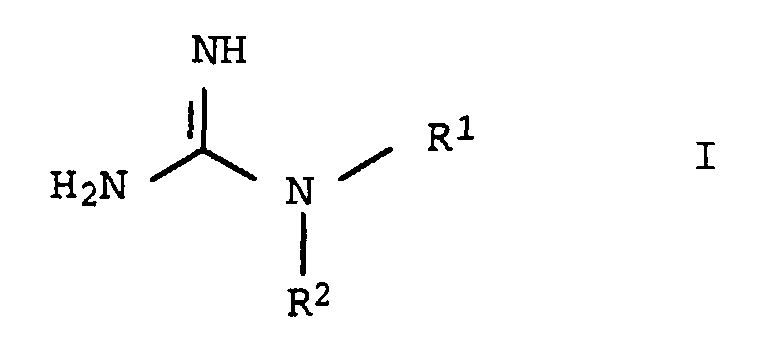
der Formel I,
Description
Die Erfindung betrifft ein Verfahren zur Herstellung von substituierten Guanidinderivaten durch Umsetzung von Haloformamidiniumsalzen mit primären oder sekundären Aminen.The invention relates to a process for the preparation of substituted Guanidine derivatives by reacting haloformamidinium salts with primary or secondary amines.
Substituierte Guanidiniumverbindungen sind in der Natur weit verbreitet. Wichtige Vertreter dieser Substanzklasse sind beispielsweise Aminosäuren, wie Arginin und Kreatin. Darüberhinaus sind substituierte Guanidinderivate als sterisch gehinderte Basen, als Biozide sowie als Komplexliganden bekannt. Die Mehrzahl der Verbindungen dieses Typs sind aufgrund der hohen Herstellkosten in ihrer technischen Anwendbarkeit jedoch stark eingeschränkt.Substituted guanidinium compounds are widely used in nature. Important representatives of this class of substances are, for example Amino acids such as arginine and creatine. Beyond that substituted guanidine derivatives as sterically hindered bases, known as biocides and complex ligands. The majority of Connections of this type are due to the high manufacturing costs however, their technical applicability is severely limited.
Ein Beispiel für ein biologisch aktives Guanidinderivat ist Kreatin, das als "Energieträger der Zelle" zur Nahrungsergänzung im Food und Pharmabereich eingesetzt wird.An example of a biologically active guanidine derivative is Creatine, the "energy carrier of the cell" for food supplements is used in the food and pharmaceutical sector.
Die Herstellung von Kreatin wird z.B. in EP-A-0 754 679 und der dort zitierten weiterführenden Literatur beschrieben, wobei maximale Ausbeuten von lediglich 70% erzielt werden. Ein Nachteil dieser Synthese für Guanidiniumverbindungen ist, daß in allen Fällen wässrige Lösungen von reinem Cyanamid eingesetzt werden. Diese Lösung ist jedoch sehr teuer und aufgrund der Instabilität des Cyanamids im allgemeinen nicht breit verfügbar.The production of creatine is e.g. in EP-A-0 754 679 and the further literature cited there, where maximum yields of only 70% can be achieved. A disadvantage this synthesis for guanidinium compounds is that in all Cases aqueous solutions of pure cyanamide are used. However, this solution is very expensive and due to the instability of cyanamide is generally not widely available.
Alternative Synthesen von Guanidiniumslzen verlaufen unter Verwendung von O-Alkylisoharnstoffen bzw. O-Alkylisothioharnstoffen. So wird in JP 077364 eine Lösung von Na-Sarkosinat mit O-Methylisoharnstoff-Methylsulfat in Ausbeuten von 80% zum Kreatin umgesetzt. All diese Synthesen machen den Einsatz von Alkylierungsmitteln wie z.B. Dimethylsulfat erforderlich und sind aufgrund auftretender Mehrfachalkylierungen häufig nicht ausreichend selektiv.Alternative syntheses of guanidinium salts are taking place Use of O-alkylisoureas or O-alkylisothioureas. JP 077364 describes a solution of sodium sarcosinate with O-methylisourea methyl sulfate in yields of 80% Creatine implemented. All of these syntheses use Alkylating agents such as e.g. Dimethyl sulfate required and are often not due to multiple alkylations sufficiently selective.
Es bestand daher die Aufgabe, ein Verfahren zur Herstellung von substituierten Guanidiniumverbindungen bereitzustellen, das die oben genannten Nachteile nicht aufweist.It was therefore the task of a process for the production of to provide substituted guanidinium compounds which the does not have the disadvantages mentioned above.
Diese Aufgabe wurde gelöst durch ein Verfahren zur Herstellung
von substituierten Guanidinderivaten der Formel I,


- R1
- H,
C1-C20-Alkyl, C2-C10-Alkenyl, C3-C8-Cycloalkyl; - R2
- C1-C20-Alkyl, C2-C10-Alkenyl, C3-C8-Cycloalkyl, ―(C1-C20-Alkylen)―COOR3, ―(C1-C20-Alkylen)―CONR4R5, ―(C1-C20-Alkylen)―CN, ―(C1-C20-Alkylen)―SO2R6, ―[(CH2)m―X―]p―[(CH2)n―Y―]q―[(CH2)o]r―Z;
- m, n, o
- 0 bis 10;
- p, q, r
- 0 bis 50000;
- x
- O, NH;
- Y
- N―[(CH2)m―X―]p―[(CH2)n―Y―]q―[(CH2)o]r―Z;
- Z
- OH, NH2;
- R3
- H, C1-C20-Alkyl, C2-C10-Alkenyl, C3-C8-Cycloalkyl, C6-C18-Aryl,
Na, K, Li, Ca, Mg, N(R7)4; - R4 und R5
- unabhängig voneinander
H, C1-C20-Alkyl, C2-C10-Alkenyl, C3-C8-Cycloalkyl, C6-C18-Aryl; - R6
- OR8, N(R9)2;
- R7
- H, C1-C20-Alkyl;
- R8
- H, C1-C20-Alkyl, C2-C10-Alkenyl, C3-C8-Cycloalkyl, C6-C18-Aryl,
Na, K, Li, Ca, Mg, N(R7)4; - R9
- H, C1-C20-Alkyl, C2-C10-Alkenyl, C3-C8-Cycloalkyl, C6-C18-Aryl.
- R 1
- H,
C 1 -C 20 alkyl, C 2 -C 10 alkenyl, C 3 -C 8 cycloalkyl; - R 2
- C 1 -C 20 alkyl, C 2 -C 10 alkenyl, C 3 -C 8 cycloalkyl, - (C 1 -C 20 alkylene) ―COOR 3 , - (C 1 -C 20 alkylene) ―CONR 4 R 5 , - (C 1 -C 20 alkylene) ―CN, - (C 1 -C 20 alkylene) ―SO 2 R 6 , - [(CH 2 ) m ―X―] p - [(CH 2 ) n ―Y―] q - [(CH 2 ) o ] r ―Z;
- m, n, o
- 0 to 10;
- p, q, r
- 0 to 50,000;
- x
- O, NH;
- Y
- N - [(CH 2 ) m ―X―] p - [(CH 2 ) n ―Y―] q - [(CH 2 ) o ] r ―Z;
- Z.
- OH, NH 2 ;
- R 3
- H, C 1 -C 20 alkyl, C 2 -C 10 alkenyl, C 3 -C 8 cycloalkyl, C 6 -C 18 aryl,
Na, K, Li, Ca, Mg, N (R 7 ) 4 ; - R 4 and R 5
- independently of each other
H, C 1 -C 20 alkyl, C 2 -C 10 alkenyl, C 3 -C 8 cycloalkyl, C 6 -C 18 aryl; - R 6
- OR 8 , N (R 9 ) 2 ;
- R 7
- H, C 1 -C 20 alkyl;
- R 8
- H, C 1 -C 20 alkyl, C 2 -C 10 alkenyl, C 3 -C 8 cycloalkyl, C 6 -C 18 aryl,
Na, K, Li, Ca, Mg, N (R 7 ) 4 ; - R 9
- H, C 1 -C 20 alkyl, C 2 -C 10 alkenyl, C 3 -C 8 cycloalkyl, C 6 -C 18 aryl.
Das erfindungsgemäße Verfahren erfüllt insbesondere wirtschaftliche Randbedingungen, wie niedrige Einsatzstoffkosten, technisch einfache Durchführbarkeit, verbesserte Ausbeuten und hinreichende Reinheit des Produktes.The method according to the invention fulfills in particular economic Boundary conditions, such as low feedstock costs, technically simple feasibility, improved yields and sufficient Purity of the product.
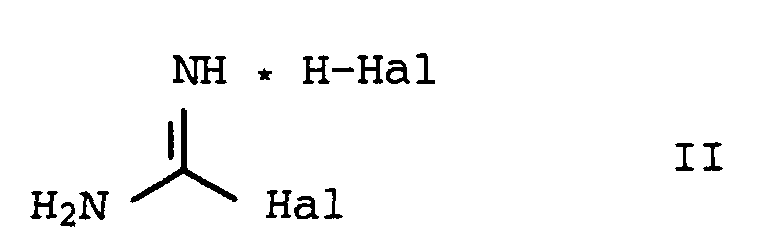
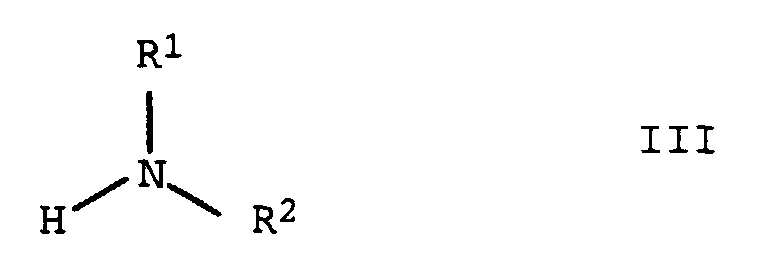
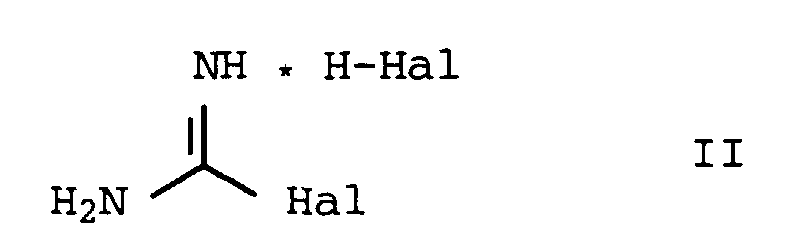
Geeignet sind für die Umsetzung mit Haloformamidiniumsalzen der Formel II prinzipiell alle beanspruchten Amine der Formel III. Dabei kann es sich sowohl um aliphatische oder cycloaliphatische primäre bzw. sekundäre Amine handeln, als auch um Aminocarbonsäuren und Aminosulfonsäuren und deren Derivate. Weiterhin lassen sich mit dem erfindungsgemäßen Verfahren auch primäre und sekundäre Amine umsetzen, die zusätzliche Amino- oder Iminogruppen enthalten, wie aminogruppenhaltige Oligomere bzw. Polymere.Are suitable for the reaction with haloformamidinium salts Formula II in principle all claimed amines of formula III. It can be aliphatic or cycloaliphatic act primary or secondary amines, as well as aminocarboxylic acids and aminosulfonic acids and their derivatives. Continue to leave primary and secondary with the inventive method Implement amines, the additional amino or imino groups contain, such as amino group-containing oligomers or polymers.
Als Alkylreste für R1 bis R5 sowie für R7 bis R9 seien verzweigte oder unverzweigte C1-C20-Alkylketten, bevorzugt Methyl, Ethyl, n-Propyl, 1-Methylethyl, n-Butyl, 1-Methylpropyl-, 2-Methylpropyl, 1,1-Dimethylethyl, n-Pentyl, 1-Methylbutyl, 2-Methylbutyl, 3-Methylbutyl, 2,2-Dimethylpropyl, 1-Ethylpropyl, n-Hexyl, 1,1-Dimethylpropyl, 1,2-Dimethylpropyl, 1-Methylpentyl, 2-Methylpentyl, 3-Methylpentyl, 4-Methylpentyl, 1,1-Dimethylbutyl, 1,2-Dimethylbutyl, 1,3-Dimethylbutyl, 2,2-Dimethylbutyl, 2,3-Dimethylbutyl, 3,3-Dimethylbutyl, 1-Ethylbutyl, 2-Ethylbutyl, 1,1,2-Trimethylpropyl, 1,2,2-Trimethylpropyl, 1-Ethyl-1-methylpropyl, 1-Ethyl-2-methylpropyl, n-Heptyl, n-Octyl, n-Nonyl, n-Decyl, n-Undecyl, n-Dodecyl, n-Tridecyl, n-Tetradecyl, n-Pentadecyl, n-Hexadecyl, n-Heptadecyl, n-Octadecyl, n-Nonadecyl oder n-Eicosyl genannt. As alkyl radicals for R 1 to R 5 and for R 7 to R 9 are branched or unbranched C 1 -C 20 alkyl chains, preferably methyl, ethyl, n-propyl, 1-methylethyl, n-butyl, 1-methylpropyl, 2 -Methylpropyl, 1,1-dimethylethyl, n-pentyl, 1-methylbutyl, 2-methylbutyl, 3-methylbutyl, 2,2-dimethylpropyl, 1-ethylpropyl, n-hexyl, 1,1-dimethylpropyl, 1,2-dimethylpropyl , 1-methylpentyl, 2-methylpentyl, 3-methylpentyl, 4-methylpentyl, 1,1-dimethylbutyl, 1,2-dimethylbutyl, 1,3-dimethylbutyl, 2,2-dimethylbutyl, 2,3-dimethylbutyl, 3,3 -Dimethylbutyl, 1-ethylbutyl, 2-ethylbutyl, 1,1,2-trimethylpropyl, 1,2,2-trimethylpropyl, 1-ethyl-1-methylpropyl, 1-ethyl-2-methylpropyl, n-heptyl, n-octyl , n-nonyl, n-decyl, n-undecyl, n-dodecyl, n-tridecyl, n-tetradecyl, n-pentadecyl, n-hexadecyl, n-heptadecyl, n-octadecyl, n-nonadecyl or n-eicosyl.
Als Alkenylreste für R1 bis R5 sowie für R8 und R9 seien verzweigte oder unverzweigte C2-C10-Alkenylketten, bevorzugt Vinyl, Propenyl, Isopropenyl, 1-Butenyl, 2-Butenyl, 1-Pentenyl, 2-Pentenyl, 2-Methyl-1-butenyl, 2-Methyl-2-butenyl, 3-Methyl-1-butenyl, 1-Hexenyl, 2-Hexenyl, 1-Heptenyl, 2-Heptenyl, 1-Octenyl oder 2-Octenyl genannt.As alkenyl radicals for R 1 to R 5 and for R 8 and R 9 are branched or unbranched C 2 -C 10 alkenyl chains, preferably vinyl, propenyl, isopropenyl, 1-butenyl, 2-butenyl, 1-pentenyl, 2-pentenyl, 2-methyl-1-butenyl, 2-methyl-2-butenyl, 3-methyl-1-butenyl, 1-hexenyl, 2-hexenyl, 1-heptenyl, 2-heptenyl, 1-octenyl or 2-octenyl.
Als Alkylenreste für R2 seien verzweigte oder unverzweigte C1-C20-Alkylenketten, bevorzugt Methylen, Ethylen, n-Propylen, 1-Methylethylen, n-Butylen, 1-Methylpropylen-, 2-Methylpropylen, 1,1-Dimethylethylen, n-Pentylen, 1-Methylbutylen, 2-Methylbutylen, 3-Methylbutylen, 2,2-Dimethylpropylen, 1-Ethylpropylen, n-Hexylen, 1,1-Dimethylpropylen, 1,2-Dimethylpropylen, 1-Methylpentylen, 2-Methylpentylen, 3-Methylpentylen, 4-Methylpentylen, 1,1-Dimethylbutylen, 1,2-Dimethylbutylen, 1,3-Dimethylbutylen, 2,2-Dimethylbutylen, 2,3-Dimethylbutylen, 3,3-Dimethylbutylen, 1-Ethylbutylen, 2-Ethylbutylen, 1,1,2-Trimethylpropylen, 1,2,2-Trimethylpropylen, 1-Ethyl-1-methylpropylen, 1-Ethyl-2-methylpropylen, n-Heptylen, n-Octylen, n-Nonylen, n-Decylen, n-Undecylen, n-Dodecylen, n-Tridecylen, n-Tetradecylen, n-Pentadecylen, n-Hexadecylen, n-Heptadecylen, n-Octadecylen, n-Nonadecylen oder n-Eicosylen genannt.As alkylene radicals for R 2 are branched or unbranched C 1 -C 20 alkylene chains, preferably methylene, ethylene, n-propylene, 1-methylethylene, n-butylene, 1-methylpropylene, 2-methylpropylene, 1,1-dimethylethylene, n -Pentylene, 1-methylbutylene, 2-methylbutylene, 3-methylbutylene, 2,2-dimethylpropylene, 1-ethylpropylene, n-hexylene, 1,1-dimethylpropylene, 1,2-dimethylpropylene, 1-methylpentylene, 2-methylpentylene, 3 -Methylpentylene, 4-methylpentylene, 1,1-dimethylbutylene, 1,2-dimethylbutylene, 1,3-dimethylbutylene, 2,2-dimethylbutylene, 2,3-dimethylbutylene, 3,3-dimethylbutylene, 1-ethylbutylene, 2-ethylbutylene , 1,1,2-trimethylpropylene, 1,2,2-trimethylpropylene, 1-ethyl-1-methylpropylene, 1-ethyl-2-methylpropylene, n-heptylene, n-octylene, n-nonylene, n-decylene, n -Undecylene, n-dodecylene, n-tridecylene, n-tetradecylene, n-pentadecylene, n-hexadecylene, n-heptadecylene, n-octadecylene, n-nonadecylene or n-eicosylene.
Die 1- bis 20-gliedrigen Alkylenketten können optional mit
folgenden Resten substituiert sein:
Als Cycloalkylreste seien für R1 bis R5 sowie für R8 und R9 verzweigte oder unverzweigte C3-C8-Cycloalkylketten, bevorzugt Cyclopropyl, Cyclobutyl, Cyclopentyl, Cyclohexyl, Cycloheptyl, 1-Methylcyclopropyl, 1-Ethylcyclopropyl, 1-Propylcyclopropyl, 1-Butylcyclopropyl, 1-Pentylcyclopropyl, 1-Methyl-1-Butylcyclopropyl, 1,2-Dimethylcyclypropyl, 1-Methyl-2-Ethylcyclopropyl oder Cyclooctyl genannt.Cycloalkyl radicals for R 1 to R 5 and for R 8 and R 9 are branched or unbranched C 3 -C 8 cycloalkyl chains, preferably cyclopropyl, cyclobutyl, cyclopentyl, cyclohexyl, cycloheptyl, 1-methylcyclopropyl, 1-ethylcyclopropyl, 1-propylcyclopropyl, 1-Butylcyclopropyl, 1-Pentylcyclopropyl, 1-Methyl-1-Butylcyclopropyl, 1,2-Dimethylcyclypropyl, 1-Methyl-2-Ethylcyclopropyl or Cyclooctyl called.
Die Cycloalkylreste können ggf. mit einem oder mehreren, z.B. 1 bis 3 Resten wie Halogen z.B. Fluor, Chlor oder Brom, Cyano, Nitro, Amino, C1-C4-Alkylamino, C1-C4-Dialkylamino, Hydroxy, C1-C4-Alkyl, C1-C4-Alkoxy oder anderen Resten substituiert sein oder 1 bis 3 Heteroatome wie Schwefel, Stickstoff, dessen freie Valenzen durch Wasserstoff oder C1-C4-Alkyl abgesättigt sein können oder Sauerstoff im Ring enthalten.The cycloalkyl radicals can optionally with one or more, for example 1 to 3 radicals such as halogen, for example fluorine, chlorine or bromine, cyano, nitro, amino, C 1 -C 4 -alkylamino, C 1 -C 4 -dialkylamino, hydroxy, C 1 -C 4 alkyl, C 1 -C 4 alkoxy or other radicals may be substituted or 1 to 3 heteroatoms such as sulfur, nitrogen, the free valences of which may be saturated by hydrogen or C 1 -C 4 alkyl or contain oxygen in the ring.
Als Alkoxyreste für R6 kommen bevorzugt solche mit 1 bis 20 C-Atomen, vorzugsweise mit 1 bis 12 C-Atomen, besonders bevorzugt 1 bis 8 C-Atomen in Betracht.Suitable alkoxy radicals for R 6 are preferably those having 1 to 20 C atoms, preferably having 1 to 12 C atoms, particularly preferably 1 to 8 C atoms.
Beispielsweise sind zu nennen:
- Methoxy-
- Ethoxy-
- Isopropoxy-
- n-Propoxy-
- 1-Methylpropoxy-
- n-Butoxy-
- n-Pentoxy-
- 2-Methylpropoxy-
- 3-Methylbutoxy-
- 1,1-Dimethylpropoxy-
- 2,2-Dimethylpropoxy-
- Hexoxy-
- 1-Methyl-1-ethylpropoxy-
- Heptoxy-
- Octoxy-
- 2-Ethylhexoxy-
- Methoxy
- Ethoxy
- Isopropoxy
- n-propoxy
- 1-methylpropoxy
- n-butoxy
- n-pentoxy
- 2-methylpropoxy
- 3-methylbutoxy
- 1,1-dimethylpropoxy
- 2,2-dimethylpropoxy
- Hexoxy
- 1-methyl-1-ethylpropoxy
- Heptoxy
- Octoxy
- 2-ethylhexoxy
Als mono- oder disubstituierte Aminoreste für R6 kommen bevorzugt solche in Betracht, die Alkylreste mit 1 bis 20, bevorzugt 1 bis 12 C-Atomen enthalten, wie z.B. Methyl-, n-Propyl-, n-Butyl-, 2-Methylpropyl-, 1,1-Dimethylpropyl-, Hexyl-, Heptyl-, 2-Ethylhexyl-, Isopropyl-, 1-Methylpropyl-, n-Pentyl-, 3-Methylbutyl-, 2,2-Dimethylpropyl-, 1-Methyl-1-ethylpropyl- und Octyl.Suitable mono- or disubstituted amino radicals for R 6 are preferably those which contain alkyl radicals having 1 to 20, preferably 1 to 12, carbon atoms, such as, for example, methyl, n-propyl, n-butyl, 2-methylpropyl , 1,1-dimethylpropyl, hexyl, heptyl, 2-ethylhexyl, isopropyl, 1-methylpropyl, n-pentyl, 3-methylbutyl, 2,2-dimethylpropyl, 1-methyl-1- ethyl propyl and octyl.
Als Tetraalkylammoniumreste für R3 und R8 kommen solche in Betracht, die Alkylreste mit 1 bis 20, bevorzugt 1 bis 12, besonders bevorzugt 1 bis 6 C-Atomen enthalten, wie z.B. Methyl-, n-Propyl-, Isopropyl-, 2-Methylpropyl-, 1,1-Dimethylpropyl-, 1-Methylpropyl-, 2,2-Dimethylpropyl-, 1-Methyl-1-ethylpropyl-, n-Butyl-, 3-Methylbutyl-, n-Pentyl- und Hexyl-.Suitable tetraalkylammonium radicals for R 3 and R 8 are those which contain alkyl radicals having 1 to 20, preferably 1 to 12, particularly preferably 1 to 6, carbon atoms, such as, for example, methyl, n-propyl, isopropyl, 2- Methylpropyl, 1,1-dimethylpropyl, 1-methylpropyl, 2,2-dimethylpropyl, 1-methyl-1-ethylpropyl, n-butyl, 3-methylbutyl, n-pentyl and hexyl.
Unter Aryl sind aromatische Ringe oder Ringsysteme mit 6 bis 18 Kohlenstoffatomen im Ringsystem zu verstehen, beispielsweise Phenyl oder Naphthyl, die ggf. mit einem oder mehreren Resten wie Halogen z.B. Fluor, Chlor oder Brom, Cyano, Nitro, Amino, C1-C4-Alkylamino, C1-C4-Dialkylamino, Hydroxy, C1-C4-Alkyl, C1-C4-Alkoxy oder anderen Resten substituiert sein können. Bevorzugt sind ggf. substituiertes Phenyl, Methoxyphenyl und Naphthyl.Aryl is to be understood as meaning aromatic rings or ring systems with 6 to 18 carbon atoms in the ring system, for example phenyl or naphthyl, which may optionally contain one or more radicals such as halogen, for example fluorine, chlorine or bromine, cyano, nitro, amino, C 1 -C 4 Alkylamino, C 1 -C 4 -dialkylamino, hydroxy, C 1 -C 4 -alkyl, C 1 -C 4 -alkoxy or other radicals can be substituted. Optionally substituted phenyl, methoxyphenyl and naphthyl are preferred.
Als bevorzugt verwendete Amine sind alle die in Wasser oder in, mit Wasser mischbaren Lösungsmitteln löslichen, primären und sekundären Amine genannt. Bevorzugte Vertreter unter den einfachen Aminen sind u.a. Methylamin, Ethylamin, n-Propylamin, 2-Propylamin, Butylamin, Isobutylamin, Anilin, Benzylamin und Anthranilsäure. Weitere bevorzugt eingesetzte Aminogruppenhaltige Verbindungen sind u.a. Taurin und Aminocarbonsäuren wie Glycin, Alanin, Valin, Prolin, Leucin, Phenylalanin, Lysin, Methionin Cystein, Asparaginsäure, Iminodiessigsäure, Sarkosin sowie deren Ester, Amide und Nitrile und deren Salze.Amines used as preferred are all those in water or in, water-miscible, soluble, primary and called secondary amines. Preferred representatives among the simple Amines include Methylamine, ethylamine, n-propylamine, 2-propylamine, butylamine, isobutylamine, aniline, benzylamine and Anthranilic acid. Further amino groups preferably used Connections include Taurine and aminocarboxylic acids such as glycine, Alanine, valine, proline, leucine, phenylalanine, lysine, methionine Cysteine, aspartic acid, iminodiacetic acid, sarcosine and their Esters, amides and nitriles and their salts.
Ganz besonders bevorzugte Verbindung der Formel III ist Sarkosin, das sowohl als freie Säure als auch insbesondere als Na- oder K-Salz in Form einer 5 bis 60 Gew.-%igen, bevorzugt 35 bis 45 Gew.-%igen wäßrigen Lösung verwendet werden kann.A very particularly preferred compound of the formula III is sarcosine, that both as a free acid and in particular as Na or K salt in the form of a 5 to 60% by weight, preferably 35 to 45 wt .-% aqueous solution can be used.
In dem erfindungsgemßen Verfahren können auch wasserlösliche, Aminogruppen enthaltende Oligomere und Polymere eingesetzt werden, wie Alkylendiamine, Dialkylentriamine bis hin zu Polyalkylenpolyamine oder Polyetherdiamine. Bevorzugte Vertreter dieser Gruppe sind Ethylendiamin, Propylendiamin, Butylendiamin, Hexamethylendiamin, Diethylentriamin, Triethylentetramin, Tetraethylenpentamin, Pentaethylenhexamin, Hexaethylenheptamin sowie verzweite oder lineare Polyalkylenpolyamine.In the process according to the invention, water-soluble, Oligomers and polymers containing amino groups are used such as alkylenediamines, dialkylenetriamines and polyalkylenepolyamines or polyether diamines. Preferred representatives in this group are ethylenediamine, propylenediamine, butylenediamine, Hexamethylene diamine, diethylene triamine, triethylene tetramine, tetraethylene pentamine, Pentaethylene hexamine, hexaethylene heptamine as well dilated or linear polyalkylene polyamines.
Von den Polyalkylenpolyaminen kommen vorzugsweise Polyethylenimine in Betracht, die beispielsweise Molmassen von 200 bis 10 Millionen, vorzugsweise 1000 bis 3 Millionen haben. Besonders bevorzugt werden Polyethylenimine mit Molmassen von 2000 bis 1300000 eingesetzt.Of the polyalkylene polyamines, there are preferably polyethyleneimines considered, for example, molecular weights from 200 to Have 10 million, preferably 1000 to 3 million. Especially preferred are polyethyleneimines with molecular weights from 2000 to 1300000 used.
Die Polyetherdiamine werden beispielsweise durch Umsetzung von Polyalkylenglykolen mit Ammoniak hergestellt. Die Polyalkylenglykole können 2 bis 50, vorzugsweise 2 bis 40 Alkylenoxideinheiten enthalten. Hierbei kann es sich beispielsweise um Polyethylenglykole, Polypropylenglykole, Polybutylenglykole oder auch um Blockcopolymerisate aus Ethylenglykol und Propylenglykol, Blockcopolymerisate aus Ethylenglykol und Butylenglykol oder um Blockcopolymerisate aus Ethylenglykol, Propylenglykol und Butylenglykol handeln. Außer den Blockcopolymerisaten eignen sich zur Herstellung der Polyetherdiamine statistisch aufgebaute Copolymerisate aus Ethylenoxid und Propylenoxid und gegebenenfalls Butylenoxid. Polyetherdiamine leiten sich außerdem von Polytetrahydrofuranen ab, die 2 bis 75 Tetrahydrofuraneinheiten aufweisen. Die Polytetrahydrofurane werden ebenfalls durch Umsetzung mit Ammoniak in die entsprechenden α,ω-Polyetherdiamine überführt. Vorzugsweise verwendet man zur Herstellung der Polyetherdiamine Polyethylenglykole oder Blockcopolymerisate aus Ethylenglykol und Propylenglykol.The polyether diamines are, for example, by reacting Polyalkylene glycols made with ammonia. The polyalkylene glycols can be 2 to 50, preferably 2 to 40 alkylene oxide units contain. This can be, for example, polyethylene glycols, Polypropylene glycols, polybutylene glycols or also block copolymers of ethylene glycol and propylene glycol, Block copolymers of ethylene glycol and butylene glycol or to block copolymers of ethylene glycol, propylene glycol and Act butylene glycol. In addition to the block copolymers built up statistically for the production of the polyether diamines Copolymers of ethylene oxide and propylene oxide and optionally Butylene oxide. Polyether diamines are also derived from Polytetrahydrofurans from 2 to 75 tetrahydrofuran units exhibit. The polytetrahydrofurans are also converted with ammonia in the corresponding α, ω-polyether diamines transferred. Preferably used for the preparation of the polyether diamines Polyethylene glycols or block copolymers Ethylene glycol and propylene glycol.
Weitere geeignete Aminogruppen enthaltende wasserlösliche Polymere sind Polyvinylamine, die erhältlich sind durch Homo- und/oder Copolymerisation von N-Vinylformamid und anschließende Hydrolyse der Polymerisate sowie Vinylamineinheiten enthaltenden Polymeren. Stoffe dieser Art sind bekannt, vgl. EP-B-0 071 050 und EP-B-0 216 387. Bevorzugt in Betracht kommende Polymerisate sind hydrolysierte Homopolymerisate des N-Vinylformamid mit einem Hydrolysegrad von 1 bis 100, vorzugsweise 80 bis 100 % und partiell oder vollständig hydrolysierte Copolymerisate aus N-Vinylformamid und Vinylformiat oder Vinylacetat. Das in die Copolymerisate einpolymerisierte N-Vinylformamid ist vorzugsweise zu 80 bis 100 % hydrolysiert. Je nach Hydrolysebedingungen können die einpolymerisierten Monomeren wie Vinylformiat oder Vinylacetat ganz oder vollständig zu Vinylalkohol-Einheiten hydrolysiert sein. Weitere Comonomere, die für die Herstellung von hydrolysierten Copolymerisaten des N-Vinylformamids in Betracht kommen, sind monoethylenisch ungesättigte Carbonsäuren wie Acrylsäure, Methacrylsäure oder Maleinsäure, N-Vinylpyrrolidon und Acrylnitril.Other suitable amino-containing water-soluble polymers are polyvinylamines which are obtainable by homo- and / or Copolymerization of N-vinylformamide and subsequent Hydrolysis of the polymers and vinylamine units containing Polymers. Substances of this type are known, cf. EP-B-0 071 050 and EP-B-0 216 387. Preferred polymers are hydrolyzed homopolymers of N-vinylformamide with a Degree of hydrolysis from 1 to 100, preferably 80 to 100% and partial or fully hydrolyzed copolymers of N-vinylformamide and vinyl formate or vinyl acetate. That in the copolymers polymerized N-vinylformamide is preferably 80 up to 100% hydrolyzed. Depending on the hydrolysis conditions, the polymerized monomers such as vinyl formate or vinyl acetate fully or completely hydrolyzed to vinyl alcohol units be. Other comonomers used for the production of hydrolyzed Copolymers of N-vinylformamide are suitable, are monoethylenically unsaturated carboxylic acids such as acrylic acid, Methacrylic acid or maleic acid, N-vinylpyrrolidone and acrylonitrile.
Weitere Aminogruppen enthaltende wasserlösliche Polymere sind Polyallylamine. Diese Polymeren enthalten mindestens 3 Allylamin-Einheiten einpolymerisiert und haben Molmassen bis zu 10 Millionen.Further water-soluble polymers containing amino groups are Polyallylamine. These polymers contain at least 3 allylamine units polymerized and have molecular weights up to 10 million.
Die für die Synthese von substituierten Guanidiniumverbindungen verwendeten Haloformamidiniumsalze sind in reiner Form stabile Verbindungen. Dies gilt insbesondere für das bevorzugt verwendete Chlorformamidin Hydrochlorid, das sowohl gemäß J. Am. Chem. Soc. 1992, 114, 9386-9390 aus reinem Cyanamid durch Umsetzung mit Chlorwasserstoff als auch durch Umsetzung des sehr billigen und wohlfeilen Calciumcyanamids (Kalkstickstoff) mit Salzsäure, gemäß US 2,727,922 beschrieben, gewonnen werden kann.The for the synthesis of substituted guanidinium compounds Haloformamidinium salts used are stable in pure form Links. This applies in particular to what is preferably used Chlorformamidine hydrochloride, which according to J. Am. Chem. Soc. 1992, 114, 9386-9390 from pure cyanamide by reaction with Hydrogen chloride as well by implementing the very cheap and cheap calcium cyanamide (calcium cyanamide) with hydrochloric acid, according to US 2,727,922 described, can be obtained.
Gemäß US 2,727,922 kann zur Herstellung des Chlorformamidiniumchlorids anstelle des teuren Cyanamids sehr billiger und breit verfügbarer Kalkstickstoff eingesetzt werden. Unter Kalkstickstoff versteht man Produkte, die z.B. bei der Umsetzung von CaC mit N2 bei sehr hohen Temperaturen von 800 bis 1100°C entstehen. Sie enthalten in der Regel 5 bis 98 Gew.-%, bevorzugt 20 bis 95 Gew.-%, besonders bevorzugt 30 bis 90 Gew.-% Calciumcyanamid. Der technisch erhältliche graue bis schwarze Kalkstickstoff enthält neben Calciumcyanamid je nach Reinheitsgrad noch Verunreinigungen wie z.B. Kohlenstoff, Ca-Carbid, CaO sowie Spuren von Metallen, üblicherweise in Anteilen < 1%. Es kann selbstverständlich auch reines Ca-Cyanamid umgesetzt werden, besonders vorteilhaft, weil wesentlich wirtschaftlicher, ist aber der Einsatz von technischem Kalkstickstoff. Dieser wird vorzugsweise in einer Korngrößenverteilung von 1 bis 100 µm, vorzugsweise 20 bis 80 µm eingesetzt. Es kann aber auch gekörntes, gestrangtes oder anderweitig verdichtetes Material verwendet werden.According to US Pat. No. 2,727,922, very cheap and widely available calcium cyanamide can be used to produce the chloroformamidinium chloride instead of the expensive cyanamide. Lime nitrogen is understood to mean products that arise, for example, from the reaction of CaC with N 2 at very high temperatures of 800 to 1100 ° C. They generally contain 5 to 98% by weight, preferably 20 to 95% by weight, particularly preferably 30 to 90% by weight, of calcium cyanamide. The technically available gray to black calcium cyanamide contains, in addition to calcium cyanamide, depending on the degree of purity, impurities such as carbon, Ca carbide, CaO and traces of metals, usually in amounts <1%. It is of course also possible to convert pure Ca-cyanamide, which is particularly advantageous because it is considerably more economical, but the use of technical calcium cyanamide is. This is preferably used in a grain size distribution of 1 to 100 μm, preferably 20 to 80 μm. However, granular, extruded or otherwise compacted material can also be used.
Ein besonderer Vorteil des Verfahrens besteht darin, daß das in wäßriger Synthese aus Salzsäure und Kalkstickstoff entstandene Chlorformamidiniumchlorid nach Antrennung des gebildeten Kohlenstoffs sowie der unlöslichen anorganischen Salze, ohne weitere Aufreinigung direkt weiter zur entsprechenden Guanidiniumverbindung umgesetzt werden kann.A particular advantage of the method is that the aqueous synthesis of hydrochloric acid and calcium cyanamide Chlorformamidinium chloride after separation of the carbon formed as well as the insoluble inorganic salts, without further Purification directly to the corresponding guanidinium compound can be implemented.
Verwendet man an dieser Stelle statt Salzsäure Bromwasserstoffsäure oder Jodwasserstoffsäure, so erhält man die entsprechenden Brom- bzw. Jodformamidiniumsalze.At this point, hydrobromic acid is used instead of hydrochloric acid or hydroiodic acid, so you get the corresponding Bromine or iodoformamidinium salts.
Die Synthese erfolgt in der Art und Weise, daß man Kalkstickstoff zu 1 bis 6, bevorzugt 2 bis 4 Äquivalenten Säure zudosiert. Insbesondere können auch Gemische von Mineralsäuren, wie z.B. Salzsäure/Schwefelsäure oder Salzsäure/Phosphorsäure in einem Verhältnis von 20/1 bis 5/1, insbesondere 15/1 bis 8/1 verwendet werden. Diese Gemische haben den Vorteil, daß in der Reaktionsmischung vorliegende Schwermetalle gleichzeitig ausgefällt werden.The synthesis takes place in such a way that lime nitrogen 1 to 6, preferably 2 to 4 equivalents of acid are metered in. Especially mixtures of mineral acids, e.g. Hydrochloric acid / sulfuric acid or hydrochloric acid / phosphoric acid in a ratio from 20/1 to 5/1, in particular 15/1 to 8/1 used become. These mixtures have the advantage that in the reaction mixture existing heavy metals precipitated at the same time become.
Darüberhinaus kann es vorteilhaft sein, Komplexbildner wie Aminopolycarboxylate, beispielsweise EDTA oder Aminopolyphosphonate sowie zur Entfernung geruchsbildender Nebenprodukte Oxidationsmittel, beispielsweise H2O2 einzusetzen. Auf diese Weise wird die Reinheit des Produktes verbessert, ohne daß es zu Ausbeuteverlusten kommt.In addition, it can be advantageous to use complexing agents such as aminopolycarboxylates, for example EDTA or aminopolyphosphonates, as well as oxidizing agents, for example H 2 O 2 , to remove odor-forming by-products. In this way, the purity of the product is improved without loss of yield.
Die Reinheit des gebildeten Haloformamidiniumsalzes läßt sich außerdem erhöhen, indem man die Durchführung der Reaktion unter vermindertem Druck, bevorzugt bei 100 bis 900 mbar, durchführt, um so leichtflüchtige Nebenprodukte, insbesondere leichtflüchtige Schwefelverbindungen abzutrennen.The purity of the haloformamidinium salt formed can be further increase by performing the reaction below reduced pressure, preferably at 100 to 900 mbar, the more volatile by-products, especially volatile ones To separate sulfur compounds.
Die Zugabe von Kalkstickstoff erfolgt üblicherweise in gleichmäßigen Portionen über einen Zeitraum von 0,5 bis 10 Std., insbesondere von 2 bis 5 Std., so daß die gewünschte Reaktionstemperatur durch Kühlung gehalten werden kann. Übliche Reaktionstemperaturen liegen im Bereich zwischen -10 und 100°C, insbesondere zwischen 0 und 40°C.The addition of calcium cyanamide is usually done evenly Servings over a period of 0.5 to 10 hours, in particular from 2 to 5 hours so that the desired reaction temperature can be kept by cooling. Usual reaction temperatures are in the range between -10 and 100 ° C, in particular between 0 and 40 ° C.
Nach Beendigung der Reaktion kann das gebildete Haloformamidiniumsalz nach Abtrennung anfallender anorganischer Nebenprodukte, wie z.B. CaSO4, CaCl2, CaPO4 und Kohlenstoff direkt ohne weitere Aufreinigungsschritte mit primären oder sekundären Aminen der allgemeinen Formel III zu den entsprechenden Guanidiniumsalzen umgesetzt werden.After the reaction has ended, the haloformamidinium salt formed can be reacted with primary or secondary amines of the general formula III to give the corresponding guanidinium salts, without further purification steps, after any inorganic by-products such as CaSO 4 , CaCl 2 , CaPO 4 and carbon have been separated off.
Die weitere Umsetzung des Haloformamidiniumsalzes mit primären oder sekundären Aminen kann in Wasser oder einem mit Wasser mischbaren Lösungsmittel oder einem Gemisch davon durchgeführt werden. Die Reaktion erfolgt in der Regel bei einem pH-Wert im Bereich des pK-Wertes des Amins, d.h. in einem Bereich zwischen pH 6 und 14, bevorzugt zwischen 8 und 12.The further implementation of the haloformamidinium salt with primary or secondary amines can be in water or with water miscible solvent or a mixture thereof become. The reaction usually takes place at a pH in the Range of the pK value of the amine, i.e. in a range between pH 6 and 14, preferably between 8 and 12.
Zur Einhaltung des pH-Wertes können u.a. Basen wie NaOH, KOH, LiOH, Ca(OH)2, Ba(OH)2, Mg(OH)2 oder Na2CO3 verwendet werden.Bases such as NaOH, KOH, LiOH, Ca (OH) 2 , Ba (OH) 2 , Mg (OH) 2 or Na 2 CO 3 can be used to maintain the pH.
Die Reaktionstemperaturen liegen im Bereich zwischen 0 und 100°C, bevorzugt zwischen 10 und 80°C, besonders bevorzugt zwischen 20 und 70°C.The reaction temperatures range between 0 and 100 ° C, preferably between 10 and 80 ° C, particularly preferably between 20 and 70 ° C.
Die Zugabe der Reaktionspartner kann in beliebiger Reihenfolge erfolgen. Eine bevorzugte Ausführungsform ist die, bei der das Haloformamidiniumsalz, insbesondere Chlorformamidiniumchlorid, zu einer Lösung des primären oder sekundären Amins zugetropft wird.The addition of the reactants can be in any order respectively. A preferred embodiment is that in which the Haloformamidinium salt, in particular chloroformamidinium chloride is added dropwise to a solution of the primary or secondary amine.
Die Zugabe kann sich über einen Zeitraum von 0,5 bis 10 Std., bevorzugt 0,5 bis 6 Std., besonders bevorzugt 1 bis 3 Std. erstrecken. Nach der Dosierung wird in der Regel 0,5 bis 10 Std., bevorzugt 1 bis 3 Std. nachgerührt.The addition can take place over a period of 0.5 to 10 hours. preferably 0.5 to 6 hours, particularly preferably 1 to 3 hours. After dosing, usually 0.5 to 10 hours. preferably stirred for 1 to 3 hours.
Eventuell ausgefallene anorganische Nebenprodukte werden bei Temperaturen von 20 bis 100°C, insbesondere von 50 bis 90°C abgetrennt.Possibly failed inorganic by-products are used in Temperatures of 20 to 100 ° C, in particular from 50 to 90 ° C separated.
Das Molverhältnis von Haloformamidiniumsalz zu primarem oder sekundärem Amin liegt im Bereich von 0,9 bis 5,0, vorzugswiese 1,0 bis 2,0.The molar ratio of haloformamidinium salt to primary or secondary amine is in the range of 0.9 to 5.0, preferably meadow 1.0 to 2.0.
Besonders hohe Umsätze können erzielt werden, wenn man beispielsweise das billige, technische Chloformamidiniumchlorid im Überschuß zum verwendeten Amin einsetzt, was im Falle von reinem Cyanamid oder reinem Chlorformamidiniumchlorid häufig unwirtschaftlich ist.Particularly high sales can be achieved if, for example the cheap, technical chloroformamidinium chloride in excess to the amine used, which in the case of pure Cyanamide or pure chloroformamidinium chloride is often uneconomical is.
Ein besonderer Vorteil des Verfahrens ist es, daß aufgrund entfallender Reinigungsschritte die Ausbeuten an Guanidiniumsalzen, bei Einsatz von rohem Haloformamidiniumsalz höher liegt als bei der Herstellung und weiteren Umsetzung von reinem Haloformamidiniumsalzen. Außerdem gestaltet sich das erfindungsgemäße Verfahren aufgrund der geringeren Anzahl an Verfahrensschritten technisch einfacher.A particular advantage of the method is that due to the omission Purification steps the yields of guanidinium salts, when using raw haloformamidinium salt is higher than in the production and further implementation of pure haloformamidinium salts. The method according to the invention is also designed due to the lower number of process steps technically easier.
Die mit dem erfindungsgemäßen Verfahren erzielte Reinheit des isolierten Guanidiniumsalzes ist mit der aus reinen Ausgangsstoffen hergestelltem Material vergleichbar. Dies ist insbesondere auf die hohe Reinheit des technischen Haloformamidiniumsalzes zurückzuführen.The purity of the obtained with the inventive method isolated guanidinium salt is made with pure starting materials manufactured material comparable. This is particularly so the high purity of the technical haloformamidinium salt attributed.
Die gebildeten substituierten Guanidiniumverbindungen lassen sich in der Regel in an sich bekannter Weise isolieren. Im Falle von nach der Umsetzung bereits gebildeten kristallinen Endprodukten kann die Isolierung durch einfaches Filtrieren, Waschen und ggf. Umkristallisieren erfolgen. Bei nicht kristallin anfallenden Endprodukten kann z.B. durch Extraktion mit organischen Lösungsmitteln im stark basischen pH-Bereich und anschließender Kristallisation oder gegebenenfalls Destillation das Wertprodukt isoliert werden.The substituted guanidinium compounds formed can be usually isolate in a manner known per se. In case of after the implementation of crystalline end products already formed the insulation can be easily filtered, washed and, if necessary, Recrystallize. For non-crystalline end products can e.g. by extraction with organic solvents in the strongly basic pH range and subsequent crystallization or optionally distillation, the product of value is isolated become.
In den folgenden Beispielen wird das Verfahren zur Herstellung substituierter Guanidiniumderivate näher erläutert.The following examples illustrate the process for making substituted guanidinium derivatives explained in more detail.
50 g Kalkstickstoff mit einem CaCN2-Gehalt von 43 Gew.-% wurden innerhalb von 2 Std. unter Eiskühlung zu einem Gemisch aus 300 g 20 Gew.-%iger wässriger Salzsäure und 1 g 85 Gew.-%iger Phosphorsäure gegeben. Die Reaktionstemperatur wurde zwischen 5 und 10°C gehalten. Während der Zugabe von Kalkstickstoff wurde das Reaktionsgemisch gleichzeitig mit 50 l/Std. Luft begast. Im Anschluß an die Zugabe von Kalkstickstoff wurde die Suspension 5 Std. bei 5 bis 10°C nachgerührt und filtriert. Der Filterrückstand wurde mit insgesamt 150 ml Wasser gewaschen. Das vereinigte Waschwasser mit Mutterlauge zeigte einen Gehalt von 26,8 g Chlorformamidiniumchlorid (nach HPLC), entsprechend 89% Ausbeute. 50 g of calcium cyanamide with a CaCN 2 content of 43% by weight were added to a mixture of 300 g of 20% by weight aqueous hydrochloric acid and 1 g of 85% by weight phosphoric acid within 2 hours while cooling with ice. The reaction temperature was kept between 5 and 10 ° C. During the addition of lime nitrogen, the reaction mixture was simultaneously at 50 l / h. Air fumigated. Following the addition of calcium cyanamide, the suspension was stirred for 5 hours at 5 to 10 ° C. and filtered. The filter residue was washed with a total of 150 ml of water. The combined washing water with mother liquor showed a content of 26.8 g chloroformamidinium chloride (according to HPLC), corresponding to 89% yield.
Die in Stufe 1 erhaltene wäßrige Lösung wurde innerhalb von 3 Std. bei 20 bis 30°C zu einer Mischung aus 55,4 g einer 40 Gew.-%igen wäßrigen Na-Sarkosinatlösung und 16 g 50 %iger Schwefelsäure getropft. Der pH-Wert der Reaktionslösung wurde mittels 50%iger NaOH bei 10 gehalten. Nach erfolgter Zugabe wurde 5 Std. bei Raumtemperatur nachgerührt, anschließend bei 60°C filtriert und das Filtrat bei max. 60°C im Vakuum auf ca. 50 bis 60% der Gesamtmasse eingeengt. Der nach dem Abkühlen ausgefallene Niederschlag wurde abfiltriert, mit 3 x 20 ml kaltem Wasser gewaschen und getrocknet. Man erhielt 22,6 g Kreatinmonohydrat mit einer Reinheit > 99%.The aqueous solution obtained in stage 1 was within 3 hours at 20 to 30 ° C to a mixture of 55.4 g of a 40% by weight aqueous sodium sarcosinate solution and 16 g 50% strength Dropped sulfuric acid. The pH of the reaction solution was kept at 10 using 50% NaOH. After the addition was complete Stirred for 5 hours at room temperature, then at 60 ° C filtered and the filtrate at max. 60 ° C in a vacuum to approx. 50 to 60% of the total mass is concentrated. The one that failed after cooling Precipitate was filtered off with 3 x 20 ml of cold water washed and dried. 22.6 g of creatine monohydrate were obtained with a purity> 99%.
Claims (5)
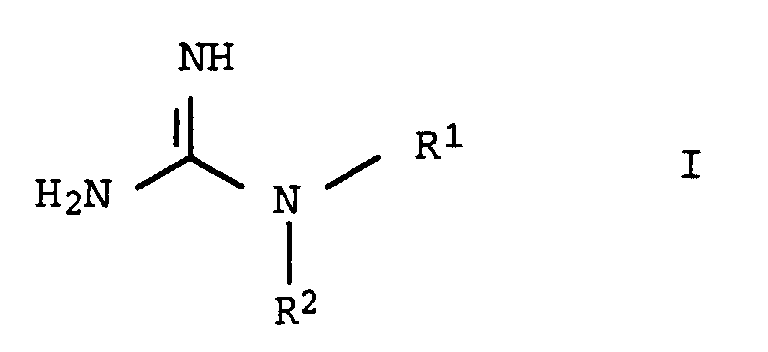
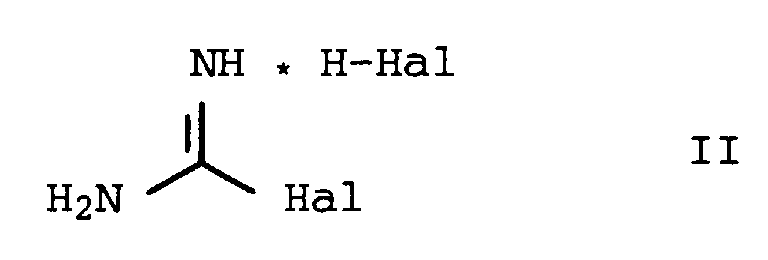

- R1
- H,
C1-C20-Alkyl, C2-C10-Alkenyl, C3-C8-Cycloalkyl; - R2
- C1-C20-Alkyl, C2-C10-Alkenyl, C3-C8-Cycloalkyl, ―(C1-C20-Alkylen)―COOR3, ―(C1-C20-Alkylen)―CONR4R5, ―(C1-C20-Alkylen)―CN, ―(C1-C20-Alkylen)―SO2R6, ―[(CH2)m―X―]p[(CH2)n―Y―]q―[(CH2)o]r―Z;
- m, n, o
- 0 bis 10;
- p, q, r
- 0 bis 50000;
- X
- O, NH;
- Y
- N―[(CH2)m―X―]p―[(CH2)n―Y―]q―[(CH2)o]r―Z;
- Z
- OH, NH2;
- R3
- H, C1-C20-Alkyl, C2-C10-Alkenyl, C3-C8-Cycloalkyl,
C6-C18-Aryl,
Na, K, Li, Ca, Mg, N(R7)4; - R4 und R5
- unabhängig voneinander
H, C1-C20-Alkyl, C2-C10-Alkenyl, C3-C8-Cycloalkyl, C6-C18-Aryl; - R6
- OR8, N(R9)2;
- R7
- H, C1-C20-Alkyl;
- R8
- H, C1-C20-Alkyl, C2-C10-Alkenyl, C3-C8-Cycloalkyl,
C6-C18-Aryl,
Na, K, Li, Ca, Mg, N(R7)4; - R9
- H, C1-C20-Alkyl, C2-C10-Alkenyl, C3-C8-Cycloalkyl, C6-C18-Aryl;
- R 1
- H,
C 1 -C 20 alkyl, C 2 -C 10 alkenyl, C 3 -C 8 cycloalkyl; - R 2
- C 1 -C 20 alkyl, C 2 -C 10 alkenyl, C 3 -C 8 cycloalkyl, - (C 1 -C 20 alkylene) ―COOR 3 , - (C 1 -C 20 alkylene) ―CONR 4 R 5 , - (C 1 -C 20 alkylene) ―CN, - (C 1 -C 20 alkylene) ―SO 2 R 6 , - [(CH 2 ) m ―X―] p [(CH 2 ) n ―Y―] q - [(CH 2 ) o ] r ―Z;
- m, n, o
- 0 to 10;
- p, q, r
- 0 to 50,000;
- X
- O, NH;
- Y
- N - [(CH 2 ) m ―X―] p - [(CH 2 ) n ―Y―] q - [(CH 2 ) o ] r ―Z;
- Z.
- OH, NH 2 ;
- R 3
- H, C 1 -C 20 alkyl, C 2 -C 10 alkenyl, C 3 -C 8 cycloalkyl, C 6 -C 18 aryl,
Na, K, Li, Ca, Mg, N (R 7 ) 4 ; - R 4 and R 5
- independently of each other
H, C 1 -C 20 alkyl, C 2 -C 10 alkenyl, C 3 -C 8 cycloalkyl, C 6 -C 18 aryl; - R 6
- OR 8 , N (R 9 ) 2 ;
- R 7
- H, C 1 -C 20 alkyl;
- R 8
- H, C 1 -C 20 alkyl, C 2 -C 10 alkenyl, C 3 -C 8 cycloalkyl, C 6 -C 18 aryl,
Na, K, Li, Ca, Mg, N (R 7 ) 4 ; - R 9
- H, C 1 -C 20 alkyl, C 2 -C 10 alkenyl, C 3 -C 8 cycloalkyl, C 6 -C 18 aryl;
Applications Claiming Priority (2)
| Application Number | Priority Date | Filing Date | Title |
|---|---|---|---|
| DE19748695A DE19748695A1 (en) | 1997-11-04 | 1997-11-04 | Process for the preparation of substituted guanidine derivatives |
| DE19748695 | 1997-11-04 |
Publications (3)
| Publication Number | Publication Date |
|---|---|
| EP0915084A2 true EP0915084A2 (en) | 1999-05-12 |
| EP0915084A3 EP0915084A3 (en) | 1999-12-08 |
| EP0915084B1 EP0915084B1 (en) | 2003-04-23 |
Family
ID=7847582
Family Applications (1)
| Application Number | Title | Priority Date | Filing Date |
|---|---|---|---|
| EP98119420A Expired - Lifetime EP0915084B1 (en) | 1997-11-04 | 1998-10-14 | Process for the preparation of creatine |
Country Status (6)
| Country | Link |
|---|---|
| US (1) | US5994582A (en) |
| EP (1) | EP0915084B1 (en) |
| JP (1) | JPH11222476A (en) |
| CN (1) | CN1077569C (en) |
| AT (1) | ATE238275T1 (en) |
| DE (2) | DE19748695A1 (en) |
Families Citing this family (7)
| Publication number | Priority date | Publication date | Assignee | Title |
|---|---|---|---|---|
| GB2379217B (en) * | 2001-08-31 | 2004-11-10 | Chordip Ltd | Halogen exchange reactions and catalysts therefor |
| US20050222064A1 (en) * | 2002-02-20 | 2005-10-06 | Sirna Therapeutics, Inc. | Polycationic compositions for cellular delivery of polynucleotides |
| US8288504B2 (en) * | 2010-03-10 | 2012-10-16 | Ppg Industries Ohio, Inc. | Method of making a cyclic guanidine from dicyandiamide and coating compositions containing same |
| JP2013010735A (en) * | 2011-05-31 | 2013-01-17 | Shikoku Chem Corp | 1, 2, 4-triazole compound and method for synthesizing guanidine derivative |
| CN102649772A (en) * | 2012-04-19 | 2012-08-29 | 宁夏兴平精细化工股份有限公司 | Artificially-synthesized taurocyamine and synthetic method thereof |
| CN106543041A (en) * | 2016-05-22 | 2017-03-29 | 上海清松制药有限公司 | A kind of synthetic method of p -guanidinobenzoic acid hydrochlorate |
| CN106831495A (en) * | 2016-12-28 | 2017-06-13 | 安徽省虹升生物股份有限公司 | A kind of chemical industry synthesis method of creatine monohydrate |
Family Cites Families (8)
| Publication number | Priority date | Publication date | Assignee | Title |
|---|---|---|---|---|
| US2727922A (en) * | 1953-03-25 | 1955-12-20 | American Cyanamid Co | Halo-formamidine salts and method of preparation |
| US3551489A (en) * | 1968-01-16 | 1970-12-29 | American Cyanamid Co | Aqueous process for preparing pseudoureas and acid salts thereof |
| JPS5377364A (en) * | 1976-12-21 | 1978-07-08 | Nec Corp | Microwave heating device |
| JPS5825662B2 (en) * | 1979-05-14 | 1983-05-28 | 株式会社 パ−マケム・アジア | Production method of guanidinocaproic acid ester |
| DE3128478A1 (en) * | 1981-07-18 | 1983-02-03 | Basf Ag, 6700 Ludwigshafen | METHOD FOR PRODUCING LINEAR, BASIC POLYMERISATS |
| DE3213873A1 (en) * | 1982-04-15 | 1983-10-27 | Basf Ag, 6700 Ludwigshafen | Flocculant for sludge |
| DE3534273A1 (en) * | 1985-09-26 | 1987-04-02 | Basf Ag | METHOD FOR PRODUCING VINYLAMINE UNITS CONTAINING WATER-SOLUBLE COPOLYMERISATS AND THE USE THEREOF AS WET AND DRY-FASTENING AGENTS FOR PAPER |
| DE19526236A1 (en) * | 1995-07-18 | 1997-01-23 | Sueddeutsche Kalkstickstoff | Process for the production of creatine or creatine monohydrate |
-
1997
- 1997-11-04 DE DE19748695A patent/DE19748695A1/en not_active Withdrawn
-
1998
- 1998-10-14 EP EP98119420A patent/EP0915084B1/en not_active Expired - Lifetime
- 1998-10-14 AT AT98119420T patent/ATE238275T1/en not_active IP Right Cessation
- 1998-10-14 DE DE59808037T patent/DE59808037D1/en not_active Expired - Lifetime
- 1998-10-27 US US09/179,464 patent/US5994582A/en not_active Expired - Fee Related
- 1998-11-02 JP JP10312194A patent/JPH11222476A/en not_active Withdrawn
- 1998-11-04 CN CN98123749A patent/CN1077569C/en not_active Expired - Fee Related
Also Published As
| Publication number | Publication date |
|---|---|
| DE19748695A1 (en) | 1999-05-06 |
| CN1077569C (en) | 2002-01-09 |
| DE59808037D1 (en) | 2003-05-28 |
| US5994582A (en) | 1999-11-30 |
| ATE238275T1 (en) | 2003-05-15 |
| EP0915084B1 (en) | 2003-04-23 |
| CN1218037A (en) | 1999-06-02 |
| EP0915084A3 (en) | 1999-12-08 |
| JPH11222476A (en) | 1999-08-17 |
Similar Documents
| Publication | Publication Date | Title |
|---|---|---|
| EP2129651A2 (en) | Novel method for producing teta by means of eddn | |
| EP0915083A2 (en) | Process for the preparation of substituted guanidine derivatives | |
| DE19748695A1 (en) | Process for the preparation of substituted guanidine derivatives | |
| CN106432032A (en) | Preparation method of levetiracetam | |
| EP0752476A1 (en) | Process for the production of l-aspartic acid | |
| US5347034A (en) | Process for the production of poly(O-alkylurethanes) of the diphenyl methane series | |
| EP0915082B1 (en) | Process for the preparation of substituted guanidine derivatives | |
| CA1202328A (en) | Preparation of polyalkylene polyamines | |
| EP0915085A2 (en) | Process for the preparation of substituted guanidine derivatives | |
| US5081293A (en) | Process for preparing solid betaines | |
| EP1028106B1 (en) | Process for the preparation of guanidine derivatives | |
| CN112898204B (en) | Synthesis method of N-carbobenzoxy-L-histidine | |
| EP1004575B1 (en) | Process for the preparation of O-alkylisourea | |
| DE2216925A1 (en) | Pyrazine derivatives and processes for their preparation | |
| DE2127263A1 (en) | PROCESS FOR THE PRODUCTION OF AROMATIC POLYAMINES | |
| DE1805411C3 (en) | Process for the preparation of N- (w-aminoalkanoyl) -diamines | |
| DE2226588B2 (en) | Process for the preparation of N- (2-cyanoethyl) - or N, N-bis- (2-cyanoethyl) aminophenols | |
| DE69610680T2 (en) | COMMON CATIONIC SURFACE ACTIVE AGENTS OF THE TYPE N ALPHA N OMEGA TO (N ALPHA-ACYL-ARGININE) ALPHA, OMEGA-DIAMINOALKYL-DICHLORHYDRATE AS AN ANTIMICROBIAL AGENT | |
| JPH01132550A (en) | Production of alkyleneamines by vapor-phase reaction | |
| AT214440B (en) | Process for the preparation of 3-iminoisoindolin-1-ones | |
| DE69114955T2 (en) | Method of extracting an amino acid ester. | |
| DE4200137A1 (en) | New amino-propyl-sulphonyl:methyl- sulpho:methyl-pyrrolidinium betaine(s) - useful as intermediates, biocides, antistatic agents and surfactants | |
| DE2528731A1 (en) | PROCESS FOR THE PREPARATION OF N, N-DIALKYLXYLYLENEDIAMINES | |
| US20030120084A1 (en) | Method of producing amino carboxylic acids | |
| DEF0012877MA (en) |
Legal Events
| Date | Code | Title | Description |
|---|---|---|---|
| PUAI | Public reference made under article 153(3) epc to a published international application that has entered the european phase |
Free format text: ORIGINAL CODE: 0009012 |
|
| AK | Designated contracting states |
Kind code of ref document: A2 Designated state(s): AT CH DE FR GB IT LI NL |
|
| AX | Request for extension of the european patent |
Free format text: AL;LT;LV;MK;RO;SI |
|
| PUAL | Search report despatched |
Free format text: ORIGINAL CODE: 0009013 |
|
| RIC1 | Information provided on ipc code assigned before grant |
Free format text: 6C 07C 277/08 A, 6C 07C 275/70 B, 6C 07C 279/14 B |
|
| AK | Designated contracting states |
Kind code of ref document: A3 Designated state(s): AT BE CH CY DE DK ES FI FR GB GR IE IT LI LU MC NL PT SE |
|
| AX | Request for extension of the european patent |
Free format text: AL;LT;LV;MK;RO;SI |
|
| 17P | Request for examination filed |
Effective date: 19991104 |
|
| AKX | Designation fees paid |
Free format text: AT CH DE FR GB IT LI NL |
|
| 17Q | First examination report despatched |
Effective date: 20001116 |
|
| GRAH | Despatch of communication of intention to grant a patent |
Free format text: ORIGINAL CODE: EPIDOS IGRA |
|
| RTI1 | Title (correction) |
Free format text: PROCESS FOR THE PREPARATION OF CREATINE |
|
| GRAH | Despatch of communication of intention to grant a patent |
Free format text: ORIGINAL CODE: EPIDOS IGRA |
|
| GRAA | (expected) grant |
Free format text: ORIGINAL CODE: 0009210 |
|
| AK | Designated contracting states |
Designated state(s): AT CH DE FR GB IT LI NL |
|
| REG | Reference to a national code |
Ref country code: GB Ref legal event code: FG4D Free format text: NOT ENGLISH |
|
| REG | Reference to a national code |
Ref country code: CH Ref legal event code: EP |
|
| REF | Corresponds to: |
Ref document number: 59808037 Country of ref document: DE Date of ref document: 20030528 Kind code of ref document: P |
|
| GBT | Gb: translation of ep patent filed (gb section 77(6)(a)/1977) |
Effective date: 20031010 |
|
| ET | Fr: translation filed | ||
| PLBE | No opposition filed within time limit |
Free format text: ORIGINAL CODE: 0009261 |
|
| STAA | Information on the status of an ep patent application or granted ep patent |
Free format text: STATUS: NO OPPOSITION FILED WITHIN TIME LIMIT |
|
| 26N | No opposition filed |
Effective date: 20040126 |
|
| PGFP | Annual fee paid to national office [announced via postgrant information from national office to epo] |
Ref country code: NL Payment date: 20041003 Year of fee payment: 7 |
|
| PGFP | Annual fee paid to national office [announced via postgrant information from national office to epo] |
Ref country code: DE Payment date: 20041007 Year of fee payment: 7 |
|
| PGFP | Annual fee paid to national office [announced via postgrant information from national office to epo] |
Ref country code: FR Payment date: 20041008 Year of fee payment: 7 |
|
| PGFP | Annual fee paid to national office [announced via postgrant information from national office to epo] |
Ref country code: GB Payment date: 20041013 Year of fee payment: 7 Ref country code: AT Payment date: 20041013 Year of fee payment: 7 |
|
| PGFP | Annual fee paid to national office [announced via postgrant information from national office to epo] |
Ref country code: CH Payment date: 20041015 Year of fee payment: 7 |
|
| PG25 | Lapsed in a contracting state [announced via postgrant information from national office to epo] |
Ref country code: IT Free format text: LAPSE BECAUSE OF NON-PAYMENT OF DUE FEES;WARNING: LAPSES OF ITALIAN PATENTS WITH EFFECTIVE DATE BEFORE 2007 MAY HAVE OCCURRED AT ANY TIME BEFORE 2007. THE CORRECT EFFECTIVE DATE MAY BE DIFFERENT FROM THE ONE RECORDED. Effective date: 20051014 Ref country code: GB Free format text: LAPSE BECAUSE OF NON-PAYMENT OF DUE FEES Effective date: 20051014 Ref country code: AT Free format text: LAPSE BECAUSE OF NON-PAYMENT OF DUE FEES Effective date: 20051014 |
|
| PG25 | Lapsed in a contracting state [announced via postgrant information from national office to epo] |
Ref country code: LI Free format text: LAPSE BECAUSE OF NON-PAYMENT OF DUE FEES Effective date: 20051031 Ref country code: CH Free format text: LAPSE BECAUSE OF NON-PAYMENT OF DUE FEES Effective date: 20051031 |
|
| PG25 | Lapsed in a contracting state [announced via postgrant information from national office to epo] |
Ref country code: DE Free format text: LAPSE BECAUSE OF THE APPLICANT RENOUNCES Effective date: 20051203 |
|
| PG25 | Lapsed in a contracting state [announced via postgrant information from national office to epo] |
Ref country code: NL Free format text: LAPSE BECAUSE OF NON-PAYMENT OF DUE FEES Effective date: 20060501 |
|
| REG | Reference to a national code |
Ref country code: CH Ref legal event code: PL |
|
| GBPC | Gb: european patent ceased through non-payment of renewal fee |
Effective date: 20051014 |
|
| PG25 | Lapsed in a contracting state [announced via postgrant information from national office to epo] |
Ref country code: FR Free format text: LAPSE BECAUSE OF NON-PAYMENT OF DUE FEES Effective date: 20060630 |
|
| NLV4 | Nl: lapsed or anulled due to non-payment of the annual fee |
Effective date: 20060501 |
|
| REG | Reference to a national code |
Ref country code: FR Ref legal event code: ST Effective date: 20060630 |