EP0915425A2 - Arbitrierungsvorrichtung und -verfahren für SCSI-Buserweiterung - Google Patents
Arbitrierungsvorrichtung und -verfahren für SCSI-Buserweiterung Download PDFInfo
- Publication number
- EP0915425A2 EP0915425A2 EP98308940A EP98308940A EP0915425A2 EP 0915425 A2 EP0915425 A2 EP 0915425A2 EP 98308940 A EP98308940 A EP 98308940A EP 98308940 A EP98308940 A EP 98308940A EP 0915425 A2 EP0915425 A2 EP 0915425A2
- Authority
- EP
- European Patent Office
- Prior art keywords
- bus
- control
- primary
- scsi
- extender
- Prior art date
- Legal status (The legal status is an assumption and is not a legal conclusion. Google has not performed a legal analysis and makes no representation as to the accuracy of the status listed.)
- Withdrawn
Links
Images



Classifications
-
- G—PHYSICS
- G06—COMPUTING OR CALCULATING; COUNTING
- G06F—ELECTRIC DIGITAL DATA PROCESSING
- G06F13/00—Interconnection of, or transfer of information or other signals between, memories, input/output devices or central processing units
- G06F13/38—Information transfer, e.g. on bus
- G06F13/40—Bus structure
- G06F13/4004—Coupling between buses
- G06F13/4027—Coupling between buses using bus bridges
- G06F13/4031—Coupling between buses using bus bridges with arbitration
Definitions
- the invention generally relates to computer systems, and, more particularly, to input/output interfaces used to connect peripheral devices to a digital computer.
- SCSI Small Computer System Interface
- ANSI X3.131-1986 The well recognized Small Computer System Interface
- peripheral devices may include, for example, disk drives, tape drives, printers, compact disk read-only memories, and scanners.
- SCSI standards are available from the American National Standards Institute, Inc., New York, N.Y., U.S.A., and are incorporated herein by reference.
- SCSI bus an I/O bus, which commonly is referred to as a "SCSI bus.”
- SCSI bus utilizes a SCSI bus protocol, specified by the SCSI standards, that is implemented distributively within either central processing units, host adapters of computers on the bus, and/or controllers of peripheral devices on the bus.
- the SCSI bus protocol facilitates information transfer between devices connected to the bus. More particularly, the bus protocol includes an addressing mechanism for identifying the devices on the bus, and specifies connection-control signals for transferring data between an initiating device i.e., "initiator” and an intended recipient device i.e., "target".
- the connection-control signals first arbitrate for control of the SCSI bus, and then establish a connection between an initiator and a target when the initiator controls the SCSI bus.
- a process designated by the standard as SELECTION occurs when an initiator (typically a host computer) establishes a connection by a signaling a device that is to become a target.
- a process designated by the standard as RESELECTION occurs when a target notifies an initiator that an existing connection is to be reestablished for the purpose of continuing a transfer.
- any peripheral device having a controller complying with the SCSI standards can function properly when connected to a SCSI bus. Accordingly, the standards have lead to a proliferation of the types and sources of commercially-available peripheral devices that may be used with conventional computer systems complying with the SCSI standards. Moreover, computer systems complying with the standards can easily be configured and reconfigured by end users to meet specific computing needs, and to incorporate evolving peripheral device technologies.
- SCSI bus interfaces While many conventionally implemented SCSI bus interfaces are suitable for their intended purposes, most generally are limited to supporting no more than fifteen peripheral devices. This limit presents a significant drawback in the art. Furthermore, as systems employing SCSI buses have expanded and become more powerful, the need has increased for more storage capacity and the ability to connect more peripheral devices to the bus. For instance, the need for more storage often is particularly acute in multi-user computer systems.
- House et al. discloses a bus extender for connecting a secondary SCSI bus to a single port on a main SCSI bus. In this manner, one or more host computers on the primary bus can be interconnected to one or more peripheral devices on the secondary bus. Since the bus extender interface complies with SCSI standards, any of a variety of types of commercially-available peripheral devices having SCSI controllers can be supported on the secondary bus.
- the bus extender employs a first transceiver coupled to the main SCSI bus, a second transceiver coupled to the secondary bus, and signal transfer and logic circuitry for controlling the operation of the transceivers and passing signals between the transceivers.
- the logic circuitry also performs the address translation necessary for inter-bus communication.
- the bus extender disclosed in House et al. takes advantage of the dual-tier, hierarchal addressing system, specified by the SCSI standards, to direct messages from initiators on the main bus to targets on the secondary bus.
- each device connected to either the main or secondary bus is identified by a unique device identification code ("ID").
- ID unique device identification code
- each device on the secondary bus is associated with an auxiliary identification, which in the SCSI standards is referred to as the logical unit number (LUN).
- LUN logical unit number
- the bus extender has an ID on both the main and secondary buses. Whenever connection-control signals on either the main or secondary buses reference the ID of the extender, the extender responds and attempts to establish the connection necessary to transfer information to the ultimate recipient on the specified bus.
- the extender first converts the LUN field data of the connection-control signals received over the primary bus to the ID of the target on the secondary bus, and then supplies its auxiliary-bus ID as the initiator ID in the auxiliary-bus connection control signals. The extender then attempts to establish a communication link with the target device via connection-control signals on the secondary bus by using the target ID generated by the extender.
- the extender converts the target ID contained in the auxiliary-bus connection-control signals into LUN field data, supplies the extender's own main-bus ID as the target attempting RESELECT, and then uses the ID of the initiator of the earlier SELECTION, which the extender has stored ( e.g., in a suitable latch), for directing the RESELECTION message to the initiator.
- the extender transfers message data signals e.g., COMMAND, STATUS, DATA-IN, and DATA-OUT between the main and secondary buses directly and without modification.
- the extender therefore intervenes only when the communication link is being established and not when the actual information is transferred.
- an apparatus for resolving a SELECTION and RESELECTION conflict between initiator and target devices comprises a mechanism for controlling the bridge to arbitrate for control of the primary bus after the conflict is detected, and a mechanism for causing the bridge to release control of the secondary bus if the mechanism for controlling the bridge enables the bridge to gain control of the primary bus.
- the target can re-arbitrate for control of the secondary bus.
- the target can direct a RESELECTION signal to the bridge, which responsively directs such signal to the initiator.
- the initiator Upon receipt of the RESELECTION signal, the initiator continues transmission of the previously interrupted transmission to the target.
- the apparatus further includes a mechanism for transmitting the SELECTION signal from the initiator to the target if the mechanism for controlling the bridge does not enable the bridge to gain control of the primary bus. After the SELECTION is delivered to the target, the bridge again may arbitrate for control of the primary bus.
- FIG. 1 shows a computer system 10 that may be used with an illustrative embodiment of the invention for arbitrating SELECTION and RESELECTION conflicts.
- the computer system 10 includes first and second host computers 14 and 16 interconnected by a SCSI interface 20.
- the SCSI interface 20 includes a primary SCSI bus 26 connected to the host computer 14, the secondary computer 16 and a first set of SCSI-conforming peripheral devices 22.
- the SCSI interface 20 further includes a secondary SCSI bus 28 connected to a second set of seven SCSI-conforming peripheral devices 24.
- the SCSI interface also includes a bus extender 30 (hereinafter "bridge 30") for interconnecting the primary and secondary buses 26, 28.
- bridge 30 bus extender 30
- Each host computer 14, 16 is connected to the primary bus 26 via a conventional SCSI port 14A, or, if necessary, a conventional host adapter 16A incorporating such a port.
- the interface 20 is responsible for transferring digital signals between the host computers 14, 16 and the secondary-bus peripheral devices 24.
- Both computers 14, 16 and each primary-bus peripheral device 22 have a unique address on the primary bus 26.
- Such addresses are specified in the drawings as ID_0 through ID_7.
- each of the secondary-bus peripheral devices 24 has a unique address on the secondary bus 28.
- Such addresses also are specified in the drawings as ID_0 through ID_6.
- the bridge 30 also occupies a unique address on each of the primary and secondary buses 26, 28.
- bridge 30 has a primary bus address of ID_0.
- the bridge has a secondary bus address of ID_7.
- the specific assignment of primary bus IDs can be varied by those skilled in the art, although priority during signal contention on the buses as discussed below should be taken into consideration during ID assignment.
- the particular configuration of the computer system 10 of figure 1 is for illustrative purposes only. Any combination of computers and primary-bus peripheral devices can be used in conjunction with the invention as long as at least one computer is connected to the primary bus 26. For instance, a single computer and seven peripheral devices could be connected to the primary bus. Unlike the primary bus 26, however, the secondary bus 28 supports peripheral devices only.
- peripheral devices 22 and 24 can be any commercially available units following the SCSI standards. As long as they conform to the SCSI standards, the peripheral devices need not be specifically adapted or modified in terms of either hardware or software for use in conjunction with the invention,.
- Data signals may be transmitted from the computers 14 and 16 (initiators) to the peripheral devices 24 on the secondary bus 28 (targets) by means of a SELECTION signal.
- targets may re-select an initiator to continue a previously interrupted transmission from such initiator by means of a RESELECTION signal.
- a target performs a reconnection when it needs to continue an I/O operation by sending or receiving data from the initiator.
- the process of re-forming a connection is called RESELECTION and is performed as follows:
- bus extender In accordance with the principles of the invention, the following improvement in the bus extender is described which resolves a SELECTION-RESELECTION conflict between the main bus initiator and secondary bus target.
- the improved extender contains logic circuitry for the attachment of the extender to the main and secondary busses.
- the bus ID of the main attachment can be set to any allowable value by someone skilled in the art through a number of methods, such as jumpers or switches.
- the bus ID of the secondary but attachment must be permanently set to the highest arbitration priority specified by the SCSI standards (bus ID 7).
- the bus extender takes advantage of the fact that any arbitration attempt on the secondary bus can only be a prelude to RESELECTION. When such an attempt is detected, the extender immediately contends for the secondary bus by arbitrating at the highest priority. The target on the secondary bus will discover that it has lost arbitration and will re-arbitrate for the bus at its next opportunity.
- the extender retains control of the secondary bus and attempts to arbitrate for control of the primary bus. If it succeeds, it relinquishes control of the secondary bus and retains control of the main bus.
- the secondary bus target Upon detecting that the secondary bus is free, the secondary bus target re-arbitrates and performs a RESELECTION as described in the pending co-patent. Since the extender already controls the main bus it can then complete the connection by forwarding the reselection to the appropriate main bus initiator. During re-arbitration on the secondary bus, another target may win. In that case, the extender simply forwards its RESELECT as described above.
- the extender looses main bus arbitration, it retains of the secondary bus. If selected by a main bus initiator, it forwards the selection to the secondary bus target as described in the previously referenced co-pending patent application. Otherwise, the extender waits for another opportunity to arbitrate for the main bus.
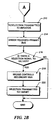
- FIGS 2A and 2B illustrate a process for resolving a SELECTION and RESELECTION conflict.
- the process begins at step 200 in which a SELECTION and RESELECTION conflict is detected by the bridge 30. Once detected, the bridge 30 arbitrates for control of the secondary bus 28 (step 202) so that the target requesting a RESELECTION will relinquish control of the bus and "hold" the RESELECTION request.
- the bridge 30 has the highest address ID on the secondary bus 28, which gives the bridge 30 priority for control of the bus 28 over the other peripheral devices 24 connected to the bus 28.
- step 204 the bridge 30 controls the secondary bus 28, it arbitrates for control of the primary bus 26 (step 204).
- the bridge 30 has the lowest ID on the primary bus 26 and therefore will gain control of the main bus 26 when it is the only device arbitrating for control of the primary bus 26.
- the bridge 30 may have a higher ID, however, and thus does not require the lowest ID.
- step 206 it then is ascertained if the bridge 30 has gained control of the primary bus 26. If the bridge 30 does not control the primary bus 26, the process proceeds to step 208 where the SELECTION signal is transmitted to the target.
- the SELECTION signal may be transmitted to the target because the bridge 30 controls the secondary bus 28 having the target. From step 208, the process loops back to step 204, in which the bridge again attempts to gain control the primary bus 26.
- step 206 if it is determined at step 206 that the bridge 30 has gained control of the primary bus 26, then the process proceeds to step 210 where the bridge 30 releases control of the secondary bus 28. This enables the target again to rearbitrate for control of the secondary bus 28 for a RESELECTION.
- step 212 the RESELECTION signal is transmitted to the initiator via the bridge 30 (step 212). After the RESELECTION signal is transmitted, the bridge 30 releases control of the primary bus (step 214).
- step 216 It then is ascertained at step 216 if there is a SELECTION signal to be delivered to a target. If the SELECTION signal has already been delivered to the target, the process ends. If there is a SELECTION signal to be delivered, the bridge 30 then arbitrates for control of the secondary bus 28 (step 218). The SELECTION signal then is transmitted to the target via the bridge 30 at step 220.
- FIG. 3 shows a block diagram of a preferred embodiment of the bridge 30, as including primary-bus and secondary-bus transceivers 42, 44, transfer circuits 46, 48 for selectively passing signals between the primary-bus transceiver 42 and the secondary-bus transceiver 44, and control logic 50 for controlling the operation of the other components of the bridge 30.
- the bridge 30 also has a primary-bus ID-input arrangement 52, such as a group of switches, which permits a user to manually enter, and then store, a primary-bus ID identifying the bridge 30.
- the bridge 30 has a clock 30A for providing timing signals, and a power supply 30B.
- Each transceiver 42, 44 has a receiver 56 for receiving signals from the respective originating buses 26, 28, and a driver 58 for sending or asserting signals on the respective target buses 28, 26.
- the transceivers 42, 44 can be either both differential or both single-ended transceivers, or one can be differential and the other single-ended, and, in any event, should conform with the type of signal lines on the bus 26, 28 to which each transceiver 42, 44 is connected.
- Each transfer circuit 46, 48 modifies certain signals, i.e., connection-control signals, received by the transceivers 44, 48, and passes other signals, i.e., message data signals, without modification.
- Each transfer circuit 46, 48 has a demultiplexer 62 ("DEMUX") for receiving the received signals at a data input thereof from the respective transceiver 42, 44 and, in response to a control signal at a control input thereof, for passing the message data signals onto direct data lines 64 connected to a first output of the DEMUX 62 and passing the connection-control signals 65A, 65B to a converter 66 connected to a second output of the DEMUX 62.
- the direct data lines 64 of the transfer circuit 46, 48 directly couple the message data signal passed by the DEMUX 62 to a multiplexer 68 ("MUX") at a first data input thereof.
- the converter 66 translates the ID and LUN field data of the connection-control signals 65A, 65B into appropriate ID and LUN field data for use on the destination bus 28, 26, in conformance with the address specifications of the SCSI standards.
- the converter 66 then passes the generated ID and LUN field data to the connection-control signal generator 72, which conforms connection-control signals 65C, 65D suitable for use on the bus 28, 26 that is to receive the communication.
- the operation of the converters 66 and signal generators 72 of the transfer circuits 46, 48 is described in more detail below.
- connection-control signals 65C, 65D generated by the signal generator 72 of the transfer circuit 46, 48 are applied to the MUX 68 at a second data input thereof. Responsive to a control signal 74B, 76B at a control input thereof, the MUX 68 passes either the message data signals received over the direct data lines 64, the connection-control signals 65C, 65D, or signals 74C, 76C generated by the control logic 50 (as described hereinafter), to the driver 58 of the target bus 28, 26.
- the control logic 50 includes first and second control logic modules 74, 76 which, among other functions, (i) monitor (over detect lines 78) signals received by the transceivers 42, 44, and, in response thereto, (ii) control the direction of the transceivers 42, 44 i.e., controls whether the transceivers are driving or receiving signals using transceiver control lines 82, (iii) control the operation of the DEMUXs 62 and the MUXs 68 by applying thereto appropriate control signals 74A, 74B, and 76A, 76B, and (iv) assert signals 74C, 76C to third data inputs of MUXs 68 to be sent over the target buses.
- first and second control logic modules 74, 76 which, among other functions, (i) monitor (over detect lines 78) signals received by the transceivers 42, 44, and, in response thereto, (ii) control the direction of the transceivers 42, 44 i.e., controls whether the transce
- the control logic 50 generates signal and control bridge 30 in accordance with figures 2A, 2b, and 3, and may be implemented economically through the use of application-specific integrated circuitry (ASIC), a programmable logic 50 can also constitute a programmable logic array, or a microprocessor, with discrete logic devices.
- ASIC application-specific integrated circuitry
- the transfer circuits 46 and 48 also may be implemented using ASIC.
- the bridge 30 has an architecture substantially similar to that described in our copending European Patent Application Ref: MJB06311EP entitled SCSI Bus Extender Utilizing Tagged Queuing in a Multi-Initiator Environment.
- bus extender 30 The signal sequence diagrams for the SELECTION and RESELECTION operations used by bus extender 30 are described in U.S. 5,274,783 with regard to Figures 7 and 8 thereof and the accompanying description in the specification.
- a software implementation of the above described embodiment(s) may comprise a series of computer instructions either fixed on a tangible medium, such as a computer readable media, e.g. diskette, CD-ROM, ROM, RAM, ASIC, Programmable Logic Array, programmable registers or fixed disk, or transmittable to a computer system, via a modem or other interface device.
- the medium can be either a tangible medium, including but not limited to optical or analog communications lines, or may be implemented with wireless techniques, including but not limited to microwave, infrared or other transmission techniques.
- the series of computer instructions embodies all or part of the functionality previously described herein with respect to the invention.
- Such computer instructions can be written in a number of programming languages for use with many computer architectures or operating systems. Further, such instructions may be stored using any memory technology, present or future, including, but not limited to, semiconductor, magnetic, optical or other memory devices, or transmitted using any communications technology, present or future, including but not limited to optical, infrared, microwave, or other transmission technologies. It is contemplated that such a computer program product may be distributed as a removable media with accompanying printed or electronic documentation, e.g., shrink wrapped software, preloaded with a computer system, e.g., on system ROM or fixed disk, or distributed from a server or electronic bulletin board over a network, e.g., the Internet or World Wide Web.
- a removable media with accompanying printed or electronic documentation, e.g., shrink wrapped software, preloaded with a computer system, e.g., on system ROM or fixed disk, or distributed from a server or electronic bulletin board over a network, e.g., the Internet or World Wide Web.
Landscapes
- Engineering & Computer Science (AREA)
- General Engineering & Computer Science (AREA)
- Theoretical Computer Science (AREA)
- Computer Hardware Design (AREA)
- Physics & Mathematics (AREA)
- General Physics & Mathematics (AREA)
- Bus Control (AREA)
Applications Claiming Priority (2)
| Application Number | Priority Date | Filing Date | Title |
|---|---|---|---|
| US08/965,072 US5987558A (en) | 1997-11-05 | 1997-11-05 | Method and apparatus for resolving over lapping selection and reselection operations of SCSI bus protocols |
| US965072 | 1997-11-05 |
Publications (2)
| Publication Number | Publication Date |
|---|---|
| EP0915425A2 true EP0915425A2 (de) | 1999-05-12 |
| EP0915425A3 EP0915425A3 (de) | 2000-04-19 |
Family
ID=25509395
Family Applications (1)
| Application Number | Title | Priority Date | Filing Date |
|---|---|---|---|
| EP98308940A Withdrawn EP0915425A3 (de) | 1997-11-05 | 1998-11-02 | Arbitrierungsvorrichtung und -verfahren für SCSI-Buserweiterung |
Country Status (2)
| Country | Link |
|---|---|
| US (1) | US5987558A (de) |
| EP (1) | EP0915425A3 (de) |
Families Citing this family (3)
| Publication number | Priority date | Publication date | Assignee | Title |
|---|---|---|---|---|
| US6708242B1 (en) * | 1999-09-10 | 2004-03-16 | Adaptec, Inc. | Methods for addressing extended number of peripheral devices over peripheral bus |
| US6541995B1 (en) * | 2001-09-20 | 2003-04-01 | International Business Machines Corporation | Circuit and method for driving signals to a receiver with terminators |
| US6915354B1 (en) * | 2002-04-30 | 2005-07-05 | Intransa, Inc. | Distributed iSCSI and SCSI targets |
Family Cites Families (10)
| Publication number | Priority date | Publication date | Assignee | Title |
|---|---|---|---|---|
| US4868741A (en) * | 1983-07-22 | 1989-09-19 | Texas Instruments Incorporated | Computer bus deadlock prevention |
| US5758109A (en) * | 1990-03-19 | 1998-05-26 | Thomas A. Gafford | Repeater/switch for distributed arbitration digital data buses |
| US5414818A (en) * | 1990-04-06 | 1995-05-09 | Mti Technology Corporation | Method and apparatus for controlling reselection of a bus by overriding a prioritization protocol |
| US5274783A (en) * | 1991-06-28 | 1993-12-28 | Digital Equipment Corporation | SCSI interface employing bus extender and auxiliary bus |
| US5708784A (en) * | 1991-11-27 | 1998-01-13 | Emc Corporation | Dual bus computer architecture utilizing distributed arbitrators and method of using same |
| US5528765A (en) * | 1993-03-15 | 1996-06-18 | R. C. Baker & Associates Ltd. | SCSI bus extension system for controlling individual arbitration on interlinked SCSI bus segments |
| US5524236A (en) * | 1993-09-15 | 1996-06-04 | Unisys Corporation | Apparatus for determining the direction of signal/data flow on CSI bus for converting between single ended and differential type signals |
| US5717873A (en) * | 1993-09-30 | 1998-02-10 | Intel Corporation | Deadlock avoidance mechanism and method for multiple bus topology |
| WO1996035175A2 (en) * | 1995-05-02 | 1996-11-07 | Apple Computer, Inc. | Deadlock avoidance in a split-bus computer system |
| US5778235A (en) * | 1996-02-26 | 1998-07-07 | Robertson; Paul Gordon | Computer system and arbitrator utilizing a bus bridge that avoids livelock |
-
1997
- 1997-11-05 US US08/965,072 patent/US5987558A/en not_active Expired - Fee Related
-
1998
- 1998-11-02 EP EP98308940A patent/EP0915425A3/de not_active Withdrawn
Also Published As
| Publication number | Publication date |
|---|---|
| EP0915425A3 (de) | 2000-04-19 |
| US5987558A (en) | 1999-11-16 |
Similar Documents
| Publication | Publication Date | Title |
|---|---|---|
| EP0520838B1 (de) | SCSI-Schnittstelle die eine Buserweiterung und einen Hilfsbus benutzt | |
| US5396602A (en) | Arbitration logic for multiple bus computer system | |
| US5175822A (en) | Apparatus and method for assigning addresses to scsi supported peripheral devices | |
| US5764930A (en) | Method and apparatus for providing reset transparency on a reconfigurable bus | |
| EP0870239B1 (de) | Stoss-rundsenden über einen pci-bus | |
| US5233692A (en) | Enhanced interface permitting multiple-byte parallel transfers of control information and data on a small computer system interface (SCSI) communication bus and a mass storage system incorporating the enhanced interface | |
| KR100368948B1 (ko) | 가변 우선순위와 공정성을 사용하는 개선된 버스 중재자 | |
| EP0576240A1 (de) | Rechnersystem und Systemerweiterungseinheit | |
| AU7726081A (en) | Improved system for interrupt arbitration | |
| US5566345A (en) | SCSI bus capacity expansion controller using gating circuits to arbitrate DMA requests from a plurality of disk drives | |
| EP0919926B1 (de) | Verfahren und Vorrichtung zum sicheren Datenrundsenden über einen PCI-bus | |
| US6185651B1 (en) | SCSI bus extender utilizing tagged queuing in a multi-initiator environment | |
| US5611056A (en) | Method for controlling the expansion of connections to a SCSI bus | |
| EP1537700B1 (de) | Protokoll zum zugriff auf eine lokale einrichtung eines fernknotens per infiniband | |
| US20030188071A1 (en) | On-chip high speed data interface | |
| US5987558A (en) | Method and apparatus for resolving over lapping selection and reselection operations of SCSI bus protocols | |
| US5598538A (en) | SCSI multiplexer for coupling a computer local bus to a shared peripheral global bus | |
| US7085903B2 (en) | Method, apparatus, and program for improving data mirroring performance in a SCSI topology | |
| EP1700223B1 (de) | Chipsatz-merkmalerkennung und konfiguration durch eine e/a-einrichtung | |
| CN117708026A (zh) | 通信控制装置及控制方法 | |
| US6754761B1 (en) | Communications system including symmetric bus bridge and method used therewith | |
| US6708242B1 (en) | Methods for addressing extended number of peripheral devices over peripheral bus | |
| JPS5986940A (ja) | マルチドロツプ方式の情報伝送方式 | |
| EP0576241A1 (de) | Rechnersystem und Systemerweiterungseinheit | |
| US6076127A (en) | Configuration of a single point bus arbitration scheme using on-chip arbiters |
Legal Events
| Date | Code | Title | Description |
|---|---|---|---|
| PUAI | Public reference made under article 153(3) epc to a published international application that has entered the european phase |
Free format text: ORIGINAL CODE: 0009012 |
|
| AK | Designated contracting states |
Kind code of ref document: A2 Designated state(s): AT BE CH CY DE DK ES FI FR GB GR IE IT LI LU MC NL PT SE |
|
| AX | Request for extension of the european patent |
Free format text: AL;LT;LV;MK;RO;SI |
|
| PUAL | Search report despatched |
Free format text: ORIGINAL CODE: 0009013 |
|
| AK | Designated contracting states |
Kind code of ref document: A3 Designated state(s): AT BE CH CY DE DK ES FI FR GB GR IE IT LI LU MC NL PT SE |
|
| AX | Request for extension of the european patent |
Free format text: AL;LT;LV;MK;RO;SI |
|
| RAP1 | Party data changed (applicant data changed or rights of an application transferred) |
Owner name: COMPAQ COMPUTER CORPORATION |
|
| AKX | Designation fees paid | ||
| STAA | Information on the status of an ep patent application or granted ep patent |
Free format text: STATUS: THE APPLICATION IS DEEMED TO BE WITHDRAWN |
|
| 18D | Application deemed to be withdrawn |
Effective date: 20001020 |