EP0915429A2 - Méthode de détection de position et appareil pour détecter plusieurs indicateurs de position - Google Patents
Méthode de détection de position et appareil pour détecter plusieurs indicateurs de position Download PDFInfo
- Publication number
- EP0915429A2 EP0915429A2 EP98110146A EP98110146A EP0915429A2 EP 0915429 A2 EP0915429 A2 EP 0915429A2 EP 98110146 A EP98110146 A EP 98110146A EP 98110146 A EP98110146 A EP 98110146A EP 0915429 A2 EP0915429 A2 EP 0915429A2
- Authority
- EP
- European Patent Office
- Prior art keywords
- detecting
- scan
- information
- indicators
- position indicator
- Prior art date
- Legal status (The legal status is an assumption and is not a legal conclusion. Google has not performed a legal analysis and makes no representation as to the accuracy of the status listed.)
- Granted
Links
Images


Classifications
-
- G—PHYSICS
- G06—COMPUTING OR CALCULATING; COUNTING
- G06F—ELECTRIC DIGITAL DATA PROCESSING
- G06F3/00—Input arrangements for transferring data to be processed into a form capable of being handled by the computer; Output arrangements for transferring data from processing unit to output unit, e.g. interface arrangements
- G06F3/01—Input arrangements or combined input and output arrangements for interaction between user and computer
- G06F3/03—Arrangements for converting the position or the displacement of a member into a coded form
- G06F3/033—Pointing devices displaced or positioned by the user, e.g. mice, trackballs, pens or joysticks; Accessories therefor
- G06F3/038—Control and interface arrangements therefor, e.g. drivers or device-embedded control circuitry
-
- G—PHYSICS
- G06—COMPUTING OR CALCULATING; COUNTING
- G06F—ELECTRIC DIGITAL DATA PROCESSING
- G06F3/00—Input arrangements for transferring data to be processed into a form capable of being handled by the computer; Output arrangements for transferring data from processing unit to output unit, e.g. interface arrangements
- G06F3/01—Input arrangements or combined input and output arrangements for interaction between user and computer
- G06F3/03—Arrangements for converting the position or the displacement of a member into a coded form
- G06F3/041—Digitisers, e.g. for touch screens or touch pads, characterised by the transducing means
- G06F3/046—Digitisers, e.g. for touch screens or touch pads, characterised by the transducing means by electromagnetic means
-
- G—PHYSICS
- G06—COMPUTING OR CALCULATING; COUNTING
- G06F—ELECTRIC DIGITAL DATA PROCESSING
- G06F2203/00—Indexing scheme relating to G06F3/00 - G06F3/048
- G06F2203/038—Indexing scheme relating to G06F3/038
- G06F2203/0382—Plural input, i.e. interface arrangements in which a plurality of input device of the same type are in communication with a PC
Definitions
- the present invention relates to a position detecting method and apparatus in a position detector called a digitizer or tablet and, more particularly, to an improvement in a method and apparatus for scanning many sensor coils provided side by side on a sensor unit of the position detector.
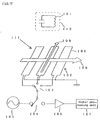
- Figure 7 is a schematic block diagram illustrating the basic operation of a position detector employing the electromagnetic transfer system.
- a position indicator 110 shown in Fig. 7 has a resonance circuit 101 composed of a coil and a capacitor.
- a position detector 111 is constituted by a sensor unit 102, a coil selector 103, a send/receive selector 104, a high-frequency signal generator 105, a receiving circuit 106, and a signal processing unit 107.
- the position indicator 110 is a so-called stylus pen shaped like, for example, a writing tool which is a position indicator capable of indicating a position when it is held in a hand of an operator, or a puck-shaped cursor which is a position indicator capable of keeping on indicating a position even when the operator releases it, i.e. it can be left alone; it is a tool which the operator holds in hand to specify a position (pointing entry), enter hand-written characters, drawing, or to perform other coordinate input operation on a computer.
- the position indicator 110 includes at least a coil or the resonance circuit 101.
- the sensor unit 102 has a plate-like sensor surface, a point on which is defined by an X-Y rectangular coordinate.
- the sensor unit 102 is formed by arranging many sensor coils 100 side by side in an X-axis direction 108 and a Y-axis direction 109. In Fig. 7, only the sensor coils arranged in the X-axis direction are shown in order to avoid confusion. There are actually a few tens of the sensor coils; however, only three sensor coils are illustrated in the drawing for clarity.
- the position detector 111 which employs the electromagnetic transfer system, electromagnetic waves are transferred between the sensor coils 100 on the sensor unit 102 and the position indicator 110 in order to determine the coordinate value of a position specified by the position indicator according to a signal received by the sensor coils 100. Further, the position detector 111 is normally provided also with means for entering the information on the switch of the position indicator or the information on writing pressure in addition to the information on the coordinate value of the position indicator.
- Two sets of sensor units are normally provided such that they are orthogonalized in the X-axis direction and the Y-axis direction, respectively, in order to perform coordinate detection in the two directions, namely, the X-axis direction and the Y-axis direction.
- the sensor coils in the X-axis direction means that they are arranged in the X-axis direction rather than meaning that they are extended in the X-axis direction.
- the lengthwise direction of the sensor coils in the X-axis direction agrees with the Y-axis direction.
- the high-frequency signal generator 105 is a well-known circuit for generating an AC signal of a predetermined frequency (e.g. a predetermined value in a range from a few hundreds of kilohertz to a few megahertz).
- the receiving circuit 106 is a well-known circuit composed primarily of an amplifier.
- the signal processing unit 107 is composed primarily of a processor (CPU) and a storage circuit; it carries out XY-coordinate calculation according to the output of the receiving circuit 106.
- the processor of the signal processing unit 107 functions to control the coil switching of the coil selector 103 and the switching of the send/receive selector 104.
- the coil selector 103 may be constituted by a well-known multiplexer.
- the send/receive selector 104 may be constituted by a well-known switching circuit.
- the position detecting process in the electromagnetic transfer system will now be described. It is assumed that the foregoing processor of the signal processing unit 107 has set the send/receive selector 104 for the send mode, namely, for the high-frequency signal generator 105, and the processor has set the coil selector 103 to select one particular sensor coil 100 in a sensor coil group of the sensor unit 102.
- a high-frequency signal is issued from the high-frequency signal generator 105 and applied to the selected sensor coil 100 via the send/receive selector 104 and the coil selector 103.
- This causes the sensor soil 100 to produce an electromagnetic wave which will be referred to as "transmitter signal.”
- the processor of the signal processing unit 107 sets the send/receive selector 104 for the receive mode, namely, for the receiving circuit 106, to stop the issuance of the transmitter signal from the sensor coil 100. In other words, the supply of the high-frequency signal from the high-frequency signal generator 105 is stopped.
- the oscillatory phenomenon in the resonance circuit 101 incorporated in the position indicator 110 is not stopped immediately; damping oscillation continues for a while.
- the coil of the resonance circuit 101 generates an electromagnetic wave which will be referred to as “response electromagnetic wave.”
- This response electromagnetic wave is received by the sensor coil 100 (the signal received by the sensor coil 100 at this time will be referred to as “received signal”).
- the received signal is sent to the receiving circuit 106, where it is processed, via the coil selector 103 and the send/receive selector 104.
- the signal which has been processed by the receiving circuit 106 is further handed to the signal processing unit 107 which performs XY coordinate calculation and the analysis of switch information according to the amplitude, phase, and so on of the processed signal.
- the obtained coordinate value and switch information are sent out to a host apparatus not shown, i.e. an external computer.
- the resonance circuit 101 built in the position indicator 110 shown in Fig. 7 is represented as the coil or the resonance circuit 101 because the resonance phenomenon is not necessarily a must as long as magnetic coupling takes place among the sensor coils.
- the sending and receiving operation on the foregoing sensor coils 100 is repeated while switching in sequence among the multiple sensor coils 100 on the sensor unit 102 in a position detecting direction.
- the operation of switching among the multiple sensor coils 100 in sequence will be referred to as "scanning".
- the coil selector 103 composed mainly of a multiplexer is primarily responsible for selecting and switching among the multiple sensor coils 100. Also, it has already been mentioned that the coil selector 103 is connected to the processor of the signal processing unit 107 by a signal line, which is not shown, and it is controlled by the processor.
- the program describing the operation of the processor is stored in a storage device called a ROM (read-only memory) of the signal processing unit 107 although the storage device, which has not been referred to, is also a component of the position detector.
- the processor reads in the program stored in the ROM and executes the scanning according to the program. Accordingly, the position detecting process, particularly the scanning method for the sensor coils 100, can be modified by the program stored in the ROM.
- the position detecting process includes the procedure from a point at which no coordinate information (not even an approximate position) on the position indicator 110 has been obtained to a point at which the detailed coordinate of the position indicator is calculated. As previously mentioned, this process corresponds to the processing contents of the processor of the signal processing unit 107 shown in Fig. 7. From this viewpoint, the position detecting process is not merely the scanning (selecting in a predetermined sequence) the sensor coils 100; instead, it also includes the processing in which the processor of the signal processing unit 107 acquires the output obtained by the receiving circuit 106 as the result of the selection, the processing for carrying out the coordinate calculation based on the signal level obtained from the previous processing, and the processing for sending out the coordinate value, which has been finally obtained, to external equipment, i.e. a computer which is host equipment in most cases.
- external equipment i.e. a computer which is host equipment in most cases.
- the processing for obtaining the output signal of the receiving circuit 106 is implemented immediately after every scan of each of the sensor coils 100.
- the coordinate calculation processing is implemented immediately after the receiving levels (the voltage levels of the transmitter signals of the receiving circuit 106) at a plurality of (about 2 to about 4) sensor coils located in the vicinity of the position indicator 110 have been obtained.
- 2-point technique or 3-point technique quadric function approximation
- the coordinate value sending-out processing is implemented upon completion of the coordinate calculation; the obtained coordinate value is sent out to external equipment by using a well-known interface circuit such as a means which conforms to the RS-232C standard.
- the description will be focused on the scanning procedure of the sensor coils 100, abstracting the procedure for obtaining the output of the receiving circuit 106, the coordinate calculation processing, and the processing for sending out the coordinate value.
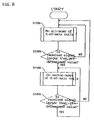
- Figure 8 shows a flowchart illustrative of the position detecting process in a conventional electromagnetic transfer system.
- the process for detecting a position of the position indicator may be roughly divided into all-scan process and sector-scan process.
- the term "all-scan” means to scan the sensor coils all over the area of the sensor coil surface, i.e. the surface on which the X- and Y-axis sensor coils are provided side by side. All-scan does not always refer to a case where all sensor coils are scanned; it may refer to a case where, for example, every other sensor coils are scanned. In the flowchart, only “scan” is shown for the purpose of simplicity; the actual scanning operation, however, includes a plurality of steps.
- the processing for detecting a position indicator starts with the all-scan process (step ST200).
- the all-scan process is implemented on both X-axis and Y-axis. This all-scan may be regarded as rough detection because it is intended mainly for quickly obtaining the approximate position of the position indicator 110.
- the processor will have obtained the signal intensity distribution of the received signals on the sensor unit according to the signals received from the sensor coils 100.
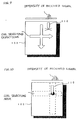
- the nearly square member in Fig. 9 represents the sensor unit 102.
- the thick arrows crossing on the sensor unit 102 indicate the coil selecting directions of the X-axis and Y-axis.
- the position indicator 110 is pointing at a certain position on the sensor unit 102.
- the signal intensity distribution obtained by the processor upon completion of the all-scan process is shown by the bar graph shown in Fig. 9.
- the bar graph shows only the intensity distribution obtained by the scan in the X-axis direction.
- the intensity of the received signal of the sensor coil closest to the position indicator 110 shows the highest value.
- the group of several sensor coils around the sensor coil giving the highest value shows the peak of the signal intensity distribution. This makes it possible to know the approximate position.
- Figure 9 shows a constant level of signal intensity in the area other than the group of several sensor coils around the sensor coil giving the highest value.
- Such a constant level of signal intensity is sometimes called as an offset value because there is a certain level of output even when no input is applied to the receiving circuit 106 in Fig. 7.
- the program determines in step ST299 whether the signal intensity of the received signal shown in Fig. 9 is larger than a predetermined value; if it is smaller than predetermined value, then the program goes back to the all-scan step ST200, or if it is larger than the predetermined value, then the program moves onto the sector-scan step ST400.
- the predetermined value is a "threshold value" which is a preset appropriate value above the offset value mentioned above.
- the sector-scan step ST400 the foregoing sending and receiving operation is repeated using the sensor coil at the central position and several sensor coils adjacent thereto obtained as the result of the all-scan step.
- the sector-scan step ST400 is carried out at least on the X-axis and the Y-axis. This allows the detailed signal intensity distribution to be obtained as shown in Fig. 10; the coordinate value is determined by performing the interpolative calculation of the respective received signals in the signal processing unit 107 shown in Fig. 7.
- the sector-scan is a more detailed detection process.
- the situation of the "more detailed space-wise” may occur when skipping scan is carried out in the all-scan step (the all-scan can include the skipping scan as previously mentioned), whereas no skipping is made in the sector-scan step.
- This is a problem with the spatial gaps of the sensor coils used; therefore, the spatial detailedness contributes to the resolution or accuracy of the obtained coordinate value.
- step ST200 when the position detector 111 is initially started up, the program performs the all-scan in step ST200, and when the approximate position of the position indicator 110 is found, the program gives an affirmative determination result (YES) in step ST299 and proceeds to the sector-scan in ST400. If no approximate position is found, then the program gives a negative determination result (NO) in step ST299 and repeats the all-scan in step ST200 thereafter.
- the affirmative determination result (YES) is given in step ST499 as long as the coordinate of the position indicator 110 is obtained by the sector-scan; hence, the sector-scan is repeated.
- step ST499 the program gives the negative determination result (NO) in step ST499, so that it goes back to the all-scan in ST200.
- the two different scanning methods namely, the all-scan and the sector-scan, are combined to accomplish efficient coordinate detection.
- the method for detecting a single position indicator is called “single-scan”; the method for detecting a plurality of position indicators is called “multi-scan”.
- a position detector performs sending and receiving at particular frequencies for the position indicators and it carries out all-scan or sector-scan for the respective resonance frequencies alternately so as to detect the multiple position indicators.
- two position indicators which have different, fixed resonance frequencies are prepared to enable a position detector to communicate with the position indicators by using the different frequencies.
- one of the following different scanning processes is selectively implemented: in a first process, all-scan is carried out for two different frequencies alternately; in a second process, two types of scanning are alternately carried out, namely, sector-scan for one frequency and all-scan for the other frequency; and in a third process, the sector-scan is carried out for the two frequencies alternately.
- the multi-scan for detecting the positions of a plurality of position indicators at the same time.
- detecting the positions of the position indicators requires that the sensor coils of the position detector be scanned alternately for the same number of times as the number of the position indicators.
- the multi-scan avoidably exhibits deteriorated performance in the trackability of coordinate values in relation to the actual positions of the position indicators when the position indicators are moved, or a deteriorated dynamic characteristic which is the performance involved in relatively quick moving of position indicators.
- the trackability of the multi-scan for detecting two position indicators is reduced simply to a half of that of the single-scan for detecting only one position indicator, thus leading to deterioration in performance of the multi-scan.
- the sensor coils of the position detector are scanned alternately to detect the position indicators. This has resulted in slower recognition of the position indicators.
- a program moves onto a second detection process.
- the sensor coils are specified and scanned according to the positional information on the first position indicator so as to alternately carry out the sector-scan step for performing more detailed detection of the position of the first position indicator and the all-scan step for detecting the approximate position of the second position indicator.
- the sector-scan is implemented more frequently than the all-scan.
- the second position indicator can be detected with a minimum sacrifice in the trackability of the first position indicator.
- the repeating frequency, etc. of the all-scan step or the sector-scan step can be set or changed according to the type or the like of the position indicator.
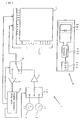
- Fig. 1 is the block diagram of a position detector of the embodiment in accordance with the present invention.
- a sensor unit 1 is composed by forty loop coils disposed in parallel to the X-axis and forty loop coils disposed in parallel to the Y-axis, thus forming a coordinate reading surface.
- the respective loop coils constitute sensor coils connected to a selector circuit 2 for selecting the loop coils.
- the selector circuit 2 is connected to a send/receive selector circuit 3; an amplifier 5 is connected to the receiving end of the send/receive selector circuit 3, and the output end of the amplifier 5 is connected to a signal processing unit 6.
- the signal processing unit 6 is constructed by a central processing unit (CPU), a read-only memory (ROM), etc.
- the output end of a current driver 11 is connected to the sending end of the send/receive selector circuit 3; a frequency selector switch 12 is connected to the input end of the current driver 11; and oscillators 13 and 14 which have different frequencies are connected to the frequency selector switch 12.
- the frequency selector switch 12 is switched in response to a control signal received from the CPU in the signal processing unit 6; it sets the frequency of a signal transmitted from each loop coil to f0 or f1.
- the frequency f0 is preset so that it is equal to the resonance frequency of a first position indicator which will be discussed later, while the frequency f1 is present so that it is equal to the resonance frequency of a second position indicator which will be discussed later.
- control signals are supplied from the CPU in the signal processing unit 6 to the selector circuit 2 and the send/receive selector circuit 3 so as to scan the sensor coils or select between the send mode and the receive mode.
- the selector circuit 2 together with the signal processing unit 6 make up the selecting means for selectively scanning the sensor coils; they select the sensor coils in sequence to selectively scan or select a particular area or a particular number of sensor coils to scan in the all-scan mode and the sector-scan mode.
- a position indicator 8 includes: a resonance circuit 201 composed of a coil and a capacitor; a ROM 203 wherein the shape or usage of the position indicator, the description of the information that can be provided, or the information on a particular identification (ID) of the position indicator is stored; and a control circuit 202 which mainly carries out the control for reading the contents stored in the ROM 203 and supplying them to the resonance circuit 201.
- a resonance circuit 201 composed of a coil and a capacitor
- ROM 203 wherein the shape or usage of the position indicator, the description of the information that can be provided, or the information on a particular identification (ID) of the position indicator is stored
- ID information on a particular identification
- the position indicator 8 only the section related to the invention is shown in a simplified manner.
- the position indicator 8 does not necessarily include the resonance circuit; it may alternatively include only the coil as long as it can be magnetically coupled with the sensor unit 1 to send and receive signals.
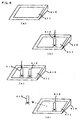
- a position detector 410 is provided with an input surface 411.
- the input surface 411 is a sensor coil in the circuit and hence it is also referred to as the sensor surface 411.
- the position indicator shown in Fig. 4 is a pen type indicator "stylus pen"; however, since the present invention applies to any type of position indicator, it is called simply as "position indicator”. In a state (a) wherein the all-scan step is implemented, no position indicator is placed on the sensor surface 411.
- a state (b) is set for carrying out the sector-scan step on the first position indicator 412.
- a state (c) is set for carrying out the sector-scan step on the first and second position indicators 412 and 413, respectively.
- a state (d) is set, wherein the sector-scan step is implemented for detecting the first position indicator 412 and the all-scan step is implemented for detecting the second position indicator 413.
- the second position indicator 413 is rendered undetectable as an example; however, the first position indicator 412 may alternatively be rendered undetectable.
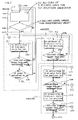
- Figures 2, 3, and 5 show flowcharts illustrative of the operation of the signal processing unit 6 of Fig. 1. The embodiment will be described by referring to Fig. 1 to Fig. 5.
- the position detector 410 first carries out an all-scan step ST01 on the first position indicator 412 at the frequency f0 in process P0 and process (1) in Fig. 2. It is determined in step ST02 whether a received signal is larger than a predetermined value; if it is determined that the received signal is larger than the predetermined value, i.e. if detection is enabled, then the position detector 410 moves onto a sector-scan step ST03.
- step ST04 it is determined whether the received signal which has been subjected to the sector-scan step ST03 is larger than the predetermined value; if it is determined that the received signal is smaller than the predetermined value, then the program returns to step ST01. If it is determined that the received signal is larger than the predetermined value, then the number of scans is first incremented and moves to ST05 wherein it is determined whether a predetermined number of scans has been satisfied. If the predetermined number of scans has not been satisfied, then steps ST03 and ST04 are repeated. If the predetermined number of scans is satisfied, then all-scan step ST06 for detecting the second position indicator 413 is carried out at the frequency f1.
- step ST07 it is determined in step ST07 whether the received signal is larger than the predetermined value; if it is judged that the received signal is less than the predetermined value, then the program returns to step ST03, or if it is judged that the received signal is larger than the predetermined value, then the program proceeds to step ST08.
- the all-scan for detecting the second position indicator 413 is continued although the all-scan step for detecting the second position indicator 413 is implemented at a lower repeating frequency than that of the sector-scan step for detecting the first position indicator 412. More specifically, the repeating frequency of the all-scan step for detecting the second position indicator 413 is lower than the repeating frequency of the sector-scan step for detecting the first position indicator 412, and these are alternately repeated.
- the ratio of the numbers of repetitions of the first position indicator 412 to the second position indicator 413 is set to 4:1.
- the predetermined number of repetitions in step ST05 is set to 4. This means that detection process P1 wherein the first position indicator 412 is detected for four times in succession is carried out, then detection process P2 wherein the second position indicator 413 is detected once is carried out; the respective detection processes P1 and P2 are implemented alternately. This enables the detecting operation to be performed with minimized sacrifice in the trackability of the first position indicator 412.
- Irregular scanning may affect the coordinate moving intervals; however, this problem may be alleviated by carrying out coordinate travel averaging processing or a method for predicting a coordinate travel.
- the scan repeating frequency can be changed as desired by a user according to the size of the effective area of the position detector or the application in which the position detector is used. For instance, there is a method wherein a means for communicating with a host computer connected to the signal processing unit 6 of the position detector shown in Fig. 1 is employed to enable the signal processing unit 6 to receive an instruction signal, which is transmitted via the communication means from the host computer, through a receiving means so as to change the setting of the repeating frequency according to the type of the instruction signal.
- a control unit such as a push-button switch or a rotary switch may be connected to the signal processing unit 6 to enable the signal processing unit to detect the operating amount of the control unit, namely, the number of pushes on the switch, the rotary angle, or the like, thereby making it possible to set or change the repeating frequency.
- Such a set value which has been established or updated may be stored in an involatile storage device or the like such as an EEPROM or a flash memory which permits electrical writing and erasing. Reading in the new set value each time the power of the position detector is turned ON eliminates the need for instructing every new set value.
- Process (1) corresponds to the first detection process
- process (2) corresponds to the second detection process in the position detecting method.
- Process (1) constitutes the first detecting means, while process (2) constitutes the second detecting means in a position detector 7.
- sector-scan step ST08 is implemented for detecting the first position indicator 412; and in step ST09, it is determined whether the received signal is larger than a predetermined value. If it is determined that the received signal is larger than the predetermined value, then sector-scan step ST10 for detecting the second position indicator 413 is carried out. In step ST11, it is determined whether the received signal is larger than the predetermined value; if it is larger than the predetermined value, then the program goes back to step ST08.
- Process (3) shows the state wherein the sector-scan step is being implemented alternately on the first position indicator 412 and the second position indicator 413 which have been detected.
- the scan repeating frequencies for the first and second position indicators 412 and 413, respectively, are set equally to 1:1. More specifically, the first position indicator 412 is sector-scanned for a predetermined number of times, then the second position indicator 413 is sector-scanned for a predetermined number of times. When repeating the sector-scanning of the two position indicators alternately, the same number of times is set for carrying out the sector-scan of the position indicators 412 and 413. This is effective for providing equal trackability while the two position indicators are being detected.
- Process (3) corresponds to a third detection process in the position detecting method.
- step ST10 for detecting the second position indicator 413 is smaller than the predetermined value in step ST11, then the program moves onto step ST14 (ST21) of Fig. 3 where process (4) is implemented.
- step ST21 for detecting the first position indicator 412 is carried out, then it is determined in step ST22 whether the received signal is larger than the predetermined value. If the received signal is larger than the predetermined value, then all-scan step ST23 for detecting the second position indicator 413 is implemented, and it is determined in step ST24 whether the received signal is larger than the predetermined value. If it is determined in step ST24 that the received signal is smaller than the predetermined value, then the program proceeds to step ST25 wherein it decides whether a predetermined time has elapsed; if the predetermined time has not elapsed, then the program returns to step ST21, or it proceeds to step ST12 if the predetermined time has elapsed.
- Process (4) if it is determined that either the position indicator 412 or 413 is invalid while the sector-scan is being carried out on the first position indicator 412 and the second position indicator 413 which have been detected, and the program returns to the all-scan step, then the scan repeating frequency for the first position indicator 412 and the second position indicator 413 is maintained to 1:1 for the foregoing predetermined time. After the predetermined time has passed, the position indicator subjected to the all-scan step is scanned at a lower repeating frequency than that for the position indicator subjected to the sector-scan step; the two types of scans are alternately repeated as described above. Process (4) corresponds to a fourth detection process in the position detecting method.
- the position indicator is no longer necessary and the operator places the position indicator in an area out of the sensor surface, i.e. out of the effective zone, of the position detector.
- the position indicator is temporarily in an invalid state in an undetectable area while it is still held in a hand of the operator. The latter case often happens in normal operation.
- it is appropriate to maintain the scan repeating frequency at 1:1 within a certain time because it would take more time to recognize the position indicator if the program goes back to process (2) immediately after the all-scan step is started on the position indicator.
- the time may be set, for example, to 1 minute; and in the other method, one process of the all-scan or sector-scan may be regarded as 1 count, and the certain time may be set as 10,000 counts.
- the repeating frequency is gradually changed within a certain time. For instance, when the ratio of the detection repeating frequency of the first position indicator 412 and the detection repeating frequency of the second position indicator 413 are set to 4:1, the repeating frequency is 1:1 in the state of sector-scan step process (3) (state (c) of Fig. 4) in which both the first position indicator 412 and the second position indicator 413 are being detected; when the second position indicator 413 is placed in the invalid state (state (d) of Fig. 4), the program returns to the all-scan step for detecting the second position indicator 413.
- the repeating frequency within 1 minute will be as follows: the ratio of the process for the first position indicator 412 to the process for the second position indicator 413 equals 1:1.
- a repeating frequency of 2:1 is applied.
- a repeating frequency of 3:1 is applied.
- the repeating frequency of 4:1 is applied.
- the scan repeating frequency is gradually changed as time passes.
- the foregoing set predetermined time may be changed as desired according to the size of the effective area of the position detector or the application in which the position detector is used.
- the setting method the one described in conjunction with process (2) may be employed.
- the position indicators In a position detector adapted to detect a plurality of position indicators by their different resonance frequencies, the position indicators have resonance frequencies which are set according to the shapes thereof. For example, a pen type position indicator has a first resonance frequency, while a cursor type position indicator has a second resonance frequency. In this case, in the state (a) of Fig. 4, the pen type position indicator and the cursor position indicator are not located on the sensor surface, and the all-scan step is being implemented on the two types of position indicators alternately.
- step ST31 the all-scan step for detecting the pen type position indicator of the first resonance frequency is carried out in step ST31, then it is determined in step ST32 whether the received signal is larger than a predetermined value; if it is smaller than the predetermined value, then the counter is incremented in step ST34.
- step ST35 it is determined whether the value on the counter is identical to the predetermined value (the predetermined value in this embodiment is "4"), and if it is smaller than the predetermined value, then the program goes to step ST31; or if it is identical to the predetermined value, then the predetermined value is initialized before moving onto all-scan step ST36 for detecting the cursor type position indicator.
- step ST37 it is determined whether the received signal is larger than the predetermined value; if it is smaller than the predetermined value, then the program goes back to step ST31. Although it is not shown, if the pen type position indicator or the cursor type position indicator becomes undetectable and invalid after the program proceeds to the sector-scan in step ST33 or ST38, then the program moves onto a step for carrying out the all-scan.
- the all-scan step for detecting the position indicator for which the recognizing time need to be shortened is repeatedly implemented more frequently than that for detecting the other position indicator.
- the all-scan step is repeated on these two position indicators alternately.
- the pen type position indicator for example, is moved up and down frequently on the sensor surface, causing the valid and invalid processing to be switched frequently. Hence, the position indicator is required to be recognized quickly.
- the cursor type position indicator is placed mostly in the effective area of the position detector, so that the recognizing speed is not as important as in the case of the pen type.
- the all-scan step for the pen type position indicator is implemented at a higher repeating frequency than that for the cursor type position indicator so as to achieve time-efficient recognition of the position indicators by their shapes.
- Process (5) corresponds to a fifth detection process in the position detecting method. Also, process (5) constitutes a third detecting means in the position detector 7.
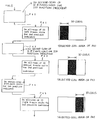
- Figure 6 corresponds to the state (b) in Fig. 4; it is characterized in that the scan is limited to small areas rather than setting the scan repeating frequencies. In Fig. 6, only the characteristic portion of the all-scan step in this embodiment is shown.
- the first position indicator 412 is placed on the sensor surface 411, and the sector-scan step for detecting the first position indicator 412 and the all-scan step for detecting the second position indicator 413 are carried out alternately.
- the ratio of the repeating frequency of the sector-scan step to that of the all-scan step is set to 1:1.
- sector-scan process P40 for detecting the first position indicator 412 is carried out.
- Process P40 corresponds to step ST03 and step ST04 of Fig. 2.
- all-scan process P41 for detecting the second position indicator 413 is carried out.
- Process P41 corresponds to step ST06 and step ST07 of Fig. 2.
- the two processes are implemented basically alternately; however, in process P41, if there are, for example, thirty X-axis sensor coils of the position detector 410, then ten sensor coils in the left area are subjected to the all-scan, for example, in the X-axis direction in this process.
- the ten sensor coils in the central area are subjected to the all-scan in process P43, and the ten sensor coils in the right area are subjected to the all-scan in process P45.
- the entire sensor surface is all-scanned in the three processes.
- the number of coils to be scanned per process is reduced and the entire sensor surface is divided into a few areas to scan it in a few processes when carrying out the all-scan step.
- This method completes the scanning process in one third of the time required when performing the all-scan over the entire sensor surface, providing an advantage in that the deterioration in the trackability of the sector-scan can be controlled.
- the process shown in Fig. 6 constitutes a fourth detecting means in the position detector 7.
- the set number of coils to be scanned may be changed as desired according to the size of the effective area of the position detector or the application in which the position detector is used.
- the setting method the one described above may be employed.
- the small areas to be scanned and the numbers of the coils are set in advance and a plurality of scanning patterns of small areas or the number of sensor coils to be selected are prepared beforehand, the scanning patterns being stored in a data table.
- the pointer is incremented upon completion of one process, and the data table of the scanning patterns is referred to in sequence according to the pointer. Scanning based on the scanning area or selected sensor coils according to the referred contents enables more sophisticated selecting method to be employed. For instance, a position indicator is usually placed at the center of the sensor surface at the beginning. Setting the scanning pattern such that the central area is scanned at a high frequency as a whole makes the operator feel that the position indicator is recognized more quickly in actual operation.
- the position indicators are provided with means for sending the information on the shape or usage of the position indicator, the information which can be provided, or the information on a particular identification (ID) to the position detector in the form of signals.
- ID information on a particular identification
- the differences of the position indicators are indicated by phase information in advance, so that the position detector may identify the position indicators by detecting the phases thereof.
- the position indicator 8 may be provided with a control circuit 202 composed of an IC circuit, and the ROM 203 for storing binary ID codes to provide a means for allowing digital information, i.e. ID information, to be transmitted to the position detector 7.
- the ID code at this time is binary ID data which provides the information on the shape or usage of the position indicator 8, the information that can be supplied, or the information on a particular ID.
- the control circuit 202 of the position indicator 8 is equipped with an IC circuit capable of receiving, through a resonance circuit, a signal sent from the sensor coils of the position detector 7 and of counting the receiving time of the signal.
- the position detector 7 is equipped with a means for changing the sending time of a transmitter signal and a setting means therefor.
- a relatively long transmitter signal is sent from the position detector 7 to the position indicator 8.
- the position indicator 8 receives the signal and reads a binary ID code from the ROM 203 of the position indicator 8 through the control circuit 202; at predetermined time intervals, the transmitter signal is sent to the position indicator 7 if the ID code "1", whereas no transmitter signal is sent if the ID code is "0".
- the position detector 7 receives the signals and judges the information on the shape or usage of the position indicator 8, the information that can be supplied, or the information on a particular ID.
- the operator will be able to operate the position detector with optimum set values without worrying about setting details by using the detecting means in combination with the means for changing the setting of the scan repeating frequency, the number of coils or areas to be scanned, predetermined time, etc. which have been preset according to the information on the shape or usage of the position indicator 8, the information that can be supplied, or the information on a particular ID.
- electromagnetic transfer type position detectors have been described; the present intention, however, can be easily applied to any type of position detector as long as it is a position detector which is adapted to detect a plurality of position indicators and which employs a method for selecting and scanning sensor coils.
- the resonance frequencies for the position indicators have been fixed; however, they may be configured to permit switching among a plurality of different frequencies.
- the sector-scan step for detecting the first position indicator is implemented more frequently than the all-scan step for detecting the second position indicator; the sector-scan step and the all-scan step are alternately implemented repeatedly, thus permitting improved trackability.
- improved trackability of the position indicators can be achieved further effectively by employing the method wherein the same repeating frequency is applied to both types of scan when a plurality of position indicators have been detected, then the same repeating frequency is used for a predetermined time if one of the position indicators is found invalid and all-scan is initiated, or the method for limiting the areas to be scanned.
- the scanning of the position indicator which need to be recognized quickly is repeated more frequently than that of the other position indicator so as to enable quicker recognition.
- the repeating frequency and the like are set according to the information on the shapes or usages of the position indicators, the information that the position indicators have, the information on particular IDs, or other information. This makes it possible to set the repeating frequency and so on suited for the position indicators, permitting higher efficiency in practical use.
Landscapes
- Engineering & Computer Science (AREA)
- General Engineering & Computer Science (AREA)
- Theoretical Computer Science (AREA)
- Physics & Mathematics (AREA)
- Human Computer Interaction (AREA)
- General Physics & Mathematics (AREA)
- Electromagnetism (AREA)
- Measurement Of Length, Angles, Or The Like Using Electric Or Magnetic Means (AREA)
- User Interface Of Digital Computer (AREA)
- Position Input By Displaying (AREA)
Applications Claiming Priority (3)
| Application Number | Priority Date | Filing Date | Title |
|---|---|---|---|
| JP31662697A JP3933278B2 (ja) | 1997-11-04 | 1997-11-04 | 位置指示器を検出可能な位置検出方法及び装置 |
| JP31662697 | 1997-11-04 | ||
| JP316626/97 | 1997-11-04 |
Publications (3)
| Publication Number | Publication Date |
|---|---|
| EP0915429A2 true EP0915429A2 (fr) | 1999-05-12 |
| EP0915429A3 EP0915429A3 (fr) | 2000-04-19 |
| EP0915429B1 EP0915429B1 (fr) | 2003-04-09 |
Family
ID=18079154
Family Applications (1)
| Application Number | Title | Priority Date | Filing Date |
|---|---|---|---|
| EP98110146A Expired - Lifetime EP0915429B1 (fr) | 1997-11-04 | 1998-06-04 | Méthode de détection de position et appareil pour détecter plusieurs indicateurs de position |
Country Status (4)
| Country | Link |
|---|---|
| US (1) | US6239789B1 (fr) |
| EP (1) | EP0915429B1 (fr) |
| JP (1) | JP3933278B2 (fr) |
| DE (1) | DE69813147T2 (fr) |
Cited By (9)
| Publication number | Priority date | Publication date | Assignee | Title |
|---|---|---|---|---|
| WO2005020057A3 (fr) * | 2003-08-26 | 2005-06-16 | Synaptics Uk Ltd | Systeme numeriseur |
| EP1387242A3 (fr) * | 2002-07-16 | 2006-03-01 | Hewlett-Packard Development Company, L.P. | Dispositif d'entrée multi-crayon et procédé de mise en oeuvre |
| EP1462919A3 (fr) * | 2003-03-28 | 2006-10-18 | Wacom Co., Ltd. | Système de détection de position et détecteur de position |
| GB2469757A (en) * | 2006-10-10 | 2010-10-27 | Promethean Ltd | Interactive surface driving a plurality of pointing devices |
| US8054301B2 (en) | 2006-10-10 | 2011-11-08 | Promethean Ltd. | Dual pen system |
| US8570028B2 (en) | 2007-05-10 | 2013-10-29 | Cambridge Integrated Circuits Limited | Transducer for a position sensor |
| FR3013482A1 (fr) * | 2013-11-20 | 2015-05-22 | Epawn | Procede et dispositif de localisation d’elements mobiles pourvus de tags standard de type nfc |
| US9410791B2 (en) | 2010-12-24 | 2016-08-09 | Cambridge Integrated Circuits Limited | Position sensing transducer |
| US9470505B2 (en) | 2012-06-13 | 2016-10-18 | Cambridge Integrated Circuits Limited | Position sensing transducer |
Families Citing this family (30)
| Publication number | Priority date | Publication date | Assignee | Title |
|---|---|---|---|---|
| WO2001048589A1 (fr) * | 1999-12-28 | 2001-07-05 | Fujitsu Limited | Procede et dispositif de resserrement des coordonnees d'un photostyle |
| US7239227B1 (en) * | 1999-12-30 | 2007-07-03 | Upek, Inc. | Command interface using fingerprint sensor input system |
| KR20020008040A (ko) * | 2000-07-18 | 2002-01-29 | 마츠시타 덴끼 산교 가부시키가이샤 | 표시 장치, 표시 방법 및 표시 제어 프로그램을 기록한기록 매체 |
| CN1179312C (zh) * | 2000-07-19 | 2004-12-08 | 松下电器产业株式会社 | 显示方法 |
| JP2002040985A (ja) * | 2000-07-21 | 2002-02-08 | Matsushita Electric Ind Co Ltd | 縮小表示方法 |
| US20020050983A1 (en) * | 2000-09-26 | 2002-05-02 | Qianjun Liu | Method and apparatus for a touch sensitive system employing spread spectrum technology for the operation of one or more input devices |
| JP3476784B2 (ja) | 2001-03-26 | 2003-12-10 | 松下電器産業株式会社 | 表示方法 |
| JP3476787B2 (ja) * | 2001-04-20 | 2003-12-10 | 松下電器産業株式会社 | 表示装置及び表示方法 |
| EP1412912B1 (fr) * | 2001-05-21 | 2008-06-18 | Synaptics (UK) Limited | Detecteur de position |
| JP3719590B2 (ja) * | 2001-05-24 | 2005-11-24 | 松下電器産業株式会社 | 表示方法及び表示装置ならびに画像処理方法 |
| JP5031954B2 (ja) * | 2001-07-25 | 2012-09-26 | パナソニック株式会社 | 表示装置、表示方法及び表示制御プログラムを記録した記録媒体 |
| GB2403017A (en) * | 2002-03-05 | 2004-12-22 | Synaptics | Position sensor |
| EP1509833A2 (fr) * | 2002-06-05 | 2005-03-02 | Synaptics (UK) Limited | Procede et appareil de transfert de signal |
| US7216805B2 (en) * | 2002-07-23 | 2007-05-15 | Massachusetts Institute Of Technology | Methods and apparatus for counting and positioning using resonant tags |
| GB0317370D0 (en) | 2003-07-24 | 2003-08-27 | Synaptics Uk Ltd | Magnetic calibration array |
| AU2003269976B2 (en) * | 2003-08-21 | 2010-06-10 | Microsoft Corporation | Focus management using in-air points |
| EP1745452B1 (fr) * | 2004-04-28 | 2008-04-09 | Checkpoint Systems, Inc. | Systeme de suivi d'article electronique pour rayon de vente a antenne cadre |
| US20060241397A1 (en) * | 2005-02-22 | 2006-10-26 | Assaf Govari | Reference pad for position sensing |
| JP5042316B2 (ja) * | 2007-11-12 | 2012-10-03 | 三菱電機株式会社 | タッチパネル及びそれを備えた表示装置 |
| EP2291729B1 (fr) * | 2008-04-30 | 2013-06-05 | N-Trig Ltd. | Détection tactile multipoint |
| TWI452488B (zh) * | 2009-05-18 | 2014-09-11 | Pixart Imaging Inc | 應用於感測系統的控制方法 |
| US20120200537A1 (en) * | 2009-10-19 | 2012-08-09 | Akihiro Okano | Coordinate position detection device, method of detecting coordinate position, and display device |
| KR20110097083A (ko) * | 2010-02-24 | 2011-08-31 | 삼성전자주식회사 | 디스플레이 장치 및 디스플레이 시스템 그리고 그것의 외부 장치 인식 방법 |
| JPWO2011145276A1 (ja) * | 2010-05-20 | 2013-07-22 | パナソニック株式会社 | 操作装置、操作方法、プログラム、記録媒体、及び集積回路 |
| WO2012063387A1 (fr) * | 2010-11-10 | 2012-05-18 | パナソニック株式会社 | Dispositif de détection de position sans contact et procédé de détection de position sans contact |
| JP5896166B2 (ja) | 2013-03-15 | 2016-03-30 | 村田機械株式会社 | 磁気式の位置センサと移動体及び移動体システム |
| JP6187067B2 (ja) * | 2013-09-13 | 2017-08-30 | 株式会社リコー | 座標検出システム、情報処理装置、プログラム、記憶媒体、座標検出方法 |
| EP3299936B1 (fr) | 2015-05-21 | 2020-01-01 | Wacom Co., Ltd. | Stylet actif |
| CN105607785B (zh) * | 2016-01-04 | 2019-11-12 | 京东方科技集团股份有限公司 | 触控显示系统及触控操作装置 |
| CN118838513A (zh) * | 2019-01-04 | 2024-10-25 | 株式会社和冠 | 位置检测装置及位置检测方法 |
Family Cites Families (8)
| Publication number | Priority date | Publication date | Assignee | Title |
|---|---|---|---|---|
| JPH01320521A (ja) * | 1988-06-22 | 1989-12-26 | Wacom Co Ltd | 電子黒板装置及びその筆記具等 |
| MY106855A (en) * | 1989-08-24 | 1995-08-30 | Sony Corp | Input devices. |
| JP2971488B2 (ja) * | 1989-11-01 | 1999-11-08 | 株式会社ワコム | 位置検出装置 |
| US5117071A (en) * | 1990-10-31 | 1992-05-26 | International Business Machines Corporation | Stylus sensing system |
| JPH07129305A (ja) * | 1993-10-29 | 1995-05-19 | Graphtec Corp | コードレスデジタイザ |
| JP3001395B2 (ja) * | 1995-04-04 | 2000-01-24 | 株式会社ワコム | 位置検出装置及び位置検出方法 |
| JP3015275B2 (ja) * | 1995-04-10 | 2000-03-06 | 株式会社ワコム | 位置検出装置およびそれに用いる位置指示器 |
| US5943044A (en) * | 1996-08-05 | 1999-08-24 | Interlink Electronics | Force sensing semiconductive touchpad |
-
1997
- 1997-11-04 JP JP31662697A patent/JP3933278B2/ja not_active Expired - Fee Related
-
1998
- 1998-06-04 DE DE69813147T patent/DE69813147T2/de not_active Expired - Lifetime
- 1998-06-04 EP EP98110146A patent/EP0915429B1/fr not_active Expired - Lifetime
- 1998-09-14 US US09/152,259 patent/US6239789B1/en not_active Expired - Lifetime
Cited By (22)
| Publication number | Priority date | Publication date | Assignee | Title |
|---|---|---|---|---|
| EP1387242A3 (fr) * | 2002-07-16 | 2006-03-01 | Hewlett-Packard Development Company, L.P. | Dispositif d'entrée multi-crayon et procédé de mise en oeuvre |
| EP1462919A3 (fr) * | 2003-03-28 | 2006-10-18 | Wacom Co., Ltd. | Système de détection de position et détecteur de position |
| US7423629B2 (en) | 2003-03-28 | 2008-09-09 | Wacom Co., Ltd. | Position detection system and position detector |
| WO2005020057A3 (fr) * | 2003-08-26 | 2005-06-16 | Synaptics Uk Ltd | Systeme numeriseur |
| US8115734B2 (en) | 2006-10-10 | 2012-02-14 | Promethean Ltd. | Moveable desktop |
| US8279186B2 (en) | 2006-10-10 | 2012-10-02 | Promethean Ltd. | Interactive display system |
| US8054301B2 (en) | 2006-10-10 | 2011-11-08 | Promethean Ltd. | Dual pen system |
| US8068093B2 (en) | 2006-10-10 | 2011-11-29 | Promethean House | Duplicate objects |
| US8072438B2 (en) | 2006-10-10 | 2011-12-06 | Promethean Limited | Gesture recognition |
| US8115733B2 (en) | 2006-10-10 | 2012-02-14 | Promethean Ltd. | Dual pen: OS/application pens |
| GB2469757A (en) * | 2006-10-10 | 2010-10-27 | Promethean Ltd | Interactive surface driving a plurality of pointing devices |
| US8125443B2 (en) | 2006-10-10 | 2012-02-28 | Promethean Ltd. | Stretch objects |
| US8159470B2 (en) | 2006-10-10 | 2012-04-17 | Promethean Ltd. | Join objects |
| GB2469757B (en) * | 2006-10-10 | 2011-03-30 | Promethean Ltd | Multi-input detection for interactive surface |
| US8279191B2 (en) | 2006-10-10 | 2012-10-02 | Promethean Limited | Automatic tool dock |
| US8325162B2 (en) | 2006-10-10 | 2012-12-04 | Promethean, Ltd. | Dual-pen: master-slave |
| US8570028B2 (en) | 2007-05-10 | 2013-10-29 | Cambridge Integrated Circuits Limited | Transducer for a position sensor |
| US9410791B2 (en) | 2010-12-24 | 2016-08-09 | Cambridge Integrated Circuits Limited | Position sensing transducer |
| US9470505B2 (en) | 2012-06-13 | 2016-10-18 | Cambridge Integrated Circuits Limited | Position sensing transducer |
| FR3013482A1 (fr) * | 2013-11-20 | 2015-05-22 | Epawn | Procede et dispositif de localisation d’elements mobiles pourvus de tags standard de type nfc |
| WO2015075370A1 (fr) * | 2013-11-20 | 2015-05-28 | Epawn | Procede et dispositif de localisation d'elements mobiles pourvus de tags standard de type nfc |
| US10090888B2 (en) | 2013-11-20 | 2018-10-02 | Starbreeze Paris | Method and device for locating mobile entities provided with NFC type standard tags |
Also Published As
| Publication number | Publication date |
|---|---|
| JP3933278B2 (ja) | 2007-06-20 |
| JPH11143623A (ja) | 1999-05-28 |
| DE69813147T2 (de) | 2003-10-16 |
| DE69813147D1 (de) | 2003-05-15 |
| EP0915429B1 (fr) | 2003-04-09 |
| US6239789B1 (en) | 2001-05-29 |
| EP0915429A3 (fr) | 2000-04-19 |
Similar Documents
| Publication | Publication Date | Title |
|---|---|---|
| EP0915429B1 (fr) | Méthode de détection de position et appareil pour détecter plusieurs indicateurs de position | |
| EP0737934B1 (fr) | Méthode de balayage pour des bobines de capteurs d'un dispositif d'entrée de coordonnées | |
| US5693914A (en) | Digitizer and method of detecting positions | |
| JP3517449B2 (ja) | 位置検出方法及びその装置 | |
| EP0582718A1 (fr) | Dispositif d'introduction de position et clavier | |
| JPS6370326A (ja) | 位置検出装置 | |
| JPH07311647A (ja) | 位置検出装置及びそのノイズ除去方法 | |
| EP1462919B1 (fr) | Système de détection de position | |
| EP0356496B1 (fr) | Systeme numeriseur a commutation de sequence de conducteurs | |
| JP3411118B2 (ja) | デジタイザおよびデジタイザの位置決定方法 | |
| US20250258566A1 (en) | Position detection apparatus configured to detect the positions of multiple position indicators, and position detection method | |
| JP4117751B2 (ja) | デジタイザ及び位置指示器情報検出方法 | |
| JP2608895B2 (ja) | 座標入力方法及びその装置 | |
| JP3239195B2 (ja) | 位置検出装置および位置検出方法 | |
| JP2857539B2 (ja) | コードレスデジタイザ | |
| JP3269677B2 (ja) | デジタイザ | |
| JPH08286813A (ja) | 位置検出装置及びその位置指示器 | |
| JP4619268B2 (ja) | 位置検出方法及び位置検出システム | |
| JPH0628093A (ja) | コードレスデジタイザ | |
| CN118843850A (zh) | 位置检测装置、电磁感应笔及位置检测系统 | |
| JP2000231443A (ja) | デジタイザのセンサコイルスキャン方法 | |
| JP2589973Y2 (ja) | デジタイザ | |
| JPH0594256A (ja) | コードレスデジタイザ | |
| JPH05289807A (ja) | 座標入力装置 | |
| JPH07200139A (ja) | コードレスデジタイザ |
Legal Events
| Date | Code | Title | Description |
|---|---|---|---|
| PUAI | Public reference made under article 153(3) epc to a published international application that has entered the european phase |
Free format text: ORIGINAL CODE: 0009012 |
|
| AK | Designated contracting states |
Kind code of ref document: A2 Designated state(s): DE GB |
|
| AX | Request for extension of the european patent |
Free format text: AL;LT;LV;MK;RO;SI |
|
| PUAL | Search report despatched |
Free format text: ORIGINAL CODE: 0009013 |
|
| AK | Designated contracting states |
Kind code of ref document: A3 Designated state(s): AT BE CH CY DE DK ES FI FR GB GR IE IT LI LU MC NL PT SE |
|
| AX | Request for extension of the european patent |
Free format text: AL;LT;LV;MK;RO;SI |
|
| 17P | Request for examination filed |
Effective date: 20000509 |
|
| AKX | Designation fees paid |
Free format text: DE GB |
|
| GRAH | Despatch of communication of intention to grant a patent |
Free format text: ORIGINAL CODE: EPIDOS IGRA |
|
| GRAH | Despatch of communication of intention to grant a patent |
Free format text: ORIGINAL CODE: EPIDOS IGRA |
|
| GRAA | (expected) grant |
Free format text: ORIGINAL CODE: 0009210 |
|
| AK | Designated contracting states |
Designated state(s): DE GB |
|
| REG | Reference to a national code |
Ref country code: GB Ref legal event code: FG4D |
|
| PLBE | No opposition filed within time limit |
Free format text: ORIGINAL CODE: 0009261 |
|
| STAA | Information on the status of an ep patent application or granted ep patent |
Free format text: STATUS: NO OPPOSITION FILED WITHIN TIME LIMIT |
|
| 26N | No opposition filed |
Effective date: 20040112 |
|
| PGFP | Annual fee paid to national office [announced via postgrant information from national office to epo] |
Ref country code: GB Payment date: 20140618 Year of fee payment: 17 |
|
| PGFP | Annual fee paid to national office [announced via postgrant information from national office to epo] |
Ref country code: DE Payment date: 20150619 Year of fee payment: 18 |
|
| GBPC | Gb: european patent ceased through non-payment of renewal fee |
Effective date: 20150604 |
|
| PG25 | Lapsed in a contracting state [announced via postgrant information from national office to epo] |
Ref country code: GB Free format text: LAPSE BECAUSE OF NON-PAYMENT OF DUE FEES Effective date: 20150604 |
|
| REG | Reference to a national code |
Ref country code: DE Ref legal event code: R119 Ref document number: 69813147 Country of ref document: DE |
|
| PG25 | Lapsed in a contracting state [announced via postgrant information from national office to epo] |
Ref country code: DE Free format text: LAPSE BECAUSE OF NON-PAYMENT OF DUE FEES Effective date: 20170103 |