EP0916449A1 - Drahtsäge und Herstellung derselbe - Google Patents
Drahtsäge und Herstellung derselbe Download PDFInfo
- Publication number
- EP0916449A1 EP0916449A1 EP98901565A EP98901565A EP0916449A1 EP 0916449 A1 EP0916449 A1 EP 0916449A1 EP 98901565 A EP98901565 A EP 98901565A EP 98901565 A EP98901565 A EP 98901565A EP 0916449 A1 EP0916449 A1 EP 0916449A1
- Authority
- EP
- European Patent Office
- Prior art keywords
- resin
- wire
- resin bond
- filler
- wire saw
- Prior art date
- Legal status (The legal status is an assumption and is not a legal conclusion. Google has not performed a legal analysis and makes no representation as to the accuracy of the status listed.)
- Granted
Links
Images

Classifications
-
- B—PERFORMING OPERATIONS; TRANSPORTING
- B24—GRINDING; POLISHING
- B24D—TOOLS FOR GRINDING, BUFFING OR SHARPENING
- B24D18/00—Manufacture of grinding tools or other grinding devices, e.g. wheels, not otherwise provided for
-
- B—PERFORMING OPERATIONS; TRANSPORTING
- B23—MACHINE TOOLS; METAL-WORKING NOT OTHERWISE PROVIDED FOR
- B23D—PLANING; SLOTTING; SHEARING; BROACHING; SAWING; FILING; SCRAPING; LIKE OPERATIONS FOR WORKING METAL BY REMOVING MATERIAL, NOT OTHERWISE PROVIDED FOR
- B23D61/00—Tools for sawing machines or sawing devices; Clamping devices for these tools
- B23D61/18—Sawing tools of special type, e.g. wire saw strands, saw blades or saw wire equipped with diamonds or other abrasive particles in selected individual positions
- B23D61/185—Saw wires; Saw cables; Twisted saw strips
-
- B—PERFORMING OPERATIONS; TRANSPORTING
- B24—GRINDING; POLISHING
- B24B—MACHINES, DEVICES, OR PROCESSES FOR GRINDING OR POLISHING; DRESSING OR CONDITIONING OF ABRADING SURFACES; FEEDING OF GRINDING, POLISHING, OR LAPPING AGENTS
- B24B27/00—Other grinding machines or devices
- B24B27/06—Grinders for cutting-off
- B24B27/0633—Grinders for cutting-off using a cutting wire
Definitions
- the present invention relates principally to a wire saw for use in working of electronic materials such as slicing a large-diameter silicon ingot into wafers thereof and working of optical materiaIs such as glass lens cutting and to a method for manufacturing such a wire saw.
- a wire saw of the above-mentioned type has been disclosed, for example, in Japanese Preliminarily Laid-open Publication No. Sho 50-102993, which comprises a core wire with superabrasives bonded thereto and a dressing layer applied to the external surface of the core wire having the superabrasives layer, while Japanese Preliminarily Laid-open Publication No. Hei 8-126953 has discussed in detail the characteristic features of wire saws when used for silicon wafer slicing operation, suggesting an advantage of the use of polyethylene, nylon or the like as a material of core wires for such wire saws.
- Japanese Preliminarily Laid-open Publication No. Hei 9-155631 suggests use of electroplating process or a synthetic resin binder solution to fix diamond abrasives on to a core wire.
- a wire saw and a method of manufacturing the same in which in a first aspect thereof there are provided a high-strength core wire having abrasives fixed onto the outer peripheral surface thereof and a resin bond layer, the grain size of said abrasives being not smaller than two-thirds the thickness of said resin bond layer but not exceeding a half the diameter of said core wire, the resin bond of said resin bond layer comprising a resin having a modulus of elasticity of 100 kg/mm 2 or above and a softening temperature of 200 °C or above, said resin containing a filler having a grain size smaller than two-thirds the thickness of said resin bond layer.
- the aforementioned abrasives grain size must be larger than or equal to two-thirds the resin bond layer thickness, because if it is smaller than said thickness it will be difficult for the abrasives to exist for at a part thereof on the surface of the resin bond layer and at the same time to protrude outward from said surface.
- the abrasive grain size should preferably be up to about one-third the core wire diameter.
- the filler which is embedded in the resin bond layer just for reinforcing the resin bond, may have a grain size smaller than two-thirds the resin bond layer thickness.
- the high-strength core wire a string of metal, metal oxide, metal carbide, metal nitride, organic material or carbon material may be used.
- a piano wire because it can be readily worked and finished into a super fine wire and because it has a high homogeneity and strength.
- Piano wires may be used without any special treatment, but it is preferable to use wires after being subjected to a surface treatment for improving adhesion to a resin bond and abrasive grain retention.
- the surface treatment includes plating a piano wire with brass or copper beforehand or applying a primary coat of resin onto the piano wire.
- the contents of the abrasive grain and filler used are specifically defined. That is to say, the content of the abrasive grain in resin bond ranges from 1 % by volume to 30 % by volume, with the filler content in resin bond ranging from 1 % by volume to 50 % by volume.
- the abrasive grain content ranges more preferably from 4 vol. % to 25 vol. %.
- the filler content ranges more preferably from 5 vol. % to 40 vol. %.
- a diamond or the like superabrasive grain in view of cutting quality and useful life of the resultant wire saw.
- a metal such as Ni or Cu.
- a filler it is also preferable to use a hard material such as a superabrasive grain or conventional abrasive grain considering the aforementioned retention, wear resistance and thermal conductivity.
- a resin bond layer is formed of an abrasive grain and a filler each of a specified grain size which are contained in a resin having a high modulus of elasticity and a high softening temperature, the resultant wire saw is permitted to be used for cutting or other operations in a continuous process.
- the abrasives comprise grains having particular sizes larger than the filler grains, the abrasive grains serve the cutting action with their ends brought into contact with a workpiece under cutting even if the abrasive grains are placed substantially flush with the resin bond layer surface without protruding significantly above the latter surface.
- the wire saw is used subsequently for cutting operation, the surface of the resin bond layer recedes inward due to wear by cutting and abrasive grains become relatively protuberant above that surface, which effects an improvement in cutting quality.
- a method for manufacturing a wire for the aforementioned wire saw it is advantageous to use so-to-say an enamelling process in which the aforesaid core wire is first coated with a coating material comprising a mixture of the aforementioned abrasive grain and filler with a solution containing the aforementioned resin dissolved therein and then the coating is dried and cured, because such a process tends to cause the abrasive grains protrude and project without difficulty.
- the enamelling may be easily accomplished by passing the core wire immersedly through the coating bath and then feeding it in a drying and curing stage.
- Both the lead-in section to the drying and curing stage and the drying and curing stage are preferably of a vertical type so that homogeneous dispersion of the abrasive grain and uniform thickness of the resin bond layer are secured.
- a floating die is employed in the lead-in section to control the state of adhesion of the coating fluid on the core wire.
- Proportion of the solvent in the coating composition ranges preferably from 25 % by volume to 75% by volume of the total coating composition.
- the coating composition For coating properties and protrusion of the adhesive grains to be effected when the grains are fixed by drying, it is necessary for the coating composition to contain not less than 25 vol.% of the solvent, while its proportion in excess of 75 vol. % is problematical, in that the drying rate will decrease and the solvent will undergo during the drying process a sudden volatilization to cause foaming in the resin bond layer, which results in loss of retention strength and wear resistance of the abrasive grain.
- the proportion of the solvent in the coating composition ranges most preferably from 40 vol. % to 60 vol. % in view of viscosity of the coating composition affecting the workability and formation of protrusion of the abrasive grains.
- any resins satisfying the aforementioned conditions for modulus of elasticity and softening temperature may be used.
- alkyd resins phenolic resin, formalin resin, polyurethane resin, polyester resin, polyimide resin, epoxy resin, melamine resin, urea resin, unsaturated polyester resin, allyl resin, polyester-imide resin, polyamide-imide resin, polyester-urethane resin, bismaleimide resin, bismaleimide-triazine resin, cyanate ester resin, polyether-imide resin, polyparabanate resin, aromatic polyamide resin, etc.
- alkyd resins phenolic resin, formalin resin, polyurethane resin, polyester resin, polyimide resin, epoxy resin, melamine resin, urea resin, unsaturated polyester resin, allyl resin, polyester-imide resin, polyamide-imide resin, polyester-urethane resin, bismaleimide resin, bismaleimide-triazine resin, cyanate ester resin, polyether-imide resin, polyparabanate resin, aromatic
- any solvents permitting dissolution of the aforementioned resins may be used, including alkylbenzenes such as xylene, toluene, benzene, ethylbenzene, etc., phenols such as phenol, cresol, xylenol, etc., alcohols such as ethanol, butanol, etc., ketones such as acetone, methyl ethyl ketone, cyclohexanone, etc., ethers such as tetrahydrofuran, dioxane, etc., and aprotic solvents such as NM 2 P, DMF, DMAC, DMSO. etc. subject to selection depending on the specific resin used.
- alkylbenzenes such as xylene, toluene, benzene, ethylbenzene, etc.
- phenols such as phenol, cresol, xylenol, etc.
- alcohols such as ethanol, butano
- fine grain diamond Al 2 O 3 , SiC, SiO 2 , CrO 2 , BN, mica, talc, calcium carbonate, kaolin, clay, titanium oxide, barium sulfate, zinc oxide, magnesium hydroxide, potassium titanate, magnesium sulfate, or metal powder such as Cu or Fe.
- fine grain diamond is most preferred because it is highly effective in improving such a strength and wear resistance of the resin bond layer as well as thermal conductivity of the latter and also in view of the useful life and cutting precision of the resultant wire saw.
- hard materials such as SiC, and Al2O3 are also preferably.
- the filler should have a grain size smaller than two-thirds of the thickness of the resin bond layer, and fillers having flat-shaped or needle-like grains may also be used as falling within the range of the present invention, so long as they have thickness or diameters smaller than two-thirds the resin bond layer thickness.
- the coating process may also be accomplished by first heat-melting a resin used as the bond, then adding the abrasive grain and filler to the molten resin, subsequently charging the resultant mixture solution into a melting extruder, through which the core wire is passed so that the outer peripheral surface thereof is extrusion-coated with a composition of said mixture solution.
- the resultant coated wire will have a structure as shown in cross-section in Fig. 2, with lower protrusions and projections of the abrasive grains resulting as compared with the preceding coating method.
- a coating composition was prepared by adding fine grain diamond of 25 ⁇ m in average grain size and SiO 2 of 10 ⁇ m in average grain size to a polyurethane resin solution (polyurethane resin content: 45 vol. %) produced by Totoku Paint Co., Ltd., said resin solution comprising a polyurethane resin dissolved in a mixture of at least one phenol and at least one alkylbenzene, so that the resultant coating composition contained 2.2 ct/cm 3 , respectively, of fine grain diamond of 25 ⁇ m in average grain size and SiO 2 of 10 ⁇ m in average grain size.
- the resultant coating composition was applied onto a brass-plated piano wire of 0.18 mm in diameter, and the coated wire after being passed through a floated die of 0.24 mm in bearing diameter was dried to cure in a vertical baking furnace at 300 °C to be formed into a wire saw.
- the resultant wire saw had a wire diameter of 0.22 mm and a resin film thickness (resin bond layer thickness) of approximately 14 ⁇ m.
- a wire saw was fabricated in a similar manner as in the foregoing Experimental Example 1, except that a coating composition used was prepared by adding fine grain diamond of 25 ⁇ m in average grain size and SiO 2 of 5 ⁇ m in average grain size to a phenolic resin solution (phenolic resin content: 50 wt. %) comprising a phenolic resin (produced by Sumitomo Bakelite Co., Ltd.) dissolved in cresol, so that the resultant coating composition contained 2.2 ct/cm 3 of fine diamond grain and 1.1 ct/cm 3 of SiO 2 , respectively.
- a coating composition used was prepared by adding fine grain diamond of 25 ⁇ m in average grain size and SiO 2 of 5 ⁇ m in average grain size to a phenolic resin solution (phenolic resin content: 50 wt. %) comprising a phenolic resin (produced by Sumitomo Bakelite Co., Ltd.) dissolved in cresol, so that the resultant coating composition contained 2.2 ct/cm 3 of fine diamond grain
- the resultant wire saw had a wire diameter of 0.22 mm and a resin film thickness of approximately 15 ⁇ m.
- a coating composition was prepared by adding fine grain diamond of 25 ⁇ m in average grain sire and a Cu powder of 5 ⁇ m in average grain size to a bismaleimide resin solution, which was prepared in a similar manner as in the foregoing Experimental Example 2 except that a bismaleimide resin (produced by Mitsui Toatsu Chemicals, Inc., present Mitsui Chemicals, Inc.) was used in place of the phenolic resin, so that the resultant coating composition contained 3.3 ct/cm 3 of fine diamond grain and 6.3 vol. % of Cu, respectively.
- a wire saw was fabricated in a similar manner as in the foregoing Experimental Example 2.
- the resultant wire saw had a wire diameter of 0.22 mm and a resin film thickness of approximately 15 ⁇ m.
- a phenolic resin (produced by Sumitomo Bakelite Co., Ltd.) was dissolved in cresol to obtain a phenol resin solution containing 45 vol. % of the phenolic resin.
- a fine grain diamond 35 ⁇ m in average grain size and SiC of 5 ⁇ m in average grain size, so that the resultant coating composition contains the phenolic resin solution, fine grade diamond and SiC at a ratio of 60 : 10 : 30 (by volume).
- the resultant coating composition was applied onto a brass-plated piano wire of 0.18 mm in diameter, and the coated wire after being passed through a floated die of 0.28 mm in bearing diameter was dried to cure in a baking furnace at 300 °C to be formed into a wire saw.
- the resultant wire saw had a wire diameter of 0.25 mm and a resin film thickness of approximately 18 ⁇ m.
- the wire saw obtained in Experimental Example 3 above was subjected to a test for cutting a single crystal silicon block.
- the single crystal silicon block used was 100 mm square ⁇ 30 mm thick in size which permitted a cut area of 100 mm ⁇ 30 mm.
- the wire saw used was 30m long .
- the wire saw was reciprocated at 400 mm/min. under wire tension of 2.5 kgf using tap water as a working fluid.
- the cut slit had a width of 0.25 mm and cutting feed rate was stable at 3.7 mm/min. over a cut cross-sectional area of 1500 cm 2.
- the wire saw obtained in Experimental Example 4 above was subjected to a test for cutting a single crystal silicon block.
- the single crystal silicon block used was 100 mm square ⁇ 30 mm thick in size which permitted a cut area of 100 mm ⁇ 30 mm.
- the wire saw used was 30m long .
- the wire saw was reciprocated at 500 mm/min. under wire tension of 2.5 kgf using tap water as a working fluid.
- the cut slit had a width of 0.29 mm and cutting feed rate was stable at 4.6 mm/min. over a cut cross-sectional area of 1500 cm 2 .
- a coating composition was prepared by mixing a phenolic resin coating material (BRP-5980 produced by Showa Highpolymer Co., Ltd. as dissolved in cresol), a diamond filler (IRM2-4 produced by Tomei Diamond Co., Ltd.) of 2.6 ⁇ m in average grain size and a diamond abrasive grain (IRM30-40 produced by Tomei Daiamond Co., Ltd.) of 30 ⁇ m in average grain size at a ratio of 60 vol.%: 20 vol. % : 20 vol. % as solid contents and adding thereto cresol as a solvent so that the resultant coating composition contained 50 vol.% of the solvent.
- a phenolic resin coating material BRP-5980 produced by Showa Highpolymer Co., Ltd. as dissolved in cresol
- a diamond filler IRM2-4 produced by Tomei Diamond Co., Ltd.
- IRM30-40 produced by Tomei Daiamond Co., Ltd.
- the resultant coating composition was applied onto a brass-plated piano wire of 0.18 mm in diameter, and the coated wire after being passed through a floated die of 0.28 mm in diameter was dried and cured in a vertical enamelling oven at 300°C to be formed into a wire saw.
- the resultant wire saw had a wire diameter of 0.239 mm and a resin bond layer thickness of approximately 19 ⁇ m after being baked to cure.
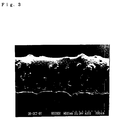
- the structure of the resultant wire saw is schematically shown in cross-section in Fig. 1, and a state of its outer peripheral surface is shown as enlarged in a photomicrograph of Fig. 3 at 200 ⁇ magnification.
- Table 1 shows the actual grain size distribution of the aforementioned diamond filler having an average grain size of 2.6 ⁇ m and the diamond abrasive grains having an average grain size of 30 ⁇ m, as measured by a laser diffractometry particle size distribution measurement system (SALD-2000A made by Shimadzu Corporation) IRM 2 ⁇ 4 Nominal average grain size 2.6 ⁇ m IRM 30 ⁇ 40 Nominal average grain size 30 ⁇ m IRM 20 ⁇ 30 Nominal average grain size 21 ⁇ m Grain size ( ⁇ m) Content (%) Grain size ( ⁇ m) Content (%) Grain size ( ⁇ m) Content (%) below 1.1 2 Below 12.5 0 below 10.0 2 1.1 ⁇ 2.1 17 12.5 ⁇ 15.3 4 10.0 ⁇ 14.0 10 2.1 ⁇ 3.1 55 15.3 ⁇ 18.7 9 14.0 ⁇ 16.0 5 3.1 ⁇ 4.6 20 18.7 ⁇ 22.9 4 16.0 ⁇ 18.0 8 4.6 ⁇ 6.9 3 22.9 ⁇ 28.0 18 18.0 ⁇ 20.0 11 6.9 ⁇ 10.3 1 28.0 ⁇ 34.3 32 20.0 ⁇ 2
- IRM2-4 might be used as a filler containing approx. 1% of abrasive grain
- IRM30-40 and IRM20-30 might be used as abrasive grains containing approx. 4 % and approx. 12 % a filler, respectively.
- the phenolic resin coating material used in Preferred Example 1 was applied on a sheet of aluminium foil and baked for two hours to cure in a thermostatic chamber at 200 °C. Consequently, phenolic resin film approx. 30 ⁇ m thick was formed on the surface of the aluminium foil.
- a tensile tester AG-1000E made by Shimadzu Corporation
- the film showed a modulus of elasticity of 170 kg/mm 2 .
- the resin bond layer of the wire saw obtained in Preferred Example 1 had a softening temperature of 330 °C.
- the wire saw of Preferred Example 1 having the aforementioned structure and arrangement was subjected to cutting test, in which a single crystal silicon block 100 mm square was cut at a wire saw speed of 400 m/min. under a hold-down pressure of 2.5 kgf in the presence of running cooling water.
- the cutting work proceeded successfully at a cutting speed of 6.8 mm/min. immediately after the start of cutting and 4.6 mm/min. 1 hour thereafter.
- a polyester coating material (Delacoat E-220 produced by Nitto Denko Corporation; Preferred Example 2), a polyester-imide coating material (Isomid 40 produced by Nippon Shokubai Kagaku Kogyo Co., Ltd.; Preferred Example 3), a polyamide-imide coating material (HI-406) produced by Hitachi Chemical Co., Ltd; Preferred Example 4), a polyurethane coating material (TPU-6155 produced by Totoku Paint Co., Ltd.; Preferred Example 5), a bismaleimide resin coating (BMI-S produced by Mitsui Toatsu Chemicals, Inc.
- a polyester coating material (Delacoat E-220 produced by Nitto Denko Corporation; Preferred Example 2), a polyester-imide coating material (Isomid 40 produced by Nippon Shokubai Kagaku Kogyo Co., Ltd.; Preferred Example 3), a polyamide-imide coating material (HI-406) produced by Hitachi Chemical Co., Ltd; Preferred Example 4), a polyurethane coating material (
- Wire saws were fabricated in a similar manner as in Preferred Example 1, except that the solid contents of the phenolic resin, diamond filler, diamond abrasive grain were changed to 75 vol. %, 5 vol. % and 20 vol. % (Preferred Example 7); 70 vol. %,10 vol. % and 20 vol. % (Preferred Example 8); and 50 vol. %, 30 vol. % and 20 vol. % (Preferred Example 9), respectively.
- the resultant respective wire saws were subjected to cutting tests on single crystal silicon blocks, the results of which are given in Table 3.
- the table also shows the results of cutting tests on Preferred Examples 10 and 11 using very small filler contents as well as on Preferred Examples 12 and 13 using conversely large filler contents, respectively.
- variations in distribution of the abrasive grain size brought forth the 1% content of filler as replaced by the abrasive grain, though the blending ratio of the filler was 0 %, as shown in the table.
- Wire saws were fabricated in a similar manner as in Preferred Example 1, except that, in place of the diamond abrasive grain of 30 ⁇ m in average grain size, a diamond abrasive grain of 21 ⁇ m in average grain size (IRM20-30 produced by Tomei Diamond Co., Ltd.; Preferred Example 14), a Ni-plated diamond grain of 30 ⁇ m in average grain size (IRM-NP30-40 produced by Tomei Diamond Co., Ltd.; Preferred Example 15) and a Ni-plated diamond grain of 21 ⁇ m in average grain size (IRM-NP20-30; Preferred Example 16) were used, respectively.
- the resultant respective wire saws were cutting tests on single crystal silicon blocks, the results of which are given in Table 4.
- Example 2 Also in a similar manner as in Example 1, the grain size distribution of the diamond grain of 21 ⁇ m in average grain size was measured, the result of which is given in previous Table 1 Preferred example 14 Preferred example 15 Preferred example 16 Preferred example 17 Preferred example 18 Abrasive grain Diamond Ni-plated diamond Ni-plated diamond S i C Diamond Average abrasive grain Size ⁇ m 21 30 21 32 30 Filler Diamond Diamond Diamond Diamond S i C Average filler Grain size ⁇ m 2.6 2.6 2.6 1.2 Filler content vol. % 22.2 20.6 22.2 19.8 20.0 Core wire O.D. mm 0.233 0.238 0.232 0.237 0.238 Resin bond Layer thickness mm 0.018 0.018 0.017 0.017 0.017 Cutting speed A mm/min.
- Cutting speed A cutting speed immediately after start of cutting
- Cutting speed B cutting speed 1 hour after the start of cutting operation
- Filler content volumetric % to the volume of (resin + filler + abrasive grain) (determined based on grain size distribution)
- Wire saws were fabricated in similar manner as in Preferred Example 1, except that in place of the diamond abrasive grain of 30 ⁇ m in average grain size an SiC abrasive grain of 32 ⁇ m in average grain size (Green SiC Mesh 400 produced by FUJIMI Abrasive Materials Co., Ltd.: Preferred Example 17) was used and SiC of 1.2 ⁇ m in average grain size (Gree SiC Mesh 8000 produced by FUJIMI Abrasive Materials Co., Ltd.: Preferred Example 18) in place of the filler of 2.6 ⁇ m in average grain size.
- the resultant respective wire saws were subjected to cutting tests on single crystal silicon blocks, the results of which are given also in Table 4 above.
- Wire saws were fabricated in a similar manner as in Preferred Example 1, except that abrasive grains of Ni-plated diamond and diamond fillers were used, based on the abrasive grain size and blending ratios by volume as shown in Table 5.
- the resultant respective wire saws were subjected to cutting tests on single crystal silicon blocks, the results of which are given also in Table 5.
- Preferred Example 21 achieved higher cutting speeds both for A and B, cut surface showed larger irregularities as compared with other preferred examples.
- Comparative Example 4 using a smaller average grain size showed very low cutting speeds
- Comparative Example 5 using an average grain size larger than a half the core wire diameter resulted in inability of fixing the abrasive grains by baking.
- Wire saws were fabricated in a similar manner as in Preferred Example 1, except that abrasive grains of Ni-plated diamond and diamond fillers were used, based on the abrasive grain size and blending ratios by volume as shown in Table 6. The resultant respective wire saws were subjected to cutting tests on single crystal silicon blocks, the results of which are given also in Table 6.
- the wire saws according to the present invention are far superior to the wire saws of the comparative examples both in cuttting speed immediately after the start of cutting operation and in cutting speed 1 hour thereafter.
- the wire saws according to the present invention kept a substantially constant speed with a relatively small reduction from the level at 1 hour later the start of cutting, thus permitting continuous cutting operation.
- the aforementioned high performance of the wire saw according to the present invention results from the fact that the abrasive grains protruding outward are fixed fast and strongly to the outer periphery of the high-strength core wire with the filler-containing resin bond by being arranged so as to be provided with a high thermal resistance and abrasive resistance durable to a working pressure and heat during cutting operations.
- the resin used In order to secure such fast and strong fixing of the protruding and projecting abrasive grains, it is necessary that the resin used have 100 kg/mm 2 or higher modulus of elasticity and 200 °C or higher softening temperature and contain a hard filler.
- the aforementioned filler used as having a grain size smaller than two-thirds the resin bond layer thickness principally reinforces the resin bond by being embedded in the resin bond layer, while the aforementioned abrasive grain used as having a grain size larger than or equal to two-thirds the resin bond layer thickness according to the present invention permits the coating composition to be cured onto the aforesaid outer periphery of the core wire when baked, so that the abrasive grains protrude and project above the resin bond layer surface to form cutting edges and chip pockets.
- the core wire diameter, the type and quantity of the resin, abrasive grain and filler and the grain size of the abrasive grain and filler as well as height of protuberance of the abrasive grains are requiredly selected, within the scope of the present invention as defined by appended claims, depending on specific objects to be cut and cutting conditions so that an optimum working efficiency and working precision can be secured.
- the present invention provides readily and with an economical feasibility, an abrasive grain wire saw permitting such slicing work with a wire saw, as an irnproved substitution for the wafer slicing with loose abrasives according to the prior art.
- the wire saw according to the present invention provides a cutting ability at least 10 times as higher as that of the loose abrasives type together with an adequate working performance and precision.
Landscapes
- Engineering & Computer Science (AREA)
- Mechanical Engineering (AREA)
- Manufacturing & Machinery (AREA)
- Polishing Bodies And Polishing Tools (AREA)
- Finish Polishing, Edge Sharpening, And Grinding By Specific Grinding Devices (AREA)
Applications Claiming Priority (7)
| Application Number | Priority Date | Filing Date | Title |
|---|---|---|---|
| JP4715397 | 1997-02-14 | ||
| JP4715397 | 1997-02-14 | ||
| JP47153/97 | 1997-02-14 | ||
| JP31648297 | 1997-10-30 | ||
| JP31648297 | 1997-10-30 | ||
| JP316482/97 | 1997-10-30 | ||
| PCT/JP1998/000532 WO1998035784A1 (fr) | 1997-02-14 | 1998-02-09 | Cable de sciage et son procede de fabrication |
Publications (3)
| Publication Number | Publication Date |
|---|---|
| EP0916449A1 true EP0916449A1 (de) | 1999-05-19 |
| EP0916449A4 EP0916449A4 (de) | 2001-04-18 |
| EP0916449B1 EP0916449B1 (de) | 2003-03-12 |
Family
ID=26387301
Family Applications (1)
| Application Number | Title | Priority Date | Filing Date |
|---|---|---|---|
| EP98901565A Expired - Lifetime EP0916449B1 (de) | 1997-02-14 | 1998-02-09 | Drahtsäge und herstellung derselben |
Country Status (9)
| Country | Link |
|---|---|
| US (1) | US6070570A (de) |
| EP (1) | EP0916449B1 (de) |
| JP (1) | JP3078020B2 (de) |
| KR (1) | KR100306358B1 (de) |
| CN (1) | CN1129506C (de) |
| DE (1) | DE69812042T2 (de) |
| MY (1) | MY118546A (de) |
| TW (1) | TW379151B (de) |
| WO (1) | WO1998035784A1 (de) |
Cited By (16)
| Publication number | Priority date | Publication date | Assignee | Title |
|---|---|---|---|---|
| EP1025942A3 (de) * | 1999-02-04 | 2001-04-18 | Ricoh Company, Ltd. | Abrasiver Sägedraht und Verfahren zu seiner Herstellung |
| WO2001085376A1 (de) * | 2000-05-11 | 2001-11-15 | Wacker-Chemie Gmbh | Nickel-diamant beschichteter sägedraht mit verbesserter verankerung der diamantpartikel |
| DE10103856B4 (de) * | 2001-01-30 | 2005-09-29 | Dia-G Kiel Diamantwerkzeuge Gmbh | Sägeblatt |
| ES2270694A1 (es) * | 2005-04-05 | 2007-04-01 | Frco. Javier Menendez Martinez | Cable de corte. |
| CN103341918A (zh) * | 2013-07-08 | 2013-10-09 | 长沙岱勒新材料科技有限公司 | 一种树脂线锯及其制备方法 |
| CN103753721A (zh) * | 2014-01-21 | 2014-04-30 | 开封恒锐新金刚石制品有限公司 | 利用金属粉末掺杂树脂浆料生产树脂金刚线的方法 |
| US9067268B2 (en) | 2009-08-14 | 2015-06-30 | Saint-Gobain Abrasives, Inc. | Abrasive articles including abrasive particles bonded to an elongated body |
| US9186816B2 (en) | 2010-12-30 | 2015-11-17 | Saint-Gobain Abrasives, Inc. | Abrasive article and method of forming |
| US9211634B2 (en) | 2011-09-29 | 2015-12-15 | Saint-Gobain Abrasives, Inc. | Abrasive articles including abrasive particles bonded to an elongated substrate body having a barrier layer, and methods of forming thereof |
| US9254552B2 (en) | 2012-06-29 | 2016-02-09 | Saint-Gobain Abrasives, Inc. | Abrasive article and method of forming |
| US9278429B2 (en) | 2012-06-29 | 2016-03-08 | Saint-Gobain Abrasives, Inc. | Abrasive article for abrading and sawing through workpieces and method of forming |
| US9375826B2 (en) | 2011-09-16 | 2016-06-28 | Saint-Gobain Abrasives, Inc. | Abrasive article and method of forming |
| US9409243B2 (en) | 2013-04-19 | 2016-08-09 | Saint-Gobain Abrasives, Inc. | Abrasive article and method of forming |
| US9533397B2 (en) | 2012-06-29 | 2017-01-03 | Saint-Gobain Abrasives, Inc. | Abrasive article and method of forming |
| US9902044B2 (en) | 2012-06-29 | 2018-02-27 | Saint-Gobain Abrasives, Inc. | Abrasive article and method of forming |
| EP3313616A4 (de) * | 2015-06-29 | 2019-01-16 | Saint-gobain Abrasives, Inc | Schleifartikel |
Families Citing this family (53)
| Publication number | Priority date | Publication date | Assignee | Title |
|---|---|---|---|---|
| US6369039B1 (en) | 1998-06-30 | 2002-04-09 | Scimed Life Sytems, Inc. | High efficiency local drug delivery |
| US6335029B1 (en) | 1998-08-28 | 2002-01-01 | Scimed Life Systems, Inc. | Polymeric coatings for controlled delivery of active agents |
| DE19841492A1 (de) * | 1998-09-10 | 2000-03-23 | Wacker Siltronic Halbleitermat | Verfahren und Vorrichtung zum Abtrennen einer Vielzahl von Scheiben von einem sprödharten Werkstück |
| JP4080141B2 (ja) * | 2000-05-22 | 2008-04-23 | 株式会社リコー | ワイヤ工具の製造方法 |
| EP1310316B1 (de) * | 2001-11-13 | 2008-10-22 | sia Abrasives Industries AG | Sägegarn |
| AU2003211347A1 (en) * | 2002-03-01 | 2003-09-16 | Neomax Co., Ltd. | Method of cutting rare earth alloy |
| US6915796B2 (en) * | 2002-09-24 | 2005-07-12 | Chien-Min Sung | Superabrasive wire saw and associated methods of manufacture |
| US20040134478A1 (en) * | 2003-01-09 | 2004-07-15 | Bailey Charles M. | Aggregate cutting saw chain |
| JP4411062B2 (ja) | 2003-12-25 | 2010-02-10 | 株式会社アライドマテリアル | 超砥粒ワイヤソー巻き付け構造、超砥粒ワイヤソー切断装置および超砥粒ワイヤソーの巻き付け方法 |
| JP2006179677A (ja) * | 2004-12-22 | 2006-07-06 | Japan Fine Steel Co Ltd | ソーワイヤ |
| US8291895B2 (en) | 2007-09-05 | 2012-10-23 | University Of South Carolina | Methods, wires, and apparatus for slicing hard materials |
| JP5557391B2 (ja) * | 2007-10-30 | 2014-07-23 | ポール・コーポレーション | 基板材料からウェハ状スライスを製造するための方法及びシステム |
| US20090320819A1 (en) * | 2008-05-21 | 2009-12-31 | Bachrach Robert Z | Carbon nanotube fiber wire for wafer slicing |
| JP5475772B2 (ja) * | 2008-07-11 | 2014-04-16 | サンーゴバン アブレイシブズ,インコーポレイティド | ワイヤスライシングシステム |
| DE102008049730B4 (de) * | 2008-09-30 | 2015-05-13 | Noritake Super Abrasive Co., Ltd. | Harzgebundene Drahtsägevorrichtung |
| US20120037140A1 (en) * | 2009-04-29 | 2012-02-16 | Nv Bekaert Sa | Fixed abrasive sawing wire with a rough interface between core and outer sheath |
| CN102413983A (zh) * | 2009-04-29 | 2012-04-11 | 贝卡尔特公司 | 具有部分嵌入金属线且部分由有机粘合剂保留的磨料颗粒的切割线 |
| CN101564828B (zh) * | 2009-06-03 | 2011-02-09 | 南京师范大学 | 切割硬、脆性材料的丝锯及其制造方法 |
| CN102458768A (zh) * | 2009-06-05 | 2012-05-16 | 应用材料公司 | 用于制造磨料线的设备和方法 |
| JP5833550B2 (ja) * | 2009-07-31 | 2015-12-16 | ダイヤモンド イノベイションズ インコーポレーテッド | 表面変性研磨材粒子を含む精密ワイヤ |
| WO2011020109A2 (en) | 2009-08-14 | 2011-02-17 | Saint-Gobain Abrasives, Inc. | Abrasive articles including abrasive particles bonded to an elongated body, and methods of forming thereof |
| KR20110048660A (ko) * | 2009-11-03 | 2011-05-12 | 일진다이아몬드(주) | 다이아몬드 와이어 쏘 |
| TWI461249B (zh) * | 2010-04-27 | 2014-11-21 | 中國砂輪企業股份有限公司 | 線鋸及其製作方法 |
| WO2011138192A2 (en) | 2010-05-04 | 2011-11-10 | Nv Bekaert Sa | Fixed abrasive sawing wire with removable protective coating |
| EP2572009A1 (de) | 2010-05-20 | 2013-03-27 | Universiteit Gent | Poröses 3d-material mit bearbeiteter seite |
| WO2012055711A1 (en) | 2010-10-28 | 2012-05-03 | Nv Bekaert Sa | A fixed abrasive sawing wire and a method to produce such wire |
| CN103189158B (zh) | 2010-10-29 | 2016-05-18 | 贝卡尔特公司 | 具有电镀在衬底线上的磨料颗粒的锯线 |
| DE102011008854A1 (de) * | 2011-01-18 | 2012-07-19 | Centrotherm Sitec Gmbh | Verfahren zum Schneiden von Halbleitermaterialien |
| JP5651045B2 (ja) * | 2011-02-28 | 2015-01-07 | 株式会社東京精密 | 切断用ブレード |
| US8778259B2 (en) | 2011-05-25 | 2014-07-15 | Gerhard B. Beckmann | Self-renewing cutting surface, tool and method for making same using powder metallurgy and densification techniques |
| JP2013038116A (ja) * | 2011-08-04 | 2013-02-21 | Sumitomo Electric Ind Ltd | Iii族窒化物結晶基板の製造方法 |
| CN102935420B (zh) * | 2011-08-15 | 2014-06-25 | 浙江瑞翌新材料科技有限公司 | 金刚石线锯植砂方法及系统 |
| JP5588483B2 (ja) * | 2011-08-18 | 2014-09-10 | 株式会社コベルコ科研 | 樹脂被覆ソーワイヤおよび切断体 |
| EP2572818A1 (de) | 2011-09-23 | 2013-03-27 | NV Bekaert SA | Starrer schleifender Sägedraht mit verbesserter Schleifpartikelerhaltung |
| TWI455965B (zh) * | 2012-04-24 | 2014-10-11 | Kinik Co | 線鋸及其製造方法 |
| TWI572439B (zh) * | 2012-05-31 | 2017-03-01 | Read Co Ltd | A fixed abrasive wire saw and its manufacturing method, and a method for cutting the workpiece using the same |
| TW201404528A (zh) * | 2012-06-29 | 2014-02-01 | 聖高拜磨料有限公司 | 研磨物品及形成方法 |
| TWI605113B (zh) * | 2012-07-05 | 2017-11-11 | 江陰貝卡爾特合金材料有限公司 | 具有立方八面體鑽石粒子之固定磨料鋸線 |
| CN102942836B (zh) * | 2012-11-28 | 2016-06-15 | 长沙岱勒新材料科技股份有限公司 | 光固化涂料,由其制得的光固化线锯及其制备方法和装置 |
| JP5792208B2 (ja) | 2013-01-10 | 2015-10-07 | 株式会社Tkx | レジンボンドワイヤーソー |
| JP6083511B2 (ja) * | 2013-03-12 | 2017-02-22 | パナソニックIpマネジメント株式会社 | 引掛装置 |
| JP6083510B2 (ja) * | 2013-03-12 | 2017-02-22 | パナソニックIpマネジメント株式会社 | 物品保持装置 |
| CN104070233A (zh) * | 2013-03-26 | 2014-10-01 | 蒙特集团(香港)有限公司 | 带磨料线锯及其制备方法 |
| CN103286865A (zh) * | 2013-05-19 | 2013-09-11 | 南京师范大学 | 一种金刚线及其制造方法 |
| CN104760146B (zh) * | 2014-01-08 | 2016-08-17 | 凡登(江苏)新型材料有限公司 | 一种用于多线切割的复合固结磨料锯线及其制备方法 |
| CN103737730B (zh) * | 2014-01-24 | 2015-12-02 | 华晶精密制造股份有限公司 | 一种金刚石切割线生产设备用磁铁定位机构 |
| CN104928671B (zh) * | 2014-03-21 | 2017-10-10 | 中国有色桂林矿产地质研究院有限公司 | 一种超硬材料工具的表面锌铬化处理方法及该方法中使用的锌铬包覆涂料 |
| US9873159B2 (en) | 2014-12-30 | 2018-01-23 | Corner Star Limited | Systems and methods for manufacturing diamond coated wires |
| JP6698682B2 (ja) | 2015-03-13 | 2020-05-27 | べカルト ビンジャン スチール コード カンパニー.,リミテッドBekaert Binjiang Steel Cord Co.,Ltd | 金属合金固定層を有する固定砥粒ソーワイヤーの製造方法及びそれにより得られるワイヤー |
| CN106273007B (zh) * | 2015-05-22 | 2017-11-03 | 江苏益林金刚石工具有限公司 | 一种复合结合剂金刚石线锯的制备方法 |
| TWI664057B (zh) | 2015-06-29 | 2019-07-01 | 美商聖高拜磨料有限公司 | 研磨物品及形成方法 |
| CN110548925B (zh) * | 2019-09-09 | 2020-05-29 | 李国生 | 一种环形磨料锯原线的制造方法 |
| CN115139231A (zh) * | 2021-03-31 | 2022-10-04 | 江苏海川光电新材料有限公司 | 一种金属微拉母线柔韧性的制造方法 |
Family Cites Families (12)
| Publication number | Priority date | Publication date | Assignee | Title |
|---|---|---|---|---|
| JPS50102993A (de) * | 1974-01-21 | 1975-08-14 | ||
| US4139659A (en) * | 1975-06-02 | 1979-02-13 | Lumalampan Ab | Thin composite wire saw with surface cutting crystals |
| US4015931A (en) * | 1975-09-29 | 1977-04-05 | Engelhard Minerals & Chemicals Corporation | Bonded-abrasive wire saw |
| US4384564A (en) * | 1981-01-22 | 1983-05-24 | Crystal Systems Inc. | Process of forming a plated wirepack with abrasive particles only in the cutting surface with a controlled kerf |
| JPS603547B2 (ja) * | 1982-05-18 | 1985-01-29 | 住友電気工業株式会社 | ワイヤ−成型加工法 |
| JPS6464717A (en) * | 1987-09-04 | 1989-03-10 | Kanai Hiroyuki | Wire for wire saw |
| JPH01271117A (ja) * | 1988-04-22 | 1989-10-30 | Kanai Hiroyuki | ワイヤソー用ワイヤ |
| DE69123749T2 (de) * | 1990-10-09 | 1997-06-05 | Minnesota Mining & Mfg | Erodierbare agglomerate enthaltendes beschichtetes schleifmittel |
| JP3557231B2 (ja) * | 1993-09-24 | 2004-08-25 | 憲一 石川 | ダイヤモンド電着ワイヤ工具及びその製造方法 |
| JPH08126953A (ja) * | 1994-10-28 | 1996-05-21 | Shin Etsu Handotai Co Ltd | ワイヤソー及びワイヤの製造方法 |
| JPH09155631A (ja) * | 1995-12-04 | 1997-06-17 | Asahi Daiyamondo Kogyo Kk | ダイヤモンドワイヤーソー及びその製造方法 |
| JPH11216657A (ja) * | 1998-01-30 | 1999-08-10 | Sumitomo Electric Ind Ltd | ワイヤーソー及びその使用方法 |
-
1998
- 1998-02-09 CN CN98800112A patent/CN1129506C/zh not_active Expired - Lifetime
- 1998-02-09 WO PCT/JP1998/000532 patent/WO1998035784A1/ja not_active Ceased
- 1998-02-09 EP EP98901565A patent/EP0916449B1/de not_active Expired - Lifetime
- 1998-02-09 KR KR1019980708164A patent/KR100306358B1/ko not_active Expired - Fee Related
- 1998-02-09 US US09/155,718 patent/US6070570A/en not_active Expired - Lifetime
- 1998-02-09 DE DE69812042T patent/DE69812042T2/de not_active Expired - Lifetime
- 1998-02-09 JP JP10535560A patent/JP3078020B2/ja not_active Expired - Lifetime
- 1998-02-12 TW TW087101913A patent/TW379151B/zh not_active IP Right Cessation
- 1998-02-13 MY MYPI98000613A patent/MY118546A/en unknown
Cited By (21)
| Publication number | Priority date | Publication date | Assignee | Title |
|---|---|---|---|---|
| US6463921B2 (en) | 1999-02-04 | 2002-10-15 | Ricoh Company, Ltd. | Abrasive wire for a wire saw and a method of manufacturing the abrasive wire |
| EP1025942A3 (de) * | 1999-02-04 | 2001-04-18 | Ricoh Company, Ltd. | Abrasiver Sägedraht und Verfahren zu seiner Herstellung |
| WO2001085376A1 (de) * | 2000-05-11 | 2001-11-15 | Wacker-Chemie Gmbh | Nickel-diamant beschichteter sägedraht mit verbesserter verankerung der diamantpartikel |
| US6783442B2 (en) | 2000-05-11 | 2004-08-31 | Wacker-Chemie Gmbh | Nickel-diamond-coated saw wire with improved anchoring of the diamond particles |
| DE10103856B4 (de) * | 2001-01-30 | 2005-09-29 | Dia-G Kiel Diamantwerkzeuge Gmbh | Sägeblatt |
| ES2270694A1 (es) * | 2005-04-05 | 2007-04-01 | Frco. Javier Menendez Martinez | Cable de corte. |
| ES2270694B1 (es) * | 2005-04-05 | 2008-04-16 | Frco. Javier Menendez Martinez | Cable de corte. |
| US9067268B2 (en) | 2009-08-14 | 2015-06-30 | Saint-Gobain Abrasives, Inc. | Abrasive articles including abrasive particles bonded to an elongated body |
| US9186816B2 (en) | 2010-12-30 | 2015-11-17 | Saint-Gobain Abrasives, Inc. | Abrasive article and method of forming |
| US9248583B2 (en) | 2010-12-30 | 2016-02-02 | Saint-Gobain Abrasives, Inc. | Abrasive article and method of forming |
| US9375826B2 (en) | 2011-09-16 | 2016-06-28 | Saint-Gobain Abrasives, Inc. | Abrasive article and method of forming |
| US9211634B2 (en) | 2011-09-29 | 2015-12-15 | Saint-Gobain Abrasives, Inc. | Abrasive articles including abrasive particles bonded to an elongated substrate body having a barrier layer, and methods of forming thereof |
| US9254552B2 (en) | 2012-06-29 | 2016-02-09 | Saint-Gobain Abrasives, Inc. | Abrasive article and method of forming |
| US9278429B2 (en) | 2012-06-29 | 2016-03-08 | Saint-Gobain Abrasives, Inc. | Abrasive article for abrading and sawing through workpieces and method of forming |
| US9533397B2 (en) | 2012-06-29 | 2017-01-03 | Saint-Gobain Abrasives, Inc. | Abrasive article and method of forming |
| US9902044B2 (en) | 2012-06-29 | 2018-02-27 | Saint-Gobain Abrasives, Inc. | Abrasive article and method of forming |
| US9409243B2 (en) | 2013-04-19 | 2016-08-09 | Saint-Gobain Abrasives, Inc. | Abrasive article and method of forming |
| CN103341918A (zh) * | 2013-07-08 | 2013-10-09 | 长沙岱勒新材料科技有限公司 | 一种树脂线锯及其制备方法 |
| CN103341918B (zh) * | 2013-07-08 | 2016-04-13 | 长沙岱勒新材料科技股份有限公司 | 一种树脂线锯及其制备方法 |
| CN103753721A (zh) * | 2014-01-21 | 2014-04-30 | 开封恒锐新金刚石制品有限公司 | 利用金属粉末掺杂树脂浆料生产树脂金刚线的方法 |
| EP3313616A4 (de) * | 2015-06-29 | 2019-01-16 | Saint-gobain Abrasives, Inc | Schleifartikel |
Also Published As
| Publication number | Publication date |
|---|---|
| JP3078020B2 (ja) | 2000-08-21 |
| US6070570A (en) | 2000-06-06 |
| DE69812042T2 (de) | 2003-10-16 |
| EP0916449A4 (de) | 2001-04-18 |
| CN1216014A (zh) | 1999-05-05 |
| CN1129506C (zh) | 2003-12-03 |
| KR100306358B1 (ko) | 2001-11-30 |
| TW379151B (en) | 2000-01-11 |
| WO1998035784A1 (fr) | 1998-08-20 |
| KR20000064902A (ko) | 2000-11-06 |
| EP0916449B1 (de) | 2003-03-12 |
| MY118546A (en) | 2004-12-31 |
| DE69812042D1 (de) | 2003-04-17 |
Similar Documents
| Publication | Publication Date | Title |
|---|---|---|
| EP0916449B1 (de) | Drahtsäge und herstellung derselben | |
| JPWO1998035784A1 (ja) | ワイヤーソー及びその製造方法 | |
| TWI517919B (zh) | 有研磨粒部份嵌入金屬線且部份以有機黏合劑固持之鋸線 | |
| US6736709B1 (en) | Grooved polishing pads for chemical mechanical planarization | |
| JP4024934B2 (ja) | ワイヤーソー及びその製造方法 | |
| US6749485B1 (en) | Hydrolytically stable grooved polishing pads for chemical mechanical planarization | |
| JP2000271872A (ja) | 超砥粒レジンボンドワイヤソー | |
| US5792544A (en) | Flexible abrasive article and method for making the same | |
| MX2013007616A (es) | Articulo abrasivo y metodo de formacion. | |
| Enomoto et al. | Development of a resinoid diamond wire containing metal powder for slicing a slicing ingot | |
| JP2000246542A (ja) | レジンボンド超砥粒ワイヤーソー | |
| JP2009285791A (ja) | ワイヤソーおよびその製造方法 | |
| JPH11216657A (ja) | ワイヤーソー及びその使用方法 | |
| CN203566873U (zh) | 一种多线切割用异构固结磨料锯线及其制造设备 | |
| JP2002036091A (ja) | 超砥粒ワイヤソーとその製造方法 | |
| JPH11216658A (ja) | ワイヤーソーの製造方法並びにワイヤーソー | |
| JP4072512B2 (ja) | 超砥粒ワイヤソーの超砥粒割合の算出方法 | |
| US7097678B2 (en) | Metal-coated cubic boron nitride abrasive grain, production method thereof, and resin bonded grinding wheel | |
| WO1999010129A1 (en) | A pad for chemical-mechanical polishing and apparatus and methods of manufacture thereof | |
| KR20200109939A (ko) | 다이아몬드 와이어 쏘우 및 이의 제조방법 | |
| JP2008006584A (ja) | 超砥粒ワイヤソーを用いた切断方法 | |
| JP2010036288A (ja) | 研磨用治具 | |
| DE69004465T2 (de) | Schleifmittel. | |
| CN104379695A (zh) | 树脂结合线锯用的粘接剂组合物以及树脂结合线锯的制造方法 | |
| EP1702969B1 (de) | Metallüberzogene würfelförmige bornitridschleifkörner und verfahren zu deren herstellung sowie harzverbundener schleifstein |
Legal Events
| Date | Code | Title | Description |
|---|---|---|---|
| PUAI | Public reference made under article 153(3) epc to a published international application that has entered the european phase |
Free format text: ORIGINAL CODE: 0009012 |
|
| 17P | Request for examination filed |
Effective date: 19981026 |
|
| AK | Designated contracting states |
Kind code of ref document: A1 Designated state(s): DE FR GB IT |
|
| A4 | Supplementary search report drawn up and despatched |
Effective date: 20010302 |
|
| AK | Designated contracting states |
Kind code of ref document: A4 Designated state(s): DE FR GB IT |
|
| RIC1 | Information provided on ipc code assigned before grant |
Free format text: 7B 24B 27/06 A, 7B 23D 61/18 B |
|
| RAP1 | Party data changed (applicant data changed or rights of an application transferred) |
Owner name: A.L.M.T. CORP. Owner name: SUMITOMO ELECTRIC INDUSTRIES, LTD. |
|
| GRAG | Despatch of communication of intention to grant |
Free format text: ORIGINAL CODE: EPIDOS AGRA |
|
| 17Q | First examination report despatched |
Effective date: 20020513 |
|
| GRAG | Despatch of communication of intention to grant |
Free format text: ORIGINAL CODE: EPIDOS AGRA |
|
| GRAH | Despatch of communication of intention to grant a patent |
Free format text: ORIGINAL CODE: EPIDOS IGRA |
|
| GRAH | Despatch of communication of intention to grant a patent |
Free format text: ORIGINAL CODE: EPIDOS IGRA |
|
| GRAA | (expected) grant |
Free format text: ORIGINAL CODE: 0009210 |
|
| AK | Designated contracting states |
Designated state(s): DE FR GB IT |
|
| REG | Reference to a national code |
Ref country code: GB Ref legal event code: FG4D |
|
| REF | Corresponds to: |
Ref document number: 69812042 Country of ref document: DE Date of ref document: 20030417 Kind code of ref document: P |
|
| ET | Fr: translation filed | ||
| PLBE | No opposition filed within time limit |
Free format text: ORIGINAL CODE: 0009261 |
|
| STAA | Information on the status of an ep patent application or granted ep patent |
Free format text: STATUS: NO OPPOSITION FILED WITHIN TIME LIMIT |
|
| 26N | No opposition filed |
Effective date: 20031215 |
|
| PGFP | Annual fee paid to national office [announced via postgrant information from national office to epo] |
Ref country code: IT Payment date: 20120221 Year of fee payment: 15 |
|
| PGFP | Annual fee paid to national office [announced via postgrant information from national office to epo] |
Ref country code: FR Payment date: 20130301 Year of fee payment: 16 Ref country code: GB Payment date: 20130207 Year of fee payment: 16 |
|
| PGFP | Annual fee paid to national office [announced via postgrant information from national office to epo] |
Ref country code: DE Payment date: 20140417 Year of fee payment: 17 |
|
| GBPC | Gb: european patent ceased through non-payment of renewal fee |
Effective date: 20140209 |
|
| REG | Reference to a national code |
Ref country code: FR Ref legal event code: ST Effective date: 20141031 |
|
| PG25 | Lapsed in a contracting state [announced via postgrant information from national office to epo] |
Ref country code: FR Free format text: LAPSE BECAUSE OF NON-PAYMENT OF DUE FEES Effective date: 20140228 Ref country code: GB Free format text: LAPSE BECAUSE OF NON-PAYMENT OF DUE FEES Effective date: 20140209 |
|
| REG | Reference to a national code |
Ref country code: DE Ref legal event code: R119 Ref document number: 69812042 Country of ref document: DE |
|
| PG25 | Lapsed in a contracting state [announced via postgrant information from national office to epo] |
Ref country code: DE Free format text: LAPSE BECAUSE OF NON-PAYMENT OF DUE FEES Effective date: 20150901 |
|
| PG25 | Lapsed in a contracting state [announced via postgrant information from national office to epo] |
Ref country code: IT Free format text: LAPSE BECAUSE OF NON-PAYMENT OF DUE FEES Effective date: 20140209 |