EP0916662A2 - Ascorbylsorbate - Google Patents

Ascorbylsorbate Download PDF

Info

Publication number
EP0916662A2
EP0916662A2 EP98119589A EP98119589A EP0916662A2 EP 0916662 A2 EP0916662 A2 EP 0916662A2 EP 98119589 A EP98119589 A EP 98119589A EP 98119589 A EP98119589 A EP 98119589A EP 0916662 A2 EP0916662 A2 EP 0916662A2
Authority
EP
European Patent Office
Prior art keywords
ascorbic acid
ascorbyl
formula
sorbates
hydrogen
Prior art date
Legal status (The legal status is an assumption and is not a legal conclusion. Google has not performed a legal analysis and makes no representation as to the accuracy of the status listed.)
Withdrawn
Application number
EP98119589A
Other languages
English (en)
French (fr)
Other versions
EP0916662A3 (de
Inventor
Harald Dr. Streicher
Linda Dr. von dem Bussche-Hünnefeld
Horst Westenfelder
Hans-Ulrich Dr. Wekel
Current Assignee (The listed assignees may be inaccurate. Google has not performed a legal analysis and makes no representation or warranty as to the accuracy of the list.)
BASF SE
Original Assignee
BASF SE
Priority date (The priority date is an assumption and is not a legal conclusion. Google has not performed a legal analysis and makes no representation as to the accuracy of the date listed.)
Filing date
Publication date
Application filed by BASF SE filed Critical BASF SE
Publication of EP0916662A2 publication Critical patent/EP0916662A2/de
Publication of EP0916662A3 publication Critical patent/EP0916662A3/de
Withdrawn legal-status Critical Current

Links

Classifications

    • AHUMAN NECESSITIES
    • A61MEDICAL OR VETERINARY SCIENCE; HYGIENE
    • A61QSPECIFIC USE OF COSMETICS OR SIMILAR TOILETRY PREPARATIONS
    • A61Q1/00Make-up preparations; Body powders; Preparations for removing make-up
    • A61Q1/02Preparations containing skin colorants, e.g. pigments
    • A61Q1/04Preparations containing skin colorants, e.g. pigments for lips
    • A61Q1/06Lipsticks
    • AHUMAN NECESSITIES
    • A61MEDICAL OR VETERINARY SCIENCE; HYGIENE
    • A61KPREPARATIONS FOR MEDICAL, DENTAL OR TOILETRY PURPOSES
    • A61K8/00Cosmetics or similar toiletry preparations
    • A61K8/18Cosmetics or similar toiletry preparations characterised by the composition
    • A61K8/30Cosmetics or similar toiletry preparations characterised by the composition containing organic compounds
    • A61K8/67Vitamins
    • A61K8/676Ascorbic acid, i.e. vitamin C
    • AHUMAN NECESSITIES
    • A61MEDICAL OR VETERINARY SCIENCE; HYGIENE
    • A61PSPECIFIC THERAPEUTIC ACTIVITY OF CHEMICAL COMPOUNDS OR MEDICINAL PREPARATIONS
    • A61P17/00Drugs for dermatological disorders
    • AHUMAN NECESSITIES
    • A61MEDICAL OR VETERINARY SCIENCE; HYGIENE
    • A61QSPECIFIC USE OF COSMETICS OR SIMILAR TOILETRY PREPARATIONS
    • A61Q17/00Barrier preparations; Preparations brought into direct contact with the skin for affording protection against external influences, e.g. sunlight, X-rays or other harmful rays, corrosive materials, bacteria or insect stings
    • AHUMAN NECESSITIES
    • A61MEDICAL OR VETERINARY SCIENCE; HYGIENE
    • A61QSPECIFIC USE OF COSMETICS OR SIMILAR TOILETRY PREPARATIONS
    • A61Q19/00Preparations for care of the skin
    • CCHEMISTRY; METALLURGY
    • C07ORGANIC CHEMISTRY
    • C07DHETEROCYCLIC COMPOUNDS
    • C07D307/00Heterocyclic compounds containing five-membered rings having one oxygen atom as the only ring hetero atom
    • C07D307/02Heterocyclic compounds containing five-membered rings having one oxygen atom as the only ring hetero atom not condensed with other rings
    • C07D307/34Heterocyclic compounds containing five-membered rings having one oxygen atom as the only ring hetero atom not condensed with other rings having two or three double bonds between ring members or between ring members and non-ring members
    • C07D307/56Heterocyclic compounds containing five-membered rings having one oxygen atom as the only ring hetero atom not condensed with other rings having two or three double bonds between ring members or between ring members and non-ring members with hetero atoms or with carbon atoms having three bonds to hetero atoms with at the most one bond to halogen, e.g. ester or nitrile radicals, directly attached to ring carbon atoms
    • C07D307/62Three oxygen atoms, e.g. ascorbic acid
    • AHUMAN NECESSITIES
    • A61MEDICAL OR VETERINARY SCIENCE; HYGIENE
    • A61KPREPARATIONS FOR MEDICAL, DENTAL OR TOILETRY PURPOSES
    • A61K2800/00Properties of cosmetic compositions or active ingredients thereof or formulation aids used therein and process related aspects
    • A61K2800/40Chemical, physico-chemical or functional or structural properties of particular ingredients
    • A61K2800/52Stabilizers
    • A61K2800/522Antioxidants; Radical scavengers
    • AHUMAN NECESSITIES
    • A61MEDICAL OR VETERINARY SCIENCE; HYGIENE
    • A61QSPECIFIC USE OF COSMETICS OR SIMILAR TOILETRY PREPARATIONS
    • A61Q17/00Barrier preparations; Preparations brought into direct contact with the skin for affording protection against external influences, e.g. sunlight, X-rays or other harmful rays, corrosive materials, bacteria or insect stings
    • A61Q17/04Topical preparations for affording protection against sunlight or other radiation; Topical sun tanning preparations
    • AHUMAN NECESSITIES
    • A61MEDICAL OR VETERINARY SCIENCE; HYGIENE
    • A61QSPECIFIC USE OF COSMETICS OR SIMILAR TOILETRY PREPARATIONS
    • A61Q19/00Preparations for care of the skin
    • A61Q19/08Anti-ageing preparations

Definitions

  • UV damage to the skin is partly due to the action of to explain free radicals.
  • Topically applied ascorbic acid protects the skin from UV damage (D. Darr, Br. J. Dermatol, 127 (1992) 247-253) as ascorbic acid as an antioxidant against free Radical works.
  • vitamin E tocopherol
  • Sorbic acid which is also widely used in the cosmetics sector become.
  • EP-A-0 313 304 describes the use of tocopheryl sorbate as a photoprotector.
  • Tocopheryl sorbate acts to prevent radiation into the skin against the formation of free radicals in the skin. Since the Active ingredient in the skin, it can not be rubbed off or wash and offers longer protection than the classic ones UV filter.
  • acyl radicals for R 1 and R 2 are to be understood as branched or unbranched, saturated or unsaturated, optionally polyunsaturated C 1 -C 20 -acyl chains.
  • acyl residues of the ant vinegar, propion, n-butter, iso-butter, sorbine, n-valerian, iso-valerian, Capron, Capryl, Caprin, Undecan, Laurin, Tridecan, Mysterin, pentadecane, palmitin, palmitolein, stearin, oil, Linoleic, linolenic, nonadecanoic and arachidonic acids.
  • acyl residues of sorbic acid and those of the long-chain fatty acids with C 10 to C 20 carbon chains are preferred, particularly preferably acyl residues of sorbic, lauric, palmitic, palmitoleic, stearic, oleic and linoleic acid.
  • R 1 and R 2 are branched or unbranched C 1 -C 12 alkyl chains, preferably methyl, ethyl, n-propyl, 1-methylethyl, n-butyl, 1-methylpropyl, 2-methylpropyl, 1,1-dimethylethyl , n-pentyl, 1-methylbutyl, 2-methylbutyl, 3-methylbutyl, 2,2-dimethylpropyl, 1-ethylpropyl, n-hexyl, 1,1-dimethylpropyl, 1,2-dimethylpropyl, 1-methylpentyl, 2-methylpentyl , 3-methylpentyl, 4-methylpentyl, 1,1-dimethylbutyl, 1,2-dimethylbutyl, 1,3-dimethylbutyl, 2,2-dimethylbutyl, 2,3-dimethylbutyl, 3,3-dimethylbutyl, 1-ethylbutyl, 2nd
  • alkyl radicals are C 1 -C 6 alkyl chains, in particular methyl, ethyl, n-propyl, 1-methylethyl, n-butyl, 1-methylpropyl, 2-methylpropyl, 1,1-dimethylethyl, n-pentyl, 1- Methyl butyl, 2-methyl butyl, 3-methyl butyl, 2,2-dimethyl propyl, 1-ethyl propyl, n-hexyl.
  • the radicals R 1 and R 2 together with the oxygen atoms to which they are attached and the carbon atoms bonded to the oxygen atoms can form an optionally substituted heterocycle.
  • These include, for example, cyclic acetals and ketals, which are used, inter alia, as a protective group for the two terminal hydroxyl functions (in the 5- and 6-position) of ascorbic acid.
  • a preferred heterocyclic system is, inter alia, the 5,6-isopropylidene residue, which is formed by reacting the two free hydroxyl groups in the 5- and 6-positions with acetone.
  • Suitable cations for R 3 are NH 4 + and representatives from the group of alkali and alkaline earth metals, preferably NH 4 + , Na, K, Li, Ca and Mg, particularly preferably Na, K and Mg.
  • ascorbyl sorbates includes both sorbic acid derivatives L and D-ascorbic acid (isoascorbic acid) are preferred to understand the L-ascorbic acid.
  • An advantage of the ascorbyl sorbates of the formula I is that the stabilizing sorbic acid residue on the ascorbic acid itself Active group that also serves as a radical quencher.
  • ascorbyl sorbates can be used of formula I good protection against free radicals, such as caused by UV radiation.
  • Tocopherol leaves however, only link to one sorbic acid residue. Because of the high molecular weight of tocopherol in contrast to Ascorbic acid is a link between sorbic acid and ascorbic acid advantageous because the active ingredient content per mole weight is higher is.
  • up to four can be added to ascorbic acid Attach sorbic acid residues, which has the radical quenching effect further increased.
  • Residues such as Attach phosphate, palmitate to ascorbic acid, which affects lipophilicity and solubility of the compound to let.
  • the 2-O-sorbinoyl-L-ascorbic acid according to the invention is water-soluble, the 6-O-palmitoyl-2-O-sorbinoyl-L-ascorbic acid is oil-soluble.
  • the different lipophilicity of the compounds I penetration in control the skin.
  • formulating a mixture of several Ascorbyl sorbates of different lipophilicity can be a very Protect broad skin layer from UV radiation.
  • the stable ascorbyl sorbates of the formula I according to the invention are therefore ideal as active ingredients for cosmetic and pharmaceutical preparations.
  • the compounds are distinguished, inter alia, in that the lipophilicity of the ascorbic acid derivatives can be specifically adjusted by varying the radicals R 1 and R 2 .
  • the application engineer has a wide range of stable vitamin C derivatives at his disposal.
  • the trisorbates and fatty acid esters of vitamin C-2 monosorbate in particular, can be incorporated very well into preparations such as ointments, lotions, gels or emulsions due to their good oil solubility.
  • the present invention also relates to cosmetics and pharmaceutical preparations containing an effective one Amount of at least one of the compounds of formula I as well usual cosmetic and pharmaceutical auxiliaries and additives.
  • the above Preparations can the compounds of formula I in Proportions of 0.01 to 10% by weight, preferably 0.1 to 8% by weight, particularly preferably 0.5 to 5% by weight, based on the total amount the cosmetic and pharmaceutical preparation.
  • the ascorbic acid derivatives of the formula I can be used i.a. in all cosmetic and pharmaceutical preparations, which besides water also emulsifiers, stabilizers, natural Oils, cosmetic oils, fats, waxes, silicone oils, silicone oil derivatives, Solubilizers, light stabilizers, active ingredients, Humectants, consistency agents, gelling agents, antioxidants, Preservatives included.
  • emulsifiers e.g. the following substances are used:
  • Polyglycerol fatty acid esters ethoxylates of fatty acids, sorbitan fatty acid esters, Phosphoric acid esters of fatty acids, phospholipids, Self-emulsifying glycerol monostearate and glycerol monostearate.
  • Stabilizers are:
  • Natural oils are e.g. Jojoba oil, sunflower oil, peanut oil, Almond oil, avocado oil, macadamia nut oil, castor nut oil, corn oil, Grape seed oil.
  • Cosmetic oils are, for example, isopropyl esters of fatty acids very special Isopropyl stearate, isopropyl palmitate, isopropyl isostearate, Isopropyl myristate, isopropyl laurate, paraffin oil, neutral oil.
  • Cosmetic agents are e.g. Panthenol, bisabolol, a-tocopherol, a-tocopherol acetate, aloe vera, algae extract, hyaluronic acid, Retinol and retinyl esters, phytantriol, panthenyl ethyl ether, Ferulic acid.
  • Acid 4-aminobenzoic acid 150-13-0 2nd 3- (4'trimethylammonium) benzylidenebornan-2-one methyl sulfate 52793-97-2 3rd 3,3,5-trimethylcyclohexyl salicylate (homosalatum) 118-56-9 4th 2-hydroxy-4-methoxy-benz
  • the ascorbyl sorbates of formula I are also for surfactants Suitable formulations.
  • the synthesis of the ascorbyl sorbates of the formula I takes place in itself known manner by base-catalyzed implementation of the ascorbic acid derivatives of the formula II with sorbic acid or sorbic acid derivatives, especially with sorbic acid chloride.
  • the production is carried out analogously to the known processes for the acylation of Ascorbic acid according to B. M. Tolberg et al. Ann., N.Y. Acad. Sci., 258 (1975) 48-69.
  • composition for moisturizer Mass content 6.00 PEG-7 hydrogenated castor oil 5.00 Isopropyl palmitate 6.00 Mineral oil 5.00 Jojoba oil 5.00 Almond oil 0.50 Tocopheryl acetates 2.00 2,5,6-O-trisorbinoyl-L-ascorbic acid 0.60 Magnesium stearates 2.00 PEG-45 / dodecyl glycol copolymer 5.00 Glycerin 0.25 Methyl paraben 0.15 Propyl paraben 5.00 Imidazolydinyl urea 0.15 Fragrance 0.20 Disodium EDTA ad 100 Water
  • composition for moisturizer Mass content 6.00 PEG-7 hydrogenated castor oil 5.00 Isopropyl palmitate 6.00 Mineral oil 5.00 Jojoba oil 5.00 Almond oil 0.50 Tocopheryl acetates 2.00 6-O-palmitoyl-2-O-sorbinoyl-L-ascorbic acid 0.60 Magnesium stearates 2.00 PEG-45 / dodecyl glycol copolymer 5.00 Glycerin 0.25 Methyl paraben 0.15 Propyl paraben 5.00 Imidazolydinyl urea 0.15 Fragrance 0.20 Disodium EDTA ad 100 Water
  • Composition for moisturizing day cream Mass content (% by weight) 2.00 Ceteareth / 6 2.00 Ceteareth / 25 10.00
  • Mineral oil 3.00
  • Caprylic acid / Caprate triglyceride 3.00
  • Isostearic acid 3.00 6-O-palmitoyl-2-O-sorbinoyl-L-ascorbic acid 1.50
  • Tocopheryl acetates 2.00
  • Tocopherol 0.20 Retinol 0.30
  • Glycerin 0.15 Dibromocyanobutanes 0.20 Sodium ascorbyl monophosphate 0.10 ⁇ -tocopherol 0.10 Ascorbyl palmitates 0.15 Fragrance ad 100 Water
  • Composition for moisturizing day cream Mass content (% by weight) 2.00 Ceteareth / 6 2.00 Ceteareth / 25 10.00
  • Mineral oil 3.00
  • Caprylic acid / Caprate triglyceride 3.00
  • Isostearic acid 3.00
  • 2-O-sorbinoyl-L-ascorbic acid 1.50
  • Tocopheryl acetates 2.00
  • D-panthenol USP 0.05
  • Tocopherol 0.20 Retinol 0.30 Glycerin 0.15 Dibromocyanobutanes 0.20 Sodium ascorbyl monophosphate 0.10 ⁇ -tocopherol 0.10 Ascorbyl palmitates 0.15 Fragrance ad 100 Water
  • Sunscreen composition (SPF 20) Mass content (% by weight) 8.00 Octyl methoxycinnamate 8.00 Titanium dioxide 6.00 PEG-7 hydrogenated castor oil 2.00 2-O-sorbinoyl-L-ascorbic acid 6.00 Mineral oil 5.00 Zinc oxide 5.00 Isopropyl palmitate 5.00 Imidazolidinyl urea 3.00 Jojoba oil 2.00 PEG-45 / dodecyl glycol copolymer 1.00 4-methylbenzylidenes camphor 0.60 Magnesium stearates 0.50 Tocopheryl acetates 0.25 Methyl paraben 0.20 Disodium EDTA 0.15 Propyl paraben ad 100 Water
  • Sunscreen composition (waterproof) Mass content (% by weight) 8.00 Octyl methoxycinnamate 5.00 PEG-7 hydrogenated castor oil 5.00 Propylene glycol 4.00 Isopropyl palmitate 4.00 Caprylic / capric triglyceride 3.00 6-O-palmitoyl-2-O-sorbinoyl-L-ascorbic acid 4.00 Glycerin 3.00 Jojoba oil 2.00 4-methylbenzylidenes camphor 2.00 Titanium dioxide 1.50 PEG-45 / dodecyl glycol copolymer 1.50 Dimethicone 0.70 Magnesium sulfates 0.50 Magnesium stearates 0.15 Fragrance ad 100 Water
  • Composition for sun milk (SPF 6) Mass content (% by weight) 10.00 Mineral oil 6.00 PEG-7 hydrogenated castor oil 5.00 Isopropyl palmitate 3.50 Octyl methoxycinnamate 2.00 2,5,6-trisorbinoyl-L-ascorbic acid 3.00 Caprylic / capric triglyceride 3.00 Jojoba oil 2.00 PEG-45 / dodecyl glycol copolymer 0.70 Magnesium sulfates 0.60 Magnesium stearates 0.50 Tocopheryl acetates 0.30 Glycerin 0.25 Methyl paraben 0.15 Propyl paraben 0.05 Tocopherol ad 100 Water
  • composition for lipstick Mass content 10.00 Glycerin 10.00 Titanium dioxide 2.00 2,5,6-trisorbinoyl-L-ascorbic acid 8.00 Octyl methoxycinnamate 5.00 Zinc oxide 4.00 Castor oil 4.00 Pentaerythrithyl stearate / caprate / caprylate adipate 3.00 Glyceryl stearate SE 2.00 Bees ax 2.00 Microcrystalline wax 2.00 Quaternium-18 bentonite 1.50 PEG-45 / dodecyl glycol copolymer ad 100 Eucerinum anhydricum

Landscapes

  • Health & Medical Sciences (AREA)
  • Life Sciences & Earth Sciences (AREA)
  • Veterinary Medicine (AREA)
  • Public Health (AREA)
  • General Health & Medical Sciences (AREA)
  • Animal Behavior & Ethology (AREA)
  • Organic Chemistry (AREA)
  • Chemical & Material Sciences (AREA)
  • Dermatology (AREA)
  • Epidemiology (AREA)
  • Birds (AREA)
  • Chemical Kinetics & Catalysis (AREA)
  • Pharmacology & Pharmacy (AREA)
  • Nuclear Medicine, Radiotherapy & Molecular Imaging (AREA)
  • Medicinal Chemistry (AREA)
  • General Chemical & Material Sciences (AREA)
  • Bioinformatics & Cheminformatics (AREA)
  • Engineering & Computer Science (AREA)
  • Cosmetics (AREA)
  • Pharmaceuticals Containing Other Organic And Inorganic Compounds (AREA)
  • Acyclic And Carbocyclic Compounds In Medicinal Compositions (AREA)
  • Organic Low-Molecular-Weight Compounds And Preparation Thereof (AREA)
  • Furan Compounds (AREA)
  • Medicinal Preparation (AREA)

Abstract

Ascorbylsorbate der allgemeinen Formel I, <IMAGE> in der die Variablen unabhängig voneinander folgende Bedeutung haben: R<1> und R<2> Wasserstoff, C1-C12-Alkyl, C1-C20-Acyl; wobei R<1> und R<2> gemeinsam mit den Sauerstoffatomen an die sie gebunden sind und den an den Sauerstoffatomen gebundenen Kohlenstoffatomen einen gegebenenfalls substituierten Heterozyklus bilden können; R<3> Wasserstoff oder ein Kation, ausgewählt aus der Gruppe, bestehend aus Alkali- und Erdalkalimetallen.

Description

Die UV-Schädigung der Haut ist zum Teil durch die Einwirkung von freien Radikalen zu erklären. Topisch aufgebrachte Ascorbinsäure schützt die Haut vor UV-Schädigung (D. Darr, Br. J. Dermatol, 127 (1992) 247-253), da Ascorbinsäure als Antioxidans gegen freie Radikale wirkt.
Die Erfahrung der Kosmetikindustrie zeigt aber, daß Ascorbinsäure in den meisten Formulierungen zu instabil ist. Deshalb werden Derivate der Ascorbinsäure eingesetzt, welche eine höhere Stabilität in Formulierungen aufweisen, aber immer noch in der Lage sind, Ascorbinsäure freizusetzen. Als Beispiel hierfür ist das L-Ascorbinsäure-2-O-D-glucosid zu nennen, das jedoch für den Einsatz in der Kosmetik häufig nicht lipophil genug ist.
Weitere wichtige Radikalfänger sind Tocopherol (Vitamin E) und Sorbinsäure, die im Kosmetiksektor ebenfalls vielfach eingesetzt werden.
So beschreibt EP-A-0 313 304 die Verwendung von Tocopherylsorbat als Photoprotektor.
Während UV-Filter auf der Haut bleiben und so ein Eindringen der Strahlung in die Haut verhindern sollen, wirkt Tocopherylsorbat der Bildung von freien Radikalen in der Haut entgegen. Da der Wirkstoff in der Haut vorliegt, läßt er sich nicht abreiben oder waschen und bietet so einen längeren Schutz, als die klassischen UV-Filter.
Es bestand nun die Aufgabe, neue Radikalfänger für die kosmetische und pharmazeutische Anwendung bereit zu stellen, die oxidationsstabil sind und über ein breites Eigenschaftsprofil hinsichtlich ihrer Lipophilie verfügen.
Diese Aufgabe wurde erfindungsgemäß gelöst durch Ascorbylsorbate der allgemeinen Formel I,
Figure 00020001
in der die Variablen unabhängig voneinander folgende Bedeutung haben:
  • R1 und R2
    Wasserstoff, C1-C12-Alkyl, C1-C20-Acyl;
    wobei R1 und R2 gemeinsam mit den Sauerstoffatomen an die sie gebunden sind und den an den Sauerstoffatomen gebundenen Kohlenstoffatomen einen gegebenenfalls substituierten Heterozyklus bilden können;
  • R3 Wasserstoff oder ein Kation, ausgewählt aus der Gruppe, bestehend aus NH4 +, Alkali- und Erdalkalimetallkationen.
  • Bevorzugt sind solche Verbindungen der Formel I, in der die Variablen unabhängig voneinander folgende Bedeutung haben:
  • R1 und R2
    Wasserstoff, C6-C20-Acyl;
  • R3 Wasserstoff oder ein Kation, ausgewählt aus der Gruppe, bestehend aus NH4 +, Alkali- und Erdalkalimetallkationen.
  • Besonders bevorzugt sind solche Verbindungen der Formel I, in der die Variablen unabhängig voneinander folgende Bedeutung haben:
  • R1 und R2
    Wasserstoff,
    Figure 00020002
  • R3 Wasserstoff oder ein Kation, ausgewählt aus der Gruppe, bestehend aus NH4 +, Alkali- und Erdalkalimetallkationen;
  • Bei den erfindungsgemäßen Ascorbylsorbaten der Formel I sind als Acylreste für R1 und R2 verzweigte oder unverzweigte, gesättigte oder ungesättigte, gegebenenfalls mehrfach ungesättigte C1-C20-Acylketten zu verstehen.
    Beispiele hierfür sind Acylreste der Ameisen-, Essig-, Propion-, n-Butter-, iso-Butter-, Sorbin-, n-Valerian-, iso-Valerian-, Capron-, Capryl-, Caprin-, Undecan-, Laurin-, Tridecan-, Mysterin-, Pentadecan-, Palmitin-, Palmitolein-, Stearin-, Öl-, Linol-, Linolen-, Nonadecan- und Arachidonsäure.
    Bevorzugt sind die Acylreste der Sorbinsäure sowie die der langkettigen Fettsäuren mit C10 bis C20 Kohlenstoffketten, besonders bevorzugt Acylreste der Sorbin-, Laurin-, Palmitin-, Palmitolein-, Stearin-, Öl- und Linolsäure.
    Als Alkylreste R1 und R2 seien verzweigte oder unverzweigte C1-C12-Alkylketten, bevorzugt Methyl, Ethyl, n-Propyl, 1-Methylethyl, n-Butyl, 1-Methylpropyl-, 2-Methylpropyl, 1,1-Dimethylethyl, n-Pentyl, 1-Methylbutyl, 2-Methylbutyl, 3-Methylbutyl, 2,2-Dimethylpropyl, 1-Ethylpropyl, n-Hexyl, 1,1-Dimethylpropyl, 1,2-Dimethylpropyl, 1-Methylpentyl, 2-Methylpentyl, 3-Methylpentyl, 4-Methylpentyl, 1,1-Dimethylbutyl, 1,2-Dimethylbutyl, 1,3-Dimethylbutyl, 2,2-Dimethylbutyl, 2,3-Dimethylbutyl, 3,3-Dimethylbutyl, 1-Ethylbutyl, 2-Ethylbutyl, 1,1,2-Trimethylpropyl, 1,2,2-Trimethylpropyl, 1-Ethyl-1-methylpropyl, 1-Ethyl-2-methylpropyl, n-Heptyl, n-Octyl, n-Nonyl, n-Decyl, n-Undecyl, n-Dodecyl genannt.
    Besonders bevorzugte Alkylreste sind C1-C6-Alkylketten, insbesondere Methyl, Ethyl, n-Propyl, 1-Methylethyl, n-Butyl, 1-Methylpropyl-, 2-Methylpropyl, 1,1-Dimethylethyl, n-Pentyl, 1-Methylbutyl, 2-Methylbutyl, 3-Methylbutyl, 2,2-Dimethylpropyl, 1-Ethylpropyl, n-Hexyl.
    Die Reste R1 und R2 können gemeinsam mit den Sauerstoffatomen an die sie gebunden sind und den an den Sauerstoffatomen gebundenen Kohlenstoffatomen einen gegebenenfalls substituierten Heterozyklus bilden. Darunter sind beispielsweise zyklische Acetale und Ketale gemeint, die u. a. als Schutzgruppe für die beiden endständigen Hydroxylfunktionen (in der 5- und 6-Position) der Ascorbinsäure eingesetzt werden. Ein bevorzugtes heterozyklisches System ist u.a. der 5,6-Isopropylidenrest, der durch Umsetzung der beiden freien Hydroxylgruppen in der 5- und 6-Position mit Aceton gebildet wird.
    Als Kationen für R3 kommen NH4 + sowie Vertreter aus der Gruppe der Alkali- und Erdalkalimetalle in Frage, bevorzugt NH4 +, Na, K, Li, Ca und Mg, besonders bevorzugt Na, K und Mg.
    Unter dem Begriff Ascorbylsorbate sind sowohl Sorbinsäurederivate der L- als auch der D-Ascorbinsäure (Isoascorbinsäure), bevorzugt der L-Ascorbinsäure zu verstehen.
    Vorteilhaft an den Ascorbylsorbaten der Formel I ist, daß der stabilisierende Sorbinsäurerest an der Ascorbinsäure selber eine Wirkgruppe ist, die ebenfalls als Radikalquencher dient.
    Ebenso wie mit Tocopherylsorbat läßt sich mit den Ascorbylsorbaten der Formel I ein guter Schutz vor freien Radikalen, wie z.B. durch UV-Strahlung hervorgerufen, erzielen. Tocopherol läßt sich jedoch nur mit einem Sorbinsäurerest verknüpfen. Aufgrund des hohen Molekulargewichtes des Tocopherols im Gegensatz zur Ascorbinsäure ist eine Verknüpfung von Sorbinsäure mit Ascorbinsäure vorteilhaft, da der Wirkstoffanteil pro Molgewicht höher ist. Desweiteren lassen sich an der Ascorbinsäure bis zu vier Sorbinsäurereste anknüpfen, was die radikalquenchende Wirkung weiter erhöht. Außer der Sorbinsäure lassen sich noch weitere Reste, wie z.B. Phosphat, Palmitat, an der Ascorbinsäure anbringen, womit sich Lipophilie und Löslichkeit der Verbindung beeinflussen lassen. Die erfindungsgemäße 2-O-Sorbinoyl-L-Ascorbinsäure ist wasserlöslich, die 6-O-Palmitoyl-2-O-sorbinoyl-L-ascorbinsäure ist öllöslich. Damit ist es möglich, die erfindungsgemäßen Ascorbylsorbate in sämtlichen gewünschten kosmetischen Formulierungen einzuarbeiten. Außerdem läßt sich durch die unterschiedliche Lipophilie der Verbindungen I die Penetration in die Haut steuern. Durch Formulieren einer Mischung von mehreren Ascorbylsorbaten unterschiedlicher Lipophilie läßt sich eine sehr breite Hautschicht vor UV-Strahlung schützen.
    Die erfindungsgemäßen stabilen Ascorbylsorbate der Formel I eignen sich somit hervorragend als Wirkstoffe für kosmetische und pharmazeutische Zubereitungen.
    So zeichnen sich die Verbindungen u.a. dadurch aus, daß man durch Variation der Reste R1 und R2 die Lipophilie der Ascorbinsäurederivate gezielt einstellen kann. Je nach Anforderung bei der Formulierung kosmetischer und pharmazeutischer Zubereitungen stehen dem Anwendungstechniker somit eine breite Palette stabiler Vitamin C-Derivate zur Verfügung. Besonders die Trisorbate und die Fettsäureester von Vitamin-C-2-monosorbat lassen sich aufgrund ihrer guten Öllöslichkeit sehr gut in Zubereitungen wie beispielsweise Salben, Lotionen, Gelen oder Emulsionen einarbeiten.
    Demgemäß sind auch Gegenstand der vorliegenden Erfindung kosmetische und pharmazeutische Zubereitungen, enthaltend eine wirksame Menge mindestens einer der Verbindungen der Formel I sowie übliche kosmetische und pharmazeutische Hilfs- und Zusatzstoffe.
    Die o.g. Zubereitungen können die Verbindungen der Formel I in Anteilen von 0,01 bis 10 Gew.-%, vorzugswiese 0,1 bis 8 Gew.-%, besonders bevorzugt 0,5 bis 5 Gew.-%, bezogen auf die Gesamtmenge der kosmetischen und pharmazetischen Zubereitung, enthalten.
    Eingesetzt werden können die Ascorbinsäurederivate der Formel I u.a. in allen kosmetischen und pharmazeutischen Zubereitungen, die neben Wasser auch noch Emulgatoren, Stabilisatoren, natürliche Öle, kosmetische Öle, Fette , Wachse, Siliconöle, Siliconölderivate, Solubilisatoren, Lichtschutzmittel, Wirkstoffe, Feuchthaltemittel, Konsitenzgeber, Gelbildner, Antioxidantien, Konservierungsmittel enthalten.
    Als Emulgatoren können z.B. folgende Substanzen verwendet werden:
    Polyglycerinfettsäureester, Ethoxylate von Fettsäuren, Sorbitanfettsäureester, Phosphorsäureester von Fettsäuren, Phospholipide, Glycerinmonostearat und Glycerinmonostearat selbstemulgierend.
    Unter Stabilisatoren versteht man:
    Magnesium und Aluminiumsalze von Fettsäuren, Komlexbildner wie EDTA, NTA, MGDA, Antioxidantien wie BHT, BHA, alpha Tocopherol, Gallsäure und ihre Salze und Ester.
    Natürliche Öle sind z.B. Jojobaöl, Sonnenblumenöl, Erdnußöl, Mandelöl, Avocadoöl, Macadamianußöl, Rizinußöl, Maiskeimöl, Traubenkernöl.
    Kosmetische Öle sind z.B.Isopropylester von Fettsäuren ganz besonders Isopropylstearat, Isopropylpalmitat, Isopropylisostearat, Isopropylmyristat, Isopropyllaurat, Paraffinöl, Neutralöl.
    Kosmetische Wirkstoffe sind z.B. Panthenol, Bisabolol, a-Tocopherol, a-Tocopherolacetat, Aloe Vera, Algenextrakt, Hyaluronsäure, Retinol und Retinylester, Phytantriol, Panthenylethylether, Ferulasäure.
    Lichtschutzmittel, die alleine oder als Gemisch zusammen mit den Verbindungen der Formel I verwendet werden können sind z.B.
    Nr. Stoff CAS-Nr. (=Säure)
    1 4-Aminobenzoesäure 150-13-0
    2 3-(4'Trimethylammonium)-benzylidenbornan-2-on-methylsulfat 52793-97-2
    3 3,3,5-Trimethyl-cyclohexyl-salicylat (Homosalatum) 118-56-9
    4 2-Hydroxy-4-methoxy-benzophenon (Oxybenzonum) 131-57-7
    5 2-Phenylbenzimidazol-5-sulfonsäure und ihre Kalium-, Natrium- u. Triethanolaminsalze 27503-81-7
    6 3,3'-(1,4-Phenylendimethin)-bis(7,7-dimethyl-2-oxobicyclo[2.2.1]heptan-1-methansulfonsäure) und ihre Salze 90457-82-2
    7 4-Bis(polyethoxy)amino-benzoesäurepolyethoxyethylester 113010-52-9
    8 4-Dimethylamino-benzoesäure-2-ethylhexylester 21245-02-3
    9 Salicylsäure-2-ethylhexylester 118-60-5
    10 4-Methoxy-zimtsäure-2-isoamylester 71617-10-2
    11 4-Methoxy-zimtsäure-2-ethylhexylester 5466-77-3
    12 2-Hydroxy-4-methoxy-benzophenon-5-sulfon-(Sulisobenzonum) und das Natriumsalz 4065-45-6
    13 3-(4'-Methyl)benzyliden-bornan-2-on 36861-47-9
    14 3-Benzylidenbornan-2-on 15087-24-8
    15 1-(4'-Isopropylphenyl)-3-phenylpropan-1,3-dion 63250-25-9
    16 4-Isopropylbenzylsalicylat 94134-93-7
    17 2,4,6-Trianilin-(o-carbo-2'-ethylhexyl-1'-oxy)-1,3,5-triazin 88122-99-0
    18 3-Imidazol-4-yl-acrylsäure und ihr Ethylester 104-98-3
    19 2-Cyano-3,3-diphenylacrylsäureethylester 5232-99-5
    20 2-Cyano-3,3-diphenylacrylsäure-2'-ethylhexylester 6197-30-4
    21 Menthyl-o-aminobenzoate oder: 5-Methyl-2-(1-methylethyl)-2-aminobenzoate 134-09-8
    22 Glyceryl p-aminobenzoat oder: 4-Aminobenzoesäure-1-glyceryl-ester 136-44-7
    23 2,2'-Dihydroxy-4-methoxybenzophenon (Dioxybenzone) 131-53-3
    24 2-Hydroxy-4-methoxy-4-methylbenzophenon (Mexonon) 1641-17-4
    25 Triethanolamin Salicylat 2174-16-5
    26 Dimethoxyphenylglyoxalsäure oder: 3,4-dimethoxy-phenyl-glyoxal-saures Natrium 4732-70-1
    27 3-(4'Sulfo)benzyliden-bornan-2-on und seine Salze 56039-58-8
    28 4-tert.-Butyl-4
    Figure 00070001
    -methoxy-dibenzoylmethan
    70356-09-1
    29 2,2 ,4,4 -Tetrahydroxybenzophenon 131-55-5
    Die Ascorbylsorbate der Formel I sind auch für tensidischen Formulierungen geeignet.
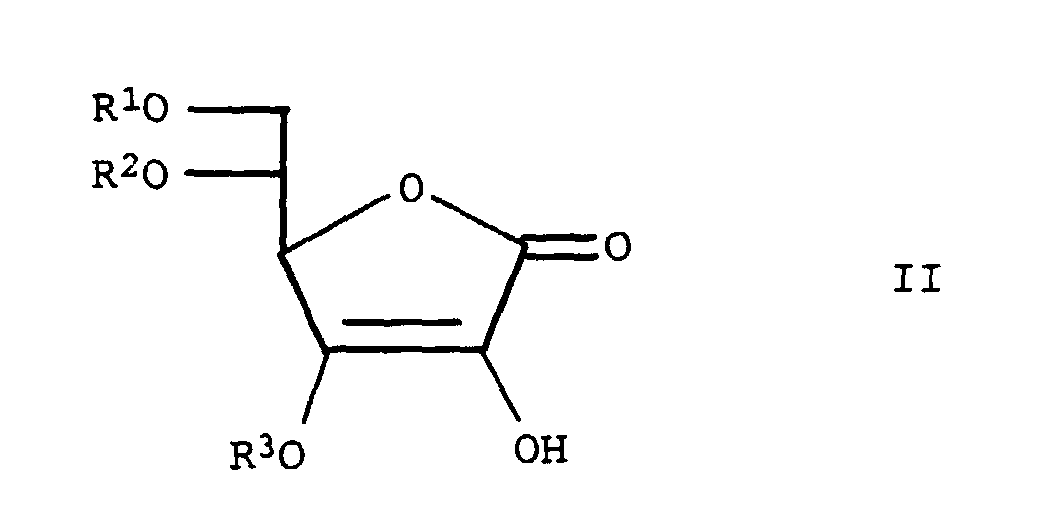
    So können problemlos Haarspülungen, Shampoos, Schäume mit stabilem Vitamin C der Formel I hergestellt werden.
    Die Kombination von anionischen mit kationischen Tensiden schränkt den Einsatz in Kosmetikprodukten nicht ein.
    Die Synthese der Ascorbylsorbate der Formel I erfolgt in an sich bekannter Weise durch basenkatalysierte Umsetzung der Ascorbinsäurederivate der Formel II mit Sorbinsäure oder Sorbinsäurederivaten, insbesondere mit Sorbinsäurechlorid. Die Herstellung erfolgt analog den bekannten Verfahren zur Acylierung von Ascorbinsäure gemäß B. M. Tolberg et al. Ann., N. Y. Acad. Sci., 258 (1975) 48-69.
    In den nachfolgenden Beispielen wird die Herstellung der erfindungsgemäßen Ascorbinsäurederivate der Formel I sowie die diese Verbindungen enthaltenden kosmetischen Formulierungen näher erläutert.
    Beispiel 1 2,5,6-O-Trisorbinoyl-L-ascorbinsäure
    In einem 100 ml 3-Halskolben wurden 2 g (11,36 mmol; 1 eq.) L-Ascorbinsäure in 50 ml Dichlormethan suspendiert. Nacheinander wurden bei - 15 °C 0,28 g (2,27 mmol; 0,2 eq.) N,N'-Dimethylaminopyridin, 5,2 ml (37,49 mmol; 3,3 eq.) Triethylamin und zuletzt langsam 4,89 g (37,49 mmol; 3,3 eq.) Sorbinsäurechlorid hinzugetropft. Anschließend wurde bei 0 °C über Nacht gerührt. Das ausgefallene Salz wurde abfiltriert und das Filtrat mit 1 M HCl extrahiert. Die organische Phase wurde mit gesättigter NaCl-Lösung extrahiert, über MgSO4 getrocknet und anschließend eingeengt.
    Ausbeute: 4,4 g (85 % Ausbeute)
    Beispiel 2 5,6-0-Isopropyliden-2-0-sorbinoyl-L-ascorbinsäure
    In einem 2l 4-Halskolben wurden 100,0 g (462,5 mmol; 1 eq.) 5,6-0-Isopropyliden-L-ascorbinsäure in einer N2-Atmosphäre in 900 ml Dichlormethan gelöst. Nacheinander wurden 11,30 g (92,51 mmol; 0,2 eq.) Dimethylaminopyridin und 64.0 ml (462,5 mmol; 1 eq.) Triethylamin hinzugegeben. Anschließend wurden bei - 15 °C 60,37 g (462,5 mmol; 1 eq.) Sorbinsäurechlorid, gelöst in 100 ml Dichlormethan, langsam hinzugetropft, wobei die Innentemperatur - 10 °C nicht überschritt. Anschließend wurde 10 Stunden bei Raumtemperatur gerührt. Der Ansatz wurde mit 0.1 M HCl und anschließend H2O gewaschen. Danach erfolgte eine Extraktion mit gesättigter wäßriger Natriumhydrogencarbonat-Lösung. Die organische Phase wurde abgetrennt und die wäßrige Phase mit konzentrierter Salzsäure bis pH 1 versetzt. Dabei fiel ein weißer Niederschlag aus, der im Ölpumpenvakuum getrocknet wurde.
    Ausbeute: 83 g (58 % Ausbeute)
    Beispiel 3 2-0-Sorbinoyl-L-ascorbinsäure
    In einem 250 ml 2-Halskolben wurden 5 g (0,012 5,6-O-Isopropyliden-2-O-sorbinoyl-L-ascorbinsäure in 160 ml Essigsäure (60 %) gelöst und 4 Stunden bei 50 °C gerührt. Anschließend wird die Lösung am Rotationsverdampfer eingeengt und mit Toluol codestilliert. Das Rohprodukt wurde an Kieselgel gereinigt (Laufmittel Dichlormethan/Methanol 5:1).
    Ausbeute: 3,1 g (96 % Ausbeute)
    Beispiel 4 6-0-Palmitoyl-2-0-sorbinoyl-L-ascorbinsäure
    In einem 11 4-Halskolben wurden 50 g (120 mmol; 1 eq.) 6-0-Palmitoyl-L-ascorbinsäure in 400 ml Pyridin gelöst. 23,40 g (130 mmol; 1,1 eq.) Sorbinsäurechlorid, gelöst in 30 ml Dichlormethan, wurden bei einer Innentemperatur von - 15 °C langsam hinzugetropft. Dabei wurde darauf geachtet, daß die Innentemperatur - 10 °C nicht überstieg. Der Ansatz wurde auf Raumtemperatur gebracht und noch 2 Stunden gerührt. Am Rotationsverdampfer wurde die Reaktionslösung eingeengt und anschließend mit Toluol codestilliert. Der Rückstand wurde in wenig Dichlormethan aufgenommen und mit 1 M HCl extrahiert. Die organische Phase wurde etwas eingeengt und mit einem Überschuß n-Hexan versetzt. Es fiel ein weißer Niederschlag aus, der im Ölpumpenvakuum getrocknet wurde.
    Ausbeute: 28 g (46 % Ausbeute)
    Kosmetische Zubereitungen Beispiel 5
    Zusammensetzung für fettfreies Sonnenschutz-Gel
    Massengehalt (Gew.-%)
    0,40 Acrylate/C10-C30 Alkylacrylate crosspolymer
    0,25 Hydroxyethyl cellulose
    8,00 Methoxycinnamic-octylester
    1,00 4-Methylbenzylidene camphor
    0,50 6-O-Palmitoyl-2-O-sorbinoyl-L-ascorbinsäure
    0,20 Disodium EDTA
    5,00 Glycerin
    0,15 Fragrance
    0,30 Imidazolydinyl urea
    0,25 Sodium methylparaben
    0,15 Sodium propylparaben
    5,00 PEG-25 PABA
    0,10 Sodiumhydroxide
    ad 100 Water
    Beispiel 6
    Zusammensetzung für Feuchtigkeitscreme
    Massengehalt (Gew.-%)
    6,00 PEG-7-Hydrogenated castor oil
    5,00 Isopropylpalmitate
    6,00 Mineral oil
    5,00 Jojoba oil
    5,00 Almond oil
    0,50 Tocopherylacetate
    2,00 2,5,6-O-Trisorbinoyl-L-ascorbinsäure
    0,60 Magnesiumstearate
    2,00 PEG-45 / Dodecyl glycol copolymer
    5,00 Glycerin
    0,25 Methylparaben
    0,15 Propylparaben
    5,00 Imidazolydinyl urea
    0,15 Fragrance
    0,20 Disodium EDTA
    ad 100 Water
    Beispiel 7
    Zusammensetzung für Feuchtigkeitscreme
    Massengehalt (Gew.-%)
    6,00 PEG-7-Hydrogenated castor oil
    5,00 Isopropylpalmitate
    6,00 Mineral oil
    5,00 Jojoba oil
    5,00 Almond oil
    0,50 Tocopherylacetate
    2,00 6-O-Palmitoyl-2-O-sorbinoyl-L-ascorbinsäure
    0,60 Magnesiumstearate
    2,00 PEG-45/Dodecyl glycol copolymer
    5,00 Glycerin
    0,25 Methylparaben
    0,15 Propylparaben
    5,00 Imidazolydinyl urea
    0,15 Fragrance
    0,20 Disodium EDTA
    ad 100 Water
    Beispiel 8
    Zusammensetzung für Nachtcreme ohne Konservierungsmittel
    Massengehalt (Gew.-%)
    5,00 PEG-7-Hydrogenated castor oil
    4,00 Isopropylpalmitate
    4,00 Caprylic acid/Caprinate triglyceride
    3,00 6-O-Palmitoyl-2-O-sorbinoyl-L-ascorbinsäure
    1,50 PEG-45/Dodecyl glycol copolymer
    0,50 Magnesiumstearate
    1,50 Dimethicon
    4,00 1,2 Propyleneglycol
    4,00 Glycerin
    8,00 611 Alcohol
    2,00 Kollagen
    0,15 Fragrance
    ad 100 Water
    Beispiel 9
    Zusammensetzung für Antifaltencreme
    Massengehalt (Gew.-%)
    6,00 PEG-7-Hydrogenated castor oil
    5,00 Isopropylpalmitate
    10,00 Mineral oil
    3,00 Caprylic acid/Caprate triglyceride
    0,60 Magnesiumstearate
    1,00 2-O-Sorbinoyl-L-ascorbinsäure
    1,50 Tocopherylacetate
    2,00 PEG-45/Dodecyl Glycol Copolymer
    0,05 Tocopherol
    0,20 Retinol
    0,30 Glycerin
    0,70 Magnesiumsulfate
    0,25 Methylparaben
    0,15 Propylparaben
    0,20 Sodiumascorbylmonophosphat
    0,10 α-Tocopherol
    0,10 Ascorbylpalmitate
    0,15 Fragrance
    ad 100 Water
    Beispiel 10
    Zusammensetzung für Antifaltencreme
    Massengehalt (Gew.-%)
    6,00 PEG-7-Hydrogenated castor oil
    5,00 Isopropylpalmitate
    10,00 Mineral oil
    3,00 Caprylic acid/Caprate triglyceride
    0,60 Magnesiumstearate
    1,00 5,6-O-Isopropyliden-2-O-sorbinoyl-L-ascorbinsäure
    1,50 Tocopherylacetate
    2,00 PEG-45/Dodecyl Glycol Copolymer
    0,05 Tocopherol
    0,20 Retinol
    0,30 Glycerin
    0,70 Magnesiumsulfate
    0,25 Methylparaben
    0,15 Propylparaben
    0,20 Sodiumascorbylmonophosphat
    0,10 α-Tocopherol
    0,10 Ascorbylpalmitate
    0,15 Fragrance
    ad 100 Water
    Beispiel 11
    Zusammensetzung für Feuchtigkeits Tagescreme
    Massengehalt (Gew.-%)
    2,00 Ceteareth/6
    2,00 Ceteareth/25
    10,00 Mineral oil
    3,00 Caprylic acid/Caprate triglyceride
    3,00 Isostearic acid
    3,00 6-O-Palmitoyl-2-O-sorbinoyl-L-ascorbinsäure
    1,50 Tocopherylacetate
    2,00 D-Panthenol USP
    0,05 Tocopherol
    0,20 Retinol
    0,30 Glycerin
    0,15 Dibromocyanobutane
    0,20 Sodiumascorbylmonophosphate
    0,10 α-Tocopherol
    0,10 Ascorbylpalmitate
    0,15 Fragrance
    ad 100 Water
    Beispiel 12
    Zusammensetzung für Feuchtigkeits Tagescreme
    Massengehalt (Gew.-%)
    2,00 Ceteareth/6
    2,00 Ceteareth/25
    10,00 Mineral oil
    3,00 Caprylic acid/Caprate triglyceride
    3,00 Isostearic acid
    3,00 2-O-Sorbinoyl-L-ascorbinsäure
    1,50 Tocopherylacetate
    2,00 D-Panthenol USP
    0,05 Tocopherol
    0,20 Retinol
    0,30 Glycerin
    0,15 Dibromocyanobutane
    0,20 Sodiumascorbylmonophosphate
    0,10 α-Tocopherol
    0,10 Ascorbylpalmitate
    0,15 Fragrance
    ad 100 Water
    Beispiel 13
    Zusammensetzung für fettfreies Gel
    Massengehalt (Gew.-%)
    8,00 Octyl Methoxycinnamate
    7,00 Titanium Dioxide
    2,00 2-O-Sorbinoyl-L-ascorbinsäure
    5,00 Glycerin
    5,00 PEG-25 PABA
    1,00 4-Methylbenzylidene Camphor
    0,40 Acrylates/C10-C30 Alkyl Acrylate Crosspolymer
    0,30 Imidazolidinyl urea
    0,25 Hydroxyethylcellulose
    0,25 Sodium methylparaben
    0,20 Disodium EDTA
    0,15 Fragrance
    0,15 Sodium propylparaben
    0,10 Sodiumhydroxide
    ad 100 Water
    Beispiel 14
    Zusammensetzung für Sonnencreme (LSF 20)
    Massengehalt (Gew.-%)
    8,00 Octyl methoxycinnamate
    8,00 Titaniumdioxide
    6,00 PEG-7-Hydrogenated castor oil
    2,00 2-O-Sorbinoyl-L-ascorbinsäure
    6,00 Mineral oil
    5,00 Zinc oxide
    5,00 Isopropylpalmitate
    5,00 Imidazolidinyl urea
    3,00 Jojoba oil
    2,00 PEG-45/Dodecyl glycol copolymer
    1,00 4-Methylbenzylidene camphor
    0,60 Magnesiumstearate
    0,50 Tocopherylacetate
    0,25 Methylparaben
    0,20 Disodium EDTA
    0,15 Propylparaben
    ad 100 Water
    Beispiel 15
    Zusammensetzung für Sonnencreme (wasserfest)
    Massengehalt (Gew.-%)
    8,00 Octyl methoxycinnamate
    5,00 PEG-7-Hydrogenated castor oil
    5,00 Propylene glycol
    4,00 Isopropyl palmitate
    4,00 Caprylic/capric triglyceride
    3,00 6-O-Palmitoyl-2-O-sorbinoyl-L-ascorbinsäure
    4,00 Glycerin
    3,00 Jojoba oil
    2,00 4-Methylbenzylidene camphor
    2,00 Titanium dioxide
    1,50 PEG-45/Dodecyl glycol copolymer
    1,50 Dimethicone
    0,70 Maghesiumsulfate
    0,50 Magnesiumstearate
    0,15 Fragrance
    ad 100 Water
    Beispiel 16
    Zusammensetzung für Sonnenmilch (LSF 6)
    Massengehalt (Gew.-%)
    10,00 Mineral oil
    6,00 PEG-7-Hydrogenated castor oil
    5,00 Isopropylpalmitate
    3,50 Octyl methoxycinnamate
    2,00 2,5,6-Trisorbinoyl-L-ascorbinsäure
    3,00 Caprylic/capric triglyceride
    3,00 Jojoba oil
    2,00 PEG-45/Dodecyl glycol copolymer
    0,70 Magnesiumsulfate
    0,60 Magnesiumstearate
    0,50 Tocopherylacetate
    0,30 Glycerin
    0,25 Methylparaben
    0,15 Propylparaben
    0,05 Tocopherol
    ad 100 Water
    Beispiel 17
    Zusammensetzung für Lippenstift
    Massengehalt (Gew.-%)
    10,00 Glycerin
    10,00 Titanium dioxide
    2,00 2,5,6-Trisorbinoyl-L-ascorbinsäure
    8,00 Octyl methoxycinnamate
    5,00 Zinc oxide
    4,00 Castor oil
    4,00 Pentaerythrithyl Stearate/caprate/caprylate adipate
    3,00 Glycerylstearate SE
    2,00 Bees ax
    2,00 Microcrystalline Wax
    2,00 Quaternium-18 Bentonite
    1,50 PEG-45/Dodecyl glycol copolymer
    ad 100 Eucerinum anhydricum
    Beispiel 18
    Zusammensetzung für Sunblock mit Mikropigmenten
    Massengehalt (Gew.-%)
    10,00 Parsol MCX octyl methoxycinnamate
    6,00 PEG-7-Hydrogenated castor oil
    6,00 Titanium dioxide
    2,00 5,6-O-Isopropyliden-2-O-sorbinoyl-L-ascorbinsäure
    5,00 Mineral oil
    5,00 Isoamyl p-Methoxycinnamate
    5,00 Propylene glycol
    3,00 Jojoba oil
    3,00 4-Methylbenzylidene camphor
    2,00 PEG-45/Dodecyl glycol copolymer
    1,00 Butyl methoxydibenzoylmethane
    1,00 Dimethicone
    0,50 PEG-40-Hydrogenated castor oil
    0,50 Tocopherylacetate
    0,50 Phenoxyethanol
    0,20 EDTA
    ad 100 Water

    Claims (8)

    1. Ascorbylsorbate der allgemeinen Formel I,
      Figure 00170001
      in der die Variablen unabhängig voneinander folgende Bedeutung haben:
      R1 und R2
      Wasserstoff, C1-C12-Alkyl, C1-C20-Acyl;
      wobei R1 und R2 gemeinsam mit den Sauerstoffatomen an die sie gebunden sind und den an den Sauerstoffatomen gebundenen Kohlenstoffatomen einen gegebenenfalls substituierten Heterozyklus bilden können;
      R3 Wasserstoff oder ein Kation, ausgewählt aus der Gruppe, bestehend aus NH4 +, Alkali- und Erdalkalimetallkationen.
    2. Ascorbylsorbate der Formel I gemäß Anspruch 1, in der die Variablen unabhängig voneinander folgende Bedeutung haben:
      R1 und R2
      Wasserstoff, C6-C20-Acyl;
      R3 Wasserstoff oder ein Kation, ausgewählt aus der Gruppe, bestehend aus NH4 +, Alkali- und Erdalkalimetallkationen.
    3. Ascorbylsorbate der Formel I gemäß den Ansprüchen 1 und 2, in der die Variablen unabhängig voneinander folgende Bedeutung haben:
      R1 und R2
      Wasserstoff,
      Figure 00180001
      R3 Wasserstoff oder ein Kation, ausgewählt aus der Gruppe, bestehend aus NH4 +, Alkali- und Erdalkalimetallkationen.
    4. Verfahren zur Herstellung der Ascorbylsorbate der Formel I gemäß den Ansprüchen 1 bis 3, dadurch gekennzeichnet, daß man Ascorbinsäure oder Ascorbinsäurederivate der Formel II, in der die Substituenten R1 bis R3 die in den Ansprüchen 1 bis 3 genannte Bedeutung haben mit Sorbinsäure oder Sorbinsäurederivaten umsetzt.
      Figure 00180002
    5. Verfahren nach Anspruch 4, dadurch gekennzeichnet, daß man Ascorbinsäure oder Ascorbinsäurederivate der Formel II mit Sorbinsäurechlorid umsetzt.
    6. Verwendung von Ascorbylsorbaten der allgemeinen Formel I gemäß den Ansprüchen 1 bis 3 für kosmetische und pharmazeutische Zubereitungen.
    7. Verwendung von Ascorbylsorbaten nach Anspruch 6 als Antioxidans in kosmetischen und pharmazeutischen Formulierungen.
    8. Kosmetische und pharmazeutische Zubereitungen, enthaltend eine wirksame Menge mindestens einer der Verbindungen der Formel I gemäß den Ansprüchen 1 bis 3 sowie übliche kosmetische und pharmazeutische Hilfs- und Zusatzstoffe.
    EP98119589A 1997-11-14 1998-10-16 Ascorbylsorbate Withdrawn EP0916662A3 (de)

    Applications Claiming Priority (2)

    Application Number Priority Date Filing Date Title
    DE19750528 1997-11-14
    DE19750528A DE19750528A1 (de) 1997-11-14 1997-11-14 Ascorbylsorbate

    Publications (2)

    Publication Number Publication Date
    EP0916662A2 true EP0916662A2 (de) 1999-05-19
    EP0916662A3 EP0916662A3 (de) 2001-04-04

    Family

    ID=7848771

    Family Applications (1)

    Application Number Title Priority Date Filing Date
    EP98119589A Withdrawn EP0916662A3 (de) 1997-11-14 1998-10-16 Ascorbylsorbate

    Country Status (5)

    Country Link
    US (1) US6143906A (de)
    EP (1) EP0916662A3 (de)
    JP (1) JPH11217380A (de)
    CN (1) CN1218806A (de)
    DE (1) DE19750528A1 (de)

    Cited By (5)

    * Cited by examiner, † Cited by third party
    Publication number Priority date Publication date Assignee Title
    FR2807320A1 (fr) * 2000-04-10 2001-10-12 Oreal Utilisation de derives d'acide ascorbique pour augmenter la synthese des creramides epidermiques
    FR2825922A1 (fr) * 2001-06-15 2002-12-20 Oreal 2-hexadecanoate d'ascorbyle comme inhibiteur de no-synthase et utilisations
    WO2005105033A1 (en) * 2004-04-21 2005-11-10 The Procter & Gamble Company Personal care compositions that deposit hydrophilic benefit agents
    EP1620419A4 (de) * 2003-04-21 2008-07-23 Tagra Biotechnologies Ltd Stabilisierte ascorbinsäurederivative
    FR2913596A1 (fr) * 2007-03-14 2008-09-19 Oreal Procede de depigmentation des matieres keratiniques a l'aide de composes carbamates de vitamine c,et utilisations desdits composes

    Families Citing this family (10)

    * Cited by examiner, † Cited by third party
    Publication number Priority date Publication date Assignee Title
    DE19962267A1 (de) * 1999-12-23 2001-06-28 Beiersdorf Ag Verwendung von Wirkstoffkombinationen aus einem oder mehreren NO-Synthasehemmern und einer oder mehreren Ascorbylverbindungen zur Stärkung der Barrierefunktion der Haut
    DE10040969A1 (de) * 2000-08-22 2002-03-07 Ifac Inst Fuer Angewandte Coll Verwendung von L-Ascorbinsäure in kosmetischen Emulsionen
    US6586662B2 (en) * 2001-06-13 2003-07-01 California Hybrids Yellow, determinate tomatoes suitable for processing
    US7253310B2 (en) * 2003-08-19 2007-08-07 Basf Aktiengesellschaft Preparation of (meth)acrylic acid
    JP2009035509A (ja) * 2007-08-01 2009-02-19 Green Products Laboratory Ltd アスコルビン酸エステル及びその合成方法
    FR2946252B1 (fr) * 2009-06-08 2011-07-29 Fabre Pierre Dermo Cosmetique Bis esters d'acide gras insature sur l'acide ascorbique et leurs utilisations cosmetiques
    JP5985637B2 (ja) * 2011-08-11 2016-09-06 スティーフェル リサーチ オーストラリア ピーティーワイ リミテッド 抗酸化剤局所用組成物
    US20130089641A1 (en) * 2011-10-11 2013-04-11 Sunway Biotech Co., Ltd. Soymilk with Additive of Vitamin C, Vitamin C salt or Vitamin C Stereoisomer
    CN103539767B (zh) * 2013-11-06 2015-04-08 江西省德兴市百勤异Vc钠有限公司 一种通过酰氯制备l-抗坏血酸或d-异抗坏血酸羧酸酯的方法
    WO2016063896A1 (ja) * 2014-10-21 2016-04-28 サントリーホールディングス株式会社 アスコルビン酸誘導体及びこの誘導体を用いた配糖体の製造方法

    Family Cites Families (3)

    * Cited by examiner, † Cited by third party
    Publication number Priority date Publication date Assignee Title
    US4847072A (en) * 1987-10-22 1989-07-11 The Procter & Gamble Company Photoprotection compositions comprising tocopherol sorbate
    FR2715156B1 (fr) * 1994-01-20 1996-03-01 Oreal Mono-esters d'acide cinnamique ou de ses dérivés et de vitamine C, leur procédé de préparation et leur utilisation comme anti-oxydants dans des compositions cosmétiques, pharmaceutiques ou alimentaires.
    FR2725897B1 (fr) * 1994-10-24 1996-12-06 Oreal Produit pour application topique contenant une lipase et un precurseur d'actif

    Cited By (9)

    * Cited by examiner, † Cited by third party
    Publication number Priority date Publication date Assignee Title
    FR2807320A1 (fr) * 2000-04-10 2001-10-12 Oreal Utilisation de derives d'acide ascorbique pour augmenter la synthese des creramides epidermiques
    EP1145710A1 (de) * 2000-04-10 2001-10-17 L'oreal Verwendung von Ascorbinsäurederivaten, um die Synthese von epidermalen Ceramiden zu erhöhen
    FR2825922A1 (fr) * 2001-06-15 2002-12-20 Oreal 2-hexadecanoate d'ascorbyle comme inhibiteur de no-synthase et utilisations
    WO2002102343A1 (fr) * 2001-06-15 2002-12-27 L'oreal - D.I.P.I. 2-hexadecanoate d'ascorbyle comme inhibiteur de no-synthase
    EP1620419A4 (de) * 2003-04-21 2008-07-23 Tagra Biotechnologies Ltd Stabilisierte ascorbinsäurederivative
    WO2005105033A1 (en) * 2004-04-21 2005-11-10 The Procter & Gamble Company Personal care compositions that deposit hydrophilic benefit agents
    US8263058B2 (en) 2004-04-21 2012-09-11 The Procter & Gamble Company Personal care compositions that deposit hydrophilic benefit agents
    FR2913596A1 (fr) * 2007-03-14 2008-09-19 Oreal Procede de depigmentation des matieres keratiniques a l'aide de composes carbamates de vitamine c,et utilisations desdits composes
    WO2008129188A1 (fr) * 2007-03-14 2008-10-30 L'oreal Procédé de dépigmentation des matières kératiniques à l'aide de composés carbamates de vitamine c, et utilisations desdits composés

    Also Published As

    Publication number Publication date
    US6143906A (en) 2000-11-07
    CN1218806A (zh) 1999-06-09
    EP0916662A3 (de) 2001-04-04
    DE19750528A1 (de) 1999-05-20
    JPH11217380A (ja) 1999-08-10

    Similar Documents

    Publication Publication Date Title
    EP0917871A2 (de) Ascorbinsäurederivate enthaltende kosmetische und pharmazeutische Zubereitungen
    EP1046391B1 (de) Verwendung von aminosubstituierten Hydroxybenzophenonen als photostabile UV-Filter in kosmetischen und pharmazeutischen Zubereitungen
    EP0916335B1 (de) Photostabile UV-Filter enthaltende kosmetsche und pharmazeutische Zubereitungen
    EP1008586B1 (de) Oligomere Diarylbutadiene
    EP0852137B1 (de) Photostabile UV-A-Filter enthaltende kosmetische Zubereitungen
    EP0916662A2 (de) Ascorbylsorbate
    EP1133981A2 (de) Verwendung von Lichtschutzmittelkombinationen, die als wesentlichen Bestandteil 4,4-Diarylbutadiene enthalten als photostabile UV-Filter in kosmetischen und pharmazeutischen Zubereitungen
    EP0962222A2 (de) Verwendung von cholesterisch-flüssigkristallinen Zusammensetzungen als UV-Filter in kosmetischen und pharmazeutischen Zubereitungen
    EP1133980A2 (de) Verwendung von Lichtschutzmittelkombinationen, die als wesentlichen Bestandteil aminosubstituierte Hydroxybenzophenone enthalten als photostabile UV-Filter in kosmetischen und pharmazeutischen Zubereitungen
    EP2049075A2 (de) Verwendung von ascorbinsäurederivaten zur funktionalisierung von matrices
    DE102013226746A1 (de) Verwendung von Alkylamidothiazolen als Antioxidans oder Radikalfänger in kosmetischen oder dermatologischen Zubereitungen
    EP1240894A2 (de) Verwendung von Lichtschutzmittelkombinationen in kosmetischen und pharmazeutischen Zubereitungen
    DE10030891A1 (de) 3,4-Dihydroxybenzyl-substituierte Kohlensäurederivate und ihre Verwendung als Antioxidantien in kosmetischen und pharmazeutischen Präparaten
    EP1219287A2 (de) Lichtschutzmittelkombinationen enthaltend 2,2&#39;-p-Phenylen-bis(3,1-benzoxazin-4-on) als photostabile UV-Filter in kosmetischen und pharmazeutischen Zubereitungen
    EP1060734A2 (de) Verwendung von cyclischen Enaminen als Lichtschutzmittel
    EP0826361A1 (de) Photostabile UV-A-Filter enthaltende kosmetische Zubereitungen
    EP0911020B1 (de) Methyl-Styrol derivate als UV-filter und diese enthaltende kosmetische und pharmazeutische Zubereitungen
    EP1092721B1 (de) Chirale Glucoside und deren Verwendung als chirale Dotierstoffe zur Herstellung von cholestrisch-flüssigkristallinen Zusammensetzungen
    EP0858318B1 (de) Photostabile uv-a-filter enthaltende kosmetische zubereitungen
    EP0945125B1 (de) Photostabile UV-Filter enthaltende kosmetische und pharmazeutische Zubereitungen
    DE10030880A1 (de) 3,4-Dihydroxymandelsäurealkylamide und ihre Verwendung
    EP2285793A1 (de) Uvb filter auf der basis von ascorbinsäurederivaten
    EP1660030B1 (de) Mischung bestehend aus einem uv-a- und einem uv-b-filter
    DE19710854C2 (de) Verwendung von Benzophenonen und deren Derivaten gegen die UV-induzierte Zersetzung von Dibenzoylmethan und dessen Derivaten
    DE10341234A1 (de) N-Acyl-hydroxyaminosäurealkylamide, Verfahren zu ihrer Herstellung und ihre Verwendung

    Legal Events

    Date Code Title Description
    PUAI Public reference made under article 153(3) epc to a published international application that has entered the european phase

    Free format text: ORIGINAL CODE: 0009012

    AK Designated contracting states

    Kind code of ref document: A2

    Designated state(s): BE CH DE FR GB IT LI NL

    AX Request for extension of the european patent

    Free format text: AL;LT;LV;MK;RO;SI

    PUAL Search report despatched

    Free format text: ORIGINAL CODE: 0009013

    AK Designated contracting states

    Kind code of ref document: A3

    Designated state(s): AT BE CH CY DE DK ES FI FR GB GR IE IT LI LU MC NL PT SE

    AX Request for extension of the european patent

    Free format text: AL;LT;LV;MK;RO;SI

    17P Request for examination filed

    Effective date: 20010308

    AKX Designation fees paid

    Free format text: BE CH DE FR GB IT LI NL

    17Q First examination report despatched

    Effective date: 20040907

    GRAP Despatch of communication of intention to grant a patent

    Free format text: ORIGINAL CODE: EPIDOSNIGR1

    RIC1 Information provided on ipc code assigned before grant

    Ipc: A61K 8/60 20060101ALI20070612BHEP

    Ipc: C07D 307/62 20060101AFI20070612BHEP

    STAA Information on the status of an ep patent application or granted ep patent

    Free format text: STATUS: THE APPLICATION HAS BEEN WITHDRAWN

    18W Application withdrawn

    Effective date: 20070830