EP0917072A2 - System zur Analyse und Synthese von Multifaktor-Daten - Google Patents
System zur Analyse und Synthese von Multifaktor-Daten Download PDFInfo
- Publication number
- EP0917072A2 EP0917072A2 EP98114893A EP98114893A EP0917072A2 EP 0917072 A2 EP0917072 A2 EP 0917072A2 EP 98114893 A EP98114893 A EP 98114893A EP 98114893 A EP98114893 A EP 98114893A EP 0917072 A2 EP0917072 A2 EP 0917072A2
- Authority
- EP
- European Patent Office
- Prior art keywords
- data
- content
- style
- factor
- factors
- Prior art date
- Legal status (The legal status is an assumption and is not a legal conclusion. Google has not performed a legal analysis and makes no representation as to the accuracy of the status listed.)
- Pending
Links
Images

Classifications
-
- G—PHYSICS
- G06—COMPUTING OR CALCULATING; COUNTING
- G06F—ELECTRIC DIGITAL DATA PROCESSING
- G06F40/00—Handling natural language data
- G06F40/20—Natural language analysis
- G06F40/205—Parsing
- G06F40/216—Parsing using statistical methods
-
- G—PHYSICS
- G06—COMPUTING OR CALCULATING; COUNTING
- G06F—ELECTRIC DIGITAL DATA PROCESSING
- G06F18/00—Pattern recognition
- G06F18/20—Analysing
- G06F18/21—Design or setup of recognition systems or techniques; Extraction of features in feature space; Blind source separation
-
- G—PHYSICS
- G06—COMPUTING OR CALCULATING; COUNTING
- G06F—ELECTRIC DIGITAL DATA PROCESSING
- G06F40/00—Handling natural language data
- G06F40/20—Natural language analysis
- G06F40/279—Recognition of textual entities
-
- Y—GENERAL TAGGING OF NEW TECHNOLOGICAL DEVELOPMENTS; GENERAL TAGGING OF CROSS-SECTIONAL TECHNOLOGIES SPANNING OVER SEVERAL SECTIONS OF THE IPC; TECHNICAL SUBJECTS COVERED BY FORMER USPC CROSS-REFERENCE ART COLLECTIONS [XRACs] AND DIGESTS
- Y10—TECHNICAL SUBJECTS COVERED BY FORMER USPC
- Y10S—TECHNICAL SUBJECTS COVERED BY FORMER USPC CROSS-REFERENCE ART COLLECTIONS [XRACs] AND DIGESTS
- Y10S707/00—Data processing: database and file management or data structures
- Y10S707/99931—Database or file accessing
-
- Y—GENERAL TAGGING OF NEW TECHNOLOGICAL DEVELOPMENTS; GENERAL TAGGING OF CROSS-SECTIONAL TECHNOLOGIES SPANNING OVER SEVERAL SECTIONS OF THE IPC; TECHNICAL SUBJECTS COVERED BY FORMER USPC CROSS-REFERENCE ART COLLECTIONS [XRACs] AND DIGESTS
- Y10—TECHNICAL SUBJECTS COVERED BY FORMER USPC
- Y10S—TECHNICAL SUBJECTS COVERED BY FORMER USPC CROSS-REFERENCE ART COLLECTIONS [XRACs] AND DIGESTS
- Y10S707/00—Data processing: database and file management or data structures
- Y10S707/99931—Database or file accessing
- Y10S707/99933—Query processing, i.e. searching
- Y10S707/99936—Pattern matching access
Definitions
- the present invention relates to a system for analyzing data in order to classify content of unknown data or to recreate missing content of data. More particularly, it relates to analysis of data which can be represented as matrices of multiple factors.
- data is modeled as a product of two linear forms corresponding to parameters of each factor.
- the data may or may not result from physical processes having a bilinear form that is used to model the data. But, by increasing the dimensionality of the bilinear forms sufficiently, the model can represent known training data to an arbitrary accuracy.
- the system determines the model parameters from training data having multiple factor interaction.
- the training data is a complete matrix of observations as to each content and style type.
- the training data may be fully labeled as to content and style, unlabeled, or partially labeled.
- the system can reasonably determine parameters from training data having unknown observations within the matrix.
- the system creates a model based upon parameter vectors for each of the factors and a combination matrix for combining the parameter vectors for each factor. The values of the elements in the parameter vectors and the combination matrix are iteratively determined based upon the training data, using Estimation-Maximization (EM) techniques.
- EM Estimation-Maximization
- the system can be used to analyze unknown data.
- the analysis can be used to categorize content of data in an unknown style.
- the system can be used to recognize letters in new styles in connection with optical character recognition, or word with new speakers.
- the analysis can also be used to create new content in a known style.
- the system can complete missing data, such as generating missing characters for a given font.
- the present invention uses bilinear models for analyzing known and unknown data.
- Bilinear models represent data which can be decomposed into two or more factors. Two factors can be considered “content” and "style”.
- Figs. 1A-1C illustrate the two factors as they apply to typography fonts. The content is the letter being represented, and the style is the font. The examples below relate to two factors, however, the processes of the present invention can be easily expanded to include any number of factors.
- each data point is modeled as a separable function of the underlying factors, that is, a product of linear forms corresponding to the parameters of a factor.
- This allows each factor to operate on the output of the model with an arbitrary affine transformation.
- Different factorial models could be used to represent the data and factors. While not all stylistic operations correspond to affine transformations, a simple linear model based upon vectorial representations of the factors provides sufficiently accurate processing results with easy learning. Of course, more complex, nonlinear models could be used to represent the factor interactions, but increasingly complex computations would be necessary to both learn and apply the factor parameters.
- a symmetric version of the model is represented as equation (1).
- Y k SC ist the kth vector component of the observed data at style index S and content-class index C
- a s is an I-dimensional vector representing parameters of the first factor for the style index S
- b c is a J-dimensional vector representing parameters of the second factor for the content class index C
- g ijk is an I x J matrix representing the interaction between the two factors for the kth output component.
- equation (2) In the model of equation (1), the separate factors contributing to each data point are not discernible. In some cases, one or more of the factors is of particular importance. In such situations, a second, asymmetric version of the model, equation (2) can be used.
- A is a matrix representing the first factor
- b is again the parameter vector for the second factor.
- A is the product of a and g of equation (1).
- equation (2) different elements for both the parameter vector for the first factor and the combination matrix do not have to be determined.
- equation (2) can provide meaningful information with less learning data than for equation (1).
- Figs.1A-1C illustrate possible analyses of data using the present invention.
- 340 represents a matrix of known data used in the training process. As illustrated, the matrix includes five known styles and five known content types.
- unknown data can be analyzed for classification (Fig.1A), extrapolation (Fig. 1B), and translation (Fig. 1C).
- Fig.1A classification
- Fig. 1B extrapolation
- Fig. 1C translation
- the unknown data 350 includes uncategorized data in a new style.
- the system determines the proper categories, i.e., letters, from the data.
- the system generates new data points from a new set of observations. As illustrated in Fig.
- the system can determine missing content (represented by "?" 360) in a new style 365. Similarly, missing styles of new content can also be determined. Finally, in translation, the system generates content 370 and style 380 data with data having both new content and new style 375.
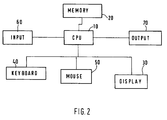
- Fig. 2 illustrates computer hardware 1 which can be used in connection with the present invention.
- a set of instruction steps are stored in a memory 20 and executed on a central processing unit (CPU) 10 connected to the memory 20.
- the memory may be of any known type, such as RAM, ROM, CD-ROM, and magnetic disk or tape.
- the CPU 10 is also connected to a display 30 for outputting information to the user as necessary during execution of the instructions.
- Input devices such as a keyboard 40 and mouse 50, are connected to the CPU 10 to allow inputs by the user in controlling execution of the instructions.
- An input 60 is also connected to the CPU 10 for inputting data to be acted upon by the system of the present invention.
- the data as inputted through the input 60 can be stored in the memory 20 during processing.
- a memory (not shown) separate from the memory having the executable instructions may be used for storing the data.
- An output 70 allows information relating to the data to be outputted by the CPU 10.
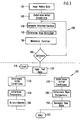
- Fig. 3 is a flow diagram for operation of the system of the present invention.
- the system operates in two parts.
- matrixed data is analyzed to determine parameters for each of the two factors.
- an application process 200 which follows the training process 100, the parameters for the two factors are applied to unknown data to determine missing information, as discussed above.
- the application process 200 can occur at any time following the training process, and can be repeated any number of times with different unknown data.
- the training process 100 can also be repeated with the new data, creating a larger matrix of known data, in order to more closely determine the parameters for the factors.
- a method is selected based upon the amount and type of information in the training data.
- the training data may be labeled, unlabeled or partially labeled.
- each letter may be categorized by the letter value and font.
- the letter values may be known, but the fonts unknown (or vice versa).
- the letters and fonts may not be given.
- equation (1) or equation (2) is selected as the model, depending upon the data and the desired applications.
- the process is based upon use of singular value decomposition (SVD) with bilinear functions. If the training data includes a complete matrix of both known styles and content, the SVD process can be used directly, as discussed below. This process is not specifically illustrated in Fig. 3. Also, use of singular value decomposition for fitting the asymmeteric model to the training data is described in J. Koenderinck and A. van Doorn, Int'l Journal of Computer Vision (1997), incorporated herein by reference, the symmetric model, the use of singular value decomposition is described in D. Marimount and B. Wandell, Journal of the Optical Society of America , A 9, 1905 (1992), incorporated herein by reference.
- k-dimensional vectors are created as the means of the observed data in a given style and content.
- the vectors are then formed into a observation matrix with rows and columns corresponding to style and content.
- the SVD of Y USV T
- the first J columns of U are defined as the matrix A
- the first J rows of SV T are defined as matrix B.
- the model dimensionality J can be chosen by prior knowledge, by requiring a sufficiently good approximation to the data, or by looking for a gap in the singular value spectrum.
- Matrices A and B are identified as the parameter estimates.
- an iterative procedure can be used to fit the model parameters to determine a locally optimal solution.
- the SVD is applied as for the asymmetric model, but with a recordering of the observation matrix elements to alternate the roles of the style and content factors. Convergence in the iterative process has typically been achieved within 5 iterations.
- Fig. 3 illustrates the slightly more complicated process used when less that complete information is known about the training data. This can result from either missing data, or from missing labels (as to content or style) on some or all of the training data.
- known data is received.
- the known data includes data points and the respective position in both factors.
- the known data consists of the bit pattern for each letter, the corresponding letter, and the font.
- initial values for the parameter vectors are determined. This provides a starting point for the EM algorithm. Different techniques can be used to determine initial starting conditions. For example, arbitrarily determined values can be assigned to each of the variable. Alternatively, different processed can be used to provide more accurate initial conditions.
- the parameter vectors for the letter, and the combination matrix for typography likely provide a good starting place. In fact, this is the initial starting condition during the application process.
- a potential function is generated based upon the initially determined conditions.
- the potential function is the sum of the squared difference between each component of the model output and the training data, summed over all components of all the training data. Standard least squares techniques to find the parameter values which minimize the sum of squared differences between the model and the data.
- the model output is given by either equation (1) or equation (2), depending on which model is used.
- a new step direction is determined at step 140.
- the step direction refers to the variable being changed and to the size of the change.
- each of the factor parameter vectors are successively selected for minimization.
- General minimization techniques are then used to determine the size of changes to parameters for that vector at step 150.
- the generation of the potential function 130, determine step direction 140, and minimize the function 150 steps are repeated until an optimum (step 160) is reached.
- the parameter vectors for each factor are then stored or outputted as the model for the data.
- the model information is used during the application process 200 in order to analyze new data for classification, extrapolation, or translation.
- the first step of the application process is to input the test data (step 220). This step may immediately follow the training process, or can begin at some later time, by entry through step 210.
- the system has two different potential process as, one for classifying the data as to content or style, and one for generating new data also as to content or style.
- Fig. 3 illustrates classification of content in a new style (steps 230-250) and generation of content in the new style (steps 270-290).
- the same processes can be used with the parameters for style and content reversed in order to classify new content as to style or to generate old styles with new content.
- the processes are similar to the process for determining the parameters during the training process. ⁇ (y k -a 1 g ijk b j ) 2
- Equation (3) illustrates an equation to be minimized in order to find the appropriate parameters for the symmetric model of equation (1) for the new data. For each data point, the difference between the value of equation (1) with estimated parameters and the actual data point is minimized. The minimization is obtained by fixing two of the values (e.g. b and g) and minimizing using general least squares techniques for the third value (e.g. a). Then, the process is repeated for each of the other variables. The process is further iteratively performed on each of the variables to find the true minimum.
- both the content labels and style parameters for the new data must be determined. If the content labels were known, the style parameters could be determined as in training. With the content labels being unknown, the system uses a separable mixture model to efficiently fit the data using EM techniques.
- the separable mixture model is formed by embedding the bilinear model in a gausian mixture model. To simplify the process, an additional parameter, representing an assignment variable, is added to the content vector. This variable will have a value of 1 for the specific content and a value of 0 at all other positions.
- the application process is also based upon use of an expectation-maximization (EM) algorithm applied to factorial mixture models. These processes allow easy analysis of the modeled data.
- EM expectation-maximization
- the EM algorithm is executed by successively alternating between E (expectation) and M (maximization) steps.
- the process operates to fit an equation with parameters to be determined to the data.
- initial conditions are set.
- the initial conditions should include the content parameter vector and the combination matrix as determined during the training process, since only the style of the new data will have changed.
- Initial conditions for the style parameter can be set randomly, set at an average of parameters for known styles, or otherwise selected.
- the system determines the style parameters and assignment variables in the content parameters at step 240.
- the initial values of the assignment variables assigning a content class to each observation are set to the content class of the most similar observation in the training set.
- the probability of a new, unlabeled observation being generated by a new style and known content has a gaussian distribution centered at the prediction of the bilinear model.
- the total probability is then given by a mixture distribution.
- the previous probabilities are equally set to sum to 1 over all styles and contents. Since the content vectors are known from the training process, the EM process alternates between two steps to find style matrices and labels to best describe the new data.
- the probabilities that each test vector belongs to a specific style and content are estimated using the current style matrix estimates.
- the EM algorithm is guaranteed to converge to a local minimum. Typically, 10-20 iterations have been used to reach convergence.
- test vectors in new styles can be classified by selecting the content class which maximizes the total probabilities.
- the assignment variables are output as the content of the unknown data at step 250, and the process ends (step 260).
- the system can also generate missing data in a new style (extrapolation or translation), as illustrated in steps 270-290.
- the parameter vector for the new style must be learned based upon the known data.
- initial conditions are set. As discussed above, different mechanism can be used to set the initial conditions, such as using the average of parameters for known styles.
- the parameters for the new style are determined at step 280. As with the training process, the parameters are determined by generating a potential function and minimizing it.
- the content parameters will need to be adjusted to include the assignment variable discussed above.
- the style parameters and the content of the new data are determined. Once the style parameters of the new style are determined, the new style parameter can be combined, using the combination matrix, with the content parameter vectors for the missing data according to the model. Then, the processing ends.
- the system of the present invention has been tested for analyzing typographic symbols, voice recognition, head pose, head illumination, and color constancy.
- the characters were represented by 2x38x38 dimensional vectors of displacements that a set of ink particles must undergo from a reference configuration to form the target shape, referred to as a warp representation.
- a physical model was used.
- Each pixel in the reference shape was considered to have a positive charge, and each pixel in the target shape to have a negative charge.
- the electrostatic force lines, calculated from Coulomb's law, from each particle in the reference shape to the plane of the target letter were tracked, and set to be in front of a parallel to the reference shape. The force lines land in a uniform density over the target letter and result in a smooth, dense warp map.
- other representations of the letter can also be used.
- the data in Fig. 4 represents a portion of the training set for this application of the system.
- the system was trained using training data 400 and the model of equation (2) to determine separate Ai models for the five fonts, and separate bi models for each of the 62 characters (A-Z, a-z, 0-9).
- the model dimensionality (I, J) were set to 30 for all of the models, and each of the pixels were treated as separate data elements (k).
- Another font was used for testing the application for generating missing data in a new style.
- a subset of the testing data 410 is illustrated in the bottom row of Fig. 4.
- Fig. 4 also illustrates the characters as generated by the model 430 the actual missing characters in the new font 440.
- Initial conditions for the application process were determined by utilizing the optimal linear combination of the five training styles. This allowed the process to estimate the parameters with minimal training and new data.
- Head pose relates to the direction that a person is facing relative to a camera.
- the subject was the style and the head direction was the content.
- the training set consisted of eleven subjects and fifteen directions. After determining the parameter vectors and combination matrix using equation (1), the system was applied to determine directions for unknown subjects. The system found to correct direction for 55 % of trials, and was within one location of the correct direction for 93 %. This compares to 48 % exact matches and 87 % within one location for a nearest neighbor approach. Of course, additional training sets or larger dimensional vectors could be used to obtain more accurate parameters and increase the efficiency of the system.
Landscapes
- Engineering & Computer Science (AREA)
- Theoretical Computer Science (AREA)
- Physics & Mathematics (AREA)
- Artificial Intelligence (AREA)
- General Physics & Mathematics (AREA)
- General Engineering & Computer Science (AREA)
- Audiology, Speech & Language Pathology (AREA)
- Health & Medical Sciences (AREA)
- General Health & Medical Sciences (AREA)
- Computational Linguistics (AREA)
- Data Mining & Analysis (AREA)
- Bioinformatics & Computational Biology (AREA)
- Life Sciences & Earth Sciences (AREA)
- Probability & Statistics with Applications (AREA)
- Bioinformatics & Cheminformatics (AREA)
- Evolutionary Biology (AREA)
- Computer Vision & Pattern Recognition (AREA)
- Evolutionary Computation (AREA)
- Image Analysis (AREA)
- Character Discrimination (AREA)
- Complex Calculations (AREA)
Applications Claiming Priority (2)
| Application Number | Priority Date | Filing Date | Title |
|---|---|---|---|
| US970824 | 1997-11-14 | ||
| US08/970,824 US6549899B1 (en) | 1997-11-14 | 1997-11-14 | System for analyzing and synthesis of multi-factor data |
Publications (2)
| Publication Number | Publication Date |
|---|---|
| EP0917072A2 true EP0917072A2 (de) | 1999-05-19 |
| EP0917072A3 EP0917072A3 (de) | 2004-06-30 |
Family
ID=25517561
Family Applications (1)
| Application Number | Title | Priority Date | Filing Date |
|---|---|---|---|
| EP98114893A Pending EP0917072A3 (de) | 1997-11-14 | 1998-08-07 | System zur Analyse und Synthese von Multifaktor-Daten |
Country Status (3)
| Country | Link |
|---|---|
| US (1) | US6549899B1 (de) |
| EP (1) | EP0917072A3 (de) |
| JP (1) | JP4279375B2 (de) |
Families Citing this family (4)
| Publication number | Priority date | Publication date | Assignee | Title |
|---|---|---|---|---|
| CA2485814A1 (en) * | 2004-11-24 | 2006-05-24 | Auroral Zone Corporation | Method and apparatus for range processing in an n-dimensional space |
| US7991199B2 (en) * | 2007-06-29 | 2011-08-02 | Microsoft Corporation | Object identification and verification using transform vector quantization |
| US11205103B2 (en) | 2016-12-09 | 2021-12-21 | The Research Foundation for the State University | Semisupervised autoencoder for sentiment analysis |
| CN107341236A (zh) * | 2017-07-04 | 2017-11-10 | 合肥市乐腾科技咨询有限公司 | 一种数据分类处理系统 |
Family Cites Families (20)
| Publication number | Priority date | Publication date | Assignee | Title |
|---|---|---|---|---|
| JP2531605B2 (ja) * | 1984-02-24 | 1996-09-04 | 株式会社東芝 | 画像の位置合せ装置 |
| US4965732A (en) * | 1985-11-06 | 1990-10-23 | The Board Of Trustees Of The Leland Stanford Junior University | Methods and arrangements for signal reception and parameter estimation |
| US4750147A (en) * | 1985-11-06 | 1988-06-07 | Stanford University | Method for estimating signal source locations and signal parameters using an array of signal sensor pairs |
| US5148488A (en) * | 1989-11-17 | 1992-09-15 | Nynex Corporation | Method and filter for enhancing a noisy speech signal |
| AU639308B2 (en) * | 1990-03-09 | 1993-07-22 | Sigtec Navigation Pty Ltd | G p s receiver |
| WO1991015995A1 (en) * | 1990-04-12 | 1991-10-31 | Felix Rosenthal | Noise cancellation arrangement |
| US5058180A (en) * | 1990-04-30 | 1991-10-15 | National Semiconductor Corporation | Neural network apparatus and method for pattern recognition |
| MY107650A (en) * | 1990-10-12 | 1996-05-30 | Exxon Res & Engineering Company | Method of estimating property and / or composition data of a test sample |
| US5121337A (en) * | 1990-10-15 | 1992-06-09 | Exxon Research And Engineering Company | Method for correcting spectral data for data due to the spectral measurement process itself and estimating unknown property and/or composition data of a sample using such method |
| US5267139A (en) * | 1991-06-25 | 1993-11-30 | Johnson Carroll D | Zee parameter estimator/identifier |
| US5459668A (en) * | 1993-06-04 | 1995-10-17 | University Of Southern California | Method and apparatus for signal analysis employing a virtual cross-correlation computer |
| US5517115A (en) * | 1993-12-16 | 1996-05-14 | Numar Corporation | Efficient processing of NMR echo trains |
| US5798942A (en) * | 1994-04-05 | 1998-08-25 | Trw Inc. | N-best feasible hypotheses multitarget tracking system for space-based early warning systems |
| US5579243A (en) * | 1994-09-20 | 1996-11-26 | Lucent Technologies Inc. | Modal parameter estimation for stable filters |
| US5781880A (en) * | 1994-11-21 | 1998-07-14 | Rockwell International Corporation | Pitch lag estimation using frequency-domain lowpass filtering of the linear predictive coding (LPC) residual |
| US5640429A (en) * | 1995-01-20 | 1997-06-17 | The United States Of America As Represented By The Secretary Of The Air Force | Multichannel non-gaussian receiver and method |
| JP2871561B2 (ja) * | 1995-11-30 | 1999-03-17 | 株式会社エイ・ティ・アール音声翻訳通信研究所 | 不特定話者モデル生成装置及び音声認識装置 |
| US5828999A (en) * | 1996-05-06 | 1998-10-27 | Apple Computer, Inc. | Method and system for deriving a large-span semantic language model for large-vocabulary recognition systems |
| US5748507A (en) * | 1996-08-06 | 1998-05-05 | Lockheed Martin Corporation | Real-time superresolution signal processing |
| US5844613A (en) * | 1997-03-17 | 1998-12-01 | Microsoft Corporation | Global motion estimator for motion video signal encoding |
-
1997
- 1997-11-14 US US08/970,824 patent/US6549899B1/en not_active Expired - Fee Related
-
1998
- 1998-08-07 EP EP98114893A patent/EP0917072A3/de active Pending
- 1998-09-01 JP JP24666498A patent/JP4279375B2/ja not_active Expired - Fee Related
Also Published As
| Publication number | Publication date |
|---|---|
| JP4279375B2 (ja) | 2009-06-17 |
| US6549899B1 (en) | 2003-04-15 |
| JPH11175732A (ja) | 1999-07-02 |
| EP0917072A3 (de) | 2004-06-30 |
Similar Documents
| Publication | Publication Date | Title |
|---|---|---|
| Chin et al. | Incremental kernel principal component analysis | |
| EP0550865A2 (de) | Auf einem "Hidden Markov Modell" mit kontinuierlichen Parametern basiertes Verfahren zur automatischen Handschrifterkennung | |
| Keysers et al. | Adaptation in statistical pattern recognition using tangent vectors | |
| Justino et al. | The interpersonal and intrapersonal variability influences on off-line signature verification using HMM | |
| KR20040037180A (ko) | 학습 모델 부분들을 사용하는 안면 인식 시스템 및 방법 | |
| Hastie et al. | Flexible Discriminant and Mixture | |
| Zhang et al. | A nonlinear neural network model of mixture of local principal component analysis: application to handwritten digits recognition | |
| US20070265991A1 (en) | Method and Apparatus for Transductive Support Vector Machines | |
| He et al. | Blind source separation using clustering-based multivariate density estimation algorithm | |
| Nguyen et al. | Markovian sliced Wasserstein distances: Beyond independent projections | |
| Watanabe et al. | Discriminative metric design for robust pattern recognition | |
| US6549899B1 (en) | System for analyzing and synthesis of multi-factor data | |
| US5708727A (en) | Neuroprocessing service | |
| Thiesson et al. | Computationally efficient methods for selecting among mixtures of graphical models | |
| Zurada et al. | Nonnegative matrix factorization and its application to pattern analysis and text mining | |
| Zhang et al. | Pattern field classification with style normalized transformation | |
| Benavent et al. | Ebem: An entropy-based em algorithm for gaussian mixture models. | |
| Dahmen et al. | Discriminative training of Gaussian mixtures for image object recognition | |
| Veeramachaneni et al. | Analytical results on style-constrained Bayesian classification of pattern fields | |
| Saon | Cursive word recognition using a random field based hidden Markov model | |
| Nagy | Classification algorithms in pattern recognition | |
| US6192353B1 (en) | Multiresolutional classifier with training system and method | |
| Eken | Determining overfitting and underfitting in generative adversarial networksusing Fréchet distance | |
| Peng et al. | Local discriminative learning for pattern recognition | |
| Do et al. | Learning mixture models with support vector machines for sequence classification and segmentation |
Legal Events
| Date | Code | Title | Description |
|---|---|---|---|
| PUAI | Public reference made under article 153(3) epc to a published international application that has entered the european phase |
Free format text: ORIGINAL CODE: 0009012 |
|
| AK | Designated contracting states |
Kind code of ref document: A2 Designated state(s): AT BE CH CY DE DK ES FI FR GB GR IE IT LI LU MC NL PT SE |
|
| AX | Request for extension of the european patent |
Free format text: AL;LT;LV;MK;RO;SI |
|
| PUAL | Search report despatched |
Free format text: ORIGINAL CODE: 0009013 |
|
| STAA | Information on the status of an ep patent application or granted ep patent |
Free format text: STATUS: THE APPLICATION HAS BEEN WITHDRAWN |
|
| 18W | Application withdrawn |
Effective date: 20040421 |
|
| D18W | Application withdrawn (deleted) | ||
| RIC1 | Information provided on ipc code assigned before grant |
Ipc: 7G 06K 9/00 B Ipc: 7G 06F 17/27 A |
|
| AK | Designated contracting states |
Kind code of ref document: A3 Designated state(s): AT BE CH CY DE DK ES FI FR GB GR IE IT LI LU MC NL PT SE |
|
| AX | Request for extension of the european patent |
Extension state: AL LT LV MK RO SI |
|
| R18W | Application withdrawn (corrected) |
Effective date: 20040421 |