EP0917385A1 - Verfahren zur Ortsbestimmung einer Mobilstation auf eine verteilte Art - Google Patents
Verfahren zur Ortsbestimmung einer Mobilstation auf eine verteilte Art Download PDFInfo
- Publication number
- EP0917385A1 EP0917385A1 EP98309100A EP98309100A EP0917385A1 EP 0917385 A1 EP0917385 A1 EP 0917385A1 EP 98309100 A EP98309100 A EP 98309100A EP 98309100 A EP98309100 A EP 98309100A EP 0917385 A1 EP0917385 A1 EP 0917385A1
- Authority
- EP
- European Patent Office
- Prior art keywords
- mobile station
- locating
- mobile
- location
- mobile network
- Prior art date
- Legal status (The legal status is an assumption and is not a legal conclusion. Google has not performed a legal analysis and makes no representation as to the accuracy of the status listed.)
- Granted
Links
Images


Classifications
-
- H—ELECTRICITY
- H04—ELECTRIC COMMUNICATION TECHNIQUE
- H04W—WIRELESS COMMUNICATION NETWORKS
- H04W64/00—Locating users or terminals or network equipment for network management purposes, e.g. mobility management
Definitions
- the invention relates to a method for locating a mobile station (MS) in a distributed manner.
- Locating methods are known which are based on the transfer of radio signals between a mobile station and mobile network. The location is determined on the basis of signals transmitted from a mobile station or from base stations and on the measurement of those signals as well as on processing the results in a substantially centralised manner.
- One such method is a locating method used in the GSM system, based on the propagation time of a radio transmission and utilising the time difference of arrival (TDOA), wherein a mobile station transmits a signal to at least three base transceiver stations (BTS) which measure the arrival times of the signals so that their time differences can be calculated.
- TDOA time difference of arrival
- BTS base transceiver stations
- the time differences are obtained using the impulse response which is a result of correlation between a known bit pattern and a received burst signal.
- the bit pattern is a so-called training sequence or a corresponding known sequence.
- the time difference can be determined on the basis of the impulse response e.g. by selecting the point corresponding to the highest correlation or the point corresponding to the first arrived component.
- First arrived component refers to the signal that arrived via the shortest route in multipath propagation and the impulse response peak caused by the signal at the point corresponding to the signal.
- the time differences are used in a location service centre (LSC) to produce at least two hyperbolas the intersection of which indicates the position of the mobile station. Because of inaccuracies in the time differences the intersection of the hyperbolas define an area, not a singular point. Positions of the hyperbolas are determined with respect to the positions of the base stations.
- LSC location service centre
- a mobile station receives signals from base stations.
- the location is calculated in the mobile station, or the measurement data, i.e. observed time difference (OTD), are sent to the mobile network where the location is then calculated.
- OTD observed time difference
- alarm devices with which they can call for immediate help.
- These alarm devices require special arrangements and indicate the location of the person needing help and the need for help to an emergency centre.
- these devices are signalling apparatus connected to the public telephone network at the patient's home, preferably beside the bed and in the living room but also elsewhere, e.g. in the garden. As a switch in such a device is pressed, the device transmits an alarm message via the public telephone network to an emergency centre. The location of the device is known in the emergency centre.
- a problem with the known methods is the need for signalling capacity between base stations and the location service centre and the mobile station. Another problem is the computing capacity of the processor in the mobile station when the location is calculated by the mobile station. A further problem related to the indication of an emergency is brought about by the necessary special arrangements and the fact that the person using them has to keep in the vicinity of them and, when calling to an emergency centre by means of a mobile station, by the fact that the caller has to know his exact location and has to communicate it verbally.
- a problem with the known mobile-based positioning methods is that the mobile station carries out constant measurements without taking into account the surroundings and other such parameters.
- a method for locating a mobile station in a distributed manner using radio signals between the mobile station and mobile network wherein the location computing is distributed between a mobile network element and the mobile station in such a manner that the location computing is divided into operation sequences and those operation sequences are carried out in the mobile network element and in the mobile station.
- a method of locating a mobile station situated within a coverage area of a mobile network wherein the method is defined in terms of a plurality of steps, and each step may be performed in either the mobile station or an element of the mobile network.
- the invention concems a method for determining the location of a mobile station by means of radio signals between the mobile station and mobile network.
- location computing is distributed between a mobile network element and the mobile station in such a manner that location computing is divided into operation sequences, and those operation sequences are carried out in the mobile network element and in the mobile station.
- computing is preferably performed by a location service centre.
- the distributed units exchange information via the mobile network and air interface.
- the first operation sequences are carried out in the mobile station.
- Base stations send to the mobile station a positioning signal which may be a normal base station signal or a special signal optimised for positioning, preferably controlled from a location service centre. At least the arrival of the signal is measured in the mobile station.
- a preliminary analysis is carried out on the measurement data in the manner according to distributed positioning.
- the type of analysis is chosen according to the locating method and used to determine the information necessary for the method. For example, in the OTD method, correlation between a signal received from a neighbouring base station and a bit pattern in a known signal is used to produce an impulse response, the shape of which is checked. As the mobile station has adjusted its timing to be in accordance with the signals of the serving base station, the impulse response is used to determine an observed time difference (OTD) between the serving base station and the neighbour base station, preferably by finding the centre of mass or the first rising edge of the impulse response. If necessary, the location service centre sends to the mobile station additional data needed in the analysis. Those additional data are e.g.
- additional data may indicate parameters related to the shape of the impulse response expected in that particular environment.
- the relative height of the highest peak in the impulse response with respect to the surrounding lower peaks should preferably exceed a certain threshold level, otherwise it is found that the shape of the impulse response is wrong and the measurement has failed.
- the first operation sequences for positioning are selected from among a set of operation sequences on the basis of a command from the mobile network.
- a command is issued on the basis of environmental or measurement data, for example.
- Environmental data can be obtained on the basis of the cell identity, for example.
- Measurement data comprise at least data on signals received at the mobile station or at base stations.
- the command is determined in the mobile network preferably by a location service centre LSC.
- a mobile network may find that the mobile station is located in a mountainous area where there is high probability of delayed components, such as reflections from mountain sides, arriving after the signal component that arrives via the direct route.
- the mobile network can drive the mobile station to carry out the impulse response analysis with the first rising edge, i.e. to select, for instance, the first impulse response tap the height of which exceeds 40% of the height of the highest tap.
- the mobile network it is advantageously calculated the dispersion of the OTD values reported by the mobile station, and if the dispersion is too high, it is deduced that it is impossible in the mobile station to determine the correct OTD value by means of the impulse response and the mobile station is instructed to average several impulse responses. This is done e.g. when the mobile station is within the area of a cell located in a mountainous area. In the case according to the example, reflections will be generated and therefore the use of the centre of mass of the impulse response would probably lead to an erroneous time difference measurement result.
- the first operation sequences of positioning performed in the mobile station are adapted to the measurement results by determining parameters.
- the decision on the adaptation is made in the mobile station or in the mobile network.
- Measurement results relevant from the adaptation standpoint include signal strength, noise ratio etc.
- the parameters to determine are preferably coefficients of an arithmetic formula, but possibly also Boolean operators used for the selection of arithmetic routines or correction measures. For example, in the OTD method the weakness and poor signal-to-noise ratio of the received signal indicate that the measurement is unreliable or inaccurate. Then, calculation of the centre of mass in the impulse response is a more reliable altemative than determining the first rising edge.
- the location service centre may also control the mobile station according to the environment and the characteristics of the mobile network cell in such a manner that positioning in those surroundings is as accurate as possible.
- data processed in the mobile station by the first operation sequences are transferred to a location service centre.
- impulse responses are calculated for the received location signals in the mobile station and those impulse responses are transferred to a location service centre for further processing.
- the impulse responses may also be processed in the mobile station to determine the arrival time differences. This way, only a small amount of data needs to be transferred between the mobile station and the service centre in the locating process.
- raw measurement data are transferred from the mobile station to a location service centre. This way, a lot of data needs to be transferred between the mobile station and the service centre in the locating process, but the processor capacity needed in the mobile station is low.
- the final stage of the locating process is computed in a location service centre in the mobile network.
- the service centre receives the processed or raw measured results from the mobile station and calculates the location estimates based on them. If necessary, the mobile station measures several series of measurement results. When using several different series of measurement results, a more accurate location estimate is calculated using averaging, for example. If additional data are sent from the mobile station in addition to the primary measured data, those data will be available in the locating process. The locating method and possible parameters for it are selected on the basis of the additional data.
- the distribution of the locating process between a mobile network and mobile station is dynamically altered by moving the execution boundary of the operation sequences.
- the execution boundary means a boundary between operation sequences which divides the overall computing into components carried out in the mobile network and in the mobile station. Computing is distributed according to the situation or the mobile station's computing capacity. Moving the execution boundary is controlled e.g. by taking into account the operating environment, characteristics of the measurement results, mobile station's computing capacity and the signalling capacity available. For example, in the OTD system, the impulse response analysis can be performed in the mobile station or in the mobile network according to the environment.
- the mobile station decides what to report to the location service centre.
- the data transferred comprise the analysed or only measured results as well as additional data such as noise ratios, signal strengths and impulse responses.
- the location service centre requests certain measurement results from the mobile station. When placing a lot of the computation load on the mobile station only a little amount of transfer capacity is needed for the transfer of results because the processed measurement results contain only key information about the location.
- Raw measurement results on the other hand, contain all measurable data and thus require a lot of capacity in the transfer.
- the mobile station normally calculates the impulse response, determines the time differences of the signals received from different base stations, and sends the time difference values to the service centre. If the shape of the impulse response is such that the mobile station cannot determine the time difference, all the impulse response data are sent to the service centre. If the signalling capacity is low, e.g. because of network congestion, the mobile station is instructed to carry out a more accurate impulse response analysis. If in some situation the computing capacity of the mobile station is too low for the mobile station to perform the task assigned to it, all the measured signals or some of the signals will be sent from the mobile station to the mobile network to be analysed. When it is known that the mobile station is located in a spot difficult to position, say, in the mountains, the mobile station is preferably immediately instructed to report the measured signals to the service centre as the mobile station is not likely to have sufficient capacity for the impulse response analysis on the spot.
- dummy bursts are used for timing. Dummy bursts are transmitted when there is no information to transmit, which often occurs when a base station is not heavily loaded.
- the dummy burst in GSM comprises 142 fixed bits and is different from any other known training sequence in the system. There are receivable bursts primarily on the common control channel (CCCH), broadcast control channel (BCCH), frequency control channel (FCCH), fast associated control channel (FACCH), slow associated control channel (SACCH), stand-alone dedicated control channel (SDCCH) as well as on the synchronisation channel (SCH) and traffic channel (TCH).
- the synchronisation channel contains bursts that have long training sequence codes (TSC) and thus are suitable for timing measurements. Bursts on the control channels and on the traffic channel are not as long as those on the synchronisation channel and thus are not as suitable for timing measurements but are, however, sufficient.
- the locating process is initiated by the user of the mobile station or by the mobile network which requests it or conveys such a request from elsewhere. For example, automatic location is started on the basis of an emergency call.
- the mobile station receives burst signals the observed time difference of which is calculated using the impulse response.
- the mobile station carries out the preliminary operations related to the locating process and sends the processed results to a location service centre in the mobile network.
- the location service centre calculates, on the basis of the received processed time difference data, and base station location data, the location of the mobile station. The location information is then sent to the appropriate recipients.
- the locating process is started automatically when a call is made to an emergency number.
- the number may belong to an emergency centre, police, fire brigade or the coast guard, for example.
- the location is computed and automatically transmitted to an emergency centre as a result of the activation of the emergency function.
- the emergency function is preferably activated in a menu-based manner or by means of a special key reserved for that function on the mobile station.
- the mobile network waits for a regularly repeated message from the mobile station, and if the message is missing the mobile network generates an alarm.
- the message preferably contains information about the location of the mobile station. The most recent location of the mobile station can be determined on the basis of the last received information after the message transmissions have ceased.
- the mobile station determines when the alarm conditions are fulfilled. This is performed by means of separate measuring instruments connected to the mobile station, or using the mobile station's internal measuring functions.
- different burst training sequences are compared with the received signal for the computing of time differences, and the impulse response obtained as a result of the correlation is used for deciding whether the training sequence is correct.
- Conditions can be set concerning the shape of the impulse response on the basis of which the training sequence is recognised correct.
- a condition is e.g. the clarity of the impulse response maximum compared to other moments of time.
- the mobile station carries out measurements and pre-calculation in order to decide whether or not measurement results will be transmitted from the mobile station to a location service centre.
- the mobile station performs measurements and calculates observed time differences. If the time differences have changed more than a threshold value it is deduced that the location of the mobile station has changed. For this, the mobile station does not need information about the real location of the mobile station. The change of location is reported to a location service centre. Measurement results or processed data are compared with known reference values and further operation is based on the result of the comparison.
- the mobile station carries out measurements and pre-calculation without performing the locating process proper in order to decide whether functions should be activated in the mobile station.
- the mobile station carries out measurements and pre-calculation and compares the results with reference values in order to find out, without performing the locating process proper, whether the mobile station is located in a certain predetermined area.
- the comparison with reference values is carried out in order to determine whether the mobile station is located in an area for which certain call prices have been set together with a network operator.
- the call prices in such an area are usually lower than elsewhere, but higher in difficult terrain where it is expensive to create mobile communication connections.
- the reference values consist of data stored in the mobile station's memory, such as information about the location of the user's home, for instance.
- the reference values may also be continuously available in the mobile network.
- the OTD values between different base stations in a certain area are preferably determined by measuring. These measured values are used as reference.
- the mobile station measures the OTD values. The measurement results are compared with the stored reference values to verify sufficient correlation and thus to determine the location area.
- An advantageous criterion is that five measured OTD values out of eight possible are congruent with each other at the accuracy of at least 200 m. When using OTD values, these can be determined also when the mobile station is idle.
- the process is carried out at certain intervals or in conjunction with a handover.
- a special area such as home area
- the tariff applied When using the OTD method in a non-synchronised mobile network, also the time differences between the base stations have to be transmitted to the mobile station so that it can measure the OTD values.
- the timing differences are transmitted using the known cell broadcast method or on the broadcast control channel (BCCH). If the measurement results correlate with the reference values the mobile station deduces that it is located in an area according to the reference values, advantageously, at home.
- the observed location is indicated to the user so that he might know that the tariff according to that location is applied.
- the mobile station informs the mobile network that it is located in a special tariff area or transmits the measurement results to the mobile network so that by analysing them the mobile network can deduce the same.
- An advantage of the invention is that by flexibly distributing the location computing the system capacity is more efficiently used. Signalling or computing is weighted in such a manner that computing is distributed a lot and more information is transferred, or computing is done in a more centralised fashion and less information is transferred.
- the mobile station does not process all the data, so it does not require a lot of processor power. However, preliminary processing in the mobile station significantly reduces the amount of information transferred. Instead of all measurement results, only the key data are transferred. So, by means of the invention, computing can be done where the computing capacity is sufficient, but without unnecessarily consuming the signalling capacity. This way, the locating accuracy will not be affected because of insufficient computing capacity of the mobile station in difficult circumstances.
- Another advantage of the invention is that at the beginning of an emergency call the locating process is carried out automatically and swiftly.
- a further advantage of the invention is that when using dummy bursts for locating, the timing of the received signal is measured considerably more often than when using only control channel or traffic channel bursts, so that there are more measurement results and they can be filtered e.g. by averaging and the measurement will be more accurate.
- Another advantage of the invention is that when a mobile station is being located, the mobile station needs to send measurement results only when its position has changed after the previous report.
- a further advantage of the invention is that a mobile station can indicate to the user in idle state whether it is in a special area, such as home, where the call tariff is lower. This way, the user has knowledge of the call tariff already before making a call.
- Fig. 1 shows components of the arrangement according to the invention.
- a mobile station 1 is located in the coverage area of base transceiver stations 2, 3, 4.
- the base transceiver stations 2, 3, 4 are connected to a location service centre 5 in which at least part of the computing is carried out in accordance with the invention.
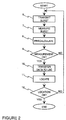
- Fig. 2 shows in a flow diagram, stages of the operation of a locating method according to the invention.
- signals containing bursts are transmitted in a known manner from the base transceiver stations.
- impulse responses are measured 7 from the burst signals using time differences compared to a reference.
- the reference is preferably created from a burst signal transmitted by another base transceiver station.
- Pre-calculation 8 is carried out for the time differences and other data, such as signal strengths, comprising data analyzation and possibly processing for the next locating steps.
- pre-calculation may include the checking of the shape of the impulse response and the search for the centre of mass corresponding to the time difference. This processing yields, e.g.
- the numeral time differences of the burst signals instead of just the received signal samples. If the pre-calculation was successful 9, the information processed in the pre-calculation is transferred 10 by radio and through the mobile network to a location service centre in which the final calculation steps are carried out 11, otherwise the process returns to the start. These calculation steps include, e.g. locating on the basis of numeral time differences and base station location data. If locating was successful 12, the process ends, otherwise it retums to the start.
- Fig. 3 shows an impulse response in a co-ordinate system.
- the horizontal axis represents time and the vertical axis represents normalised correlation.
- Response taps 1 to 9 and 22 to 33 show almost negligible correlation with the training sequence code used.
- Response taps 10 to 21 show detectable correlation between the burst and the training sequence code.
- Response taps 15 to 17 show full or almost full correlation.
- the time difference corresponds to response taps 15 to 17.
- Dashed line Th1 in the co-ordinate system represents a threshold level which the highest response tap must exceed in order to be acceptable.
- a second dashed line Th2 in the co-ordinate system represents a threshold level which the surrounding response taps must not reach for the highest response tap to be acceptable.
- Fig. 4 shows in a block diagram a method for determining the time difference from a received burst. This method is used for calculating time differences between burst signals preferably in a mobile station.
- Block 13 represents information about the radio channel configuration; it is used for choosing or creating 14 a training sequence.
- the training sequence is in this case preferably a known training sequence or a bit pattern in a dummy burst.
- a receiver 15 converts the burst in the radio signal into digital form and sends it further to a cross-correlation block 16 where the burst is compared with the training sequence.
- the impulse response (IR) obtained is taken to block 17 where the shape of the impulse response is checked.
- the method begins to calculate the time difference 18 on the basis of the impulse response, e.g. using the highest response tap or the tap corresponding to the first received signal component. If the impulse response is unacceptable, a different training sequence is selected 14 and the cross-correlation 16 and the checking 17 of the shape of the impulse response are repeated. If all training sequences and the dummy burst have been used in the cross-correlation 16 and the shape is unacceptable, the burst is rejected 19.
- Fig. 5 schematically shows possible boundaries of the distribution of some locating functions presented by way of example.
- Part A is carried out in the mobile station and includes sampling.
- Parts B1 to B4 are carried out alternatively in the mobile station or in the mobile network so that the distribution boundary is placed at one of the lines shown.
- Part B1 includes calculation of impulse response.
- Part B2 includes the determination of the signal arrival time using a criterion suitable for the shape of the impulse response, such as the centre of mass or 40% level of rising edge.
- Part B3 includes filtering and combining of measurement data, using averaging, calculation of the median, or averaging of filtered data.
- Part B4 includes pre-calculation, used advantageously for detecting location change.
- Part C is carried out in the mobile network and includes calculation of location estimate.
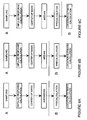
- Figs. 6A, 6B and 6C show some exemplary distributions of locating functions.
- Fig. 6A the mobile station is in idle state in a rural area where no reflections occur in the radio transmission. All operations according to part A are carried out in the mobile station, in this case, sampling, calculation of impulse response, determination of the centre of mass and averaging. Operations according to part B are carried out in the mobile network, in this case, pre-calculation and calculation of location estimate.
- Fig. 6B the mobile station is in idle state in a city where a lot of reflections occur in the radio transmission. All operations according to part A are carried out in the mobile station, in this case, sampling, calculation of impulse response, determination of the advantageously 40%-level of the rising edge and determination of the median. Operations according to part B are carried out in the mobile network, in this case, pre-calculation and calculation of location estimate.
- Fig. 6C the mobile station is in idle state in a city, monitoring its position and reporting of movement. All operations according to part A are carried out in the mobile station, in this case, sampling, calculation of impulse response, determination of the advantageously 40%-level of the rising edge, determination of the median and pre-calculation. Operations according to part B are carried out in the mobile network, in this case, calculation of location estimate.
- the distribution of functions is dynamically alterable, it is possible to change between the situations described in Figs. 6A, 6B and 6C as well as other alternatives e.g. when detecting in the mobile station a change in the impulse width, in the mobile network a change in the signal-to-noise ratio on the basis of data sent from the mobile station, or in the location service centre movement by the mobile station from an area to another. At least these are reasons for shifting the execution boundary between the mobile station and mobile network.
- Averaging and median calculation parameters such as the magnitude of the set of samples, are also advantageously alterable according to the situation. Natural averaging magnitudes comprise e.g. 5 to 20 samples.
- automatic emergency indication which is started using menus or a special key on the mobile station.
- menus one can indicate the type of emergency, say, distress, robbery or heart attack.
- an automatic surveillance centre which further contacts a location service centre 5.
- the location service centre 5 sends to the mobile station 1 a command to carry out locating process as described above, after which the location of the mobile station 1 and the type of the emergency are indicated to an emergency centre.
- locating measures are commenced on the mobile station as soon as the user activates the automatic emergency indication on the mobile station, without waiting for a command from the service centre.
- the emergency centre receives the information in the form of voice message or as a message conveyed to a computer.
- the voice message is preferably stored in the mobile station 1 and indicates the cause of the emergency.
- the locating and emergency signalling are continued at a predetermined schedule.
- the location is verified by determining that the mobile station 1 is within the coverage area of the mobile network. Possibly the location is also shown to the user on the display of the apparatus 1.
- Emergency indication can also be activated by means of separate activation devices which e.g. monitor the heartbeat of a patient with heart troubles and activate the emergency indication when the pulse becomes weak or disappears, as happens in a heart attack.
- Other such activation devices include apparatus containing acceleration sensors, which detect collision, and smoke detectors in buildings.
- a function may be implemented in the method so that after the activation of the function the mobile station 1 repeatedly requests a secret code in order not to transmit an alarm.
- This function is useful especially in a dangerous area where the user might get robbed, as the mobile station 1 will call for help, in addition to carrying out the locating process, even if the apparatus were stolen.
- the function is also useful when the user is unable to call for help, say, because of an attack of illness.
- the function can be realized such that the mobile network waits for regular acknowledgements to prevent an alarm. Then, advantageously, the mobile station 1 automatically informs the mobile network of a low battery charge before the apparatus ceases to function, to not to generate an unnecessary alarm. On the other hand, an alarm is generated if the mobile station 1 gets broken in an accident or, in the case of distress, sinks with the boat.
- Different mobile stations 1 may have different computing capacities the use of which changes as the mobile station changes from idle state to active state and vice versa.
- the mobile station 1 estimates the capacity available, processes measurement results in the limits of the estimated capacity and sends the processed data to a location service centre 5 for final processing. Especially processing that requires base station location information is preferably carried out in a location service centre 5.
- history data are also used in the locating process in such a manner that impossible values are eliminated.
- Such history data include previous location estimates or in the OTD system, previous OTD values, for example.
- Impossible values are e.g. those that would result in an unreasonably high speed estimate for the mobile station 1.
- the locating process may also utilise subscriber specific profiles which e.g. indicate fixed installation on a car, which may move with high speeds, or data related to the equipment used by the subscriber, say, information about the delays in the propagation of the received signal, generated in the radiofrequency part of the equipment type in question. Coefficients correcting known systematic errors can also be included in the profiles.
- burst signals used in the locating process are known, so they can be used to calculate the impulse response through correlation.
- the following elements in the burst signals are used for correlation:
- Received synchronisation bursts are compared with the corresponding long training sequence.
- the time difference values calculated from them are used as reference values and possibly weighted in the averaging.
- bursts are compared with the normal training sequence as that is likely to be the correct one. This is because the number of a training sequence is always the same as the base station colour code (BCC) on the broadcast and control channels and usually on other channels as well.
- BCC base station colour code
- a received burst does not correlate with any normal training sequence it will be compared with the middle part of the dummy burst.
- the highest tap of the impulse response is higher than a predetermined threshold value or the highest tap and the taps around it are considerably higher than the rest.
- a predetermined threshold value e.g. 20% threshold for the comparison between the current tap and the highest tap, but the threshold may also be different before and after the highest tap.
- the latter threshold shall be set higher than the first e.g. in a mountainous area where mountain sides cause reflected non-line-of-sight (NLOS) signals from a base station to the mobile station.
- NLOS non-line-of-sight
- a reflected signal is excluded from the locating process because its propagation time is longer than that of a signal arriving via the direct route, and therefore it would cause an erroneous result.
- the impulse response has only one high tap.
- the signal-to-noise ratio can also be used in determining the threshold value.
- a window can be formed around the highest tap such that all taps outside the window will be rejected regardless of their height. The window may be e.g. 20 taps long and it confines a safe area on the time axis.
- the highest tap is compared with the first and last taps of the impulse response.
- the highest tap should be clearly higher than those.
- the first three and the last three taps could be used in the comparison, for example.
- the highest tap is expected to be located within a certain time zone which is the only one to be checked.
- This statistical zone could consist of taps 14 to 25, assuming 33 taps in the impulse response. The highest tap must be located within this zone for the impulse response to be acceptable.
- the method can be refined by adding tests based on previous bursts.
- the global positioning system used e.g. on a ship for navigation, can possibly be connected to the mobile station 1 so that it would provide more accurate information on the position of the mobile station 1, especially when far away from base transceiver stations 2, 3, 4 or in the coverage area of only one base transceiver station 2, 3, 4.
Landscapes
- Engineering & Computer Science (AREA)
- Computer Networks & Wireless Communication (AREA)
- Signal Processing (AREA)
- Mobile Radio Communication Systems (AREA)
- Position Fixing By Use Of Radio Waves (AREA)
Applications Claiming Priority (2)
| Application Number | Priority Date | Filing Date | Title |
|---|---|---|---|
| FI974196 | 1997-11-11 | ||
| FI974196A FI113896B (fi) | 1997-11-11 | 1997-11-11 | Menetelmä matkaviestimen sijainnin hajautetuksi määrittelemiseksi |
Publications (2)
| Publication Number | Publication Date |
|---|---|
| EP0917385A1 true EP0917385A1 (de) | 1999-05-19 |
| EP0917385B1 EP0917385B1 (de) | 2011-10-12 |
Family
ID=8549913
Family Applications (1)
| Application Number | Title | Priority Date | Filing Date |
|---|---|---|---|
| EP98309100A Expired - Lifetime EP0917385B1 (de) | 1997-11-11 | 1998-11-06 | Verfahren zur Ortsbestimmung einer Mobilstation auf eine verteilte Art |
Country Status (9)
| Country | Link |
|---|---|
| US (1) | US6327474B1 (de) |
| EP (1) | EP0917385B1 (de) |
| JP (1) | JP4286450B2 (de) |
| CN (1) | CN1158891C (de) |
| AU (1) | AU754839B2 (de) |
| BR (1) | BR9814119A (de) |
| CA (1) | CA2308409C (de) |
| FI (1) | FI113896B (de) |
| WO (1) | WO1999025144A2 (de) |
Cited By (8)
| Publication number | Priority date | Publication date | Assignee | Title |
|---|---|---|---|---|
| WO2001019112A1 (en) * | 1999-09-03 | 2001-03-15 | Nokia Corporation | Distance estimation in a communication system |
| WO2001018560A1 (en) * | 1999-09-02 | 2001-03-15 | Nokia Corporation | Distance estimation between transmitter and receiver |
| WO2001091385A1 (en) * | 2000-05-22 | 2001-11-29 | Nokia Corporation | Data transmission in packet-switched radio system implementing user equipment location service |
| EP1229756A3 (de) * | 2001-02-02 | 2003-12-17 | Nokia Corporation | Verfahren und System zur Erfassung der Position eines Mobilfunkendgerätes in einem Zellularen Funksystem |
| US7068704B1 (en) | 2001-09-26 | 2006-06-27 | Itt Manufacturing Enterpprises, Inc. | Embedded chirp signal for position determination in cellular communication systems |
| US7358899B1 (en) | 2000-08-31 | 2008-04-15 | Nokia Corporation | Distance estimation in a communication system |
| WO2009111127A3 (en) * | 2008-02-29 | 2010-01-28 | Apple Inc. | Location determination |
| US8213389B2 (en) | 2008-04-15 | 2012-07-03 | Apple Inc. | Location determination using formula |
Families Citing this family (29)
| Publication number | Priority date | Publication date | Assignee | Title |
|---|---|---|---|---|
| US6701143B1 (en) * | 1999-12-15 | 2004-03-02 | Vert, Inc. | Apparatus, methods, and computer programs for displaying information on mobile signs |
| GB0023366D0 (en) * | 2000-09-23 | 2000-11-08 | Koninkl Philips Electronics Nv | Mobile radio terminal and related method and system |
| US6473038B2 (en) * | 2001-01-05 | 2002-10-29 | Motorola, Inc. | Method and apparatus for location estimation |
| US20030036374A1 (en) * | 2001-06-04 | 2003-02-20 | Time Domain Corporation | Wireless local area network using impulse radio technology to improve communications between mobile nodes and access points |
| GB0121030D0 (en) * | 2001-08-30 | 2001-10-24 | Nokia Corp | Location services |
| US7647422B2 (en) | 2001-11-06 | 2010-01-12 | Enterasys Networks, Inc. | VPN failure recovery |
| US8972589B2 (en) * | 2002-03-01 | 2015-03-03 | Enterasys Networks, Inc. | Location-based access control in a data network |
| US20040203972A1 (en) * | 2002-03-21 | 2004-10-14 | Christiansen Robert D. | Method of snmp printing device/user communication for detecting imaging device proximity |
| US20030181195A1 (en) * | 2002-03-21 | 2003-09-25 | Christiansen Robert D. | Method of SNMP printing device/mobile device communication for assuring proper imaging device selection |
| US20050003828A1 (en) * | 2002-04-09 | 2005-01-06 | Sugar Gary L. | System and method for locating wireless devices in an unsynchronized wireless environment |
| US20030199284A1 (en) * | 2002-04-19 | 2003-10-23 | Christiansen Robert D. | Mobile device power modulation for detecting imaging device proximity |
| US20040100918A1 (en) * | 2002-11-27 | 2004-05-27 | Antti Toskala | Method and system for forwarding a control information |
| WO2004052027A2 (en) * | 2002-11-27 | 2004-06-17 | Cognio, Inc | System and method for locating sources of unknown wireless radio signals |
| US7580403B2 (en) | 2004-02-26 | 2009-08-25 | Enterasys Networks, Inc. | Status transmission system and method |
| CN1677906B (zh) * | 2004-03-31 | 2010-07-21 | 华为技术有限公司 | 一种监听目标用户设备位置业务的方法 |
| CN100456875C (zh) * | 2004-04-12 | 2009-01-28 | 华为技术有限公司 | 一种自动上报目标用户设备位置信息的方法 |
| CN1691675B (zh) * | 2004-04-20 | 2012-03-21 | 华为技术有限公司 | 一种自动上报目标用户设备位置信息的方法 |
| US7945945B2 (en) | 2004-08-06 | 2011-05-17 | Enterasys Networks, Inc. | System and method for address block enhanced dynamic network policy management |
| US7347628B2 (en) | 2004-11-08 | 2008-03-25 | Enterasys Networks, Inc. | Optical interface identification system |
| US8086232B2 (en) | 2005-06-28 | 2011-12-27 | Enterasys Networks, Inc. | Time synchronized wireless method and operations |
| WO2007051223A1 (en) * | 2005-11-04 | 2007-05-10 | Seeker Wireless Pty Limited | Profile based communications service |
| WO2009036497A1 (en) | 2007-09-17 | 2009-03-26 | Seeker Wireless Pty Limited | Systems and methods for triggering location based voice and/or data communications to or from mobile radio terminals |
| EP2269390A4 (de) * | 2008-04-07 | 2012-04-04 | Wavemarket Inc D B A Location Labs | Ortung von drahtlosen mobilen endgeräten |
| WO2009155036A2 (en) * | 2008-05-28 | 2009-12-23 | Nivis, Llc | Methods and systems for location estimation |
| US20100098204A1 (en) * | 2008-08-01 | 2010-04-22 | Nivis, Llc | Systems and Methods for Regulating Clock Precision in Distributed Devices |
| US20100027437A1 (en) * | 2008-08-01 | 2010-02-04 | Nivis, Llc | Systems and Methods for Determining Link Quality |
| WO2011003104A1 (en) * | 2009-07-02 | 2011-01-06 | Maxlinear, Inc. | Methods and systems for location estimation |
| US8233911B2 (en) * | 2009-12-16 | 2012-07-31 | Nokia Corporation | Method and apparatus for estimating a position of a node in a communications network |
| KR101779539B1 (ko) * | 2015-06-18 | 2017-09-19 | 주식회사 사운들리 | 훈련열 동기화 위치 추정방법 및 이를 이용한 수신기 |
Citations (5)
| Publication number | Priority date | Publication date | Assignee | Title |
|---|---|---|---|---|
| GB2260050A (en) | 1991-09-09 | 1993-03-31 | Nec Corp | Control of digital mobile communications system |
| US5293645A (en) | 1991-10-04 | 1994-03-08 | Sharp Microelectronics Technology, Inc. | Apparatus and method for locating mobile and portable radio terminals in a radio network |
| US5542100A (en) | 1991-06-06 | 1996-07-30 | Sony Corporation | Mobile communication system |
| WO1996035306A1 (en) | 1995-05-02 | 1996-11-07 | Telecom Securicor Cellular Radio Limited | Cellular radio location system |
| EP0767594A2 (de) | 1995-10-03 | 1997-04-09 | Nokia Mobile Phones Ltd. | Mobilstationsortungssystem |
Family Cites Families (21)
| Publication number | Priority date | Publication date | Assignee | Title |
|---|---|---|---|---|
| US4748685A (en) * | 1986-10-10 | 1988-05-31 | Motorola, Inc. | Mobile radio communications system |
| FR2646302B1 (fr) * | 1989-04-25 | 1993-01-15 | Matra Communication | Procede de pseudo-synchronisation d'un reseau de communication a multiplexage dans le temps et applications |
| US5208756A (en) | 1991-01-28 | 1993-05-04 | Song Han L | Vehicle locating and navigating system |
| US5592180A (en) | 1992-08-20 | 1997-01-07 | Nexus1994 Limited | Direction finding and mobile location system for trunked mobile radio systems |
| SE9302140L (sv) * | 1993-06-21 | 1994-08-29 | Televerket | Förfarande för lokalisering av mobilstationer i digitalt telenät |
| WO1995000821A1 (en) * | 1993-06-25 | 1995-01-05 | Omniplex, Inc. | Determination of location using time-synchronized cell site transmissions |
| FR2710805B1 (fr) * | 1993-09-29 | 1995-11-10 | Alcatel Mobile Comm France | Structure de burst de remplissage dans un système cellulaire de radiocommunications numériques utilisant le principe de l'AMRT, et station de base pour l'élaboration d'une telle structure. |
| DE4409178A1 (de) | 1994-03-17 | 1995-09-21 | Siemens Ag | Verfahren und Anordnung zum Ermitteln der Position von Mobilstationen in einem Mobilfunksystem |
| EP0752113B1 (de) | 1994-03-25 | 2001-11-07 | QUALCOMM Incorporated | Standortsbestimmungsverfahren zur verwendung mit einem analogen zellularsystem |
| US5646632A (en) * | 1994-11-14 | 1997-07-08 | Lucent Technologies Inc. | Method and apparatus for a portable communication device to identify its own location |
| GB9519087D0 (en) | 1995-09-19 | 1995-11-22 | Cursor Positioning Sys Ltd | Navigation and tracking system |
| FI101668B1 (fi) | 1995-11-13 | 1998-07-31 | Nokia Mobile Phones Ltd | Menetelmä solukkoverkon tilaajapäätelaitteen lisälaitteen ohjaamiseksi sekä tilaajapäätelaitteen lisälaite |
| US5883598A (en) * | 1995-12-15 | 1999-03-16 | Signatron Technology Corporation | Position location system and method |
| US5946626A (en) * | 1995-12-26 | 1999-08-31 | At&T Corp. | Method and system for determining location of subscriber of two-way paging service |
| JP2865043B2 (ja) * | 1996-02-02 | 1999-03-08 | 日本電気株式会社 | 移動体無線電話装置 |
| US5960355A (en) * | 1996-02-16 | 1999-09-28 | Telefonaktiebolaget Lm Ericsson | Method and an arrangement relating to telecommunication systems |
| FI108985B (fi) | 1996-04-04 | 2002-04-30 | Sonera Oyj | Menetelmä ja järjestelmä paikan määrittämiseksi |
| US5970413A (en) * | 1996-06-06 | 1999-10-19 | Qualcomm Incorporated | Using a frequency that is unavailable for carrying telephone voice information traffic for determining the position of a mobile subscriber in a CDMA cellular telephone system |
| US5675344A (en) | 1996-06-28 | 1997-10-07 | Motorola, Inc. | Method and apparatus for locating a mobile station in a spread spectrum communication system |
| US5983109A (en) * | 1997-02-03 | 1999-11-09 | Northern Telecom Limited | Method and apparatus for using advanced positioning systems in cellular communications networks |
| US5987329A (en) * | 1997-07-30 | 1999-11-16 | Ericsson Inc | System and method for mobile telephone location measurement using a hybrid technique |
-
1997
- 1997-11-11 FI FI974196A patent/FI113896B/fi not_active IP Right Cessation
-
1998
- 1998-11-06 EP EP98309100A patent/EP0917385B1/de not_active Expired - Lifetime
- 1998-11-09 US US09/188,507 patent/US6327474B1/en not_active Expired - Lifetime
- 1998-11-11 AU AU10363/99A patent/AU754839B2/en not_active Ceased
- 1998-11-11 CN CNB988130327A patent/CN1158891C/zh not_active Expired - Fee Related
- 1998-11-11 JP JP2000520610A patent/JP4286450B2/ja not_active Expired - Fee Related
- 1998-11-11 WO PCT/FI1998/000875 patent/WO1999025144A2/en not_active Ceased
- 1998-11-11 CA CA002308409A patent/CA2308409C/en not_active Expired - Fee Related
- 1998-11-11 BR BR9814119-8A patent/BR9814119A/pt not_active Application Discontinuation
Patent Citations (5)
| Publication number | Priority date | Publication date | Assignee | Title |
|---|---|---|---|---|
| US5542100A (en) | 1991-06-06 | 1996-07-30 | Sony Corporation | Mobile communication system |
| GB2260050A (en) | 1991-09-09 | 1993-03-31 | Nec Corp | Control of digital mobile communications system |
| US5293645A (en) | 1991-10-04 | 1994-03-08 | Sharp Microelectronics Technology, Inc. | Apparatus and method for locating mobile and portable radio terminals in a radio network |
| WO1996035306A1 (en) | 1995-05-02 | 1996-11-07 | Telecom Securicor Cellular Radio Limited | Cellular radio location system |
| EP0767594A2 (de) | 1995-10-03 | 1997-04-09 | Nokia Mobile Phones Ltd. | Mobilstationsortungssystem |
Cited By (11)
| Publication number | Priority date | Publication date | Assignee | Title |
|---|---|---|---|---|
| WO2001018560A1 (en) * | 1999-09-02 | 2001-03-15 | Nokia Corporation | Distance estimation between transmitter and receiver |
| WO2001019112A1 (en) * | 1999-09-03 | 2001-03-15 | Nokia Corporation | Distance estimation in a communication system |
| WO2001091385A1 (en) * | 2000-05-22 | 2001-11-29 | Nokia Corporation | Data transmission in packet-switched radio system implementing user equipment location service |
| US7068634B2 (en) | 2000-05-22 | 2006-06-27 | Nokia Mobile Phones, Ltd. | Data transmission in packet-switched radio system implementing user equipment location service |
| US7358899B1 (en) | 2000-08-31 | 2008-04-15 | Nokia Corporation | Distance estimation in a communication system |
| EP1229756A3 (de) * | 2001-02-02 | 2003-12-17 | Nokia Corporation | Verfahren und System zur Erfassung der Position eines Mobilfunkendgerätes in einem Zellularen Funksystem |
| US7068704B1 (en) | 2001-09-26 | 2006-06-27 | Itt Manufacturing Enterpprises, Inc. | Embedded chirp signal for position determination in cellular communication systems |
| WO2009111127A3 (en) * | 2008-02-29 | 2010-01-28 | Apple Inc. | Location determination |
| US8803737B2 (en) | 2008-02-29 | 2014-08-12 | Apple Inc. | Location determination |
| US8213389B2 (en) | 2008-04-15 | 2012-07-03 | Apple Inc. | Location determination using formula |
| US8514816B2 (en) | 2008-04-15 | 2013-08-20 | Apple Inc. | Location determination using formula |
Also Published As
| Publication number | Publication date |
|---|---|
| CA2308409C (en) | 2009-11-10 |
| US6327474B1 (en) | 2001-12-04 |
| EP0917385B1 (de) | 2011-10-12 |
| JP4286450B2 (ja) | 2009-07-01 |
| CA2308409A1 (en) | 1999-05-20 |
| FI113896B (fi) | 2004-06-30 |
| AU754839B2 (en) | 2002-11-28 |
| CN1286007A (zh) | 2001-02-28 |
| BR9814119A (pt) | 2000-10-03 |
| FI974196A0 (fi) | 1997-11-11 |
| FI974196L (fi) | 1999-05-12 |
| JP2001523077A (ja) | 2001-11-20 |
| WO1999025144A2 (en) | 1999-05-20 |
| AU1036399A (en) | 1999-05-31 |
| CN1158891C (zh) | 2004-07-21 |
| WO1999025144A3 (en) | 1999-09-02 |
Similar Documents
| Publication | Publication Date | Title |
|---|---|---|
| EP0917385B1 (de) | Verfahren zur Ortsbestimmung einer Mobilstation auf eine verteilte Art | |
| US6243588B1 (en) | Mobile positioning method for a portable communications device using shortened repetitive bursts | |
| US6438380B1 (en) | System for robust location of a mobile-transmitter | |
| US6658258B1 (en) | Method and apparatus for estimating the location of a mobile terminal | |
| JP4365298B2 (ja) | 携帯用通信装置自体の位置を識別するための方法および装置 | |
| KR101060808B1 (ko) | 핸드폰 통신 분석을 기초로 도로교통량을 측정하는 방법 | |
| KR100763041B1 (ko) | 위치기반 기능을 활성화하는 방법, 시스템 및 기기 | |
| KR100705730B1 (ko) | 무선 측위 시스템을 개선하기 위한 방법 | |
| EP1271986B1 (de) | Verfahren und System für die Ortsbestimmung von Mobilstationen | |
| US20010051527A1 (en) | Wireless position measurement terminal and wireless position measurement system | |
| EP2285147A2 (de) | Verfahren zur Übertragung einer Nachricht an eine Mobilstation | |
| US6289211B1 (en) | Method for determining the position of a mobile station | |
| JPH11513848A (ja) | 移動電話位置確定システムおよび方法 | |
| CA2681105A1 (en) | System and method of umts ue location using uplink dedicated physical control channel and downlink synchronization channel | |
| EP2425667B1 (de) | Dynamische tag-steuerung und fingerabdruck-ereignislokalisierung | |
| EP2168391B1 (de) | Verfahren und anordnung zur positionsbestimmung in einem mobilkommunikationsnetz | |
| EP1179282B1 (de) | Verfahren und vorrichtung zur schätzung einer signalcharakteristik | |
| US20060262731A1 (en) | Method and apparatus for determining path loss by combining geolocation with interference suppression | |
| EP1568244B1 (de) | Schätzung einer signalverzögerung | |
| WO2003015447A1 (en) | Methods for detecting, computing and disseminating location information associated with emergency 911 wireless transmissions | |
| US20020198002A1 (en) | Method and apparatus for troubleshooting lost call location | |
| MXPA00004519A (en) | Method for locating mobile station in distributed manner | |
| HK1035628A (en) | Method for locating mobile station in distributed manner | |
| KR100736419B1 (ko) | 신호 지연 추정 | |
| JP2000261848A (ja) | 移動体通信システム及びそのシステムにおける移動端末の位置情報検索方法 |
Legal Events
| Date | Code | Title | Description |
|---|---|---|---|
| PUAI | Public reference made under article 153(3) epc to a published international application that has entered the european phase |
Free format text: ORIGINAL CODE: 0009012 |
|
| AK | Designated contracting states |
Kind code of ref document: A1 Designated state(s): DE FR GB IT |
|
| AX | Request for extension of the european patent |
Free format text: AL;LT;LV;MK;RO;SI |
|
| 17P | Request for examination filed |
Effective date: 19991119 |
|
| AKX | Designation fees paid |
Free format text: DE FR GB IT |
|
| RAP1 | Party data changed (applicant data changed or rights of an application transferred) |
Owner name: NOKIA CORPORATION |
|
| 17Q | First examination report despatched |
Effective date: 20070831 |
|
| REG | Reference to a national code |
Ref country code: DE Ref legal event code: R079 Ref document number: 69842441 Country of ref document: DE Free format text: PREVIOUS MAIN CLASS: H04Q0007380000 Ipc: H04W0064000000 |
|
| GRAP | Despatch of communication of intention to grant a patent |
Free format text: ORIGINAL CODE: EPIDOSNIGR1 |
|
| RIC1 | Information provided on ipc code assigned before grant |
Ipc: H04W 64/00 20090101AFI20110404BHEP |
|
| GRAS | Grant fee paid |
Free format text: ORIGINAL CODE: EPIDOSNIGR3 |
|
| GRAA | (expected) grant |
Free format text: ORIGINAL CODE: 0009210 |
|
| AK | Designated contracting states |
Kind code of ref document: B1 Designated state(s): DE FR GB IT |
|
| REG | Reference to a national code |
Ref country code: GB Ref legal event code: FG4D |
|
| REG | Reference to a national code |
Ref country code: DE Ref legal event code: R081 Ref document number: 69842441 Country of ref document: DE Owner name: NOKIA TECHNOLOGIES OY, FI Free format text: FORMER OWNER: NOKIA CORPORATION, 02610 ESPOO, FI Ref country code: DE Ref legal event code: R081 Ref document number: 69842441 Country of ref document: DE Owner name: NOKIA TECHNOLOGIES OY, FI Free format text: FORMER OWNER: NOKIA CORPORATION, ESPOO, FI Ref country code: DE Ref legal event code: R081 Ref document number: 69842441 Country of ref document: DE Owner name: NOKIA TECHNOLOGIES OY, FI Free format text: FORMER OWNER: NOKIA MOBILE PHONES LTD., ESPOO, FI |
|
| REG | Reference to a national code |
Ref country code: DE Ref legal event code: R096 Ref document number: 69842441 Country of ref document: DE Effective date: 20111201 |
|
| PLBE | No opposition filed within time limit |
Free format text: ORIGINAL CODE: 0009261 |
|
| REG | Reference to a national code |
Ref country code: FR Ref legal event code: ST Effective date: 20120731 |
|
| STAA | Information on the status of an ep patent application or granted ep patent |
Free format text: STATUS: NO OPPOSITION FILED WITHIN TIME LIMIT |
|
| PG25 | Lapsed in a contracting state [announced via postgrant information from national office to epo] |
Ref country code: IT Free format text: LAPSE BECAUSE OF FAILURE TO SUBMIT A TRANSLATION OF THE DESCRIPTION OR TO PAY THE FEE WITHIN THE PRESCRIBED TIME-LIMIT Effective date: 20111012 |
|
| 26N | No opposition filed |
Effective date: 20120713 |
|
| GBPC | Gb: european patent ceased through non-payment of renewal fee |
Effective date: 20120112 |
|
| PG25 | Lapsed in a contracting state [announced via postgrant information from national office to epo] |
Ref country code: GB Free format text: LAPSE BECAUSE OF NON-PAYMENT OF DUE FEES Effective date: 20120112 |
|
| REG | Reference to a national code |
Ref country code: DE Ref legal event code: R097 Ref document number: 69842441 Country of ref document: DE Effective date: 20120713 |
|
| PG25 | Lapsed in a contracting state [announced via postgrant information from national office to epo] |
Ref country code: FR Free format text: LAPSE BECAUSE OF NON-PAYMENT OF DUE FEES Effective date: 20111212 |
|
| REG | Reference to a national code |
Ref country code: DE Ref legal event code: R081 Ref document number: 69842441 Country of ref document: DE Owner name: NOKIA TECHNOLOGIES OY, FI Free format text: FORMER OWNER: NOKIA CORPORATION, 02610 ESPOO, FI Ref country code: DE Ref legal event code: R081 Ref document number: 69842441 Country of ref document: DE Owner name: NOKIA TECHNOLOGIES OY, FI Free format text: FORMER OWNER: NOKIA CORPORATION, ESPOO, FI |
|
| PGFP | Annual fee paid to national office [announced via postgrant information from national office to epo] |
Ref country code: DE Payment date: 20151103 Year of fee payment: 18 |
|
| REG | Reference to a national code |
Ref country code: DE Ref legal event code: R119 Ref document number: 69842441 Country of ref document: DE |
|
| PG25 | Lapsed in a contracting state [announced via postgrant information from national office to epo] |
Ref country code: DE Free format text: LAPSE BECAUSE OF NON-PAYMENT OF DUE FEES Effective date: 20170601 |
|
| REG | Reference to a national code |
Ref country code: DE Ref legal event code: R081 Ref document number: 69842441 Country of ref document: DE Owner name: WSOU INVESTMENTS, LLC, LOS ANGELES, US Free format text: FORMER OWNER: NOKIA TECHNOLOGIES OY, ESPOO, FI |