EP0917852A1 - Verfahren zur Herstellung eines Reinigungstuches - Google Patents
Verfahren zur Herstellung eines Reinigungstuches Download PDFInfo
- Publication number
- EP0917852A1 EP0917852A1 EP19980121568 EP98121568A EP0917852A1 EP 0917852 A1 EP0917852 A1 EP 0917852A1 EP 19980121568 EP19980121568 EP 19980121568 EP 98121568 A EP98121568 A EP 98121568A EP 0917852 A1 EP0917852 A1 EP 0917852A1
- Authority
- EP
- European Patent Office
- Prior art keywords
- fabric
- wiper
- temperature
- microns
- measured
- Prior art date
- Legal status (The legal status is an assumption and is not a legal conclusion. Google has not performed a legal analysis and makes no representation as to the accuracy of the status listed.)
- Granted
Links
Images
Classifications
-
- A—HUMAN NECESSITIES
- A47—FURNITURE; DOMESTIC ARTICLES OR APPLIANCES; COFFEE MILLS; SPICE MILLS; SUCTION CLEANERS IN GENERAL
- A47L—DOMESTIC WASHING OR CLEANING; SUCTION CLEANERS IN GENERAL
- A47L13/00—Implements for cleaning floors, carpets, furniture, walls, or wall coverings
- A47L13/10—Scrubbing; Scouring; Cleaning; Polishing
- A47L13/16—Cloths; Pads; Sponges
-
- D—TEXTILES; PAPER
- D06—TREATMENT OF TEXTILES OR THE LIKE; LAUNDERING; FLEXIBLE MATERIALS NOT OTHERWISE PROVIDED FOR
- D06C—FINISHING, DRESSING, TENTERING OR STRETCHING TEXTILE FABRICS
- D06C7/00—Heating or cooling textile fabrics
- D06C7/02—Setting
-
- D—TEXTILES; PAPER
- D06—TREATMENT OF TEXTILES OR THE LIKE; LAUNDERING; FLEXIBLE MATERIALS NOT OTHERWISE PROVIDED FOR
- D06M—TREATMENT, NOT PROVIDED FOR ELSEWHERE IN CLASS D06, OF FIBRES, THREADS, YARNS, FABRICS, FEATHERS OR FIBROUS GOODS MADE FROM SUCH MATERIALS
- D06M10/00—Physical treatment of fibres, threads, yarns, fabrics or fibrous goods made from such materials, e.g. by ultrasonic waves, corona discharge, irradiation, electric currents or magnetic fields; Physical treatment combined with treatment with chemical compounds or elements
-
- Y—GENERAL TAGGING OF NEW TECHNOLOGICAL DEVELOPMENTS; GENERAL TAGGING OF CROSS-SECTIONAL TECHNOLOGIES SPANNING OVER SEVERAL SECTIONS OF THE IPC; TECHNICAL SUBJECTS COVERED BY FORMER USPC CROSS-REFERENCE ART COLLECTIONS [XRACs] AND DIGESTS
- Y10—TECHNICAL SUBJECTS COVERED BY FORMER USPC
- Y10T—TECHNICAL SUBJECTS COVERED BY FORMER US CLASSIFICATION
- Y10T442/00—Fabric [woven, knitted, or nonwoven textile or cloth, etc.]
- Y10T442/10—Scrim [e.g., open net or mesh, gauze, loose or open weave or knit, etc.]
- Y10T442/102—Woven scrim
- Y10T442/172—Coated or impregnated
- Y10T442/178—Synthetic polymeric fiber
-
- Y—GENERAL TAGGING OF NEW TECHNOLOGICAL DEVELOPMENTS; GENERAL TAGGING OF CROSS-SECTIONAL TECHNOLOGIES SPANNING OVER SEVERAL SECTIONS OF THE IPC; TECHNICAL SUBJECTS COVERED BY FORMER USPC CROSS-REFERENCE ART COLLECTIONS [XRACs] AND DIGESTS
- Y10—TECHNICAL SUBJECTS COVERED BY FORMER USPC
- Y10T—TECHNICAL SUBJECTS COVERED BY FORMER US CLASSIFICATION
- Y10T442/00—Fabric [woven, knitted, or nonwoven textile or cloth, etc.]
- Y10T442/30—Woven fabric [i.e., woven strand or strip material]
-
- Y—GENERAL TAGGING OF NEW TECHNOLOGICAL DEVELOPMENTS; GENERAL TAGGING OF CROSS-SECTIONAL TECHNOLOGIES SPANNING OVER SEVERAL SECTIONS OF THE IPC; TECHNICAL SUBJECTS COVERED BY FORMER USPC CROSS-REFERENCE ART COLLECTIONS [XRACs] AND DIGESTS
- Y10—TECHNICAL SUBJECTS COVERED BY FORMER USPC
- Y10T—TECHNICAL SUBJECTS COVERED BY FORMER US CLASSIFICATION
- Y10T442/00—Fabric [woven, knitted, or nonwoven textile or cloth, etc.]
- Y10T442/30—Woven fabric [i.e., woven strand or strip material]
- Y10T442/3179—Woven fabric is characterized by a particular or differential weave other than fabric in which the strand denier or warp/weft pick count is specified
- Y10T442/322—Warp differs from weft
- Y10T442/3228—Materials differ
- Y10T442/3236—Including inorganic strand material
- Y10T442/3252—Including synthetic polymeric strand material
-
- Y—GENERAL TAGGING OF NEW TECHNOLOGICAL DEVELOPMENTS; GENERAL TAGGING OF CROSS-SECTIONAL TECHNOLOGIES SPANNING OVER SEVERAL SECTIONS OF THE IPC; TECHNICAL SUBJECTS COVERED BY FORMER USPC CROSS-REFERENCE ART COLLECTIONS [XRACs] AND DIGESTS
- Y10—TECHNICAL SUBJECTS COVERED BY FORMER USPC
- Y10T—TECHNICAL SUBJECTS COVERED BY FORMER US CLASSIFICATION
- Y10T442/00—Fabric [woven, knitted, or nonwoven textile or cloth, etc.]
- Y10T442/30—Woven fabric [i.e., woven strand or strip material]
- Y10T442/3179—Woven fabric is characterized by a particular or differential weave other than fabric in which the strand denier or warp/weft pick count is specified
- Y10T442/3301—Coated, impregnated, or autogenous bonded
-
- Y—GENERAL TAGGING OF NEW TECHNOLOGICAL DEVELOPMENTS; GENERAL TAGGING OF CROSS-SECTIONAL TECHNOLOGIES SPANNING OVER SEVERAL SECTIONS OF THE IPC; TECHNICAL SUBJECTS COVERED BY FORMER USPC CROSS-REFERENCE ART COLLECTIONS [XRACs] AND DIGESTS
- Y10—TECHNICAL SUBJECTS COVERED BY FORMER USPC
- Y10T—TECHNICAL SUBJECTS COVERED BY FORMER US CLASSIFICATION
- Y10T442/00—Fabric [woven, knitted, or nonwoven textile or cloth, etc.]
- Y10T442/60—Nonwoven fabric [i.e., nonwoven strand or fiber material]
- Y10T442/689—Hydroentangled nonwoven fabric
Definitions
- This invention relates to the manufacturing of polyester fabric for wipers, in particular, wipers which release fewer particulate contaminates.
- Wipers may be made from knitted, woven or non-woven polyester fabrics.
- the typical manufacturing process begins with drawing and texturing continuous filament polyester yarn.
- the textured yarn is knitted or woven to construct a fabric, and the fabric is washed or scoured to remove spinning oils.
- the fabric may be chemically modified in order to improve its wettability and performance.
- the fabric is then dried in a "tenter frame” oven at a temperature of between 325 and 450° F, to remove moisture and heat set the fabric. Heat setting dissipates stress in the polyester fibers and stabilizes the fabric.
- the fabric is cut into wipers, typically 9 inch by 9 inch squares.
- the wipers may remain unlaundered or may be washed in a cleanroom laundry, employing special surfactants and highly-filtered and purified water, to reduce the contamination present on the fabric.
- the wipers may be packaged dry in air-tight plastic bags, or pre-saturated with a suitable solvent before being packaged, and are ready for use.
- wipers are utilized for a number of different applications, including cleaning within cleanrooms, automotive painting rooms and other cleanroom environments.
- Each different application emphasizes certain standards these types of wipers should attain.
- stringent performance standards must be met. These standards are related to sorbency and contamination, including maximum allowable particulate, unspecified extractable matter and individual ionic contaminants.
- the standards for particulate contaminant release are especially rigorous and various methods have been devised to meet them.
- Paley et al., US 4,888,229 describes a wiper having fused borders, the sealed edge of the wipers being present to reduce contamination caused by small fibers.
- Diaber et al., US 5,229,181 describes a knit fabric tube, only two edges of which must be cut and sealed, thereby reducing the contamination caused by loose fibers from the edges.
- Paley et al., US 5,271,995 describes a wiper for a cleanroom environment that has reduced inorganic contaminants through the use of a specific yarn, namely "nylon bright".
- Reynolds, US 5,069,735 describes a procedure to cut the fabric into pieces using a hot air jet in the range of 600 to 800° F to melt the fibers, forming a sealed edge product with reduced loose fiber contamination.
- an object of the invention is to provide a low contaminant wiping cloth suitable for a wide range of applications.
- Another object of the invention is to provide a wiper which meets substantially all of the specifications for use in cleanrooms, particularly Class 100 cleanrooms and below, to provide an improved method of manufacturing a cleanroom wiper and to provide a wiper having a substantial reduction in particulate release.
- a further object of the invention is to provide a cleanroom wiper having a high liquid sorbency capacity.
- Yet another object of the invention is to provide a wiper which is dimensionally stable.
- the term dimensionally stable means, in this instance, a wiper which lies substantially flat and does not curl into a roll, especially after the wiper is laundered.
- the wiper does not undergo any appreciable linear shrinkage (less than 5%) when it is exposed to a heat source of 175 degrees fahrenheit for 5 minutes.
- a method of manufacturing a textile article for use in a cleanroom having the steps of constructing a knitted or woven fabric from polyester yarn, heat setting the fabric at a temperature of from 180° to 300° F and cutting the fabric to form the desired article; wherein the polyester fiber has not been heated above a temperature of 300° F.
- the invention also includes a textile article, such as a wiper, made according to the aforementioned process.
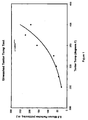
- polyester particles can number as high as 1 x 10 9 or greater particles per square meter, have a high affinity for the polyester fabric and are very difficult to remove using conventional laundering procedures. Nevertheless, the trimer particles can release from the fabric and become a source of contamination. Applicant has established a direct correlation between the temperature to which the polyester fiber has been exposed and particulate contamination released from the fabric.
- the invention incorporates the advantages of being adaptable to existing manufacturing processes; reducing particulate contamination on the fiber dramatically; being useful with conventional polyester fibers; and having high sorbency capacity and dimensional stability, as defined above.
- the wipers of the present invention may be constructed from woven or knitted polyester fibers, preferably fibers of poly(ethylene terephthalate). It is also preferable to construct the fabrics from continuous filament, polyester yarn. Yarns having a wide variety of denier and filament count may be employed. Examples of useful yarns are those having a denier to filament ratio of from 0.1 to 10, a denier of 15 to 250 with filament counts ranging from 10 to 250. A wide range of fabric weights may be employed in the present invention. Typically, the fabrics used for cleanroom wipers have a weight of 1 to 9 ounces per square yard, preferably 3 to 7 ounces per square yard.
- the yarn employed in the fabric may be a textured polyester yarn.
- Such yarns are commercially available and their manufacture is well known in the arts.
- POY partially oriented yarn
- the yarn is preferably not heated above a temperature of 300° F during the texturing process, and generally will not be heated above a temperature of 225°F.
- the fabric may be washed or scoured to remove spinning oils, dirt and other contamination.
- the fabric may also be chemically modified with a finish to improve its wettability and washability. Examples of applicable chemical modifications may be found in U.S. Patents 3,660,010; 3,676,052; 3,981,807; 3,625,754; 4,014,857; 4,207,071; 4,290,765; 4,068,035; 4,937,277; 3,377,249; 3,535,141; 3,540,835; 3,563,795; 3,598,641; 3,574,620; 3,632,420; 3,650,801; 3,652,212; 3,690,942; 3,897,206; 4,090,844; 4,131,550; 3,649,165; 4,073,993; 4,427,557; 3,620,826; 4,164,392; and 4,168,954.
- the finish may be applied to the fabric in the form of an aqueous liquor using conventional techniques.
- the fabric is heat set to provide dimensional stability, as defined above, which is usually combined with drying the fabric subsequent to washing, scouring or application of miscellaneous finishes.
- the fabric is preferably heat set at a temperature above what the yarns have previously experienced, after the initial spinning of the fiber. Preferably, the fabric lies flat when it is heat set.
- the fabric is heat set at a temperature of from 180° to 300° F, preferably from 200° to 275° F, most preferably from 225° to 265° F.
- Heat setting may advantageously be performed in a tenter frame oven, in which the fabric is held flat during heating and while it begins to cool.
- the temperature of the oven may be higher than the temperature actually experienced by the yarn, which will be a function of the oven or dryer temperature profile, length and speed of the fabric through the oven.
- the highest temperature which the polyester yarn experiences subsequent to spinning can be determined by Differential Scanning Calorimeter (DSC). Briefly, the method involves heating a sample while measuring heat flow. The highest temperature experienced by the sample appears as a broad peak. In order to minimize generation of particulates, the maximum temperature to which the yarn is heated during any processing step is 300° F or below, preferably 275° F or below, most preferably 265° F or below.
- DSC Differential Scanning Calorimeter
- the fabric is cut into nominal sizes for use as a cleanroom wiper, which are preferably squares ranging from 6 inch by 6 inch to 12 inch by 12 inch, with 9 inch by 9 inch squares being common. Any geometric shape may be employed as the shape of the inventive wipes.
- the fabric is preferably, though not necessarily, cut using a technique which fuses the end of the yarn, thereby preventing unraveling and particle generation. Examples of suitable techniques may be found in Reynolds, US 5,069,735, and the references cited therein.
- inventive wipes may also be utilized in automotive paint rooms where the area itself is not necessarily substantially free from contamination.
- the low level of contaminants which may be released from the inventive wipes aids in the spray painting of an automobile.
- the inventive wipes provide such a painter with a cleaning article which will deposit a minimum of debris, fibers, or other type of contaminant on the surface to be painted.
- a cleanroom laundry Prior to packaging the wipers for use in cleanrooms, it is desirable to wash the fabric or wipers in a cleanroom laundry, which may be characterized as a laundry facility to remove and minimize contamination of the wipers.
- the cleanroom laundry may employ special filters, surfactants, sequestrants, purified water, etc. to remove oils, reduce particle count and extract undesirable ion contaminates. Examples of suitable equipment and description of cleanroom laundries may be found in Austin, Dr. Philip R., "Encyclopedia of Cleanrooms, Bio-Cleanrooms and Aseptic Areas", Contamination Control Seminars, Michigan (1995).
- cleanroom wipers include performance criteria related to sorbency and contaminates.
- One standard for evaluating cleanroom wipers is the Institute of Environmental Sciences & Technology (IEST), Contamination Control Division Recommended Practice 004.2, which may be cited as IEST-RP-CC004.2, "Evaluating Wiping Materials Used in Cleanrooms and Other Controlled Environments".
- Section 7 of Recommended Practice 004.2 sets forth some of the tests utilized for determining the capacity and rate sorption of cleanroom wipers.
- the capacity tests is performed by saturating a known area of wiper with a selected liquid and then calculating the volume sorbed per unit mass and per unit area of wiper (IEST-RP-CC004.2 ⁇ 7.1).
- the sorbency per unit mass is referred to as the "intrinsic sorbency” and is the volume of liquid in milliliters sorbed per unit of mass of wiper in grams.
- the “extrinsic sorbency” is the volume of liquid in milliliters sorbed per unit area of wiper in square meters.
- the rate of sorption of a cleanroom wiper is measured by allowing a drop of water to fall from a fixed height onto the surface of a wiper. The time required for the disappearance of specular reflection from the drop is measured and recorded as the sorption rate (IEST-RP-CC004.2 ⁇ 7.2).
- the primary test for contamination associated with cleanroom wipers are those measuring particles, unspecified extractable matter, and individual ionic constituents.
- the number of particles released during wetting and mechanical stress can be measured in the Biaxial Shake Test (IEST-RP-CC004.2 ⁇ 5.2). Briefly, the wipers are placed in a jar of water and shaken. Aliquots are removed from the shaker and the number of particles is counted, typically those in the size range of 0.1 microns and larger are specified. The number of particles greater than a given particle size are reported in millions per square meter of fabric.
- the amount of extractable contamination associated with a cleanroom wiper is determined by extracting the wiper with a solvent, such as water, isopropyl alcohol or acetone, evaporating the solvent and weighing the non-volatile residue (IEST-RP-CC004.2 ⁇ 6.1).
- the quantity of extracted matter may be reported as mass extracted per mass of wiper or mass extracted per unit area of wiper.
- the organic and inorganic non-volatile residue may be further analyzed, when it is desirable to know how much of a particular species is present.
- the non-volatile residue is tested for various inorganic, anionic or cationic constituents, for example Al, Ca, Cl, F, Li, Mg, K, Na and Zn (IEST-RP-CC004.2 ⁇ 6.2).
- Partially oriented yarn (POY) was drawn and textured on a false twist texturing machine at a maximum temperature of approximately 180° F.
- the textured yarn was circular knit into a fabric of approximately 4 ounces per square yard. This fabric was scoured in a jet to remove spinning oils, for 20 minutes at 180° F.
- the fabric was dried on a tenter frame oven at 250° F, at a speed of 25 yards per minute.
- the fabric was rewet, and samples of the fabric were dried and heat set on a tenter frame oven at temperatures ranging from 250° to 400° F.
- the fabric samples were then cut into 9" x 9" squares and tested for particulate contamination according to the Biaxial Shake Test (IEST-RP-CC004.2 & 5.2).
- the results of the test are shown in Table 1 below, and in Figure 1.
- the heat history of the fabric was tested using a differential scanning calorimeter (DSC). The highest temperature to which the fabric (and yarn) had been heated is also reported in Table 1 below. Pieces of the fabric were cut and viewed under a scanning electron microscope (SEM).
- a test was conducted to test the release of particles from wipers which were heat set at various temperatures and were saturated in a mixture of water and 2-propanol.
- Two types of partially oriented yarn were drawn and textured on a false twist texturing machine at a maximum temperature of approximately 180° F.
- the textured yams, 70 denier/34 filament and 70 denier/100 filament were circular knit into a fabric in a 3:1 ratio, respectively, to give a weight of approximately 4 ounces per square yard.
- This fabric was scoured in a jet to remove spinning oils, for 20 minutes at 180° F.
- the fabric was designated Style "A”. Samples of the fabric were dried in a tenter frame oven at three temperatures: 250° F, 300° F, and 350° F, at speeds of 25, 35, and 50 yards per minute respectively. The fabric was then cut into 9" x 9" wipers, and washed and dried in a cleanroom laundry.
- Fabric Style A of Example 2 was wet out and dried in the tenter frame oven at 250, 275, 300, and 350 degrees F at 40, 45, 53, and 55 yards per minute respectively.
- Fabric Style B and Style C are circular knit fabrics constructed entirely of 70/34 POY yarn, prepared according to Example 2.
- Style B weighed 4.0 oz. per square yard and Style C weighed 3.5 oz. per square yard. Both Styles B and C were dried in the tenter frame oven at 250 and 350° F. Then, Styles B and C were cut into wipers, and washed and dried in a cleanroom laundry.
- the cleanroom wipers of the present invention demonstrate good dimensional stability, i.e. they remain relatively flat and do not roll up after laundering.
- the cleanroom wipers find utility in virtually any environment where a low contaminate, high absorbance wiping cloth is desired, such as in semiconductor and pharmaceutical cleanrooms, and in preparation of surfaces for painting or other coating.
- the wipers may be presaturated with a desired solvent and sold in sealed dispensers, as is well known in the art.
- Suitable solvents include water, organic solvents such as naphtha, and aqueous solutions of water miscible organic solvents, in particular solutions of alcohols, such as C 1 -C 8 alcohols, especially isopropanol, and water.
- wipers presaturated with a solution of isopropanol and water, especially 1 to 99 wt.% isopropanol/water solutions.
- the solvent composition may also contain a surfactant and/or other additives selected for their cleaning characteristics.
- a surfactant and/or other additives selected for their cleaning characteristics.
- additional solvents and packages for pre-saturated wipers may be found in the following references: US 3,994,751; US 4,627,936; US 4,639, 327; US 4,998,984; US 5,145,091; US 5,344,007 and JP 6[1994]-48475.
- the wipers may be sealed in air tight packages while dry.
Landscapes
- Engineering & Computer Science (AREA)
- Textile Engineering (AREA)
- Cleaning Implements For Floors, Carpets, Furniture, Walls, And The Like (AREA)
- Treatment Of Fiber Materials (AREA)
- Knitting Of Fabric (AREA)
- Treatments For Attaching Organic Compounds To Fibrous Goods (AREA)
- Woven Fabrics (AREA)
- Detergent Compositions (AREA)
Applications Claiming Priority (2)
| Application Number | Priority Date | Filing Date | Title |
|---|---|---|---|
| US08/976,225 US6189189B1 (en) | 1997-11-21 | 1997-11-21 | Method of manufacturing low contaminant wiper |
| US976225 | 2001-10-12 |
Publications (2)
| Publication Number | Publication Date |
|---|---|
| EP0917852A1 true EP0917852A1 (de) | 1999-05-26 |
| EP0917852B1 EP0917852B1 (de) | 2004-08-18 |
Family
ID=25523890
Family Applications (1)
| Application Number | Title | Priority Date | Filing Date |
|---|---|---|---|
| EP19980121568 Expired - Lifetime EP0917852B1 (de) | 1997-11-21 | 1998-11-18 | Reinigungstuch und Verfahren zur dessen Herstellung |
Country Status (8)
| Country | Link |
|---|---|
| US (2) | US6189189B1 (de) |
| EP (1) | EP0917852B1 (de) |
| JP (1) | JPH11318792A (de) |
| CA (1) | CA2254439C (de) |
| DE (1) | DE69825706T2 (de) |
| IL (3) | IL162625A (de) |
| SG (1) | SG68704A1 (de) |
| TW (1) | TW440631B (de) |
Cited By (2)
| Publication number | Priority date | Publication date | Assignee | Title |
|---|---|---|---|---|
| EP1050577A1 (de) * | 1999-05-07 | 2000-11-08 | Air Products And Chemicals, Inc. | Reinraumwischtücher mit niedrigem Gehalt an flüchtigen, organischen Verbindungen |
| US7130027B2 (en) | 2002-07-19 | 2006-10-31 | Roche Diagnostics Operations, Inc. | Reflection-photometric analytical system |
Families Citing this family (9)
| Publication number | Priority date | Publication date | Assignee | Title |
|---|---|---|---|---|
| IL132212A (en) * | 1998-10-23 | 2003-03-12 | Milliken & Co | Textile fabric with particle attracting finish |
| US20030072915A1 (en) * | 2001-10-12 | 2003-04-17 | Kelly Creighton C. | Low contaminant wiper |
| US20030186609A1 (en) * | 2002-03-28 | 2003-10-02 | Booker Archer E. D. | Nonwoven fabric having low ion content and method for producing the same |
| US7201777B2 (en) * | 2002-03-28 | 2007-04-10 | Booker Jr Archer E D | Nonwoven fabric having low ion content and method for producing the same |
| US20060217021A1 (en) * | 2005-03-22 | 2006-09-28 | Illinois Tool Woks Inc. | Clean-room wipers |
| US20070010148A1 (en) * | 2005-07-11 | 2007-01-11 | Shaffer Lori A | Cleanroom wiper |
| US20070010153A1 (en) * | 2005-07-11 | 2007-01-11 | Shaffer Lori A | Cleanroom wiper |
| US8431497B2 (en) * | 2009-08-25 | 2013-04-30 | Berkshire Corporation | Clean room wipes |
| CN103015081B (zh) * | 2012-12-26 | 2015-02-11 | 东莞市硕源电子材料有限公司 | 一种超净擦拭布的生产方法 |
Citations (2)
| Publication number | Priority date | Publication date | Assignee | Title |
|---|---|---|---|---|
| US4888229A (en) * | 1988-04-08 | 1989-12-19 | The Texwipe Company | Wipers for cleanroom use |
| US5229181A (en) * | 1990-10-30 | 1993-07-20 | Amber Technologies | Tubular knit cleanroom wiper |
Family Cites Families (12)
| Publication number | Priority date | Publication date | Assignee | Title |
|---|---|---|---|---|
| US3902299A (en) | 1971-09-02 | 1975-09-02 | Int Clean Products Inc | Wiping cloth |
| US3897206A (en) | 1972-12-27 | 1975-07-29 | Bibb Company | Method of preparing cellulosic textile materials having improved soil release and stain resistance properties |
| JPS5626061A (en) | 1979-08-01 | 1981-03-13 | Toyo Boseki | Heat treatment of knitted fabric using polyester long fiber |
| JPS6321968A (ja) | 1986-07-08 | 1988-01-29 | ユニチカ株式会社 | 鬼シボ調ポリエステル系織物の製造方法 |
| US5271995A (en) | 1990-02-23 | 1993-12-21 | The Texwipe Company | Particulate contamination control in cleanrooms |
| US5069735A (en) | 1990-06-04 | 1991-12-03 | Milliken Research Corporation | Apparatus for producing sealed edge knit wiping cloths |
| JPH05125658A (ja) | 1991-10-28 | 1993-05-21 | Unitika Ltd | 拭き布等として使用するのに適した丸編地の製造方法 |
| US5320900A (en) | 1993-08-10 | 1994-06-14 | E. I. Du Pont De Nemours And Company | High absorbency cleanroom wipes having low particles |
| US5460655A (en) | 1994-01-27 | 1995-10-24 | Wilshire Technologies, Inc. | Hydrophilic foam article and surface-cleaning method for clean room |
| JP3402019B2 (ja) * | 1995-10-24 | 2003-04-28 | 東レ株式会社 | 精密機器用またはクリーンルーム用ワイパーおよびその製造方法 |
| WO1997021862A2 (en) * | 1995-11-30 | 1997-06-19 | Kimberly-Clark Worldwide, Inc. | Superfine microfiber nonwoven web |
| US5736469A (en) * | 1996-03-15 | 1998-04-07 | The Texwipe Company Llc | Anti-static cleanroom products and methods and methods of making same |
-
1997
- 1997-11-21 US US08/976,225 patent/US6189189B1/en not_active Expired - Lifetime
-
1998
- 1998-11-16 IL IL162625A patent/IL162625A/en unknown
- 1998-11-16 IL IL12706098A patent/IL127060A0/xx not_active IP Right Cessation
- 1998-11-18 EP EP19980121568 patent/EP0917852B1/de not_active Expired - Lifetime
- 1998-11-18 DE DE1998625706 patent/DE69825706T2/de not_active Expired - Fee Related
- 1998-11-19 CA CA 2254439 patent/CA2254439C/en not_active Expired - Fee Related
- 1998-11-20 SG SG1998004880A patent/SG68704A1/en unknown
- 1998-11-24 JP JP33330298A patent/JPH11318792A/ja not_active Ceased
- 1998-12-07 TW TW87119274A patent/TW440631B/zh not_active IP Right Cessation
-
2000
- 2000-09-29 US US09/676,161 patent/US6740608B1/en not_active Expired - Lifetime
-
2004
- 2004-06-17 IL IL16262504A patent/IL162625A0/xx not_active IP Right Cessation
Patent Citations (3)
| Publication number | Priority date | Publication date | Assignee | Title |
|---|---|---|---|---|
| US4888229A (en) * | 1988-04-08 | 1989-12-19 | The Texwipe Company | Wipers for cleanroom use |
| US4888229B1 (de) * | 1988-04-08 | 1992-06-16 | Teven J Paley | |
| US5229181A (en) * | 1990-10-30 | 1993-07-20 | Amber Technologies | Tubular knit cleanroom wiper |
Cited By (3)
| Publication number | Priority date | Publication date | Assignee | Title |
|---|---|---|---|---|
| EP1050577A1 (de) * | 1999-05-07 | 2000-11-08 | Air Products And Chemicals, Inc. | Reinraumwischtücher mit niedrigem Gehalt an flüchtigen, organischen Verbindungen |
| US7078358B2 (en) | 1999-05-07 | 2006-07-18 | Air Products And Chemicals, Inc. | Low VOC cleanroom cleaning wipe |
| US7130027B2 (en) | 2002-07-19 | 2006-10-31 | Roche Diagnostics Operations, Inc. | Reflection-photometric analytical system |
Also Published As
| Publication number | Publication date |
|---|---|
| US6740608B1 (en) | 2004-05-25 |
| HK1018391A1 (en) | 1999-12-24 |
| CA2254439C (en) | 2007-04-17 |
| US6189189B1 (en) | 2001-02-20 |
| EP0917852B1 (de) | 2004-08-18 |
| CA2254439A1 (en) | 1999-05-21 |
| TW440631B (en) | 2001-06-16 |
| JPH11318792A (ja) | 1999-11-24 |
| IL127060A0 (en) | 1999-09-22 |
| DE69825706T2 (de) | 2005-07-14 |
| IL162625A (en) | 2006-08-01 |
| DE69825706D1 (de) | 2004-09-23 |
| SG68704A1 (en) | 1999-11-16 |
| IL162625A0 (en) | 2005-11-20 |
Similar Documents
| Publication | Publication Date | Title |
|---|---|---|
| US20150107039A1 (en) | Textile Fabric With Particle Attracting Finish | |
| EP0917852B1 (de) | Reinigungstuch und Verfahren zur dessen Herstellung | |
| US20070010153A1 (en) | Cleanroom wiper | |
| JP3697788B2 (ja) | ワイピングクロスおよびその製造方法 | |
| US20030182730A1 (en) | Nonwoven fabric having low ion content and method for producing the same | |
| HK1018391B (en) | Wiper and method for its manufacture | |
| US20070010148A1 (en) | Cleanroom wiper | |
| US20030186609A1 (en) | Nonwoven fabric having low ion content and method for producing the same | |
| WO2001080706A1 (en) | Wiper with particle attracting finish | |
| KR100441928B1 (ko) | 와이핑용 부직물 | |
| HK1026594B (en) | Textile fabric with particle attracting finish | |
| JP2002161452A (ja) | クリーナークロス用布帛及びその製造方法 | |
| US20030049984A1 (en) | Electro-static dissipative clean room wiper | |
| 노의경 et al. | Changes in absorbency and drying speed of a quick-drying knit fabric by repeated laundering | |
| CN101218389A (zh) | 洁净室拭巾 |
Legal Events
| Date | Code | Title | Description |
|---|---|---|---|
| PUAI | Public reference made under article 153(3) epc to a published international application that has entered the european phase |
Free format text: ORIGINAL CODE: 0009012 |
|
| AK | Designated contracting states |
Kind code of ref document: A1 Designated state(s): BE CH DE ES FR GB IE IT LI |
|
| AX | Request for extension of the european patent |
Free format text: AL;LT;LV;MK;RO;SI |
|
| 17P | Request for examination filed |
Effective date: 19990701 |
|
| AKX | Designation fees paid |
Free format text: BE CH DE ES FR GB IE IT LI |
|
| 17Q | First examination report despatched |
Effective date: 20020517 |
|
| GRAP | Despatch of communication of intention to grant a patent |
Free format text: ORIGINAL CODE: EPIDOSNIGR1 |
|
| RTI1 | Title (correction) |
Free format text: WIPER AND METHOD FOR ITS MANUFACTURE |
|
| GRAS | Grant fee paid |
Free format text: ORIGINAL CODE: EPIDOSNIGR3 |
|
| GRAA | (expected) grant |
Free format text: ORIGINAL CODE: 0009210 |
|
| RAP1 | Party data changed (applicant data changed or rights of an application transferred) |
Owner name: MILLIKEN RESEARCH CORPORATION |
|
| AK | Designated contracting states |
Kind code of ref document: B1 Designated state(s): BE CH DE ES FR GB IE IT LI |
|
| REG | Reference to a national code |
Ref country code: GB Ref legal event code: FG4D |
|
| REG | Reference to a national code |
Ref country code: CH Ref legal event code: EP |
|
| REG | Reference to a national code |
Ref country code: IE Ref legal event code: FG4D |
|
| REF | Corresponds to: |
Ref document number: 69825706 Country of ref document: DE Date of ref document: 20040923 Kind code of ref document: P |
|
| PG25 | Lapsed in a contracting state [announced via postgrant information from national office to epo] |
Ref country code: ES Free format text: LAPSE BECAUSE OF FAILURE TO SUBMIT A TRANSLATION OF THE DESCRIPTION OR TO PAY THE FEE WITHIN THE PRESCRIBED TIME-LIMIT Effective date: 20041129 |
|
| REG | Reference to a national code |
Ref country code: CH Ref legal event code: NV Representative=s name: KIRKER & CIE SA |
|
| REG | Reference to a national code |
Ref country code: HK Ref legal event code: GR Ref document number: 1018391 Country of ref document: HK |
|
| PLBE | No opposition filed within time limit |
Free format text: ORIGINAL CODE: 0009261 |
|
| STAA | Information on the status of an ep patent application or granted ep patent |
Free format text: STATUS: NO OPPOSITION FILED WITHIN TIME LIMIT |
|
| ET | Fr: translation filed | ||
| 26N | No opposition filed |
Effective date: 20050519 |
|
| PGFP | Annual fee paid to national office [announced via postgrant information from national office to epo] |
Ref country code: IT Payment date: 20071128 Year of fee payment: 10 Ref country code: CH Payment date: 20071129 Year of fee payment: 10 |
|
| PGFP | Annual fee paid to national office [announced via postgrant information from national office to epo] |
Ref country code: BE Payment date: 20071213 Year of fee payment: 10 |
|
| PGFP | Annual fee paid to national office [announced via postgrant information from national office to epo] |
Ref country code: GB Payment date: 20071128 Year of fee payment: 10 Ref country code: FR Payment date: 20071119 Year of fee payment: 10 |
|
| PGFP | Annual fee paid to national office [announced via postgrant information from national office to epo] |
Ref country code: DE Payment date: 20071221 Year of fee payment: 10 |
|
| BERE | Be: lapsed |
Owner name: *MILLIKEN RESEARCH CORP. Effective date: 20081130 |
|
| REG | Reference to a national code |
Ref country code: CH Ref legal event code: PL |
|
| GBPC | Gb: european patent ceased through non-payment of renewal fee |
Effective date: 20081118 |
|
| REG | Reference to a national code |
Ref country code: IE Ref legal event code: MM4A |
|
| PG25 | Lapsed in a contracting state [announced via postgrant information from national office to epo] |
Ref country code: IT Free format text: LAPSE BECAUSE OF NON-PAYMENT OF DUE FEES Effective date: 20081118 |
|
| PGFP | Annual fee paid to national office [announced via postgrant information from national office to epo] |
Ref country code: IE Payment date: 20071126 Year of fee payment: 10 |
|
| REG | Reference to a national code |
Ref country code: FR Ref legal event code: ST Effective date: 20090731 |
|
| PG25 | Lapsed in a contracting state [announced via postgrant information from national office to epo] |
Ref country code: BE Free format text: LAPSE BECAUSE OF NON-PAYMENT OF DUE FEES Effective date: 20081130 |
|
| PG25 | Lapsed in a contracting state [announced via postgrant information from national office to epo] |
Ref country code: LI Free format text: LAPSE BECAUSE OF NON-PAYMENT OF DUE FEES Effective date: 20081130 Ref country code: IE Free format text: LAPSE BECAUSE OF NON-PAYMENT OF DUE FEES Effective date: 20081118 Ref country code: DE Free format text: LAPSE BECAUSE OF NON-PAYMENT OF DUE FEES Effective date: 20090603 Ref country code: CH Free format text: LAPSE BECAUSE OF NON-PAYMENT OF DUE FEES Effective date: 20081130 |
|
| PG25 | Lapsed in a contracting state [announced via postgrant information from national office to epo] |
Ref country code: GB Free format text: LAPSE BECAUSE OF NON-PAYMENT OF DUE FEES Effective date: 20081118 |
|
| PG25 | Lapsed in a contracting state [announced via postgrant information from national office to epo] |
Ref country code: FR Free format text: LAPSE BECAUSE OF NON-PAYMENT OF DUE FEES Effective date: 20081130 |