EP0919244A2 - Kombinationspräparate für die Therapie von Tumoren - Google Patents
Kombinationspräparate für die Therapie von Tumoren Download PDFInfo
- Publication number
- EP0919244A2 EP0919244A2 EP98250357A EP98250357A EP0919244A2 EP 0919244 A2 EP0919244 A2 EP 0919244A2 EP 98250357 A EP98250357 A EP 98250357A EP 98250357 A EP98250357 A EP 98250357A EP 0919244 A2 EP0919244 A2 EP 0919244A2
- Authority
- EP
- European Patent Office
- Prior art keywords
- alkyl
- protein
- inhibitors
- inhibitor
- protein kinases
- Prior art date
- Legal status (The legal status is an assumption and is not a legal conclusion. Google has not performed a legal analysis and makes no representation as to the accuracy of the status listed.)
- Withdrawn
Links
Images



Classifications
-
- A—HUMAN NECESSITIES
- A61—MEDICAL OR VETERINARY SCIENCE; HYGIENE
- A61K—PREPARATIONS FOR MEDICAL, DENTAL OR TOILETRY PURPOSES
- A61K31/00—Medicinal preparations containing organic active ingredients
- A61K31/33—Heterocyclic compounds
- A61K31/395—Heterocyclic compounds having nitrogen as a ring hetero atom, e.g. guanethidine or rifamycins
- A61K31/40—Heterocyclic compounds having nitrogen as a ring hetero atom, e.g. guanethidine or rifamycins having five-membered rings with one nitrogen as the only ring hetero atom, e.g. sulpiride, succinimide, tolmetin, buflomedil
-
- A—HUMAN NECESSITIES
- A61—MEDICAL OR VETERINARY SCIENCE; HYGIENE
- A61K—PREPARATIONS FOR MEDICAL, DENTAL OR TOILETRY PURPOSES
- A61K31/00—Medicinal preparations containing organic active ingredients
- A61K31/33—Heterocyclic compounds
- A61K31/395—Heterocyclic compounds having nitrogen as a ring hetero atom, e.g. guanethidine or rifamycins
-
- A—HUMAN NECESSITIES
- A61—MEDICAL OR VETERINARY SCIENCE; HYGIENE
- A61K—PREPARATIONS FOR MEDICAL, DENTAL OR TOILETRY PURPOSES
- A61K31/00—Medicinal preparations containing organic active ingredients
- A61K31/33—Heterocyclic compounds
- A61K31/395—Heterocyclic compounds having nitrogen as a ring hetero atom, e.g. guanethidine or rifamycins
- A61K31/55—Heterocyclic compounds having nitrogen as a ring hetero atom, e.g. guanethidine or rifamycins having seven-membered rings, e.g. azelastine, pentylenetetrazole
-
- A—HUMAN NECESSITIES
- A61—MEDICAL OR VETERINARY SCIENCE; HYGIENE
- A61K—PREPARATIONS FOR MEDICAL, DENTAL OR TOILETRY PURPOSES
- A61K38/00—Medicinal preparations containing peptides
- A61K38/04—Peptides having up to 20 amino acids in a fully defined sequence; Derivatives thereof
- A61K38/12—Cyclic peptides, e.g. bacitracins; Polymyxins; Gramicidins S, C; Tyrocidins A, B or C
- A61K38/13—Cyclosporins
Definitions
- the present invention relates to drugs for treatment of tumors that are a synergistic combination of an inhibitor of cyclin-dependent protein kinases and a modulator contain at least one further protein-modifying enzyme.
- the central goal of tumor therapy is selective elimination neoplastic transformed cells.
- active ingredients are used for this purpose, which directly with the Mechanisms of DNA replication or mitosis interact, for example by inhibiting nucleotide biosynthesis, changing the DNA structure by intercalation, alkylation or blocking the enzymes involved in replication, such as of topoisomerases, or in that they act as mitotic spindle poisons Act. Because these processes are operations acts, which are essential for the survival of normal cells conventional chemotherapy usually has serious side effects connected.
- cytokines for induction of cell death from tumor cells. Cytokines intervene the other responsible for cellular proliferation intracellular signal transduction. The cytokine-induced Cell death is accompanied by fragmentation of genomic DNA, leading to an irreversible loss of genetic information leads and therefore presumably the cause of irreversibility of the death event is.
- cytokines are generally not therapeutically applicable due to high side effects such as shock or multi-organ failure (RA Heller, M. Krönke, The Journal of Cell Biology 126 (1994) 5; R. Beyaert, W. Fiers, FEBS Letters 340 (1994) 9).
- cytokines can be demonstrated by the simultaneous administration of Inhibitors of protein biosynthesis, such as cycloheximide, reinforce (R. A. Heller, M. Krönke, op. cit.; R. Beyaert, W. Fiers, loc. cit.).
- EP 0 366 061 B1 discloses the use of 4H-1-benzopyran-4-one derivatives to fight tumor diseases.
- EP 0 464 656 A1 disclose new anisomycin derivatives that can be used, among other things, for treatment of tumors.
- EP A 0 196 415 and J60149520 A disclose the use of trichostatin A and C as anti-tumor agents.
- the object of the invention is to provide drugs for Treatment of tumor diseases compared to known ones Agents have increased effectiveness and not with side effects associated with conventional chemotherapy.
- This task is surprisingly solved by products that an inhibitor of cyclin-dependent protein kinases and one or several modulators of at least one further protein-modifying Enzyme as a combination preparation for simultaneous, separate or timed application included.
- Inhibitors of cyclin-dependent protein kinases in the sense of the invention are substances whose IC 50 with respect to the activity of a cyclin-dependent kinase is 10 10 ⁇ M, preferably 1 1 ⁇ M.
- Alkyl preferably stands for straight-chain or branched Radicals with 1 to 6, particularly preferably 1 to 5 carbon atoms, especially methyl, ethyl, propyl, isopropyl, t-butyl, Pentyl or isopentyl groups.
- Substituted alkyl preferably represents haloalkyl, such as Trifluoromethylalkyl, hydroxyalkyl, such as hydroxyethyl, or carboxyalkyl, such as carboxyethyl.
- Cycloalkyl preferably represents groups with 3 to 6 carbon atoms, especially cyclopropyl, cyclobutyl, cyclopentyl or cyclohexyl.
- a preferred cycloalkylalkyl group is cyclopropylmethyl.
- Preferred aralkyl groups are phenyl groups which are unsubstituted or monosubstituted or polysubstituted by substituents such as halogen, C 1 -C 4 alkyl, C 1 -C 4 alkoxy, nitro or trifluoromethyl groups, amino groups and / or substituted amino groups.
- Aryl stands for unsubstituted and mono- or polysubstituted phenyl groups. Preferred substituents are halogen, C 1 -C 4 alkyl, C 1 -C 4 alkoxy, hydroxy, carboxy, COO-alkyl, CONH 2 , CONH-alkyl, CON (alkyl) 2 , nitro, trifluoromethyl, amino, C 1 -C 4 alkylamino, di-C 1 -C 4 alkylamino, aromatic heterocycles such as pyridyl groups or polycyclic aromatic radicals such as naphthyl groups.
- R 6 and R 7 are alkyl groups, where alkyl has the meaning given above, or together with the nitrogen atom to which they are attached, form a heterocyclic ring having one or more heteroatoms.
- Preferred heterocyclic rings are piperidine, pyrrolidine, morpholine, piperazine and imidazole.
- the heterocyclic rings can be unsubstituted or substituted one or more times by C 1 -C 4 alkyl, C 1 -C 4 alkoxy, aryl, hydroxyl or amino group.
- Suitable examples of salts of the compounds according to the invention with inorganic or organic acids are the hydrochloride, Hydrobromide, sulfate, phosphate, acetate, oxalate, tartrate, citrate, Maleate or fumarate.
- the most preferred inhibitor of cyclin-dependent protein kinases is flavopiridol ((-) cis-5,7-dihydroxy-2- (2-chlorophenyl) -8- (4- (3-hydroxy-1-methyl) -piperidinyl) -4H-1-benzopyran-4-one) ).
- Protein-modifying enzymes in the sense of the invention are, for example stress-activated protein kinases, histone deacetylase, the enzymes involved in protein biosynthesis and protein phosphatases and protein kinases.
- Preferred modulators are protein-modifying enzymes Activators of stress-activated protein kinases, inhibitors of histone deacetylase, Inhibitors of protein biosynthesis and inhibitors of protein phosphatases as well as others, i.e. not stress-activated or cyclin-dependent, protein kinases, such as inhibitors of tyrosine kinases and broad-spectrum protein kinase inhibitors.
- activators of stress-activated protein kinases are substances which directly or indirectly activate stress-activated protein kinases. Activators are preferred which, in a concentration of 1 1 ⁇ M, bring about an activation of 50 50%.
- Stress-activated protein kinases (SAPKs) are a group of protein kinases that are activated by stress stimuli such as UV radiation (JR Woodgett, J. Avruch, J. Kyriakis, Cancer Surveys 27 (1996) 127; S. Cosulich and P Clarke, Current Biology 6 (1996) 1586; P. Cohen, Trends in Cell Biol. 7 (1997) 353).
- the most preferred activator for stress activated protein kinases is anisomycin (2-p-methoxyphenylmethyl-3-acetoxy-4-hydroxypyrrolidine).
- Preferred inhibitors of histone deacetylases are pharmaceutically acceptable salts of butyric acid, trichostatin A, trichostatin C, trapoxin, chlamydocin, HC toxin, WP-3161 and / or cyt 2.
- Suitable compounds of this type are described, for example, by J. Taunton et al., J. At the. Chem. Soc. 118 (1996) 10412.
- Suitable GDA and DHGDA derivatives are described, for example, by RC Schnur et al., J. Med. Chem. 38 (1995) 3806; RC Schnur et al., J. Med. Chem. 38 (1995) 3813 and K. Sasaki et al., The Journal of Antibiotics 32 (1979) 849.
- Staurosporine is an inhibitor of a wide range of protein kinases known, geldanamycin inhibits tyrosine-specific protein kinases and various other cellular protein kinases the inhibition of enzyme activity take place directly or indirectly can.
- Cyclosporin A acts as an inhibitor of the protein phosphatase calcineurin. In addition, this substance acts as an immunosuppressant and protects mitochondria against those caused by noxious substances Collapse of the membrane potential (mitochondrial permeability transition).
- Protein kinases an inhibitor of histone deacetylase, an inhibitor of protein biosynthesis, an inhibitor of tyrosine kinases or in particular an activator of stress-activated protein kinases contain.
- Such products are preferred here: which (a) an inhibitor of cyclin-dependent protein kinases, an inhibitor of protein biosynthesis and an inhibitor of histone deacetylase; (b) an inhibitor of cyclin-dependent protein kinases, an inhibitor of protein biosynthesis, an inhibitor of histone deacetylase and an inhibitor of tyrosine-specific protein kinases contain.
- the products mentioned can each additionally a broad spectrum protein kinase inhibitor and / or a protein phosphatase inhibitor contain.
- Products which are more cyclin-dependent in addition to the inhibitor are particularly preferred Protein kinases an activator stress-activated Protein kinases and possibly other modulators protein-modifying Contain enzymes.
- the administration of the inhibitor of cyclin-dependent protein kinases and the other modulators can be operated simultaneously, i.e. in shape a combination preparation containing all substances or separately, i.e. by administering two or more separate preparations respectively.
- the preparations are sequential or sequential be administered. A particularly great success in therapy is achieved with graded application.
- the inhibitor cyclin-dependent protein kinases preferably in front of the activator the stress-activated protein kinases is administered.
- the temporal Distance between these applications depends on the ones used Active ingredients and in the case of the preferred Fabrics preferably about 1 to 12 hours, particularly preferred 3 to 4 hours.
- Products that are in addition to the inhibitor are very particularly preferred cyclin-dependent protein kinases and the activator stress-activated Protein kinases additionally 1 to 4, in particular 2 or 4 Contain active substances that consist of inhibitors of histone deacetylase, Inhibitors of protein biosynthesis and inhibitors of protein phosphatases or inhibitors of further protein kinases are selected, wherein the additional active ingredients preferably from different Active ingredient groups can be selected.
- Examples of such products are drugs that contain flavopiridol, Anisomycin, trichostatin A and puromycin; or flavopiridol, Anisomycin, trichostatin A, puromycin, geldanamycin, Cyclosporin A and possibly additional staurosporin included.
- the active substances used according to the invention are preferably administered intravenously or intraperitoneally.
- the dose of the active substances depends on the tumor to be treated and on the respective active substance and can be determined by a person skilled in the art using routine tests.
- the individual active ingredients are generally used in doses of 10 nmol to 1 mmol per kg body weight and therapy cycle. This application amount can be administered in the form of one or more injections or as an infusion.
- the preferred active ingredients are preferably dosed as follows ( in vivo ): Active ingredient Duration of application [H] dosage [mg / kg] preferred dosage [mg / kg] Trichostatin A 13-42 1-100 10-50 Puromycin 13-42 1-100 10-50 Cyclosporin A 13-42 10-200 50-150 Geldanamycin 13-42 0.1-10 0.2-6 Flavopiridol 4-18 1-10 5-8 Staurosporine 13-42 0.05-1 0.1-0.2 Anisomycin 3-12 1-150 6-90 Cycloheximide 13-42 0.1-5 0.1-2.5
- those products are preferred which each contain 7 ⁇ mol to 40 mmol of the inhibitor of cyclin-dependent protein kinases and of the modulator (s) of protein-modifying enzymes.
- products are preferred that contain the following amounts of active ingredient per dosage unit (solutions for injection): Active ingredient Active ingredient quantity / dosage unit Trichostatin 0.7-3.5 g / ampoule Puromycin 0.7-3.5 g / ampoule Cyclosporin A 3.5-10.5 g / ampoule Geldanamycin 14-420 mg / ampoule Flavopiridol 70 - 700 mg / ampoule Staurosporine 3.5 - 70 mg / ampoule Anisomycin 0.07 - 7 g / ampoule Cycloheximide 35-170 mg / ampoule
- One dosage unit / ampoule contains those for infusion per therapy cycle required amount of active ingredient.
- the dosage information for the individual active ingredients are independent of which one Combination the active ingredients are used.
- the invention Medicines preferably used according to a therapy plan the one or more multi-stage, in particular three-stage Therapy cycles include.
- the first, optional stage of the therapy cycle includes administration one or more inhibitors of histone deacetylase, preferably Trichostation A, inhibitors of tyrosine kinases, preferably Geldanamycin, inhibitors of protein biosynthesis, preferably puromycin, Inhibitors of protein phosphatases, preferably cyclosporin A and / or protein kinases, preferably staurosporine.
- histone deacetylase preferably Trichostation A
- inhibitors of tyrosine kinases preferably Geldanamycin
- inhibitors of protein biosynthesis preferably puromycin
- Inhibitors of protein phosphatases preferably cyclosporin A and / or protein kinases, preferably staurosporine.
- one or more inhibitors become more cyclin-dependent Kinases and possibly broadband protein kinase inhibitors are used.
- the third stage of treatment involves the administration of one or more Activators of stress-activated protein kinases and / or inhibitors protein biosynthesis.
- the total duration of a therapy cycle preferably comprises 14 to 42 hours.
- the application of preparations of the first stage preferably extends over the entire therapy area.
- the second treatment step is preferably started 12 to 24 hours and the third treatment step 13 to 30 hours after the start of the first step.
- the substances characteristic of the individual stages are ideally applied continuously until the end of the overall therapy, so that the application of preparations of the second and third stages extends over a period of 2 to 18 hours or 1 to 12 hours.
- the chronological sequence and duration of the individual stages are shown in the following table. The table also shows the assignment of the different active ingredients to the levels.
- the therapy cycle can be repeated several times, with the Time intervals between the individual therapy cycles typically 1 to 14 days.
- the various active ingredients are preferably applied by multiple distributed over the application period Bolus injections or continuous infusion.
- the inventive Products preferably in the form of 2 to 4, in particular 3 spatially separate compositions.
- the combination preparations according to the invention act in comparison extremely fast, synchronous with conventional tumor agents and quantitative, so that the treated tumor cell population only little time and opportunity to develop resistance remains.
- the therapy is surprisingly hardly of side effects accompanied.
- only short-term, temporary ones Diarrhea and a slight impairment of Spontaneous activity of the test animals was observed.
- compositions and preparations takes place in a manner known per se by the active ingredients together or separately together with usual pharmaceutical Carriers, diluents and / or auxiliaries mixed and these Mixtures to tablets, capsules or preferably solutions for intravenous or intraperitoneal injection or infusion be shaped.
- Products are preferred in which the individual active ingredients in each case be in separate formulations so that a separate one or timed administration is possible.
- the Formulations are coordinated, i.e. the concentrations of the individual active ingredients of the combination are so low that side effects are almost completely excluded and the individual substances alone do not have any, or at least not sufficient Have cell death inducing effects. Only through that Combination with the other active ingredients mentioned is a efficient tumor therapy possible.
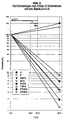
- each therapy condition 3 replicates each regarding the number of vital Cells evaluated.
- Within a group 3 replicates deviated from the respective mean 2 to 10%.
- the ones entered above left horizontal bars the exposure period for those above the Bars labeled substances.
- the medium was removed from the culture holes by suction and through 1.5 ml of a 0.25% Triton-X-100 solution (Serva, Boehringer Ingelheim KG, Cat. No. 37240) in 0 , 4 mM ethylenediaminetetraacetic acid (EDTA, pH 7.5) replaced. Under these conditions, the cell membranes of the tumor cells are dissolved, while the cell nuclei swell and are released, so that a single nucleus suspension is formed.
- Triton-X-100 solution Serva, Boehringer Ingelheim KG, Cat. No. 37240
- EDTA ethylenediaminetetraacetic acid
- the core suspension was fixed by adding 0.5 ml of a 10% formaldehyde solution and the total number of particles (G) was determined using a Coulter Counter (Coulter Counter Type ZM with a connected size distribution analysis Coulter Channelyzer 256).
- the Triton treatment only releases the nuclei of vital cells, while dead cells are not disintegrated due to protein cross-linking by Triton-X-100, ie they do not release any nucleus and remain as "sclerotized" cell bodies.
- the relative proportions of intact nuclei (K) and dead cell bodies (T) in the total number of particles (G) can be determined in flow cytometry (Coulter flow cytometer Epics XL) based on the different side light scatter signals of the particle populations (cf. J. Breder, S. Joller, E Hailler, M. Schlaak, J. van der Bosch, Exp. Cell Res. 223 (1996) 259-267).
- Figure 5 shows that under these conditions the number of Tumor cells continue to rise despite the addition of flavopiridol.
- GFA tested for comparison approximately 90% of the tumor cells are killed while by the investigated combinations of four and five substances up to approx. 99% of the original cells were killed.
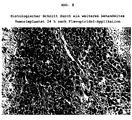
- Figure 6 shows a histological section of an untreated one Tumor graft and Figures 7 and 8 sections of two differently treated tumor grafts 24 hours after the flavopiridol application.
- the massive induction of dark-colored pyknoses (dead cells) in the treated tumor grafts is obvious.
Landscapes
- Health & Medical Sciences (AREA)
- Life Sciences & Earth Sciences (AREA)
- Public Health (AREA)
- Veterinary Medicine (AREA)
- Epidemiology (AREA)
- Medicinal Chemistry (AREA)
- Animal Behavior & Ethology (AREA)
- General Health & Medical Sciences (AREA)
- Chemical & Material Sciences (AREA)
- Pharmacology & Pharmacy (AREA)
- Gastroenterology & Hepatology (AREA)
- Engineering & Computer Science (AREA)
- Bioinformatics & Cheminformatics (AREA)
- Immunology (AREA)
- Proteomics, Peptides & Aminoacids (AREA)
- Pharmaceuticals Containing Other Organic And Inorganic Compounds (AREA)
- Medicines That Contain Protein Lipid Enzymes And Other Medicines (AREA)
Abstract
Description
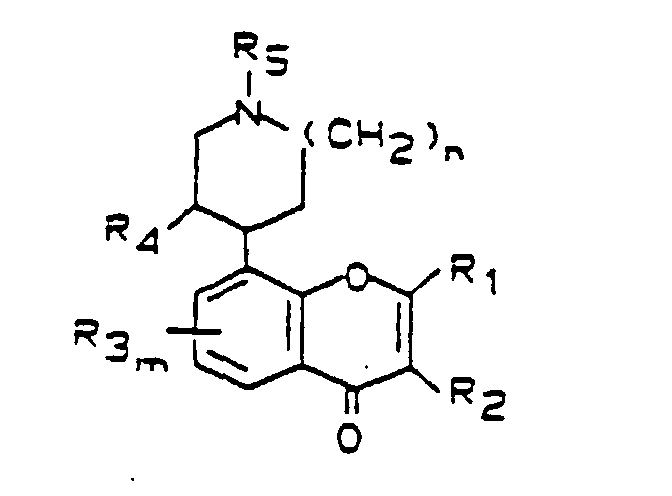
- R1
- Wasserstoff, C1-C6-Alkyl, Aryl-C1-C4-alkyl, substituiertes C1-C6-Alkyl, C3-6-Cycloalkyl, einen C3-C9-Heterozyklus mit 1, 2 oder 3 Heteroatomen wie N, S, O oder einer beliebigen Kombinationen dieser Atome, C3-C6-Cycloalkyl-C1-C4-alkyl, C2-C6-Alkenyl, C2-C6-Alkinyl, Aryl (einschließlich polycyclischer Ringe), einen aromatischen heterocyclischen Rest, substituiertes Aryl, -COOH, eine Aldehyd-C1-C4-alkylgruppe, eine COO-C1-C4-alkylgruppe, eine primäre Amino-, Alkylamino-, Aralkylamino-, Dialkylamino-, Amido-, Arylamino-, Diarylaminogruppe oder -CH2O-C1-C4-Alkyl bedeutet;
- R2
- Wasserstoff oder C1-C6-Alkyl, Aryl, Nitro, Amino, Di-C1-C4-alkylamino, Halogen, Hydroxy, Alkoxy, -COOH, -COO-C1-C4-Alkyl, -CHO, -CH2OH oder -CH2O-C1-C4-Alkyl bedeutet;
- R3
- Wasserstoff oder C1-C4-Alkyl, substituiertes C1-C4-Alkyl, Hydroxy, -COOH, Nitro, eine Amino-, C1-C4-Alkylamino-, Di-C1-C4-alkylaminogruppe, Halogen, O-Alkyl-C(=0)-alkyl, -CHO, -CH2OH, -CH2O-C1-C4-Alkyl, R2N-C(=0)-O- bedeutet; wobei
- R
- H, C1-C6-Alkyl, Cycloalkyl O-Alkyl-C(=O)-alkyl oder Aryl ist;
- R4
- Wasserstoff, Hydroxy, C1-C4-Alkoxy, C1-C4-Alkanoyloxy, C1-C4-Alkoxycarbonyl, Aryloxy, eine Amino-, C1-C4-Alkylamino-, Di-C1-C4-alkylaminogruppe, R2N-C(=O)-O-, bedeutet und R die oben angegebene Bedeutung hat;
- R5
- Wasserstoff, C1-C6-Alkyl, Aryl-C1-C4-alkyl, C3-C6-Cycloalkyl, C3-C6-Cycloalkyl-C1-C4-alkyl, Alkylamino-, C1-C4-Alkanoyl, -C(=O)-O-C1-C4-Alkyl oder Aroyl bedeutet, wobei die Arylgruppe ein unsubstituierter oder mono- oder polysubstituierter Phenylrest ist.
- m
- eine ganze Zahl zwischen 0 und 3; und
- n
- eine ganze Zahl zwischen 0 und 2 ist.
- R1
- H, C1-C3-Alkyl, Naphthyl, Aryl, subsituiertes Aryl, Aralkyl oder ein aliphatischer oder aromatischer C3-C9-Heterocyclus mit 1, 2 oder 3 Heteroatomen wie N, S, O oder einer beliebigen Kombination dieser Atome;
- R2
- H oder C1-C3-Alkyl;
- R3
- OH oder OCH3;
- R4
- OH;
- R5
- C1-C3-Alkyl, C3-C5-Cycloalkyl, C3-C5-Cycloalkyl-C1-C4-Alkyl;
- m = 1 oder 2; und/oder
- n = 1 ist.
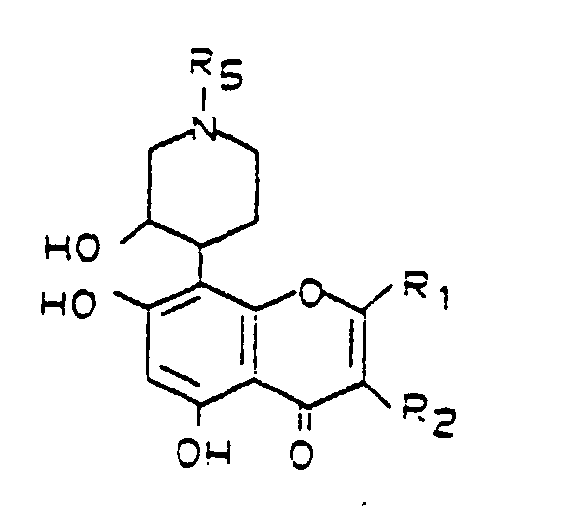
- R1
- Wasserstoff, C1-C3-Alkyl, Naphthyl, Aryl, Aralkyl, substituiertes Aryl, einen C3-C9-Heterocyclus oder einen aromatischen Heterocyclus bedeutet;
- R2
- Wasserstoff oder C1-C3-Alkyl bedeutet;
- R5
- C1-C3-Alkyl, C3-C5-Cycloalkyl, C3-C5-Cycloalkyl-C1-C4-Alkyl bedeutet.
- R1
- Phenyl, Thienyl, Pyridyl, Chlorphenyl, Dichlorphenyl, Methylphenyl, Aminophenyl, Bromphenyl, Hydroxyphenyl oder Naphthyl bedeutet;
- R2
- Wasserstoff bedeutet; und
- R5
- Methyl bedeutet.

- R6
- Wasserstoff oder C1-C6-Alkyl bedeutet;
- R7
- Wasserstoff oder eine gesättigte oder ungesättigte, lineare, verzweigte oder cyclische C1-C18-Acylgruppe bedeutet; und
- X
- C1-C6-Alkyl-CO-; -CO-NR8R9 oder -CH2R10 bedeutet, wobei
- R8 und R9
- unabhängig voneinander Wasserstoff, eine lineare oder cyclische C1-C6-Alkylgruppe, Phenyl, eine substituierte lineare oder verzweigte C1-C6-Alkylgruppe oder einen substituierten Phenylrest bedeuten; und
- R10
- Wasserstoff, C1-C6-Alkyl, C1-C6-Alkoxy oder eine substituierte C1-C6-Alkoxygruppe bedeutet.


- R
- H ist und
- R'
- eine primäre, sekundäre oder tertiäre Aminogruppe, wie eine
einfach oder zweifach durch C1-6-, vorzugsweise C1-3-Alkyl- oder
C1-6-, vorzugsweise C1-3-Alkenylreste substituierte Aminogruppe,
insbesondere -NH2, -NH-(CH2)n-CH3,
bedeutet, wobei n und m unabhängig voneinander 0 bis 6 und p 1 bis 7, vorzugsweise 1 bis 4 sind.

| Wirkstoff | Applikationsdauer [h] | Dosierung [mg/kg] | bevorzugte Dosierung [mg/kg] |
| Trichostatin A | 13-42 | 1-100 | 10-50 |
| Puromycin | 13-42 | 1-100 | 10-50 |
| Cyclosporin A | 13-42 | 10-200 | 50-150 |
| Geldanamycin | 13-42 | 0,1-10 | 0,2-6 |
| Flavopiridol | 4-18 | 1-10 | 5-8 |
| Staurosporin | 13-42 | 0,05-1 | 0,1-0,2 |
| Anisomycin | 3-12 | 1-150 | 6-90 |
| Cycloheximid | 13-42 | 0,1-5 | 0,1-2,5 |
| Wirkstoff | Wirkstoffmenge/Dosierungseinheit |
| Trichostatin | 0,7 - 3,5 g/Ampulle |
| Puromycin | 0,7 - 3,5 g/Ampulle |
| Cyclosporin A | 3,5 - 10,5 g/Ampulle |
| Geldanamycin | 14 - 420 mg/Ampulle |
| Flavopiridol | 70 - 700 mg/Ampulle |
| Staurosporin | 3,5 - 70 mg/Ampulle |
| Anisomycin | 0,07 - 7 g/Ampulle |
| Cycloheximid | 35 - 170 mg/Ampulle |

- K:
- Kontrolle ohne Substanz,
- C:
- Cyclosporin A (Sandoz, Nürnberg, 1,5 µg/ml),
- S:
- Staurosporin (Serva, Boehringer Ingelheim KG, Kat.-Nr. 35385, 20 nM),
- T:
- Trichostatin A (Wako, Neuss, Kat.-Nr. B20411991, 150 ng/ml),
- X:
- Cycloheximid (Sigma, Deisenhofen, Kat.-Nr. C7698, 1 µg/ml),
- P:
- Puromycin (Serva, Boehringer Ingelheim KG, Kat.-Nr. 33835, 500 ng/ml),
- E:
- Emetin (Sigma, Deisenhofen, Kat.-Nr. E 2375, 300 ng/ml),
- A:
- Anisomycin (Sigma, Deisenhofen, Kat.-Nr. A 9789, 150 ng/ml),
- G:
- Geldanamycin (Calbiochem, Bad Soden, Kat.-Nr. 345805, 100 ng/ml).
- F:
- Flavopiridol (National Cancer Institute, Drug Synthesis & Chemistry Branch, Bethesda, USA, 400 ng/ml) wurde erst zum Zeitpunkt t = 16 h zugesetzt.
- BM
- 1:1 Mischung aus Dulbecco's modified Eagle's medium (DMEM) und Ham's F12 nutrient mixture (beide von Gibco/BRL), gepuffert mit 22 mM NaHCO3 und 15 mM HEPES.
- KM1
- KM1 wurde aus Basalmedium (BM) durch Supplementierung mit Insulin aus Rinderpankreas (Sigma, Deisenhofen, Kat.-Nr. I 5500, 5 µg/ml), Transferrin (human, Sigma, Kat.-Nr. T 2252, 5 µg/ml), Epidermal Growth Factor (EGF, human, Fa. TEBU, Frankfurt, Kat.-Nr. 100-15, 5 ng/ml), Trijodthyronin (Sigma, Kat.-Nr. T 6397, 0,1 nM), Na-Selenit (Sigma, Kat.-Nr. S 1382, 75 nM), Ethanolamin (Sigma, Kat.-Nr. E 0135, 8 µM), Ölsäure (Sigma, Kat.-Nr. O 1383, 2,5 µg/ml) und fettsäurefreiem Rinderserumalbumin (Sigma, Kat.-Nr. A 6003) hergestellt.
- KM2
- wird aus KM1 durch Zusatz von Rinderserumalbumin (Serva, Boehringer Ingelheim KG, Kat.-Nr. 11930, 20 mg/ml) hergestellt.
- Puromycin:
- 667 µg/ml, in Wasser enthaltend 0,9% NaCl/0,24% BSA/10 mM HEPES/pH 7,4
- Trichostatin A:
- 500 µg/ml, in Wasser enthaltend 0,9% NaCl/4,5% BSA/1,25% DMSO/10 mM HEPES/pH 7,4
- Flavopiridol:
- 5 mM, in Wasser enthaltend 0,9% NaCl/0,24% BSA/10% DMSO/10 mM HEPES/pH 7,4
- Anisomycin:
- 6 mg/ml, in Wasser enthaltend 0,9% NaCl/0,24% BSA/6% DMSO/10 mM HEPES/pH 7,4
- BSA:
- Bovines Serumalbumin
- DMSO:
- Dimethylsulfoxid
- HEPES:
- N-(2-Hydroxyethyl)piperazin-N'-2-ethansulfonsäure
Claims (32)
- Erzeugnisse, enthaltend einen Hemmer cyclinabhängiger Proteinkinasen und einen oder mehrere Modulatoren mindestens eines weiteren proteinmodifizierenden Enzyms als Kombinationspräparat zur gleichzeitigen, getrennten oder zeitlich abgestuften Anwendung als Arzneimittel, wobei Zweistoffgemische aus Flavopiridol und Cycloheximid ausgenommen sind.
- Erzeugnis gemäß Anspruch 1, dadurch gekennzeichnet, daß es als Hemmer cyclinabhängiger Proteinkinasen ein 4H-1-Benzopyran-4-on-Derivat gemäß der Formelenthält, in der

- R1
- Wasserstoff, C1-C6-Alkyl, Aryl-C1-C4-alkyl, substituiertes C1-C6-Alkyl, C3-6-Cycloalkyl, einen C3-C9-Heterozyklus mit 1, 2 oder 3 Heteroatomen wie N, S, O oder einer beliebigen Kombinationen dieser Atome, C3-C6-Cycloalkyl-C1-C4-alkyl, C2-C6-Alkenyl, C2-C6-Alkinyl, Aryl (einschließlich polycyclischer Ringe), einen aromatischen heterocyclischen Rest, substituiertes Aryl, -COOH, eine Aldehyd-C1-C4-alkylgruppe, eine COO-C1-C4-alkylgruppe, eine primäre Amino-, Alkylamino-, Aralkylamino-, Dialkylamino-, Amido-, Arylamino-, Diarylaminogruppe oder -CH2O-C1-C4-Alkyl bedeutet;
- R2
- Wasserstoff oder C1-C6-Alkyl, Aryl, Nitro, Amino, Di-C1-C4-alkylamino, Halogen, Hydroxy, Alkoxy, -COOH, -COO-C1-C4-Alkyl, -CHO, -CH2OH oder -CH2O-C1-C4-Alkyl bedeutet;
- R3
- Wasserstoff oder C1-C4-Alkyl, substituiertes C1-C4-Alkyl, Hydroxy, -COOH, Nitro, eine Amino-, C1-C4-Alkylamino-, Di-C1-C4-alkylaminogruppe, Halogen, O-Alkyl-C(=0)-alkyl, -CHO, -CH2OH, -CH2O-C1-C4-Alkyl, R2N-C(=0)-O- bedeutet, wobei
- R
- H, C1-C6-Alkyl, Cycloalkyl O-Alkyl-C(=O)-alkyl oder Aryl ist;
- R4
- Wasserstoff, Hydroxy, C1-C4-Alkoxy, C1-C4-Alkanoyloxy, C1-C4-Alkoxycarbonyl, Aryloxy, eine Amino-, C1-C4-Alkylamino-, Di-C1-C4-alkylaminogruppe, R2N-C(=O)-O-, bedeutet und R die oben angegebene Bedeutung hat;
- R5
- Wasserstoff, C1-C6-Alkyl, Aryl-C1-C4-alkyl, C3-C6-Cycloalkyl, C3-C6-Cycloalkyl-C1-C4-alkyl, Alkylamino-, C1-C4-Alkanoyl, -C(=O)-O-C1-C4-Alkyl oder Aroyl bedeutet, wobei die Arylgruppe ein unsubstituierter oder mono- oder polysubstituierter Phenylrest ist;
- m
- eine ganze Zahl zwischen 0 und 3; und
- n
- eine ganze Zahl zwischen 0 und 2 ist.
- Erzeugnis gemäß Anspruch 2, dadurch gekennzeichnet, daß
- R1
- H, C1-C3-Alkyl, Naphthyl, Aryl, subsituiertes Aryl, Aralkyl oder ein aliphatischer oder aromatischer C3-C9-Heterocyclus mit 1, 2 oder 3 Heteroatomen wie N, S, O oder einer beliebigen Kombination dieser Atome;
- R2
- H oder C1-C3-Alkyl;
- R3
- OH oder OCH3;
- R4
- OH;
- R5
- C1-C3-Alkyl, C3-C5-Cycloalkyl, C3-C5-Cycloalkyl-C1-C4-Alkyl;
- m
- = 1 oder 2; und/oder
- n
- = 1 ist.
- Erzeugnis gemäß Anspruch 3, dadurch gekennzeichnet, daß es als Hemmer cyclinabhängiger Proteinkinasen Flavopiridol enthält.
- Erzeugnis gemäß einem der Ansprüche 1 bis 4, dadurch gekennzeichnet, daß es als Modulator proteinmodifizierender Enzyme einen Aktivator streßaktivierter Proteinkinasen enthält.
- Erzeugnis gemäß Anspruch 5, dadurch gekennzeichnet, daß es Anisomycin oder ein Anisomycin-Derivat gemäß der Formelenthält, in der

- R6
- Wasserstoff oder C1-C6-Alkyl bedeutet;
- R7
- Wasserstoff oder eine gesättigte oder ungesättigte, lineare, verzweigte oder cyclische C1-C18-Acylgruppe bedeutet; und
- X
- C1-C6-Alkyl-CO-; -CO-NR8R9 oder -CH2R10 bedeutet, wobei
- R8 und R9
- unabhängig voneinander Wasserstoff, eine lineare oder cyclische C1-C6-Alkylgruppe, Phenyl, eine substituierte lineare oder verzweigte C1-C6-Alkylgruppe oder einen substituierten Phenylrest bedeuten; und
- R10
- Wasserstoff, C1-C6-Alkyl, C1-C6-Alkoxy oder eine substituierte C1-C6-Alkoxygruppe bedeutet.
- Erzeugnis gemäß Anspruch 6, dadurch gekennzeichnet, daßR6 CH3;R7 C1-C12-AcylR8 und R9 H;R10 H oder C1-3-Alkyl bedeutet undX gleich -C(=O)NH2, C1-C6-Alkyl-C(=O)- ist.
- Erzeugnis gemäß Anspruch 7, dadurch gekennzeichnet, daß es als Aktivator für streßaktivierte Proteinkinasen Anisomycin enthält.
- Erzeugnis gemäß einem der Ansprüche 5 bis 8 zur Therapie durch Applikation des Hemmers für cyclinabhängige Proteinkinasen, gefolgt von der Applikation des Aktivators für streßaktivierte Proteinkinasen im zeitlichen Abstand von 1 bis 12 Stunden.
- Erzeugnis gemäß einem der Ansprüche 1 bis 9, dadurch gekennzeichnet, daß es als Modulator proteinmodifizierender Enzyme einen Hemmer der Histondeacetylase enthält.
- Erzeugnis gemäß Anspruch 10, dadurch gekennzeichnet, daß es als Hemmer der Histondeacetylase ein pharmazeutisch verträgliches Salz der Buttersäure, Trichostatin A, Trapoxin, Chlamydocin, HC-Toxin, WP-3161 und/oder Cyt 2 enthält.
- Erzeugnis gemäß einem der Ansprüche 1 bis 11, dadurch gekennzeichnet, daß es als Modulator proteinmodifizierender Enzyme einen Hemmer der Proteinbiosynthese enthält.
- Erzeugnis gemäß Anspruch 12, dadurch gekennzeichnet, daß es als Hemmer der Proteinbiosynthese Puromycin, Cycloheximid und/oder Emetin enthält.
- Erzeugnis gemäß einem der Ansprüche 1 bis 13, dadurch gekennzeichnet, daß es als Modulator proteinmodifizierender Enzyme einen Hemmer von Proteinphosphatasen oder weiterer Proteinkinasen enthält.
- Erzeugnis gemäß Anspruch 14, dadurch gekennzeichnet, daß es Staurosporin, ein Staurosporin-Derivat, Cyclosporin A, Geldanamycin, Dihydrogeldanamycin, ein Geldanamycin- und/oder Dihydrogeldanamycin-Derivat gemäß der Formelenthält, in der
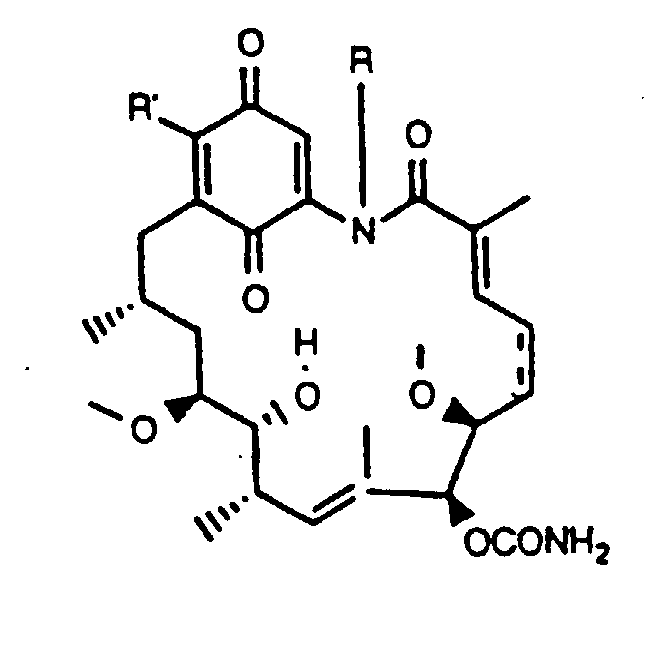
- R
- H ist und
- R'
- eine primäre, sekundäre oder tertiäre Aminogruppe, wie
eine einfach oder zweifach durch C1-C6-Alkyl- oder C1-C6-Alkenylreste
substituierte Aminogruppe, insbesondere
-NH2, -NH-(CH2)n-CH3,
bedeutet, wobei n und m unabhängig voneinander 0 bis 6 und p 1 bis 7 sind.

- Erzeugnis gemäß einem der Ansprüche 1 bis 15, dadurch gekennzeichnet, daß es jeweils 7 µmol bis 40 mmol des Hemmers cyclinabhängiger Proteinkinasen und des oder der Modulatoren proteinmodifizierender Enzyme enthält.
- Erzeugnis gemäß einem der Ansprüche 1 bis 16 zur intravenösen Applikation.
- Erzeugnis gemäß einem der Ansprüche 1 bis 17 zur Therapie durch ein- bis viermalige oder kontinuierliche Applikation von (a) ggf. einem oder mehreren Histondeacetylasehemmern, Hemmern der Proteinbiosynthese, Hemmern von Proteinphosphatasen und/oder Hemmern von weiteren Proteinkinasen, (b) einem oder mehreren Hemmern cyclinabhängiger Proteinkinasen und ggf. Breitband-Proteinkinasehemmern sowie (c) einem oder mehreren Aktivatoren für streßaktivierte Proteinkinasen und ggf. Hemmern der Proteinbiosynthese.
- Erzeugnis gemäß Anspruch 18 zur Applikation des oder der Wirkstoffe gemäß (a) über einen Zeitraum von 14 bis 42 Stunden, des oder der Wirkstoffe gemäß (b) über einen Zeitraum von 2 bis 13 Stunden und des oder der Wirkstoffe gemäß (c) über einen Zeitraum von 1 bis 12 Stunden.
- Erzeugnis gemäß Anspruch 19, zur Applikation des oder der Wirkstoffe gemäß (b) im zeitlichen Abstand von 12 bis 24 Stunden nach Beginn der Applikation des oder der Wirkstoffe gemäß (a) und des oder der Wirkstoffe gemäß (c) im zeitlichen Abstand von 1 bis 6 Stunden nach Beginn der Applikation des oder der Wirkstoffe gemäß (b).
- Verfahren zur Herstellung eines Erzeugnisses gemäß den Ansprüchen 1 bis 20, dadurch gekennzeichnet, daß man mindestens einen Hemmer cyclinabhängiger Proteinkinasen und mindestens einen Modulator proteinmodifizierender Enzyme mit üblichen pharmazeutischen Träger-, Verdünnungs- und/oder Hilfsstoffen, getrennt oder zusammen vermischt und diese Mischung(en) Zu Tabletten, Kapseln oder Lösungen für die lokale, orale, parenterale, insbesondere intravenöse oder intraperitoneale Injektion oder Infusion formt.
- Verwendung eines Hemmers cyclinabhängiger Proteinkinasen und eines Modulators proteinmodifizierender Enzyme zur Herstellung von Arzneimittelzubereitungen.
- Verwendung nach Anspruch 22 zur Herstellung von Arzneimittelzubereitungen zur Behandlung von Tumoren.
- Verwendung gemäß einem der Ansprüche 22 bis 23 zur Behandlung von Tumoren der Blase, Lunge, Brust, des Pankreas und Dickdarms.
- Verwendung nach einem der Ansprüche 20 bis 22 zur Herstellung von Arzneimittelzubereitungen zur intravenösen Therapie.
- Verwendung nach einem der Ansprüche 22 bis 25 zur Herstellung von Arzneimittelzubereitungen zur einfachen, mehrfachen oder kontinuierlichen Applikation von (a) ggf. einem oder mehreren Histondeacetylasehemmern, Hemmern der Proteinbiosynthese, Hemmern von Proteinphosphatasen und/oder Hemmern von weiteren Proteinkinasen (b) einem oder mehreren Hemmern für cyclinabhängige Kinasen und ggf. Breitband-Proteinkinasehemmern und (c) einem oder mehreren Aktivatoren für streßaktivierte Proteinkinasen und ggf. Hemmern der Proteinbiosynthese.
- Verwendung nach Anspruch 26 zur Applikation des oder der Wirkstoffe gemäß (a) über einen Zeitraum von 12 bis 42 Stunden, des oder der Wirkstoffe gemäß (b) über einen Zeitraum von 1 bis 18 Stunden und des oder der Wirkstoffe gemäß (c) über einen Zeitraum von 1 bis 12 Stunden.
- Verwendung eines Hemmers cyclinabhängiger Proteinkinasen und eines oder mehrerer Modulatoren mindestens eines weiteren proteinmodifizierenden Enzyms in Form eines aus mindestens zwei räumlich getrennten Zusammensetzungen, von denen die eine den Hemmer cyclinabhängiger Proteinkinasen (Zusammensetzung A) und die andere den oder die Modulatoren mindestens eines weiteren proteinmodifizierenden Enzyms (Zusammensetzung B) enthält, bestehenden Mittels zur aufeinanderfolgenden und/oder gleichzeitigen Anwendung bei der Behandlung von Tumoren bei Menschen oder Säugetieren nach einem Therapieplan, der aus einem oder mehreren Zyklen besteht, wobei jeder Therapiezyklus folgende Stufen umfaßt:
- Stufe 1
- (optional) einfache, mehrfache oder kontinuierliche Applikation der Zusammensetzung (B);
- Stufe 2
- einfache, mehrfache oder kontinuierliche Applikation der Zusammensetzung (A);
- Stufe 3
- einfache, mehrfache oder kontinuierliche Applikation der Zusammensetzung (B).
- Verwendung nach Anspruch 28, dadurch gekennzeichnet, daß Stufe 1 die Applikation eines oder mehrerer Histondeacetylasehemmer, Hemmer der Proteinbiosynthese, Hemmer von Proteinphosphatasen und/oder von Hemmern von weiteren Proteinkinasen und Stufe 3 die Applikation eines oder mehrerer Aktivatoren für streßaktivierte Proteinkinasen und ggf. Hemmern der Proteinbiosynthese umfaßt.
- Verwendung nach Anspruch 29, dadurch gekennzeichnet, daß Stufe 2 zusätzlich die Applikation eines Breitband-Proteinkinasehemmers umfaßt.
- Verwendung nach einem der Ansprüche 28 bis 30, dadurch gekennzeichnet, daß sich Stufe 1 über einen Zeitraum von 12 bis 42 Stunden, Stufe 2 über einen Zeitraum von 1 bis 18 Stunden und Stufe 3 über einen Zeitraum von 1 bis 12 Stunden erstreckt.
- Arzneimittel, enthaltend einen Hemmer cyclinabhängiger Proteinkinasen und einen oder mehrere Modulatoren mindestens eines weiteren proteinmodifizierenden Enzyms als Kombinationspräparat zur gleichzeitigen, getrennten oder zeitlich abgestellten Anwendung.
Applications Claiming Priority (2)
| Application Number | Priority Date | Filing Date | Title |
|---|---|---|---|
| DE19744676 | 1997-10-10 | ||
| DE19744676A DE19744676A1 (de) | 1997-10-10 | 1997-10-10 | Kombinationspräparate für die Therapie von Tumoren |
Publications (2)
| Publication Number | Publication Date |
|---|---|
| EP0919244A2 true EP0919244A2 (de) | 1999-06-02 |
| EP0919244A3 EP0919244A3 (de) | 2000-03-29 |
Family
ID=7845086
Family Applications (1)
| Application Number | Title | Priority Date | Filing Date |
|---|---|---|---|
| EP98250357A Withdrawn EP0919244A3 (de) | 1997-10-10 | 1998-10-09 | Kombinationspräparate für die Therapie von Tumoren |
Country Status (2)
| Country | Link |
|---|---|
| EP (1) | EP0919244A3 (de) |
| DE (1) | DE19744676A1 (de) |
Cited By (9)
| Publication number | Priority date | Publication date | Assignee | Title |
|---|---|---|---|---|
| WO2001080896A3 (en) * | 2000-04-21 | 2002-07-11 | Arch Dev Corp | Flavopiridol drug combinations and methods with reduced side effects |
| US6482842B2 (en) | 2000-02-07 | 2002-11-19 | Bristol-Myers Squibb Company | 3-aminopyrazole inhibitors of cyclin dependent kinases |
| US6521759B2 (en) | 1999-12-15 | 2003-02-18 | Bristol-Myers Squibb Company | Aminothiazole inhibitors of cyclin dependent kinases |
| WO2005014004A1 (en) * | 2003-08-08 | 2005-02-17 | Novartis Ag | Combinations comprising staurosporines |
| WO2006021456A1 (en) * | 2004-08-27 | 2006-03-02 | Novartis Ag | Combination comprising a staurosporine and a cyp3a4 inhibitor |
| US7405208B2 (en) | 2001-08-06 | 2008-07-29 | Kosan Biosciences, Inc. | Benzoquinone ansamycins |
| US7691838B2 (en) | 2003-05-30 | 2010-04-06 | Kosan Biosciences Incorporated | Method for treating diseases using HSP90-inhibiting agents in combination with antimitotics |
| US7732476B2 (en) | 2003-07-31 | 2010-06-08 | University Of South Florida | Leukemia treatment method and composition |
| US7807350B2 (en) | 2003-05-30 | 2010-10-05 | The University Of Chicago | Methods for predicting irinotecan toxicity |
Family Cites Families (1)
| Publication number | Priority date | Publication date | Assignee | Title |
|---|---|---|---|---|
| EP0888458A4 (de) * | 1996-02-20 | 2004-05-06 | Sloan Kettering Institutefor C | Kombination von pkc-inhibitoren und therapeutischen agenzien zur behandlung von krebs |
-
1997
- 1997-10-10 DE DE19744676A patent/DE19744676A1/de not_active Ceased
-
1998
- 1998-10-09 EP EP98250357A patent/EP0919244A3/de not_active Withdrawn
Cited By (14)
| Publication number | Priority date | Publication date | Assignee | Title |
|---|---|---|---|---|
| US6521759B2 (en) | 1999-12-15 | 2003-02-18 | Bristol-Myers Squibb Company | Aminothiazole inhibitors of cyclin dependent kinases |
| US6482842B2 (en) | 2000-02-07 | 2002-11-19 | Bristol-Myers Squibb Company | 3-aminopyrazole inhibitors of cyclin dependent kinases |
| US6610724B2 (en) | 2000-02-07 | 2003-08-26 | Bristol-Myers Squibb Company | 3-Aminopyrazole inhibitors of cyclin dependent kinases |
| WO2001080896A3 (en) * | 2000-04-21 | 2002-07-11 | Arch Dev Corp | Flavopiridol drug combinations and methods with reduced side effects |
| US7405208B2 (en) | 2001-08-06 | 2008-07-29 | Kosan Biosciences, Inc. | Benzoquinone ansamycins |
| US7691838B2 (en) | 2003-05-30 | 2010-04-06 | Kosan Biosciences Incorporated | Method for treating diseases using HSP90-inhibiting agents in combination with antimitotics |
| US7807350B2 (en) | 2003-05-30 | 2010-10-05 | The University Of Chicago | Methods for predicting irinotecan toxicity |
| US7732476B2 (en) | 2003-07-31 | 2010-06-08 | University Of South Florida | Leukemia treatment method and composition |
| US8242101B2 (en) | 2003-07-31 | 2012-08-14 | University Of South Florida | Leukemia treatment method and composition |
| AU2004262927B2 (en) * | 2003-08-08 | 2008-05-22 | Novartis Ag | Combinations comprising staurosporines |
| CN100536850C (zh) * | 2003-08-08 | 2009-09-09 | 诺瓦提斯公司 | 包含星孢素的组合 |
| WO2005014004A1 (en) * | 2003-08-08 | 2005-02-17 | Novartis Ag | Combinations comprising staurosporines |
| EP2305265A1 (de) * | 2003-08-08 | 2011-04-06 | Novartis AG | Kombinationen mit Staurosporinen |
| WO2006021456A1 (en) * | 2004-08-27 | 2006-03-02 | Novartis Ag | Combination comprising a staurosporine and a cyp3a4 inhibitor |
Also Published As
| Publication number | Publication date |
|---|---|
| EP0919244A3 (de) | 2000-03-29 |
| DE19744676A1 (de) | 1999-04-15 |
Similar Documents
| Publication | Publication Date | Title |
|---|---|---|
| DE60216139T3 (de) | Arylharnstoff-verbindungen in kombination mit anderen zytostatisch oder zytotoxisch wirksamen stoffen zur behandlungen menschlicher krebserkrankungen | |
| DE69530606T2 (de) | Verwendung von pramipexole als neuroschutzmittel | |
| DE69815872T2 (de) | Verwendung von d-methionin zur verminderung der toxizität von ototoxischen arzneimitteln und geräusch | |
| DE69634074T2 (de) | Thiole zur Förderung des Wachstums von Hömatopoietischen Vorläuferzellen | |
| DE69026620T2 (de) | Anti-tumor-zubereitung enthaltend interleukin-2 und histamin, analoge dazu oder h2-rezeptor-agonisten | |
| DE60213407T2 (de) | Zusammensetzungen zur hemmung der angiogenese | |
| DE69519385T2 (de) | Chinazolinon-arzneimittel sowie deren verwendung | |
| DE69615984T2 (de) | Verwendung von Ursolsäure zur Herstellung eines Arzneimittels zur Unterdrückung von Metastasen | |
| DE69821929T2 (de) | Pharmazeutische zusammensetzung zur behandlung von parkinsonkrankheit oder depression | |
| DE69530510T2 (de) | Chinazolinon enthaltende arzneimittel und verfahren zu deren verwendung | |
| DE69824165T2 (de) | Verwendung von chelerythrin und strahlung in der tumortherapie | |
| DE19744676A1 (de) | Kombinationspräparate für die Therapie von Tumoren | |
| DE69531722T2 (de) | Karzinostatische Zusammensetzungen, welche Cis-Oxaliplatin und eine oder mehrere andere verträgliche Karzinostatika enthalten | |
| DE60316297T2 (de) | Verbindungen, die zur behandlung von erkrankungen, die auf antiangiogene therapie ansprechen, nützlich sind | |
| DE69428995T2 (de) | Verfahren zur behandlung von neoplastischen erkrankungen unter verwendung von tiazofurin und ribavirin | |
| KR20070083650A (ko) | 중추 신경적으로 유발된 신경병증성 통증을 치료하기 위한테트로도톡신 및 그것의 유도체 | |
| DE69127285T2 (de) | Verwendung von verbindungen zur behandlung von altersbedingtem gedächtnisschwund und anderen kognitiven störungen | |
| DE69430047T2 (de) | Pharmazeutische Zusammensetzungen die Isochinolinderivate enthalten | |
| DE2951671A1 (de) | Arzneimittelzubereitung | |
| DE69902748T2 (de) | Propargylamin enthaltende zusammensetzung zur verbesserung der krebstherapie | |
| DE60319211T2 (de) | Kombination von glivec (sti571) mit einem cyclinabhängigen kinaseinhibitoren, ins besonders flavopiridol, zur behandlung von krebs | |
| EP0821960A1 (de) | Verwendung von Xanthinderivaten zur Modulation der Apoptose | |
| WO2003053445A1 (de) | Verwendung von desoxypeganin zur behandlung der klinischen depression | |
| DE3641822A1 (de) | Verwendung von dihydrophenylaminosaeurederivaten und diese enthaltende arzneimittel zur immunmodulation und cytostase | |
| DE60125048T2 (de) | Polycyclische dianthrachinone als antikrebsmittel und antiangiogenesemittel |
Legal Events
| Date | Code | Title | Description |
|---|---|---|---|
| PUAI | Public reference made under article 153(3) epc to a published international application that has entered the european phase |
Free format text: ORIGINAL CODE: 0009012 |
|
| AK | Designated contracting states |
Kind code of ref document: A2 Designated state(s): AT BE CH CY DE DK ES FI FR GB GR IE IT LI LU MC NL PT SE |
|
| AX | Request for extension of the european patent |
Free format text: AL;LT;LV;MK;RO;SI |
|
| PUAL | Search report despatched |
Free format text: ORIGINAL CODE: 0009013 |
|
| RIC1 | Information provided on ipc code assigned before grant |
Free format text: 7A 61K 45/06 A, 7A 61K 31/445 B, 7A 61K 38/13 B, 7A 61K 31/55 B, 7A 61K 31/40 B, 7A 61K 31/45 B, 7A 61K 31/395 B, 7A 61K 31/52 B, 7A 61K 31/165 B, 7A 61K 31/445 J, 7A 61K 31:165 J, 7A 61K 31:52 J, 7A 61K 31:395 J, 7A 61K 31:40 J, 7A 61K 31:445 J, 7A 61K 38/13 K, 7A 61K 31:445 K, 7A 61K 31/55 L, 7A 61K 31:445 L |
|
| AK | Designated contracting states |
Kind code of ref document: A3 Designated state(s): AT BE CH CY DE DK ES FI FR GB GR IE IT LI LU MC NL PT SE |
|
| AX | Request for extension of the european patent |
Free format text: AL;LT;LV;MK;RO;SI |
|
| AKX | Designation fees paid | ||
| REG | Reference to a national code |
Ref country code: DE Ref legal event code: 8566 |
|
| STAA | Information on the status of an ep patent application or granted ep patent |
Free format text: STATUS: THE APPLICATION IS DEEMED TO BE WITHDRAWN |
|
| 18D | Application deemed to be withdrawn |
Effective date: 20000930 |