EP0920118A2 - Resonanz-Stromversorgungsschaltung - Google Patents
Resonanz-Stromversorgungsschaltung Download PDFInfo
- Publication number
- EP0920118A2 EP0920118A2 EP98122197A EP98122197A EP0920118A2 EP 0920118 A2 EP0920118 A2 EP 0920118A2 EP 98122197 A EP98122197 A EP 98122197A EP 98122197 A EP98122197 A EP 98122197A EP 0920118 A2 EP0920118 A2 EP 0920118A2
- Authority
- EP
- European Patent Office
- Prior art keywords
- resonance
- capacitor
- power supply
- switching
- supply circuit
- Prior art date
- Legal status (The legal status is an assumption and is not a legal conclusion. Google has not performed a legal analysis and makes no representation as to the accuracy of the status listed.)
- Withdrawn
Links
- 239000003990 capacitor Substances 0.000 claims abstract description 104
- 238000004804 winding Methods 0.000 claims abstract description 51
- 239000004743 Polypropylene Substances 0.000 claims description 3
- XBYNNYGGLWJASC-UHFFFAOYSA-N barium titanium Chemical compound [Ti].[Ba] XBYNNYGGLWJASC-UHFFFAOYSA-N 0.000 claims description 3
- -1 polypropylene Polymers 0.000 claims description 3
- 229920001155 polypropylene Polymers 0.000 claims description 3
- 229920000728 polyester Polymers 0.000 claims 2
- 230000007423 decrease Effects 0.000 abstract description 5
- 230000003071 parasitic effect Effects 0.000 description 8
- 238000009499 grossing Methods 0.000 description 7
- 238000001514 detection method Methods 0.000 description 5
- 230000000694 effects Effects 0.000 description 5
- 238000010586 diagram Methods 0.000 description 4
- 230000005669 field effect Effects 0.000 description 4
- 239000004020 conductor Substances 0.000 description 3
- 239000000126 substance Substances 0.000 description 3
- XAGFODPZIPBFFR-UHFFFAOYSA-N aluminium Chemical compound [Al] XAGFODPZIPBFFR-UHFFFAOYSA-N 0.000 description 2
- 229910052782 aluminium Inorganic materials 0.000 description 2
- 239000003973 paint Substances 0.000 description 2
- 238000011084 recovery Methods 0.000 description 2
- 230000003321 amplification Effects 0.000 description 1
- 239000011230 binding agent Substances 0.000 description 1
- 238000006073 displacement reaction Methods 0.000 description 1
- 238000003199 nucleic acid amplification method Methods 0.000 description 1
- 229920006267 polyester film Polymers 0.000 description 1
- 230000000630 rising effect Effects 0.000 description 1
Images






Classifications
-
- H—ELECTRICITY
- H02—GENERATION; CONVERSION OR DISTRIBUTION OF ELECTRIC POWER
- H02M—APPARATUS FOR CONVERSION BETWEEN AC AND AC, BETWEEN AC AND DC, OR BETWEEN DC AND DC, AND FOR USE WITH MAINS OR SIMILAR POWER SUPPLY SYSTEMS; CONVERSION OF DC OR AC INPUT POWER INTO SURGE OUTPUT POWER; CONTROL OR REGULATION THEREOF
- H02M3/00—Conversion of DC power input into DC power output
- H02M3/22—Conversion of DC power input into DC power output with intermediate conversion into AC
- H02M3/24—Conversion of DC power input into DC power output with intermediate conversion into AC by static converters
- H02M3/28—Conversion of DC power input into DC power output with intermediate conversion into AC by static converters using discharge tubes with control electrode or semiconductor devices with control electrode to produce the intermediate AC
- H02M3/325—Conversion of DC power input into DC power output with intermediate conversion into AC by static converters using discharge tubes with control electrode or semiconductor devices with control electrode to produce the intermediate AC using devices of a triode or a transistor type requiring continuous application of a control signal
- H02M3/335—Conversion of DC power input into DC power output with intermediate conversion into AC by static converters using discharge tubes with control electrode or semiconductor devices with control electrode to produce the intermediate AC using devices of a triode or a transistor type requiring continuous application of a control signal using semiconductor devices only
- H02M3/33569—Conversion of DC power input into DC power output with intermediate conversion into AC by static converters using discharge tubes with control electrode or semiconductor devices with control electrode to produce the intermediate AC using devices of a triode or a transistor type requiring continuous application of a control signal using semiconductor devices only having several active switching elements
- H02M3/33571—Half-bridge at primary side of an isolation transformer
-
- H—ELECTRICITY
- H02—GENERATION; CONVERSION OR DISTRIBUTION OF ELECTRIC POWER
- H02M—APPARATUS FOR CONVERSION BETWEEN AC AND AC, BETWEEN AC AND DC, OR BETWEEN DC AND DC, AND FOR USE WITH MAINS OR SIMILAR POWER SUPPLY SYSTEMS; CONVERSION OF DC OR AC INPUT POWER INTO SURGE OUTPUT POWER; CONTROL OR REGULATION THEREOF
- H02M3/00—Conversion of DC power input into DC power output
- H02M3/01—Resonant DC/DC converters
-
- H—ELECTRICITY
- H04—ELECTRIC COMMUNICATION TECHNIQUE
- H04N—PICTORIAL COMMUNICATION, e.g. TELEVISION
- H04N5/00—Details of television systems
- H04N5/63—Generation or supply of power specially adapted for television receivers
-
- Y—GENERAL TAGGING OF NEW TECHNOLOGICAL DEVELOPMENTS; GENERAL TAGGING OF CROSS-SECTIONAL TECHNOLOGIES SPANNING OVER SEVERAL SECTIONS OF THE IPC; TECHNICAL SUBJECTS COVERED BY FORMER USPC CROSS-REFERENCE ART COLLECTIONS [XRACs] AND DIGESTS
- Y02—TECHNOLOGIES OR APPLICATIONS FOR MITIGATION OR ADAPTATION AGAINST CLIMATE CHANGE
- Y02B—CLIMATE CHANGE MITIGATION TECHNOLOGIES RELATED TO BUILDINGS, e.g. HOUSING, HOUSE APPLIANCES OR RELATED END-USER APPLICATIONS
- Y02B70/00—Technologies for an efficient end-user side electric power management and consumption
- Y02B70/10—Technologies improving the efficiency by using switched-mode power supplies [SMPS], i.e. efficient power electronics conversion e.g. power factor correction or reduction of losses in power supplies or efficient standby modes
Definitions
- the present invention relates to a resonance type power supply circuit.
- the power supply circuit of current resonance type has been conventionally implemented as one of the power supply circuits used in electronic devices such as a TV set.
- Fig. 5 is a circuit diagram showing such a conventional current resonance type power supply circuit.
- an output terminal of an alternating current (AC) power supply 51 or a commercial AC power, for example, is connected to an input terminal of a rectifier circuit 52, or a full-wave rectifier using a diode bridge, for example.
- the other output terminal of the AC power supply 51 is connected to the other input terminal of the rectifier circuit 52.
- the output terminal on the negative polarity side of the rectifier circuit 52 is connected to the reference potential point.
- the output terminal on the positive polarity side of the rectifier circuit 52 is connected to the reference potential point via a smoothing capacitor C51 and also connected to the reference potential point via switching elements 61 and 62 connected in series.
- switching elements 61 and 62 a field effect transistor such as a MOSFET may be used. With such elements, the parasitic diode incorporated in the configuration of the field effect transistor can be used for inverse current flowing.
- the source of the switching element 61 is connected to the drain of the switching element 61 via the anode-cathode channel of a parasitic diode D61.
- the source of the switching element 62 is connected to the drain of the switching element 62 via the anode-cathode channel of a parasitic diode D62.
- the switching elements 61 and 62 are turned on and off by a drive circuit 63.
- connection point of the switching elements 61 and 62 is connected to the reference potential point via a voltage resonance capacitor C6V and at the same time connected to the reference potential point via a primary winding L61 of a switching transformer 64 and a current resonance capacitor C6I connected in series.
- the current resonance capacitor C6I has a larger capacity than the voltage resonance capacitor C6V.
- the secondary winding of the switching transformer 64 is connected to an output terminal 65 via the anode-cathode channel of a diode D63 at an end and connected to the output terminal 65 via the anode-cathode channel of a diode D64 at the other end.
- the cathodes of the diodes D63 and D64 are connected to the reference potential point via a smoothing capacitor C65. With such connections, the output voltage Eo is led to the output terminal 65.
- the cathodes of the diodes D63 and D64 are connected to an input terminal 661 of an error amplifier circuit 66 via a resistor R61 and also connected to an output terminal 662 of the error amplifier circuit 66 via a resistor R62 and the anode-cathode channel of a light emitting diode D60 in a photo coupler PC6.
- the error amplification circuit has a negative polarity terminal 663 connected to the reference potential point.
- a control circuit 67 has a detection terminal 671 connected to the reference potential point via a resistor R63 and a phototransistor Tr60 in the photo coupler PC6 connected in series and has an output terminal 672 connected to the drive circuit 63.
- the control circuit 67 prepares a control signal a1 at the output terminal 672 according to the current flowing from the detection terminal 671 to the resistor R63 and supplies such signal to the drive circuit 63.
- the drive circuit 63 supplies, corresponding to the control signal a1 from the control circuit 67, gate voltages VG11 and VG12 to turn on and off the switching elements 61 and 62 to the gates of the switching elements 61 and 62 respectively.
- the error amplifier circuit 66 amplifies the error between the voltage applied to the input terminal 661 via the resistor R61 and the target voltage and, according to the amplified voltage, controls the current flowing through the light emitting diode D60.
- the resistors R61 and R62, the error amplifier circuit 66, the photo coupler PC6, the drive circuit 63 and the control circuit 67 control the operation frequency f of the switching elements 61 and 62 corresponding to the change in the output voltage on the secondary side of the transformer 64.
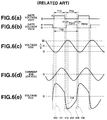
- Figs. 6(a) to (e) are timing charts showing the operation of a conventional current resonance type power supply circuit.
- Fig. 6(a) shows the gate voltage VG11 of the switching element 61 and
- Fig. 6(b) shows the gate voltage VG12 of the switching element 62.
- Fig. 6(c) shows the voltage VC6I applied to the capacitor C6I
- Fig. 6(d) shows the current IC6I flowing through the capacitor C6I
- Fig. 6(e) shows the voltage VL6I applied to the primary winding L61.
- the interval from timing t10 to timing t16 constitutes one period.
- Figs. 7(a) to (c) and Figs. 8(a) to (c) are explanatory views illustrating the operation of a conventional current resonance type power supply circuit.
- Figs. 7(a) to (c) illustrate the first half (t10 to t13) of the period in Figs. 6(a) to (e) and Figs. 8(a) to (c) illustrate the latter half (t13 to t16) of the period in Figs. 6(a) to (e).
- Fig. 7(a) shows the operation of timings from t10 to t11
- Fig. 7(b) shows the operation of timings from t11 to t12
- Fig. 7(c) shows the operation of timings t12 to t13.
- Fig. 8(a) shows the operation of timings t13 to t14
- Fig. 8(b) shows the operation of timings t14 to t15
- Fig. 8(c) shows the operation of
- the AC power voltage from the AC power supply 51 is rectified by the rectifier circuit 52, smoothed by the smoothing capacitor C51 and supplied as the direct current (DC) voltage Ei to the switching elements 61 and 62.
- the AC power supply 51, the rectifier circuit 52 and the smoothing capacitor C51 are shown as a DC power supply 71 for output of the DC voltage Ei to simplify the description.
- the drive circuit 63 supplies, corresponding to the control signal a1 from the control circuit 67, the gate voltages VG11 and VG12 as shown in Figs. 6(a) and (b) to the gates of the switching elements 61 and 62.
- the gate voltage VG11 shown in Fig. 6 (a) is at the high level (H) to turn on the switching element 61 for the time T11 from t10 to t12 and is at the 0 level to turn off the switching element 61 from t12 to t16.
- the gate voltage VG12 in Fig. 6 (b) is at the high (H) level to turn on the switching element 62 for the time T12 from t13 to t15 and is at the 0 level to turn off the switching element 62 from t10 to t13 and from t15 to t16.
- the time T10 from t10 to t16 is one period.
- the diode D61 is turned on and the current flows through the route from the capacitor C6I to the winding L61 and then to the diode D61.
- the voltage VC61 applied to the capacitor C6I as shown in Fig. 6 (c) goes down from 0V to the minimum level and the current IC61 flowing in the capacitor C6I as shown in Fig. 6(d) rises from the negative side to 0A level.
- the voltage VL61 applied to the primary winding L61 shown in Fig. 6(e) rises to the maximum level.
- the switching element 61 is turned on and the current flows through the route from the switching element 61 to the winding L61 and then to the capacitor C6I.
- the voltage VC61 shown in Fig. 6(c) rises from the minimum level, passes 0V and enters the positive side.
- the current IC61 shown in Fig. 6(d) rises from 0A to the maximum level and then lowers.
- the voltage VL61 shown in Fig. 6(e) lowers from the maximum level. Note that, however, the current flowing from the switching element 61 to the capacitor C6V during this time is omitted in Fig. 7 (b) since it is of a small amount.
- the time TD11 (see Fig. 6(b)) from timing t12 to timing t13 as shown in Fig. 7 (c) is a damper time.
- the current flows through the route from the capacitor C6V to the winding L61 and then to the capacitor C6I.
- the voltage VC6I shown in Fig. 6 (c) rises in the positive side to reach Ei.
- the current IC61 shown in Fig. 6(d) lowers in the positive side and the voltage VL61 shown in Fig. 6(e) sharply lowers under the effect of resonance.
- the diode D62 is turned on and the current flows through the route from the diode D62 to the winding L61 and then to the capacitor C6I.
- the voltage VC61 shown in Fig. 6(c) rises from Ei to the maximum level
- the current IC6I shown in Fig. 6(d) lowers in the positive side to reach 0A
- the voltage VL61 shown in Fig. 6(e) lowers in the negative side to reach the minimum level.
- the switching element 62 is turned on and the current flows through the route from the capacitor C6I to the winding L61 and then to the switching element 62.
- the voltage VC6I shown in Fig. 6 (c) lowers from the maximum level in the positive side to a level in the negative side.
- the current IC6I shown in Fig. 6 (d) lowers from 0A to the minimum level and then rises in the negative side.
- the voltage Vl61 shown in Fig. 6(e) rises from the minimum level in the negative side.
- the time TD12 (see Fig. 6(b)) from timing t15 to timing t16 as shown in Fig. 8 (c) is a damper time.
- the current flows through the route from the capacitor C6I to the winding L61 and then to the capacitor C6V.
- the voltage VC6I as shown in Fig. 6(c) lowers in the negative side to reach 0V and the current IC6I shown in Fig. 6(d) rises in the negative side.
- the voltage VL61 as shown in Fig. 6(e) sharply rises under the effect of resonance.
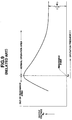
- Fig. 9 is a graph showing the control characteristic of the operation frequency f at the current resonance type power supply circuit in Fig. 5.
- the output voltage Eo is indicated on the vertical axis and the operation frequency f is on the horizontal axis. As understood from the characteristics, the output voltage Eo becomes the maximum when the operation frequency f is close to the resonance point f01. The specified range higher than the resonance point f01 is the normal operation area. Therefore, the output voltage Eo can be kept stable by controlling the operation frequency f corresponding to the change in the output voltage Eo.
- the error amplifier circuit 66 detects the decline of the output voltage Eo in the range of the normal operation area.
- the photo coupler PC6 and the control circuit 67 control the drive circuit 63 to change the on/off status of the switching elements 61 and 62 so that the operation frequency f is reduced and the output voltage Eo is increased.
- the output voltage Eo is restored to the original level.
- the load connected to the output terminal 65 rapidly increases or the output of the AC power supply 51 sharply declines, and the output voltage Eo becomes lower than a predetermined level.
- the operation frequency f quickly lowers to compensate for such change and may become lower than the resonance frequency f01 for the primary winding L61 of the switching transformer 64 and the capacitor C6I (See Fig. 9). This is the "out-of-resonance" phenomenon.
- the impedance of the resonance circuit consisting of the primary winding L61 and the capacitor C6I becomes negative (capacitive) [ ⁇ L-(1/ ⁇ C) ⁇ 0 where ⁇ is the angular frequency, L is the inductance of the primary winding L61 and C is the capacity of the capacitor C6I].
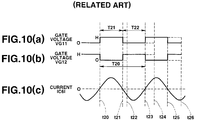
- Fig. 10 (a) to (c) show timing charts illustrating the operation waveform in the out-of-resonance status.
- Fig. 10(a) shows the gate voltage VG11 of the switching element 61
- Fig. 10(b) shows the gate voltage VG12 of the switching element 62
- Fig. 10(c) shows the current IC61 flowing through the capacitor C6I.
- Figs. 10(a) to (c) are compared with Figs. 6(a) to (e)
- the times T21 and T22 in Figs. 10(a) to (c) are longer than the times T11 and T12 in Figs. 6(a) to (e).
- the former figures have a longer period T20 and a low operation frequency.
- Figs. 11(a) to (c) and Fig. 12(a) to (c) are explanatory views illustrating the current route in the out-of-resonance status.
- Figs. 11(a) to (c) and Figs. 12(a) to (c) show the operation in a period (T20) as shown in Figs. 10(a) to (c).
- Fig. 11(a) shows the operation of timings from t20 to t21
- Fig. 11(b) shows the operation of timings from t21 to t22
- Fig. 11(c) shows the operation of timings from t22 to t23.
- Fig. 12(a) shows the operation of timings from t23 to t24
- Fig. 12(b) shows the operation of timings from t24 to t25
- Fig. 12(c) shows the operation of timings from t25 to t26.
- the drive circuit 63 supplies, according to the control signal a1 from the control circuit 67, the gate voltages VG11 and VG12 as shown in Figs. 10(a) and 10(b) to the gates of the switching elements 61 and 62.
- the gate voltage VG11 as shown in Fig. 10(a) is at the high (H) level to turn on the switching element 61 for the time T21 from t20 to t21 and the time from t23 to t25. It is at the 0 level to turn off the switching element 61 for the times from t21 to t23 and from t25 to t26.
- the gale voltage VG12 as shown in Fig. 10(b) is at the high (H) level to turn on the switching element 62 for the time T22 from t21 to t23 and is at the 0 level to turn off the switching element 62 for the times from t20 to t21 and from t23 to t25.
- the interval T20 from t20 to t23 is one period.
- the switching element 61 In the time from timing t20 to timing t21 as shown in Fig. 11(a), the switching element 61 is turned on and the current flows through the route from the switching element 61 to the winding L61 and then to the capacitor C6I.
- the current IC6I flowing through the capacitor C6I shown in Fig. 10(c) rises from 0A to the maximum level and then goes down to 0A.
- the diode D61 is turned on and the current flows through the route from the capacitor C6I to the winding L61 and then to the diode D61.
- the current IC6I flowing at the capacitor C6I as shown in Fig. 10(c) declines from 0A to a level in the negative side.
- the switching element 62 is turned on and the current flows through the route from the capacitor C6I to the winding L61 and then to the switching element 62.
- the current IC6I flowing through the capacitor C6I as shown in Fig. 10(c) declines in the negative side, reaches the minimum level and then rises to 0A.
- the switching element 61 In the time from timing 124 to timing t25 as shown in Fig. 12(b), the switching element 61 is turned on and the current flows through the route from the switching element 61 to the winding L61 and then to the capacitor C6I.
- the current IC6I flowing through the capacitor C6I as shown in Fig. 10(c) rises in the positive side to reach the maximum level and then declines to 0A.
- the diode D61 is turned on and the current flows through the route from the capacitor C6I to the winding L61 and then to the diode D61.
- the current IC6I flowing through the capacitor C6I shown in Fig. 10(c) declines from 0A to a level in the negative side, reaches the minimum level and then rises.
- An object of the present invention is to provide a current resonance type power supply circuit which is not susceptible to the out-of-resonance phenomenon when the AC power voltage sharply declines or when the load quickly increases.
- the current resonance type power supply circuit of the present invention turns on and off the switching elements to resonate the primary winding of the switching transformer and the current resonance capacitor and obtains high frequency output from the secondary winding of the switching transformer according to the resonance. It is characterized by adoption of a current resonance capacitor which has a larger capacity when the operation frequency of the switching elements becomes lower.
- the normal operation area can be enlarged toward the lower frequency side so as to suppress occurrence of the out-of-resonance phenomenon.
- Fig. 1 is a schematic circuit diagram showing an embodiment of a power supply circuit of current resonance type according to the present invention.
- the power supply circuit of Fig. 1 is of current resonance type. It resonates a primary winding L61 of a switching transformer 64 and a current resonance capacitor C2I by turning on and off switching elements 61 and 62 and obtains high frequency output from a secondary winding L62 of the switching transformer 64 according to such resonance.
- An output terminal of an alternating current (AC) power supply 51 or a commercial AC power, for example, is connected to an input terminal of a rectifier circuit 52, or a full-wave rectifier using a diode bridge, for example.
- the other output terminal of the AC power supply 51 is connected to the other input terminal of the rectifier circuit 52.
- the output terminal on the negative polarity side of the rectifier circuit 52 is connected to the reference potential point.
- the output terminal on the positive polarity side of the rectifier circuit 52 is connected to the reference potential point via a smoothing capacitor C51 and also connected to the reference potential point via switching elements 61 and 62 connected in series.
- switching elements 61 and 62 a MOSFET is used, for example.
- the source of the switching element 61 is connected to the drain of the switching element 61 via the anode-cathode channel of a parasitic diode D61.
- the source of the switching element 62 is connected to the drain of the switching element 62 via the anode-cathode channel of a parasitic diode D22.
- the switching elements 61 and 62 are alternately turned on and off by a drive circuit 63.
- the switching elements 61 and 62 and the diodes D61 and D62 constitute a switching means.
- connection point of the switching elements 61 and 62 is connected to the reference potential point via a voltage resonance capacitor C6V and at the same time connected to the reference potential point via the primary winding L61 of a switching transformer 64 and the current resonance capacitor C2I connected in series.
- the capacitor C2I has a larger capacity than the capacitor C6V.
- the above capacitor C2I is characterized by that its capacity increases as the operation frequency of the switching elements 61 and 62 declines.
- the secondary winding L62 of the switching transformer 64 is connected to an output terminal 65 via the anode-cathode channel of a diode D63 at an end and connected to the output terminal 65 via the anode-cathode channel of a diode D64 at the other end.
- the cathodes of the diodes D63 and D64 are connected to the reference potential point via a smoothing capacitor C65.
- the cathodes of the diodes D63 and D64 are connected to an input terminal 661 of an error amplifier circuit 66 via a resistor R61 and also connected to an output terminal 662 of the error amplifier circuit 66 via a resistor R62 and the anode-cathode channel of a light emitting diode D60 in a photo coupler PC6.
- the error amplifier circuit 66 has a negative polarity terminal 663 connected to the reference potential point. The error amplifier circuit 66 amplifies the error between the voltage applied to the input terminal 661 via the resistor R61 and the target voltage and controls the current flowing through the light emitting diode D60 corresponding to such amplified voltage.
- a control circuit 67 has a detection terminal 671 connected to the reference potential point via a resistor R63 and a phototransistor Tr60 in the photo coupler PC6 connected in series and has an output terminal 672 connected to the drive circuit 63.
- the light emitting diode D60 of the photo coupler PC6 emits light with the current corresponding to the error voltage. Upon receipt of such light by the phototransistor Tr60, the current corresponding to the received light amount flows from the detection terminal 671 of the control circuit 67 to the reference potential point via the resistor R63 and the collector-emitter channel of the phototransistor Tr60.
- the control circuit 67 prepares a control signal a1 at the output terminal 672 according to the current flowing from the detection terminal 671 to the resistor R63 and supplies such signal to the drive circuit 63.
- the drive circuit 63 supplies, corresponding to the control signal a1 from the control circuit 67, gate voltages VG11 and VG12 to turn on and off the switching elements 61 and 62 to the gates of the switching elements 61 and 62 respectively.
- the resistors R61 and R62, the error amplifier circuit 66, the photo coupler PC6, the drive circuit 63 and the control circuit 67 control the operation frequency f of the switching elements 61 and 62 corresponding to change in the output voltage Eo on the secondary side of the switching transformer 64 and thereby keep the output voltage Eo constant.
- the rectifier circuit 52 and the smoothing capacitor C51 constitute a rectifier-smoother circuit which rectifies and smoothes the output voltage from the AC power supply 51 and outputs the smooth DC voltage Ei.
- the switching elements 61 and 62 on the charge side and on the discharge side are provided in series between the output terminal of the above rectifier-smoother circuit and the reference potential point.
- the drive circuit 63 is designed to turn on and off the switching elements 61 and 62 on the charge side and on the discharge side at different timings.
- the capacitor C2I provided in parallel with the switching element 62 on the discharge side is characterized by that its capacity increases as the operation frequency of the switching elements 61 and 62 lowers.
- the switching transformer 64 has its primary winding L61 inserted between the switching element 62 and the capacitor C2I so that high frequency output is generated at the secondary winding L62 corresponding to the resonance of the primary winding L61 and the capacitor C2I.
- the timing charts to show the operation of the current resonance power supply circuit of Fig. 1 are the same as those of Figs. 6(a) to (e).
- the operation in a period (T10) of the power supply circuit as shown in Fig. 1 is the same as that illustrated in Figs. 7(a) to (c) and Figs. 8(a) to (c).
- the current IC6I of the capacitor C6I in Fig. 6(d) reads the current IC2 of the capacitor C2I and the capacitor C6I in Figs. 7(a) to (c) and Figs. 8(a) to (c) reads the capacitor C2I.
- the operation waveform of a single period (T10) as shown in Figs. 6(a) to (e) can be divided into six sections, which correspond to the times from t10 to t11, t11 to t12, t12 to t13, t13 to t14, t14 to t15 and t15 to t16.
- the time TD11 from timing t12 to timing t13 is a damper time and the switching elements and the diodes are turned off. As shown in Fig. 7(c), the current flows through the route from the capacitor C6V to the winding L61 and then to the capacitor C2I.
- the switching element 62 is turned on and the current flows through the route from the capacitor C2I to the winding L61 and then to the switching element 62.
- the time TD12 from timing t15 to timing t16 is a damper time and the switching elements and the diodes are turned off. As shown in Figs. 8(c), the current flows through the route from the capacitor C2I to the winding L61 and then to the capacitor C6V.
- the capacitor C2I which is an essential part of this embodiment according to the present invention, will be described below.
- Fig. 2 is a cross sectional view showing an example of a capacitor C2I as in Fig. 1.
- the capacitor C2I comprises a base 31 made of a polyester film or a polypropylene film and a layer 32 made of a substance such as TiBa (Titanium-barium) having the negative frequency characteristics with respect to a dielectric constant. They are adhered with a binder and laminated and wound to form a capacitor.
- a pair of electrodes 33 and 34 made of aluminum paint.
- a conductor layer 35 made of aluminum paint is provided on the side of the base 31 opposite to the side facing to the layer 32.
- a capacity C33 is formed between the electrode 33 and the conductor layer 35 and a capacity C34 is formed between the electrode 34 and the conductor layer 35.
- a capacitor having the electrode 33 as a terminal and the electrode 34 as the other terminal is constituted.
- Fig. 3 is a graph showing the frequency characteristics of the current resonance capacitor C2I as shown in Fig. 1. It shows the capacity on the vertical axis and the operation frequency f on the horizontal axis.
- the conventional capacitor keeps a constant capacity without any change corresponding to the operation frequency f (as shown with broken line in the figure).
- the capacitor C2I of the present invention has a larger capacity as the operation frequency f becomes lower in the range where the operation frequency f is below a certain frequency under the effect of the substance having negative frequency characteristics with respect to a dielectric constant.
- the capacity change of the capacitor C2I corresponding to the frequency has a negative characteristic (the characteristic to increase the capacity when the frequency becomes lower).
- formulae (1) and (2) show the voltage VL61 generated at the primary winding L61 of the switching transformer 64 in the applicable time.
- the first term represents the DC component and the second term represents the AC component (Resonance voltage).
- the second term represents that the AC component (Resonance voltage) has a level equivalent to that of the resonance voltage generated at the capacitor C2I but has a phase with a displacement for ⁇ (radian).
- the DC component in formulae (1) and (2) is constant regardless of the operation frequency.
- the AC component (resonance voltage) has the frequency characteristics that it reaches the maximum level at the resonance frequency and becomes 0 when the frequency becomes infinite. Therefore, the maximum load can be supplied within the range free from out-of-resonance phenomenon when the operation frequency becomes equal to the resonance frequency.
- the power which can be supplied from the switching transformer 64 at the resonance frequency is determined below.
- the resonance angular frequency is ⁇ 0
- the resonance current is I
- the voltage generated at the primary winding L6I of the switching transformer is VL61
- the power which can be supplied from the switching transformer 64 at the resonance frequency is PL
- the capacity of the capacitor C2I is C
- the inductance of the primary winding L61 is L.
- Fig. 4 is a graph showing the change characteristics of the output voltage corresponding to the change in the operation frequency f in the power supply circuit of current resonance type in Fig. 1.
- the output voltage Eo is indicated on the vertical axis and the operation frequency f is indicated on the horizontal axis.
- the error amplifier circuit 66 detects the decline of the output voltage in the range of the normal operation area.
- the photo coupler PC6 and the control circuit 67 control the drive circuit 63 to change the on/off status of the switching elements 61 and 62 so that the operation frequency f is reduced and the output voltage Eo is increased.
- the output voltage is restored to the original level.
- the operation frequency f becomes lower in the circuit of Fig. 1
- the capacitor C2I has a larger capacity and a lower resonance frequency under the effect of the substance having the negative frequency characteristics with respect to a dielectric constant when a operation frequency f lowers. Even when the operation frequency of the switching elements on the charge side and the discharge side becomes lower than the resonance frequency, the out-of-resonance phenomenon hardly occurs. This prevents the current flowing through the switching elements and the parasitic diodes, and thereby protects the switching elements from being destroyed.
- a field effect transistor such as a MOSFET is used as the switching element and the parasitic diode incorporated in the structure of the field effect transistor is utilized for reverse current flowing.
- the switching element may comprise a bipolar type transistor such as an NPN transistor.
- a bipolar type transistor does not incorporate a parasitic diode between the collector and emitter, but the operation similar to that made by the circuit of Fig. 1 can be realized by connecting a diode having a reverse conductivity to that of the transistor between the collector and the emitter in parallel.
Landscapes
- Engineering & Computer Science (AREA)
- Power Engineering (AREA)
- Multimedia (AREA)
- Signal Processing (AREA)
- Dc-Dc Converters (AREA)
- Inverter Devices (AREA)
- Fixed Capacitors And Capacitor Manufacturing Machines (AREA)
Applications Claiming Priority (3)
| Application Number | Priority Date | Filing Date | Title |
|---|---|---|---|
| JP32908097 | 1997-11-28 | ||
| JP329080/97 | 1997-11-28 | ||
| JP9329080A JPH11164554A (ja) | 1997-11-28 | 1997-11-28 | 電流共振電源回路 |
Publications (2)
| Publication Number | Publication Date |
|---|---|
| EP0920118A2 true EP0920118A2 (de) | 1999-06-02 |
| EP0920118A3 EP0920118A3 (de) | 2000-07-19 |
Family
ID=18217407
Family Applications (1)
| Application Number | Title | Priority Date | Filing Date |
|---|---|---|---|
| EP98122197A Withdrawn EP0920118A3 (de) | 1997-11-28 | 1998-11-27 | Resonanz-Stromversorgungsschaltung |
Country Status (4)
| Country | Link |
|---|---|
| US (1) | US6038141A (de) |
| EP (1) | EP0920118A3 (de) |
| JP (1) | JPH11164554A (de) |
| KR (1) | KR100287797B1 (de) |
Cited By (1)
| Publication number | Priority date | Publication date | Assignee | Title |
|---|---|---|---|---|
| WO2007020550A1 (en) * | 2005-08-16 | 2007-02-22 | Koninklijke Philips Electronics N.V. | Resonant power converter |
Families Citing this family (6)
| Publication number | Priority date | Publication date | Assignee | Title |
|---|---|---|---|---|
| TW584341U (en) * | 2003-05-09 | 2004-04-11 | Profantec Dev Corp | Brushless DC motor applied to AC power |
| JP4957180B2 (ja) | 2006-10-25 | 2012-06-20 | サンケン電気株式会社 | 電力変換装置及びその制御方法 |
| JP4669502B2 (ja) * | 2007-10-30 | 2011-04-13 | 株式会社ナナオ | 共振型スイッチング電源装置の異常検出方法及び共振型スイッチング電源装置 |
| JP5736772B2 (ja) * | 2010-12-27 | 2015-06-17 | サンケン電気株式会社 | 定電流電源装置 |
| KR101532131B1 (ko) | 2013-04-29 | 2015-06-26 | 삼성전기주식회사 | 공진형 전원 공급 장치 |
| JP6849143B2 (ja) * | 2018-03-23 | 2021-03-24 | 富士電機株式会社 | 共振型コンバータの制御装置 |
Family Cites Families (6)
| Publication number | Priority date | Publication date | Assignee | Title |
|---|---|---|---|---|
| US4992919A (en) * | 1989-12-29 | 1991-02-12 | Lee Chu Quon | Parallel resonant converter with zero voltage switching |
| DE4313359A1 (de) * | 1992-04-24 | 1993-10-28 | Matsushita Electric Industrial Co Ltd | Schaltnetzteil |
| KR100219314B1 (ko) * | 1992-09-25 | 1999-09-01 | 무라따 미치히로 | 공진형 전원 회로 |
| US5748458A (en) * | 1995-02-10 | 1998-05-05 | Kabushiki Kaisha Toshiba | AC/DC converter power supply circuit having multiple rectifiers |
| JP2792536B2 (ja) * | 1995-09-26 | 1998-09-03 | 日本電気株式会社 | 共振型dc−dcコンバータ |
| US5684678A (en) * | 1995-12-08 | 1997-11-04 | Delco Electronics Corp. | Resonant converter with controlled inductor |
-
1997
- 1997-11-28 JP JP9329080A patent/JPH11164554A/ja active Pending
-
1998
- 1998-11-25 KR KR1019980050664A patent/KR100287797B1/ko not_active Expired - Fee Related
- 1998-11-27 US US09/200,596 patent/US6038141A/en not_active Expired - Fee Related
- 1998-11-27 EP EP98122197A patent/EP0920118A3/de not_active Withdrawn
Cited By (1)
| Publication number | Priority date | Publication date | Assignee | Title |
|---|---|---|---|---|
| WO2007020550A1 (en) * | 2005-08-16 | 2007-02-22 | Koninklijke Philips Electronics N.V. | Resonant power converter |
Also Published As
| Publication number | Publication date |
|---|---|
| EP0920118A3 (de) | 2000-07-19 |
| KR19990045555A (ko) | 1999-06-25 |
| JPH11164554A (ja) | 1999-06-18 |
| US6038141A (en) | 2000-03-14 |
| KR100287797B1 (ko) | 2001-04-16 |
Similar Documents
| Publication | Publication Date | Title |
|---|---|---|
| US7894212B2 (en) | Switching power supply device | |
| JP4158054B2 (ja) | スイッチング電源装置 | |
| US7898823B2 (en) | Quasi-resonant fly-back converter without auxiliary winding | |
| US6690143B2 (en) | Power factor correction circuit with resonant snubber | |
| CN105846695A (zh) | 用于同步整流器的自供电 | |
| KR100583670B1 (ko) | 스위칭 전원 장치 | |
| US20020080634A1 (en) | DC/DC Converter and control method thereof | |
| US9912241B2 (en) | System and method for a cascode switch | |
| US6266254B1 (en) | Switching power circuit | |
| US10903751B2 (en) | Method and system of driving an electrically controlled switch with a snubber capacitor | |
| TW201935836A (zh) | 整合型自驅動式主動箝位 | |
| JP2001238444A (ja) | スイッチング電源装置 | |
| US8120275B2 (en) | Inverter and lamp driver including the same | |
| US6038141A (en) | Resonance power supply circuit of variable capacity type | |
| JPH10191575A (ja) | 電源回路 | |
| JP7619840B2 (ja) | 半導体駆動回路及び電力変換装置 | |
| EP0827264A2 (de) | Schaltnetzteil | |
| CN209860802U (zh) | 一种谐振式反激电源电路、装置及电子设备 | |
| KR100909008B1 (ko) | 자려식 인버터 구동회로 | |
| JP4745043B2 (ja) | 電源回路 | |
| JP6717426B2 (ja) | 電力変換装置 | |
| JPH0683573B2 (ja) | 共振コンバータおよびその制御方法 | |
| JP2004096967A (ja) | スイッチング電源装置 | |
| US7773391B2 (en) | Direct current to direct current converter with single ended transformer and pulse reverse circuit | |
| JP2001190070A (ja) | スイッチング電源装置 |
Legal Events
| Date | Code | Title | Description |
|---|---|---|---|
| PUAI | Public reference made under article 153(3) epc to a published international application that has entered the european phase |
Free format text: ORIGINAL CODE: 0009012 |
|
| 17P | Request for examination filed |
Effective date: 19981127 |
|
| AK | Designated contracting states |
Kind code of ref document: A2 Designated state(s): DE FR GB IT |
|
| AX | Request for extension of the european patent |
Free format text: AL;LT;LV;MK;RO;SI |
|
| PUAL | Search report despatched |
Free format text: ORIGINAL CODE: 0009013 |
|
| RIC1 | Information provided on ipc code assigned before grant |
Free format text: 7H 02M 3/337 A |
|
| AK | Designated contracting states |
Kind code of ref document: A3 Designated state(s): AT BE CH CY DE DK ES FI FR GB GR IE IT LI LU MC NL PT SE |
|
| AX | Request for extension of the european patent |
Free format text: AL;LT;LV;MK;RO;SI |
|
| AKX | Designation fees paid |
Free format text: DE FR GB IT |
|
| 17Q | First examination report despatched |
Effective date: 20080108 |
|
| STAA | Information on the status of an ep patent application or granted ep patent |
Free format text: STATUS: THE APPLICATION IS DEEMED TO BE WITHDRAWN |
|
| 18D | Application deemed to be withdrawn |
Effective date: 20080520 |