EP0920236A2 - Auf dynamische Kapazitätsanpassung der physikalischen Schicht basierte Steuerung von Übertragungseigenschaften einer ATM Schicht - Google Patents
Auf dynamische Kapazitätsanpassung der physikalischen Schicht basierte Steuerung von Übertragungseigenschaften einer ATM Schicht Download PDFInfo
- Publication number
- EP0920236A2 EP0920236A2 EP98309765A EP98309765A EP0920236A2 EP 0920236 A2 EP0920236 A2 EP 0920236A2 EP 98309765 A EP98309765 A EP 98309765A EP 98309765 A EP98309765 A EP 98309765A EP 0920236 A2 EP0920236 A2 EP 0920236A2
- Authority
- EP
- European Patent Office
- Prior art keywords
- rate
- end point
- physical layer
- transport rate
- transmission
- Prior art date
- Legal status (The legal status is an assumption and is not a legal conclusion. Google has not performed a legal analysis and makes no representation as to the accuracy of the status listed.)
- Withdrawn
Links
Images

Classifications
-
- H—ELECTRICITY
- H04—ELECTRIC COMMUNICATION TECHNIQUE
- H04L—TRANSMISSION OF DIGITAL INFORMATION, e.g. TELEGRAPHIC COMMUNICATION
- H04L12/00—Data switching networks
- H04L12/54—Store-and-forward switching systems
- H04L12/56—Packet switching systems
- H04L12/5601—Transfer mode dependent, e.g. ATM
- H04L12/5602—Bandwidth control in ATM Networks, e.g. leaky bucket
-
- H—ELECTRICITY
- H04—ELECTRIC COMMUNICATION TECHNIQUE
- H04Q—SELECTING
- H04Q11/00—Selecting arrangements for multiplex systems
- H04Q11/04—Selecting arrangements for multiplex systems for time-division multiplexing
- H04Q11/0428—Integrated services digital network, i.e. systems for transmission of different types of digitised signals, e.g. speech, data, telecentral, television signals
- H04Q11/0478—Provisions for broadband connections
-
- H—ELECTRICITY
- H04—ELECTRIC COMMUNICATION TECHNIQUE
- H04L—TRANSMISSION OF DIGITAL INFORMATION, e.g. TELEGRAPHIC COMMUNICATION
- H04L12/00—Data switching networks
- H04L12/54—Store-and-forward switching systems
- H04L12/56—Packet switching systems
- H04L12/5601—Transfer mode dependent, e.g. ATM
- H04L2012/5629—Admission control
- H04L2012/5631—Resource management and allocation
- H04L2012/5632—Bandwidth allocation
- H04L2012/5635—Backpressure, e.g. for ABR
Definitions
- This invention relates to communications service over an asynchronous transfer mode (ATM) network and more particularly, to management of data traffic over an end-system to end-system path which includes an ATM layer connection and a physical layer link having a transfer or transport rate subject to variation as a function of time. Transfer characteristics provided by the network for the ATM layer connection are controlled based on dynamic adaptation to the physical layer rate variation of the link.
- ATM asynchronous transfer mode
- ATM Asynchronous transfer mode
- DSL digital subscriber line
- xDSL technologies include symmetric digital subscriber line (SDSL), asymmetric digital subscriber line (ADSL) and very-high rate digital subscriber line (VDSL).
- SDSL symmetric digital subscriber line
- ADSL asymmetric digital subscriber line
- VDSL very-high rate digital subscriber line
- the range of downstream transport rate typically varies from as little as 32 kb/s to over 8 mb/s and the upstream rate from 32 kb/s to over 640 kb/s. This downstream rate offers considerable improvement over the 160 kb/s rates provided by existing ISDN architectures.
- xDSL termination units also commonly referred to as xDSL modems
- dynamic rate adaptation functionality whereby the modem dynamically adjusts its transmission rate according to the measured physical characteristics (i.e., usable transport rate) of the loop.
- the transmission rate in use by the xDSL modem is stored in an internal register which may be read by an end-system connected to the modem.
- UBR unspecified bit rate
- This service category is intended for non-real time applications such as those that do not require tightly constrained delay and delay variations.
- UBR service does not specify traffic related service guarantees.
- PCR peak cell rate
- the transport rate characteristics of the xDSL link forming part of the path between the two end-systems may change during the time of the connection (i.e. after the connection has been set up). If, for example, the transport rate decreases during this interval the xDSL link will not be able to carry the data at the negotiated transmission rate of the source. As a result, congestion will occur at the interface between the ATM path and the xDSL link leading to packet discard and a reduction in system performance.
- a transmission link may have a variable transport rate
- the data is transmitted from the ATM network interface card to the destination across a wireless link.
- Such wireless links are subject to transport rate variations due to atmospheric conditions changing path lengths, etc. Again, if the transport rate characteristic is reduced after the connection has been negotiated, congestion will occur.
- a third example of a transmission link having a dynamically varying transport rate is an inverse multiplexing over ATM (IMA) system.
- IMA inverse multiplexing over ATM
- one of the multi paths through the network may experience a temporary failure which results in increase demands on the bandwidth requirements of the remaining paths. If the connections are already operating at or near their physical capacity they will be unable to satisfy the negotiated peak cell rate (PCR) resulting in congestion.
- PCR peak cell rate
- a method of managing transmission of the data traffic through the system comprising: monitoring the physical layer transport rate of the transmission link; sending to the source end point a management cell including rate information based on the monitored physical layer transport rate; and adjusting, by the source end point, the transmission rate responsive to the rate information in the management cell.
- a system for managing transmission of the data traffic through the system comprising: monitoring means associated with the physical layer to monitor the transport rate of the transmission link; sending means to send to the source end point a management cell including rate information based on the monitored physical layer transport rate; and adjusting means, at the source end point, to adjust the transmission rate responsive to the rate information in the management cell.
- a method of managing transmission of the data traffic through the system comprising: continually monitoring the physical layer transport rate of the transmission link; generating a management cell in response to a change in the monitored physical layer transport rate which exceeds a threshold value, the management cell including rate information based on the monitored transport rate; sending to the source end point the management cell; and adjusting the source end point transmission rate in response to the rate information in the management cell.
- a system for managing transmission of the data traffic through the system comprising: monitoring means for monitoring the physical layer transport rate of the link; generating means to generate a management cell in response to a change is the monitored physical layer transport rate which exceeds a threshold value, the management cell including information based on the monitored transport rate; means to send the management cell to the source end point; and adjusting means at the source end point to adjust the transmission rate in response to the rate information in the management cell.
- a communications system for transporting data traffic from a source end point to a destination end point over an ATM path which includes a transmission link having a physical layer transport rate which is subject to variations as a function of time, a method of managing transmission of data traffic through the system.
- the method comprises: shaping data connections from the source end point in accordance with the ATM available bit rate (ABR) category of service, the ABR connection including integrated resource management (RM) cells for carrying congestion information back to the source over a feedback path; monitoring dynamically the transport rate of the transmission link and recording a rate derived from the monitored transport rate in the RM cell; returning the RM cell including the recorded dynamic transport rate of the transmission link to the source; and adjusting the send rate of the source in accordance with the transport rate information.
- ABR ATM available bit rate
- RM integrated resource management
- a system for managing data traffic from a source end point to a destination end point over an ATM path the ATM path including a transmission link having a dynamically variable physical layer transport rate.
- the system comprises shaping means in the source to shape the data traffic connection to comply with ATM available bit rate (ABR) category of service, the ABR connection including an integrated resource management (RM) cell for returning explicit rate congestion information to the source over a feedback path; monitoring means associated with the transmission link to monitor dynamically, the physical layer transport rate capability of the transmission link; recording means in the monitoring means to record a value derived from the transport rate capability in the RM cell; and control means in the source to change the send rate of the data traffic in accordance with the transport rate information.
- ABR ATM available bit rate
- RM integrated resource management
- the invention advantageously uses the instantaneous physical layer information on transmission rates to provide control of the ATM layer congestion control loop, in advance of the onset of congestion and cell loss.
- an exemplary client-server based data processing system comprising an ATM network 10, communicatively coupled to which are two conventional end-systems 11 and 12.
- End-system 11 is embodied by a data server 13 connected through an ATM network interface card (NIC) 14 to the ATM network 10.
- End-system 12 is embodied by a personal computer functioning as a client 15 connected through an ADSL link 16 and ATM termination unit 17 to the ATM network 10.
- the ADSL link 16 is constituted by two ADSL modem 18 and 19, with which the client 15 and ATM termination unit 17 are respectively equipped and which are interconnected by a typical subscriber loop 20.
- a telephone 22 may be connected to the ADSL line with or without POTS splitters 23.
- end systems 11 and 12 can represent any data processing system including, for instance, other communications networks.
- Bi-directional data traffic identified as upstream and downstream in Figure 1, is exchanged between the two end-systems 11 and 12.
- client 15 end-system 12
- server 13 end-system 11
- client 15 end-system 12
- the ATM termination unit 17 interfaces traffic to and from the ATM network 10 with the ADSL link 16, and includes a buffer 21 for managing egress of downstream traffic onto the link 16.
- An example of the ATM termination unit 17 is an access node or digital subscriber loop access multiplexer (DSLAM).
- DSLAM digital subscriber loop access multiplexer
- the ATM termination unit 17 together with the ATM NIC 14 are responsible for shaping ATM layer traffic between their respective end-systems 12 and 11.
- data from source end-system 11 is shaped to comply with the ATM Forum's unspecified bit rate (UBR) category of service.
- UBR unspecified bit rate
- ADSL link 16 represents a copper local loop 20 commonly found in private homes and small businesses. It is known that the physical characteristics of ADSL link 16 may change with time due to the physical condition of the link, temperature variations or electromagnetic interference. If the physical characteristic of the loop 20 changes such that the peak cell rate carried by the ADSL link 16 is reduced after the connection has been negotiated, ADSL link 16 will not be able to carry all of the data traffic sent out from source end-system 11. In this case, buffer 21 will become full and a congestion condition will result. Eventually buffer 21 will overflow resulting in cell traffic discard and loss of continuity.
- ABR class traffic typically includes data cells 28 and resource management (RM) cells 26 integrated into the traffic flow from source end-system 11.
- RM resource management
- Each network element 24 along the path within the ATM network monitors its local congestion conditions and may mark the resource management cell with an indication of bandwidth availability through that element.
- the resource management cells reach destination end-system 12 they are returned towards the source end-system 11 along feedback path 30.
- Each RM cell passing back through the network elements 24 receives updated congestion information and returns to the source end-system 11 with an explicit rate (ER) of the available bandwidth or the peak cell rate permitted by the source.
- ER explicit rate
- ER methodology handles variable rate links along with variable load.
- a quick convergence to the available or usable bandwidth of a particular variable rate link is desired, and the use of physical layer information about the instantaneous transmission rate of the link achieves increased convergence speed.
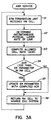
- FIG 3A in conjunction with reference to Figure 1 illustrates the manner in which the ABR category of service is implemented in the present invention.
- Downstream data traffic egressing from source end-system 11, specifically server 13 is shaped to comply with the ABR category of service.
- the ATM termination unit 17 receives an RM cell, responsive to which the destination end-system 12 determines the instantaneous physical layer rate of the ADSL link 16, at step S2.
- Such is effected by the ADSL modem 19 measuring (monitoring) the physical layer rate over the loop 20 in a conventional manner and providing the measured physical link rate in an internal register, or memory location from which this information is retrieved by the ATM termination unit 17.
- ACR allowed cell rate
- the ER value in the received RM cell is compared to the computed ACR. If the ACR is less than that ER, step S5, then the computed ACR is inserted as the new ER parameter in the RM cell, and otherwise advance directly to step S6.
- the RM cell of the ABR traffic is returned to the source end-system 11 in order to appropriately modify the send rate of traffic leaving source end-system 11.
- the ACR is now derived from the transport rate (i.e. less than or equal to transport rate) recorded in the ER field of the RM cell and is returned to ATM NIC 14 of the source end-system 11 over the feedback path, thereby shaping the downstream traffic. Consequently, previously occurring congestion problems are avoided.
- Conditions may occur in the system wherein it is advantageous to independently generate a management cell containing allowable rate information instead of waiting for the next resource management cell in the ABR loop to carry the new transmission rate to the source end point.
- it may be beneficial to have the instantaneous allowable cell rate passed immediately to the source via an autonomously generated RM cell.
- Another situation in which it is beneficial to immediately send rate information respecting the physical layer transport rate to the source end is when there is a sudden or dramatic change in available bandwidth. This might occur, for example, when the telephone 22 shown bridging the xDSL link in Figure 1 goes off-hook.
- a change in available bandwidth such as this will lead to the generation of a management cell containing new transport rate information and this management cell is sent to the source for adjustment of the transmission rate.
- the access modem generate a management cell containing rate information any time a change in transport rate exceeds a preset threshold.
- This feature may be implemented independently of the resource management cells associated with the ABR category of service or in combination therewith. By immediately generating a management cell with new rate information each time a change in the transport rate exceeds a set threshold potential congestion can be avoided by implementing an adjusted transmission rate earlier. If the traffic is shaped to the ABR category of service the frequency of resource management cells or stated differently the number of RM cells can be reduced as any change in transport rate in excess of the threshold will automatically lead to the generation of a management cell with new rate information. The reduced number of RM cells results in an overall savings of bandwidth to the system as RM cells do not carry data traffic. This feature also results in better buffer utilization and smaller queues with lower cell loss. In the ABR implementation RM cells are still treated normally by other multiplexing or switching nodes in the system, and this feature is interoperable with standard ABR behaviours.
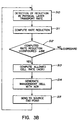
- FIG. 3B illustrates this aspect of the invention.
- step S10 there is a detection of an instantaneous change in transport rate of the physical layer of the transmission link (ADSL link in Figure 1). This change may be caused, for example, by telephone 22 going off-hook.
- the actual rate reduction is computed at step S11 and this computed rate is compared with the cell rate or link bandwidth negotiated at call set up (step S12). If the reduction is less than a threshold value the occurrence of the detected reduction is disregarded. If, however, the reduction is greater than the threshold value an allowed cell rate (ACR) is computed at step S13.
- a management cell is generated and rate information based on the ACR is inserted in the management cell at step S14.
- the management cell with rate information is sent to the source end point and the transmission rate of the system is adjusted accordingly.
- the foregoing description is based primarily on the detection of a reduction in the transport rate of the physical layer. It will be apparent that this aspect applies to a situation in which the transport rate dramatically increases. This could occur, for example, when the system shown in Figure 1 with telephone 22 off hook has established a stable transmission rate and the telephone goes on hook. The available bandwidth will suddenly increase and this increase will be detected by the access modem. The management cell generated in this case will contain information which will lead to an increase in transmission rate for the system.
- bandwidth change thresholds can be used, dependent upon whether the physical layer transport rate is decreasing or increasing. It may be advantageous to have a smaller ⁇ BW when the transport rate decreases, thereby adjusting more quickly to the change. Alternatively, one might choose not to send independently generated RM cells when the physical transport rate increases.
- Traffic management for the ATM based system in Figure 1 has been described thus far having regard to downstream traffic, for which the ABR service class has been used to shape traffic dependent upon the physical layer transmission rate of the ADSL link 16.
- ABR may be used to shape the upstream traffic as well.
- some network level efficiencies may be realized by employing a different class of service, e.g. either ABR or UBR, for each direction of such bi-directional traffic.
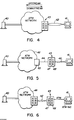
- Figures 4 to 6 depict various end-system configurations and the preferred service classes to be used.
- Figure 4 relates to bi-directional traffic flow between end systems 40 and 41.
- traffic from source end-system 40 to destination end-system 41 is shaped to conform to the ABR category of service as explained above. If, however, traffic is flowing in the upstream direction from source end-system 41 towards destination end-system 40, the change in physical characteristics of ADSL link 42 will not lead to downstream congestion. In this case, traffic may be shaped by the ATM termination unit 43 to the UBR category of service for the upstream direction.
- the UBR class of service does not transfer resource management cells between end systems, whereas the ABR class of services provides for RM cells in both directions. Consequently, employment of ABR service for downstream traffic (i.e., from end system 40 to end system 41) and UBR service for upstream traffic (i.e., from end system 41 to end system 40) achieves a more efficient utilization of network bandwidth resources because of less overhead.
- Figures 5 and 6 illustrate different network architectures in which at least a portion of the bi-directional path between end systems 40 and 41 includes an ADSL link 42.
- the path includes optical fiber 44 providing an OC3 link between an access switch 45 of the ATM network 46 and the termination unit 43 which includes ABR interface 47 and UBR interface 48.
- downstream traffic from end system 40 to end-system 41 is shaped to conform to ABR category of service whereas upstream traffic from end system 41 to termination unit 43 may comply with UBR category of service. It is, of course, within the scope of the invention to shape traffic in accordance with ABR category of service in both directions.
- Figure 6 is yet a further example in which the ADSL link is between two ATM networks.
- traffic from end source to end source is shaped to ABR but may be shaped to UBR within the network at the interface to the ADSL link 42.
- the ADSL link represents one example wherein physical characteristics of the path may change dynamically to alter the transport rate capabilities.
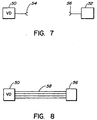
- Figure 7 represents a further example incorporating a wireless path.
- virtual destination 50 represents the termination unit for ATM traffic.
- Destination 52 is configured to received data traffic from virtual destination 50. Traffic between the destination 52 and virtual destination 50 is carried through a wireless path from transmitter 54 to receiver 56.
- the physical characteristics of the wireless path are also subject to variations due to changes such as environmental conditions. As in the previous example, if the conditions change after the peak cell rate has been negotiated the virtual destination will not be able to transmit data across the wireless link if the data is shaped to UBR. Under ABR shaping the new permitted transport rate is returned to the source (not shown) in order to avoid congestion at virtual destination 50.
- Figure 8 is a high level diagram representing an inverse multiplexing over ATM (IMA) configuration.
- traffic from virtual destination 50 to actual destination 56 is shared by virtual channel connections 58. Inverse multiplexing occurs at destination 56.
- a UBR connection between virtual destination 50 and destination 56 will carry traffic at the negotiated rate at connection setup. If one of the intermediate paths 58 is lost or temporarily interrupted, the remaining virtual channel connections will be called on to carry that portion of the traffic which was previously carried by the interrupted connection. This may result in an inability to transport data at the negotiated rate, again resulting in congestion. If the traffic is shaped to the ABR category of service, however, the need to share a greater transport rate will be recorded in the resource management cell and the send rate from the source revised accordingly.
- IMA inverse multiplexing over ATM
- Embodiments of the invention described above include an ATM network interconnecting the two end-systems.
- the invention may be readily applied to any data communications networking technology implementing a class of service providing an explicit rate flow control.
- An explicit rate flow control specifies the particular rate at which a network connection may carry data traffic.
- Frame relay and Internet Protocol may some day offer various classes of service and explicit rate based service similar to ATM's ABR.
Landscapes
- Engineering & Computer Science (AREA)
- Computer Networks & Wireless Communication (AREA)
- Signal Processing (AREA)
- Data Exchanges In Wide-Area Networks (AREA)
Applications Claiming Priority (4)
| Application Number | Priority Date | Filing Date | Title |
|---|---|---|---|
| CA 2222934 CA2222934A1 (en) | 1997-11-28 | 1997-11-28 | Controlling atm layer transfer characteristics based on physical layer dynamic rate adaptation |
| CA2222934 | 1997-11-28 | ||
| CA2240596 | 1998-06-12 | ||
| CA002240596A CA2240596A1 (en) | 1997-11-28 | 1998-06-12 | Controlling atm layer transfer characteristics based on physical layer dynamic rate adaptation |
Publications (2)
| Publication Number | Publication Date |
|---|---|
| EP0920236A2 true EP0920236A2 (de) | 1999-06-02 |
| EP0920236A3 EP0920236A3 (de) | 2000-08-09 |
Family
ID=25679869
Family Applications (1)
| Application Number | Title | Priority Date | Filing Date |
|---|---|---|---|
| EP98309765A Withdrawn EP0920236A3 (de) | 1997-11-28 | 1998-11-27 | Auf dynamische Kapazitätsanpassung der physikalischen Schicht basierte Steuerung von Übertragungseigenschaften einer ATM Schicht |
Country Status (3)
| Country | Link |
|---|---|
| US (1) | US6963538B1 (de) |
| EP (1) | EP0920236A3 (de) |
| CA (1) | CA2240596A1 (de) |
Cited By (2)
| Publication number | Priority date | Publication date | Assignee | Title |
|---|---|---|---|---|
| EP1455490A3 (de) * | 2003-03-03 | 2004-12-08 | Microsoft Corporation | Zulassungssteuernung der Datenübertragung in Netzwerken auf Basis der Ende-zu-Ende Verbindungsvermessung. |
| EP1545071A1 (de) * | 2003-12-19 | 2005-06-22 | Evolium S.A.S. | Verfahren zur verbesserten Behandlung von dynamischen Bandbreitenveränderungen in einem Transportnetz mit inversem Multiplexen |
Families Citing this family (13)
| Publication number | Priority date | Publication date | Assignee | Title |
|---|---|---|---|---|
| US20040246897A1 (en) * | 1997-06-13 | 2004-12-09 | Qingming Ma | Startup management system and method for networks |
| EP1111841B1 (de) * | 1999-12-21 | 2011-06-22 | Alcatel Lucent | Verfahren zur Übermittlung des Netzwerkzustandes und Kommunikationsnetzwerk |
| WO2002032083A1 (en) * | 2000-10-13 | 2002-04-18 | Sony Corporation | Data communication quality control system, transmitter system and receiver |
| US20020172274A1 (en) * | 2001-05-18 | 2002-11-21 | Carlson Arthur J. | Method of intelligently restricting symbol size in ADSL modems |
| JP3627680B2 (ja) | 2001-06-20 | 2005-03-09 | 日本電気株式会社 | デジタル加入者線ネットワークにおける帯域制御システム及びその制御方法 |
| KR100415114B1 (ko) * | 2001-11-28 | 2004-01-13 | 삼성전자주식회사 | 음성 및 데이타 서비스를 지원하는 비동기전송모드 네트워크의 음성 다중화 장치 및 방법 |
| DE102005003016B4 (de) * | 2005-01-21 | 2006-10-26 | Infineon Technologies Ag | Verfahren und Vorrichtungen zur Datenübertragung |
| BRPI0614570A2 (pt) * | 2005-07-29 | 2012-11-27 | British Telecommunications Public Limited Company | método para aprovisionar um dispositivo de interface, dispositivo de gerenciamento para automaticamente aprovisionar um dispositivo de interface, programa de computador, e, meio portador |
| EP2169980A1 (de) * | 2008-09-30 | 2010-03-31 | BRITISH TELECOMMUNICATIONS public limited company | Dynamische Leitungsverwaltung |
| EP2209324A1 (de) | 2009-01-15 | 2010-07-21 | BRITISH TELECOMMUNICATIONS public limited company | Verwaltung von Telekommunikationsverbindungen |
| EP2237478A1 (de) | 2009-03-31 | 2010-10-06 | BRITISH TELECOMMUNICATIONS public limited company | Dynamische Linienverwaltung |
| CN103891222B (zh) * | 2011-10-20 | 2017-06-27 | 瑞典爱立信有限公司 | 对光传输网络中的现有业务流调整大小的方法及装置 |
| CN117155867A (zh) * | 2022-05-24 | 2023-12-01 | 华为技术有限公司 | 拥塞控制方法、节点及系统 |
Family Cites Families (10)
| Publication number | Priority date | Publication date | Assignee | Title |
|---|---|---|---|---|
| US5784358A (en) * | 1994-03-09 | 1998-07-21 | Oxford Brookes University | Broadband switching network with automatic bandwidth allocation in response to data cell detection |
| ZA959722B (en) * | 1994-12-19 | 1996-05-31 | Alcatel Nv | Traffic management and congestion control for packet-based networks |
| GB2307823B (en) * | 1995-11-29 | 2000-04-12 | Gen Datacomm Adv Res | Available bit rate services in ATM networks |
| GB9602027D0 (en) * | 1996-02-01 | 1996-04-03 | Madge Networks Ltd | Flow control in a cell switched communication system |
| EP0800294B1 (de) * | 1996-03-20 | 2004-08-04 | Alcatel | Verfahren zur Kontrolle der Datenstromgeschwindigkeit, des Warteschlangenetzknoten und des Paketvermittlungsnetzwerkes |
| JP2991125B2 (ja) * | 1996-09-06 | 1999-12-20 | 日本電気株式会社 | Abr用セルレート監視装置 |
| EP0838924A1 (de) * | 1996-10-23 | 1998-04-29 | Alcatel | Verfahren zur Bestimmung einer geplanten Zellenrate zur Verwendung in einem Überwachungsalgorithmus und entsprechender Überwachungseinrichtung |
| US6069872A (en) * | 1997-11-20 | 2000-05-30 | Cabletron Systems, Inc. | Explicit rate congestion control system and method |
| US6118764A (en) * | 1997-12-30 | 2000-09-12 | Nortel Networks Corporation | Congestion indication/no increase (CI/NI) ABR flow control for ATM switches |
| US6178159B1 (en) * | 1998-03-02 | 2001-01-23 | Lucent Technologies Inc. | Available bit rate flow control algorithms for ATM networks |
-
1998
- 1998-06-12 CA CA002240596A patent/CA2240596A1/en not_active Abandoned
- 1998-11-25 US US09/199,786 patent/US6963538B1/en not_active Expired - Fee Related
- 1998-11-27 EP EP98309765A patent/EP0920236A3/de not_active Withdrawn
Cited By (3)
| Publication number | Priority date | Publication date | Assignee | Title |
|---|---|---|---|---|
| EP1455490A3 (de) * | 2003-03-03 | 2004-12-08 | Microsoft Corporation | Zulassungssteuernung der Datenübertragung in Netzwerken auf Basis der Ende-zu-Ende Verbindungsvermessung. |
| US7239611B2 (en) | 2003-03-03 | 2007-07-03 | Microsoft Corporation | Controlling admission of data streams onto a network based on end-to-end measurements |
| EP1545071A1 (de) * | 2003-12-19 | 2005-06-22 | Evolium S.A.S. | Verfahren zur verbesserten Behandlung von dynamischen Bandbreitenveränderungen in einem Transportnetz mit inversem Multiplexen |
Also Published As
| Publication number | Publication date |
|---|---|
| EP0920236A3 (de) | 2000-08-09 |
| CA2240596A1 (en) | 1999-05-28 |
| US6963538B1 (en) | 2005-11-08 |
Similar Documents
| Publication | Publication Date | Title |
|---|---|---|
| US6542465B1 (en) | Method for flow control in asymmetric digital subscriber line devices | |
| US6963538B1 (en) | Controlling ATM layer transfer characteristics based on physical layer dynamic rate adaptation | |
| JP2982828B2 (ja) | セル・ベース通信ネットワークのためのフロー制御方法及び装置 | |
| CA2316960C (en) | Xdsl-based internet access router | |
| US6041039A (en) | System and method for determining network bandwidth availability using priority level feedback | |
| JP4650716B2 (ja) | 通信ネットワーク用の動的トラフィック帯域幅管理システム | |
| US6687228B1 (en) | Method and system in a packet switching network for dynamically sharing the bandwidth of a virtual path connection among different types of connections | |
| US6690678B1 (en) | Method and system in a packet switching network for dynamically adjusting the bandwidth of a continuous bit rate virtual path connection according to the network load | |
| US6169738B1 (en) | Method for call admission in packet voice system using statistical multiplexing and dynamic voice encoding | |
| US7061861B1 (en) | Method and system for weighted fair flow control in an asynchronous metro packet transport ring network | |
| US20010055313A1 (en) | Method and apparatus for communicating congestion information among different protocol layers between networks | |
| US20030043741A1 (en) | Bandwidth updating method and bandwidth updating apparatus | |
| US5940369A (en) | Asynchronous transfer mode and media access protocol interoperability apparatus and method | |
| US6614756B1 (en) | Method of detecting and recovering from signaling congestion in an asynchronous transfer mode network | |
| WO2002014978A2 (en) | Support for quality of service and vertical services in digital subscriber line domain | |
| US6636487B1 (en) | Apparatus and method for providing multimedia conferencing services with an unspecified bit rate quality of service class over an asynchronous transfer mode network | |
| JP2002520910A (ja) | ネットワーク用トラフィックの成形方法及び装置 | |
| Muddu et al. | Max-min rate control algorithm for available bit rate service in atm networks | |
| US6167050A (en) | User traffic control apparatus for asynchronous transfer mode networks | |
| US20030081635A1 (en) | Packet communication system and packet communication method for use in the same system | |
| JP3075188B2 (ja) | セルレート監視装置 | |
| US20020163883A1 (en) | Methods and systems for providing call admission control in packetized voice networks | |
| US7023829B1 (en) | Systems and methods for providing communication between an ATM layer device and multiple multi-channel physical layer devices | |
| JPH11205349A (ja) | 非同期転送モードスイッチ | |
| US7508765B2 (en) | Network status reporting method and a communications network |
Legal Events
| Date | Code | Title | Description |
|---|---|---|---|
| PUAI | Public reference made under article 153(3) epc to a published international application that has entered the european phase |
Free format text: ORIGINAL CODE: 0009012 |
|
| AK | Designated contracting states |
Kind code of ref document: A2 Designated state(s): DE FR GB |
|
| AX | Request for extension of the european patent |
Free format text: AL;LT;LV;MK;RO;SI |
|
| PUAL | Search report despatched |
Free format text: ORIGINAL CODE: 0009013 |
|
| AK | Designated contracting states |
Kind code of ref document: A3 Designated state(s): AT BE CH CY DE DK ES FI FR GB GR IE IT LI LU MC NL PT SE |
|
| AX | Request for extension of the european patent |
Free format text: AL;LT;LV;MK;RO;SI |
|
| 17P | Request for examination filed |
Effective date: 20001117 |
|
| AKX | Designation fees paid |
Free format text: DE FR GB |
|
| RAP1 | Party data changed (applicant data changed or rights of an application transferred) |
Owner name: ALCATEL CANADA INC. |
|
| 17Q | First examination report despatched |
Effective date: 20070817 |
|
| STAA | Information on the status of an ep patent application or granted ep patent |
Free format text: STATUS: THE APPLICATION IS DEEMED TO BE WITHDRAWN |
|
| 18D | Application deemed to be withdrawn |
Effective date: 20080228 |