EP0920876A2 - Articles médicaux stérilisables - Google Patents
Articles médicaux stérilisables Download PDFInfo
- Publication number
- EP0920876A2 EP0920876A2 EP98122047A EP98122047A EP0920876A2 EP 0920876 A2 EP0920876 A2 EP 0920876A2 EP 98122047 A EP98122047 A EP 98122047A EP 98122047 A EP98122047 A EP 98122047A EP 0920876 A2 EP0920876 A2 EP 0920876A2
- Authority
- EP
- European Patent Office
- Prior art keywords
- stopper
- copolymer
- syringe
- assembly
- article
- Prior art date
- Legal status (The legal status is an assumption and is not a legal conclusion. Google has not performed a legal analysis and makes no representation as to the accuracy of the status listed.)
- Withdrawn
Links
Images


Classifications
-
- A—HUMAN NECESSITIES
- A61—MEDICAL OR VETERINARY SCIENCE; HYGIENE
- A61L—METHODS OR APPARATUS FOR STERILISING MATERIALS OR OBJECTS IN GENERAL; DISINFECTION, STERILISATION OR DEODORISATION OF AIR; CHEMICAL ASPECTS OF BANDAGES, DRESSINGS, ABSORBENT PADS OR SURGICAL ARTICLES; MATERIALS FOR BANDAGES, DRESSINGS, ABSORBENT PADS OR SURGICAL ARTICLES
- A61L31/00—Materials for other surgical articles, e.g. stents, stent-grafts, shunts, surgical drapes, guide wires, materials for adhesion prevention, occluding devices, surgical gloves, tissue fixation devices
- A61L31/04—Macromolecular materials
- A61L31/048—Macromolecular materials obtained by reactions only involving carbon-to-carbon unsaturated bonds
-
- A—HUMAN NECESSITIES
- A61—MEDICAL OR VETERINARY SCIENCE; HYGIENE
- A61L—METHODS OR APPARATUS FOR STERILISING MATERIALS OR OBJECTS IN GENERAL; DISINFECTION, STERILISATION OR DEODORISATION OF AIR; CHEMICAL ASPECTS OF BANDAGES, DRESSINGS, ABSORBENT PADS OR SURGICAL ARTICLES; MATERIALS FOR BANDAGES, DRESSINGS, ABSORBENT PADS OR SURGICAL ARTICLES
- A61L29/00—Materials for catheters, medical tubing, cannulae, or endoscopes or for coating catheters
- A61L29/04—Macromolecular materials
- A61L29/041—Macromolecular materials obtained by reactions only involving carbon-to-carbon unsaturated bonds
-
- A—HUMAN NECESSITIES
- A61—MEDICAL OR VETERINARY SCIENCE; HYGIENE
- A61M—DEVICES FOR INTRODUCING MEDIA INTO, OR ONTO, THE BODY; DEVICES FOR TRANSDUCING BODY MEDIA OR FOR TAKING MEDIA FROM THE BODY; DEVICES FOR PRODUCING OR ENDING SLEEP OR STUPOR
- A61M5/00—Devices for bringing media into the body in a subcutaneous, intra-vascular or intramuscular way; Accessories therefor, e.g. filling or cleaning devices, arm-rests
- A61M5/178—Syringes
- A61M5/31—Details
- A61M5/3129—Syringe barrels
- A61M2005/3131—Syringe barrels specially adapted for improving sealing or sliding
-
- A—HUMAN NECESSITIES
- A61—MEDICAL OR VETERINARY SCIENCE; HYGIENE
- A61M—DEVICES FOR INTRODUCING MEDIA INTO, OR ONTO, THE BODY; DEVICES FOR TRANSDUCING BODY MEDIA OR FOR TAKING MEDIA FROM THE BODY; DEVICES FOR PRODUCING OR ENDING SLEEP OR STUPOR
- A61M5/00—Devices for bringing media into the body in a subcutaneous, intra-vascular or intramuscular way; Accessories therefor, e.g. filling or cleaning devices, arm-rests
- A61M5/001—Apparatus specially adapted for cleaning or sterilising syringes or needles
-
- A—HUMAN NECESSITIES
- A61—MEDICAL OR VETERINARY SCIENCE; HYGIENE
- A61M—DEVICES FOR INTRODUCING MEDIA INTO, OR ONTO, THE BODY; DEVICES FOR TRANSDUCING BODY MEDIA OR FOR TAKING MEDIA FROM THE BODY; DEVICES FOR PRODUCING OR ENDING SLEEP OR STUPOR
- A61M5/00—Devices for bringing media into the body in a subcutaneous, intra-vascular or intramuscular way; Accessories therefor, e.g. filling or cleaning devices, arm-rests
- A61M5/178—Syringes
- A61M5/31—Details
- A61M5/315—Pistons; Piston-rods; Guiding, blocking or restricting the movement of the rod or piston; Appliances on the rod for facilitating dosing ; Dosing mechanisms
- A61M5/31511—Piston or piston-rod constructions, e.g. connection of piston with piston-rod
- A61M5/31513—Piston constructions to improve sealing or sliding
Definitions
- This invention relates to medical articles, and more particularly relates to medical articles of improved sterilizability resulting from improved physical properties.
- stick-slip is often a problem.
- two plastic surfaces having a sliding relationship often exhibit sufficient resistance to initiation of sliding movement that gradually increased pressure applied to one of the surface does not cause movement until a threshold pressure is reached at which point a sudden sliding separation of the surfaces takes place.
- This situation is commonly referred to as stick-slip or sticktion.
- Stick-slip is exacerbated by prolonged stationary contact between the surfaces, such as occurs during shelf time. It is particularly troublesome in devices such as syringes, in particular syringes to be used with syringe pumps where ultra slow advancement of the stopper is required, and repeating sequential episodes of stick-slip occurs.
- tribology refers to the study of friction, lubrication and wear of surfaces in relative motion.
- Natural rubber has been fabricated into articles of low stick-slip which resist morphological change because of low compression set.
- This material is, however, expensive, difficult to process and for this reason, SANTOPRENETM (blend of polypropylene and EPDM (ethylene-propylene-diene monomer) has become a material of choice for stoppers intended for medical use.
- This material while of excellent compression set, is subject to substantial stick-slip.
- a silane grafted copolymer (SGC) of ethylene and an alpha olefin having 3-20 carbon atoms having particular hardness, density and melt flow index is molded to the shape of a medical article and treated with water to give a crosslinked silane-grafted copolymer (CSGC).
- Preferred medical articles have a plurality of components. The most preferred articles are tube closure assemblies and syringe assemblies.
- Preferred alpha olefins have 4 to 8 carbon atoms and 0.1 to 10 weight percent of grafted silane groups pendant to the polyolefin chains.
- the CSGC of the invention has very low compression set making it particularly suitable for articles which must be sterilized.
- the low set enables the article to undergo autoclave conditions with minimal morphological changes so that tolerance specifications between parts in a contiguous or sliding relationship are not compromised and leakage between the parts does not develop.
- substantially no stick-slip occurs when used as one component of a multicomponent article.
- the medical article contemplated by the invention to benefit from the improved compression set and seal retention exhibited by the disclosed CSGC may be, for example, shields, syringe and tube stoppers and the like, where close tolerances between a needle and shield or between a stopper and a tube or septum therein must be maintained during conventional sterilization by autoclaving, ethylene oxide or radiation.
- Preferred medical articles are multicomponent articles, at least one component of which comprises the CSGC, such as tube closure assemblies in which sealability between a stopper or cap portion of the CSGC and a septum is maintained.
- the closure assembly may include an optional permeability lowering barrier adjacent the septum.
- the most preferred medical article is a syringe assembly, either 2- piece or 3-piece, in which the sliding seal between a stopper of CSGC and a barrel remains uncompromised and free of stick-slip during sterilization or use.
- other components such as barrel, plunger rod and septum respectively, may be of glass or any suitable elastomer.
- the invention will henceforth be described for the syringe and closure assemblies with the understanding that the description thereof may equally well be applied to other medical articles which would benefit from the outstanding compression set and sealability provided by the composition disclosed.
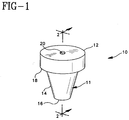
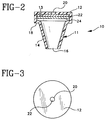
- Figs 1-3 illustrate a typical closure assembly of the invention.
- Assembly 10 includes a cap portion 11 having an annular top wall 12 with a bottom edge 13 and a side wall 14 defining an open bottom end 16.
- Side wall 14 may include a shelf 18 for engagement with the lip of a tube (not shown).
- Top wall 12 includes an opening 20 to receive a needle.
- a conventional septum 22 is adjacent and adhered to bottom edge 13 of cap portion 11.
- a permeability lowering barrier 24, preferably of foil, is adjacent and adhered to septum 22. As shown in Fig 3, septum 22 is visible through opening 20 when the closure assembly is viewed from above.
- the septum may be of any suitable elastomer as known in the art, and the barrier is preferably of foil, such as aluminum foil.
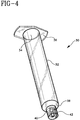
- Figs 4 and 5 illustrate a typical syringe stopper and barrel assembly.
- syringe barrel 30 has a body portion 32 having an open top end 34, an inside wall 35 and an optional grasping portion 36.
- a bottom wall 38 includes a tube portion 40 for delivery of a fluid from body portion 32 when the assembly is in use.
- Bottom portion 38 is affixed to a conventional hub 42.
- a syringe stopper 50 for a 2-piece assembly has a body portion 52 and a bottom wall 54.
- a top wall 56 has an annular projection 58 so that, when the assembly is in use, the stopper can be advanced and retracted in the barrel.
- Stopper 50 is dimensioned to have a sliding and sealing relationship to inside wall surface 35 of body portion 32 of barrel 30.
- Fig 6 illustrates a stopper 60 adapted to be mounted on a conventional plunger rod of a 3-piece syringe assembly.
- Stopper 60 may have a body portion 62 having a top wall 64, a bottom wall 66 and a side wall 68.
- Body portion 62 has a recess 70 into which the plunger rod (not shown) is securely mounted.
- the rod-stopper assembly is inserted into the barrel so that the stopper slides sealingly against the inside wall of the barrel.
- a conventional lubricant such as polydimethylsiloxane (not shown in the drawings) may be present between the stopper and barrel.
- thermoplastic elastomers preferably crosslinked polyolefins.
- Polyolefins suitable for crosslinking are copolymers of ethylene with an alpha olefin having 3-20, preferably 4-8 carbon atoms. Most preferably, the copolymers are members of the class known in the art as plastomers, i.e., polymers or copolymers made using metallocene catalysts.
- Ethylene-alpha olefin copolymers which have been found to be suitable for processing and crosslinking as described below are commercially available from Aldrich Chemical Co. from Exxon under the trade name EXACTTM or from Dow under the trade name ENGAGETM.
- the copolymers may be grafted to silane groups to give the SGC.
- Silane crosslinking reagents are sold by HULS AG, Somerset, New Jersey, under the trade name DYNASYLANTM. While not wishing to be limited thereby, a preferred crosslinking agent is vinyl trimethoxysilane which grafts onto a polyolefin chain under catalysis by peroxide. Preferably, about 0.1 to 10% by weight, most preferably about 2-10%, of reactive silane groups are grafted onto the polyolefin.
- Preferred SGC have a density of 0.85 to 0.95 most preferably 0.85-0.87 g/cc, a melt flow index of 0.1 to 1000, preferably 1 to 100 dg/10 min, a durometer hardness of 40-70A and a molecular weight distribution of 2-5, preferably about 3.
- Silane crosslinking technology is well known in the art, and further details on this aspect of the invention are not needed for a complete understanding of the invention by one skilled in the polymer arts.
- additives as known in the art may be added prior to or subsequent to grafting to provide other desirable properties.
- fillers clarifying agents, coloring agents, radiation stabilizers, antistatic materials, wetting agents, oils to reduce hardness, catalysts, foaming agents and the like may be added in suitable quantities.
- clarifying agents coloring agents, radiation stabilizers, antistatic materials, wetting agents, oils to reduce hardness, catalysts, foaming agents and the like may be added in suitable quantities.
- the SGC may be processed by any convenient technique such as injection, compression or rotary compression molding to have the shape of a medical article.
- the shaped article may then be exposed to moisture whereby the grafted silane groups react to crosslink the polymer molecules through siloxane groups (to form the CSGC).
- the shaped article may be immersed in a water bath at any temperature from 1 to 100°C for about 1 minute to 16 hours, or preferably may simply be exposed to steam or an atmosphere of high water vapor content until crosslinking is complete.
- the SGC in molten form may be crosslinked by moisture, and while still molten, the resulting CSGC may be processed into the desired shape.
- the CSGC and articles therefrom have greatly improved compression set, seal retention and stick-slip and are particularly well suited for manufacture of multi-component medical assemblies.
- compression set is used in its conventional sense as a measure of the permanent deformation of a material which has been stressed, i.e. the percentage of compressive deformation not recovered on removal of the stress.
- a compression set of 0% indicates that all deformation is recovered and no permanent morphological change has occurred whereas a compression set of 100% indicates no recovery upon removal of the stress.
- the improved compression set of the CSGC provides the advantage of minimal change in morphology of the shaped medical article when subjected to stress, such as sterilization conditions.
- stress such as sterilization conditions.
- articles of the invention have compression set of less that 20% after autoclaving. Compression set may be measured in accordance with ASTM D395. Set data is given in the Table for syringe stoppers of CSGC and several prior art plastics in a polypropylene barrel.
- seal retention in a syringe assembly depends on retention of the strain imparted at the stopper-barrel interface during sterilization and autoclaving. Strain may be determined by the procedure of Example 1. It has been found that a leak-free seal between a syringe stopper of the CSGC and a polypropylene syringe barrel may be achieved if a strain of 3% or more is retained after autoclaving. Minimum strain providing leak-proof seals after radiation sterilization and subsequent autoclaving is given in the Table for stoppers of the polyolefin copolymer, the CSGC of the invention and for two plastics commonly used in prior art syringe stoppers.
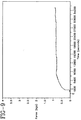
- the article of the invention provides excellent tribological properties when tested by the procedure of Example 2. It has been found that the syringe stopper described above and fabricated from the CSGC of the invention slides smoothly in a conventional syringe barrel with substantially no stick-slip.
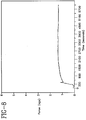
- Figs 7 and 8 show the smooth advancement of syringe stoppers of CSGC and natural rubber respectively in polypropylene syringe barrels.
- Fig 9 illustrates severe stick-slip which occurs when a stopper of SANTOPRENETM is advanced in a polypropylene barrel.
- a 60 ml syringe having a barrel and stopper was mounted onto a syringe pump fitted with a force transducer which grips the thumbpress of the stopper.
- the transducer was calibrated to the "O" line on the monitor of a computerized data acquisition system and the syringe barrel filled with deionized water and purged of air bubbles.
- the pump was set for the slowest possible speed (O.1 ml/hr) to give maximum stick-slip. Force data against time was collected at the monitor.
- Fig 7 shows substantial stick-slip for a SANTOPRENETM stopper.
- Fig 8 shows relatively little stick-slip for the stopper of the invention, as does Fig 9 for a natural rubber stopper.
Landscapes
- Health & Medical Sciences (AREA)
- General Health & Medical Sciences (AREA)
- Veterinary Medicine (AREA)
- Epidemiology (AREA)
- Life Sciences & Earth Sciences (AREA)
- Animal Behavior & Ethology (AREA)
- Chemical & Material Sciences (AREA)
- Public Health (AREA)
- Chemical Kinetics & Catalysis (AREA)
- Heart & Thoracic Surgery (AREA)
- Surgery (AREA)
- Vascular Medicine (AREA)
- Infusion, Injection, And Reservoir Apparatuses (AREA)
- Manufacture Of Macromolecular Shaped Articles (AREA)
- Apparatus For Disinfection Or Sterilisation (AREA)
Applications Claiming Priority (2)
| Application Number | Priority Date | Filing Date | Title |
|---|---|---|---|
| US08/985,895 US5986002A (en) | 1997-12-05 | 1997-12-05 | Medical article of improved sterilizability |
| US985895 | 1997-12-05 |
Publications (2)
| Publication Number | Publication Date |
|---|---|
| EP0920876A2 true EP0920876A2 (fr) | 1999-06-09 |
| EP0920876A3 EP0920876A3 (fr) | 2000-12-20 |
Family
ID=25531895
Family Applications (1)
| Application Number | Title | Priority Date | Filing Date |
|---|---|---|---|
| EP98122047A Withdrawn EP0920876A3 (fr) | 1997-12-05 | 1998-11-20 | Articles médicaux stérilisables |
Country Status (4)
| Country | Link |
|---|---|
| US (1) | US5986002A (fr) |
| EP (1) | EP0920876A3 (fr) |
| JP (1) | JPH11235382A (fr) |
| CA (1) | CA2254696A1 (fr) |
Cited By (7)
| Publication number | Priority date | Publication date | Assignee | Title |
|---|---|---|---|---|
| WO2001014219A1 (fr) * | 1999-08-20 | 2001-03-01 | Supreme Corq. Inc. | Second systeme de fermeture synthetique pour bouteilles ou contenants bouches |
| WO2018107052A1 (fr) * | 2016-12-10 | 2018-06-14 | Cooper-Standard Automotive Inc. | Tuyaux souples, compositions et procédés de fabrication de tels tuyaux souples |
| US10040888B1 (en) | 2013-06-14 | 2018-08-07 | Cooper-Standard Automotive Inc. | Composition including silane-grafted polyolefin |
| US10100139B2 (en) | 2013-08-01 | 2018-10-16 | Cooper-Standard Automotive Inc. | Hose, composition including silane-grafted polyolefin, and process of making a hose |
| US10371292B2 (en) | 2014-07-02 | 2019-08-06 | Cooper-Standard Automotive Inc. | Hose, abrasion resistant composition, and process of making a hose |
| US10570236B2 (en) | 2016-12-10 | 2020-02-25 | Cooper-Standard Automotive Inc. | Combined seals, compositions, and methods of making the same |
| US10779608B2 (en) | 2016-12-10 | 2020-09-22 | Cooper-Standard Automotive, Inc. | Polyolefin elastomer compositions and methods of making the same |
Families Citing this family (9)
| Publication number | Priority date | Publication date | Assignee | Title |
|---|---|---|---|---|
| US20060036231A1 (en) * | 2004-05-27 | 2006-02-16 | Conard William A | Injection port and method of making the same |
| DK2240222T3 (en) | 2008-01-11 | 2018-06-25 | Ucb Biopharma Sprl | SYSTEMS FOR THE ADMINISTRATION OF PHARMACEUTICALS FOR PATIENTS WITH RHEUMATOID ARTHRITIS |
| US8435217B2 (en) | 2008-04-11 | 2013-05-07 | Applied Silicone Corporation | Gas sterilizable two-part polymer delivery system |
| USD641078S1 (en) | 2008-12-29 | 2011-07-05 | Ucb Pharma, S.A. | Medical syringe with needle tip cap |
| SMT201900652T1 (it) | 2008-07-18 | 2020-01-14 | Ucb Biopharma Sprl | Sistemi per somministrare medicinale per pazienti con artrite reumatoide |
| US20120046411A1 (en) | 2010-08-20 | 2012-02-23 | Becton, Dickinson And Company | Recycled Resin Compositions And Disposable Medical Devices Made Therefrom |
| CN102678923A (zh) * | 2012-05-15 | 2012-09-19 | 苏州国环环境检测有限公司 | 耐高温采样口密封装置 |
| US12214113B2 (en) | 2016-02-01 | 2025-02-04 | Liberdi Ltd. | Dialysis system pump with connector |
| WO2018142406A1 (fr) | 2017-02-01 | 2018-08-09 | Liberdi Ltd. | Dispositif intelligent de dialyse péritonéale |
Family Cites Families (7)
| Publication number | Priority date | Publication date | Assignee | Title |
|---|---|---|---|---|
| JPS62137065A (ja) * | 1985-12-11 | 1987-06-19 | 磯野 啓之介 | シリンジ |
| US5142010A (en) * | 1990-05-10 | 1992-08-25 | H. B. Fuller Licensing & Financing Inc. | Polymeric biocidal agents |
| DE4404041C1 (de) * | 1994-02-09 | 1995-03-23 | Ruesch Willy Ag | Polymermaterial von medizinischen Instrumenten und Verfahren zur Herstellung des Polymermaterials |
| KR100345419B1 (ko) * | 1994-04-20 | 2002-11-29 | 더 다우 케미칼 캄파니 | 실질적으로선형인실란가교결합성에틸렌중합체,이의제조방법및이로부터제조된제품 |
| KR960010734A (ko) * | 1994-09-19 | 1996-04-20 | 존 디. 밤바라 | 필수 선형 폴리올레핀의 교차- 결합된 발포 구조 및 그 제조방법 |
| US5795941A (en) * | 1995-10-03 | 1998-08-18 | The Dow Chemical Company | Crosslinkable bimodal polyolefin compositions |
| DE19748976A1 (de) * | 1997-11-06 | 1999-05-20 | Danubia Petrochem Polymere | Thermoplastische Elastomere hoher Festigkeit, Elastizität und guter Einfärbbarkeit und daraus hergestellte hochschlagzähe Polymerblends |
-
1997
- 1997-12-05 US US08/985,895 patent/US5986002A/en not_active Expired - Fee Related
-
1998
- 1998-11-20 EP EP98122047A patent/EP0920876A3/fr not_active Withdrawn
- 1998-11-25 CA CA002254696A patent/CA2254696A1/fr not_active Abandoned
- 1998-12-04 JP JP10345052A patent/JPH11235382A/ja active Pending
Cited By (16)
| Publication number | Priority date | Publication date | Assignee | Title |
|---|---|---|---|---|
| WO2001014219A1 (fr) * | 1999-08-20 | 2001-03-01 | Supreme Corq. Inc. | Second systeme de fermeture synthetique pour bouteilles ou contenants bouches |
| US10040888B1 (en) | 2013-06-14 | 2018-08-07 | Cooper-Standard Automotive Inc. | Composition including silane-grafted polyolefin |
| US10253127B2 (en) | 2013-06-14 | 2019-04-09 | Cooper-Standard Automotive, Inc. | Composition including silane-grafted polyolefin |
| US10774168B2 (en) | 2013-06-14 | 2020-09-15 | Cooper-Standard Automotive, Inc. | Composition including silane-grafted polyolefin |
| US10100139B2 (en) | 2013-08-01 | 2018-10-16 | Cooper-Standard Automotive Inc. | Hose, composition including silane-grafted polyolefin, and process of making a hose |
| US10774955B2 (en) | 2013-08-01 | 2020-09-15 | Cooper-Standard Automotive, Inc. | Hose, composition including silane-grafted polyolefin, and process of making a hose |
| US10895335B2 (en) | 2014-07-02 | 2021-01-19 | Cooper-Standard Automotive, Inc. | Hose, abrasion resistant composition, and process of making a hose |
| US10371292B2 (en) | 2014-07-02 | 2019-08-06 | Cooper-Standard Automotive Inc. | Hose, abrasion resistant composition, and process of making a hose |
| US10689470B2 (en) | 2016-12-10 | 2020-06-23 | Cooper-Standard Automotive, Inc. | Static seals, compositions, and methods of making the same |
| US10689471B2 (en) | 2016-12-10 | 2020-06-23 | Cooper-Standard Automotive, Inc. | Microdense seals, compositions, and methods of making the same |
| US10570236B2 (en) | 2016-12-10 | 2020-02-25 | Cooper-Standard Automotive Inc. | Combined seals, compositions, and methods of making the same |
| CN110267808A (zh) * | 2016-12-10 | 2019-09-20 | 库珀标准汽车公司 | 软管、制造其的组合物和方法 |
| US10779608B2 (en) | 2016-12-10 | 2020-09-22 | Cooper-Standard Automotive, Inc. | Polyolefin elastomer compositions and methods of making the same |
| WO2018107052A1 (fr) * | 2016-12-10 | 2018-06-14 | Cooper-Standard Automotive Inc. | Tuyaux souples, compositions et procédés de fabrication de tels tuyaux souples |
| US11377514B2 (en) | 2016-12-10 | 2022-07-05 | Cooper-Standard Automotive, Inc. | Combined seals, compositions, and methods of making the same |
| US11684115B2 (en) | 2016-12-10 | 2023-06-27 | Cooper-Standard Automotive Inc. | Roofing membranes, compositions, and methods of making the same |
Also Published As
| Publication number | Publication date |
|---|---|
| JPH11235382A (ja) | 1999-08-31 |
| CA2254696A1 (fr) | 1999-06-05 |
| EP0920876A3 (fr) | 2000-12-20 |
| US5986002A (en) | 1999-11-16 |
Similar Documents
| Publication | Publication Date | Title |
|---|---|---|
| US5986002A (en) | Medical article of improved sterilizability | |
| EP0921151B1 (fr) | Composition et article ayant une déformation permanente améliorée | |
| US9931440B2 (en) | Biocompatible self-lubricating polymer compositions and their use in medical and surgical devices | |
| EP0264273B1 (fr) | Piston composite pour seringue | |
| EP0338671B1 (fr) | Piston glissable pour une seringue | |
| EP2226088B1 (fr) | Joint d'étanchéité pour une seringue et seringue comprenant le joint d'étanchéité | |
| US8816022B2 (en) | Sealing members, articles using the same and methods of reducing sticktion | |
| US8075995B2 (en) | Coating system, articles and assembly using the same and methods of reducing sticktion | |
| US20080069970A1 (en) | Medical Components Having Coated Surfaces Exhibiting Low Friction and Methods of Reducing Sticktion | |
| EP2621567B1 (fr) | Bouchons de seringue pharmaceutique auto-lubrifiants | |
| JP5977462B1 (ja) | 摺動性を有する医療用シリコーンゴムを使用したガスケット及び該ガスケットを使用したシリンジ並びにその製造方法 | |
| JP2003500304A (ja) | 医療用容器のための射出成形されたストッパー | |
| JPS6210152A (ja) | 高温クリ−プ耐性熱可塑性エラストマ−組成物 | |
| EP1028141A1 (fr) | Article médical ayant un déplacement saccadé amélioré | |
| EP0689847A1 (fr) | Ensemble de seringue | |
| CN111163741A (zh) | 初级包装 | |
| JP6907453B2 (ja) | シリンジ用組立体、プレフィルドシリンジ、穿刺針付外筒用シールキャップおよびシリンジ用組立体包装体 | |
| WO2026023571A1 (fr) | Pièce en résine pour accessoire d'écriture et accessoire d'écriture pourvu de celle-ci | |
| CN119775664A (zh) | 一种双色注塑的注射器用活塞及其制备方法 |
Legal Events
| Date | Code | Title | Description |
|---|---|---|---|
| PUAI | Public reference made under article 153(3) epc to a published international application that has entered the european phase |
Free format text: ORIGINAL CODE: 0009012 |
|
| AK | Designated contracting states |
Kind code of ref document: A2 Designated state(s): DE FR GB IT |
|
| AX | Request for extension of the european patent |
Free format text: AL;LT;LV;MK;RO;SI |
|
| PUAL | Search report despatched |
Free format text: ORIGINAL CODE: 0009013 |
|
| AK | Designated contracting states |
Kind code of ref document: A3 Designated state(s): AT BE CH CY DE DK ES FI FR GB GR IE IT LI LU MC NL PT SE |
|
| AX | Request for extension of the european patent |
Free format text: AL;LT;LV;MK;RO;SI |
|
| 17P | Request for examination filed |
Effective date: 20010522 |
|
| AKX | Designation fees paid |
Free format text: DE FR GB IT |
|
| 17Q | First examination report despatched |
Effective date: 20020322 |
|
| STAA | Information on the status of an ep patent application or granted ep patent |
Free format text: STATUS: THE APPLICATION IS DEEMED TO BE WITHDRAWN |
|
| 18D | Application deemed to be withdrawn |
Effective date: 20030329 |