EP0921440A1 - Verfahren zur herstellung von tief- und reliefmustern und deren anwendung zur erzeugung von farbfiltermaterialien für flüssigkristallanzeigen - Google Patents
Verfahren zur herstellung von tief- und reliefmustern und deren anwendung zur erzeugung von farbfiltermaterialien für flüssigkristallanzeigen Download PDFInfo
- Publication number
- EP0921440A1 EP0921440A1 EP98929725A EP98929725A EP0921440A1 EP 0921440 A1 EP0921440 A1 EP 0921440A1 EP 98929725 A EP98929725 A EP 98929725A EP 98929725 A EP98929725 A EP 98929725A EP 0921440 A1 EP0921440 A1 EP 0921440A1
- Authority
- EP
- European Patent Office
- Prior art keywords
- photosensitive resin
- substrate
- layer
- negative
- resin
- Prior art date
- Legal status (The legal status is an assumption and is not a legal conclusion. Google has not performed a legal analysis and makes no representation as to the accuracy of the status listed.)
- Granted
Links
- 239000004973 liquid crystal related substance Substances 0.000 title claims abstract description 49
- 238000000034 method Methods 0.000 title claims abstract description 48
- 238000004519 manufacturing process Methods 0.000 title 1
- 229920005989 resin Polymers 0.000 claims abstract description 309
- 239000011347 resin Substances 0.000 claims abstract description 309
- 239000010410 layer Substances 0.000 claims abstract description 129
- 239000000758 substrate Substances 0.000 claims abstract description 84
- 239000011241 protective layer Substances 0.000 claims abstract description 45
- 229920001187 thermosetting polymer Polymers 0.000 claims abstract description 24
- 239000011342 resin composition Substances 0.000 description 36
- 239000000203 mixture Substances 0.000 description 35
- 239000011159 matrix material Substances 0.000 description 18
- -1 t-butoxycarbonyl Chemical group 0.000 description 17
- 125000006850 spacer group Chemical group 0.000 description 15
- 230000015572 biosynthetic process Effects 0.000 description 14
- 230000033228 biological regulation Effects 0.000 description 13
- 239000011521 glass Substances 0.000 description 12
- 239000000463 material Substances 0.000 description 11
- KWYUFKZDYYNOTN-UHFFFAOYSA-M Potassium hydroxide Chemical compound [OH-].[K+] KWYUFKZDYYNOTN-UHFFFAOYSA-M 0.000 description 10
- IISBACLAFKSPIT-UHFFFAOYSA-N bisphenol A Chemical compound C=1C=C(O)C=CC=1C(C)(C)C1=CC=C(O)C=C1 IISBACLAFKSPIT-UHFFFAOYSA-N 0.000 description 10
- 238000009472 formulation Methods 0.000 description 10
- 125000004435 hydrogen atom Chemical group [H]* 0.000 description 10
- 238000000862 absorption spectrum Methods 0.000 description 9
- 125000000217 alkyl group Chemical group 0.000 description 9
- 150000001875 compounds Chemical class 0.000 description 9
- 239000010408 film Substances 0.000 description 9
- QSHDDOUJBYECFT-UHFFFAOYSA-N mercury Chemical compound [Hg] QSHDDOUJBYECFT-UHFFFAOYSA-N 0.000 description 9
- 229910052753 mercury Inorganic materials 0.000 description 9
- 239000003822 epoxy resin Substances 0.000 description 8
- 229920000647 polyepoxide Polymers 0.000 description 8
- 239000002253 acid Substances 0.000 description 7
- 238000010438 heat treatment Methods 0.000 description 7
- 239000003505 polymerization initiator Substances 0.000 description 7
- 238000010521 absorption reaction Methods 0.000 description 6
- 239000011248 coating agent Substances 0.000 description 6
- 238000000576 coating method Methods 0.000 description 6
- 239000003086 colorant Substances 0.000 description 6
- 238000011161 development Methods 0.000 description 6
- 238000010586 diagram Methods 0.000 description 6
- 239000000178 monomer Substances 0.000 description 6
- 229920003986 novolac Polymers 0.000 description 6
- 239000000049 pigment Substances 0.000 description 6
- 230000001105 regulatory effect Effects 0.000 description 6
- TXBCBTDQIULDIA-UHFFFAOYSA-N 2-[[3-hydroxy-2,2-bis(hydroxymethyl)propoxy]methyl]-2-(hydroxymethyl)propane-1,3-diol Chemical compound OCC(CO)(CO)COCC(CO)(CO)CO TXBCBTDQIULDIA-UHFFFAOYSA-N 0.000 description 5
- UHFFVFAKEGKNAQ-UHFFFAOYSA-N 2-benzyl-2-(dimethylamino)-1-(4-morpholin-4-ylphenyl)butan-1-one Chemical compound C=1C=C(N2CCOCC2)C=CC=1C(=O)C(CC)(N(C)C)CC1=CC=CC=C1 UHFFVFAKEGKNAQ-UHFFFAOYSA-N 0.000 description 5
- 239000003513 alkali Substances 0.000 description 5
- 125000003545 alkoxy group Chemical group 0.000 description 5
- 238000006243 chemical reaction Methods 0.000 description 5
- 150000002148 esters Chemical class 0.000 description 5
- 238000000206 photolithography Methods 0.000 description 5
- KCTAWXVAICEBSD-UHFFFAOYSA-N prop-2-enoyloxy prop-2-eneperoxoate Chemical compound C=CC(=O)OOOC(=O)C=C KCTAWXVAICEBSD-UHFFFAOYSA-N 0.000 description 5
- 239000007787 solid Substances 0.000 description 5
- 239000000126 substance Substances 0.000 description 5
- QTWJRLJHJPIABL-UHFFFAOYSA-N 2-methylphenol;3-methylphenol;4-methylphenol Chemical compound CC1=CC=C(O)C=C1.CC1=CC=CC(O)=C1.CC1=CC=CC=C1O QTWJRLJHJPIABL-UHFFFAOYSA-N 0.000 description 4
- VYZAMTAEIAYCRO-UHFFFAOYSA-N Chromium Chemical compound [Cr] VYZAMTAEIAYCRO-UHFFFAOYSA-N 0.000 description 4
- CERQOIWHTDAKMF-UHFFFAOYSA-N Methacrylic acid Chemical compound CC(=C)C(O)=O CERQOIWHTDAKMF-UHFFFAOYSA-N 0.000 description 4
- 235000010724 Wisteria floribunda Nutrition 0.000 description 4
- 230000005540 biological transmission Effects 0.000 description 4
- 229910052804 chromium Inorganic materials 0.000 description 4
- 239000011651 chromium Substances 0.000 description 4
- 238000007796 conventional method Methods 0.000 description 4
- 229930003836 cresol Natural products 0.000 description 4
- 125000002496 methyl group Chemical group [H]C([H])([H])* 0.000 description 4
- 125000006502 nitrobenzyl group Chemical group 0.000 description 4
- 230000003287 optical effect Effects 0.000 description 4
- 150000003460 sulfonic acids Chemical class 0.000 description 4
- 125000003866 trichloromethyl group Chemical group ClC(Cl)(Cl)* 0.000 description 4
- 239000004925 Acrylic resin Substances 0.000 description 3
- OKKJLVBELUTLKV-UHFFFAOYSA-N Methanol Chemical compound OC OKKJLVBELUTLKV-UHFFFAOYSA-N 0.000 description 3
- DNIAPMSPPWPWGF-UHFFFAOYSA-N Propylene glycol Chemical compound CC(O)CO DNIAPMSPPWPWGF-UHFFFAOYSA-N 0.000 description 3
- VYPSYNLAJGMNEJ-UHFFFAOYSA-N Silicium dioxide Chemical compound O=[Si]=O VYPSYNLAJGMNEJ-UHFFFAOYSA-N 0.000 description 3
- 238000003491 array Methods 0.000 description 3
- 229910052736 halogen Inorganic materials 0.000 description 3
- 150000002367 halogens Chemical class 0.000 description 3
- 239000002245 particle Substances 0.000 description 3
- 238000000059 patterning Methods 0.000 description 3
- 125000002924 primary amino group Chemical group [H]N([H])* 0.000 description 3
- 238000007639 printing Methods 0.000 description 3
- 239000002904 solvent Substances 0.000 description 3
- 239000010409 thin film Substances 0.000 description 3
- MYWOJODOMFBVCB-UHFFFAOYSA-N 1,2,6-trimethylphenanthrene Chemical compound CC1=CC=C2C3=CC(C)=CC=C3C=CC2=C1C MYWOJODOMFBVCB-UHFFFAOYSA-N 0.000 description 2
- 229920000178 Acrylic resin Polymers 0.000 description 2
- 229910017048 AsF6 Inorganic materials 0.000 description 2
- OKTJSMMVPCPJKN-UHFFFAOYSA-N Carbon Chemical compound [C] OKTJSMMVPCPJKN-UHFFFAOYSA-N 0.000 description 2
- LFQSCWFLJHTTHZ-UHFFFAOYSA-N Ethanol Chemical compound CCO LFQSCWFLJHTTHZ-UHFFFAOYSA-N 0.000 description 2
- PEDCQBHIVMGVHV-UHFFFAOYSA-N Glycerine Chemical compound OCC(O)CO PEDCQBHIVMGVHV-UHFFFAOYSA-N 0.000 description 2
- 229920001665 Poly-4-vinylphenol Polymers 0.000 description 2
- WGLPBDUCMAPZCE-UHFFFAOYSA-N Trioxochromium Chemical compound O=[Cr](=O)=O WGLPBDUCMAPZCE-UHFFFAOYSA-N 0.000 description 2
- 230000002411 adverse Effects 0.000 description 2
- 125000002490 anilino group Chemical group [H]N(*)C1=C([H])C([H])=C([H])C([H])=C1[H] 0.000 description 2
- 125000003118 aryl group Chemical group 0.000 description 2
- 239000004841 bisphenol A epoxy resin Substances 0.000 description 2
- 229910052799 carbon Inorganic materials 0.000 description 2
- 229910000423 chromium oxide Inorganic materials 0.000 description 2
- 229920001577 copolymer Polymers 0.000 description 2
- XCJYREBRNVKWGJ-UHFFFAOYSA-N copper(II) phthalocyanine Chemical compound [Cu+2].C12=CC=CC=C2C(N=C2[N-]C(C3=CC=CC=C32)=N2)=NC1=NC([C]1C=CC=CC1=1)=NC=1N=C1[C]3C=CC=CC3=C2[N-]1 XCJYREBRNVKWGJ-UHFFFAOYSA-N 0.000 description 2
- 238000000354 decomposition reaction Methods 0.000 description 2
- 238000001035 drying Methods 0.000 description 2
- 238000010828 elution Methods 0.000 description 2
- 125000003700 epoxy group Chemical group 0.000 description 2
- 239000010419 fine particle Substances 0.000 description 2
- 125000001188 haloalkyl group Chemical group 0.000 description 2
- 125000005843 halogen group Chemical group 0.000 description 2
- 125000002887 hydroxy group Chemical group [H]O* 0.000 description 2
- 239000013307 optical fiber Substances 0.000 description 2
- 229920000642 polymer Polymers 0.000 description 2
- 150000003839 salts Chemical class 0.000 description 2
- JYEUMXHLPRZUAT-UHFFFAOYSA-N 1,2,3-triazine Chemical compound C1=CN=NN=C1 JYEUMXHLPRZUAT-UHFFFAOYSA-N 0.000 description 1
- BTJPUDCSZVCXFQ-UHFFFAOYSA-N 2,4-diethylthioxanthen-9-one Chemical compound C1=CC=C2C(=O)C3=CC(CC)=CC(CC)=C3SC2=C1 BTJPUDCSZVCXFQ-UHFFFAOYSA-N 0.000 description 1
- SMZOUWXMTYCWNB-UHFFFAOYSA-N 2-(2-methoxy-5-methylphenyl)ethanamine Chemical compound COC1=CC=C(C)C=C1CCN SMZOUWXMTYCWNB-UHFFFAOYSA-N 0.000 description 1
- NIXOWILDQLNWCW-UHFFFAOYSA-N 2-Propenoic acid Natural products OC(=O)C=C NIXOWILDQLNWCW-UHFFFAOYSA-N 0.000 description 1
- ZCSHACFHMFHFKK-UHFFFAOYSA-N 2-methyl-1,3,5-trinitrobenzene;2,4,6-trinitro-1,3,5-triazinane Chemical compound [O-][N+](=O)C1NC([N+]([O-])=O)NC([N+]([O-])=O)N1.CC1=C([N+]([O-])=O)C=C([N+]([O-])=O)C=C1[N+]([O-])=O ZCSHACFHMFHFKK-UHFFFAOYSA-N 0.000 description 1
- LWRBVKNFOYUCNP-UHFFFAOYSA-N 2-methyl-1-(4-methylsulfanylphenyl)-2-morpholin-4-ylpropan-1-one Chemical compound C1=CC(SC)=CC=C1C(=O)C(C)(C)N1CCOCC1 LWRBVKNFOYUCNP-UHFFFAOYSA-N 0.000 description 1
- VPWNQTHUCYMVMZ-UHFFFAOYSA-N 4,4'-sulfonyldiphenol Chemical compound C1=CC(O)=CC=C1S(=O)(=O)C1=CC=C(O)C=C1 VPWNQTHUCYMVMZ-UHFFFAOYSA-N 0.000 description 1
- RZVAJINKPMORJF-UHFFFAOYSA-N Acetaminophen Chemical compound CC(=O)NC1=CC=C(O)C=C1 RZVAJINKPMORJF-UHFFFAOYSA-N 0.000 description 1
- HRPVXLWXLXDGHG-UHFFFAOYSA-N Acrylamide Chemical compound NC(=O)C=C HRPVXLWXLXDGHG-UHFFFAOYSA-N 0.000 description 1
- 102100033806 Alpha-protein kinase 3 Human genes 0.000 description 1
- 101710082399 Alpha-protein kinase 3 Proteins 0.000 description 1
- GAWIXWVDTYZWAW-UHFFFAOYSA-N C[CH]O Chemical group C[CH]O GAWIXWVDTYZWAW-UHFFFAOYSA-N 0.000 description 1
- PXGOKWXKJXAPGV-UHFFFAOYSA-N Fluorine Chemical compound FF PXGOKWXKJXAPGV-UHFFFAOYSA-N 0.000 description 1
- 238000005033 Fourier transform infrared spectroscopy Methods 0.000 description 1
- UFHFLCQGNIYNRP-UHFFFAOYSA-N Hydrogen Chemical compound [H][H] UFHFLCQGNIYNRP-UHFFFAOYSA-N 0.000 description 1
- QIGBRXMKCJKVMJ-UHFFFAOYSA-N Hydroquinone Chemical compound OC1=CC=C(O)C=C1 QIGBRXMKCJKVMJ-UHFFFAOYSA-N 0.000 description 1
- LRHPLDYGYMQRHN-UHFFFAOYSA-N N-Butanol Chemical compound CCCCO LRHPLDYGYMQRHN-UHFFFAOYSA-N 0.000 description 1
- 229920001807 Urea-formaldehyde Polymers 0.000 description 1
- MBHRHUJRKGNOKX-UHFFFAOYSA-N [(4,6-diamino-1,3,5-triazin-2-yl)amino]methanol Chemical compound NC1=NC(N)=NC(NCO)=N1 MBHRHUJRKGNOKX-UHFFFAOYSA-N 0.000 description 1
- SSOONFBDIYMPEU-UHFFFAOYSA-N [3-hydroxy-2-[[3-hydroxy-2,2-bis(hydroxymethyl)propoxy]methyl]-2-(hydroxymethyl)propyl] prop-2-enoate Chemical compound OCC(CO)(CO)COCC(CO)(CO)COC(=O)C=C SSOONFBDIYMPEU-UHFFFAOYSA-N 0.000 description 1
- 150000001298 alcohols Chemical class 0.000 description 1
- 125000002723 alicyclic group Chemical group 0.000 description 1
- 125000001931 aliphatic group Chemical group 0.000 description 1
- PNEYBMLMFCGWSK-UHFFFAOYSA-N aluminium oxide Inorganic materials [O-2].[O-2].[O-2].[Al+3].[Al+3] PNEYBMLMFCGWSK-UHFFFAOYSA-N 0.000 description 1
- 150000001412 amines Chemical class 0.000 description 1
- PYKYMHQGRFAEBM-UHFFFAOYSA-N anthraquinone Natural products CCC(=O)c1c(O)c2C(=O)C3C(C=CC=C3O)C(=O)c2cc1CC(=O)OC PYKYMHQGRFAEBM-UHFFFAOYSA-N 0.000 description 1
- 150000004056 anthraquinones Chemical class 0.000 description 1
- OCVSBJXTWPHUPQ-UHFFFAOYSA-N benzyl 2-methylprop-2-enoate;2-methylprop-2-enoic acid Chemical compound CC(=C)C(O)=O.CC(=C)C(=O)OCC1=CC=CC=C1 OCVSBJXTWPHUPQ-UHFFFAOYSA-N 0.000 description 1
- 239000004842 bisphenol F epoxy resin Substances 0.000 description 1
- 239000001055 blue pigment Substances 0.000 description 1
- 239000003054 catalyst Substances 0.000 description 1
- 229910052801 chlorine Inorganic materials 0.000 description 1
- 229910001914 chlorine tetroxide Inorganic materials 0.000 description 1
- 125000001309 chloro group Chemical group Cl* 0.000 description 1
- 230000008878 coupling Effects 0.000 description 1
- 238000010168 coupling process Methods 0.000 description 1
- 238000005859 coupling reaction Methods 0.000 description 1
- 239000003431 cross linking reagent Substances 0.000 description 1
- 125000004093 cyano group Chemical group *C#N 0.000 description 1
- 230000007423 decrease Effects 0.000 description 1
- 230000006866 deterioration Effects 0.000 description 1
- HWPZEWOIDTVKLI-UHFFFAOYSA-N dinitro(phenyl)methanesulfonic acid Chemical class OS(=O)(=O)C([N+]([O-])=O)([N+]([O-])=O)C1=CC=CC=C1 HWPZEWOIDTVKLI-UHFFFAOYSA-N 0.000 description 1
- 239000006185 dispersion Substances 0.000 description 1
- 230000000694 effects Effects 0.000 description 1
- 238000004070 electrodeposition Methods 0.000 description 1
- 238000005530 etching Methods 0.000 description 1
- BHXIWUJLHYHGSJ-UHFFFAOYSA-N ethyl 3-ethoxypropanoate Chemical compound CCOCCC(=O)OCC BHXIWUJLHYHGSJ-UHFFFAOYSA-N 0.000 description 1
- 125000000219 ethylidene group Chemical group [H]C(=[*])C([H])([H])[H] 0.000 description 1
- 229910052731 fluorine Inorganic materials 0.000 description 1
- 239000011737 fluorine Substances 0.000 description 1
- 235000011187 glycerol Nutrition 0.000 description 1
- 239000001056 green pigment Substances 0.000 description 1
- 150000002391 heterocyclic compounds Chemical class 0.000 description 1
- 150000002430 hydrocarbons Chemical class 0.000 description 1
- 229910052739 hydrogen Inorganic materials 0.000 description 1
- 239000001257 hydrogen Substances 0.000 description 1
- 238000005286 illumination Methods 0.000 description 1
- 239000012535 impurity Substances 0.000 description 1
- 239000004615 ingredient Substances 0.000 description 1
- 125000005928 isopropyloxycarbonyl group Chemical group [H]C([H])([H])C([H])(OC(*)=O)C([H])([H])[H] 0.000 description 1
- 238000010030 laminating Methods 0.000 description 1
- 238000003475 lamination Methods 0.000 description 1
- 239000007788 liquid Substances 0.000 description 1
- FPYJFEHAWHCUMM-UHFFFAOYSA-N maleic anhydride Chemical compound O=C1OC(=O)C=C1 FPYJFEHAWHCUMM-UHFFFAOYSA-N 0.000 description 1
- 229910044991 metal oxide Inorganic materials 0.000 description 1
- 150000004706 metal oxides Chemical class 0.000 description 1
- 229920003145 methacrylic acid copolymer Polymers 0.000 description 1
- 229940117841 methacrylic acid copolymer Drugs 0.000 description 1
- 125000000956 methoxy group Chemical group [H]C([H])([H])O* 0.000 description 1
- 238000002156 mixing Methods 0.000 description 1
- 125000001624 naphthyl group Chemical group 0.000 description 1
- 125000000449 nitro group Chemical group [O-][N+](*)=O 0.000 description 1
- IZJVVXCHJIQVOL-UHFFFAOYSA-N nitro(phenyl)methanesulfonic acid Chemical class OS(=O)(=O)C([N+]([O-])=O)C1=CC=CC=C1 IZJVVXCHJIQVOL-UHFFFAOYSA-N 0.000 description 1
- WXZMFSXDPGVJKK-UHFFFAOYSA-N pentaerythritol Chemical compound OCC(CO)(CO)CO WXZMFSXDPGVJKK-UHFFFAOYSA-N 0.000 description 1
- VLTRZXGMWDSKGL-UHFFFAOYSA-M perchlorate Chemical compound [O-]Cl(=O)(=O)=O VLTRZXGMWDSKGL-UHFFFAOYSA-M 0.000 description 1
- 229920001568 phenolic resin Polymers 0.000 description 1
- 239000005011 phenolic resin Substances 0.000 description 1
- 125000001997 phenyl group Chemical group [H]C1=C([H])C([H])=C(*)C([H])=C1[H] 0.000 description 1
- 229920002120 photoresistant polymer Polymers 0.000 description 1
- IEQIEDJGQAUEQZ-UHFFFAOYSA-N phthalocyanine Chemical compound N1C(N=C2C3=CC=CC=C3C(N=C3C4=CC=CC=C4C(=N4)N3)=N2)=C(C=CC=C2)C2=C1N=C1C2=CC=CC=C2C4=N1 IEQIEDJGQAUEQZ-UHFFFAOYSA-N 0.000 description 1
- 239000011295 pitch Substances 0.000 description 1
- 239000004033 plastic Substances 0.000 description 1
- 229920003023 plastic Polymers 0.000 description 1
- 229920000058 polyacrylate Polymers 0.000 description 1
- 239000004645 polyester resin Substances 0.000 description 1
- 229920001225 polyester resin Polymers 0.000 description 1
- 229920001223 polyethylene glycol Polymers 0.000 description 1
- 229920001721 polyimide Polymers 0.000 description 1
- 239000009719 polyimide resin Substances 0.000 description 1
- 230000000379 polymerizing effect Effects 0.000 description 1
- 229920005862 polyol Polymers 0.000 description 1
- BDERNNFJNOPAEC-UHFFFAOYSA-N propan-1-ol Chemical compound CCCO BDERNNFJNOPAEC-UHFFFAOYSA-N 0.000 description 1
- LLHKCFNBLRBOGN-UHFFFAOYSA-N propylene glycol methyl ether acetate Chemical compound COCC(C)OC(C)=O LLHKCFNBLRBOGN-UHFFFAOYSA-N 0.000 description 1
- 125000006239 protecting group Chemical group 0.000 description 1
- 230000001681 protective effect Effects 0.000 description 1
- 239000005297 pyrex Substances 0.000 description 1
- 239000010453 quartz Substances 0.000 description 1
- 238000010526 radical polymerization reaction Methods 0.000 description 1
- 239000001054 red pigment Substances 0.000 description 1
- 239000007962 solid dispersion Substances 0.000 description 1
- 238000004528 spin coating Methods 0.000 description 1
- 150000005846 sugar alcohols Polymers 0.000 description 1
- 230000003746 surface roughness Effects 0.000 description 1
- 229920003051 synthetic elastomer Polymers 0.000 description 1
- 125000001412 tetrahydropyranyl group Chemical group 0.000 description 1
- 238000012546 transfer Methods 0.000 description 1
- 239000012780 transparent material Substances 0.000 description 1
- 125000000026 trimethylsilyl group Chemical group [H]C([H])([H])[Si]([*])(C([H])([H])[H])C([H])([H])[H] 0.000 description 1
- 238000005406 washing Methods 0.000 description 1
Images



Classifications
-
- G—PHYSICS
- G03—PHOTOGRAPHY; CINEMATOGRAPHY; ANALOGOUS TECHNIQUES USING WAVES OTHER THAN OPTICAL WAVES; ELECTROGRAPHY; HOLOGRAPHY
- G03F—PHOTOMECHANICAL PRODUCTION OF TEXTURED OR PATTERNED SURFACES, e.g. FOR PRINTING, FOR PROCESSING OF SEMICONDUCTOR DEVICES; MATERIALS THEREFOR; ORIGINALS THEREFOR; APPARATUS SPECIALLY ADAPTED THEREFOR
- G03F7/00—Photomechanical, e.g. photolithographic, production of textured or patterned surfaces, e.g. printing surfaces; Materials therefor, e.g. comprising photoresists; Apparatus specially adapted therefor
- G03F7/0005—Production of optical devices or components in so far as characterised by the lithographic processes or materials used therefor
- G03F7/0007—Filters, e.g. additive colour filters; Components for display devices
-
- G—PHYSICS
- G03—PHOTOGRAPHY; CINEMATOGRAPHY; ANALOGOUS TECHNIQUES USING WAVES OTHER THAN OPTICAL WAVES; ELECTROGRAPHY; HOLOGRAPHY
- G03F—PHOTOMECHANICAL PRODUCTION OF TEXTURED OR PATTERNED SURFACES, e.g. FOR PRINTING, FOR PROCESSING OF SEMICONDUCTOR DEVICES; MATERIALS THEREFOR; ORIGINALS THEREFOR; APPARATUS SPECIALLY ADAPTED THEREFOR
- G03F7/00—Photomechanical, e.g. photolithographic, production of textured or patterned surfaces, e.g. printing surfaces; Materials therefor, e.g. comprising photoresists; Apparatus specially adapted therefor
- G03F7/004—Photosensitive materials
- G03F7/027—Non-macromolecular photopolymerisable compounds having carbon-to-carbon double bonds, e.g. ethylenic compounds
-
- G—PHYSICS
- G02—OPTICS
- G02B—OPTICAL ELEMENTS, SYSTEMS OR APPARATUS
- G02B5/00—Optical elements other than lenses
- G02B5/20—Filters
- G02B5/201—Filters in the form of arrays
-
- G—PHYSICS
- G03—PHOTOGRAPHY; CINEMATOGRAPHY; ANALOGOUS TECHNIQUES USING WAVES OTHER THAN OPTICAL WAVES; ELECTROGRAPHY; HOLOGRAPHY
- G03F—PHOTOMECHANICAL PRODUCTION OF TEXTURED OR PATTERNED SURFACES, e.g. FOR PRINTING, FOR PROCESSING OF SEMICONDUCTOR DEVICES; MATERIALS THEREFOR; ORIGINALS THEREFOR; APPARATUS SPECIALLY ADAPTED THEREFOR
- G03F7/00—Photomechanical, e.g. photolithographic, production of textured or patterned surfaces, e.g. printing surfaces; Materials therefor, e.g. comprising photoresists; Apparatus specially adapted therefor
- G03F7/004—Photosensitive materials
- G03F7/09—Photosensitive materials characterised by structural details, e.g. supports, auxiliary layers
- G03F7/095—Photosensitive materials characterised by structural details, e.g. supports, auxiliary layers having more than one photosensitive layer
-
- G—PHYSICS
- G03—PHOTOGRAPHY; CINEMATOGRAPHY; ANALOGOUS TECHNIQUES USING WAVES OTHER THAN OPTICAL WAVES; ELECTROGRAPHY; HOLOGRAPHY
- G03F—PHOTOMECHANICAL PRODUCTION OF TEXTURED OR PATTERNED SURFACES, e.g. FOR PRINTING, FOR PROCESSING OF SEMICONDUCTOR DEVICES; MATERIALS THEREFOR; ORIGINALS THEREFOR; APPARATUS SPECIALLY ADAPTED THEREFOR
- G03F7/00—Photomechanical, e.g. photolithographic, production of textured or patterned surfaces, e.g. printing surfaces; Materials therefor, e.g. comprising photoresists; Apparatus specially adapted therefor
- G03F7/20—Exposure; Apparatus therefor
- G03F7/2022—Multi-step exposure, e.g. hybrid; backside exposure; blanket exposure, e.g. for image reversal; edge exposure, e.g. for edge bead removal; corrective exposure
-
- G—PHYSICS
- G02—OPTICS
- G02F—OPTICAL DEVICES OR ARRANGEMENTS FOR THE CONTROL OF LIGHT BY MODIFICATION OF THE OPTICAL PROPERTIES OF THE MEDIA OF THE ELEMENTS INVOLVED THEREIN; NON-LINEAR OPTICS; FREQUENCY-CHANGING OF LIGHT; OPTICAL LOGIC ELEMENTS; OPTICAL ANALOGUE/DIGITAL CONVERTERS
- G02F1/00—Devices or arrangements for the control of the intensity, colour, phase, polarisation or direction of light arriving from an independent light source, e.g. switching, gating or modulating; Non-linear optics
- G02F1/01—Devices or arrangements for the control of the intensity, colour, phase, polarisation or direction of light arriving from an independent light source, e.g. switching, gating or modulating; Non-linear optics for the control of the intensity, phase, polarisation or colour
- G02F1/13—Devices or arrangements for the control of the intensity, colour, phase, polarisation or direction of light arriving from an independent light source, e.g. switching, gating or modulating; Non-linear optics for the control of the intensity, phase, polarisation or colour based on liquid crystals, e.g. single liquid crystal display cells
- G02F1/133—Constructional arrangements; Operation of liquid crystal cells; Circuit arrangements
- G02F1/1333—Constructional arrangements; Manufacturing methods
- G02F1/1335—Structural association of cells with optical devices, e.g. polarisers or reflectors
- G02F1/133509—Filters, e.g. light shielding masks
- G02F1/133514—Colour filters
- G02F1/133519—Overcoatings
Definitions
- the present invention relates to a method for forming a concave-convex pattern, and particularly to a method for simply forming a concave-convex pattern which permits the thickness of concaves and the thickness of convexes to be easily regulated.
- the present invention also relates to use of the above method in the formation of a protective layer and a columnar spacer of color filters for liquid crystal displays.
- the present invention further relates to a color filter, for liquid crystal displays, which has columnar convexes as spacers and a protective layer having highly regulated thickness.
- microlens arrays comprising microlenses arranged on a substrate have been used as means for efficiently focusing light from an illumination light source onto pixels in color liquid crystal displays (LCD) of a backlight system which have spread in recent years.
- LCD color liquid crystal displays
- microlenses are arranged on the photoreceptive surface so as to correspond to photoreceptive cells in order to increase the effective numerical aperture.
- microlenses are used in combination with optical fibers when optical coupling is contemplated.
- a concave-convex pattern is formed by providing a positive-working or negative-working photosensitive resin, exposing the photosensitive resin in a desired pattern, and developing the exposed resin, or by providing a positive-working or negative-working photosensitive resin, forming a mask in a predetermined pattern on a layer of the resin and etching the resin layer through the mask.
- color liquid crystal displays have drawn attention as flat displays.
- a color filter comprising a black matrix, a colored layer of a plurality of colors (in general, the three primary colors of red (R), green (G), and blue (B)), a transparent conductive layer (a common electrode), and an aligning layer is provided so as to face a thin film transistor (TFT element) array substrate, comprising a TFT transistor, a pixel electrode, and an aligning layer, while leaving a predetermined gap between the color filter and the TFT array substrate, and a liquid crystal material is poured into the gap to form a liquid crystal layer.
- the gap constitutes the thickness per se of the liquid crystal layer.
- the thickness of the liquid crystal layer that is, the distance between the color filter and the TFT array substrate, should be strictly held at a constant value.
- a method for determining the thickness of the liquid crystal layer in color liquid crystal displays which has been recently proposed in the art, is to pour a liquid crystal containing a large number of particles or rods, of glass, alumina, plastics or the like, called a spacer into gaps between the color filter and the TFT array substrate.
- the size of the spacer determines the size of the gap between two substrates, that is, the thickness of the liquid crystal layer.
- gaps which are even over the whole area of the color liquid crystal display, cannot be formed unless the density of the spacers dispersed on the surface of the substrate is proper with the spacers being evenly dispersed on the surface of the substrate.
- the deviation of the scattering in the thickness of gaps generally decreases with increasing the amount (density) of the spacer dispersed.
- Increasing the amount (density) of the spacers dispersed results in increased number of spacers present on display pixels, and, in the display pixels, the spacers constitute foreign materials in the liquid crystal material.
- spacers causes problems, such as disorder in alignment of liquid crystal molecules regulated by the aligning film and impossible regulation of alignment by ON/OFF of the voltage in the liquid crystal around the spacers. This poses a problem of a deterioration in display properties such as contrast ratio.
- a color filter provided with columnar convexes for determining the gaps (thickness of the liquid crystal layer) has been proposed (Japanese Patent Laid-Open No. 318816/1992 and the like).
- a colored layer is first formed, and a protective layer is then formed so as to cover the colored layer, followed by formation of columnar convexes using a photosensitive resin again by photolithography on the black matrix in its predetermined portions. This renders the process troublesome.
- the present invention has been made, and it is an object of the present invention to provide a method for forming a concave-convex pattern with high dimensional accuracy.
- a method for forming a concave-convex pattern comprising:
- a method for forming a concave-convex pattern comprising:
- a color filter for liquid crystal displays comprising: a substrate; a colored layer of a plurality of predetermined color patterns on the substrate; a transparent protective layer provided so as to cover at least the colored layer; and transparent columnar convexes which are provided on the substrate in its plurality of predetermined portions and are protruded from the transparent protective layer, the transparent protective layer and the columnar convexes having been formed by the method according to any one of the above methods.
- a color filter for liquid crystal displays comprising: a substrate; a colored layer of a plurality of predetermined color patterns on the substrate; a transparent protective layer provided so as to cover at least the colored layer; and transparent columnar convexes which are provided on the substrate in its plurality of predetermined portions and are protruded from the transparent protective layer, the transparent protective layer being composed mainly of an alkali-insoluble resin or a thermosetting resin, the columnar convexes being composed mainly of a cured negative-working photosensitive resin.
- the method for forming a concave-convex pattern using a specific photosensitive resin composition according to the present invention can form a concave-convex pattern by one-stage photolithography. This simplifies the process. Further, properly setting the ratio of the alkali-insoluble resin or the thermosetting resin to the negative-working photosensitive resin in the photosensitive resin layer and/or the exposure can realize simultaneous regulation of the thickness of the concaves and the convexes constituting the concave-convex pattern and the height of the convexes (the depth of the concaves) with high accuracy.
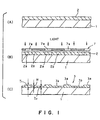
- Fig. 1 is a process diagram illustrating one embodiment of the method for forming a concave-convex pattern according to the present invention.
- a photosensitive resin layer 2 containing an alkali-insoluble resin and a negative-working photosensitive resin in a predetermined ratio is first formed on a substrate 1 (Fig. 1 (A)).
- This photosensitive resin layer 2 may be formed by optimizing the viscosity of a photosensitive resin composition containing the alkali-insoluble resin and the negative photosensitive resin in a predetermined ratio, coating the photosensitive resin composition onto the substrate 1 by conventional means, such as spin coating or roll coating, and drying the coating.
- the alkali-insoluble resin and the negative-working photosensitive resin used may be selected from conventional alkali-insoluble resins and negative-working photosensitive resins by taking into consideration properties required of the concave-convex pattern, for example, light transmission, heat resistance, chemical resistance, and mechanical strength.
- Alkali-soluble resins and negative-working photosensitive resins usable herein include the following resins.
- Alkali-insoluble resins usable herein may be classified roughly into the following positive-working photosensitive resins and non-photosensitive resins.
- polarity-variable transparent positive-working photosensitive resins may be used, and specific examples thereof include positive-working photosensitive resins containing the following resins and photo-induced acid generators.
- R 2 represents a hydrogen atom or an o-tetrahydropyranyl group and R 3 represents a t-butoxycarbonyl, phenol-o-t-butoxycarbonyl, or methyleneoxyacetyl group.
- the photo-induced acid generator is a catalyst which eliminates the protective group from the above resin to render the resin soluble in an alkaline developing solution.
- the photo-induced acid generator is not particularly limited so far as it can form an acid upon exposure to light, and examples thereof include 1 ⁇ onium salts, 2 ⁇ halogen-containing compounds, 3 ⁇ sulfone compounds, 4 ⁇ nitrobenzyl compounds, and 5 ⁇ sulfonic acid compounds.
- R 4 to R 6 which may be the same or different, each independently represent a hydrogen atom, an amino, nitro, or cyano group, or a substituted or unsubstituted alkyl or alkoxyl group; and X represents SbF 6 , AsF 6 , PF 6 , BF 4 , CF 3 CO 2 , ClO 4 , or CF 3 SO 3 , wherein R 7 represents a hydrogen atom, an amino or anilino group, or a substituted or unsubstituted alkyl or alkoxy group; R 8 and R 9 , which may be the same or different, each independently represent a substituted or unsubstituted alkoxyl group; and R 10 represents a hydrogen atom, an amino or anilino group, or a substituted or unsubstituted alkyl or alkoxy group.
- Y represents SbF 6 , AsF 6 , PF 6 , or BF 4 .
- R 11 represents and and
- Halogen-containing compounds usable herein include haloalkyl-containing hydrocarbon compounds and haloalkyl-containing heterocyclic compounds with the following compounds being preferred.
- R 4 , R 5 , and X are as defined above.
- R 12 represents a hydrogen atom or a methyl group
- Y represents SbF 6 or PF 6 .
- R 4 to R 6 and X are as defined above.
- R 14 represents a trichloromethyl, phenyl, methoxyphenyl, naphthyl, or methoxynaphthyl group.
- R 15 to R 17 which may be the same or different, each independently represent a hydrogen or halogen atom or a methyl, methoxy, or hydroxyl group.
- Sulfone compounds usable herein include ⁇ -ketosulfone and ⁇ -sulfonylsulfone.
- Preferred sulfone compounds include compounds represented by formula wherein R 18 to R 21 , which may be the same or different, each independently represent a substituted or unsubstituted alkyl group or a halogen atom; Y represents -CO- or -SO 2 -; and u is an integer of 0 to 3.
- Nitrobenzyl compounds usable herein include nitrobenzyl sulfonate compounds and dinitrobenzyl sulfonate compounds.
- Preferred nitrobenzyl compounds include compounds represented by formula wherein R 22 represents a substituted or unsubstituted alkyl group; R 23 represents a hydrogen atom or a methyl group; and R 24 represents a compound represented by the following formula: wherein R 25 represents a hydrogen atom or a methyl group; and R 26 and R 27 , which may be the same or different, each independently represent a substituted or unsubstituted alkoxyl group; and v is an integer of 1 to 3.
- Sulfonic acid compounds usable herein include alkylsufonic esters, haloalkylsulfonic esters, arylsulfonic esters, and iminosulfonates.
- Preferred sulfonic acid compounds include compounds represented by formula wherein R 28 and R 29 , which may be the same or different, each independently represent a hydrogen atom or a substituted or unsubstituted alkyl group; and R 30 and R 31 , which may be the same or different, each independently represent a hydrogen atom or a substituted or unsubstituted alkyl or aryl group.
- R 32 represents a hydrogen atom or a substituted or unsubstituted alkyl group
- R 33 and R 34 which may be the same or different, each independently represent a substituted or unsubstituted alkyl group or aryl group
- R 33 and R 34 may combine with each other to form a ring structure.
- Z represents a fluorine or chlorine atom.
- Non-photosensitive resins usable herein include dihydroxyacrylic esters or polyhydroxyacrylic esters of a copolymer of an epoxy resin with acrylic acid, and bisphenol A epoxy resins.
- Negative-working photosensitive resins containing the following resins, polymerization initiators, and monomers may be used.
- Epoxyacrylate resins obtained by reacting epoxy groups contained in bisphenol A epoxy resin, bisphenol F epoxy resin, bisphenol S epoxy resin, novolak type epoxy resin, polycarboxylic acid, glycidyl ester, polyol glycidyl ester, aliphatic or alicyclic epoxy resin, amine epoxy resin, triphenolmethane type epoxy resin, or dihydroxybenzene type epoxy resin, with (meth)acrylic acid; ester compounds obtained by reacting lower alcohols, such as methanol, ethanol, and propanol, or polyhydric alcohols, such as (poly)ethylene glycol, (poly)propylene glycol, glycerin, methylolpropane, pentaerythritol, and dipentaerythritol, with (meth) acrylic acid; ester compounds obtained by reacting N-methylolmelamine, N-methylolbenzoguanamine, (poly)N-methylol(meth)acrylamide or the like with (
- the ratio of the alkali-insoluble resin to the negative-working photosensitive resin in the photosensitive resin layer 2 may be properly determined by taking into consideration the thickness of the concaves in the concave-convex pattern, the thickness of the convexes, the height of the convexes (the depth of the concaves), and the exposure in the second step described below.
- the weight ratio of the positive-working photosensitive resin to the negative-working photosensitive resin may be in the range of 1 : 2 to 1 : 10.
- the thickness of the photosensitive resin layer 2 may be properly determined by taking into consideration the alkali-insoluble resin and negative-working photosensitive resin used, the thickness of the concaves in the concave-convex pattern, the thickness of the convexes, the height of the convexes (the depth of the concaves) and the like.
- the thickness is generally in the range of 1 to 10 ⁇ m.
- the photosensitive resin composition used in the formation of the photosensitive resin layer 2 may contain, besides the alkali-insoluble resin and the negative-working photosensitive resin, a polymerization initiator and a photosensitive crosslinking agent in an amount of 1 to 30% by weight.
- the wavelength to which the positive-working photosensitive resin is sensitive may be the same as or different from the wavelength to which the negative-working photosensitive resin is sensitive.
- the photosensitive resin layer 2 is exposed through a photomask 7 for a pattern (Fig. 1 (B)). Openings 7a corresponding to convexes in the concave-convex pattern to be formed are provided in the photomask 7.
- the exposure of the photosensitive resin layer 2 is carried out using light containing a wavelength to which both the positive-working photosensitive resin and the negative-working photosensitive resin are sensitive, or light containing a wavelength to which the negative-working photosensitive resin is sensitive.
- the exposure is carried out using light containing a wavelength to which the negative-working photosensitive resin is sensitive.
- the exposure may be properly determined by taking into consideration the exposure necessary for allowing the curing reaction of the negative-working photosensitive resin used to satisfactorily proceed, the ratio of the alkali-insoluble resin to the negative-working photosensitive resin, the thickness of the concaves, the thickness of the convexes, the height of the convexes (the depth of the concaves) and the like in the concave-convex pattern.
- the exposure is generally in the range of 100 to 700 mJ/cm 2 .
- the third step in the method for forming a concave-convex pattern according to the present invention involves development of the photosensitive resin layer 2 with an alkali developing solution.
- the positive-working photosensitive resin is used as the alkali-insoluble resin, as described above, in the second step, the curing reaction of the negative-working photosensitive resin and the decomposition reaction of the positive-working photosensitive resin proceed in the convex-forming portions 2a.
- the positive-working photosensitive resin in the convex-forming portions 2a is dissolved in and removed by the developing solution to form convexes 3a composed mainly of the negative-working photosensitive resin, that is, convexes 3a wherein more than 50% by weight of the chemical composition of the convexes 3a is accounted for by the cured negative-working photosensitive resin.
- the non-photosensitive resin is used as the alkali-insoluble resin
- the curing reaction of the negative-working photosensitive resin proceeds in the convex-forming portions 2a.
- this step of development results in the formation of convexes 3a composed mainly of the cured negative-working photosensitive resin and the non-photosensitive resin insoluble in the alkali developing solution, that is, convexes 3a wherein more than 50% by weight of the chemical composition of the convexes 3a is accounted for by the cured negative-working photosensitive resin and the non-photosensitive resin.
- the unexposed negative-working photosensitive resin is dissolved in and removed by the developing solution to form concaves 3b composed mainly of the alkali-insoluble resin insoluble in the developing solution, that is, concaves 3b wherein 50% by weight of the chemical composition of the concaves 4b is accounted for by the alkali-insoluble resin.
- post baking is carried out to form a concave-convex pattern comprising convexes 3a and concaves 3b (Fig. 1 (C)).
- the concave-convex pattern 3 can be formed by one-stage photolithography.
- the convexes 3a in the concave-convex pattern 3 thus formed have a flat surface and are even in thickness T 1 .
- the concaves 3b in the concave-convex pattern 3 also have a flat surface and are even in thickness T 2 . Therefore, the height H of the convexes 3a (the depth of the concaves 3b) is even.
- the thickness T 1 of the convexes 3a, the thickness T 2 of the concaves 3b, and the height H of the convexes 3a can be controlled as desired by properly setting the ratio of the positive-working photosensitive resin to the negative-working photosensitive resin in the photosensitive resin layer 2 and/or the exposure.
- the thickness T 1 of the convexes 3a may be properly set in the range of 0.2 to 5 ⁇ m
- the thickness T 2 of the concaves 3b may be properly set in the range of 0.1 to 2 ⁇ m
- the height H (the depth of the concaves 3b) of the convexes 3a may be properly set in the range of 0.1 to 4.5 ⁇ m.
- the minimum width may be set up to about 8 ⁇ m.
- the method for forming a concave-convex pattern according to the second aspect of the present invention is substantially the same as the method for forming a concave-convex pattern according to the first aspect of the present invention, except that 1) the photosensitive resin composition contains a thermosetting resin and a negative-working photosensitive resin and 2) the thermosetting resin component is cured after the formation of the photosensitive resin layer on the substrate in the first step.
- thermosetting resins include phenolic resins, novolak resins, urea resins, polyester resins, and acrylic resins.
- Negative-working photosensitive resins usable herein include those described above.
- the ratio of the amount of the thermosetting resin used to the amount of the negative-working photosensitive resin used may be properly set, for example, in the range of 1 : 2 to 1 : 10.
- the photosensitive resin layer formed on the substrate is then heat treated so as to cure at least a part of the thermosetting resin component.
- this heat treatment is carried out from the backside (a side on which the photosensitive resin layer is not formed) of the substrate by heating means, such as a hot plate.
- the photosensitive resin layer 2 after the heat treatment is exposed to light containing a wavelength to which the negative-working photosensitive resin is sensitive in the same manner as described above in connection with the method according to the first aspect of the present invention.
- thermosetting resin component per se is insoluble or sparingly soluble in an alkali
- mixing the thermosetting resin component with a negative-working photosensitive resin permits the photosensitive resin layer 2, formed of the above mixture, in an unexposed and unheated state to be rendered soluble in an alkali developing solution.
- the resin in its portion, around the substrate, which has been heat cured is not dissolved in the developing solution, while the photosensitive resin layer in its portion which has been unsatisfactorily heated and, at the same time, has been unexposed is dissolved in and removed by the developing solution, whereby concaves 3b composed mainly of the thermosetting resin and convexes 3a composed mainly of the exposure-cured negative-working photosensitive resin are formed.
- the method according to the second aspect of the present invention can be applied to the formation of various concave-convex patterns, for example, can be advantageously applied to the formation of intaglio plates and relief plates for printing, hologram original plates for relief holograms, microlens arrays, columnar convexes in color filters and the like.
- Fig. 2 is a fragmentary plan view showing one embodiment of the color filter for liquid crystal displays
- Fig. 3 is a longitudinal sectional view taken on line A-A of Fig. 2.
- a color filter 10 comprises: a substrate 1; and a black matrix 4 and a colored layer 5 provided on the substrate 1.
- Nonflexible, transparent rigid materials such as quartz glass, Pyrex glass, and synthetic quartz plates, or flexible, transparent materials, such as transparent resin films and optical resin plates, may be used as the substrate 1.
- Glass 7059 manufactured by Corning has a small coefficient of thermal expansion, possesses excellent dimensional stability and workability in heat treatment at high temperatures and is an alkali-free glass not containing any alkali component in the glass, and hence is particularly suitable for color filters for color liquid crystal displays of active matrix system.
- the black matrix 4 is provided between display pixels of the colored layer 5 and outside the colored layer 5 regions.
- This black matrix 4 may be formed by forming an about 1000 to 2000 ⁇ -thick metallic thin film of chromium or the like and patterning the thin film, by forming a resin layer of a polyimide resin, an acrylic resin, an epoxy resin or the like containing light-shielding particles, such as fine particles of carbon, and patterning the resin layer, or by forming a photosensitive resin layer containing fine particles of carbon, a metal oxide or the like and patterning the photosensitive resin layer.
- the colored layer 5 comprises a red pattern 5R, a green pattern 5G, and a blue pattern 5B in respective desired pattern forms, and may be formed by a pigment dispersion method using photosensitive resins containing desired colorants.
- the colored layer 5 may also be formed by printing, electrodeposition, transfer and other conventional methods.
- the colored layer 5 may also be constructed, for example, so that the red pattern 5R has the smallest thickness and the green pattern 5G and the blue pattern 5B are thicker in that order. In this case, the optimal liquid crystal layer thickness for each color in the color layer 5 can be determined.
- a transparent protective layer 3b corresponding to the concaves and columnar convexes 3a corresponding to the convexes may be formed on the substrate, with the colored layer and the black matrix being formed thereon, according to the method for forming a concave-convex pattern according to the first or second aspect of the present invention.
- the transparent protective layer 3b is provided to flatten the surface of the color filter 10 and to prevent the elution of ingredients contained in the colored layer 5 into the liquid crystal layer.
- the thickness of the transparent protective layer 3b may be determined by taking into consideration the light transmission of the material used, the surface appearance of the color filter 10 and the like and may be, for example, in the range of 0.1 to 2.0 ⁇ m.
- the transparent protective layer 3b is formed so as to cover at least the colored layer 5 which, when the color filter 10 is laminated onto a TFT array substrate, comes into contact with the liquid crystal layer.
- the transparent protective layer 3b is composed mainly of the alkali-insoluble resin or the thermosetting resin after curing. That is, more than 50% by weight of the transparent protective layer 3b is accounted for by the alkali-insoluble resin or the thermosetting resin after curing.
- the alkali-insoluble resin or the thermosetting resin is selected by taking into consideration the light transmission and other properties required of the transparent protective layer 3b.
- the columnar convexes 3a when the color filter 10 is laminated onto the TFT array substrate, functions as a spacer.
- the columnar convexes 3a have such a given height as to protrude by about 2 to 10 ⁇ m from the transparent protective layer 3b.
- the degree of the protrusion may be properly determined by the thickness and the like required of the liquid crystal layer in color liquid crystal displays.
- the provision density of the columnar convexes 3a may be properly determined by taking into consideration the unevenness in thickness of the liquid crystal layer, the numerical aperture, the shape and material of the columnar convexes 3a and the like. For example, a necessary and sufficient function as a spacer can be developed by providing one columnar convex for each set of the red pattern 5R, the green pattern 5G, and the blue pattern 5B.
- the shape of the convexes 3a constituting the colored layer 5 is shown in the drawing to be columnar, the shape is not limited to this only.
- the convexes may be in the form of a prism, a truncated cone or the like.
- the columnar convexes 3a are composed mainly of the cured negative-working photosensitive resin. That is, more than 50% by weight of the chemical composition of the columnar convex 3a is accounted for by the cured negative-working photosensitive resin.
- the negative-working photosensitive resin may be selected from the above negative-working photosensitive resins by taking into consideration the mechanical strength, the light transmission and other properties required of the columnar convexes 3a.
- Provision of an aligning layer on the color filter 1 of the present invention provided with the transparent protective layer 3b and the columnar convexes 3a followed by alignment (rubbing) treatment and lamination of the assembly onto the TFT array substrate permits the columnar convexes 3a to create gaps between the color filter 10 and the TFT array substrate.
- the columnar convexes 3a Unlike columnar convexes, formed by laminating three colored layers of R, G, and B, which suffer from unsatisfactory accuracy in height caused by a leveling phenomenon and misregistration for each color, the columnar convexes 3a have very high height accuracy and positional accuracy and consequently can provide very high accuracy in gap between both the substrates.
- the transparent protective layer 3b flattens the surface of the color filter 10 having fine irregularities to reduce the surface roughness having an adverse effect on the alignment of the liquid crystal and, at the same time, prevents the elution of ionic impurities or the like contained in a very small amount in the colored layer into the liquid crystal layer which aversely affects the display quality.
- a 1.1 mm-thick glass substrate (Glass 7059, manufactured by Corning) having a size of 300 mm x 400 mm was provided.
- There photosensitive resin compositions A-1, A-2, and A-3 having the following compositions were spin coated on this substrate to form photosensitive resin layers each having a thickness of 5 ⁇ m.
- Positive-working photosensitive resin TDUR-P007 (wavelength of light to which the resin is sensitive: 254 nm), manufactured by Tokyo Ohka Kogyo Co., Ltd.) 20 pts.wt.
- Negative-working photosensitive resin having the following composition (wavelength of light to which the resin is sensitive: 365 nm) 80 pts.wt.
- Resin bisphenol A cresol novolak epoxy acrylate 75 pts.wt.
- Monomer dipentaerythritol tetraacrylate 20 pts.wt.
- Positive-working photosensitive resin TDUR-P007 (wavelength of light to which the resin is sensitive: 254 nm), manufactured by Tokyo Ohka Kogyo Co., Ltd.) 25 pts.wt.
- Negative-working photosensitive resin having the above composition (wavelength of light to which the resin is sensitive: 365 nm) 75 pts.wt.
- Positive-working photosensitive resin TDUR-P007 (wavelength of light to which the resin is sensitive: 254 nm), manufactured by Tokyo Ohka Kogyo Co., Ltd. 33 pts.wt. ⁇ Negative-working photosensitive resin having the above composition (wavelength of light to which the resin is sensitive: 365 nm) 67 pts.wt.
- the photosensitive resin layers were then exposed at an exposure of 300 mJ/cm 2 by means of a proximity exposure machine using an ultrahigh pressure mercury lamp as an exposure light source through a photomask having stripe opening patterns with the line width being varied. (Second step)
- the substrates were then developed by immersion in a 0.05% aqueous potassium hydroxide solution for 40 sec, rinsed, and baked in a clean oven at 200°C for 30 min. (Third step)
- Photosensitive resin composition Positive negative Thickness of convex T 1 , ⁇ m Thickness of concave T 2 , ⁇ m Height of convex H (T 1 - T 2 ), ⁇ m Min. line width, ⁇ m A-1 1 : 4 4.80 0.10 4.70 8 A-2 1 : 3 4.60 0.60 4.00 8 A-3 1 : 2 4.70 1.10 3.60 10
- the photosensitive resin composition A-3 of Example 1 was provided, and a 4.5 ⁇ m-thick photosensitive resin layer was formed using the photosensitive resin composition A-3 on the substrate in the same manner as in Example 1. (First step)
- the photosensitive resin layer was then exposed by means of a proximity exposure machine using an ultrahigh pressure mercury lamp as an exposure light source through the same photomask as used in Example 1 at exposures on four levels indicated in the following Table 2. (Second step)
- the substrate was then developed by immersion in a 0.05% aqueous potassium hydroxide solution for 40 sec, rinsed, and baked in a clean oven at 200°C for 30 min. (Third step)
- photosensitive resin compositions B-1, B-2, and B-3 were prepared according to the following formulations and spin coated on the same substrate as used in Example 1. Thus, photosensitive resin layers each having a thickness of 5 ⁇ m were formed. (First step)
- Negative-working photosensitive resin having the following composition (wavelength of light to which the resin is sensitive: 365 nm) 67 pts.wt. Resin: bisphenol A cresol novolak epoxy acrylate 75 pts.wt.
- Monomer dipentaerythritol tetraacrylate 20 pts.wt.
- Polymerization initiator: Irgacure 369 (manufactured by Ciba-Geigy Limited) 5 pts.wt. (Solid content of the negative-working photosensitive resin 35 wt%)
- Positive-working photosensitive resin having the above composition (wavelength of light to which the resin is sensitive: 365 nm) 29 pts.wt. .
- Negative-working photosensitive resin having the above composition (wavelength of light to which the resin is sensitive: 365 nm) 71 pts.wt.
- Positive-working photosensitive resin having the above composition (wavelength of light to which the resin is sensitive: 365 nm) 25 pts.wt. .
- Negative-working photosensitive resin having the above composition (wavelength of light to which the resin is sensitive: 365 nm) 75 pts.wt.
- the photosensitive resin layers were then exposed at an exposure of 300 mJ/cm 2 by means of a proximity exposure machine using an ultrahigh pressure mercury lamp as an exposure light source, which applies the wavelength of light to which the negative-working photosensitive resin is sensitive, through the same photomask as described above. (Second step)
- the substrates were then developed by immersion in a 0.05% aqueous potassium hydroxide solution for 40 sec, rinsed, and baked in a clean oven at 200°C for 30 min. (Third step)
- Photosensitive resin composition Positive negative Thickness of convex T 1 , ⁇ m Thicknesses of concave T 2 , ⁇ m Height of convex H (T 1 - T 2 ), ⁇ m Min. line width, ⁇ m B-1 1 : 2 3.40 0.60 2.80 10 B-2 1 : 2.5 3.20 1.10 2.10 10 B-3 1 : 3 3.01 2.88 0.13 14
- the photosensitive resin composition B-2 of Example 3 was provided, and a 4.5 ⁇ m-thick photosensitive resin layer was formed using the photosensitive resin composition B-2 in the same manner as in Example 3. (First step)
- the photosensitive resin layer was then exposed in the same manner as in Example 3, except that the exposure of light by means of a proximity exposure machine using an ultrahigh pressure mercury lamp as an exposure light source, which applies light in its wavelength to which the negative-working photosensitive resin is sensitive, was varied on four levels as indicated in the following Table 4. (Second step)
- the substrate was then developed by immersion in a 0.05% aqueous potassium hydroxide solution for 40 sec, rinsed, and baked in a clean oven at 200°C for 30 min. (Third step)
- a quartz glass substrate having a size of 10 cm square (thickness 1.1 mm, refractive index 1.46) was provided as a substrate for a lens, and the photosensitive resin composition A-3 of Example 1 was used to form a 20 ⁇ m-thick photosensitive resin layer on the substrate for a lens in the same manner as in Example 1. (First step)
- the photosensitive resin layers were then exposed at an exposure of 300 mJ/cm 2 by means of a proximity exposure machine using an ultrahigh pressure mercury lamp as an exposure light source through a photomask with openings having a size of 100 ⁇ m x 100 ⁇ m being formed at pitches of 120 ⁇ m.
- the substrate was then developed by immersion in a 0.05% aqueous potassium hydroxide solution for 40 sec, rinsed, and baked in a clean oven at 200°C for 30 min. (Third step)
- a series of steps described above provided a microlens array comprising a plurality of microlenses having a size of about 110 ⁇ m square and a focal length of 200 ⁇ m arranged on the substrate.
- a 1.1 mm-thick glass substrate (Glass 7059, manufactured by Corning) was provided. Three photosensitive resin compositions C-1, C-2, and C-3 having the following compositions were spin coated on this substrate to form photosensitive resin layers each having a thickness of 5 ⁇ m. (First step)
- Alkali-insoluble resin Bisphenol A resin (VR-60, manufactured by Showa High Polymer Co., Ltd.) 17 pts.wt. .
- Negative-working photosensitive resin having the following composition (wavelength of light to which the resin is sensitive: 365 nm) 83 pts.wt.
- Resin bisphenol A cresol novolak epoxy acrylate 75 pts.wt.
- Monomer dipentaerythritol tetraacrylate 20 pts.wt.
- the above alkali-insoluble resin 10 pts.wt. .
- the photosensitive resin layers were then exposed at an exposure of 400 mJ/cm 2 by means of a proximity exposure machine using an ultrahigh pressure mercury lamp as an exposure light source through a photomask having stripe opening patterns with the line width being varied. (Second step)
- the substrates were then developed by immersion in a 0.05% aqueous potassium hydroxide solution for 40 sec, rinsed, and baked in a clean oven at 200°C for 30 min. (Third step)
- Photosensitive resin composition Positive negative Thickness of convex T 1 , ⁇ m Thickness of concave T 2 , ⁇ m Height of convex H (T 1 - T 2 ), ⁇ m Min. line width, ⁇ m C-1 1 : 5 5.62 1.41 4.21 14 C-2 1 : 7 5.57 0.99 4.58 10 C-3 1 : 9 5.35 0.32 5.03 10
- This substrate was cleaned by a conventional method.
- a light-shielding layer (thickness 0.1 ⁇ m) of metallic chromium was sputtered on the whole area of the substrate in its one side.
- this light-shielding layer was treated by the conventional photolithography. Specifically, according to the photolithography, a photosensitive resist was coated on the light-shielding layer, exposed through a mask, developed, and etched, and the resist layer was then removed to form a black matrix.
- a photosensitive colorant for a red pattern (Color Mosaic CR-7001, manufactured by Fuji Film Olin Co., Ltd.) was then spin coated on the substrate in its whole area with the black matrix formed thereon, thereby forming a red sensitive resin layer.
- the red sensitive resin layer was then prebaked at 85°C for 5 min. Thereafter, the red sensitive resin layer was subjected to alignment exposure through a photomask for a predetermined color pattern, developed with a developing solution (a diluted solution of a developing solution CD for a color mosaic, manufactured by Fuji Film Olin Co., Ltd.). Subsequently, post baking was carried out at 200°C for 30 min to form a red pattern (thickness 1.5 ⁇ m) at a predetermined position relative to the black matrix pattern.
- a green pattern (thickness 1.5 ⁇ m) was formed at a predetermined position relative to the black matrix pattern in the same manner as described above, except that a photosensitive colorant for a green pattern (Color Mosaic CG-7001, manufactured by Fuji Film Olin Co., Ltd.) was used.
- a blue pattern (thickness 1.5 ⁇ m) was formed at a predetermined position relative to the black matrix pattern in the same manner as described above, except that a photosensitive colorant for a blue pattern (Color Mosaic CB-7001, manufactured by Fuji Film Olin Co., Ltd.) was used.
- the photosensitive resin layers thus formed were exposed and prebaked (second step) and developed and post-baked (third step) in the same manner as in Example 1.
- the photosensitive resin composition A-3 of Example 1 was used to form a 5 ⁇ m-thick photosensitive resin layer on a substrate with a black matrix and a colored layer formed thereon in the same manner as in Example 7. (First step)
- the photosensitive resin layers were then exposed at exposures on four levels as indicated in Table 2 by means of a proximity exposure machine using an ultrahigh pressure mercury lamp as an exposure light source through a photomask with openings having a predetermined shape being formed at respective positions corresponding to columnar convex-forming positions.
- the substrate was then developed by immersion in a 0.05% aqueous potassium hydroxide solution for 40 sec, rinsed, and baked in a clean oven at 200°C for 30 min. (Third step)
- a black matrix was formed on a substrate in the same manner as in Example 7.
- a red pattern, a green pattern, and a blue pattern were formed at respective predetermined positions relative to the black matrix pattern.
- the substrate was then developed by immersion in a 0.05% aqueous potassium hydroxide solution for 40 sec, rinsed, and baked in a clean oven at 200°C for 30 min. (Third step)
- the photosensitive resin composition B-2 of Example 3 was used to form a 4.5 ⁇ m-thick photosensitive resin layer on a substrate with a black matrix and a colored layer formed thereon in the same manner as in Example 7. (First step)
- the photosensitive resin layer was then exposed by means of a proximity exposure machine using an ultrahigh pressure mercury lamp as an exposure light source in the same manner as in Example 1, except that the exposure was varied on four levels as indicated in Table 4 above. (Second step)
- the substrate was then developed by immersion in a 0.05% aqueous potassium hydroxide solution for 40 sec, rinsed, and baked in a clean oven at 200°C for 30 min. (Third step)
- a series of steps described above could provide color filters having a structure as shown in Figs. 2 and 3.
- the thickness of the transparent protective layer (T 2 ), the height of the protrusion in the transparent columnar convex (H), and the thickness of the columnar convex (T 1 ) were as shown in Table 4. The results confirm that properly setting the exposure enables simultaneous regulation of the height of the columnar convexes and the thickness of the transparent protective layer.
- a 0.2 ⁇ m-thick film having a chromium oxide/chromium laminate structure was sputtered on glass 7059 (manufactured by Corning) having a short side of 300 mm, a long side of 400 mm, and a sheet thickness of 1.1 mm.
- glass 7059 manufactured by Corning
- a low reflective laminate having an optical density of 4.0 as measured from the glass surface side was obtained.
- a photoresist (OFPR-800, manufactured by Tokyo Ohka Kogyo Co., Ltd.) was coated to a thickness of 0.5 ⁇ m. The coating was prebaked, and exposed through a mask with a predetermined pattern formed thereon, and the resist was then developed. The chromium oxide/chromium film was then etched, followed by the steps of removal of the resist, washing, and drying to form a black matrix.
- a photosensitive material composition prepared by dispersing anthraquinone red pigment (a mixture of C.I. Pigment Red 177 with C.I. Pigment Yellow 139) particles of submicron in diameter in a solvent and a radical polymerization type photopolymer (acrylic polymer) and adding a benzyl methacrylate-methacrylic acid copolymer, pentaerythritol tetraacrylate, 4-[P-N,N-di(ethoxycarbonylmethyl)]-2-6-di(trichloromethyl)-s-triazine, and ethyl 3-ethoxypropionate as a solvent to regulate the solid content to 20% and the viscosity to 6.5 cP (25°C) was coated to a thickness of 1.6 ⁇ m after the completion of the final heat treatment.
- anthraquinone red pigment a mixture of C.I. Pigment Red 177 with C.I. Pigment Yellow 139
- a photosensitive material prepared by dispersing a phthalocyanine green pigment (a mixture of C.I. Pigment Green 7 with Pigment Yellow 83) in the same composition as used in the red photosensitive material was then coated to a thickness of 1.8 ⁇ m in terms of the thickness after the completion of the final heat treatment.
- a photosensitive material prepared by dispersing a phthalocyanine blue pigment (a mixture of C.I. Pigment Blue 15 : 3 with Pigment Violet 23) in the same composition as used in the red photosensitive material was then coated to a thickness of 1.8 ⁇ m in terms of the thickness after the completion of the final heat treatment.
- a transparent protective layer and columnar convexes were formed as follows.
- Propylene glycol monomethyl ether acetate as a solvent was added to the following negative-working photosensitive resin composition to regulate the solid dispersion concentration to 20% by weight.
- Bisphenol A cresol novolak epoxy acrylate 75 pts.wt. Dipentaerythritol tetraacrylate 20 pts.wt.
- thermosetting resin An acrylate resin having an epoxy group in its side chain (Optomer SS6699G, manufactured by Japan Synthetic Rubber Co., Ltd.) was provided as a thermosetting resin.
- the negative-working photosensitive resin and the thermosetting resin were mixed together in a weight ratio of 5 : 1 to prepare a mixed resin composition.
- the mixed resin composition was coated to a thickness of 6.5 ⁇ m.
- the assembly in its substrate side was put on a hot plate, and prebaking was carried out at 150 for 180 sec, and ultraviolet light was then applied through a photomask having a pattern for forming a column in each of the black matrix portions.
Landscapes
- Physics & Mathematics (AREA)
- General Physics & Mathematics (AREA)
- Optics & Photonics (AREA)
- Engineering & Computer Science (AREA)
- Architecture (AREA)
- Structural Engineering (AREA)
- Spectroscopy & Molecular Physics (AREA)
- Materials For Photolithography (AREA)
- Optical Filters (AREA)
- Liquid Crystal (AREA)
Applications Claiming Priority (7)
| Application Number | Priority Date | Filing Date | Title |
|---|---|---|---|
| JP18586597 | 1997-06-26 | ||
| JP18586697 | 1997-06-26 | ||
| JP18586597 | 1997-06-26 | ||
| JP18586697 | 1997-06-26 | ||
| JP32293997 | 1997-11-25 | ||
| JP32293997 | 1997-11-25 | ||
| PCT/JP1998/002887 WO1999000705A1 (fr) | 1997-06-26 | 1998-06-26 | Procedes de formation de motifs creux et en relief et utilisation de ces motifs dans la fabrication de filtres de couleur d'ecrans a cristaux liquides |
Publications (3)
| Publication Number | Publication Date |
|---|---|
| EP0921440A1 true EP0921440A1 (de) | 1999-06-09 |
| EP0921440A4 EP0921440A4 (de) | 1999-10-06 |
| EP0921440B1 EP0921440B1 (de) | 2006-02-22 |
Family
ID=27325639
Family Applications (1)
| Application Number | Title | Priority Date | Filing Date |
|---|---|---|---|
| EP98929725A Expired - Lifetime EP0921440B1 (de) | 1997-06-26 | 1998-06-26 | Verfahren zur herstellung von tief- und reliefmustern und deren anwendung zur erzeugung von farbfiltermaterialien für flüssigkristallanzeigen |
Country Status (7)
| Country | Link |
|---|---|
| US (1) | US6187485B1 (de) |
| EP (1) | EP0921440B1 (de) |
| JP (2) | JP3947232B2 (de) |
| KR (1) | KR100578605B1 (de) |
| DE (1) | DE69833550T2 (de) |
| TW (1) | TW581911B (de) |
| WO (1) | WO1999000705A1 (de) |
Cited By (3)
| Publication number | Priority date | Publication date | Assignee | Title |
|---|---|---|---|---|
| WO2005026791A1 (en) * | 2003-09-15 | 2005-03-24 | Koninklijke Philips Electronics N.V. | Reflective structure having a directivity of diffuse reflection and apparatus with it |
| US7026100B2 (en) * | 1999-09-29 | 2006-04-11 | Nec Lcd Tecnologies, Ltd. | Active matrix substrate having column spacers integral with protective layer and process for fabrication thereof |
| CN100344430C (zh) * | 2003-03-24 | 2007-10-24 | 可乐丽股份有限公司 | 树脂成型品的制造方法、金属结构体的制造方法及树脂成型品 |
Families Citing this family (31)
| Publication number | Priority date | Publication date | Assignee | Title |
|---|---|---|---|---|
| JP4810713B2 (ja) * | 1999-06-07 | 2011-11-09 | 大日本印刷株式会社 | カラーフィルタの製造方法 |
| JP2001042339A (ja) * | 1999-08-02 | 2001-02-16 | Minolta Co Ltd | 液晶光変調素子 |
| TW548481B (en) * | 1999-12-27 | 2003-08-21 | Sharp Kk | Liquid crystal display apparatus and method for manufacturing same |
| JP2001222107A (ja) * | 2000-02-10 | 2001-08-17 | Dainippon Printing Co Ltd | パターン形成用の感光性樹脂組成物およびカラーフィルタ |
| JP2001305557A (ja) * | 2000-04-21 | 2001-10-31 | Nec Corp | 液晶表示装置 |
| KR100371175B1 (ko) * | 2000-10-07 | 2003-02-06 | 엘지전자 주식회사 | 액정 디스플레이의 홀로그램 디퓨저 및 그 제조방법 |
| JP4153159B2 (ja) * | 2000-12-18 | 2008-09-17 | 富士フイルム株式会社 | ネガ型感光性熱硬化性樹脂組成物、ネガ型感光性熱硬化性樹脂層転写材料、及びネガ型耐性画像形成方法 |
| JP2002350864A (ja) * | 2001-05-25 | 2002-12-04 | Matsushita Electric Ind Co Ltd | 液晶表示装置の製造方法 |
| JP4703045B2 (ja) * | 2001-07-10 | 2011-06-15 | 大日本印刷株式会社 | カラーフィルタの製造方法 |
| JP4703048B2 (ja) * | 2001-07-17 | 2011-06-15 | 大日本印刷株式会社 | カラーフィルタの製造方法 |
| KR100806182B1 (ko) * | 2001-09-28 | 2008-02-21 | 엘지.필립스 엘시디 주식회사 | 반사형 액정표시장치용 콜레스테릭 액정 컬러필터 및 그의제조방법 |
| US7067566B2 (en) * | 2001-11-12 | 2006-06-27 | Lg Cable Ltd. | Triazine ring based polymers for photoinduced liquid crystal alignment, liquid crystal alignment layer containing the same, liquid crystal element using the alignment layer and method of manufacturing the same |
| KR100863164B1 (ko) * | 2002-05-17 | 2008-10-13 | 옵트렉스 가부시키가이샤 | 광반사성 구조체, 그 제조방법 및 표시장치 |
| US7172922B2 (en) * | 2002-08-19 | 2007-02-06 | Tower Semiconductor Ltd. | CMOS image sensor array with black pixel using negative-tone resist support layer |
| US6638786B2 (en) * | 2002-10-25 | 2003-10-28 | Hua Wei Semiconductor (Shanghai ) Co., Ltd. | Image sensor having large micro-lenses at the peripheral regions |
| JP4608861B2 (ja) * | 2003-09-02 | 2011-01-12 | セイコーエプソン株式会社 | 液晶表示装置の製造方法、液晶表示装置および電子機器 |
| KR101121211B1 (ko) * | 2004-02-17 | 2012-03-23 | 치 메이 옵토일렉트로닉스 코포레이션 | Lcd 장치, 컬러 필터 기판, 및 돌출 구조체, 및 이들의제조방법 |
| US7012754B2 (en) * | 2004-06-02 | 2006-03-14 | Micron Technology, Inc. | Apparatus and method for manufacturing tilted microlenses |
| KR101066480B1 (ko) * | 2004-06-22 | 2011-09-21 | 엘지디스플레이 주식회사 | 컬러 필터 기판의 제조 방법 |
| JP2006030650A (ja) * | 2004-07-16 | 2006-02-02 | Koninkl Philips Electronics Nv | カラーフィルタ及びその製造方法並びにカラーフィルタを用いた液晶表示装置 |
| JP4244933B2 (ja) * | 2005-01-19 | 2009-03-25 | セイコーエプソン株式会社 | 液晶表示装置 |
| JP4396614B2 (ja) * | 2005-09-21 | 2010-01-13 | エプソンイメージングデバイス株式会社 | 液晶装置及び電子機器 |
| JP5144055B2 (ja) * | 2005-11-15 | 2013-02-13 | 三星電子株式会社 | 表示基板及びこれを有する表示装置 |
| KR101299693B1 (ko) * | 2006-06-29 | 2013-08-28 | 가부시키가이샤 아루박 | 액정 표시 장치용 컬러 필터 기판 및 그의 제조 방법 |
| JP2008275691A (ja) * | 2007-04-25 | 2008-11-13 | Sekisui Chem Co Ltd | 液晶配向用突起形成用ネガ型レジスト、液晶配向用突起、カラーフィルター、及び、液晶表示装置 |
| JP2009008713A (ja) * | 2007-06-26 | 2009-01-15 | Toppan Printing Co Ltd | カラーフィルタ |
| JP2009031778A (ja) * | 2007-06-27 | 2009-02-12 | Mitsubishi Chemicals Corp | 感光性組成物、方法、硬化物及び液晶表示装置 |
| JP4480740B2 (ja) * | 2007-07-03 | 2010-06-16 | シャープ株式会社 | 固体撮像素子およびその製造方法、電子情報機器 |
| WO2011105117A1 (ja) | 2010-02-24 | 2011-09-01 | シャープ株式会社 | 液晶表示パネル |
| US20150336340A1 (en) * | 2013-09-06 | 2015-11-26 | Asukanet Company, Ltd. | Method for producing a light control panel provided with parallelly-arranged light-reflective portions |
| CN112083594A (zh) * | 2019-06-13 | 2020-12-15 | 夏普株式会社 | 彩色滤光片基板及其制造方法、以及液晶显示装置 |
Family Cites Families (12)
| Publication number | Priority date | Publication date | Assignee | Title |
|---|---|---|---|---|
| JPS6145224A (ja) * | 1984-08-10 | 1986-03-05 | Alps Electric Co Ltd | 液晶表示素子の製造方法 |
| US5055439A (en) * | 1989-12-27 | 1991-10-08 | International Business Machines Corporation | Photoacid generating composition and sensitizer therefor |
| JPH04170547A (ja) * | 1990-11-01 | 1992-06-18 | Fuji Photo Film Co Ltd | 光硬化性樹脂組成物 |
| JPH04180066A (ja) * | 1990-11-15 | 1992-06-26 | Sanyo Chem Ind Ltd | カラーフィルター保護材および保護層の形成法 |
| JP3148429B2 (ja) | 1992-02-04 | 2001-03-19 | 新日本製鐵株式会社 | 光重合性不飽和化合物及びアルカリ現像型感光性樹脂組成物 |
| JPH05295080A (ja) * | 1992-04-15 | 1993-11-09 | Nippon Kayaku Co Ltd | 樹脂組成物、透明薄膜の形成法及び透明薄膜 |
| TW353858B (en) * | 1994-07-07 | 1999-03-01 | Morton Int Inc | Method of forming a multilayer printed circuit board and product thereof |
| JP3427508B2 (ja) * | 1994-08-31 | 2003-07-22 | ジェイエスアール株式会社 | 着色ミクロパターンの形成方法 |
| US5631120A (en) * | 1994-09-02 | 1997-05-20 | Motorola, Inc. | Method of forming a pattern with step features in a photopolymer |
| JPH0894824A (ja) * | 1994-09-29 | 1996-04-12 | Toppan Printing Co Ltd | カラーフィルタの製造方法 |
| JP3478353B2 (ja) * | 1994-10-11 | 2003-12-15 | 住友ベークライト株式会社 | 樹脂組成物、永久レジスト樹脂組成物及びこれらの硬化物 |
| JP3540436B2 (ja) * | 1995-06-02 | 2004-07-07 | 株式会社東芝 | 感光性組成物 |
-
1998
- 1998-06-26 DE DE69833550T patent/DE69833550T2/de not_active Expired - Fee Related
- 1998-06-26 EP EP98929725A patent/EP0921440B1/de not_active Expired - Lifetime
- 1998-06-26 TW TW087110482A patent/TW581911B/zh not_active IP Right Cessation
- 1998-06-26 US US09/242,956 patent/US6187485B1/en not_active Expired - Lifetime
- 1998-06-26 KR KR1019997001495A patent/KR100578605B1/ko not_active Expired - Fee Related
- 1998-06-26 WO PCT/JP1998/002887 patent/WO1999000705A1/ja not_active Ceased
- 1998-06-26 JP JP50544399A patent/JP3947232B2/ja not_active Expired - Fee Related
-
2006
- 2006-06-09 JP JP2006161398A patent/JP4200168B2/ja not_active Expired - Fee Related
Non-Patent Citations (2)
| Title |
|---|
| DATABASE WPI Section Ch, Week 9622 Derwent Publications Ltd., London, GB; Class A89, AN 96-212324 XP002111228 & JP 08 075915 A (NIPPON GOSEI GOMU KK), 22 March 1996 (1996-03-22) * |
| See also references of WO9900705A1 * |
Cited By (4)
| Publication number | Priority date | Publication date | Assignee | Title |
|---|---|---|---|---|
| US7026100B2 (en) * | 1999-09-29 | 2006-04-11 | Nec Lcd Tecnologies, Ltd. | Active matrix substrate having column spacers integral with protective layer and process for fabrication thereof |
| CN100344430C (zh) * | 2003-03-24 | 2007-10-24 | 可乐丽股份有限公司 | 树脂成型品的制造方法、金属结构体的制造方法及树脂成型品 |
| WO2005026791A1 (en) * | 2003-09-15 | 2005-03-24 | Koninklijke Philips Electronics N.V. | Reflective structure having a directivity of diffuse reflection and apparatus with it |
| US7440050B2 (en) | 2003-09-15 | 2008-10-21 | Tpo Hong Kong Holding Limited | Reflective structure having a directivity of diffuse reflection and apparatus with it |
Also Published As
| Publication number | Publication date |
|---|---|
| TW581911B (en) | 2004-04-01 |
| JP2006338032A (ja) | 2006-12-14 |
| DE69833550T2 (de) | 2006-08-10 |
| EP0921440A4 (de) | 1999-10-06 |
| KR100578605B1 (ko) | 2006-05-24 |
| KR20000068331A (ko) | 2000-11-25 |
| WO1999000705A1 (fr) | 1999-01-07 |
| JP3947232B2 (ja) | 2007-07-18 |
| EP0921440B1 (de) | 2006-02-22 |
| US6187485B1 (en) | 2001-02-13 |
| DE69833550D1 (de) | 2006-04-27 |
| JP4200168B2 (ja) | 2008-12-24 |
Similar Documents
| Publication | Publication Date | Title |
|---|---|---|
| US6187485B1 (en) | Method of forming concave-convex pattern and use of the method in the production of color filters for liquid crystal displays | |
| JPWO1999000705A1 (ja) | 凹凸パターンの形成方法および液晶表示装置用カラーフィルター製造におけるその使用 | |
| EP0655647B1 (de) | Verfahren zur Herstellung eines Farbfilters bzw. eines Flüssigkristallschirms | |
| US5948577A (en) | Color filter substrate, liquid crystal display device using the same and method of manufacturing color filter substrate | |
| US10088612B2 (en) | Alkali-soluble resin, photosensitive resin composition for color filter containing the same and uses thereof | |
| KR101910674B1 (ko) | 흑색 감광성 수지 조성물, 이를 포함하는 컬러 필터 및 표시 장치 | |
| JP4597692B2 (ja) | カラーフィルタ用着色組成物およびカラーフィルタ | |
| TWI611219B (zh) | 彩色濾光片的製造方法、彩色濾光片及固體攝影元件 | |
| JP4736692B2 (ja) | 感光性赤色着色組成物、それを用いたカラーフィルタ基板、および半透過型液晶表示装置 | |
| KR20080070809A (ko) | 감광성 전사 재료, 격벽과 그 형성 방법, 광학 소자와 그제조 방법, 및 표시 장치 | |
| KR101543802B1 (ko) | 흑색 감광성 수지 조성물, 컬러필터 및 이를 구비한 액정표시장치 | |
| JP4473394B2 (ja) | カラーフィルタおよびその製造方法 | |
| US20070238047A1 (en) | Photosensitive resin composition for color filters | |
| JP4929707B2 (ja) | カラーフィルタ用フォトマスク及びカラーフィルタの製造方法 | |
| JP5007572B2 (ja) | 位相差制御部材とそのアライメント調整方法、およびカラーフィルタの製造方法 | |
| KR101182247B1 (ko) | 컬러필터 및 그 제조방법 | |
| KR102028489B1 (ko) | 흑색 감광성 수지 조성물, 이를 포함하는 컬러 필터 및 표시 장치 | |
| KR100655048B1 (ko) | 고감도 감광성 수지 조성물 및 이를 이용한 블랙매트릭스 | |
| US20240219833A1 (en) | Black resist composition, and method for forming black pattern by near-infrared photolithographic method | |
| KR101339747B1 (ko) | 열경화성 수지조성물, 컬러필터용 하지막, 고체촬상소자 및액정표시장치 | |
| KR20100089036A (ko) | 컬러 필터의 제조 방법 | |
| JP2007171333A (ja) | カラーフィルタ用フォトマスク、カラーフィルタの製造方法、カラーフィルタ、及び液晶表示装置 | |
| KR20070054786A (ko) | 현상마진과 패턴현상성이 우수한 감광성 수지 조성물 | |
| KR20060073479A (ko) | 컬러필터용 착색조성물 및 컬러필터 | |
| JPH0749414A (ja) | カラーフィルタの製造方法 |
Legal Events
| Date | Code | Title | Description |
|---|---|---|---|
| PUAI | Public reference made under article 153(3) epc to a published international application that has entered the european phase |
Free format text: ORIGINAL CODE: 0009012 |
|
| 17P | Request for examination filed |
Effective date: 19990326 |
|
| AK | Designated contracting states |
Kind code of ref document: A1 Designated state(s): DE FR GB NL |
|
| A4 | Supplementary search report drawn up and despatched |
Effective date: 19990820 |
|
| AK | Designated contracting states |
Kind code of ref document: A4 Designated state(s): DE FR GB NL |
|
| RIC1 | Information provided on ipc code assigned before grant |
Free format text: 6G 03F 7/027 A, 6G 03F 7/038 B, 6G 03F 7/039 B, 6G 03F 7/38 B, 6G 02B 5/20 B, 6G 02F 1/1335 B, 6G 03F 7/00 B, 6G 03F 7/095 B |
|
| 17Q | First examination report despatched |
Effective date: 20011130 |
|
| GRAP | Despatch of communication of intention to grant a patent |
Free format text: ORIGINAL CODE: EPIDOSNIGR1 |
|
| GRAS | Grant fee paid |
Free format text: ORIGINAL CODE: EPIDOSNIGR3 |
|
| GRAA | (expected) grant |
Free format text: ORIGINAL CODE: 0009210 |
|
| AK | Designated contracting states |
Kind code of ref document: B1 Designated state(s): DE FR GB NL |
|
| REG | Reference to a national code |
Ref country code: GB Ref legal event code: FG4D |
|
| REF | Corresponds to: |
Ref document number: 69833550 Country of ref document: DE Date of ref document: 20060427 Kind code of ref document: P |
|
| ET | Fr: translation filed | ||
| PLBE | No opposition filed within time limit |
Free format text: ORIGINAL CODE: 0009261 |
|
| STAA | Information on the status of an ep patent application or granted ep patent |
Free format text: STATUS: NO OPPOSITION FILED WITHIN TIME LIMIT |
|
| 26N | No opposition filed |
Effective date: 20061123 |
|
| PGFP | Annual fee paid to national office [announced via postgrant information from national office to epo] |
Ref country code: FR Payment date: 20090612 Year of fee payment: 12 |
|
| PGFP | Annual fee paid to national office [announced via postgrant information from national office to epo] |
Ref country code: GB Payment date: 20090625 Year of fee payment: 12 Ref country code: DE Payment date: 20090630 Year of fee payment: 12 |
|
| PGFP | Annual fee paid to national office [announced via postgrant information from national office to epo] |
Ref country code: NL Payment date: 20100521 Year of fee payment: 13 |
|
| GBPC | Gb: european patent ceased through non-payment of renewal fee |
Effective date: 20100626 |
|
| REG | Reference to a national code |
Ref country code: FR Ref legal event code: ST Effective date: 20110228 |
|
| PG25 | Lapsed in a contracting state [announced via postgrant information from national office to epo] |
Ref country code: DE Free format text: LAPSE BECAUSE OF NON-PAYMENT OF DUE FEES Effective date: 20110101 |
|
| PG25 | Lapsed in a contracting state [announced via postgrant information from national office to epo] |
Ref country code: FR Free format text: LAPSE BECAUSE OF NON-PAYMENT OF DUE FEES Effective date: 20100630 |
|
| PG25 | Lapsed in a contracting state [announced via postgrant information from national office to epo] |
Ref country code: GB Free format text: LAPSE BECAUSE OF NON-PAYMENT OF DUE FEES Effective date: 20100626 |
|
| REG | Reference to a national code |
Ref country code: NL Ref legal event code: V1 Effective date: 20120101 |
|
| PG25 | Lapsed in a contracting state [announced via postgrant information from national office to epo] |
Ref country code: NL Free format text: LAPSE BECAUSE OF NON-PAYMENT OF DUE FEES Effective date: 20120101 |