EP0921832B1 - Verfahren zur herstellung von hochfesten dilatationsballons mit hoher compliance zur behandlung gastrointestinaler schädigungen - Google Patents
Verfahren zur herstellung von hochfesten dilatationsballons mit hoher compliance zur behandlung gastrointestinaler schädigungen Download PDFInfo
- Publication number
- EP0921832B1 EP0921832B1 EP97933387A EP97933387A EP0921832B1 EP 0921832 B1 EP0921832 B1 EP 0921832B1 EP 97933387 A EP97933387 A EP 97933387A EP 97933387 A EP97933387 A EP 97933387A EP 0921832 B1 EP0921832 B1 EP 0921832B1
- Authority
- EP
- European Patent Office
- Prior art keywords
- balloon
- diameter
- pressure
- temperature
- balloons
- Prior art date
- Legal status (The legal status is an assumption and is not a legal conclusion. Google has not performed a legal analysis and makes no representation as to the accuracy of the status listed.)
- Expired - Lifetime
Links
- 238000000034 method Methods 0.000 title claims abstract description 39
- 231100001014 gastrointestinal tract lesion Toxicity 0.000 title abstract description 3
- 238000011282 treatment Methods 0.000 title description 8
- 229920001400 block copolymer Polymers 0.000 claims abstract description 21
- 239000000463 material Substances 0.000 claims abstract description 12
- 239000002861 polymer material Substances 0.000 claims abstract description 11
- 229920001169 thermoplastic Polymers 0.000 claims abstract description 11
- 238000000137 annealing Methods 0.000 claims abstract description 9
- 229920000570 polyether Polymers 0.000 claims description 31
- 239000004721 Polyphenylene oxide Substances 0.000 claims description 28
- 239000004952 Polyamide Substances 0.000 claims description 27
- 229920002647 polyamide Polymers 0.000 claims description 27
- 229920000728 polyester Polymers 0.000 claims description 18
- 238000007664 blowing Methods 0.000 claims description 10
- 150000002009 diols Chemical class 0.000 claims description 5
- 125000001931 aliphatic group Chemical group 0.000 claims description 4
- OFOBLEOULBTSOW-UHFFFAOYSA-N Malonic acid Chemical compound OC(=O)CC(O)=O OFOBLEOULBTSOW-UHFFFAOYSA-N 0.000 claims description 3
- 239000002253 acid Substances 0.000 claims description 3
- 125000003118 aryl group Chemical group 0.000 claims description 3
- 150000001735 carboxylic acids Chemical class 0.000 claims description 2
- 150000004985 diamines Chemical class 0.000 claims description 2
- 229920000642 polymer Polymers 0.000 description 16
- 230000003902 lesion Effects 0.000 description 14
- 229920002614 Polyether block amide Polymers 0.000 description 11
- 208000031481 Pathologic Constriction Diseases 0.000 description 10
- -1 polyethylene Polymers 0.000 description 10
- 230000008569 process Effects 0.000 description 8
- 238000013461 design Methods 0.000 description 7
- 230000010339 dilation Effects 0.000 description 7
- XLYOFNOQVPJJNP-UHFFFAOYSA-N water Chemical compound O XLYOFNOQVPJJNP-UHFFFAOYSA-N 0.000 description 7
- RTZKZFJDLAIYFH-UHFFFAOYSA-N Diethyl ether Chemical compound CCOCC RTZKZFJDLAIYFH-UHFFFAOYSA-N 0.000 description 6
- 238000002399 angioplasty Methods 0.000 description 5
- 210000000111 lower esophageal sphincter Anatomy 0.000 description 5
- 208000000289 Esophageal Achalasia Diseases 0.000 description 4
- 206010030136 Oesophageal achalasia Diseases 0.000 description 4
- 201000000621 achalasia Diseases 0.000 description 4
- 210000003238 esophagus Anatomy 0.000 description 4
- 238000013459 approach Methods 0.000 description 3
- 230000000052 comparative effect Effects 0.000 description 3
- 238000010276 construction Methods 0.000 description 3
- 229920001971 elastomer Polymers 0.000 description 3
- 239000000806 elastomer Substances 0.000 description 3
- 239000000203 mixture Substances 0.000 description 3
- 210000003800 pharynx Anatomy 0.000 description 3
- 229920002635 polyurethane Polymers 0.000 description 3
- 239000004814 polyurethane Substances 0.000 description 3
- 210000002784 stomach Anatomy 0.000 description 3
- 238000012800 visualization Methods 0.000 description 3
- 229920011372 Arnitel® EM740 Polymers 0.000 description 2
- JHWNWJKBPDFINM-UHFFFAOYSA-N Laurolactam Chemical compound O=C1CCCCCCCCCCCN1 JHWNWJKBPDFINM-UHFFFAOYSA-N 0.000 description 2
- 229920000299 Nylon 12 Polymers 0.000 description 2
- 239000004698 Polyethylene Substances 0.000 description 2
- 239000004734 Polyphenylene sulfide Substances 0.000 description 2
- FAPWRFPIFSIZLT-UHFFFAOYSA-M Sodium chloride Chemical compound [Na+].[Cl-] FAPWRFPIFSIZLT-UHFFFAOYSA-M 0.000 description 2
- 230000008901 benefit Effects 0.000 description 2
- 230000015572 biosynthetic process Effects 0.000 description 2
- 230000000112 colonic effect Effects 0.000 description 2
- 238000007598 dipping method Methods 0.000 description 2
- 208000037265 diseases, disorders, signs and symptoms Diseases 0.000 description 2
- 208000035475 disorder Diseases 0.000 description 2
- 239000012530 fluid Substances 0.000 description 2
- 230000002496 gastric effect Effects 0.000 description 2
- 210000001035 gastrointestinal tract Anatomy 0.000 description 2
- 239000000178 monomer Substances 0.000 description 2
- 230000000414 obstructive effect Effects 0.000 description 2
- 230000002572 peristaltic effect Effects 0.000 description 2
- 229920000069 polyphenylene sulfide Polymers 0.000 description 2
- 239000011780 sodium chloride Substances 0.000 description 2
- 239000000126 substance Substances 0.000 description 2
- 239000004416 thermosoftening plastic Substances 0.000 description 2
- IUGOPULVANEDRX-UHFFFAOYSA-N 2-ethylhexane-1,1-diol Chemical compound CCCCC(CC)C(O)O IUGOPULVANEDRX-UHFFFAOYSA-N 0.000 description 1
- 239000004953 Aliphatic polyamide Substances 0.000 description 1
- 206010057202 Biliary dilatation Diseases 0.000 description 1
- 239000004215 Carbon black (E152) Substances 0.000 description 1
- 208000019505 Deglutition disease Diseases 0.000 description 1
- 208000007217 Esophageal Stenosis Diseases 0.000 description 1
- RYECOJGRJDOGPP-UHFFFAOYSA-N Ethylurea Chemical compound CCNC(N)=O RYECOJGRJDOGPP-UHFFFAOYSA-N 0.000 description 1
- 206010061218 Inflammation Diseases 0.000 description 1
- 206010074061 Large intestinal stenosis Diseases 0.000 description 1
- 206010028980 Neoplasm Diseases 0.000 description 1
- 206010030164 Oesophageal dilatation Diseases 0.000 description 1
- 206010030194 Oesophageal stenosis Diseases 0.000 description 1
- 239000002202 Polyethylene glycol Substances 0.000 description 1
- KKEYFWRCBNTPAC-UHFFFAOYSA-N Terephthalic acid Chemical compound OC(=O)C1=CC=C(C(O)=O)C=C1 KKEYFWRCBNTPAC-UHFFFAOYSA-N 0.000 description 1
- WYURNTSHIVDZCO-UHFFFAOYSA-N Tetrahydrofuran Chemical compound C1CCOC1 WYURNTSHIVDZCO-UHFFFAOYSA-N 0.000 description 1
- 229920003231 aliphatic polyamide Polymers 0.000 description 1
- 150000001408 amides Chemical class 0.000 description 1
- 210000003484 anatomy Anatomy 0.000 description 1
- 239000004760 aramid Substances 0.000 description 1
- 229920003235 aromatic polyamide Polymers 0.000 description 1
- 210000004204 blood vessel Anatomy 0.000 description 1
- 201000011510 cancer Diseases 0.000 description 1
- 229910052799 carbon Inorganic materials 0.000 description 1
- 125000004432 carbon atom Chemical group C* 0.000 description 1
- 230000008859 change Effects 0.000 description 1
- 238000010622 cold drawing Methods 0.000 description 1
- 230000008984 colonic lesion Effects 0.000 description 1
- 230000008602 contraction Effects 0.000 description 1
- 238000001816 cooling Methods 0.000 description 1
- 229920001577 copolymer Polymers 0.000 description 1
- 230000006735 deficit Effects 0.000 description 1
- 239000008367 deionised water Substances 0.000 description 1
- 229910021641 deionized water Inorganic materials 0.000 description 1
- 150000001991 dicarboxylic acids Chemical class 0.000 description 1
- 125000005442 diisocyanate group Chemical group 0.000 description 1
- 230000009977 dual effect Effects 0.000 description 1
- 239000002355 dual-layer Substances 0.000 description 1
- 238000012277 endoscopic treatment Methods 0.000 description 1
- 229920006351 engineering plastic Polymers 0.000 description 1
- 150000002148 esters Chemical class 0.000 description 1
- 238000001125 extrusion Methods 0.000 description 1
- 229920005570 flexible polymer Polymers 0.000 description 1
- 210000003736 gastrointestinal content Anatomy 0.000 description 1
- 239000011521 glass Substances 0.000 description 1
- 229920001519 homopolymer Polymers 0.000 description 1
- 229930195733 hydrocarbon Natural products 0.000 description 1
- 150000002430 hydrocarbons Chemical class 0.000 description 1
- 230000004054 inflammatory process Effects 0.000 description 1
- 229920000554 ionomer Polymers 0.000 description 1
- 239000007788 liquid Substances 0.000 description 1
- 230000007774 longterm Effects 0.000 description 1
- 230000036210 malignancy Effects 0.000 description 1
- 238000004519 manufacturing process Methods 0.000 description 1
- 230000007246 mechanism Effects 0.000 description 1
- QSHDDOUJBYECFT-UHFFFAOYSA-N mercury Chemical compound [Hg] QSHDDOUJBYECFT-UHFFFAOYSA-N 0.000 description 1
- 229910052753 mercury Inorganic materials 0.000 description 1
- 230000003387 muscular Effects 0.000 description 1
- 230000002232 neuromuscular Effects 0.000 description 1
- 229920001778 nylon Polymers 0.000 description 1
- 210000000056 organ Anatomy 0.000 description 1
- 230000000704 physical effect Effects 0.000 description 1
- 239000004417 polycarbonate Substances 0.000 description 1
- 229920000515 polycarbonate Polymers 0.000 description 1
- 238000006068 polycondensation reaction Methods 0.000 description 1
- 229920006149 polyester-amide block copolymer Polymers 0.000 description 1
- 229920000573 polyethylene Polymers 0.000 description 1
- 229920001223 polyethylene glycol Polymers 0.000 description 1
- 229920001470 polyketone Polymers 0.000 description 1
- 229920002959 polymer blend Polymers 0.000 description 1
- 229920005862 polyol Polymers 0.000 description 1
- 150000003077 polyols Chemical class 0.000 description 1
- 229920001451 polypropylene glycol Polymers 0.000 description 1
- 229920001021 polysulfide Polymers 0.000 description 1
- 239000005077 polysulfide Substances 0.000 description 1
- 150000008117 polysulfides Polymers 0.000 description 1
- 230000002980 postoperative effect Effects 0.000 description 1
- 230000000750 progressive effect Effects 0.000 description 1
- 229920005604 random copolymer Polymers 0.000 description 1
- 230000009467 reduction Effects 0.000 description 1
- 238000010992 reflux Methods 0.000 description 1
- 238000011160 research Methods 0.000 description 1
- 230000004044 response Effects 0.000 description 1
- 229920006395 saturated elastomer Polymers 0.000 description 1
- 230000037390 scarring Effects 0.000 description 1
- 239000002356 single layer Substances 0.000 description 1
- 210000005070 sphincter Anatomy 0.000 description 1
- 238000005507 spraying Methods 0.000 description 1
- 230000000087 stabilizing effect Effects 0.000 description 1
- 230000036262 stenosis Effects 0.000 description 1
- 208000037804 stenosis Diseases 0.000 description 1
- 238000001356 surgical procedure Methods 0.000 description 1
- 230000009747 swallowing Effects 0.000 description 1
- 229920002725 thermoplastic elastomer Polymers 0.000 description 1
- 239000012815 thermoplastic material Substances 0.000 description 1
- 230000007704 transition Effects 0.000 description 1
- 230000000472 traumatic effect Effects 0.000 description 1
- 230000002792 vascular Effects 0.000 description 1
Images


Classifications
-
- A—HUMAN NECESSITIES
- A61—MEDICAL OR VETERINARY SCIENCE; HYGIENE
- A61M—DEVICES FOR INTRODUCING MEDIA INTO, OR ONTO, THE BODY; DEVICES FOR TRANSDUCING BODY MEDIA OR FOR TAKING MEDIA FROM THE BODY; DEVICES FOR PRODUCING OR ENDING SLEEP OR STUPOR
- A61M25/00—Catheters; Hollow probes
- A61M25/10—Balloon catheters
- A61M25/1027—Making of balloon catheters
- A61M25/1029—Production methods of the balloon members, e.g. blow-moulding, extruding, deposition or by wrapping a plurality of layers of balloon material around a mandril
Definitions
- This application refers to catheter balloons useful for treatment of gastrointestinal lesions.
- Balloons mounted on the distal ends of catheters are widely used in medical treatment.
- the balloon may be used to widen a vessel into which the catheter is inserted or to force open a blocked vessel.
- the requirements for strength and size of the balloons vary widely depending on the balloon's intended use and the vessel size into which the catheter is inserted.
- the balloon must have some elasticity so that the inflated diameter can be controlled, enabling the surgeon to vary the balloon's diameter as required to treat individual lesions, but that elasticity must be relatively low so that the diameter is easily controllable. Small variations in pressure must not cause wide variations in diameter.
- Such angioplasty balloons have nominal diameters in the range of from about 1.25-4.5 mm:
- balloon dilatation is the most recently developed modality.
- Clinical research studies have been conducted to compare the efficacy of the technique to earlier approaches. For example, in one study evaluating Savary-Guillard® Dilators versus balloon dilators for dilatation of benign esophageal strictures, both methods achieved effective dilatation. However, during the 24 month follow-up, 88% of patients treated with Savary dilators required redilations vs 54% of patients in the balloon group. As a result, the researchers concluded that, over the long term, the balloon may provide superior efficacy. Additional studies have clearly documented the convenience, effectiveness and safety of balloon dilatation of strictures.
- balloon dilatation over the alternative techniques is that it enables the clinician to dilate remote strictures throughout the GI tract.
- An example is the treatment of esophagal achalasia.
- the esophagus a hollow, muscular organ that originates at the pharynx and terminates at the stomach, functions to transport food and fluids from the pharynx to the stomach via a complex, neuromuscular response to the act of swallowing. Specifically, the passage of food or fluid from the pharynx into the esophagus stimulates the peristaltic contractions designed to propel the contents forward through the esophagus. Concurrently, the lower esophageal sphincter (LES) at the gastroesophagal junction relaxes allowing the passage of esophagal contents into the stomach.
- LES lower esophageal sphincter
- Achalasia is a disorder of unknown etiology that disrupts the normal esophageal function. In this disorder, two deficits are present. First, the normal esophagal peristaltic wave is absent. Second, the lower esophageal sphincter does not relax. The result is esophageal dilatation and severe, progressive dysphagia. Treatment for achalasia is aimed at reduction of LES pressure. This is accomplished nonsurgically via forceful balloon dilatation of the sphincter.
- Biliary dilatation may also be performed by such balloon catheter dilatation. Biliary strictures may result from variety of processes including postoperative scarring, inflammation, or malignancy. Endoscopic balloon dilatation of these lesions has been shown to be an effective treatment approach.
- the balloons for such devices desirably would have a long dilation length, high operating pressure, typically grater than 50 psi (3 atm, 344.7 kPa) and desirably up to 146 psi, (10 atm, 1013 kPa), low withdrawal force and high compliance.
- a compliance change is desirable which would allow a balloon having a 1.25-3.0 mm nominal diameter at 3 atm to grow in a generally linear manner at least 0.25 mm, preferably about 0.5 mm, or more as pressure is increased from 3 to 12 atm.
- a growth of at least 1.0 mm over the same range would be desirable.
- a growth of at least 2.0 mm over a 3-10 atm pressure range would be desirable.
- a compliance curve which provides growth of about 3 mm or more, preferably about 4.0 mm or more, over the range of 3 to 9 atm is desirable.
- a single layer angioplasty balloon made of material such as PET which follows a stepped compliance curve.
- the stepped compliance curves of these balloons have a low pressure segment following a first generally linear profile, a transition region, typically in the 8-14 atm range, during which the balloon rapidly expands yielding inelastically, and a higher pressure region in which the balloon expands along a generally linear, low compliance curve.
- the stepped compliance curve allows a physician to dilate different sized lesions without using multiple balloon catheters.
- a polyethylene ionomer balloon with a stepped compliance curve is discloses in EP 540 858.
- WO 95/23619 there are described balloons, useful on angioplasty catheters and similar medical devices, which are made from certain block copolymer materials which provide an unusual combination of compliance, softness and strength properties.
- the balloons are formed by extrusion.
- the extruded polymer material is cooled in a deionized water bath maintained at about 18°C.
- Block copolymer balloons for balloon catheters prepared using a particular heat set technique to stabilize the balloon dimensions, are also described in US 5,500,180.
- the invention provides balloons having the desired properties just described.
- the invention is a method for forming a balloon for a medical device in which a tubing of a thermoplastic polymer material is radially expanded under a first elevated pressure at a first elevated temperature to form the balloon at a first diameter, the thermoplastic polymer material being a block copolymer material and the method including the further step of annealing the balloon at a second elevated temperature less than or equal to the first temperature and a second pressure less than the first elevated pressure for a time sufficient to shrink the formed balloon to a second diameter less than the first diameter.
- the second temperature is in the range of 70-100°C
- the second pressure is no more than about 50 psi (3.4023 atm, 344.738 kPa)
- the time of annealing is sufficient to shrink the balloon so that its diameter at 3 atm pressure is about 90% or less, preferably about 85% or less, of the 3 atm diameter of a correspondingly prepared balloon prepared without said shrinking step.
- the balloon may be shrunk at a very low inflation pressure (typically 0-10 psi, 68.9476 kPa) to a nominal diameter below that desired in the final balloon, and then pressurized at a pressure between the shrink pressure and 50 psi (3.4023 atm, 344.738 kPa), at a temperature within the same range within a mold or cylinder which is sized to provide the desired nominal diameter, still below the diameter at which the balloon was initially blown, and suitably 90% or less of the initial blow diameter.
- a very low inflation pressure typically 0-10 psi, 68.9476 kPa
- a pressure between the shrink pressure and 50 psi 3.4023 atm, 344.738 kPa
- the shrinking process used in the invention is quite different from the heat set technique used in US 5,500,180, in that the process of US 5,500,180 after formation of the balloon heats the balloon under pressure of 100-500 psi (6.8046 - 34.023 atm, 989.476 - 3447.38 kPa) to a temperature above the blowing temperature specifically for the purpose of stabilizing the balloon against shrinkage upon cooling.
- the present invention is directed to exploitation of shrinkage behavior in order to increase the compliance of the resulting balloon
- Balloons made of multiple layers of thermoplastic material such as coextruded balloons of the types described in US 5,195,969, US 5,270,086, and US 5,478,320, or separately blown dual layer balloons of the types described in US 5,512,051, WO 96/04951 and in US 5,805,600, filed 6 March 1996, may also be employed in the present invention by shrinking the so-formed in accordance with the present invention after is has been formed.
- balloons particularly suited to dilation of GI lesions of various types which are characterized by unique combinations of balloon diameter, high burst strength and high compliance characteristics.
- the high strength, high compliance balloons of the invention also provide excellent rewrap characteristics, in comparison of high strength balloons formed by other processes. Consequently, after treatment of a lesion and deflation of the balloon, the force required to withdraw the balloon catheter from the body is low, especially for catheters designed to pass through endoscopes (TTS).
- TTS endoscopes
- balloon dilatation catheters for gastrointestinal applications are available in two design options: 1) through-the scope (TTS); and 2) over-the-wire (OTW).
- TTS through-the scope
- OGW over-the-wire
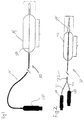
- a TTS balloon dilatation catheter 10 comprises a shaft 12, a balloon 14 near the distal end thereof and an inflation apparatus 16 at the proximal end thereof.
- Shaft 12 has a strong flexible kink-resistant construction and includes a longitudinal lumen extending therethrough by means of which the balloon 14 may be inflated by the inflation apparatus 16.
- Catheter 10 is designed for direct passage through the working channel of the endoscope to the site of an obstructive lesion. Because ITS catheters are not passed over a guidewire, the design includes a mechanism for stiffening the shaft enough to allow advancement through the narrow scope channel to the lesion. To achieve this result, TTS catheters suitably incorporate a stiffening stylet 18 within the shaft. This stylet extends from the proximal end of the shaft through the length of the balloon and provides the stiffness required to facilitate passage through an endoscope and enhance appropriate positioning within the lesion.
- TTS balloon dilatation catheters are useful when an endoscopist prefers to dilate under direct visualization.
- catheter advancement and balloon inflation can be directly monitored.
- Scope placement immediately proximal to the balloon also assists in maintaining proper balloon position during inflation. For example, during dilatation of pyloric structures, the balloon has a tendency to slip proximally or distally during inflation.
- the endoscopist is able to mechanically block any backward movement during inflation thereby facilitating efficient, effective dilatation.
- Fig. 2 illustrates the construction of an OTW balloon dilation catheter 30.
- Catheter 30 includes a shaft 32 which has a strong flexible kink-resistant construction and incorporates a double-lumen design. This design provides a lumen for guidewire passage and a lumen for balloon inflation. At the proximal end of catheter 30 the lumens of shaft 32 divide into separate portions 34, 36 which communicate respectively to balloon inflation apparatus 38 and to guidewire control apparatus 40.
- a balloon 42 is mounted on the shaft 32 near the distal end of catheter 30.
- Catheter 30 may incorporate a soft flexible tip 44 to provide less traumatic advancement through tortuous or narrow strictures. Tip 44 may be radiopaque to assist in fluoroscopic positioning of the catheter at the lesion site.
- OTW balloon dilatation catheters are the preferred design option when extremely tortuous of difficult anatomy is encountered. In these cases, the ability to track the catheter over a previously placed guidewire enhances the clinician's ability to precisely position the balloon for effective dilatation. Further, for colonic lesions distal to scope access, a fluoroscopically-guided, OTW placement technique can be used to achieve appropriate positioning.
- OTW balloon dilatation catheters With OTW balloon dilatation catheters, the endoscopist typically monitors balloon inflation fluoroscopically rather than under direct visualization. Therefore, these dilators incorporate radiopaque markers to aid in accurate positioning. These catheters are designed to be used with guidewires and are available in a variety of shaft and balloon lengths and diameters. This allows the endoscopist to select a catheter appropriate for each lesion.
- the balloon must provide effective radial force against the entire length of the stricture.
- the balloon diameter is indicated by dimension A and the dilation length indicated by dimension B.
- the balloon should be long enough to dilate the entire length of the stricture.
- the inflated outer diameter should affect the desired degree of dilatation.
- the length of the catheter shaft required varies with the location of the structure. For example, catheters 180 cm in length allow access to esophageal and pyloric lesions, while a catheter 240 cm in length is required for colonic strictures.
- Balloon Dilators which are inflated with air
- balloons are primarily inflated with water, saline or a contract/saline mixture.
- the latter is used with OTW balloon catheters to enhance visualization. It is important not to exceed the maximum inflation pressure specified for any particular balloon catheter. Surpassing this pressure could lead to balloon rupture.
- the balloon is fully inflated to the desired dilatation diameter. Dilatation force is applied for as long as necessary to achieve desired results.
- the balloons of the present invention provide a substantially wider range of stricture diameters which may be treated with a single catheter. After treatment, the deflated balloons of the invention provide substantially reduced resistance to withdrawal of the catheter from the body compared to prior art high strength balloons made for instance from biaxially oriented PET. In some TTS applications measured withdrawal force through the scope for catheters bearing balloons of the invention has been found to be only about 1/2 of the withdrawal force for corresponding catheters bearing PET balloons of similar burst strength.
- a balloon of approximately 8 cm length (dimension B), having an outer diameter (dimension A) of 6 to 20 mm is suitable.
- the preferred length of the catheter is 180 cm.
- a balloon of approximately 5.5 cm length balloon, having an outer diameter of 6 to 20 mm is suitable.
- the preferred length of the catheter is 180 cm.
- a balloon of approximately 5.5 cm length balloon, having an outer diameter of 6 to 20 mm is suitable.
- the preferred length of the catheter is 240 cm.
- a balloon of approximately 8 cm length balloon, having an outer diameter of 20-30 mm is suitable.
- the preferred length of the catheter is 240 cm.
- Balloon materials are thermoplastic block copolymers, preferably characterized as follows:
- the preferred balloons made with the method of the invention are made of polyamide/polyether block copolymers.
- the polyamide/polyether block copolymers are commonly identified by the acronym PEBA (polyether block amide).
- PEBA polyether block amide
- the polyamide and polyether segments of these block copolymers may be linked through amide linkages, however, most preferred are ester linked segmented polymers, i.e. polyamide/polyether polyesters.
- Such polyamide/polyether/polyester block copolymers are made by a molten state polycondensation reaction of a dicarboxylic pulyamide and a polyether diol. The result is a short chair polyester made up of blooks of polyamide and polyether.
- the polyamide and polyether blocks are not miscible.
- the materials are characterized by a two phase structure: one is a thermoplastic region that is primarily polyamide and the other is elastomer region that is rich in polyether.
- the polyamide segments are semicrystalline at room temperature.
- the generalized chemical formula for these polyester polymers may be represented by the following formula: in which PA is a polyamide segment, PE is a polyether segment and the repeating number n is between 5 and 10.
- the polyamide segments are suitably aliphatic polyamides, such as nylons 12, 11, 9, 6, 6/12, 6/11,6/9, or 6/6. Most preferably they are nylon 12 segments.
- the polyamide segments may also be based on aromatic polyamides but in such case significantly lower compliance characteristics are to be expected.
- the polyamide segments are relatively low molecular weight, generally within the range of 500-8,000, more preferably 2,000-6,000, most preferably about 3,000-5,000.
- the polyether segments are aliphatic polyethers having at least 2 and no more than 10 linear saturated aliphatic carbon atoms between ether linkages. More preferably the ether segments have 4-6 carbons between ether linkages, and most preferably they are poly(tetramethylene ether) segments. Examples of other polyethers which may be employed in place of the preferred tetramethylene ether segments include polyethylene glycol, polypropylene glycol, poly(pentamethylene ether) and poly(hexamethylene ether). The hydrocarbon portions of the polyether may be optionally branched. An example is the polyether of 2-ethylhexane diol. Generally such branches will contain no more than two carbon atoms. The molecular weight of the polyether segments is suitably between about 400 and 2,500, preferably between 650 and 1000.
- the weight ratio of polyamide to polyether in the polyamide/polyether polyesters used in the invention desirably should be in the range of 50/50 to 98/2, preferably between 60/30 and 92/08, more preferably, between 70/30 and 90/10.
- Polyamide/polyether polyesters are sold commercially under the Pebax® trademark by Atochem North America, Inc., Philadelphia PA.
- suitable commercially available polymers are the Pebax® 33 series polymers with hardness 60 and above, Shore D scale, especially Pebax® 7233, 7033 and 6333. These polymers are made up of nylon 12 segments and poly(tetramethylene ether) segments in different weight ratios and segment lengths.
- polyester/polyether segmented block copolymers As an alternative to polyamide elastomers, it is also possible to utilize polyester/polyether segmented block copolymers and obtain similar balloon properties.
- Such polymers are made up of at least two polyester and at least two polyether segments.
- the polyether segments are the same as previously described for the polyamide/polyether biock copolymers useful in the invention.
- the polyester segments are polyesters of an aromatic dicarboxylic acid and a two to four carbon diol.
- Suitable dicarboxylic acids used to prepare the polyester segments of the polyester/polyether block copolymers are ortho-, meta- or para- phthalic acid, napthalenedicarboxylic acid or meta-terphenyl-4,4'-dicarboxylic acids.
- polyester/polyether block copolymers are poly(butylene terephthalate)- block -poly(tetramethylene oxide) polymers such as Arnitel EM 740, sold by DSM Engineering Plastics. Hytrel polymers: soid by DuPont which meet the physical and chemical specifications set out herein can also be used.
- the block copolymers have a hardness, Shore D scale, of at least 60 and a flexural modulus of no more than about 150,000, in order to obtain optimal strength, compliance and softness characteristics.
- Shore D hardness is in the range of 65-75 and the flexural modulus is in the range of 50,000-120,000.
- the preferred polymers useful in the invention are also characterized by a high ultimate elongation of about 300% or higher and an ultimate tensile strength of at least 6,000 psi (408.276 aim, 41368.5 kPa).
- thermoplastic polymer materials which may be used to prepare balloons in accordance with the invention include blends of rigid and flexible polymers; polyurethanes which have flexible portions, typically derived from polyester or polyether polyols and rigid portions, typically derived from diisocyanates; random copolymers of rigid and flexible monomers: aliphatic polyketones; polysulfides such as PPS. (polyphenylenesulfide); polyamides, for instance C 6 or higher polyamides which are saturated with water, C 11 or higher polyamide homopolymers regardless of water content, and polyamide copolymers of linear and branched monomer units; and other polymers or polymer blends which are known in the art as thermoplastic elastomers.
- thermoplastic polymer products which are considered suitable include polyurethane/polycarbonate blend or block copolymers sold under the trademarks, TEXIN IPU by Bayer Corp and TECOTHANE by Thermedics Inc. and polyurethanes sold under the trademark PELLETHANE by Dow Chemical Co.
- polyurethane/polycarbonate blend or block copolymers sold under the trademarks, TEXIN IPU by Bayer Corp and TECOTHANE by Thermedics Inc. and polyurethanes sold under the trademark PELLETHANE by Dow Chemical Co.
- multilayer balloon structures formed by concentric coextrusion of different thennoplastic polymers, or by sequential concentric blowing of separate tubing parisons of different materials may also be employed.
- Manufacture of balloons of the invention is started with an extruded tubing of the thermoplastic polymer material.
- the balloon prior to its being shrunk, may be manufactured in accordance with known techniques such as described in U.S. Patent 5,556,383, entitled Block Copolymer Elastomer Catheter Balloons, incorporated herein by reference, which corresponds to WO 95/23619, and late published WO 97/17089, entitled Method of Balloon Formation by Cold Drawing/Necking. Multi-staged blowing techniques as described in US 5 542 851 filed 17 Feb. 1994 may also be employed.
- the balloon shrinking process is similar to that described in US 5,348,538 for balloons of non-compliant material such as PET.
- the balloons of the invention are desirably constructed by blowing the balloon from a block copolymer or other polymer material as described above and then shrinking the balloon to a greater extent than was done in the specific illustrative examples of US 5,348,538.
- the amount of shrinkage is controlled by the pressure maintained in the balloon during annealing and the temperature and time of the annealing.
- the blowing pressure is suitably in the range 200-400 psi (13.6092 - 27.2184 atm, 1378.95 - 2757.9 kPa), and temperature is suitably in the range of 90-100°C, and the annealing pressure is in the range of 0-50, preferably 1-30 psi (6.89476 - 206,343 kPa) at 70-100°C for 3-30 seconds.
- the balloon may be shrunk at a very low inflation pressure (typically 0-30 psi, 0 - 2.04138 atm, 0 - 206.843 kPa) to a nominal diameter below that desired in the final balloon, and then pressurized at a pressure between the shrink pressure and 50 psi (3.4023 atm, 344.7 kPa), at a temperature within the same range within a mold or cylinder- which is sized to provide the desired nominal diameter, still below the diameter at which the balloon was initially blown, and suitably 90% or less of the initial blow diameter.
- Example 10 is illustrative of this technique.
- Pebax® 7233 tubes with dimensions of 0.105 inch (2.667mm) ID (inner diameter) x 0.140 (3.556 mm) OD (outer diameter) are cold-drawn at a very low temperature, approximately in the range of-100°C to -20° C as follows.
- a screw driven Stretching machine with a pair of pneumatic grippers is used to stretch the tubing.
- the center portion of the tube is cooled by directly spraying liquid N 2 on the center portion.
- Five 30 mm length balloons are blown at 95°C in a 16 mm diameter mold using a blowing pressure of 260 psi (1792.64 kPa) and a tension of 160 grams.
- the average double wall thickness of the balloons was 0.00282 inch (0.07162,8 mm).
- the burst pressure was 9.2 atm.
- the compliance from 3 atm to 5 atm was 42% and from 3 atm to burst pressure was 11.7%.
- Example 1 Five balloons were prepared as in Example 1. The balloons, while inflated at about 5 psi (34.4738 kPa) pressure, were shrunk by dipping in a 80°C water bath for 5 minutes. The average double wall thickness after shrinking was 0.00429 inch (0.108966 mm). The average burst pressure of the balloons was 9.4 atm. The compliance from 3 atm to 5 atm was 15% and from 3 atm to burst pressure was 39%
- Pebax® 7233 tubes with dimensions of 0.0264 inch (0.67056 mm) ID x 0.0464 (1.17856 mm) OD (outer diameter) are cold-drawn as in Example 1.
- a 4 mm balloon is blown at 95°C in a mold using a blowing pressure of 450 psi (3102.64 kPa) and a tension of 300 grams, The burst pressure was 22 atm.
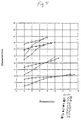
- Example 2 The process of Example 2 is repeated except that the shrinking step is performed by annealing the balloons while inflated to 2 atm pressure in water baths under different conditions, namely: 75 ° C for 10 seconds; 75 °C for 30 seconds; 75 °C for 60 seconds; and 95°C for 10 seconds. Compliance curves for the balloons of Examples 3 and 4 are plotted in Figure 3.
- Balloons were prepared as in Examples 1 and 2 using Pebax 7033 polymer and the conditions specified in Table 1. The compliance results are summarized in Table 1 and are plotted in Figure 4.
- Balloons were made from Arnitel EM 740 polymer cubing by stretching tubing as specified in Table 2 at room temperature at a stretch ratio of 4.2 and then blowing the balloon from the stretched tubing under the conditions specified in Table 2.
- the compliance results are summarized in Table 2 and are plotted in Figure 5.
- the balloons prepared utilizing the shrinking step have very high compliance profiles, in addition to high wall strength.
- the shrinking step causes, the compliance curve to start from a lower point so that overall the balloon is much more compliant. In this manner the comparatively high strength of the block copolymer material is made accessible to medical device applications where high compliance is also desirable.
- Example 9 Five balloons were prepared as in Example 9. The balloons while at a tension and inflated at atmospheric pressure were shrunk by dipping in an 85°C water bath for 2 minutes. The balloons were then each inserted into a 5.6 mm ID glass tube, replaced in the 85° bath and pressurized at 30 psi (206.843 kPa) for 2 minutes. The resulting balloons had an average double wall thickness of 0.00233 inch (0.059182 mm). an average burst pressure of 12.6 mm, a compliance from 3 atm to 10 atm of 36% and a compliance from 3 atm to burst of 44%.
Landscapes
- Health & Medical Sciences (AREA)
- Heart & Thoracic Surgery (AREA)
- Engineering & Computer Science (AREA)
- Life Sciences & Earth Sciences (AREA)
- Anesthesiology (AREA)
- Child & Adolescent Psychology (AREA)
- Biophysics (AREA)
- Pulmonology (AREA)
- Manufacturing & Machinery (AREA)
- Biomedical Technology (AREA)
- Hematology (AREA)
- Animal Behavior & Ethology (AREA)
- General Health & Medical Sciences (AREA)
- Public Health (AREA)
- Veterinary Medicine (AREA)
- Materials For Medical Uses (AREA)
- Media Introduction/Drainage Providing Device (AREA)
Claims (11)
- Verfahren zur Ausbildung eines Ballons für eine medizinische Vorrichtung, wobei ein Schlauch aus einem thermoplastischen Polymermaterial unter einem ersten Druck bei einer ersten Temperatur radial ausgedehnt wird, um den Ballon mit einem ersten Durchmesser auszubilden, und das Verfahren den weiteren Schritt des Temperns des Ballons bei einer zweiten Temperatur, die über der Umgebungstemperatur und unter der ersten Temperatur liegt, und unter einem zweiten Druck über einen Zeitraum umfaßt, der zum Schrumpfen des ausgebildeten Ballons auf einen zweiten Durchmesser ausreicht, der kleiner als der erste Durchmesser ist,
dadurch gekennzeichnet, daßdas thermoplastische Polymermaterial ein Blockcopolymer-Material ist,der zweite Druck über dem Umgebungsdruck und unter dem ersten Druck liegt, unddas Verfahren weiter den Schritt des Unterdrucksetzens des Ballons in der Form eines festen Durchmessers, wobei der feste Durchmesser größer als der zweite Durchmesser ist, jedoch nicht mehr als 90 % des ersten Durchmessers beträgt, bei einem Druck über dem Temperungsdruck, jedoch von nicht mehr als 50 psi (206,845 kPa), und bei einer Temperatur, die nicht niedriger als die zweite Temperatur und nicht höher als die erste Temperatur ist, über einen Zeitraum umfaßt, um den Ballon bei einem Aufblasdruck von 3 at mit einem Enddurchmesser zu versehen, der größer als der zweite Durchmesser ist, jedoch nicht mehr als 90 % des ersten Durchmessers beträgt. - Verfahren nach Anspruch 1, wobei der zweite Druck nicht mehr als 20 psi (137,895 kPa) beträgt.
- Verfahren nach Anspruch 2, wobei der zweite Druck im Bereich von 1 - 10 psi (6,89476 - 68,9476 kPa) liegt.
- Verfahren nach einem der Ansprüche 1 bis 3, wobei die erste Temperatur im Bereich von 90° - 100° liegt und die zweite Temperatur im Bereich von 70° - 100° liegt.
- Verfahren nach einem der Ansprüche 1 bis 4, wobei das Blockcopolymer aus weichen Segmenten eines Polyethers und aus harten Segmenten eines Polyesters oder eines Polyamids besteht.
- Verfahren nach Anspruch 5, wobei die weichen Segmente des Polyethers Polyether von C2-C10 -Diolen sind.
- Verfahren nach Anspruch 5 oder 6, wobei die harten Segmente Polyester einer aromatischen Dicarbonsäure und eines C2-C4 -Diols sind.
- Verfahren nach Anspruch 5 oder 6, wobei die harten Segmente Polyamide sind, die ausgewählt sind aus der Gruppe bestehend aus C6- oder höheren Carbonsäuren und C6- oder höheren organischen Diaminen und C6- oder höheren aliphatischen ω-Amino-α-säuren.
- Verfahren nach einem der vorhergehenden Ansprüche, wobei:der erste Blasdruck über dem Umgebungsdruck liegt und höher als 50. psi (206,843 kPa) bei der ersten Temperatur ist, um den Ballon bei einem Aufblasdruck von 3 at mit dem ersten Durchmesser auszubilden,die zweite Temperatur über der Umgebungstemperatur liegt und niedriger als die erste Temperatur oder gleich derselben ist, und bei einem zweiten Druck, der im Bereich von 0-20 psi (0 - 137,895 kPa) über einen Zeitraum liegt, der ausreicht, um den ausgebildeten Ballon bei einem Aufblasdruck von 3 atm auf den zweiten Durchmesser zu schrumpfen, der kleiner als 90 % des ersten Durchmessers ist.
- Verfahren nach Anspruch 9, wobei der Ballon in der Form des festen Durchmessers über einen Zeitraum derart unter Druck gesetzt wird, daß der Enddurchmesser 85 % oder weniger des ersten Durchmessers beträgt.
- Verfahren nach Anspruch 9, wobei der Ballon in der Form des festen Durchmessers über einen Zeitraum derart unter Druck gesetzt wird, daß der Enddurchmesser 65 - 75 % des ersten Durchmessers beträgt.
Applications Claiming Priority (3)
| Application Number | Priority Date | Filing Date | Title |
|---|---|---|---|
| US68533896A | 1996-07-23 | 1996-07-23 | |
| US685338 | 1996-07-23 | ||
| PCT/US1997/012074 WO1998003218A1 (en) | 1996-07-23 | 1997-07-11 | High compliance, high strength catheter balloons useful for treatment of gastrointestinal lesions |
Publications (2)
| Publication Number | Publication Date |
|---|---|
| EP0921832A1 EP0921832A1 (de) | 1999-06-16 |
| EP0921832B1 true EP0921832B1 (de) | 2004-01-14 |
Family
ID=24751763
Family Applications (1)
| Application Number | Title | Priority Date | Filing Date |
|---|---|---|---|
| EP97933387A Expired - Lifetime EP0921832B1 (de) | 1996-07-23 | 1997-07-11 | Verfahren zur herstellung von hochfesten dilatationsballons mit hoher compliance zur behandlung gastrointestinaler schädigungen |
Country Status (6)
| Country | Link |
|---|---|
| EP (1) | EP0921832B1 (de) |
| JP (2) | JP3597868B2 (de) |
| AT (1) | ATE257721T1 (de) |
| CA (1) | CA2261217C (de) |
| DE (1) | DE69727234T2 (de) |
| WO (1) | WO1998003218A1 (de) |
Families Citing this family (45)
| Publication number | Priority date | Publication date | Assignee | Title |
|---|---|---|---|---|
| US20030032963A1 (en) | 2001-10-24 | 2003-02-13 | Kyphon Inc. | Devices and methods using an expandable body with internal restraint for compressing cancellous bone |
| US5868705A (en) * | 1996-05-20 | 1999-02-09 | Percusurge Inc | Pre-stretched catheter balloon |
| US6554795B2 (en) | 1997-03-06 | 2003-04-29 | Medtronic Ave, Inc. | Balloon catheter and method of manufacture |
| US6319229B1 (en) | 1998-02-19 | 2001-11-20 | Medtronic Percusurge, Inc. | Balloon catheter and method of manufacture |
| US20010001113A1 (en) * | 1998-04-21 | 2001-05-10 | Florencia Lim | Balloon catheter |
| US6719773B1 (en) | 1998-06-01 | 2004-04-13 | Kyphon Inc. | Expandable structures for deployment in interior body regions |
| AU756969B2 (en) | 1998-06-01 | 2003-01-30 | Kyphon Sarl | Expandable preformed structures for deployment in interior body regions |
| JP4815657B2 (ja) * | 1999-05-18 | 2011-11-16 | 株式会社カネカ | 医療用ポリマーブレンド材料およびこの材料を用いた医療用バルーン |
| US6673302B2 (en) * | 2001-01-24 | 2004-01-06 | Scimed Life Systems, Inc. | Wet processing method for catheter balloons |
| US7572287B2 (en) | 2001-10-25 | 2009-08-11 | Boston Scientific Scimed, Inc. | Balloon expandable polymer stent with reduced elastic recoil |
| US7005097B2 (en) * | 2002-01-23 | 2006-02-28 | Boston Scientific Scimed, Inc. | Medical devices employing chain extended polymers |
| US7029732B2 (en) | 2002-02-28 | 2006-04-18 | Boston Scientific Scimed, Inc. | Medical device balloons with improved strength properties and processes for producing same |
| US6835189B2 (en) | 2002-10-15 | 2004-12-28 | Scimed Life Systems, Inc. | Controlled deployment balloon |
| US7727442B2 (en) | 2003-07-10 | 2010-06-01 | Boston Scientific Scimed, Inc. | Medical device tubing with discrete orientation regions |
| WO2005037337A1 (en) * | 2003-10-17 | 2005-04-28 | Invatec S.R.L. | Catheter balloons |
| RU2327489C2 (ru) * | 2003-10-17 | 2008-06-27 | ИНВАТЭК С.р.л. | Баллонные катетеры |
| US7220816B2 (en) * | 2003-12-16 | 2007-05-22 | Advanced Cardiovascular Systems, Inc. | Biologically absorbable coatings for implantable devices based on poly(ester amides) and methods for fabricating the same |
| US7435788B2 (en) | 2003-12-19 | 2008-10-14 | Advanced Cardiovascular Systems, Inc. | Biobeneficial polyamide/polyethylene glycol polymers for use with drug eluting stents |
| US8685431B2 (en) * | 2004-03-16 | 2014-04-01 | Advanced Cardiovascular Systems, Inc. | Biologically absorbable coatings for implantable devices based on copolymers having ester bonds and methods for fabricating the same |
| US7892478B2 (en) | 2004-04-19 | 2011-02-22 | Boston Scientific Scimed, Inc. | Catheter balloon mold form and molding process |
| JP4967258B2 (ja) * | 2004-06-10 | 2012-07-04 | 株式会社カネカ | バルーンおよびバルーンカテーテル |
| US7635510B2 (en) | 2004-07-07 | 2009-12-22 | Boston Scientific Scimed, Inc. | High performance balloon catheter/component |
| US7166680B2 (en) | 2004-10-06 | 2007-01-23 | Advanced Cardiovascular Systems, Inc. | Blends of poly(ester amide) polymers |
| WO2006126311A1 (ja) * | 2005-05-27 | 2006-11-30 | Kaneka Corporation | バルーンおよびバルーンカテーテル |
| JP2007061258A (ja) * | 2005-08-30 | 2007-03-15 | Kaneka Corp | バルーンおよびバルーンカテーテル |
| US8858855B2 (en) | 2006-04-20 | 2014-10-14 | Boston Scientific Scimed, Inc. | High pressure balloon |
| US7943221B2 (en) | 2006-05-22 | 2011-05-17 | Boston Scientific Scimed, Inc. | Hinged compliance fiber braid balloon |
| US20090318863A1 (en) | 2008-06-18 | 2009-12-24 | Boston Scientific Scimed, Inc. | Functional Balloon With Built in Lubricity or Drug Delivery System |
| US10881839B2 (en) | 2012-10-26 | 2021-01-05 | Urotronic, Inc. | Drug-coated balloon catheters for body lumens |
| US11938287B2 (en) | 2012-10-26 | 2024-03-26 | Urotronic, Inc. | Drug-coated balloon catheters for body lumens |
| US10898700B2 (en) | 2012-10-26 | 2021-01-26 | Urotronic, Inc. | Balloon catheters for body lumens |
| US11504450B2 (en) | 2012-10-26 | 2022-11-22 | Urotronic, Inc. | Drug-coated balloon catheters for body lumens |
| US10806830B2 (en) | 2012-10-26 | 2020-10-20 | Urotronic, Inc. | Drug-coated balloon catheters for body lumens |
| JP2015104485A (ja) | 2013-11-29 | 2015-06-08 | オリンパスメディカルシステムズ株式会社 | カテーテル |
| CN114773559A (zh) * | 2014-03-25 | 2022-07-22 | 巴斯夫欧洲公司 | Tpu气动软管 |
| US20150328441A1 (en) * | 2014-05-16 | 2015-11-19 | Boston Scientific Scimed Inc. | High Pressure Low Cost Multilayer Balloon Catheter |
| US11904072B2 (en) | 2015-04-24 | 2024-02-20 | Urotronic, Inc. | Drug coated balloon catheters for nonvascular strictures |
| EP3442642B1 (de) | 2016-04-12 | 2025-10-15 | Boston Scientific Scimed, Inc. | Methode zur herstellung einer katheterbaugruppe |
| WO2018111898A1 (en) | 2016-12-13 | 2018-06-21 | Boston Scientific Scimed, Inc. | Medical balloon |
| WO2018200661A1 (en) | 2017-04-25 | 2018-11-01 | Boston Scientific Scimed, Inc. | Medical balloon |
| PL3664706T3 (pl) * | 2017-08-10 | 2022-02-14 | Vipun Medical Nv | Urządzenie do pomiaru zmian ciśnienia w żołądku |
| EP4223352A3 (de) * | 2019-02-22 | 2023-11-01 | Urotronic, Inc. | Medikamentenbeschichtete ballonkatheter für körperlumen |
| US20220273313A1 (en) * | 2019-08-19 | 2022-09-01 | The Regents Of The University Of Michigan | Gastroesophageal aortic occlusion device and method |
| EP4304699A4 (de) * | 2021-03-12 | 2024-12-25 | Hope Medical | Ballonkatheter, verfahren zur verwendung |
| CN114177489B (zh) * | 2021-12-17 | 2024-08-20 | 普利瑞医疗科技(苏州)有限公司 | 一种鼓泡球囊的制备方法 |
Family Cites Families (12)
| Publication number | Priority date | Publication date | Assignee | Title |
|---|---|---|---|---|
| EP0439202B1 (de) * | 1989-07-24 | 1993-09-29 | Cordis Corporation | Vorrichtung und Verfahren zur Herstellung von Ballonen für medizinische Geräte |
| ES2043289T3 (es) | 1989-09-25 | 1993-12-16 | Schneider Usa Inc | La extrusion de capas multiples como procedimiento para hacer balones de angioplastia. |
| US5478320A (en) | 1989-11-29 | 1995-12-26 | Cordis Corporation | Puncture resistant balloon catheter and method of manufacturing |
| JP2555298B2 (ja) * | 1990-11-10 | 1996-11-20 | テルモ株式会社 | カテーテル用バルーン、カテーテル用バルーンの製造方法およびバルーンカテーテル |
| US5195969A (en) | 1991-04-26 | 1993-03-23 | Boston Scientific Corporation | Co-extruded medical balloons and catheter using such balloons |
| DE69231986T3 (de) | 1991-09-12 | 2008-09-11 | Advanced Cardiovascular Systems, Inc., Santa Clara | In begrenztem Bereich elastisch dehnbarer aufblasbarer Gegenstand |
| US5348538A (en) | 1992-09-29 | 1994-09-20 | Scimed Life Systems, Inc. | Shrinking balloon catheter having nonlinear or hybrid compliance curve |
| US5500180A (en) * | 1992-09-30 | 1996-03-19 | C. R. Bard, Inc. | Method of making a distensible dilatation balloon using a block copolymer |
| US5512051A (en) | 1993-02-16 | 1996-04-30 | Boston Scientific Corporation | Slip-layered catheter balloon |
| JP3494654B2 (ja) | 1994-03-02 | 2004-02-09 | シメッド ライフ システムズ インコーポレイテッド | ブロックコポリマーエラストマー・カテーテル・バルーン |
| US5587125A (en) | 1994-08-15 | 1996-12-24 | Schneider (Usa) Inc. | Non-coextrusion method of making multi-layer angioplasty balloons |
| WO1996012516A1 (en) * | 1994-10-19 | 1996-05-02 | Advanced Cardiovascular Systems, Inc. | High strength dilatation balloons |
-
1997
- 1997-07-11 DE DE69727234T patent/DE69727234T2/de not_active Expired - Lifetime
- 1997-07-11 AT AT97933387T patent/ATE257721T1/de not_active IP Right Cessation
- 1997-07-11 WO PCT/US1997/012074 patent/WO1998003218A1/en not_active Ceased
- 1997-07-11 JP JP50455998A patent/JP3597868B2/ja not_active Expired - Lifetime
- 1997-07-11 EP EP97933387A patent/EP0921832B1/de not_active Expired - Lifetime
- 1997-07-11 CA CA002261217A patent/CA2261217C/en not_active Expired - Fee Related
-
2004
- 2004-04-21 JP JP2004125008A patent/JP4643173B2/ja not_active Expired - Lifetime
Also Published As
| Publication number | Publication date |
|---|---|
| CA2261217C (en) | 2008-07-08 |
| JP3597868B2 (ja) | 2004-12-08 |
| WO1998003218A1 (en) | 1998-01-29 |
| DE69727234D1 (de) | 2004-02-19 |
| EP0921832A1 (de) | 1999-06-16 |
| CA2261217A1 (en) | 1998-01-29 |
| ATE257721T1 (de) | 2004-01-15 |
| DE69727234T2 (de) | 2004-11-11 |
| JP2000515036A (ja) | 2000-11-14 |
| JP4643173B2 (ja) | 2011-03-02 |
| JP2004223280A (ja) | 2004-08-12 |
Similar Documents
| Publication | Publication Date | Title |
|---|---|---|
| EP0921832A1 (de) | Hochfeste dilatationsballons mit hoher compliance zur behandlung gastrointestinaler schädigungen | |
| WO1998003218A9 (en) | High compliance, high strength catheter balloons useful for treatment of gastrointestinal lesions | |
| US7108826B2 (en) | High compliance, high strength catheter balloons useful for treatment of gastrointestinal lesions | |
| US11357892B2 (en) | Multilayer medical balloon | |
| EP0888145B1 (de) | Verfahren zur Herstellung eines laminierten Katheterballons | |
| US20020018866A1 (en) | Polyether block amide catheter balloons | |
| EP2437840B1 (de) | Robuster katheterschlauch | |
| EP2361103B1 (de) | Katheterschlauch mit geringer nachgiebigkeit | |
| US20090254113A1 (en) | Dilatation balloon with ridges and methods | |
| EP2437800A2 (de) | Robuster katheterschlauch mit nylon | |
| US20090264822A1 (en) | Method of Making a Zero-Fold Balloon With Variable Inflation Volume | |
| JP4815657B2 (ja) | 医療用ポリマーブレンド材料およびこの材料を用いた医療用バルーン | |
| JP4402218B2 (ja) | バルーンカテーテル |
Legal Events
| Date | Code | Title | Description |
|---|---|---|---|
| PUAI | Public reference made under article 153(3) epc to a published international application that has entered the european phase |
Free format text: ORIGINAL CODE: 0009012 |
|
| 17P | Request for examination filed |
Effective date: 19990211 |
|
| AK | Designated contracting states |
Kind code of ref document: A1 Designated state(s): AT BE CH DE DK ES FI FR GB GR IE IT LI LU MC NL PT SE |
|
| RIN1 | Information on inventor provided before grant (corrected) |
Inventor name: FOURNIER, DONALD, J. Inventor name: WANG, LIXIAO |
|
| 17Q | First examination report despatched |
Effective date: 20020307 |
|
| GRAP | Despatch of communication of intention to grant a patent |
Free format text: ORIGINAL CODE: EPIDOSNIGR1 |
|
| RTI1 | Title (correction) |
Free format text: METHOD FOR FORMING HIGH COMPLIANCE, HIGH STRENGTH CATHETER BALLOONS USEFUL FOR TREATMENT OF GASTROINTESTINAL LESIONS |
|
| GRAS | Grant fee paid |
Free format text: ORIGINAL CODE: EPIDOSNIGR3 |
|
| RTI1 | Title (correction) |
Free format text: METHOD FOR FORMING HIGH COMPLIANCE, HIGH STRENGTH CATHETER BALLOONS USEFUL FOR TREATMENT OF GASTROINTESTINAL LESIONS |
|
| GRAA | (expected) grant |
Free format text: ORIGINAL CODE: 0009210 |
|
| AK | Designated contracting states |
Kind code of ref document: B1 Designated state(s): AT BE CH DE DK ES FI FR GB GR IE IT LI LU MC NL PT SE |
|
| PG25 | Lapsed in a contracting state [announced via postgrant information from national office to epo] |
Ref country code: LI Free format text: LAPSE BECAUSE OF FAILURE TO SUBMIT A TRANSLATION OF THE DESCRIPTION OR TO PAY THE FEE WITHIN THE PRESCRIBED TIME-LIMIT Effective date: 20040114 Ref country code: IT Free format text: LAPSE BECAUSE OF FAILURE TO SUBMIT A TRANSLATION OF THE DESCRIPTION OR TO PAY THE FEE WITHIN THE PRESCRIBED TIME-LIMIT;WARNING: LAPSES OF ITALIAN PATENTS WITH EFFECTIVE DATE BEFORE 2007 MAY HAVE OCCURRED AT ANY TIME BEFORE 2007. THE CORRECT EFFECTIVE DATE MAY BE DIFFERENT FROM THE ONE RECORDED. Effective date: 20040114 Ref country code: FI Free format text: LAPSE BECAUSE OF FAILURE TO SUBMIT A TRANSLATION OF THE DESCRIPTION OR TO PAY THE FEE WITHIN THE PRESCRIBED TIME-LIMIT Effective date: 20040114 Ref country code: CH Free format text: LAPSE BECAUSE OF FAILURE TO SUBMIT A TRANSLATION OF THE DESCRIPTION OR TO PAY THE FEE WITHIN THE PRESCRIBED TIME-LIMIT Effective date: 20040114 Ref country code: BE Free format text: LAPSE BECAUSE OF FAILURE TO SUBMIT A TRANSLATION OF THE DESCRIPTION OR TO PAY THE FEE WITHIN THE PRESCRIBED TIME-LIMIT Effective date: 20040114 Ref country code: AT Free format text: LAPSE BECAUSE OF FAILURE TO SUBMIT A TRANSLATION OF THE DESCRIPTION OR TO PAY THE FEE WITHIN THE PRESCRIBED TIME-LIMIT Effective date: 20040114 |
|
| REG | Reference to a national code |
Ref country code: GB Ref legal event code: FG4D |
|
| REG | Reference to a national code |
Ref country code: CH Ref legal event code: EP |
|
| REG | Reference to a national code |
Ref country code: IE Ref legal event code: FG4D |
|
| REF | Corresponds to: |
Ref document number: 69727234 Country of ref document: DE Date of ref document: 20040219 Kind code of ref document: P |
|
| PG25 | Lapsed in a contracting state [announced via postgrant information from national office to epo] |
Ref country code: SE Free format text: LAPSE BECAUSE OF FAILURE TO SUBMIT A TRANSLATION OF THE DESCRIPTION OR TO PAY THE FEE WITHIN THE PRESCRIBED TIME-LIMIT Effective date: 20040414 Ref country code: GR Free format text: LAPSE BECAUSE OF FAILURE TO SUBMIT A TRANSLATION OF THE DESCRIPTION OR TO PAY THE FEE WITHIN THE PRESCRIBED TIME-LIMIT Effective date: 20040414 Ref country code: DK Free format text: LAPSE BECAUSE OF FAILURE TO SUBMIT A TRANSLATION OF THE DESCRIPTION OR TO PAY THE FEE WITHIN THE PRESCRIBED TIME-LIMIT Effective date: 20040414 |
|
| PG25 | Lapsed in a contracting state [announced via postgrant information from national office to epo] |
Ref country code: ES Free format text: LAPSE BECAUSE OF FAILURE TO SUBMIT A TRANSLATION OF THE DESCRIPTION OR TO PAY THE FEE WITHIN THE PRESCRIBED TIME-LIMIT Effective date: 20040425 |
|
| PG25 | Lapsed in a contracting state [announced via postgrant information from national office to epo] |
Ref country code: LU Free format text: LAPSE BECAUSE OF NON-PAYMENT OF DUE FEES Effective date: 20040711 |
|
| REG | Reference to a national code |
Ref country code: CH Ref legal event code: PL |
|
| PG25 | Lapsed in a contracting state [announced via postgrant information from national office to epo] |
Ref country code: MC Free format text: LAPSE BECAUSE OF NON-PAYMENT OF DUE FEES Effective date: 20040731 |
|
| ET | Fr: translation filed | ||
| PLBE | No opposition filed within time limit |
Free format text: ORIGINAL CODE: 0009261 |
|
| STAA | Information on the status of an ep patent application or granted ep patent |
Free format text: STATUS: NO OPPOSITION FILED WITHIN TIME LIMIT |
|
| 26N | No opposition filed |
Effective date: 20041015 |
|
| PG25 | Lapsed in a contracting state [announced via postgrant information from national office to epo] |
Ref country code: PT Free format text: LAPSE BECAUSE OF NON-PAYMENT OF DUE FEES Effective date: 20040614 |
|
| REG | Reference to a national code |
Ref country code: DE Ref legal event code: R082 Ref document number: 69727234 Country of ref document: DE Representative=s name: VOSSIUS & PARTNER PATENTANWAELTE RECHTSANWAELT, DE |
|
| REG | Reference to a national code |
Ref country code: FR Ref legal event code: PLFP Year of fee payment: 19 |
|
| PGFP | Annual fee paid to national office [announced via postgrant information from national office to epo] |
Ref country code: NL Payment date: 20150709 Year of fee payment: 19 |
|
| PGFP | Annual fee paid to national office [announced via postgrant information from national office to epo] |
Ref country code: GB Payment date: 20150708 Year of fee payment: 19 Ref country code: IE Payment date: 20150709 Year of fee payment: 19 Ref country code: DE Payment date: 20150707 Year of fee payment: 19 |
|
| PGFP | Annual fee paid to national office [announced via postgrant information from national office to epo] |
Ref country code: FR Payment date: 20150629 Year of fee payment: 19 |
|
| REG | Reference to a national code |
Ref country code: DE Ref legal event code: R119 Ref document number: 69727234 Country of ref document: DE |
|
| REG | Reference to a national code |
Ref country code: NL Ref legal event code: MM Effective date: 20160801 |
|
| GBPC | Gb: european patent ceased through non-payment of renewal fee |
Effective date: 20160711 |
|
| PG25 | Lapsed in a contracting state [announced via postgrant information from national office to epo] |
Ref country code: NL Free format text: LAPSE BECAUSE OF NON-PAYMENT OF DUE FEES Effective date: 20160801 Ref country code: DE Free format text: LAPSE BECAUSE OF NON-PAYMENT OF DUE FEES Effective date: 20170201 Ref country code: FR Free format text: LAPSE BECAUSE OF NON-PAYMENT OF DUE FEES Effective date: 20160801 |
|
| REG | Reference to a national code |
Ref country code: FR Ref legal event code: ST Effective date: 20170331 |
|
| REG | Reference to a national code |
Ref country code: IE Ref legal event code: MM4A |
|
| PG25 | Lapsed in a contracting state [announced via postgrant information from national office to epo] |
Ref country code: GB Free format text: LAPSE BECAUSE OF NON-PAYMENT OF DUE FEES Effective date: 20160711 |
|
| PG25 | Lapsed in a contracting state [announced via postgrant information from national office to epo] |
Ref country code: IE Free format text: LAPSE BECAUSE OF NON-PAYMENT OF DUE FEES Effective date: 20160711 |