EP0922073B1 - Moulding compounds consisting of a polycarbonate mixture and a siloxane reticular rubber - Google Patents
Moulding compounds consisting of a polycarbonate mixture and a siloxane reticular rubber Download PDFInfo
- Publication number
- EP0922073B1 EP0922073B1 EP97941949A EP97941949A EP0922073B1 EP 0922073 B1 EP0922073 B1 EP 0922073B1 EP 97941949 A EP97941949 A EP 97941949A EP 97941949 A EP97941949 A EP 97941949A EP 0922073 B1 EP0922073 B1 EP 0922073B1
- Authority
- EP
- European Patent Office
- Prior art keywords
- weight
- graft
- bis
- molding material
- gew
- Prior art date
- Legal status (The legal status is an assumption and is not a legal conclusion. Google has not performed a legal analysis and makes no representation as to the accuracy of the status listed.)
- Expired - Lifetime
Links
- 239000000203 mixture Substances 0.000 title claims description 76
- 229920001971 elastomer Polymers 0.000 title claims description 40
- 239000005060 rubber Substances 0.000 title claims description 38
- 229920000515 polycarbonate Polymers 0.000 title claims description 25
- 239000004417 polycarbonate Substances 0.000 title claims description 24
- KPUWHANPEXNPJT-UHFFFAOYSA-N disiloxane Chemical class [SiH3]O[SiH3] KPUWHANPEXNPJT-UHFFFAOYSA-N 0.000 title description 14
- 239000000206 moulding compound Substances 0.000 title 1
- PPBRXRYQALVLMV-UHFFFAOYSA-N Styrene Chemical compound C=CC1=CC=CC=C1 PPBRXRYQALVLMV-UHFFFAOYSA-N 0.000 claims description 53
- 238000000465 moulding Methods 0.000 claims description 48
- 229920001577 copolymer Polymers 0.000 claims description 27
- CQEYYJKEWSMYFG-UHFFFAOYSA-N butyl acrylate Chemical compound CCCCOC(=O)C=C CQEYYJKEWSMYFG-UHFFFAOYSA-N 0.000 claims description 23
- -1 siloxanes Chemical class 0.000 claims description 20
- 229920000578 graft copolymer Polymers 0.000 claims description 18
- VVQNEPGJFQJSBK-UHFFFAOYSA-N Methyl methacrylate Chemical compound COC(=O)C(C)=C VVQNEPGJFQJSBK-UHFFFAOYSA-N 0.000 claims description 16
- 125000004432 carbon atom Chemical group C* 0.000 claims description 10
- 230000009477 glass transition Effects 0.000 claims description 10
- 238000004519 manufacturing process Methods 0.000 claims description 10
- 150000002825 nitriles Chemical class 0.000 claims description 9
- 125000005250 alkyl acrylate group Chemical group 0.000 claims description 8
- 125000003118 aryl group Chemical group 0.000 claims description 8
- 239000000835 fiber Substances 0.000 claims description 8
- 150000003440 styrenes Chemical class 0.000 claims description 8
- 229920000642 polymer Polymers 0.000 claims description 7
- 239000000654 additive Substances 0.000 claims description 6
- 150000002148 esters Chemical class 0.000 claims description 6
- NIXOWILDQLNWCW-UHFFFAOYSA-N 2-Propenoic acid Natural products OC(=O)C=C NIXOWILDQLNWCW-UHFFFAOYSA-N 0.000 claims description 5
- 239000011574 phosphorus Substances 0.000 claims description 5
- 229910052698 phosphorus Inorganic materials 0.000 claims description 5
- SMZOUWXMTYCWNB-UHFFFAOYSA-N 2-(2-methoxy-5-methylphenyl)ethanamine Chemical compound COC1=CC=C(C)C=C1CCN SMZOUWXMTYCWNB-UHFFFAOYSA-N 0.000 claims description 4
- GOXQRTZXKQZDDN-UHFFFAOYSA-N 2-Ethylhexyl acrylate Chemical compound CCCCC(CC)COC(=O)C=C GOXQRTZXKQZDDN-UHFFFAOYSA-N 0.000 claims description 4
- CERQOIWHTDAKMF-UHFFFAOYSA-N Methacrylic acid Chemical compound CC(=C)C(O)=O CERQOIWHTDAKMF-UHFFFAOYSA-N 0.000 claims description 4
- 125000000217 alkyl group Chemical group 0.000 claims description 4
- 150000002734 metacrylic acid derivatives Chemical class 0.000 claims description 4
- 150000001252 acrylic acid derivatives Chemical class 0.000 claims description 3
- 229910052739 hydrogen Inorganic materials 0.000 claims description 3
- 239000001257 hydrogen Substances 0.000 claims description 3
- 125000004435 hydrogen atom Chemical class [H]* 0.000 claims description 2
- 239000012778 molding material Substances 0.000 claims 8
- 239000002245 particle Substances 0.000 description 26
- 239000000178 monomer Substances 0.000 description 23
- NLHHRLWOUZZQLW-UHFFFAOYSA-N Acrylonitrile Chemical compound C=CC#N NLHHRLWOUZZQLW-UHFFFAOYSA-N 0.000 description 20
- 238000000034 method Methods 0.000 description 16
- 150000001875 compounds Chemical class 0.000 description 15
- 239000004816 latex Substances 0.000 description 15
- 229920000126 latex Polymers 0.000 description 15
- XLYOFNOQVPJJNP-UHFFFAOYSA-N water Chemical compound O XLYOFNOQVPJJNP-UHFFFAOYSA-N 0.000 description 14
- 238000009826 distribution Methods 0.000 description 12
- IISBACLAFKSPIT-UHFFFAOYSA-N bisphenol A Chemical compound C=1C=C(O)C=CC=1C(C)(C)C1=CC=C(O)C=C1 IISBACLAFKSPIT-UHFFFAOYSA-N 0.000 description 11
- 239000006185 dispersion Substances 0.000 description 11
- 125000002496 methyl group Chemical group [H]C([H])([H])* 0.000 description 9
- 239000000243 solution Substances 0.000 description 9
- 208000010392 Bone Fractures Diseases 0.000 description 8
- YMWUJEATGCHHMB-UHFFFAOYSA-N Dichloromethane Chemical compound ClCCl YMWUJEATGCHHMB-UHFFFAOYSA-N 0.000 description 8
- 125000001495 ethyl group Chemical group [H]C([H])([H])C([H])([H])* 0.000 description 8
- BAPJBEWLBFYGME-UHFFFAOYSA-N Methyl acrylate Chemical compound COC(=O)C=C BAPJBEWLBFYGME-UHFFFAOYSA-N 0.000 description 6
- GYCMBHHDWRMZGG-UHFFFAOYSA-N Methylacrylonitrile Chemical compound CC(=C)C#N GYCMBHHDWRMZGG-UHFFFAOYSA-N 0.000 description 6
- WYURNTSHIVDZCO-UHFFFAOYSA-N Tetrahydrofuran Chemical compound C1CCOC1 WYURNTSHIVDZCO-UHFFFAOYSA-N 0.000 description 6
- YXFVVABEGXRONW-UHFFFAOYSA-N Toluene Chemical compound CC1=CC=CC=C1 YXFVVABEGXRONW-UHFFFAOYSA-N 0.000 description 6
- NIXOWILDQLNWCW-UHFFFAOYSA-M acrylate group Chemical group C(C=C)(=O)[O-] NIXOWILDQLNWCW-UHFFFAOYSA-M 0.000 description 6
- MVPPADPHJFYWMZ-UHFFFAOYSA-N chlorobenzene Chemical compound ClC1=CC=CC=C1 MVPPADPHJFYWMZ-UHFFFAOYSA-N 0.000 description 6
- 238000010438 heat treatment Methods 0.000 description 6
- 238000012360 testing method Methods 0.000 description 6
- KAKZBPTYRLMSJV-UHFFFAOYSA-N Butadiene Chemical compound C=CC=C KAKZBPTYRLMSJV-UHFFFAOYSA-N 0.000 description 5
- XYLMUPLGERFSHI-UHFFFAOYSA-N alpha-Methylstyrene Chemical compound CC(=C)C1=CC=CC=C1 XYLMUPLGERFSHI-UHFFFAOYSA-N 0.000 description 5
- 239000000945 filler Substances 0.000 description 5
- 238000005259 measurement Methods 0.000 description 5
- 229910052751 metal Inorganic materials 0.000 description 5
- 239000002184 metal Substances 0.000 description 5
- 238000006116 polymerization reaction Methods 0.000 description 5
- 239000003381 stabilizer Substances 0.000 description 5
- 239000004971 Cross linker Substances 0.000 description 4
- YIVJZNGAASQVEM-UHFFFAOYSA-N Lauroyl peroxide Chemical compound CCCCCCCCCCCC(=O)OOC(=O)CCCCCCCCCCC YIVJZNGAASQVEM-UHFFFAOYSA-N 0.000 description 4
- ZMXDDKWLCZADIW-UHFFFAOYSA-N N,N-Dimethylformamide Chemical compound CN(C)C=O ZMXDDKWLCZADIW-UHFFFAOYSA-N 0.000 description 4
- PXHVJJICTQNCMI-UHFFFAOYSA-N Nickel Chemical compound [Ni] PXHVJJICTQNCMI-UHFFFAOYSA-N 0.000 description 4
- 229910019142 PO4 Inorganic materials 0.000 description 4
- 239000004793 Polystyrene Substances 0.000 description 4
- 239000006227 byproduct Substances 0.000 description 4
- 239000003086 colorant Substances 0.000 description 4
- 238000004132 cross linking Methods 0.000 description 4
- 239000003431 cross linking reagent Substances 0.000 description 4
- 125000001449 isopropyl group Chemical group [H]C([H])([H])C([H])(*)C([H])([H])[H] 0.000 description 4
- 238000002156 mixing Methods 0.000 description 4
- ISWSIDIOOBJBQZ-UHFFFAOYSA-N phenol group Chemical group C1(=CC=CC=C1)O ISWSIDIOOBJBQZ-UHFFFAOYSA-N 0.000 description 4
- 125000001997 phenyl group Chemical group [H]C1=C([H])C([H])=C(*)C([H])=C1[H] 0.000 description 4
- 235000021317 phosphate Nutrition 0.000 description 4
- 150000003018 phosphorus compounds Chemical class 0.000 description 4
- 229920002223 polystyrene Polymers 0.000 description 4
- USHAGKDGDHPEEY-UHFFFAOYSA-L potassium persulfate Chemical compound [K+].[K+].[O-]S(=O)(=O)OOS([O-])(=O)=O USHAGKDGDHPEEY-UHFFFAOYSA-L 0.000 description 4
- RIOQSEWOXXDEQQ-UHFFFAOYSA-N triphenylphosphine Chemical compound C1=CC=CC=C1P(C=1C=CC=CC=1)C1=CC=CC=C1 RIOQSEWOXXDEQQ-UHFFFAOYSA-N 0.000 description 4
- MYRTYDVEIRVNKP-UHFFFAOYSA-N 1,2-Divinylbenzene Chemical compound C=CC1=CC=CC=C1C=C MYRTYDVEIRVNKP-UHFFFAOYSA-N 0.000 description 3
- 229920000049 Carbon (fiber) Polymers 0.000 description 3
- UFHFLCQGNIYNRP-UHFFFAOYSA-N Hydrogen Chemical compound [H][H] UFHFLCQGNIYNRP-UHFFFAOYSA-N 0.000 description 3
- RRHGJUQNOFWUDK-UHFFFAOYSA-N Isoprene Chemical compound CC(=C)C=C RRHGJUQNOFWUDK-UHFFFAOYSA-N 0.000 description 3
- 239000006057 Non-nutritive feed additive Substances 0.000 description 3
- YGYAWVDWMABLBF-UHFFFAOYSA-N Phosgene Chemical compound ClC(Cl)=O YGYAWVDWMABLBF-UHFFFAOYSA-N 0.000 description 3
- KWYUFKZDYYNOTN-UHFFFAOYSA-M Potassium hydroxide Chemical compound [OH-].[K+] KWYUFKZDYYNOTN-UHFFFAOYSA-M 0.000 description 3
- UIIMBOGNXHQVGW-UHFFFAOYSA-M Sodium bicarbonate Chemical compound [Na+].OC([O-])=O UIIMBOGNXHQVGW-UHFFFAOYSA-M 0.000 description 3
- HEMHJVSKTPXQMS-UHFFFAOYSA-M Sodium hydroxide Chemical compound [OH-].[Na+] HEMHJVSKTPXQMS-UHFFFAOYSA-M 0.000 description 3
- 239000002253 acid Substances 0.000 description 3
- 239000004917 carbon fiber Substances 0.000 description 3
- 238000007334 copolymerization reaction Methods 0.000 description 3
- 239000000839 emulsion Substances 0.000 description 3
- 239000003365 glass fiber Substances 0.000 description 3
- 229920001519 homopolymer Polymers 0.000 description 3
- 239000000314 lubricant Substances 0.000 description 3
- 125000004123 n-propyl group Chemical group [H]C([H])([H])C([H])([H])C([H])([H])* 0.000 description 3
- 150000002989 phenols Chemical class 0.000 description 3
- 150000003013 phosphoric acid derivatives Chemical class 0.000 description 3
- 238000002360 preparation method Methods 0.000 description 3
- 150000004756 silanes Chemical class 0.000 description 3
- 238000003756 stirring Methods 0.000 description 3
- 239000000126 substance Substances 0.000 description 3
- YLQBMQCUIZJEEH-UHFFFAOYSA-N tetrahydrofuran Natural products C=1C=COC=1 YLQBMQCUIZJEEH-UHFFFAOYSA-N 0.000 description 3
- 229920001169 thermoplastic Polymers 0.000 description 3
- 239000004416 thermosoftening plastic Substances 0.000 description 3
- 229920002554 vinyl polymer Polymers 0.000 description 3
- KOMNUTZXSVSERR-UHFFFAOYSA-N 1,3,5-tris(prop-2-enyl)-1,3,5-triazinane-2,4,6-trione Chemical compound C=CCN1C(=O)N(CC=C)C(=O)N(CC=C)C1=O KOMNUTZXSVSERR-UHFFFAOYSA-N 0.000 description 2
- BJELTSYBAHKXRW-UHFFFAOYSA-N 2,4,6-triallyloxy-1,3,5-triazine Chemical compound C=CCOC1=NC(OCC=C)=NC(OCC=C)=N1 BJELTSYBAHKXRW-UHFFFAOYSA-N 0.000 description 2
- IGRYVRNQZARURF-UHFFFAOYSA-N 2-(dimethoxymethylsilyl)ethyl 2-methylprop-2-enoate Chemical compound COC(OC)[SiH2]CCOC(=O)C(C)=C IGRYVRNQZARURF-UHFFFAOYSA-N 0.000 description 2
- BQQGVSONEPNPAB-UHFFFAOYSA-N 3-(diethoxymethylsilyl)propyl 2-methylprop-2-enoate Chemical compound CCOC(OCC)[SiH2]CCCOC(=O)C(C)=C BQQGVSONEPNPAB-UHFFFAOYSA-N 0.000 description 2
- VLZDYNDUVLBNLD-UHFFFAOYSA-N 3-(dimethoxymethylsilyl)propyl 2-methylprop-2-enoate Chemical compound COC(OC)[SiH2]CCCOC(=O)C(C)=C VLZDYNDUVLBNLD-UHFFFAOYSA-N 0.000 description 2
- WUTSHINWYBIRDG-UHFFFAOYSA-N 3-[ethoxy(diethyl)silyl]propyl 2-methylprop-2-enoate Chemical compound CCO[Si](CC)(CC)CCCOC(=O)C(C)=C WUTSHINWYBIRDG-UHFFFAOYSA-N 0.000 description 2
- JBDMKOVTOUIKFI-UHFFFAOYSA-N 3-[methoxy(dimethyl)silyl]propyl 2-methylprop-2-enoate Chemical compound CO[Si](C)(C)CCCOC(=O)C(C)=C JBDMKOVTOUIKFI-UHFFFAOYSA-N 0.000 description 2
- XDLMVUHYZWKMMD-UHFFFAOYSA-N 3-trimethoxysilylpropyl 2-methylprop-2-enoate Chemical compound CO[Si](OC)(OC)CCCOC(=O)C(C)=C XDLMVUHYZWKMMD-UHFFFAOYSA-N 0.000 description 2
- AIDAPOBEZDTRDC-UHFFFAOYSA-N 4-(diethoxymethylsilyl)butyl 2-methylprop-2-enoate Chemical compound C(C(=C)C)(=O)OCCCC[SiH2]C(OCC)OCC AIDAPOBEZDTRDC-UHFFFAOYSA-N 0.000 description 2
- SDDLEVPIDBLVHC-UHFFFAOYSA-N Bisphenol Z Chemical compound C1=CC(O)=CC=C1C1(C=2C=CC(O)=CC=2)CCCCC1 SDDLEVPIDBLVHC-UHFFFAOYSA-N 0.000 description 2
- UXVMQQNJUSDDNG-UHFFFAOYSA-L Calcium chloride Chemical compound [Cl-].[Cl-].[Ca+2] UXVMQQNJUSDDNG-UHFFFAOYSA-L 0.000 description 2
- ZAMOUSCENKQFHK-UHFFFAOYSA-N Chlorine atom Chemical compound [Cl] ZAMOUSCENKQFHK-UHFFFAOYSA-N 0.000 description 2
- JIGUQPWFLRLWPJ-UHFFFAOYSA-N Ethyl acrylate Chemical compound CCOC(=O)C=C JIGUQPWFLRLWPJ-UHFFFAOYSA-N 0.000 description 2
- QIGBRXMKCJKVMJ-UHFFFAOYSA-N Hydroquinone Chemical compound OC1=CC=C(O)C=C1 QIGBRXMKCJKVMJ-UHFFFAOYSA-N 0.000 description 2
- XYFCBTPGUUZFHI-UHFFFAOYSA-N Phosphine Chemical compound P XYFCBTPGUUZFHI-UHFFFAOYSA-N 0.000 description 2
- OAICVXFJPJFONN-UHFFFAOYSA-N Phosphorus Chemical compound [P] OAICVXFJPJFONN-UHFFFAOYSA-N 0.000 description 2
- JUJWROOIHBZHMG-UHFFFAOYSA-N Pyridine Chemical compound C1=CC=NC=C1 JUJWROOIHBZHMG-UHFFFAOYSA-N 0.000 description 2
- 229920006362 Teflon® Polymers 0.000 description 2
- 239000012963 UV stabilizer Substances 0.000 description 2
- 125000005396 acrylic acid ester group Chemical group 0.000 description 2
- 125000005907 alkyl ester group Chemical group 0.000 description 2
- 239000002216 antistatic agent Substances 0.000 description 2
- 239000000460 chlorine Substances 0.000 description 2
- 229910052801 chlorine Inorganic materials 0.000 description 2
- 239000011362 coarse particle Substances 0.000 description 2
- 238000001816 cooling Methods 0.000 description 2
- OIWOHHBRDFKZNC-UHFFFAOYSA-N cyclohexyl 2-methylprop-2-enoate Chemical compound CC(=C)C(=O)OC1CCCCC1 OIWOHHBRDFKZNC-UHFFFAOYSA-N 0.000 description 2
- 235000014113 dietary fatty acids Nutrition 0.000 description 2
- 239000000806 elastomer Substances 0.000 description 2
- 239000000194 fatty acid Substances 0.000 description 2
- 229930195729 fatty acid Natural products 0.000 description 2
- 150000004665 fatty acids Chemical class 0.000 description 2
- 238000010528 free radical solution polymerization reaction Methods 0.000 description 2
- 238000005227 gel permeation chromatography Methods 0.000 description 2
- 239000011521 glass Substances 0.000 description 2
- 238000010559 graft polymerization reaction Methods 0.000 description 2
- 125000000959 isobutyl group Chemical group [H]C([H])([H])C([H])(C([H])([H])[H])C([H])([H])* 0.000 description 2
- 239000000155 melt Substances 0.000 description 2
- XJRBAMWJDBPFIM-UHFFFAOYSA-N methyl vinyl ether Chemical compound COC=C XJRBAMWJDBPFIM-UHFFFAOYSA-N 0.000 description 2
- 125000004108 n-butyl group Chemical group [H]C([H])([H])C([H])([H])C([H])([H])C([H])([H])* 0.000 description 2
- 229910052759 nickel Inorganic materials 0.000 description 2
- 125000005375 organosiloxane group Chemical group 0.000 description 2
- PNJWIWWMYCMZRO-UHFFFAOYSA-N pent‐4‐en‐2‐one Natural products CC(=O)CC=C PNJWIWWMYCMZRO-UHFFFAOYSA-N 0.000 description 2
- 230000005501 phase interface Effects 0.000 description 2
- 229910000073 phosphorus hydride Inorganic materials 0.000 description 2
- 229920000058 polyacrylate Polymers 0.000 description 2
- 229920001296 polysiloxane Polymers 0.000 description 2
- 239000000843 powder Substances 0.000 description 2
- 239000000047 product Substances 0.000 description 2
- FBCQUCJYYPMKRO-UHFFFAOYSA-N prop-2-enyl 2-methylprop-2-enoate Chemical compound CC(=C)C(=O)OCC=C FBCQUCJYYPMKRO-UHFFFAOYSA-N 0.000 description 2
- GHMLBKRAJCXXBS-UHFFFAOYSA-N resorcinol Chemical compound OC1=CC=CC(O)=C1 GHMLBKRAJCXXBS-UHFFFAOYSA-N 0.000 description 2
- 102200046998 rs62645894 Human genes 0.000 description 2
- 159000000000 sodium salts Chemical class 0.000 description 2
- 239000007787 solid Substances 0.000 description 2
- 239000002904 solvent Substances 0.000 description 2
- 125000000999 tert-butyl group Chemical group [H]C([H])([H])C(*)(C([H])([H])[H])C([H])([H])[H] 0.000 description 2
- 125000000391 vinyl group Chemical group [H]C([*])=C([H])[H] 0.000 description 2
- VXQYYCAYEIGMKW-UHFFFAOYSA-N (2-benzylphenyl) diphenyl phosphate Chemical compound C=1C=CC=CC=1OP(OC=1C(=CC=CC=1)CC=1C=CC=CC=1)(=O)OC1=CC=CC=C1 VXQYYCAYEIGMKW-UHFFFAOYSA-N 0.000 description 1
- YFVPSVILXHJMEY-UHFFFAOYSA-N (2-ethyl-4-methyl-3,5-diphenylphenyl) dihydrogen phosphate Chemical compound CCC1=C(OP(O)(O)=O)C=C(C=2C=CC=CC=2)C(C)=C1C1=CC=CC=C1 YFVPSVILXHJMEY-UHFFFAOYSA-N 0.000 description 1
- XMNDMAQKWSQVOV-UHFFFAOYSA-N (2-methylphenyl) diphenyl phosphate Chemical compound CC1=CC=CC=C1OP(=O)(OC=1C=CC=CC=1)OC1=CC=CC=C1 XMNDMAQKWSQVOV-UHFFFAOYSA-N 0.000 description 1
- AWYVETCHVQGXMB-UHFFFAOYSA-N (3-hydroxyphenyl) diphenyl phosphate Chemical compound OC1=CC=CC(OP(=O)(OC=2C=CC=CC=2)OC=2C=CC=CC=2)=C1 AWYVETCHVQGXMB-UHFFFAOYSA-N 0.000 description 1
- BGGGMYCMZTXZBY-UHFFFAOYSA-N (3-hydroxyphenyl) phosphono hydrogen phosphate Chemical compound OC1=CC=CC(OP(O)(=O)OP(O)(O)=O)=C1 BGGGMYCMZTXZBY-UHFFFAOYSA-N 0.000 description 1
- 125000000008 (C1-C10) alkyl group Chemical group 0.000 description 1
- 125000004209 (C1-C8) alkyl group Chemical group 0.000 description 1
- ZEDILIZPCWFFRY-UHFFFAOYSA-N 18,18-diphenyloctadecylphosphane Chemical compound C=1C=CC=CC=1C(CCCCCCCCCCCCCCCCCP)C1=CC=CC=C1 ZEDILIZPCWFFRY-UHFFFAOYSA-N 0.000 description 1
- VSIKJPJINIDELZ-UHFFFAOYSA-N 2,2,4,4,6,6,8,8-octakis-phenyl-1,3,5,7,2,4,6,8-tetraoxatetrasilocane Chemical compound O1[Si](C=2C=CC=CC=2)(C=2C=CC=CC=2)O[Si](C=2C=CC=CC=2)(C=2C=CC=CC=2)O[Si](C=2C=CC=CC=2)(C=2C=CC=CC=2)O[Si]1(C=1C=CC=CC=1)C1=CC=CC=C1 VSIKJPJINIDELZ-UHFFFAOYSA-N 0.000 description 1
- IRVZFACCNZRHSJ-UHFFFAOYSA-N 2,4,6,8-tetramethyl-2,4,6,8-tetraphenyl-1,3,5,7,2,4,6,8-tetraoxatetrasilocane Chemical compound O1[Si](C)(C=2C=CC=CC=2)O[Si](C)(C=2C=CC=CC=2)O[Si](C)(C=2C=CC=CC=2)O[Si]1(C)C1=CC=CC=C1 IRVZFACCNZRHSJ-UHFFFAOYSA-N 0.000 description 1
- HNURKXXMYARGAY-UHFFFAOYSA-N 2,6-Di-tert-butyl-4-hydroxymethylphenol Chemical compound CC(C)(C)C1=CC(CO)=CC(C(C)(C)C)=C1O HNURKXXMYARGAY-UHFFFAOYSA-N 0.000 description 1
- SLUKQUGVTITNSY-UHFFFAOYSA-N 2,6-di-tert-butyl-4-methoxyphenol Chemical compound COC1=CC(C(C)(C)C)=C(O)C(C(C)(C)C)=C1 SLUKQUGVTITNSY-UHFFFAOYSA-N 0.000 description 1
- VMZVBRIIHDRYGK-UHFFFAOYSA-N 2,6-ditert-butyl-4-[(dimethylamino)methyl]phenol Chemical compound CN(C)CC1=CC(C(C)(C)C)=C(O)C(C(C)(C)C)=C1 VMZVBRIIHDRYGK-UHFFFAOYSA-N 0.000 description 1
- JJBFVQSGPLGDNX-UHFFFAOYSA-N 2-(2-methylprop-2-enoyloxy)propyl 2-methylprop-2-enoate Chemical compound CC(=C)C(=O)OC(C)COC(=O)C(C)=C JJBFVQSGPLGDNX-UHFFFAOYSA-N 0.000 description 1
- KAIRTVANLJFYQS-UHFFFAOYSA-N 2-(3,5-dimethylheptyl)phenol Chemical compound CCC(C)CC(C)CCC1=CC=CC=C1O KAIRTVANLJFYQS-UHFFFAOYSA-N 0.000 description 1
- AKFYZDAGSTVEAN-UHFFFAOYSA-N 2-[(3,5-ditert-butyl-4-hydroxyphenyl)methylperoxy]ethylphosphonic acid Chemical compound CC(C)(C)C1=CC(=CC(=C1O)C(C)(C)C)COOCCP(=O)(O)O AKFYZDAGSTVEAN-UHFFFAOYSA-N 0.000 description 1
- LVXMAGKUEQAWCM-UHFFFAOYSA-N 2-bis(2,6-dimethylphenyl)phosphoryl-1,3-dimethylbenzene Chemical compound CC1=CC=CC(C)=C1P(=O)(C=1C(=CC=CC=1C)C)C1=C(C)C=CC=C1C LVXMAGKUEQAWCM-UHFFFAOYSA-N 0.000 description 1
- WDQMWEYDKDCEHT-UHFFFAOYSA-N 2-ethylhexyl 2-methylprop-2-enoate Chemical compound CCCCC(CC)COC(=O)C(C)=C WDQMWEYDKDCEHT-UHFFFAOYSA-N 0.000 description 1
- HOZMLTCHTRHKRK-UHFFFAOYSA-N 2-methyl-1-silylprop-2-en-1-one Chemical class CC(=C)C([SiH3])=O HOZMLTCHTRHKRK-UHFFFAOYSA-N 0.000 description 1
- GAODDBNJCKQQDY-UHFFFAOYSA-N 2-methyl-4,6-bis(octylsulfanylmethyl)phenol Chemical compound CCCCCCCCSCC1=CC(C)=C(O)C(CSCCCCCCCC)=C1 GAODDBNJCKQQDY-UHFFFAOYSA-N 0.000 description 1
- ZDWSNKPLZUXBPE-UHFFFAOYSA-N 3,5-ditert-butylphenol Chemical compound CC(C)(C)C1=CC(O)=CC(C(C)(C)C)=C1 ZDWSNKPLZUXBPE-UHFFFAOYSA-N 0.000 description 1
- YGRVCNYIEKLRED-UHFFFAOYSA-N 4,4-diphenylbutylphosphane Chemical compound C=1C=CC=CC=1C(CCCP)C1=CC=CC=C1 YGRVCNYIEKLRED-UHFFFAOYSA-N 0.000 description 1
- XOJWAAUYNWGQAU-UHFFFAOYSA-N 4-(2-methylprop-2-enoyloxy)butyl 2-methylprop-2-enoate Chemical compound CC(=C)C(=O)OCCCCOC(=O)C(C)=C XOJWAAUYNWGQAU-UHFFFAOYSA-N 0.000 description 1
- CUAUDSWILJWDOD-UHFFFAOYSA-N 4-(3,5-dimethylheptyl)phenol Chemical compound CCC(C)CC(C)CCC1=CC=C(O)C=C1 CUAUDSWILJWDOD-UHFFFAOYSA-N 0.000 description 1
- KJWMCPYEODZESQ-UHFFFAOYSA-N 4-Dodecylphenol Chemical compound CCCCCCCCCCCCC1=CC=C(O)C=C1 KJWMCPYEODZESQ-UHFFFAOYSA-N 0.000 description 1
- BFZOTKYPSZSDEV-GFCCVEGCSA-N 4-[(2R)-butan-2-yl]-2,6-ditert-butylphenol Chemical compound CC[C@@H](C)C1=CC(C(C)(C)C)=C(O)C(C(C)(C)C)=C1 BFZOTKYPSZSDEV-GFCCVEGCSA-N 0.000 description 1
- UMPGNGRIGSEMTC-UHFFFAOYSA-N 4-[1-(4-hydroxyphenyl)-3,3,5-trimethylcyclohexyl]phenol Chemical compound C1C(C)CC(C)(C)CC1(C=1C=CC(O)=CC=1)C1=CC=C(O)C=C1 UMPGNGRIGSEMTC-UHFFFAOYSA-N 0.000 description 1
- NIRYBKWMEWFDPM-UHFFFAOYSA-N 4-[3-(4-hydroxyphenyl)-3-methylbutyl]phenol Chemical compound C=1C=C(O)C=CC=1C(C)(C)CCC1=CC=C(O)C=C1 NIRYBKWMEWFDPM-UHFFFAOYSA-N 0.000 description 1
- DBCAQXHNJOFNGC-UHFFFAOYSA-N 4-bromo-1,1,1-trifluorobutane Chemical compound FC(F)(F)CCCBr DBCAQXHNJOFNGC-UHFFFAOYSA-N 0.000 description 1
- QOPABJOZVXZFJG-UHFFFAOYSA-N 4-diphenylphosphanylphenol Chemical compound C1=CC(O)=CC=C1P(C=1C=CC=CC=1)C1=CC=CC=C1 QOPABJOZVXZFJG-UHFFFAOYSA-N 0.000 description 1
- FXTXRXXCMFFRTL-UHFFFAOYSA-N 4-ethyl-2-methylideneoctanoic acid Chemical compound CCCCC(CC)CC(=C)C(O)=O FXTXRXXCMFFRTL-UHFFFAOYSA-N 0.000 description 1
- IGFHQQFPSIBGKE-UHFFFAOYSA-N 4-nonylphenol Chemical compound CCCCCCCCCC1=CC=C(O)C=C1 IGFHQQFPSIBGKE-UHFFFAOYSA-N 0.000 description 1
- ISAVYTVYFVQUDY-UHFFFAOYSA-N 4-tert-Octylphenol Chemical compound CC(C)(C)CC(C)(C)C1=CC=C(O)C=C1 ISAVYTVYFVQUDY-UHFFFAOYSA-N 0.000 description 1
- QHPQWRBYOIRBIT-UHFFFAOYSA-N 4-tert-butylphenol Chemical compound CC(C)(C)C1=CC=C(O)C=C1 QHPQWRBYOIRBIT-UHFFFAOYSA-N 0.000 description 1
- RWZDVKFLBVWOAE-UHFFFAOYSA-N 8,8-diphenyloctylphosphane Chemical compound C=1C=CC=CC=1C(CCCCCCCP)C1=CC=CC=C1 RWZDVKFLBVWOAE-UHFFFAOYSA-N 0.000 description 1
- LSNNMFCWUKXFEE-UHFFFAOYSA-M Bisulfite Chemical compound OS([O-])=O LSNNMFCWUKXFEE-UHFFFAOYSA-M 0.000 description 1
- NLZUEZXRPGMBCV-UHFFFAOYSA-N Butylhydroxytoluene Chemical compound CC1=CC(C(C)(C)C)=C(O)C(C(C)(C)C)=C1 NLZUEZXRPGMBCV-UHFFFAOYSA-N 0.000 description 1
- 229920000742 Cotton Polymers 0.000 description 1
- XMSXQFUHVRWGNA-UHFFFAOYSA-N Decamethylcyclopentasiloxane Chemical compound C[Si]1(C)O[Si](C)(C)O[Si](C)(C)O[Si](C)(C)O[Si](C)(C)O1 XMSXQFUHVRWGNA-UHFFFAOYSA-N 0.000 description 1
- 239000004641 Diallyl-phthalate Substances 0.000 description 1
- IUMSDRXLFWAGNT-UHFFFAOYSA-N Dodecamethylcyclohexasiloxane Chemical compound C[Si]1(C)O[Si](C)(C)O[Si](C)(C)O[Si](C)(C)O[Si](C)(C)O[Si](C)(C)O1 IUMSDRXLFWAGNT-UHFFFAOYSA-N 0.000 description 1
- LFQSCWFLJHTTHZ-UHFFFAOYSA-N Ethanol Chemical compound CCO LFQSCWFLJHTTHZ-UHFFFAOYSA-N 0.000 description 1
- VGGSQFUCUMXWEO-UHFFFAOYSA-N Ethene Chemical compound C=C VGGSQFUCUMXWEO-UHFFFAOYSA-N 0.000 description 1
- 239000005977 Ethylene Substances 0.000 description 1
- 241001295925 Gegenes Species 0.000 description 1
- CERQOIWHTDAKMF-UHFFFAOYSA-M Methacrylate Chemical compound CC(=C)C([O-])=O CERQOIWHTDAKMF-UHFFFAOYSA-M 0.000 description 1
- 241001415846 Procellariidae Species 0.000 description 1
- XUIMIQQOPSSXEZ-UHFFFAOYSA-N Silicon Chemical group [Si] XUIMIQQOPSSXEZ-UHFFFAOYSA-N 0.000 description 1
- YSMRWXYRXBRSND-UHFFFAOYSA-N TOTP Chemical compound CC1=CC=CC=C1OP(=O)(OC=1C(=CC=CC=1)C)OC1=CC=CC=C1C YSMRWXYRXBRSND-UHFFFAOYSA-N 0.000 description 1
- BOTDANWDWHJENH-UHFFFAOYSA-N Tetraethyl orthosilicate Chemical compound CCO[Si](OCC)(OCC)OCC BOTDANWDWHJENH-UHFFFAOYSA-N 0.000 description 1
- 239000002318 adhesion promoter Substances 0.000 description 1
- 238000005054 agglomeration Methods 0.000 description 1
- 230000002776 aggregation Effects 0.000 description 1
- 230000032683 aging Effects 0.000 description 1
- 125000003545 alkoxy group Chemical group 0.000 description 1
- 229910052782 aluminium Inorganic materials 0.000 description 1
- XAGFODPZIPBFFR-UHFFFAOYSA-N aluminium Chemical compound [Al] XAGFODPZIPBFFR-UHFFFAOYSA-N 0.000 description 1
- 239000003963 antioxidant agent Substances 0.000 description 1
- 239000007864 aqueous solution Substances 0.000 description 1
- 150000004945 aromatic hydrocarbons Chemical class 0.000 description 1
- 125000003710 aryl alkyl group Chemical group 0.000 description 1
- OZJDKMBIEWVOEH-UHFFFAOYSA-N benzene-1,4-diol;phosphono dihydrogen phosphate Chemical compound OC1=CC=C(O)C=C1.OP(O)(=O)OP(O)(O)=O OZJDKMBIEWVOEH-UHFFFAOYSA-N 0.000 description 1
- 239000012965 benzophenone Substances 0.000 description 1
- 150000008366 benzophenones Chemical class 0.000 description 1
- 150000001565 benzotriazoles Chemical class 0.000 description 1
- UZCPNEBHTFYJNY-UHFFFAOYSA-N benzyl(diphenyl)phosphane Chemical compound C=1C=CC=CC=1CP(C=1C=CC=CC=1)C1=CC=CC=C1 UZCPNEBHTFYJNY-UHFFFAOYSA-N 0.000 description 1
- ZWJFZNHVUSVMAT-UHFFFAOYSA-N benzyl-naphthalen-1-yl-phenylphosphane Chemical compound C=1C=CC=CC=1CP(C=1C2=CC=CC=C2C=CC=1)C1=CC=CC=C1 ZWJFZNHVUSVMAT-UHFFFAOYSA-N 0.000 description 1
- 230000001588 bifunctional effect Effects 0.000 description 1
- 230000002902 bimodal effect Effects 0.000 description 1
- VCCBEIPGXKNHFW-UHFFFAOYSA-N biphenyl-4,4'-diol Chemical group C1=CC(O)=CC=C1C1=CC=C(O)C=C1 VCCBEIPGXKNHFW-UHFFFAOYSA-N 0.000 description 1
- DUYBDYAAZCCXIH-UHFFFAOYSA-N bis(2-benzylphenyl) phenyl phosphate Chemical compound C=1C=CC=C(CC=2C=CC=CC=2)C=1OP(OC=1C(=CC=CC=1)CC=1C=CC=CC=1)(=O)OC1=CC=CC=C1 DUYBDYAAZCCXIH-UHFFFAOYSA-N 0.000 description 1
- ZPOLOEWJWXZUSP-AATRIKPKSA-N bis(prop-2-enyl) (e)-but-2-enedioate Chemical compound C=CCOC(=O)\C=C\C(=O)OCC=C ZPOLOEWJWXZUSP-AATRIKPKSA-N 0.000 description 1
- ZPOLOEWJWXZUSP-WAYWQWQTSA-N bis(prop-2-enyl) (z)-but-2-enedioate Chemical compound C=CCOC(=O)\C=C/C(=O)OCC=C ZPOLOEWJWXZUSP-WAYWQWQTSA-N 0.000 description 1
- QUDWYFHPNIMBFC-UHFFFAOYSA-N bis(prop-2-enyl) benzene-1,2-dicarboxylate Chemical compound C=CCOC(=O)C1=CC=CC=C1C(=O)OCC=C QUDWYFHPNIMBFC-UHFFFAOYSA-N 0.000 description 1
- BSNCHTCSRRSJLA-UHFFFAOYSA-N bis[2,6-dimethyl-4-(1-phenylethyl)phenyl] phenyl phosphate Chemical compound C=1C(C)=C(OP(=O)(OC=2C=CC=CC=2)OC=2C(=CC(=CC=2C)C(C)C=2C=CC=CC=2)C)C(C)=CC=1C(C)C1=CC=CC=C1 BSNCHTCSRRSJLA-UHFFFAOYSA-N 0.000 description 1
- 238000000071 blow moulding Methods 0.000 description 1
- 238000012662 bulk polymerization Methods 0.000 description 1
- AXCZMVOFGPJBDE-UHFFFAOYSA-L calcium dihydroxide Chemical compound [OH-].[OH-].[Ca+2] AXCZMVOFGPJBDE-UHFFFAOYSA-L 0.000 description 1
- 239000000920 calcium hydroxide Substances 0.000 description 1
- 229910001861 calcium hydroxide Inorganic materials 0.000 description 1
- 238000003490 calendering Methods 0.000 description 1
- 239000006229 carbon black Substances 0.000 description 1
- 238000006243 chemical reaction Methods 0.000 description 1
- 239000007795 chemical reaction product Substances 0.000 description 1
- 239000003795 chemical substances by application Substances 0.000 description 1
- HAURRGANAANPSQ-UHFFFAOYSA-N cis-2,4,6-Trimethyl-2,4,6-triphenylcyclotrisiloxane Chemical compound O1[Si](C)(C=2C=CC=CC=2)O[Si](C)(C=2C=CC=CC=2)O[Si]1(C)C1=CC=CC=C1 HAURRGANAANPSQ-UHFFFAOYSA-N 0.000 description 1
- 238000010276 construction Methods 0.000 description 1
- 125000000853 cresyl group Chemical group C1(=CC=C(C=C1)C)* 0.000 description 1
- 125000000753 cycloalkyl group Chemical group 0.000 description 1
- 125000000113 cyclohexyl group Chemical group [H]C1([H])C([H])([H])C([H])([H])C([H])(*)C([H])([H])C1([H])[H] 0.000 description 1
- ORICWOYODJGJMY-UHFFFAOYSA-N dibutyl(phenyl)phosphane Chemical compound CCCCP(CCCC)C1=CC=CC=C1 ORICWOYODJGJMY-UHFFFAOYSA-N 0.000 description 1
- HASCQPSFPAKVEK-UHFFFAOYSA-N dimethyl(phenyl)phosphine Chemical compound CP(C)C1=CC=CC=C1 HASCQPSFPAKVEK-UHFFFAOYSA-N 0.000 description 1
- YHTCUUPQEPBRRC-UHFFFAOYSA-N diphenyl (4-phenylphenyl) phosphate Chemical class C=1C=CC=CC=1OP(OC=1C=CC(=CC=1)C=1C=CC=CC=1)(=O)OC1=CC=CC=C1 YHTCUUPQEPBRRC-UHFFFAOYSA-N 0.000 description 1
- GMSCBRSQMRDRCD-UHFFFAOYSA-N dodecyl 2-methylprop-2-enoate Chemical compound CCCCCCCCCCCCOC(=O)C(C)=C GMSCBRSQMRDRCD-UHFFFAOYSA-N 0.000 description 1
- 239000003995 emulsifying agent Substances 0.000 description 1
- 238000007720 emulsion polymerization reaction Methods 0.000 description 1
- SUPCQIBBMFXVTL-UHFFFAOYSA-N ethyl 2-methylprop-2-enoate Chemical compound CCOC(=O)C(C)=C SUPCQIBBMFXVTL-UHFFFAOYSA-N 0.000 description 1
- STVZJERGLQHEKB-UHFFFAOYSA-N ethylene glycol dimethacrylate Substances CC(=C)C(=O)OCCOC(=O)C(C)=C STVZJERGLQHEKB-UHFFFAOYSA-N 0.000 description 1
- 238000000605 extraction Methods 0.000 description 1
- 238000001125 extrusion Methods 0.000 description 1
- 230000002349 favourable effect Effects 0.000 description 1
- 239000011152 fibreglass Substances 0.000 description 1
- 239000003063 flame retardant Substances 0.000 description 1
- 239000008187 granular material Substances 0.000 description 1
- 229910052736 halogen Inorganic materials 0.000 description 1
- 125000005843 halogen group Chemical group 0.000 description 1
- 150000002367 halogens Chemical class 0.000 description 1
- HTDJPCNNEPUOOQ-UHFFFAOYSA-N hexamethylcyclotrisiloxane Chemical compound C[Si]1(C)O[Si](C)(C)O[Si](C)(C)O1 HTDJPCNNEPUOOQ-UHFFFAOYSA-N 0.000 description 1
- LNCPIMCVTKXXOY-UHFFFAOYSA-N hexyl 2-methylprop-2-enoate Chemical compound CCCCCCOC(=O)C(C)=C LNCPIMCVTKXXOY-UHFFFAOYSA-N 0.000 description 1
- 125000002887 hydroxy group Chemical group [H]O* 0.000 description 1
- 239000003999 initiator Substances 0.000 description 1
- 238000001746 injection moulding Methods 0.000 description 1
- 238000004898 kneading Methods 0.000 description 1
- 125000005397 methacrylic acid ester group Chemical group 0.000 description 1
- UJNZOIKQAUQOCN-UHFFFAOYSA-N methyl(diphenyl)phosphane Chemical compound C=1C=CC=CC=1P(C)C1=CC=CC=C1 UJNZOIKQAUQOCN-UHFFFAOYSA-N 0.000 description 1
- 239000010445 mica Substances 0.000 description 1
- 229910052618 mica group Inorganic materials 0.000 description 1
- 239000002557 mineral fiber Substances 0.000 description 1
- 239000006082 mold release agent Substances 0.000 description 1
- 125000000740 n-pentyl group Chemical group [H]C([H])([H])C([H])([H])C([H])([H])C([H])([H])C([H])([H])* 0.000 description 1
- SSDSCDGVMJFTEQ-UHFFFAOYSA-N octadecyl 3-(3,5-ditert-butyl-4-hydroxyphenyl)propanoate Chemical compound CCCCCCCCCCCCCCCCCCOC(=O)CCC1=CC(C(C)(C)C)=C(O)C(C(C)(C)C)=C1 SSDSCDGVMJFTEQ-UHFFFAOYSA-N 0.000 description 1
- HMMGMWAXVFQUOA-UHFFFAOYSA-N octamethylcyclotetrasiloxane Chemical compound C[Si]1(C)O[Si](C)(C)O[Si](C)(C)O[Si](C)(C)O1 HMMGMWAXVFQUOA-UHFFFAOYSA-N 0.000 description 1
- 239000003960 organic solvent Substances 0.000 description 1
- TWNQGVIAIRXVLR-UHFFFAOYSA-N oxo(oxoalumanyloxy)alumane Chemical compound O=[Al]O[Al]=O TWNQGVIAIRXVLR-UHFFFAOYSA-N 0.000 description 1
- 239000012188 paraffin wax Substances 0.000 description 1
- DEKWSNGEGWMFGN-UHFFFAOYSA-N phenyl bis(4-phenylphenyl) phosphate Chemical compound C=1C=C(C=2C=CC=CC=2)C=CC=1OP(OC=1C=CC(=CC=1)C=1C=CC=CC=1)(=O)OC1=CC=CC=C1 DEKWSNGEGWMFGN-UHFFFAOYSA-N 0.000 description 1
- UMVZPPNANKTUGR-UHFFFAOYSA-N phenyl bis[2-(1-phenylethyl)phenyl] phosphate Chemical compound C=1C=CC=C(OP(=O)(OC=2C=CC=CC=2)OC=2C(=CC=CC=2)C(C)C=2C=CC=CC=2)C=1C(C)C1=CC=CC=C1 UMVZPPNANKTUGR-UHFFFAOYSA-N 0.000 description 1
- JSTUKMRYYAHONK-UHFFFAOYSA-N phenyl bis[2-(2-phenylpropan-2-yl)phenyl] phosphate Chemical compound C=1C=CC=C(OP(=O)(OC=2C=CC=CC=2)OC=2C(=CC=CC=2)C(C)(C)C=2C=CC=CC=2)C=1C(C)(C)C1=CC=CC=C1 JSTUKMRYYAHONK-UHFFFAOYSA-N 0.000 description 1
- 150000003003 phosphines Chemical class 0.000 description 1
- ACVYVLVWPXVTIT-UHFFFAOYSA-N phosphinic acid Chemical class O[PH2]=O ACVYVLVWPXVTIT-UHFFFAOYSA-N 0.000 description 1
- AQSJGOWTSHOLKH-UHFFFAOYSA-N phosphite(3-) Chemical class [O-]P([O-])[O-] AQSJGOWTSHOLKH-UHFFFAOYSA-N 0.000 description 1
- XRBCRPZXSCBRTK-UHFFFAOYSA-N phosphonous acid Chemical class OPO XRBCRPZXSCBRTK-UHFFFAOYSA-N 0.000 description 1
- DOIRQSBPFJWKBE-UHFFFAOYSA-N phthalic acid di-n-butyl ester Natural products CCCCOC(=O)C1=CC=CC=C1C(=O)OCCCC DOIRQSBPFJWKBE-UHFFFAOYSA-N 0.000 description 1
- 239000000049 pigment Substances 0.000 description 1
- 239000004033 plastic Substances 0.000 description 1
- 229920003023 plastic Polymers 0.000 description 1
- 239000004597 plastic additive Substances 0.000 description 1
- 229920001485 poly(butyl acrylate) polymer Polymers 0.000 description 1
- 229920000728 polyester Polymers 0.000 description 1
- 229920002959 polymer blend Polymers 0.000 description 1
- 229920001343 polytetrafluoroethylene Polymers 0.000 description 1
- 239000004810 polytetrafluoroethylene Substances 0.000 description 1
- 238000003825 pressing Methods 0.000 description 1
- HJWLCRVIBGQPNF-UHFFFAOYSA-N prop-2-enylbenzene Chemical compound C=CCC1=CC=CC=C1 HJWLCRVIBGQPNF-UHFFFAOYSA-N 0.000 description 1
- PNXMTCDJUBJHQJ-UHFFFAOYSA-N propyl prop-2-enoate Chemical compound CCCOC(=O)C=C PNXMTCDJUBJHQJ-UHFFFAOYSA-N 0.000 description 1
- UMJSCPRVCHMLSP-UHFFFAOYSA-N pyridine Natural products COC1=CC=CN=C1 UMJSCPRVCHMLSP-UHFFFAOYSA-N 0.000 description 1
- 239000010453 quartz Substances 0.000 description 1
- 238000010526 radical polymerization reaction Methods 0.000 description 1
- 239000012779 reinforcing material Substances 0.000 description 1
- 238000005096 rolling process Methods 0.000 description 1
- 150000003839 salts Chemical class 0.000 description 1
- VYPSYNLAJGMNEJ-UHFFFAOYSA-N silicon dioxide Inorganic materials O=[Si]=O VYPSYNLAJGMNEJ-UHFFFAOYSA-N 0.000 description 1
- 238000005245 sintering Methods 0.000 description 1
- 229910000030 sodium bicarbonate Inorganic materials 0.000 description 1
- 235000017557 sodium bicarbonate Nutrition 0.000 description 1
- FQENQNTWSFEDLI-UHFFFAOYSA-J sodium diphosphate Chemical compound [Na+].[Na+].[Na+].[Na+].[O-]P([O-])(=O)OP([O-])([O-])=O FQENQNTWSFEDLI-UHFFFAOYSA-J 0.000 description 1
- 229940048086 sodium pyrophosphate Drugs 0.000 description 1
- YIVJSMIYMAOVSJ-UHFFFAOYSA-N sodium;phosphono dihydrogen phosphate Chemical compound [Na+].OP(O)(=O)OP(O)(O)=O YIVJSMIYMAOVSJ-UHFFFAOYSA-N 0.000 description 1
- 239000000725 suspension Substances 0.000 description 1
- 238000010557 suspension polymerization reaction Methods 0.000 description 1
- UQMOLLPKNHFRAC-UHFFFAOYSA-N tetrabutyl silicate Chemical compound CCCCO[Si](OCCCC)(OCCCC)OCCCC UQMOLLPKNHFRAC-UHFFFAOYSA-N 0.000 description 1
- LFQCEHFDDXELDD-UHFFFAOYSA-N tetramethyl orthosilicate Chemical compound CO[Si](OC)(OC)OC LFQCEHFDDXELDD-UHFFFAOYSA-N 0.000 description 1
- ZQZCOBSUOFHDEE-UHFFFAOYSA-N tetrapropyl silicate Chemical compound CCCO[Si](OCCC)(OCCC)OCCC ZQZCOBSUOFHDEE-UHFFFAOYSA-N 0.000 description 1
- 235000019818 tetrasodium diphosphate Nutrition 0.000 description 1
- 239000001577 tetrasodium phosphonato phosphate Substances 0.000 description 1
- 238000009757 thermoplastic moulding Methods 0.000 description 1
- TUQOTMZNTHZOKS-UHFFFAOYSA-N tributylphosphine Chemical compound CCCCP(CCCC)CCCC TUQOTMZNTHZOKS-UHFFFAOYSA-N 0.000 description 1
- JCVQKRGIASEUKR-UHFFFAOYSA-N triethoxy(phenyl)silane Chemical compound CCO[Si](OCC)(OCC)C1=CC=CC=C1 JCVQKRGIASEUKR-UHFFFAOYSA-N 0.000 description 1
- RXJKFRMDXUJTEX-UHFFFAOYSA-N triethylphosphine Chemical compound CCP(CC)CC RXJKFRMDXUJTEX-UHFFFAOYSA-N 0.000 description 1
- TUQLLQQWSNWKCF-UHFFFAOYSA-N trimethoxymethylsilane Chemical compound COC([SiH3])(OC)OC TUQLLQQWSNWKCF-UHFFFAOYSA-N 0.000 description 1
- DMEUUKUNSVFYAA-UHFFFAOYSA-N trinaphthalen-1-ylphosphane Chemical compound C1=CC=C2C(P(C=3C4=CC=CC=C4C=CC=3)C=3C4=CC=CC=C4C=CC=3)=CC=CC2=C1 DMEUUKUNSVFYAA-UHFFFAOYSA-N 0.000 description 1
- RMZAYIKUYWXQPB-UHFFFAOYSA-N trioctylphosphane Chemical compound CCCCCCCCP(CCCCCCCC)CCCCCCCC RMZAYIKUYWXQPB-UHFFFAOYSA-N 0.000 description 1
- XZZNDPSIHUTMOC-UHFFFAOYSA-N triphenyl phosphate Chemical compound C=1C=CC=CC=1OP(OC=1C=CC=CC=1)(=O)OC1=CC=CC=C1 XZZNDPSIHUTMOC-UHFFFAOYSA-N 0.000 description 1
- FIQMHBFVRAXMOP-UHFFFAOYSA-N triphenylphosphane oxide Chemical compound C=1C=CC=CC=1P(C=1C=CC=CC=1)(=O)C1=CC=CC=C1 FIQMHBFVRAXMOP-UHFFFAOYSA-N 0.000 description 1
- KCTAHLRCZMOTKM-UHFFFAOYSA-N tripropylphosphane Chemical compound CCCP(CCC)CCC KCTAHLRCZMOTKM-UHFFFAOYSA-N 0.000 description 1
- QLORRTLBSJTMSN-UHFFFAOYSA-N tris(2,6-dimethylphenyl) phosphate Chemical compound CC1=CC=CC(C)=C1OP(=O)(OC=1C(=CC=CC=1C)C)OC1=C(C)C=CC=C1C QLORRTLBSJTMSN-UHFFFAOYSA-N 0.000 description 1
- WOYIYFOFUCRZLF-UHFFFAOYSA-N tris(2-benzylphenyl) phosphate Chemical compound C=1C=CC=C(CC=2C=CC=CC=2)C=1OP(OC=1C(=CC=CC=1)CC=1C=CC=CC=1)(=O)OC1=CC=CC=C1CC1=CC=CC=C1 WOYIYFOFUCRZLF-UHFFFAOYSA-N 0.000 description 1
- HRXQUQAOBBGDQF-UHFFFAOYSA-N tris(2-butylphenyl)phosphane Chemical compound CCCCC1=CC=CC=C1P(C=1C(=CC=CC=1)CCCC)C1=CC=CC=C1CCCC HRXQUQAOBBGDQF-UHFFFAOYSA-N 0.000 description 1
- LIPMRGQQBZJCTM-UHFFFAOYSA-N tris(2-propan-2-ylphenyl) phosphate Chemical compound CC(C)C1=CC=CC=C1OP(=O)(OC=1C(=CC=CC=1)C(C)C)OC1=CC=CC=C1C(C)C LIPMRGQQBZJCTM-UHFFFAOYSA-N 0.000 description 1
- IQKSLJOIKWOGIZ-UHFFFAOYSA-N tris(4-chlorophenyl)phosphane Chemical compound C1=CC(Cl)=CC=C1P(C=1C=CC(Cl)=CC=1)C1=CC=C(Cl)C=C1 IQKSLJOIKWOGIZ-UHFFFAOYSA-N 0.000 description 1
- GEPJPYNDFSOARB-UHFFFAOYSA-N tris(4-fluorophenyl)phosphane Chemical compound C1=CC(F)=CC=C1P(C=1C=CC(F)=CC=1)C1=CC=C(F)C=C1 GEPJPYNDFSOARB-UHFFFAOYSA-N 0.000 description 1
- WXAZIUYTQHYBFW-UHFFFAOYSA-N tris(4-methylphenyl)phosphane Chemical compound C1=CC(C)=CC=C1P(C=1C=CC(C)=CC=1)C1=CC=C(C)C=C1 WXAZIUYTQHYBFW-UHFFFAOYSA-N 0.000 description 1
- JNJGSDYMEKOBPD-UHFFFAOYSA-N tris(4-nonylphenyl)phosphane Chemical compound C1=CC(CCCCCCCCC)=CC=C1P(C=1C=CC(CCCCCCCCC)=CC=1)C1=CC=C(CCCCCCCCC)C=C1 JNJGSDYMEKOBPD-UHFFFAOYSA-N 0.000 description 1
- GXZLXDRFEDHOAU-UHFFFAOYSA-N tris(4-phenylphenyl) phosphate Chemical compound C=1C=C(C=2C=CC=CC=2)C=CC=1OP(OC=1C=CC(=CC=1)C=1C=CC=CC=1)(=O)OC(C=C1)=CC=C1C1=CC=CC=C1 GXZLXDRFEDHOAU-UHFFFAOYSA-N 0.000 description 1
- 239000001993 wax Substances 0.000 description 1
- 239000010456 wollastonite Substances 0.000 description 1
- 229910052882 wollastonite Inorganic materials 0.000 description 1
Classifications
-
- C—CHEMISTRY; METALLURGY
- C08—ORGANIC MACROMOLECULAR COMPOUNDS; THEIR PREPARATION OR CHEMICAL WORKING-UP; COMPOSITIONS BASED THEREON
- C08L—COMPOSITIONS OF MACROMOLECULAR COMPOUNDS
- C08L69/00—Compositions of polycarbonates; Compositions of derivatives of polycarbonates
-
- C—CHEMISTRY; METALLURGY
- C08—ORGANIC MACROMOLECULAR COMPOUNDS; THEIR PREPARATION OR CHEMICAL WORKING-UP; COMPOSITIONS BASED THEREON
- C08L—COMPOSITIONS OF MACROMOLECULAR COMPOUNDS
- C08L51/00—Compositions of graft polymers in which the grafted component is obtained by reactions only involving carbon-to-carbon unsaturated bonds; Compositions of derivatives of such polymers
Definitions
- Siloxane rubbers are often used in polymer blends, the polycarbonates included, used to improve their toughness. Different siloxane rubbers are used for this purpose used. For example, DE-A 42 38 906 multi-shell partially crosslinked graft rubbers with an acrylate core and a siloxane shell used. Crosslinked siloxanes can also be used as Serve graft base for siloxane graft rubbers (see e.g. EP-A 260 559). Make another group of siloxane rubbers the network rubbers, which are also referred to as compound rubbers become. The latter differ from graft rubbers in that the siloxane rubber component and penetrate network-like at least one further rubber component, where the rubbers are chemical with each other Ties are linked. These networks can also be used with a or several graft casings.
- EP-A 369 200 for example, mixtures of polycarbonate, Styrene / acrylonitrile copolymers and network rubbers known on the basis of siloxane. In it the network rubber causes that molded articles from the molding compositions have a matt surface.
- JP-OS 6049313 were impact-resistant molding compounds made of polycarbonate and siloxane network rubber.
- Siloxane network rubber containing polycarbonate / polyester blends are disclosed in EP-A 307 963. These molding compounds contain as a further component styrene / acrylonitrile copolymers and are characterized by their good low-temperature toughness.
- EP-A 641 827 describes easy-flowing blends made of polycarbonate, Acrylonitrile / butadiene / styrene (ABS) and a network rubber described on a siloxane basis. These molding compounds can contain small amounts of other polymers such as vinyl polymers that as by-products in the grafting of the siloxane network rubbers be formed.
- the molding compound cools naturally in the mold not always evenly, i.e. at different Places of the molded part are different values for the Puncture work measured.
- the object of the present invention was therefore to make molding compositions Polycarbonate and siloxane network rubbers are available too who maintain the advantages of the known blends, i.e. are tough at low temperatures and flow easily, but are independent let process conditions process.
- the molding compositions comprise, as component A, from 25 up to 95.4% by weight, based on the sum of components A to G, at least one polycarbonate.
- Molding compositions contain from 25 to 88.8% by weight, based on the Sum of components A to G, component A.
- Halogen-free polycarbonates are preferably used as component A. Suitable halogen-free polycarbonates are, for example, those based on diphenols of the general formula II wherein A is a single bond, a C 1 to C 3 alkylene, a C 2 to C 3 alkylidene, a C 3 to C 6 cycloalkylidene group, and also -S- or -SO 2 -.
- Preferred diphenols of the formula II are, for example, hydroquinone, Resorcinol, 4,4'-dihydroxydiphenyl, 2,2-bis (4-hydroxyphenyl) propane, 2,4-bis (4-hydroxyphenyl) -2-methylbutane, 1,1-bis (4-hydroxyphenyl) cyclohexane.
- 2,2-bis (4-hydroxyphenyl) propane and 1,1-bis (4-hydroxyphenyl) cyclohexane and 1,1-bis (4-hydroxyphenyl) -3,3,5-trimethylcyclohexane.
- Both homopolycarbonates and copolycarbonates are components A is suitable, in addition to the bisphenol A homopolymer are preferred the copolycarbonates of bisphenol A.
- the suitable polycarbonates can be branched in a known manner be, preferably by incorporating 0.05 to 2.0 mol%, based on the sum of the diphenols used at least trifunctional compounds, for example those with three or more than three phenolic OH groups.
- the diphenols of the general formula II are known per se or can be produced by known processes.
- the polycarbonates can be produced, for example, by reaction of diphenols with phosgene using the phase interface method or with phosgene using the homogeneous phase method (the so-called pyridine process), which in each case molecular weight to be set in a known manner by a appropriate amount of known chain terminators is achieved.
- Suitable chain terminators are, for example, phenol, p-t-butylphenol but also long-chain alkylphenols such as 4- (1,3-tetramethylbutyl) phenol, according to DE-OS 28 42 005 or monoalkylphenols or Dialkylphenols with a total of 8 to 20 carbon atoms in the alkyl substituents according to DE-A 35 06 472, such as p-nonylphenol, 3,5-di-t-butylphenol, p-t-octylphenol, p-dodecylphenol, 2- (3,5-dimethyl-heptyl) phenol and 4- (3,5-dimethylheptyl) phenol.
- alkylphenols such as 4- (1,3-tetramethylbutyl) phenol, according to DE-OS 28 42 005 or monoalkylphenols or Dialkylphenols with a total of 8 to 20 carbon atoms in the alkyl substituents according to DE
- Halogen-free polycarbonates in the sense of the present invention means that the polycarbonates from halogen-free diphenols, halogen-free chain terminators and halogen-free if necessary Branch are built, the content of subordinate ppm amounts of saponifiable chlorine, resulting for example from the production of the polycarbonates with phosgene using the phase interface process, not as containing halogen in the sense of the invention can be seen.
- Such polycarbonates with ppm contents saponifiable chlorine means halogen-free polycarbonates present invention.
- One or a mixture of different graft copolymers are used as component B in the molding compositions according to the invention in Amounts of 2 to 30 wt .-%, based on the sum of the components A to G, used.
- Preferred molding compositions according to the invention contain from 2 to 25, particularly preferably from 6 to 22.5% by weight, based on the sum of components A to G, at least a graft copolymer B.
- Polymers whose glass transition temperature is below 10 ° C., preferably below 0 ° C., particularly preferably below -20 ° C., are suitable for the graft base b 1 .
- These are, for example, elastomers based on C 1 to C 8 alkyl esters of acrylic acid, which may optionally contain further comonomers.
- graft pads b2 preference is given to those in which b 21 is styrene or ⁇ -methylstyrene or mixtures thereof and b 22 is acrylonitrile or methacrylonitrile. Styrene and acrylonitrile or ⁇ -methylstyrene and acrylonitrile are used as preferred monomer mixtures.
- the grafting pads can be obtained by copolymerizing components b 21 and b 22 .
- the graft base b 1 of the graft polymers B which is composed of components b 11 , optionally b12 and b13, is also referred to as ASA rubber.
- Their manufacture is known per se and is described, for example, in DE-A 28 26 925, DE-A 31 49 358 and DE-A 34 14 118.
- the graft polymers B can be prepared, for example, according to the method described in DE-PS 12 60 135.
- the structure of the graft pad (graft shell) of the graft polymers can be done in one or two stages.
- the first stage In the case of a two-stage construction of the graft shell b 2 , the first stage generally makes up 20 to 70% by weight, preferably 25 to 50% by weight, based on b 2 . Only styrene or substituted styrenes or mixtures thereof (b 21 ) are preferably used for their preparation.
- the second stage of the graft shell generally makes up 30 to 80% by weight, in particular 50 to 75% by weight, based in each case on b 2 .
- the conditions of the graft polymerization are preferably chosen so that particle sizes of 50 to 700 nm (d 50 value of the integral mass distribution) result. Measures for this are known and described, for example, in DE-OS 28 26 925.
- the rubber particles are known in the art Manner, e.g. by agglomeration, enlarged so that the Latex is bimodal (50 to 180 nm and 200 to 700 nm).
- a mixture of two graft polymers with particle diameters (d 50 value of the integral mass distribution) of 50 to 180 nm or 200 to 700 nm in a weight ratio of 70:30 to 30:70 is used.
- the chemical structure of the two graft polymers is preferred the same, although the shell of the coarse-particle graft polymer in particular can also be built in two stages.
- the molding compositions according to the invention contain as component C of 2 to 50% by weight, based on the sum of components A to G, at least one copolymer based on styrene or substituted styrenes and unsaturated nitriles.
- Preferred Molding compositions according to the invention contain component C in proportions from 5 to 40, in particular from 6 to 35% by weight, based on the sum of components A to G.
- the copolymers C are resinous, thermoplastic and rubber-free. Particularly preferred copolymers C are those from styrene and acrylonitrile, from ⁇ -methylstyrene and acrylonitrile or from styrene, ⁇ -methylstyrene and acrylonitrile. It can too several of the copolymers described can be used simultaneously.
- Such copolymers are often formed in the graft polymerization for the production of component B as by-products, especially when large amounts of monomers on small amounts Grafted rubber.
- copolymers C are known per se and can be prepared by radical polymerization, in particular by emulsion, suspension, solution and bulk polymerization. They have viscosity numbers in the range from 40 to 160, this corresponds to average molecular weights M w (weight average) of 40,000 to 2,000,000.
- the molding compositions according to the invention contain as a further component 0.5 to 25 wt .-%, based on the sum of components A to G. at least one network rubber D.
- Preferred according to the invention Molding compounds contain the network rubbers D in quantities from 1 to 20% by weight, based on the sum of components A to G.
- Have particularly preferred molding compositions for the purposes of the invention from 1.5 to 17.5% by weight, based on the sum of components A to G, on network rubbers D.
- D is a network rubber based on Siloxanes and acrylates or methacrylates.
- Preferred polysiloxanes are derived from cyclic organosiloxanes with preferably three to six silicon atoms.
- suitable siloxanes are hexamethylcyclotrisiloxane, octamethylcyclotetrasiloxane, Decamethylcyclopentasiloxane, dodecamethylcyclohexasiloxane, Trimethyltriphenylcyclotrisiloxane, tetramethyltetraphenylcyclotetrasiloxane or octaphenylcyclotetrasiloxane.
- the Polysiloxanes can be made from one or different organosiloxanes be constructed.
- the polyorganosiloxanes d 11 generally contain from 0.1 to 30% by weight, based on d 11 , of at least one crosslinking agent.
- Trifunctional or tetrafunctional silanes such as trimethoxymethylsilane, triethoxyphenylsilane, tetramethoxysilane, tetraethoxysilane, tetra-n-propoxysilane or tetrabutoxysilane can be used as crosslinkers. Among them, tetrafunctional silanes are particularly preferred.
- the polyorganosiloxanes generally contain from 0 to 10% by weight, based on d 11 , of graft-active monomers.
- graft-active monomers which can be used are unsaturated silanes of the general formulas III to V: wherein R 2 is methyl, ethyl, n-propyl, i-propyl or phenyl, R 3 is hydrogen or methyl, R 4 is a C 1 - to C 10 -alkyl or C 6 - to C 18 -aryl, preferably methyl, ethyl , n-propyl, i-propyl, n-butyl, i-butyl, t-butyl or phenyl, m is 0, 1 or 2 and p is an integer from 1 to 6.
- polyorganosiloxanes are prepared in that in a Solvent a mixture of organosiloxanes, crosslinkers and if desired, the graft-active monomers with shear Water in the presence of an emulsion agent such as an alkyl sulfonic acid or preferably mixed with an alkylbenzenesulfonic acid become.
- an emulsion agent such as an alkyl sulfonic acid or preferably mixed with an alkylbenzenesulfonic acid become.
- the metal salts of alkyl sulfonic acid can also be used as emulsifiers or the alkylbenzenesulfonic acid can be used.
- the polyalkylacrylates or polyalkylmethacrylates d 12 generally contain, as monomeric building blocks, alkyl acrylates or methacrylates or their mixtures, crosslinking agents and graft-active monomers, it being possible for crosslinking agents and graft-active monomers to be used individually or together.
- the proportion of crosslinking agent and graft-active monomers is generally in the range from 0.1 to 20% by weight, based on d 12 .
- alkyl acrylates or alkyl methacrylates are Methyl acrylate, ethyl acrylate, n-propyl acrylate, n-butyl acrylate, 2-ethylhexyl acrylate, hexyl methacrylate, 2-ethylhexyl methacrylate or n-lauryl methacrylate. N-Butyl acrylate is particularly preferred used.
- the crosslinker can be, for example, ethylene glycol dimethacrylate, Propylene glycol dimethacrylate, l, 3-butylene glycol dimethacrylate or 1,4-butylene glycol dimethacrylate.
- Allyl methacrylate, triallyl cyanurate or triallyl isocyanurate examples of suitable graft-active monomers. Below that Allyl methacrylate also act as a crosslinker.
- the network is produced by adding the monomeric building blocks of component d 12 to the polyorganosiloxane d 11 , which is neutralized by adding an aqueous solution of a base such as sodium hydroxide, potassium hydroxide or calcium hydroxide. This swells the polyorganosiloxane. Then customary radical initiators are added. In the course of the polymerization reaction, a network is formed in which components d 11 and d12 penetrate one another. The networks can also be linked to one another via chemical bonds.
- a base such as sodium hydroxide, potassium hydroxide or calcium hydroxide.
- Networks in which the polyorganosiloxane has a main chain of dimethylsiloxane and d 12 is a polyalkyl acrylate which has a main chain of n-butyl acrylate are very particularly preferred.
- the gel content of the network is usually more than 80% (measured by extraction with toluene at 90 ° C over a period of time from 12 h).
- the graft d 2 is usually made up of vinyl monomers. These include styrene, ⁇ -methylstyrene, vinyltoluene, acrylic acid esters, for example methyl acrylate, ethyl acrylate, or n-butyl acrylate, methacrylic acid esters such as methyl methacrylate or ethyl methacrylate, nitriles, for example acrylonitrile or methacrylonitrile.
- the vinyl monomers can be used alone. Mixtures of different monomers can also be used.
- the monomers are generally chosen such that the graft has a glass transition temperature of at least 80 ° C., preferably in the range from 80 to 110 ° C.
- Grafting pads which have a predominant proportion of methyl methacrylate are particularly preferred, preferably grafting pads with at least 85% by weight of methyl acrylate. Grafting pads with a proportion of 95 to 100% by weight of methyl methacrylate are particularly preferred.
- styrene, n-butyl acrylate or cyclohexyl methacrylate are preferably used.
- Methyl methacrylate is very particularly preferably used alone.
- the molding compositions according to the invention contain as component E of 0.1 to 5% by weight of at least one copolymer E. are preferred Molding compositions according to the invention, the from 0.2 to 4, in particular from 0.3 to 3% by weight, based on the sum of components A to G, of component E included.
- the copolymers E are composed of at least two different ones Alkyl esters, aromatic or alkyl aromatic Esters of acrylic acid or methacrylic acid or their Mixtures built up.
- the esters have 1 to 10, preferably 1 to 8 Carbon atoms in the alkyl radical.
- the alkyl radical can be both linear be branched as well.
- the alkyl radicals include methyl, ethyl, n-propyl, i-propyl, n-butyl, i-butyl, t-butyl, n-pentyl, 2-ethylhexyl or cyclohexyl. Methyl methacrylate, cyclohexyl methacrylate, n-butyl acrylate or 2-ethylhexyl acrylate used.
- the aromatic esters are esters with 6 to 18 Carbons preferred, including especially phenyl.
- Especially copolymers E which are from 70 to 99, in particular, are preferred from 80 to 93% by weight of methyl methacrylate and from 1 to 30, in particular contain from 7 to 20% by weight of n-butyl acrylate.
- the polymers E have a high molecular weight. As a rule, they have molecular weights (number average M w ) of at least 1,000,000 g / mol (measured by means of gel permeation chromatography in tetrahydrofuran against a polystyrene standard). Preferred copolymers E have molecular weights M w of 1,100,000 g / mol or more, for example at least 1,200,000 g / mol. In general, the copolymers E have a glass transition temperature in the range from 40 to 125, preferably 70 to 120 ° C. (determined by means of DSC measurements, at a heating rate of 10 K / min, second cycle after heating to 175 ° C. and cooling to room temperature) .
- the molding compositions according to the invention can also be used with flame retardants be equipped. According to the invention, they contain from 0 to 25, preferably from 0 to 17.5% by weight, based on the sum of the Components A to G, at least one halogen-free phosphorus compound. For example, they can range from 5 to 15 wt .-%, based on the sum of components A to G, in the Molding compounds may be included.
- Such phosphorus compounds are known per se or according to known ones Methods available.
- aromatic phosphates especially of Phosphates of the general formula VI, in which the radicals for Phenyl or cresyl groups, which in turn are also one to two, preferably by methyl, ethyl and isopropyl groups may be substituted, is preferred.
- phosphorus compounds of the general formula VI can be, for example, tri (2,6-dimethylphenyl) phosphate, Triphenyl phosphate, tricresyl phosphate, Diphenyl-2-ethyl-cresyl phosphate, diphenyl-cresyl phosphate and Name tri- (isopropylphenyl) phosphate.
- Phosphates such as phosphoric acid bis-phenyl (4-phenylphenyl) esters, Phosphoric acid phenyl bis (4-phenylphenyl) ester, phosphoric acid tris (4-phenylphenyl) ester, Phosphoric acid bis-phenyl (benzylphenyl) ester, Phosphoric acid phenyl bis (benzylphenyl) ester, Phosphoric acid tris (benzylphenyl) ester, phosphoric acid phenyl bis - [(1-phenylethyl) phenyl] ester, Phosphoric acid phenyl bis - [(l-methyl-1-phenylethyl) phenyl] ester and phosphoric acid phenyl bis- [4- (1-phenylethyl) -2,6-dimethylphenyl] ester to increase the Vicat temperature of the mixtures.
- Phosphates such as phosphoric acid bis-pheny
- resorcinol diphosphate or correspondingly higher ones Oligomers, hydroquinone diphosphate or higher oligomers of these Compound can be used as component F.
- Phosphorus compounds are described, for example, in EP-A 522 397.
- the molding compositions contain from 0 to 45% by weight, preferably from 0 to 35% by weight, based on the sum of components A to G, of additives.
- additives are e.g. fibrous or particulate fillers or their mixture, processing aids, for example Lubricants, lubricants or mold release agents, stabilizers such as UV stabilizers, phosphorus stabilizers, antioxidants, To understand antistatic agents or colorants.
- processing aids for example Lubricants, lubricants or mold release agents, stabilizers such as UV stabilizers, phosphorus stabilizers, antioxidants, To understand antistatic agents or colorants.
- Fillers are generally preferred in amounts of 0 to 40 from 0 to 30% by weight, based on the sum of components A to G contained in the molding compositions according to the invention.
- Processing aids are usually preferred in amounts of 0 to 5 from 0 to 3% by weight, based on the sum of components A to G used.
- Stabilizers and antistatic agents usually have a proportion of 0 to 3, preferably from 0 to 2 wt .-%, based on the sum of components A to G, on the inventive Molding compounds.
- Colorants can e.g. in amounts of 0 to 10, preferred from 0 to 8% by weight, based on the sum of components A to G, can be used.
- the preferred fillers include carbon fibers, in particular Fiberglass.
- the glass fibers used can be made of E, A or C glass be and are preferably with a size and a Adhesion promoter equipped. Their diameter is generally between 6 and 20 ⁇ m. Both continuous fibers (rovings) and also cut glass fibers with a length of 1 to 10 mm, preferably 3 to 6 mm.
- fillers or reinforcing materials such as glass balls, Mineral fibers, whiskers, aluminum oxide fibers, mica, quartz powder and wollastonite can be added.
- metal flakes for example aluminum flakes from Transmet Corp.
- metal powder for example aluminum flakes from Transmet Corp.
- metal fibers for example nickel-coated glass fibers
- metal-coated fillers for example nickel-coated glass fibers
- other additives which shield electromagnetic waves are mentioned.
- Al-flakes come (K 102 from Transmet.)
- EMI purposes e lectro- m agnetic nterference i
- Processing aids are generally known. For example can multicomponent esters based on fatty acids or ethylene waxes are used as lubricants.
- phosphites, hypophosphites or phosphonites, and also benzotriazoles or benzophenones come into consideration as UV stabilizers.
- Particularly preferred stabilizers are mixtures of a phosphine of the general formula VII PR 7 R 8 R 9 wherein R 7 , R 8 and R 9 independently represent an alkyl, cycloalkyl, aryl or arylalkyl or an aryl group which is substituted on the aromatic ring with one or more halogen atoms or one or more alkyl or alkoxy groups and a hindered phenol.
- the particularly preferred phosphines include triethylphosphine, Tributylphosphine, tripropylphosphine, triamylphosphine, trioctylphosphine, Dimethylphenylphosphine, dibutylphenylphosphine, diphenylmethylphosphine, Diphenylbutylphosphine, diphenyloctylphosphine, Diphenyloctadecylphosphine, triphenylphosphine, tri (butylphenyl) phosphine, Tri-p-tolylphosphine, tri (p-nonylphenyl) phosphine, Trinaphthylphosphine, tri (p-chlorophenyl) phosphine, tri (p-fluorophenyl) phosphine, Diphenylbenzylphosphine, diphenyl- (p-hydroxyphenyl)
- the hindered phenols are in particular 2,6-di-t-butyl-4-methylphenol, 2,6-di-t-butyl-4-s-butylphenol, 4- (hydroxymethyl) -2,6-di-t-butylphenol or 2,6-di-t-butyl-4-methoxyphenol.
- phenols are octadecyl-3,5-di-t-butyl-4-hydroxyhydrocinnamate, 2-methyl-4,6-bis ((octylthio) methyl) phenol, 2,6-di-t-butyl-4- (dimethylaminomethyl) phenol or 3,5-di-t-butyl-4-hydroxybenzyl-di-O-ethylphosphonate.
- dinuclear hindered phenols be used. Such stabilizer mixtures are see for example DE-A 44 19 897.
- the molding compositions according to the invention can also contain small amounts of homopolymers or copolymers which can be formed as by-products in the grafting of the networks d 1 .
- These homopolymers and copolymers each have the composition and glass transition temperature of the graft to d 2 .
- Their molecular weights (weight average M w ) are below 400,000 g / mol, generally less than 200,000 g / mol.
- these by-products are contained in amounts of not more than 10% by weight, based on the sum of components A to G.
- the molding compositions according to the invention are produced according to known methods by mixing the components. It can be advantageous to premix individual components. Mixing too the components in solution and solvent removal is possible.
- Suitable organic solvents for components A to F and the Group G additives are, for example, chlorobenzene, mixtures from chlorobenzene and methylene chloride or mixtures Chlorobenzene and aromatic hydrocarbons e.g. Toluene.
- components A, B, C, D, E and optionally F and G can be done by all known methods.
- components A, B are preferably mixed, C, D, E and optionally F and G at temperatures from 200 to 320 ° C by extruding, kneading or rolling the Components, the components if necessary from the solution obtained in the polymerization or from the aqueous Dispersion have been isolated.
- thermoplastic processing e.g. by extrusion, injection molding, calendering, blow molding, Pressing or sintering.
- the molding compositions according to the invention are thermoplastic and draw is characterized by the fact that it is weather and aging resistant are, have very good low-temperature toughness and good Have heat resistance. They also have one excellent flowability and very good impact resistance. In particular they are characterized by the fact that they have piercing work which are largely independent of the processing conditions, that is, molding temperatures that are molding compounds.
- the molding compositions according to the invention are therefore particularly suitable for Manufacture of moldings, especially large-scale moldings.
- the molding compositions according to the invention are particularly suitable for the production of moldings for outdoor applications. Underneath fall, for example, vehicle parts, in particular body parts for use in passenger cars. But it is also possible to produce films or fibers from the molding compositions according to the invention.
- the mean particle size and the particle size distribution were determined from the integral mass distribution.
- the mean particle sizes are in all cases the weight-average of the particle sizes, as they are using an analytical ultracentrifuge according to the method of W. Scholtan and H. Lange, Kolloid-Z, and Z.-Polymer 250 (1972), pages 782 to 796.
- the ultracentrifuge measurement provides the integral mass distribution of the particle diameter of a sample. From this it can be seen what percentage by weight of the particles have a diameter equal to or smaller than a certain size.
- the mean particle diameter, which is also referred to as the d 50 value of the integral mass distribution is defined here as the particle diameter at which 50% by weight of the particles have a smaller diameter than the diameter which corresponds to the d 50 value.
- d 10 - and d 90 -values used to characterize the breadth of the particle size distribution of the rubber particles in addition to the d50 value (median particle diameter) which are selected from the integral mass distribution.
- the d 10 or d 90 value of the integral mass distribution is defined in accordance with the d 50 value with the difference that they are based on 10 or 90% by weight of the particles.
- the quotient Q (d 90 -d 10 ) / d 50 represents a measure of the distribution width of the particle size.
- the components listed in the table were in a twin-screw extruder (ZKS 30 from Werner and Pfleiderer) at 250 mixed up to 280 ° C, discharged as a strand, cooled and granulated. The dried granules became standard small bars at 250 to 280 ° C or ISO test specimens processed. The production of Round disks were made at 240, 260, 280 and 300 ° C melt temperature and a tool temperature of 80 ° C.
- the heat resistance of the samples was determined using the Vicat softening temperature determined.
- the Vicat softening temperature was according to DIN 53 460, with a force of 49.05 N and a Temperature increase of 50 K per hour, determined on standard small bars.
- the flowability (MVI) of the molding compositions was in accordance with DIN 53 735 Temperatures of 260 ° C and 5 kg load determined.
- the impact strength was determined according to ISO 179 1eA at -30 ° C.
- the puncture work W s [Nm] (average of five individual measurements) was measured using puncture tests according to DIN 53 443 at -30 ° C.
- the fracture behavior was also assessed qualitatively on the basis of the pierced test specimens, a distinction being made between brittle fracture (S) and ductile fracture (D).
- S brittle fracture
- D ductile fracture
- the flame retardancy was tested in the vertical fire test according to the regulations of Underwriter Laboratories (Ul 94). The Testing was carried out on 5 samples of dimensions each 127 mm x 12.7 mmm x 1.7 mm.
- the corresponding fire classes were classified according to UL-94 according to the following criteria Fire class Burning time Total burn time Burning draining V-0 ⁇ 10 ⁇ 50 No V-1 ⁇ 30 ⁇ 250 No V-2 ⁇ 30 ⁇ 250 yes, with lighting of the cotton wool V-- no assignment to the above classes possible
- Molding compound no. V1 V2 1 2nd 3rd V3 4th 5 Component [% by weight] A 1 60 60 59.4 58.8 58.8 67.5 67.5 67.5 B 1 20th 5 4.95 4.9 4.9 7 5 5 B 2 - 5 4.95 4.9 4.9 7 5 5 C 1 20th 20th 19.8 19.6 19.6 7 5 5 D 1 - 10th 9.9 9.8 - 4th 4th E 1 - - 1 2nd 2nd - 2nd 2nd F 1 - - - - - 11 11 11 G 1 - - - - - 0.5 - - - G 2 - - - - - - 0.5 0.5 0.5 0.5 0.5 0.5 0.5 0.5 0.5 0.5 0.5 0.5 0.5 0.5 0.5 0.5 0.5 0.5 0.5 0.5 0.5 0.5 0.5 0.5 0.5 0.5 0.5 0.5 0.5 0.5 0.5 0.5 0.5 0.5 0.5 0.5 0.5 0.5 0.5 -
- thermoplastic molding compositions according to the invention stand out by ductile fracture behavior at -30 ° C, with no dependency is observed from the melt temperature. Furthermore point the molding compositions according to the invention have very good toughness and good Flowability on.
Landscapes
- Chemical & Material Sciences (AREA)
- Health & Medical Sciences (AREA)
- Chemical Kinetics & Catalysis (AREA)
- Medicinal Chemistry (AREA)
- Polymers & Plastics (AREA)
- Organic Chemistry (AREA)
- Compositions Of Macromolecular Compounds (AREA)
- Manufacture Of Macromolecular Shaped Articles (AREA)
- Artificial Filaments (AREA)
- Graft Or Block Polymers (AREA)
Description
Die vorliegende Erfindung betrifft Formmassen, die als wesentliche
Komponenten

enthalten. Darüberhinaus betrifft die vorliegende Erfindung die Verwendung dieser Formmassen zur Herstellung von Formkörpern, Folien oder Fasern und die Formkörper, Folien oder Fasern, die aus den erfindungsgemäßen Formmassen erhältlich sind.The present invention relates to molding compositions which are essential components
contain. In addition, the present invention relates to the use of these molding compositions for the production of moldings, films or fibers and the moldings, films or fibers which can be obtained from the molding compositions according to the invention.
Siloxankautschuke werden häufig in Polymerblends, die Polycarbonate enthalten, eingesetzt, um deren Zähigkeit zu verbessern. Für diesen Zweck werden unterschiedliche Siloxankautschuke verwendet. Beispielsweise werden in der DE-A 42 38 906 mehrschalige teilvernetzte Pfropfkautschuke mit einem Acrylatkern und einer Siloxanhülle eingesetzt. Vernetzte Siloxane können auch als Pfropfgrundlage für Siloxanpfropfkautschuke dienen (siehe z.B. EP-A 260 559). Eine andere Gruppe von Siloxankautschuken stellen die Netzwerkkautschuke dar, die auch als Kompoundkautschuke bezeichnet werden. Letztere unterscheiden sich von Pfropfkautschuken dadurch, daß sich die Siloxankautschukkomponente und mindestens eine weitere Kautschukkomponente netzwerkartig durchdringen, wobei die Kautschuke miteinander über chemische Bindungen verknüpft sind. Diese Netzwerke können auch mit einer oder mehreren Pfropf hüllen versehen werden.Siloxane rubbers are often used in polymer blends, the polycarbonates included, used to improve their toughness. Different siloxane rubbers are used for this purpose used. For example, DE-A 42 38 906 multi-shell partially crosslinked graft rubbers with an acrylate core and a siloxane shell used. Crosslinked siloxanes can also be used as Serve graft base for siloxane graft rubbers (see e.g. EP-A 260 559). Make another group of siloxane rubbers the network rubbers, which are also referred to as compound rubbers become. The latter differ from graft rubbers in that the siloxane rubber component and penetrate network-like at least one further rubber component, where the rubbers are chemical with each other Ties are linked. These networks can also be used with a or several graft casings.
Aus der EP-A 369 200 waren beipielsweise Mischungen aus Polycarbonat, Styrol/Acrylnitril-Copolymeren und Netzwerkkautschuken auf Siloxanbasis bekannt. Darin bewirkt der Netzwerkkautschuk, daß Formkörper aus den Formmassen eine matte Oberfläche haben. Der JP-OS 6049313 waren schlagzähe Formmassen aus Polycarbonat und Siloxannetzwerkkautschuk zu entnehmen. EP-A 369 200, for example, mixtures of polycarbonate, Styrene / acrylonitrile copolymers and network rubbers known on the basis of siloxane. In it the network rubber causes that molded articles from the molding compositions have a matt surface. JP-OS 6049313 were impact-resistant molding compounds made of polycarbonate and siloxane network rubber.
Siloxannetzwerk Kautschuk enthaltende Polycarbonat/Polyester-Blends sind in der EP-A 307 963 offenbart. Diese Formmassen enthalten als weitere Komponente Styrol/Acrylnitril-Copolymere und zeichnen sich durch ihre gute Tieftemperaturzähigkeit aus.Siloxane network rubber containing polycarbonate / polyester blends are disclosed in EP-A 307 963. These molding compounds contain as a further component styrene / acrylonitrile copolymers and are characterized by their good low-temperature toughness.
In der EP-A 641 827 werden leicht fließende Blends aus Polycarbonat, Acrylnitril/Butadien/Styrol (ABS) und einem Netzwerkkautschuk auf Siloxanbasis beschrieben. Diese Formmassen können kleine Mengen anderer Polymerer wie Vinylpolymerer enthalten, die als Nebenprodukte bei der Pfropfung der Siloxannetzwerkkautschuke gebildet werden.EP-A 641 827 describes easy-flowing blends made of polycarbonate, Acrylonitrile / butadiene / styrene (ABS) and a network rubber described on a siloxane basis. These molding compounds can contain small amounts of other polymers such as vinyl polymers that as by-products in the grafting of the siloxane network rubbers be formed.
Die bekannten Polycarbonatblends, die Netzwerkkautschuke auf Siloxanbasis enthalten, haben den Nachteil, daß die daraus hergestellten Formteile, je nachdem bei welcher Temperatur sie geformt werden, unterschiedliche Durchstoßarbeiten aufweisen. Dies bedeutet, daß die Durchstoßarbeit von den Verarbeitungsbedingungen, d.h. der jeweiligen Massetemperatur abhängig ist, was sich besonders dann negativ auswirkt, wenn großteilige Formteile hergestellt werden sollen. In der Form kühlt die Formmasse selbstverständlich nicht stets gleichmäßig ab, d.h. an unterschiedlichen Stellen des Formteiles werden unterschiedliche Werte für die Durchstoßarbeit gemessen.The well-known polycarbonate blends, the network rubbers based on siloxane contain, have the disadvantage that the manufactured from it Molded parts, depending on the temperature at which they are molded different piercing work. This means, that the piercing work from the processing conditions, i.e. the particular melt temperature depends on what is special then has a negative impact if large-scale molded parts are produced should be. The molding compound cools naturally in the mold not always evenly, i.e. at different Places of the molded part are different values for the Puncture work measured.
Aufgabe der vorliegenden Erfindung war es deshalb, Formmassen aus Polycarbonat und Siloxannetzwerkkautschuken zur Verfügung zu stellen, die die Vorteile der bekannten Blends beibehalten, d.h. tieftemperaturzäh und leicht fließend sind, sich aber unabhängig von den Verfahrensbedingungen verarbeiten lassen.The object of the present invention was therefore to make molding compositions Polycarbonate and siloxane network rubbers are available too who maintain the advantages of the known blends, i.e. are tough at low temperatures and flow easily, but are independent let process conditions process.
Diese Aufgabe wird von den eingangs definierten Formmassen erfüllt. Besondere Ausführungsformen sind den Unteransprüchen und der Beschreibung zu entnehmen.This task is fulfilled by the molding compounds defined at the beginning. Special embodiments are the subclaims and see the description.
Als Komponente A enthalten die Formmassen erfindungsgemäß von 25 bis 95,4 Gew.-%, bezogen auf die Summe der Komponenten A bis G, mindestens eines Polycarbonates. Bevorzugte erfindungsgemäße Formmassen enthalten von 25 bis 88,8 Gew.-%, bezogen auf die Summe der Komponenten A bis G, der Komponente A. Besonders bevorzugt sind Formmassen gemäß der Erfindung, die von 27,5 bis 86,2 Gew.-%, bezogen auf die Summe der Komponenten A bis G, der Komponente A enthalten. According to the invention, the molding compositions comprise, as component A, from 25 up to 95.4% by weight, based on the sum of components A to G, at least one polycarbonate. Preferred according to the invention Molding compositions contain from 25 to 88.8% by weight, based on the Sum of components A to G, component A. Particularly preferred are molding compositions according to the invention, which range from 27.5 to 86.2% by weight, based on the sum of components A to G, of Component A included.
Bevorzugt werden als Komponente A halogenfreie Polycarbonate eingesetzt.
Geeignete halogenfreie Polycarbonate sind beispielsweise
solche auf Basis von Diphenolen der allgemeinen Formel II

Bevorzugte Diphenole der Formel II sind beispielsweise Hydrochinon, Resorcin, 4,4'-Dihydroxydiphenyl, 2,2-Bis-(4-hydroxyphenyl)-propan, 2,4-Bis-(4-hydroxyphenyl)-2-methylbutan, 1,1-Bis-(4-hydroxyphenyl)-cyclohexan. Besonders bevorzugt sind 2,2-Bis-(4-hydroxyphenyl)-propan und 1,1-Bis-(4-hydroxyphenyl)-cyclohexan, sowie 1,1-Bis-(4-hydroxyphenyl)-3,3,5-trimethylcyclohexan.Preferred diphenols of the formula II are, for example, hydroquinone, Resorcinol, 4,4'-dihydroxydiphenyl, 2,2-bis (4-hydroxyphenyl) propane, 2,4-bis (4-hydroxyphenyl) -2-methylbutane, 1,1-bis (4-hydroxyphenyl) cyclohexane. Are particularly preferred 2,2-bis (4-hydroxyphenyl) propane and 1,1-bis (4-hydroxyphenyl) cyclohexane, and 1,1-bis (4-hydroxyphenyl) -3,3,5-trimethylcyclohexane.
Sowohl Homopolycarbonate als auch Copolycarbonate sind als Komponente A geeignet, bevorzugt sind neben dem Bisphenol A-Homopolymerisat die Copolycarbonate von Bisphenol A.Both homopolycarbonates and copolycarbonates are components A is suitable, in addition to the bisphenol A homopolymer are preferred the copolycarbonates of bisphenol A.
Die geeigneten Polycarbonate können in bekannter Weise verzweigt sein, und zwar vorzugsweise durch den Einbau von 0,05 bis 2,0 mol-%, bezogen auf die Summe der eingesetzten Diphenole, an mindestens trifunktionellen Verbindungen, beispielsweise solchen mit drei oder mehr als drei phenolischen OH-Gruppen.The suitable polycarbonates can be branched in a known manner be, preferably by incorporating 0.05 to 2.0 mol%, based on the sum of the diphenols used at least trifunctional compounds, for example those with three or more than three phenolic OH groups.
Als besonders geeignet haben sich Polycarbonate erwiesen, die relative Viskositäten ηrel von 1,10 bis 1,50, insbesondere von 1,25 bis 1,40 aufweisen. Dies entspricht mittleren Molekulargewichten Mw (Gewichtsmittelwert) von 10 000 bis 200 000, vorzugsweise von 20 000 bis 80 000.Polycarbonates which have relative viscosities η rel of 1.10 to 1.50, in particular of 1.25 to 1.40, have proven to be particularly suitable. This corresponds to average molecular weights M w (weight average) of 10,000 to 200,000, preferably 20,000 to 80,000.
Die Diphenole der allgemeinen Formel II sind an sich bekannt oder nach bekannten Verfahren herstellbar.The diphenols of the general formula II are known per se or can be produced by known processes.
Die Herstellung der Polycarbonate kann beispielsweise durch Umsetzung der Diphenole mit Phosgen nach dem Phasengrenzflächenverfahren oder mit Phosgen nach dem Verfahren in homogener Phase (dem sogenannten Pyridinverfahren) erfolgen, wobei das jeweils einzustellende Molekulargewicht in bekannter Weise durch eine entsprechende Menge an bekannten Kettenabbrechern erzielt wird. The polycarbonates can be produced, for example, by reaction of diphenols with phosgene using the phase interface method or with phosgene using the homogeneous phase method (the so-called pyridine process), which in each case molecular weight to be set in a known manner by a appropriate amount of known chain terminators is achieved.
(Bezüglich polydiorganosiloxanhaltigen Polycarbonaten siehe beispielsweise DE-OS 33 34 782).(Regarding polydiorganosiloxane-containing polycarbonates see for example DE-OS 33 34 782).
Geeignete Kettenabbrecher sind beispielsweise Phenol, p-t-Butylphenol aber auch langkettige Alkylphenole wie 4-(1,3-Tetramethylbutyl)-phenol, gemäß DE-OS 28 42 005 oder Monoalkylphenole oder Dialkylphenole mit insgesamt 8 bis 20 C-Atomen in den Alkylsubstituenten gemäß DE-A 35 06 472, wie p-Nonylphenol, 3,5-di-t-Butylphenol, p-t-Octylphenol, p-Dodecylphenol, 2-(3,5-dimethyl-heptyl)-phenol und 4-(3,5-Dimethylheptyl)-phenol.Suitable chain terminators are, for example, phenol, p-t-butylphenol but also long-chain alkylphenols such as 4- (1,3-tetramethylbutyl) phenol, according to DE-OS 28 42 005 or monoalkylphenols or Dialkylphenols with a total of 8 to 20 carbon atoms in the alkyl substituents according to DE-A 35 06 472, such as p-nonylphenol, 3,5-di-t-butylphenol, p-t-octylphenol, p-dodecylphenol, 2- (3,5-dimethyl-heptyl) phenol and 4- (3,5-dimethylheptyl) phenol.
Halogenfreie Polycarbonate im Sinne der vorliegenden Erfindung bedeutet, daß die Polycarbonate aus halogenfreien Diphenolen, halogenfreien Kettenabbrechern und gegebenenfalls halogenfreien Verzweigern aufgebaut sind, wobei der Gehalt an untergeordneten ppm-Mengen an verseifbarem Chlor, resultierend beispielsweise aus der Herstellung der Polycarbonate mit Phosgen nach dem Phasengrenzflächenverfahren, nicht als halogenhaltig im Sinne der Erfindung anzusehen ist. Derartige Polycarbonate mit ppm-Gehalten an verseifbarem Chlor sind halogenfreie Polycarbonate im Sinne vorliegender Erfindung.Halogen-free polycarbonates in the sense of the present invention means that the polycarbonates from halogen-free diphenols, halogen-free chain terminators and halogen-free if necessary Branch are built, the content of subordinate ppm amounts of saponifiable chlorine, resulting for example from the production of the polycarbonates with phosgene using the phase interface process, not as containing halogen in the sense of the invention can be seen. Such polycarbonates with ppm contents saponifiable chlorine means halogen-free polycarbonates present invention.
Ein oder eine Mischung unterschiedlicher Pfropfcopolymerisate werden als Komponente B in den erfindungsgemäßen Formmassen in Mengen von 2 bis 30 Gew.-%, bezogen auf die Summe der Komponenten A bis G, eingesetzt. Bevorzugte erfindungsgemäße Formmassen enthalten von 2 bis 25, besonders bevorzugt von 6 bis 22,5 Gew.-%, bezogen auf die Summe der Komponenten A bis G, mindestens eines Pfropfcopolymerisates B.One or a mixture of different graft copolymers are used as component B in the molding compositions according to the invention in Amounts of 2 to 30 wt .-%, based on the sum of the components A to G, used. Preferred molding compositions according to the invention contain from 2 to 25, particularly preferably from 6 to 22.5% by weight, based on the sum of components A to G, at least a graft copolymer B.
Die Pfropfpolymerisate B sind aufgebaut aus
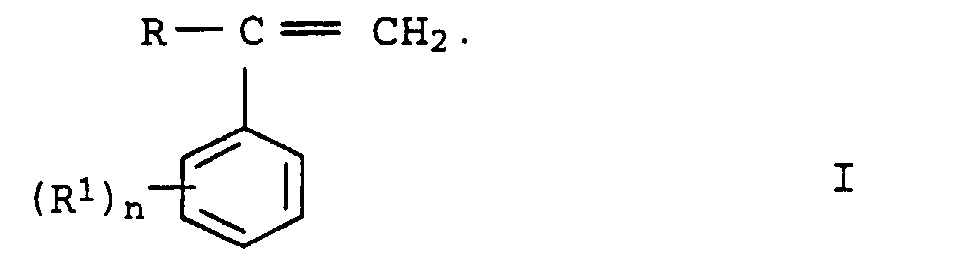
Für die Pfropfgrundlage b1 kommen Polymerisate in Betracht, deren Glasübergangstemperatur unterhalb von 10°C, vorzugsweise unterhalb von 0°C, besonders bevorzugt unterhalb von -20°C liegt. Dies sind z.B. Elastomere auf der Basis von C1- bis C8-Alkylestern der Acrylsäure, die gegebenenfalls weitere Comonomere enthalten können.Polymers whose glass transition temperature is below 10 ° C., preferably below 0 ° C., particularly preferably below -20 ° C., are suitable for the graft base b 1 . These are, for example, elastomers based on C 1 to C 8 alkyl esters of acrylic acid, which may optionally contain further comonomers.
Bevorzugt sind Pfropfgrundlagen b1, die aufgebaut sind aus
Diese Art von Pfropfgrundlagen ist an sich bekannt und in der Literatur beschrieben, beispielsweise in der DE-A 31 49 358.This type of graft base is known per se and in the Literature described, for example in DE-A 31 49 358.
Von den Pfropfauflagen b2 sind diejenigen bevorzugt, in denen b21 Styrol oder α-Methylstyrol oder deren Mischungen und b22 Acrylnitril oder Methacrylnitril bedeutet. Als bevorzugte Monomeren-Gemische werden vor allem Styrol und Acrylnitril oder α-Methylstyrol und Acrylnitril eingesetzt. Die Pfropfauflagen sind erhältlich durch Copolymerisation der Komponenten b21 und b22.Of the graft pads b2, preference is given to those in which b 21 is styrene or α-methylstyrene or mixtures thereof and b 22 is acrylonitrile or methacrylonitrile. Styrene and acrylonitrile or α-methylstyrene and acrylonitrile are used as preferred monomer mixtures. The grafting pads can be obtained by copolymerizing components b 21 and b 22 .
Die Pfropfgrundlage b1 der Pfropfpolymerisate B, die aus den Komponenten b11, gegebenenfalls b12 und b13 aufgebaut ist, wird auch als ASA-Kautschuk bezeichnet. Ihre Herstellung ist an sich bekannt und beispielsweise in der DE-A 28 26 925, der DE-A 31 49 358 und der DE-A 34 14 118 beschrieben.The graft base b 1 of the graft polymers B, which is composed of components b 11 , optionally b12 and b13, is also referred to as ASA rubber. Their manufacture is known per se and is described, for example, in DE-A 28 26 925, DE-A 31 49 358 and DE-A 34 14 118.
Die Herstellung der Pfropfpolymerisate B kann beispielsweise nach der in der DE-PS 12 60 135 beschriebenen Methode erfolgen.The graft polymers B can be prepared, for example, according to the method described in DE-PS 12 60 135.
Der Aufbau der Pfropfauflage (Pfropfhülle) der Pfropfpolymerisate kann ein- oder zweistufig erfolgen.The structure of the graft pad (graft shell) of the graft polymers can be done in one or two stages.
Im Falle des einstufigen Aufbaues der Pfropfhülle wird ein Gemisch der Monomeren b21 und b22 in dem gewünschten Gew.-Verhältnis im Bereich von 95:5 bis 50:50, vorzugsweise von 90:10 bis 65:35 in Gegenwart des Elastomeren b1, in an sich bekannter Weise (vgl. z.B. DE-OS 28 26 925), vorzugsweise in Emulsion, polymerisiert.In the case of the one-stage structure of the graft shell, a mixture of the monomers b 21 and b 22 in the desired weight ratio in the range from 95: 5 to 50:50, preferably from 90:10 to 65:35 in the presence of the elastomer b 1 , polymerized in a manner known per se (cf., for example, DE-OS 28 26 925), preferably in emulsion.
Im Falle eines zweistufigen Aufbaus der Pfropfhülle b2 macht die 1. Stufe im allgemeinen 20 bis 70 Gew.-%, vorzugsweise 25 bis 50 Gew.-%, bezogen auf b2, aus. Zu ihrer Herstellung werden vorzugsweise nur Styrol oder substituierte Styrole oder deren Mischungen (b21) verwendet.In the case of a two-stage construction of the graft shell b 2 , the first stage generally makes up 20 to 70% by weight, preferably 25 to 50% by weight, based on b 2 . Only styrene or substituted styrenes or mixtures thereof (b 21 ) are preferably used for their preparation.
Die 2. Stufe der Pfropfhülle macht im allgemeinen 30 bis 80 Gew.-%, insbesondere 50 bis 75 Gew.-%, jeweils bezogen auf b2, aus. Zu ihrer Herstellung werden Mischungen aus den Monomeren b21 und den Nitrilen b22 im Gewichtsverhältnis b21/b22 von im allgemeinen 90:10 bis 60:40, insbesondere 80:20 bis 70:30 angewendet. The second stage of the graft shell generally makes up 30 to 80% by weight, in particular 50 to 75% by weight, based in each case on b 2 . Mixtures of the monomers b 21 and the nitriles b 22 in a weight ratio b 21 / b 22 of generally 90:10 to 60:40, in particular 80:20 to 70:30, are used for their preparation.
Die Bedingungen der Pfropfpolymerisation werden vorzugsweise so gewählt, daß Teilchengrößen von 50 bis 700 nm (d50-Wert der integralen Massenverteilung) resultieren. Maßnahmen hierzu sind bekannt und z.B. in der DE-OS 28 26 925 beschrieben.The conditions of the graft polymerization are preferably chosen so that particle sizes of 50 to 700 nm (d 50 value of the integral mass distribution) result. Measures for this are known and described, for example, in DE-OS 28 26 925.
Durch das Saatlatex-Verfahren kann direkt eine grobteilige Kautschukdispersion hergestellt werden.With the seed latex process, a coarse-grained Rubber dispersion can be produced.
Um möglichst zähe Produkte zu erzielen, ist es häufig von Vorteil, eine Mischung mindestens zweier Pfropfpolymerisate mit unterschiedlicher Teilchengröße zu verwenden.In order to achieve products that are as tough as possible, it is often advantageous to a mixture of at least two graft polymers with different ones To use particle size.
Um dies zu erreichen, werden die Teilchen des Kautschuks in bekannter Weise, z.B. durch Agglomeration, vergrößert, so daß der Latex bimodal (50 bis 180 nm und 200 bis 700 nm) aufgebaut ist.To achieve this, the rubber particles are known in the art Manner, e.g. by agglomeration, enlarged so that the Latex is bimodal (50 to 180 nm and 200 to 700 nm).
In einer bevorzugten Ausführungsform wird eine Mischung aus zwei Pfropfpolymerisaten mit Teilchendurchmessern (d50-Wert der integralen Massenverteilung) von 50 bis 180 nm bzw. 200 bis 700 nm im Gewichtsverhältnis 70:30 bis 30:70 eingesetzt.In a preferred embodiment, a mixture of two graft polymers with particle diameters (d 50 value of the integral mass distribution) of 50 to 180 nm or 200 to 700 nm in a weight ratio of 70:30 to 30:70 is used.
Der chemische Aufbau der beiden Pfropfpolymerisate ist vorzugsweise derselbe, obwohl die Hülle des grobteiligen Pfropfpolymerisates insbesondere auch zweistufig aufgebaut werden kann.The chemical structure of the two graft polymers is preferred the same, although the shell of the coarse-particle graft polymer in particular can also be built in two stages.
Mischungen aus der Komponente A und B, wobei letztere ein grob- und ein feinteiliges Pfropfpolymerisat aufweist, sind z.B. in der DE-OS 36 15 607 beschrieben. Mischungen aus der Komponente A und B, wobei letzere eine zweistufige Pfropfhülle aufweist, sind aus EP-A 111 260 bekannt.Mixtures of components A and B, the latter being a rough and has a finely divided graft polymer, e.g. in the DE-OS 36 15 607 described. Mixtures of component A and B, the latter having a two-stage graft shell, are off EP-A 111 260 known.
Als Komponente C enthalten die erfindungsgemäßen Formmassen von 2 bis 50 Gew.-%, bezogen auf die Summe der Komponenten A bis G, mindestens eines Copolymerisates auf der Basis von Styrol oder substituierten Styrolen und ungesättigten Nitrilen. Bevorzugte erfindungsgemäße Formmassen enthalten die Komponente C in Anteilen von 5 bis 40, insbesondere von 6 bis 35 Gew.-%, bezogen auf die Summe der Komponente A bis G.The molding compositions according to the invention contain as component C of 2 to 50% by weight, based on the sum of components A to G, at least one copolymer based on styrene or substituted styrenes and unsaturated nitriles. Preferred Molding compositions according to the invention contain component C in proportions from 5 to 40, in particular from 6 to 35% by weight, based on the sum of components A to G.
Die Copolymerisate C sind erfindungsgemäß aus
Die Copolymerisate C sind harzartig, thermoplastisch und kautschukfrei. Besonders bevorzugte Copolymerisate C sind solche aus Styrol und Acrylnitril, aus α-Methylstyrol und Acrylnitril oder aus Styrol, α-Methylstyrol und Acrylnitril. Es können auch mehrere der beschriebenen Copolymere gleichzeitig eingesetzt werden.The copolymers C are resinous, thermoplastic and rubber-free. Particularly preferred copolymers C are those from styrene and acrylonitrile, from α-methylstyrene and acrylonitrile or from styrene, α-methylstyrene and acrylonitrile. It can too several of the copolymers described can be used simultaneously.
Solche Copolymerisate entstehen häufig bei der Pfropfpolymerisation zur Herstellung der Komponente B als Nebenprodukte, besonders dann, wenn große Mengen Monomere auf kleine Mengen Kautschuk gepropft werden.Such copolymers are often formed in the graft polymerization for the production of component B as by-products, especially when large amounts of monomers on small amounts Grafted rubber.
Die Copolymerisate C sind an sich bekannt und lassen sich durch radikalische Polymerisation, insbesondere durch Emulsions-, Suspensions-, Lösungs- und Massepolymerisation herstellen. Sie weisen Viskositätszahlen im Bereich von 40 bis 160 auf, dies entspricht mittleren Molekulargewichten Mw (Gewichtsmittelwert) von 40 000 bis 2 000 000.The copolymers C are known per se and can be prepared by radical polymerization, in particular by emulsion, suspension, solution and bulk polymerization. They have viscosity numbers in the range from 40 to 160, this corresponds to average molecular weights M w (weight average) of 40,000 to 2,000,000.
Als weitere Komponente enthalten die erfindungsgemäßen Formmassen 0,5 bis 25 Gew.-%, bezogen auf die Summe der Komponenten A bis G mindestens eines Netzwerkkautschukes D. Bevorzugte erfindungsgemäße Formmassen enthalten die Netzwerkkautschuke D in Mengen von 1 bis 20 Gew.-%, bezogen auf die Summe der Komponenten A bis G. Besonders bevorzugte Formmassen im Sinne der Erfindung weisen von 1,5 bis 17,5 Gew.-%, bezogen auf die Summe der Komponenten A bis G, an Netzwerkkautschuken D auf.The molding compositions according to the invention contain as a further component 0.5 to 25 wt .-%, based on the sum of components A to G. at least one network rubber D. Preferred according to the invention Molding compounds contain the network rubbers D in quantities from 1 to 20% by weight, based on the sum of components A to G. Have particularly preferred molding compositions for the purposes of the invention from 1.5 to 17.5% by weight, based on the sum of components A to G, on network rubbers D.
Erfindungsgemäß ist D ein Netzwerkkautschuk auf der Basis von Siloxanen und Acrylaten oder Methacrylaten.According to the invention, D is a network rubber based on Siloxanes and acrylates or methacrylates.
Die Netzwerkkautschuke D enthalten im allgemeinen
Bevorzugte Polysiloxane leiten sich von cyclischen Organosiloxanen mit vorzugsweise drei bis sechs Siliziumatomen ab. Beispiele geeigneter Siloxane sind Hexamethylcyclotrisiloxan, Octamethylcyclotetrasiloxan, Decamethylcyclopentasiloxan, Dodecamethylcyclohexasiloxan, Trimethyltriphenylcyclotrisiloxan, Tetramethyltetraphenylcyclotetrasiloxan oder Octaphenylcyclotetrasiloxan. Die Polysiloxane können aus einem oder verschiedenen Organosiloxanen aufgebaut sein.Preferred polysiloxanes are derived from cyclic organosiloxanes with preferably three to six silicon atoms. Examples suitable siloxanes are hexamethylcyclotrisiloxane, octamethylcyclotetrasiloxane, Decamethylcyclopentasiloxane, dodecamethylcyclohexasiloxane, Trimethyltriphenylcyclotrisiloxane, tetramethyltetraphenylcyclotetrasiloxane or octaphenylcyclotetrasiloxane. The Polysiloxanes can be made from one or different organosiloxanes be constructed.
Darüber hinaus enthalten die Polyorganosiloxane d11 in der Regel von 0,1 bis 30 Gew.-%, bezogen auf d11, mindestens eines Vernetzers . Tri- oder tetrafunktionelle Silane wie Trimethoxymethylsilan, Triethoxyphenylsilan, Tetramethoxysilan, Tetraethoxysilan, Tetra-n-propoxysilan oder Tetrabutoxysilan können als Vernetzer eingesetzt werden. Darunter sind tetrafunktionelle Silane besonders bevorzugt.In addition, the polyorganosiloxanes d 11 generally contain from 0.1 to 30% by weight, based on d 11 , of at least one crosslinking agent. Trifunctional or tetrafunctional silanes such as trimethoxymethylsilane, triethoxyphenylsilane, tetramethoxysilane, tetraethoxysilane, tetra-n-propoxysilane or tetrabutoxysilane can be used as crosslinkers. Among them, tetrafunctional silanes are particularly preferred.
Weiterhin enthalten die Polyorganosiloxane im allgemeinen von 0
bis 10 Gew.-%, bezogen auf d11, an pfropfaktiven Monomeren. Als
pfropfaktive Monomere können beispielsweise ungesättigte Silane
der allgemeinen Formeln III bis V eingesetzt werden:



Bevorzugte pfropfaktive Monomere sind die Methacryloylsilane der
allgemeinen Formel III. Als Beispiele seien genannt:
Verfahren zur Herstellung von Polyorganosiloxanen sind beipielsweise in der US 2,891,920 oder 3,294,725 beschrieben Bevorzugt werden die Polyorganosiloxane dadurch hergestellt, daß in einem Lösungsmittel eine Mischung der Organosiloxane, der Vernetzer und gewünschtenfalls der pfropfaktiven Monomeren unter Scherung mit Wasser in Gegenwart eines Emulsionsmittels wie einer Alkylsulfonsäure oder vorzugsweise einer Alkylbenzolsulfonsäure gemischt werden. Als Emulsionsmittel können auch die Metallsalze der Alkylsulfonsäure oder der Alkylbenzolsulfonsäure eingesetzt werden.Examples of processes for the preparation of polyorganosiloxanes are preferred in US 2,891,920 or 3,294,725 the polyorganosiloxanes are prepared in that in a Solvent a mixture of organosiloxanes, crosslinkers and if desired, the graft-active monomers with shear Water in the presence of an emulsion agent such as an alkyl sulfonic acid or preferably mixed with an alkylbenzenesulfonic acid become. The metal salts of alkyl sulfonic acid can also be used as emulsifiers or the alkylbenzenesulfonic acid can be used.
Als monomere Bausteine enthalten die Polyalkylacrylate bzw. Polyalkylmethacrylate d12 im allgemeinen Alkylacrylate oder Methacrylate oder deren Mischungen, Vernetzer und pfropfaktive Monomere, wobei Vernetzer und pfropfaktive Monomere jeweils allein oder zusammen verwendet werden können. Der Anteil von Vernetzer und pfropfaktiven Monomeren liegt in der Regel zusammen im Bereich von 0,1 bis 20 Gew.-%, bezogen auf d12.The polyalkylacrylates or polyalkylmethacrylates d 12 generally contain, as monomeric building blocks, alkyl acrylates or methacrylates or their mixtures, crosslinking agents and graft-active monomers, it being possible for crosslinking agents and graft-active monomers to be used individually or together. The proportion of crosslinking agent and graft-active monomers is generally in the range from 0.1 to 20% by weight, based on d 12 .
Beispiele geeigneter Alkylacrylate bzw. Alkylmethacrylate sind Methylacrylat, Ethylacrylat, n-Propylacrylat, n-Butylacrylat, 2-Ethylhexylacrylat, Hexylmethacrylat, 2-Ethylhexylmethacrylat oder n-Laurylmethacrylat. Besonders bevorzugt wird n-Butylacrylat eingesetzt.Examples of suitable alkyl acrylates or alkyl methacrylates are Methyl acrylate, ethyl acrylate, n-propyl acrylate, n-butyl acrylate, 2-ethylhexyl acrylate, hexyl methacrylate, 2-ethylhexyl methacrylate or n-lauryl methacrylate. N-Butyl acrylate is particularly preferred used.
Der Vernetzer kann beispielsweise Ethylenglycoldimethacrylat, Propylenglycoldimethacrylat, l,3-Butylenglycoldimethacrylat oder 1,4-Butylenglycoldimethacrylat sein.The crosslinker can be, for example, ethylene glycol dimethacrylate, Propylene glycol dimethacrylate, l, 3-butylene glycol dimethacrylate or 1,4-butylene glycol dimethacrylate.
Allylmethacrylat, Triallylcyanurat oder Triallylisocyanurat sind Beispiele geeigneter pfropfaktiver Monomerer. Darunter kann Allylmethacrylat auch als Vernetzer wirken. Allyl methacrylate, triallyl cyanurate or triallyl isocyanurate Examples of suitable graft-active monomers. Below that Allyl methacrylate also act as a crosslinker.
Die Herstellung des Netzwerkes erfolgt dadurch, daß die monomeren Bausteine der Komponente d12 zu dem Polyorganosiloxan d11 gegeben werden, der durch Zugabe von einer wässrigen Lösung einer Base wie Natriumhydroxid, Kaliumhydroxid oder Calciumhydroxid neutralisiert ist. Dadurch wird das Polyorganosiloxan angequollen. Anschließend werden übliche Radikalstarter zugesetzt. Im Verlauf der Polymerisationsreaktion bildet sich ein Netzwerk, bei dem die Komponenten d11 und d12 sich gegenseitig durchdringen. Die Netzwerke können auch miteinander über chemische Bindungen verknüpft sein.The network is produced by adding the monomeric building blocks of component d 12 to the polyorganosiloxane d 11 , which is neutralized by adding an aqueous solution of a base such as sodium hydroxide, potassium hydroxide or calcium hydroxide. This swells the polyorganosiloxane. Then customary radical initiators are added. In the course of the polymerization reaction, a network is formed in which components d 11 and d12 penetrate one another. The networks can also be linked to one another via chemical bonds.
Ganz besonders bevorzugt sind Netzwerke bei denen das Polyorganosiloxan eine Hauptkette aus Dimethylsiloxan aufweist und d12 ein Polyalkylacrylat ist, das eine Hauptkette aus n-Butylacrylat hat.Networks in which the polyorganosiloxane has a main chain of dimethylsiloxane and d 12 is a polyalkyl acrylate which has a main chain of n-butyl acrylate are very particularly preferred.
Der Gelgehalt des Netzwerkes beträgt in der Regel mehr als 80 % (gemessen durch Extraktion mit Toluol bei 90°C über einen Zeitraum von 12 h).The gel content of the network is usually more than 80% (measured by extraction with toluene at 90 ° C over a period of time from 12 h).
Die Pfropfauflage d2 ist in der Regel aus vinylischen Monomeren aufgebaut. Zu diesen zählen Styrol, α-Methylstyrol, Vinyltoluol, Acrylsäureester, z.B. Methylacrylat, Ethylacrylat, oder n-Butylacrylat, Methacrylsäureester wie Methylmethacrylat oder Ethylmethacrylat, Nitrile, beispielsweise Acrylnitril oder Methacrylnitril. Die vinylischen Monomeren können alleine verwendet werden. Es können aber auch Mischungen unterschiedlicher Monomerer eingesetzt werden. Dabei werden die Monomeren im allgemeinen derart gewählt, daß die Pfropfauflage eine Glasübergangstemperatur von mindestens 80°C, bevorzugt im Bereich von 80 bis 110°C (bestimmt mittels Torsionspendelmessung bei einer Frequenz von 1 Hz und einer Aufheizrate von 10°C/min) hat. Besonders bevorzugt werden Pfropfauflagen, die einen überwiegenden Anteil an Methylmethacrylat aufweisen, bevorzugt Pfropfauflagen mit mindestens 85 Gew.-% Methylacrylat. Besonders bevorzugt werden Pfropfauflagen mit einem Anteil von 95 bis 100 Gew.-% Methylmethacrylat. Neben Methylmethacrylat werden bevorzugt Styrol, n-Butylacrylat oder Cyclohexylmethacrylat eingesetzt. Ganz besonders bevorzugt wird Methylmethacrylat alleine verwendet.The graft d 2 is usually made up of vinyl monomers. These include styrene, α-methylstyrene, vinyltoluene, acrylic acid esters, for example methyl acrylate, ethyl acrylate, or n-butyl acrylate, methacrylic acid esters such as methyl methacrylate or ethyl methacrylate, nitriles, for example acrylonitrile or methacrylonitrile. The vinyl monomers can be used alone. Mixtures of different monomers can also be used. The monomers are generally chosen such that the graft has a glass transition temperature of at least 80 ° C., preferably in the range from 80 to 110 ° C. (determined by means of torsional pendulum measurement at a frequency of 1 Hz and a heating rate of 10 ° C./min) . Grafting pads which have a predominant proportion of methyl methacrylate are particularly preferred, preferably grafting pads with at least 85% by weight of methyl acrylate. Grafting pads with a proportion of 95 to 100% by weight of methyl methacrylate are particularly preferred. In addition to methyl methacrylate, styrene, n-butyl acrylate or cyclohexyl methacrylate are preferably used. Methyl methacrylate is very particularly preferably used alone.
Als Komponente E enthalten die erfindungsgemäßen Formmassen von 0,1 bis 5 Gew.-% mindestens eines Copolymeren E. Bevorzugt werden erfindungsgemäße Formmassen, die von 0,2 bis 4, insbesondere von 0,3 bis 3 Gew.-%, bezogen auf die Summe der Komponenten A bis G, der Komponente E enthalten. The molding compositions according to the invention contain as component E of 0.1 to 5% by weight of at least one copolymer E. are preferred Molding compositions according to the invention, the from 0.2 to 4, in particular from 0.3 to 3% by weight, based on the sum of components A to G, of component E included.
Die Copolymeren E sind erfindungsgemäß aus mindestens zwei unterschiedlichen Alkylestern, aromatischen oder alkylaromatischen Ester der Acrylsäure oder der Methacrylsäure oder deren Mischungen aufgebaut.According to the invention, the copolymers E are composed of at least two different ones Alkyl esters, aromatic or alkyl aromatic Esters of acrylic acid or methacrylic acid or their Mixtures built up.
Im allgemeinen haben die Ester 1 bis 10, bevorzugt 1 bis 8 Kohlenstoffatome im Alkylrest. Der Alkylrest kann sowohl linear als auch verzweigt sein. Zu den Alklyresten zählt Methyl, Ethyl, n-Propyl, i-Propyl, n-Butyl, i-Butyl, t-Butyl, n-Pentyl, 2-Ethylhexyl oder Cyclohexyl. Bevorzugt werden Methylmethacrylat, Cyclohexylmethacrylat, n-Butylacrylat oder 2-Ethylhexylacrylat verwendet. Unter den aromatischen Estern sind Ester mit 6 bis 18 Kohlenstoffen bevorzugt, darunter insbesondere Phenyl. Besonders bevorzugt werden Copolymere E, die von 70 bis 99, insbesondere von 80 bis 93 Gew.-% Methylmethacrylat und von 1 bis 30, insbesondere von 7 bis 20 Gew.-% n-Butylacrylat enthalten.In general, the esters have 1 to 10, preferably 1 to 8 Carbon atoms in the alkyl radical. The alkyl radical can be both linear be branched as well. The alkyl radicals include methyl, ethyl, n-propyl, i-propyl, n-butyl, i-butyl, t-butyl, n-pentyl, 2-ethylhexyl or cyclohexyl. Methyl methacrylate, cyclohexyl methacrylate, n-butyl acrylate or 2-ethylhexyl acrylate used. Among the aromatic esters are esters with 6 to 18 Carbons preferred, including especially phenyl. Especially copolymers E which are from 70 to 99, in particular, are preferred from 80 to 93% by weight of methyl methacrylate and from 1 to 30, in particular contain from 7 to 20% by weight of n-butyl acrylate.
Erfindungsgemäß haben die Polymeren E ein hohes Molekulargewicht. In der Regel weisen sie Molekulargewichte (Zahlenmittelwert Mw) von mindestens 1.000.000 g/mol (gemessen mittels Gelpermeationschromatographie in Tetrahydrofuran gegen einen Polystyrolstandard) auf. Bevorzugte Copolymere E haben Molekulargewichte Mw von 1.100 000 g/mol oder darüber, beispielsweise mindestens 1.200 000 g/mol. Im allgemeinen haben die Copolymeren E eine Glasübergangstemperatur im Bereich von 40 bis 125, bevorzugt 70 bis 120°C (bestimmt mittels DSC-Messungen, bei einer Aufheizrate von 10 K/min, zweiter Cyclus nach Aufheizen auf 175°C und Abkühlen auf Raumtemperatur).According to the invention, the polymers E have a high molecular weight. As a rule, they have molecular weights (number average M w ) of at least 1,000,000 g / mol (measured by means of gel permeation chromatography in tetrahydrofuran against a polystyrene standard). Preferred copolymers E have molecular weights M w of 1,100,000 g / mol or more, for example at least 1,200,000 g / mol. In general, the copolymers E have a glass transition temperature in the range from 40 to 125, preferably 70 to 120 ° C. (determined by means of DSC measurements, at a heating rate of 10 K / min, second cycle after heating to 175 ° C. and cooling to room temperature) .
Die erfindungsgemäßen Formmassen können auch mit Flammschutzmitteln ausgerüstet sein. Sie enthalten erfindungsgemäß von 0 bis 25, bevorzugt von 0 bis 17,5 Gew-%, bezogen auf die Summe der Komponenten A bis G, mindestens einer halogenfreien Phosphorverbindung. Beispielsweise können sie in Mengen von 5 bis 15 Gew.-%, bezogen auf die Summe der Komponenten A bis G, in den Formmassen enthalten sein.The molding compositions according to the invention can also be used with flame retardants be equipped. According to the invention, they contain from 0 to 25, preferably from 0 to 17.5% by weight, based on the sum of the Components A to G, at least one halogen-free phosphorus compound. For example, they can range from 5 to 15 wt .-%, based on the sum of components A to G, in the Molding compounds may be included.
Derartige Phosphorverbindungen sind an sich bekannt oder nach bekannten Methoden erhältlich.Such phosphorus compounds are known per se or according to known ones Methods available.
Bevorzugt sind Phosphorverbindungen der allgemeinen Formel VI, in
denen mindestens zwei der Reste am Phosphor gleich sind:

- R4, R5, R6
- unabhängig voneinander halogenfreie C1- bis C8-Alkylgruppen oder halogenfreie C6- bis C20-Arylgruppen, die ein- bis zweifach durch C1- bis C4-Alkylgruppen substituiert sein können.
- R 4 , R 5 , R 6
- independently of one another halogen-free C 1 to C 8 alkyl groups or halogen-free C 6 to C 20 aryl groups which can be substituted one to two times by C 1 to C 4 alkyl groups.
Die Verwendung von aromatischen Phosphaten, insbesondere von Phosphaten der allgemeinen Formel VI, in denen die Reste für Phenyl- oder Kresylgruppen, die ihrerseits auch ein- bis zweifach, vorzugsweise durch Methyl-, Ethyl- und Isopropylgruppen substituiert sein können, stehen, ist bevorzugt.The use of aromatic phosphates, especially of Phosphates of the general formula VI, in which the radicals for Phenyl or cresyl groups, which in turn are also one to two, preferably by methyl, ethyl and isopropyl groups may be substituted, is preferred.
Als besonders geeignete Phosphorverbindungen der allgemeinen Formel VI lassen sich beispielsweise Tri-(2,6-dimethylphenyl)-phosphat, Triphenylphosphat, Trikresylphosphat, Diphenyl-2-ethyl-kresylphosphat, Diphenyl-kresylphosphat und Tri-(isopropylphenyl)-phosphat nennen.As particularly suitable phosphorus compounds of the general formula VI can be, for example, tri (2,6-dimethylphenyl) phosphate, Triphenyl phosphate, tricresyl phosphate, Diphenyl-2-ethyl-cresyl phosphate, diphenyl-cresyl phosphate and Name tri- (isopropylphenyl) phosphate.
Um eine erhöhte Vicat-Temperatur in den Mischungen einzustellen, können auch Mischungen der obengenannten Phosphate mit beispielsweise Triphenylphosphinoxid oder Tri-(2,6-dimethylphenyl)-phosphinoxid eingesetzt werden.To set a higher Vicat temperature in the mixtures, can also mixtures of the above-mentioned phosphates with, for example Triphenylphosphine oxide or tri (2,6-dimethylphenyl) phosphine oxide be used.
Weiterhin ist der Zusatz der in der DE-A 38 24 356 genannten Phosphate wie Phosphorsäure-bis-phenyl-(4-phenylphenyl)-ester, Phosphorsäure-phenyl-bis-(4-phenylphenyl)-ester, Phosphorsäuretris-(4-phenylphenyl)-ester, Phosphorsäure-bis-phenyl-(benzylphenyl)-ester, Phosphorsäure-phenyl-bis-(benzylphenyl)-ester, Phosphorsäure-tris-(benzylphenyl)-ester, Phosphorsäure-phenylbis-[(1-phenylethyl)-phenyl]-ester, Phosphorsäure-phenylbis-[(l-methyl-1-phenylethyl)-phenyl]-ester und Phosphorsäurephenyl-bis-[4-(1-phenylethyl)-2,6-dimethylphenyl]-ester zur Erhöhung der Vicat-Temperatur der Mischungen geeignet.Furthermore, the addition of those mentioned in DE-A 38 24 356 Phosphates such as phosphoric acid bis-phenyl (4-phenylphenyl) esters, Phosphoric acid phenyl bis (4-phenylphenyl) ester, phosphoric acid tris (4-phenylphenyl) ester, Phosphoric acid bis-phenyl (benzylphenyl) ester, Phosphoric acid phenyl bis (benzylphenyl) ester, Phosphoric acid tris (benzylphenyl) ester, phosphoric acid phenyl bis - [(1-phenylethyl) phenyl] ester, Phosphoric acid phenyl bis - [(l-methyl-1-phenylethyl) phenyl] ester and phosphoric acid phenyl bis- [4- (1-phenylethyl) -2,6-dimethylphenyl] ester to increase the Vicat temperature of the mixtures.
Des weiteren können Resorcinoldiphosphat bzw. entsprechende höhere Oligomere, Hydrochinondiphosphat oder höhere Oligomere dieser Verbindung als Komponente F eingesetzt werden. Derartige Phosphorverbindungen sind beispielsweise in der EP-A 522 397 beschrieben.Furthermore, resorcinol diphosphate or correspondingly higher ones Oligomers, hydroquinone diphosphate or higher oligomers of these Compound can be used as component F. Such Phosphorus compounds are described, for example, in EP-A 522 397.
Neben den Komponenten A bis F enthalten die Formmassen erfindungsgemäß von 0 bis 45, bevorzugt von 0 bis 35 Gew.-%, bezogen auf die Summe der Komponenten A bis G, an Zusatzstoffen.In addition to components A to F, the molding compositions contain from 0 to 45% by weight, preferably from 0 to 35% by weight, based on the sum of components A to G, of additives.
Unter Zusatzstoffen sind z.B. faser- oder teilchenförmige Füllstoffe oder deren Mischung, Verarbeitungshilfsmittel, beispielsweise Schmiermittel, Gleit- oder Entformungsmittel, Stabilisatoren wie UV-Stabilisatoren, Phosphorstabilisatoren, Antioxidantien, Antistatika oder Farbmittel zu verstehen.Among additives are e.g. fibrous or particulate fillers or their mixture, processing aids, for example Lubricants, lubricants or mold release agents, stabilizers such as UV stabilizers, phosphorus stabilizers, antioxidants, To understand antistatic agents or colorants.
Füllstoffe sind im allgemeinen in Mengen von 0 bis 40, bevorzugt von 0 bis 30 Gew.-%, bezogen auf die Summe der Komponenten A bis G in den erfindungsgemäßen Formmassen enthalten. Verarbeitungshilfsmittel werden üblicherweise in Mengen von 0 bis 5, bevorzugt von 0 bis 3 Gew.-%, bezogen auf die Summe der Komponenten A bis G verwendet. Stabilisatoren und Antistatika haben in der Regel einen Anteil von 0 bis 3, bevorzugt von 0 bis 2 Gew.-%, bezogen auf die Summe der Komponenten A bis G, an den erfindungsgemäßen Formmassen. Farbmittel können z.B. in Mengen von 0 bis 10, bevorzugt von 0 bis 8 Gew.-%, bezogen auf die Summe der Komponenten A bis G, verwendet werden.Fillers are generally preferred in amounts of 0 to 40 from 0 to 30% by weight, based on the sum of components A to G contained in the molding compositions according to the invention. Processing aids are usually preferred in amounts of 0 to 5 from 0 to 3% by weight, based on the sum of components A to G used. Stabilizers and antistatic agents usually have a proportion of 0 to 3, preferably from 0 to 2 wt .-%, based on the sum of components A to G, on the inventive Molding compounds. Colorants can e.g. in amounts of 0 to 10, preferred from 0 to 8% by weight, based on the sum of components A to G, can be used.
Zu den bevorzugten Füllstoffen zählen Kohlefasern, insbesondere Glasfasern. Die verwendeten Glasfasern können aus E-, A- oder C-Glas sein und sind vorzugsweise mit einer Schlichte und einem Haftvermittler ausgerüstet. Ihr Durchmesser liegt im allgemeinen zwischen 6 und 20 µm. Es können sowohl Endlosfasern (rovings) als auch Schnittglasfasern mit einer Länge von 1 bis 10 mm, vorzugsweise 3 bis 6 mm, eingesetzt werden.The preferred fillers include carbon fibers, in particular Fiberglass. The glass fibers used can be made of E, A or C glass be and are preferably with a size and a Adhesion promoter equipped. Their diameter is generally between 6 and 20 µm. Both continuous fibers (rovings) and also cut glass fibers with a length of 1 to 10 mm, preferably 3 to 6 mm.
Weiterhin können Füll- oder Verstärkungsstoffe, wie Glaskugeln, Mineralfasern, Whisker, Aluminiumoxidfasern, Glimmer, Quarzmehl und Wollastonit zugesetzt werden.Furthermore, fillers or reinforcing materials, such as glass balls, Mineral fibers, whiskers, aluminum oxide fibers, mica, quartz powder and wollastonite can be added.
Außerdem seien Metallflocken (z.B. Aluminiumflocken der Fa. Transmet Corp.), Metallpulver, Metallfasern, metallbeschichtete Füllstoffe (z.B. nickelbeschichtete Glasfasern) sowie andere Zuschlagsstoffe, die elektromagnetische Wellen abschirmen, genannt. Insbesondere kommen Al-Flocken (K 102 der Fa. Transmet) für EMI-Zwecke (electro-magnetic interference) in Betracht; ferner Abmischen dieser Masse mit zusätzlichen Kohlenstoffasern, Leitfähigkeitsruß oder nickelbeschichteten C-Fasern.In addition, metal flakes (for example aluminum flakes from Transmet Corp.), metal powder, metal fibers, metal-coated fillers (for example nickel-coated glass fibers) and other additives which shield electromagnetic waves are mentioned. In particular, Al-flakes come (K 102 from Transmet.) For EMI purposes (e lectro- m agnetic nterference i) into consideration; further mixing of this mass with additional carbon fibers, carbon black or nickel-coated carbon fibers.
Verarbeitungshilfsmittel sind allgemein bekannt. Beispielsweise können Mehrkomponentenester auf Fettsäurebasis oder Ethylenwachse als Schmiermittel eingesetzt werden.Processing aids are generally known. For example can multicomponent esters based on fatty acids or ethylene waxes are used as lubricants.
Als UV-Stabilisatoren kommen vor allem Phosphite, Hypophosphite
oder Phosphonite, sowie Benzotriazole oder Benzophenone in Betracht.
Besonders bevorzugte Stabilisatoren sind Mischungen aus
einem Phosphin der allgemeinen Formel VII
Zu den besonders bevorzugten Phosphinen zählen Triethylphosphin, Tributylphosphin, Tripropylphosphin, Triamylphosphin, Trioctylphosphin, Dimethylphenylphosphin, Dibutylphenylphosphin, Diphenylmethylphosphin, Diphenylbutylphosphin, Diphenyloctylphosphin, Diphenyloctadecylphosphin, Triphenylphosphin, Tri(butylphenyl)phosphin, Tri-p-tolylphosphin, Tri(p-nonylphenyl)phosphin, Trinaphthylphosphin, Tri(p-chlorophenyl)phosphin, Tri(p-fluorophenyl)phosphin, Diphenylbenzylphosphin, Diphenyl-(p-hydroxyphenyl)phosphin, Di-phenyl-1,4-dihydroxyphenyl-2-phosphin und Phenylnaphthylbenzylphosphin. Triphenylphosphin ist die besonders bevorzugte Verbindung der Formel VII.The particularly preferred phosphines include triethylphosphine, Tributylphosphine, tripropylphosphine, triamylphosphine, trioctylphosphine, Dimethylphenylphosphine, dibutylphenylphosphine, diphenylmethylphosphine, Diphenylbutylphosphine, diphenyloctylphosphine, Diphenyloctadecylphosphine, triphenylphosphine, tri (butylphenyl) phosphine, Tri-p-tolylphosphine, tri (p-nonylphenyl) phosphine, Trinaphthylphosphine, tri (p-chlorophenyl) phosphine, tri (p-fluorophenyl) phosphine, Diphenylbenzylphosphine, diphenyl- (p-hydroxyphenyl) phosphine, Di-phenyl-1,4-dihydroxyphenyl-2-phosphine and phenylnaphthylbenzylphosphine. Triphenylphosphine is the special one preferred compound of formula VII.
Als gehinderte Phenole kommen insbesondere 2,6-Di-t-butyl-4-methylphenol, 2,6-Di-t-butyl-4-s-butylphenol, 4-(Hydroxymethyl)-2,6-di-t-butylphenol oder 2,6-Di-t-butyl-4-methoxyphenol. Weitere Beispiele bevorzugter Phenole sind Octadecyl-3,5-di-t-butyl-4-hydroxyhydrocinnamat, 2-Methyl-4,6-bis((octylthio)-methyl)-phenol, 2,6-Di-t-butyl-4-(dimethylaminomethyl)phenol oder 3,5-Di-t-butyl-4-hydroxybenzyl-di-O-ethylphosphonat. Darüber hinaus können zweikernige gehinderte Phenole eingesetzt werden. Derartige Stabilisatormischungen sind beispielsweise der DE-A 44 19 897 zu entnehmen. The hindered phenols are in particular 2,6-di-t-butyl-4-methylphenol, 2,6-di-t-butyl-4-s-butylphenol, 4- (hydroxymethyl) -2,6-di-t-butylphenol or 2,6-di-t-butyl-4-methoxyphenol. Further examples of preferred phenols are octadecyl-3,5-di-t-butyl-4-hydroxyhydrocinnamate, 2-methyl-4,6-bis ((octylthio) methyl) phenol, 2,6-di-t-butyl-4- (dimethylaminomethyl) phenol or 3,5-di-t-butyl-4-hydroxybenzyl-di-O-ethylphosphonate. In addition, dinuclear hindered phenols be used. Such stabilizer mixtures are see for example DE-A 44 19 897.
Als Farbmittel können sowohl organische als auch anorganische Pigmente verwendet werden. Eine Aufstellung geeigneter Farbmittel findet sich beispielsweise bei Gächter/Müller "Kunststoff-Additive", 3. Auflage, Hanser Verlag München, 1989.Both organic and inorganic can be used as colorants Pigments are used. A list of suitable colorants can be found for example at Gächter / Müller "plastic additives", 3rd edition, Hanser Verlag Munich, 1989.
Neben den genannten Komponenten können die erfindungsgemäßen Formmassen auch noch geringe Mengen an Homo- oder Copolymeren enthalten, die als Nebenprodukte bei der Pfropfung der Netzwerke d1 entstehen können. Diese Homo- bzw. Copolymeren weisen jeweils die Zusammensetzung und Glasübergangstemperatur der Pfropf auf läge d2 auf. Ihre Molekulargewichte (Gewichtsmittelwert Mw) liegen unterhalb von 400 000 g/mol, im allgemeinen weniger als 200 000 g/ mol. In der Regel sind diese Nebenprodukte in Mengen von nicht mehr als 10 Gew.-%, bezogen auf die Summe der Komponenten A bis G, enthalten.In addition to the components mentioned, the molding compositions according to the invention can also contain small amounts of homopolymers or copolymers which can be formed as by-products in the grafting of the networks d 1 . These homopolymers and copolymers each have the composition and glass transition temperature of the graft to d 2 . Their molecular weights (weight average M w ) are below 400,000 g / mol, generally less than 200,000 g / mol. As a rule, these by-products are contained in amounts of not more than 10% by weight, based on the sum of components A to G.
Die Herstellung der erfindungsgemäßen Formmassen erfolgt nach an sich bekannten Verfahren durch Mischen der Komponenten. Es kann vorteilhaft sein, einzelne Komponenten vorzumischen. Auch das Mischen der Komponenten in Lösung und Entfernen der Lösungsmittel ist möglich.The molding compositions according to the invention are produced according to known methods by mixing the components. It can be advantageous to premix individual components. Mixing too the components in solution and solvent removal is possible.
Geeignete organische Lösungsmittel für die Komponenten A bis F und die Zusätze der Gruppe G sind beispielsweise Chlorbenzol, Gemische aus Chlorbenzol und Methylenchlorid oder Gemische aus Chlorbenzol und aromatischen Kohlenwasserstoffen, z.B. Toluol.Suitable organic solvents for components A to F and the Group G additives are, for example, chlorobenzene, mixtures from chlorobenzene and methylene chloride or mixtures Chlorobenzene and aromatic hydrocarbons e.g. Toluene.
Das Mischen der z.B. trockenen Komponenten A, B, C, D, E und gegebenenfalls F und G kann nach allen bekannten Methoden erfolgen. Vorzugsweise geschieht jedoch das Mischen der Komponenten A, B, C, D, E und gegebenenfalls F und G bei Temperaturen von 200 bis 320°C durch gemeinsames Extrudieren, Kneten oder Verwalzen der Komponenten, wobei die Komponenten notwendigenfalls zuvor aus der bei der Polymerisation erhaltenen Lösung oder aus der wäßrigen Dispersion isoliert worden sind.Mixing the e.g. dry components A, B, C, D, E and optionally F and G can be done by all known methods. However, components A, B are preferably mixed, C, D, E and optionally F and G at temperatures from 200 to 320 ° C by extruding, kneading or rolling the Components, the components if necessary from the solution obtained in the polymerization or from the aqueous Dispersion have been isolated.
Die erfindungsgemäßen Formmassen können nach den bekannten Verfahren der Thermoplastverarbeitung bearbeitet werden, also z.B. durch Extrudieren, Spritzgießen, Kalandrieren, Hohlkörperblasen, Pressen oder Sintern.The molding compositions according to the invention can by the known methods thermoplastic processing, e.g. by extrusion, injection molding, calendering, blow molding, Pressing or sintering.
Die erfindungsgemäßen Formmassen sind thermoplastisch und zeichnen sich dadurch aus, daß sie witterungs- und alterungsbeständig sind, sehr gute Tieftemperaturzähigkeiten haben und eine gute Wärmeformbeständigkeit aufweisen. Darüberhinaus haben sie eine hervorragende Fließfähigkeit und sind sehr gut schlagzäh. Insbesondere zeichnen sie sich dadurch aus, daß sie Durchstoßarbeiten aufweisen, die weitgehend unabhängig von den Verarbeitungsbedingungen, sprich Massetemperaturen, der Formmassen sind.The molding compositions according to the invention are thermoplastic and draw is characterized by the fact that it is weather and aging resistant are, have very good low-temperature toughness and good Have heat resistance. They also have one excellent flowability and very good impact resistance. In particular they are characterized by the fact that they have piercing work which are largely independent of the processing conditions, that is, molding temperatures that are molding compounds.
Daher eignen sich die erfindungsgemäßen Formmassen vor allem zum Herstellen von Formkörpern, besonders von großteiligen Formkörpern. Besonders eigenen sich die erfindungsgemäßen Formmassen zum Herstellen von Formkörpern für Außenanwendungen. Darunter fallen beispielsweise Fahrzeugteile, insbesondere Karosserieteile für den Einsatz in Personenkraftwagen. Es ist aber auch möglich aus den erfindungsgemäßen Formmassen Folien oder Fasern herzustellen.The molding compositions according to the invention are therefore particularly suitable for Manufacture of moldings, especially large-scale moldings. The molding compositions according to the invention are particularly suitable for the production of moldings for outdoor applications. Underneath fall, for example, vehicle parts, in particular body parts for use in passenger cars. But it is also possible to produce films or fibers from the molding compositions according to the invention.
Die mittlere Teilchengröße und die Teilchengrößenverteilung wurden aus der integralen Massenverteilung bestimmt. Bei den mittleren Teilchengrößen handelt es sich in allen Fällen um das Gewichtsmittel der Teilchengrößen, wie sie mittels einer analytischen Ultrazentrifuge entsprechend der Methode von W. Scholtan und H. Lange, Kolloid-Z, und Z.-Polymere 250 (1972), Seiten 782 bis 796, bestimmt wurden. Die Ultrazentrifugenmessung liefert die integrale Massenverteilung des Teilchendurchmessers einer Probe. Hieraus läßt sich entnehmen, wieviel Gewichtsprozent der Teilchen einen Durchmesser gleich oder kleiner einer bestimmten Größe haben. Der mittlere Teilchendurchmesser, der auch als d50-Wert der integralen Massenverteilung bezeichnet wird, ist dabei als der Teilchendurchmesser definiert, bei dem 50 Gew.-% der Teilchen einen kleineren Durchmesser haben als der Durchmesser, der dem d50-Wert entspricht. Ebenso haben dann 50 Gew.-% der Teilchen einen größeren Durchmesser als der d50-Wert. Zur Charakterisierung der Breite der Teilchengrößenverteilung der Kautschukteilchen werden neben dem d50-Wert (mittlerer Teilchendurchmesser) die sich aus der integralen Massenverteilung ergebenden d10- und d90-Werte herangezogen. Der d10- bzw. d90-Wert der integralen Massenverteilung ist dabei entsprechend dem d50-Wert definiert mit dem Unterschied, daß sie auf 10 bzw. 90 Gew.-% der Teilchen bezogen sind. Der Quotient Q=(d90-d10)/d50 stellt ein Maß für die Verteilungsbreite der Teilchengröße dar.The mean particle size and the particle size distribution were determined from the integral mass distribution. The mean particle sizes are in all cases the weight-average of the particle sizes, as they are using an analytical ultracentrifuge according to the method of W. Scholtan and H. Lange, Kolloid-Z, and Z.-Polymer 250 (1972), pages 782 to 796. The ultracentrifuge measurement provides the integral mass distribution of the particle diameter of a sample. From this it can be seen what percentage by weight of the particles have a diameter equal to or smaller than a certain size. The mean particle diameter, which is also referred to as the d 50 value of the integral mass distribution, is defined here as the particle diameter at which 50% by weight of the particles have a smaller diameter than the diameter which corresponds to the d 50 value. Likewise, 50% by weight of the particles then have a larger diameter than the d 50 value. To characterize the breadth of the particle size distribution of the rubber particles in addition to the d50 value (median particle diameter) which are selected from the integral mass distribution are d 10 - and d 90 -values used. The d 10 or d 90 value of the integral mass distribution is defined in accordance with the d 50 value with the difference that they are based on 10 or 90% by weight of the particles. The quotient Q = (d 90 -d 10 ) / d 50 represents a measure of the distribution width of the particle size.
Es wurden folgende Komponenten eingesetzt:
Die Tg-Werte der Copolymeren E wurden jeweils durch DSC-Messungen
(Aufheizrate 10 K/min, zweiter Cyclus nach Aufheizen auf 175°C und
Abkühlen auf Raumtemperatur) ermittelt.
Die in der Tabelle angegebenen Komponenten wurden in einem Zweiwellenextruder (ZKS 30 der Firma Werner und Pfleiderer) bei 250 bis 280°C gemischt, als Strang ausgetragen, abgekühlt und granuliert. Das getrocknete Granulat wurde bei 250 bis 280°C zu Normkleinstäben bzw. ISO-Prüfkörpern verarbeitet. Die Herstellung von Rundscheiben erfolgte bei 240, 260, 280 und 300°C Massetemperatur und einer Werkzeugtemperatur von 80°C.The components listed in the table were in a twin-screw extruder (ZKS 30 from Werner and Pfleiderer) at 250 mixed up to 280 ° C, discharged as a strand, cooled and granulated. The dried granules became standard small bars at 250 to 280 ° C or ISO test specimens processed. The production of Round disks were made at 240, 260, 280 and 300 ° C melt temperature and a tool temperature of 80 ° C.
Die Wärmeformbeständigkeit der Proben wurde mittels der Vicat-Erweichungstemperatur ermittelt. Die Vicat-Erweichungstemperatur wurde nach DIN 53 460, mit einer Kraft von 49,05 N und einer Temperatursteigerung von 50 K je Stunde, an Normkleinstäben ermittelt.The heat resistance of the samples was determined using the Vicat softening temperature determined. The Vicat softening temperature was according to DIN 53 460, with a force of 49.05 N and a Temperature increase of 50 K per hour, determined on standard small bars.
Die Fließfähigkeit (MVI) der Formmassen wurde nach DIN 53 735 bei Temperaturen von 260°C und 5 kg Belastung bestimmt.The flowability (MVI) of the molding compositions was in accordance with DIN 53 735 Temperatures of 260 ° C and 5 kg load determined.
Die Kerbschlagzähigkeit wurde nach ISO 179 1eA bei -30°C bestimmt.The impact strength was determined according to ISO 179 1eA at -30 ° C.
Die Durchstoßarbeiten Ws [Nm] (Mittelwert aus fünf Einzelmessungen) wurden mittels Durchstoßtests nach DIN 53 443 bei -30°C gemessen. Das Bruchverhalten wurde auch qualitativ anhand der durchstoßenen Prüfkörper beurteilt, wobei zwischen Sprödbruch (S) und duktilem Bruch (D) unterschieden wurde. Die Zahlenwerte geben dabei die Anzahl der duktil gebrochenen Rundscheiben an. The puncture work W s [Nm] (average of five individual measurements) was measured using puncture tests according to DIN 53 443 at -30 ° C. The fracture behavior was also assessed qualitatively on the basis of the pierced test specimens, a distinction being made between brittle fracture (S) and ductile fracture (D). The numerical values indicate the number of ductile broken round disks.
Die Prüfung der Flammwidrigkeit erfolgte im vertikalen Brandtest nach den Vorschriften der Underwriter Laboratories (Ul 94). Die Prüfung wurde an jeweils 5 Proben der Abmessungen 127 mm x 12,7 mmm x 1,7 mm durchgeführt.The flame retardancy was tested in the vertical fire test according to the regulations of Underwriter Laboratories (Ul 94). The Testing was carried out on 5 samples of dimensions each 127 mm x 12.7 mmm x 1.7 mm.
Die Einteilung in die entsprechenden Brandklassen erfolgte gemäß
UL-94 nach folgenden Kriterien
Die Zusammensetzungen und die Eigenschaften der Formmassen sind
der Tabelle 1 zu entnehmen.
Bruchbild
1D
5D
5D
5D
5D
1D
3D
4D
Bruchbild
3D
5D
5D
5D
5D
2D
3D
5D
Bruchbild
OD
5D
5D
5D
5D
3D
5D
Bruchbild
5D
1D
3D
5D
5D
Fracture pattern
1D
5D
5D
5D
5D
1D
3D
4D
Fracture pattern
3D
5D
5D
5D
5D
2D
3D
5D
Fracture pattern
OD
5D
5D
5D
5D
3D
5D
Fracture pattern
5D
1D
3D
5D
5D
Die erfindungsgemäßen thermoplastischen Formmassen zeichnen sich durch duktiles Bruchverhalten bei -30°C aus, wobei keine Abhängigkeit von der Massetemperatur beobachtet wird. Desweiteren weisen die erfindungsgemäßen Formmassen sehr gute Zähigkeit und gute Fließfähigkeit auf.The thermoplastic molding compositions according to the invention stand out by ductile fracture behavior at -30 ° C, with no dependency is observed from the melt temperature. Furthermore point the molding compositions according to the invention have very good toughness and good Flowability on.
Claims (8)
- A molding material containing, as essential components,the sum of components A to G being 100% by weight.A) from 25 to 95.4% by weight of at least one aromatic polycarbonate,B) from 2 to 30% by weight of at least one graft polymer composed ofb1) from 40 to 80% by weight of a grafting base comprising an elastomeric polymer based on alkyl acrylates where the alkyl radical is of from 1 to 8 carbon atoms and having a glass transition temperature of less than 10°Cb2) from 20 to 60% by weight of a graft layer comprisingb21) from 60 to 95% by weight of styrene or substituted styrenes of the general formula Iwhere R is alkyl of 1 to 8 carbon atoms or hydrogen, R1 is alkyl of 1 to 8 carbon atoms and n is 1, 2 or 3, and
 b22) from 5 to 40% by weight of at least one unsaturated nitrile,C) from 2 to 50% by weight of a copolymer ofc1) from 60 to 95% by weight of styrene or substituted styrenes of the general formula I or mixtures thereofc2) from 5 to 40% by weight of at least one unsaturated nitrile,D) from 0.5 to 25% by weight of at least one network rubber based on siloxanes and acrylates or methacrylates,E) from 0.1 to 5% by weight of at least one copolymer having a weight average molecular weight (Mw) of at least 1,000,000 g/mol of at least two different esters of acrylic acid or of methacrylic acid or mixtures thereof,F) from 0 to 25% by weight of at least one halogen-free phosphorus compound andG) from 0 to 45% by weight of additives,
 - A molding material as claimed in claim 1, containing, as essential components,A) from 25 to 88.8% by weight of at least one polycarbonate A,B) from 5 to 25% by weight of at least one graft polymer B,C) from 5 to 40% by weight of at least one copolymer C,D) from 1 to 15% by weight of at least one network rubber D andE) from 0.2 to 3% by weight of at least one copolymer E.
- A molding material as claimed in claim 1 or 2, in which a network rubber having a graft shell of from 95 to 100% by weight of methyl methacrylate is used as network rubber D.
- A molding material as claimed in any of claims 1 to 3, in which the copolymer E is composed of methyl methacrylate and n-butyl acrylate or methyl methacrylate and 2-ethylhexyl acrylate.
- The use of a molding material as claimed in any of claims 1 to 4 for the production of moldings, films or fibers.
- The use of a molding material as claimed in claim 5 for the production of bodywork parts.
- A molding, film or fiber obtainable from a molding material as claimed in any of claims 1 to 4.
- A bodywork part obtainable from a molding material as claimed in any of claims 1 to 4.
Applications Claiming Priority (3)
| Application Number | Priority Date | Filing Date | Title |
|---|---|---|---|
| DE19635078 | 1996-08-30 | ||
| DE19635078A DE19635078A1 (en) | 1996-08-30 | 1996-08-30 | Molding compounds made from a polycarbonate mixture and a siloxane network rubber |
| PCT/EP1997/004543 WO1998008900A1 (en) | 1996-08-30 | 1997-08-21 | Moulding compounds consisting of a polycarbonate mixture and a siloxane reticular rubber |
Publications (2)
| Publication Number | Publication Date |
|---|---|
| EP0922073A1 EP0922073A1 (en) | 1999-06-16 |
| EP0922073B1 true EP0922073B1 (en) | 2000-03-15 |
Family
ID=7804113
Family Applications (1)
| Application Number | Title | Priority Date | Filing Date |
|---|---|---|---|
| EP97941949A Expired - Lifetime EP0922073B1 (en) | 1996-08-30 | 1997-08-21 | Moulding compounds consisting of a polycarbonate mixture and a siloxane reticular rubber |
Country Status (17)
| Country | Link |
|---|---|
| US (1) | US6232397B1 (en) |
| EP (1) | EP0922073B1 (en) |
| JP (1) | JP2001501227A (en) |
| KR (1) | KR20000035951A (en) |
| CN (1) | CN1228799A (en) |
| AR (1) | AR009454A1 (en) |
| AT (1) | ATE190639T1 (en) |
| AU (1) | AU4380497A (en) |
| BR (1) | BR9711239A (en) |
| CA (1) | CA2263103A1 (en) |
| DE (2) | DE19635078A1 (en) |
| ES (1) | ES2144879T3 (en) |
| HU (1) | HUP9904126A3 (en) |
| PL (1) | PL331890A1 (en) |
| SK (1) | SK22799A3 (en) |
| TW (1) | TW358823B (en) |
| WO (1) | WO1998008900A1 (en) |
Families Citing this family (9)
| Publication number | Priority date | Publication date | Assignee | Title |
|---|---|---|---|---|
| DE19959410A1 (en) * | 1999-12-09 | 2001-06-13 | Basf Ag | Filler-containing thermoplastic molding compounds based on polycarbonate and styrene copolymers |
| AU2002213366A1 (en) * | 2000-10-30 | 2002-05-15 | General Electric Company | Pc/asa composition having improved notched izod and reduced gate blush |
| AU2003244100A1 (en) * | 2002-06-21 | 2004-01-06 | Teijin Chemicals, Ltd. | Acrylic resin composition, organosiloxane resin composition and laminates made by using them |
| KR100665806B1 (en) * | 2005-06-30 | 2007-01-09 | 제일모직주식회사 | Polycarbonate resin composition excellent in light reflectivity |
| DE102007002925A1 (en) * | 2007-01-19 | 2008-07-24 | Bayer Materialscience Ag | Impact modified polycarbonate compositions |
| DE102008028571A1 (en) * | 2008-06-16 | 2009-12-17 | Bayer Materialscience Ag | Impact modified polycarbonate compositions |
| US20100160481A1 (en) * | 2008-12-22 | 2010-06-24 | Cheil Industries Inc. | Blend Composition of Polycarbonate Resin and Vinyl-Based Copolymer and Molded Product Made Using the Same |
| KR20150047991A (en) * | 2013-10-25 | 2015-05-06 | 제일모직주식회사 | Thermoplastic resin composition with excellent colorability and mechanical properties |
| KR102624855B1 (en) * | 2020-08-27 | 2024-01-12 | 롯데케미칼 주식회사 | Thermoplastic resin composition and article produced therefrom |
Family Cites Families (14)
| Publication number | Priority date | Publication date | Assignee | Title |
|---|---|---|---|---|
| US2891920A (en) | 1955-01-26 | 1959-06-23 | Dow Corning | Polymerization of organopolysiloxanes in aqueous emulsion |
| GB1024024A (en) | 1963-04-08 | 1966-03-30 | Dow Corning | Improvements in or relating to polymerising or co-polymerising organosilicon compounds |
| DE2842005A1 (en) | 1978-09-27 | 1980-04-10 | Bayer Ag | POLYCARBONATES WITH ALKYLPHENYL END GROUPS, THEIR PRODUCTION AND THEIR USE |
| DE3245292A1 (en) | 1982-12-08 | 1984-06-20 | Basf Ag, 6700 Ludwigshafen | THERMOPLASTIC MOLDS |
| DE3334782A1 (en) | 1983-04-19 | 1984-10-25 | Bayer Ag, 5090 Leverkusen | METHOD FOR PRODUCING POLYDIORGANOSILOXANES WITH HYDROXYARYLOXY END GROUPS |
| DE3506472A1 (en) | 1985-02-23 | 1986-08-28 | Bayer Ag, 5090 Leverkusen | NEW POLYDIORGANOSILOXANE POLYCARBONATE BLOCK COPOLYMERS |
| DE3631540A1 (en) | 1986-09-17 | 1988-03-24 | Bayer Ag | THERMOPLASTIC MOLDS WITH HIGH AGING RESISTANCE AND GOOD DEEP TEMPERATURE |
| EP0307963B1 (en) | 1987-09-21 | 1995-02-15 | Mitsubishi Rayon Co., Ltd. | Polycarbonate resin composition |
| US4927880A (en) | 1988-11-14 | 1990-05-22 | General Electric Company | Low gloss molded articles using polyorganosiloxane/polyvinyl-based graft polymers |
| DE4238906A1 (en) | 1991-11-23 | 1993-05-27 | Basf Ag | Moulding material contg. toughened polystyrene - exhibits high deg. of toughness and good resistance to weathering and ageing |
| WO1993022382A1 (en) * | 1992-04-24 | 1993-11-11 | Ge Plastics Japan, Ltd. | Polycarbonate resin composition |
| US5362783A (en) * | 1993-06-08 | 1994-11-08 | The Dow Chemical Company | Stabilizer composition |
| AU676590B2 (en) | 1993-09-08 | 1997-03-13 | Teijin Chemicals Ltd | Resin composition and molded article |
| JPH07207085A (en) * | 1994-01-12 | 1995-08-08 | Nippon G Ii Plast Kk | High-impact resin composition |
-
1996
- 1996-08-30 DE DE19635078A patent/DE19635078A1/en not_active Withdrawn
-
1997
- 1997-08-21 US US09/242,733 patent/US6232397B1/en not_active Expired - Fee Related
- 1997-08-21 CA CA002263103A patent/CA2263103A1/en not_active Abandoned
- 1997-08-21 HU HU9904126A patent/HUP9904126A3/en unknown
- 1997-08-21 ES ES97941949T patent/ES2144879T3/en not_active Expired - Lifetime
- 1997-08-21 SK SK227-99A patent/SK22799A3/en unknown
- 1997-08-21 DE DE59701282T patent/DE59701282D1/en not_active Expired - Lifetime
- 1997-08-21 WO PCT/EP1997/004543 patent/WO1998008900A1/en not_active Ceased
- 1997-08-21 EP EP97941949A patent/EP0922073B1/en not_active Expired - Lifetime
- 1997-08-21 KR KR1019997001692A patent/KR20000035951A/en not_active Withdrawn
- 1997-08-21 PL PL97331890A patent/PL331890A1/en unknown
- 1997-08-21 CN CN97197556A patent/CN1228799A/en active Pending
- 1997-08-21 AT AT97941949T patent/ATE190639T1/en not_active IP Right Cessation
- 1997-08-21 JP JP10511250A patent/JP2001501227A/en active Pending
- 1997-08-21 AU AU43804/97A patent/AU4380497A/en not_active Abandoned
- 1997-08-21 BR BR9711239A patent/BR9711239A/en unknown
- 1997-08-25 TW TW086112186A patent/TW358823B/en active
- 1997-08-27 AR ARP970103894A patent/AR009454A1/en unknown
Also Published As
| Publication number | Publication date |
|---|---|
| ES2144879T3 (en) | 2000-06-16 |
| AR009454A1 (en) | 2000-04-26 |
| KR20000035951A (en) | 2000-06-26 |
| AU4380497A (en) | 1998-03-19 |
| EP0922073A1 (en) | 1999-06-16 |
| CN1228799A (en) | 1999-09-15 |
| JP2001501227A (en) | 2001-01-30 |
| DE19635078A1 (en) | 1998-03-05 |
| HUP9904126A2 (en) | 2000-04-28 |
| WO1998008900A1 (en) | 1998-03-05 |
| HUP9904126A3 (en) | 2000-05-29 |
| DE59701282D1 (en) | 2000-04-20 |
| US6232397B1 (en) | 2001-05-15 |
| SK22799A3 (en) | 2000-04-10 |
| PL331890A1 (en) | 1999-08-16 |
| CA2263103A1 (en) | 1998-03-05 |
| ATE190639T1 (en) | 2000-04-15 |
| TW358823B (en) | 1999-05-21 |
| BR9711239A (en) | 1999-08-17 |
Similar Documents
| Publication | Publication Date | Title |
|---|---|---|
| EP1527138B1 (en) | Flame-resistant polycarbonate moulding compounds | |
| EP0320836B1 (en) | Halogen-free flame-resistant moulding compositions, process for their preparation une their use | |
| EP2382269B1 (en) | Flame-protected impact strength modified polycarbonate compounds | |
| DE69912592T2 (en) | Halogen free flame retardant thermoplastic molding compounds | |
| DE19753541A1 (en) | Polycarbonate molding compounds | |
| EP2373743B1 (en) | Impact-modified polycarbonate compositions containing acidic phosphorus compounds and comprising basically precipitated emulsion graft polymer | |
| DE19734661A1 (en) | Flame retardant, stress crack resistant polycarbonate ABS molding compounds | |
| EP1592740B1 (en) | Flame-resistant polycarbonate blends | |
| EP0704488B2 (en) | Polycarbonate moulding compositions with improved toughness | |
| EP1641880B1 (en) | Molded polycarbonate materials having improved melt flow behavior and resistance to chemicals | |
| EP1570002B1 (en) | Flame-resistant polycarbonate compositions comprising phosphorus-silicon compounds | |
| EP1137710B2 (en) | Polycarbonate molding materials exhibiting improved mechanical properties | |
| EP0463467B1 (en) | Thermoplastic polycarbonate moulding compositions with flame retarding properties | |
| EP0922073B1 (en) | Moulding compounds consisting of a polycarbonate mixture and a siloxane reticular rubber | |
| EP1051445B1 (en) | Polycarbonate moulding materials | |
| EP1497371B1 (en) | Polycarbonate styrene copolymer blends with improved properties | |
| DE19842713B4 (en) | Thermoplastic resin composition | |
| EP0258728A2 (en) | Impact-resistant, flame-retarding moulding compositions | |
| EP0816434A1 (en) | Flame resistant thermoplastic moulding matters | |
| EP0869150A2 (en) | Flame retardant thermoplastic polycarbonate moulding compositions having good melt flow | |
| DE4014419A1 (en) | Thermoplastic moulding compsns. - comprises polycarbonate, mass or soln.-polymerised graft polymer and emulsion-polymerised graft polymer | |
| EP1151031B1 (en) | Polycarbonate moulding materials with anti-static properties | |
| DE10360367A1 (en) | Stabilized thermoplastic compositions | |
| EP1318175A1 (en) | Blends of polycarbonate and styrene-copolymer showing reduced tendency for delamination | |
| DE4100192A1 (en) | Chlorine- and bromine- free flame-resistant thermoplastic compsns. |
Legal Events
| Date | Code | Title | Description |
|---|---|---|---|
| PUAI | Public reference made under article 153(3) epc to a published international application that has entered the european phase |
Free format text: ORIGINAL CODE: 0009012 |
|
| 17P | Request for examination filed |
Effective date: 19990114 |
|
| AK | Designated contracting states |
Kind code of ref document: A1 Designated state(s): AT BE DE DK ES FR GB IE IT NL SE |
|
| AX | Request for extension of the european patent |
Free format text: SI PAYMENT 19990114 |
|
| GRAG | Despatch of communication of intention to grant |
Free format text: ORIGINAL CODE: EPIDOS AGRA |
|
| GRAG | Despatch of communication of intention to grant |
Free format text: ORIGINAL CODE: EPIDOS AGRA |
|
| GRAH | Despatch of communication of intention to grant a patent |
Free format text: ORIGINAL CODE: EPIDOS IGRA |
|
| 17Q | First examination report despatched |
Effective date: 19990730 |
|
| GRAH | Despatch of communication of intention to grant a patent |
Free format text: ORIGINAL CODE: EPIDOS IGRA |
|
| GRAA | (expected) grant |
Free format text: ORIGINAL CODE: 0009210 |
|
| AK | Designated contracting states |
Kind code of ref document: B1 Designated state(s): AT BE DE DK ES FR GB IE IT NL SE |
|
| AX | Request for extension of the european patent |
Free format text: SI PAYMENT 19990114 |
|
| PG25 | Lapsed in a contracting state [announced via postgrant information from national office to epo] |
Ref country code: SE Free format text: THE PATENT HAS BEEN ANNULLED BY A DECISION OF A NATIONAL AUTHORITY Effective date: 20000315 |
|
| REF | Corresponds to: |
Ref document number: 190639 Country of ref document: AT Date of ref document: 20000415 Kind code of ref document: T |
|
| REF | Corresponds to: |
Ref document number: 59701282 Country of ref document: DE Date of ref document: 20000420 |
|
| GBT | Gb: translation of ep patent filed (gb section 77(6)(a)/1977) |
Effective date: 20000410 |
|
| REG | Reference to a national code |
Ref country code: IE Ref legal event code: FG4D Free format text: GERMAN |
|
| ITF | It: translation for a ep patent filed | ||
| PG25 | Lapsed in a contracting state [announced via postgrant information from national office to epo] |
Ref country code: DK Free format text: LAPSE BECAUSE OF FAILURE TO SUBMIT A TRANSLATION OF THE DESCRIPTION OR TO PAY THE FEE WITHIN THE PRESCRIBED TIME-LIMIT Effective date: 20000615 |
|
| REG | Reference to a national code |
Ref country code: ES Ref legal event code: FG2A Ref document number: 2144879 Country of ref document: ES Kind code of ref document: T3 |
|
| ET | Fr: translation filed | ||
| PG25 | Lapsed in a contracting state [announced via postgrant information from national office to epo] |
Ref country code: AT Free format text: LAPSE BECAUSE OF NON-PAYMENT OF DUE FEES Effective date: 20000821 |
|
| PG25 | Lapsed in a contracting state [announced via postgrant information from national office to epo] |
Ref country code: ES Free format text: LAPSE BECAUSE OF NON-PAYMENT OF DUE FEES Effective date: 20000822 |
|
| PG25 | Lapsed in a contracting state [announced via postgrant information from national office to epo] |
Ref country code: BE Free format text: LAPSE BECAUSE OF NON-PAYMENT OF DUE FEES Effective date: 20000831 |
|
| PLBE | No opposition filed within time limit |
Free format text: ORIGINAL CODE: 0009261 |
|
| STAA | Information on the status of an ep patent application or granted ep patent |
Free format text: STATUS: NO OPPOSITION FILED WITHIN TIME LIMIT |
|
| PG25 | Lapsed in a contracting state [announced via postgrant information from national office to epo] |
Ref country code: IE Free format text: LAPSE BECAUSE OF NON-PAYMENT OF DUE FEES Effective date: 20010205 |
|
| 26N | No opposition filed | ||
| BERE | Be: lapsed |
Owner name: BASF A.G. Effective date: 20000831 |
|
| REG | Reference to a national code |
Ref country code: IE Ref legal event code: FD4D |
|
| PG25 | Lapsed in a contracting state [announced via postgrant information from national office to epo] |
Ref country code: GB Free format text: LAPSE BECAUSE OF NON-PAYMENT OF DUE FEES Effective date: 20010821 |
|
| PG25 | Lapsed in a contracting state [announced via postgrant information from national office to epo] |
Ref country code: FR Free format text: LAPSE BECAUSE OF NON-PAYMENT OF DUE FEES Effective date: 20011031 |
|
| REG | Reference to a national code |
Ref country code: FR Ref legal event code: ST |
|
| PG25 | Lapsed in a contracting state [announced via postgrant information from national office to epo] |
Ref country code: NL Free format text: LAPSE BECAUSE OF NON-PAYMENT OF DUE FEES Effective date: 20020301 |
|
| GBPC | Gb: european patent ceased through non-payment of renewal fee |
Effective date: 20010821 |
|
| NLV4 | Nl: lapsed or anulled due to non-payment of the annual fee |
Effective date: 20020301 |
|
| PGFP | Annual fee paid to national office [announced via postgrant information from national office to epo] |
Ref country code: DE Payment date: 20020924 Year of fee payment: 6 |
|
| PG25 | Lapsed in a contracting state [announced via postgrant information from national office to epo] |
Ref country code: DE Free format text: LAPSE BECAUSE OF THE APPLICANT RENOUNCES Effective date: 20030927 |
|
| REG | Reference to a national code |
Ref country code: ES Ref legal event code: FD2A Effective date: 20010911 |
|
| PG25 | Lapsed in a contracting state [announced via postgrant information from national office to epo] |
Ref country code: IT Free format text: LAPSE BECAUSE OF NON-PAYMENT OF DUE FEES Effective date: 20050821 |
|
| PG25 | Lapsed in a contracting state [announced via postgrant information from national office to epo] |
Ref country code: FR Free format text: LAPSE BECAUSE OF NON-PAYMENT OF DUE FEES Effective date: 20000831 |