EP0922194B1 - Entrainement et competition de tir - Google Patents
Entrainement et competition de tir Download PDFInfo
- Publication number
- EP0922194B1 EP0922194B1 EP97936767A EP97936767A EP0922194B1 EP 0922194 B1 EP0922194 B1 EP 0922194B1 EP 97936767 A EP97936767 A EP 97936767A EP 97936767 A EP97936767 A EP 97936767A EP 0922194 B1 EP0922194 B1 EP 0922194B1
- Authority
- EP
- European Patent Office
- Prior art keywords
- clay
- pair
- shooter
- clays
- launcher
- Prior art date
- Legal status (The legal status is an assumption and is not a legal conclusion. Google has not performed a legal analysis and makes no representation as to the accuracy of the status listed.)
- Expired - Lifetime
Links
Images


Classifications
-
- F—MECHANICAL ENGINEERING; LIGHTING; HEATING; WEAPONS; BLASTING
- F41—WEAPONS
- F41J—TARGETS; TARGET RANGES; BULLET CATCHERS
- F41J11/00—Target ranges
Definitions
- This invention relates to shooting training. It is particularly concerned with the training of individuals in, and competition involving, clay pigeon shooting.
- a shooting facility comprising a support surface for supporting one or more participants during shooting and defining one or more shooting stations from which the participants may shoot, a first trap means located substantially directly below the support surface and a second trap means located directly above the support surface, the first and second trap means each being adapted to project target objects into the air in order to be shot at by participants.
- the UPP disclosure provides for a relatively self contained shooting facility which can be transported as a trailer unit and used for entertainment or competitive purposes. Effectively the UPP facility provides a support surface in the form of a gallery to be mounted by the participant or participants together with traps located above and below the gallery.
- a training method for clay pigeon shooting wherein a shooting position is provided from which a shooter can direct a pair of shots in succession across a shooting area towards a clay pigeon released from a trap at a specific location relative to the area to follow a given path across the area characterised by the steps of:
- the training method is further characterised in that, at least during a first sequence of firing, the first launcher of the pair is always the same so that, at least during the first sequence, the first distinguishable clay in any given pair of discharged clays is always the same.
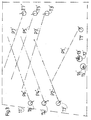
- Figures 1 and 2 A clay pigeon shooting area with boundary 11 has a position 12 for a shooter 13. Path A extends through position 12 and across the area 11. In general terms it is found that a clay following a trajectory across line of sight in direction D of the shooter 13 is more readily hit by shooter 13 than a clay following a trajectory towards or away from the shooter 13.
- a plurality of seven remotely operable clay pigeon launchers are provided namely launchers T1 to T7 spaced about the area 11.
- the launchers are not visible from the position 12 but serve to provide for the projection of clays along the paths P1 and paths P2 to P7 shown in Figure 2 extending from, respectively, their corresponding launchers T1 to T7.
- Each launcher T1 to T7 is equipped with a magazine for clays and an operating system so that once a clay is fired from the launcher a fresh clay is loaded.
- Each launcher has in its magazine a set of coloured clays, the clays in a given magazine being of a colour unique to that launcher so that once a clay is launched into the firing area the shooter will be able to identify the launcher from which it comes.
- the launchers T1 to T7 are operated remotely from a central control position 15 which is occupied by a trainer 16 who also keeps the score of a shooter.
- the control position 15 includes equipment 17 linked to the launchers L1 to L7 whereby trainer 16 can cause a launcher or any combination of launchers P1 to P7 (usually not more than two) to discharge a clay along the path associated with the launcher.
- the discharges can either be simultaneous or separated by a pre-determined time interval.
- Figure 3 shows a more elaborate layout for use when a greater area of land is available. Items of similar form and function in Figure 3 to those in Figures 1 and 2 are given similar reference references but with the addition of am apostrophe (').
- Launcher T1' is in a similar relative position to the shooter 13' as launcher T1 to shooter 13 in Figure 1. However the remaining launchers T2' to T7' are laid on either side of the frontage of the shooter 13' to provide a wider range of possible trajectories for clays in contrast to the linear layout of launchers described in connection with Figures 1 and 2.. As in the case of the embodiment of Figures 1 and 2 the launchers T1' to T7' have magazines loaded with coloured clays unique identifying the launcher from which the clay is projected.
- the training system used in the case of both embodiments is based on the game of table snooker.
- a characteristic of table snooker is that a player on potting a red ball (scoring 1 point) is entitled thereafter to attempt to pot a ball of a colour other than red.
- the colours of the balls other than red score the following points: black 7, pink 6, blue 5, brown 4, green 3 and yellow 2.
- the launcher T1 (T1') has a magazine filled with red coloured clays and the path P1 (P1') is diagonally across the field of view of the shooter 13 (13') and at a relatively short distance from the shooting position 12 (12').
- the path P1 (P1') represents the path for a clay which is most readily hit by a shooter 13 ('13').
- the remaining paths P2 to P7 provide progressively more difficult paths for a clay to be hit by shooter 13.
- the clays of launchers L2 to L7 are coloured respectively yellow (scoring 2), green (3), brown (4), blue (5), pink (6) and black (7).
- the first is always from launcher T1 (T1') and so is red.
- the second is selected by the trainer but will usually be from one of the higher value launchers T2 to T7 (T2' to T7').
- the interval between the launch of the first and second clays of the pair is regulated by the trainer but for a reasonably experienced shooter they will be launched simultaneously.
- the shooter will be aware of the trajectory of the red clay and can consequently anticipate its trajectory so as to be able to fire and hit the red clay while evaluating the path of the second clay.
- the red clay must be hit before the shooter can attempt to hit the second clay.
- the colour of the second clay will convey to the shooter the likely trajectory or at least the relative difficulty of the shot.
- the behaviour, movements and action of the shooter 13 (13') is clearly observable by the trainer 15 (15') so enabling the trainer to provide the appropriate instructions and advice in any given circumstance.
- the trainer 15 (15') ensures that the shooter 13 (13') is subjected to an appropriate sequence of actions to build up the shooters confidence.
- inexperienced shooters can be trained to deal with clays following more difficult trajectories.
- the player can strike the cue ball to cause it to follow a path of more than one stage involving bouncing off one or more cushions before striking the correct ball without striking any other ball on the way.
- penalties arise including a re-taking of the shot and/or a loss of points.
- a snookering position can be generated by enabling a first shooter to call for a 'snooker' clay to be fired from a specially selected launcher.
- the second player In the event the first shooter hits the clay with the first of his two shots then the second player must hit their next clay with his first shot. In the event the second player does not score a hit with his first shot then the second player incurs a penalty (typically a loss of points as in the table game).
- the second shooter In the event the first shooter only hits the snooker clay with the second of his two shots then the second shooter has two shots in which to hit the next clay. If the second shooter does hit the clay with one of his two shots then the second shooter is regarded as having got out of the snookered position. If the second shooter misses with both shots then the second player incurs a penalty.
- the training provided by the present invention facilitates the training of shooters and also serves to provide a number of competitive opportunities for shooters of any degree of skill or experience with an opportunity to win prizes or achieve recognised standards.
- a tyro shooter aware of the characteristic colours and scoring of a universally played game such as snooker can readily concentrate on the required actions for shooting while readily appreciating the significance of his scores over an extended period. It also enable a new comer to clay pigeon shooting to soon establish what paths provide the greatest difficulty by relating them to a particular colour and enable him to consider why for them clays on some trajectories are more readily dealt with than others. This will enable the shooter to consider the development of their skills on their own account in addition to during sessions under training.
- the exemplary embodiments refers to the use of the invention in relating to training.
- a competitive element can be introduced by having a two or more shooters each in turn endeavouring to score more or more quickly or in some other quantitative way to a greater extent than another.
Landscapes
- Engineering & Computer Science (AREA)
- General Engineering & Computer Science (AREA)
- Toys (AREA)
- Steroid Compounds (AREA)
- Aiming, Guidance, Guns With A Light Source, Armor, Camouflage, And Targets (AREA)
Claims (2)
- Procédé d'entraínement pour le tir aux pigeons d'argile dans lequel une position de tir est fournie, à partir de laquelle un tireur peut diriger une paire de tirs successifs à travers une zone de tir vers un pigeon d'argile libéré par un appareil de lancement à un endroit spécifique par rapport à la zone pour suivre une trajectoire donnée à travers la zone, caractérisé par les étapes suivantes :1. fournir une pluralité d'appareils de lancement (T1 à T7. T1' à T7') par rapport à une position de tir (12, 12') et à la zone (11), chaque appareil de lancement de ladite pluralité fournissant un pigeon d'argile d'une couleur unique correspondant à la couleur de la séquence de boules utilisées pour le jeu de snooker, c'est-à-dire de la marque la plus basse jusqu'à la plus haute, rouge, jaune, vert, marron, bleu, rose et noir et les lanceurs de ladite pluralité servant à fournir une difficulté de trajectoire correspondant à la couleur de la séquence de pigeons d'argile utilisés, c'est-à-dire de la plus facile, rouge, à la plus difficile, noir, pour le lancement d'un pigeon d'argile le long d'une trajectoire (P1 à P7, P1' à P7') fournissant un degré de difficulté unique comme cible pour un tireur (13, 13') en position de tir (12, 12');2. localiser un tireur (13, 13') en position de tir (12, 12');3. sélectionner une paire de lanceurs (T1 à T7, T1' à Y7') à partir de laquelle les cibles d'argile doivent être lancées sur un appel;4. faire lancer leurs pigeons d'argile discernables respectivement au premier lanceur et au deuxième lanceur de la paire sélectionnée;5. faire tirer au tireur (13, 13') un premier coup d'une paire en direction du pigeon d'argile discernable à partir du premier lanceur de la paire et, au cas où le pigeon d'argile du premier lanceur serait touché, faire tirer au tireur un deuxième coup de la paire en direction du pigeon d'argile discernable à partir du deuxième lanceur;6. au cas où le premier et le deuxième pigeons d'argile seraient touchés, répéter les étapes 3 à 5 soit pour la paire donnée de lanceurs soit à partir d'une autre paire de lanceurs jusqu'à ce qu'un nombre prédéterminé de pigeons d'argile ait été envoyé à partir de quelques-uns des ou de tous les lanceurs ou jusqu'à ce que tous les pigeons d'argile aient été touchés ou en fonction d'autres critères.
- Procédé d'entraínement selon la revendication 1, caractérisé en ce que, au moins pendant une première séquence de tir, le premier lanceur de la paire est toujours le même de façon à ce que, au moins pendant la première séquence, le premier pigeon d'argile discernable dans n'importe quelle paire de pigeons d'argile envoyés soit toujours le même.
Applications Claiming Priority (3)
| Application Number | Priority Date | Filing Date | Title |
|---|---|---|---|
| GBGB9617036.0A GB9617036D0 (en) | 1996-08-14 | 1996-08-14 | Shooting training |
| GB9617036 | 1996-08-14 | ||
| PCT/GB1997/002166 WO1998006997A1 (fr) | 1996-08-14 | 1997-08-13 | Entrainement et competition de tir |
Publications (2)
| Publication Number | Publication Date |
|---|---|
| EP0922194A1 EP0922194A1 (fr) | 1999-06-16 |
| EP0922194B1 true EP0922194B1 (fr) | 2002-11-20 |
Family
ID=10798452
Family Applications (1)
| Application Number | Title | Priority Date | Filing Date |
|---|---|---|---|
| EP97936767A Expired - Lifetime EP0922194B1 (fr) | 1996-08-14 | 1997-08-13 | Entrainement et competition de tir |
Country Status (4)
| Country | Link |
|---|---|
| EP (1) | EP0922194B1 (fr) |
| AT (1) | ATE228235T1 (fr) |
| GB (1) | GB9617036D0 (fr) |
| WO (1) | WO1998006997A1 (fr) |
Families Citing this family (1)
| Publication number | Priority date | Publication date | Assignee | Title |
|---|---|---|---|---|
| RU2375663C1 (ru) * | 2008-04-14 | 2009-12-10 | Александр Иванович Петров | Способ удержания автомата при ведении скоростной стрельбы одиночными выстрелами и автоматическим огнем |
Family Cites Families (4)
| Publication number | Priority date | Publication date | Assignee | Title |
|---|---|---|---|---|
| GB2127311A (en) * | 1982-09-17 | 1984-04-11 | William George Cooper | Dartboard for snooker-type game |
| GB2140313B (en) * | 1983-05-25 | 1987-03-11 | Philip Byrne | Target for playing a game |
| GB2221845A (en) * | 1988-08-20 | 1990-02-21 | Critchley Horrocks Garry Willi | Shooting facility |
| GB2281516B (en) * | 1993-09-07 | 1997-05-21 | Urban Pitch Projects Limited | Shooting facility |
-
1996
- 1996-08-14 GB GBGB9617036.0A patent/GB9617036D0/en active Pending
-
1997
- 1997-08-13 AT AT97936767T patent/ATE228235T1/de not_active IP Right Cessation
- 1997-08-13 EP EP97936767A patent/EP0922194B1/fr not_active Expired - Lifetime
- 1997-08-13 WO PCT/GB1997/002166 patent/WO1998006997A1/fr not_active Ceased
Also Published As
| Publication number | Publication date |
|---|---|
| GB9617036D0 (en) | 1996-09-25 |
| EP0922194A1 (fr) | 1999-06-16 |
| ATE228235T1 (de) | 2002-12-15 |
| WO1998006997A1 (fr) | 1998-02-19 |
Similar Documents
| Publication | Publication Date | Title |
|---|---|---|
| US6814667B2 (en) | eTroops infrared shooting game | |
| US3398956A (en) | Retaliatory game | |
| US3137503A (en) | Basketball game | |
| WO1996039232A1 (fr) | Cible pour flechettes pour un jeu calque sur le golf et technique de jeu associee | |
| US20110037225A1 (en) | Projectile golf game | |
| US20080277875A1 (en) | Target Shooting Game | |
| US4183530A (en) | Football game played with aerial projectiles | |
| US5286034A (en) | Disc pitching game | |
| EP0922194A1 (fr) | Entrainement et competition de tir | |
| JP2004012045A (ja) | 電子競技システム、電子競技方法、サーバ及びコンピュータプログラム | |
| US4221389A (en) | War game apparatus | |
| US5050890A (en) | Dart board game | |
| WO2006134465A2 (fr) | Jeu magnetique simulant un sport d'equipe | |
| US20040262839A1 (en) | Shooting game | |
| US3589727A (en) | Shooting range and game apparatus | |
| GB1333862A (en) | Apparatus for playing a game | |
| US20230381634A1 (en) | Apparatus for an electronically-enabled board game | |
| GB2244933A (en) | Projectile/target systems | |
| US20100140875A1 (en) | Method of Competitive Marksmanship and Game Therefore | |
| US20200248992A1 (en) | Archery Game | |
| WO2013070092A1 (fr) | Jeu | |
| US4796894A (en) | Board game apparatus and method | |
| KR102717040B1 (ko) | 양궁 게임 시스템 | |
| US20250116490A1 (en) | Marksmanship training devices, systems, methods, and games | |
| US3698714A (en) | Projectile displacing apparatus including stressible strands and missiles |
Legal Events
| Date | Code | Title | Description |
|---|---|---|---|
| PUAI | Public reference made under article 153(3) epc to a published international application that has entered the european phase |
Free format text: ORIGINAL CODE: 0009012 |
|
| 17P | Request for examination filed |
Effective date: 19990315 |
|
| AK | Designated contracting states |
Kind code of ref document: A1 Designated state(s): AT BE DK ES FR GB IE IT NL PT SE |
|
| 17Q | First examination report despatched |
Effective date: 19990825 |
|
| GRAG | Despatch of communication of intention to grant |
Free format text: ORIGINAL CODE: EPIDOS AGRA |
|
| GRAG | Despatch of communication of intention to grant |
Free format text: ORIGINAL CODE: EPIDOS AGRA |
|
| GRAH | Despatch of communication of intention to grant a patent |
Free format text: ORIGINAL CODE: EPIDOS IGRA |
|
| GRAH | Despatch of communication of intention to grant a patent |
Free format text: ORIGINAL CODE: EPIDOS IGRA |
|
| GRAA | (expected) grant |
Free format text: ORIGINAL CODE: 0009210 |
|
| AK | Designated contracting states |
Kind code of ref document: B1 Designated state(s): AT BE DK ES FR GB IE IT NL PT SE |
|
| PG25 | Lapsed in a contracting state [announced via postgrant information from national office to epo] |
Ref country code: NL Free format text: LAPSE BECAUSE OF FAILURE TO SUBMIT A TRANSLATION OF THE DESCRIPTION OR TO PAY THE FEE WITHIN THE PRESCRIBED TIME-LIMIT Effective date: 20021120 Ref country code: IT Free format text: LAPSE BECAUSE OF FAILURE TO SUBMIT A TRANSLATION OF THE DESCRIPTION OR TO PAY THE FEE WITHIN THE PRE;WARNING: LAPSES OF ITALIAN PATENTS WITH EFFECTIVE DATE BEFORE 2007 MAY HAVE OCCURRED AT ANY TIME BEFORE 2007. THE CORRECT EFFECTIVE DATE MAY BE DIFFERENT FROM THE ONE RECORDED.SCRIBED TIME-LIMIT Effective date: 20021120 Ref country code: FR Free format text: LAPSE BECAUSE OF FAILURE TO SUBMIT A TRANSLATION OF THE DESCRIPTION OR TO PAY THE FEE WITHIN THE PRESCRIBED TIME-LIMIT Effective date: 20021120 Ref country code: BE Free format text: LAPSE BECAUSE OF FAILURE TO SUBMIT A TRANSLATION OF THE DESCRIPTION OR TO PAY THE FEE WITHIN THE PRESCRIBED TIME-LIMIT Effective date: 20021120 Ref country code: AT Free format text: LAPSE BECAUSE OF FAILURE TO SUBMIT A TRANSLATION OF THE DESCRIPTION OR TO PAY THE FEE WITHIN THE PRESCRIBED TIME-LIMIT Effective date: 20021120 |
|
| REF | Corresponds to: |
Ref document number: 228235 Country of ref document: AT Date of ref document: 20021215 Kind code of ref document: T |
|
| REG | Reference to a national code |
Ref country code: GB Ref legal event code: FG4D |
|
| REG | Reference to a national code |
Ref country code: IE Ref legal event code: FG4D |
|
| PG25 | Lapsed in a contracting state [announced via postgrant information from national office to epo] |
Ref country code: SE Free format text: LAPSE BECAUSE OF FAILURE TO SUBMIT A TRANSLATION OF THE DESCRIPTION OR TO PAY THE FEE WITHIN THE PRESCRIBED TIME-LIMIT Effective date: 20030220 Ref country code: PT Free format text: LAPSE BECAUSE OF FAILURE TO SUBMIT A TRANSLATION OF THE DESCRIPTION OR TO PAY THE FEE WITHIN THE PRESCRIBED TIME-LIMIT Effective date: 20030220 Ref country code: DK Free format text: LAPSE BECAUSE OF FAILURE TO SUBMIT A TRANSLATION OF THE DESCRIPTION OR TO PAY THE FEE WITHIN THE PRESCRIBED TIME-LIMIT Effective date: 20030220 |
|
| NLV1 | Nl: lapsed or annulled due to failure to fulfill the requirements of art. 29p and 29m of the patents act | ||
| PG25 | Lapsed in a contracting state [announced via postgrant information from national office to epo] |
Ref country code: ES Free format text: LAPSE BECAUSE OF FAILURE TO SUBMIT A TRANSLATION OF THE DESCRIPTION OR TO PAY THE FEE WITHIN THE PRESCRIBED TIME-LIMIT Effective date: 20030529 |
|
| PGFP | Annual fee paid to national office [announced via postgrant information from national office to epo] |
Ref country code: IE Payment date: 20030730 Year of fee payment: 7 |
|
| EN | Fr: translation not filed | ||
| PLBE | No opposition filed within time limit |
Free format text: ORIGINAL CODE: 0009261 |
|
| STAA | Information on the status of an ep patent application or granted ep patent |
Free format text: STATUS: NO OPPOSITION FILED WITHIN TIME LIMIT |
|
| 26N | No opposition filed |
Effective date: 20030821 |
|
| PG25 | Lapsed in a contracting state [announced via postgrant information from national office to epo] |
Ref country code: IE Free format text: LAPSE BECAUSE OF NON-PAYMENT OF DUE FEES Effective date: 20040813 |
|
| REG | Reference to a national code |
Ref country code: IE Ref legal event code: MM4A |
|
| PGFP | Annual fee paid to national office [announced via postgrant information from national office to epo] |
Ref country code: GB Payment date: 20071115 Year of fee payment: 11 |
|
| GBPC | Gb: european patent ceased through non-payment of renewal fee |
Effective date: 20080813 |
|
| PG25 | Lapsed in a contracting state [announced via postgrant information from national office to epo] |
Ref country code: GB Free format text: LAPSE BECAUSE OF NON-PAYMENT OF DUE FEES Effective date: 20080813 |