EP0922767A1 - Ribozyme die fähig sind Widerstand gegen Potyviren Infektion zu verleihen, und Pflanzen die diese Ribozyme exprimieren - Google Patents
Ribozyme die fähig sind Widerstand gegen Potyviren Infektion zu verleihen, und Pflanzen die diese Ribozyme exprimieren Download PDFInfo
- Publication number
- EP0922767A1 EP0922767A1 EP97402925A EP97402925A EP0922767A1 EP 0922767 A1 EP0922767 A1 EP 0922767A1 EP 97402925 A EP97402925 A EP 97402925A EP 97402925 A EP97402925 A EP 97402925A EP 0922767 A1 EP0922767 A1 EP 0922767A1
- Authority
- EP
- European Patent Office
- Prior art keywords
- complementary
- nucleic acid
- rna
- gene
- acid molecule
- Prior art date
- Legal status (The legal status is an assumption and is not a legal conclusion. Google has not performed a legal analysis and makes no representation as to the accuracy of the status listed.)
- Withdrawn
Links
- 108090000994 Catalytic RNA Proteins 0.000 title claims abstract description 297
- 108091092562 ribozyme Proteins 0.000 title claims abstract description 274
- 102000053642 Catalytic RNA Human genes 0.000 title claims abstract description 257
- 241000710078 Potyvirus Species 0.000 title claims abstract description 82
- 208000015181 infectious disease Diseases 0.000 title claims description 22
- 108091032973 (ribonucleotides)n+m Proteins 0.000 claims abstract description 165
- 230000000295 complement effect Effects 0.000 claims abstract description 131
- 102000039446 nucleic acids Human genes 0.000 claims abstract description 60
- 108020004707 nucleic acids Proteins 0.000 claims abstract description 60
- 150000007523 nucleic acids Chemical class 0.000 claims abstract description 60
- 230000003197 catalytic effect Effects 0.000 claims abstract description 46
- 230000003362 replicative effect Effects 0.000 claims abstract description 45
- 230000000694 effects Effects 0.000 claims abstract description 37
- 108010093099 Endoribonucleases Proteins 0.000 claims abstract description 6
- 102100030011 Endoribonuclease Human genes 0.000 claims abstract 3
- 108090000623 proteins and genes Proteins 0.000 claims description 136
- 241000196324 Embryophyta Species 0.000 claims description 100
- 241000700605 Viruses Species 0.000 claims description 80
- 241001310178 Watermelon mosaic virus Species 0.000 claims description 73
- 241000723854 Zucchini yellow mosaic virus Species 0.000 claims description 56
- 239000002773 nucleotide Substances 0.000 claims description 37
- 125000003729 nucleotide group Chemical group 0.000 claims description 37
- 102000004169 proteins and genes Human genes 0.000 claims description 36
- 230000003612 virological effect Effects 0.000 claims description 27
- 108091028664 Ribonucleotide Proteins 0.000 claims description 23
- 239000002336 ribonucleotide Substances 0.000 claims description 23
- 125000002652 ribonucleotide group Chemical group 0.000 claims description 23
- 230000014509 gene expression Effects 0.000 claims description 22
- 230000009261 transgenic effect Effects 0.000 claims description 22
- 208000024891 symptom Diseases 0.000 claims description 18
- 239000013598 vector Substances 0.000 claims description 18
- 108091023045 Untranslated Region Proteins 0.000 claims description 17
- 101800001776 Nuclear inclusion protein B Proteins 0.000 claims description 16
- 244000241257 Cucumis melo Species 0.000 claims description 15
- 238000013518 transcription Methods 0.000 claims description 15
- 230000035897 transcription Effects 0.000 claims description 15
- 241000723762 Potato virus Y Species 0.000 claims description 14
- 230000004927 fusion Effects 0.000 claims description 14
- 238000000034 method Methods 0.000 claims description 14
- 101150083464 CP gene Proteins 0.000 claims description 11
- 108091028043 Nucleic acid sequence Proteins 0.000 claims description 11
- 210000003462 vein Anatomy 0.000 claims description 9
- 241000723997 Pea seed-borne mosaic virus Species 0.000 claims description 8
- 108700008625 Reporter Genes Proteins 0.000 claims description 8
- 230000000692 anti-sense effect Effects 0.000 claims description 8
- 239000003550 marker Substances 0.000 claims description 8
- 108091026890 Coding region Proteins 0.000 claims description 7
- 241000723990 Papaya ringspot virus Species 0.000 claims description 7
- 241000723784 Plum pox virus Species 0.000 claims description 7
- 241000723792 Tobacco etch virus Species 0.000 claims description 7
- 230000010076 replication Effects 0.000 claims description 7
- 235000015510 Cucumis melo subsp melo Nutrition 0.000 claims description 6
- 108020004414 DNA Proteins 0.000 claims description 6
- 241001429318 Johnsongrass mosaic virus Species 0.000 claims description 6
- 241000723996 Pepper mottle virus Species 0.000 claims description 6
- 241000723838 Turnip mosaic virus Species 0.000 claims description 6
- FJJCIZWZNKZHII-UHFFFAOYSA-N [4,6-bis(cyanoamino)-1,3,5-triazin-2-yl]cyanamide Chemical compound N#CNC1=NC(NC#N)=NC(NC#N)=N1 FJJCIZWZNKZHII-UHFFFAOYSA-N 0.000 claims description 6
- 241000894007 species Species 0.000 claims description 6
- 240000007087 Apium graveolens Species 0.000 claims description 5
- 235000015849 Apium graveolens Dulce Group Nutrition 0.000 claims description 5
- 235000010591 Appio Nutrition 0.000 claims description 5
- 235000010469 Glycine max Nutrition 0.000 claims description 5
- 244000068988 Glycine max Species 0.000 claims description 5
- 239000003184 complementary RNA Substances 0.000 claims description 5
- 108090000565 Capsid Proteins Proteins 0.000 claims description 4
- 235000002637 Nicotiana tabacum Nutrition 0.000 claims description 4
- 240000000111 Saccharum officinarum Species 0.000 claims description 4
- 235000007201 Saccharum officinarum Nutrition 0.000 claims description 4
- 241000710076 Bean common mosaic virus Species 0.000 claims description 3
- 241000710073 Bean yellow mosaic virus Species 0.000 claims description 3
- 241000258937 Hemiptera Species 0.000 claims description 3
- 241001505704 Henbane mosaic virus Species 0.000 claims description 3
- 244000061176 Nicotiana tabacum Species 0.000 claims description 3
- 240000004713 Pisum sativum Species 0.000 claims description 3
- 235000010582 Pisum sativum Nutrition 0.000 claims description 3
- 241000723806 Sugarcane mosaic virus Species 0.000 claims description 3
- 108091036066 Three prime untranslated region Proteins 0.000 claims description 3
- 241000723790 Tobacco vein mottling virus Species 0.000 claims description 3
- 240000008042 Zea mays Species 0.000 claims description 3
- 235000016383 Zea mays subsp huehuetenangensis Nutrition 0.000 claims description 3
- 235000002017 Zea mays subsp mays Nutrition 0.000 claims description 3
- 235000013399 edible fruits Nutrition 0.000 claims description 3
- 235000009973 maize Nutrition 0.000 claims description 3
- 230000002103 transcriptional effect Effects 0.000 claims description 3
- 235000017060 Arachis glabrata Nutrition 0.000 claims description 2
- 244000105624 Arachis hypogaea Species 0.000 claims description 2
- 235000010777 Arachis hypogaea Nutrition 0.000 claims description 2
- 235000018262 Arachis monticola Nutrition 0.000 claims description 2
- 235000016068 Berberis vulgaris Nutrition 0.000 claims description 2
- 241000335053 Beta vulgaris Species 0.000 claims description 2
- 235000002566 Capsicum Nutrition 0.000 claims description 2
- 241000871189 Chenopodiaceae Species 0.000 claims description 2
- 241000219104 Cucurbitaceae Species 0.000 claims description 2
- 235000002767 Daucus carota Nutrition 0.000 claims description 2
- 244000000626 Daucus carota Species 0.000 claims description 2
- 235000009355 Dianthus caryophyllus Nutrition 0.000 claims description 2
- 240000006497 Dianthus caryophyllus Species 0.000 claims description 2
- 240000005979 Hordeum vulgare Species 0.000 claims description 2
- 235000007340 Hordeum vulgare Nutrition 0.000 claims description 2
- 241000209082 Lolium Species 0.000 claims description 2
- 235000007688 Lycopersicon esculentum Nutrition 0.000 claims description 2
- 240000004370 Pastinaca sativa Species 0.000 claims description 2
- 235000017769 Pastinaca sativa subsp sativa Nutrition 0.000 claims description 2
- 239000006002 Pepper Substances 0.000 claims description 2
- 235000016761 Piper aduncum Nutrition 0.000 claims description 2
- 240000003889 Piper guineense Species 0.000 claims description 2
- 235000017804 Piper guineense Nutrition 0.000 claims description 2
- 235000008184 Piper nigrum Nutrition 0.000 claims description 2
- 235000004789 Rosa xanthina Nutrition 0.000 claims description 2
- 241000220222 Rosaceae Species 0.000 claims description 2
- 240000003768 Solanum lycopersicum Species 0.000 claims description 2
- 235000002595 Solanum tuberosum Nutrition 0.000 claims description 2
- 244000061456 Solanum tuberosum Species 0.000 claims description 2
- 241000219793 Trifolium Species 0.000 claims description 2
- 235000021307 Triticum Nutrition 0.000 claims description 2
- 244000098338 Triticum aestivum Species 0.000 claims description 2
- 230000033228 biological regulation Effects 0.000 claims description 2
- 230000001747 exhibiting effect Effects 0.000 claims description 2
- 230000033001 locomotion Effects 0.000 claims description 2
- 235000020232 peanut Nutrition 0.000 claims description 2
- 230000029812 viral genome replication Effects 0.000 claims description 2
- 244000046052 Phaseolus vulgaris Species 0.000 claims 3
- 235000010627 Phaseolus vulgaris Nutrition 0.000 claims 3
- 235000007319 Avena orientalis Nutrition 0.000 claims 1
- 241000209763 Avena sativa Species 0.000 claims 1
- 235000007558 Avena sp Nutrition 0.000 claims 1
- 108020004394 Complementary RNA Proteins 0.000 claims 1
- 241000208278 Hyoscyamus Species 0.000 claims 1
- 240000008415 Lactuca sativa Species 0.000 claims 1
- 235000003228 Lactuca sativa Nutrition 0.000 claims 1
- 241000208292 Solanaceae Species 0.000 claims 1
- 230000009087 cell motility Effects 0.000 claims 1
- 239000013256 coordination polymer Substances 0.000 claims 1
- 108090001052 hairpin ribozyme Proteins 0.000 claims 1
- 230000008929 regeneration Effects 0.000 claims 1
- 238000011069 regeneration method Methods 0.000 claims 1
- 125000006850 spacer group Chemical group 0.000 claims 1
- 239000013612 plasmid Substances 0.000 description 53
- 230000009466 transformation Effects 0.000 description 33
- 230000002068 genetic effect Effects 0.000 description 32
- 239000012634 fragment Substances 0.000 description 29
- 238000003776 cleavage reaction Methods 0.000 description 27
- 230000007017 scission Effects 0.000 description 27
- 238000000338 in vitro Methods 0.000 description 26
- 239000000047 product Substances 0.000 description 22
- 101710132601 Capsid protein Proteins 0.000 description 21
- 101710094648 Coat protein Proteins 0.000 description 21
- 102100021181 Golgi phosphoprotein 3 Human genes 0.000 description 21
- 101710125418 Major capsid protein Proteins 0.000 description 21
- 101710141454 Nucleoprotein Proteins 0.000 description 21
- 101710083689 Probable capsid protein Proteins 0.000 description 21
- 238000003556 assay Methods 0.000 description 19
- UYTPUPDQBNUYGX-UHFFFAOYSA-N guanine Chemical compound O=C1NC(N)=NC2=C1N=CN2 UYTPUPDQBNUYGX-UHFFFAOYSA-N 0.000 description 18
- 239000000758 substrate Substances 0.000 description 18
- 230000008685 targeting Effects 0.000 description 18
- 210000004027 cell Anatomy 0.000 description 17
- 238000006243 chemical reaction Methods 0.000 description 17
- 238000010276 construction Methods 0.000 description 17
- 235000018102 proteins Nutrition 0.000 description 14
- 238000005204 segregation Methods 0.000 description 14
- 230000001052 transient effect Effects 0.000 description 14
- 108020004705 Codon Proteins 0.000 description 12
- 238000010367 cloning Methods 0.000 description 11
- 239000002299 complementary DNA Substances 0.000 description 11
- 238000001727 in vivo Methods 0.000 description 11
- 238000000099 in vitro assay Methods 0.000 description 10
- 108091034117 Oligonucleotide Proteins 0.000 description 9
- JLCPHMBAVCMARE-UHFFFAOYSA-N [3-[[3-[[3-[[3-[[3-[[3-[[3-[[3-[[3-[[3-[[3-[[5-(2-amino-6-oxo-1H-purin-9-yl)-3-[[3-[[3-[[3-[[3-[[3-[[5-(2-amino-6-oxo-1H-purin-9-yl)-3-[[5-(2-amino-6-oxo-1H-purin-9-yl)-3-hydroxyoxolan-2-yl]methoxy-hydroxyphosphoryl]oxyoxolan-2-yl]methoxy-hydroxyphosphoryl]oxy-5-(5-methyl-2,4-dioxopyrimidin-1-yl)oxolan-2-yl]methoxy-hydroxyphosphoryl]oxy-5-(6-aminopurin-9-yl)oxolan-2-yl]methoxy-hydroxyphosphoryl]oxy-5-(6-aminopurin-9-yl)oxolan-2-yl]methoxy-hydroxyphosphoryl]oxy-5-(6-aminopurin-9-yl)oxolan-2-yl]methoxy-hydroxyphosphoryl]oxy-5-(6-aminopurin-9-yl)oxolan-2-yl]methoxy-hydroxyphosphoryl]oxyoxolan-2-yl]methoxy-hydroxyphosphoryl]oxy-5-(5-methyl-2,4-dioxopyrimidin-1-yl)oxolan-2-yl]methoxy-hydroxyphosphoryl]oxy-5-(4-amino-2-oxopyrimidin-1-yl)oxolan-2-yl]methoxy-hydroxyphosphoryl]oxy-5-(5-methyl-2,4-dioxopyrimidin-1-yl)oxolan-2-yl]methoxy-hydroxyphosphoryl]oxy-5-(5-methyl-2,4-dioxopyrimidin-1-yl)oxolan-2-yl]methoxy-hydroxyphosphoryl]oxy-5-(6-aminopurin-9-yl)oxolan-2-yl]methoxy-hydroxyphosphoryl]oxy-5-(6-aminopurin-9-yl)oxolan-2-yl]methoxy-hydroxyphosphoryl]oxy-5-(4-amino-2-oxopyrimidin-1-yl)oxolan-2-yl]methoxy-hydroxyphosphoryl]oxy-5-(4-amino-2-oxopyrimidin-1-yl)oxolan-2-yl]methoxy-hydroxyphosphoryl]oxy-5-(4-amino-2-oxopyrimidin-1-yl)oxolan-2-yl]methoxy-hydroxyphosphoryl]oxy-5-(6-aminopurin-9-yl)oxolan-2-yl]methoxy-hydroxyphosphoryl]oxy-5-(4-amino-2-oxopyrimidin-1-yl)oxolan-2-yl]methyl [5-(6-aminopurin-9-yl)-2-(hydroxymethyl)oxolan-3-yl] hydrogen phosphate Polymers Cc1cn(C2CC(OP(O)(=O)OCC3OC(CC3OP(O)(=O)OCC3OC(CC3O)n3cnc4c3nc(N)[nH]c4=O)n3cnc4c3nc(N)[nH]c4=O)C(COP(O)(=O)OC3CC(OC3COP(O)(=O)OC3CC(OC3COP(O)(=O)OC3CC(OC3COP(O)(=O)OC3CC(OC3COP(O)(=O)OC3CC(OC3COP(O)(=O)OC3CC(OC3COP(O)(=O)OC3CC(OC3COP(O)(=O)OC3CC(OC3COP(O)(=O)OC3CC(OC3COP(O)(=O)OC3CC(OC3COP(O)(=O)OC3CC(OC3COP(O)(=O)OC3CC(OC3COP(O)(=O)OC3CC(OC3COP(O)(=O)OC3CC(OC3COP(O)(=O)OC3CC(OC3COP(O)(=O)OC3CC(OC3COP(O)(=O)OC3CC(OC3CO)n3cnc4c(N)ncnc34)n3ccc(N)nc3=O)n3cnc4c(N)ncnc34)n3ccc(N)nc3=O)n3ccc(N)nc3=O)n3ccc(N)nc3=O)n3cnc4c(N)ncnc34)n3cnc4c(N)ncnc34)n3cc(C)c(=O)[nH]c3=O)n3cc(C)c(=O)[nH]c3=O)n3ccc(N)nc3=O)n3cc(C)c(=O)[nH]c3=O)n3cnc4c3nc(N)[nH]c4=O)n3cnc4c(N)ncnc34)n3cnc4c(N)ncnc34)n3cnc4c(N)ncnc34)n3cnc4c(N)ncnc34)O2)c(=O)[nH]c1=O JLCPHMBAVCMARE-UHFFFAOYSA-N 0.000 description 9
- 238000013461 design Methods 0.000 description 9
- 238000007852 inverse PCR Methods 0.000 description 9
- 229930027917 kanamycin Natural products 0.000 description 9
- SBUJHOSQTJFQJX-NOAMYHISSA-N kanamycin Chemical compound O[C@@H]1[C@@H](O)[C@H](O)[C@@H](CN)O[C@@H]1O[C@H]1[C@H](O)[C@@H](O[C@@H]2[C@@H]([C@@H](N)[C@H](O)[C@@H](CO)O2)O)[C@H](N)C[C@@H]1N SBUJHOSQTJFQJX-NOAMYHISSA-N 0.000 description 9
- 229960000318 kanamycin Drugs 0.000 description 9
- 229930182823 kanamycin A Natural products 0.000 description 9
- 238000012360 testing method Methods 0.000 description 9
- 108700026244 Open Reading Frames Proteins 0.000 description 8
- 230000029087 digestion Effects 0.000 description 8
- 230000001939 inductive effect Effects 0.000 description 8
- 210000001519 tissue Anatomy 0.000 description 8
- 125000003275 alpha amino acid group Chemical group 0.000 description 7
- 108091036078 conserved sequence Proteins 0.000 description 7
- 230000002779 inactivation Effects 0.000 description 7
- 238000011081 inoculation Methods 0.000 description 7
- 108020005345 3' Untranslated Regions Proteins 0.000 description 6
- 235000018185 Betula X alpestris Nutrition 0.000 description 6
- 235000018212 Betula X uliginosa Nutrition 0.000 description 6
- 101100437498 Escherichia coli (strain K12) uidA gene Proteins 0.000 description 6
- LFQSCWFLJHTTHZ-UHFFFAOYSA-N Ethanol Chemical compound CCO LFQSCWFLJHTTHZ-UHFFFAOYSA-N 0.000 description 6
- 101000699774 Homo sapiens Retrotransposon Gag-like protein 6 Proteins 0.000 description 6
- 102100029147 Retrotransposon Gag-like protein 6 Human genes 0.000 description 6
- ISAKRJDGNUQOIC-UHFFFAOYSA-N Uracil Chemical group O=C1C=CNC(=O)N1 ISAKRJDGNUQOIC-UHFFFAOYSA-N 0.000 description 6
- 238000012217 deletion Methods 0.000 description 6
- 230000037430 deletion Effects 0.000 description 6
- 230000002829 reductive effect Effects 0.000 description 6
- 238000002474 experimental method Methods 0.000 description 5
- 239000002245 particle Substances 0.000 description 5
- 230000009467 reduction Effects 0.000 description 5
- 238000013519 translation Methods 0.000 description 5
- 101150101900 uidA gene Proteins 0.000 description 5
- 102000040650 (ribonucleotides)n+m Human genes 0.000 description 4
- 108020005544 Antisense RNA Proteins 0.000 description 4
- 241000701489 Cauliflower mosaic virus Species 0.000 description 4
- 102000016928 DNA-directed DNA polymerase Human genes 0.000 description 4
- 108010014303 DNA-directed DNA polymerase Proteins 0.000 description 4
- 108010076039 Polyproteins Proteins 0.000 description 4
- 230000015572 biosynthetic process Effects 0.000 description 4
- 239000012467 final product Substances 0.000 description 4
- 230000002285 radioactive effect Effects 0.000 description 4
- 239000000243 solution Substances 0.000 description 4
- 230000001225 therapeutic effect Effects 0.000 description 4
- XLYOFNOQVPJJNP-UHFFFAOYSA-N water Substances O XLYOFNOQVPJJNP-UHFFFAOYSA-N 0.000 description 4
- 241001124076 Aphididae Species 0.000 description 3
- OKTJSMMVPCPJKN-UHFFFAOYSA-N Carbon Chemical compound [C] OKTJSMMVPCPJKN-UHFFFAOYSA-N 0.000 description 3
- 102100030013 Endoribonuclease Human genes 0.000 description 3
- 108700039691 Genetic Promoter Regions Proteins 0.000 description 3
- 108090001102 Hammerhead ribozyme Proteins 0.000 description 3
- 101100288095 Klebsiella pneumoniae neo gene Proteins 0.000 description 3
- 108060001084 Luciferase Proteins 0.000 description 3
- 241000208125 Nicotiana Species 0.000 description 3
- 108091092724 Noncoding DNA Proteins 0.000 description 3
- 241001533393 Potyviridae Species 0.000 description 3
- 241000251131 Sphyrna Species 0.000 description 3
- 108020000999 Viral RNA Proteins 0.000 description 3
- 235000001014 amino acid Nutrition 0.000 description 3
- 150000001413 amino acids Chemical class 0.000 description 3
- 238000004458 analytical method Methods 0.000 description 3
- 230000005540 biological transmission Effects 0.000 description 3
- 201000010099 disease Diseases 0.000 description 3
- 208000037265 diseases, disorders, signs and symptoms Diseases 0.000 description 3
- 230000003993 interaction Effects 0.000 description 3
- 210000001739 intranuclear inclusion body Anatomy 0.000 description 3
- 239000000463 material Substances 0.000 description 3
- 239000000203 mixture Substances 0.000 description 3
- 230000036961 partial effect Effects 0.000 description 3
- 229920002401 polyacrylamide Polymers 0.000 description 3
- 229940035893 uracil Drugs 0.000 description 3
- LRFVTYWOQMYALW-UHFFFAOYSA-N 9H-xanthine Chemical compound O=C1NC(=O)NC2=C1NC=N2 LRFVTYWOQMYALW-UHFFFAOYSA-N 0.000 description 2
- 241000238876 Acari Species 0.000 description 2
- 229930024421 Adenine Natural products 0.000 description 2
- IJGRMHOSHXDMSA-UHFFFAOYSA-N Atomic nitrogen Chemical compound N#N IJGRMHOSHXDMSA-UHFFFAOYSA-N 0.000 description 2
- UXVMQQNJUSDDNG-UHFFFAOYSA-L Calcium chloride Chemical compound [Cl-].[Cl-].[Ca+2] UXVMQQNJUSDDNG-UHFFFAOYSA-L 0.000 description 2
- 241000710070 Clover yellow vein virus Species 0.000 description 2
- ZHNUHDYFZUAESO-UHFFFAOYSA-N Formamide Chemical compound NC=O ZHNUHDYFZUAESO-UHFFFAOYSA-N 0.000 description 2
- 241000233866 Fungi Species 0.000 description 2
- 235000014820 Galium aparine Nutrition 0.000 description 2
- 240000005702 Galium aparine Species 0.000 description 2
- 206010021929 Infertility male Diseases 0.000 description 2
- 241000724005 Lettuce mosaic virus Species 0.000 description 2
- 239000005089 Luciferase Substances 0.000 description 2
- 208000007466 Male Infertility Diseases 0.000 description 2
- IMTUWVJPCQPJEE-IUCAKERBSA-N Met-Lys Chemical compound CSCC[C@H](N)C(=O)N[C@H](C(O)=O)CCCCN IMTUWVJPCQPJEE-IUCAKERBSA-N 0.000 description 2
- 241001465754 Metazoa Species 0.000 description 2
- 238000012408 PCR amplification Methods 0.000 description 2
- 101710137500 T7 RNA polymerase Proteins 0.000 description 2
- XSQUKJJJFZCRTK-UHFFFAOYSA-N Urea Chemical compound NC(N)=O XSQUKJJJFZCRTK-UHFFFAOYSA-N 0.000 description 2
- 108700022715 Viral Proteases Proteins 0.000 description 2
- 229960000643 adenine Drugs 0.000 description 2
- GFFGJBXGBJISGV-UHFFFAOYSA-N adenyl group Chemical group N1=CN=C2N=CNC2=C1N GFFGJBXGBJISGV-UHFFFAOYSA-N 0.000 description 2
- 101150039403 ams gene Proteins 0.000 description 2
- 238000013459 approach Methods 0.000 description 2
- 238000000211 autoradiogram Methods 0.000 description 2
- 230000008901 benefit Effects 0.000 description 2
- 229910001628 calcium chloride Inorganic materials 0.000 description 2
- 239000001110 calcium chloride Substances 0.000 description 2
- 108020001778 catalytic domains Proteins 0.000 description 2
- 230000001413 cellular effect Effects 0.000 description 2
- OPTASPLRGRRNAP-UHFFFAOYSA-N cytosine Chemical compound NC=1C=CNC(=O)N=1 OPTASPLRGRRNAP-UHFFFAOYSA-N 0.000 description 2
- 230000007423 decrease Effects 0.000 description 2
- 230000002950 deficient Effects 0.000 description 2
- 238000011161 development Methods 0.000 description 2
- 230000018109 developmental process Effects 0.000 description 2
- 230000007613 environmental effect Effects 0.000 description 2
- 235000013305 food Nutrition 0.000 description 2
- 238000001415 gene therapy Methods 0.000 description 2
- 238000009396 hybridization Methods 0.000 description 2
- FDGQSTZJBFJUBT-UHFFFAOYSA-N hypoxanthine Chemical compound O=C1NC=NC2=C1NC=N2 FDGQSTZJBFJUBT-UHFFFAOYSA-N 0.000 description 2
- 230000006872 improvement Effects 0.000 description 2
- 238000011534 incubation Methods 0.000 description 2
- 239000003112 inhibitor Substances 0.000 description 2
- 230000005764 inhibitory process Effects 0.000 description 2
- 238000004519 manufacturing process Methods 0.000 description 2
- 230000001404 mediated effect Effects 0.000 description 2
- 108020004999 messenger RNA Proteins 0.000 description 2
- 230000035772 mutation Effects 0.000 description 2
- 230000017074 necrotic cell death Effects 0.000 description 2
- 230000008488 polyadenylation Effects 0.000 description 2
- 239000002244 precipitate Substances 0.000 description 2
- 238000002360 preparation method Methods 0.000 description 2
- 238000012545 processing Methods 0.000 description 2
- 238000000159 protein binding assay Methods 0.000 description 2
- 230000001105 regulatory effect Effects 0.000 description 2
- 108091008146 restriction endonucleases Proteins 0.000 description 2
- 238000003757 reverse transcription PCR Methods 0.000 description 2
- 238000012163 sequencing technique Methods 0.000 description 2
- 238000004114 suspension culture Methods 0.000 description 2
- RWQNBRDOKXIBIV-UHFFFAOYSA-N thymine Chemical compound CC1=CNC(=O)NC1=O RWQNBRDOKXIBIV-UHFFFAOYSA-N 0.000 description 2
- 238000011144 upstream manufacturing Methods 0.000 description 2
- 210000002845 virion Anatomy 0.000 description 2
- 239000005723 virus inoculator Substances 0.000 description 2
- HWPZZUQOWRWFDB-UHFFFAOYSA-N 1-methylcytosine Chemical compound CN1C=CC(N)=NC1=O HWPZZUQOWRWFDB-UHFFFAOYSA-N 0.000 description 1
- VUFNLQXQSDUXKB-DOFZRALJSA-N 2-[4-[4-[bis(2-chloroethyl)amino]phenyl]butanoyloxy]ethyl (5z,8z,11z,14z)-icosa-5,8,11,14-tetraenoate Chemical compound CCCCC\C=C/C\C=C/C\C=C/C\C=C/CCCC(=O)OCCOC(=O)CCCC1=CC=C(N(CCCl)CCCl)C=C1 VUFNLQXQSDUXKB-DOFZRALJSA-N 0.000 description 1
- OSBLTNPMIGYQGY-UHFFFAOYSA-N 2-amino-2-(hydroxymethyl)propane-1,3-diol;2-[2-[bis(carboxymethyl)amino]ethyl-(carboxymethyl)amino]acetic acid;boric acid Chemical compound OB(O)O.OCC(N)(CO)CO.OC(=O)CN(CC(O)=O)CCN(CC(O)=O)CC(O)=O OSBLTNPMIGYQGY-UHFFFAOYSA-N 0.000 description 1
- 108091027075 5S-rRNA precursor Proteins 0.000 description 1
- 241000589158 Agrobacterium Species 0.000 description 1
- 241000589156 Agrobacterium rhizogenes Species 0.000 description 1
- 241000589155 Agrobacterium tumefaciens Species 0.000 description 1
- IPWKGIFRRBGCJO-IMJSIDKUSA-N Ala-Ser Chemical compound C[C@H]([NH3+])C(=O)N[C@@H](CO)C([O-])=O IPWKGIFRRBGCJO-IMJSIDKUSA-N 0.000 description 1
- 108020004491 Antisense DNA Proteins 0.000 description 1
- XTWSWDJMIKUJDQ-RYUDHWBXSA-N Arg-Tyr Chemical compound NC(N)=NCCC[C@H](N)C(=O)N[C@H](C(O)=O)CC1=CC=C(O)C=C1 XTWSWDJMIKUJDQ-RYUDHWBXSA-N 0.000 description 1
- UVTGNSWSRSCPLP-UHFFFAOYSA-N Arg-Tyr Natural products NC(CCNC(=N)N)C(=O)NC(Cc1ccc(O)cc1)C(=O)O UVTGNSWSRSCPLP-UHFFFAOYSA-N 0.000 description 1
- 241000894006 Bacteria Species 0.000 description 1
- 102100023321 Ceruloplasmin Human genes 0.000 description 1
- 108091035707 Consensus sequence Proteins 0.000 description 1
- 241000724252 Cucumber mosaic virus Species 0.000 description 1
- 241000219130 Cucurbita pepo subsp. pepo Species 0.000 description 1
- IGXWBGJHJZYPQS-SSDOTTSWSA-N D-Luciferin Chemical compound OC(=O)[C@H]1CSC(C=2SC3=CC=C(O)C=C3N=2)=N1 IGXWBGJHJZYPQS-SSDOTTSWSA-N 0.000 description 1
- 241000208296 Datura Species 0.000 description 1
- 241001338022 Daucus carota subsp. sativus Species 0.000 description 1
- 241000522190 Desmodium Species 0.000 description 1
- KCXVZYZYPLLWCC-UHFFFAOYSA-N EDTA Chemical compound OC(=O)CN(CC(O)=O)CCN(CC(O)=O)CC(O)=O KCXVZYZYPLLWCC-UHFFFAOYSA-N 0.000 description 1
- 238000002965 ELISA Methods 0.000 description 1
- 241000588724 Escherichia coli Species 0.000 description 1
- 241001310821 Freesia mosaic virus Species 0.000 description 1
- 241000702463 Geminiviridae Species 0.000 description 1
- TUTIHHSZKFBMHM-WHFBIAKZSA-N Glu-Asn Chemical compound OC(=O)CC[C@H](N)C(=O)N[C@@H](CC(N)=O)C(O)=O TUTIHHSZKFBMHM-WHFBIAKZSA-N 0.000 description 1
- IKAIKUBBJHFNBZ-LURJTMIESA-N Gly-Lys Chemical compound NCCCC[C@@H](C(O)=O)NC(=O)CN IKAIKUBBJHFNBZ-LURJTMIESA-N 0.000 description 1
- 101800000653 Helper component proteinase Proteins 0.000 description 1
- 241000701024 Human betaherpesvirus 5 Species 0.000 description 1
- UGQMRVRMYYASKQ-UHFFFAOYSA-N Hypoxanthine nucleoside Natural products OC1C(O)C(CO)OC1N1C(NC=NC2=O)=C2N=C1 UGQMRVRMYYASKQ-UHFFFAOYSA-N 0.000 description 1
- 229930010555 Inosine Natural products 0.000 description 1
- UGQMRVRMYYASKQ-KQYNXXCUSA-N Inosine Chemical compound O[C@@H]1[C@H](O)[C@@H](CO)O[C@H]1N1C2=NC=NC(O)=C2N=C1 UGQMRVRMYYASKQ-KQYNXXCUSA-N 0.000 description 1
- 244000017020 Ipomoea batatas Species 0.000 description 1
- 235000002678 Ipomoea batatas Nutrition 0.000 description 1
- QNAYBMKLOCPYGJ-REOHCLBHSA-N L-alanine Chemical compound C[C@H](N)C(O)=O QNAYBMKLOCPYGJ-REOHCLBHSA-N 0.000 description 1
- SENJXOPIZNYLHU-UHFFFAOYSA-N L-leucyl-L-arginine Natural products CC(C)CC(N)C(=O)NC(C(O)=O)CCCN=C(N)N SENJXOPIZNYLHU-UHFFFAOYSA-N 0.000 description 1
- SENJXOPIZNYLHU-IUCAKERBSA-N Leu-Arg Chemical compound CC(C)C[C@H](N)C(=O)N[C@H](C(O)=O)CCCN=C(N)N SENJXOPIZNYLHU-IUCAKERBSA-N 0.000 description 1
- 241000209510 Liliopsida Species 0.000 description 1
- 241000723994 Maize dwarf mosaic virus Species 0.000 description 1
- KAKJTZWHIUWTTD-VQVTYTSYSA-N Met-Thr Chemical compound CSCC[C@H]([NH3+])C(=O)N[C@@H]([C@@H](C)O)C([O-])=O KAKJTZWHIUWTTD-VQVTYTSYSA-N 0.000 description 1
- 235000016462 Mimosa pudica Nutrition 0.000 description 1
- 240000001140 Mimosa pudica Species 0.000 description 1
- PESQCPHRXOFIPX-UHFFFAOYSA-N N-L-methionyl-L-tyrosine Natural products CSCCC(N)C(=O)NC(C(O)=O)CC1=CC=C(O)C=C1 PESQCPHRXOFIPX-UHFFFAOYSA-N 0.000 description 1
- 235000000370 Passiflora edulis Nutrition 0.000 description 1
- 244000288157 Passiflora edulis Species 0.000 description 1
- 108091005804 Peptidases Proteins 0.000 description 1
- 102000035195 Peptidases Human genes 0.000 description 1
- 241000723764 Potato virus A Species 0.000 description 1
- 240000008519 Prunus americana Species 0.000 description 1
- 230000006819 RNA synthesis Effects 0.000 description 1
- 241001515849 Satellite Viruses Species 0.000 description 1
- 108091081024 Start codon Proteins 0.000 description 1
- 108091027544 Subgenomic mRNA Proteins 0.000 description 1
- 108700005078 Synthetic Genes Proteins 0.000 description 1
- 239000008051 TBE buffer Substances 0.000 description 1
- YKRQRPFODDJQTC-CSMHCCOUSA-N Thr-Lys Chemical compound C[C@@H](O)[C@H](N)C(=O)N[C@H](C(O)=O)CCCCN YKRQRPFODDJQTC-CSMHCCOUSA-N 0.000 description 1
- 101500019503 Tobacco etch virus Capsid protein Proteins 0.000 description 1
- 241000723677 Tobacco ringspot virus Species 0.000 description 1
- 241000005602 Trisetum flavescens Species 0.000 description 1
- 240000007026 Tylosema esculentum Species 0.000 description 1
- WITCOKQIPFWQQD-FSPLSTOPSA-N Val-Asn Chemical compound CC(C)[C@H](N)C(=O)N[C@H](C(O)=O)CC(N)=O WITCOKQIPFWQQD-FSPLSTOPSA-N 0.000 description 1
- STTYIMSDIYISRG-UHFFFAOYSA-N Valyl-Serine Chemical compound CC(C)C(N)C(=O)NC(CO)C(O)=O STTYIMSDIYISRG-UHFFFAOYSA-N 0.000 description 1
- 240000004922 Vigna radiata Species 0.000 description 1
- 235000010721 Vigna radiata var radiata Nutrition 0.000 description 1
- 235000011469 Vigna radiata var sublobata Nutrition 0.000 description 1
- 208000036142 Viral infection Diseases 0.000 description 1
- 241001123606 Wild potato mosaic virus Species 0.000 description 1
- 238000010521 absorption reaction Methods 0.000 description 1
- 238000007792 addition Methods 0.000 description 1
- 235000004279 alanine Nutrition 0.000 description 1
- 210000004102 animal cell Anatomy 0.000 description 1
- 230000000840 anti-viral effect Effects 0.000 description 1
- 239000003816 antisense DNA Substances 0.000 description 1
- 230000010165 autogamy Effects 0.000 description 1
- 230000001580 bacterial effect Effects 0.000 description 1
- 108010028263 bacteriophage T3 RNA polymerase Proteins 0.000 description 1
- 238000009395 breeding Methods 0.000 description 1
- 230000001488 breeding effect Effects 0.000 description 1
- UDSAIICHUKSCKT-UHFFFAOYSA-N bromophenol blue Chemical compound C1=C(Br)C(O)=C(Br)C=C1C1(C=2C=C(Br)C(O)=C(Br)C=2)C2=CC=CC=C2S(=O)(=O)O1 UDSAIICHUKSCKT-UHFFFAOYSA-N 0.000 description 1
- 239000000872 buffer Substances 0.000 description 1
- 239000004202 carbamide Substances 0.000 description 1
- 230000030570 cellular localization Effects 0.000 description 1
- 230000008859 change Effects 0.000 description 1
- 239000002361 compost Substances 0.000 description 1
- 230000001276 controlling effect Effects 0.000 description 1
- 210000000805 cytoplasm Anatomy 0.000 description 1
- 229940104302 cytosine Drugs 0.000 description 1
- 230000003247 decreasing effect Effects 0.000 description 1
- 230000001419 dependent effect Effects 0.000 description 1
- LMBWSYZSUOEYSN-UHFFFAOYSA-N diethyldithiocarbamic acid Chemical compound CCN(CC)C(S)=S LMBWSYZSUOEYSN-UHFFFAOYSA-N 0.000 description 1
- BNIILDVGGAEEIG-UHFFFAOYSA-L disodium hydrogen phosphate Chemical compound [Na+].[Na+].OP([O-])([O-])=O BNIILDVGGAEEIG-UHFFFAOYSA-L 0.000 description 1
- 239000012153 distilled water Substances 0.000 description 1
- 229950004394 ditiocarb Drugs 0.000 description 1
- 241001493065 dsRNA viruses Species 0.000 description 1
- 238000004520 electroporation Methods 0.000 description 1
- 241001233957 eudicotyledons Species 0.000 description 1
- 239000011536 extraction buffer Substances 0.000 description 1
- 230000035558 fertility Effects 0.000 description 1
- 238000007710 freezing Methods 0.000 description 1
- 230000008014 freezing Effects 0.000 description 1
- 230000005094 fruit set Effects 0.000 description 1
- 108020001507 fusion proteins Proteins 0.000 description 1
- 102000037865 fusion proteins Human genes 0.000 description 1
- 238000010353 genetic engineering Methods 0.000 description 1
- 108010015792 glycyllysine Proteins 0.000 description 1
- 230000036039 immunity Effects 0.000 description 1
- 238000005462 in vivo assay Methods 0.000 description 1
- 230000000415 inactivating effect Effects 0.000 description 1
- 210000003000 inclusion body Anatomy 0.000 description 1
- 238000010348 incorporation Methods 0.000 description 1
- 230000002458 infectious effect Effects 0.000 description 1
- 230000002401 inhibitory effect Effects 0.000 description 1
- 229960003786 inosine Drugs 0.000 description 1
- 238000003780 insertion Methods 0.000 description 1
- 230000037431 insertion Effects 0.000 description 1
- 230000003834 intracellular effect Effects 0.000 description 1
- 108010000761 leucylarginine Proteins 0.000 description 1
- 239000007788 liquid Substances 0.000 description 1
- 239000012160 loading buffer Substances 0.000 description 1
- 238000011068 loading method Methods 0.000 description 1
- 230000004807 localization Effects 0.000 description 1
- 238000003670 luciferase enzyme activity assay Methods 0.000 description 1
- 108010026228 mRNA guanylyltransferase Proteins 0.000 description 1
- 210000001161 mammalian embryo Anatomy 0.000 description 1
- 244000005700 microbiome Species 0.000 description 1
- 238000001823 molecular biology technique Methods 0.000 description 1
- 238000010369 molecular cloning Methods 0.000 description 1
- 125000000896 monocarboxylic acid group Chemical group 0.000 description 1
- 229910052757 nitrogen Inorganic materials 0.000 description 1
- 244000052769 pathogen Species 0.000 description 1
- 230000001717 pathogenic effect Effects 0.000 description 1
- 230000007170 pathology Effects 0.000 description 1
- 230000035515 penetration Effects 0.000 description 1
- 244000000003 plant pathogen Species 0.000 description 1
- 229920003023 plastic Polymers 0.000 description 1
- 238000004382 potting Methods 0.000 description 1
- 238000004321 preservation Methods 0.000 description 1
- 230000002265 prevention Effects 0.000 description 1
- 235000019833 protease Nutrition 0.000 description 1
- 210000004777 protein coat Anatomy 0.000 description 1
- 210000001938 protoplast Anatomy 0.000 description 1
- -1 rRNA Proteins 0.000 description 1
- 239000000700 radioactive tracer Substances 0.000 description 1
- 238000011084 recovery Methods 0.000 description 1
- 230000001172 regenerating effect Effects 0.000 description 1
- 230000008439 repair process Effects 0.000 description 1
- 230000001850 reproductive effect Effects 0.000 description 1
- 238000011160 research Methods 0.000 description 1
- 230000004044 response Effects 0.000 description 1
- 230000001177 retroviral effect Effects 0.000 description 1
- 238000010839 reverse transcription Methods 0.000 description 1
- 239000004576 sand Substances 0.000 description 1
- 238000012216 screening Methods 0.000 description 1
- 229910010271 silicon carbide Inorganic materials 0.000 description 1
- 239000002689 soil Substances 0.000 description 1
- 238000009331 sowing Methods 0.000 description 1
- 238000010561 standard procedure Methods 0.000 description 1
- 238000003860 storage Methods 0.000 description 1
- 238000006467 substitution reaction Methods 0.000 description 1
- 238000003786 synthesis reaction Methods 0.000 description 1
- 229940113082 thymine Drugs 0.000 description 1
- 231100000331 toxic Toxicity 0.000 description 1
- 230000002588 toxic effect Effects 0.000 description 1
- 108700012359 toxins Proteins 0.000 description 1
- 230000001131 transforming effect Effects 0.000 description 1
- WFKWXMTUELFFGS-UHFFFAOYSA-N tungsten Chemical compound [W] WFKWXMTUELFFGS-UHFFFAOYSA-N 0.000 description 1
- 229910052721 tungsten Inorganic materials 0.000 description 1
- 239000010937 tungsten Substances 0.000 description 1
- 241000712461 unidentified influenza virus Species 0.000 description 1
- 241001430294 unidentified retrovirus Species 0.000 description 1
- 230000009385 viral infection Effects 0.000 description 1
- 239000013603 viral vector Substances 0.000 description 1
- 229940075420 xanthine Drugs 0.000 description 1
- NLIVDORGVGAOOJ-MAHBNPEESA-M xylene cyanol Chemical compound [Na+].C1=C(C)C(NCC)=CC=C1C(\C=1C(=CC(OS([O-])=O)=CC=1)OS([O-])=O)=C\1C=C(C)\C(=[NH+]/CC)\C=C/1 NLIVDORGVGAOOJ-MAHBNPEESA-M 0.000 description 1
Images
















Classifications
-
- C—CHEMISTRY; METALLURGY
- C12—BIOCHEMISTRY; BEER; SPIRITS; WINE; VINEGAR; MICROBIOLOGY; ENZYMOLOGY; MUTATION OR GENETIC ENGINEERING
- C12N—MICROORGANISMS OR ENZYMES; COMPOSITIONS THEREOF; PROPAGATING, PRESERVING, OR MAINTAINING MICROORGANISMS; MUTATION OR GENETIC ENGINEERING; CULTURE MEDIA
- C12N15/00—Mutation or genetic engineering; DNA or RNA concerning genetic engineering, vectors, e.g. plasmids, or their isolation, preparation or purification; Use of hosts therefor
- C12N15/09—Recombinant DNA-technology
- C12N15/11—DNA or RNA fragments; Modified forms thereof; Non-coding nucleic acids having a biological activity
- C12N15/113—Non-coding nucleic acids modulating the expression of genes, e.g. antisense oligonucleotides; Antisense DNA or RNA; Triplex- forming oligonucleotides; Catalytic nucleic acids, e.g. ribozymes; Nucleic acids used in co-suppression or gene silencing
- C12N15/1131—Non-coding nucleic acids modulating the expression of genes, e.g. antisense oligonucleotides; Antisense DNA or RNA; Triplex- forming oligonucleotides; Catalytic nucleic acids, e.g. ribozymes; Nucleic acids used in co-suppression or gene silencing against viruses
-
- C—CHEMISTRY; METALLURGY
- C12—BIOCHEMISTRY; BEER; SPIRITS; WINE; VINEGAR; MICROBIOLOGY; ENZYMOLOGY; MUTATION OR GENETIC ENGINEERING
- C12N—MICROORGANISMS OR ENZYMES; COMPOSITIONS THEREOF; PROPAGATING, PRESERVING, OR MAINTAINING MICROORGANISMS; MUTATION OR GENETIC ENGINEERING; CULTURE MEDIA
- C12N15/00—Mutation or genetic engineering; DNA or RNA concerning genetic engineering, vectors, e.g. plasmids, or their isolation, preparation or purification; Use of hosts therefor
- C12N15/09—Recombinant DNA-technology
- C12N15/63—Introduction of foreign genetic material using vectors; Vectors; Use of hosts therefor; Regulation of expression
- C12N15/79—Vectors or expression systems specially adapted for eukaryotic hosts
- C12N15/82—Vectors or expression systems specially adapted for eukaryotic hosts for plant cells, e.g. plant artificial chromosomes (PACs)
- C12N15/8241—Phenotypically and genetically modified plants via recombinant DNA technology
- C12N15/8261—Phenotypically and genetically modified plants via recombinant DNA technology with agronomic (input) traits, e.g. crop yield
- C12N15/8271—Phenotypically and genetically modified plants via recombinant DNA technology with agronomic (input) traits, e.g. crop yield for stress resistance, e.g. heavy metal resistance
- C12N15/8279—Phenotypically and genetically modified plants via recombinant DNA technology with agronomic (input) traits, e.g. crop yield for stress resistance, e.g. heavy metal resistance for biotic stress resistance, pathogen resistance, disease resistance
- C12N15/8283—Phenotypically and genetically modified plants via recombinant DNA technology with agronomic (input) traits, e.g. crop yield for stress resistance, e.g. heavy metal resistance for biotic stress resistance, pathogen resistance, disease resistance for virus resistance
-
- C—CHEMISTRY; METALLURGY
- C12—BIOCHEMISTRY; BEER; SPIRITS; WINE; VINEGAR; MICROBIOLOGY; ENZYMOLOGY; MUTATION OR GENETIC ENGINEERING
- C12N—MICROORGANISMS OR ENZYMES; COMPOSITIONS THEREOF; PROPAGATING, PRESERVING, OR MAINTAINING MICROORGANISMS; MUTATION OR GENETIC ENGINEERING; CULTURE MEDIA
- C12N2310/00—Structure or type of the nucleic acid
- C12N2310/10—Type of nucleic acid
- C12N2310/11—Antisense
- C12N2310/111—Antisense spanning the whole gene, or a large part of it
-
- C—CHEMISTRY; METALLURGY
- C12—BIOCHEMISTRY; BEER; SPIRITS; WINE; VINEGAR; MICROBIOLOGY; ENZYMOLOGY; MUTATION OR GENETIC ENGINEERING
- C12N—MICROORGANISMS OR ENZYMES; COMPOSITIONS THEREOF; PROPAGATING, PRESERVING, OR MAINTAINING MICROORGANISMS; MUTATION OR GENETIC ENGINEERING; CULTURE MEDIA
- C12N2310/00—Structure or type of the nucleic acid
- C12N2310/10—Type of nucleic acid
- C12N2310/12—Type of nucleic acid catalytic nucleic acids, e.g. ribozymes
-
- C—CHEMISTRY; METALLURGY
- C12—BIOCHEMISTRY; BEER; SPIRITS; WINE; VINEGAR; MICROBIOLOGY; ENZYMOLOGY; MUTATION OR GENETIC ENGINEERING
- C12N—MICROORGANISMS OR ENZYMES; COMPOSITIONS THEREOF; PROPAGATING, PRESERVING, OR MAINTAINING MICROORGANISMS; MUTATION OR GENETIC ENGINEERING; CULTURE MEDIA
- C12N2310/00—Structure or type of the nucleic acid
- C12N2310/10—Type of nucleic acid
- C12N2310/12—Type of nucleic acid catalytic nucleic acids, e.g. ribozymes
- C12N2310/121—Hammerhead
-
- C—CHEMISTRY; METALLURGY
- C12—BIOCHEMISTRY; BEER; SPIRITS; WINE; VINEGAR; MICROBIOLOGY; ENZYMOLOGY; MUTATION OR GENETIC ENGINEERING
- C12N—MICROORGANISMS OR ENZYMES; COMPOSITIONS THEREOF; PROPAGATING, PRESERVING, OR MAINTAINING MICROORGANISMS; MUTATION OR GENETIC ENGINEERING; CULTURE MEDIA
- C12N2310/00—Structure or type of the nucleic acid
- C12N2310/10—Type of nucleic acid
- C12N2310/12—Type of nucleic acid catalytic nucleic acids, e.g. ribozymes
- C12N2310/122—Hairpin
Definitions
- the present invention relates to a class of ⁇ ribozymes ⁇ , i.e. nucleic acid molecules having endoribonuclease activity, which are capable of conferring on plants, resistance to infection by potyviruses.
- the invention also relates to plants and plant cells expressing the ribozymes, and showing resistance or tolerance to potyvirus infection.
- Potyviruses belong to the picorna-like supergroup of viruses, and within this supergroup, to the family of the potyviridae. Potyviruses are mostly aphid-, transmitted, although some are transmitted by mites, whiteflies or fungi. They and are one of the world's most widespread plant pathogens, causing especially severe disease in cucurbits in many countries.
- Potyviruses include : Zucchini yellow mosaic virus (ZYMV), Watermelon mosaic virus 2 (WMV2), Tobacco vein mottling virus (TVMV), Tobacco etch virus (TEV), Potato virus Y(PVY), Pepper mottle virus (PepMoV), Soyabean mosaic virus (SbMV), Papaya ringspot virus (PRSV), Pea seed-borne mosaic virus (PSbMV), Turnip mosaic virus (TuMV), Johnson grass mosaic virus (JGMV), Plum pox virus (PPV, Maize Dwarf Virus (MDV), Bean common mosaic virus (BCMV), Bean yellow mosaic Virus (BYMV), Carnation vein mottle (CarVMV), Celery mosaic virius (CeMV), Clover yellow vein virus (ClYVV), Henbane mosaic virus (HMV), Lettuce mosaic virus (LtMV), Sugarcane mosaic (SCMV).
- ZYMV Zucchini yellow mosaic virus
- WMV2 Watermelon mosaic virus 2
- TVMV To
- Potyviruses regarded as strains of the above potyviruses, or of uncertain relationship to the above viruses, and included in the definition of ⁇ Potyviruses ⁇ for the purposes of the present invention include : Clover mosaic virus, Datura mosaic virus, Desmodium mosaic virus, Freesia mosaic virus, Mungbean mosaic virus, Passionfruit ringspot virus, Pea necrosis virus, Sweet potato A virus, Wild potato mosaic virus.
- Possible members of the Potyvirus family include : Carrot mosaic virus, Celery latent virus, Palm mosaic virus and fern virus.
- WMV2, ZYMV and PRSV are responsible for severe yield reduction in Cucurbit crops.
- Complete resistance to infection by potyviruses rarely occurs in economically important crops, although tolerance, in which plants are susceptible to infection but either remain symptomless or only slowly develop inconspicuous symptoms and often support restricted virus replication, is more common.
- Van der Vlugt Plant Molecular Biology, 1992, vol. 20 : 631-639
- transgenic tobacco plants expressing both translatable and non-translatable Coat Protein (CP) RNA from PVY.
- Full protection i.e completely free of systemically spread virus
- the work described did not extend to testing for resistance against inoculation by aphids, or against other related and unrelated potyviruses.
- ⁇ long-arm ⁇ ribozyme Whilst the ⁇ long-arm ⁇ ribozyme (total arm length 106 bases) cleaved the substrate RNA efficiently, the ⁇ short-arm ⁇ ribozyme (total arm length 19 bases) failed to cleave. This short-arm ribozyme was however capable of cleaving a much shorter PVY specific RNA transcript. The authors conclude that the cleavage activity of the ribozyme is in part determined by the substrate involved, long substrate RNA's such as full-length viral RNA's being likely to possess extensive secondary structure which prevents the formation of the correct ribozyme hammerhead structure and thus prevents cleavage. No in vivo tests are described for these ribozymes.
- the technical problem underlying the present invention is to provide a means for conferring protection, on plants, to potyvirus infection, or disease development.
- the means provide protection to a large number of host plants against a particular potyvirus and to serologically related potyviruses, preferably in the heterozygous state.
- the present invention provides a solution to the above technical problem by providing nucleic acid molecules or ⁇ ribozymes ⁇ having endoribonuclease activity which are designed to specifically cleave full-length potyviral RNA, (either (+) sense genomic RNA and/or the (-) sense replicative strand RNA).
- the ribozymes of the present invention may comprise single or multiple catalytic regions ( ⁇ mono- ⁇ or ⁇ poly- ⁇ ribozymes).
- the present invention relates to a nucleic acid molecule, called ⁇ ribozyme ⁇ , having endoribonuclease activity, comprising at least one hybridising region and at least one catalytic region, said hybridising region being complementary to one or more target regions of the genomic (+) RNA of a potyvirus, and/or to one or more target regions of the replicative (-) strand RNA of A potyvirus, with the proviso that the said target region does not contain the GUC triplet located at position 8122-8124 of the PVYn strain or the equivalent triplet of other potyviruses.
- the resistance provided by the ribozymes of the present invention is, for a number of reasons, unexpected on the basis of previous knowledge. Specifically, it has been shown both by the present inventors and by other authors (Edington and Nelson, Gene Regulation - Biology of Antisense RNA and DNA : Ed. Erickson and Izant, Raven Press Ltd. New York, 1992), that in-vitro cleavage results obtained with ribozymes are not always predictive of in-vivo situations. In vitro data obtained by Van der Vlugt (1993 supra ) can therefore not be reliably extrapolated to in vivo situations. Furthermore, use of ribozymes on full-length viral RNA could not be expected to work efficiently in view of the secondary structure associated with such long RNA, as pointed out by Van der Vlugt et al (1993 et al supra ).
- (+) strand RNA may be protected by a protein coat during the early stages of infection ( ⁇ stripeosome ⁇ hypothesis) until replication, and therefore would not be an appropriate target for ribozymes.
- ribozymes give rise to resistance in the heterozygous state, thereby facilitating transmission of the resistance characteristic to progeny of transgenic plants.
- polymerlc ribozymes of the invention are capable of conferring resistance in vivo to virus strains related to, but different from the particular targeted strains.
- RNA RNA
- ribozymes of the invention target sites which are either on different strands of RNA (i.e (+) and (-)), or have sites which are widely separated regions on the same strand.
- the ribozymes thus do not only act as a single molecule simultaneously targeting a plurality of sites, but rather can act as if the molecule were a plurality of monoribozymes each targeting a single site, thus increasing the probability that the substrate will be cleaved.
- Potyvirus A large group of PLANT VIRUSES in which the virions are flexuous filaments (ca. 680-900 x 11 mm) comprising one type of coat protein (MWt ca. 32,000-36,000) and one molecule of linear position-sense ssRNA (MWt ca. 3.0-3.5 x 10 6 ) comprising a single large open reading frame (ORF) coding for a polyprotein of ca. 350.000 Da which is proteolytically processed by virally encoded proteinases.
- the viruses infect a wide range of host plants, including monocots and dicots, but individual members typically have a narrow host range. Symptoms depend on plant cultivar, virus strain, and environmental conditions, but typically include mosaic or mottle in the leaves, colour-breaking in flowers, mottling and/or distortion in the fruits ; characteristic proteinaceous inclusion bodies (serologically unrelated to virus coat protein) are formed in the cytoplasm of infected plant cells, appearing as ⁇ pinwheels ⁇ in transverse section or as ⁇ bundles ⁇ in longitudinal section. A few members also form crystalline nuclear inclusions. Potyviruses are transmitted (non-persistently) by aphids and can be transmitted mechanically ; some viruses tentatively included in the group are transmitted by whitefly, mites or fungi.
- the replication cycle of potyviruses involves the following successive steps ; infection, uncoating, translation, polyprotein processing to yield functional, viral coded products, genome replication via a negative strand RNA template, progeny virus particle assembly, cell-to-cell movement within the infected plant and vector transmission from plant to plant.
- the present invention therefore extends to a ribozyme having one or a plurality of hybridising domains and catalytic domains, wherein the hybridising domain comprises a sequence of nucleotides substantially complementary to a sequence of nucleotides in a potyvirus RNA in vitro under high stringency conditions and wherein said catalytic region is capable of cleaving said target RNA sequence.
- This aspect of the present invention is conveniently determined by the extent of cleavage of the target RNA sequence in vitro .
- the stringency conditions set forth in Sambrook et al Molecular Cloning : A laboratory Manual, Cold Spring Harbor laboratories, Cold Spring Harbor, NY, USA, pages 387-389 at paragraph 11 are considered high stringent conditions.
- medium stringency may be used involving 0.25-05 % w/v SDS at 45°C for 2-3 hours.
- the alternative conditions are applicable depending on concentration, purity and source of nucleic acid molecules.
- potyviruses targeted by the ribozymes of the present invention are preferably :
- Target regions of potyviral RNA which are particularly preferred are those cistrons (and the corresponding regions of (-) sense RNA) which give rise to proteins involved in viral processing, replication, and assembly such as NIa, NIb and CP. These cistrons are located in the 3'-half of the genomic RNA.
- the nucleic acid molecules of the invention comprise at least one unit ⁇ R ⁇ having the general formula : 3' [(X) n - Q - (X') n' ] p 5' wherein :
- n and n' are, independently, at least 4, for example from 4 to 4000. Preferred values are from 4 to 50, for example 6 to 50 or 8 to 12 nucleotides for ⁇ short arm ⁇ ribozymes. For ⁇ long arm ⁇ ribozymes, n and n' normally have values greater than 50, for example 50 to 400, particularly 60 to 300 nucleotides.
- p 1 for monoribozymes.
- p ⁇ 2-20 or 4-10 for example 2-20 or 4-10.
- Polyribozymes are particularly preferred.
- the complementary sequences (X) n and (X') n' are complementary to target regions of potyvirus RNA which are conserved between strains of a given species, and preferably also between different species of potyvirus.
- ⁇ conserved ⁇ signifies that the sequences on at least one side, and preferably on both sides of the cleavage site in the substrate are essentially identical over a length of 20 bases, i.e. have at least 85% identity, and preferably at least 90% identity over 20 bases.
- the target triplet itself is identically conserved between two viruses.
- the third base in the target triplet X°X°X° remains unpaired after hybridisation of the ribozyme to the target region in the substrate, this base may vary between two viruses in a conserved region without affecting cleavage capacity.
- the hybridising arms of the polyribozyme may be derived from at least two different types of virus.
- Such polyribozymes are referred to hereinafter as ⁇ chimeric polyribozymes ⁇ .
- ⁇ chimeric polyribozymes ⁇ As an example of this type of construction, mixtures of ZYMV and WMV2 derived sequences can be cited.
- This type of polyribozyme ensures the inactivation of both types of virus, if present together, or allows the use of a single construction in different geographical areas.
- the catalytic region ⁇ Q ⁇ in the above general formula is a hammerhead ribozyme catalytic region as described in European patent EP-B-0 321 201.
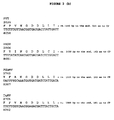
- a ribozyme can be represented as a molecule of formula (I): wherein, (X) n and (X) n' represent ribonucleotide sequences substantially complementary to an RNA sequence of a potyvirus (either genomic or replicative intermediate) ; an (*) represents a base pair between complementary ribonucleotides ; Y represents any ribonucleotide and each Y may be the same or different ; y' and Y'' represent ribonucleotides of complementary sequence along at least part of their length to allow base pairing between the oligoribonucleotides, or Y' and Y'' together form a single RNA sequence wherein at least part of said sequence comprises a stem formed by base pairing between complementary nucleotides ;
- the ribozyme is as set forth in formula (II) : wherein (X) n and (X) n ' represent ribonucleotides sequences substantially complementary to an RNA of a potyvirus ; Y represents any ribonucleotide and each Y residue may be the same or different ; an (*) represents a base pair between complementary ribonucleotides ; n and n' are as previously defined ; B represents a bond, a base pair, a ribonucleotide, or an oligoribonucleotide containing at least 2 ribonocleotides ; m and m' are 1 or more and may be the same or different ; and optionally, an additional nucleotide selected from any one of A, G, C or U is inserted after 1 A.
- the ribozyme is as set forth in formula (III): wherein (X) n and (X) n ' represent a ribonucleotide sequence substantially complementary to an RNA of a potyvirus ; Y represents any ribonucleotide and each Y residue may be the same or different ; an (*) represents a base pair between complementary ribonucleotides ; n and n' are as previously defined.
- catalytic regions illustrated above have a conserved structure and sequence, it has been observed that some nucleotides may be deleted, inserted, substituted or modified without prejudice to the activity of the ribozyme.
- the invention comprises the use of these modified catalytic regions in the polyribozyme provided that their catalytic activity is conserved. This activity can be verified by using the tests described below.
- nucleotides of the catalytic region II illustrated in formula I, II and III may be replaced by nucleotides containing bases such as adenine, guanine, cytosine, methylcytosine, uracil, thymine, xanthine, hypoxanthine, inosine or other methylated bases.
- bases such as adenine, guanine, cytosine, methylcytosine, uracil, thymine, xanthine, hypoxanthine, inosine or other methylated bases.
- the ⁇ conserved ⁇ bases C-G which together form the first base pair of the catalytic loop, can be replaced by U-A.
- the 3' (X) n sequence of a given R unit and the 5' (X') n' sequence of the adjacent R unit are complementary to sequences which are contiguous in the potyvirus genomic (+) strand RNA or replicative (-) strand RNA.
- the complementary sequence may hybridise with the entire length of the target transcript. On the other hand, it may hybridise with only a portion or region of the targeted transcript. The portion or region in question must be long enough to allow the inclusion of at least 1 catalytic region in the corresponding sequence of the polyribozyme.
- the length of the complementary sequence, not counting the catalytic regions may vary from about 4 to 4000 bases Lengths of 40 to 1000 are particularly preferred.
- the 3' hybridising arm (X') n of a given ⁇ R ⁇ unit and the 5' hybridising arm (X') n' of the adjacent ⁇ R ⁇ unit are complementary to non-contiguous portions of the genome or of the (-)sense RNA transcript.
- An example of this type of structure is the ⁇ short arm polyribozyme ⁇ .
- the structure of these non-contiguous polyribozymes can be thought of as a sequence complementary to the target sequence in which ribozyme catalytic regions are embedded and which has undergone deletions in the complementary sequence.
- the distance between two catalytic regions in the polyribozyme is normally shorter than the distance between the two corresponding X°X°X° sites in the target sequence.
- the distance between ribozymes can be reduced significantly with respect to the distance between the corresponding target sites in the substrate, for example, if two adjacent targeted X°UX° sites in the substrate are separated by a distance of 1000 nucleotides, the distance between the catalytic regions of the ⁇ short arm ribozyme ⁇ may be as little as 30 or 40 nucleotides.
- the minimum length between two adjacent catalytic regions is normally about 8 nucleotides and preferably at least 20.
- the present inventors have shown that such shortened hybridising sequences do not, surprisingly, prevent the polyribozyme from efficiently cleaving the substrate and can, in fact, in many cases improve the efficiency of the inactivation.
- the reduction in the length of the complementary sequence avoids problems associated with the formation of competing or unfavourable secondary structure leading to the inactivation of the ribozyme.
- more catalytic regions may be inserted targeting more cleavage sites in the substrate.
- the use of the short arm polyribozymes means that efficent polyribozymes may be constructed even if only parts of the sequence of the substrate are known. It is sufficient to know the 10 or 15 bases surrounding an X°X°X° target site.
- Another important advantage is the possibility to use, as the shortened hybridising arms, exclusively those sequences which are conserved in different viruses, for example viruses of the same type. In this way, different viruses may be inactivated by the same polyribozyme even if the sequences between the conserved regions are totally dissimilar. These viruses may be of the potyviridae family or species within the family or different isolates of the same species.
- ⁇ short arm ⁇ ribozymes of the invention proves that, in a polyribozyme, the different catalytic regions can act independently of each other.
- Long-arm ribozymes having arm lengths of at least 50 nucleotides, either contiguous or non-contiguous, are also preferred embodiments of the invention. Examples are shown in Table 8 below.
- Any one polyribozyme of the invention may include a mixture of ⁇ long arm ⁇ and ⁇ short arm ⁇ ribozymes, and also of ⁇ contiguous ⁇ and ⁇ non-contiguous ⁇ ribozymes. Alternatively, it may include only long arm ribozymes, or only short arm, or only contiguous, etc...
- the structure of the ribozyme can therefore be optimised by testing usinq the in vitro - in vivo and transient assay described below.
- the polyribozymes may include, between two consecutive ⁇ R ⁇ units, a non-complementary sequence (A) which has a length of at least 1 base, and which is non-complementary to the (+) or (-)sense potyviral RNA.
- the non-complementary sequence of the polyribozyme may have a precise function, for example, it may be constituted by a coding sequence which can be used to select transformants or also a sequence containing a ribozyme which acts on a substrate other than the primary target of the DNA virus or which is cis acting on a part of the polyribozyme It typically contains a polylinker for cloning, or an adaptor to facilitate constructions of chimeric polyribozyme.
- the non-complementary sequence ⁇ A ⁇ usually has a length comprised between about 2 and 500 bases, for example 20 to 100 based. When there is a plurality of non-complementary sequences, they may together constitute as much as about 90% of the length of the polyribozyme, more preferably 50%.
- Preferred ribozymes of the present invention have multiple catalytic domains ( ⁇ polyribozyme ⁇ ) targeting different regions or different RNA strands of the potyvirus. According to their construction (long arm or short arm, contiguous or not contiguous), the polyribozyme may act as a series of individual monoribozyme or may act as an unimolecule simultaneously agains each of its target sites.
- two ribozyme units R1 and R2 target either, different cistrons (or ⁇ genes ⁇ ) on the same RNA strand, or they target the same or different cistrons on different RNA strands.
- such a ribozyme comprises at least two of said R units, ⁇ R 1 ⁇ and ⁇ R 2 ⁇ , wherein the complementary sequences (X) n and (X') n' of R 1 are complementary to sections of a first target region, % 1 , of the potyvirus genomic (+) RNA or of the replicative (-) strand RNA, region Z 1 being within or comprising a first cistron or untranslated region (UTR), and X and X' of R 2 are complementary to sections of a second target region, Z 2 , of the potyvirus genomic RNA or (-) strand replicative intermediate, region Z 2 being within or comprising a second cistron or untranslated region, Z 1 and Z 2 being either different cistrons or untranslated regions, on the same RNA strand, or being the same or different cistrons or untranslated regions on different strands, of the potyvirus RNA.
- Preferred examples of this type of polyribozyme are those whose targets are all on the (+) strand, but within different cistrons, or alternatively, all on the (-) strand, but within regions corresponding to different cistrons or untranslated regions.
- Another example of this type of ribozyme is a polyribozyme which targets regions on different RNA strands of the potyvirus, the regions corresponding to (+) and (-) forms of the same cistron.
- a further preferred polyribozyme of the invention is one comprising at least two R units, ⁇ R 1 ⁇ and ⁇ R 2 ⁇ , wherein the complementary sequences (X) n and (X') n' of R 1 are complementary to sections of a target region Z 1 within a given gene or untranslated region of the potyvirus genomic (+) strand RNA or of the corresponding region of the replicative (-) strand RNA, and the hybridising sequences (X) and (X') of R 2 are complementary to a target region Z 2 within the same gene or untranslated region as that of Z 1 , on the same RNA strand, provided that if the gene is the capsid protein gene, the hybridising sequences X and X' of both R 1 and R 2 are complementary to the replicative (-) strand RNA.
- Preferred target regions for the polyribozymes of the invention are regions within or comprising the cistron giving rise to the capsid protein, the NIa cistron, the NIb cistron, the 3' untranslated region of a potyvirus, or the corresponding sequences in the replicative (-) strand RNA.
- ribozymes of the invention are the following :
- a further variant can be obtained by incuding in the ribozyme construction, all or part of a 3' non-coding region of a potyvirus, preferably WMV2, to control intracellular localisation of the ribozyme gene. This may help to direct the ribozyme RNA to the cellular compartment where the potyviral RNA might be.
- the enhanced functioning of ribozymes carrying the 3' non-coding region is suspected by analogy to the observations in animal cells (Sullenger and Cooh 1993, Science vol. 262 p 1566-1569) that a ribozyme against a retrovirus was much more efficient when it was co-localised with the target, using a retroviral vector to express it.
- the 3' non-translated sequence usually contains all the untranslated region of the virus and may also contain the last 10 to 20 codons of the protein and the first 10 to 15 residues of the viral poly A tail.
- the ribozymes of the present invention can be tested for their capacity to cleave a substrate RNA, and / or to confer resistance to potyvirus infection, by in vitro , in vivo or transient assays as described below in examples 8, 9 and 10 respectively.
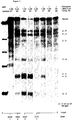
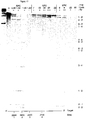
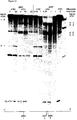
- the in vitro test involves incubating a suitable RNA substrate, uniformly labeled with a radioactive label, with the ribozyme under test, prepared by in vitro transcription. Incubation is carried out at varying temeratures as described in example 8. The capacity of the ribozyme to cleave the substrate at the expected target sites is shown by carrying out an autoradiogram on a polyacrylamide gel.
- the ribozymes and genetic constructs of the present invention can be conveniently tested in vivo using virus-sensitive plants.
- the analysis may be qualitative such as by screening for severity of symptoms, or quantitative where samples are analysed, for example, by measuring the level of virus replicating in infected plants using procedures such as ELISA, or alternatively, the level of ribozyme RNA, or the level of target RNA.
- a combination of qualitative or quantitative analyses may also be employed.
- the genetic nature of the virus-resistant transgenic plants can be determined by carrying out a segregation analysis. The goal of this test is to determine genetic linkage of the ribozyme gene and virus resistance. Self-fertilisation, or a cross with a non transformed genotype can be carried out on a primary descendant to obtain T 1 . Subsequently, T 1 plants are inoculated with the potyvirus by mechanical inoculaion or natural inoculation or by using aphids fed on infected plants. Plants are scored for resistance to infection.
- a segregation ratio of 3:1 indicates a single locus acting as a heterozygous trait ( ⁇ dominant ⁇ ) ; a segregation ratio of 1:3 indicates a single locus acting as a heterozygous trait ( ⁇ recessive ⁇ ), and a segregation ratio of >3:1 indicates a plurality of loci, acting independently of each other, and conferring resistance as a single copy as a heterozygous trait.
- the ribozymes of the invention can also be tested using a transient transformation assay as described below in Example 10.
- the target is linked to a reporter gene such as LUC.
- DNA encoding the substrate-reporet gene hybrid is co-introduced into a plant cell along with a plasmid encoding the ribozyme under test.
- the level of expression of the reporter gene is measured. Expression is decreased when the ribozyme interacts with the target.
- the present invention also extends to genetic constructs comprising the ribozymes herein described.
- These genetic constructs generally comprise a vector sequence as a vehicle for transferring the ribozyme to a host cell and a promoter sequence to direct transcription of the ribozyme and a terminator to signal termination of transcription.
- a preferred promoter includes but is not limited to a 35S Cauliflower Mosaic Virus (CaMV) or to a double 35S CaMV promoter.
- CaMV 35S Cauliflower Mosaic Virus
- the CaMV promoter is described by Odell et al , Nature 313 : 810-812, 1985.
- the ribozymes are generally in the complementary form such that upon transcription, the ribozyme is produced.
- the genetic constructs of the present invention are used to generate transgenic plants capable of constitutively, developmentally or inducibly (e.g. in response to certain stimuli) expressing the ribozymes herein described. Most preferred transgenic cells and plants are rendered substantially resistant to potyvirus infection.
- the invention also extends to a method for producing transgenic plants which exhibit at least some resistance to infection by potyviruses, and to the plants which can be obtained thereby.
- a method of generating trangenic plants exhibiting reduced symptoms following exposure to potyviruses compared to non-transgenic plants comprising transforming plant cells with a genetic construct encoding a ribozyme as hereinbefore described capable of cleaving potyvirus RNA, regenerating plants from said transformed cells, self-fertilising said regenerated plants and obtaining seeds there from and then growing transgenic plants from said seeds.
- All of the known means for introducing foreign DNA into plants may be used for example Agrobacterium , electroporation, protoplast fusion, bombardment with a particle gun, or penetration of DNA into cells such as pollen, the microspore, the seed and the immature embryo, viral vectors such as the Geminiviruses or the satellite viruses.
- Agrobacterium tumefaciens and rhizogenes constitute the preferred means.
- the sequence coding for the polyribozyme is introduced into a suitable vector together with all of the regulatory sequences necessary such as promoters, terminators, etc... as well as any sequence necessary for selecting the transformants.
- the invention also extends to progeny, reproductive material and seeds from the transgenic plants.
- the ribozymes may be expressed constitutively, developmentally or inducibly in the whole plant, or in specific tissues of the plant.
- plants which can be rendered resistant to potyvirus infection by the present invention mention can be made of plants belonging to the families : Cucurbitaceae (e.g. courgette melon), Chenopodiaceae (e.g. beet), Cruciferaceae, Graminaceae (e.g. oat, wheat, sugar cane, barley, ryegrass), Leguminoseae (e.g. bean, pea, soya, peanut), Ombelliferaceae (e.g. carrot, celery, parsnip), Rosaceae (e.g. plum), Solanaccae (e.g. potato, tomato, tobacco, pepper).
- Cucurbitaceae e.g. courgette melon
- Chenopodiaceae e.g. beet
- Cruciferaceae e.g. oat, wheat, sugar cane, barley, ryegrass
- Leguminoseae e.g. bean, pea, soya, peanut
- the present invention also extends to the use of the claimed ribozymes in plant cells or plants, in association with other virus resistance genes or systems, either to potyviruses or to other viruses, for example, anti-CMV ribozymes (CMV signifies ⁇ cucumber mosaic virus), or coat-protein mediated systems for virus resistance such as coat protein antisense or sense (translated, or translation deficient) RNA.
- the plant may comprise cells which are transformed both by the ribozyme sequences of the invention and by the sequences providing associated protection. Expression of the different sequences providing protection may be simultaneous or otherwise.
- nucleic acid molecule which consists of a fragment of the WMV2.
- viral replicative (-)RNA which has been shown to be particularly amenable to cleavage or inactivation by ribozymes, and can thus be used us an artificial target molecule.
- This molecule, and its derivatives will be referred to hereinafter as the ⁇ artificial target ⁇ molecule.
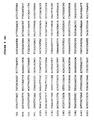
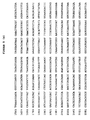
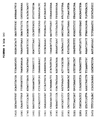
- the artificial target molecules consist of either nucleotides 1704 to 1873 of the (-) strand of the sequence illustrated in figure 18, or of at least 20, for example between 40 and 170, consecutive nucleotides of the 1704-1873 fragment, including the ATG shown at Position 1748-1750 in Figure 18.
- the artificial target molecules may also consist of a sequence having at least 75% identity and preferably at least 85% or even 95% identity with the underlined sequence of Figure 18, or a fragment thereof hving at least 20 nucleotides.
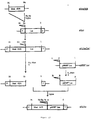
- the artififcial target sequence present on pBPL 0186 as described in figure 15, is made of approximately 180 bases of viral sequence from the minus strand of the viral genome, in the region coding on the plus strand for the replicase NIb gene.
- the sequence is made of 125 bases in 5' of the A of the GUA ribozyme cleavage site arid 44 bases in 3' of the A.
- the A is the complementary base to the T shown as base n° 1748 on figure 18. Part of this sequence is present on many RNA viruses. For example around this cleavage site in WMV2 :
- This region is therefore a good target for molecules designed against those viruses.
- the invention also relates to larger nucleic acid molecules containing the artificial target sequences of the invention with the exception of known full length viral (-)RNA which naturally contains the sequence.
- Preferred examples of molecules comprising the artificial target sequences are molecules in which the artificial target sequence is transcriptionally or translationally fused to a second nucleic acid molecule.
- the artificial target sequence and its derivatives is thus appended to a gene of interest (hereafter called ⁇ the useful gene ⁇ or ⁇ gene of interest ⁇ ), in 5' or in 3' of the open reading frame or coding sequence of the useful gene, so that it does not prevent the function of the useful gene and makes this gene easily controllable by a ribozyme (such as those described earlier), or antisense, directed against the artificial target.
- a gene of interest hereafter called ⁇ the useful gene ⁇ or ⁇ gene of interest ⁇
- ⁇ coding sequence ⁇ in this context includes those sequences active as RNA like tRNA, rRNA, etc. in addition to those sequences coding for proteins.
- the appended sequence may also be a regulatory sequences, sequences encoding functional RNA such as rRNA, tRNA, mRNA etc.
- the 5' fusion can be transcriptional, or translational.
- the 3' fusion can be transcriptional or translational.
- the precise nature of the fusion depends on the functionality of the useful gene. For example, in the case of a gene coding for a protein, a translational fusion can be used if the aminoacids added to the protein (in NH 2 or COOH terminus as the case may be) do not prevent its function.
- the artificial target sequence can be smaller than the sequence described above, as demonstrated by the inhibitory activity of short arm ribozymes pairing with only a very small stretch of that sequence.
- the artificial target sequence can be reduced to 40 bases on each side of the A of the GUA, or to 10 bases in 5' and 12 bases in 3' of the A, or even to 8 bases on each side of the A, if a slightly lower efficiency of the ribozyme is acceptable.
- ribozymes against the artificial target sequence in the experiments described can probably be explained in part by its accessibility to inhibitor RNA molecules. Therefore, it is possible to use not only ribozymes but also antisense RNA against the artificial target, albeit with a lower efficiency.
- the fusion between the gene of interest and the artificial target can now be used as a target for ribozymes or antisense RNA.
- the inactivation of the useful gene containing the artificial target can be caused by the ribozyme gene brought in through a cross, or by the tissue specific expression of the ribozyme gene if the ribozyme gene is under control of a tissue specific promoter.
- it can be caused by the inducible expression of the ribozyme gene if the ribozyme gene is under control of an inducible promoter.
- inducible is meant chemically inducible (by a natural or an artificial molecule) or inducible by environmental factors such as light, drought, stress, pathogen attack and other stimuli. Inducible and tissue specific promoters are well known.
- AMS artificial male sterility
- the gene can be engineered by fusing to it the artificial target sequence described above so that the gene function is not affected.
- a ribozyme against the artificial target is introduced in the male parent where it has no effect (since there is no target sequence in that plant).
- the hybrid plant resulting from the cross between the AMS female plant and the male restorer plant will be fully fertile since the ribozyme brought in by the male parent will inactivate the AMS gene brought in by the female parent.
- Other AMS gene can be used similarly.
- the use of the artificial target is not limited to the area of plant improvement.
- the artificial target could be used with any artificial gene when an efficient inhibition of the gene is necessary in some circumstances. For example, the artificial target could be appended to a therapeutic gene used in a gene therapy treatment in humans or animals.
- a tissue specific ribozyme gene against the artificial target could then be used to protect some specific tissue against the activity of the therapeutic gene if such activity was deemed undesirable in laid tissue.
- An inducible ribozyme gene against the artificial target could be used to give the clinician the ability to stop the effect of the therapeutic gene if it was necessary, just by inducing the ribozyme gene. Indeed such systems might be absolutely required for certain gene therapy procedures, perhaps wwhere the expression of toxin genes is involved.
- a synthetic ribozyme against the artificial target could also be used through extraneaous delivery to control activity of the therapeutic gene in the appropriate tissue or at the appropriate time.
- the artificial target could be used in association with genes used in animal improvement. It could also be used in association with genes used in the food areas for example to improve microorganisms used in food production.
- Different aspect, of the invention arc illustrated in the figures :
- WMV2 Watermelon Mosaic Virus 2
- ZYMV Zucchini Yellow Mosaic Virus
- the sequence of the 3' region of ZYMV strain E15 is described in Figure 6.
- the E9 strain was more than 99% identical to E15.
- Both the plus (+, coding, or genomic) RNA strand of the virus and the minus (-, replication intermediate) RNA strand of the virus were targeted by ribozymes.
- Triplets located in a region of sequence conservation were preferred. This would increase the chance that the ribozyme could target multiple strains of the virus or even multiple species of related viruses. It would also decrease the chance that a virus resistant to cleavage arises.
- site 2259 was conserved in ZYMV (at base 2249 on figure 6).
- Site 1747 was highly conserved among most potyviruses: a comparison of a 23 base segment surrounding the site shows the following identity:
- Inverse PCR (IPCR) reactions were used to insert a ribozyme catalytic sequence in replacement of the third base of each target triplet, essentially as described in Unit 3.17.3 of Current Protocols in Molecular Biology.
- the primers used are listed below.
- Bases in lower case are encoding the ribozyme catalytic sequence.
- Bases in upper case are complementary to the target region and used to prime the plasmid template. Bases paired with the first 2 bases of the cleaved triplet are in bold. For the first primer pair the sequence of the final product around site 696 is shown, to demonstrate that ligation of the IPCR product will produce a molecule with a functional catalytic sequence inserted in replacement of the third base of the target site.
- the plasmid template was amplified by IPCR using the first pair of primers.
- the full length PCR product was purified on a gel, and circularised by ligation.
- the circular product was transformed into bacteria, and the resulting plasmid was extracted from a bacterial colony and submitted to the second IPCR reaction using the second pair of primers.
- the procedure was repeated with the third and fourth pair, and the final product was analysed by sequencing the modified regions.
- a plasmid called pBPL4734 was obtained; it had the correct sequence except for ribozyme 696 which had one extra base in the loop, and ribozyme 996, where a small deletion had taken place. Attempts were made to repair errors in 996 by a new round of IPCR.
- the final product was called pBPL4738 and had the expected sequence except at sites 696 and 996 where the catalytic sequence is mutated in the ribozyme loop (upper case):
- the multimeric long arm ribozyme sequence was cloned in the plant expression cassette from pBIOS512, made of the enhanced 35S promoter and the nos terminator, and the gene was then inserted in the plant transformation vector pSCK.
- this plasmid was built by replacing the 35S promoter region of plasmid pBIOS3 (Perez et al., 1989) by the enhanced 35S promoter region from pJIT163, a plasmid derived from pJIT60 (described in Guerineau and Mullineaux, 1993) by inserting an NcoI site in the polylinker.
- the enhanced 35S promoter was isolated from pJIT163 as a SstI - BamHI fragment and cloned into sites SstI - BamHI of pBIOS3 in replacement of the 35S promoter.
- this plasmid was built by inserting a kanamycin resistance gene into the plant transformation vector pSCV1 (Firek et al., 1993).
- the kanamycin resistance gene was built by inserting the nptII coding sequence from pCaMVNEO (Fromm et al., 1986) as a BaHI fragment in the BamHI site of pBIOS1 (Perez et al., 1989), resulting in pBIOS1K.
- the gene was then isolated from pBIOS1K as a EcoRI(Klenow) fragment and inserted into site EcoRV of pSCVl , resulting in pSCK.
- the ribozyme sequence was cloned in the expression cassette of pBIOS512, as a EcoRV-SmaI - HindIII fragment in the HindIII (Klenow) site of pBIOS512. The gene was then excised as a EcoICRI - EcoRI(Klenow) fragment and inserted into the SmaI site of pSCK.
- the resulting plasmid was called pBPL3817. It contains a T-DNA with a marker gone conferring resistance to kanamycin and the long arm ribozyme gene expressing an RNA with approximately 1900 bases complementary to the minus strand of the virus (the target RNA) and targeting four sites on the target RNA.
- a procedure similar to that described in 3. was used to build a ribozyme gene against the + strand.
- the plasmid template used in the 1PCR reactions extended from base 2164 (site XhoI) to the end of the CDNA (base 2988, including 18 A of the polyA tail) and was obtained by internal deletions of a partial cDNA clone of the 3' region of WMV2.
- the plasmid obtained was called pBPL4736, and had half of ribozyme 2259 missing, and a one base deletion in the 3 other ribozymes' loop New rounds of IPCR inserted a correct ribozyme for 2259 and corrected ribozyme 2403. The final product still contained some errors which were not considered serious problems.
- the ribozyme sequence for sites 2259 and 2403 is correct (wild type as described).
- the ribozyme sequences for sites 2520 and 2720 each have one base deleted:
- the resulting plasmid was called pBPL38010. It contains a T-DNA with a marker gene conferring resistance to kanamycin and the ribozyme gene expressing an RNA with approximately 830 bases complementary to the plus strand of the virus (the target RNA) and targeting four sites on the target RNA.
- the ribozyme catalytic sequence used for these constructs was a variant of the sTobRV ribozyme described above, with a 3 base pair helix II instead of the natural 4 base-pair.
- the ribozyme used for the short multimeric ribozyme was : cugaugaGCGgugaCGCgaa. (Helix II shown here in upper case letters)
- the pairing regions between the ribozymes and the target was made of 2 arms of 10 to 12 bases (see Haseloff and Gerlach, 1988 for a description of helices I, II, and III).
- sequence of the oligonucleotides used is given below; lower case letters are the ribozyme catalytic sequence, lower italic letters are linker regions, upper case letters are target sequences. All sequences are shown 5' to 3'. The sequence synthesized (shown) is actually the strand complementary to the ribozyme RNA.
- Oligonucleotides used for the ribozymes against minus strand are:
- the PCR products were digested with BamHI and HindIII and cloned into BlueScript SK+.
- the ribozyme against the minus strand gave plasmid pBPL4741, and the ribozyme against the plus strand gave pBPL4742.
- the sequences of the relevant regions are on figure 7. Restriction sites used for further cloning are indicated.
- the 2 ribozymes were combined by inserting the BstXI - BspMI fragment of pBPL4742 in sites BstXI - BamHI of pBPL4741, yielding pBPL4743.
- the 3' non coding region of WMV2 strain Val3 (3' UTR) was then cloned in 3' of the multimeric ribozyme sequence. This was done as an attempt to increase the efficacy of the ribozyme by co-compartmentalisation with the target viral RNA. If 3' end sequences of RNA are involved in cellular localisation of RNA, as is the case with many RNAs, it was hoped that by providing the ribozyme RNA with a 3' sequence similar to that of its target, the 2 molecules would be present in the same cellular compartment.
- the 3' UTR region of WMV2 Val3 was cloned from the original cDNA (see sequence in figure 5 bis) as a HinfI (at base 2678) - BamHI (from the anchor region in primer 1, see 1. above) fragment into EcoRI - BamHI of BlueScript SK+.
- the fragment contains bases 2678 to 2970 of strain Val3 cDNA, which contains the last 14 codons of the cDNA followed by the complete untranslated region.
- This sequence (shown in figure 7) was then inserted as an EcoRV - NotI fragment into BamHI(Klenow) - NotI sites of pBPL4743, giving pBPL4744.
- pBPL3754 contains a T-DNA with a marker gene conferring resistance to kanamycin and the ribozyme gene expressing an RNA approximately 700 bases long.
- This RNA contains 8 regions of homology to the plus or minus strand of the virus. Each region is between 20 and 22 bases long, and is split in the middle by the ribozyme catalytic sequence.
- the ribozyme RNA has a 3' region containing approximately 300 bases identical to the viral 3' end.
- the first combination contained 10 ribozyme activities, 5 against each strand:
- the ribozyme catalytic sequence used for these constructs was the same variant of the sTobRV ribozyme as described in 5. above, with a 3 base-pair GCG helix II instead of the natural 4 base-pair.
- the pairing regions between the ribozymes and the target was made of 2 arms of between 8 and 11 bases.
- the sequences were assembled together with the 3'UTR of WMV2 Val3 (shown on figure 7), by a tripartite ligation: the EcoRV(de phosphorylated) - NotI fragment containing the 3'UTR and the BamHI(Klenow) - HindIII(Klenow) fragment from pBPL4747 were ligated together in pBPL4746 cut with BamHI (Klenow) and NotI (both sites de phosphorylated). The resulting plasmid was called pBPL4748 and contained (from HindIII to BamHI) the sequence for the ribozymes against the plus strand, followed by the ribozymes against the minus strand followed by the 3'UTR.
- Plasmid pBPL3906 contains a T-DNA with a marker gene conferring resistance to kanamycin and the ribozyme gene expressing an RNA approximately 750 bases long.
- This RNA contains 10 regions of homology to the plus or minus strand of ZYMV. Each region is between 16 and 20 bases long, and is split in the middle by the ribozyme catalytic sequence.
- the ribozyme RNA has a 3' region containing approximately 300 bases identical to the non-translated 3' end of WMV2 Val3.
- the ribozyme catalytic sequence used for these construct was the natural sTobRV hammerhead ribozyme except for 2354 and 2603 where the same variant of the sTobRV ribozyme as described in 5. above, with a 3 base-pair GCG helix II instead of the natural 4 base-pair was used.
- the pairing regions between the ribozymes and the target was made of 2 arms of between 8 and 12 bases. Adjacent ribozymes 2455-2466 and 2590-2603 had one arm in common.
- pBPL4750 The relevant sequence of pBPL4750 is shown on figure 8.
- the ribozyme sequence was cloned directly as a BamHI - HindIII fragment in the expression cassette of pBIOS512 as described in 3. above, and the functional gene was then cloned into the plant transformation vector pSCK as described in 3. above yielding pBPL4186.
- Plasmid pBPL4186 contains a T-DNA with a marker gene conferring resistance to kanamycin and the ribozyme gene expressing an RNA approximately 250 bases long. This RNA contains 3 regions of homology to the plus and minus strand of ZYMV. One region of 21 bases is split in the middle by one ribozyme catalytic sequence. The other 2 regions of 31 and 32 bases are each split in three parts by two ribozyme sequences.
- the ribozyme catalytic sequence used for this construct was the same variant of the sTobRV ribozyme as described in 5. above, with a 3 base-pair GCG helix II instead of the natural 4 base-pair.
- the pairing regions between the ribozymes and the target was made of 2 arms of 10 and 17 bases for each ribozyme.
- the 17 base arm was shared between the 2 ribozymes.
- the total pairing region was 37 bases (10 + 17 + 10), interrupted in 2 places by the 2 ribozyme sequences
- pBPL4751 The relevant sequence of pBPL4751 is shown on figure 8.
- the ribozyme sequence was cloned directly as a BamHI - HindIII fragment in the expression cassette of pBIOS512 as described in 3. above, and the functional gene was then cloned into the plant transformation vector pSCK as described in 3. above yielding pBPL4194.
- Plasmid pBPL4194 contains a T-DNA with a marker gene conferring resistance to kanamycin and the ribozyme gene expressing an RNA approximately 100 bases long. This RNA contains 1 region of homology to the minus strand of ZYMV. The region is 37 bases long, and is split in three parts by the 2 ribozyme catalytic sequences.
- the cDNA clone obtained from ZYMV E15 with PCR primers 1 and 2 (as described in 1. above) was cut with NsiI (at base 2383) and SacII (in the polylinker, next to 5'end of the cDNA), than treated with Klenow and do phosphorylated. The large fragment was then purified and used as a vector in the subsequent ligation.
- the same plasmid was cut with NsiI (at base 2383) and AlwNI (at base 1955), then treated with Klenow, and the 470 base fragment was purified and used as the insert in the subsequent ligation.
- the clones obtained were screened for the appropriate orientation, and the selected plasmid was called pBPL0157.
- This plasmid contains the sequence between bases 2383 and 1961 linked to the sequence between bases 2388 and 2922.
- the ligation places side by side the region 3' of 1961 and the region 3' of 2383.
- the transcription product of this sequence will be complementary to the minus strand of ZYMV between base 1961 and 2383, and complementary to the plus strand of ZYMV between base 2388 and 2922.
- Ribozyme catalytic sequences were inserted at the positions mentioned above using a sequence of IPCR reactions on template plasmid pBPL0157, following the procedure described for WMV2 in 2. above.
- the ribozyme catalytic sequence used for this construct was the natural sTobRV hammerhead ribozyme as described previously.
- pBPL4760 The plasmid containing the 7 ribozyme sequences was called pBPL4760. Sequence of the ribozyme gene in pBPL4760 is shown in figure 9.
- Plasmid pBPL4771 contains a T-DNA with a marker gene conferring resistance to kanamycin and the long arm ribozyme gene expressing an RNA with approximately 900 bases complementary to the plus and minus strand of ZYMV RNA and targeting seven sites on the target RNAs.
- Ribozyme activity was assayed in vitro by incubating an appropriate target RNA prepared by in vitro transcription and uniformly labelled with radioactive UTP, with the ribozyme RNA prepared by in vitro transcription. The protocol is described in detail below and the result for each ribozyme are also shown.
- the plasmids used for target RNA synthesis were all derived from the plasmids containing the original PCR amplified viral sequences described in 1. above.
- the T3 and T7 promoters present in the BlueScript vector were used to transcribe the plus or the minus strand of the cloned fragment as appropriate.
- In vitro transcription using T3 RNA Polymerase or T7 RNA Polymerase from Promega or New England Biolabs was done following the suppliers instructions (for example in Promega Protocols and Application Guide, available from the Promega company, Madison, Wisconsin, USA), in the presence of radioactive ⁇ 32 p-UTP.
- the template plasmid was linearised with an appropriate restriction enzyme prior to transcription.
- Target RNA was quantitated by measuring the incorporation of radiolabel using the DE81 filter binding assay as described in the Promega Protocols.
- Target RNA was stored as a precipitate under ethanol at -20°C, and resuspended in water at between 0.01 and 0.1 pmol/ ⁇ l when needed.
- Specific activity was usually between 20,000 and 200,000 cpm/pmol.
- plasmids described above in sections 3, 4, 5, 6 and 7, made of the various polyribozyme sequences cloned into BlueScript, were used as templates for in vitro transcription reactions as described above, but using only non radioactive nucleotides.
- a pilot reaction with a small amount of radioactive tracer was done separately to quantitate the synthesised RNA, using the DE81 filter binding assay.
- Ribozyme RNA was stored as a precipitate under ethanol at -20°C and resuspended in water at between 0.1 and 1 pmol/ ⁇ l when needed.
- the target RNA and ribozyme RNA were mixed in T7 RNA Polymerase buffer (from New Englands Biolabs) and incubated at various temperature (22°C, 37°C or 50°C).
- the standard reaction was in 4 ⁇ l and contained 0.005 to 0.1 pmol of target, and between 1 and 10 fold molar excess of ribozyme.
- the reaction was stopped by adding an equal volume of stop-loading buffer (Formamide containing 10mM EDTA and 1mg/ml each Xylene Cyanol and Bromophenol Blue) to the reaction and freezing the sample at -20°C until all samples were ready.
- stop-loading buffer Formamide containing 10mM EDTA and 1mg/ml each Xylene Cyanol and Bromophenol Blue
- the reactions were then boiled for 30 seconds, placed on ice, and loaded on a denaturing polyacrylamide gel in TBE buffer with 7M urea.
- Polyacrylamide concentration was between 4 and 6 % depending on the expected length of the products.
- the gel was transferred to a Whatmann 3MM paper, dried and exposed to a PhosphorImager screen. An autoradiogram of the gel was obtained by scanning the screen using a PhosphorImager.
- the ribozyme used was obtained from pBPL4734 (described in 3. above).
- the target contained 1898 bases of viral sequence, complementary to the sequence from base 2168 (site XhoI) to base 270 (site EcoRI) of WMV2 Mar6, with some sequence from the polylinker of BlueScript KS+ (between the T3 promoter and the XhoI site).
- Figure 10 shows the result of one assay. There was 4 fold excess ribozyme and the reaction was done at 50°C for 30, 60, and 90 mn. Products clearly identifiable include the fragments generated by cleaving all four sites (shown by arrows on the gel). However it seems that sites 996 and 1747 were preferentially cleaved.
- the ribozyme used was obtained from pBPL4736 (described in 4. above).
- the target contained 807 bases of viral sequence, between base 2163 (site XhoI) and base 2970 (start of polyA tail), with the polyA tail and polylinker sequence from BlueScript KS+ (between the T7 promoter and the EcoRI site).
- Figure 11 shows the result of one assay. Incubation of target with 4 fold excess ribozyme at three different temperatures showed that site 2259 was not cleaved as expected because of the mutation in that ribozyme (see 4. above). Site 2720 was the fastest cleaver and gave products at 22°C. Site 2403 was next and site 2520 appears the slowest.
- the ribozyme used was obtained from pBPL4741 (described in 5. above)
- the target contained 1880 bases of viral sequence complementary to the sequence bewteen base 2278 (ClaI site) and base 398 (SpeI site), with polylinker sequence in 5' from BlueScript KS+ (betwen the T3 promoter and the ClaI site).
- Figure 12 shows the result of on assay. All four sites are cleaved at high temperature. At 22°C, all sites except 696 are cleaved but cleavage is very slow as demonstrated by the very low abundance of double cleaved products.
- the ribozyme used was obtained from pBPL4742 (described in 5. above).
- the target was the same as described above for the long arm ribozyme.
- Figure 13 shows the result of an assay. Note that the molar excess ribozyme over the substrate was 4.5 (+), 9 (++) and 13.5 (+++). All four sites are cleaved at 50°C; with four fold excess ribozyme, cleavage is essentially complete after 1.0 to 1.5 hour. At 22°C, only sites 2259 and 2403 are cleaved, with ribozyme 2259 being the fastest cleaver.
- Short arm ribozyme against ZYMV first combination (pBPL4746 and pBPL4747)
- the 2 polyribozymes showed some cleavage activity at 50°C, but very little at 37°C and none detectable at 22°C.
- sites 110, 2590 and 2255 were cleaved faster than 2455 and 2161.
- the polyribozyme showed cleavage activity on the plus strand at all 4 predicted sites only at 50°C. No activity was detected at 22°C. The same polyribozyme however showed good cleavage activity on the only site present on the minus strand (site 2354) both at 50°C and 22°C.
- Figure 14 shows the result of an assay of this ribozyme on the minus strand target.
- the target contained 1058 bases of viral sequence, complementary to the sequence between base 2633 (SpeI site) and base 1575 (XbaI site) as shown on figure 6, with 39 bases added in 5' (polylinker sequence between the T3 promoter and the XbaI site of BlueScript SK+) and 11 bases added in 3' (polylinker sequence between the XbaI and the BamHI site of SK+; BamHI was used to linearise the plasmid prior to in vitro transcription).
- the labelled ribozyme from the pilot reaction used to quantitate was mixed with the unlabelled ribozyme. The position of the ribozyme band on the gel is shown by an arrow. The ribozyme was used at 5 fold molar excess over the substrate.
- the ribozyme from pBPL4751 (targeting sites 2009 and 2027 on the minus strand) was assayed on the same target as the ribozyme from pBPL4750.
- Figure 14 shows the result of this assay. Both sites were cleaved efficiently at both 22°C and 50°C. The presence of a two bands of equal intensity for the products 5' - 2 and 5' - 3 (see figure 14) suggest that site 2009 is cleaved more readily or faster than 2027: about 50% of cleaved products are cleaved only at 2009.
- the strain of WMV2 used is called ⁇ MAR ⁇ .
- Two strains of ZYMV pathotype 0 are used:
- Leaves showing symptoms are thinly cut with a razor blade and placed in boxes with calcium chloride to dry them.
- the boxes are stored at 6°C during a maximum of one year (Bos, 1969).
- T l progeny Forty-six to forty-eight seeds (T l progeny) per genetic transformation event are sown in 10 cm square pots filled with a potting soil. The temperature is maintained from 18 to 25 °C with a photo period of 12 hours. Mechanical inoculation on melon plantlets is carried out at the first leaf stage (approximately 15 days after sowing) (Marrov, 1967). The plantlets are inoculated in the same way as for virus multiplication.
- control plants do not show symptoms of virus attack due to bad inoculation of the cotyledons.
- the behaviour of these control plants enables the determination of the value of the pathology test.
- ⁇ Escape ⁇ plants are considered to have escaped from a ⁇ correct ⁇ virus inoculation.
- the transformed plants are demonstrated to be resistant to WMV2 and to ZYMV.
- the segregation ratio (susceptible:resistant) was 3:1 for nine genetic transformation events.
- the segregation ratio (susceptible:resistant) was 1:3.
- the segregation ratio for fourteen genetic transformation events, the segregation ratio (susceptible: resistant) was 1:3 and for three genetic transformation events, the segregation ratio (susceptible:resistant) was 3:1.
- the transient assay system for in vivo activity of ribozyme or antisense genes was described by Sawyer and Birch (1996).
- a target reporter gene and the ribozyme gene to be tested are cloned on two separate plasmids and co-introduced into Nicotiana suspension culture cells by particle bombardment.
- the target reporter gene is an in-frame fusion between the target sequence and the LUC sequence. This in frame fusion encodes a chimeric protein with luciferase activity.
- the ribozyme gene tested expresses transiently a ribozyme which interacts with the target sequence and decreases the quantity of the chimeric target-LUC mRNA which is detected as a reduced luciferase activiiy.
- a 540 bases fragment containing four sites targeted by the polyribozyme was amplified by PCR and cloned in-frame in front of LUC, under control of a modified version of the 35S promoter, using the plasmid pGLFuz (bee figure 17) as described by Sawyer and Birch (1996). Because the most 3' site is located close to the stop codon, it was also necessary to change one base of the viral sequence to remove this stop codon and provide a flanking sequence to this site.
- Target sites on the negative strand of the virus WMV2 (pBPL0184 to 0187):
- the short arm polyribozyme targeting four sites on the plus (2259, 2403, 2520 and 2720) and four sites on the minus strand (696, 996, 1747 and 2067) of WMV2 from pBPL4743 was cloned under control of the modified version of the 35S promoter in pGLFuz.
- ⁇ 1747 One site on the minus strand (hereafter referred to as 1747) of the virus is present on both WMV2 and ZYMV.
- the pentameric ribozyme against the minus strand of ZYMV in pBPL4747 is targeting site 1747 amongst others.
- the ribozyme against site 1747 is identical to the ribozyme present in the construct against WMV2, but the arms are shorter; 8 bases each side.
- the pentameric ribozyme was cloned under control of the modified version of the 35S promoter in pGLFuz.
- the assays were carried out as described by Sawyer and Birch (1996).
- target and ribozyme plasmid DHA (2 ⁇ g each, approx. 25% molar excess of ribozyme) were co-precipitated onto tungsten particles and shot onto Nicotiana plumagnifolia cells on filter paper discs (harvested from suspension culture). After bombardment, the cells were cultured on the discs for 48 hours at 28° C in the dark.
- luciferase assay the cells wore placed into a petri dish containing D-luciferin for 30 minutes, then imaged using a liquid nitrogen cooled CCD camera and AT1 software (Wright instruments Ltd, Enfield, UK). Results are shown in figure 16.
- the WMV2 polyribozyme (pBPL0189) could inhibit the target containing the four sites on the plus strand (pBPL0188) to an extent (70%) not seen in previous uses of the system with full length antisense when an equal amount of target and inhibitor gene was used (Sawyer and Birch, 1996).
- Minus strand target (see figure 12):
- Site 696 was the site least cleaved in vitro by the WMV2 ribozyme, and was not cleaved at all at 22°C. This is in agreement with the transient assay results.
- uidA::luc translational fusion vector pGLFuz
- the uidA gene was first modified by PCR amplification to introduce novel XhoI and NsiI sites upstream of the start codon, replace the stop codon with an alanine codon (TGA -> GCG) and introduce a novel NotI site downstream of this codon.
- the modified uidA gene PCR product was ligated into pGcmT (Promega).
- the appropriate recombinant plasmid was designated PGemGUS.
- the modified uidA gene from pGemGUS was ligated into pZorz vector as a NsiI NcoI fragment.
- the uidA coding region is flanked by an osa promoter and ocs polyadenylation region.
- the luc gene in pGLFuzTAG was removed (by digestion with NotI, treatment with T4 DNA polymerase to create blunt ends, then digestion with XhoI) and replaced by the luc gene from pSPNF+luc (Promega) (prepared by digestion with KpnI, treatment with T4 DNA polymerase and digestion with XhoI).
- the appropriate recombinant plasmid was designated pGLFuz.
- the uidA coding sequence is replaced by viral sequences.
- both the uidA and luc coding sequences are replaced by the ribozyme sequences. (see figure 15)
Landscapes
- Life Sciences & Earth Sciences (AREA)
- Health & Medical Sciences (AREA)
- Genetics & Genomics (AREA)
- Engineering & Computer Science (AREA)
- Biomedical Technology (AREA)
- Zoology (AREA)
- Bioinformatics & Cheminformatics (AREA)
- Chemical & Material Sciences (AREA)
- Molecular Biology (AREA)
- Wood Science & Technology (AREA)
- Biotechnology (AREA)
- General Engineering & Computer Science (AREA)
- Organic Chemistry (AREA)
- Microbiology (AREA)
- Virology (AREA)
- Biophysics (AREA)
- Physics & Mathematics (AREA)
- Plant Pathology (AREA)
- Biochemistry (AREA)
- General Health & Medical Sciences (AREA)
- Cell Biology (AREA)
- Micro-Organisms Or Cultivation Processes Thereof (AREA)
- Medicines That Contain Protein Lipid Enzymes And Other Medicines (AREA)
- Measuring Or Testing Involving Enzymes Or Micro-Organisms (AREA)
- Breeding Of Plants And Reproduction By Means Of Culturing (AREA)
- Agricultural Chemicals And Associated Chemicals (AREA)
- Pharmaceuticals Containing Other Organic And Inorganic Compounds (AREA)
- Enzymes And Modification Thereof (AREA)
- Saccharide Compounds (AREA)
Priority Applications (6)
| Application Number | Priority Date | Filing Date | Title |
|---|---|---|---|
| EP97402925A EP0922767A1 (de) | 1997-12-03 | 1997-12-03 | Ribozyme die fähig sind Widerstand gegen Potyviren Infektion zu verleihen, und Pflanzen die diese Ribozyme exprimieren |
| EP98966607A EP1036186A1 (de) | 1997-12-03 | 1998-12-03 | Ribozyme die fähig sind resistenz gegen potyvirus-infektionen zu verleihen, und planzen die diese ribozyme exprimieren |
| PCT/EP1998/007871 WO1999028485A2 (en) | 1997-12-03 | 1998-12-03 | Ribozymes capable of conferring resistance to potyvirus infection, and plants expressing said ribozymes |
| IL13641798A IL136417A0 (en) | 1997-12-03 | 1998-12-03 | Ribozymes capable of conferring resistance to potyvirus infection, and plants expressing said ribozymes |
| AU24129/99A AU763298B2 (en) | 1997-12-03 | 1998-12-03 | Ribozymes capable of conferring resistance to potyvirus infection, and plants expressing said ribozymes |
| JP2000523361A JP2003521218A (ja) | 1997-12-03 | 1998-12-03 | ポチイウィルス感染に対する耐性を付与できるリボザイム、及び前記リボザイムを発現する植物 |
Applications Claiming Priority (1)
| Application Number | Priority Date | Filing Date | Title |
|---|---|---|---|
| EP97402925A EP0922767A1 (de) | 1997-12-03 | 1997-12-03 | Ribozyme die fähig sind Widerstand gegen Potyviren Infektion zu verleihen, und Pflanzen die diese Ribozyme exprimieren |
Publications (1)
| Publication Number | Publication Date |
|---|---|
| EP0922767A1 true EP0922767A1 (de) | 1999-06-16 |
Family
ID=8229919
Family Applications (2)
| Application Number | Title | Priority Date | Filing Date |
|---|---|---|---|
| EP97402925A Withdrawn EP0922767A1 (de) | 1997-12-03 | 1997-12-03 | Ribozyme die fähig sind Widerstand gegen Potyviren Infektion zu verleihen, und Pflanzen die diese Ribozyme exprimieren |
| EP98966607A Ceased EP1036186A1 (de) | 1997-12-03 | 1998-12-03 | Ribozyme die fähig sind resistenz gegen potyvirus-infektionen zu verleihen, und planzen die diese ribozyme exprimieren |
Family Applications After (1)
| Application Number | Title | Priority Date | Filing Date |
|---|---|---|---|
| EP98966607A Ceased EP1036186A1 (de) | 1997-12-03 | 1998-12-03 | Ribozyme die fähig sind resistenz gegen potyvirus-infektionen zu verleihen, und planzen die diese ribozyme exprimieren |
Country Status (5)
| Country | Link |
|---|---|
| EP (2) | EP0922767A1 (de) |
| JP (1) | JP2003521218A (de) |
| AU (1) | AU763298B2 (de) |
| IL (1) | IL136417A0 (de) |
| WO (1) | WO1999028485A2 (de) |
Families Citing this family (3)
| Publication number | Priority date | Publication date | Assignee | Title |
|---|---|---|---|---|
| ITMI20011364A1 (it) * | 2001-06-28 | 2002-12-28 | Metapontum Agrobios S C R L | Robozima hammerhead specifico per la stearoyl-acp desaturesi di piante oleaginose differenti |
| ZA200607843B (en) * | 2004-02-23 | 2008-06-25 | Israel State | Engrafted plants resistant to viral diseases and methods of producing same |
| CN113667772B (zh) * | 2021-07-19 | 2023-12-29 | 福建省中科生物股份有限公司 | 一种用于鉴定病毒TuMV的引物组合及鉴定方法 |
Citations (6)
| Publication number | Priority date | Publication date | Assignee | Title |
|---|---|---|---|---|
| WO1993014210A1 (en) * | 1992-01-08 | 1993-07-22 | Sandoz Ltd. | Virus resistant corn plants |
| WO1994000012A1 (en) * | 1992-06-29 | 1994-01-06 | Gene Shears Pty. Ltd. | Nucleic acids and methods of use thereof for controlling viral pathogens |
| WO1994019476A1 (fr) * | 1993-02-26 | 1994-09-01 | Gene Shears Pty. Ltd | Polyribozyme apte a conferer, aux plantes, une resistance aux virus et plantes resistantes produisant ce polyribozyme |
| WO1995003404A1 (en) * | 1993-07-22 | 1995-02-02 | Gene Shears Pty Limited | Dna virus ribozymes |
| WO1995004825A1 (en) * | 1993-08-06 | 1995-02-16 | Unilever Plc | Improvements in or relating to disease-resistance of plants |
| WO1996021024A1 (en) * | 1994-12-30 | 1996-07-11 | Asgrow Seed Company | Papaya ringspot virus replicase gene |
-
1997
- 1997-12-03 EP EP97402925A patent/EP0922767A1/de not_active Withdrawn
-
1998
- 1998-12-03 EP EP98966607A patent/EP1036186A1/de not_active Ceased
- 1998-12-03 AU AU24129/99A patent/AU763298B2/en not_active Ceased
- 1998-12-03 IL IL13641798A patent/IL136417A0/xx unknown
- 1998-12-03 JP JP2000523361A patent/JP2003521218A/ja active Pending
- 1998-12-03 WO PCT/EP1998/007871 patent/WO1999028485A2/en not_active Ceased
Patent Citations (6)
| Publication number | Priority date | Publication date | Assignee | Title |
|---|---|---|---|---|
| WO1993014210A1 (en) * | 1992-01-08 | 1993-07-22 | Sandoz Ltd. | Virus resistant corn plants |
| WO1994000012A1 (en) * | 1992-06-29 | 1994-01-06 | Gene Shears Pty. Ltd. | Nucleic acids and methods of use thereof for controlling viral pathogens |
| WO1994019476A1 (fr) * | 1993-02-26 | 1994-09-01 | Gene Shears Pty. Ltd | Polyribozyme apte a conferer, aux plantes, une resistance aux virus et plantes resistantes produisant ce polyribozyme |
| WO1995003404A1 (en) * | 1993-07-22 | 1995-02-02 | Gene Shears Pty Limited | Dna virus ribozymes |
| WO1995004825A1 (en) * | 1993-08-06 | 1995-02-16 | Unilever Plc | Improvements in or relating to disease-resistance of plants |
| WO1996021024A1 (en) * | 1994-12-30 | 1996-07-11 | Asgrow Seed Company | Papaya ringspot virus replicase gene |
Non-Patent Citations (7)
| Title |
|---|
| EDINGTON, B. & NELSON, R.: "Utilization of ribozymes in plants: Plant viral resistance", ERICKSON, R. & IZANT, J. 'GENE REGULATION: BIOLOGY OF ANTISENSE RNA AND DNA'; RAVEN PRESS, NEW YORK, US; 1992, pages 209 - 221, XP002064880 * |
| FANG, G. & GRUMET, R.: "Genetic engineering of potyvirus resistance using constructs derived from the Zucchini yellow mosaic virus coat protein gene", MOL. PLANT-MICROBE INTERACTIONS, vol. 6, 1993, pages 358 - 367, XP002064882 * |
| GADANI, F. ET AL.: "Genetic engineering of plants for virus resistance.", ARCHIVES OF VIROLOGY, vol. 115, 1990, pages 1 - 21, XP002064877 * |
| SAWYER, B. & BIRCH, R.: "A generic transient assay for antisense and ribozyme inhibition in vivo", PROCEEDINGS OF THE AUSTRALIAN SOCIETY FOR BIOCHEMISTRY AND MOLECULAR BIOLOGY, vol. 28, 1996, XP002073852 * |
| SULLENGER, B. & CECH, T.: "TETHERING RIBOZYMES TO A RETROVIAL PACKAGING SIGNAL FOR DESTRUCTIONOF VIRAL RNA", SCIENCE, vol. 262, 3 December 1993 (1993-12-03), pages 1566 - 1569, XP000567869 * |
| TURPEN T: "Molecular cloning of a potato virus Y genome: nucleotide sequence homology in non-coding regions of poty viruses", J.GEN.VIROL.;(1989) 70, PT.8, 1951-6, XP002064879 * |
| VAN DER VLUGT R A ET AL: "Complex formation determines the activity of ribozymes directed against potato virus YN genomic RNA sequences.", VIRUS RESEARCH, (1993 FEB) 27 (2) 185-200., XP002064878 * |
Also Published As
| Publication number | Publication date |
|---|---|
| AU763298B2 (en) | 2003-07-17 |
| AU2412999A (en) | 1999-06-16 |
| EP1036186A1 (de) | 2000-09-20 |
| IL136417A0 (en) | 2001-06-14 |
| WO1999028485A2 (en) | 1999-06-10 |
| JP2003521218A (ja) | 2003-07-15 |
| WO1999028485A3 (en) | 1999-09-02 |
Similar Documents
| Publication | Publication Date | Title |
|---|---|---|
| CA2137161C (en) | Nucleic acids and methods of use thereof for controlling viral pathogens | |
| Haan et al. | Characterization of RNA–mediated resistance to tomato spotted wilt virus in transgenic tobacco plants | |
| EP2267138B1 (de) | Verfahren und Mittel zum Erhalt von modifizierten Phänotypen | |
| EP0728199A1 (de) | Dna-virus ribozyme | |
| US5834265A (en) | Multifunctional RNA having self-processing activity, the preparation thereof and the use thereof | |
| CA2154178C (en) | Plants resistant to infection by plrv | |
| CA2281002A1 (en) | Dna construct to confer multiple traits on plants | |
| Huttner et al. | Ribozyme genes protecting transgenic melon plants against potyviruses | |
| US5877403A (en) | Papaya ringspot virus protease gene | |
| HUT74227A (en) | Virus-resistant plants | |
| Balazs et al. | Virus-resistant transgenic plants: potential ecological impact | |
| US6451603B1 (en) | Ribozyme nucleic acids and methods of use thereof for controlling viral pathogens | |
| US5633449A (en) | Induction of resistance to viral diseases in plants | |
| US6265634B1 (en) | Polyribozyme capable of conferring on plants resistance to cucumber mosaic virus and resistant plants producing this polyribozyme | |
| Kollar et al. | Efficient pathogen-derived resistance induced by integrated potato virus Y coat protein gene in tobacco | |
| HU223266B1 (hu) | Eljárás vírussal szembeni rezisztencia indukálására növényben | |
| EP0922767A1 (de) | Ribozyme die fähig sind Widerstand gegen Potyviren Infektion zu verleihen, und Pflanzen die diese Ribozyme exprimieren | |
| US20090265808A1 (en) | P15 hairpin constructs and use | |
| HUT58794A (en) | Process for producing rns of endonuclease- and antisense activity | |
| Lim et al. | Resistance to tobamoviruses in transgenic tobacco plants expressing the coat protein gene of pepper mild mottle virus (Korean isolate) | |
| MXPA00005493A (en) | Ribozymes capable of conferring resistance to potyvirus infection, and plants expressing said ribozymes | |
| KR0180274B1 (ko) | 담배 모자이크 바이러스의 복제효소 내에 존재하는 도메인 1 염기 서열을 이용한 바이러스 저항성 식물의 개발 | |
| AU683619B2 (en) | Nucleic acids and methods of use thereof for controlling viral pathogens | |
| CA2167701A1 (en) | Dna virus ribozymes | |
| Angenon et al. | LEAKY AMBER CODONS OF PLANT VIRAL mRNAs: ANALYSIS OF TRE CODON CONTEXT REQUIREMENTS FOR READTHROUGH |
Legal Events
| Date | Code | Title | Description |
|---|---|---|---|
| PUAI | Public reference made under article 153(3) epc to a published international application that has entered the european phase |
Free format text: ORIGINAL CODE: 0009012 |
|
| AK | Designated contracting states |
Kind code of ref document: A1 Designated state(s): AT BE CH DE DK ES FI FR GB GR IE IT LI LU MC NL PT SE |
|
| AX | Request for extension of the european patent |
Free format text: AL;LT;LV;MK;RO;SI |
|
| AKX | Designation fees paid | ||
| REG | Reference to a national code |
Ref country code: DE Ref legal event code: 8566 |
|
| STAA | Information on the status of an ep patent application or granted ep patent |
Free format text: STATUS: THE APPLICATION IS DEEMED TO BE WITHDRAWN |
|
| 18D | Application deemed to be withdrawn |
Effective date: 19991217 |