EP0923253A2 - Datenmultiplexierungsverfahren und -vorrichtung - Google Patents
Datenmultiplexierungsverfahren und -vorrichtung Download PDFInfo
- Publication number
- EP0923253A2 EP0923253A2 EP98309921A EP98309921A EP0923253A2 EP 0923253 A2 EP0923253 A2 EP 0923253A2 EP 98309921 A EP98309921 A EP 98309921A EP 98309921 A EP98309921 A EP 98309921A EP 0923253 A2 EP0923253 A2 EP 0923253A2
- Authority
- EP
- European Patent Office
- Prior art keywords
- data
- invalid
- amount
- multiplexing
- stream
- Prior art date
- Legal status (The legal status is an assumption and is not a legal conclusion. Google has not performed a legal analysis and makes no representation as to the accuracy of the status listed.)
- Withdrawn
Links
Images




Classifications
-
- H—ELECTRICITY
- H04—ELECTRIC COMMUNICATION TECHNIQUE
- H04N—PICTORIAL COMMUNICATION, e.g. TELEVISION
- H04N19/00—Methods or arrangements for coding, decoding, compressing or decompressing digital video signals
- H04N19/42—Methods or arrangements for coding, decoding, compressing or decompressing digital video signals characterised by implementation details or hardware specially adapted for video compression or decompression, e.g. dedicated software implementation
-
- H—ELECTRICITY
- H04—ELECTRIC COMMUNICATION TECHNIQUE
- H04N—PICTORIAL COMMUNICATION, e.g. TELEVISION
- H04N19/00—Methods or arrangements for coding, decoding, compressing or decompressing digital video signals
-
- H—ELECTRICITY
- H04—ELECTRIC COMMUNICATION TECHNIQUE
- H04N—PICTORIAL COMMUNICATION, e.g. TELEVISION
- H04N19/00—Methods or arrangements for coding, decoding, compressing or decompressing digital video signals
- H04N19/10—Methods or arrangements for coding, decoding, compressing or decompressing digital video signals using adaptive coding
- H04N19/102—Methods or arrangements for coding, decoding, compressing or decompressing digital video signals using adaptive coding characterised by the element, parameter or selection affected or controlled by the adaptive coding
- H04N19/124—Quantisation
-
- H—ELECTRICITY
- H04—ELECTRIC COMMUNICATION TECHNIQUE
- H04N—PICTORIAL COMMUNICATION, e.g. TELEVISION
- H04N19/00—Methods or arrangements for coding, decoding, compressing or decompressing digital video signals
- H04N19/10—Methods or arrangements for coding, decoding, compressing or decompressing digital video signals using adaptive coding
- H04N19/134—Methods or arrangements for coding, decoding, compressing or decompressing digital video signals using adaptive coding characterised by the element, parameter or criterion affecting or controlling the adaptive coding
- H04N19/146—Data rate or code amount at the encoder output
- H04N19/15—Data rate or code amount at the encoder output by monitoring actual compressed data size at the memory before deciding storage at the transmission buffer
-
- H—ELECTRICITY
- H04—ELECTRIC COMMUNICATION TECHNIQUE
- H04N—PICTORIAL COMMUNICATION, e.g. TELEVISION
- H04N19/00—Methods or arrangements for coding, decoding, compressing or decompressing digital video signals
- H04N19/10—Methods or arrangements for coding, decoding, compressing or decompressing digital video signals using adaptive coding
- H04N19/134—Methods or arrangements for coding, decoding, compressing or decompressing digital video signals using adaptive coding characterised by the element, parameter or criterion affecting or controlling the adaptive coding
- H04N19/146—Data rate or code amount at the encoder output
- H04N19/152—Data rate or code amount at the encoder output by measuring the fullness of the transmission buffer
-
- H—ELECTRICITY
- H04—ELECTRIC COMMUNICATION TECHNIQUE
- H04N—PICTORIAL COMMUNICATION, e.g. TELEVISION
- H04N19/00—Methods or arrangements for coding, decoding, compressing or decompressing digital video signals
- H04N19/10—Methods or arrangements for coding, decoding, compressing or decompressing digital video signals using adaptive coding
- H04N19/169—Methods or arrangements for coding, decoding, compressing or decompressing digital video signals using adaptive coding characterised by the coding unit, i.e. the structural portion or semantic portion of the video signal being the object or the subject of the adaptive coding
- H04N19/17—Methods or arrangements for coding, decoding, compressing or decompressing digital video signals using adaptive coding characterised by the coding unit, i.e. the structural portion or semantic portion of the video signal being the object or the subject of the adaptive coding the unit being an image region, e.g. an object
- H04N19/172—Methods or arrangements for coding, decoding, compressing or decompressing digital video signals using adaptive coding characterised by the coding unit, i.e. the structural portion or semantic portion of the video signal being the object or the subject of the adaptive coding the unit being an image region, e.g. an object the region being a picture, frame or field
-
- H—ELECTRICITY
- H04—ELECTRIC COMMUNICATION TECHNIQUE
- H04N—PICTORIAL COMMUNICATION, e.g. TELEVISION
- H04N19/00—Methods or arrangements for coding, decoding, compressing or decompressing digital video signals
- H04N19/10—Methods or arrangements for coding, decoding, compressing or decompressing digital video signals using adaptive coding
- H04N19/169—Methods or arrangements for coding, decoding, compressing or decompressing digital video signals using adaptive coding characterised by the coding unit, i.e. the structural portion or semantic portion of the video signal being the object or the subject of the adaptive coding
- H04N19/17—Methods or arrangements for coding, decoding, compressing or decompressing digital video signals using adaptive coding characterised by the coding unit, i.e. the structural portion or semantic portion of the video signal being the object or the subject of the adaptive coding the unit being an image region, e.g. an object
- H04N19/176—Methods or arrangements for coding, decoding, compressing or decompressing digital video signals using adaptive coding characterised by the coding unit, i.e. the structural portion or semantic portion of the video signal being the object or the subject of the adaptive coding the unit being an image region, e.g. an object the region being a block, e.g. a macroblock
-
- H—ELECTRICITY
- H04—ELECTRIC COMMUNICATION TECHNIQUE
- H04N—PICTORIAL COMMUNICATION, e.g. TELEVISION
- H04N19/00—Methods or arrangements for coding, decoding, compressing or decompressing digital video signals
- H04N19/46—Embedding additional information in the video signal during the compression process
-
- H—ELECTRICITY
- H04—ELECTRIC COMMUNICATION TECHNIQUE
- H04N—PICTORIAL COMMUNICATION, e.g. TELEVISION
- H04N19/00—Methods or arrangements for coding, decoding, compressing or decompressing digital video signals
- H04N19/60—Methods or arrangements for coding, decoding, compressing or decompressing digital video signals using transform coding
-
- H—ELECTRICITY
- H04—ELECTRIC COMMUNICATION TECHNIQUE
- H04N—PICTORIAL COMMUNICATION, e.g. TELEVISION
- H04N19/00—Methods or arrangements for coding, decoding, compressing or decompressing digital video signals
- H04N19/60—Methods or arrangements for coding, decoding, compressing or decompressing digital video signals using transform coding
- H04N19/61—Methods or arrangements for coding, decoding, compressing or decompressing digital video signals using transform coding in combination with predictive coding
-
- H—ELECTRICITY
- H04—ELECTRIC COMMUNICATION TECHNIQUE
- H04N—PICTORIAL COMMUNICATION, e.g. TELEVISION
- H04N19/00—Methods or arrangements for coding, decoding, compressing or decompressing digital video signals
- H04N19/80—Details of filtering operations specially adapted for video compression, e.g. for pixel interpolation
-
- H—ELECTRICITY
- H04—ELECTRIC COMMUNICATION TECHNIQUE
- H04N—PICTORIAL COMMUNICATION, e.g. TELEVISION
- H04N19/00—Methods or arrangements for coding, decoding, compressing or decompressing digital video signals
- H04N19/85—Methods or arrangements for coding, decoding, compressing or decompressing digital video signals using pre-processing or post-processing specially adapted for video compression
-
- H—ELECTRICITY
- H04—ELECTRIC COMMUNICATION TECHNIQUE
- H04N—PICTORIAL COMMUNICATION, e.g. TELEVISION
- H04N21/00—Selective content distribution, e.g. interactive television or video on demand [VOD]
- H04N21/20—Servers specifically adapted for the distribution of content, e.g. VOD servers; Operations thereof
- H04N21/23—Processing of content or additional data; Elementary server operations; Server middleware
- H04N21/236—Assembling of a multiplex stream, e.g. transport stream, by combining a video stream with other content or additional data, e.g. inserting a URL [Uniform Resource Locator] into a video stream, multiplexing software data into a video stream; Remultiplexing of multiplex streams; Insertion of stuffing bits into the multiplex stream, e.g. to obtain a constant bit-rate; Assembling of a packetised elementary stream
- H04N21/23605—Creation or processing of packetized elementary streams [PES]
-
- H—ELECTRICITY
- H04—ELECTRIC COMMUNICATION TECHNIQUE
- H04N—PICTORIAL COMMUNICATION, e.g. TELEVISION
- H04N21/00—Selective content distribution, e.g. interactive television or video on demand [VOD]
- H04N21/20—Servers specifically adapted for the distribution of content, e.g. VOD servers; Operations thereof
- H04N21/23—Processing of content or additional data; Elementary server operations; Server middleware
- H04N21/236—Assembling of a multiplex stream, e.g. transport stream, by combining a video stream with other content or additional data, e.g. inserting a URL [Uniform Resource Locator] into a video stream, multiplexing software data into a video stream; Remultiplexing of multiplex streams; Insertion of stuffing bits into the multiplex stream, e.g. to obtain a constant bit-rate; Assembling of a packetised elementary stream
- H04N21/2365—Multiplexing of several video streams
-
- H—ELECTRICITY
- H04—ELECTRIC COMMUNICATION TECHNIQUE
- H04N—PICTORIAL COMMUNICATION, e.g. TELEVISION
- H04N19/00—Methods or arrangements for coding, decoding, compressing or decompressing digital video signals
- H04N19/70—Methods or arrangements for coding, decoding, compressing or decompressing digital video signals characterised by syntax aspects related to video coding, e.g. related to compression standards
Definitions
- the present invention relates to a data multiplexer and a multiplexing method and more particularly, is suitably applied, for example, to a data multiplexer of a digital broadcasting system.
- MPEG2 Moving Picture Experts Group Phase 2
- the MPEG2 method is standardized (e.g. Recommendation H.222.0) by an organization such as International Telecommunication Union-Telecommunication Standardization Sector (ITU-T) and specified in order to compression-encode, multiplex and transmit picture data and sound data.
- ITU-T International Telecommunication Union-Telecommunication Standardization Sector
- the MPEG2 method specifies a data format referred to as a program stream (hereafter, referred to as a PS data format) and a data format referred to as a transport stream (hereafter, referred to as a TS data format) as data formats for multiplexing compression-encoded picture data and sound data.
- a PS data format a program stream
- a transport stream a transport stream
- the PS data format is used to accumulate multiplexed picture data and sound data in a predetermined digital accumulation medium
- the TS data format is used to transmit multiplexed picture data and sound data.
- streams having the PS data format and TS data format can be mutually converted with a variable-length Packetized Elementary Stream (PES) packet as a basic element.
- PES Packetized Elementary Stream
- PS data format for example, it is specified that compression-encoded picture data and sound data are respectively formed into a PES packet every predetermined unit (e.g. every picture), to form a PS packet string (so-called, a program stream) by time-dividing and multiplexing each of the resultant PES packets.
- Fig. 1 shows a transmitter 100 of a digital broadcasting system.
- the transmitter 100 supplies picture data D1A and D1B corresponding to respective television broadcast programs to corresponding encoders 101A and 101B from data output sections (not illustrated) corresponding to plural channels, compression-encodes the picture data D1A and D1B in accordance with the MPEG2 method in the corresponding encoders 101A and 101B, and successively forms encoded data thus obtained into a PES packet every picture, in order to form and supply encoded data streams D31A and D31B to a multiplexer 102.
- the multiplexer 102 stores and temporarily accumulates plural PES packets included in the encoded data streams D31A and D31B in corresponding buffers 103A and 103B in arriving order and then, reads out and transmits the PES packets from the buffers to a multiplexing section 104 in accordance with the first-in first-out method.
- the buffers 103A and 103B respectively supply the amount of data accumulated in the PES packets to a multiplexing control section 105 as data accumulation signals S2A and S2B and thereby, the multiplexing control section 105 respectively detects the amount of data accumulated in the buffers 103A and 103B, based on the data accumulation signals S2A and S2B.
- the multiplexing control section 105 transmits buffer output control signals S3A and S3B to the respective buffers 103A and 103B based on the detection result before the amount of data exceed the maximum data accumulation capacities of the buffers 103A and 103B. Thereby, the section 105 can read out the PES packets from the buffers 103A and 103B in accordance with the first-in first-out method and thus, it is possible to prevent the buffers 103A and 103B from being broken down due to excessive data accumulation.
- the multiplexing section 104 receives the encoded data streams D31A and D31B from the respective buffers 103A and 103B and moreover, receives a multiplexing control signal S4 from the multiplexing control section 105 and then, successively forms plural PES packets included in the respective encoded data streams D31A and D31B into a packet (hereafter, referred to as transport stream "TS" packet) every predetermined unit (e.g. every 188-byte data) and thereafter, forms a transport stream (TS stream) comprising one TS packet string D32 by time-dividing and multiplexing the resultant TS packets.
- transport stream transport stream
- the TS stream D32 is modulated by a not-illustrated modulator in accordance with a predetermined method and the resultant transmission signal is transmitted toward a broadcasting satellite (not illustrated) through an antenna.
- the transmitter 100 can broadcast television programs for plural channels through the broadcasting satellite.
- the encoders 101A and 101B supply the respective compression-encoded picture data (encoded data streams D31A and D31B) to a multiplexer at a fixed bit rate.
- the encoders 101A and 101B supply the respective compression-encoded picture data (encoded data streams D31A and D31B) to a multiplexer at a fixed bit rate.
- the encoders 101A and 101B form successively generated encoded data into a PES packet every picture, they keep the transmission rates of the encoded data streams D31A and D31B comprising the PES packet strings constant by adding dummy data originally unnecessary for encoding (hereafter, referred to as invalid data) to valid data in bytes.
- the transmission rates of significant information in the encoded data streams D31A and D31B have a problem of being reduced by a value equivalent to added invalid data because the encoders 101A and 101B respectively output encoded data streams D31A and D31B to which invalid data is added.
- an object of this invention is to provide a data multiplexer in which multiplexing efficiency can be improved by effectively using the data transmission rate of a transmission system.
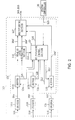
- numeral 120 denotes a transmitter of a digital broadcasting system according to the first embodiment, to which the present invention is applied as a whole.
- picture data D1A and D1B constituting television broadcast programs are respectively supplied to encoders 101A and 101B from data output sections (not illustrated) corresponding to plural of channels.
- the encoders 101A and 101B have the same structure.
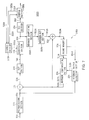
- the encoder 101A inputs the picture data D1A to a preprocessing section 11A as shown in Fig. 3.
- the preprocessing section 11A designates as which type each frame picture of successively inputted picture data D1A should be processed among three picture types of I-picture, P-picture, and B-picture and then, rearranges the frame pictures in order of encoding in accordance with the picture type of the frame pictures, divides the frame pictures into macroblocks respectively constituted with a luminance signal of 16 pixels ⁇ 16 lines and a color difference signal corresponding to the luminance signal, and supplies the macroblocks to an arithmetic circuit 12A and a movement vector detecting section 23A as macroblock data D2A.
- the movement vector detecting section 23A computes the movement vector of each macroblock of the macroblock data D2A in accordance with the macroblock data D2A and reference picture data D14A stored in a frame memory 21A and transmits the computed movement vector to a movement compensating section 22A as movement vector data D18A.
- the arithmetic circuit 12A applies any movement compensation of the intramode, forward estimation mode, backward estimation mode, and bidirectional estimation mode to the macroblock data D2A supplied from the preprocessing section 11A in accordance with the picture type of each macroblock of the macroblock data D2A.
- the intramode is a method of using a frame picture to be encoded directly as transmission data
- the forward estimation mode is a method of using the estimation residue between a frame picture to be encoded and a past reference picture as transmission data.
- the backward estimation mode is a method of using the estimation residue between a frame picture to be encoded and a future reference picture as transmission data
- the bidirectional estimation mode is a method of using the estimation residue between a frame picture to be encoded and the average value of a past reference picture and a future reference picture as transmission data.
- the macroblock data D2A is an I-picture.
- the macroblock data D2A is processed in the intramode. That is, the arithmetic circuit 12A directly transmits the macroblock of the macroblock data D2A to a discrete cosine transform (DCT) section 13A as arithmetic data D3A.
- the DCT section 13A applies the DCT processing to the arithmetic data D3A to transform the data D3A into a DCT coefficient and transmits the DCT coefficient to a quantizing section 14A as DCT coefficient data D4A.
- the quantizing section 14A applies quantization processing to the DCT coefficient data D4A and transmits it to a VLC section 15A and a reverse-quantizing section 18A as quantized DCT coefficient data D5A.
- the quantizing section 14A adjusts a quantization step size in the quantization processing in accordance with a quantization control value D21A supplied from a control section 142A in order to control the number of codes to be generated.
- the quantized DCT coefficient data D5A transmitted to the reverse-quantizing section 18A undergoes the reverse-quantization processing to be transmitted to a reverse-DCT section 19A as DCT coefficient data D11A. Then, the DCT coefficient data D11A undergoes the reverse-DCT processing in the reverse-DCT section 19A to be transmitted to an arithmetic circuit 20A as arithmetic data D12A and stored in the frame memory 21A as reference picture data D13A.
- the arithmetic circuit 12A applies the movement compensation processing based on either the intramode or forward estimation mode, to the macroblock data D2A.
- the arithmetic circuit 12A directly transmits the macroblock of the macroblock data D2A to the DCT section 13A as the arithmetic signal D3A as the same as the case of the above I-picture.
- the arithmetic circuit 12A applies a subtraction processing to the macroblock data D2A by using forward-estimation picture data D17A supplied from the movement compensating section 22A.
- the forward-estimation picture data D17A is computed by movement-compensating the reference picture data D13A, which is stored in the frame memory 21A, in accordance with the movement vector data D18A. That is, the movement compensating section 22 reads out the reference picture data D13A in the forward estimation mode by shifting the read address of the frame memory 21A in accordance with the movement vector data D18A and supplies the data D13A to the arithmetic circuits 12A and 20A as the forward-estimation picture data D17A.
- the arithmetic circuit 12A subtracts the forward-estimation picture data D17A from the macroblock data D2A to obtain difference data as estimation residue and transmits the difference data to the DCT section 13A as the arithmetic data D3A.
- the forward-estimation picture data D17A is supplied to the arithmetic circuit 20A from the movement compensating section 22A.
- the arithmetic circuit 20A locally regenerates the reference picture data D13A (P-picture) by adding the forward-estimation picture data D17A to the arithmetic data D12A and stores the data D13A in the frame memory 21A.
- the arithmetic circuit 12A applies any movement compensation processing of the intramode, forward estimation mode, backward estimation mode, and bidirectional estimation mode to the macroblock data D2A.
- macroblock data S2 undergoes the same processing as the case of the above P-picture.
- the reference picture data D13A is not stored in the frame memory 21A.
- the arithmetic circuit 12A applies the subtraction processing to the macroblock data D2A by using backward-estimation picture data D16A supplied from the movement compensating section 22A.
- the backward-estimation picture data D16A is computed by movement-compensating the reference picture data D13A stored in the frame memory 21A in accordance with the movement vector data D18A. That is, the movement compensating section 22A reads out the reference picture data D13A in the backward estimation mode by shifting the read address of the frame memory 21A in accordance with the movement vector data D18A, and supplies the data D13A to the arithmetic circuits 12A and 20A as the backward-estimation picture data D16A.
- the arithmetic circuit 12A subtracts the backward-estimation picture data D16A from the macroblock data D2A to obtain difference data as estimation residue and transmits the difference data to the DCT section 13A as the arithmetic data D3A.
- the backward-estimation picture data D16A is supplied to the arithmetic circuit 20A from the movement compensating section 22A and the arithmetic circuit 20A locally regenerates the reference picture data D13A (B-picture) by adding the backward-estimation picture data D16A to the arithmetic data D12A.
- the reference picture data D13A is not stored in the frame memory 21A because the B-picture is not used as an estimation reference picture.
- the arithmetic circuit 12A subtracts the average value of the forward-estimation picture data D17A and backward-estimation picture data D16A, which are supplied from the movement compensating section 22A, from the macroblock data D2A to obtain difference data as estimation residue and transmits the difference data to the DCT section 13A as the arithmetic data D3A.
- the forward-estimation picture data D17A and the backward-estimation picture data D16A are supplied to the arithmetic circuit 20A from the movement compensating section 22A and the arithmetic circuit 20A generates the reference picture data D13A (B-picture) by adding the average value of the forward-estimation picture data D17A and the backward-estimation picture data D16A to the arithmetic data D12A.
- the reference picture data D13A is not stored in the frame memory 21A because the B-picture is not used as another estimation reference picture
- the picture data D1A inputted to the encoder 101A undergoes the movement compensation processing, DCT processing, and quantization processing to be supplied to the VLC section 15A as the quantized DCT coefficient data D5A.
- the VLC section 15A applies variable-length encoding processing based on a predetermined transform table to the quantized DCT coefficient data D5A and transmits the resultant data to a buffer section 141A as variable-length encoded data D6A.
- the control section 142A always monitors the accumulation state of the variable-length encoded data D6A in the buffer section 141A and obtains the above accumulation state as occupied amount information D23A. Moreover, the control section 142A generates such the amount of data that the buffer section 141A does not overflow or under-flow, in accordance with the amount of data occupying the buffer 141A, by generating the quantization control value D21A in accordance with the occupied amount information D23A, transmitting the value D21A to the quantizing section 14A, and adjusting the quantization step size in the quantization processing.
- the buffer section 141A transmits the accumulated variable-length encoded data D6A to a multiplexer 121 (Fig. 2) as an output data stream D8A constituting a PES every picture at a constant rate in accordance with a data transmission control signal D22A supplied from the control section 142A.
- the buffer section 141A of the encoder lOlA can keep the rate of the output data stream D8A outputted from the buffer section 141A constant even if the amount of data generated in the quantizing section 14A is extremely reduced and thereby the amount of variable-length encoded data D6A accumulated in the buffer 141A is reduced, because dummy data is added to an optional position of the output data stream D8A at an invalid-data adding section (not illustrated) provided at the output stage of the buffer section 141A in accordance with the amount of encoded data accumulated in the buffer section 141A when the amount of encoded data is extremely small.
- the PES packet constituting the output data stream D8A outputted from the encoder 101A is composed of a header part and a data part, and a packet start code prefix, PES header option, and other various packet control data are stored in the header part and encoded data is stored in the data part.
- the encoder lOlA forms an invalid data part for dummy data referred to as stuffing-byte data between the header part and the invalid-data part in the data part of the PES packet (after the header part) when forming encoded data into a PES packet every picture and outputting the PES packet from the buffer 141A, as shown in Fig. 4B.
- the amount of data is assigned as the dummy data in bytes so as to keep the transmission rate of the output data stream D8A outputted from the encoder lOlA at a preset rate.
- the boundary between the invalid data part, to which dummy data is assigned, and the valid data part, to which encoded picture data (valid data) is assigned, can be detected by the header part of the picture data added to the head of the valid data.
- the output data stream D8A comprising a PES packet string is outputted to the multiplexer 121 from the encoder 101A, keeping the transmission rate constant.
- the multiplexer 121 stores and temporarily accumulates a plurality of PES packets included in the output data streams D8A and D8B in their corresponding buffers 103A and 103B in arriving order, and the data accumulated in the buffers 103A and 103B are read out in accordance with the first-in first-out method to be transmitted to an invalid data extracting section 122.
- the buffers 103A and 103B respectively supply the amount of data of the accumulated PES packets to the multiplexing control section 123 as the data accumulation signals S2A and S2B and thereby, the multiplexing control section 123 detects the amount of data which occupy the buffers 103A and 103B in accordance with the respective data accumulation signals S2A and S2B.
- the multiplexing control section 123 can read out PES packets from the buffers 103A and 103B in accordance with the first-in first-out method by transmitting the buffer output control signals S3A and S3B to the buffers 103A and 103B respectively in accordance with the above detection result before the buffers 103A and 103B exceed their maximum data accumulation capacity and thus, it is possible to prevent the buffers 103A and 103B from being broken down due to excessive data accumulation.
- the invalid data extracting section 122 successively extracts dummy data from the respective PES packets of the output data streams D8A and D8B, which are successively read out from the buffers 103A and 103B, and thereafter, respectively transmits the dummy data to a multiplexing section 127 as valid data streams D8A' and D8B' and counts the number of extracted dummy data and transmits the counted result to the multiplexing control section 123 as an invalid-data-amount-information signal S10.
- ND A2 and ND A4 are formed in, for example, respective PES packets P A2 and P A4 among PES packet strings P A1 , P A2 , P A2 , P A4 ,... forming the output data stream D8A outputted from the encoder 101A and invalid data parts ND B1 , ND B2 , and ND B3 are formed in, for example, respective PES packets P B1 , P B2 , and P B3 among PES packet strings P B1 , P B2 , P B3 , P B4 ,...
- the invalid data extracting section 122 successively detects the header parts H A1 , H A2 , H A3 , and H A4 and H B1 , H B2 , H B3 , and H B4 of a coming PES packet string on the respective output data streams D8A and D8B in order to judge whether the data detected after each header part is dummy data.
- dummy data is data not used as valid data (e.g. "00" or "FF"
- the invalid data extracting section 122 can easily discriminate the dummy data (ND A2 and ND A4 , and ND B1 , ND B2 , and ND B3 ).
- the invalid data extracting section 122 can discriminate the start of the valid data by detecting the header part of the picture data.
- the invalid data extracting section 122 does not allow the dummy data ND A2 , ND A4 , ND B1 , ND B2 , or ND B3 in the respective output data streams D8A and D8B composed of PES packet strings to pass but it outputs only valid data and header parts other than the dummy data.
- valid data streams D8A' and D8B' outputted from the invalid data extracting section 122 are constituted using the PES packets P A2 ' and P A4 ', and P B1 ', P B2 ', and P B3 ' each of whose data length became short because the dummy data ND A2 and ND A4 , and ND B1 , ND B2 , and ND B3 are extracted, as shown in Figs. 5G and 5H.
- the invalid data extracting section 122 transmits the amount of counted dummy data to the multiplexing control section 123 as the invalid-data-amount-information signal S10 as shown in Fig. 5F.
- the multiplexing control section 123 sequentially detects the total amount of the dummy data extracted from the output data streams D8A and D8B outputted from the encoders 101A and 101B.
- the valid data streams D8A' and D8B' outputted from the invalid data extracting section 122 lose its total amount of data because the dummy data ND A2 and ND A4 , and ND B1 , ND B2 , and ND B3 are extracted and under the above state, the data streams D8A' and D8B' are outputted to the multiplexing section 127 and recognized using the invalid-data-quantity-information signal S10 by the multiplexing control section 123.
- the multiplexing control section 123 transmits a multiplexing control signal S16 to the multiplexing section 127 in accordance with the multiplexing schedule obtained depending on the amount of data which occupy in the buffers 103A and 103B.
- the multiplexing section 127 generates a transport stream (TS) packet having a fixed data length in accordance with the valid data streams D8A' and D8B' respectively having the PES structure, multiplexes the TS packet in order to generate a multiplexed stream (transport stream) D15, and outputs the multiplexed stream to a transmission system (not illustrated) including a transmission antenna.
- TS transport stream
- the multiplexing control section 123 adds new time information by transmitting the multiplexing control signal S16 to the multiplexing section 127.
- service data D1X such as personal-computer communication data and information service data is supplied to the encoder 124 from a not-illustrated data output section when required.
- the encoder 124 successively forms the generated encoded data into PES packets in order for each predetermined data unit in accordance with the aforementioned compression-encoding of the MPEG2 method, in order to form and supply an output data stream D8X to a corresponding buffer 125 in the multiplexer 121.
- the service data D1X is data which can be accumulated and is unnecessary to transmit in real time but it can be used according to necessity after being accumulated at the receiving side.
- Plural PES packets included in the output data stream D8X are successively stored and accumulated in the buffer 125 in arriving order.
- the buffer 125 supplies the amount of data of the accumulated PES packets to the multiplexing control section 123 as a data accumulation signal S12 and thereby, the multiplexing control section 123 can recognize the amount of data accumulated in the buffer 125 based on the data accumulation signal S12.
- the multiplexing control section 123 when a service-data multiplexing request signal S15 is supplied from an external system controller 126, judges whether the amount of the service data D1X accumulated in the buffer 125 is secured up to a minimum amount of data which can be transmitted. When the amount of data is secured, the section 123 transmits a buffer output control signal S13 for designating the amount of data equal to or less than the total amount of dummy data extracted by the invalid data extracting section 122, to the buffer 125 in which the service data D1X is accumulated.
- the buffer 125 reads out the accumulated PES packets by the amount of data to be used as dummy data in accordance with the first-in first-out method, and transmits the PES packets to the multiplexing section 127 as a service data stream D8X'.
- the multiplexing control section 123 generates a new multiplexing schedule in order to newly multiplex the service data stream D8X' in addition to the valid data streams D8A' and D8B' which are supplied from the invalid data extracting section 122, reads out the output data streams D8A and D8B from the buffers 103A and 103B in accordance with the schedule, in order to control the multiplexing of the multiplexing section 127.
- the multiplexing section 127 generates TS packets having the fixed length in accordance with the valid data streams D8A' and D8B' supplied from the invalid data extracting section 122 and the service data stream D8X' supplied from the buffer 125, multiplexes these TS packets, in order to generate a multiplexed stream (transport stream) D16 including the service data (D1X), and outputs the stream D16 to a transmission system (not illustrated) including a transmission antenna.
- the multiplexed stream D15 or D16 outputted from the multiplexing section 127 is modulated by a modulator of the transmission system (not illustrated) in a predetermined method, and the resultant transmission signal is transmitted toward a broadcasting satellite (not illustrated) through the antenna.
- the service data D1X is multiplexed instead of extracted dummy data and is broadcasted in addition to television broadcast programs for plural channels at the same time through the broadcasting satellite.
- the multiplexing control section 123 when there is no service data D1X to be transmitted, the multiplexing control section 123 multiplexes an invalid data stream corresponding to the amount of invalid data onto a valid data stream at the multiplexing section 127.
- the data streams D8A and D8B outputted as the result of being compression-encoded by the encoders 101A and 101B respectively keep a certain rate by inserting dummy data (stuffing-byte data) between the header part and the valid data part (after the header part) of a PES packet forming the stream D8A or D8B.
- the dummy data is inserted so as to be sprinkled in optional PES packets in accordance with the amount of encoded data generated at the encoders 101A and 101B.
- the dummy data is extracted by the invalid data extracting section 122 of the multiplexer 121 and the valid data streams D8A' and D8B' are formed by closing the extracted portions. Therefore, the amount of data of the valid data streams D8A' and D8B' is reduced because of extracting the dummy data.
- the amount of reduced data is sequentially detected by the multiplexing control section 123 and accumulated by a counter whenever dummy data is extracted. Therefore, the dummy data sprinkled in the output data streams D8A and D8B is accumulated as a series of dead data whenever it is extracted by the data extracting section 122.
- the situation in which the amount of reduced data (the amount of dead data) reaches to a certain value or more represents the situation in which the service data D1X that can be accumulated and transmitted at any timing can be multiplexed and transmitted to the multiplexed stream 16 every predetermined data unit.
- the multiplexing control section 123 receiving the service-data multiplexing request signal S15 from the system controller 126, decides whether the amount of reduced data due to dummy data extraction by the invalid data extracting section 122 reaches to a value for multiplexing the service data D1X by predetermined amount.
- the multiplexing control section 123 waits for the amount of extracted dummy data to reach to a predetermined value.
- the multiplexing control section 123 transmits the buffer output control signal S13 to the buffer 125 and thereby, reads out service data streams from the buffer 125 by a value equivalent to the amount of extracted dummy data in predetermined data unit, and supplies the data streams to the multiplexing section 127.
- service data is multiplexed by the amount of data extracted by the invalid data extracting section 122, and the whole multiplexed stream D16 is transmitted while keeping a certain rate.
- the invalid data extracting section 122 in the output data streams D8A and D8B respectively outputted from the encoders 101A and 101B, the invalid data extracting section 122, while extracting dummy data (stuffing-byte data) inserted every optional PES packet, counts the amount of extracted dummy data.
- Fig. 6 in which the same reference numerals are applied to parts corresponding to Fig. 2 shows a transmitter 130 used for a digital broadcasting system in a second embodiment.
- a multiplexing control section 132 is constituted so as to be able to control the number of codes generated by the encoders 101A and 101B in addition to the structure and function of the multiplexing control section 123 described in Fig. 2.
- the multiplexing control section 132 when the multiplexing request signal S15 is supplied to the multiplexing control section 132 from the external system controller 126, the service data D1X is multiplexed by the amount of extracted dummy data similarly to the aforementioned first embodiment.
- the multiplexing control section 132 returns number-of-code control signals S20A and S20B to the encoders 101A and 101B based on the invalid-data-amount information signal S10 obtained from the invalid data extracting section 122.
- Fig. 7 in which the same reference numerals are applied to parts corresponding to Fig. 3 shows the encoder 101A of the second embodiment.
- a control section 242A is constituted so as to input a number-of-code control signal S20A supplied from a multiplexer 131 and changes quantization step sizes of the quantizing section 14A, in order to control the number of codes to be generated.
- the encoder 101B also receives the number-of-code control signal S20B from the multiplexing control section 132 and thereby changes quantization step sizes so as to control the number of codes to be generated.
- the multiplexing control section 132 transmits the number-of-code control signals S20A and S20B to the encoders 101A and 101B and thereby, controls the number of codes so that the total number of codes generated by the encoders 101A and 101B becomes equal to the number of codes obtained by adding a value equivalent to dummy data to the number of codes which have been already generated.
- the multiplexing control section 132 transmits the number-of-code control signals S20A and S20B to the encoders 101A and 101B and thereby, controls the number of codes so that the total number of codes generated by the encoders 101A and 101B becomes equal to the number of codes obtained by adding the difference between the amount of dummy data and the amount of service data to the number of codes which have been already generated.
- the buffer 141A can output the output data stream D8A having a predetermined rate only by significant data (PES packet string comprising a header part and valid data) without adding dummy data (stuffing-byte data).
- the second encoder 101B can also output the output data stream D8B having a predetermined rate only by significant data similarly to the case of the encoder 101A.
- the above structure makes it possible to further improve transmission efficiency of significant data because a certain rate can be kept without adding dummy data to the output data streams D8A and D8B outputted from the encoders 101A and 101B.
- the invalid data extracting section 122 successively extracts invalid data from the PES packets of the output data streams D8A and D8B, which are successively read out from the buffers 103A and 103B, in bytes (that is, every stuffing-byte data).
- the present invention is not limited thereto but when all regions designated by a header of a PES packet is dummy data, all the dummy data including the header can be used as invalid data.
- Figs. 8A and 8B in the case where invalid data parts ND A2 and ND A4 are formed in, for example, the PES packets P A2 and P A4 of the PES packet string P A1 , P A2 , P A3 , P A4 ,... forming the output data stream D8A outputted from the encoder 101A and invalid data parts ND B1 , ND B2 , and ND B3 are formed in, for example, the PES packets P B1 , P B2 , and P B3 of the PES packet string P B1 , P B2 , P B3 , P B4 ,...
- the invalid data extracting section 122 (Fig. 2 or 6) applies the same dummy-data detection and extraction as the case above described in Fig. 5 to the invalid data parts ND A2 , ND A4 , ND B1 , and ND B2 and thereby, extracts only these dummy data (invalid data part).
- the invalid data extracting section 122 extracts not only the invalid data part ND B3 , which is constituted with the dummy data, but also the header part H B3 of the PES packet as invalid data parts.
- the type of data (normally indicating the type of picture data or the like) assigned to the region (invalid data part ND B3 of the PES packet P B3 ) designated by the header part H B3 is rewritten by the encoder 101B so as to indicate dummy data (stuffing-byte data) and therefore, the invalid data extracting section 122 can detect that dummy data is assigned to all the regions designated by the header H B3 of the PES packet P B3 by reading out the header part H B3 .
- the invalid data extracting section 122 extracts the header part H B3 as invalid data and thereby, transmits the amount of reduced data including the header part H B3 to the multiplexing control section 123 (or 132) as the invalid-data-amount information S10.
- the multiplexing control section 123 recognizes the amount of data including the header part H B3 as the amount of invalid data. Thereby, it is possible to further improve multiplexing efficiency, such as the case of raising a rate for multiplexing the service data D1X and the case of increasing the number of codes to be generated by the encoding sections 101A and 101B.
- Figs. 8G and 8H show the valid data streams D8A' and D8B' after invalid data is extracted.
- the encoders 101A and 101B and the buffers 103A and 103B are provided correspondingly with two channels so as to multiplex the two output data streams D8A and D8B.
- the present invention is not limited thereto but three or more channels can be used.
- encoders and buffers equal to the number of channels can be provided to multiplex output data streams equal to the number of channels similarly to the aforementioned method.
- the output data streams D8A and D8B outputted from the encoders 101A and 101B are respectively handled as data streams comprising a PES packet string.
- the present invention is not limited thereto but it is also possible to apply the present invention to a case of outputting the data streams in another data unit.
- the present invention is applied to the transmitters 120 and 130 of a digital broadcasting system according to the PEG2 method.
- the present invention is not limited thereto but it can be applied to other various transmitters adopting other compression-encoding methods.
- the service data D1X for one channel is multiplexed instead of invalid data.
- the present invention is not limited thereto but the service data for two channels or more can be multiplexed.
- a plurality of channels comprising an encoder 124X and the buffer 125 is provided.
- the quantization step sizes of the encoders 101A and 101B are controlled by the number-of-code control signals S20A and S20B outputted from the multiplexing control section 123 (or 132).
- the present invention is not limited thereto but a data rate to be outputted from the output stage of the buffer section 141A (141B) of the encoders 101A and 101B can be changed.
- multiplexing efficiency of valid data can be improved by detecting and extracting invalid data assigned to an inputted data stream and multiplexing and outputting the data stream from which the invalid data is extracted.
Landscapes
- Engineering & Computer Science (AREA)
- Multimedia (AREA)
- Signal Processing (AREA)
- Compression Or Coding Systems Of Tv Signals (AREA)
- Time-Division Multiplex Systems (AREA)
- Television Systems (AREA)
Applications Claiming Priority (2)
| Application Number | Priority Date | Filing Date | Title |
|---|---|---|---|
| JP34041497 | 1997-12-10 | ||
| JP9340414A JPH11177520A (ja) | 1997-12-10 | 1997-12-10 | データ多重化装置 |
Publications (2)
| Publication Number | Publication Date |
|---|---|
| EP0923253A2 true EP0923253A2 (de) | 1999-06-16 |
| EP0923253A3 EP0923253A3 (de) | 2003-05-02 |
Family
ID=18336727
Family Applications (1)
| Application Number | Title | Priority Date | Filing Date |
|---|---|---|---|
| EP98309921A Withdrawn EP0923253A3 (de) | 1997-12-10 | 1998-12-03 | Datenmultiplexierungsverfahren und -vorrichtung |
Country Status (5)
| Country | Link |
|---|---|
| US (1) | US6504855B1 (de) |
| EP (1) | EP0923253A3 (de) |
| JP (1) | JPH11177520A (de) |
| KR (1) | KR19990066839A (de) |
| CN (1) | CN1236265A (de) |
Cited By (1)
| Publication number | Priority date | Publication date | Assignee | Title |
|---|---|---|---|---|
| WO2004028164A1 (en) * | 2002-09-20 | 2004-04-01 | Matsushita Electric Industrial Co., Ltd. | Data replacement output apparatus and method |
Families Citing this family (19)
| Publication number | Priority date | Publication date | Assignee | Title |
|---|---|---|---|---|
| US6721957B1 (en) * | 1999-08-16 | 2004-04-13 | Georgia Tech Research Corporation | System and method for maximizing bandwidth efficiency in a digital video program stream |
| EP1148727A1 (de) * | 2000-04-05 | 2001-10-24 | THOMSON multimedia | Verfahren und Vorrichtung zur Dekodierung von digitalen Videosignalen in einem digitalen Fernsehsystem unter Verwendung von Scheinheadereinfügung |
| US6791991B1 (en) * | 2000-10-31 | 2004-09-14 | Agere Systems Inc. | Channel sequencing using a round-robin scheduler |
| JP2002300128A (ja) * | 2001-03-29 | 2002-10-11 | Sanyo Electric Co Ltd | トランスポートストリームデコーダおよびそれを用いるデジタル放送受信装置 |
| JP2003069517A (ja) * | 2001-08-29 | 2003-03-07 | Fujitsu Ltd | 信号処理装置及び信号処理方法、多重化装置 |
| GB2399718A (en) * | 2003-03-18 | 2004-09-22 | Agilent Technologies Inc | Rate adaptive optical communication system |
| KR20060108752A (ko) * | 2003-12-17 | 2006-10-18 | 산요덴키가부시키가이샤 | 무선영상 송신장치, 무선영상 수신장치 및 무선영상 송수신시스템 및 신호 생성장치, 신호 정정장치 및 신호생성정정장치 |
| KR100788983B1 (ko) * | 2005-11-02 | 2007-12-27 | 엠텍비젼 주식회사 | 인코딩된 데이터 전달 방법 및 그 방법을 수행하는 촬상장치 |
| KR100664554B1 (ko) * | 2005-11-02 | 2007-01-03 | 엠텍비젼 주식회사 | 인코딩된 데이터 전달 방법 및 그 방법을 수행하는 촬상장치 |
| KR100685302B1 (ko) * | 2005-11-02 | 2007-02-22 | 엠텍비젼 주식회사 | 수직 동기 신호 지연 출력 방법 및 그 방법을 수행하는이미지 시그널 프로세서 |
| KR100664550B1 (ko) * | 2005-11-02 | 2007-01-03 | 엠텍비젼 주식회사 | 인코딩된 데이터 전달 방법 및 그 방법을 수행하는 촬상장치 |
| US8213509B2 (en) | 2006-10-06 | 2012-07-03 | Calos Fund Limited Liability Company | Video coding on parallel processing systems |
| KR100854724B1 (ko) * | 2006-12-01 | 2008-08-27 | 엠텍비젼 주식회사 | 인코딩된 데이터 전달 방법 및 그 방법을 수행하는 촬상장치 |
| EP2337348A4 (de) * | 2008-10-15 | 2012-09-05 | Mitsubishi Electric Corp | Verschlüsselungseinrichtung und dekodierungseinrichtung und verschlüsselungsverfahren und dekodierungsverfahren |
| CN106664135B (zh) | 2014-05-14 | 2020-02-07 | 萨迪斯飞以色列有限公司 | 卫星和与其相关联的终端之间的交换通信的方法 |
| US10368327B2 (en) | 2014-05-14 | 2019-07-30 | Satixfy Israel Ltd. | Method and system for signal communications |
| US10312997B2 (en) * | 2014-05-20 | 2019-06-04 | Satixfy Israel Ltd. | Method for reducing interference in a satellite communications network |
| US10033509B2 (en) | 2014-05-20 | 2018-07-24 | Satixfy Israel Ltd. | Method and system for satellite communication |
| CN105989789B (zh) * | 2015-02-17 | 2020-03-03 | 奇景光电股份有限公司 | 自时序控制器传送数据的方法以及时序控制器与显示系统 |
Family Cites Families (8)
| Publication number | Priority date | Publication date | Assignee | Title |
|---|---|---|---|---|
| US5289276A (en) * | 1992-06-19 | 1994-02-22 | General Electric Company | Method and apparatus for conveying compressed video data over a noisy communication channel |
| US5710756A (en) * | 1995-02-13 | 1998-01-20 | Netro Corporation | Burst-error resistant ATM microwave link and network |
| US5657325A (en) * | 1995-03-31 | 1997-08-12 | Lucent Technologies Inc. | Transmitter and method for transmitting information packets with incremental redundancy |
| US5650825A (en) * | 1995-03-31 | 1997-07-22 | Matsushita Electric Corporation Of America | Method and apparatus for sending private data instead of stuffing bits in an MPEG bit stream |
| JPH09139937A (ja) * | 1995-11-14 | 1997-05-27 | Fujitsu Ltd | 動画ストリーム変換装置 |
| US5761209A (en) * | 1996-03-15 | 1998-06-02 | Nec Corporation | Method of transmitting digital signals, transmitter and receiver used therefor |
| US5878045A (en) * | 1996-04-26 | 1999-03-02 | Motorola, Inc. | Method and apparatus for converting data streams in a cell based communications system |
| JP3249457B2 (ja) * | 1997-11-28 | 2002-01-21 | 沖電気工業株式会社 | ディジタル通信用音声送受信装置 |
-
1997
- 1997-12-10 JP JP9340414A patent/JPH11177520A/ja active Pending
-
1998
- 1998-12-03 EP EP98309921A patent/EP0923253A3/de not_active Withdrawn
- 1998-12-08 US US09/208,289 patent/US6504855B1/en not_active Expired - Fee Related
- 1998-12-10 KR KR1019980054069A patent/KR19990066839A/ko not_active Abandoned
- 1998-12-10 CN CN98127176A patent/CN1236265A/zh active Pending
Cited By (1)
| Publication number | Priority date | Publication date | Assignee | Title |
|---|---|---|---|---|
| WO2004028164A1 (en) * | 2002-09-20 | 2004-04-01 | Matsushita Electric Industrial Co., Ltd. | Data replacement output apparatus and method |
Also Published As
| Publication number | Publication date |
|---|---|
| US6504855B1 (en) | 2003-01-07 |
| EP0923253A3 (de) | 2003-05-02 |
| KR19990066839A (ko) | 1999-08-16 |
| JPH11177520A (ja) | 1999-07-02 |
| CN1236265A (zh) | 1999-11-24 |
Similar Documents
| Publication | Publication Date | Title |
|---|---|---|
| EP0923253A2 (de) | Datenmultiplexierungsverfahren und -vorrichtung | |
| US5956088A (en) | Method and apparatus for modifying encoded digital video for improved channel utilization | |
| US6188700B1 (en) | Method and apparatus for encoding MPEG signals using variable rate encoding and dynamically varying transmission buffers | |
| KR100420740B1 (ko) | 인코딩 장치, 인코딩 방법, 디코딩 장치, 디코딩 방법,코딩 시스템, 코딩 방법 | |
| US5534944A (en) | Method of splicing MPEG encoded video | |
| CA2457614C (en) | First pass encoding of i and p-frame complexity for compressed digital video | |
| JP3552811B2 (ja) | ディジタル映像信号符号化装置および復号化装置 | |
| US6987739B2 (en) | Video data multiplexing device, video data multiplexing control method, encoded stream multiplexing device and method, and encoding device and method | |
| KR100533437B1 (ko) | 비디오 데이터 처리 장치, 비디오 데이터 부호화 장치 및 그 방법 | |
| US6907069B2 (en) | Picture coding apparatus, picture coding method, and recording medium having picture coding program recorded thereon | |
| EP0692911B1 (de) | Verfahren zur Verbindung von MPEG-Videosequenzen | |
| EP0923243A1 (de) | Bearbeitungsanlage, bearbeitungsverfahren, splissungsanlage, splissungs- verfahren, kodieranlage und kodierverfahren | |
| US20070253488A1 (en) | Coding system and method, encoding device and method, decoding device and method, recording device and method, and reproducing device and method | |
| KR100676093B1 (ko) | 비디오 데이터 기록 장치, 비디오 데이터 기록 방법,비디오 데이터 재생 장치, 비디오 데이터 재생 방법,비디오 데이터 기록 및 재생 장치, 및 비디오 데이터 기록및 재생 방법 | |
| EP1143737A2 (de) | Vorrichtung und Verfahren zur Bildkodierung, Videokamera, Bildaufnahmevorrichtung, und Bildübertragungsvorrichung | |
| KR19990007312A (ko) | 디지털 신호 부호화 방법 및 장치, 신호 기록 매체 및 신호 전송 방법 | |
| AU670288B2 (en) | Device for high efficiency encoding and decoding of picture signals and recording medium | |
| JPH11317951A (ja) | データ符号化装置、データ符号化方法及びデータ伝送方法 | |
| US6314139B1 (en) | Method of inserting editable point and encoder apparatus applying the same | |
| US6628839B1 (en) | Image coding system converting apparatus, image coding system converting method, and recording medium | |
| EP0602621B1 (de) | Verfahren und Vorrichtung zur Bildcodierung und -decodierung | |
| EP1371230B1 (de) | Lauflängenkodierung nichtkodierter makroblöcke | |
| US20080285649A1 (en) | Method and Apparatus for Encoding a Picture Sequence Using Predicted and Non-Predicted Pictures Which Each Include Multiple Macroblocks | |
| US7733954B2 (en) | Method of coding a video image stream with a view for subsequent recoding using the same type of code | |
| JP3218994B2 (ja) | 画像符号化方法および装置 |
Legal Events
| Date | Code | Title | Description |
|---|---|---|---|
| PUAI | Public reference made under article 153(3) epc to a published international application that has entered the european phase |
Free format text: ORIGINAL CODE: 0009012 |
|
| AK | Designated contracting states |
Kind code of ref document: A2 Designated state(s): AT BE CH CY DE DK ES FI FR GB GR IE IT LI LU MC NL PT SE |
|
| AX | Request for extension of the european patent |
Free format text: AL;LT;LV;MK;RO;SI |
|
| PUAL | Search report despatched |
Free format text: ORIGINAL CODE: 0009013 |
|
| AK | Designated contracting states |
Designated state(s): AT BE CH CY DE DK ES FI FR GB GR IE IT LI LU MC NL PT SE |
|
| AX | Request for extension of the european patent |
Extension state: AL LT LV MK RO SI |
|
| 17P | Request for examination filed |
Effective date: 20031017 |
|
| AKX | Designation fees paid |
Designated state(s): DE FR GB |
|
| STAA | Information on the status of an ep patent application or granted ep patent |
Free format text: STATUS: THE APPLICATION HAS BEEN WITHDRAWN |
|
| 18W | Application withdrawn |
Effective date: 20040430 |