EP0924087A2 - Appareil d'impression directe de type tandem - Google Patents
Appareil d'impression directe de type tandem Download PDFInfo
- Publication number
- EP0924087A2 EP0924087A2 EP98123598A EP98123598A EP0924087A2 EP 0924087 A2 EP0924087 A2 EP 0924087A2 EP 98123598 A EP98123598 A EP 98123598A EP 98123598 A EP98123598 A EP 98123598A EP 0924087 A2 EP0924087 A2 EP 0924087A2
- Authority
- EP
- European Patent Office
- Prior art keywords
- printing
- apertures
- particles
- stations
- station
- Prior art date
- Legal status (The legal status is an assumption and is not a legal conclusion. Google has not performed a legal analysis and makes no representation as to the accuracy of the status listed.)
- Withdrawn
Links
Images



Classifications
-
- B—PERFORMING OPERATIONS; TRANSPORTING
- B41—PRINTING; LINING MACHINES; TYPEWRITERS; STAMPS
- B41J—TYPEWRITERS; SELECTIVE PRINTING MECHANISMS, i.e. MECHANISMS PRINTING OTHERWISE THAN FROM A FORME; CORRECTION OF TYPOGRAPHICAL ERRORS
- B41J2/00—Typewriters or selective printing mechanisms characterised by the printing or marking process for which they are designed
- B41J2/385—Typewriters or selective printing mechanisms characterised by the printing or marking process for which they are designed characterised by selective supply of electric current or selective application of magnetism to a printing or impression-transfer material
- B41J2/41—Typewriters or selective printing mechanisms characterised by the printing or marking process for which they are designed characterised by selective supply of electric current or selective application of magnetism to a printing or impression-transfer material for electrostatic printing
- B41J2/415—Typewriters or selective printing mechanisms characterised by the printing or marking process for which they are designed characterised by selective supply of electric current or selective application of magnetism to a printing or impression-transfer material for electrostatic printing by passing charged particles through a hole or a slit
- B41J2/4155—Typewriters or selective printing mechanisms characterised by the printing or marking process for which they are designed characterised by selective supply of electric current or selective application of magnetism to a printing or impression-transfer material for electrostatic printing by passing charged particles through a hole or a slit for direct electrostatic printing [DEP]
Definitions
- the present invention relates to a tandem type of direct printing apparatus for use in a color copying machine and printer.
- U.S. Patent No. 5,477,250 issued on Dec. 19, 1995 discloses a tandem type of direct printing apparatus.
- the direct printing apparatus four printing stations are disposed along a sheet moving direction.
- Each printing station comprises a toner carrier retaining toner on its outer periphery, a backing electrode opposed to the toner carrier and a printing head disposed between the toner carrier and the backing electrode, the printing head having a plurality of apertures and a plurality of electrodes surrounding each aperture.
- On the outer periphery of the toner carrier in each printing station are retained toner having different colors, for example, magenta, cyan, yellow and black.
- the backing electrode of each printing station is electrically connected to a power source, thereby between the toner carrier and the backing electrode is formed an electric field for attracting the toner on the toner carrier and propelling it toward the backing electrode through the apertures of the printing head. Between the printing head and the backing electrode in each printing station is formed a passage for a sheet.
- each aperture of printing head of one printing station corresponds to that of the other printing stations and that the corresponding apertures between the printing stations are aligned on a line parallel to the sheet moving direction.
- each printing station is installed separately from each other. Therefore, the corresponding apertures between the printing stations are shifted in a direction perpendicular to the sheet moving direction (hereinafter referred as a main scanning direction) due to the installation error of the printing head of each printing station.
- a main scanning direction a direction perpendicular to the sheet moving direction
- a position shift or a color deviation of 50 ⁇ m which is same as the installation error is caused between the first aperture 102 of the first printing station 104a and the first aperture 102 of the second printing station 104b.
- the position of the printing head 106 can be adjusted with high precision so that the installation error become zero.
- this adjusting work is very difficult, the accuracy obtained by the adjusting work is limited.
- An object of the present invention is to provide a tandem type of direct printing apparatus in which color deviation is minimized without position adjustment of the printing head.
- a tandem type direct printing apparatus comprising a plurality of printing stations for depositing printing particles on a print medium, the plurality of printing stations being positioned in a moving direction of the print medium, the printing station comprising:
- each of the plurality of apertures of the printing head in any one of the printing stations corresponds to the aperture of the printing head in another printing station so that the latter is closest to a line along the moving direction of the printing medium which pass through the center of the former, whereby no position adjusting work of each printing stations is necessary. a quantity of color deviation is reduced to at most half the pitch of the apertures.
- the number of the plurality of apertures of the printing head in each of the printing stations may be larger than an effective dots number to prevent lack of dot.
- the controller may output the image signal as a dummy to the driver so that the electrodes corresponding to the dots over the effective dots number are supplied with a voltage for forbidding the printing particles to be propelled.
- the electrodes corresponding to the dots over the effective dots number may be supplied with a voltage for forbidding the printing particles to be propelled.
- the bearing member in each of the printing stations may bear the charged printing particles with different color thereon to perform color print.
- the printing device 2 has a sheet feed station generally indicated by reference numeral 4.
- the sheet feed station 4 includes a cassette 6 in which a number of sheets 8 or plain papers are stacked.
- a sheet feed roller 10 is mounted for rotation above the cassette 6 so that it can frictionally contact with the top sheet 8, thereby the feed roller 10 can feed the top sheet 8 into the direct printing device 2 as it rotates.
- a pair of timing rollers 12 are arranged adjacent to the sheet feed roller 10, for supplying the sheet 8 fed from the cassette 6 through a sheet passage 14 indicated by a dotted line into a printing station, generally indicated by reference numeral 16, where a printing material is deposited on the sheet to form an image thereon.
- the printing device 2 includes a fusing station 18 for fusing and permanently fixing the image of printing material on the sheet 8, and a final stack station 20 for catching the sheets 8 on which the image has been fixed.
- the sheet 8 is conveyed along the sheet passage 14 by an unshown transfer belt.
- the printing station 16 comprises four printing stations 16a, 16b, 16c and 16d equally spaced along the sheet passage 14. These printing stations 16a, 16b, 16c and 16d have essentially same construction respectively and therefore one printing station, for example, the printing station 16a positioned at the most upstream side in the sheet passage 14 will be explained hereinafter.
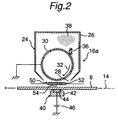
- the printing station 16a comprises a developing device generally indicated by reference numeral 24 above the sheet passage 14.
- the developing device 24 comprises a container 26 which has an opening 28 confronting the sheet passage 14. Adjacent the opening 28, a developing roller 30 as a bearing member of printing particles according to the present invention is supported for rotation in a direction indicated by an arrow 32.
- the developing roller 30 is made of conductive material and is electrically connected to the earth.
- a blade 36 preferably made from a plate of elastic material such as rubber or stainless steel, is disposed in contact with the developing roller 30.
- the container 26 accommodates printing particles, i.e., toner particles 38.
- the toner particles capable of being charged with negative polarity by the contact with the blade 36 are used.
- the color of the toner particles 38 at each of the printing stations 16a, 16b, 16c and 16d is different from each other.
- the color of the toner particles 38 is magenta at the printing station 16a, cyan at the printing station 16b, yellow at the printing station 16c and black at printing station 16d, thereby color printing is possible.
- an electrode mechanism Disposed under the developing device 24, beyond the sheet passage 14, is an electrode mechanism generally indicated by reference numeral 40 which includes a support 42 made of electrically insulative material and a backing electrode 44 made of electrically conductive material.
- the backing electrode 44 is electrically connected to a direct power supply 46 which supplies a voltage of predetermined polarity (positive polarity in this embodiment) so that the backing electrode 44 is provided with, for example, a voltage of +1200 volts.
- a direct power supply 46 which supplies a voltage of predetermined polarity (positive polarity in this embodiment) so that the backing electrode 44 is provided with, for example, a voltage of +1200 volts.
- an electric field E that the negatively charged toner particles 38 on the developing roller 30 are electrically attracted to the backing electrode 44.
- the backing electrode 44 comes into contact with the back side surface of the sheet 8 to be conveyed via a transfer belt not shown.
- a printing head Fixed between the developing device 24 and the electrode mechanism 40 and above the sheet passage 14 is a printing head generally indicated by reference numeral 50.
- the printing head 50 is made from a flexible printed circuit board 52, having a thickness of about 50 to 150 micrometers.
- a portion of the printing head 50 located in a printing zone where the developing roller 30 confronts the backing electrode 44 includes a plurality of apertures 56 having a diameter of about 25 to 200 micrometers which is substantially larger than an average diameter (about several micrometers to a dozen micrometers) of the toner particles 38.
- the apertures 56 are formed on equally spaced three parallel lines 58, 60 and 62 each extending in a direction indicated by reference numeral 64 which is parallel to an axis of the developing roller 30 and perpendicular to a direction indicated by reference numeral 66 along which the sheet 8 will be transported, ensuring the printing head 50 with a resolution of 600 dpi.
- the apertures 56 on the lines 58, 60 and 62 are formed at regular intervals of D, e.g., 127 micrometers, and the apertures 56(56a) and 56(56c) on the lines 58 and 62 are shifted by the distance D/N to the opposite directions with respect the apertures 56(56b) on the central line 60, respectively, so that, when viewed from the sheet transporting direction 66, the apertures 56 appear to be equally spaced.
- the number N represents the number of line rows and is "3" in this embodiment, however, the number N as well as the interval D can be determined depending upon the required resolution of the print head.
- the flexible printed circuit board 52 further includes therein doughnut-like first and second electrodes 68 and 70 each of which surrounding the apertures 56.
- the first electrode 68 is disposed on one side opposing the developing roller 30 while the second electrode 70 is on the other side opposing the backing electrode 44.
- the first electrode 68 is electrically communicated with a driver 72 through a printed wire 74 and the second electrode 70 is electrically communicated with a driver 76 through a printed wire 78, so that the drivers 72 and 76 can transmit image signals to the first and second electrodes 68 and 70, respectively.
- the drivers 72 and 76 are in turn electrically communicated with a controller 80 that feeds out data of image to be reproduced by the printing device 2.
- the image signals to be transmitted to the first and second electrodes 68 and 70 consist of a DC component constantly applied to the first and second electrodes 68, 70 and a pulse component applied to the first and second electrodes 68, 70 in response to the image data from the controller 80 for forming dots on the sheet 8.
- the base voltage V1(B) is about -50 volts, and the pulse voltage V1(P) is about +300 volts.
- the base voltage V2(B) is about -100 volts and the pulse voltage V2(P) is about +200 volts.
- Figs. 5A and 5B shows how to make the apertures 56 of the printing head 50 of the first printing station 16a correspond to that of the second printing station 16b.
- Figs. 5A and 5B only one line of the apertures 56 of the printing heads 50 of the second printing station 16b and the first printing station 16a are shown and the other lines of apertures 56 is omitted to simplify the drawings.
- the effective dot number for forming an image within the width of the sheet 8 in the printing stations 16a, 16b are six (6) respectively, the total aperture number of each of the printing stations 16a, 16b is larger by four (4) than the effective dot number, i.e. 10 (ten), and the pitch of the apertures 56 is 42 ⁇ m.
- the third aperture 56 of the second printing station 16b corresponds to the fourth aperture 56 of the first printing station 16a, which fourth aperture 56 is closest to a line S along the sheet moving direction which pass through the center of the third aperture 56 of the second printing station 16b.
- the second, fourth, fifth, sixth and seventh apertures 56 of the second printing station 16b correspond to the third, fifth, sixth, seventh, and eighth apertures 56 of the first printing station 16a.
- the first ,eighth, ninth and tenth apertures 56 (painted over with black in Fig. 5B) are unused, while the first ,second, ninth and tenth apertures 56 (painted over with black in Fig. 5B) are also unused.
- Fig. 5B between the apertures 56 of the second printing station 16b and the apertures 56 of the first printing station 16a, only a color deviation of 8 ⁇ m is caused.
- Fig. 6 shows an example of wiring condition between the first electrodes 68 around the apertures 56 of the printing stations 16a, 16b, 16c and 16d and the first drivers 72.
- the second electrode 70 is the same as the first electrode 68.
- each of the printing stations 16a, 16b, 16c and 16d has apertures 56 the number of which is larger by four (4) than the effective dot number. Supposing that the first printing station 16a is properly installed, the first, second, (n-1)-th and n-th apertures 56 which are positioned at the both side of the first printing station 16a are unused.
- the second printing station 16b is installed and shifted to the left side with respect to the first printing station 16a when looking at the sheet moving direction and the first, (n-2)-th, (n-1)-th and n-th apertures 56 are unused.
- the third printing station 16c is installed and shifted to the right side with respect to the first printing station 16a when looking at the sheet moving direction and the first, second, third and n-th apertures 56 are unused.
- the fourth printing station 16d is installed with almost same accuracy as the first printing station 16a, the first, second, (n-1)-th and n-th apertures 56 are unused.
- the first electrodes 68 of all apertures 56 in each of the printing stations 16a, 16b, 16c and 16d are connected to the output terminals of the drivers 72a, 72b, 72c and 72d corresponding to the printing stations 16a, 16b, 16c and 16d respectively.
- essential image signals IS (0 or 1) are input from the controller 80.
- dummy image signals (constantly 0) are input from the controller 80.
- essential image signals IS (0 or 1) are input from the controller 80.
- dummy image signals (constantly 0) are input from the controller 80.
- a voltage of approximately -50 bolts is applied as a base voltage V1(B) when image signal is 0, while a voltage of approximately +300 bolts is applied as a pulse voltage V1(P) when image signal is 1.
- a voltage of approximately -50 bolts is constantly applied as a base voltage V1(B), whereby no image is formed.
- the developing roller 30 rotates in the direction indicated by the arrow 32.
- the toner particles 38 are deposited on the developing roller 30 and then transported by the rotation of the developing roller 30 into a contact region of the blade 36 and the developing roller 30 where the toner particles 38 are provided with triboelectric negative charge by the frictional contact of the blade 36.
- incremental peripheral portions of the developing roller 30 which has passed through the contact region bear a thin layer of charged toner particles 38.
- the first and second electrodes 68 and 70 are constantly biased to the base voltage V1(B) of about -50 volts and V2(B) of about -100 volts. Therefore, the negatively charge toner particle 38 on the developing roller 30 electrically repels against the first and second electrodes 68 and 70 and therefore stays on the developing roller 30 without propelling toward the aperture 56.
- the controller 80 outputs the image data corresponding to a magenta image to be reproduced to the drivers 72 and 76.
- the drivers 72 and 76 supplies the respective voltages V1(P) of about +300 volts and V2(P) of about +200 volts to the pairs of first and second electrodes 68 and 70.
- V1(P) of about +300 volts
- V2(P) of about +200 volts
- the toner particles 38 on the portions of the developing roller 30 confronting the biased electrodes are electrically attracted by the first and second electrodes 68 and 70. This energizes a number of toner particles 38 to propel by the attraction force of the backing electrode 44 into the opposing aperture 56.
- the voltages to be applied to the first and second electrodes 68 and 70 are changed from the pulse voltages V1(P) and V2(P) to base voltages V1(B) and V2(B), at respective timings.
- the toner particles 38 in the aperture 56 are then forced radially inwardly by the repelling force from the first and second electrodes 68 and 70 applied with the base voltages V1(B) and V2(B), respectively, and then converged into a mass.
- the converged mass of the toner particles 38 are then deposited on the sheet 8 which is moving past the printing zone 54, thereby forming a layer of the magenta toner particles on the sheet 8.
- the aforementioned second electrode 70 is provided mainly for the purpose of converging the mass of the toner particles 38. Therefore, the second electrode 70 can be excluded if necessary.
- a layer of cyan toner particles is formed over the layer of magenta toner particles formed by the first printing station 16a.
- a layer of yellow toner particles is formed over the layer of cyan toner particles formed by the second printing station 16b.
- a layer of black toner particles is formed over the layer of yellow toner particles formed by the third printing station 16c.
- the sheet 8 to which the image consists of the layers of the toner particles 38 is formed is transported in the fusing station 18 where the layers of the toner particles 38 are fused and permanently fixed on the sheet 8 and finally fed out onto the final stack station or catch tray 20.
- Fig. 7 shows an another example of wiring condition between the first electrodes 68 around the apertures 56 of the printing stations 16a, 16b, 16c and 16d and the first drivers 72.
- the drivers 72a, 72b, 72c and 72d of the printing stations 16a, 16b, 16c and 16d are provided with auxiliary output terminals for constantly outputting a voltage of approximately -50 volts in spite of image signal as well as the input terminals and the output terminals corresponding to the effective dot number.
- the first electrodes 68 of the usable apertures 56 in the printing stations 16a, 16b, 16c and 16d are connected to the output terminals of the drivers 72a, 72b, 72c and 72d, while the first electrodes 68 of the unused apertures 56 are connected to the auxiliary output terminals.
- a voltage of approximately -50 bolts or a voltage of approximately +300 bolts is applied in accordance with the image signal, whereby image corresponding to the image signal is formed.
- a voltage of approximately -50 bolts is constantly applied as a base voltage V1(B), whereby no image is formed.
- any type of developing device capable of being employed in the electrophotographic image forming apparatus can be used instead of the developing device 24 as shown in Fig. 2 of the direct printing apparatuses 2 in the aforementioned embodiments.
- the backing electrode 44 may be a roller made of electrically conductive material.
- an endless belt type of conveying belt or a cylindrical type of conveying drum can be provided.
- an endless belt type of conveying belt or a cylindrical type of conveying drum can be provided.
Landscapes
- Printers Or Recording Devices Using Electromagnetic And Radiation Means (AREA)
- Printers Characterized By Their Purpose (AREA)
- Electrophotography Using Other Than Carlson'S Method (AREA)
Applications Claiming Priority (2)
| Application Number | Priority Date | Filing Date | Title |
|---|---|---|---|
| JP35279897 | 1997-12-22 | ||
| JP9352798A JPH11179952A (ja) | 1997-12-22 | 1997-12-22 | タンデム型直接印刷装置 |
Publications (2)
| Publication Number | Publication Date |
|---|---|
| EP0924087A2 true EP0924087A2 (fr) | 1999-06-23 |
| EP0924087A3 EP0924087A3 (fr) | 1999-10-13 |
Family
ID=18426516
Family Applications (1)
| Application Number | Title | Priority Date | Filing Date |
|---|---|---|---|
| EP98123598A Withdrawn EP0924087A3 (fr) | 1997-12-22 | 1998-12-10 | Appareil d'impression directe de type tandem |
Country Status (3)
| Country | Link |
|---|---|
| US (1) | US6270196B1 (fr) |
| EP (1) | EP0924087A3 (fr) |
| JP (1) | JPH11179952A (fr) |
Families Citing this family (3)
| Publication number | Priority date | Publication date | Assignee | Title |
|---|---|---|---|---|
| AU4615600A (en) | 1999-05-19 | 2000-12-05 | Array Printers Ab | Image-forming device |
| AU2005201838B2 (en) * | 2000-03-06 | 2008-03-06 | Silverbrook Research Pty Ltd | A pagewidth printhead assembly |
| AUPQ605800A0 (en) * | 2000-03-06 | 2000-03-30 | Silverbrook Research Pty Ltd | Printehead assembly |
Citations (1)
| Publication number | Priority date | Publication date | Assignee | Title |
|---|---|---|---|---|
| US5477250A (en) | 1992-11-13 | 1995-12-19 | Array Printers Ab | Device employing multicolor toner particles for generating multicolor images |
Family Cites Families (2)
| Publication number | Priority date | Publication date | Assignee | Title |
|---|---|---|---|---|
| JPH07256918A (ja) * | 1994-03-28 | 1995-10-09 | Brother Ind Ltd | 記録装置 |
| US5596356A (en) * | 1995-10-26 | 1997-01-21 | Hewlett-Packard Company | Toner ejection printer with dummy electrode for improving print quality |
-
1997
- 1997-12-22 JP JP9352798A patent/JPH11179952A/ja active Pending
-
1998
- 1998-12-10 EP EP98123598A patent/EP0924087A3/fr not_active Withdrawn
- 1998-12-16 US US09/212,206 patent/US6270196B1/en not_active Expired - Fee Related
Patent Citations (1)
| Publication number | Priority date | Publication date | Assignee | Title |
|---|---|---|---|---|
| US5477250A (en) | 1992-11-13 | 1995-12-19 | Array Printers Ab | Device employing multicolor toner particles for generating multicolor images |
Also Published As
| Publication number | Publication date |
|---|---|
| US6270196B1 (en) | 2001-08-07 |
| JPH11179952A (ja) | 1999-07-06 |
| EP0924087A3 (fr) | 1999-10-13 |
Similar Documents
| Publication | Publication Date | Title |
|---|---|---|
| US5257046A (en) | Direct electrostatic printing with latent image assist | |
| US6270196B1 (en) | Tandem type of direct printing apparatus using gating apertures for supplying toner | |
| US6244692B1 (en) | Tandem type of direct printing apparatus and method for making a registration of composite image therein | |
| US6250743B1 (en) | Tandem type of direct printing apparatus using gating apertures for supplying toner | |
| US6565194B2 (en) | Image forming method and image forming apparatus | |
| EP0816944B1 (fr) | Dispositif d'impression électrostatique directe (DEP) à distance constante entre la structure de tête d'impression et les moyens d'alimentation en toner | |
| US6264308B1 (en) | Direct printing apparatus | |
| US6715858B1 (en) | Image-forming device | |
| US6283583B1 (en) | Image forming apparatus having float electrode provided to make uniform electric field | |
| US6231164B1 (en) | Apparatus and method for direct printing using first and second electrodes to deposit charged particles | |
| US6176567B1 (en) | Direct printing apparatus with automatic cleaning of excess print particles | |
| US6241343B1 (en) | Direct printing apparatus | |
| US6056390A (en) | Image forming apparatus wherein the velocity of the toner supporting medium is higher than recording medium transport velocity | |
| US6601946B1 (en) | Image forming apparatus in which toner is removed by changing electric field between opposing electrode and control electrode | |
| US6227656B1 (en) | Depositing charged particles onto a sheet based on distances relative to a print head | |
| US20080036842A1 (en) | Electronic printing press | |
| EP1038683A1 (fr) | Appareil d'impression électrostatique direct | |
| US6286937B1 (en) | Direct printing apparatus with first and second rollers | |
| JP2000015861A (ja) | 直接印刷装置 | |
| JPH09207376A (ja) | 画像形成装置 | |
| JPH07285235A (ja) | 画像形成装置 | |
| JPH07132642A (ja) | パウダージェット画像形成装置 | |
| JPH07214815A (ja) | 画像形成装置 | |
| JPH0970999A (ja) | 画像形成装置 | |
| JPH10258539A (ja) | 画像形成装置 |
Legal Events
| Date | Code | Title | Description |
|---|---|---|---|
| PUAI | Public reference made under article 153(3) epc to a published international application that has entered the european phase |
Free format text: ORIGINAL CODE: 0009012 |
|
| AK | Designated contracting states |
Kind code of ref document: A2 Designated state(s): DE FR GB IT |
|
| AX | Request for extension of the european patent |
Free format text: AL;LT;LV;MK;RO;SI |
|
| PUAL | Search report despatched |
Free format text: ORIGINAL CODE: 0009013 |
|
| AK | Designated contracting states |
Kind code of ref document: A3 Designated state(s): AT BE CH CY DE DK ES FI FR GB GR IE IT LI LU MC NL PT SE |
|
| AX | Request for extension of the european patent |
Free format text: AL;LT;LV;MK;RO;SI |
|
| 17P | Request for examination filed |
Effective date: 19991116 |
|
| AKX | Designation fees paid |
Free format text: DE FR GB IT |
|
| 17Q | First examination report despatched |
Effective date: 20010315 |
|
| STAA | Information on the status of an ep patent application or granted ep patent |
Free format text: STATUS: THE APPLICATION HAS BEEN WITHDRAWN |
|
| 18W | Application withdrawn |
Withdrawal date: 20010625 |