EP0924181A1 - Verfahren zum Entfernen von polaren Verbindungen aus einer Etherifizierungseinheit - Google Patents
Verfahren zum Entfernen von polaren Verbindungen aus einer Etherifizierungseinheit Download PDFInfo
- Publication number
- EP0924181A1 EP0924181A1 EP98403066A EP98403066A EP0924181A1 EP 0924181 A1 EP0924181 A1 EP 0924181A1 EP 98403066 A EP98403066 A EP 98403066A EP 98403066 A EP98403066 A EP 98403066A EP 0924181 A1 EP0924181 A1 EP 0924181A1
- Authority
- EP
- European Patent Office
- Prior art keywords
- impurities
- fluid
- purified
- phase
- vapor phase
- Prior art date
- Legal status (The legal status is an assumption and is not a legal conclusion. Google has not performed a legal analysis and makes no representation as to the accuracy of the status listed.)
- Granted
Links
- 238000000034 method Methods 0.000 title claims abstract description 63
- 238000006266 etherification reaction Methods 0.000 title claims abstract description 40
- 150000001875 compounds Chemical class 0.000 title claims description 23
- 239000012535 impurity Substances 0.000 claims abstract description 95
- 229930195733 hydrocarbon Natural products 0.000 claims abstract description 69
- 150000002430 hydrocarbons Chemical class 0.000 claims abstract description 69
- 239000012530 fluid Substances 0.000 claims abstract description 47
- 238000000746 purification Methods 0.000 claims abstract description 39
- 239000012071 phase Substances 0.000 claims abstract description 29
- 239000008346 aqueous phase Substances 0.000 claims abstract description 9
- 239000002253 acid Substances 0.000 claims abstract description 8
- 238000010992 reflux Methods 0.000 claims abstract description 6
- 230000008030 elimination Effects 0.000 claims abstract description 5
- 238000003379 elimination reaction Methods 0.000 claims abstract description 5
- 230000007935 neutral effect Effects 0.000 claims abstract description 4
- 239000007791 liquid phase Substances 0.000 claims abstract description 3
- XLYOFNOQVPJJNP-UHFFFAOYSA-N water Substances O XLYOFNOQVPJJNP-UHFFFAOYSA-N 0.000 claims description 106
- 238000005406 washing Methods 0.000 claims description 77
- 239000004215 Carbon black (E152) Substances 0.000 claims description 35
- 239000012808 vapor phase Substances 0.000 claims description 30
- 238000004821 distillation Methods 0.000 claims description 8
- 238000000926 separation method Methods 0.000 claims description 6
- 125000004432 carbon atom Chemical group C* 0.000 claims description 5
- 238000009833 condensation Methods 0.000 claims description 5
- 230000005494 condensation Effects 0.000 claims description 5
- 239000007790 solid phase Substances 0.000 claims description 5
- 239000002826 coolant Substances 0.000 claims description 3
- 238000000622 liquid--liquid extraction Methods 0.000 claims description 3
- 238000000638 solvent extraction Methods 0.000 claims description 3
- 238000004064 recycling Methods 0.000 abstract description 7
- 239000007788 liquid Substances 0.000 abstract description 6
- 239000007787 solid Substances 0.000 abstract description 2
- 238000009835 boiling Methods 0.000 abstract 1
- OKKJLVBELUTLKV-UHFFFAOYSA-N Methanol Chemical compound OC OKKJLVBELUTLKV-UHFFFAOYSA-N 0.000 description 36
- CSCPPACGZOOCGX-UHFFFAOYSA-N Acetone Chemical compound CC(C)=O CSCPPACGZOOCGX-UHFFFAOYSA-N 0.000 description 21
- 150000002825 nitriles Chemical class 0.000 description 13
- 238000006243 chemical reaction Methods 0.000 description 10
- 238000010926 purge Methods 0.000 description 10
- VQTUBCCKSQIDNK-UHFFFAOYSA-N Isobutene Chemical class CC(C)=C VQTUBCCKSQIDNK-UHFFFAOYSA-N 0.000 description 8
- 239000003054 catalyst Substances 0.000 description 8
- LFQSCWFLJHTTHZ-UHFFFAOYSA-N Ethanol Chemical compound CCO LFQSCWFLJHTTHZ-UHFFFAOYSA-N 0.000 description 7
- 239000007789 gas Substances 0.000 description 7
- WEVYAHXRMPXWCK-UHFFFAOYSA-N Acetonitrile Chemical compound CC#N WEVYAHXRMPXWCK-UHFFFAOYSA-N 0.000 description 6
- BZLVMXJERCGZMT-UHFFFAOYSA-N Methyl tert-butyl ether Chemical group COC(C)(C)C BZLVMXJERCGZMT-UHFFFAOYSA-N 0.000 description 6
- -1 isoamylenes Chemical class 0.000 description 5
- 239000008213 purified water Substances 0.000 description 5
- HIXDQWDOVZUNNA-UHFFFAOYSA-N 2-(3,4-dimethoxyphenyl)-5-hydroxy-7-methoxychromen-4-one Chemical compound C=1C(OC)=CC(O)=C(C(C=2)=O)C=1OC=2C1=CC=C(OC)C(OC)=C1 HIXDQWDOVZUNNA-UHFFFAOYSA-N 0.000 description 4
- IJGRMHOSHXDMSA-UHFFFAOYSA-N Atomic nitrogen Chemical compound N#N IJGRMHOSHXDMSA-UHFFFAOYSA-N 0.000 description 4
- RTZKZFJDLAIYFH-UHFFFAOYSA-N ether Substances CCOCC RTZKZFJDLAIYFH-UHFFFAOYSA-N 0.000 description 4
- 238000004519 manufacturing process Methods 0.000 description 4
- 150000001993 dienes Chemical class 0.000 description 3
- 238000010438 heat treatment Methods 0.000 description 3
- 150000005673 monoalkenes Chemical class 0.000 description 3
- OFBQJSOFQDEBGM-UHFFFAOYSA-N n-pentane Natural products CCCCC OFBQJSOFQDEBGM-UHFFFAOYSA-N 0.000 description 3
- NUMQCACRALPSHD-UHFFFAOYSA-N tert-butyl ethyl ether Chemical compound CCOC(C)(C)C NUMQCACRALPSHD-UHFFFAOYSA-N 0.000 description 3
- 238000011144 upstream manufacturing Methods 0.000 description 3
- VXNZUUAINFGPBY-UHFFFAOYSA-N 1-Butene Chemical compound CCC=C VXNZUUAINFGPBY-UHFFFAOYSA-N 0.000 description 2
- BKOOMYPCSUNDGP-UHFFFAOYSA-N 2-methylbut-2-ene Chemical compound CC=C(C)C BKOOMYPCSUNDGP-UHFFFAOYSA-N 0.000 description 2
- KAKZBPTYRLMSJV-UHFFFAOYSA-N Butadiene Chemical compound C=CC=C KAKZBPTYRLMSJV-UHFFFAOYSA-N 0.000 description 2
- OKTJSMMVPCPJKN-UHFFFAOYSA-N Carbon Chemical compound [C] OKTJSMMVPCPJKN-UHFFFAOYSA-N 0.000 description 2
- ATUOYWHBWRKTHZ-UHFFFAOYSA-N Propane Chemical compound CCC ATUOYWHBWRKTHZ-UHFFFAOYSA-N 0.000 description 2
- 241001080024 Telles Species 0.000 description 2
- 150000007513 acids Chemical class 0.000 description 2
- 150000001298 alcohols Chemical class 0.000 description 2
- 150000001336 alkenes Chemical group 0.000 description 2
- 239000003795 chemical substances by application Substances 0.000 description 2
- 238000001816 cooling Methods 0.000 description 2
- HGCIXCUEYOPUTN-UHFFFAOYSA-N cyclohexene Chemical compound C1CCC=CC1 HGCIXCUEYOPUTN-UHFFFAOYSA-N 0.000 description 2
- ZSWFCLXCOIISFI-UHFFFAOYSA-N cyclopentadiene Chemical compound C1C=CC=C1 ZSWFCLXCOIISFI-UHFFFAOYSA-N 0.000 description 2
- LPIQUOYDBNQMRZ-UHFFFAOYSA-N cyclopentene Chemical compound C1CC=CC1 LPIQUOYDBNQMRZ-UHFFFAOYSA-N 0.000 description 2
- 238000000354 decomposition reaction Methods 0.000 description 2
- 238000000605 extraction Methods 0.000 description 2
- 239000002737 fuel gas Substances 0.000 description 2
- 230000010354 integration Effects 0.000 description 2
- NNPPMTNAJDCUHE-UHFFFAOYSA-N isobutane Chemical compound CC(C)C NNPPMTNAJDCUHE-UHFFFAOYSA-N 0.000 description 2
- QWTDNUCVQCZILF-UHFFFAOYSA-N isopentane Chemical compound CCC(C)C QWTDNUCVQCZILF-UHFFFAOYSA-N 0.000 description 2
- 150000002576 ketones Chemical class 0.000 description 2
- 239000000203 mixture Substances 0.000 description 2
- VLKZOEOYAKHREP-UHFFFAOYSA-N n-Hexane Chemical class CCCCCC VLKZOEOYAKHREP-UHFFFAOYSA-N 0.000 description 2
- 229910052757 nitrogen Inorganic materials 0.000 description 2
- YWAKXRMUMFPDSH-UHFFFAOYSA-N pentene Chemical compound CCCC=C YWAKXRMUMFPDSH-UHFFFAOYSA-N 0.000 description 2
- QMMOXUPEWRXHJS-UHFFFAOYSA-N pentene-2 Natural products CCC=CC QMMOXUPEWRXHJS-UHFFFAOYSA-N 0.000 description 2
- FVSKHRXBFJPNKK-UHFFFAOYSA-N propionitrile Chemical compound CCC#N FVSKHRXBFJPNKK-UHFFFAOYSA-N 0.000 description 2
- 229920005989 resin Polymers 0.000 description 2
- 239000011347 resin Substances 0.000 description 2
- 239000000243 solution Substances 0.000 description 2
- 230000008016 vaporization Effects 0.000 description 2
- 239000002351 wastewater Substances 0.000 description 2
- PMJHHCWVYXUKFD-SNAWJCMRSA-N (E)-1,3-pentadiene Chemical compound C\C=C\C=C PMJHHCWVYXUKFD-SNAWJCMRSA-N 0.000 description 1
- MHNNAWXXUZQSNM-UHFFFAOYSA-N 2-methylbut-1-ene Chemical compound CCC(C)=C MHNNAWXXUZQSNM-UHFFFAOYSA-N 0.000 description 1
- IRUDSQHLKGNCGF-UHFFFAOYSA-N 2-methylhex-1-ene Chemical class CCCCC(C)=C IRUDSQHLKGNCGF-UHFFFAOYSA-N 0.000 description 1
- YHQXBTXEYZIYOV-UHFFFAOYSA-N 3-methylbut-1-ene Chemical compound CC(C)C=C YHQXBTXEYZIYOV-UHFFFAOYSA-N 0.000 description 1
- JIUFYGIESXPUPL-UHFFFAOYSA-N 5-methylhex-1-ene Chemical class CC(C)CCC=C JIUFYGIESXPUPL-UHFFFAOYSA-N 0.000 description 1
- LCGLNKUTAGEVQW-UHFFFAOYSA-N Dimethyl ether Chemical compound COC LCGLNKUTAGEVQW-UHFFFAOYSA-N 0.000 description 1
- 229920002367 Polyisobutene Polymers 0.000 description 1
- 235000010599 Verbascum thapsus Nutrition 0.000 description 1
- 244000178289 Verbascum thapsus Species 0.000 description 1
- 238000007171 acid catalysis Methods 0.000 description 1
- 239000003463 adsorbent Substances 0.000 description 1
- 150000001299 aldehydes Chemical class 0.000 description 1
- 238000005804 alkylation reaction Methods 0.000 description 1
- 125000004429 atom Chemical group 0.000 description 1
- 230000000721 bacterilogical effect Effects 0.000 description 1
- 239000001273 butane Substances 0.000 description 1
- IAQRGUVFOMOMEM-UHFFFAOYSA-N butene Natural products CC=CC IAQRGUVFOMOMEM-UHFFFAOYSA-N 0.000 description 1
- 238000005260 corrosion Methods 0.000 description 1
- 230000007797 corrosion Effects 0.000 description 1
- 230000009849 deactivation Effects 0.000 description 1
- 230000007423 decrease Effects 0.000 description 1
- 238000010586 diagram Methods 0.000 description 1
- AFABGHUZZDYHJO-UHFFFAOYSA-N dimethyl butane Natural products CCCC(C)C AFABGHUZZDYHJO-UHFFFAOYSA-N 0.000 description 1
- 230000000694 effects Effects 0.000 description 1
- 150000002170 ethers Chemical class 0.000 description 1
- 125000001495 ethyl group Chemical group [H]C([H])([H])C([H])([H])* 0.000 description 1
- 239000007792 gaseous phase Substances 0.000 description 1
- 239000003502 gasoline Substances 0.000 description 1
- 238000005984 hydrogenation reaction Methods 0.000 description 1
- 230000000977 initiatory effect Effects 0.000 description 1
- 238000002347 injection Methods 0.000 description 1
- 239000007924 injection Substances 0.000 description 1
- 150000002500 ions Chemical class 0.000 description 1
- 239000001282 iso-butane Substances 0.000 description 1
- 239000000463 material Substances 0.000 description 1
- 150000005217 methyl ethers Chemical class 0.000 description 1
- IJDNQMDRQITEOD-UHFFFAOYSA-N n-butane Chemical compound CCCC IJDNQMDRQITEOD-UHFFFAOYSA-N 0.000 description 1
- TVMXDCGIABBOFY-UHFFFAOYSA-N octane Chemical compound CCCCCCCC TVMXDCGIABBOFY-UHFFFAOYSA-N 0.000 description 1
- 238000006384 oligomerization reaction Methods 0.000 description 1
- RGSFGYAAUTVSQA-UHFFFAOYSA-N pentamethylene Natural products C1CCCC1 RGSFGYAAUTVSQA-UHFFFAOYSA-N 0.000 description 1
- PMJHHCWVYXUKFD-UHFFFAOYSA-N piperylene Natural products CC=CC=C PMJHHCWVYXUKFD-UHFFFAOYSA-N 0.000 description 1
- 239000002574 poison Substances 0.000 description 1
- 231100000614 poison Toxicity 0.000 description 1
- 229920005990 polystyrene resin Polymers 0.000 description 1
- 239000001294 propane Substances 0.000 description 1
- QQONPFPTGQHPMA-UHFFFAOYSA-N propylene Natural products CC=C QQONPFPTGQHPMA-UHFFFAOYSA-N 0.000 description 1
- 125000004805 propylene group Chemical group [H]C([H])([H])C([H])([*:1])C([H])([H])[*:2] 0.000 description 1
- 239000010865 sewage Substances 0.000 description 1
- 239000000126 substance Substances 0.000 description 1
- IAQRGUVFOMOMEM-ONEGZZNKSA-N trans-but-2-ene Chemical compound C\C=C\C IAQRGUVFOMOMEM-ONEGZZNKSA-N 0.000 description 1
- 238000009834 vaporization Methods 0.000 description 1
Images

Classifications
-
- B—PERFORMING OPERATIONS; TRANSPORTING
- B01—PHYSICAL OR CHEMICAL PROCESSES OR APPARATUS IN GENERAL
- B01D—SEPARATION
- B01D3/00—Distillation or related exchange processes in which liquids are contacted with gaseous media, e.g. stripping
- B01D3/14—Fractional distillation or use of a fractionation or rectification column
- B01D3/143—Fractional distillation or use of a fractionation or rectification column by two or more of a fractionation, separation or rectification step
-
- C—CHEMISTRY; METALLURGY
- C07—ORGANIC CHEMISTRY
- C07C—ACYCLIC OR CARBOCYCLIC COMPOUNDS
- C07C41/00—Preparation of ethers; Preparation of compounds having groups, groups or groups
- C07C41/01—Preparation of ethers
- C07C41/05—Preparation of ethers by addition of compounds to unsaturated compounds
- C07C41/06—Preparation of ethers by addition of compounds to unsaturated compounds by addition of organic compounds only
-
- C—CHEMISTRY; METALLURGY
- C07—ORGANIC CHEMISTRY
- C07C—ACYCLIC OR CARBOCYCLIC COMPOUNDS
- C07C41/00—Preparation of ethers; Preparation of compounds having groups, groups or groups
- C07C41/01—Preparation of ethers
- C07C41/34—Separation; Purification; Stabilisation; Use of additives
- C07C41/40—Separation; Purification; Stabilisation; Use of additives by change of physical state, e.g. by crystallisation
- C07C41/42—Separation; Purification; Stabilisation; Use of additives by change of physical state, e.g. by crystallisation by distillation
Definitions
- the present invention relates to a method for removing impurities, including traces of polar compounds that are contained in a fluid, by bringing it into contact with a vapor phase generated at least in part during the process or consecutively with a vapor phase, followed possibly a solid phase.
- polar compounds we mean in particular nitriles, and acetone.
- nitriles groups together compounds comprising nitrogen such as acetonitrile, propionitrile and their possible mixtures.
- the invention fits well for example in etherification processes. In indeed, in such processes it is necessary to wash the hydrocarbon charge with water before sending it to the reaction zone. Wash water loaded with impurities can be purified by implementing the method according to the invention.
- washing applies to the devices and processes for washing a second fluid with a first fluid, before send the second washed fluid to a sensitive subsequent treatment process to said impurities, which may for example be an etherification reaction by acid catalysis.
- purification is used to designate the operations of treatment of the first fluid which is loaded with impurities.
- charge represents the fluid which will be subjected to a treatment.
- hydrocarbon charge For the etherification process, the expression “hydrocarbon charge” will be used.
- Etherification processes are commonly used to increase the octane number quality of gasolines. These units typically process C 4 -C 5 olefinic cuts or light gasoline fractions containing tertiary olefins such as isobutenes, isoamylenes, isohexenes, isoheptenes, which can react easily with alcohols, for example methanol, to give methyl ethers respectively ethyl.
- tertiary olefins such as isobutenes, isoamylenes, isohexenes, isoheptenes, which can react easily with alcohols, for example methanol, to give methyl ethers respectively ethyl.
- Etherification processes can also be used intermediately for the extraction of pure isoolefins from hydrocarbon cuts which contain.
- the ether is produced by the etherification reaction and then performs a catalyzed decomposition of the purified ether thus previously isolated.
- pure isobutylene can be obtained for the production of polyisobutylene, ter-butyl-phenol and this by decomposition of methyl-tert-butyl-ether (MTBE).
- MTBE methyl-tert-butyl-ether
- the MTBE production process is the most common etherification process.
- the treated hydrocarbon feed a C 4 cut in this case, contains olefins in general and isobutene in particular.
- Other etherification processes which are of general interest and which have received large scale industrial applications include the production of tertioamyl methyl ether (TAME) by reaction of isoolefins comprising 5 carbon atoms with methanol and the production of 'Ethyl-tert-butyl ether (ETBE) obtained by reaction of isobutene contained in a C 4 cup with ethanol.
- TAME tertioamyl methyl ether
- ETBE 'Ethyl-tert-butyl ether
- This washing water which contains the impurities which we have removed hydrocarbon charge plus small amounts of hydrocarbons is then treated by physico-chemical and / or bacteriological processes so as to make it generally rejectable if necessary towards a sewage system without that can consider any recycling to the washing unit located in upstream of the etherification unit from which it comes.
- This way of operating requires the use of a significant quantity of water of good purity and which is supplied by an external source.
- the purification of the load washing water of hydrocarbons containing the impurities is produced by contacting liquid-liquid, at least partially with part of the final effluent raffinate from the etherification unit.
- the purified water is then recycled to the load wash column. If such a process offers in particular as advantage of recycling water, it nevertheless has the disadvantage of polluting the raffinate by charging it with impurities or nitriles. This is not recommended, the raffinate can be used downstream for other treatment processes, such as alkylation process.
- the degree of water purification is necessarily limited, on the one hand because the sharing of impurities is done in favor of the phase aqueous, as shown by the washing of hydrocarbons, and secondly the fact that the relative amount of raffinate relative to the water laden with impurities is imposed by the process and cannot be increased.
- the recycled water is still impure which decreases the efficiency of washing hydrocarbons.
- the overall flow of washing water to the washing column is more important compared to that used in waste water processes (external source).
- US patent 5,684,212 relates to an improvement to an etherification process which includes a step where the water which is charged with impurities by washing the hydrocarbon charge is brought into contact with a first flow of steam or a flow of "fuel gas" under conditions which allow the nitriles to be removed from the water loaded with impurities.
- the vapor flow or the fuel gas comes from sources outside the process.
- Such a method has the particular disadvantage of having to have external sources which are not always available.
- One of the objects of the present invention is to use a vapor phase in given operating conditions, to capture impurities such as polar compounds and more particularly nitriles (acetonitrile, propionitrile, ...) and acetone, which are contained in a load wash water of hydrocarbons intended for example for an etherification reaction.
- impurities such as polar compounds and more particularly nitriles (acetonitrile, propionitrile, ...) and acetone, which are contained in a load wash water of hydrocarbons intended for example for an etherification reaction.
- the idea notably consists in carrying out a closed or quasi-closed loop process, in which, the vapor phase used for the step of capturing impurities is produced during the process.
- the vapor phase can be generated by the fluid loaded with impurities itself.
- impurities itself.
- the method according to the invention can apply to purify a first fluid which was used to "wash" a second fluid, in order to remove impurities contained in this second fluid, the latter being intended for further processing.
- a first fluid which was used to "wash” a second fluid
- the present invention relates to a method for removing at least impurities, such as polar compounds present in a first fluid, the first fluid coming from a step of washing a second fluid, said second fluid being intended to be sent to a subsequent processing step.
- step a) of contacting for example said generator is generated.
- vapor phase by reboiling.
- the first fluid can be introduced into a purification column and can circulate against the current a vapor phase from a coupled reboiler to the purification column.
- At least said vapor phase loaded with impurities is sent to a stage of condensation and separation so as to produce at least one phase essentially aqueous containing impurities and a liquid phase comprising mainly hydrocarbons
- a gas phase containing hydrocarbons and a part of the impurities is sent to a removal step under a gaseous form.
- At least part of the essentially aqueous phase is purged.
- At least part of the first purified fluid is used to heating the first fluid to be purified, before the contacting step.
- step a) we can operate step a) in a temperature range between 60 and 210 ° C and a pressure range varying between 0.02 MPa and 2 MPa absolute.
- the first purified fluid is for example sent at the end of step a) to an additional stage of treatment where it is brought into contact with a phase solid capable of retaining impurities.
- a diluted base or acid can be injected in step a) for maintain the pH in a substantially neutral range.
- At least part of the aqueous phase is purged.
- Step a) can be carried out in a liquid-liquid extraction column and / or step c) 1) in a distillation column.
- Steps a) and / or c) 1) can be carried out by circulating the counter-current fluids inside the liquid-liquid extraction column and the purification column.
- At least part of the hydrocarbon charge is used free of impurities (step b)) as a cooling agent and / or a hot fluid from a step in the etherification process at the reboiler the purification column.
- Water loaded with impurities can be sent to a separation stage before step c) 1) of contacting so as to eliminate at least part of the lightest hydrocarbons.
- the hydrocarbon feedstock may contain hydrocarbons of 3 to 8 carbon atoms, for example typically C 4 , C 5 , but also C 6 , C 7 , C 8 , and impurities such as polar compounds previously mentioned (nitriles , acetone).
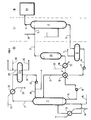
- the hydrocarbon charge to be washed from the impurities it contains is sent via a pipe 1 to the bottom of a washing column 2. Inside of this washing column 2, it is brought into contact, for example against the current, with washing water introduced for example at the head of the column via a pipe 3.
- the operating conditions of this washing operation in particular the pressure P and the temperature T, are chosen so as to carry out the extraction of the compounds polar and / or water-soluble compounds by the wash water, and obtain a hydrocarbon feedstock at least mostly free of impurities.
- the hydrocarbon charge purified of the impurities is discharged through a pipe 4 at the head of the washing column, and sent for example to a treatment unit U 1 .
- a processing unit for example an etherification unit, is given briefly in FIG. 2.
- washing water which is loaded with impurities is extracted at the bottom of washing column 2 via a line 5, and sent to a treatment or purification (part III of the figure).
- a treatment or purification part III of the figure.
- At the level of this circuit it is regenerated in implementing the steps of the method according to the invention, before being recycled to the washing column 2.
- Line 3b allows water to be added to the washing column 2 of the hydrocarbon charge.
- Part III of Figure 1 shows schematically an embodiment for the circuit for purifying the washing water loaded with impurities and coming from the wash 2.
- the washing water loaded with polar compounds is sent through a pipe 5 from washing column 2 to a buffer tank 6. Part of the hydrocarbons the lightest is discharged from the flask through a conduit 7, and the remainder of the washing water loaded with polar compounds and depleted in lighter hydrocarbons is evacuated at the bottom of the buffer tank 6 through a conduit 8.
- the water loaded with impurities is sent using a pump 9, and after passing through a heat exchanger heat 10, in a purification column 11. It is for example introduced in head of the purification column 11, through a conduit 12.
- This purification column 11 is provided in its lower part with a reboiler 13 having in particular the function of initiating a vapor flow, by partial vaporization of liquid.
- a fluid having a temperature sufficient for partially vaporizing the liquid from the bottom of the column feeds the reboiler 13 by a line 14.
- the pH value of the liquid at the bottom of the column can be checked by an automatic make-up of diluted acid or base, added via a line 15.
- the washing water purified mainly of impurities is extracted at the bottom of purification column 11 via a conduit 16, and the vapor phase which has become charged impurities (nitriles, acetone and / or possibly hydrocarbons) during the circulation against the current, is evacuated at the head of the column by a conduit 17.
- the purified water extracted through line 16 is taken up by a pump 18, and sent to heat exchanger 10 where it exchanges calories for reheat the washing water loaded with impurities coming from the tank 6.
- the water purified is then cooled in an exchanger 19 before being optionally introduced into a device 20 allowing its purification to be perfected.
- the purified water from the device 20 is extracted through a conduit 21, and recycled to the line 3 for introducing the washing water into the column 2 for washing the load of hydrocarbons.
- the device 20 can be formed of an enclosure comprising a solid phase, for example activated carbon, a resin or an adsorbent, which have as a special feature of retaining residual impurities.
- a solid phase for example activated carbon, a resin or an adsorbent, which have as a special feature of retaining residual impurities.
- a conduit 30 connected to the conduit 29 allows to introduce a certain amount of nitrogen to keep inside the balloon 23 a given pressure.
- the temperature and pressure conditions that are maintained in the purification column 11 are chosen to allow training at least the majority of impurities by water vapor.
- the temperature at which one operates is between 60 ° C and 210 ° C and the pressure varies between 0.02 and 2 MPa absolute.
- the pH is controlled at the bottom of the purification column 11, by injection of a base or of a dilute acid, in order to keep it in a neutral domain varying for example between 6.5 and 7.5. In this way, the effect of undesirable phenomena, such as corrosion, is limited. equipment.
- the rate of removal of impurities from the washing water by using the process varies from 85% to 100%.
- the degree of purity of the purified water being high, it is possible to recycle it to the step of washing the hydrocarbon charge without any other purification step important. It is also possible to perfect this purification step by passing on the solid phase of the device 20.
- the rate of reflux by load ratio is between 2 and 20%.
- the purge rate via line 29 represents about 0.1 to 5% of the water of wash to be treated, and includes most of the impurities.
- the method according to the invention offers the advantage of rejecting a quantity of water loaded with impurities which is low compared to the methods of the prior art.
- Any additional water will therefore be very small, varying for example from 0.1 to 5%.
- thermal integration means the possibility of using hot or cold fluids coming from a processing unit to which the method according to the invention is associated, to serve as a heating agent at the reboiler or cooling for the condenser 22 and / or the cooling exchanger 19.
- Figure 2 shows schematically an example of an etherification unit arranged after a purification circuit as described in FIG. 1. For reasons of clarity and simplification, only the material flows have been shown diagrammatically, the valves, exchangers, purge line, pumps, Vietnamese have not been shown.
- the hydrocarbon charge initially comprising the impurities is for example composed of monoolefins, and paraffins, each containing 3 to 8 carbon atoms, typically C 4 , C 5 , but also C 6 , C 7 , C 8 , in the majority of cases in an amount greater than that of the mono olefins.
- Paraffins can include butane, propane, isobutane, isopentane or n-pentane, hexanes (iso or n-).
- the mono olefins can contain propylene, butene-1, butene-2, isobutene, 2-methyl-2-butene, 2-methyl-1-butene, 3-methyl-1-butene, 1-pentene, 2-pentene, cyclopentene, cyclohexene.
- This charge can also contain a small amount of diolefins such as 1,3 butadiene and 1,3 pentadiene, isopropene, cyclo pentadiene.
- the impurities or polar compounds are present in the feed in the form of traces in proportions varying between 10 and 500 ppm / weight and more particularly in the range 15 to 80 ppm. -weight.
- the load can also contain water in a variable amount between 5 and 500 ppm-weight measured in H 2 O at saturation.
- the impurities can also include oxygenated compounds such as alcohols, ethers, aldehydes, ketones and acids. As more specific examples for these compounds, mention may be made of ethanol, methanol, acetone, etc.
- Acetone can be present as traces varying in the range of 1 at 500 ppm-weight.
- the load may or may not have been subjected to a process selective hydrogenation to remove the diolefins before or after treatment.
- the charge may contain between 50 ppm-weight and about 4% by weight of diolefins.
- the temperature range for performing the etherification operation is for example from 20 to 400 ° C, and the pressure range between the pressure atmospheric and 1MPa.
- the stoichiometric molar ratios of alcohol to reactive isoolefins vary, for example, in a range from 0.2: 1 to about 10: 1 and preferably between 0.95 and 1.15. These conditions will be chosen in function of the catalyst of the reaction zone.
- the etherification unit U 1 comprises a reaction zone 31 provided with a conduit 33 for introducing make-up alcohol such as methanol necessary for etherification, a conduit 32 for the arrival of the charge d 'washed hydrocarbon from washing column 2 and optionally a conduit 44 for alcohol recycling.
- the washed hydrocarbon charge is heated by passing through the condenser 22 or the exchanger 19 (FIG. 1), for which it acts as a cooling agent.
- the reaction zone comprises a catalyst chosen to carry out the etherification reaction and operates under conditions such that a mixture formed by unconverted C 4 and methanol is obtained at the outlet, and the ether produced during the reaction is sent via a line 34 to a distillation column 35.
- a stream containing ether is discharged at the bottom of the distillation column 35 produced by a conduit 36.
- the raffinate washing column 38 is equipped with a duct 39 allowing introduce the raffinate wash water. It is evacuated by a conduit 40 at the head of column 38 a raffinate stripped of methanol and at the bottom by a conduit 41 a solution formed by water and methanol.
- This solution is sent to a distillation column 42.
- the water is evacuated via line 39 before recycling it to the raffinate washing column 38.
- the methanol extracted through line 43 passes through line 14 of the reboiler 13 ( Figure 1).
- the cooled methanol is recycled by the. line 44 towards reaction zone 31.
- the washing water loaded with impurities is extracted from the washing column of the load of hydrocarbons with a flow rate which can represent around 5 to 150 % of the hydrocarbon charge, depending on the nature of the impurities in this charge and their content.
- the gas flow composed of the most hydrocarbons light varies from 0 to 0.005% of the flow of washing water to be purified.
- the vapor phase loaded with impurities is discharged with a flow rate of up to 0.05% by weight of the water flow of washing to be purified entering the purification column.
- the flow rate of the liquid distillate discharged through line 28 is between 0 and 0.05% by weight of the washing water flow entering the purification column.
- the method according to the invention is applicable for washing a C 4 -C 6 cut intended to be sent to an oligomerization unit, or even washing a C cut 4 before its treatment in a methathesis unit.
Landscapes
- Chemical & Material Sciences (AREA)
- Organic Chemistry (AREA)
- Crystallography & Structural Chemistry (AREA)
- Chemical Kinetics & Catalysis (AREA)
- Organic Low-Molecular-Weight Compounds And Preparation Thereof (AREA)
Applications Claiming Priority (2)
| Application Number | Priority Date | Filing Date | Title |
|---|---|---|---|
| FR9716035 | 1997-12-17 | ||
| FR9716035A FR2772373B1 (fr) | 1997-12-17 | 1997-12-17 | Procede d'elimination de composes polaires sur une unite d'etherification |
Publications (2)
| Publication Number | Publication Date |
|---|---|
| EP0924181A1 true EP0924181A1 (de) | 1999-06-23 |
| EP0924181B1 EP0924181B1 (de) | 2010-03-03 |
Family
ID=9514745
Family Applications (1)
| Application Number | Title | Priority Date | Filing Date |
|---|---|---|---|
| EP19980403066 Expired - Lifetime EP0924181B1 (de) | 1997-12-17 | 1998-12-07 | Verfahren zum Entfernen von polaren Verbindungen aus einer Etherifizierungseinheit |
Country Status (5)
| Country | Link |
|---|---|
| EP (1) | EP0924181B1 (de) |
| AR (1) | AR023013A1 (de) |
| DE (1) | DE69841528D1 (de) |
| FR (1) | FR2772373B1 (de) |
| TW (1) | TW541196B (de) |
Cited By (1)
| Publication number | Priority date | Publication date | Assignee | Title |
|---|---|---|---|---|
| CN113680090A (zh) * | 2021-08-25 | 2021-11-23 | 安徽金邦医药化工有限公司 | 一种利用多级回路的乙醚纯化装置 |
Citations (6)
| Publication number | Priority date | Publication date | Assignee | Title |
|---|---|---|---|---|
| US4246417A (en) * | 1978-05-15 | 1981-01-20 | The Lummus Company | Treatment of waste water from nitrile production |
| GB2074035A (en) * | 1980-03-31 | 1981-10-28 | Elf Aquitaine | Regenerating absorbent solution |
| WO1993016779A1 (fr) * | 1992-02-27 | 1993-09-02 | Elf Aquitaine Production | Procede et dispositif d'elimination des hydrocarbures contenus a l'etat dissous et/ou emulsionne dans une eau residuaire par stripage a la vapeur d'eau |
| DE4330570C1 (de) * | 1992-11-23 | 1995-05-04 | Preussag Noell Wassertech | Verfahren und Vorrichtung zur Entfernung von ammoniumhaltigen Verbindungen aus Abwässern |
| US5569790A (en) * | 1994-05-03 | 1996-10-29 | Uop | Process for removal of nitriles from etherification feedstocks |
| US5684212A (en) * | 1996-05-30 | 1997-11-04 | Phillips Petroleum Company | Nitrile removal process and etherification process with same |
Family Cites Families (2)
| Publication number | Priority date | Publication date | Assignee | Title |
|---|---|---|---|---|
| US4808765A (en) * | 1987-07-17 | 1989-02-28 | The Dow Chemical Company | Sulfur removal from hydrocarbons |
| US5569788A (en) * | 1995-03-20 | 1996-10-29 | Uop | Process for removal of impurities from etherification feedstocks |
-
1997
- 1997-12-17 FR FR9716035A patent/FR2772373B1/fr not_active Expired - Fee Related
-
1998
- 1998-12-07 EP EP19980403066 patent/EP0924181B1/de not_active Expired - Lifetime
- 1998-12-07 DE DE69841528T patent/DE69841528D1/de not_active Expired - Lifetime
- 1998-12-15 AR ARP980106389 patent/AR023013A1/es active IP Right Grant
- 1998-12-22 TW TW87121047A patent/TW541196B/zh not_active IP Right Cessation
Patent Citations (6)
| Publication number | Priority date | Publication date | Assignee | Title |
|---|---|---|---|---|
| US4246417A (en) * | 1978-05-15 | 1981-01-20 | The Lummus Company | Treatment of waste water from nitrile production |
| GB2074035A (en) * | 1980-03-31 | 1981-10-28 | Elf Aquitaine | Regenerating absorbent solution |
| WO1993016779A1 (fr) * | 1992-02-27 | 1993-09-02 | Elf Aquitaine Production | Procede et dispositif d'elimination des hydrocarbures contenus a l'etat dissous et/ou emulsionne dans une eau residuaire par stripage a la vapeur d'eau |
| DE4330570C1 (de) * | 1992-11-23 | 1995-05-04 | Preussag Noell Wassertech | Verfahren und Vorrichtung zur Entfernung von ammoniumhaltigen Verbindungen aus Abwässern |
| US5569790A (en) * | 1994-05-03 | 1996-10-29 | Uop | Process for removal of nitriles from etherification feedstocks |
| US5684212A (en) * | 1996-05-30 | 1997-11-04 | Phillips Petroleum Company | Nitrile removal process and etherification process with same |
Cited By (2)
| Publication number | Priority date | Publication date | Assignee | Title |
|---|---|---|---|---|
| CN113680090A (zh) * | 2021-08-25 | 2021-11-23 | 安徽金邦医药化工有限公司 | 一种利用多级回路的乙醚纯化装置 |
| CN113680090B (zh) * | 2021-08-25 | 2022-03-25 | 安徽金邦医药化工有限公司 | 一种利用多级回路的乙醚纯化装置 |
Also Published As
| Publication number | Publication date |
|---|---|
| TW541196B (en) | 2003-07-11 |
| DE69841528D1 (de) | 2010-04-15 |
| FR2772373B1 (fr) | 2001-05-04 |
| EP0924181B1 (de) | 2010-03-03 |
| AR023013A1 (es) | 2002-09-04 |
| FR2772373A1 (fr) | 1999-06-18 |
Similar Documents
| Publication | Publication Date | Title |
|---|---|---|
| EP3194350B1 (de) | Verfahren zur herstellung von butadien aus ethanol in einem reaktionsschritt mit geringem wasser- und geringem energieverbrauch | |
| CA2357860C (fr) | Procede de desacidification d'un gaz par absorption dans un solvant avec un controle de la temperature | |
| CA2960715C (fr) | Procede de production de butadiene et d'hydrogene a partir d'ethanol en deux etapes reactionnelles a faible consommation en eau et en energie | |
| CA2135127C (fr) | Procede de separation des composes oxygenes d'hydrocarbures, combinant une distillation et une permeation et son utilisation en etherification | |
| EP1932818B1 (de) | Entfernung von Acetonitril aus einem im Herstellungsverfahren von Ethern zu verwendenden olefinischen Einsatzstoffes unter Verwendung von ionischen Flüssigkeiten | |
| FR2739789A1 (fr) | Procede et dispositif de traitement d'un gaz contenant de l'eau tel qu'un gaz naturel | |
| EP3478648B1 (de) | Verfahren zur herstellung von butadien aus ethanol mittels reinigung eines butadienreichen abwassers durch extraktive destillation | |
| FR2567534A1 (fr) | Procede de production d'une coupe d'hydrocarbures a indice d'octane eleve, par etherification d'olefines | |
| EP0869107B1 (de) | Verfahren zur Herstellung von alpha-Olefinen, tertiären Olefinen und/oder Ethern aus einer ungesättigten Kohlenwasserstofffraktion | |
| EP0924181B1 (de) | Verfahren zum Entfernen von polaren Verbindungen aus einer Etherifizierungseinheit | |
| EP3478649B1 (de) | Verfahren zur herstellung von butadien aus ethanol unter einbeziehung einer extraktivdestillation | |
| EP3797096B1 (de) | Verfahren zur herstellung eines propylenstroms und zugehörige anlage | |
| FR2520356A1 (fr) | Procede de valorisation des coupes c4 olefiniques | |
| WO2007128912A1 (fr) | Procédé de production d'éthers incluant une séparation de l'alcool par un liquide ionique | |
| FR2761682A1 (fr) | Procede de production d'ether et d'olefine a partir de coupe hydrocarbonee contenant au moins une olefine tertiaire par synthese puis decomposition d'ether comportant une premiere etape de purification d'olefine par lavage a l'eau | |
| CA3029107C (fr) | Procede de production de butadiene a partir d'ethanol comprenant une purification d'un effluent riche en butadiene par distillation extractive | |
| FR2933093A1 (fr) | Procede de fabrication d'ether utilisant une colonne de distillation reactive, colonne de distillation reactive et unite d'etherification correspondantes | |
| FR2866346A1 (fr) | Procede d'extraction d'un anti-hydrates contenu dans des hydrocarbures condenses | |
| EP3564343A1 (de) | Verfahren und vorrichtung zur trennung von aromastoffen unter vakuum | |
| FR2764881A1 (fr) | Procede de synthese et de purification d'olefines comprenant la deshydrogenation d'une paraffine | |
| EP3802472B1 (de) | Teilextraktion von butanol aus einer wässrigen lösung mit ethanol und butanol | |
| FR3060558A1 (fr) | Procede de production de butadiene comprenant des etapes de separation ameliorees | |
| FR3038905A1 (fr) | Procede de traitement d'une charge hydrocarbonee | |
| FR2730502A1 (fr) | Carburant obtenu par un procede comportant l'etherification optimisee d'une coupe d'hydrocarbures contenant des olefines ayant de 5 a 8 atomes de carbone | |
| FR3034764A1 (fr) | Procede d'isomerisation d'une charge d'hydrocarbures en c7 a c11. |
Legal Events
| Date | Code | Title | Description |
|---|---|---|---|
| PUAI | Public reference made under article 153(3) epc to a published international application that has entered the european phase |
Free format text: ORIGINAL CODE: 0009012 |
|
| AK | Designated contracting states |
Kind code of ref document: A1 Designated state(s): DE FI FR GB IT |
|
| AX | Request for extension of the european patent |
Free format text: AL;LT;LV;MK;RO;SI |
|
| 17P | Request for examination filed |
Effective date: 19991223 |
|
| AKX | Designation fees paid |
Free format text: DE FI FR GB IT |
|
| 17Q | First examination report despatched |
Effective date: 20060810 |
|
| GRAP | Despatch of communication of intention to grant a patent |
Free format text: ORIGINAL CODE: EPIDOSNIGR1 |
|
| GRAS | Grant fee paid |
Free format text: ORIGINAL CODE: EPIDOSNIGR3 |
|
| GRAA | (expected) grant |
Free format text: ORIGINAL CODE: 0009210 |
|
| AK | Designated contracting states |
Kind code of ref document: B1 Designated state(s): DE FI FR GB IT |
|
| REG | Reference to a national code |
Ref country code: GB Ref legal event code: FG4D Free format text: NOT ENGLISH |
|
| REF | Corresponds to: |
Ref document number: 69841528 Country of ref document: DE Date of ref document: 20100415 Kind code of ref document: P |
|
| REG | Reference to a national code |
Ref country code: FR Ref legal event code: CD |
|
| PLBE | No opposition filed within time limit |
Free format text: ORIGINAL CODE: 0009261 |
|
| STAA | Information on the status of an ep patent application or granted ep patent |
Free format text: STATUS: NO OPPOSITION FILED WITHIN TIME LIMIT |
|
| 26N | No opposition filed |
Effective date: 20101206 |
|
| REG | Reference to a national code |
Ref country code: DE Ref legal event code: R081 Ref document number: 69841528 Country of ref document: DE Owner name: IFP ENERGIES NOUVELLES, FR Free format text: FORMER OWNER: INSTITUT FRANCAIS DU PETROLE, RUEIL MALMAISON, FR Effective date: 20110331 |
|
| PGFP | Annual fee paid to national office [announced via postgrant information from national office to epo] |
Ref country code: GB Payment date: 20141218 Year of fee payment: 17 Ref country code: FI Payment date: 20141222 Year of fee payment: 17 Ref country code: FR Payment date: 20141014 Year of fee payment: 17 |
|
| PGFP | Annual fee paid to national office [announced via postgrant information from national office to epo] |
Ref country code: IT Payment date: 20141218 Year of fee payment: 17 |
|
| PGFP | Annual fee paid to national office [announced via postgrant information from national office to epo] |
Ref country code: DE Payment date: 20141222 Year of fee payment: 17 |
|
| REG | Reference to a national code |
Ref country code: DE Ref legal event code: R119 Ref document number: 69841528 Country of ref document: DE |
|
| GBPC | Gb: european patent ceased through non-payment of renewal fee |
Effective date: 20151207 |
|
| REG | Reference to a national code |
Ref country code: FR Ref legal event code: ST Effective date: 20160831 |
|
| PG25 | Lapsed in a contracting state [announced via postgrant information from national office to epo] |
Ref country code: GB Free format text: LAPSE BECAUSE OF NON-PAYMENT OF DUE FEES Effective date: 20151207 Ref country code: DE Free format text: LAPSE BECAUSE OF NON-PAYMENT OF DUE FEES Effective date: 20160701 |
|
| PG25 | Lapsed in a contracting state [announced via postgrant information from national office to epo] |
Ref country code: FR Free format text: LAPSE BECAUSE OF NON-PAYMENT OF DUE FEES Effective date: 20151231 |
|
| PG25 | Lapsed in a contracting state [announced via postgrant information from national office to epo] |
Ref country code: IT Free format text: LAPSE BECAUSE OF NON-PAYMENT OF DUE FEES Effective date: 20151207 |
|
| PG25 | Lapsed in a contracting state [announced via postgrant information from national office to epo] |
Ref country code: FI Free format text: LAPSE BECAUSE OF NON-PAYMENT OF DUE FEES Effective date: 20151207 |