EP0924501A2 - Structure sensible piézoresistive à couche épaisse - Google Patents
Structure sensible piézoresistive à couche épaisse Download PDFInfo
- Publication number
- EP0924501A2 EP0924501A2 EP98203988A EP98203988A EP0924501A2 EP 0924501 A2 EP0924501 A2 EP 0924501A2 EP 98203988 A EP98203988 A EP 98203988A EP 98203988 A EP98203988 A EP 98203988A EP 0924501 A2 EP0924501 A2 EP 0924501A2
- Authority
- EP
- European Patent Office
- Prior art keywords
- sensing structure
- oxide
- alumina
- glass frit
- recited
- Prior art date
- Legal status (The legal status is an assumption and is not a legal conclusion. Google has not performed a legal analysis and makes no representation as to the accuracy of the status listed.)
- Granted
Links
Images



Classifications
-
- H—ELECTRICITY
- H01—ELECTRIC ELEMENTS
- H01C—RESISTORS
- H01C10/00—Adjustable resistors
- H01C10/10—Adjustable resistors adjustable by mechanical pressure or force
- H01C10/103—Adjustable resistors adjustable by mechanical pressure or force by using means responding to magnetic or electric fields, e.g. by addition of magnetisable or piezoelectric particles to the resistive material, or by an electromagnetic actuator
Definitions
- the present invention generally relates to a thick-film piezoresistive pressure sensor.
- Diaphragms of single-crystal silicon pressure transducer cells are typically small, rarely exceeding a few millimeters in width, and are very thin, with a thickness of often less than 100 micrometers.
- the use of standard single-crystal silicon wafers and standard semiconductor device fabrication processes allows many such cells to be fabricated from a single wafer, providing some economy of scale.
- silicon is susceptible to chemical attack and erosion by various media, particularly in applications where a high-pressure medium is to be sensed, e.g., automotive applications that involve sensing brake fluid, oil, transmission fluid, hydraulic fluid, fuel and steering fluid pressures.
- a pressure sensor must also be physically rugged and resistant to the hostile environment of the sensed medium, necessitating that a micromachined silicon pressure transducer cell include some form of protection in order to realize its advantageous operational characteristics in the chemically hostile environment.
- Current methods for producing media-compatible, high-pressure sensors include enclosing a silicon sensing chip in an inert fluid, such as a silicone oil or gel, and then further separating the sensing chip from the medium to be sensed with a metal diaphragm, such that pressure must be transmitted through the metal diaphragm and fluid to the sensing chip. While achieving some of the operational advantages of silicon pressure transducer cells, the manufacturing processes for these sensors are relatively expensive and complicated. As a result, these sensors are not suitable as mass-produced sensors for automotive applications.
- alternative approaches include ceramic capacitive pressure sensors and ceramic diaphragms that use thick-film piezoresistors as strain sensing elements.
- each of these also have certain disadvantages, such as complex circuitry to detect capacitance changes, the requirement for ceramic-to-ceramic bonds, and a maximum pressure capability typically not exceeding about 1000 psi (about 7 MPa).
- metal diaphragms have found use as the sensing element. Because metal diaphragms generally deflect more for a given thickness and pressure than ceramic diaphragms, sensing is performed by thin-film polysilicon or metal deposited on the metal diaphragm.
- the diaphragm must first be coated with a dielectric layer to electrically insulate the diaphragm from the thin-film resistors and conductors.
- a thin-film polysilicon layer is then deposited to form the piezoresistors, followed by thin-film metallization to provide electrical interconnects.
- the thin-film layers are typically deposited by such processes as chemical or physical vapor deposition. The equipment necessary for these processes is expensive, and deposition rates are extremely slow. Deposition of the thin-film layers requires multiple patterning, exposure, developing and stripping steps for the required thin-film photoresists and metallization, and must be carried out in a controlled environment to assure that no air borne particles are present on the surface to be coated.
- the surface of the metal diaphragm must be extremely smooth to avoid rough surface features penetrating through or producing discontinuities in the deposited thin films.
- the resistance of the resulting polysilicon thin-film piezoresistors can vary dramatically with temperature.
- At least one thick-film dielectric layer is required to electrically insulate the metal diaphragm from the thick-film piezoresistors.
- the dielectric layer applied directly to the diaphragm must be formed of a material that will adhere to the metal diaphragm, withstand the strains induced as the diaphragm deflects, faithfully transmit such strains to the thick-film piezoresistors, and compensate for the coefficient of thermal expansion (CTE) mismatch between the metal diaphragm and piezoresistors.
- CTE coefficient of thermal expansion
- a complication is that metal oxide constituents of dielectric materials found suitable for this purpose have been found to diffuse into the thick-film piezoresistor and react with metal oxides present in the frit component of the piezoresistor, thereby significantly increasing the sheet resistivity of the piezoresistor, e.g., above the 3 to 10 kilo-ohm/square (k ⁇ / ⁇ ) range typically desired. Accordingly, improved performance could be achieved if diffusion between the electrical-insulating layers and the thick-film piezoresistors was inhibited or at least controlled. While there have been suggestions to compensate CTE mismatch with temperature compensation electronics instead of manipulating the composition of the required insulating material, doing so undesirably increases processing and costs of the sensor.
- strain-sensing structure employs thick-film technology, including thick-film electrical-insulating layers and thick-film piezoresistors, yielding a sensor that is capable of sensing very high pressures while being chemically and mechanically robust, readily manufacturable to be compatible with mass-production techniques, and relatively insensitive to temperature variations.
- the present invention provides a media-compatible, high-pressure sensor that employs a thick-film strain-sensing structure.
- the strain-sensing structure generally includes a metal diaphragm, at least one electrical-insulating layer on the diaphragm, an interface layer on the electrical-insulating layer, and one or more thick-film piezoresistors on the interface layer for sensing deflection of the diaphragm.
- the metal diaphragm is preferably formed of a steel, most preferably a stainless steel such as an AISI Type 300 or 400 Series.
- the interface layer and the electrical-insulating layers are preferably formed by thick-film processing, as done for the piezoresistors.
- the electrical-insulating layer applied to the diaphragm must be formulated such that it adheres to the metal diaphragm and has a CTE that matches or is close to that of the metal diaphragm.
- the frit present in such an electrical-insulating layer may contain many of the same metal oxides present in the frit component of the piezoresistors, the relative proportions of a given metal oxide may be such that interdiffusion during firing of the thick-film piezoresistors creates a third glass composition whose impact on the piezoresistors depends on the degree of diffusion and the proportion that the newly created frit assumes relative to the total frit content of the piezoresistors. It is not unusual for the new frit to be of a different phase, relative to solidus and liquidus temperatures, with consequent changes in softening point, melting point, wetting and CTE as a result.
- glass frits are primary determinants of thick-film resistor properties such as sheet resistivity, temperature coefficient of resistance (TCR), stability and piezoresistivity.
- TCR temperature coefficient of resistance
- the intermingling of the glass frit components of the electrical-insulating layer, as a result of diffusion, increases the sheet resistivity of the piezoresistors and negatively affecting their performance.
- the interface layer of this invention is formulated to inhibit and control diffusion of the electrical-insulating layers into the piezoresistors.
- the interface layer is characterized by particulate alumina (Al 2 O 3 , aluminum oxide) and particulate zinc oxide (ZnO) closely divided and suspended in a glass matrix, forming an alumina glass ceramic, preferably a lead-alumina-borosilicate glass composed primarily of lead oxide, alumina, boron oxide and silica.
- the interface layer is formed from a composition that contains, in addition to a suitable organic media, alumina, zinc oxide, and a glass frit mixture that preferably contains lead oxide (PbO; litharge), a source of boron oxide (B 2 O 3 ) such as boric acid (H 3 BO 3 ), silica (SiO 2 , silicon dioxide), and alumina.
- the interface layer may also include such constituents as titania (TiO 2 , titanium dioxide), cupric oxide (CuO), manganese monoxide (MnO), and cobalt oxide (CoO), the latter three preferably being provided alone or in combination.
- the interface layer separates the piezoresistors from the electrical-insulating layers, and inhibits diffusion into the piezoresistors of constituents in the electrical-insulating layers.
- the sheet resistivity of the thick-film piezoresistors exhibits minimal change following firing.
- the interface layer of this invention has been shown to relay strains from the diaphragm and electrical-insulating layers to the piezoresistor with negligible degradation.
- interface layers having the composition set forth above have also been determined to actually increase the gage factor of the piezoresistor by as much as 25% to 40%.
- Another unexpected advantage of this invention is that the detrimental effect of the high CTE of a metal diaphragm on resistance versus temperature of a piezoresistive sensor has been found to be largely offset by the presence of the interface layer, thereby eliminating the need for temperature compensation electronics as required by sensors of the past.
- the present invention provides for a pressure sensor that combines a corrosion-resistant metal diaphragm and thick-film technology, and avoids thick-film interactions to enable accurate sensing of very high pressures, e.g., in excess of 10,000 psi (about 70 MPa).
- very high pressures e.g., in excess of 10,000 psi (about 70 MPa).
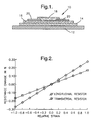
- Figure 1 represents a pressure sensing structure 10 for a high-pressure sensor in accordance with the present invention.
- the sensing structure 10 is formed to be capable of deflecting in response to a pressure applied by a medium to the structure 10.
- the sensing structure 10 includes multiple layers 14, 16, 18 and 20 on a metal diaphragm 12.
- the diaphragm 12 may be in the form of a monolithic metal structure formed by either conventional stamping, machining or micromachining a metal body, the latter using known etching techniques, with the remainder of the metal body forming an annular-shaped support (not shown) for the diaphragm 12.
- the diaphragm 12 could be a discrete member that is permanently secured, such as by welding, to a support.
- the diaphragm 12 is formed of a steel alloy, and preferably stainless steel in order to achieve a suitable level of corrosion resistance to the given medium. While various grades of steel could be used, preferred alloys are AISI Type 300 and 400 Series alloys, with Types 304, 316, 404, 430, 430 S17 and 444 being particularly suitable as being compatible with materials suitable for the layer 14 contacting and adhered to the metal diaphragm 12, as will be discussed below. However, it is within the scope of this invention to use other stainless steels, as well as carbon and galvanized steels and other metals.
- the layers on the sensing structure 10 are a single thick-film dielectric layer 14, a thick-film interface layer 16, a thick-film piezoresistor 18, and contacts 20.
- the piezoresistor 18 is employed to sense the deflection of the diaphragm 12, while the dielectric layer 14 is necessary to electrically insulate the piezoresistor 18 from the diaphragm 12.
- the contacts 20 enable the use of wire bonding to electrically interconnect appropriate conditioning circuitry (not shown) to the piezoresistor 18. Alternatively, a chip carrying the circuitry can be connected to the contacts 20 by known flip chip attachment methods. While a single piezoresistor 18 is shown, it will be understood that any number of piezoresistors could be used, such as for the purpose of using a Wheatstone bridge to process the output of the sensing structure 10.
- a preferred aspect of this invention is that the dielectric layer 14, the interface layer 16, the piezoresistor 18 and the contacts 20 are each formed by thick-film processes, though it is foreseeable that laminated tapes could be used. As thick films, each is about 25 ⁇ m (about one mil) or more in thickness, and formed by depositing an appropriate paste or ink using a printing technique or similar process. Consequently, the dielectric and interface layers 14 and 16, the piezoresistor 18 and contacts 20 are distinguishable from thin-film structures. The piezoresistor 18 is also distinguishable from implanted and diffused piezoresistors employed with single-crystal pressure cells. According to the invention, suitable inks for the piezoresistor 18 and contacts 20 are known in the art.
- a commercially available resistive ink found suitable for the piezoresistor 18 is available under the name ESL 3414B from Electro-Science Laboratories, Inc.
- suitable conductor inks for the contacts 20 include silver-palladium and gold compositions identified as 7484 and 5760, respectively, and commercially available from E.I. DuPont de Nemours and Company, Inc., of Wilmington, Delaware. Thick-film printing processes for depositing the inks and the thermal processing required to fire such inks are generally known in the art.
- Suitable resistive materials for the piezoresistor 18 generally have sheet resistances of about 3 to 10 kilo-ohms/square.
- the ESL 3414B composition yields thick-film piezoresistors within this range that exhibit a gage factor (the ratio of the change in resistance ( ⁇ R) to strain ( ⁇ L/L)) of about 15 to 20.
- the electrical resistance of thick-film resistive materials is known to vary with temperature, and can be permanently altered when subjected to a hostile environment.
- the sensitivity of a thick-film resistor to temperature is indicated by its temperature coefficient of resistance (TCR), as measured in parts per million per °C (ppm/°C).
- Thick-film piezoresistors can typically be calibrated to have a TCR in the range of about ⁇ 200 to about ⁇ 100 ppm/°C when measured across a temperature range of -55°C and 125°C, which are standard temperature extremes used by the industry to evaluate the electrical characteristics of thick-film resistors.
- the diameter and thickness of the diaphragm 12 are relatively sized to ensure that the diaphragm 12 is sufficiently flexible to respond to changes in pressure in the medium.
- the flexibility of the metal diaphragm 12 is particularly demanding of the thick-film dielectric layer 14.
- the dielectric layer 14 must be formed of a material that will adhere to the diaphragm 12 and compensate for the large CTE mismatch between the metal diaphragm 12 and the thick-film piezoresistor 18.
- the dielectric layer 14 must withstand the strains induced as the diaphragm 12 deflects, yet faithfully transmit such strains to the thick-film piezoresistor 18.
- the present invention fulfills these requirements by using at least one dielectric layer 14 that preferably contains one or more bonding agents and a mixture of metal oxides that, when the ink for the dielectric layer 14 is fired, provide for a coefficient of thermal expansion (CTE) that approximately equals that of the diaphragm 12.
- Suitable bonding agents are those that are noncorrosive to the material of the diaphragm 12.
- Other possible materials that could be substituted for the metal oxides include porcelain, quartz, SiO 2 , Si 3 N 4 , SiC, etc.
- Particularly suitable ink compositions for the dielectric layer 14 include ESL D-4914 and ESL D-4913B commercially available from Electro-Science, and QM44 from DuPont.
- the dielectric layer 14 can alternatively be formed with a dielectric tape, such as ESL D-41030-25C from Electro-Science and HD-3 from DuPont.
- ESL D-41030-25C from Electro-Science and HD-3 from DuPont.
- These dielectric materials though developed for static applications such as heating elements, have been surprisingly found to exhibit suitable mechanical properties for dynamic applications such as the flexing metal diaphragm 12 of this invention.
- thick-film dielectric materials determined to be compatible with steel sensing diaphragms contain glass frits composed of metal oxides that tend to diffuse into the piezoresistor 18 during firing of the dielectric ink.
- the interface layer 16 inhibits diffusion of metal oxides from the frit component of the dielectric layer 14 into the piezoresistor 18, while also being compatible with the materials for the dielectric layer 14 and the piezoresistor 18.
- Compositions for the interface layer 16 that have been determined to provide this function contain particulate alumina (Al 2 O 3 , aluminum oxide) and particulate zinc oxide (ZnO) closely divided and suspended in a glass matrix forming an alumina glass ceramic.
- the glass is preferably a lead-alumina-borosilicate glass composed primarily of lead oxide, alumina, boron oxide and silica.
- the interface layer 16 having the preferred composition is formed from dielectric ink compositions that contain, in addition to a suitable organic media, alumina, zinc oxide, and a glass frit mixture that preferably contains lead oxide (PbO, litharge), a source of boron oxide (B 2 O 3 ) such as boric acid (H 3 BO 3 ), silica (SiO 2 , silicon dioxide), and alumina.
- Additional glass constituents preferably including titania (TiO 2 , titanium dioxide), cupric oxide (CuO), manganese monoxide (MnO) from manganese carbonate (MnCO 3 ), and cobalt oxide (CoO) from cobalt carbonate (CoCO 3 ), the latter three being provided alone or in combination, are introduced into the glass to act as fine tuning control of thermal expansion of the alumina glass ceramic and/or to add color to it.
- a preferred particle size for the dry constituents is about 230 mesh (about 64 ⁇ m) to about 325 mesh (about 45 ⁇ m), though the use of larger and smaller particles is foreseeable.
- Suitable ranges for the constituents of the ink composition of the interface layer 16 are, in weight percent, about 15% to about 35% alumina, about 3 % to about 6% zinc oxide, and about 34% to about 53% of the glass frit materials, the balance being the organic media. Notably, sufficient particulate alumina is present in the interface layer 16 to achieve physical properties similar to that of alumina substrate materials.
- Suitable ranges for the individual constituents of the glass frit materials are, in weight percent, about 50% to about 74% lead oxide, about 10% to about 25% boric acid as a source of boron oxide, about 8% to about 26% silica, up to about 12% alumina, up to about 3% titania, and up to 8% of cupric oxide, manganese carbonate as a source of manganese monoxide, and/or cobalt carbonate as a source of cobalt oxide. More particular ranges for the last three constituents are, in weight percent, about 0.5% to about 3.0% cupric oxide, about 0.5% to about 4.0% manganese carbonate, and about 3.5 % to about 4% cobalt carbonate.
- a suitable organic media is a terpineol/ethyl cellulose solution, though other vehicles such as butyl carbitol acetate/acrylic resin could be used.
- the organic media was a terpineol/ethyl cellulose solution.
- INK COMPOSITION IN WEIGHT PERCENT
- Test substrates were formed of 96% pure alumina and AISI Type 300 stainless steel having thicknesses of about 0.035 inch (about 0.9 mm) and about 0.020 inch (about 0.5mm), respectively.
- the stainless steel specimens were prepared by first sandblasting their surfaces, then oxidizing with two passes through a belt furnace at a peak temperature of about 850°C to about 950°C. Following oxidation, the steel specimens were washed to remove any contamination and oily residue.
- the stainless steel substrates were printed and fired with two layers of ESL D-4914 dielectric ink and one layer of ESL D-4913B dielectric ink to form insulating dielectric layers corresponding to layer 14 in Figure 1.
- Each layer was printed with a 230 mesh screen OF 1.4 mil (about 36 ⁇ m) diameter wire and 0.9 mil (about 23 ⁇ m) emulsion thickness.
- the substrates were divided into two groups. One group was fired in a conventional furnace having a peak temperature of about 850°C for a duration at or near the peak temperature of about ten minutes. Total cycle time, from entrance to exit, was about forty-five minutes. The second group was fast-fired in an infrared (IR) furnace having a peak temperature of about 915°C for a duration at or near the peak temperature of about three minutes. Total cycle time, from entrance to exit, was about fifteen minutes for the second group.
- IR infrared
- An interface layer 16 of the Ink #1 composition was then printed and fired over the dielectric layers 14 on each of the steel substrates under the same conditions as the dielectric layers 14.
- Contacts 20 were then formed by printing the DuPont 7484 ink composition on the alumina substrates and on the interface layers 16 of the steel substrates with a 325 mesh screen of about 0.9 mil (about 23 ⁇ m) diameter wire and about 0.5 mil (about 13 ⁇ m) emulsion thickness.
- the inks were dried and fired, with the alumina substrates being divided into two groups as was done with the steel substrates, the first group of each type of substrate being fired at about 850°C using a conventional oven and the second group being fired in the IR furnace at about 915°C.
- pairs of thick-film piezoresistors 18 oriented transversely to each other were formed on each specimen by printing, drying and firing the ESL 3414B piezoresistor ink in the same manner as was done for the contacts 20.
- the resulting thick-film piezoresistors 18 were then evaluated for sheet resistivity, TCR and resistance change versus strain (i.e., gage factor).
- Sheet resistivity (Rs) in ohms/ ⁇ and TCR in ppm/°C at about -40°C (“CTCR”) and about +125°C (“HTCR”) for each group are summarized below in Table III.
- the sheet resistivity values obtained on the stainless steel substrates closely approximate those obtained on the alumina substrates, which is an object of this invention.
- the differences between the TCR values of the alumina and steel substrates are explained by the large CTE difference between alumina (having a CTE range of about 6.54 ppm/°C) and stainless steels (having a CTE range of about 10 ppm/°C to about 18 ppm/°C, depending on the type of steel).
- Dielectric and interface layers were printed and fired on four groups of stainless steel substrates using the same screen parameters noted above as follows.
- the substrates were fired in an IR furnace with a peak temperature of about 915°C for a duration at peak temperature of about three minutes as in Experiment #1.
- the substrates of each group were then printed and fired with the DuPont 7484 conductive ink and the ESL 3414B piezoresistive ink to form contacts and piezoresistors, respectively. Firing was performed in an IR furnace for about three minutes at a peak temperature of either 895°C or 915°C for a duration of about three minutes at the peak temperature. Screening of the piezoresistive ink was done in such a way as to achieve thick-film piezoresistors of different thicknesses according to Table V below.
- the thick-film piezoresistors were evaluated for sheet resistivity, TCR and gage factor using the resistance versus strain test method of Experiment #1.
- the test data were statistically analyzed to determine the impact of print thickness, firing, interface composition, and dielectric composition and sequence on sheet resistance, TCR and gage factor. The results unexpectedly showed that sheet resistance, TCR and gage factor were overwhelmingly determined by the interface layer composition.
- Figures 3 and 4 show the average sheet resistances and gage factors for piezoresistors isolated from the dielectric layers with either Ink #1 or Ink #2 relative to interface layer thickness
- Figure 5 shows resistance versus temperature for baseline alumina substrates printed with the same piezoresistive inks under the same conditions, and for the stainless steel substrates with piezoresistors isolated from the dielectric layers with either Ink #1 or #2 at the different test thicknesses.
- Figure 4 shows that the composition of the interface layer actually enhanced the gage factor of the piezoresistor from the initial 15 to 20 typical for the ESL 3414B material, to about 21 to 25, a minimum increase of 25% depending on the thickness of the piezoresistor. Also unexpected was that the interface layer formed with Ink #2 was capable of offsetting the effect of the higher CTE of stainless steel relative to resistance versus temperature, as shown in Figure 5.
- the sensing cells had diaphragms approximately eight mils (about 0.2 mm) thick formed of AISI Type 304L stainless steel, and were prepared for printing by bead blasting and oxidation by firing in a belt furnace with a peak temperature of about 915°C and a duration at peak temperature of about ten minutes.
- Half of the diaphragms were printed with two layers of QM44 using a 230 mesh screen, while the remaining diaphragms were printed with two layers of ESL D-4914 using the 230 mesh screen.
- the diaphragms were dried at about 150°C for about ten to fifteen minutes, and then fired in a belt furnace having a peak temperature of about 850°C for a duration at peak temperature of about ten minutes.
- the dried thickness of each dielectric layer was about 1.5 mils (about 38 ⁇ m), yielding a total fired thickness of about 1.5 mils.
- the diaphragms printed with ESL D-4914 and QM44 were then each divided into four groups, with the diaphragms of each group being printed with a single layer of one of Inks #2 through #5 using a 230 mesh screen to achieve a dried thickness of about 1.5 mils. Drying and firing were performed in the same manner as were the dielectric layers.
- the fired substrates were printed with the DuPont 5760 and 7484 thick-film conductive inks to form the appropriate circuitry for the sensing cells, then dried and fired under the same conditions as the dielectric layers.
- the ESL 3414B piezoresistive ink was then printed using a 325 screen mesh onto the interface layers to yield a thickness of about 1.0 mil (about 25 ⁇ m) after drying. Drying and firing conditions were again the same as that for the dielectric layers.
- the resulting pressure sensing cells were then evaluated for resistance. Average sheet resistance values for each group were as follows. DIELECTRIC INTERFACE SHEET RESISTIVITY ESL D-4914 Ink #2 6.1 k ⁇ / ⁇ ESL D-4914 Ink #3 3.2 ESL D-4914 Ink #4 5.8 ESL D-4914 Ink #5 2.7 QM44 Ink #2 6.0 QM44 Ink #3 2.7 QM44 Ink #4 9.3 QM44 Ink #5 7.9
- the sensing cells were then assembled using standard practices into pressure sensors (minus amplification and temperature compensation circuitry) and subjected to pressure and temperature testing.
- TCGF temperature coefficient of gage factor
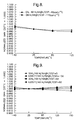
- Resulting temperature related data are summarized in Figure 9 and show variations in gain relative to temperature were within about ⁇ 1% for all steel and interface material combinations.
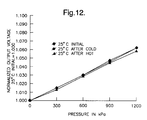
- Resulting data for normalized output in response to pressure are shown in Figure 10 for the same steel and interface combinations.
Landscapes
- Physics & Mathematics (AREA)
- Electromagnetism (AREA)
- Engineering & Computer Science (AREA)
- Microelectronics & Electronic Packaging (AREA)
- Pressure Sensors (AREA)
- Measuring Fluid Pressure (AREA)
- Glass Compositions (AREA)
Applications Claiming Priority (2)
| Application Number | Priority Date | Filing Date | Title |
|---|---|---|---|
| US08/994,113 US5898359A (en) | 1997-12-19 | 1997-12-19 | Diffusion-barrier materials for thick-film piezoresistors and sensors formed therewith |
| US994113 | 1997-12-19 |
Publications (3)
| Publication Number | Publication Date |
|---|---|
| EP0924501A2 true EP0924501A2 (fr) | 1999-06-23 |
| EP0924501A3 EP0924501A3 (fr) | 1999-12-01 |
| EP0924501B1 EP0924501B1 (fr) | 2004-03-31 |
Family
ID=25540296
Family Applications (1)
| Application Number | Title | Priority Date | Filing Date |
|---|---|---|---|
| EP98203988A Expired - Lifetime EP0924501B1 (fr) | 1997-12-19 | 1998-11-25 | Structure sensible piézoresistive à couche épaisse |
Country Status (4)
| Country | Link |
|---|---|
| US (1) | US5898359A (fr) |
| EP (1) | EP0924501B1 (fr) |
| JP (1) | JP3010166B2 (fr) |
| DE (1) | DE69822770T2 (fr) |
Cited By (2)
| Publication number | Priority date | Publication date | Assignee | Title |
|---|---|---|---|---|
| WO2006072391A1 (fr) | 2005-01-03 | 2006-07-13 | Hydac Electronic Gmbh | Dispositif de mesure de force, en particulier capteur de pression, et son procédé de production |
| EP1584907B1 (fr) * | 2003-11-04 | 2012-01-11 | Panasonic Corporation | Capteur de charge et son procede de fabrication |
Families Citing this family (40)
| Publication number | Priority date | Publication date | Assignee | Title |
|---|---|---|---|---|
| US6906700B1 (en) | 1992-03-05 | 2005-06-14 | Anascape | 3D controller with vibration |
| US6222525B1 (en) | 1992-03-05 | 2001-04-24 | Brad A. Armstrong | Image controllers with sheet connected sensors |
| US6344791B1 (en) | 1998-07-24 | 2002-02-05 | Brad A. Armstrong | Variable sensor with tactile feedback |
| US6347997B1 (en) | 1997-10-01 | 2002-02-19 | Brad A. Armstrong | Analog controls housed with electronic displays |
| US8674932B2 (en) | 1996-07-05 | 2014-03-18 | Anascape, Ltd. | Image controller |
| US6351205B1 (en) * | 1996-07-05 | 2002-02-26 | Brad A. Armstrong | Variable-conductance sensor |
| DE19711874C2 (de) * | 1997-03-21 | 1999-08-12 | Max Planck Gesellschaft | Folienmanometer |
| US6532000B2 (en) | 1997-10-01 | 2003-03-11 | Brad A. Armstrong | Analog controls housed with electronic displays for global positioning systems |
| US6456778B2 (en) | 1997-10-01 | 2002-09-24 | Brad A. Armstrong | Analog controls housed with electronic displays for video recorders and cameras |
| US6415707B1 (en) | 1997-10-01 | 2002-07-09 | Brad A. Armstrong | Analog controls housed with electronic displays for coffee makers |
| US6404584B2 (en) | 1997-10-01 | 2002-06-11 | Brad A. Armstrong | Analog controls housed with electronic displays for voice recorders |
| DE19814261A1 (de) * | 1998-03-31 | 1999-10-14 | Mannesmann Vdo Ag | Dehnungsempfindlicher Widerstand |
| EP0987529A1 (fr) | 1998-09-14 | 2000-03-22 | Heraeus Electro-Nite International N.V. | Résistance électrique avec au moins deux champs de contact sur un substrat avec au moins un évidement, et son procédé de fabrication |
| US6309993B1 (en) * | 1999-04-28 | 2001-10-30 | National Science Council Of Republic Of China | Low-fire microwave dielectric compositions |
| US6432853B1 (en) * | 2000-06-01 | 2002-08-13 | Corning Incorporated | Medium expansion leaded copper boroaluminosilicate glasses |
| US6622558B2 (en) | 2000-11-30 | 2003-09-23 | Orbital Research Inc. | Method and sensor for detecting strain using shape memory alloys |
| US6679100B2 (en) * | 2001-03-05 | 2004-01-20 | Delphi Technologies, Inc. | Spark plug mounted thick film strain gauge |
| DE10113474B4 (de) * | 2001-03-17 | 2007-09-13 | Siemens Ag | Elektrische Schaltung |
| US6476332B1 (en) | 2001-09-12 | 2002-11-05 | Visteon Global Technologies, Inc. | Conductor systems for thick film electronic circuits |
| JP3811042B2 (ja) * | 2001-10-04 | 2006-08-16 | アルプス電気株式会社 | 歪みセンサおよびその製造方法 |
| DE10156160B4 (de) * | 2001-11-15 | 2007-06-14 | Siemens Ag | Mechanisch-elektrischer Wandler |
| EP1365220A1 (fr) * | 2002-05-24 | 2003-11-26 | CTS Corporation | Capteur de contraintes avec un substrat en acier |
| US6725514B2 (en) * | 2002-05-31 | 2004-04-27 | Delphi Technologies, Inc. | Method of making thick film pressure and temperature sensors on a stainless steel diaphragm |
| JP4803157B2 (ja) * | 2002-08-07 | 2011-10-26 | パナソニック株式会社 | 荷重センサ及びその製造方法 |
| WO2004015384A1 (fr) * | 2002-08-07 | 2004-02-19 | Matsushita Electric Industrial Co., Ltd. | Detecteur de charge et son procede de fabrication, pate intervenant dans ce procede et procede de fabrication de cette pate |
| EP1405707A1 (fr) * | 2002-10-01 | 2004-04-07 | DSM IP Assets B.V. | Procédé de fabrication d'un article moulé en matière plastique comportant une surface métallisée |
| DE10314910A1 (de) * | 2003-04-01 | 2004-11-11 | Siemens Ag | Drucksensor |
| US7093495B2 (en) * | 2003-07-28 | 2006-08-22 | Cts Corporation | Pressure sensor |
| US6997059B2 (en) * | 2003-10-07 | 2006-02-14 | Cts Corporation | Pressure sensor |
| US20050103110A1 (en) * | 2003-11-19 | 2005-05-19 | Cts Corporation | Integrated pressure and temperature sensor |
| US7240558B2 (en) * | 2003-11-19 | 2007-07-10 | Cts Corporation | Pressure sensor |
| WO2006068121A1 (fr) * | 2004-12-20 | 2006-06-29 | Matsushita Electric Industrial Co., Ltd. | Jauge de contrainte et son procede de fabrication |
| DE102005004603B3 (de) * | 2005-02-01 | 2006-06-08 | Siemens Ag | Kraftsensor |
| US7441467B2 (en) * | 2006-07-12 | 2008-10-28 | Cts Corporation | Compression strain sensor |
| DE102006047395A1 (de) * | 2006-10-06 | 2008-04-10 | Robert Bosch Gmbh | Verfahren zur Herstellung eines Sensorbauelements und Sensorbauelement |
| DE102007011878A1 (de) * | 2007-03-13 | 2008-09-18 | Hydac Electronic Gmbh | Isolatorschichtsystem für einen Sensor und Sensor mit einem solchen Isolatorschichtsystem |
| DE102017108582A1 (de) | 2017-04-21 | 2018-10-25 | Epcos Ag | Schichtwiderstand und Dünnfilmsensor |
| DE102017113401A1 (de) | 2017-06-19 | 2018-12-20 | Epcos Ag | Schichtwiderstand und Dünnfilmsensor |
| JP7630121B2 (ja) * | 2018-11-29 | 2025-02-17 | 大日本印刷株式会社 | 圧電積層体及び圧電素子 |
| DE102020105210A1 (de) | 2020-02-27 | 2021-09-02 | Tdk Electronics Ag | Sensor und Verfahren zur Herstellung eines Sensors |
Family Cites Families (13)
| Publication number | Priority date | Publication date | Assignee | Title |
|---|---|---|---|---|
| US4125820A (en) * | 1975-10-06 | 1978-11-14 | Honeywell Inc. | Stress sensor apparatus |
| US4320664A (en) * | 1980-02-25 | 1982-03-23 | Texas Instruments Incorporated | Thermally compensated silicon pressure sensor |
| US4416932A (en) * | 1981-08-03 | 1983-11-22 | E. I. Du Pont De Nemours And Company | Thick film conductor compositions |
| US4592794A (en) * | 1981-09-01 | 1986-06-03 | Motorola, Inc. | Glass bonding method |
| US4651120A (en) * | 1985-09-09 | 1987-03-17 | Honeywell Inc. | Piezoresistive pressure sensor |
| JPH0711461B2 (ja) * | 1986-06-13 | 1995-02-08 | 株式会社日本自動車部品総合研究所 | 圧力検出器 |
| US5089172A (en) * | 1987-08-31 | 1992-02-18 | Ferro Corporation | Thick film conductor compositions for use with an aluminum nitride substrate |
| US4959262A (en) * | 1988-08-31 | 1990-09-25 | General Electric Company | Zinc oxide varistor structure |
| US5058435A (en) * | 1989-06-22 | 1991-10-22 | Ic Sensors, Inc. | Single diaphragm transducer with multiple sensing elements |
| US5295395A (en) * | 1991-02-07 | 1994-03-22 | Hocker G Benjamin | Diaphragm-based-sensors |
| US5353003A (en) * | 1992-10-16 | 1994-10-04 | Honeywell Inc. | Force sensor |
| US5463367A (en) * | 1993-10-14 | 1995-10-31 | Delco Electronics Corp. | Method for forming thick film resistors and compositions therefor |
| US5867886A (en) * | 1997-10-20 | 1999-02-09 | Delco Electronics Corp. | Method of making a thick film pressure sensor |
-
1997
- 1997-12-19 US US08/994,113 patent/US5898359A/en not_active Expired - Lifetime
-
1998
- 1998-11-25 DE DE69822770T patent/DE69822770T2/de not_active Expired - Lifetime
- 1998-11-25 EP EP98203988A patent/EP0924501B1/fr not_active Expired - Lifetime
- 1998-12-21 JP JP10362990A patent/JP3010166B2/ja not_active Expired - Fee Related
Cited By (2)
| Publication number | Priority date | Publication date | Assignee | Title |
|---|---|---|---|---|
| EP1584907B1 (fr) * | 2003-11-04 | 2012-01-11 | Panasonic Corporation | Capteur de charge et son procede de fabrication |
| WO2006072391A1 (fr) | 2005-01-03 | 2006-07-13 | Hydac Electronic Gmbh | Dispositif de mesure de force, en particulier capteur de pression, et son procédé de production |
Also Published As
| Publication number | Publication date |
|---|---|
| JPH11326090A (ja) | 1999-11-26 |
| EP0924501A3 (fr) | 1999-12-01 |
| US5898359A (en) | 1999-04-27 |
| DE69822770T2 (de) | 2004-08-19 |
| EP0924501B1 (fr) | 2004-03-31 |
| DE69822770D1 (de) | 2004-05-06 |
| JP3010166B2 (ja) | 2000-02-14 |
Similar Documents
| Publication | Publication Date | Title |
|---|---|---|
| EP0924501B1 (fr) | Structure sensible piézoresistive à couche épaisse | |
| US4311980A (en) | Device for pressure measurement using a resistor strain gauge | |
| US5867886A (en) | Method of making a thick film pressure sensor | |
| US4481497A (en) | Transducer structures employing ceramic substrates and diaphragms | |
| US4522067A (en) | Thin-film strain gauge | |
| US4894635A (en) | Strain sensor | |
| US20070095144A1 (en) | Low cost high-pressure sensor | |
| GB2285138A (en) | Temperature sensor | |
| CA2356856A1 (fr) | Thermometre a resistance de platine et son procede de production | |
| US6022756A (en) | Metal diaphragm sensor with polysilicon sensing elements and methods therefor | |
| US5959214A (en) | Strain gauge with steel substrate | |
| Prudenziati et al. | Piezoresistive Properties of Thick‐film Resistors An Overview | |
| CA1086537A (fr) | Compose de cermet servant a la fabrication de transducteurs a extensometre et methode utilisee a cette fin | |
| JP2000088671A (ja) | 少なくとも一つの凹所を有するサブストレ―ト上に配置された少なくとも二つの接続接触フィ―ルドを具備する電気抵抗体及びその製造方法 | |
| US4821011A (en) | Pressure sensor | |
| WO2003031907A1 (fr) | Capteur de contrainte et son procede de fabrication | |
| JPH08304447A (ja) | 半導体加速度センサおよびその製造方法 | |
| US4469626A (en) | Composition and method for forming a thick film oxygen sensing element | |
| EP1377990B1 (fr) | Resistance a couche mince comprenant une barriere de pentoxyde de tantale contre l'humidite | |
| KR100240012B1 (ko) | 다이어 프램식 압력센서 | |
| CN117099172A (zh) | 应变电阻膜、压力传感器及层叠体 | |
| JPS6212458B2 (fr) | ||
| KR100427430B1 (ko) | 금속박막형 압력센서 및 그 제조방법 | |
| US5279855A (en) | Manufacture of inert, catalytic or gas-sensitive ceramic layers for gas sensors | |
| EP1828733B1 (fr) | Capteur de contrainte mecanique a film mince de siliciure de chrome |
Legal Events
| Date | Code | Title | Description |
|---|---|---|---|
| PUAI | Public reference made under article 153(3) epc to a published international application that has entered the european phase |
Free format text: ORIGINAL CODE: 0009012 |
|
| AK | Designated contracting states |
Kind code of ref document: A2 Designated state(s): AT BE CH CY DE DK ES FI FR GB GR IE IT LI LU MC NL PT SE |
|
| AX | Request for extension of the european patent |
Free format text: AL;LT;LV;MK;RO;SI |
|
| PUAL | Search report despatched |
Free format text: ORIGINAL CODE: 0009013 |
|
| AK | Designated contracting states |
Kind code of ref document: A3 Designated state(s): AT BE CH CY DE DK ES FI FR GB GR IE IT LI LU MC NL PT SE |
|
| AX | Request for extension of the european patent |
Free format text: AL;LT;LV;MK;RO;SI |
|
| AKX | Designation fees paid | ||
| 17P | Request for examination filed |
Effective date: 20000602 |
|
| RBV | Designated contracting states (corrected) |
Designated state(s): DE FR GB |
|
| REG | Reference to a national code |
Ref country code: DE Ref legal event code: 8566 |
|
| RAP1 | Party data changed (applicant data changed or rights of an application transferred) |
Owner name: DELPHI TECHNOLOGIES, INC. |
|
| 17Q | First examination report despatched |
Effective date: 20021113 |
|
| GRAH | Despatch of communication of intention to grant a patent |
Free format text: ORIGINAL CODE: EPIDOS IGRA |
|
| GRAS | Grant fee paid |
Free format text: ORIGINAL CODE: EPIDOSNIGR3 |
|
| GRAA | (expected) grant |
Free format text: ORIGINAL CODE: 0009210 |
|
| AK | Designated contracting states |
Kind code of ref document: B1 Designated state(s): DE FR GB |
|
| REG | Reference to a national code |
Ref country code: GB Ref legal event code: FG4D |
|
| REF | Corresponds to: |
Ref document number: 69822770 Country of ref document: DE Date of ref document: 20040506 Kind code of ref document: P |
|
| ET | Fr: translation filed | ||
| PLBE | No opposition filed within time limit |
Free format text: ORIGINAL CODE: 0009261 |
|
| STAA | Information on the status of an ep patent application or granted ep patent |
Free format text: STATUS: NO OPPOSITION FILED WITHIN TIME LIMIT |
|
| 26N | No opposition filed |
Effective date: 20050104 |
|
| REG | Reference to a national code |
Ref country code: GB Ref legal event code: 732E Free format text: REGISTERED BETWEEN 20091029 AND 20091104 |
|
| REG | Reference to a national code |
Ref country code: FR Ref legal event code: TP |
|
| PGFP | Annual fee paid to national office [announced via postgrant information from national office to epo] |
Ref country code: DE Payment date: 20121130 Year of fee payment: 15 Ref country code: FR Payment date: 20121113 Year of fee payment: 15 |
|
| PGFP | Annual fee paid to national office [announced via postgrant information from national office to epo] |
Ref country code: GB Payment date: 20121025 Year of fee payment: 15 |
|
| GBPC | Gb: european patent ceased through non-payment of renewal fee |
Effective date: 20131125 |
|
| REG | Reference to a national code |
Ref country code: FR Ref legal event code: ST Effective date: 20140731 |
|
| REG | Reference to a national code |
Ref country code: DE Ref legal event code: R119 Ref document number: 69822770 Country of ref document: DE Effective date: 20140603 |
|
| PG25 | Lapsed in a contracting state [announced via postgrant information from national office to epo] |
Ref country code: DE Free format text: LAPSE BECAUSE OF NON-PAYMENT OF DUE FEES Effective date: 20140603 |
|
| PG25 | Lapsed in a contracting state [announced via postgrant information from national office to epo] |
Ref country code: FR Free format text: LAPSE BECAUSE OF NON-PAYMENT OF DUE FEES Effective date: 20131202 Ref country code: GB Free format text: LAPSE BECAUSE OF NON-PAYMENT OF DUE FEES Effective date: 20131125 |