EP0924671B1 - Bildanalysator - Google Patents
Bildanalysator Download PDFInfo
- Publication number
- EP0924671B1 EP0924671B1 EP99102604A EP99102604A EP0924671B1 EP 0924671 B1 EP0924671 B1 EP 0924671B1 EP 99102604 A EP99102604 A EP 99102604A EP 99102604 A EP99102604 A EP 99102604A EP 0924671 B1 EP0924671 B1 EP 0924671B1
- Authority
- EP
- European Patent Office
- Prior art keywords
- image
- pixels
- cells
- characteristic values
- memory
- Prior art date
- Legal status (The legal status is an assumption and is not a legal conclusion. Google has not performed a legal analysis and makes no representation as to the accuracy of the status listed.)
- Expired - Lifetime
Links
Images


Classifications
-
- G—PHYSICS
- G08—SIGNALLING
- G08B—SIGNALLING SYSTEMS, e.g. PERSONAL CALLING SYSTEMS; ORDER TELEGRAPHS; ALARM SYSTEMS
- G08B13/00—Burglar, theft or intruder alarms
- G08B13/18—Actuation by interference with heat, light, or radiation of shorter wavelength; Actuation by intruding sources of heat, light, or radiation of shorter wavelength
- G08B13/189—Actuation by interference with heat, light, or radiation of shorter wavelength; Actuation by intruding sources of heat, light, or radiation of shorter wavelength using passive radiation detection systems
- G08B13/194—Actuation by interference with heat, light, or radiation of shorter wavelength; Actuation by intruding sources of heat, light, or radiation of shorter wavelength using passive radiation detection systems using image scanning and comparing systems
- G08B13/196—Actuation by interference with heat, light, or radiation of shorter wavelength; Actuation by intruding sources of heat, light, or radiation of shorter wavelength using passive radiation detection systems using image scanning and comparing systems using television cameras
- G08B13/19602—Image analysis to detect motion of the intruder, e.g. by frame subtraction
-
- G—PHYSICS
- G06—COMPUTING OR CALCULATING; COUNTING
- G06V—IMAGE OR VIDEO RECOGNITION OR UNDERSTANDING
- G06V20/00—Scenes; Scene-specific elements
- G06V20/50—Context or environment of the image
- G06V20/52—Surveillance or monitoring of activities, e.g. for recognising suspicious objects
- G06V20/53—Recognition of crowd images, e.g. recognition of crowd congestion
-
- G—PHYSICS
- G08—SIGNALLING
- G08B—SIGNALLING SYSTEMS, e.g. PERSONAL CALLING SYSTEMS; ORDER TELEGRAPHS; ALARM SYSTEMS
- G08B13/00—Burglar, theft or intruder alarms
- G08B13/18—Actuation by interference with heat, light, or radiation of shorter wavelength; Actuation by intruding sources of heat, light, or radiation of shorter wavelength
- G08B13/189—Actuation by interference with heat, light, or radiation of shorter wavelength; Actuation by intruding sources of heat, light, or radiation of shorter wavelength using passive radiation detection systems
- G08B13/194—Actuation by interference with heat, light, or radiation of shorter wavelength; Actuation by intruding sources of heat, light, or radiation of shorter wavelength using passive radiation detection systems using image scanning and comparing systems
- G08B13/196—Actuation by interference with heat, light, or radiation of shorter wavelength; Actuation by intruding sources of heat, light, or radiation of shorter wavelength using passive radiation detection systems using image scanning and comparing systems using television cameras
- G08B13/19602—Image analysis to detect motion of the intruder, e.g. by frame subtraction
- G08B13/19608—Tracking movement of a target, e.g. by detecting an object predefined as a target, using target direction and or velocity to predict its new position
-
- G—PHYSICS
- G08—SIGNALLING
- G08B—SIGNALLING SYSTEMS, e.g. PERSONAL CALLING SYSTEMS; ORDER TELEGRAPHS; ALARM SYSTEMS
- G08B13/00—Burglar, theft or intruder alarms
- G08B13/18—Actuation by interference with heat, light, or radiation of shorter wavelength; Actuation by intruding sources of heat, light, or radiation of shorter wavelength
- G08B13/189—Actuation by interference with heat, light, or radiation of shorter wavelength; Actuation by intruding sources of heat, light, or radiation of shorter wavelength using passive radiation detection systems
- G08B13/194—Actuation by interference with heat, light, or radiation of shorter wavelength; Actuation by intruding sources of heat, light, or radiation of shorter wavelength using passive radiation detection systems using image scanning and comparing systems
- G08B13/196—Actuation by interference with heat, light, or radiation of shorter wavelength; Actuation by intruding sources of heat, light, or radiation of shorter wavelength using passive radiation detection systems using image scanning and comparing systems using television cameras
- G08B13/19665—Details related to the storage of video surveillance data
- G08B13/19671—Addition of non-video data, i.e. metadata, to video stream
- G08B13/19673—Addition of time stamp, i.e. time metadata, to video stream
Definitions
- the present invention relates to a method of image analysis and an apparatus for carrying out the method.
- the invention is particularly, although not exclusively, suited to surveillance applications.
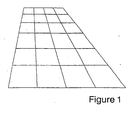
- US Patent 4 249 207 relates to a surveillance system in which an image received by a television camera is divided electronically into an array of cells or 'tiles'.
- the tiles are dimensioned to allow for perspective, so that they each cover substantially the same area regardless of the particular part of the image to which they respectively correspond. This is illustrated in Figure 1 of the accompanying drawings.
- the system monitors each cell to determine whether a potentially significant event is occurring in each cell. If such an event is detected in one cell, neighbouring cells are checked and if an event is occurring in, say two, of these, it is taken as indicative of a track of a moving person or object of interest.
- Occurrence of a potentially significant event in a cell is determined according to changes in the average light intensity received from that cell.
- Each cell consists of an array of pixels. These are analysed line by line and the integrated incident light intensity for that cell is computed. Over time, a weighted comparison is continuously made between the average present intensity and the average intensity in a previous frame. If the result of this comparison exceeds a predetermined threshold, then that is taken as a potentially significant event occurring in that cell.
- the present invention in its various aspects has a significant advantage over that described in the aforementioned US patent in that it provides the ability to 'learn' the nature of a complex backround. This enables it to discriminate better for genuine events of interest in an otherwise crowded or busy scene.
- the detected light level is compared with a threshold and a 1 or 0 is set according to whether the intensity is below the threshold or not.
- These binary signals are then combined into groups, which form pointers into an array stored in a random access memory (RAM). Each time an array element is addressed by a pointer, its value is set to "on” otherwise it is left unchanged. This process is carried out over a number of "frames”.
- WISARD over successive frames, values in certain elements of the array become set. This is in effect a 'training period'. After sufficient frames have elapsed, the array is considered suitably primed and the system is put into run mode and pointers are generated in the same way. Then, if a pointer addresses an element which is set, this indicates that the intensities in pixels forming the pointer are similar to values which occurred in the training set. Pointers which address elements which are not set indicate that the situation is different from the training period. In this way WISARD detects when the scene changes.
- WISARD can only compare the present situation with what happened during its finite 'training' period and has no memory for events before or since. Also, transient events in the training period have as much effect as common events. As a result, WISARD cannot continuously improve its record of background, and so is limited in its ability to discriminate between significant events and the background.
- the present invention is capable of continuously improving its record of the background and so can provide better discrimination than WISARD.
- US-A-4774570 discloses a video signal processing system which detects a change of the video data in the video signal supplied by a source by comparing the source video signal with a variable reference signal derived from a predetermined number of sampled fields of the source video signal but which excludes the video data of those pixels whose video data fluctuates during the sampled frames.
- the invention provides a method of analyzing an electronic image signal, as defined in Claim 1, and a corresponding device as claimed in Claim 7.
- the device may comprise electronic means for effecting steps (a)-(c) in the aforementioned method.
- the present invention in general, mitigates the problems of the prior art referred to above and can extend the possibilities for scene monitoring to a wider variety of scenes.
- the invention is suited to monitoring scenes with a large amount of normal activity, for example to monitor busy street scenes to identify specific events. Examples of such events are:
- the invention requires only one cell, it is preferred that the image is represented as a plurality of cells, most preferably adjusted for perspective as hereinbefore described.
- At least one pair of pixels is so selected for each of a plurality of cells. It is also much preferred to select in the same way, a plurality of pixels for each cell of the image field.
- the same pixels can then be used in subsequent frames until the end of the operating session. In a subsequent session, the same pairs could be used again or different pairs selected for the remainder of that session.
- the pair or pairs of pixels could be chosen at the same relative positions in each although again, this is not necessary.
- a particularly advantageous means of doing this is to generate a set of pointers a 1 ,...,a m , each of n binary bits and sequentially setting these bits according to the respective binary values of the signals resulting from the comparisons of the pixel pairs.
- pairs 1,...,n of the pixel pairs are used to set the values of a 1 [1,...,n] then pairs (n+1),...,2n are used to set a 2 [1,...,n] and so on.
- a preferred method comprises:
- the device for analysing an image signal preferably comprises electronic means for effecting steps (a) - (c) of the method.
- n and m may be any convenient numbers and may be the same or different, but n x m will be equal to the number of characteristic values. Therefore, in this context n x m will be equal to half the number of pixels selected in each cell.
- these pointers are used to address a memory comprising an array of addresses comprising rows 1,...,m and columns 1,...,2 n .
- the latter address the memory as follows.
- Pointer a 1 addresses row 1.
- the pointer contains a binary number of value somewhere between 0 and 2 n .
- the pointer points to the column in row 1 having a column number corresponding to the value in a 1 .
- the value in that address is then incremented by 1 (at the outset, all addresses will be set to zero). This is done for all rows up to m. In the next frame, the whole process is repeated, updating the value by 1 in a particular address pointed to in each row.
- the method preferably comprises:-
- the set of pointers comprises pointers a 1 , ...., a m , each of n binary bits and the memory array has m rows and 2 n columns.
- a further advantageous feature is the way in which the values in the memory are used to discriminate between the background and unusual or unexpected occurrences.
- the maximum value at any address in the row is determined, the value currently pointed at also being known.
- the ratio of the sum of values in currently pointed to addresses, divided by the sum of the maxima is calculated. This ratio is compared with a time weighted average for the same ratio from previous frames. If this ratio is less than a chosen proportion of the time weighted average then it is taken as indicative of an unusual or unexpected event occuring in the relevant cell.
- the method preferably comprises:-
- the device may be implemented as hardware/firmware arranged to operate under the control of appropriate software or it may be realised in terms only of hardware/firmware configured from logic gates, flip-flops etc, arranged to carry out the required functions.
- a pixel defines a grey level at a point in an image. Typically up to 256 grey levels are represented in 8-bits.
- An image is an array of pixels, typically 512 x 512.
- a tile is a subset of an image made up of N pixels. N must be even.
- the pixels in a tile are denoted:
- the pixels are randomly ordered and divided into two halves:
- a 1 [ b 1 b 2 b 3 ... b n ]
- a 2 [ b n + 1 b n + 2 ... b 2 n ]
- ⁇ a m [ ... b M ⁇ 1 b M ]
- Memory is an m x 2 n array of data values holding information about the past history of the scene. This array is continually updated as the process proceeds.
- Image frames are processed at a chosen rate, which will be application specific.
- the time at which the current frame is processed is denoted by t, and the time at which the previous frame was processed is denoted t-1.
- Parameters f, UpperLimit and k are selected to determine time constants over which a history is required.
- Threshold is a parameter which determines the detection sensitivity of the technique.
- the purpose of the mechanisms is to compute, for each tile, an activity level indicating if the image is in a normal state.
- the Computer Processors in c), e) and f) may be a single processor, or these activities may be distributed across several processors.
- Running the process is preceded by defining tiles and pixel orders. The choice and size of tiles is application specific. When running, images are captured in the Frame Buffer at the frame rate of the camera. The Computer Processors then carry out the following actions relating to each frame analysed. The Computation is described below and is carried out for each tile and the relationship between the separate processes is represented in Figure 2 and the precise nature of the computer hardware is shown in Figure 3.
- the overall technique described above derives a single value (Activity t ) which indicates whether the current scene has changed from recent scenes.
- the time frame over which the change is being determined is specified by choice of the parameters f and k. For example; for a slowly varying background scene values of f and k close to 1 could be used. Smaller values would be necessary where the background scene changes rapidly.
- the technique is sensitive to real changes to the scene and discriminates between these and typical acceptable changes to the scene. This is because the memory array remembers the characteristics of a normal scene.
- a local change caused for example by a person moving in the scene, may affect only a small number of pixels.
- ten pixels are affected, then because of the way the pointers are generated, this change will typically affect ten pointers.
- a small local change will have a large affect on the Activity score.
- the result of the computations is to derive, for each image processed, an attribute Active, which can take the value true or false, for each tile.
- Active values can be input to a process which determines the nature of an event in the scene. Such a process can track events and compute shape and size attributes of objects in the scene. The reliability of the claimed procedure for identifying active tiles, as opposed to ambient light changes, makes it possible to perform Event Recognition successfully.
- the number of pixels in a tile is application specific.
- the size of a tile will depend upon the size of object to be identified in the scene. Also, because of perspective, the number of pixels in each tile will vary.
- M the number of pixel pairs in a tile, is also application specific and tile specific. In general not all pixels in a tile need be considered and pixels can generally be undersampled. However, given the definition in the present preferred embodiment, M should be no smaller than 8.
- n is generally selected as 8. Also, elements of Memory are typically 8-bit locations, and so UpperLimit would normally be chosen as 255.
- Each tile is processed separately, and generates m pointers into the Memory array.
- more sensitivity can be gained by repeating the pixel generation a number of times to define more pointers.
- three re-orderings of pixels are used, generating 3m pointers which implies a Memory array of 3m x 2 n elements.
- the rate at which images are processed is typically 25 frames per second. This could be less depending on the rate at which events occur in the scene.
- the mechanism incorporates flexibility so that the system can be implemented on a single computer or several computers depending on the frame rate required.
- the processing mechanisms previously defined show how each tile is assessed to see if it is Active.
- the determination of events in the scene can then be carried out by consideration of how the Activity values vary temporally and spatially.
- the determination of events can be carried out successfully using simple logic based on Activity values. This is because the claimed mechanisms reduce the false alarm rate, i.e. the rate at which tiles are indicated as Active when they are not.
- the active values can be used to Track objects passing through the scene.
- a tile has the additional attribute Track, which can take the value true or false, to indicate if an object is currently passing through that tile.
- the logic applied to each tile is indicated in the Flowchart presented in Figure 4.
- the tests are applied at time step t based on the Active value at time t and the Track values at time t-1.
- Tracks in an arbitrary direction are determined by defining local tiles to be:
- local tiles is defined accordingly. For example as indicated in Figure 5 to track movement from the top right to the bottom left of a scene, local tiles would be chosen to be:
- Tiles which have a Track value of true can be indicated on an image to show moving objects. Also, a combination of track direction can be used to detect objects which exhibit specific behaviour, e.g:
- the Active and Track values can be used to detect objects which move into the scene and then stop. This is achieved by counting for each tile, the consecutive frames for which the tile has a Track value of true. The event is identified when this count passes a prescribed threshold.
- This process can identify, for example, a vehicle parking in a busy street, or a person loitering in a busy walkway.
- WISARD Various aspects of the present invention may also be embodied in the known WISARD system hereinbefore described. It will now be explained how WISARD can be so adapted.
- the original WISARD system involves generation of pointers into a binary memory array for a fixed period, i. e. , a fixed number of frames.
- the scheme is unsuccessful because:
- a combination of the WISARD Pointer Generation together with the Memory Update and Image Assessment of the present invention can be more effective.
- the following description identifies these modifications in presenting a Pointer Generation scheme which can be very effective so long as the images processed have a large contrast (i.e. a wide range of light levels).
- the notation is essentially the same as used hereinbefore and has the same meanings.
- This method of pointer generation is sensitive to choice of threshold T 2 .
- an object which is a similar grey level to the background may have no effect on the pointers.
- a second set of 1 n-bit addresses are generated from this second set of bits b 1, b 2, ..., b N , which act as pointers into the second memory array.
- the Activity values derived from the two memory arrays are then averaged to give an accumulated Activity.
- the threshold must be chosen to accommodate to variation in light level across the image. An effective way is to adjust them so that, across the whole image (i.e. across all the tiles):
- T 1, T 2 and T 3 must be adjusted for every image which is processed.
Landscapes
- Engineering & Computer Science (AREA)
- Multimedia (AREA)
- Physics & Mathematics (AREA)
- General Physics & Mathematics (AREA)
- Library & Information Science (AREA)
- Computer Vision & Pattern Recognition (AREA)
- Theoretical Computer Science (AREA)
- Image Processing (AREA)
- Investigating Or Analysing Materials By Optical Means (AREA)
- Investigating Or Analysing Biological Materials (AREA)
- Vehicle Body Suspensions (AREA)
- Steroid Compounds (AREA)
- Image Analysis (AREA)
- Burglar Alarm Systems (AREA)
- Photoreceptors In Electrophotography (AREA)
- Optical Measuring Cells (AREA)
Claims (19)
- Verfahren zum Analysieren eines elektronischen Bildsignals, welches zu einem Bild gehört, welches gerade überwacht wird, umfassend:Verarbeiten des Bildsignals als eine Vielzahl von Zellen, die jeweils eine Vielzahl von Pixeln umfassen;Erzeugen, für jeden aufeinanderfolgenden Rahmen des Bild, welches gerade überwacht wird, von charakteristischen Werten durch zufälliges und pseudo-zufälliges Wählen von wenigstens einem Paar von Pixeln in jeder einer Vielzahl von Zellen innerhalb eines Rahmens, und, für jedes Paar, Einrichten eines binären Signals in Abhängigkeit davon, ob die Intensität von Licht, welches auf ein vorbestimmtes Pixel des Paars von Pixeln einfällt, größer als die Intensität von Licht, welches auf das Andere einfällt, ist oder nicht, wobei die binären Signale verwendet werden, um Zeiger zum Adressieren eines Speichers, der eine Zeitgeschichte des Bilds enthält, zu erzeugen.
- Verfahren nach Anspruch 1, wobei eine Vielzahl von Pixeln für jede Zelle eines Bildfelds gewählt werden.
- Verfahren nach Anspruch 1, wobei die gleichen Pixel in jedem Rahmen verwendet werden bis zu einem Ende einer nachfolgenden Betriebssession.
- Verfahren nach Anspruch 1, wobei ein Satz von Zeigern a1,...,am erzeugt wird, jeder aus n binären Bits, und die Bits sequentiell in Übereinstimmung mit jeweiligen binären Werten der Signale, die sich aus Vergleichen der Pixelpaare ergeben, gesetzt werden.
- Verfahren nach Anspruch 1, ferner umfassend:für aufeinanderfolgende Bildrahmen, Akkumulieren der charakteristischen Werte, so dass in einem Einzelbetriebsmodus eine Zeitgeschichte des Bilds, die in dem Speicher gespeichert wird, wobei jede Zelle ihr eigenes Speicherfeld aufweist, während einer Überwachung des Bilds aktualisiert wird und eine Anzeige erzeugt wird, die das Auftreten oder Nicht- Auftreten eines Ereignisses anzeigt, das nicht zu einem Bildhintergrund gehört.
- Verfahren nach Anspruch 1, wobei das Bild als eine Vielzahl von Zellen dargestellt wird, wobei die Vielzahl von Zellen für eine Perspektive eingestellt sind.
- Verfahren nach Anspruch 1, ferner umfassend:Erzeugen eines Satzes von Zeigern a1,..., am durch zufälliges oder pseudo-zufälliges Wählen von Paaren von Pixeln innerhalb einer Zelle und, für jedes Paar, Vergleichen einer Lichtintensität eines Pixels mit einer Lichtintensität des anderen Pixels, jeder Zeiger mit n Bits und sequentielles Setzen von diesen Bits in Übereinstimmung mit den charakteristischen Werten während einer Überwachung des Bilds.
- Verfahren nach Anspruch 7, wobei die Zeiger verwendet werden, um ein Speicherfeld mit m Zeilen und 2n Spalten zu adressieren, wobei jeder Zeiger einer Zeile des Speicherfelds entspricht und der Inhalt von jedem Zeiger auf ein Speicherelement in der entsprechenden Zeile zeigt.
- Verfahren nach Anspruch 8, ferner umfassend:für jeden aufeinanderfolgenden Rahmen des Bilds, welches gerade überwacht wird, Aktualisieren eines Werts, der zu einer vorgegebenen Adresse gehört, die durch einen Inhalt jedes Zeigers in jeder Zeile des Speicherfelds identifiziert wird; undüber alle Zeilen, Aktualisieren des Werts, der zu der vorgegebenen Adresse gehört, auf die durch den Inhalt jedes Zeigers gezeigt wird;Aufsummieren der aktualisierten Werte für jede Zeile;Wählen eines maximalen Werts in jeder Zeile;Aufsummieren des maximalen Werts für alle Zeilen;Unterziehen des Verhältnisses der zwei Summen einer zeitgewichteten Mittelung in Bezug auf die Verhältnisses, die von vorangehenden Rahmen erhalten werden;Vergleichen des Verhältnisses mit der zeitgewichteten Mittelung und Verwenden des Ergebnisses, um das Auftreten oder Nicht-Auftreten eines signifikanten Ereignisses innerhalb des Bilds zu bestimmen.
- Einrichtung zum Analysieren eines elektronischen Bildsignals, welches zu einem Bild gehört, welches gerade überwacht wird, wobei die Einrichtung umfasst:eine Einrichtung zum Verarbeiten des Bildsignals als eine Vielzahl von Zellen, die jeweils eine Vielzahl von Pixeln umfassen;eine Einrichtung zum Erzeugen von charakteristischen Werten, für jeden aufeinanderfolgenden Rahmen des Bild, welches gerade überwacht wird, durch zufälliges und pseudo-zufälliges Wählen von wenigstens einem Paar von Pixeln in jeder einer Vielzahl von Zellen innerhalb eines Rahmens, und, für jedes Paar, Einrichten eines binären Signals in Abhängigkeit davon, ob die Intensität von Licht, welches auf ein vorbestimmtes Pixel des Paars von Pixeln einfällt, größer als die Intensität von Licht, welches auf das Andere einfällt, ist oder nicht, wobei die Einrichtung zum Erzeugen von charakteristischen Werten dafür ausgelegt ist die binären Signale zu verwenden, um Zeiger zum Adressieren eines Speichers, der eine Zeitgeschichte des Bilds enthält, zu erzeugen.
- Einrichtung nach Anspruch 10, wobei die Einrichtung zum Erzeugen von charakteristischen Werten ausgelegt ist, um eine Vielzahl von Pixeln für jede Zelle eines Bildfelds zu wählen.
- Einrichtung nach Anspruch 10, wobei die Einrichtung zum Erzeugen von charakteristischen Werten ausgelegt ist, um die gleichen Pixel in jedem Rahmen bis zu einem Ende einer nachfolgenden Betriebssession zu verwenden.
- Einrichtung nach Anspruch 10, wobei die elektrische Einrichtung zum Erzeugen von charakteristischen Werten ausgelegt ist, um einen Satz von Zeigern a1,..., am zu erzeugen, jeder aus n binären Bits, und die Bits sequentiell in Übereinstimmung mit jeweiligen binären Werten der Signale, die sich aus Vergleichen der Pixelpaare ergeben, zu setzen.
- Einrichtung nach Anspruch 10, wobei die Einrichtung zum Erzeugen von charakteristischen Werten eine Bildrahmen-Ergreifungseinheit, einen Speicher, und einen oder mehrere Computerprozessoren umfasst.
- Einrichtung nach Anspruch 10, ferner umfassend:eine Einrichtung zum Akkumulieren der charakteristischen Werte, für aufeinanderfolgende Bildrahmen, so dass in einem Einzelbetriebsmodus eine Zeitgeschichte des Bilds, die in dem Speicher gespeichert wird, wobei jede Zelle ihr eigenes Speicherfeld aufweist, während einer Überwachung des Bilds aktualisiert wird und eine Anzeige erzeugt wird, die das Auftreten oder Nicht- Auftreten eines Ereignisses anzeigt, das nicht zu einem Bildhintergrund gehört.
- Einrichtung nach Anspruch 10, wobei das Bild als eine Vielzahl von Zellen dargestellt wird, wobei die Vielzahl von Zellen für eine Perspektive eingestellt sind.
- Einrichtung nach Anspruch 10, ferner umfassend:eine Einrichtung zum Erzeugen eines Satzes von Zeigern a1,..., am durch zufälliges oder pseudo-zufälliges Wählen von Paaren von Pixeln innerhalb einer Zelle und, für jedes Paar, Vergleichen einer Lichtintensität eines Pixels mit einer Lichtintensität des anderen Pixels, jeder Zeiger mit n Bits und sequentielles Setzen von diesen Bits in Übereinstimmung mit den charakteristischen Werten während einer Überwachung des Bilds.
- Einrichtung nach Anspruch 17, wobei die Zeiger verwendet werden, um ein Speicherfeld mit m Zeilen und 2n Spalten zu adressieren, wobei jeder Zeiger einer Zeile des Speicherfelds entspricht und der Inhalt von jedem Zeiger auf ein Speicherelement in der entsprechenden Zeile zeigt.
- Einrichtung nach Anspruch 18, ferner umfassend:eine Einrichtung zum Aktualisieren, für jeden aufeinanderfolgenden Rahmen des Bilds, welches gerade überwacht wird, eines Werts, der zu einer vorgegebenen Adresse gehört, die durch einen Inhalt jedes Zeigers in jeder Zeile des Speicherfelds identifiziert wird; undeine Einrichtung zum Aktualisieren des Werts, über alle Zeilen, der zu der vorgegebenen Adresse gehört, auf die durch den Inhalt jedes Zeigers gezeigt wird;eine Einrichtung zum Aufsummieren der aktualisierten Werte für jede Zeile;eine Einrichtung zum Wählen eines maximalen Werts in jeder Zeile;eine Einrichtung zum Aufsummieren des maximalen Werts für alle Zeilen;eine Einrichtung zum Unterziehen des Verhältnisses der zwei Summen einer zeitgewichteten Mittelung in Bezug auf die Verhältnisses, die von vorangehenden Rahmen erhalten werden;eine Einrichtung zum Vergleichen des Verhältnisses mit der zeitgewichteten Mittelung und Verwenden des Ergebnisses, um das Auftreten oder Nicht-Auftreten eines signifikanten Ereignisses innerhalb des Bilds zu bestimmen.
Priority Applications (1)
| Application Number | Priority Date | Filing Date | Title |
|---|---|---|---|
| EP04030628A EP1522982A1 (de) | 1991-09-12 | 1992-09-11 | Bildanalysator |
Applications Claiming Priority (3)
| Application Number | Priority Date | Filing Date | Title |
|---|---|---|---|
| GB9119588 | 1991-09-12 | ||
| GB9119588 | 1991-09-12 | ||
| EP92919450A EP0603276B1 (de) | 1991-09-12 | 1992-09-11 | Bildanalysator |
Related Parent Applications (1)
| Application Number | Title | Priority Date | Filing Date |
|---|---|---|---|
| EP92919450A Division EP0603276B1 (de) | 1991-09-12 | 1992-09-11 | Bildanalysator |
Related Child Applications (1)
| Application Number | Title | Priority Date | Filing Date |
|---|---|---|---|
| EP04030628A Division EP1522982A1 (de) | 1991-09-12 | 1992-09-11 | Bildanalysator |
Publications (3)
| Publication Number | Publication Date |
|---|---|
| EP0924671A2 EP0924671A2 (de) | 1999-06-23 |
| EP0924671A3 EP0924671A3 (de) | 2001-10-10 |
| EP0924671B1 true EP0924671B1 (de) | 2006-07-05 |
Family
ID=10701366
Family Applications (3)
| Application Number | Title | Priority Date | Filing Date |
|---|---|---|---|
| EP92919450A Expired - Lifetime EP0603276B1 (de) | 1991-09-12 | 1992-09-11 | Bildanalysator |
| EP99102604A Expired - Lifetime EP0924671B1 (de) | 1991-09-12 | 1992-09-11 | Bildanalysator |
| EP04030628A Withdrawn EP1522982A1 (de) | 1991-09-12 | 1992-09-11 | Bildanalysator |
Family Applications Before (1)
| Application Number | Title | Priority Date | Filing Date |
|---|---|---|---|
| EP92919450A Expired - Lifetime EP0603276B1 (de) | 1991-09-12 | 1992-09-11 | Bildanalysator |
Family Applications After (1)
| Application Number | Title | Priority Date | Filing Date |
|---|---|---|---|
| EP04030628A Withdrawn EP1522982A1 (de) | 1991-09-12 | 1992-09-11 | Bildanalysator |
Country Status (8)
| Country | Link |
|---|---|
| EP (3) | EP0603276B1 (de) |
| JP (1) | JP3268646B2 (de) |
| AT (2) | ATE183595T1 (de) |
| AU (1) | AU662560B2 (de) |
| CA (1) | CA2118687C (de) |
| DE (2) | DE69233637T2 (de) |
| ES (1) | ES2267208T3 (de) |
| WO (1) | WO1993005488A1 (de) |
Families Citing this family (8)
| Publication number | Priority date | Publication date | Assignee | Title |
|---|---|---|---|---|
| US6028626A (en) | 1995-01-03 | 2000-02-22 | Arc Incorporated | Abnormality detection and surveillance system |
| US5666157A (en) | 1995-01-03 | 1997-09-09 | Arc Incorporated | Abnormality detection and surveillance system |
| US6061471A (en) * | 1996-06-07 | 2000-05-09 | Electronic Data Systems Corporation | Method and system for detecting uniform images in video signal |
| US5734735A (en) * | 1996-06-07 | 1998-03-31 | Electronic Data Systems Corporation | Method and system for detecting the type of production media used to produce a video signal |
| US20030123703A1 (en) * | 2001-06-29 | 2003-07-03 | Honeywell International Inc. | Method for monitoring a moving object and system regarding same |
| AT500925A1 (de) * | 2003-03-05 | 2006-04-15 | Walter Dipl Ing Lorenz | Verfahren und einrichtung zur überwachung des einstiegsbereiches von fahrzeugen |
| WO2008046662A1 (en) * | 2006-10-16 | 2008-04-24 | Schuette Joerg | Video image guideway intrusion detection system |
| ATE458231T1 (de) | 2007-07-08 | 2010-03-15 | Univ Liege | Extraktor für visuellen hintergrund |
Family Cites Families (3)
| Publication number | Priority date | Publication date | Assignee | Title |
|---|---|---|---|---|
| CA1116286A (en) * | 1979-02-20 | 1982-01-12 | Control Data Canada, Ltd. | Perimeter surveillance system |
| US4774570A (en) * | 1986-09-20 | 1988-09-27 | Sony Corporation | System for processing video signal for detecting changes in video data and security monitoring system utilizing the same |
| GB2218507B (en) * | 1989-05-15 | 1992-02-26 | Plessey Co Plc | Digital data processing |
-
1992
- 1992-09-11 DE DE69233637T patent/DE69233637T2/de not_active Expired - Lifetime
- 1992-09-11 AT AT92919450T patent/ATE183595T1/de active
- 1992-09-11 EP EP92919450A patent/EP0603276B1/de not_active Expired - Lifetime
- 1992-09-11 AU AU25592/92A patent/AU662560B2/en not_active Ceased
- 1992-09-11 EP EP99102604A patent/EP0924671B1/de not_active Expired - Lifetime
- 1992-09-11 EP EP04030628A patent/EP1522982A1/de not_active Withdrawn
- 1992-09-11 ES ES99102604T patent/ES2267208T3/es not_active Expired - Lifetime
- 1992-09-11 WO PCT/GB1992/001669 patent/WO1993005488A1/en not_active Ceased
- 1992-09-11 JP JP50508093A patent/JP3268646B2/ja not_active Expired - Fee Related
- 1992-09-11 DE DE69229831T patent/DE69229831T2/de not_active Expired - Lifetime
- 1992-09-11 CA CA002118687A patent/CA2118687C/en not_active Expired - Fee Related
- 1992-09-11 AT AT99102604T patent/ATE332550T1/de not_active IP Right Cessation
Also Published As
| Publication number | Publication date |
|---|---|
| EP1522982A1 (de) | 2005-04-13 |
| EP0924671A3 (de) | 2001-10-10 |
| ES2267208T3 (es) | 2007-03-01 |
| DE69233637T2 (de) | 2007-06-28 |
| EP0603276A1 (de) | 1994-06-29 |
| DE69229831T2 (de) | 2001-04-12 |
| EP0924671A2 (de) | 1999-06-23 |
| ATE332550T1 (de) | 2006-07-15 |
| AU662560B2 (en) | 1995-09-07 |
| JP3268646B2 (ja) | 2002-03-25 |
| EP0603276B1 (de) | 1999-08-18 |
| CA2118687C (en) | 2003-11-18 |
| DE69233637D1 (de) | 2006-08-17 |
| ATE183595T1 (de) | 1999-09-15 |
| DE69229831D1 (de) | 1999-09-23 |
| JPH07509329A (ja) | 1995-10-12 |
| CA2118687A1 (en) | 1993-03-18 |
| WO1993005488A1 (en) | 1993-03-18 |
| AU2559292A (en) | 1993-04-05 |
Similar Documents
| Publication | Publication Date | Title |
|---|---|---|
| US5999634A (en) | Device and method for analyzing an electronic image signal | |
| US7460691B2 (en) | Image processing techniques for a video based traffic monitoring system and methods therefor | |
| US7391907B1 (en) | Spurious object detection in a video surveillance system | |
| US20040085449A1 (en) | Directional motion estimator | |
| WO2020008667A1 (en) | System and method for video anomaly detection | |
| CN101299275A (zh) | 一种目标检测方法、装置及一种监控系统 | |
| US7982774B2 (en) | Image processing apparatus and image processing method | |
| EP0603276B1 (de) | Bildanalysator | |
| Vijayan et al. | A fully residual convolutional neural network for background subtraction | |
| CN110674887A (zh) | 一种基于视频分类的端到端道路拥堵检测算法 | |
| GB2282294A (en) | Method of detecting moving objects | |
| CN115909144A (zh) | 一种基于对抗学习的监控视频异常检测方法及系统 | |
| AU726071B2 (en) | Image analyser | |
| KR102238610B1 (ko) | 딥러닝 객체 검출기의 추론 정보를 이용한 정지객체 검출 방법 | |
| CN119785162A (zh) | 一种基于多模型融合提升事件检测正确率的方法 | |
| Becina et al. | Abnormal Behavior Detection using Object Detection and Tracking | |
| KR20030018487A (ko) | 영상을 이용한 출입 이동 물체 계수 방법 및 장치 | |
| CN119316556A (zh) | 一种智能监控方法、设备和存储介质 | |
| JPH0721488A (ja) | 交通流異常監視支援装置 | |
| CN115035543B (zh) | 一种基于大数据的移动轨迹预测系统 | |
| CN118887616A (zh) | 图像中违章行为确定方法、装置及电子设备 | |
| JP2007018324A (ja) | 画像処理による侵入物体検出装置および方法およびプログラム | |
| CN113435352A (zh) | 文明城市评分方法、装置、电子设备和存储介质 | |
| CN120198742B (zh) | 基于红外感应与ai识别的野生动物通道监测方法 | |
| WO2005109893A2 (en) | System and method for detecting anomalies in a video image sequence |
Legal Events
| Date | Code | Title | Description |
|---|---|---|---|
| PUAI | Public reference made under article 153(3) epc to a published international application that has entered the european phase |
Free format text: ORIGINAL CODE: 0009012 |
|
| 17P | Request for examination filed |
Effective date: 19990311 |
|
| AC | Divisional application: reference to earlier application |
Ref document number: 603276 Country of ref document: EP |
|
| AK | Designated contracting states |
Kind code of ref document: A2 Designated state(s): AT BE DE ES FR GB IE IT |
|
| PUAL | Search report despatched |
Free format text: ORIGINAL CODE: 0009013 |
|
| AK | Designated contracting states |
Kind code of ref document: A3 Designated state(s): AT BE DE ES FR GB IE IT |
|
| 17Q | First examination report despatched |
Effective date: 20021114 |
|
| GRAP | Despatch of communication of intention to grant a patent |
Free format text: ORIGINAL CODE: EPIDOSNIGR1 |
|
| GRAS | Grant fee paid |
Free format text: ORIGINAL CODE: EPIDOSNIGR3 |
|
| GRAA | (expected) grant |
Free format text: ORIGINAL CODE: 0009210 |
|
| AC | Divisional application: reference to earlier application |
Ref document number: 0603276 Country of ref document: EP Kind code of ref document: P |
|
| AK | Designated contracting states |
Kind code of ref document: B1 Designated state(s): AT BE DE ES FR GB IE IT |
|
| PG25 | Lapsed in a contracting state [announced via postgrant information from national office to epo] |
Ref country code: BE Free format text: LAPSE BECAUSE OF FAILURE TO SUBMIT A TRANSLATION OF THE DESCRIPTION OR TO PAY THE FEE WITHIN THE PRESCRIBED TIME-LIMIT Effective date: 20060705 Ref country code: AT Free format text: LAPSE BECAUSE OF FAILURE TO SUBMIT A TRANSLATION OF THE DESCRIPTION OR TO PAY THE FEE WITHIN THE PRESCRIBED TIME-LIMIT Effective date: 20060705 |
|
| REG | Reference to a national code |
Ref country code: GB Ref legal event code: FG4D |
|
| REG | Reference to a national code |
Ref country code: IE Ref legal event code: FG4D |
|
| REF | Corresponds to: |
Ref document number: 69233637 Country of ref document: DE Date of ref document: 20060817 Kind code of ref document: P |
|
| REG | Reference to a national code |
Ref country code: ES Ref legal event code: FG2A Ref document number: 2267208 Country of ref document: ES Kind code of ref document: T3 |
|
| PLBE | No opposition filed within time limit |
Free format text: ORIGINAL CODE: 0009261 |
|
| STAA | Information on the status of an ep patent application or granted ep patent |
Free format text: STATUS: NO OPPOSITION FILED WITHIN TIME LIMIT |
|
| 26N | No opposition filed |
Effective date: 20070410 |
|
| PGFP | Annual fee paid to national office [announced via postgrant information from national office to epo] |
Ref country code: IE Payment date: 20090925 Year of fee payment: 18 Ref country code: ES Payment date: 20090928 Year of fee payment: 18 |
|
| PGFP | Annual fee paid to national office [announced via postgrant information from national office to epo] |
Ref country code: GB Payment date: 20090929 Year of fee payment: 18 |
|
| REG | Reference to a national code |
Ref country code: FR Ref legal event code: TP Ref country code: FR Ref legal event code: CD |
|
| PGFP | Annual fee paid to national office [announced via postgrant information from national office to epo] |
Ref country code: DE Payment date: 20090929 Year of fee payment: 18 |
|
| PGFP | Annual fee paid to national office [announced via postgrant information from national office to epo] |
Ref country code: IT Payment date: 20090929 Year of fee payment: 18 |
|
| REG | Reference to a national code |
Ref country code: GB Ref legal event code: 732E Free format text: REGISTERED BETWEEN 20100408 AND 20100414 |
|
| GBPC | Gb: european patent ceased through non-payment of renewal fee |
Effective date: 20100911 |
|
| PG25 | Lapsed in a contracting state [announced via postgrant information from national office to epo] |
Ref country code: IT Free format text: LAPSE BECAUSE OF NON-PAYMENT OF DUE FEES Effective date: 20100911 |
|
| REG | Reference to a national code |
Ref country code: FR Ref legal event code: ST Effective date: 20110531 |
|
| REG | Reference to a national code |
Ref country code: DE Ref legal event code: R119 Ref document number: 69233637 Country of ref document: DE Effective date: 20110401 |
|
| PG25 | Lapsed in a contracting state [announced via postgrant information from national office to epo] |
Ref country code: FR Free format text: LAPSE BECAUSE OF NON-PAYMENT OF DUE FEES Effective date: 20100930 Ref country code: IE Free format text: LAPSE BECAUSE OF NON-PAYMENT OF DUE FEES Effective date: 20100913 Ref country code: DE Free format text: LAPSE BECAUSE OF NON-PAYMENT OF DUE FEES Effective date: 20110401 |
|
| PG25 | Lapsed in a contracting state [announced via postgrant information from national office to epo] |
Ref country code: GB Free format text: LAPSE BECAUSE OF NON-PAYMENT OF DUE FEES Effective date: 20100911 |
|
| PGFP | Annual fee paid to national office [announced via postgrant information from national office to epo] |
Ref country code: FR Payment date: 20091006 Year of fee payment: 18 |
|
| REG | Reference to a national code |
Ref country code: ES Ref legal event code: FD2A Effective date: 20111019 |
|
| PG25 | Lapsed in a contracting state [announced via postgrant information from national office to epo] |
Ref country code: ES Free format text: LAPSE BECAUSE OF NON-PAYMENT OF DUE FEES Effective date: 20100912 |