EP0924766A2 - Réseau de cellules de mémoire, procédé de fabrication et procédé d'utilisation - Google Patents
Réseau de cellules de mémoire, procédé de fabrication et procédé d'utilisation Download PDFInfo
- Publication number
- EP0924766A2 EP0924766A2 EP98120336A EP98120336A EP0924766A2 EP 0924766 A2 EP0924766 A2 EP 0924766A2 EP 98120336 A EP98120336 A EP 98120336A EP 98120336 A EP98120336 A EP 98120336A EP 0924766 A2 EP0924766 A2 EP 0924766A2
- Authority
- EP
- European Patent Office
- Prior art keywords
- word line
- trenches
- selection transistor
- memory cell
- memory cells
- Prior art date
- Legal status (The legal status is an assumption and is not a legal conclusion. Google has not performed a legal analysis and makes no representation as to the accuracy of the status listed.)
- Granted
Links
Images






Classifications
-
- H—ELECTRICITY
- H10—SEMICONDUCTOR DEVICES; ELECTRIC SOLID-STATE DEVICES NOT OTHERWISE PROVIDED FOR
- H10B—ELECTRONIC MEMORY DEVICES
- H10B12/00—Dynamic random access memory [DRAM] devices
-
- H—ELECTRICITY
- H10—SEMICONDUCTOR DEVICES; ELECTRIC SOLID-STATE DEVICES NOT OTHERWISE PROVIDED FOR
- H10B—ELECTRONIC MEMORY DEVICES
- H10B53/00—Ferroelectric RAM [FeRAM] devices comprising ferroelectric memory capacitors
- H10B53/30—Ferroelectric RAM [FeRAM] devices comprising ferroelectric memory capacitors characterised by the memory core region
-
- H—ELECTRICITY
- H10—SEMICONDUCTOR DEVICES; ELECTRIC SOLID-STATE DEVICES NOT OTHERWISE PROVIDED FOR
- H10B—ELECTRONIC MEMORY DEVICES
- H10B12/00—Dynamic random access memory [DRAM] devices
- H10B12/01—Manufacture or treatment
- H10B12/02—Manufacture or treatment for one transistor one-capacitor [1T-1C] memory cells
- H10B12/05—Making the transistor
- H10B12/053—Making the transistor the transistor being at least partially in a trench in the substrate
-
- H—ELECTRICITY
- H10—SEMICONDUCTOR DEVICES; ELECTRIC SOLID-STATE DEVICES NOT OTHERWISE PROVIDED FOR
- H10B—ELECTRONIC MEMORY DEVICES
- H10B12/00—Dynamic random access memory [DRAM] devices
- H10B12/30—DRAM devices comprising one-transistor - one-capacitor [1T-1C] memory cells
- H10B12/34—DRAM devices comprising one-transistor - one-capacitor [1T-1C] memory cells the transistor being at least partially in a trench in the substrate
-
- H—ELECTRICITY
- H10—SEMICONDUCTOR DEVICES; ELECTRIC SOLID-STATE DEVICES NOT OTHERWISE PROVIDED FOR
- H10B—ELECTRONIC MEMORY DEVICES
- H10B53/00—Ferroelectric RAM [FeRAM] devices comprising ferroelectric memory capacitors
-
- H—ELECTRICITY
- H10—SEMICONDUCTOR DEVICES; ELECTRIC SOLID-STATE DEVICES NOT OTHERWISE PROVIDED FOR
- H10B—ELECTRONIC MEMORY DEVICES
- H10B69/00—Erasable-and-programmable ROM [EPROM] devices not provided for in groups H10B41/00 - H10B63/00, e.g. ultraviolet erasable-and-programmable ROM [UVEPROM] devices
Definitions
- Memory cell arrangements in particular DRAM arrangements, ROM arrangements, EPROM arrangements and EEPROM arrangements, have a large number of memory cells, most of them matrix-shaped are arranged.
- the individual memory cells are each can be controlled via a bit line and a word line.
- the memory cells each have a memory element where information is stored.
- the storage The information takes place, for example, via a storage capacity stored charge, via a floating on a Gate stored charge, or through properties of a Transistor, for example the threshold voltage, or over the presence or absence of a manager Connection to the bit line.
- the individual memory cells are used to read out the information sequentially over the associated word line and bit line controlled and the information by voltage or Current evaluation read out (see for example Y. Nakagome et al, IEEE Journal of Solid-State Circuits, Vol. 26, No. 4, 1991, pages 465 to 470).
- the current rating is regarding to prefer reading speed to voltage evaluation, however, it requires increased circuitry.
- For Accelerating the reading process is often several to Example 256 memory cells combined into a cell block. The individual cell blocks are then read out in parallel. The reading process takes place in the individual cell block however, still sequential.
- Example DRAM devices or EEPROM devices becomes Writing information into the respective memory cell also via the associated bit line and the word line controlled.
- the bit line is at a voltage level applied to the information to be registered corresponds.
- the information is written in sequentially in all memory cells.
- the bit line each time from one state of tension to another state of tension be reloaded. This is electrical with a consumption Performance related, especially when deployed the memory cell arrangement in mobile devices such as Mobile phones, notebook computers, database computers or PDA (Personal Digital Assistant) is perceived as disturbing.
- PDA Personal Digital Assistant
- a DRAM cell arrangement is known from DE 19 519 160 C1, which can be produced with a memory cell area of 4F 2 , where F is the minimum structure size that can be produced in the respective technology.
- a vertical MOS transistor is provided per memory cell, the first source / drain region of which is connected to a storage node of a storage capacitor, the channel region of which is surrounded by a gate electrode and the second source / drain region of which is connected to a buried bit line .
- the gate electrodes of vertical MOS transistors adjacent along a word line adjoin one another and together form the word line.
- the invention is based on the problem of a memory cell arrangement specify which can be controlled in an improved manner is.
- the memory cell arrangement should have a Storage density can be produced, as in the Giga-Bit generations is required.
- a manufacturing process is also intended and an operating method for such a memory cell arrangement can be specified.
- the memory cells each have at least one one with respect to a main surface of the semiconductor substrate vertical selection transistor on that with a memory element connected is.
- the selection transistor is preferably connected between a bit line and the memory element.
- the bit lines can also be connected differently.
- the memory cells are each via a first word line and a second word line can be driven, the first Cross the word line and the second word line.
- the control a memory cell takes place only via the first word line and the second word line. This allows bit lines can be read out in parallel.
- the memory cells are likewise each driven via the first word line and the second word line.
- the bit line is only used to apply the voltage level corresponding to the information and not for control. Therefore, in order to write information corresponding to a predetermined voltage level, all of the bit lines can be supplied with the predetermined voltage level.
- the memory cells in which the associated information is to be stored are controlled via the first word lines and the second word lines. This is written into all corresponding memory cells in one cycle. Two processes are therefore sufficient for writing in digital information: first, writing one in parallel One "and second parallel registration of one Zero ". This speeds up the writing process considerably in comparison with the prior art.
- the bit line only has to be reloaded as often as the number of different items of information. In the case of digital information, the bit line only has to be reloaded twice the power consumption is reduced.
- this is also used for refreshing the information (refresh) exploited.
- the stored information via a shift register read out.
- the data word stored in the shift register is subsequently used to control the first word lines and of the second word lines, the bit line being on the respective voltage level is set.
- Bit line Due to the essential compared to the prior art lower number of required reloading operations Bit line is the power consumption when registered as well significantly reduced when refreshing information.
- a monocrystalline is used as the semiconductor substrate Silicon wafer or the monocrystalline silicon layer one Suitable SOI substrate.
- the memory cell arrangement is designed as a DRAM arrangement.
- the memory element is preferably configured as a storage capacitance, which can be implemented both in the semiconductor substrate, in particular as a trench capacitor, and on the main surface of the semiconductor substrate or above the main surface of the semiconductor substrate, in particular as a stacked capacitor.
- the usual storage dielectrics are suitable as the capacitor dielectric, in particular silicon oxide, combinations of silicon oxide and silicon nitride or high-epsilon dielectrics such as, for example, BST (barium strontium titanate), Ta 2 O 5 or SBT (strontium bismuth tantalate).
- the Memory cells each cell block are with a common bit line connected. This has the advantage that the bit line resistance is reduced. It also results from this new freedom for the design of the sense amplifier.
- the memory cells each a first selection transistor and a second selection transistor have that in series between the bit line and the storage element are switched.
- the first selection transistor from the first word line and the second selection transistor can be driven by the second word line.
- neighboring memory cells each have a common one first selection transistor and a common first word line exhibit.
- the neighboring memory cells have different ones second selection transistors and different second word lines. They are then shared over each first word line and the different second Word lines can be controlled.
- two are adjacent Memory cells with a common first selection transistor and different second selection transistors in one Semiconductor column arranged.
- the semiconductor column borders on the Main surface of the semiconductor substrate and has flanks, that cross the main surface of the semiconductor substrate. she will in particular by essentially parallel first ones Trenches and essentially parallel second trenches, that cross each other, defined.
- the common first selection transistor is designed as a vertical MOS transistor, whose gate electrode on at least one edge of the semiconductor column is arranged. In the area of the main area are the second selection transistors of the two adjacent memory cells arranged as planar MOS transistors.
- the gate electrodes the second selection transistors are located above the main surface of the semiconductor column. They are part of it of the different second word lines.
- the Is the gate electrode of the common first selection transistor Part of the first word line.
- the neighboring memory cells are arranged in a semiconductor column.
- first gate electrode of the common first selection transistor it is advantageous to be ring-shaped so that it surrounds the semiconductor column.
- the semiconductor columns are from along one of the first Word lines arranged adjacent pairs of memory cells so that their distance is less than the thickness of the first Gate electrodes parallel to the main surface, so limit the first Gate electrodes of adjacent semiconductor columns together and thus form the first word line.
- Cross to The first word line is the distance between adjacent semiconductor columns greater than twice the thickness of the first gate electrodes parallel to the main surface.
- the first word line can be in this case through self-adjusting process steps, the means making without using masks to be adjusted.
- the first selection transistor and along the second selection transistor to arrange at least one flank of a semiconductor column, the adjacent to the main surface of the semiconductor substrate and the the main surface has intersecting flanks.
- the first selection transistor and the second selection transistor are included arranged one above the other.
- a first gate electrode of the first Selection transistor and a second gate electrode of the second Selection transistors border on the respective edge of the Semiconductor column.
- the first gate electrode and the second gate electrode die Semiconductor column surrounds each ring.
- this configuration is produced in that in the main area of the semiconductor substrate first trenches and second trenches be etched.
- the first trenches run one below the other essentially parallel.
- the second trenches run also essentially parallel to each other.
- the first Trenches and the second trenches cross each other.
- Two neighboring ones first trenches and second trenches define one of the semiconductor columns.
- the cross section of the semiconductor columns enlarged at least one auxiliary structure so that the distance adjacent semiconductor columns in the direction of the first word lines less than in the direction of the second word lines is.
- each semiconductor column has a memory cell.
- the memory cells each have only one selection transistor which can be controlled via the first word line and the second word line.
- the selection transistor is implemented in particular as a MOS transistor, which has two gate electrodes between the source and drain region, which are part of the first word line and part of the second word line. This takes advantage of the fact that the stray field of the first word line and the stray field of the second word line overlap, so that a continuous conductive channel can be switched on by actuation via the first word line and the second word line.
- the selection transistor is advantageous to arrange the selection transistor on the flanks of a semiconductor column, which is delimited by adjacent first trenches and second trenches that intersect, and to arrange the first word line and the second word line on flanks of the semiconductor column one above the other . If the width and the mutual spacing of the first trenches and the second trenches each have a minimally producible structure size F, the memory cell arrangement can be realized with an area requirement of 4F 2 per memory cell.
- the semiconductor columns can both by etching the trenches in a semiconductor substrate as well as by selective epitaxy inside openings of a lattice-shaped insulation structure be formed.
- the grid-like insulation structure defines in the second case, the course of the trenches.
- each memory cell has the first and second word lines is controllable, the memory cell arrangement by appropriate control of the first and second word lines operate in the sense of a folded bitline architecture.
- a semiconductor substrate which has monocrystalline silicon at least in the region of a main surface 11 comprises a p-doped substrate body 12, an n + -doped silicon layer 13 arranged thereon, a first p-doped layer 14 arranged thereon and a second p-doped silicon layer arranged thereon 15 (see Figure 1).
- the p-doped substrate body 12 has a dopant concentration of 10 16 cm -3 .
- the n + -doped silicon layer 13 is produced by epitaxial growth in a thickness of 500 nm. It has a dopant concentration of 10 20 cm -3 .
- the first p-doped silicon layer 14 and the second p-doped silicon layer 15 have grown epitaxially and together have a thickness of 500 nm.
- the first p-doped silicon layer 14 has a thickness of 200 nm and a dopant concentration of 10 17 cm -3 .
- the second p-doped silicon layer 15 has a thickness of 300 nm and a dopant concentration of 10 16 cm -3 .
- a first trench mask 16 is then formed on the main surface 11 by depositing and structuring an SiO 2 layer.
- the SiO 2 layer is deposited in a TEOS process in a layer thickness of 150 nm and structured with the help of a photoresist mask by dry etching with CHF 3 , O 2 .
- the first trench mask 16 has strip-shaped openings which have a width of 250 nm and a mutual spacing of 250 nm. The width and the distance each correspond to a structure size F that can be minimally produced in the technology used.
- first trenches 17 are etched, the first trench mask 16 being used as an etching mask in a dry etching process with HBr, He, O 2 , NF 3 .
- the first trench mask 16 is then removed by wet chemical means, for example using HF (see FIG. 2).
- the depth of the first trenches 17 is 1100 nm.
- the first trenches 17 thus extend into the p-doped substrate body 12.
- Strip-shaped bit lines 13 ′ are formed from the n + -doped silicon layer 13.
- An SiO 2 layer 18 is subsequently deposited, which completely fills the first trenches 17.
- the SiO 2 layer 18 is deposited in a TEOS process with a layer thickness of 200 nm (see FIG. 3).
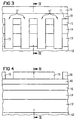
- a photoresist mask 19 is formed on the surface of the SiO 2 layer 18 and has strip-shaped openings.
- the strip-shaped openings of the photoresist mask 19 run transversely to the first trenches 17 (see FIG. 3 and FIG. 4).
- the strip-shaped openings in the photoresist mask 19 have a width of 250 nm and a mutual distance of 1250 nm.
- a second trench mask 18 ' is formed from the SiO 2 layer 18 by dry etching with Ar, CF 4 , CHF 3 , N 2 , He.
- the photoresist mask 19 is subsequently removed.
- the first trenches 17 remain filled with SiO 2 .
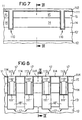
- SiO 2 spacers 19 are formed on flanks of the second trench mask 18 ′ perpendicular to the main surface 11 (see FIG. 5) .
- second trenches 110 are formed by anisotropic dry etching (see FIG. 5).
- the second trenches 110 are etched to a depth of 500 nm. They extend into the bit lines 13 'without, however, cutting through the bit lines 13'.
- the second trenches 110 must be so deep that the first p-doped silicon layer 14 is reliably severed.
- the width of the second trenches 110 is 90 nm. In comparison to the width of the strip-shaped openings in the second trench mask 18 ', it is reduced by the width of the SiO 2 spacer 190.
- the part of the second trench mask 18 ′ located in the first trenches 17 is etched to such an extent that first isolation structures 18 ′′ are formed from the second trench mask 18 ′ in the trenches 17 (see FIGS. 6 and 7).
- the first insulation structures 18 ′′ cover the bottom of the first trenches and extend into the upper region of the bit lines 13 ′.
- the height of the first insulation structures 18 ′′ is approximately 500 nm.
- a first dielectric layer 111 made of SiO 2 with a layer thickness of 5 nm is formed by thermal oxidation.
- a conductive layer 112 is applied to the first dielectric layer 111.
- the conductive layer 112 is formed from in-situ doped polysilicon in a layer thickness of 80 nm. Phosphorus is used as the dopant.
- the dopant concentration is 10 21 cm -3 .
- the conductive layer 112 completely fills the second trenches 110.
- the first trenches 17 are not filled by the conductive layer 112 (see FIG. 6 and FIG. 7).
- the conductive layer 112 is selectively etched to the first dielectric layer 111 by anisotropic etching with He, HBr, Cl 2 , C 2 F 6 .
- the conductive layer 112 is removed to a depth of 200 nm below the main surface 11.
- First word lines 112 ′ are formed from the conductive layer 112.
- the height of the first word lines 112 ′ is dimensioned such that it reliably covers the area in which the first dielectric layer 111 covers the flanks of the first p-doped silicon layer 14.
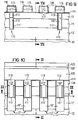
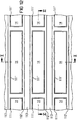
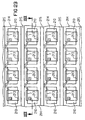
- the word line 112 ' is formed from ring-shaped elements which each surround one of the semiconductor columns. Annular elements adjacent in the direction of the first trenches 17 adjoin one another (see FIGS. 8 and 9).
- the first trenches 17 and the second trenches 110 are filled with a second insulation structure 113.
- the SiO 2 layer is deposited in a TEOS process with a layer thickness of 200 nm. The etching back takes place at CHF 3 , O 2 .
- the second insulation structure 113 is formed, the main surface 11 is exposed outside the first trenches 17 and the second trenches 110.
- a second dielectric layer 114 made of SiO 2 with a layer thickness of 5 nm is formed by thermal oxidation.
- Strip-shaped second word lines 115 and strip-shaped silicon nitride structures 116 are produced on the second dielectric layer 114 (see FIGS. 8 and 9).
- the second word lines 115 run parallel to the second trenches 110.
- a second conductive layer and a silicon nitride layer are deposited and structured in the form of a strip using a photoresist mask. The following etching process is used for this: CF 4 , O 2 , N 2 / He, HBr, Cl 2 , C 2 F 6 .
- the second word lines 115 are formed with a width of 250 nm, a distance of 250 nm, a length of 200 ⁇ m and a thickness of 150 nm.
- the second word lines 115 are formed, for example, from polysilicon doped in situ. Phosphorus is suitable as a dopant. The dopant concentration is 10 21 cm -3 .
- the strip-shaped silicon nitride structures 116 have the same dimensions as the second word lines 115 and have a thickness of 50 nm.
- silicon nitride spacers are formed on the flanks of the second word lines.
- the silicon nitride layer is deposited in a CVD process in a layer thickness of 30 nm.
- the etching is done with CF 4 , O 2 , N 2 .
- the etching is selective to SiO 2 .
- first n + -doped regions 118 are subsequently formed.
- the first n + -doped regions 118 are each arranged between adjacent first trenches 17, adjoin the main area 11 and adjoin the interface with the first p-doped silicon layer 14.
- a first n + -doped region 118 is provided in each semiconductor column, which is defined by respectively adjacent first trenches 17 and second trenches 110. It is located approximately in the middle between adjacent second trenches 110 (see FIG. 10 and FIG. 11).
- the first n + -doped regions 118 have a dopant concentration of 10 21 cm -3 and a depth of 300 nm.
- the implantation is carried out with phosphorus or with arsenic.
- a further photoresist mask (not shown) is formed, which is used as an implantation mask to form second n + -doped regions 119.
- Two n + -doped regions 119 are formed in each semiconductor column and are arranged on both sides of the respective first n + -doped region 118 between adjacent second trenches 110.
- the second p-doped silicon layer 15 adjoins the main surface 11 between the second n + -doped region 119 and the first n + -doped region 118.
- the depth of the second n + -doped regions 119 is 100 nm. It is less than the thickness of the second doped silicon layer 15.
- the implantation is carried out with phosphorus.
- One of the second word lines 115 runs between the first n + -doped region 118 and each of the second n + -doped regions 119 on the surface of the semiconductor columns (see FIG. 11).
- An SiO 2 layer 120 is then deposited and planarized by chemical mechanical polishing (CMP). The planar surface of the SiO 2 layer 120 is arranged approximately 500 nm above the main surface 11.
- Contact holes to the second n + -doped regions 119 in the SiO 2 layer 120 are subsequently opened using a photoresist mask and anisotropic etching, for example using Ar, CF 4 , CHF 3 .
- the contact holes are provided with storage nodes 121.
- a doped polysilicon layer is deposited over the entire surface and planarized by chemical-mechanical polishing.
- the storage nodes 121 are doped with phosphorus with a dopant concentration of 10 21 cm -3 in situ.
- the capacitor dielectric 122 is deposited in a layer thickness of 4 nm.
- a capacitor plate 123 made of doped polysilicon is applied to the capacitor dielectric 122.
- the capacitor plate 123 is formed by in situ doped deposition of polysilicon with phosphorus as the dopant and a dopant concentration of 10 21 cm -3 .
- each semiconductor column which is defined by two adjacent first trenches 17 and second trenches 110, comprises two memory cells. These two memory cells have a common first selection transistor, which consists of the bit line 13 ', the first n + -doped region 118 as source / drain regions and the part of the first p-doped silicon layer 14 arranged between them as the channel region, the first gate dielectric 11 'and the first word line 112' is formed.
- Each of the memory cells also has a second selection transistor, each of the first n + -doped region 118 and one of the second n + -doped regions 119 as source / drain regions and the part of the second p-doped silicon layer arranged therebetween 15 as the channel region, the second dielectric layer 114 as the gate dielectric and the second word line 115 arranged above the channel region.
- the two second selection transistors are connected in series with the common first selection transistor via the first n + -doped region 118.
- the second word lines 115 arranged above the second trenches 110 have no electrical function in this memory cell arrangement. Their function is to enable the contact hole etching for the storage nodes 121 selectively with respect to silicon nitride.
- the threshold voltage of the common first selection transistor is about the doping of the first p-doped silicon layer 14 set.
- the threshold voltage of the second selection transistors is about the doping of the second p-doped Silicon layer 15 set.
- the Threshold voltage of the second selection transistors through a special channel implantation can be set.
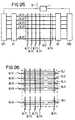
- the first word lines 112 run across the second Word lines 115 and have annular elements that each surround one of the semiconductor columns (see Figure 12).
- the first trenches 17 are formed with a width of a minimally producible structure size F and a distance of F, and the second trenches 110 with a width of F minus the width of the SiO 2 spacers 190 and a distance between adjacent second trenches 110 of 5F plus the width of the Si0 2 spacer 190, this results in a space requirement of 12F 2 for every two memory cells. This means that the memory cell arrangement can be produced with an area requirement of 6F 2 per memory cell.
- a semiconductor substrate which comprises an SOI substrate 21 onto which a first n + -doped silicon layer 22, a first p-doped silicon layer 23, a second n + -doped silicon layer 24, a second p-doped Silicon layer 25 and a third n + -doped layer 26 are grown epitaxially.
- the third n + -doped layer 26 adjoins a main surface 27 (see FIG. 13).
- the first n + -doped silicon layer 22 is formed in a layer thickness of 300 nm with the dopant As and a dopant concentration of 1 x 10 20 cm -3 .
- the first p-doped silicon layer 23 is formed in a layer thickness of 200 nm with a dopant concentration of 1 x 10 18 cm -3 boron.
- the second n + -doped layer 24 is formed in a layer thickness of 100 nm with a dopant concentration of 1 x 10 19 cm -3 and the dopant As.
- the second p-doped silicon layer 25 is formed in a layer thickness of 200 nm with a dopant concentration of 1 x 10 18 cm -3 with boron.
- the third n + -doped layer 26 is formed in a layer thickness of 200 nm with a dopant concentration of 1 x 10 19 cm -3 with the dopant As.
- a first trench mask 28 is formed on the main surface 27 by depositing and structuring an SiO 2 layer.
- the SiO 2 layer is deposited in a TEOS process with a layer thickness of 150 nm.
- a photoresist mask it is structured by anisotropic etching with CHF 3 , O 2 .
- first trenches 29 are etched.
- the first trenches 29 are produced by anisotropic etching with HBr, He, O 2 , NF 3 .
- the first trenches 29 extend into the first n + -doped silicon layer 22.
- the first trenches 29 are strip-shaped and have a width of 200 nm and a distance between adjacent first trenches 29 of 200 nm.
- the length of the first trenches 29 is 5 ⁇ m and the depth is 800 nm.
- silicon nitride spacers 210 are formed on flanks of the first trenches 29 which are essentially perpendicular to the main surface 27.
- a silicon nitride layer with a thickness of 70 nm is deposited and anisotropically etched with CF 4 , O 2 , N 2 to silicon. The thickness of the nitride layer corresponds to one third of the width of the first trenches 29.
- the space remaining between the silicon spacers 210 is subsequently filled with a first insulation structure 211.
- a first insulation structure 211 For this purpose, an SiO 2 layer is deposited in a TEOS process and anisotropically etched back with CHF 3 , O 2 until the main surface 27 is exposed (see FIG. 14).
- a second trench mask is formed on the main surface 27 by depositing an SiO 2 layer and a silicon nitride layer.
- the SiO 2 layer is deposited in a TEOS process with a thickness of 150 nm.
- the thickness of the silicon nitride layer is 70 nm.
- the nitride layer and the SiO 2 layer are structured by anisotropic etching with CHF 3 , O 2 .
- second trenches 212 are produced. Silicon is first anisotropically etched with HBr, He, O 2 , NF 3 .
- SiO2 is then selectively etched to nitride using C 2 F 6 , C 3 F 8 , the silicon nitride layer of the second trench mask serving as a hard mask. Then the silicon nitride spacer and at the same time the silicon nitride hard mask are removed by wet chemical means using H 3 PO 4 .
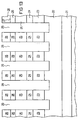
- the second trenches 212 run essentially perpendicular to the first trenches 29 (see FIG. 15, in which the section shown by XV-XV in FIG. 14 is shown).
- the second trenches 212 have a strip-shaped cross section with a width of 200 nm, a distance between adjacent second trenches 212 of 200 nm and a length of 5 ⁇ m.
- the depth of the second trenches 212 is 800 nm.
- the second trenches 212 thus also extend into the first n + -doped silicon layer 22.
- the first insulation structure 211 is then removed. This is done selectively by wet chemical etching of silicon oxide to silicon nitride and silicon with HF.
- a first gate oxide 213 with a thickness of 5 nm is formed by thermal oxidation.
- First word lines 214 are subsequently formed by depositing an in-situ doped polysilicon layer and anisotropically etching the doped polysilicon layer.
- the doped polysilicon layer is deposited doped with phosphorus. It has a thickness of 70 nm. This corresponds to a third of the width of the first trenches 29 and the second trenches 212.
- the space between the silicon nitride spacers 210 arranged on opposite flanks of one of the first trenches 29 is thus filled, the second trenches 212, the flanks of which essentially run perpendicular to the main surface 27 are covered with the thin first gate oxide 213, but not.
- the doped polysilicon layer is etched anisotropically with He, HBr, Cl 2 , C 2 F 6 .
- the anisotropic etching is continued until the word lines are at a height in the region of the second n + -doped silicon layer 24.
- the height of the first word lines 214 completely covers the first p-doped silicon layer 23 (see FIG. 16 and FIG. 17).
- Parts of the first word lines 214 each surround one of the Semiconductor columns, each with two adjacent first Trenches 29 and second trenches 212 are defined in an annular manner.
- the space remaining between the silicon nitride spacers 210 in the first trenches 29 is completely with the first word lines 214 filled. In the first trenches 29 therefore delimit ring-shaped elements of the first word lines 214 together.
- the first word lines 214 are thus formed by adjoining annular elements.
- a second insulation structure 215 is formed by deposition of an SiO 2 layer and anisotropic etching back, which fills up the free space remaining between adjacent first word lines 214 in the second trenches 212.
- the height of the second insulation structure 215 is greater than that of the first word lines 214.
- the second insulation structure 215 extends at most to the interface between the second n + -doped silicon layer 24 and the second p-doped silicon layer 25.
- the deposition of the SiO 2 layer takes place in a TEOS process. It is anisotropically etched with Ar, CF 4 , CHF 3 . With this anisotropic etching, first gate oxide located on the main surface 27 and in the upper region of the second trenches 212 is also removed.
- Silicon structures 216 are subsequently grown on exposed silicon surfaces by selective epitaxy.
- the selective epitaxy takes place in the temperature range from 700 ° C to 900 ° C using a process gas containing silane.
- the silicon structures 216 cover the exposed flanks in the region of the second trenches 212 above the second insulation structure 215. Furthermore, they cover the surface of the third n + -doped silicon layer 26.
- the silicon structures 216 have a dimension of 70 nm perpendicular to the silicon surface on which they are located grow up on. This corresponds to a third of the width of the second trenches 212.
- the second trenches 212 are therefore not filled.
- the flanks of the first trenches 29 are covered by the silicon nitride spacers 210, so that no silicon grows on the flanks of the first trenches 29 (see FIG. 18 and FIG. 19).
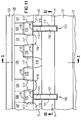
- Silicon nitride is selectively attacked to silicon by wet chemical etching with H 3 PO 4 . Such an etching exposes the flanks of the third n + -doped silicon layer 26 and the second p-doped silicon layer 25 at least partially. As a result, the height of the silicon nitride spacers 210 in the first trenches 29 is reduced (see FIG. 20).
- a second gate oxide 217 is formed by thermal oxidation exposed silicon areas formed. In particular arises the second gate oxide 217 on the exposed surface of the second p-doped silicon layer 25 in the first trenches 29 (see Figure 20 and Figure 21).
- the second gate oxide 217 is formed in a layer thickness of 5 nm.
- Second word lines 218 are formed by depositing an in-situ doped polysilicon layer and anisotropically etching back the doped polysilicon layer.
- the in-situ doped polysilicon layer is doped with phosphorus and has a dopant concentration of 10 21 cm -3 .
- the doped polysilicon layer is deposited to a thickness of 70 nm. This corresponds to a third of the width of the first trenches 29 and the second trenches 212.
- the anisotropic etching is continued until the flanks of the third n + -doped silicon layer 26 in the region of the first trenches 29 are partially exposed (see FIG. 20).
- the second word lines fill accordingly 218 the second trenches in the distance.
- the second Word lines 218 include annular elements, each surrounded one of the silicon pillars. In the second trenches 212 abut adjacent annular elements so that the second word lines 218 as a chain of adjacent one another annular elements are formed.
- the first trenches 29 are filled with a third insulation structure 219.
- a SiO 2 layer is deposited in a TEOS process and anisotropically etched with CHF 3 , O 2 .
- the third insulation structure 219 is flush with the main surface 27.
- storage nodes 220 arranged on the main surface 27 are formed.
- the storage nodes 220 are formed from the parts of the silicon structure 216 located on the main surface 27.
- the storage nodes 219 are electrically connected to the third n + -doped silicon layer 26.
- a capacitor dielectric 221 is then deposited over the entire surface.
- the capacitor dielectric 221 is formed from SiO 2 , a triple layer of SiO 2 , Si 3 N 4 and SiO 2 or a high-epsilon dielectric, for example BST (barium strontium titanate) or SBT (strontium bismuth tantalate).
- a capacitor plate 222 is applied to the capacitor dielectric 221.
- the capacitor plate 221 is formed by in situ doped deposition of polysilicon in a layer thickness of 200 nm and planarization of the doped polysilicon layer.
- the doped polysilicon layer is doped with phosphorus with a dopant concentration of 10 21 cm -3 (see Figure 22).
- FIG. 23 shows that designated XXIII-XXIII in FIG. 22 Cut.
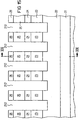
- FIG. 24 shows that designated XXIV-XXIV in FIG. 22 Cut.
- the first word lines 214 and the second word lines 218 are each ring-shaped as a chain Elements are formed and run parallel to each other.
- the first word lines 214 and the second word lines 218 run across each other.
- each semiconductor column which is defined in each case by two adjacent first trenches 29 and second trenches 212, comprises a memory cell.
- the memory cell has a first selection transistor, which consists of the first n + -doped silicon layer 22 and the second n + -doped silicon layer 24 as source / drain regions, the first p-doped silicon layer 23 as a channel region, the first gate oxide 213 and of the first word line 214 is formed as a gate electrode.
- a second selection transistor of the memory cell is made up of the second n + -doped silicon layer 24 and the third n + -doped silicon layer 26 as a source / drain region, the second p-doped silicon layer 25 as a channel region, the second gate oxide 217 and the second word line 218 formed as a gate electrode.
- the first selection transistor and the second selection transistor are connected in series via the second n + -doped silicon layer 24, which acts as a common source / drain region.
- the first n + -doped silicon layer 22 acts as a common bit line.
- the second n + -doped silicon layer 24 is replaced by a p-doped silicon layer.
- each memory cell comprises only one selection transistor, which, however, is controlled via two gate electrodes which are arranged one above the other and whose stray fields are so large that they overlap.
- the overlapping stray fields when switched on, lead to the formation of a conductive channel from the first n + -doped silicon layer 22 to the third n + -doped silicon layer 26 through all p-doped silicon layers.
- the selection transistor acts like two selection transistors connected in series, since a conductive channel is only formed when both gate electrodes are activated.
Landscapes
- Engineering & Computer Science (AREA)
- Manufacturing & Machinery (AREA)
- Semiconductor Memories (AREA)
- Dram (AREA)
Applications Claiming Priority (2)
| Application Number | Priority Date | Filing Date | Title |
|---|---|---|---|
| DE19756183 | 1997-12-17 | ||
| DE19756183 | 1997-12-17 |
Publications (3)
| Publication Number | Publication Date |
|---|---|
| EP0924766A2 true EP0924766A2 (fr) | 1999-06-23 |
| EP0924766A3 EP0924766A3 (fr) | 2000-09-20 |
| EP0924766B1 EP0924766B1 (fr) | 2008-02-20 |
Family
ID=7852307
Family Applications (1)
| Application Number | Title | Priority Date | Filing Date |
|---|---|---|---|
| EP98120336A Expired - Lifetime EP0924766B1 (fr) | 1997-12-17 | 1998-10-27 | Réseau de cellules de mémoire et procédé de fabrication |
Country Status (7)
| Country | Link |
|---|---|
| US (1) | US6229169B1 (fr) |
| EP (1) | EP0924766B1 (fr) |
| JP (1) | JPH11243183A (fr) |
| KR (1) | KR100560648B1 (fr) |
| CN (1) | CN1169223C (fr) |
| DE (1) | DE59814170D1 (fr) |
| TW (1) | TW402816B (fr) |
Cited By (31)
| Publication number | Priority date | Publication date | Assignee | Title |
|---|---|---|---|---|
| US6806140B1 (en) | 2000-06-15 | 2004-10-19 | Samsung Electronics Co., Ltd. | Semiconductor memory device for eliminating floating body effect and method of fabricating the same |
| US6873539B1 (en) | 2001-06-18 | 2005-03-29 | Pierre Fazan | Semiconductor device |
| US6912150B2 (en) | 2003-05-13 | 2005-06-28 | Lionel Portman | Reference current generator, and method of programming, adjusting and/or operating same |
| DE10152911B4 (de) * | 2000-10-28 | 2005-11-24 | Samsung Electronics Co., Ltd., Suwon | Integrierte Schaltungsvorrichtungen, die aktive Bereiche mit erweiterten effektiven Breiten aufweisen, und Verfahren zur Herstellung derselben |
| US6982918B2 (en) | 2002-04-18 | 2006-01-03 | Pierre Fazan | Data storage device and refreshing method for use with such device |
| EP1179850A3 (fr) * | 2000-08-11 | 2006-02-22 | Fujio Masuoka | Une mémoire semi-conductrice et son procédé de fabrication |
| EP1246247A3 (fr) * | 2001-03-30 | 2006-04-12 | Fujio Masuoka | Mémoire semi-conductrice et son procédé de fabrication |
| US7061050B2 (en) | 2002-04-18 | 2006-06-13 | Innovative Silicon S.A. | Semiconductor device utilizing both fully and partially depleted devices |
| US7085156B2 (en) | 2003-05-13 | 2006-08-01 | Innovative Silicon S.A. | Semiconductor memory device and method of operating same |
| US7085153B2 (en) | 2003-05-13 | 2006-08-01 | Innovative Silicon S.A. | Semiconductor memory cell, array, architecture and device, and method of operating same |
| US7177175B2 (en) | 2003-09-24 | 2007-02-13 | Innovative Silicon S.A. | Low power programming technique for a floating body memory transistor, memory cell, and memory array |
| US7335934B2 (en) | 2003-07-22 | 2008-02-26 | Innovative Silicon S.A. | Integrated circuit device, and method of fabricating same |
| US8861247B2 (en) | 2009-04-27 | 2014-10-14 | Micron Technology, Inc. | Techniques for providing a direct injection semiconductor memory device |
| US8947965B2 (en) | 2009-07-27 | 2015-02-03 | Micron Technology Inc. | Techniques for providing a direct injection semiconductor memory device |
| US8964479B2 (en) | 2010-03-04 | 2015-02-24 | Micron Technology, Inc. | Techniques for sensing a semiconductor memory device |
| US8982633B2 (en) | 2009-05-22 | 2015-03-17 | Micron Technology, Inc. | Techniques for providing a direct injection semiconductor memory device |
| US9019759B2 (en) | 2010-03-15 | 2015-04-28 | Micron Technology, Inc. | Techniques for providing a semiconductor memory device |
| US9019788B2 (en) | 2008-01-24 | 2015-04-28 | Micron Technology, Inc. | Techniques for accessing memory cells |
| US9064730B2 (en) | 2009-03-04 | 2015-06-23 | Micron Technology, Inc. | Techniques for forming a contact to a buried diffusion layer in a semiconductor memory device |
| US9093311B2 (en) | 2009-03-31 | 2015-07-28 | Micron Technology, Inc. | Techniques for providing a semiconductor memory device |
| US9142264B2 (en) | 2010-05-06 | 2015-09-22 | Micron Technology, Inc. | Techniques for refreshing a semiconductor memory device |
| US9240496B2 (en) | 2009-04-30 | 2016-01-19 | Micron Technology, Inc. | Semiconductor device with floating gate and electrically floating body |
| US9257155B2 (en) | 2007-05-30 | 2016-02-09 | Micron Technology, Inc. | Integrated circuit having voltage generation circuitry for memory cell array, and method of operating and/or controlling same |
| US9263133B2 (en) | 2011-05-17 | 2016-02-16 | Micron Technology, Inc. | Techniques for providing a semiconductor memory device |
| US9276000B2 (en) | 2007-03-29 | 2016-03-01 | Micron Technology, Inc. | Manufacturing process for zero-capacitor random access memory circuits |
| US9331083B2 (en) | 2009-07-10 | 2016-05-03 | Micron Technology, Inc. | Techniques for providing a semiconductor memory device |
| US9553186B2 (en) | 2008-09-25 | 2017-01-24 | Micron Technology, Inc. | Recessed gate silicon-on-insulator floating body device with self-aligned lateral isolation |
| US9559216B2 (en) | 2011-06-06 | 2017-01-31 | Micron Technology, Inc. | Semiconductor memory device and method for biasing same |
| US9812179B2 (en) | 2009-11-24 | 2017-11-07 | Ovonyx Memory Technology, Llc | Techniques for reducing disturbance in a semiconductor memory device |
| US10304837B2 (en) | 2007-11-29 | 2019-05-28 | Ovonyx Memory Technology, Llc | Integrated circuit having memory cell array including barriers, and method of manufacturing same |
| US10418091B2 (en) | 2005-09-07 | 2019-09-17 | Ovonyx Memory Technology, Llc | Memory cell and memory cell array having an electrically floating body transistor, and methods of operating same |
Families Citing this family (69)
| Publication number | Priority date | Publication date | Assignee | Title |
|---|---|---|---|---|
| DE19845004C2 (de) * | 1998-09-30 | 2002-06-13 | Infineon Technologies Ag | DRAM-Zellenanordnung und Verfahren zu deren Herstellung |
| DE19911148C1 (de) * | 1999-03-12 | 2000-05-18 | Siemens Ag | DRAM-Zellenanordnung und Verfahren zu deren Herstellung |
| DE19929211B4 (de) * | 1999-06-25 | 2005-10-06 | Infineon Technologies Ag | Verfahren zur Herstellung eines MOS-Transistors sowie einer DRAM-Zellenanordung |
| DE19943760C1 (de) * | 1999-09-13 | 2001-02-01 | Infineon Technologies Ag | DRAM-Zellenanordnung und Verfahren zu deren Herstellung |
| DE10125967C1 (de) * | 2001-05-29 | 2002-07-11 | Infineon Technologies Ag | DRAM-Zellanordnung mit vertikalen MOS-Transistoren und Verfahren zu deren Herstellung |
| US6567329B2 (en) | 2001-08-28 | 2003-05-20 | Intel Corporation | Multiple word-line accessing and accessor |
| US6842369B2 (en) | 2002-05-07 | 2005-01-11 | Hewlett-Packard Development Company, L.P. | Intermesh memory device |
| US6734063B2 (en) * | 2002-07-22 | 2004-05-11 | Infineon Technologies Ag | Non-volatile memory cell and fabrication method |
| US6777260B1 (en) * | 2003-08-14 | 2004-08-17 | Silicon Storage Technology, Inc. | Method of making sub-lithographic sized contact holes |
| US7042030B2 (en) * | 2003-11-21 | 2006-05-09 | Texas Instruments Incorporated | High density memory array |
| JP4593960B2 (ja) * | 2004-04-14 | 2010-12-08 | 白土 猛英 | 半導体記憶装置 |
| US7098105B2 (en) * | 2004-05-26 | 2006-08-29 | Micron Technology, Inc. | Methods for forming semiconductor structures |
| US7247570B2 (en) | 2004-08-19 | 2007-07-24 | Micron Technology, Inc. | Silicon pillars for vertical transistors |
| US7442976B2 (en) | 2004-09-01 | 2008-10-28 | Micron Technology, Inc. | DRAM cells with vertical transistors |
| US7476939B2 (en) | 2004-11-04 | 2009-01-13 | Innovative Silicon Isi Sa | Memory cell having an electrically floating body transistor and programming technique therefor |
| KR100618875B1 (ko) * | 2004-11-08 | 2006-09-04 | 삼성전자주식회사 | 수직 채널 mos 트랜지스터를 구비한 반도체 메모리소자 및 그 제조방법 |
| US7251164B2 (en) | 2004-11-10 | 2007-07-31 | Innovative Silicon S.A. | Circuitry for and method of improving statistical distribution of integrated circuits |
| US7301838B2 (en) | 2004-12-13 | 2007-11-27 | Innovative Silicon S.A. | Sense amplifier circuitry and architecture to write data into and/or read from memory cells |
| US7301803B2 (en) | 2004-12-22 | 2007-11-27 | Innovative Silicon S.A. | Bipolar reading technique for a memory cell having an electrically floating body transistor |
| US7120046B1 (en) | 2005-05-13 | 2006-10-10 | Micron Technology, Inc. | Memory array with surrounding gate access transistors and capacitors with global and staggered local bit lines |
| US7371627B1 (en) | 2005-05-13 | 2008-05-13 | Micron Technology, Inc. | Memory array with ultra-thin etched pillar surround gate access transistors and buried data/bit lines |
| US7902598B2 (en) | 2005-06-24 | 2011-03-08 | Micron Technology, Inc. | Two-sided surround access transistor for a 4.5F2 DRAM cell |
| US7888721B2 (en) | 2005-07-06 | 2011-02-15 | Micron Technology, Inc. | Surround gate access transistors with grown ultra-thin bodies |
| US7768051B2 (en) | 2005-07-25 | 2010-08-03 | Micron Technology, Inc. | DRAM including a vertical surround gate transistor |
| US7696567B2 (en) | 2005-08-31 | 2010-04-13 | Micron Technology, Inc | Semiconductor memory device |
| US7355916B2 (en) | 2005-09-19 | 2008-04-08 | Innovative Silicon S.A. | Method and circuitry to generate a reference current for reading a memory cell, and device implementing same |
| US7683430B2 (en) | 2005-12-19 | 2010-03-23 | Innovative Silicon Isi Sa | Electrically floating body memory cell and array, and method of operating or controlling same |
| US7542345B2 (en) | 2006-02-16 | 2009-06-02 | Innovative Silicon Isi Sa | Multi-bit memory cell having electrically floating body transistor, and method of programming and reading same |
| US7476933B2 (en) | 2006-03-02 | 2009-01-13 | Micron Technology, Inc. | Vertical gated access transistor |
| US7842558B2 (en) | 2006-03-02 | 2010-11-30 | Micron Technology, Inc. | Masking process for simultaneously patterning separate regions |
| US7492632B2 (en) | 2006-04-07 | 2009-02-17 | Innovative Silicon Isi Sa | Memory array having a programmable word length, and method of operating same |
| US7606098B2 (en) | 2006-04-18 | 2009-10-20 | Innovative Silicon Isi Sa | Semiconductor memory array architecture with grouped memory cells, and method of controlling same |
| US7933142B2 (en) | 2006-05-02 | 2011-04-26 | Micron Technology, Inc. | Semiconductor memory cell and array using punch-through to program and read same |
| US8069377B2 (en) | 2006-06-26 | 2011-11-29 | Micron Technology, Inc. | Integrated circuit having memory array including ECC and column redundancy and method of operating the same |
| US7542340B2 (en) | 2006-07-11 | 2009-06-02 | Innovative Silicon Isi Sa | Integrated circuit including memory array having a segmented bit line architecture and method of controlling and/or operating same |
| US7666797B2 (en) | 2006-08-17 | 2010-02-23 | Micron Technology, Inc. | Methods for forming semiconductor constructions, and methods for selectively etching silicon nitride relative to conductive material |
| US7692949B2 (en) * | 2006-12-04 | 2010-04-06 | Qimonda North America Corp. | Multi-bit resistive memory |
| KR101406604B1 (ko) | 2007-01-26 | 2014-06-11 | 마이크론 테크놀로지, 인코포레이티드 | 게이트형 바디 영역으로부터 격리되는 소스/드레인 영역을 포함하는 플로팅-바디 dram 트랜지스터 |
| US8085594B2 (en) | 2007-06-01 | 2011-12-27 | Micron Technology, Inc. | Reading technique for memory cell with electrically floating body transistor |
| US7923373B2 (en) | 2007-06-04 | 2011-04-12 | Micron Technology, Inc. | Pitch multiplication using self-assembling materials |
| US8194487B2 (en) | 2007-09-17 | 2012-06-05 | Micron Technology, Inc. | Refreshing data of memory cells with electrically floating body transistors |
| US8349662B2 (en) | 2007-12-11 | 2013-01-08 | Micron Technology, Inc. | Integrated circuit having memory cell array, and method of manufacturing same |
| US8014195B2 (en) | 2008-02-06 | 2011-09-06 | Micron Technology, Inc. | Single transistor memory cell |
| US8189376B2 (en) | 2008-02-08 | 2012-05-29 | Micron Technology, Inc. | Integrated circuit having memory cells including gate material having high work function, and method of manufacturing same |
| KR101132302B1 (ko) * | 2008-03-07 | 2012-04-05 | 주식회사 하이닉스반도체 | 반도체 소자의 제조방법 |
| KR101145396B1 (ko) * | 2008-04-04 | 2012-05-16 | 에스케이하이닉스 주식회사 | 수직게이트 형성 방법 및 그를 이용한 반도체장치 제조방법 |
| US7957206B2 (en) | 2008-04-04 | 2011-06-07 | Micron Technology, Inc. | Read circuitry for an integrated circuit having memory cells and/or a memory cell array, and method of operating same |
| KR101037495B1 (ko) * | 2008-07-31 | 2011-05-26 | 주식회사 하이닉스반도체 | 고집적 반도체 장치의 제조 방법 및 반도체 장치 |
| US8101497B2 (en) | 2008-09-11 | 2012-01-24 | Micron Technology, Inc. | Self-aligned trench formation |
| US7933140B2 (en) | 2008-10-02 | 2011-04-26 | Micron Technology, Inc. | Techniques for reducing a voltage swing |
| US7924630B2 (en) | 2008-10-15 | 2011-04-12 | Micron Technology, Inc. | Techniques for simultaneously driving a plurality of source lines |
| US8223574B2 (en) | 2008-11-05 | 2012-07-17 | Micron Technology, Inc. | Techniques for block refreshing a semiconductor memory device |
| US8213226B2 (en) | 2008-12-05 | 2012-07-03 | Micron Technology, Inc. | Vertical transistor memory cell and array |
| US8319294B2 (en) | 2009-02-18 | 2012-11-27 | Micron Technology, Inc. | Techniques for providing a source line plane |
| US8199595B2 (en) | 2009-09-04 | 2012-06-12 | Micron Technology, Inc. | Techniques for sensing a semiconductor memory device |
| US8310893B2 (en) | 2009-12-16 | 2012-11-13 | Micron Technology, Inc. | Techniques for reducing impact of array disturbs in a semiconductor memory device |
| US8416636B2 (en) | 2010-02-12 | 2013-04-09 | Micron Technology, Inc. | Techniques for controlling a semiconductor memory device |
| US8411513B2 (en) | 2010-03-04 | 2013-04-02 | Micron Technology, Inc. | Techniques for providing a semiconductor memory device having hierarchical bit lines |
| US8369177B2 (en) | 2010-03-05 | 2013-02-05 | Micron Technology, Inc. | Techniques for reading from and/or writing to a semiconductor memory device |
| US8207041B2 (en) * | 2010-03-09 | 2012-06-26 | Micron Technology, Inc. | Semiconductor processing methods |
| CN102222524B (zh) * | 2010-04-14 | 2014-07-16 | 旺宏电子股份有限公司 | 记忆胞的操作方法 |
| JP2013045894A (ja) * | 2011-08-24 | 2013-03-04 | Rexchip Electronics Corp | 補助電極構造を備えた立体型dram |
| KR20130139599A (ko) * | 2012-06-13 | 2013-12-23 | 에스케이하이닉스 주식회사 | 반도체 소자, 이를 포함하는 전자 시스템 및 제조 방법 |
| US9728266B1 (en) | 2016-07-08 | 2017-08-08 | Micron Technology, Inc. | Memory device including multiple select gates and different bias conditions |
| US11164879B2 (en) | 2018-11-16 | 2021-11-02 | International Business Machines Corporation | Microelectronic device with a memory element utilizing stacked vertical devices |
| US10804266B2 (en) * | 2018-11-16 | 2020-10-13 | International Business Machines Corporation | Microelectronic device utilizing stacked vertical devices |
| US11171142B2 (en) | 2018-11-16 | 2021-11-09 | International Business Machines Corporation | Integrated circuit with vertical structures on nodes of a grid |
| US10833089B2 (en) | 2018-11-16 | 2020-11-10 | International Business Machines Corporation | Buried conductive layer supplying digital circuits |
| TWI897435B (zh) * | 2024-05-23 | 2025-09-11 | 力晶積成電子製造股份有限公司 | 動態隨機存取記憶體結構 |
Family Cites Families (15)
| Publication number | Priority date | Publication date | Assignee | Title |
|---|---|---|---|---|
| DE2740113A1 (de) * | 1977-09-06 | 1979-03-15 | Siemens Ag | Monolithisch integrierter halbleiterspeicher |
| JPH02188958A (ja) * | 1989-01-17 | 1990-07-25 | Mitsubishi Electric Corp | ダイナミックメモリ構造 |
| JPH0821689B2 (ja) * | 1990-02-26 | 1996-03-04 | 株式会社東芝 | 半導体記憶装置およびその製造方法 |
| US5289432A (en) * | 1991-04-24 | 1994-02-22 | International Business Machines Corporation | Dual-port static random access memory cell |
| JPH05218349A (ja) * | 1992-02-04 | 1993-08-27 | Sony Corp | 半導体記憶装置 |
| US5208172A (en) * | 1992-03-02 | 1993-05-04 | Motorola, Inc. | Method for forming a raised vertical transistor |
| JP2824713B2 (ja) * | 1992-04-24 | 1998-11-18 | 三菱電機株式会社 | 半導体記憶装置 |
| DE19519160C1 (de) * | 1995-05-24 | 1996-09-12 | Siemens Ag | DRAM-Zellenanordnung und Verfahren zu deren Herstellung |
| ATE212149T1 (de) * | 1995-09-26 | 2002-02-15 | Infineon Technologies Ag | Selbstverstärkende dram-speicherzellenanordnung |
| KR970018065A (ko) * | 1995-09-29 | 1997-04-30 | 김광호 | 금속 배선의 제조 방법 |
| KR100198662B1 (ko) | 1996-05-16 | 1999-06-15 | 구본준 | 디램 셀, 디램 및 그의 제조 방법 |
| US5990509A (en) * | 1997-01-22 | 1999-11-23 | International Business Machines Corporation | 2F-square memory cell for gigabit memory applications |
| US6072209A (en) * | 1997-07-08 | 2000-06-06 | Micro Technology, Inc. | Four F2 folded bit line DRAM cell structure having buried bit and word lines |
| US5907170A (en) * | 1997-10-06 | 1999-05-25 | Micron Technology, Inc. | Circuit and method for an open bit line memory cell with a vertical transistor and trench plate trench capacitor |
| TW393731B (en) * | 1997-12-01 | 2000-06-11 | Nanya Plastics Corp | DRAM sharing a bit line contact window with multi-memory cells and its manufacturing method |
-
1998
- 1998-10-27 DE DE59814170T patent/DE59814170D1/de not_active Expired - Fee Related
- 1998-10-27 EP EP98120336A patent/EP0924766B1/fr not_active Expired - Lifetime
- 1998-10-29 TW TW087117960A patent/TW402816B/zh not_active IP Right Cessation
- 1998-12-16 CN CNB981253814A patent/CN1169223C/zh not_active Expired - Fee Related
- 1998-12-16 JP JP10358127A patent/JPH11243183A/ja not_active Abandoned
- 1998-12-17 KR KR1019980055576A patent/KR100560648B1/ko not_active Expired - Fee Related
- 1998-12-17 US US09/213,724 patent/US6229169B1/en not_active Expired - Fee Related
Cited By (56)
| Publication number | Priority date | Publication date | Assignee | Title |
|---|---|---|---|---|
| DE10128928B4 (de) * | 2000-06-15 | 2011-11-03 | Samsung Electronics Co., Ltd. | Halbleiterspeichervorrichtung, die keinen Floating-Body-Effekt aufweist, und dazugehöriges Herstellungsverfahren |
| US6806140B1 (en) | 2000-06-15 | 2004-10-19 | Samsung Electronics Co., Ltd. | Semiconductor memory device for eliminating floating body effect and method of fabricating the same |
| EP1179850A3 (fr) * | 2000-08-11 | 2006-02-22 | Fujio Masuoka | Une mémoire semi-conductrice et son procédé de fabrication |
| US7135726B2 (en) | 2000-08-11 | 2006-11-14 | Fujio Masuoka | Semiconductor memory and its production process |
| US7187032B2 (en) | 2000-10-28 | 2007-03-06 | Samsung Electronics Co., Ltd | Integrated circuit devices having active regions with expanded effective widths |
| DE10152911B9 (de) * | 2000-10-28 | 2013-04-18 | Samsung Electronics Co., Ltd. | Integrierte Schaltungsvorrichtungen, die aktive Bereiche mit erweiterten effektiven Breiten aufweisen, und Verfahren zur Herstellung derselben |
| US7521753B2 (en) | 2000-10-28 | 2009-04-21 | Samsung Electronics Co., Ltd. | Integrated circuit devices having active regions with expanded effective widths |
| DE10152911B4 (de) * | 2000-10-28 | 2005-11-24 | Samsung Electronics Co., Ltd., Suwon | Integrierte Schaltungsvorrichtungen, die aktive Bereiche mit erweiterten effektiven Breiten aufweisen, und Verfahren zur Herstellung derselben |
| EP1246247A3 (fr) * | 2001-03-30 | 2006-04-12 | Fujio Masuoka | Mémoire semi-conductrice et son procédé de fabrication |
| US7541616B2 (en) | 2001-06-18 | 2009-06-02 | Innovative Silicon Isi Sa | Semiconductor device |
| US6925006B2 (en) | 2001-06-18 | 2005-08-02 | Innovative Silicon S.A. | Semiconductor device |
| US6969662B2 (en) | 2001-06-18 | 2005-11-29 | Pierre Fazan | Semiconductor device |
| US7280399B2 (en) | 2001-06-18 | 2007-10-09 | Innovative Silicon S.A. | Semiconductor device |
| US6937516B2 (en) | 2001-06-18 | 2005-08-30 | Innovative Silicon S.A. | Semiconductor device |
| US6934186B2 (en) | 2001-06-18 | 2005-08-23 | Innovative Silicon S.A. | Semiconductor device |
| US6930918B2 (en) | 2001-06-18 | 2005-08-16 | Innovative Silicon S.A. | Semiconductor device |
| US7239549B2 (en) | 2001-06-18 | 2007-07-03 | Innovative Silicon S.A. | Semiconductor device |
| US7732816B2 (en) | 2001-06-18 | 2010-06-08 | Innovative Silicon Isi Sa | Semiconductor device |
| US6873539B1 (en) | 2001-06-18 | 2005-03-29 | Pierre Fazan | Semiconductor device |
| US6982918B2 (en) | 2002-04-18 | 2006-01-03 | Pierre Fazan | Data storage device and refreshing method for use with such device |
| US7342842B2 (en) | 2002-04-18 | 2008-03-11 | Innovative Silicon, S.A. | Data storage device and refreshing method for use with such device |
| US7170807B2 (en) | 2002-04-18 | 2007-01-30 | Innovative Silicon S.A. | Data storage device and refreshing method for use with such device |
| US7061050B2 (en) | 2002-04-18 | 2006-06-13 | Innovative Silicon S.A. | Semiconductor device utilizing both fully and partially depleted devices |
| US7514748B2 (en) | 2002-04-18 | 2009-04-07 | Innovative Silicon Isi Sa | Semiconductor device |
| US7085156B2 (en) | 2003-05-13 | 2006-08-01 | Innovative Silicon S.A. | Semiconductor memory device and method of operating same |
| US7187581B2 (en) | 2003-05-13 | 2007-03-06 | Innovative Silicon S.A. | Semiconductor memory device and method of operating same |
| US7085153B2 (en) | 2003-05-13 | 2006-08-01 | Innovative Silicon S.A. | Semiconductor memory cell, array, architecture and device, and method of operating same |
| US6912150B2 (en) | 2003-05-13 | 2005-06-28 | Lionel Portman | Reference current generator, and method of programming, adjusting and/or operating same |
| US7335934B2 (en) | 2003-07-22 | 2008-02-26 | Innovative Silicon S.A. | Integrated circuit device, and method of fabricating same |
| US7184298B2 (en) | 2003-09-24 | 2007-02-27 | Innovative Silicon S.A. | Low power programming technique for a floating body memory transistor, memory cell, and memory array |
| US7177175B2 (en) | 2003-09-24 | 2007-02-13 | Innovative Silicon S.A. | Low power programming technique for a floating body memory transistor, memory cell, and memory array |
| US10418091B2 (en) | 2005-09-07 | 2019-09-17 | Ovonyx Memory Technology, Llc | Memory cell and memory cell array having an electrically floating body transistor, and methods of operating same |
| US11031069B2 (en) | 2005-09-07 | 2021-06-08 | Ovonyx Memory Technology, Llc | Memory cell and memory cell array having an electrically floating body transistor, and methods of operating same |
| US9276000B2 (en) | 2007-03-29 | 2016-03-01 | Micron Technology, Inc. | Manufacturing process for zero-capacitor random access memory circuits |
| US9257155B2 (en) | 2007-05-30 | 2016-02-09 | Micron Technology, Inc. | Integrated circuit having voltage generation circuitry for memory cell array, and method of operating and/or controlling same |
| US10304837B2 (en) | 2007-11-29 | 2019-05-28 | Ovonyx Memory Technology, Llc | Integrated circuit having memory cell array including barriers, and method of manufacturing same |
| US11081486B2 (en) | 2007-11-29 | 2021-08-03 | Ovonyx Memory Technology, Llc | Integrated circuit having memory cell array including barriers, and method of manufacturing same |
| US9019788B2 (en) | 2008-01-24 | 2015-04-28 | Micron Technology, Inc. | Techniques for accessing memory cells |
| US9553186B2 (en) | 2008-09-25 | 2017-01-24 | Micron Technology, Inc. | Recessed gate silicon-on-insulator floating body device with self-aligned lateral isolation |
| US9064730B2 (en) | 2009-03-04 | 2015-06-23 | Micron Technology, Inc. | Techniques for forming a contact to a buried diffusion layer in a semiconductor memory device |
| US9093311B2 (en) | 2009-03-31 | 2015-07-28 | Micron Technology, Inc. | Techniques for providing a semiconductor memory device |
| US9425190B2 (en) | 2009-04-27 | 2016-08-23 | Micron Technology, Inc. | Techniques for providing a direct injection semiconductor memory device |
| US8861247B2 (en) | 2009-04-27 | 2014-10-14 | Micron Technology, Inc. | Techniques for providing a direct injection semiconductor memory device |
| US9240496B2 (en) | 2009-04-30 | 2016-01-19 | Micron Technology, Inc. | Semiconductor device with floating gate and electrically floating body |
| US8982633B2 (en) | 2009-05-22 | 2015-03-17 | Micron Technology, Inc. | Techniques for providing a direct injection semiconductor memory device |
| US9331083B2 (en) | 2009-07-10 | 2016-05-03 | Micron Technology, Inc. | Techniques for providing a semiconductor memory device |
| US9679612B2 (en) | 2009-07-27 | 2017-06-13 | Micron Technology, Inc. | Techniques for providing a direct injection semiconductor memory device |
| US8964461B2 (en) | 2009-07-27 | 2015-02-24 | Micron Technology, Inc. | Techniques for providing a direct injection semiconductor memory device |
| US8947965B2 (en) | 2009-07-27 | 2015-02-03 | Micron Technology Inc. | Techniques for providing a direct injection semiconductor memory device |
| US9812179B2 (en) | 2009-11-24 | 2017-11-07 | Ovonyx Memory Technology, Llc | Techniques for reducing disturbance in a semiconductor memory device |
| US8964479B2 (en) | 2010-03-04 | 2015-02-24 | Micron Technology, Inc. | Techniques for sensing a semiconductor memory device |
| US9019759B2 (en) | 2010-03-15 | 2015-04-28 | Micron Technology, Inc. | Techniques for providing a semiconductor memory device |
| US9524971B2 (en) | 2010-03-15 | 2016-12-20 | Micron Technology, Inc. | Techniques for providing a semiconductor memory device |
| US9142264B2 (en) | 2010-05-06 | 2015-09-22 | Micron Technology, Inc. | Techniques for refreshing a semiconductor memory device |
| US9263133B2 (en) | 2011-05-17 | 2016-02-16 | Micron Technology, Inc. | Techniques for providing a semiconductor memory device |
| US9559216B2 (en) | 2011-06-06 | 2017-01-31 | Micron Technology, Inc. | Semiconductor memory device and method for biasing same |
Also Published As
| Publication number | Publication date |
|---|---|
| KR19990063147A (ko) | 1999-07-26 |
| CN1169223C (zh) | 2004-09-29 |
| EP0924766B1 (fr) | 2008-02-20 |
| JPH11243183A (ja) | 1999-09-07 |
| EP0924766A3 (fr) | 2000-09-20 |
| US6229169B1 (en) | 2001-05-08 |
| DE59814170D1 (de) | 2008-04-03 |
| TW402816B (en) | 2000-08-21 |
| KR100560648B1 (ko) | 2006-06-21 |
| CN1220494A (zh) | 1999-06-23 |
Similar Documents
| Publication | Publication Date | Title |
|---|---|---|
| EP0924766B1 (fr) | Réseau de cellules de mémoire et procédé de fabrication | |
| DE19519160C1 (de) | DRAM-Zellenanordnung und Verfahren zu deren Herstellung | |
| EP0744772B1 (fr) | Cellule de stockage DRAM à transistor vertical et son procédé de fabrication | |
| DE19928781C1 (de) | DRAM-Zellenanordnung und Verfahren zu deren Herstellung | |
| DE10038728A1 (de) | Halbleiterspeicher-Zellenanordnung und Verfahren zu deren Herstellung | |
| DE102005055853A1 (de) | Transistor-Feld für Halbleiterspeicherbauelemente und Verfahren zum Herstellen eines Feldes von Transistoren mit vertikalem Kanal | |
| DE102004043858A1 (de) | Verfahren zur Herstellung einer Speicherzelle, einer Speicherzellenanordnung und Speicherzellenanordnung | |
| DE3787687T2 (de) | Halbleiterspeicher. | |
| DE19620625C1 (de) | DRAM-Zellenanordnung und Verfahren zu deren Herstellung | |
| DE102007013978A1 (de) | 3D-Kanal Feldeffekttransistor, Speicherzelle und integrierter Schaltkreis | |
| DE19845004C2 (de) | DRAM-Zellenanordnung und Verfahren zu deren Herstellung | |
| EP0946985B1 (fr) | Agencement de cellules de memoire et son procede de fabrication | |
| DE19811882A1 (de) | DRAM-Zellenanordnung und Verfahren zu deren Herstellung | |
| EP0945901A1 (fr) | Réseau de cellules DRAM à transistor vertical et son procédé de fabrication | |
| DE19525070A1 (de) | Elektrisch schreib- und löschbare Festwertspeicherzellenanordnung und Verfahren zu deren Herstellung | |
| EP1116270A1 (fr) | Ensemble circuit integre comportant des transistors verticaux, et son procede de production | |
| EP1129482B1 (fr) | Procédé de production d'une configuration de cellules DRAM | |
| EP1125328B1 (fr) | Procede de production d'un ensemble de cellules de memoire ram dynamique | |
| EP1161770A1 (fr) | Agencement de cellules de memoire ram dynamique, et son procede de realisation | |
| DE19832095C1 (de) | Stapelkondensator-Herstellungsverfahren | |
| WO2001001481A1 (fr) | Transistor mos et ensemble de cellules dram et procede pour les fabriquer | |
| DE19646419C1 (de) | Verfahren zur Herstellung einer elektrisch schreib- und löschbaren Festwertspeicherzellenanordnung | |
| DE19637389C1 (de) | Verfahren zur Herstellung einer DRAM-Zellenanordnung | |
| DE19727436C1 (de) | DRAM-Zellenanordnung mit dynamischen selbstverstärkenden Speicherzellen und Verfahren zu deren Herstellung | |
| DE19914490C1 (de) | Speicherzellenanordnung und Verfahren zu deren Herstellung |
Legal Events
| Date | Code | Title | Description |
|---|---|---|---|
| PUAI | Public reference made under article 153(3) epc to a published international application that has entered the european phase |
Free format text: ORIGINAL CODE: 0009012 |
|
| AK | Designated contracting states |
Kind code of ref document: A2 Designated state(s): DE FR GB IE IT |
|
| AX | Request for extension of the european patent |
Free format text: AL;LT;LV;MK;RO;SI |
|
| RIC1 | Information provided on ipc code assigned before grant |
Free format text: 7H 01L 27/108 A, 7H 01L 27/115 B, 7G 11C 11/408 B |
|
| PUAL | Search report despatched |
Free format text: ORIGINAL CODE: 0009013 |
|
| AK | Designated contracting states |
Kind code of ref document: A3 Designated state(s): AT BE CH CY DE DK ES FI FR GB GR IE IT LI LU MC NL PT SE |
|
| AX | Request for extension of the european patent |
Free format text: AL;LT;LV;MK;RO;SI |
|
| 17P | Request for examination filed |
Effective date: 20001017 |
|
| AKX | Designation fees paid |
Free format text: DE FR GB IE IT |
|
| RAP1 | Party data changed (applicant data changed or rights of an application transferred) |
Owner name: INFINEON TECHNOLOGIES AG |
|
| 17Q | First examination report despatched |
Effective date: 20051028 |
|
| RTI1 | Title (correction) |
Free format text: MEMORY CELL ARRAY AND METHOD OF ITS MANUFACTURE |
|
| GRAP | Despatch of communication of intention to grant a patent |
Free format text: ORIGINAL CODE: EPIDOSNIGR1 |
|
| GRAS | Grant fee paid |
Free format text: ORIGINAL CODE: EPIDOSNIGR3 |
|
| GRAA | (expected) grant |
Free format text: ORIGINAL CODE: 0009210 |
|
| AK | Designated contracting states |
Kind code of ref document: B1 Designated state(s): DE FR GB IE IT |
|
| REG | Reference to a national code |
Ref country code: GB Ref legal event code: FG4D Free format text: NOT ENGLISH |
|
| REG | Reference to a national code |
Ref country code: IE Ref legal event code: FG4D Free format text: LANGUAGE OF EP DOCUMENT: GERMAN |
|
| REF | Corresponds to: |
Ref document number: 59814170 Country of ref document: DE Date of ref document: 20080403 Kind code of ref document: P |
|
| REG | Reference to a national code |
Ref country code: IE Ref legal event code: FD4D |
|
| PG25 | Lapsed in a contracting state [announced via postgrant information from national office to epo] |
Ref country code: IE Free format text: LAPSE BECAUSE OF FAILURE TO SUBMIT A TRANSLATION OF THE DESCRIPTION OR TO PAY THE FEE WITHIN THE PRESCRIBED TIME-LIMIT Effective date: 20080220 |
|
| EN | Fr: translation not filed | ||
| PLBE | No opposition filed within time limit |
Free format text: ORIGINAL CODE: 0009261 |
|
| STAA | Information on the status of an ep patent application or granted ep patent |
Free format text: STATUS: NO OPPOSITION FILED WITHIN TIME LIMIT |
|
| 26N | No opposition filed |
Effective date: 20081121 |
|
| PG25 | Lapsed in a contracting state [announced via postgrant information from national office to epo] |
Ref country code: FR Free format text: LAPSE BECAUSE OF FAILURE TO SUBMIT A TRANSLATION OF THE DESCRIPTION OR TO PAY THE FEE WITHIN THE PRESCRIBED TIME-LIMIT Effective date: 20081212 |
|
| GBPC | Gb: european patent ceased through non-payment of renewal fee |
Effective date: 20081027 |
|
| PG25 | Lapsed in a contracting state [announced via postgrant information from national office to epo] |
Ref country code: IT Free format text: LAPSE BECAUSE OF FAILURE TO SUBMIT A TRANSLATION OF THE DESCRIPTION OR TO PAY THE FEE WITHIN THE PRESCRIBED TIME-LIMIT Effective date: 20080220 Ref country code: DE Free format text: LAPSE BECAUSE OF NON-PAYMENT OF DUE FEES Effective date: 20090501 |
|
| PG25 | Lapsed in a contracting state [announced via postgrant information from national office to epo] |
Ref country code: GB Free format text: LAPSE BECAUSE OF NON-PAYMENT OF DUE FEES Effective date: 20081027 |