EP0924914B1 - Protocole pour internet mobile - Google Patents
Protocole pour internet mobile Download PDFInfo
- Publication number
- EP0924914B1 EP0924914B1 EP98660119A EP98660119A EP0924914B1 EP 0924914 B1 EP0924914 B1 EP 0924914B1 EP 98660119 A EP98660119 A EP 98660119A EP 98660119 A EP98660119 A EP 98660119A EP 0924914 B1 EP0924914 B1 EP 0924914B1
- Authority
- EP
- European Patent Office
- Prior art keywords
- network
- mobile host
- address
- home agent
- internet
- Prior art date
- Legal status (The legal status is an assumption and is not a legal conclusion. Google has not performed a legal analysis and makes no representation as to the accuracy of the status listed.)
- Expired - Lifetime
Links
- 230000001413 cellular effect Effects 0.000 claims description 29
- 238000000034 method Methods 0.000 claims description 15
- 230000005540 biological transmission Effects 0.000 claims description 3
- 238000010295 mobile communication Methods 0.000 claims description 3
- 238000004891 communication Methods 0.000 description 4
- 238000005516 engineering process Methods 0.000 description 2
- 230000008901 benefit Effects 0.000 description 1
- 230000008859 change Effects 0.000 description 1
- 230000000694 effects Effects 0.000 description 1
- 230000007246 mechanism Effects 0.000 description 1
- 238000012986 modification Methods 0.000 description 1
- 230000004048 modification Effects 0.000 description 1
- 238000005457 optimization Methods 0.000 description 1
- 230000008569 process Effects 0.000 description 1
- 230000000717 retained effect Effects 0.000 description 1
Images

Classifications
-
- H—ELECTRICITY
- H04—ELECTRIC COMMUNICATION TECHNIQUE
- H04W—WIRELESS COMMUNICATION NETWORKS
- H04W8/00—Network data management
- H04W8/02—Processing of mobility data, e.g. registration information at HLR [Home Location Register] or VLR [Visitor Location Register]; Transfer of mobility data, e.g. between HLR, VLR or external networks
- H04W8/08—Mobility data transfer
- H04W8/082—Mobility data transfer for traffic bypassing of mobility servers, e.g. location registers, home PLMNs or home agents
-
- H—ELECTRICITY
- H04—ELECTRIC COMMUNICATION TECHNIQUE
- H04L—TRANSMISSION OF DIGITAL INFORMATION, e.g. TELEGRAPHIC COMMUNICATION
- H04L61/00—Network arrangements, protocols or services for addressing or naming
- H04L61/50—Address allocation
- H04L61/5007—Internet protocol [IP] addresses
-
- H—ELECTRICITY
- H04—ELECTRIC COMMUNICATION TECHNIQUE
- H04L—TRANSMISSION OF DIGITAL INFORMATION, e.g. TELEGRAPHIC COMMUNICATION
- H04L61/00—Network arrangements, protocols or services for addressing or naming
- H04L61/50—Address allocation
- H04L61/5007—Internet protocol [IP] addresses
- H04L61/5014—Internet protocol [IP] addresses using dynamic host configuration protocol [DHCP] or bootstrap protocol [BOOTP]
-
- H—ELECTRICITY
- H04—ELECTRIC COMMUNICATION TECHNIQUE
- H04L—TRANSMISSION OF DIGITAL INFORMATION, e.g. TELEGRAPHIC COMMUNICATION
- H04L61/00—Network arrangements, protocols or services for addressing or naming
- H04L61/50—Address allocation
- H04L61/5076—Update or notification mechanisms, e.g. DynDNS
-
- H—ELECTRICITY
- H04—ELECTRIC COMMUNICATION TECHNIQUE
- H04L—TRANSMISSION OF DIGITAL INFORMATION, e.g. TELEGRAPHIC COMMUNICATION
- H04L61/00—Network arrangements, protocols or services for addressing or naming
- H04L61/50—Address allocation
- H04L61/5084—Providing for device mobility
-
- H—ELECTRICITY
- H04—ELECTRIC COMMUNICATION TECHNIQUE
- H04L—TRANSMISSION OF DIGITAL INFORMATION, e.g. TELEGRAPHIC COMMUNICATION
- H04L9/00—Cryptographic mechanisms or cryptographic arrangements for secret or secure communications; Network security protocols
- H04L9/40—Network security protocols
-
- H—ELECTRICITY
- H04—ELECTRIC COMMUNICATION TECHNIQUE
- H04W—WIRELESS COMMUNICATION NETWORKS
- H04W36/00—Hand-off or reselection arrangements
- H04W36/0005—Control or signalling for completing the hand-off
- H04W36/0011—Control or signalling for completing the hand-off for data sessions of end-to-end connection
- H04W36/0019—Control or signalling for completing the hand-off for data sessions of end-to-end connection adapted for mobile IP [MIP]
-
- H—ELECTRICITY
- H04—ELECTRIC COMMUNICATION TECHNIQUE
- H04W—WIRELESS COMMUNICATION NETWORKS
- H04W80/00—Wireless network protocols or protocol adaptations to wireless operation
- H04W80/04—Network layer protocols, e.g. mobile IP [Internet Protocol]
-
- H—ELECTRICITY
- H04—ELECTRIC COMMUNICATION TECHNIQUE
- H04W—WIRELESS COMMUNICATION NETWORKS
- H04W84/00—Network topologies
- H04W84/02—Hierarchically pre-organised networks, e.g. paging networks, cellular networks, WLAN [Wireless Local Area Network] or WLL [Wireless Local Loop]
- H04W84/10—Small scale networks; Flat hierarchical networks
- H04W84/12—WLAN [Wireless Local Area Networks]
Definitions
- the present invention relates to mobile internet protocol and in particular to a mobile internet protocol which provides for the mobility of mobile internet access hosts between two or more internet access networks.
- LAN Local Area Network
- HN Local Area Network
- the user interface to the internet is typically a personal computer (the "host”).
- the home network is connected to an internet service provider which routes internet data, so-called “datagrams”, between the home network and the internet, the internet in turn comprising other routers and service providers which route data to and from other "foreign” networks (FN).
- FN "foreign” networks
- a host In order to be able to transmit and receive datagrams to and from the internet, a host requires an internet address.
- a corporate home network is typically allocated a set of internet addresses by a national authority and the home network can assign these either fixedly or dynamically to hosts attached to the home network (using for example the Dynamic Host Configuration Protocol DHCP).
- the allocated set of internet addresses comprise a common prefix portion which identifies the home network, whilst a suffix portion identifies the destination host.
- a router (R) of the home network polls the attached hosts to determine which host corresponds to the internet address conveyed with the datagram. The datagram is then forwarded by the router to the identified host.
- a mobile host may have a fixedly or dynamically assigned internet address, allocated by a service provider who is usually the cellular telephone network operator.
- a communication channel between the mobile host and the network is reserved for the duration of the call. Internet data destined for the mobile host is received by the network and is sent to the host over the reserved channel.
- This system works satisfactorily whilst a mobile host remains within one homogeneous network. However, it does not provide for "roaming" between different types of networks or between networks operated by different operators.
- a mobile host "de-registers" with one network and registers with a new network, there is no mechanism for forwarding internet datagrams, addressed to the old network, to the new network as the communication channel between the mobile host and the old network no longer exists. It is therefore necessary to open a new communication channel between the mobile host and the new network. All datagrams addressed to the old network and not yet received by the mobile host are lost as a result of this channel change.
- a mobile internet access protocol which provides for roaming is currently being standardised by the Internet Engineering Task Force (IETF). This protocol is known as RFC2002.
- RFC2002 This protocol is known as RFC2002.
- a mobile internet protocol is also described in EP556012. These protocols make use of a "home agent", located in a mobile host's home network, to keep track of the host when it leaves the home network. A mobile host is fixedly allocated an internet address corresponding to the home network.
- the functionality of the network's home agent is off for that host (i.e. the host is "deregistered" with the home agent) so that the home agent does not alter the flow of datagrams from the internet to the network's router and the mobile host (as indicated by reference numeral 1 in Figure 2).
- the mobile host leaves its home network and contacts a foreign network (FN)
- the host is registered with a foreign agent (FA) of that network.
- the foreign agent then transmits to the mobile host an internet address of the foreign agent, and the mobile host in turn transmits the received internet address to the home network's home agent, together with a registration instruction.
- the home agent registers the new status of the mobile host and records the newly allocated internet address as a "care-of-address" for the host. Whenever the mobile host registers with a new foreign network, a new care-of-address is sent to the home network's home agent to replace the previously registered care-of-address.
- a mobile host has a fixed internet address allocated to it, datagrams destined for the host will always be sent to the home network. If a mobile host has an active internet connection when it passes from its home network to a foreign network, and a datagram destined for the host subsequently arrives at the home network, the home agent determines that the mobile host is registered with a foreign agent and forwards the datagrams to the registered care-of-address. A communication channel will have been reserved between the mobile host and the foreign agent, and the redirected datagram can be sent to the mobile host over this channel. Similarly, if a mobile host initiates a new internet access when registered with a foreign network, the host continues to use its allocated internet address. The home agent has already received the care-of-address and can again forward datagrams destined for the mobile host to the foreign agent for transfer to the host.
- the foreign network may dynamically assign an internet address to a visiting mobile host, e.g. if the foreign network does not have a foreign agent. This address is sent to the mobile host which in turn sends it to the home network's home agent as a care-of-address. Rather than just merely redirecting datagrams to the care-of-address, the home agent actually replaces the old internet address contained in the datagram with the co-located care-of-address before retransmitting the datagram.
- This particular form of care-of-address which identifies the mobile host as the end point for the redirected datagrams, rather than a foreign agent, is known as a "co-located care-of-address".
- IMHP Internet Mobile Host Protocol
- Myles A et al A Mobile Host Protocol Supporting Route Optimization and Authentication, IEEE JOURNAL ON SELECTED AREAS IN COMMUNICATIONS, vol. 13, no. 5, 1 June 1995, pages 839-849.
- IMHP Internet Mobile Host Protocol
- a mobile host is assigned a constant, unique home address that belongs to its home network.
- the protocol defines some rules for forwarding that ensure that, whenever possible, packets are routed directly to a destination mobile host rather than being routed through that mobile host's home agent. To that end a corresponding host sending datagrams to the mobile host has to acquire a current binding of the mobile host's new location and uses tunnelling to send the datagrams directly.
- a cellular telephone operator operates a number of different networks, e.g. GSM and hot-spot LANs
- the operator in order to bill a subscriber using the roaming facility, the operator must collect details, e.g. call duration, location, from the foreign agents of each of the operated networks. This is necessary because internet data is not routed through any central facility of the operator but is rather routed through the home network's home agent to which the operator does not have access. Collecting this information for billing purposes is complex and time consuming.
- a method of enabling roaming of a mobile host from a first to a second internet access network each of which has a home agent for routing internet datagrams between networks comprising:
- the method set out above is performed in reverse when the mobile host roams from the second network to the first network, so that datagrams sent to an old address in the second network are forwarded to the mobile host in the first network.
- the present invention may be applied to provide mobility for a mobile host between a corporate local area network (LAN) or wide area network (WAN), and a cellular telephone network.
- the corporate LAN or WAN may be a fixed line network or a wireless network.
- the cellular telephone network may comprise, for example, a GSM (Global System for Mobile Communications) network.
- the cellular telephone network may alternatively, or in addition, comprise one or more subnetworks, i.e. wireless LANs or WANs (known as "hot-spot" LANs or WANs).
- the network operator can collect all internet call data for a mobile host from its own home agent.
- An advantage of embodiments of the present invention is that the transmission route from a source host to the destination mobile host may be shortened when the mobile host is visiting a foreign network, as compared to prior proposals. This is because datagrams do not necessarily have to be routed via the mobile host's home network but instead can be sent directly to the foreign network.
- the mobile host comprises an access point to the internet.
- the user interface may be a personal computer, e.g. a laptop computer, coupled to the access point.
- the user interface may be connected to a cellular telephone.
- the user interface may be a computer or personal digital assistant incorporating a cellular telephone.
- the new internet address in the second network assigned to the mobile host may be an internet address allocated to the second network's home agent. In this case the address is a care-of-address.
- the internet address may be an address dynamically assigned to the mobile host, in which case the address is a co-located care-of-address.
- apparatus for enabling roaming of a mobile host from a first to a second internet access network, the apparatus comprising:
- Figures 1 and 2 illustrate respectively, conventional fixed host and mobile host internet access systems.
- a wireless corporate LAN in which a number of mobile hosts are coupled to a common network home agent (HA) via a router (R).
- the corporate LAN is connected via one or more fixed land lines to an internet service provider which provides connectivity and routing functions between the corporate LAN and the internet.
- the host Whilst a mobile host is registered to the corporate LAN, the host either has a fixed internet address or an address dynamically assigned by the router. In either case, the host's address is one of those assigned to the corporate LAN.
- the home address is attached to datagrams sent from the mobile host to the internet and enables return datagrams to be correctly delivered back to the home agent at the corporate LAN.
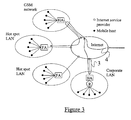
- FIG 3 also illustrates a GSM cellular telephone network together with two so-called hot spot LANs.
- the GSM network provides cellular telephone services to subscribers over a wide geographical area whilst the hot spot LANs provide relatively high capacity telephone services over a smaller local area.
- the geographical coverage of the GSM network may overlap with that of the hot spot LANs.
- the GSM network and the two hot spot LANs are operated by the same operator which bills subscribers using any or all of the operated networks by way of a single bill.
- the host will deregister with the former whilst registering with the latter.
- the network assigns and transmits to the mobile host a new internet address in that network.
- This new address is either one of a number of addresses allocated to the GSM network and defining the home agent as the end point, or is dynamically assigned to the mobile host (e.g. using DHCP) to define the mobile host as the end point. In either case, the new address replaces the internet address allocated to the host when it was registered to the corporate LAN.
- a registration message is therefore transmitted from the mobile host to the corporate LAN's home agent to register the mobile host's new internet address with the home agent (either as a care-of-address or as a co-located care-of-address).
- the corporate LAN's home agent determines that the mobile host is now registered with a foreign network and it redirects the datagrams to the care-of-address or co-located care-of-address now registered for the mobile host.
- the GSM network's home agent receives these forwarded datagrams and redirects them to the mobile host, either directly or via a foreign agent in a hot spot LAN. This redirection route is indicated in Figure 3 by reference numeral 3.
- the mobile host On the mobile host returning from the cellular telephone network to the corporate LAN, the process described above is repeated in reverse.
- the mobile host deregisters to the cellular telephone network and registers with the corporate LAN.
- the mobile host sends its new internet address in the corporate LAN to the home agent of the GSM network as a care-of-address (or co-located care-of-address) for the mobile host.
- the cellular telephone network described above may comprise more or fewer than three subnetworks.
- the corporate network may comprise a number of different subnetworks, all sharing a common home agent.
- the invention may also be applied to more than two networks, e.g. to a corporate network and to two cellular telephone networks operated by different operators.
Landscapes
- Engineering & Computer Science (AREA)
- Computer Networks & Wireless Communication (AREA)
- Signal Processing (AREA)
- Databases & Information Systems (AREA)
- Computer Security & Cryptography (AREA)
- Data Exchanges In Wide-Area Networks (AREA)
- Mobile Radio Communication Systems (AREA)
- Small-Scale Networks (AREA)
Claims (11)
- Procédé pour permettre la navigation d'un hôte mobile depuis un premier réseau d'accès à Internet à un second réseau d'accès à Internet, le procédé comprenant les étapes consistant à :fournir, pour l'hôte mobile, un agent d'accueil dans le premier réseau ;dé-enregistrer l'hôte mobile à partir dudit premier réseau et l'enregistrer avec ledit second réseau ;affecter à l'hôte mobile une nouvelle adresse Internet dans ledit second réseau ;transmettre ladite nouvelle adresse Internet à l'agent d'accueil du premier réseau et enregistrer cette adresse transmise au niveau de l'agent d'accueil du premier réseau comme adresse sûre ou adresse sûre co-placée pour l'hôte mobile, dans lequel le procédé comprend, en outre :fournir, pour l'hôte mobile, un agent d'accueil dans le second réseau, en plus de l'agent d'accueil dans le premier réseau ;remplacer, dans l'hôte mobile, la nouvelle adresse Internet par une adresse Internet précédemment affectée à l'hôte mobile dans le premier réseau ;envoyer des datagrammes adressés à ladite nouvelle adresse Internet directement à l'hôte mobile via l'agent d'accueil du second réseau, etsi ledit premier réseau reçoit les datagrammes adressés à une adresse Internet précédemment affectée à l'hôte mobile dans ledit premier réseau :envoyer lesdits datagrammes reçus, en utilisant ladite adresse sûre enregistrée ou adresse sûre co-positionnée, de l'agent d'accueil dudit premier réseau à l'hôte mobile via l'agent d'accueil du second réseau.
- Procédé selon la revendication 1, dans lequel le second réseau comprend un sous-réseau, le procédé comprenant les étapes consistant à :émettre ou envoyer des datagrammes à l'hôte mobile dans le sous-réseau via l'agent d'accueil du second réseau.
- Procédé selon la revendication 1, dans lequel le premier réseau d'accès à Internet est un réseau d'un premier type et le second réseau d'accès à Internet est un réseau d'un autre type.
- Procédé selon la revendication 1, dans lequel lesdits premier et second réseaux sont un d'un réseau local de société ou d'un réseau étendu et un réseau téléphonique cellulaire.
- Procédé selon la revendication 4, dans lequel le réseau local de société ou le réseau étendu est un d'un réseau à ligne fixe ou un réseau sans fil.
- Procédé selon la revendication 4 ou 5, dans lequel le réseau téléphonique cellulaire comprend un réseau GSM (Système Global pour Communications Mobiles).
- Procédé selon l'une quelconque des revendications 4 à 6, dans lequel le réseau téléphonique cellulaire comprend une pluralité de sous-réseaux.
- Procédé selon la revendication 7, dans lequel un ou plusieurs desdits sous-réseaux est/sont des réseaux locaux sans fil ou des réseaux étendus.
- Appareil pour permettre la navigation d'un hôte mobile d'un premier réseau d'accès à Internet à un second réseau d'accès à Internet, l'appareil comprenant :un agent d'accueil, pour l'hôte mobile, dans le premier réseau ;un moyen de commande de second réseau pour enregistrer l'hôte mobile dans le second réseau et pour transmettre à l'hôte mobile une nouvelle adresse Internet dans le second réseau ;un moyen de transmission pour transmettre ladite nouvelle adresse Internet depuis l'hôte mobile à l'agent d'accueil dans le premier réseau ;un moyen de commande du premier réseau pour enregistrer ladite adresse transmise au niveau de l'agent d'accueil du premier réseau comme adresse sûre ou adresse sûre co-positionnée pour l'hôte mobile, dans lequel les moyens de commande du second réseau sont conçus pour transmettre ladite nouvelle adresse Internet à l'hôte mobile pour remplacer toute adresse Internet précédemment attribuée à l'hôte, l'appareil comprenant, en outre :un agent d'accueil, pour l'hôte mobile, dans le second réseau ;un moyen d'acheminement de datagrammes dans ledit premier réseau pour envoyer des datagrammes, reçus au niveau dudit premier réseau et destinés à l'hôte mobile, via l'agent d'accueil du second réseau, etun moyen d'émission pour émettre des datagrammes adressés à la nouvelle adresse Internet directement à l'hôte mobile via l'agent d'accueil du second réseau.
- Appareil selon la revendication 9, dans lequel le premier réseau d'accès à Internet est un réseau d'un premier type et le second réseau d'accès à Internet est un réseau d'un autre type.
- Appareil selon la revendication 9, dans lequel au moins un desdits premier et second réseaux est un réseau téléphonique sans fil et ledit hôte mobile est un terminal sans fil.
Applications Claiming Priority (2)
| Application Number | Priority Date | Filing Date | Title |
|---|---|---|---|
| FI974557A FI113445B (fi) | 1997-12-18 | 1997-12-18 | Liikkuva Internet-protokolla |
| FI974557 | 1997-12-18 |
Publications (3)
| Publication Number | Publication Date |
|---|---|
| EP0924914A2 EP0924914A2 (fr) | 1999-06-23 |
| EP0924914A3 EP0924914A3 (fr) | 1999-08-18 |
| EP0924914B1 true EP0924914B1 (fr) | 2003-04-23 |
Family
ID=8550161
Family Applications (1)
| Application Number | Title | Priority Date | Filing Date |
|---|---|---|---|
| EP98660119A Expired - Lifetime EP0924914B1 (fr) | 1997-12-18 | 1998-11-10 | Protocole pour internet mobile |
Country Status (4)
| Country | Link |
|---|---|
| US (1) | US6484211B2 (fr) |
| EP (1) | EP0924914B1 (fr) |
| DE (1) | DE69813743T2 (fr) |
| FI (1) | FI113445B (fr) |
Cited By (7)
| Publication number | Priority date | Publication date | Assignee | Title |
|---|---|---|---|---|
| US8843515B2 (en) | 2012-03-07 | 2014-09-23 | Snap Trends, Inc. | Methods and systems of aggregating information of social networks based on geographical locations via a network |
| US8886226B2 (en) | 2008-03-14 | 2014-11-11 | William J. Johnson | System and method for timely whereabouts determination by a mobile data processing system |
| US8887177B2 (en) | 2008-03-14 | 2014-11-11 | William J. Johnson | System and method for automated content distribution objects |
| US8897741B2 (en) | 2009-11-13 | 2014-11-25 | William J. Johnson | System and method for mobile device usability by locational conditions |
| US8942732B2 (en) | 2008-03-14 | 2015-01-27 | William J. Johnson | Location based exchange operating system |
| US8942693B2 (en) | 2008-03-14 | 2015-01-27 | William J. Johnson | System and method for targeting data processing system(s) with data |
| US9477991B2 (en) | 2013-08-27 | 2016-10-25 | Snap Trends, Inc. | Methods and systems of aggregating information of geographic context regions of social networks based on geographical locations via a network |
Families Citing this family (51)
| Publication number | Priority date | Publication date | Assignee | Title |
|---|---|---|---|---|
| US6496505B2 (en) * | 1998-12-11 | 2002-12-17 | Lucent Technologies Inc. | Packet tunneling optimization to wireless devices accessing packet-based wired networks |
| US6763007B1 (en) * | 1998-12-11 | 2004-07-13 | Lucent Technologies Inc. | Two phase local mobility scheme for wireless access to packet based networks |
| GB9900970D0 (en) * | 1999-01-15 | 1999-03-10 | British Telecomm | Communications network |
| US6973057B1 (en) * | 1999-01-29 | 2005-12-06 | Telefonaktiebolaget L M Ericsson (Publ) | Public mobile data communications network |
| US6725047B1 (en) * | 1999-06-09 | 2004-04-20 | Tantivy Communications, Inc. | Floating IP address for roaming internet connected subscriber units |
| US8670405B1 (en) * | 1999-06-09 | 2014-03-11 | Cellco Partnership | Mobile internet protocol square |
| DE19936783C2 (de) * | 1999-08-09 | 2001-09-27 | Deutsche Telekom Mobil | Verfahren zur Nutzung von durch ein Kommunikationsnetz bereitgestellten teilnehmerbezogenen Wirknetzinformationen in Mehrwert- oder Internetdiensten |
| US6526034B1 (en) | 1999-09-21 | 2003-02-25 | Tantivy Communications, Inc. | Dual mode subscriber unit for short range, high rate and long range, lower rate data communications |
| US6904025B1 (en) * | 1999-10-12 | 2005-06-07 | Telefonaktiebolaget Lm Ericsson (Publ) | Wide area network mobility for IP based networks |
| KR100655828B1 (ko) * | 1999-10-08 | 2006-12-11 | 텔레호낙티에볼라게트 엘엠 에릭슨(피유비엘) | Ip 기반 네트워크를 위한 광역 네트워크 이동성 |
| US7743089B2 (en) * | 1999-10-13 | 2010-06-22 | Intel Corporation | Method and system for dynamic application layer gateways |
| AU773884B2 (en) | 1999-11-03 | 2004-06-10 | Cisco Technology, Inc. | Distributed network communication system which enables multiple network providers to use a common distributed network infrastructure |
| EP1111874A1 (fr) * | 1999-12-20 | 2001-06-27 | Telefonaktiebolaget L M Ericsson | Prócede de routage dans un réseau mobile-IP Ad-Hoc |
| CA2327160A1 (fr) * | 2000-01-12 | 2001-07-12 | Lucent Technologies Inc. | Acheminement dynamique de communications sans fil |
| US7554967B1 (en) * | 2000-03-30 | 2009-06-30 | Alcatel-Lucent Usa Inc. | Transient tunneling for dynamic home addressing on mobile hosts |
| US7173917B1 (en) * | 2000-03-31 | 2007-02-06 | Nortel Networks Limited | Unicast agent advertisement based on layer 2 and layer 3 motion detection |
| US20020022483A1 (en) | 2000-04-18 | 2002-02-21 | Wayport, Inc. | Distributed network communication system which allows multiple wireless service providers to share a common network infrastructure |
| AU2001259394A1 (en) * | 2000-05-05 | 2001-11-20 | Adsi, Inc | End-t0o-end aeronautical data network architecture and method and apparatus for transitioning thereto |
| US6804720B1 (en) * | 2000-06-07 | 2004-10-12 | Telefonaktiebolaget Lm Ericsson (Publ) | Mobile internet access |
| US6751204B1 (en) * | 2000-07-05 | 2004-06-15 | Telefonaktiebolaget Lm Ericsson (Publ) | Call routing method for 3G.IP networks |
| DE10054046A1 (de) * | 2000-10-31 | 2002-05-16 | Bernhard Walke | System zur Erbringung mobiler Internetdienste durch Koordination unabhängiger Funkzugangspunkte |
| US7139833B2 (en) * | 2001-04-04 | 2006-11-21 | Ipr Licensing, Inc. | Proxy mobile node capability for mobile IP |
| DE10120772A1 (de) | 2001-04-24 | 2002-11-07 | Siemens Ag | Heterogenes Mobilfunksystem |
| FR2827465B1 (fr) * | 2001-07-13 | 2004-01-02 | Cegetel | Procede d'adressage d'un terminal mobile |
| US20090168719A1 (en) * | 2001-10-11 | 2009-07-02 | Greg Mercurio | Method and apparatus for adding editable information to records associated with a transceiver device |
| KR20030033202A (ko) * | 2001-10-19 | 2003-05-01 | 학교법인고려중앙학원 | 이동 인터넷 프로토콜 상에서의 재지정 서브넷 스위칭 방법 |
| FI114190B (fi) | 2002-01-11 | 2004-08-31 | Radionet Oy | Menetelmä liikkuvuuden tukemiseksi langattomissa verkoissa |
| WO2003077429A2 (fr) * | 2002-03-04 | 2003-09-18 | Air Broadband Communications | Systeme de pont d'acces sans fil hybride et de routeur d'acces mobile et procede associe |
| US7072657B2 (en) * | 2002-04-11 | 2006-07-04 | Ntt Docomo, Inc. | Method and associated apparatus for pre-authentication, preestablished virtual private network in heterogeneous access networks |
| US7525940B2 (en) * | 2002-04-26 | 2009-04-28 | Nokia Siemens Networks Oy | Relocation of content sources during IP-level handoffs |
| US20030220111A1 (en) * | 2002-05-13 | 2003-11-27 | Kang Ki Bong | DSL mobile access router system and method |
| KR100427551B1 (ko) | 2002-05-14 | 2004-04-28 | 에스케이 텔레콤주식회사 | 공중 무선랜과 셀룰러망 간의 로밍 방법 |
| US7315526B2 (en) * | 2002-06-20 | 2008-01-01 | Thomson Licensing | Dual home mobility management in a wireless telephony/wireless LAN interworking environment |
| FR2849976B1 (fr) * | 2003-01-09 | 2005-04-08 | 6Wind | Procede pour l'autoconfiguration d'un routeur de bordure par diffusion d'un contexte. |
| US20040137901A1 (en) * | 2003-01-13 | 2004-07-15 | Ryutaro Hamasaki | Vertical handover method by IP multicast |
| JP4295023B2 (ja) * | 2003-02-25 | 2009-07-15 | 株式会社エヌ・ティ・ティ・ドコモ | ネットワークを制御するシステム、装置及び方法 |
| US20040179537A1 (en) * | 2003-03-11 | 2004-09-16 | Motorola, Inc. | Method and apparatus providing a mobile server function in a wireless communications device |
| US7328256B2 (en) * | 2003-06-02 | 2008-02-05 | Apple Inc. | Method and apparatus for distributing computer files across a network to multiple clients |
| DE10346086B4 (de) * | 2003-10-04 | 2006-12-14 | Fritz Paul | Verfahren zur Datenkommunikation zwischen einem mobilen Datenendgerät (ME) eines Anwenders und einem Zieldatennetzwerk |
| CA2752219C (fr) * | 2003-10-08 | 2015-03-17 | Research In Motion Limited | Systeme et procede permettant de gerer la mobilite des couches ip dans un reseau sans fil |
| FR2858511A1 (fr) * | 2003-12-11 | 2005-02-04 | France Telecom | Procede, systeme et terminal de continuite de services de telecommunications |
| KR20070007032A (ko) * | 2004-01-20 | 2007-01-12 | 엘지전자 주식회사 | 이동 애드 혹 네트워크 시스템 및 운용 방법 |
| US7206859B2 (en) * | 2004-02-18 | 2007-04-17 | Motorola, Inc. | Method for optimized local routing between mobile nodes |
| US20050255849A1 (en) * | 2004-03-17 | 2005-11-17 | Kang Ki B | User movement prediction algorithm in wireless network environment |
| KR100621590B1 (ko) | 2004-10-16 | 2006-09-19 | 삼성전자주식회사 | 무선 네트워크 장치 및 이를 이용한 통신 방법 |
| KR100727932B1 (ko) * | 2005-02-14 | 2007-06-14 | 삼성전자주식회사 | 이동 노드를 등록하는 방법 및 장치 |
| US20080020758A1 (en) * | 2006-07-20 | 2008-01-24 | Symbol Technologies, Inc. | Query-response techniques for reduction of wireless client database size to provide scalability in large wireless switch networks supporting layer 3 mobility |
| CN101179820A (zh) * | 2006-11-06 | 2008-05-14 | 华为技术有限公司 | 一种移动台注册方法及通用接入网控制器 |
| US8171120B1 (en) * | 2006-11-22 | 2012-05-01 | Rockstar Bidco Lp | Mobile IPv6 route optimization authorization |
| US8634796B2 (en) | 2008-03-14 | 2014-01-21 | William J. Johnson | System and method for location based exchanges of data facilitating distributed location applications |
| US9894489B2 (en) | 2013-09-30 | 2018-02-13 | William J. Johnson | System and method for situational proximity observation alerting privileged recipients |
Family Cites Families (8)
| Publication number | Priority date | Publication date | Assignee | Title |
|---|---|---|---|---|
| US5517618A (en) * | 1992-02-10 | 1996-05-14 | Matsushita Electric Industrial Co., Ltd. | Mobile migration communications control device |
| US5442633A (en) * | 1992-07-08 | 1995-08-15 | International Business Machines Corporation | Shortcut network layer routing for mobile hosts |
| US5325362A (en) * | 1993-09-29 | 1994-06-28 | Sun Microsystems, Inc. | Scalable and efficient intra-domain tunneling mobile-IP scheme |
| US5825759A (en) * | 1994-10-26 | 1998-10-20 | Telefonaktiebolaget Lm Ericsson | Distributing network services and resources in a mobile communications network |
| JP2838998B2 (ja) * | 1996-02-07 | 1998-12-16 | 日本電気株式会社 | 移動端末及び移動対応ネットワーク |
| DE69738095T2 (de) | 1996-06-07 | 2008-05-29 | Nippon Telegraph And Telephone Corp. | Verfahren und System zur Steuerung eines VLANs |
| JPH1023056A (ja) * | 1996-07-01 | 1998-01-23 | Nec Corp | ローカルエリアネットワークにおける移動ホスト管理方法 |
| JP3488347B2 (ja) * | 1996-08-29 | 2004-01-19 | 株式会社日立製作所 | アドレス自動配布システム及びアドレス配布サーバ |
-
1997
- 1997-12-18 FI FI974557A patent/FI113445B/fi active
-
1998
- 1998-11-10 EP EP98660119A patent/EP0924914B1/fr not_active Expired - Lifetime
- 1998-11-10 DE DE69813743T patent/DE69813743T2/de not_active Expired - Lifetime
- 1998-12-10 US US09/209,106 patent/US6484211B2/en not_active Expired - Lifetime
Cited By (23)
| Publication number | Priority date | Publication date | Assignee | Title |
|---|---|---|---|---|
| US9055406B2 (en) | 2008-03-14 | 2015-06-09 | William J. Johnson | Server-less synchronized processing across a plurality of interoperating data processing systems |
| US8942693B2 (en) | 2008-03-14 | 2015-01-27 | William J. Johnson | System and method for targeting data processing system(s) with data |
| US8887177B2 (en) | 2008-03-14 | 2014-11-11 | William J. Johnson | System and method for automated content distribution objects |
| US9584993B2 (en) | 2008-03-14 | 2017-02-28 | William J. Johnson | System and method for vector processing on behalf of image aperture aim |
| US9456303B2 (en) | 2008-03-14 | 2016-09-27 | William J. Johnson | System and method for service access via hopped wireless mobile device(s) |
| US8923806B2 (en) | 2008-03-14 | 2014-12-30 | William J. Johnson | System and method for presenting application data by data processing system(s) in a vicinity |
| US8942732B2 (en) | 2008-03-14 | 2015-01-27 | William J. Johnson | Location based exchange operating system |
| US9088869B2 (en) | 2008-03-14 | 2015-07-21 | William J. Johnson | System and method for application search results by locational conditions |
| US9078095B2 (en) | 2008-03-14 | 2015-07-07 | William J. Johnson | System and method for location based inventory management |
| US9014658B2 (en) | 2008-03-14 | 2015-04-21 | William J. Johnson | System and method for application context location based configuration suggestions |
| US8886226B2 (en) | 2008-03-14 | 2014-11-11 | William J. Johnson | System and method for timely whereabouts determination by a mobile data processing system |
| US9445238B2 (en) | 2008-03-14 | 2016-09-13 | William J. Johnson | System and method for confirming data processing system target(s) |
| US8942733B2 (en) | 2008-03-14 | 2015-01-27 | William J. Johnson | System and method for location based exchanges of data facilitating distributed location applications |
| US9088868B2 (en) | 2008-03-14 | 2015-07-21 | William J. Johnson | Location based exchange permissions |
| US9100792B2 (en) | 2008-03-14 | 2015-08-04 | William J. Johnson | System and method for service-free location based applications |
| US9113295B2 (en) | 2008-03-14 | 2015-08-18 | William J. Johnson | System and method for location based exchange vicinity interest specification |
| US9204275B2 (en) | 2008-03-14 | 2015-12-01 | William J. Johnson | System and method for targeting data processing system(s) with data |
| US9253597B2 (en) | 2008-03-14 | 2016-02-02 | William J. Johnson | System and method for determining mobile users of interest |
| US9392408B2 (en) | 2008-03-14 | 2016-07-12 | William J. Johnson | System and method for location based exchanges of data facilitating distributed locational applications |
| US8897742B2 (en) | 2009-11-13 | 2014-11-25 | William J. Johnson | System and method for sudden proximal user interface |
| US8897741B2 (en) | 2009-11-13 | 2014-11-25 | William J. Johnson | System and method for mobile device usability by locational conditions |
| US8843515B2 (en) | 2012-03-07 | 2014-09-23 | Snap Trends, Inc. | Methods and systems of aggregating information of social networks based on geographical locations via a network |
| US9477991B2 (en) | 2013-08-27 | 2016-10-25 | Snap Trends, Inc. | Methods and systems of aggregating information of geographic context regions of social networks based on geographical locations via a network |
Also Published As
| Publication number | Publication date |
|---|---|
| EP0924914A2 (fr) | 1999-06-23 |
| FI974557A0 (fi) | 1997-12-18 |
| US6484211B2 (en) | 2002-11-19 |
| US20020143990A1 (en) | 2002-10-03 |
| FI113445B (fi) | 2004-04-15 |
| FI974557L (fi) | 1999-06-19 |
| DE69813743D1 (de) | 2003-05-28 |
| EP0924914A3 (fr) | 1999-08-18 |
| DE69813743T2 (de) | 2004-03-18 |
Similar Documents
| Publication | Publication Date | Title |
|---|---|---|
| EP0924914B1 (fr) | Protocole pour internet mobile | |
| EP0944203B1 (fr) | Accès mobile à Internet | |
| EP1927228B1 (fr) | Noeud mobile a interfaces multiples et a connexion reseau domestique et etranger simultanee | |
| KR101086349B1 (ko) | 통신 네트워크의 동작 제어방법 및 시스템과 관련된네트워크 및 그 컴퓨터 프로그램 제품 | |
| JP3924502B2 (ja) | モバイル通信方法およびモバイル通信システム | |
| US7751379B2 (en) | IP mobility mechanism for a packet radio network | |
| EP1667407A1 (fr) | Traduction d'adresses réseau par le domaine de réseau domestique d'un réseau embarqué | |
| JP4522035B2 (ja) | 通信システム及び方法 | |
| AU2004209863A1 (en) | Methods and apparatus for supporting an internet protocol (IP) version independent mobility management system | |
| US8300631B2 (en) | Method for realizing mobile IP management and the network system thereof | |
| EP1719321B1 (fr) | Procede et appareil de gestion de groupes de plusieurs identificateurs de liaisons destines a la mobilite collective | |
| JP2000092562A (ja) | ルータ装置、無線端末装置、無線基地局及びメッセージ送信制御方法 | |
| JP5404791B2 (ja) | モバイルノードをホームエージェントに登録するための方法及びフォーリンエージェントグループ | |
| FI113328B (fi) | Mekanismi roamingin yksinkertaistamiseksi viestintäjärjestelmässä | |
| Sun et al. | Mobile IP applicability: When do we really need it? | |
| Onah | Mobile IP Framework for Seamless Global Roaming Across Heterogeneous Networks. | |
| EP1883196A1 (fr) | Méthode pour une transmission de données a base de paquets dans un réseau comprenant fonctionnalité mobilité | |
| Criste et al. | Introspection in Mobile IP | |
| Florian et al. | A New Network Based Global Mobility Management Solution. | |
| CA2313165A1 (fr) | Methode et appareillage de transmission de donnees dans un reseau sans fil |
Legal Events
| Date | Code | Title | Description |
|---|---|---|---|
| PUAI | Public reference made under article 153(3) epc to a published international application that has entered the european phase |
Free format text: ORIGINAL CODE: 0009012 |
|
| AK | Designated contracting states |
Kind code of ref document: A2 Designated state(s): DE FR GB SE |
|
| AX | Request for extension of the european patent |
Free format text: AL;LT;LV;MK;RO;SI |
|
| PUAL | Search report despatched |
Free format text: ORIGINAL CODE: 0009013 |
|
| AK | Designated contracting states |
Kind code of ref document: A3 Designated state(s): AT BE CH CY DE DK ES FI FR GB GR IE IT LI LU MC NL PT SE |
|
| AX | Request for extension of the european patent |
Free format text: AL;LT;LV;MK;RO;SI |
|
| RIC1 | Information provided on ipc code assigned before grant |
Free format text: 6H 04L 29/06 A, 6H 04L 12/28 B |
|
| 17P | Request for examination filed |
Effective date: 20000218 |
|
| AKX | Designation fees paid |
Free format text: DE FR GB SE |
|
| 17Q | First examination report despatched |
Effective date: 20000324 |
|
| RAP1 | Party data changed (applicant data changed or rights of an application transferred) |
Owner name: NOKIA CORPORATION |
|
| GRAH | Despatch of communication of intention to grant a patent |
Free format text: ORIGINAL CODE: EPIDOS IGRA |
|
| GRAH | Despatch of communication of intention to grant a patent |
Free format text: ORIGINAL CODE: EPIDOS IGRA |
|
| GRAA | (expected) grant |
Free format text: ORIGINAL CODE: 0009210 |
|
| AK | Designated contracting states |
Designated state(s): DE FR GB SE |
|
| REG | Reference to a national code |
Ref country code: GB Ref legal event code: FG4D |
|
| REF | Corresponds to: |
Ref document number: 69813743 Country of ref document: DE Date of ref document: 20030528 Kind code of ref document: P |
|
| REG | Reference to a national code |
Ref country code: SE Ref legal event code: TRGR |
|
| ET | Fr: translation filed | ||
| PLBE | No opposition filed within time limit |
Free format text: ORIGINAL CODE: 0009261 |
|
| STAA | Information on the status of an ep patent application or granted ep patent |
Free format text: STATUS: NO OPPOSITION FILED WITHIN TIME LIMIT |
|
| 26N | No opposition filed |
Effective date: 20040126 |
|
| PGFP | Annual fee paid to national office [announced via postgrant information from national office to epo] |
Ref country code: SE Payment date: 20081107 Year of fee payment: 11 |
|
| EUG | Se: european patent has lapsed | ||
| PGFP | Annual fee paid to national office [announced via postgrant information from national office to epo] |
Ref country code: FR Payment date: 20101123 Year of fee payment: 13 |
|
| PGFP | Annual fee paid to national office [announced via postgrant information from national office to epo] |
Ref country code: DE Payment date: 20101104 Year of fee payment: 13 |
|
| PGFP | Annual fee paid to national office [announced via postgrant information from national office to epo] |
Ref country code: GB Payment date: 20101110 Year of fee payment: 13 |
|
| PG25 | Lapsed in a contracting state [announced via postgrant information from national office to epo] |
Ref country code: SE Free format text: LAPSE BECAUSE OF NON-PAYMENT OF DUE FEES Effective date: 20091111 |
|
| GBPC | Gb: european patent ceased through non-payment of renewal fee |
Effective date: 20111110 |
|
| REG | Reference to a national code |
Ref country code: FR Ref legal event code: ST Effective date: 20120731 |
|
| REG | Reference to a national code |
Ref country code: DE Ref legal event code: R119 Ref document number: 69813743 Country of ref document: DE Effective date: 20120601 |
|
| PG25 | Lapsed in a contracting state [announced via postgrant information from national office to epo] |
Ref country code: GB Free format text: LAPSE BECAUSE OF NON-PAYMENT OF DUE FEES Effective date: 20111110 |
|
| PG25 | Lapsed in a contracting state [announced via postgrant information from national office to epo] |
Ref country code: FR Free format text: LAPSE BECAUSE OF NON-PAYMENT OF DUE FEES Effective date: 20111130 |
|
| PG25 | Lapsed in a contracting state [announced via postgrant information from national office to epo] |
Ref country code: DE Free format text: LAPSE BECAUSE OF NON-PAYMENT OF DUE FEES Effective date: 20120601 |