EP0925311B1 - Verfahren zur herstellung von polymeren in gegenwart von triazolylradikalen - Google Patents
Verfahren zur herstellung von polymeren in gegenwart von triazolylradikalen Download PDFInfo
- Publication number
- EP0925311B1 EP0925311B1 EP97902328A EP97902328A EP0925311B1 EP 0925311 B1 EP0925311 B1 EP 0925311B1 EP 97902328 A EP97902328 A EP 97902328A EP 97902328 A EP97902328 A EP 97902328A EP 0925311 B1 EP0925311 B1 EP 0925311B1
- Authority
- EP
- European Patent Office
- Prior art keywords
- monomers
- styrene
- polymer
- group
- radicals
- Prior art date
- Legal status (The legal status is an assumption and is not a legal conclusion. Google has not performed a legal analysis and makes no representation as to the accuracy of the status listed.)
- Expired - Lifetime
Links
Classifications
-
- C—CHEMISTRY; METALLURGY
- C08—ORGANIC MACROMOLECULAR COMPOUNDS; THEIR PREPARATION OR CHEMICAL WORKING-UP; COMPOSITIONS BASED THEREON
- C08F—MACROMOLECULAR COMPOUNDS OBTAINED BY REACTIONS ONLY INVOLVING CARBON-TO-CARBON UNSATURATED BONDS
- C08F4/00—Polymerisation catalysts
-
- C—CHEMISTRY; METALLURGY
- C08—ORGANIC MACROMOLECULAR COMPOUNDS; THEIR PREPARATION OR CHEMICAL WORKING-UP; COMPOSITIONS BASED THEREON
- C08F—MACROMOLECULAR COMPOUNDS OBTAINED BY REACTIONS ONLY INVOLVING CARBON-TO-CARBON UNSATURATED BONDS
- C08F293/00—Macromolecular compounds obtained by polymerisation on to a macromolecule having groups capable of inducing the formation of new polymer chains bound exclusively at one or both ends of the starting macromolecule
-
- C—CHEMISTRY; METALLURGY
- C09—DYES; PAINTS; POLISHES; NATURAL RESINS; ADHESIVES; COMPOSITIONS NOT OTHERWISE PROVIDED FOR; APPLICATIONS OF MATERIALS NOT OTHERWISE PROVIDED FOR
- C09B—ORGANIC DYES OR CLOSELY-RELATED COMPOUNDS FOR PRODUCING DYES, e.g. PIGMENTS; MORDANTS; LAKES
- C09B21/00—Thiazine dyes
Definitions
- the present invention relates to a method for manufacturing of polymers.
- the present invention further relates to the use of the polymers obtainable here for the preparation of moldings, foils or fibers.
- the present invention according to the inventive method available polymers, and their use.
- iniferters are radical formers, which are a polymerization both radical initiate as well as the chain end by combination terminate.
- photochemically activated inifers such as dithiocarbamates
- photochemical inifters are very expensive compounds and a photochemically initiated polymerization is in the industrial practice very uneconomical.
- the Polydispersity index sometimes very high.
- thermal inifters such as tetramethylene disulfides, for example in K. Endo et al., Macromolecules, Vol. 25 (1992), Pages 5554 to 5556.
- the PDI is included Values between 3 and 4 unsatisfactorily high.
- EP-A 135 280 describes the use of stable N-oxyl radicals described that reversibly combine with the reactive chain ends. However, this procedure does not result in high molecular weight Polymers, but only oligomers obtained.
- a special group of initiators for controlled radical Polymerization are compounds that start in radical initiators and N-oxyl radicals can be split (trends in Polymer Science, 4 (6), 1996, 183-188). These connections allow, for example, the construction of branched polymers. However, only selected monomers can be polymerized and the reaction temperatures are unsatisfactorily high.
- reaction rates are at Polymerization of monomers in the presence of N-oxyl radicals too small for many technical purposes. Therefore e.g. Strength organic acids also used (US-A 5,322,912). these can however, cause difficulties when refurbishing the products.
- DE-P 195 16 967.0 describes processes in which vinyl monomers in the presence of common radical initiators and Electron donors that stabilize the radical chain end, be polymerized.
- the object of the present invention was to develop a new method to provide for the production of polymers with which polymerizes a wide range of unsaturated monomers can be. Furthermore, the new process should be a very good control over both the molecular weight distribution as well also allow the architecture and structure of the polymers. Furthermore a procedure should be found that is adequate high reaction speed even at lower temperatures having.
- radicals of the general formula I in which Q is NR 2 or S and T is CR 3 R 4 or S and R 1 , R 2 , R 3 and R 4 can be identical or different from one another and independently of one another hydrogen, C 1 - to C 20 -alkyl or C 6 - until C 18 aryl is carried out.
- the radicals represented in the general formula I are also to be understood to mean their tautomers and positional isomers.
- the alkyl radicals can be linear, branched or cyclic.
- alkyl radicals can contain sulfoxide or carbonyl radicals.
- the alkyl radicals include C 1 to C 12 alkyl, preferably C 1 to C 10 alkyl, for example methyl, ethyl, n-propyl, i-propyl, n-butyl, i-butyl, t-butyl, n- Pentyl, cyclopentyl, n-hexyl or cyclohexyl. Among them, methyl is particularly preferred.
- the preferred aryl radicals include phenyl, naphthyl and biphenyl. The aryl radicals can be substituted with one or more substituents or unsubstituted.
- Suitable substituents are alkyl radicals, for example C 1 -C 10 -alkyl, preferably C 1 -C 6 -alkyl, such as methyl, ethyl, n-propyl, i-propyl, n-butyl, i-butyl or t-butyl or else Hydroxy groups or halogen atoms, such as chlorine.
- the aryl radicals can also be substituted with one or more halogen atoms, such as chlorine, nitrile groups, NO 2 , sulfonic acid radicals, alkyl or aryl ester radicals. Phenyl is particularly preferred among the aryl radicals.
- the invention also relates to the use of radical I for the preparation of polymers.
- radicals I are thiatianolyls of the general formulas or dithiadianolyls of the general formula
- Triazolyl radicals whose radicals R 3 and R 4 are identical are particularly preferred.
- R 1 is phenyl
- R 2 is phenyl or methyl
- R 3 and R 4 are each phenyl, biphenyl-2,2'-diyl, 6,6'-dimethylbiphenyl-2,2'-diyl or 5, 5'-dimethylbiphenyl-2,2'-diyl.
- 2,5-Dihydro-1H-1,2,4-triazol-2-yl radicals are known per se or available by methods known per se. That's how they are Triazolyl radicals, for example, by irradiating 1H-1,2,4-triazoles accessible with ⁇ -radiation or can by Dehydrogenation of 4,5-dihydro-1H-1,2,4-triazoles with basic Potassium hexacyanoferrate solution can be prepared.
- Another The method of obtaining triazolyl radicals is the ring narrowing of tetrazines in the presence of acids (Tetrahedron, 51 (47), 1995, 12883-12898).
- Thiatrianolyls are e.g. by reducing the corresponding thiatriazol-1-ium salts representable (J. Am. Chem. Soc. Perkin Trans 2 (1990) 1619).
- Dithiadianolyls are e.g. through reduction of the corresponding dithiadiazadium salts available (Chem. Ber. 118 (1985) 3781.
- the radicals I can be generated in situ, for example, by one of the abovementioned methods.
- the radicals I are preferably prepared separately, isolated and used as such.
- the radicals I can also be used in the process according to the invention in the form of compounds II which can be split into radical initiators and radicals I.
- Such compounds can be summarized, for example, under the general formula II in which R 5 represents a radical which, when split off, can initiate a radical reaction.
- Preferred compounds II contain, as R 5, alkyl, preferably C 1 to C 10 alkyl, where the alkyl radical can be both linear and branched and can be substituted by one or more substituents, in particular halogen atoms, such as chlorine, or nitrile groups.
- the alkyl radicals can also be interrupted by one or more heteroatoms such as oxygen.
- R 5 can also be an aryl or substituted aryl radical, preferably C 6 to C 18 aryl.
- Preferred radicals R 5 are decomposition residues of commercially available radical initiators such as isobutyronitrile or benzoyl.
- the invention also relates to the use of compounds II, which can be split into radicals I and radical starters, for Manufacture of polymers.
- the preparation of compounds II can e.g. through reaction a radical source such as dibenzoyl peroxide or azoisobutyronitrile done with a radical I.
- a radical source such as dibenzoyl peroxide or azoisobutyronitrile
- the source of radicals can thereby methods known per se, for example thermally, photochemically or be split redorchemically into the decay residues.
- the compounds II can, for example, be thermally or cleave photochemically. Furthermore, the compounds II can be redox-chemically to be split. Usually the connections II thermally split. Generally the connections split II at temperatures in the range from 0 to 300 ° C, preferably in Range from 50 to 150 ° C.
- the inventive method can be carried out so that a radical I or a compound II uses. It is also possible to use different radicals I or compounds II. It is also possible to use mixtures of radicals I and Use compounds II.
- the method according to the invention can be used for a wide variety of purposes unsaturated monomers, especially vinyl monomers, convert to polymers.
- vinyl monomers are vinyl aromatics such as styrene, 2-vinylnaphthalene and 9-vinylanthracene, substituted vinyl aromatics such as p-methylstyrene, ⁇ -methylstyrene, p-chlorostyrene, 2,4-dimethylstyrene and 4-vinylbiphenyl, C 1 - to C 8 - Alkyl esters of acrylic acid or methacrylic acid, especially C 1 to C 4 acrylates and C 1 to C 4 methacrylates, unsaturated dicarboxylic acids, for example aliphatic unsaturated dicarboxylic acids such as maleic and fumaric acid, or their derivatives such as anhydrides, esters and amides, in particular Anhydrides, such as maleic anhydride, or vinyl cyanides, especially acrylonitrile. Mixtures of different monomers can also be used.
- vinyl aromatics such as styrene, 2-vinylnaphthalene and 9
- Preferred monomers are styrene, substituted styrenes, C 1 to C 4 acrylates and C 1 to C 4 methacrylates, in particular methyl methacrylate, and acrylonitrile.
- radical initiators can also be used.
- the radical initiators are known per se and for example in Ullmann's Encyclopedia of Technical Chemistry, 4th edition, Volume 15, page 187. Are particularly suitable Peroxides such as dibenzoyl peroxide and cumene hydroperoxide and in particular Diazo compounds such as azodiisobutyronitrile (AIBN). It can also use mixtures of different radical initiators become.
- the molar amount of radical initiator can be 10 -6 to 1 mol / l, preferably 10 -4 to 10 -1 mol / l, based on the volume of the monomers used.
- the molar ratio of radical initiator to radical I is generally from 1: 0.5 to 1:10, preferably from 1: 0.5 to 1: 5, in particular from 1: 0.5 to 1: 2.5.
- the preferred phenothiazines include: where r is an integer from 2 to 11 and s is an integer from 1 to 4.
- the compounds used as electron donors are in themselves known or can be produced by methods known per se and for example in J.H. Perlstein, Angew. Chem. Int. Ed. Engl. 16 (1977), pages 519 to 534 and M.R. Bryce, Aldrichimica Acta, Vol. 18 (1985), pages 73 to 77.
- the molar ratio of electron donors to radicals I can in the range from 0.1: 1 to 10: 1, preferably from 0.5: 1 to 2: 1 lie.
- the molar ratio of electron donors to radical initiators can range from 1: 1 to 3: 1, preferably 1.6: 1 to 2.4: 1 lie.
- the inventive method can also in the presence of Mixtures of the radicals I and N-oxyl radicals carried out become. Furthermore, the invention is also considered Process in the presence of mixtures of radicals I, Perform electron donors and N-oxyl radicals. there the N-oxyl radicals serve as moderators, i.e. they slow down the reaction rate. This is probably because that the N-oxyl radicals partially remove the radicals I from the chain end oust.
- N-oxyl radicals are known per se or they can be prepared by methods known per se. According to the invention, different structures of N-oxyl radicals can be used. This includes both N-oxyl radicals of acyclic and cyclic structure. As a rule, cyclic N-oxyl radicals of the general formula IV are preferred:
- the radicals R 9 to R 14 may be identical or different from one another and are independently hydrogen, C 1 -C 20 -alkyl, C 6 -C 18 -aryl, -OH, -SH, -NH 2 , alkylamine or Dialkylamine.
- the variable n represents an integer from 1 to 5, preferably 2 or 3.
- C 1 to C 10 alkyl, in particular C 1 to C 5 alkyl, and phenyl among the aryl radicals are preferred.
- the radicals R 9 and R 10 and R 13 and R 14 are each preferably phenyl or alkyl or a phenyl radical and an alkyl group such as methyl or ethyl.
- R 11 and R 12 are preferably hydrogen.
- n is greater than 1, the CR 11 R 12 groups can in each case be the same. However, different CR 11 R 12 groups can also be present. If there is more than one CR 11 R 12 group, the residues of one of these groups preferably denote OH and hydrogen.
- 2,2,6,6-Tetramethyl-1-piperidinyloxy are preferred, 4-oxo-2,2,6,6-tetramethyl-1-piperidinyloxy (4-oxo-TEMPO), 4-hydroxy-2,2,6,6-tetramethyl-1-piperidinyloxy, 2,2,5,5-tetramethyl-1-pyrrolidinyloxy, 3-carboxy-2,2,5,5-tetramethyl-pyrrolidinyloxy and di-tert-butyl nitroxide.
- 2,6-diphenyl-2,6-dimethyl-1-piperidinyloxy and 2,5-diphenyl-2,5-dimethyl-1-pyrrolidinyloxy can also be used. Mixtures of different N-oxyl radicals can also be used.
- the molar ratio of N-oxyl radical and radical I is in generally in the range from 0.1: 1 to 20: 1, preferably in Range from 0.1: 1 to 10: 1, particularly preferably in the range from 0.1: 1 to 2: 1.
- the molar ratio between the N-oxyl radical and the radical initiator is preferably in the range from 0.5: 1 to 5: 1, in particular from 0.8: 1 to 4: 1, particularly preferably in the range from 1 : 1 to 1.5: 1.
- the invention also relates to mixtures containing radicals I or compounds II and radical initiator or electron donor or N-oxyl radical or contain mixtures thereof.
- the polymerization according to the invention can be varied Methods such as bulk, solution, emulsion or suspension polymerization be made.
- the polymerization in the melt e.g. in an extruder or a kneader be performed.
- a solvent for the polymerization in Solution are, for example, tetrahydrofuran, toluene, ethylbenzene or their mixtures.
- the reaction conditions are generally not critical, the temperatures can range from 0 to 220 ° C, preferably in the range from 20 to 180 ° C, usually one works at normal pressure, but you can also work at pressures up to 30 bar.
- the Reaction times are preferably chosen so that one polymerizes, until the desired molecular weight is reached, for example 1 hour to 6 days.
- an inert gas for example Nitrogen or an inert gas such as argon.
- the method according to the invention is preferably carried out in this way before that the radical starter and radical I or a Compound II presents and the monomer or monomers and if necessary, the solvent is added.
- the radical starter and radical I or a Compound II presents and the monomer or monomers and if necessary, the solvent is added.
- it is possible also a reverse order of addition. Become electron donors or N-oxyl radicals or mixtures thereof, together with the radical starters and radical I be presented. But you can also separately or individually in the Course of the polymerization reaction are added.
- the workup the polymers can be precipitated, for example in methanol or hexane.
- the molecular weights M n (number average) of the resulting polymers can vary within wide ranges, for example from 5000 to 500,000 g / mol.
- the process according to the invention can be used or statistical copolymers also segmented Copolymers such as block copolymers, star block copolymers, graft copolymers or graft copolymers made by the polymers preferably without working up with other monomers or Monomer mixtures of different compositions can be further implemented.
- segmented Copolymers such as block copolymers, star block copolymers, graft copolymers or graft copolymers made by the polymers preferably without working up with other monomers or Monomer mixtures of different compositions can be further implemented.
- the addition of further amounts of radicals I or Compounds II, radical initiators, electron donors or N-oxyl radicals or mixtures thereof may be required.
- the monomers A) are preferably in an amount of 10 to 90 wt .-% used, in particular from 20 to 80 wt .-%.
- Monomers B) used are those which contain blocks B with a Form glass transition temperature of less than 0 ° C, selected from the group consisting of n-butyl acrylate, methyl acrylate and 2-ethylhexyl acrylate, preferably n-butyl acrylate.
- the monomers B) are preferably in an amount of 10 to 90 wt .-% used, in particular from 20 to 80 wt .-%, wherein the sum of the amounts of the monomers A) and B) gives 100% by weight.
- Particularly preferred block copolymers are those made from styrene or acrylonitrile or mixtures thereof, and n-butyl acrylate are or from methyl methacrylate and n-butyl acrylate.
- Blocks A and B each preferably have a molecular weight M w (weight average) in the range from 1000 to 250,000 and blocks A and B are not compatible with one another.
- the individual blocks A and B likewise preferably have a molecular weight distribution M w / M n of less than 3, in particular less than 2.
- Three-block polymers of the ABA or BAB type with a mixture of 65 to 85% by weight, preferably 70 to 80% by weight, styrene and 15 to 35% by weight, preferably 20 to 30% by weight, acrylonitrile are particularly suitable as monomer A and 50 to 100% by weight, preferably 70 to 100% by weight of n-butyl acrylate and 0 to 50% by weight, preferably 0 to 30% by weight, of one or more monomers from the group of acrylonitrile, olefinic Dienes such as butadiene, a, ⁇ -unsaturated carboxylic acids such as acrylic acid or methacrylic acid and esters of such carboxylic acids, in particular of C 1 -C 10 -alkanols as monomer B, the molecular weight M w of blocks A and B independently of one another each being 5000 to 10,000, preferably 30,000 to 70,000, like three-block polymers of the type BAB with a mixture of 75% by weight of styrene and
- the block copolymers according to the invention generally have a residue at the chain end which is derived from the radicals I or R 5 . Some of these residues can be replaced by a terminal oxyamine group.
- the block copolymers are preferred at a temperature in the Range from 100 to 160 ° C, preferably made from 130 to 160 ° C.
- the block copolymers can still 0 to 50 wt .-%, based on the Sum of the percentages by weight of A) and B), of fibrous or particulate Contain additives.
- This can be, for example, glass fibers, flame retardants, stabilizers and antioxidants, anti-heat decomposition agents or decomposition by ultraviolet light, lubricants and mold release agents, Dyes and pigments or plasticizers.
- Glass fibers made of E, A or C glass can be used. Most of time are the glass fibers with a size and an adhesion promoter equipped. The diameter of the glass fibers is generally between 6 and 20 ⁇ m. Both continuous fibers (rovings) and cut glass fibers with a length of 1 to 10 mm are also preferred from 3 to 6 mm.
- Pigments and dyes are generally preferred in amounts up to 6 from 0.5 to 5 and in particular from 0.5 to 3% by weight on the monomers A) and B).
- the pigments for coloring thermoplastics are generally known, see, for example, R. Gumbleter and H. Müller, Taschenbuch der Kunststoffadditive, Carl Hanser Verlag, 1983, pp. 494 to 510.
- the first preferred group of pigments are white pigments such as zinc oxide and zinc sulfide , Lead white (2PbCO 3 Pb (OH) 2 , lithopone, antimony white and titanium dioxide.
- Black color pigments that can be used are iron oxide black (Fe 3 O 4 ), spinel black (Cu (Cr, Fe) 2 O 4 ), manganese black (mixture of manganese dioxide, silicon dioxide and iron oxide), cobalt black and antimony black and particularly preferably carbon black is usually used in the form of furnace black or gas black (see G. Benzing, Pigments for Paints, Expert Verlag (1988), p. 78 ff).
- Oxidation retarders and heat stabilizers that block copolymers can be added, e.g. Halides of Group I metals of the periodic table, e.g. Sodium-, Potassium, lithium halides, optionally in combination with Copper (I) halides, e.g. Chlorides, bromides or iodides.
- the halides, especially those of copper, can also contain electron-rich p-ligands.
- Copper complexes are Cu halide complexes with e.g. Called triphenylphosphine.
- zinc fluoride or Zinc chloride can be used.
- UV stabilizers are various substituted ones Resorcins, salicylates, benzotriazoles and benzophenones, which in the generally in amounts up to 2 wt .-%, based on the monomers A) and B) are used.
- Lubricants and mold release agents usually in quantities up to 1% by weight added to the block copolymers are stearic acid, Stearyl alcohol, alkyl stearates and amides and Ester of pentaerythritol with long chain fatty acids. It can also salts of calcium, zinc or aluminum of stearic acid as well as dialkyl ketones, e.g. Distearyl ketone can be used.
- plasticizers are dialkyl phthalates or polymer Plasticizers containing at least one of the monomers A) or B) must be homogeneously miscible.
- the plasticizers can be used in quantities up to 50 wt .-%, based on the monomers A) and B), added become.
- the mixtures of the block copolymers with the additives can be prepared by processes known per se by the components in conventional mixing devices such as screw extruders, Brabender mills or Banbury mills mixes and then extruded. After extrusion, the extrudate cooled and crushed.
- block copolymers obtainable by the process according to the invention are characterized by high impact strength, in particular at low temperatures. At the same time, they point a high resistance to weathering and aging. Moreover they can be colored well and are also characterized by a Transparency / translucency from what leads to excellent coloring behavior leads. They are also suitable as impact modifiers in thermoplastic molding compounds.
- she can be processed into moldings or foils. she can also, for example, by means of known coextrusion processes in the form of layers (preferably in layer thicknesses in Range from 100 ⁇ m to 100 mm) on surfaces, preferably on Thermoplastics such as styrene-acrylonitrile copolymers, acrylonitrile-butadiene-styrene terpolymers (ABS), ASA plastics, polystyrene, impact-resistant polystyrene (HIPS), impact-resistant polymethyl methacrylate or PCV can be applied.
- Thermoplastics such as styrene-acrylonitrile copolymers, acrylonitrile-butadiene-styrene terpolymers (ABS), ASA plastics, polystyrene, impact-resistant polystyrene (HIPS), impact-resistant polymethyl methacrylate or PCV can be applied.
- thermoplastics such as styrene-acrylonitrile copolymers, Polymethyl methacrylate, polystyrene, polycarbonate, polyphenylene ether, Polyamide, impact modified polystyrene, acrylonitrile-butadiene-styrene copolymers (ABS), acrylonitrile-styrene-acrylate copolymers (ASA) or mixtures thereof, by means of known Injection molding and extrusion processes.
- styrene-acrylonitrile copolymers Polymethyl methacrylate, polystyrene, polycarbonate, polyphenylene ether, Polyamide, impact modified polystyrene, acrylonitrile-butadiene-styrene copolymers (ABS), acrylonitrile-styrene-acrylate copolymers (ASA) or mixtures thereof, by means of known Injection molding and extrusion processes.
- ABS acrylonitrile-butadiene-st
- the amphiphilic block copolymers according to the invention can be two-block copolymers, three-block copolymers or else multiblock copolymers comprising more than three blocks. Preferably they are not networked.
- amphiphilic block copolymers such as CD, CDC, DCC or ( CD) n , star-shaped systems such as C (D) n , D (C) n or (C) n -DC- (D) m , dendrimeric systems such as ((C) n -D) m C, ((D) n -C) m D, ((C) m -D) n C) p D or ((D) m -C) n D) p C or comb-shaped systems such as ((C) n -C (D)) q or ((D) n -D (C)) q , where m, n and p are integers from 1 to 5 and q is
- Blocks C and D preferably have (independently of one another) a degree of polymerization from 10 to 50, often from 10 to 40, often from 10 to 30 or 10 to 20.
- linear di- and triblock copolymers are according to the invention prefers.
- the sequence of the letters C, D the temporal Sequence of block production again can be inventively schematically represent favorable amphiphilic block copolymers as C-D, D-C, D-C-D and D'-C-D.
- the polymer blocks C, D, D ' often homopolymers.
- all polymer blocks are made of amphiphilic block copolymers according to the invention from homopolymers.
- the degrees of polymerization of hydrophilic and To coordinate hydrophobic polymer blocks in preliminary tests that the amphiphilic block copolymer to be used in the Amount to be used in the aqueous polymerization medium according to the invention required manner (usually the solubility is in water at 20 ° C and 1 atm at least 0.1 wt .-% soluble is.
- Amphiphilic block copolymers are also said to are to be expected, which are not directly in the aqueous Polymerization medium are soluble, but their solution indirectly e.g. can be brought about by first placing them in one with water-miscible organic solvents or in one Mixture of water and such an organic solvent dissolves (e.g. in dioxane, tetrahydrofuran or their mixtures Water) and this solution (some of which according to the invention be added directly to the aqueous polymerization medium can) e.g.
- solution implies not necessarily a molecular solution here, but only expresses that it is a clear liquid acts and includes in particular micellar solutions, especially those that are not thermodynamic Balance.
- the amphiphilic block copolymers according to the invention generally have a radical at the chain end which is derived from the radicals I or from R 5 . Some of these residues can be replaced by a terminal oxyamine group. For various reasons, removal of the radicals I derived from radicals I may be desirable. In column 6, lines 54ff, US-A 4,581,429 offers various such removal options. Of particular interest according to the invention are those which lead to an -H, a hydroxyl group or an ethylenically unsaturated terminal group.
- amphiphilic block copolymers are available (macromers), which are of interest in that they are chemically bound to the dispersed polymer particles in the course of a free radical aqueous emulsion polymerization, which completely precludes their migration after filming.
- the amphiphilic block copolymers to be used are preferably prepared in such a way that an optionally hydrophobic initiator or moderator residue terminates the hydrophobic block.
- the hydrophilic block can also be terminated in this way.
- Carrying out a radical aqueous emulsion polymerization using the amphiphilic block copolymers according to the invention can be done in a simple manner so that one Polymerization vessel a preferably micellar aqueous solution of the amphiphilic block copolymer to be used, if appropriate further aqueous dispersing medium, those to be polymerized Monomers and the radical polymerization initiator with one another mixed, the mixture with stirring to the polymerization temperature warmed up and stirring until the polymerization maintains the desired polymerization conversion.
- the polymerization temperature moves usually between 20 and 100 ° C. It is often 50 to 95 ° C and often it is 70 to 90 ° C.
- the free radical aqueous emulsion polymerization usually takes place at normal pressure (1 atm). However, it can, especially at Use of gaseous monomers at normal pressure, also under increased pressure. Polymerization temperatures are also corresponding possible above 100 ° C (e.g. up to 130 ° C). The same conditions are also for the rest radical treatment procedures dealt with in this document aqueous emulsion polymerization typical.
- the total amount of Polymerization approach presented in the polymerization vessel is the size of the resulting polymer particles essentially by the type and amount of amphiphilic contained in the batch Block copolymers determined. With increasing amount of the approach Block copolymers according to the invention contained are smaller Polymer particles achieved and vice versa.
- a disadvantage of the emulsion polymerization method described is, however, that they are only for manufacturing aqueous polymer dispersions with a relatively low polymer content is suitable.
- the ratio of the quantities presented Micelles (and their type) and monomers to be polymerized essentially determines the size of the polymer particles in the resulting aqueous polymer dispersion.
- To Radical aqueous emulsion polymerization begins the inflow of the other monomers within the inventive Feed process so that the polymerization conversion at all times of the polymerization vessel previously overall supplied monomers at least 80 mol%, preferably is at least 90 mol%.
- the initiator system can both completely placed in the polymerization vessel, as also in accordance with its consumption in the course of the invention Feed process added continuously or in stages become. In particular, this depends on the average specialist in a manner known per se both from the chemical nature of the Initiator system as well as on the polymerization temperature.
- amphiphilic block copolymers to be added are added also here in the form of a prefabricated micellar aqueous solution.
- Radical polymerization initiators come for the radical one aqueous emulsion polymerization processes all of those considered that are capable of a radical aqueous Trigger emulsion polymerization. It can be both Peroxides, e.g. Alkali metal peroxidisulfates, as well as azo compounds act. For polymerizations at low temperatures are preferably combined systems consisting of at least an organic reducing agent and at least one peroxide and / or hydroperoxide, e.g.
- tert-butyl hydroperoxide and the sodium metal salt of hydroxymethanesulfinic acid or hydrogen peroxide and ascorbic acid (as electrolyte-free Redox initiator system), and very particularly preferably combined Systems that also have a small amount of one in Polymerization medium soluble metal compound, its metallic Component can occur in several severity levels included, e.g. Ascorbic acid / iron (II) sulfate / hydrogen peroxide, used, but instead of ascorbic acid often Sodium metal salt of hydroxymethanesulfinic acid, sodium sulfite, Sodium hydrogen sulfite or sodium metal disulfite and instead of Hydrogen peroxide tert.
- Ascorbic acid / iron (II) sulfate / hydrogen peroxide used, but instead of ascorbic acid often Sodium metal salt of hydroxymethanesulfinic acid, sodium sulfite, Sodium hydrogen sulfite or sodium metal disulfite and instead of Hydro
- Butyl hydroperoxide or alkali metal peroxide sulfates and / or ammonium peroxydisulfate can be used.
- a water-soluble iron (II) salt one is often used Combination of water-soluble Fe / V salts used.
- the amount of radicals used is Initiator systems, based on the total amount to be polymerized Monomers, 0.1 to 2% by weight.
- the radical aqueous emulsion polymerization process requires not necessarily according to the invention the use of additional dispersants by one to obtain aqueous polymer dispersion of satisfactory stability.
- Examples of such conventional dispersants are the classic surfactants. May be mentioned by way of example, Dowfax ® 2A1 from Dow Chemical Company, ethoxylated mono-, di- and tri-alkylphenols (EO units: 3 to 50, alkyl radical: C 4 to C 9), ethoxylated fatty alcohols (EO units: 3 to 50, Alkyl radical: C 8 to C 36 ), and alkali and ammonium salts of alkyl sulfates (alkyl radical: C 8 to C 12 ), of sulfuric acid semiesters of ethoxylated alcohols (EO degree: 4 to 30, alkyl radical: C 12 to C 18 ) and ethoxylated alkylphenols (EO grade: 3 to 50, alkyl radical: C 4 to C 9 ), of alkyl sulfonic acids (alkyl radical: C 12 to C 18 ) and of alkylarylsulfonic acids (alkyl radical: C 9 to C 18 ).
- surfactants can be found in Houben-Weyl, Methods of Organic Chemistry, Volume XIV / 1, Macromolecular Substances, Georg-Thieme Verlag, Stuttgart, 1961, pages 192 to 208.
- conventional protective colloids can also be used such as polyvinyl alcohol, polyvinyl pyrrolidone can be used for co-stabilization.
- the amount of conventional dispersants used, based on the monomers to be polymerized, will not exceed 3 or 2% by weight.
- Suitable radically polymerizable monomers for the free radical aqueous emulsion polymerization process are, in particular, monoethylenically unsaturated monomers such as olefins, for example ethylene, vinylaromatic monomers such as styrene, ⁇ -methylstyrene, o -chlorostyrene or vinyltoluenes, vinyl and vinylidene halides such as vinyl and vinylidene chloride, esters from vinyl alcohol and monocarboxylic acids having 1 to 18 carbon atoms, such as vinyl acetate, vinyl propionate, vinyl n-butyrate, vinyl laurate and vinyl stearate, esters of ⁇ , ⁇ -monoethylenically unsaturated mono- and dicarboxylic acids, preferably having 3 to 6 carbon atoms, such as, in particular, acrylic acid, methacrylic acid , Maleic acid, fumaric acid and itaconic acid, with alkanols generally having 1
- the monomers mentioned generally form the main monomers, which, based on the total amount of the monomers to be polymerized by the free-radical aqueous emulsion polymerization process according to the invention, normally comprise a proportion of more than 50% by weight.
- Examples of such monomers are ⁇ , ⁇ -monoethylenically unsaturated mono- and dicarboxylic acids and their amides such as, for example, acrylic acid, methacrylic acid, maleic acid, fumaric acid, itaconic acid, acrylamide and methacrylamide, also vinyl sulfonic acid and its water-soluble salts and N- Vinyl pyrrolidone.
- Monomers which usually increase the internal strength of the films in the aqueous polymer dispersion, are also generally copolymerized only in minor amounts, usually 0.5 to 10% by weight, based on the total amount of the monomers to be polymerized.
- Such monomers normally have an epoxy, hydroxy, N-methylol, carbonyl or at least two non-conjugated ethylenically unsaturated double bonds.
- these are N-alkylolamides of ⁇ , ⁇ -monoethylenically unsaturated carboxylic acids having 3 to 10 C atoms and their esters with alcohols having 1 to 4 C atoms, among which the N-methylolacrylamide and the N-methylolmethacrylamide are very particularly preferred, silanized monomers such as vinyltrimethoxysilane, two vinyl-containing monomers, two vinylidene-containing monomers and two alkenyl-containing monomers.
- the di-esters of dihydric alcohols with ⁇ , ⁇ -monoethylenically unsaturated monocarboxylic acids are particularly suitable, among which in turn acrylic and methacrylic acid are preferably used.
- monomers having two non-conjugated ethylenically unsaturated double bonds are alkylene glycol diacrylates and dimethacrylates such as ethylene glycol diacrylate, 1,3-butylene glycol diacrylate and 1,4-butylene glycol diacrylate as well as propylene glycol diacrylate, dicinylbenzene, vinylamethacrylate, methacrylate, methacrylate, methacrylate, methacrylate, methacrylate, methacrylate, methacrylate Cyclopentadienyl acrylate or triallyl cyanurate.
- the methacrylic acid and acrylic acid C 1 -C 8 hydroxyalkyl esters such as n-hydroxyethyl, n-hydroxypropyl or n-hydroxybutyl acrylate and methacrylate as well as compounds such as diacetone acrylamide and acetylacetoxyethyl acrylate or methacrylate are also of particular importance.
- minor amounts usually 0.01 to 2% by weight, based on the monomers to be polymerized, can also be used to copolymerize substances which regulate the molecular weight, such as t-dodecyl mercaptan and 3-mercaptopropyltrimethoxysilane. Such substances are preferably added to the polymerization zone in a mixture with the monomers to be polymerized.
- aqueous polymer dispersions both as a binder (e.g. paper coating slips, Interior paints, fiber mats) as well as adhesives or additives in mineral setting, e.g. cementitious, masses suitable are.
- a binder e.g. paper coating slips, Interior paints, fiber mats
- adhesives or additives in mineral setting e.g. cementitious, masses suitable are.
- the radically aqueous according to the invention Emulsion polymerization process normally under inert gas and carried out with stirring.
- the amount is amphiphilic block copolymers added according to the invention 0.1 to 15, preferably 0.5 to 6 wt .-%, based on those to be polymerized Monomers.
- the solid volume concentration of available aqueous polymer dispersions 10 to 70 vol%, or 25 to 70 vol%, or 35 to 70 vol% or 45 can be up to 70 vol .-%.
- the resulting number average polymer particle diameter can be at 10 to 2000 nm, 50 to 1500 nm, 100 to 1000 nm, 200 to 750 nm or 300 to 500 nm.
- aqueous polymer dispersions often in a simple manner without additional aids can be dried to redispersible polymer powders (e.g. Freeze drying or spray drying).
- esters IV are primarily esters of ⁇ , ⁇ -unsaturated carboxylic acids V of the formula into consideration, in which R 15 , R 16 and R 17 represent hydrogen or C 1 -C 4 -alkyl radicals, acrylic acid and methacrylic acid being preferred. Mixtures of esters of various such carboxylic acids can also be used.
- the C 1 to C 8 alcohols in particular methanol, ethanol, n-propanol, i-propanol, n-, are suitable as alcohol component VI.
- Esters VII are esters of vinyl alcohol and a saturated one Carboxylic acid with 1 to 4 carbon atoms such as formic acid, Butyric acid and isopropyl carboxylic acid, especially acetic acid and Propionic acid. Mixtures of different esters can also be used such carboxylic acids are used.
- compound III olefinically unsaturated ones
- Compounds such as vinyl chloride, styrene, vinylbenzenes, the Benzene ring carry an alkyl group with 1 to 4 carbon atoms, such as 4-ethyl styrene.
- the polymers F can consist of a compound III or more compounds III can be constructed.
- the polymers F can from the reaction mixture according to known Methods, e.g. by precipitation or extraction, isolated or without Insulation can be used for further processing.
- the polymers F should advantageously have a molecular weight (Weight average) of over 1000, preferably 3000 to 30000, and a quotient from molecular weight (weight average) to molecular weight (Number average) of less than 3, preferably less than 2 exhibit.
- esters XII are primarily esters of ⁇ , ⁇ -unsaturated carboxylic acids XIII of the formula into consideration, in which R 18 , R 19 and R 20 represent hydrogen or C 1 -C 4 -alkyl radicals, acrylic acid and methacrylic acid being preferred. Mixtures of esters of various such carboxylic acids can also be used.
- Suitable alcohol components XIV are diols such as 1,2-ethanediol, 1,3-propanediol, 1,4-butanediol, polar substituted alcohols such as N, N-dimethylaminoethanol and ethylene glycol monoethyl ether, alcohols, which carry acidic groups, such as 2-sulfoethanol (isethionic acid) and 3-sulfopropanol and mixtures of such alcohols.
- diols such as 1,2-ethanediol, 1,3-propanediol, 1,4-butanediol
- polar substituted alcohols such as N, N-dimethylaminoethanol and ethylene glycol monoethyl ether
- alcohols, which carry acidic groups such as 2-sulfoethanol (isethionic acid) and 3-sulfopropanol and mixtures of such alcohols.
- Amides XV are primarily amides of ⁇ , ⁇ -unsaturated carboxylic acids XVI of the formula into consideration, in which R 21 , R 22 and R 23 represent hydrogen or C 1 -C 4 -alkyl radicals, acrylic acid and methacrylic acid being preferred. Mixtures of amides of various such carboxylic acids can also be used.
- Suitable amine components are ammonia and amines XVII, the at least a polar group, an acid group or a group, that can easily go into an acidic group like salts, carry, such as 2-methyl-2-aminopropanesulfonic acid, 2-aminoethanesulfonic acid, 3-aminopropanesulfonic acid and its salts, preferably metal salts and mixtures of such amine components.
- the primary polar groups are OH groups, tertiary groups Amino groups, sulfone groups and especially as acidic groups Sulfonic acid, phosphonic acid, phosphoric acid and above all Carboxyl group into consideration.
- ester group or salts preferably the alkali metals like sodium or potassium.
- N-vinyl compounds XVIII such as N-vinylformamide, N-vinylpyrrolidone, N-vinylcaprolactam, N-vinylimidazole, Vinylbenzenesulfonic acids and vinylbenzenesulfonic acids, an alkyl group on the benzene ring, in particular with 1 to 4 Carbon atoms and mixtures of such compounds.
- the polymers I can be one compound XI or more Compounds XI included.
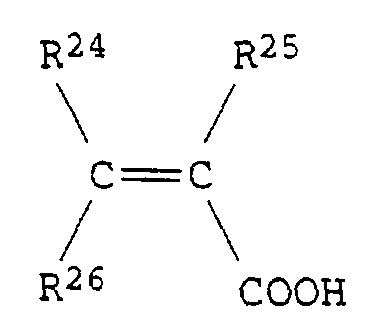
- esters XX are primarily esters of ⁇ , ⁇ -unsaturated carboxylic acids XXI of the formula into consideration, in which R 24 , R 25 and R 26 represent hydrogen or C 1 -C 4 -alkyl radicals, acrylic acid and methacrylic acid being preferred. Mixtures of esters of various such carboxylic acids can also be used.
- Suitable alcohol components XXII in addition to the C 9 to C 25 alcohols such as 2-ethylhexanol, nonanol, stearyl alcohol and lauryl alcohol, preferably the C 1 to C 8 alcohols, in particular methanol, ethanol, n-propanol, i-propanol, n- Butanol, sec-butanol, tert-butanol, i-butanol, tert-butan-1-ol and mixtures of such alcohols.
- the C 9 to C 25 alcohols such as 2-ethylhexanol, nonanol, stearyl alcohol and lauryl alcohol
- the C 1 to C 8 alcohols in particular methanol, ethanol, n-propanol, i-propanol, n- Butanol, sec-butanol, tert-butanol, i-butanol, tert-butan-1-ol and mixtures of
- esters XXIII come esters of vinyl alcohol and a saturated one Carboxylic acid with 1 to 4 carbon atoms such as formic acid, Butyric acid and isopropyl carboxylic acid, especially acetic acid and Propionic acid. Mixtures of different esters can also be used such carboxylic acids are used.
- compound XIX olefinically unsaturated ones
- Compounds such as vinyl chloride, styrene, vinylbenzenes, on the benzene ring carry an alkyl group with 1 to 4 carbon atoms, such as 4-ethylstyrene and mixtures of such compounds.
- the proportion by weight of compound X, based on the polymers E should be 10 to 90% by weight and the proportion by weight of the polymers F based on the polymers E 10 to 90 wt .-%, wherein the proportion by weight of compound XI based on compound X 50 to 100 wt .-% and the proportion by weight of the compound XIX of the compound X should be 0 to 50% by weight.
- Initiators with a half-life of 1 are particularly suitable Hour at 60 to 90 ° C and a half-life of 10 hours at 50 to 80 ° C.
- initiators with a longer half-life can advantageously be promoters such as tertiary amines become.
- the molar ratio between compound XXV and the initiator should be 0.5 to 5, preferably 0.8 to 4.
- the polymers can from the reaction mixture according to known Methods, e.g. by precipitation or extraction, isolated or without Insulation can be used for further processing.
- the polymers E advantageously have a molecular weight (Weight average) of over 2000, preferably 3000 to 50,000, and a quotient from molecular weight (weight average) to molecular weight (Number average) of less than 3, preferably less than 2 on.
- the polymers E contain residues which differ from derive the radicals I or R5. In part, this can be done by Oxamine groups to be exchanged.
- Polymers E from a mixture of 40 are particularly suitable up to 60% by weight, preferably 45 to 55% by weight, of butyl acrylate and 40 to 60% by weight, preferably 45 to 55% by weight, of methyl acrylate with a number of monomers of 20 to 30, preferably 24, 25 or 26, as compound III and 2-acrylamido-2methylpropanesulfonic acid with a number of monomers Pn of 3 to 7, preferably 4.5 or 6, as compound X, for example Polymers I from a mixture of 50% by weight of butyl acrylate and 50% by weight of methyl acrylate with a number of monomers of 25 as compound III and 2-acrylamido-2-methylpropanesulfonic acid with a monomer number Pn of 5 as compound X.
- the inventive Polymer E from an organophilic polymer chain part (Polymer F) and a hydrophilic chain part, the acidic or polar groups.
- These acidic or polar groups have numerous pigments, especially oxidic inorganic Pigments have a strong affinity and therefore accumulate on their surface.
- the pigments are mixed with the polymers E and, if appropriate, additives in a solvent-free manner or preferably in the presence of an organic diluent in a manner known per se.
- Suitable diluents are hydrocarbons, in particular toluene and cyclohexane, ketones, in particular methyl ethyl ketone and cyclohexanone, esters, in particular ethyl acetate, and ethers, in particular tetrahydrofuran or dioxane. In some cases, water is also considered.
- the pigment preparation can be isolated from the mixture by removing the diluent or can be used without further isolation for further processing.
- the pigment preparations can be conveniently and without unwanted Incorporate agglomerations in organic binders.
- the pigment preparations can be carried out in a manner known per se with a binder and any additives, solvent-free or preferably in the presence of an organic diluent be mixed.
- an organic diluent are suitable hydrocarbons, especially toluene, cyclohexane and n-alkanes, ketones, especially methyl ethyl ketone, cyclohexanone and methyl isobutyl ketone, esters, especially ethyl acetate, as well as ethers, especially tetrahydrofuran and dioxane.
- polyurethanes polyacrylates, Polymethacrylates, polyacrylamide, vinyl polymers such as polystyrene, Polyvinyl chloride, polyvinyl acetate, polyvinyl propionate and polyacrylonitrile, cellulose-containing binders such as cellulose esters, in particular cellulose nitrates, cellulose acetates, cellulose acetopropionate and cellulose acetobutyrate, phenoxy resins and epoxy resins into consideration.
- vinyl polymers such as polystyrene, Polyvinyl chloride, polyvinyl acetate, polyvinyl propionate and polyacrylonitrile
- cellulose-containing binders such as cellulose esters, in particular cellulose nitrates, cellulose acetates, cellulose acetopropionate and cellulose acetobutyrate, phenoxy resins and epoxy resins into consideration.
- fillers such as inorganic are found as additives and organic pigments, e.g. Aluminum oxide, silicon dioxide, Titanium dioxide, carbon black, polyethylene, polypropylene, chalk inhibitors, e.g. Antimony oxide, thixotropic substances, e.g. amorphous Silicic acid, application.
- organic pigments e.g. Aluminum oxide, silicon dioxide, Titanium dioxide, carbon black, polyethylene, polypropylene, chalk inhibitors, e.g. Antimony oxide, thixotropic substances, e.g. amorphous Silicic acid, application.
- the mixtures of pigment preparation, binder and optionally Additives or solvents are used in the usual way as a coating agent.
- the coating compositions can be the pigment preparations alone or in a mixture with other pigments or pigment preparations contain.
- the method according to the invention is characterized in particular by Profitability because the reaction to the technically interesting Temperature range is running fast enough and itself the reaction rate can also be controlled well. It can polar and non-polar monomers are used.
- the invention The process is largely insensitive to small quantities moisture and it can also cause mixtures of monomers statistical copolymers are implemented.
- the emerging Polymers have a PDI of less than 2 and they can have a high molecular weight.
- Styrene (S) was purified over aluminum oxide and over calcium hydride distilled.
- Methyl methacrylate (MMA) was over calcium hydride distilled.
- Toluene was distilled over sodium.
- Azoisobutyronitrile (AIBN) was recrystallized from ether.
- Commercially available benzoyl peroxide (BPO) (as 25 wt .-% solution in Water) was used without further purification.
- 2,5-dihydro-1,3,5,5-tetraphenyl-1H-1,2,4, -triazol-2-yl was according to tetrahedron 51 (47), 12883-12898, 1995 by dehydrogenation of the corresponding 4,5-Dihydro-1H-1,2,4-triazole.
Landscapes
- Chemical & Material Sciences (AREA)
- Organic Chemistry (AREA)
- Health & Medical Sciences (AREA)
- Chemical Kinetics & Catalysis (AREA)
- Medicinal Chemistry (AREA)
- Polymers & Plastics (AREA)
- Engineering & Computer Science (AREA)
- Materials Engineering (AREA)
- Graft Or Block Polymers (AREA)
- Compositions Of Macromolecular Compounds (AREA)
- Polymerization Catalysts (AREA)
Description


- X
- für Sauerstoff, Schwefel oder Selen, vorzugsweise Schwefel steht
- R6
- ein Wasserstoffatom, -C1- bis C5-Alkyl, bevorzugt Methyl oder Ethyl, -CF3, Halogen, bevorzugt -Cl, -CN, Alkylsulfid, bevorzugt C1- bis C10-Alkylsulfid, Arylsulfid, bevorzugt Phenylsulfid, Alkoxy, bevorzugt C1- bis C10-Alkoxy, Aryloxy, bevorzugt Phenoxy, Alkylamin, bevorzugt C1- bis C10-Alkylamin, Dialkylamin, bevorzugt Di-C1- bis C10-alkylamin, Arylamin, bevorzugt Phenylamin, Diarylamin, bevorzugt Diphenylamin.
- R7
- ein Wasserstoffatom oder (Z)Z1 ist,
- Z
- für eine unverzweigte oder verzweigte C1- bis C25-Alkylengruppe, bevorzugt eine C1- bis C25-Alkylengruppe, besonders bevorzugt eine C1- bis C10-Alkylengruppe, beispielsweise Methylen, Ethylen, 2-Methyl-ethylen, n-Propylen oder n-Butylen steht,
- Z1
- -OH, Alkoxy, bevorzugt C1- bis C10-Alkoxy, Aryloxy, bevorzugt Phenoxy, Alkylsulfid, bevorzugt C1- bis C10-Alkylsulfid, Arylsulfid, bevorzugt Phenylsulfid, -NH2, Alkylamin, bevorzugt C1- bis C10-Alkylamin, Dialkylamin, bevorzugt Di-C1- bis C10-alkylamin, Arylamin, bevorzugt Phenylamin, Diarylamin, bevorzugt Diphenylamin oder Z2 ist, worunter Z2, -NH2, Alkylamin oder Dialkylamin bevorzugt sind,
- Z2
- einen C4- bis C7-cycloaliphatischen Rest, vorzugsweise einen C5- oder C6-cycloaliphatischen Ring, der eine oder mehrere -O-, -S- oder -N(Alkyl)-Gruppen, bevorzugt -N(C1- bis C10-Alkylamin) enthalten kann, wobei letztere Gruppe bevorzugt ist und Z2 jeweils über ein Kohlenstoffatom mit Z verknüpft ist und die Gruppen -O-, -S- und -N(Alkyl)- nicht direkt miteinander verbunden sind.


und
- wenigstens einem Polymerblock der Sorte C, erhältlich durch Polymerisation in Gegenwart von Radikalen I von einem oder mehreren hydrophoben Monomeren aus der Gruppe C umfassend Styrol, Methylmethacrylat, n-Butylacrylat, n-Dodecylacrylat, 2-Ethylhexylacrylat, Dihydrodicyclopentadienylacrylat und Vinyldodecylether
- wenigstens einem Polymerblock der Sorte D, erhältlich durch Polymerisation in Gegenwart von Radikalen I von einem oder mehreren hydrophilen oder zu hydrophilen Monomeren hydrolysierbaren Monomeren aus der Gruppe D umfassend Acrylsäure, Methacrylsäure, 2-Acrylamido-2-methylpropansulfonsäure, Styrolsulfonsäure, die Kalium-, Natrium- und Ammoniumsalze der vorgenannten Säuren, Methylacrylat, t-Butylacrylat, t-Butylmethacrylat, ω-Hydroxy-C2- bis C4-alkylacrylat, ω-Hydroxy-C2- bis C4-methacrylat, Vinylpyrrolidon, Vinylimidazol, Vinylcaprolactam, Vinylformamid, N-Methylvinylimidazol, Vinylmethylether und Dimethylaminoethylacrylat,
b, b' bis b5', b* bis b9* und b+ bis b9+ = wenigstens 50 %, oder wenigstens 75 % oder ≥100 % des jeweiligen zugehörigen Koeffizienten a, a' bis a5', a* bis a9* und a+ bis a9+ (vorzugsweise betragen die Koeffizienten a etc. 35 bis 45 und die Koeffizienten b etc. gleichfalls 35 bis 45). Ist das Molekulargewicht der erfindungsgemäßen amphiphilen Blockcopolymere uneinheitlich, meinen die Koeffizienten a, a' bis a5', a* bis a9* und b, b' bis b9', b* bis b9* und b+ bis b9+ die zahlenmittleren Mittelwerte. Vorgenannte Blockcopolymere bilden auch dann erfindungsgemäße amphiphile Blockcopolymere, wenn Styrol durch Methylmethacrylat, n-Butylacrylat und/oder 2-Ethylhexylacrylat partiell oder vollständig ersetzt wird, wobei zu vorteilhaften amphiphilen Blockpolymeren beispielsweise
- [Methylmethacrylat]a x [t-Butylacrylat]b x
- [t-Butylacrylat]b x [Methylmethacrylat]a x
- zu 70 bis 100 Gew.-% aus Estern der Acryl- und/oder Methacrylsäure mit 1 bis 12 C-Atome aufweisenden Alkanolen und/oder Styrol oder
- zu 70 bis 100 Gew.-% aus Vinylchlorid und/oder Vinylidenchlorid oder
- zu 70 bis 100 Gew.-% aus Styrol und/oder Butadien oder
- zu 40 bis 100 Gew.-% aus Vinylacetat, Vinylpropionat und/oder Ethylen
| 70 bis 99 Gew.-% | wenigstens eines Esters der Acryl- und/oder Methacrylsäure mit 1 bis 8 C-Atome aufweisenden Alkanolen, |
| 1 bis 5 Gew.-% | wenigstens eines Monomeren aus der Gruppe umfassend Acrylsäure, Methacrylsäure sowie die K⊕-, Na⊕- und Ammoniumsalze dieser Säuren, |
| 0 bis 25 Gew.-% | Vinylacetat, Styrol oder deren Gemisch. |
a1) einem Ester XII aus
a2) einem Amid XV aus
b1) einem Ester XX aus
b2) einem Ester XXIII aus


Die Pigmentzubereitung kann aus dem Gemisch durch Entfernen des Verdünnungsmittels isoliert oder vorzugsweise ohne Isolierung zur Weiterverarbeitung eingesetzt werden.


Claims (16)
- Verfahren zur Herstellung von Polymeren, dadurch gekennzeichnet, daß man die Polymerisation in Gegenwart von Radikalen der allgemeinen Formel Iworin Q NR2 oder S und T CR3R4 oder S bedeutet und R1, R2, R3 und R4 gleich oder verschieden voneinander sein können und unabhängig voneinander Wasserstoff, C1- bis C20-Alkyl oder C6-bis C18-Aryl bedeuten, durchführt.

- Verfahren nach Anspruch 1, dadurch gekennzeichnet, daß man einen Radikalstarter mitverwendet.
- Verfahren nach Anspruch 1 oder 2, dadurch gekennzeichnet, daß man einen Elektronendonor mitverwendet.
- Verfahren nach einem der Ansprüche 1 bis 3, dadurch gekennzeichnet, daß man ein N-Oxylradikal mitverwendet.
- Verfahren nach einem der Ansprüche 1 bis 4, dadurch gekennzeichnet, daß man als Radikale I 2,5-Dihydro-1H-1,2,4- triazolylradikale einsetzt.
- Verfahren nach einem der Ansprüche 1 bis 6, dadurch gekennzeichnet, daß man die Radikale I aus Verbindungen II, die in Radikalstarter und Radikale I gespalten werden können, erzeugt.
- Mischungen, enthaltend Radikale I oder Verbindungen II und Radikalstarter oder Elektronendonor oder N-Oxylradikal oder deren Mischungen.
- Verwendung von Radikalen I zur Herstellung von Polymeren.
- Verwendung von Verbindungen II, die in Radikale I und Radikalstarter gespalten werden können zur Herstellung von Polymeren.
- Verwendung der gemäß einem der Ansprüche 1 bis 6 hergestellten Polymeren zur Herstellung von Formkörpern, Folien oder Fasern.
- Polymere, erhältlich nach dem Verfahren gemäß einem der Ansprüche 1 bis 6.
- Blockcopolymere, erhältlich durch Umsetzen vonnach dem Verfahren gemäß einem der Ansprüche 1 bis 6.A) Monomeren, ausgewählt aus der Gruppe bestehend aus Styrol, α-Methylstyrol, Acrylnitril, Methacrylnitril, Methylmethacrylat und Maleinsäureanhydrid, zu Blöcken A mit einer Glasübergangstemperatur Tg von größer als 0°C
undB) Monomeren, ausgewählt aus der Gruppe bestehend aus n-Butylacrylat, Methylacrylat und 2-Ethylhexylacrylat zu Blöcken B mit einer Glasübergangstemperatur Tg von kleiner als 0°C - Bei 20°C und 1 atm in Wasser lösliche amphiphile Blockcopolymere und durch selektive Hydrolyse in solche amphiphile Blockcopolymere wandelbare Blockcopolymere bestehend ausundwenigstens einem Polymerblock der Sorte C, erhältlich durch Polymerisation in Gegenwart von Radikalen I von einem oder mehreren hydrophoben Monomeren aus der Gruppe C umfassend Styrol, Methylmethacrylat, n-Butylacrylat, n-Dodecylacrylat, 2-Ethylhexylacrylat, Dihydrodicyclopentadienylacrylat und Vinyldodecyletherwobei die Polymerblöcke der Sorten C, D direkt und nicht durch konstitutionelle Einheiten, die nicht Teil der Blöcke sind, miteinander verbunden sind, nach dem Verfahren gemäß einem der Ansprüche 1 bis 6.wenigstens einem Polymerblock der Sorte D, erhältlich durch Polymerisation in Gegenwart von Radikalen I von einem oder mehreren hydrophilen oder zu hydrophilen Monomeren hydrolysierbaren Monomeren aus der Gruppe D umfassend Acrylsäure, Methacrylsäure, 2-Acrylamido-2-methylpropansulfonsäure, Styrolsulfonsäure, die Kalium-, Natrium- und Ammoniumsalze der vorgenannten Säuren, Methylacrylat, t-Butylacrylat, t-Butylmethacrylat, ω-Hydroxy-C2- bis C4-alkylacrylat, ω-Hydroxy-C2- bis C4-methacrylat, Vinylpyrrolidon, Vinylimidazol, Vinylcaprolactam, Vinylformamid, N-Methylvinylimidazol, Vinylmethylether und Dimethylaminoethylacrylat,
- Verwendung der amphiphilen Blockcopolymeren gemäß Anspruch 13 als Dispergiermittel in radikalisch wäßrigen Emulsionspolymerisationen.
- Als Dispergierharze geeignete Polymerisate E, erhältlich durch Umsetzung vonnach dem Verfahren gemäß einem der Ansprüche 1 bis 6, wobei der Gewichtsanteil von F an dem Polymerisat E 10 bis 90 Gew.-% und der Gewichtsanteil der Gesamtmenge von X 10 bis 90 Gew.-% an dem Polymerisat E beträgt.F. einem Polymerisat F, erhältlich durch Umsetzung von mindestens einer Verbindung III aus der Gruppe bestehend ausa) einem Ester IV ausa1) einer α,β-ungesättigten Carbonsäure V unda2) einem Alkylalkohol VI mit 1 bis 25 Kohlenstoffatomen,b) einem Ester VII ausb1) Vinylalkohol undb2) einer gesättigten Carbonsäure VIII mit 1 bis 4 Kohlenstoffatomen,c) Vinylchlorid,d) Styrol oder Vinylbenzole, die am Benzolring eine Alkylgruppe mit 1 bis 4 Kohlenstoffatomen tragen, nach dem Verfahren gemäß einem der Ansprüche 1 bis 6, mitG. mindestens einer Verbindung X ausa) 50 bis 100 Gew.-% bezogen auf X mindestens einer Verbindung XI aus der Gruppe bestehend aus
a1) einem Ester XII ausa) einer α,β-ungesättigten Carbonsäure XIII undb) einem Alkylalkohol XIV mit 2 bis 10 Kohlenstoffatomen, der mindestens eine polare oder saure Gruppe trägt,
a2) einem Amid XV ausa) einer α,β-ungesättigten Carbonsäure XVI undb) Ammoniak oder einem Amin XVII mit 2 bis 10 Kohlenstoffatomen, das mindestens eine polare oder saure Gruppe trägt,a3) N-Vinyl-Verbindungen XVIII,a4) Styrolsulfonsäure oder einer Vinylbenzolsulfonsäure, dieeine Alkylgruppe mit 1 bis 4 Kohlenstoffatomen am Ring trägt, undb) 0 bis 50 Gew.-% bezogen auf X mindestens einer Verbindung XIX aus der Gruppe bestehend aus
b1) einem Ester XX ausa) einer α,β-ungesättigten Carbonsäure XXI undb) einem Alkylalkohol XXII mit 1 bis 25 Kohlenstoffatomen,
b2) einem Ester XXIII ausa) Vinylalkohol undb) einer gesättigten Carbonsäure XXIV mit 1 bis 4 Kohlenstoffatomen,b3) Vinylchlorid,b4) Styrol oder Vinylbenzole, die am Benzolring eine Alkylgruppe mit 1 bis 4 Kohlenstoffatomen tragen, - Verwendung der Polymerisate E gemäß Anspruch 15 zur Herstellung von Pigmentzubereitungen oder pigmenthaltigen Beschichtungen.
Applications Claiming Priority (3)
| Application Number | Priority Date | Filing Date | Title |
|---|---|---|---|
| DE19636996A DE19636996A1 (de) | 1996-09-12 | 1996-09-12 | Verfahren zur Herstellung von Polymeren in Gegenwart von Triazolylradikalen |
| DE19636996 | 1996-09-12 | ||
| PCT/EP1997/000510 WO1998011143A1 (de) | 1996-09-12 | 1997-02-05 | Verfahren zur herstellung von polymeren in gegenwart von triazolylradikalen |
Publications (2)
| Publication Number | Publication Date |
|---|---|
| EP0925311A1 EP0925311A1 (de) | 1999-06-30 |
| EP0925311B1 true EP0925311B1 (de) | 2001-05-02 |
Family
ID=7805315
Family Applications (1)
| Application Number | Title | Priority Date | Filing Date |
|---|---|---|---|
| EP97902328A Expired - Lifetime EP0925311B1 (de) | 1996-09-12 | 1997-02-05 | Verfahren zur herstellung von polymeren in gegenwart von triazolylradikalen |
Country Status (6)
| Country | Link |
|---|---|
| US (1) | US6380315B1 (de) |
| EP (1) | EP0925311B1 (de) |
| JP (1) | JP2000517350A (de) |
| CA (1) | CA2260812A1 (de) |
| DE (2) | DE19636996A1 (de) |
| WO (1) | WO1998011143A1 (de) |
Families Citing this family (14)
| Publication number | Priority date | Publication date | Assignee | Title |
|---|---|---|---|---|
| FR2791687A1 (fr) * | 1999-03-31 | 2000-10-06 | Atochem Elf Sa | Procede de polymerisation ou copolymerisation radicalaire controlee |
| US6413306B1 (en) | 1999-10-07 | 2002-07-02 | E. I. Du Pont De Nemours And Company | Pigment dispersions containing ABC-block polymer dispersant |
| DE10036804A1 (de) * | 2000-07-28 | 2002-02-07 | Tesa Ag | Haftklebemassen auf Basis von Blockcopolymeren der Struktur P(B)-P(A/C)-P(B) |
| DE10036803A1 (de) * | 2000-07-28 | 2002-02-07 | Tesa Ag | Haftklebemassen auf Basis von Blockcopolymeren der Struktur P(A/C)-P(B)-P(A/C) |
| US20020155309A1 (en) * | 2001-02-21 | 2002-10-24 | Zhixin Li | Mold release and anti-blocking coating for powder-free natural or synthetic rubber articles |
| JP3595805B2 (ja) * | 2001-08-07 | 2004-12-02 | キヤノン株式会社 | 刺激応答性組成物、並びに該組成物を用いた画像形成方法および装置 |
| DE10149083A1 (de) | 2001-10-05 | 2003-04-17 | Tesa Ag | Acrylathaftklebemassen mit enger Molekulargewichtsverteilung |
| FR2832720B1 (fr) * | 2001-11-29 | 2004-02-13 | Oreal | Copolymeres ethyleniques sequences, compositions cosmetiques les contenant, et utilisation de ces copolymeres en cosmetique |
| JP4020301B2 (ja) * | 2002-06-14 | 2007-12-12 | キヤノン株式会社 | インクジェット用記録インク |
| JP3890266B2 (ja) * | 2002-07-03 | 2007-03-07 | キヤノン株式会社 | ブロックポリマー化合物、インク組成物、分散性組成物及び画像形成方法並びに画像形成装置 |
| US20080262160A1 (en) | 2004-07-01 | 2008-10-23 | Universiteit Gent | Monodisperse Polymers Containing (Alkyl)Acrylic Acid Moieties, Precursors and Methods for Making them and their Applications |
| DE102005051906A1 (de) * | 2005-10-29 | 2007-05-03 | Basf Construction Polymers Gmbh | Mischpolymer auf Basis olefinischer Sulfonsäuren |
| EP2201935B1 (de) * | 2008-12-26 | 2020-07-08 | Samyang Biopharmaceuticals Corporation | Polymere Mizellenzusammensetzung, die ein schlecht lösliches Arzneimittel enthält, und zugehöriges Herstellungsverfahren |
| CN108701833B (zh) * | 2016-03-10 | 2022-02-01 | 日本瑞翁株式会社 | 非水系二次电池电极用粘结剂、非水系二次电池电极用浆料、非水系二次电池用电极及非水系二次电池 |
Family Cites Families (5)
| Publication number | Priority date | Publication date | Assignee | Title |
|---|---|---|---|---|
| GB1061120A (en) | 1965-01-29 | 1967-03-08 | Du Pont | Tetraazadiborines |
| US4040922A (en) | 1975-10-06 | 1977-08-09 | Eastman Kodak Company | Photopolymerizable polymeric compositions containing halogen containing heterocyclic compound |
| AU571240B2 (en) | 1983-07-11 | 1988-04-14 | Commonwealth Scientific And Industrial Research Organisation | Alkoxy-amines, useful as initiators |
| JP2657806B2 (ja) * | 1987-07-15 | 1997-09-30 | 株式会社 スリーボンド | 嫌気硬化性組成物 |
| US5322912A (en) | 1992-11-16 | 1994-06-21 | Xerox Corporation | Polymerization processes and toner compositions therefrom |
-
1996
- 1996-09-12 DE DE19636996A patent/DE19636996A1/de not_active Withdrawn
-
1997
- 1997-02-05 US US09/254,455 patent/US6380315B1/en not_active Expired - Fee Related
- 1997-02-05 CA CA002260812A patent/CA2260812A1/en not_active Abandoned
- 1997-02-05 EP EP97902328A patent/EP0925311B1/de not_active Expired - Lifetime
- 1997-02-05 JP JP09539314A patent/JP2000517350A/ja active Pending
- 1997-02-05 WO PCT/EP1997/000510 patent/WO1998011143A1/de not_active Ceased
- 1997-02-05 DE DE59703474T patent/DE59703474D1/de not_active Expired - Fee Related
Also Published As
| Publication number | Publication date |
|---|---|
| EP0925311A1 (de) | 1999-06-30 |
| CA2260812A1 (en) | 1998-03-19 |
| WO1998011143A1 (de) | 1998-03-19 |
| US6380315B1 (en) | 2002-04-30 |
| DE59703474D1 (de) | 2001-06-07 |
| JP2000517350A (ja) | 2000-12-26 |
| DE19636996A1 (de) | 1998-03-19 |
Similar Documents
| Publication | Publication Date | Title |
|---|---|---|
| EP0876414B1 (de) | Blockcopolymere | |
| EP0925311B1 (de) | Verfahren zur herstellung von polymeren in gegenwart von triazolylradikalen | |
| DE69808622T3 (de) | Verfahren zur herstellung von blockcopolymeren durch kontrollierte radikalische polymerisation | |
| EP2025688B1 (de) | Polyvinylesterdispersionen, Verfahren zu deren Herstellung und deren Verwendung | |
| EP0522351B1 (de) | Schlagzäh-Modifizierungsmittel | |
| EP2291413B1 (de) | Verfahren zur herstellung einer wässrigen polymerisatdispersion | |
| EP0245647B2 (de) | Polymethacrylat-Formmasse mit hoher Wärmeformbeständigkeit und hoher thermischer Stabilität | |
| EP0381065A2 (de) | Elastomere Acrylharze | |
| DE2105576B2 (de) | Beständige und schlagfeste Massen auf der Basis von Vinylhalogenidpolymerisaten | |
| DE1520119B2 (de) | Verfahren zur Herstellung einer stabilen Disperion eines Additionspolymeren in einer organischen Flüssigkeit | |
| DE19704714A1 (de) | Amphiphile Blockcopolymere | |
| DE60305528T2 (de) | Styrolpolymerverbundwerkstoffe | |
| DE60316947T2 (de) | Verfahren zur polymerisation ethylenisch ungesättigter monomere | |
| EP0074046A1 (de) | Thermoplastische Formmasse | |
| EP1511782A1 (de) | Verfahren zur herstellung einer wässrigen polymerisatdispersion | |
| EP1448692B1 (de) | Wässrige kunstharzzubereitung | |
| EP0752427B1 (de) | Verfahren zur Herstellung von verzweigten Polymerisaten | |
| EP0402748B1 (de) | Vinylchloridpolymerisat enthaltende Formmassen mit verringertem Fogging | |
| DE2135024A1 (de) | Zur Modifizierung von Vinylhalogemd polymeren geeignete mehrphasige Acryl Verbundpolymere | |
| EP0824552B1 (de) | Verfahren zur herstellung von polymerisaten von vinylischen monomeren mit enger molekulargewichtsverteilung durch kontrollierte radikalische polymerisation | |
| DE4000543A1 (de) | Emulsionspfropfpolymerisate mit verbesserter anbindung zwischen pfropfgrundlage und pfropfhuelle | |
| DE4410883A1 (de) | Thermoplastische Formmassen aus einem Pfropfcopolymerisat und einem Olefin-Copolymeren | |
| EP0960165A1 (de) | Wärmeformbeständiges styrol-copolymerisat | |
| EP0644214A1 (de) | Teilchenförmiges Pfropfcopolymerisat | |
| DE2438864A1 (de) | Verfahren zur herstellung von acrylatpolymeren |
Legal Events
| Date | Code | Title | Description |
|---|---|---|---|
| PUAI | Public reference made under article 153(3) epc to a published international application that has entered the european phase |
Free format text: ORIGINAL CODE: 0009012 |
|
| 17P | Request for examination filed |
Effective date: 19981002 |
|
| AK | Designated contracting states |
Kind code of ref document: A1 Designated state(s): BE CH DE FR GB IT LI NL |
|
| 17Q | First examination report despatched |
Effective date: 19990728 |
|
| GRAG | Despatch of communication of intention to grant |
Free format text: ORIGINAL CODE: EPIDOS AGRA |
|
| GRAG | Despatch of communication of intention to grant |
Free format text: ORIGINAL CODE: EPIDOS AGRA |
|
| GRAH | Despatch of communication of intention to grant a patent |
Free format text: ORIGINAL CODE: EPIDOS IGRA |
|
| GRAH | Despatch of communication of intention to grant a patent |
Free format text: ORIGINAL CODE: EPIDOS IGRA |
|
| GRAA | (expected) grant |
Free format text: ORIGINAL CODE: 0009210 |
|
| AK | Designated contracting states |
Kind code of ref document: B1 Designated state(s): BE CH DE FR GB IT LI NL |
|
| PG25 | Lapsed in a contracting state [announced via postgrant information from national office to epo] |
Ref country code: NL Free format text: LAPSE BECAUSE OF FAILURE TO SUBMIT A TRANSLATION OF THE DESCRIPTION OR TO PAY THE FEE WITHIN THE PRESCRIBED TIME-LIMIT Effective date: 20010502 Ref country code: IT Free format text: LAPSE BECAUSE OF FAILURE TO SUBMIT A TRANSLATION OF THE DESCRIPTION OR TO PAY THE FEE WITHIN THE PRESCRIBED TIME-LIMIT;WARNING: LAPSES OF ITALIAN PATENTS WITH EFFECTIVE DATE BEFORE 2007 MAY HAVE OCCURRED AT ANY TIME BEFORE 2007. THE CORRECT EFFECTIVE DATE MAY BE DIFFERENT FROM THE ONE RECORDED. Effective date: 20010502 Ref country code: FR Free format text: LAPSE BECAUSE OF FAILURE TO SUBMIT A TRANSLATION OF THE DESCRIPTION OR TO PAY THE FEE WITHIN THE PRESCRIBED TIME-LIMIT Effective date: 20010502 |
|
| REG | Reference to a national code |
Ref country code: CH Ref legal event code: EP |
|
| GBT | Gb: translation of ep patent filed (gb section 77(6)(a)/1977) |
Effective date: 20010515 |
|
| REF | Corresponds to: |
Ref document number: 59703474 Country of ref document: DE Date of ref document: 20010607 |
|
| NLV1 | Nl: lapsed or annulled due to failure to fulfill the requirements of art. 29p and 29m of the patents act | ||
| EN | Fr: translation not filed | ||
| REG | Reference to a national code |
Ref country code: GB Ref legal event code: IF02 |
|
| PG25 | Lapsed in a contracting state [announced via postgrant information from national office to epo] |
Ref country code: LI Free format text: LAPSE BECAUSE OF NON-PAYMENT OF DUE FEES Effective date: 20020228 Ref country code: CH Free format text: LAPSE BECAUSE OF NON-PAYMENT OF DUE FEES Effective date: 20020228 Ref country code: BE Free format text: LAPSE BECAUSE OF NON-PAYMENT OF DUE FEES Effective date: 20020228 |
|
| PLBE | No opposition filed within time limit |
Free format text: ORIGINAL CODE: 0009261 |
|
| STAA | Information on the status of an ep patent application or granted ep patent |
Free format text: STATUS: NO OPPOSITION FILED WITHIN TIME LIMIT |
|
| 26N | No opposition filed | ||
| BERE | Be: lapsed |
Owner name: MAX-PLANCK-GESELLSCHAFT ZUR FORDERUNG DER WISSENS Effective date: 20020228 Owner name: BASF A.G. Effective date: 20020228 |
|
| REG | Reference to a national code |
Ref country code: CH Ref legal event code: PL |
|
| PGFP | Annual fee paid to national office [announced via postgrant information from national office to epo] |
Ref country code: GB Payment date: 20030130 Year of fee payment: 7 |
|
| PG25 | Lapsed in a contracting state [announced via postgrant information from national office to epo] |
Ref country code: GB Free format text: LAPSE BECAUSE OF NON-PAYMENT OF DUE FEES Effective date: 20040205 |
|
| PGFP | Annual fee paid to national office [announced via postgrant information from national office to epo] |
Ref country code: DE Payment date: 20040212 Year of fee payment: 8 |
|
| GBPC | Gb: european patent ceased through non-payment of renewal fee |
Effective date: 20040205 |
|
| PG25 | Lapsed in a contracting state [announced via postgrant information from national office to epo] |
Ref country code: DE Free format text: LAPSE BECAUSE OF NON-PAYMENT OF DUE FEES Effective date: 20050901 |