EP0925319B1 - Polymeres de triazine et leur utilisation dans des dispositifs electroluminescents - Google Patents
Polymeres de triazine et leur utilisation dans des dispositifs electroluminescents Download PDFInfo
- Publication number
- EP0925319B1 EP0925319B1 EP97943830A EP97943830A EP0925319B1 EP 0925319 B1 EP0925319 B1 EP 0925319B1 EP 97943830 A EP97943830 A EP 97943830A EP 97943830 A EP97943830 A EP 97943830A EP 0925319 B1 EP0925319 B1 EP 0925319B1
- Authority
- EP
- European Patent Office
- Prior art keywords
- alkyl
- bis
- halogen
- hydroxyphenyl
- polymers
- Prior art date
- Legal status (The legal status is an assumption and is not a legal conclusion. Google has not performed a legal analysis and makes no representation as to the accuracy of the status listed.)
- Expired - Lifetime
Links
- 0 CCCC*CCS(*)(*)CCCN(C)C Chemical compound CCCC*CCS(*)(*)CCCN(C)C 0.000 description 11
- OONVLCPCMXSRKQ-UHFFFAOYSA-N C=NC(c1ccccc1)=N Chemical compound C=NC(c1ccccc1)=N OONVLCPCMXSRKQ-UHFFFAOYSA-N 0.000 description 1
- YXFVVABEGXRONW-UHFFFAOYSA-N Cc1ccccc1 Chemical compound Cc1ccccc1 YXFVVABEGXRONW-UHFFFAOYSA-N 0.000 description 1
Classifications
-
- C—CHEMISTRY; METALLURGY
- C08—ORGANIC MACROMOLECULAR COMPOUNDS; THEIR PREPARATION OR CHEMICAL WORKING-UP; COMPOSITIONS BASED THEREON
- C08G—MACROMOLECULAR COMPOUNDS OBTAINED OTHERWISE THAN BY REACTIONS ONLY INVOLVING UNSATURATED CARBON-TO-CARBON BONDS
- C08G65/00—Macromolecular compounds obtained by reactions forming an ether link in the main chain of the macromolecule
- C08G65/34—Macromolecular compounds obtained by reactions forming an ether link in the main chain of the macromolecule from hydroxy compounds or their metallic derivatives
- C08G65/38—Macromolecular compounds obtained by reactions forming an ether link in the main chain of the macromolecule from hydroxy compounds or their metallic derivatives derived from phenols
- C08G65/40—Macromolecular compounds obtained by reactions forming an ether link in the main chain of the macromolecule from hydroxy compounds or their metallic derivatives derived from phenols from phenols (I) and other compounds (II), e.g. OH-Ar-OH + X-Ar-X, where X is halogen atom, i.e. leaving group
- C08G65/4006—(I) or (II) containing elements other than carbon, oxygen, hydrogen or halogen as leaving group (X)
-
- C—CHEMISTRY; METALLURGY
- C08—ORGANIC MACROMOLECULAR COMPOUNDS; THEIR PREPARATION OR CHEMICAL WORKING-UP; COMPOSITIONS BASED THEREON
- C08G—MACROMOLECULAR COMPOUNDS OBTAINED OTHERWISE THAN BY REACTIONS ONLY INVOLVING UNSATURATED CARBON-TO-CARBON BONDS
- C08G73/00—Macromolecular compounds obtained by reactions forming a linkage containing nitrogen with or without oxygen or carbon in the main chain of the macromolecule, not provided for in groups C08G12/00 - C08G71/00
- C08G73/06—Polycondensates having nitrogen-containing heterocyclic rings in the main chain of the macromolecule
-
- C—CHEMISTRY; METALLURGY
- C08—ORGANIC MACROMOLECULAR COMPOUNDS; THEIR PREPARATION OR CHEMICAL WORKING-UP; COMPOSITIONS BASED THEREON
- C08G—MACROMOLECULAR COMPOUNDS OBTAINED OTHERWISE THAN BY REACTIONS ONLY INVOLVING UNSATURATED CARBON-TO-CARBON BONDS
- C08G73/00—Macromolecular compounds obtained by reactions forming a linkage containing nitrogen with or without oxygen or carbon in the main chain of the macromolecule, not provided for in groups C08G12/00 - C08G71/00
- C08G73/06—Polycondensates having nitrogen-containing heterocyclic rings in the main chain of the macromolecule
- C08G73/0622—Polycondensates containing six-membered rings, not condensed with other rings, with nitrogen atoms as the only ring hetero atoms
- C08G73/0638—Polycondensates containing six-membered rings, not condensed with other rings, with nitrogen atoms as the only ring hetero atoms with at least three nitrogen atoms in the ring
- C08G73/0644—Poly(1,3,5)triazines
-
- C—CHEMISTRY; METALLURGY
- C08—ORGANIC MACROMOLECULAR COMPOUNDS; THEIR PREPARATION OR CHEMICAL WORKING-UP; COMPOSITIONS BASED THEREON
- C08G—MACROMOLECULAR COMPOUNDS OBTAINED OTHERWISE THAN BY REACTIONS ONLY INVOLVING UNSATURATED CARBON-TO-CARBON BONDS
- C08G73/00—Macromolecular compounds obtained by reactions forming a linkage containing nitrogen with or without oxygen or carbon in the main chain of the macromolecule, not provided for in groups C08G12/00 - C08G71/00
- C08G73/06—Polycondensates having nitrogen-containing heterocyclic rings in the main chain of the macromolecule
- C08G73/10—Polyimides; Polyester-imides; Polyamide-imides; Polyamide acids or similar polyimide precursors
- C08G73/1085—Polyimides with diamino moieties or tetracarboxylic segments containing heterocyclic moieties
-
- C—CHEMISTRY; METALLURGY
- C09—DYES; PAINTS; POLISHES; NATURAL RESINS; ADHESIVES; COMPOSITIONS NOT OTHERWISE PROVIDED FOR; APPLICATIONS OF MATERIALS NOT OTHERWISE PROVIDED FOR
- C09K—MATERIALS FOR MISCELLANEOUS APPLICATIONS, NOT PROVIDED FOR ELSEWHERE
- C09K11/00—Luminescent materials, e.g. electroluminescent or chemiluminescent
- C09K11/06—Luminescent materials, e.g. electroluminescent or chemiluminescent containing organic luminescent materials
-
- H—ELECTRICITY
- H10—SEMICONDUCTOR DEVICES; ELECTRIC SOLID-STATE DEVICES NOT OTHERWISE PROVIDED FOR
- H10K—ORGANIC ELECTRIC SOLID-STATE DEVICES
- H10K50/00—Organic light-emitting devices
- H10K50/10—OLEDs or polymer light-emitting diodes [PLED]
- H10K50/11—OLEDs or polymer light-emitting diodes [PLED] characterised by the electroluminescent [EL] layers
Definitions
- An electroluminescent (EL) arrangement is characterized in that it emits light under the application of an electrical voltage under current flow.
- polymers such as poly- (p-phenylene) and poly- (p-phenylene vinylene (PPV)) as electroluminescent polymers: G. Leising et al., Adv. Mater. 4 (1992) No. 1; Friend et al., J. Chem. Soc., Chem. Commun. 32 (1992); Saito et al., Polymer, 1990, Vol. 31, 1137; Friend et al., Physical Review B, Vol. 42, No. 18, 11670 or WO 90/13148. More examples of PPV in electroluminescent displays are described in EP-A 443 861, WO-A-9203490 and 92003491 described.
- EP-A 0 294 061 presents an optical modulator based on polyacetylene.
- an EL arrangement consists of two electrodes, between which there is an organic layer that functions - including the emission of light - fulfilled.
- Such systems are e.g. in the Application WO 90/13148 based on poly (p-phenylene vinylene) is described.
- the construction of multilayer systems can be carried out by vapor deposition processes the layers are applied successively from the gas phase or by casting processes respectively. Casting processes are due to the higher process speeds prefers. However, the process of dissolving represents one that has already been brought up Layer is difficult when layering with the next layer.
- the object of the present invention is to provide electroluminescent Arrangements with high luminance, the one to be applied Mixable pourable can be applied.
- the invention therefore relates to polymers with 1,3,5-triazine units - in the following Triazines called - and their use in electroluminescent Layer arrangements, e.g. Electron injection layer, electron conducting or luminescent layer.
- Polymers of this type have good reduction properties, with high oxidation stability.
- they are very film-forming, have high glass levels and are highly temperature stable.
- the processing takes place preferably from alcohols, ketones, ethers or N-methylpyrrolidone.
- diphenols (building block Q) of the formula (II) are e.g. in US-A 3 028 365, 2 999 835, 3 148 172, 2 069 560, 3 275 601, 2 991 273, 3 271 367, 3 062 781, 2 970 131, 2 069 573 and 2 999 846, in the DE-A 1 570 703, 2 063 050, 2 063 052, 2 211 095 and 3 832 936, the FR-A 1 561 518, JP-A 62 093/86, 62 040/86 and 105 550/86 and in the Monograph "H. Schnell, Chemistry and Physics of Polycarbonates, Interscience Publishers, New York 1964 ".
- Particularly preferred polymers are: Ph - phenyl
- the polymers according to the invention are in common solvents such as alcohols, Ketones, tetrahydrofuran (THF), N-methylpyrrolidone (NMP), dimethylformamide (DMF) or chlorinated hydrocarbons soluble.
- solvents such as alcohols, Ketones, tetrahydrofuran (THF), N-methylpyrrolidone (NMP), dimethylformamide (DMF) or chlorinated hydrocarbons soluble.
- a suitable solvent e.g. a suitable solvent
- knife coating or spin coating applied to a suitable surface. It can e.g. around glass or a plastic material that is provided with a transparent electrode is.
- a plastic material e.g. a film made of polycarbonate, polyester such as polyethylene terephthalate or polyethylene naphthalate, polysulfone or polyimide be used.
- the metal oxide and semi-transparent metal film electrodes are made by Techniques such as vapor deposition, sputtering, platinum plating, etc., applied in a thin layer.
- the conductive polymer films are made by techniques such as spin coating, Casting, squeegees etc. applied from the solution.
- the thickness of the transparent electrode is 30 ⁇ to about several ⁇ m, preferably 100 ⁇ to 5,000 ⁇ .
- the electroluminescent layer is applied directly to the transparent electrode or on a possibly present charge-transporting layer as a thinner Film applied.
- the thickness of the film is 10 to 500 nm, preferably 20 to 400 nm, particularly preferably 50 to 250 nm.
- Another charge-transporting layer can be applied to the electroluminescent layer Layer be inserted before a counter electrode is applied.
- EP-A 532 798 A compilation of suitable charge-transporting intermediate layers, which are hole- and / or electron-conducting materials can, which are present in polymer or low molecular weight form optionally as a blend can, is listed in EP-A 532 798.
- the content of low molecular hole conductor in a polymeric binder is in Range can be varied from 2 to 85% by weight; the content is preferably 5 to 75 % By weight, particularly preferably 10 to 70% by weight.
- Film-forming hole conductors can can also be used in pure form (100%).
- the content of low molecular weight electron conductors in the polymeric binder is in the Range can be varied from 2 to 85% by weight; the content is preferably 5 to 75 % By weight, particularly preferably 10 to 70% by weight. Film-forming electron conductors can also be used in pure form (100%).
- the counter electrode consists of a conductive substance that can be transparent can.
- Metals are preferably suitable, e.g. Al, Au, Ag, Mg, In, etc. or Alloys and oxides of these by techniques such as vapor deposition, sputtering, Platination can be applied.
- the arrangement according to the invention is implemented by two electrical leads (e.g. Metal wires) brought into contact with the two electrodes.
- two electrical leads e.g. Metal wires
- the devices emit in the range of when a DC voltage is applied 0.1 to 100 volts of light with a wavelength of 200 to 2000 nm Range from 200 to 2000 nm photoluminescence.
- the arrangements according to the invention are for the production of units for Lighting and suitable for displaying information.
- the triazine polymers are prepared by generally known methods, see. e.g. H. R. Kricheldorf, Handbook of Polymer Synthesis, Part A, Chapter 9 and Part B, Chapter 15, (1992).
- the corresponding s-triazine diamine is used together with a stoichiometric Amount of the 5-ring di-anhydride presented in NMP (10% by weight) and initially 4 Stirred for hours at room temperature.
- the polyamide carboxylic acid formed can can be obtained by precipitation in methanol. Imidization takes several hours Heating the viscous mixture to 200 ° C reached. (Regulation analogous "Handbook of Polymer Synthesis", Part B, Chapter 15, page 941, H.R. Kricheldorf 1992))
- di-halo-s-triazine with a stoichiometric amount Diphenols in preferably NMP or diphenyl sulfone (10% by weight) with a diphenol appropriate amount of potassium carbonate presented and with toluene on Water separator heated to reflux for 3 hours. After distilling off the Toluene is heated again to 200 ° C. for 5 to 12 hours and then in methanol likes (regulation analogous to "Handbook of Polymer Synthesis", Part A, Chapter 8, H. R. Kricheldorf).
- the corresponding s-triazine diamine is used together with a stoichiometric Amount of 5-ring di-anhydride in m-cresol and a catalytic amount of isoquinoline submitted (10 wt .-%) and heated to 200 ° C for 24 hours.
- the polymer is precipitated in methanol (regulation analogous to "Handbook of Polymer Synthesis", Part B, Chapter 15, H. R. Kricheldorf).
- the corresponding s-triazine diamine is used together with a stoichiometric Amount of the 5-ring di-anhydride presented in NMP (10% by weight) and initially 4 Stirred for hours at room temperature.
- the polyamide carboxylic acid formed can obtained by precipitation in methanol (19). Imidization is through Heating of the viscous mixture to 200 ° C for several hours was achieved (regulation analogous to "Handbook of Polymer Synthesis", Part B, Chapter 15, H. R. Kricheldorf) and subsequent precipitation in acetone (20).
- PPV is used as the hole conductor (precursor polymer / doctored with 150 ⁇ m gap / thermally eliminated for 3 hours at 160 ° C).
- the polyether (16) made from cyclohexanone (0.3% by weight) is knife-coated (80 ⁇ m gap / 75 ° C.).
- a current / voltage curve is recorded which characterizes the diode behavior with and without example 16.
- Onset Voltage [V] PM max [A] I max [A] ITO / PPV / Al 3rd 5 10 -10 300 ITO / PPV / Ex. 16 / Al 4th 4th 10 -6 ( 200 Cd / m2) 50
Landscapes
- Chemical & Material Sciences (AREA)
- Organic Chemistry (AREA)
- Health & Medical Sciences (AREA)
- Chemical Kinetics & Catalysis (AREA)
- Medicinal Chemistry (AREA)
- Polymers & Plastics (AREA)
- Physics & Mathematics (AREA)
- Materials Engineering (AREA)
- Engineering & Computer Science (AREA)
- Optics & Photonics (AREA)
- Compositions Of Macromolecular Compounds (AREA)
- Macromolecular Compounds Obtained By Forming Nitrogen-Containing Linkages In General (AREA)
- Polymers With Sulfur, Phosphorus Or Metals In The Main Chain (AREA)
- Polyethers (AREA)
- Addition Polymer Or Copolymer, Post-Treatments, Or Chemical Modifications (AREA)
- Polyoxymethylene Polymers And Polymers With Carbon-To-Carbon Bonds (AREA)
Claims (5)
- Polymères et/ou copolymères comprenant des unités de structure répondant à la formule (I)dans laquelle
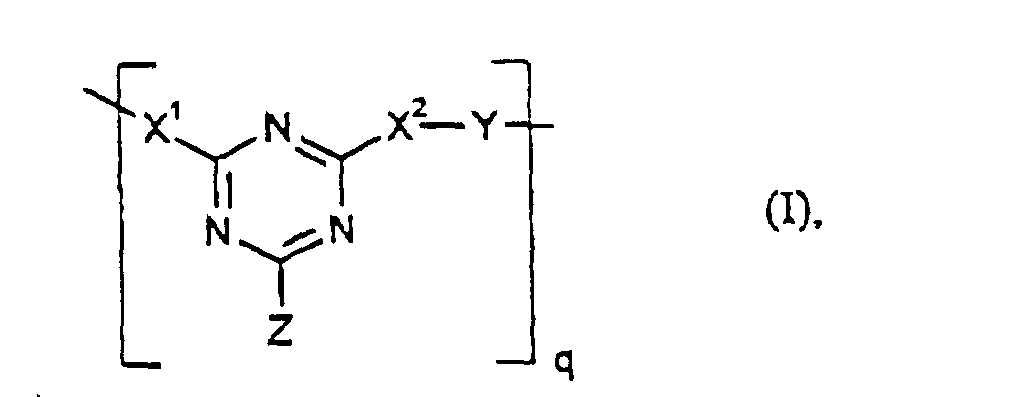
les radicaux X1, X2, Y, Z peuvent varier indépendamment les uns des autres,- q
- représente un nombre entier de 3 à 1.000,
- X1 et X2
- représentent, indépendamment l'un de l'autre, un atome d'oxygène, un groupe -NH-, un groupe phényle ou une liaison chimique, et
- Y
- représente un radical à 2 liaisons choisi
parmi le groupe comprenant
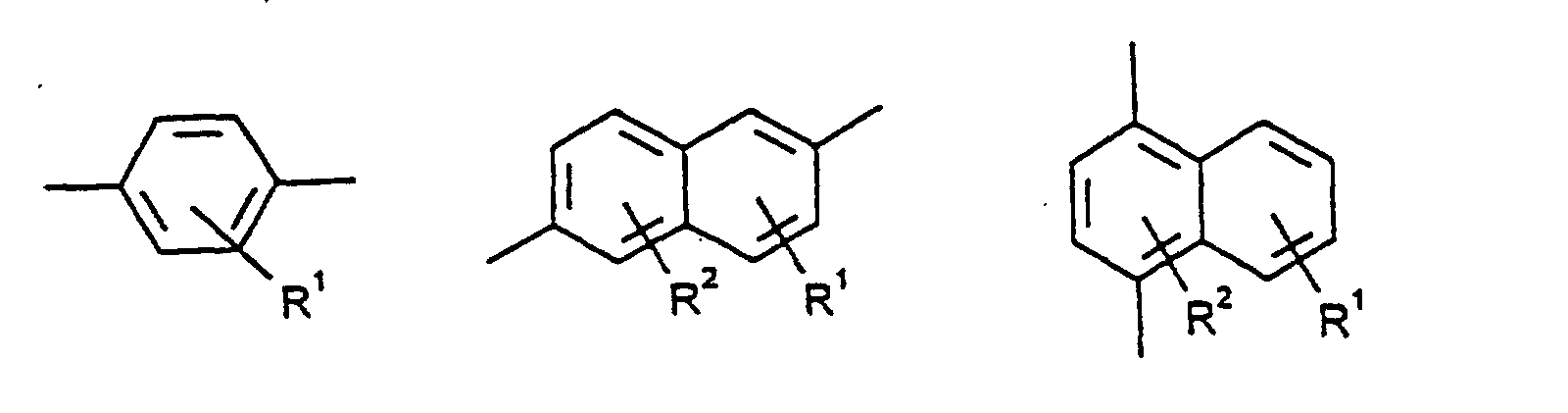
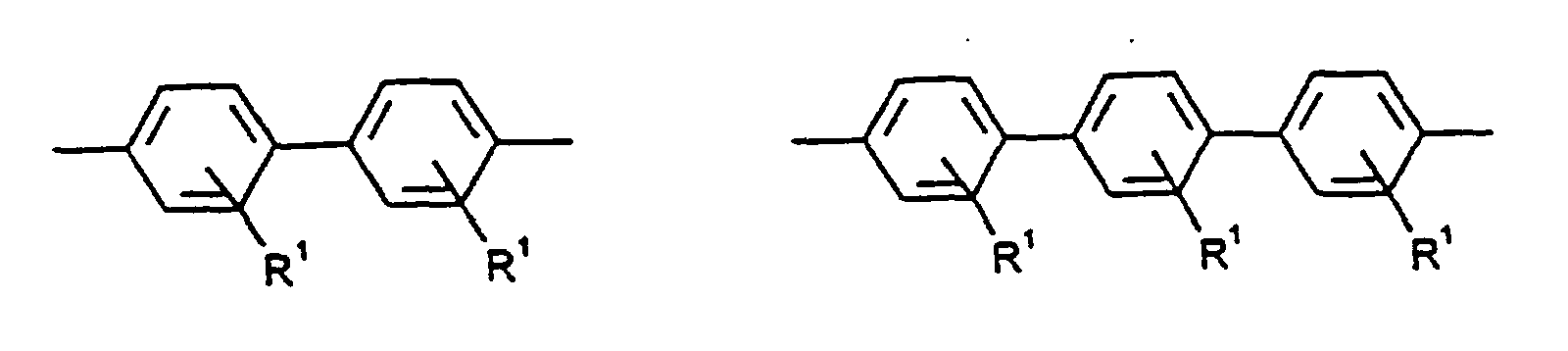


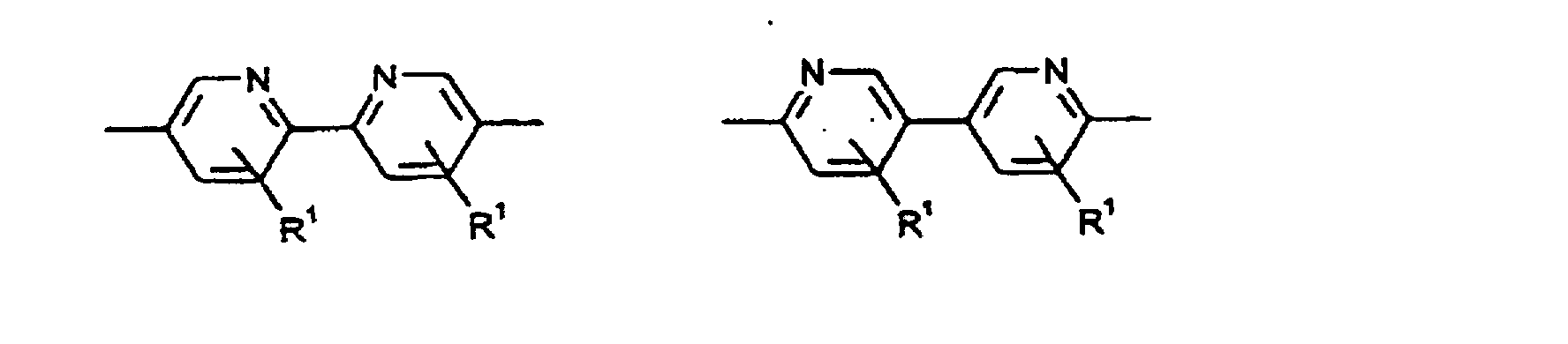
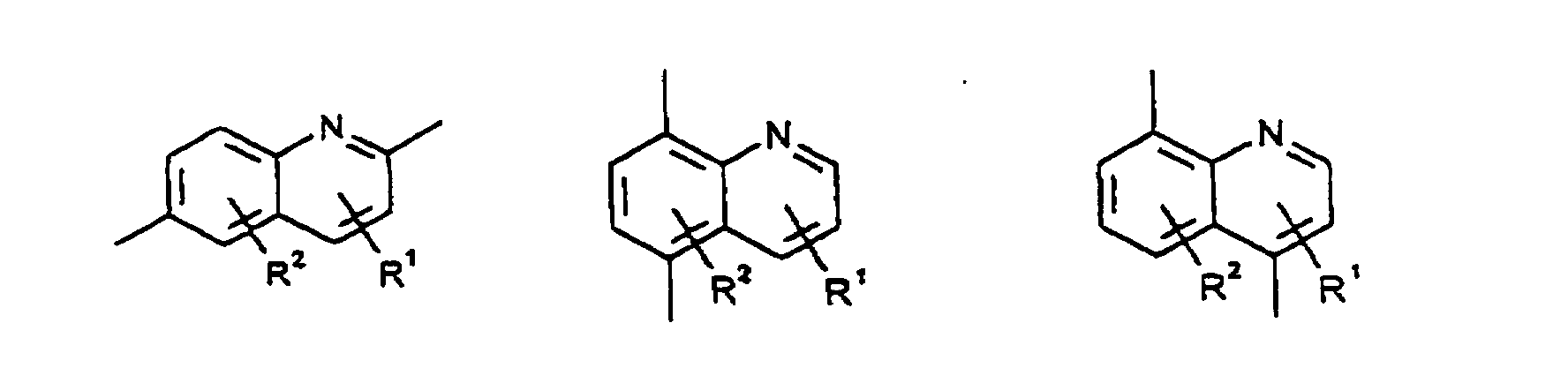

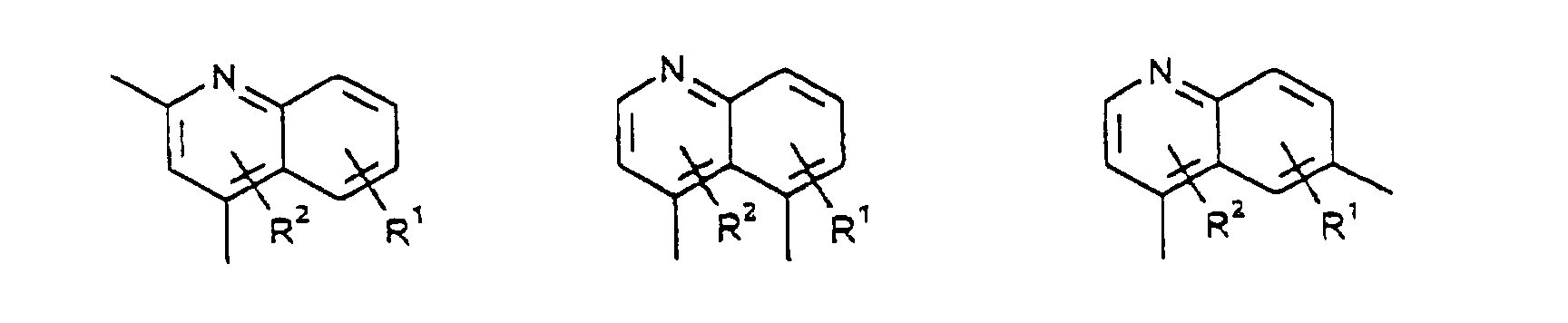
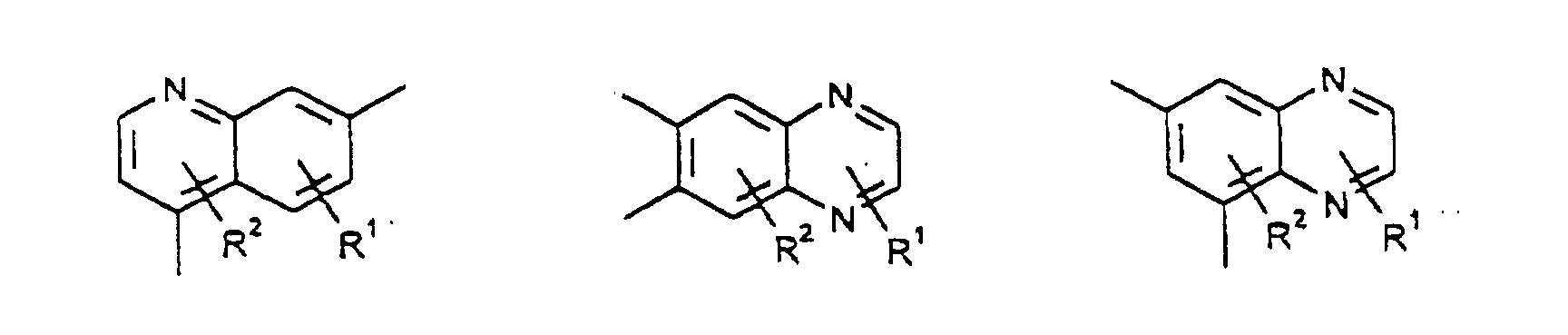

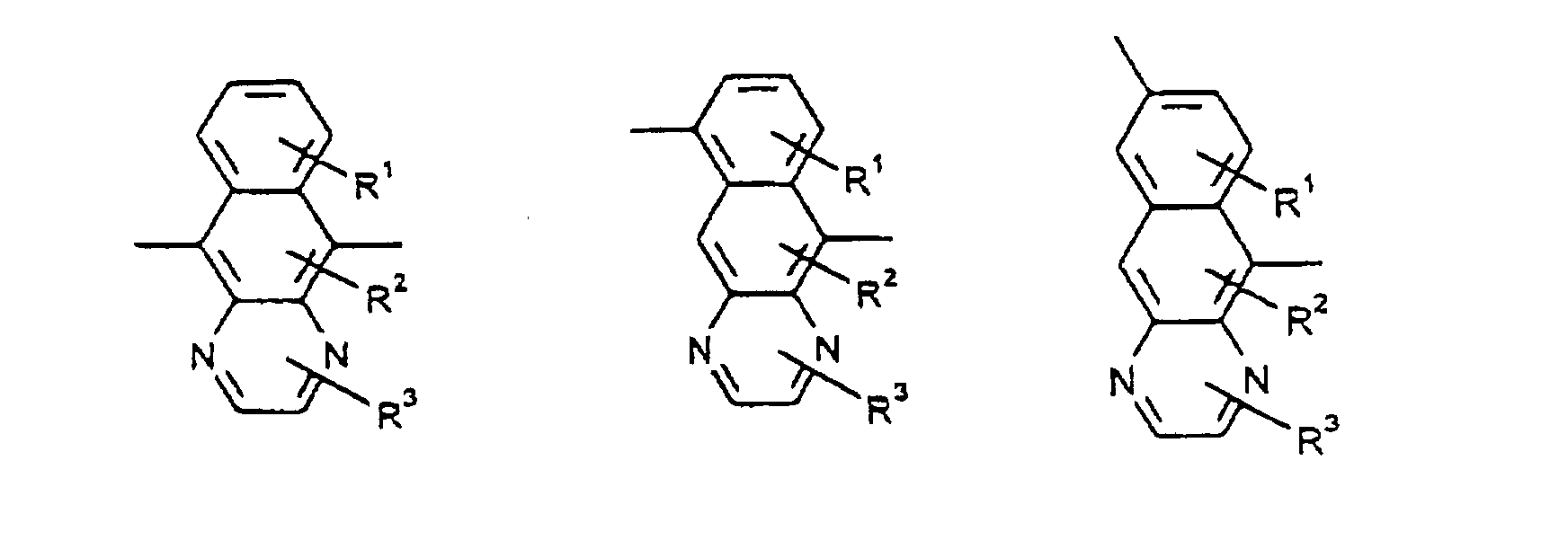
 avec p = 0 ou 1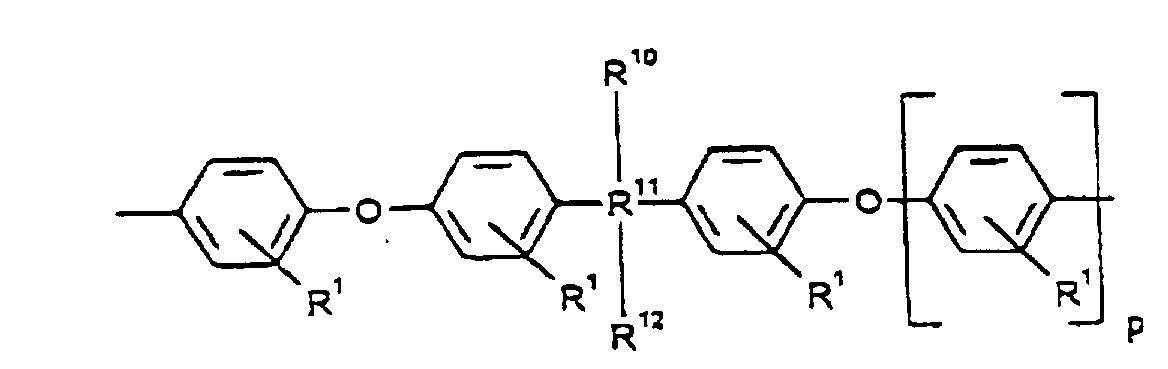
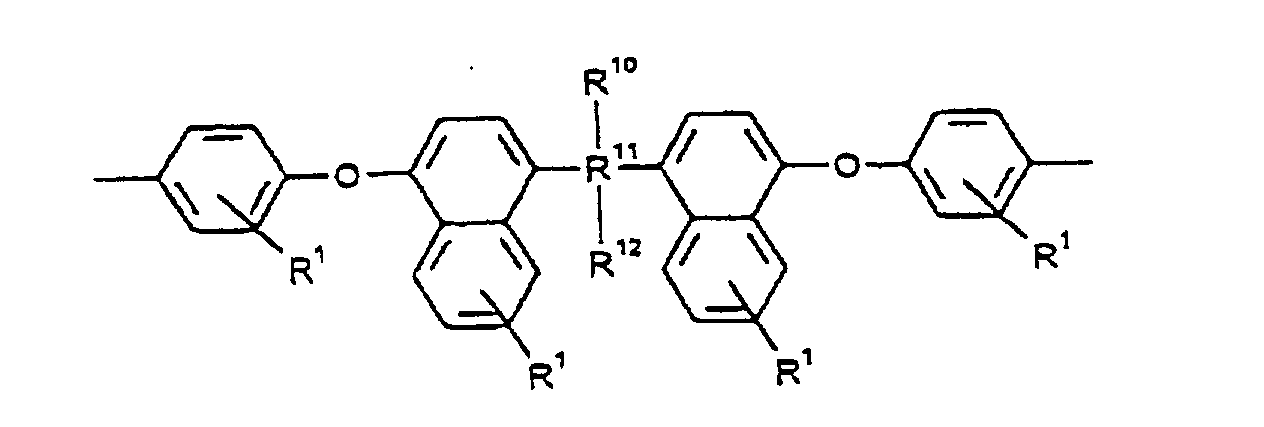


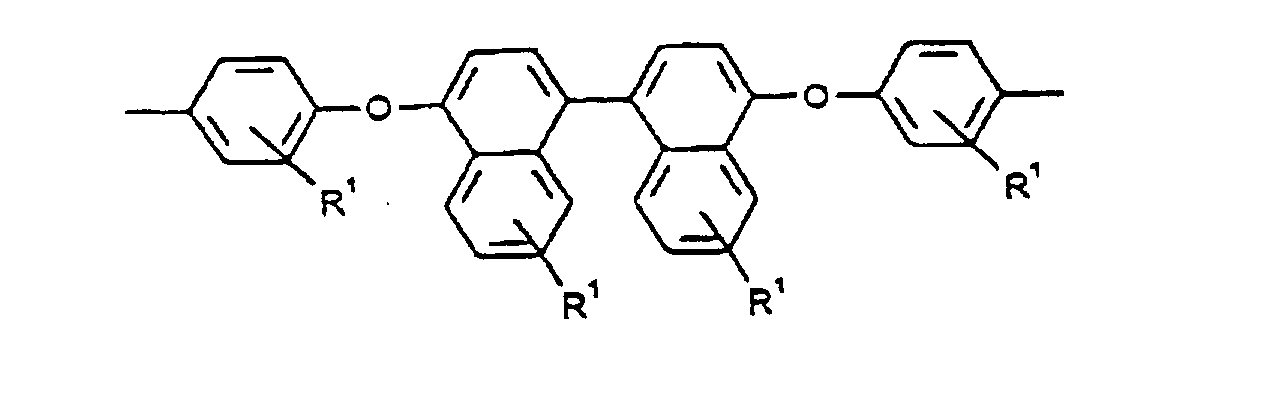
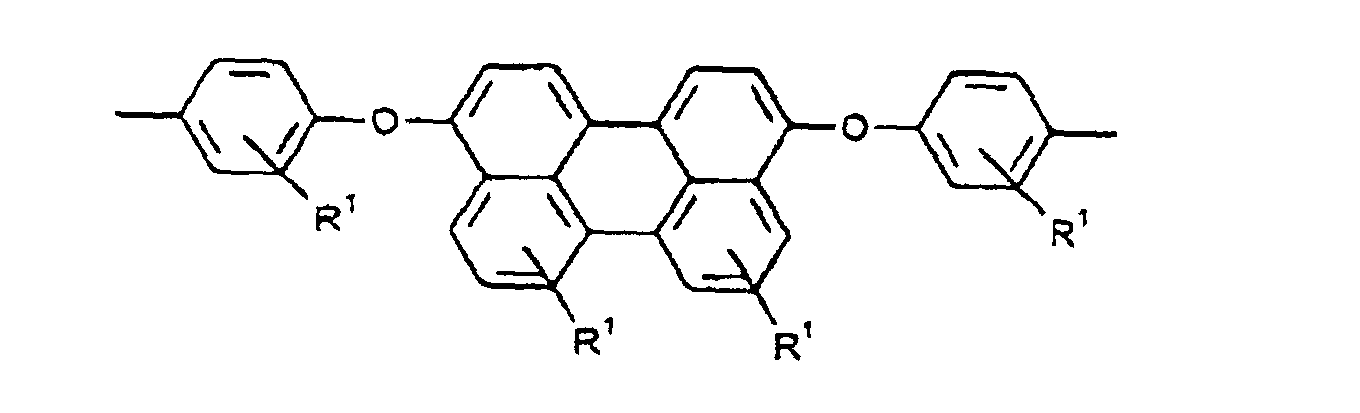


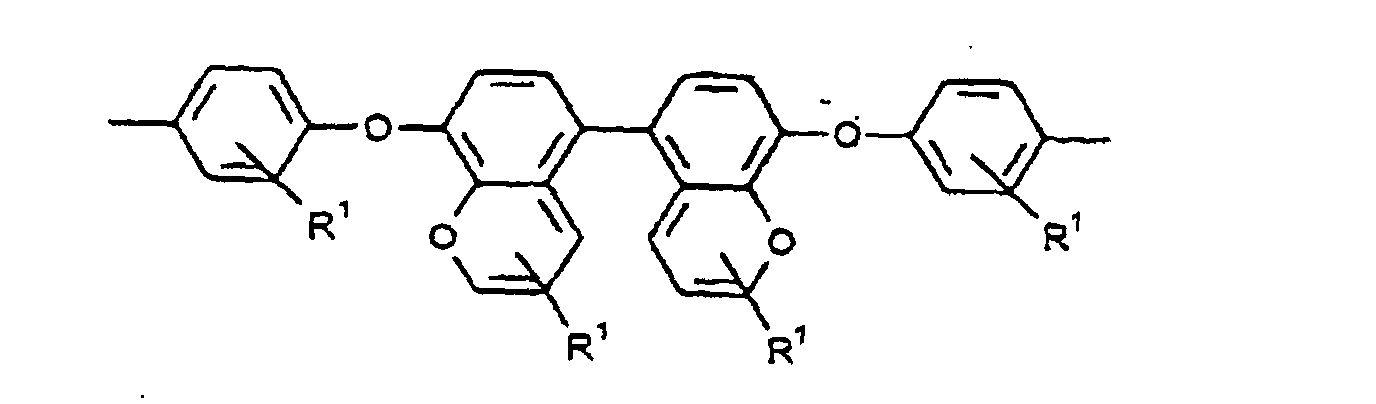

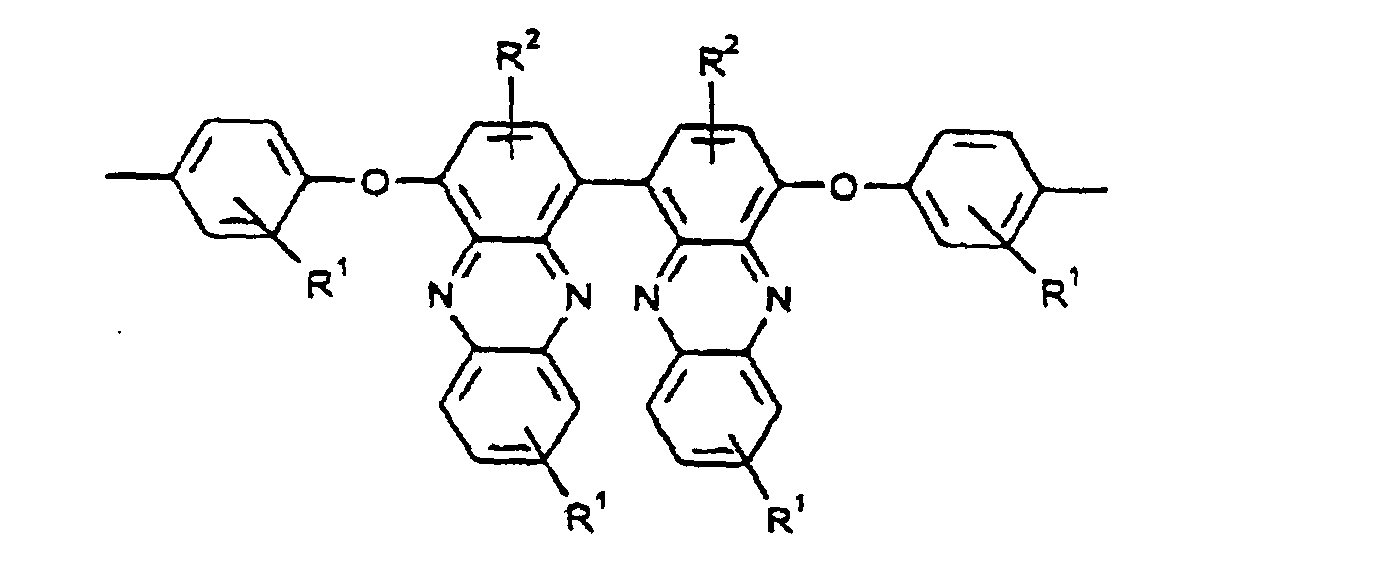

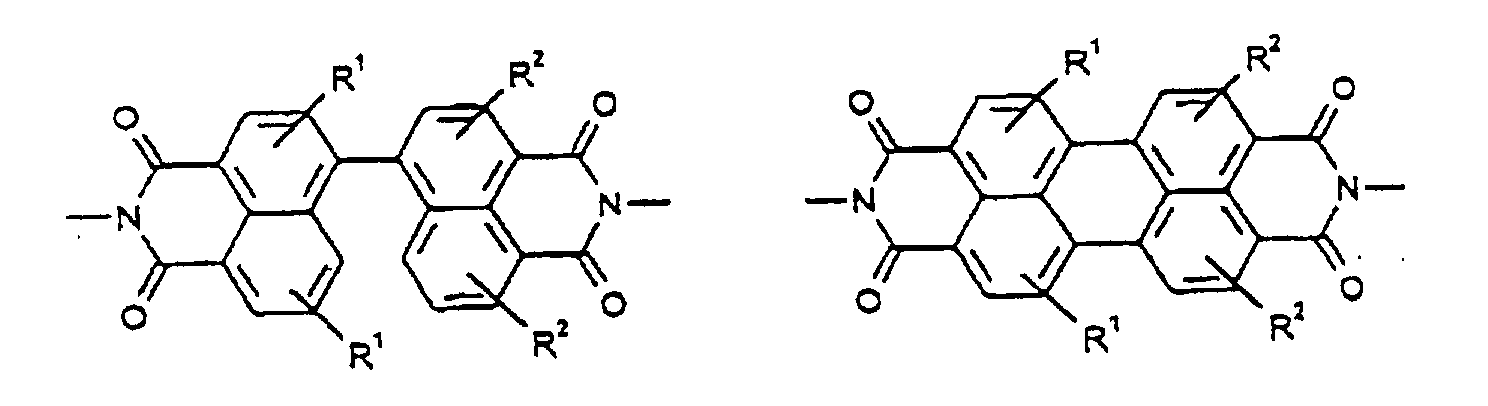
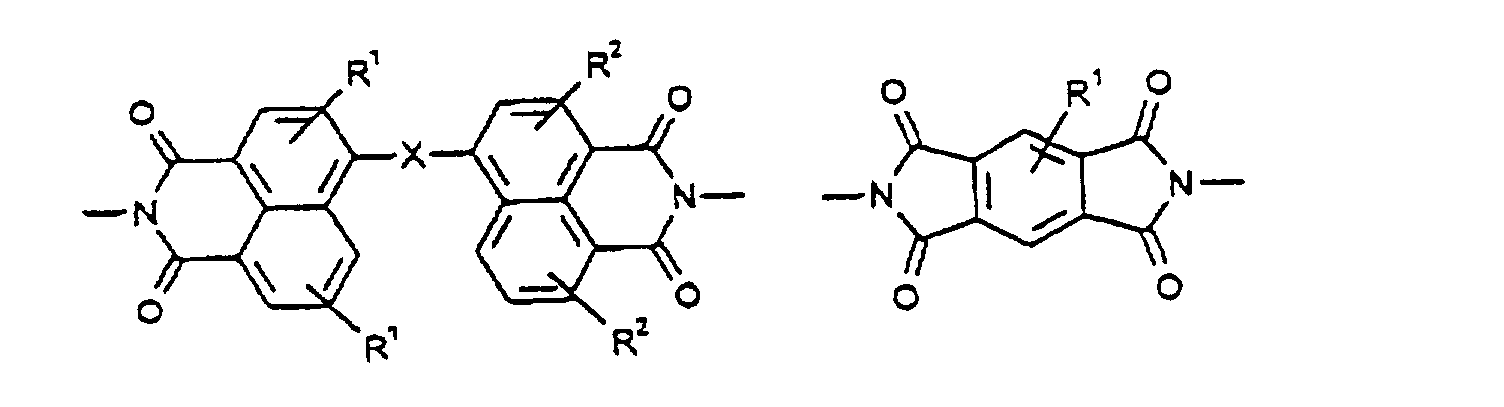
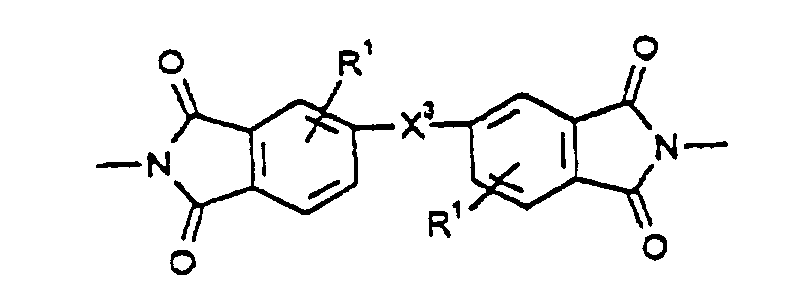
- où X3
- représente
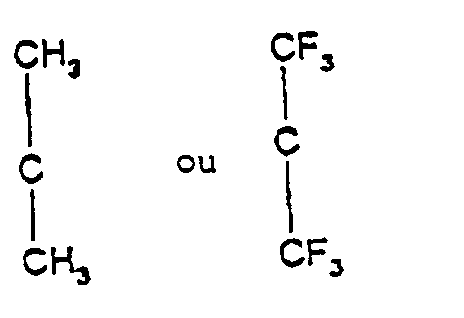

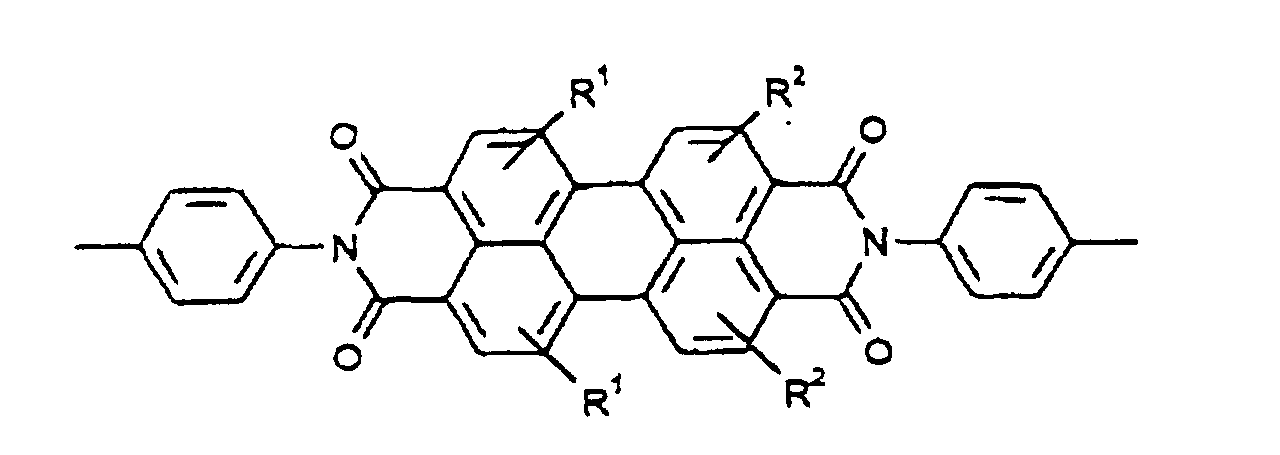

- R1, R2, R3, R10 et R12
- représentent, indépendamment l'un de l'autre, un atome d'hydrogène, un groupe alkyle en C1-C10, le cas échéant substitué, un groupe alcoxy en C1-C10, un groupe alkyle en C1-C10 portant un ou plusieurs substituants alcoxycarbonyle; un groupe aryle, un groupe arylalkyle en C1-C6 ou un groupe cycloalkyle, chacun de ces groupes étant le cas échéant substitué;
- R11
- représente les mêmes radicaux que R10 ou R12 à l'exception d'un atome d'hydrogène, R11 pouvant représenter en outre un groupe sulfonyle ou un groupe sulfoxy, ou bien
- Y
- représente un radical répondant à la formule
(II)

- R4 et R5
- sont identiques ou différents et représentent un atome d'halogène, un groupe alkyle en C1-C4, un groupe aryle en C6-C12 ou un groupe aralkyle en C7-C12,
- n
- représente 0 ou un nombre entier de 1 à 4,
- A
- représente une liaison chimique, un groupe CO,
un atome d'oxygène, un atome de soufre, un
groupe SO2 ou encore un radical répondant à la
formule (III) ou (IV)
dans laquelle
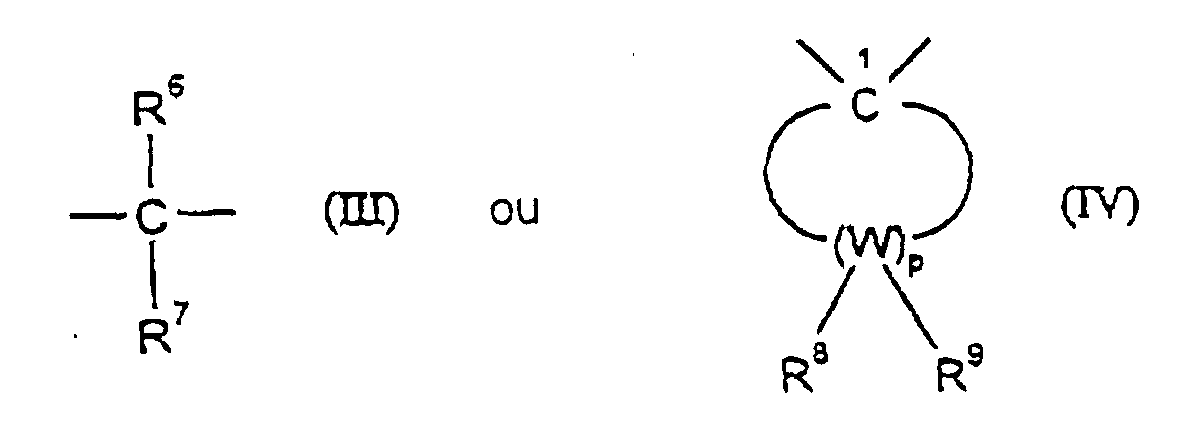
- R6 et R7
- sont identiques ou différents et représentent un atome d'hydrogène, un atome d'halogène, un groupe alkyle en C1-C4, un groupe halogénalkyle en C1-C4 ou un groupe cycloalkyle en C5-C12 avec le cas échéant un ou plusieurs substituants du groupe aryle,
- P
- représente un nombre entier de 4 à 7,
- R8 et R9
- peuvent être sélectionnés de manière individuelle pour chaque atome W et représentent indépendamment l'un de l'autre un atome d'hydrogène ou un groupe alkyle en C1-C6,
- W
- représente un atome de carbone
avec cette mesure que, sur au moins un atome W, les radicaux R8 et R9 représentent simultanément un groupe alkyle, - m
- représente 0 ou un nombre entier de 1 à 3,
- z
- représente un atome d'hydrogène, un atome
d'halogène, un groupe CN, un groupe alkyle en
C1-C20 portant le cas échéant un ou plusieurs
substituants halogéno, un groupe alkyle en C1-C10
portant un ou plusieurs substituants
alcoxy(én C1-C10)carbonyle, un groupe aryle en
C6-C10, un groupe aryl (alkyle en C1-C6), un
groupe pyridyle ou un groupe isoquinolyle,
chacun de ces groupes portant le cas échéant
un ou plusieurs substituants halogéno, alkyle
en C1-C6, halogénalkyle en C1-C6 et/ou
halogénalcoxy en C1-C6; un groupe cycloalkyle
en C4-C10 ou encore un radical répondant aux
formules


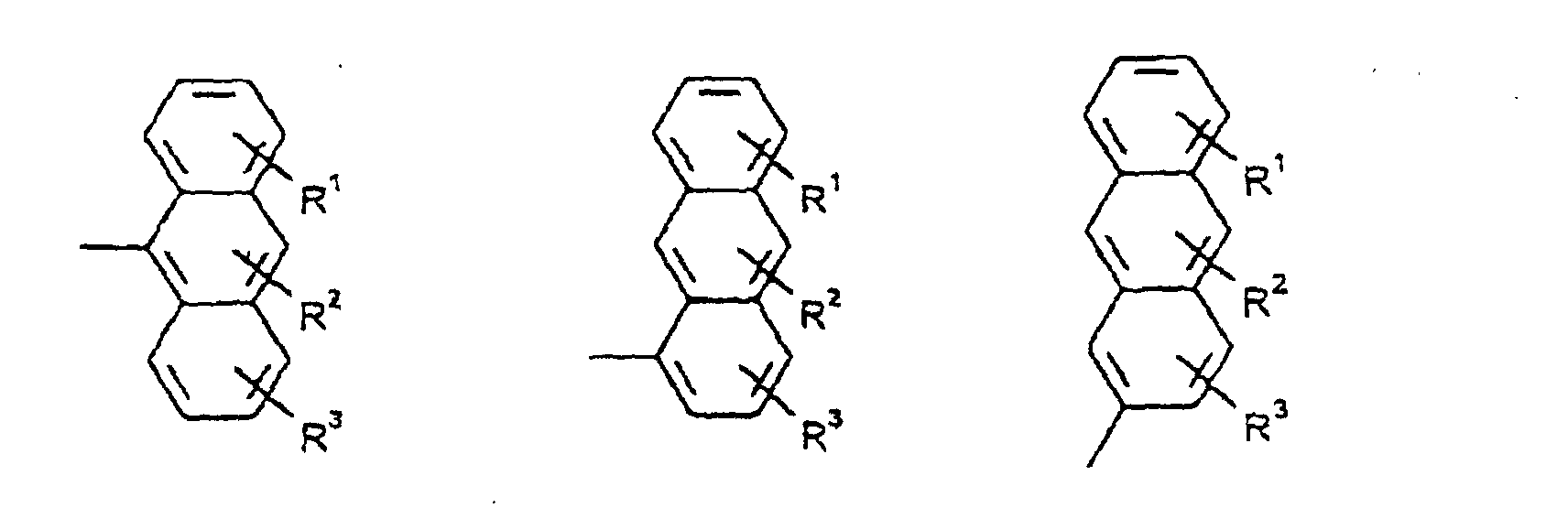
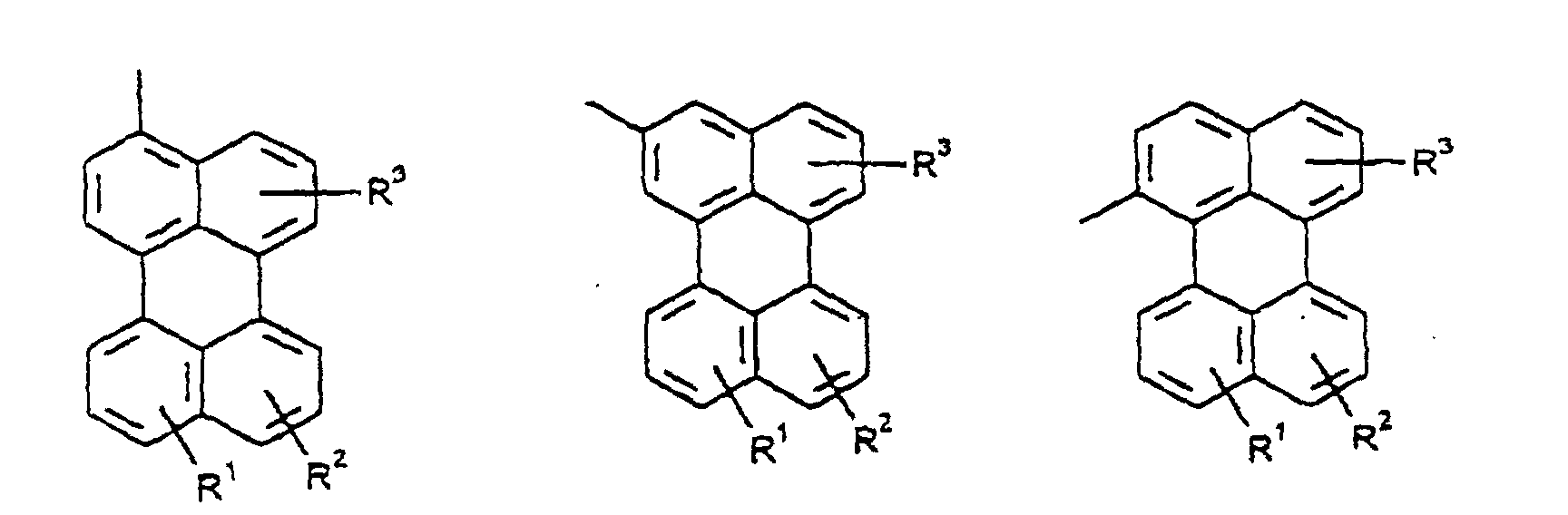


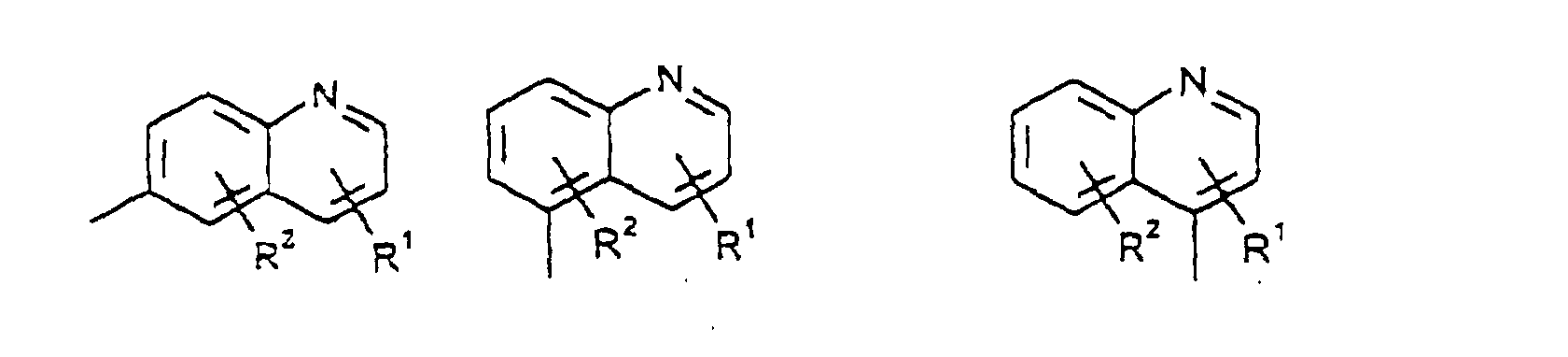


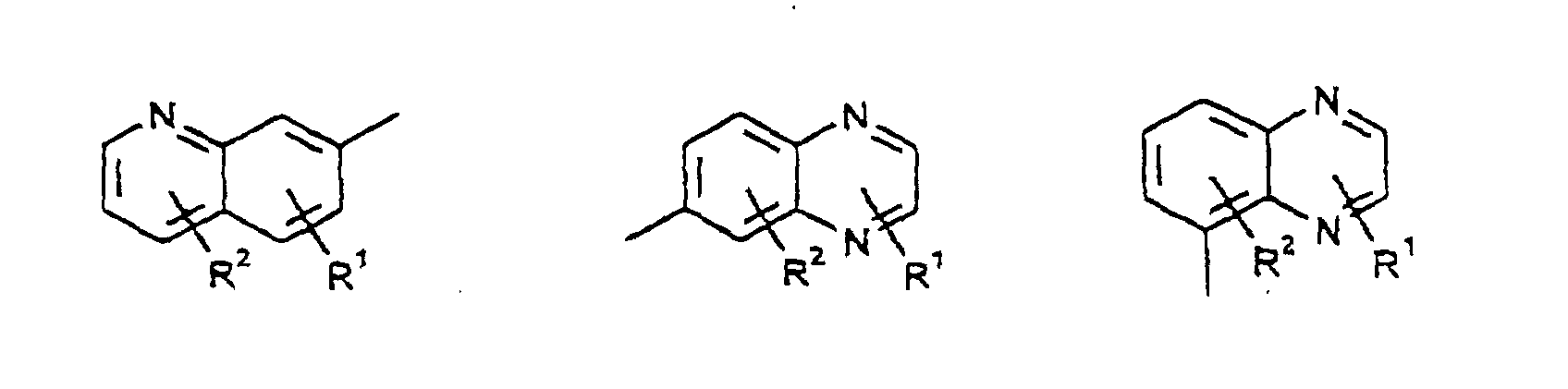

 dans lesquelles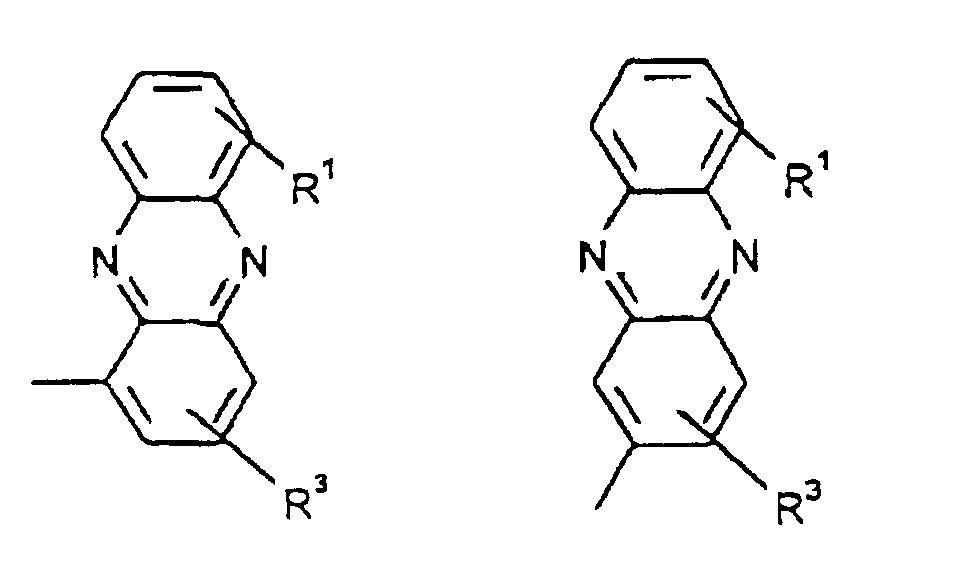
R1, R2 et R3 ont la signification indiquée ci-dessus.
- Utilisation de polymères et/ou de copolymères selon la revendication 1, sous forme de couche dans des agencements électroluminescents.
- Utilisation de polymères et/ou de copolymères selon la revendication 2, sous forme de couche d'injection d'électrons, de couche conductrice d'électrons ou de couche luminescente.
- Couche dans des agencements électroluminescents, contenant des polymères et/ou des copolymères selon la revendication 1.
- Agencement électroluminescent contenant une couche qui contient des polymères et/ou des copolymères selon la revendication 1.
Applications Claiming Priority (5)
| Application Number | Priority Date | Filing Date | Title |
|---|---|---|---|
| DE19637600 | 1996-09-16 | ||
| DE19637600 | 1996-09-16 | ||
| DE19644930A DE19644930A1 (de) | 1996-09-16 | 1996-10-29 | Triazinpolymere und deren Verwendung in elektrolumineszierenden Anordnungen |
| DE19644930 | 1996-10-29 | ||
| PCT/EP1997/004802 WO1998011150A1 (fr) | 1996-09-16 | 1997-09-04 | Polymeres de triazine et leur utilisation dans des dispositifs electroluminescents |
Publications (2)
| Publication Number | Publication Date |
|---|---|
| EP0925319A1 EP0925319A1 (fr) | 1999-06-30 |
| EP0925319B1 true EP0925319B1 (fr) | 2001-12-05 |
Family
ID=26029385
Family Applications (1)
| Application Number | Title | Priority Date | Filing Date |
|---|---|---|---|
| EP97943830A Expired - Lifetime EP0925319B1 (fr) | 1996-09-16 | 1997-09-04 | Polymeres de triazine et leur utilisation dans des dispositifs electroluminescents |
Country Status (8)
| Country | Link |
|---|---|
| EP (1) | EP0925319B1 (fr) |
| JP (1) | JP2001503077A (fr) |
| KR (1) | KR100521299B1 (fr) |
| AT (1) | ATE210163T1 (fr) |
| DK (1) | DK0925319T3 (fr) |
| ES (1) | ES2168144T3 (fr) |
| PT (1) | PT925319E (fr) |
| WO (1) | WO1998011150A1 (fr) |
Cited By (3)
| Publication number | Priority date | Publication date | Assignee | Title |
|---|---|---|---|---|
| US8618243B2 (en) | 2009-05-07 | 2013-12-31 | Nissan Chemical Industries, Ltd. | Triazine ring-containing polymer and film-forming composition comprising same |
| EP2636697A4 (fr) * | 2010-11-01 | 2014-05-07 | Nissan Chemical Ind Ltd | Polymère contenant un cycle triazine et composition filmogène le contenant |
| EP2636704A4 (fr) * | 2010-11-02 | 2014-05-07 | Nissan Chemical Ind Ltd | Composition filmogène |
Families Citing this family (27)
| Publication number | Priority date | Publication date | Assignee | Title |
|---|---|---|---|---|
| US6656608B1 (en) * | 1998-12-25 | 2003-12-02 | Konica Corporation | Electroluminescent material, electroluminescent element and color conversion filter |
| US6821643B1 (en) * | 2000-01-21 | 2004-11-23 | Xerox Corporation | Electroluminescent (EL) devices |
| GB0109108D0 (en) * | 2001-04-11 | 2001-05-30 | Cambridge Display Tech Ltd | Polymer, its preparation and uses |
| JP4623961B2 (ja) * | 2001-09-11 | 2011-02-02 | デュポン テイジン フィルムズ ユー.エス.リミテッド パートナーシップ | 可撓性電子および光電子素子用の熱安定化されたポリ(エチレンナフタレート)フィルム |
| US6730417B2 (en) * | 2002-01-29 | 2004-05-04 | Xerox Corporation | Organic electroluminescent (EL) devices |
| GB0225244D0 (en) * | 2002-10-30 | 2002-12-11 | Ciba Sc Holding Ag | Electroluminescent device |
| US7649077B2 (en) | 2002-10-30 | 2010-01-19 | Ciba Specialty Chemicals Corporation | Polymers for use in optical devices |
| US7906224B2 (en) * | 2003-08-21 | 2011-03-15 | Konica Minolta Holdings, Inc. | Organic electroluminescent device, display, and illuminating device |
| JP4802472B2 (ja) * | 2004-09-28 | 2011-10-26 | Jsr株式会社 | アリーレンエーテル重合体、有機エレクトロルミネッセンス素子用重合体組成物並びに有機エレクトロルミネッセンス素子 |
| JP4878819B2 (ja) * | 2005-11-18 | 2012-02-15 | ケミプロ化成株式会社 | 新規なトリアジン誘導体およびそれを含む有機エレクトロルミネッセンス素子 |
| KR100796988B1 (ko) * | 2006-09-13 | 2008-01-22 | 연세대학교 산학협력단 | 트리아진계 형광 화합물 및 이의 제조방법 |
| EP2275469A4 (fr) * | 2008-04-25 | 2012-11-28 | Sumitomo Chemical Co | Composé polymère portant un groupe fonctionnel restant d'un composé hétérocyclique azoté |
| JP5691177B2 (ja) * | 2009-01-29 | 2015-04-01 | 住友化学株式会社 | 高分子化合物及びそれを用いる発光素子 |
| CN101613477B (zh) * | 2009-07-16 | 2012-08-08 | 浙江工业大学 | 主链含萘衍生物的共轭聚合物发光材料的制备方法 |
| WO2012026452A1 (fr) * | 2010-08-25 | 2012-03-01 | 日産化学工業株式会社 | Polymère contenant un cycle triazine et composition formant membrane le contenant |
| JP5885256B2 (ja) * | 2010-08-30 | 2016-03-15 | 国立大学法人岩手大学 | トリアジン環含有重合体 |
| WO2012057104A1 (fr) * | 2010-10-28 | 2012-05-03 | 日産化学工業株式会社 | Polymère contenant un cycle triazine et composition filmogène contenant ledit polymère |
| JP5880452B2 (ja) * | 2011-02-15 | 2016-03-09 | 日産化学工業株式会社 | 光硬化型膜形成用組成物および硬化膜の製造方法 |
| US10174164B2 (en) | 2011-12-20 | 2019-01-08 | Nissan Chemical Industries, Ltd. | Triazine ring-containing polymer and composition for film formation comprising same |
| JP6094579B2 (ja) * | 2012-05-11 | 2017-03-15 | 日産化学工業株式会社 | 膜形成用組成物及び埋め込み材料 |
| WO2015093508A1 (fr) * | 2013-12-17 | 2015-06-25 | 日産化学工業株式会社 | Composition pour formation de film |
| EP3085750A4 (fr) * | 2013-12-17 | 2017-07-26 | Nissan Chemical Industries, Ltd. | Composition permettant de former un film protecteur pour film conducteur transparent |
| JP6478175B2 (ja) | 2014-10-28 | 2019-03-06 | エルジー・ケム・リミテッド | 高分子重合用組成物、これを用いた高分子、これを用いた高分子電解質膜 |
| JP6804047B2 (ja) * | 2015-06-03 | 2020-12-23 | 日産化学株式会社 | トリアジン環含有重合体およびそれを含む膜形成用組成物 |
| US11814482B2 (en) | 2019-12-03 | 2023-11-14 | Samsung Electronics Co., Ltd. | Triazine ring-containing polymer, and thermoplastic article and optical part including same |
| TWI871505B (zh) * | 2021-03-24 | 2025-02-01 | 國立大學法人岩手大學 | 低介電材料用之樹脂組成物、積層基板用膜、積層基板、低介電材料用之樹脂組成物之製造方法、積層基板用膜之製造方法以及積層基板之製造方法 |
| CN117062876A (zh) * | 2021-03-24 | 2023-11-14 | 国立大学法人岩手大学 | 低介电材料用树脂组合物、层叠基板用膜、层叠基板、低介电材料用树脂组合物的制造方法、层叠基板用膜的制造方法以及层叠基板的制造方法 |
Family Cites Families (4)
| Publication number | Priority date | Publication date | Assignee | Title |
|---|---|---|---|---|
| US3803075A (en) * | 1969-08-01 | 1974-04-09 | Ciba Geigy Corp | Soluble polyimides from 2,6-diamino-s-triazines and dianhydrides |
| US4102872A (en) * | 1977-06-14 | 1978-07-25 | The United States Of America As Represented By The Secretary Of The Air Force | Fluorocarbon triazine polymers |
| US4487920A (en) * | 1983-06-13 | 1984-12-11 | Allied Corporation | Polyamide-polyol-triazine block copolymer and anionic polymerization process |
| JPH07224162A (ja) * | 1994-02-14 | 1995-08-22 | Hoechst Japan Ltd | トリアジンポリマー |
-
1997
- 1997-09-04 ES ES97943830T patent/ES2168144T3/es not_active Expired - Lifetime
- 1997-09-04 JP JP10513219A patent/JP2001503077A/ja active Pending
- 1997-09-04 AT AT97943830T patent/ATE210163T1/de not_active IP Right Cessation
- 1997-09-04 PT PT97943830T patent/PT925319E/pt unknown
- 1997-09-04 EP EP97943830A patent/EP0925319B1/fr not_active Expired - Lifetime
- 1997-09-04 DK DK97943830T patent/DK0925319T3/da active
- 1997-09-04 WO PCT/EP1997/004802 patent/WO1998011150A1/fr not_active Ceased
- 1997-09-04 KR KR10-1999-7002161A patent/KR100521299B1/ko not_active Expired - Lifetime
Cited By (5)
| Publication number | Priority date | Publication date | Assignee | Title |
|---|---|---|---|---|
| US8618243B2 (en) | 2009-05-07 | 2013-12-31 | Nissan Chemical Industries, Ltd. | Triazine ring-containing polymer and film-forming composition comprising same |
| US8710174B2 (en) | 2009-05-07 | 2014-04-29 | Nissan Chemical Industries, Ltd. | Triazine ring-containing polymer and film-forming composition comprising same |
| EP2636697A4 (fr) * | 2010-11-01 | 2014-05-07 | Nissan Chemical Ind Ltd | Polymère contenant un cycle triazine et composition filmogène le contenant |
| EP2636704A4 (fr) * | 2010-11-02 | 2014-05-07 | Nissan Chemical Ind Ltd | Composition filmogène |
| US9502592B2 (en) | 2010-11-02 | 2016-11-22 | Nissan Chemical Industries, Ltd. | Film-forming composition |
Also Published As
| Publication number | Publication date |
|---|---|
| DK0925319T3 (da) | 2002-04-02 |
| PT925319E (pt) | 2002-05-31 |
| EP0925319A1 (fr) | 1999-06-30 |
| JP2001503077A (ja) | 2001-03-06 |
| ES2168144T3 (es) | 2002-06-01 |
| KR100521299B1 (ko) | 2005-10-14 |
| ATE210163T1 (de) | 2001-12-15 |
| WO1998011150A1 (fr) | 1998-03-19 |
| KR20000036127A (ko) | 2000-06-26 |
Similar Documents
| Publication | Publication Date | Title |
|---|---|---|
| EP0925319A1 (fr) | Polymeres de triazine et leur utilisation dans des dispositifs electroluminescents | |
| EP1668058B1 (fr) | Polymeres conjugues, leur representation et leur utilisation | |
| EP1564251B1 (fr) | Compositions de polythiophène pour améliorer les diodes organiques electroluminenscentes | |
| DE60103442T2 (de) | Polymerisches fluoreszentes Material, Verfahren zu ihrer Herstellung, und lumineszentes Polymergerät worin es eingesetzt wird | |
| DE60102456T2 (de) | Lösbare poly(aryl-oxadiazol) konjugierte polymere | |
| EP0949695B1 (fr) | Structure électroluminescente utilisant des systèmes de mélanges | |
| DE19627070A1 (de) | Elektrolumineszierende Anordnungen unter Verwendung von Blendsystemen | |
| DE19829947A1 (de) | Elektrolumineszierende Anordnungen mit Bor-Chelaten | |
| EP1913797A1 (fr) | Polymeres electroluminescents et leur utilisation | |
| EP0969532A2 (fr) | Dispositifs électroluminescents comprenant des complexes métalliques d'azométhine | |
| JP4934888B2 (ja) | 高分子蛍光体およびそれを用いた高分子発光素子 | |
| JP2000303066A (ja) | 高分子蛍光体およびそれを用いた高分子発光素子 | |
| EP1477993B1 (fr) | Materiau organique conducteur et vernis conducteur | |
| EP1109851B1 (fr) | Poly(1,3,4-heterodiazoles) aromatiques s'utilisant dans des dispositifs optiques, notamment des composants electroluminescents | |
| DE112004001737B4 (de) | Verfahren umfassend lösliche, konjugierte Polymere zur Ausbildung benachbarter Schichten auf einem Substrat oder zum Hinzufügen einer Polymerschicht zu einem Substrat, mehrschichtige elektronische Vorrichtung und Verwendung in elektronischen Bauteilen | |
| DE19825737A1 (de) | Elektrolumineszierende Anordnungen mit N-Alkyl-2,2'-imino-bis-(8-hydroxychinolin)-Metallkomplexen | |
| EP1114474A1 (fr) | Ensembles electroluminescents comportant des complexes metalliques a base de thiophenecarboxylate | |
| DE60032744T2 (de) | Aromatische aminoderivate, löslich leitfähige zusammensetzung, und elektroluminescente vorrichtung | |
| DE19839946A1 (de) | Elektrolumineszierende Anordnungen mit mehrkernigen Metallkomplexen | |
| DE19644930A1 (de) | Triazinpolymere und deren Verwendung in elektrolumineszierenden Anordnungen | |
| DE102004010811B4 (de) | Polythiophenformulierungen zur Verbesserung von organischen Leuchtdioden | |
| JP4461548B2 (ja) | 有機エレクトロルミネッセンス素子の製造方法および有機エレクトロルミネッセンス素子 | |
| JP4375502B2 (ja) | 発光素子 | |
| DE19839948A1 (de) | Elektrolumineszierende Anordnungen mit Metallkomplexen mit angeknüpften Fluoreszenzfarbstoffen | |
| EP1074602A1 (fr) | Dispositifs électroluminescents utilisant des chelates de bore des dériveés de 8-aminoquinoline |
Legal Events
| Date | Code | Title | Description |
|---|---|---|---|
| PUAI | Public reference made under article 153(3) epc to a published international application that has entered the european phase |
Free format text: ORIGINAL CODE: 0009012 |
|
| 17P | Request for examination filed |
Effective date: 19990416 |
|
| AK | Designated contracting states |
Kind code of ref document: A1 Designated state(s): AT BE CH DE DK ES FI FR GB IE IT LI NL PT SE |
|
| 17Q | First examination report despatched |
Effective date: 19990721 |
|
| GRAG | Despatch of communication of intention to grant |
Free format text: ORIGINAL CODE: EPIDOS AGRA |
|
| GRAG | Despatch of communication of intention to grant |
Free format text: ORIGINAL CODE: EPIDOS AGRA |
|
| GRAH | Despatch of communication of intention to grant a patent |
Free format text: ORIGINAL CODE: EPIDOS IGRA |
|
| GRAH | Despatch of communication of intention to grant a patent |
Free format text: ORIGINAL CODE: EPIDOS IGRA |
|
| GRAA | (expected) grant |
Free format text: ORIGINAL CODE: 0009210 |
|
| AK | Designated contracting states |
Kind code of ref document: B1 Designated state(s): AT BE CH DE DK ES FI FR GB IE IT LI NL PT SE |
|
| REF | Corresponds to: |
Ref document number: 210163 Country of ref document: AT Date of ref document: 20011215 Kind code of ref document: T |
|
| REG | Reference to a national code |
Ref country code: CH Ref legal event code: NV Representative=s name: E. BLUM & CO. PATENTANWAELTE Ref country code: CH Ref legal event code: EP |
|
| REG | Reference to a national code |
Ref country code: GB Ref legal event code: IF02 |
|
| REG | Reference to a national code |
Ref country code: IE Ref legal event code: FG4D Free format text: GERMAN |
|
| REF | Corresponds to: |
Ref document number: 59705691 Country of ref document: DE Date of ref document: 20020117 |
|
| GBT | Gb: translation of ep patent filed (gb section 77(6)(a)/1977) |
Effective date: 20020218 |
|
| REG | Reference to a national code |
Ref country code: DK Ref legal event code: T3 |
|
| ET | Fr: translation filed | ||
| REG | Reference to a national code |
Ref country code: PT Ref legal event code: SC4A Free format text: AVAILABILITY OF NATIONAL TRANSLATION Effective date: 20020227 |
|
| REG | Reference to a national code |
Ref country code: ES Ref legal event code: FG2A Ref document number: 2168144 Country of ref document: ES Kind code of ref document: T3 |
|
| PG25 | Lapsed in a contracting state [announced via postgrant information from national office to epo] |
Ref country code: FI Free format text: LAPSE BECAUSE OF NON-PAYMENT OF DUE FEES Effective date: 20020904 |
|
| PG25 | Lapsed in a contracting state [announced via postgrant information from national office to epo] |
Ref country code: SE Free format text: LAPSE BECAUSE OF NON-PAYMENT OF DUE FEES Effective date: 20020905 Ref country code: ES Free format text: LAPSE BECAUSE OF NON-PAYMENT OF DUE FEES Effective date: 20020905 |
|
| PG25 | Lapsed in a contracting state [announced via postgrant information from national office to epo] |
Ref country code: DK Free format text: LAPSE BECAUSE OF NON-PAYMENT OF DUE FEES Effective date: 20020930 Ref country code: BE Free format text: LAPSE BECAUSE OF NON-PAYMENT OF DUE FEES Effective date: 20020930 |
|
| PLBE | No opposition filed within time limit |
Free format text: ORIGINAL CODE: 0009261 |
|
| STAA | Information on the status of an ep patent application or granted ep patent |
Free format text: STATUS: NO OPPOSITION FILED WITHIN TIME LIMIT |
|
| RAP2 | Party data changed (patent owner data changed or rights of a patent transferred) |
Owner name: SCHMIDT, HANS-WERNER, PROFESSOR DR. |
|
| REG | Reference to a national code |
Ref country code: GB Ref legal event code: 732E |
|
| REG | Reference to a national code |
Ref country code: CH Ref legal event code: PUE Owner name: BAYER AG TRANSFER- SCHMIDT, HANS-WERNER, PROFESSOR |
|
| 26N | No opposition filed | ||
| NLS | Nl: assignments of ep-patents |
Owner name: PROFESSOR DR. HANS-WERNER SCHMIDT |
|
| NLT2 | Nl: modifications (of names), taken from the european patent patent bulletin |
Owner name: SCHMIDT, HANS-WERNER, PROFESSOR DR. |
|
| REG | Reference to a national code |
Ref country code: FR Ref legal event code: TP |
|
| BERE | Be: lapsed |
Owner name: *BAYER A.G. Effective date: 20020930 |
|
| PG25 | Lapsed in a contracting state [announced via postgrant information from national office to epo] |
Ref country code: PT Free format text: LAPSE BECAUSE OF NON-PAYMENT OF DUE FEES Effective date: 20030331 |
|
| REG | Reference to a national code |
Ref country code: DK Ref legal event code: EBP |
|
| EUG | Se: european patent has lapsed | ||
| REG | Reference to a national code |
Ref country code: PT Ref legal event code: MM4A Free format text: LAPSE DUE TO NON-PAYMENT OF FEES Effective date: 20030331 |
|
| REG | Reference to a national code |
Ref country code: ES Ref legal event code: FD2A Effective date: 20031011 |
|
| PGFP | Annual fee paid to national office [announced via postgrant information from national office to epo] |
Ref country code: CH Payment date: 20040909 Year of fee payment: 8 |
|
| PGFP | Annual fee paid to national office [announced via postgrant information from national office to epo] |
Ref country code: AT Payment date: 20040910 Year of fee payment: 8 |
|
| PGFP | Annual fee paid to national office [announced via postgrant information from national office to epo] |
Ref country code: IE Payment date: 20040915 Year of fee payment: 8 |
|
| REG | Reference to a national code |
Ref country code: CH Ref legal event code: PUE Owner name: COVION ORGANIC SEMICONDUCTORS GMBH Free format text: SCHMIDT, HANS-WERNER, PROFESSOR DR.#LISZTSTRASSE 26#95444 BAYREUTH (DE) -TRANSFER TO- COVION ORGANIC SEMICONDUCTORS GMBH#INDUSTRIEPARK HOECHST#65926 FRANKFURT AM MAIN (DE) |
|
| REG | Reference to a national code |
Ref country code: GB Ref legal event code: 732E |
|
| NLS | Nl: assignments of ep-patents |
Owner name: COVION ORGANIC SEMICONDUCTORS GMBH |
|
| PG25 | Lapsed in a contracting state [announced via postgrant information from national office to epo] |
Ref country code: IT Free format text: LAPSE BECAUSE OF NON-PAYMENT OF DUE FEES Effective date: 20050904 Ref country code: AT Free format text: LAPSE BECAUSE OF NON-PAYMENT OF DUE FEES Effective date: 20050904 |
|
| PG25 | Lapsed in a contracting state [announced via postgrant information from national office to epo] |
Ref country code: IE Free format text: LAPSE BECAUSE OF NON-PAYMENT OF DUE FEES Effective date: 20050905 |
|
| PG25 | Lapsed in a contracting state [announced via postgrant information from national office to epo] |
Ref country code: LI Free format text: LAPSE BECAUSE OF NON-PAYMENT OF DUE FEES Effective date: 20050930 Ref country code: CH Free format text: LAPSE BECAUSE OF NON-PAYMENT OF DUE FEES Effective date: 20050930 |
|
| REG | Reference to a national code |
Ref country code: CH Ref legal event code: PL |
|
| REG | Reference to a national code |
Ref country code: IE Ref legal event code: MM4A |
|
| REG | Reference to a national code |
Ref country code: GB Ref legal event code: 732E |
|
| REG | Reference to a national code |
Ref country code: FR Ref legal event code: TP |
|
| NLS | Nl: assignments of ep-patents |
Owner name: MERCK PATENT GMBH Effective date: 20070320 |
|
| NLT1 | Nl: modifications of names registered in virtue of documents presented to the patent office pursuant to art. 16 a, paragraph 1 |
Owner name: MERCK OLED MATERIALS GMBH |
|
| PGFP | Annual fee paid to national office [announced via postgrant information from national office to epo] |
Ref country code: NL Payment date: 20090903 Year of fee payment: 13 |
|
| PGFP | Annual fee paid to national office [announced via postgrant information from national office to epo] |
Ref country code: FR Payment date: 20091012 Year of fee payment: 13 |
|
| PGFP | Annual fee paid to national office [announced via postgrant information from national office to epo] |
Ref country code: GB Payment date: 20100901 Year of fee payment: 14 |
|
| REG | Reference to a national code |
Ref country code: NL Ref legal event code: V1 Effective date: 20110401 |
|
| REG | Reference to a national code |
Ref country code: FR Ref legal event code: ST Effective date: 20110531 |
|
| PG25 | Lapsed in a contracting state [announced via postgrant information from national office to epo] |
Ref country code: FR Free format text: LAPSE BECAUSE OF NON-PAYMENT OF DUE FEES Effective date: 20100930 |
|
| PG25 | Lapsed in a contracting state [announced via postgrant information from national office to epo] |
Ref country code: NL Free format text: LAPSE BECAUSE OF NON-PAYMENT OF DUE FEES Effective date: 20110401 |
|
| GBPC | Gb: european patent ceased through non-payment of renewal fee |
Effective date: 20110904 |
|
| PG25 | Lapsed in a contracting state [announced via postgrant information from national office to epo] |
Ref country code: GB Free format text: LAPSE BECAUSE OF NON-PAYMENT OF DUE FEES Effective date: 20110904 |
|
| PGFP | Annual fee paid to national office [announced via postgrant information from national office to epo] |
Ref country code: DE Payment date: 20160831 Year of fee payment: 20 |
|
| REG | Reference to a national code |
Ref country code: DE Ref legal event code: R071 Ref document number: 59705691 Country of ref document: DE |