EP0925775A2 - Haarbehandlungsmittel - Google Patents
Haarbehandlungsmittel Download PDFInfo
- Publication number
- EP0925775A2 EP0925775A2 EP98121895A EP98121895A EP0925775A2 EP 0925775 A2 EP0925775 A2 EP 0925775A2 EP 98121895 A EP98121895 A EP 98121895A EP 98121895 A EP98121895 A EP 98121895A EP 0925775 A2 EP0925775 A2 EP 0925775A2
- Authority
- EP
- European Patent Office
- Prior art keywords
- hair treatment
- group
- treatment composition
- composition according
- alkyl
- Prior art date
- Legal status (The legal status is an assumption and is not a legal conclusion. Google has not performed a legal analysis and makes no representation as to the accuracy of the status listed.)
- Granted
Links
Classifications
-
- A—HUMAN NECESSITIES
- A61—MEDICAL OR VETERINARY SCIENCE; HYGIENE
- A61K—PREPARATIONS FOR MEDICAL, DENTAL OR TOILETRY PURPOSES
- A61K8/00—Cosmetics or similar toiletry preparations
- A61K8/18—Cosmetics or similar toiletry preparations characterised by the composition
- A61K8/30—Cosmetics or similar toiletry preparations characterised by the composition containing organic compounds
- A61K8/40—Cosmetics or similar toiletry preparations characterised by the composition containing organic compounds containing nitrogen
- A61K8/41—Amines
- A61K8/416—Quaternary ammonium compounds
-
- A—HUMAN NECESSITIES
- A61—MEDICAL OR VETERINARY SCIENCE; HYGIENE
- A61K—PREPARATIONS FOR MEDICAL, DENTAL OR TOILETRY PURPOSES
- A61K8/00—Cosmetics or similar toiletry preparations
- A61K8/18—Cosmetics or similar toiletry preparations characterised by the composition
- A61K8/30—Cosmetics or similar toiletry preparations characterised by the composition containing organic compounds
- A61K8/33—Cosmetics or similar toiletry preparations characterised by the composition containing organic compounds containing oxygen
- A61K8/36—Carboxylic acids; Salts or anhydrides thereof
- A61K8/361—Carboxylic acids having more than seven carbon atoms in an unbroken chain; Salts or anhydrides thereof
-
- A—HUMAN NECESSITIES
- A61—MEDICAL OR VETERINARY SCIENCE; HYGIENE
- A61K—PREPARATIONS FOR MEDICAL, DENTAL OR TOILETRY PURPOSES
- A61K8/00—Cosmetics or similar toiletry preparations
- A61K8/18—Cosmetics or similar toiletry preparations characterised by the composition
- A61K8/30—Cosmetics or similar toiletry preparations characterised by the composition containing organic compounds
- A61K8/40—Cosmetics or similar toiletry preparations characterised by the composition containing organic compounds containing nitrogen
- A61K8/45—Derivatives containing from 2 to 10 oxyalkylene groups
-
- A—HUMAN NECESSITIES
- A61—MEDICAL OR VETERINARY SCIENCE; HYGIENE
- A61Q—SPECIFIC USE OF COSMETICS OR SIMILAR TOILETRY PREPARATIONS
- A61Q5/00—Preparations for care of the hair
- A61Q5/12—Preparations containing hair conditioners
-
- A—HUMAN NECESSITIES
- A61—MEDICAL OR VETERINARY SCIENCE; HYGIENE
- A61Q—SPECIFIC USE OF COSMETICS OR SIMILAR TOILETRY PREPARATIONS
- A61Q7/00—Preparations for affecting hair growth
Definitions
- the present invention relates to a hair treatment composition, in particular a Hair conditioning agent, which above all gives human hair an improved volume, gives increased gloss and easy wet and dry combability as well as able is to regenerate damaged hair.
- Means for conditioning human hair have long been known. They generally contain quaternary ammonium compounds which have at least one long-chain alkyl or alkenyl group, and optionally also polymers. Such agents are usually packaged as aqueous dispersions or emulsions, microemulsions, gels or also in aerosol form and used as hair rinses, treatments, etc.
- An overview of the known hair aftertreatment agents and their composition can be found in the monograph by K. Schrader, Fundamentals and Recipes of Cosmetics, 2nd edition (1989), pp. 722 to 781, in particular pp. 728 to 737. However, these known compositions can still be improved.
- Preferred fatty acids in the compositions according to the invention are those with 14 to 22 carbon atoms in an amount of about 0.1 to 10% by weight, in particular 0.5 up to 8 wt .-%, based on the total composition used.
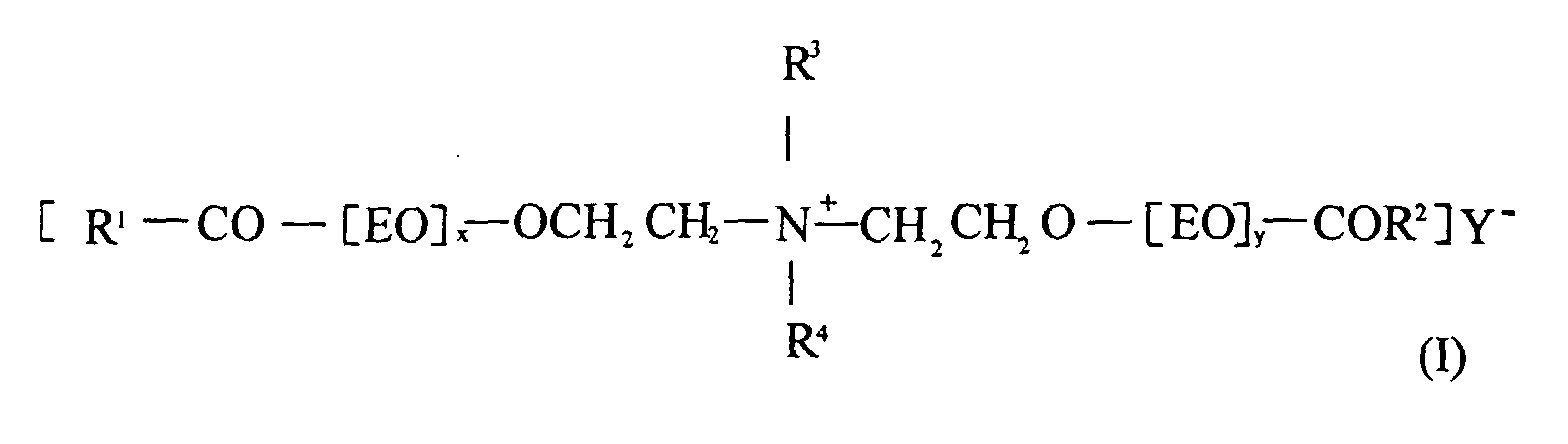
- a particularly preferred compound of the formula I in the context of the invention is one in which the radicals R 1 and R 2 each have an oleyl group or a C 12 -C 18 alkyl group, the radical R 3 is a methyl group and the radical R 4 is a group -CH 2 -CH 2 -O- [EO] z -H mean.
- the anion Y- is preferably a halide such as Cl - or Br - , a lower alkyl sulfate, for example methosulfate, or an alkyl phosphate, but other radicals can of course also be used.
- Hair treatment agents is 0.1 to 20, preferably 0.5 to 15, in particular 1 to 10 % By weight, calculated on the total composition of the agent.
- the hair treatment composition according to the invention can be a further preferred constituent at least one compound selected from the group 1-methoxypropanol (-2), 1-ethoxypropanol (-2), Diethylene glycol monomethyl or ethyl ether, dipropylene glycol monomethyl or ethyl ether, benzyl alcohol, benzyloxyethanol, phenylethyl alcohol, Phenoxyethanol and / or cinnamon alcohol, preferably in an amount of 0.5 to 25, in particular 1 to 20, especially 2.5 to 15 wt .-%, calculated on the Total composition of the agent.
- Preferred compounds from this group are ethoxydiglycol and benzyloxyethanol.
- the hair treatment compositions according to the invention can of course additionally contain the constituents customary in such compositions; to avoid repetition, it is again on K. Schrader, Fundamentals and formulations of cosmetics ", 2nd ed. (1989), pp. 722-771.
- Suitable additives are, for example, synthetic or natural hair conditioning agents Polymers, preferably in an amount of 0.1 to 2.5, in particular 0.25 to 1.5% by weight the overall composition.
- the quaternary ammonium compounds which have long been known as conditioning agents and contain one or two long-chain, in particular C 10 -C 22 -alkyl radicals can also be used.
- Suitable long-chain quaternary ammonium compounds which may be used alone or in admixture with each other are in particular cetyl trimethyl ammonium chloride, Dimethyldicetylammoniumchlorid, trimethylcetylammonium bromide, stearyltrimethylammonium chloride, dimethylstearylbenzylammonium chloride Benzyltetradecyldimethylammoniumchlorid, dimethyl dihydrogenated tallow ammonium chloride-, lauryl pyridinium chloride, lauryldimethylbenzylammonium chloride, behenyltrimethylammonium chloride, lauryltrimethylammonium chloride, tris- (oligooxyethyl) alkyl ammonium phosphate, Cetylpyri
- quaternary ammonium salts disclosed in EP-A 472 107 are also very suitable.
- all quaternary ammonium compounds are as in the currently valid CTFA International Cosmetic Ingredient Dictionary "under the trivial name Quaternium "are listed. Their proportion is preferably about 0.1 to 10, in particular about 0.5 to 7.5% by weight, calculated on the total composition.
- ceramide in particular of the type known from EP 227 994 A1 and WO-A 96/37462, but there are also other ceramides, for example those from WO-A 97/15724 or EP 647 617 B1 known ceramides, suitable.
- the amount in the hair treatment compositions according to the invention is advantageously about 0.01 to 10, preferably about 0.05 to 7.5, in particular about 0.1 to 5% by weight, based on the total composition.
- additives the type and amount of which depend, of course, on the form in which the agent is administered are dependent on fats, fatty alcohols, emulsifiers, pH regulators, solution and Thinners, solubilizers, preservatives, perfumes, etc.
- Suitable fats and oils which also include waxes, are in particular natural oils such as Avocado oil, coconut oil, palm oil, sesame oil, peanut oil, sperm oil, sunflower oil, almond oil, Peach seed oil, wheat germ oil, macadamia nut oil, evening primrose oil, jojoba oil, castor oil, or also olive or Soybean oil, lanolin and its derivatives, as well as mineral oils such as paraffin oil and Vaseline.
- natural oils such as avocado oil, coconut oil, palm oil, sesame oil, peanut oil, sperm oil, sunflower oil, almond oil, Peach seed oil, wheat germ oil, macadamia nut oil, evening primrose oil, jojoba oil, castor oil, or also olive or Soybean oil, lanolin and its derivatives, as well as mineral oils such as paraffin oil and Vaseline.
- Synthetic oils and waxes are, for example, silicone oils, polyethylene glycols, etc.
- suitable hydrophobic components are, in particular, fatty alcohols, preferably those with about 8 to 22 carbon atoms in the molecule, such as myristyl, cetyl, stearyl alcohol, Wax alcohols and fatty acid esters such as isopropyl myristate, palmitate, stearate and isostearate, Oleyl oleate, isocet / istearate, hexyl laurate, dibutyl adipate, dioctyl adipate, myristyl myristate, Oleylerucat, polyethylene glycol and polyglyceryl fatty acid esters such as PEG-7-glyceryl cocoate, Cetyl palmitate, etc.
- hydrophobic components are in the composition according to the invention preferably in a total amount of about 0.5 to about 10, in particular about 1 to 7.5, especially about 1.5 to 5 wt .-%, calculated on the total composition.
- a preferred surfactant group are the known C 8 -C 20 -alkyl polyglucosides, preferably those with a degree of polymerization of approximately 1.1 to approximately 5, in a preferred amount of approximately 0.5 to approximately 20, in particular 1 to approximately 10% by weight. %, calculated on the total composition.
- the hair conditioning agents according to the invention are preferably in the form of, aqueous or aqueous / alcoholic solution, aqueous emulsion, microemulsion, dispersion or opaque or transparent gel, and can also be packaged as aerosols.
- aqueous or aqueous / alcoholic solution aqueous emulsion, microemulsion, dispersion or opaque or transparent gel
- Such Compositions and their preparation are fundamentally known to the person skilled in the art and therefore require no further explanation.
- the pH of the hair treatment compositions according to the invention is not critical; he can preferably 3 to about 8, in particular between 4 and 6.5.
- Behenic acid 1.0 (% by weight) Avocadin R 0.5
- Steartrimonium chloride 1.0 1,2-propanediol 5.0 Cocoamidopropyl betaine 1.5 C 12 -C 24 alkyl polyglucoside (PD ⁇ 1.5) 2.5 Benzyloxyethanol 5.0 Preservative 0.3 Perfume 0.3 water ad 100.0
- compositions according to the invention both with and without rinsing, an excellent hair-conditioning effect and a shine were achieved after 10 minutes of exposure, which were significantly better than when the component of formula I or the fatty acids (behenic acid, stearic acid) were omitted.
- the wet and dry combability of the treated hair was also significantly improved.
Landscapes
- Health & Medical Sciences (AREA)
- Life Sciences & Earth Sciences (AREA)
- Animal Behavior & Ethology (AREA)
- General Health & Medical Sciences (AREA)
- Public Health (AREA)
- Veterinary Medicine (AREA)
- Birds (AREA)
- Epidemiology (AREA)
- Dermatology (AREA)
- Emergency Medicine (AREA)
- Cosmetics (AREA)
- Acyclic And Carbocyclic Compounds In Medicinal Compositions (AREA)
Abstract

Description
Eine Übersicht über die bekannten Haarnachbehandlungsmittel und ihre Zusammensetzung findet sich in der Monographie von K. Schrader, Grundlagen und Rezepturen der Kosmetika, 2. Aufl. (1989), S. 722 bis 781, insbesondere S. 728 bis 737.
Diese bekannten Zusammensetzungen sind aber noch verbesserungsfähig.

Geeignete langkettige quaternäre Ammoniumverbindungen, die allein oder im Gemisch miteinander eingesetzt werden können, sind insbesondere Cetyltrimethylammoniumchlorid, Dimethyldicetylammoniumchlorid, Trimethylcetylammoniumbromid, Stearyltrimethylammoniumchlorid, Dimethylstearylbenzylammoniumchlorid, Benzyltetradecyldimethylammoniumchlorid, Dimethyl- dihydriertes-Talgammoniumchlorid, Laurylpyridiniumchlorid, Lauryldimethylbenzylammoniumchlorid, Behenyltrimethylammoniumchlorid, Lauryltrimethylammoniumchlorid, Tris-(oligooxyethyl)alkylammoniumphosphat, Cetylpyridiniumchlorid, etc. Gut geeignet sind auch die in der EP-A 472 107 geoffenbarten quaternären Ammoniumsalze.
Im Prinzip sind alle quaternären Ammoniumverbindungen, wie sie im jeweils gültigen
Ihr Anteil liegt vorzugsweise bei etwa 0,1 bis 10, insbesondere etwa 0,5 bis 7,5 Gew.-%, berechnet auf die Gesamtzusammensetzung.
Deren Menge in den erfindungsgemäßen Haarbehandlungsmitteln liegt zweckmäßigerweise bei etwa 0,01 bis 10, vorzugsweise etwa 0,05 bis 7,5, insbesondere etwa 0,1 bis 5 Gew.-%, berechnet auf die Gesamtzusammensetzung.
Eine beispielhafte Zusammenfassung der Herstellung solcher Mittel findet sich ebenfalls in der bereits erwähnten Monographie von K. Schrader, S. 798 bis 818, insbesondere S. 804 ff.
| Behensäure | 1,0 (Gew.-%) |
| AvocadinR | 0,5 |
| Verbindung der Formel I (R1=R2=Oleyl; R3=CH3; R4=CH2-CH2-OH; Y=CH3SO4 -) | 1,0 |
| Steartrimoniumchlorid | 1,0 |
| 1,2-Propandiol | 5,0 |
| Cocoamidopropylbetain | 1,5 |
| C12-C24-Alkylpolyglucosid (P.D.∼1,5) | 2,5 |
| Benzyloxyethanol | 5,0 |
| Konservierungsmittel | 0,3 |
| Parfum | 0,3 |
| Wasser | ad 100,0 |
| Behensäure | 2,0 (Gew.-%) |
| Stearinsäure | 1,0 |
| N-(3-Hexadecyloxy-2-hydroxypropyl)-N-2-hydroxyethyldecanamid (Ceramid) | 0,5 |
| Verbindung der Formel I (R1=C18H37-Alkyl; R2= C11H23 -Alkyl; R3=R4=CH3; Y=Cl-) | 3,0 |
| Steartrimoniumchlorid | 1,0 |
| 1,2-Propandiol | 2,5 |
| Benzyloxyethanol | 5,0 |
| C8-C20-Alkylpolyglucosid (P.D.∼1,4) | 4,5 |
| Parfum | 0,3 |
| Konservierungsmittel | 0,3 |
| Wasser | ad 100,0 |
| Behensäure | 2,5 (Gew.-%) |
| AvocadinR | 0,5 |
| Verbindung der Formel I (R1=R2=C12H31; R3=CH3; R4=CH2-CH2-OH; Y = Cl-) | 3,5 |
| 1,2-Propandiol | 5,0 |
| Benzyloxyethanol | 5,0 |
| C12-C14-Alkylpolyglucosid (P.D.∼1,5) | 3,5 |
| Parfum | 0,3 |
| Konservierungsmittel | 0,4 |
| Wasser | ad 100,0 |
Auch die Naß- und Trockenkämmbarkeit des behandelten Haares war deutlich verbessert. Diese Effekte konnten auch durch in vitro-Untersuchungen bestätigt werden.
| Verbindung der Formel I (R1=R2=Oleyl; R3=CH3; R4=-CH2-CH2-OH; Y=CH3SO4 -) | 1,0 (Gew.-%) |
| Dimethicone Copolyol Bienenwachs | 1,0 |
| Cetylstearylalkohol | 1,0 |
| C8-C10-Alkylpolyglucosid (P.D.∼1,4) | 1,5 |
| 1,2-Propandiol | 2,0 |
| Hydroxyethylcellulose | 0,8 |
| Saccharose | 0,5 |
| Behentrimoniumchlorid | 0,4 |
| Grüner Tee-Extrakt | 0,3 |
| Isostearylglycerylether | 0,2 |
| Parfum | 0,3 |
| Konservierungsmittel | 0,3 |
| Farbstoffe, UV-Absorber | q.s. |
| Wasser | ad 100,0 |
Claims (10)
- Haarbehandlungsmittel auf wäßriger Grundlage, enthaltend ein Gemisch ausa) mindestens einer C10-C24-Fettsäure, undb) mindestens einer Verbindung der allgemeinen Formel Iin der R1 und R2 jeweils für eine gegebenenfalls hydroxysubstituierte C8-C22- Alkyl- oder Alkenylgruppe, R3 und R4 für eine C1-C3-Alkylgruppe oder eine Gruppe -CH2-CH2-O-[EO]z-H, sowie x,y und z für 0 bis 5 und Y- für ein Anion stehen.

- Haarbehandlungsmittel nach Anspruch 1, enthaltend 0,1 bis 10 Gew.-% mindestens einer C1O-C24-Fettsäure, berechnet auf die Gesamtzusammensetzung.
- Haarbehandlungsmittel nach Anspruch 1 oder 2, enthaltend 0,1 bis 20 Gew.-% mindestens einer Verbindung der Formel I, berechnet auf die Gesamtzusammensetzung.
- Haarbehandlungsmittel nach einem oder mehreren der Ansprüche 1 bis 3, dadurch gekennzeichnet, daß die Reste R1 und R2 jeweils einen Oleylrest, der Rest R3 eine Methylgruppe, der Rest R4 eine Gruppe -CH2-CH2-OH, und x und y 0 bedeuten.
- Haarbehandlungsmittel nach einem oder mehreren der Ansprüche 1 bis 3, dadurch gekennzeichnet, daß die Reste R1 und R2 jeweils eine C12-C18-Alkylgruppe, der Rest R3 eine Methylgruppe, und der Rest R4 eine Gruppe -CH2-CH2-O-[EO]zH und x, y und z 0 bedeuten.
- Haarbehandlungsmittel nach einem oder mehreren der Ansprüche 1 bis 5, enthaltend Behensäure.
- Haarbehandlungsmittel nach einem oder mehreren der Ansprüche 1 bis 6, enthaltend zusätzlich mindestens eine Verbindung, ausgewählt aus der Gruppe 1-Methoxypropanol(-2), 1-Ethoxypropanol(-2), Diethylenglykolmonomethyl- oder -ethylether, Dipropylenglykolmonomethyl- oder -ethylether, Benzylalkohol, Benzyloxyethanol, Phenylethylalkohol, Phenoxyethanol und/oder Zimtalkohol.
- Haarbehandlungsmittel nach einem oder mehreren der Ansprüche 1 bis 7, enthaltend zusätzlich mindestens ein quaternäres Ammoniumsalz mit ein oder zwei C10-C22-Alkylgruppen.
- Haarbehandlungsmittel nach einem oder mehreren der Ansprüche 1 bis 8, enthaltend zusätzlich mindestens ein amphoteres bzw. zwitterionisches und/oder nichtionisches Tensid.
- Haarbehandlungsmittel nach Anspruch 9, enthaltend als nichtionisches Tensid ein C8-C20-Alkylpolyglucosid.
Applications Claiming Priority (2)
| Application Number | Priority Date | Filing Date | Title |
|---|---|---|---|
| DE19751589 | 1997-11-21 | ||
| DE19751589A DE19751589C1 (de) | 1997-11-21 | 1997-11-21 | Haarbehandlungsmittel |
Publications (3)
| Publication Number | Publication Date |
|---|---|
| EP0925775A2 true EP0925775A2 (de) | 1999-06-30 |
| EP0925775A3 EP0925775A3 (de) | 2000-06-21 |
| EP0925775B1 EP0925775B1 (de) | 2003-05-07 |
Family
ID=7849393
Family Applications (1)
| Application Number | Title | Priority Date | Filing Date |
|---|---|---|---|
| EP98121895A Expired - Lifetime EP0925775B1 (de) | 1997-11-21 | 1998-11-18 | Haarbehandlungsmittel |
Country Status (3)
| Country | Link |
|---|---|
| EP (1) | EP0925775B1 (de) |
| AT (1) | ATE239442T1 (de) |
| DE (2) | DE19751589C1 (de) |
Cited By (5)
| Publication number | Priority date | Publication date | Assignee | Title |
|---|---|---|---|---|
| EP2277600A1 (de) * | 2009-07-22 | 2011-01-26 | KPSS-Kao Professional Salon Services GmbH | Zusammensetzung und Verfahren zur Färbung von Haar |
| EP2277497A1 (de) * | 2009-07-22 | 2011-01-26 | KPSS-Kao Professional Salon Services GmbH | Zusammensetzung und Verfahren zur Färbung von Haar |
| US8114855B2 (en) | 2006-11-22 | 2012-02-14 | L'oreal | Low density cosmetic formulations, cosmetic products containing the same and methods of treating hair, nails and/or skin using the same |
| US8388699B2 (en) | 2009-07-22 | 2013-03-05 | Kao Germany Gmbh | Method for levelling hair colour |
| US8388701B2 (en) | 2009-07-22 | 2013-03-05 | Kao Germany Gmbh | Composition and method for colouring hair |
Families Citing this family (3)
| Publication number | Priority date | Publication date | Assignee | Title |
|---|---|---|---|---|
| DE19805704A1 (de) * | 1998-02-06 | 1999-08-19 | Henkel Kgaa | Verwendung von Fettsäuren als Avivagemittel |
| DE19916027A1 (de) * | 1999-04-09 | 2000-10-19 | Goldwell Gmbh | Verfahren zum Behandeln von Haar |
| FR2926979B1 (fr) * | 2008-02-04 | 2010-12-17 | Oreal | Nouveaux composes cationiques, compositions les comprenant, utilisation comme conditionneur, et procede de traitement cosmetique. |
Family Cites Families (6)
| Publication number | Priority date | Publication date | Assignee | Title |
|---|---|---|---|---|
| DE3623215A1 (de) * | 1986-07-10 | 1988-01-21 | Henkel Kgaa | Neue quartaere ammoniumverbindungen und deren verwendung |
| US5248445A (en) * | 1992-01-30 | 1993-09-28 | Helene Curtis, Inc. | Stable conditioning shampoo containing fatty acid |
| DE4224714A1 (de) * | 1992-07-27 | 1994-02-03 | Henkel Kgaa | Schäumende Detergensgemische |
| SE500222C2 (sv) * | 1992-09-18 | 1994-05-09 | Ecogreen Ab | Mjuksköljningsmedel i flytande form |
| JPH0718578A (ja) * | 1993-06-30 | 1995-01-20 | Lion Corp | 繊維製品処理用物品 |
| JP3208237B2 (ja) * | 1993-11-19 | 2001-09-10 | 花王株式会社 | 毛髪化粧料 |
-
1997
- 1997-11-21 DE DE19751589A patent/DE19751589C1/de not_active Revoked
-
1998
- 1998-11-18 EP EP98121895A patent/EP0925775B1/de not_active Expired - Lifetime
- 1998-11-18 AT AT98121895T patent/ATE239442T1/de not_active IP Right Cessation
- 1998-11-18 DE DE59808253T patent/DE59808253D1/de not_active Expired - Lifetime
Cited By (9)
| Publication number | Priority date | Publication date | Assignee | Title |
|---|---|---|---|---|
| US8114855B2 (en) | 2006-11-22 | 2012-02-14 | L'oreal | Low density cosmetic formulations, cosmetic products containing the same and methods of treating hair, nails and/or skin using the same |
| EP2277600A1 (de) * | 2009-07-22 | 2011-01-26 | KPSS-Kao Professional Salon Services GmbH | Zusammensetzung und Verfahren zur Färbung von Haar |
| EP2277497A1 (de) * | 2009-07-22 | 2011-01-26 | KPSS-Kao Professional Salon Services GmbH | Zusammensetzung und Verfahren zur Färbung von Haar |
| WO2011009561A3 (en) * | 2009-07-22 | 2012-03-15 | Kpss-Kao Professional Salon Services Gmbh | Composition and method for colouring hair |
| WO2011009563A3 (en) * | 2009-07-22 | 2012-03-15 | Kpss-Kao Professional Salon Services Gmbh | Composition and method for colouring hair |
| US8382855B2 (en) | 2009-07-22 | 2013-02-26 | Kao Germany Gmbh | Composition and method for colouring hair |
| US8388699B2 (en) | 2009-07-22 | 2013-03-05 | Kao Germany Gmbh | Method for levelling hair colour |
| US8388701B2 (en) | 2009-07-22 | 2013-03-05 | Kao Germany Gmbh | Composition and method for colouring hair |
| US8388700B2 (en) | 2009-07-22 | 2013-03-05 | Kao Germany Gmbh | Composition and method for colouring hair |
Also Published As
| Publication number | Publication date |
|---|---|
| ATE239442T1 (de) | 2003-05-15 |
| DE19751589C1 (de) | 1999-02-04 |
| DE59808253D1 (de) | 2003-06-12 |
| EP0925775B1 (de) | 2003-05-07 |
| EP0925775A3 (de) | 2000-06-21 |
Similar Documents
| Publication | Publication Date | Title |
|---|---|---|
| EP1197200B1 (de) | Haarpflegemittel | |
| EP0925775B1 (de) | Haarbehandlungsmittel | |
| EP0943314B1 (de) | Verwendung eines Mittels zur Haarbehandlung | |
| EP1043011B1 (de) | Zweistufiges Verfahren zur Konditionierung von Haaren und zum Erhalten der Frisur | |
| DE19849218C2 (de) | Haut- und Haarbehandlungsmittel | |
| DE19810122C2 (de) | Haarbehandlungsmittel | |
| EP1366756A1 (de) | Mittel zum Färben von menschlichen Haaren | |
| DE19902528A1 (de) | Haarbehandlungsmittel | |
| DE19955842A1 (de) | Verfahren zum Behandeln von menschlichem Haar | |
| DE19751588C1 (de) | Haarbehandlungsmittel | |
| EP1203573B1 (de) | Haarpflegemittel | |
| DE19902530C1 (de) | Verwendung eines Mittels zum Behandeln von menschlichen Haaren | |
| DE19703000C2 (de) | Haarbehandlungsmittel | |
| DE19902529A1 (de) | Haarbehandlungsmittel | |
| DE19845276C1 (de) | Verwendung einer Zusammensetzung zur Verhinderung des Zusammenklebens und Verbesserung der Textur von naturgrauen menschlichen Haaren | |
| DE19821448C1 (de) | Verwendung einer Zusammensetzung zur Glanzverbesserung und Farbintensivierung von menschlichen Haaren | |
| DE29901069U1 (de) | Haarbehandlungsmittel | |
| DE19724280A1 (de) | Haarbehandlungsmittel | |
| DE29804154U1 (de) | Haarbehandlungsmittel | |
| DE29720635U1 (de) | Haarbehandlungsmittel | |
| DE10002107C2 (de) | Haarpflegeemulsion | |
| DE29901084U1 (de) | Haarbehandlungsmittel | |
| DE20019871U1 (de) | Haarbehandlungsmittel | |
| DE29901085U1 (de) | Haarbehandlungsmittel | |
| DE29720634U1 (de) | Haarbehandlungsmittel |
Legal Events
| Date | Code | Title | Description |
|---|---|---|---|
| PUAI | Public reference made under article 153(3) epc to a published international application that has entered the european phase |
Free format text: ORIGINAL CODE: 0009012 |
|
| AK | Designated contracting states |
Kind code of ref document: A2 Designated state(s): AT BE CH DE FR GB IT LI NL |
|
| AX | Request for extension of the european patent |
Free format text: AL;LT;LV;MK;RO;SI |
|
| PUAL | Search report despatched |
Free format text: ORIGINAL CODE: 0009013 |
|
| AK | Designated contracting states |
Kind code of ref document: A3 Designated state(s): AT BE CH CY DE DK ES FI FR GB GR IE IT LI LU MC NL PT SE |
|
| AX | Request for extension of the european patent |
Free format text: AL;LT;LV;MK;RO;SI |
|
| 17P | Request for examination filed |
Effective date: 20000923 |
|
| AKX | Designation fees paid |
Free format text: AT BE CH DE FR GB IT LI NL |
|
| 17Q | First examination report despatched |
Effective date: 20011016 |
|
| GRAG | Despatch of communication of intention to grant |
Free format text: ORIGINAL CODE: EPIDOS AGRA |
|
| GRAG | Despatch of communication of intention to grant |
Free format text: ORIGINAL CODE: EPIDOS AGRA |
|
| GRAG | Despatch of communication of intention to grant |
Free format text: ORIGINAL CODE: EPIDOS AGRA |
|
| GRAH | Despatch of communication of intention to grant a patent |
Free format text: ORIGINAL CODE: EPIDOS IGRA |
|
| GRAH | Despatch of communication of intention to grant a patent |
Free format text: ORIGINAL CODE: EPIDOS IGRA |
|
| RAP1 | Party data changed (applicant data changed or rights of an application transferred) |
Owner name: KPSS-KAO PROFESSIONAL SALON SERVICES GMBH |
|
| GRAA | (expected) grant |
Free format text: ORIGINAL CODE: 0009210 |
|
| AK | Designated contracting states |
Designated state(s): AT BE CH DE FR GB IT LI NL |
|
| PG25 | Lapsed in a contracting state [announced via postgrant information from national office to epo] |
Ref country code: IT Free format text: LAPSE BECAUSE OF FAILURE TO SUBMIT A TRANSLATION OF THE DESCRIPTION OR TO PAY THE FEE WITHIN THE PRE;WARNING: LAPSES OF ITALIAN PATENTS WITH EFFECTIVE DATE BEFORE 2007 MAY HAVE OCCURRED AT ANY TIME BEFORE 2007. THE CORRECT EFFECTIVE DATE MAY BE DIFFERENT FROM THE ONE RECORDED.SCRIBED TIME-LIMIT Effective date: 20030507 |
|
| REG | Reference to a national code |
Ref country code: GB Ref legal event code: FG4D Free format text: NOT ENGLISH |
|
| REG | Reference to a national code |
Ref country code: CH Ref legal event code: EP |
|
| REF | Corresponds to: |
Ref document number: 59808253 Country of ref document: DE Date of ref document: 20030612 Kind code of ref document: P |
|
| GBT | Gb: translation of ep patent filed (gb section 77(6)(a)/1977) |
Effective date: 20030801 |
|
| PLBQ | Unpublished change to opponent data |
Free format text: ORIGINAL CODE: EPIDOS OPPO |
|
| PLBI | Opposition filed |
Free format text: ORIGINAL CODE: 0009260 |
|
| PLAX | Notice of opposition and request to file observation + time limit sent |
Free format text: ORIGINAL CODE: EPIDOSNOBS2 |
|
| ET | Fr: translation filed | ||
| 26 | Opposition filed |
Opponent name: HENKEL KGAA Effective date: 20040209 |
|
| NLR1 | Nl: opposition has been filed with the epo |
Opponent name: HENKEL KGAA |
|
| PLAX | Notice of opposition and request to file observation + time limit sent |
Free format text: ORIGINAL CODE: EPIDOSNOBS2 |
|
| PLBB | Reply of patent proprietor to notice(s) of opposition received |
Free format text: ORIGINAL CODE: EPIDOSNOBS3 |
|
| PLBQ | Unpublished change to opponent data |
Free format text: ORIGINAL CODE: EPIDOS OPPO |
|
| PLAB | Opposition data, opponent's data or that of the opponent's representative modified |
Free format text: ORIGINAL CODE: 0009299OPPO |
|
| R26 | Opposition filed (corrected) |
Opponent name: HENKEL KGAA Effective date: 20040209 |
|
| NLR1 | Nl: opposition has been filed with the epo |
Opponent name: HENKEL KGAA |
|
| PGFP | Annual fee paid to national office [announced via postgrant information from national office to epo] |
Ref country code: NL Payment date: 20061105 Year of fee payment: 9 |
|
| PGFP | Annual fee paid to national office [announced via postgrant information from national office to epo] |
Ref country code: AT Payment date: 20061113 Year of fee payment: 9 |
|
| PGFP | Annual fee paid to national office [announced via postgrant information from national office to epo] |
Ref country code: CH Payment date: 20061115 Year of fee payment: 9 |
|
| PLBP | Opposition withdrawn |
Free format text: ORIGINAL CODE: 0009264 |
|
| PLBD | Termination of opposition procedure: decision despatched |
Free format text: ORIGINAL CODE: EPIDOSNOPC1 |
|
| PGFP | Annual fee paid to national office [announced via postgrant information from national office to epo] |
Ref country code: BE Payment date: 20070118 Year of fee payment: 9 |
|
| PLBM | Termination of opposition procedure: date of legal effect published |
Free format text: ORIGINAL CODE: 0009276 |
|
| STAA | Information on the status of an ep patent application or granted ep patent |
Free format text: STATUS: OPPOSITION PROCEDURE CLOSED |
|
| 27C | Opposition proceedings terminated |
Effective date: 20070121 |
|
| NLR2 | Nl: decision of opposition |
Effective date: 20070121 |
|
| BERE | Be: lapsed |
Owner name: *KPSS-KAO PROFESSIONAL SALON SERVICES G.M.B.H. Effective date: 20071130 |
|
| PG25 | Lapsed in a contracting state [announced via postgrant information from national office to epo] |
Ref country code: LI Free format text: LAPSE BECAUSE OF NON-PAYMENT OF DUE FEES Effective date: 20071130 Ref country code: CH Free format text: LAPSE BECAUSE OF NON-PAYMENT OF DUE FEES Effective date: 20071130 |
|
| REG | Reference to a national code |
Ref country code: CH Ref legal event code: PL |
|
| NLV4 | Nl: lapsed or anulled due to non-payment of the annual fee |
Effective date: 20080601 |
|
| PG25 | Lapsed in a contracting state [announced via postgrant information from national office to epo] |
Ref country code: AT Free format text: LAPSE BECAUSE OF NON-PAYMENT OF DUE FEES Effective date: 20071118 |
|
| PG25 | Lapsed in a contracting state [announced via postgrant information from national office to epo] |
Ref country code: BE Free format text: LAPSE BECAUSE OF NON-PAYMENT OF DUE FEES Effective date: 20071130 |
|
| PG25 | Lapsed in a contracting state [announced via postgrant information from national office to epo] |
Ref country code: NL Free format text: LAPSE BECAUSE OF NON-PAYMENT OF DUE FEES Effective date: 20080601 |
|
| REG | Reference to a national code |
Ref country code: FR Ref legal event code: CD Owner name: KAO GERMANY GMBH, DE Effective date: 20120411 |
|
| PGFP | Annual fee paid to national office [announced via postgrant information from national office to epo] |
Ref country code: GB Payment date: 20121130 Year of fee payment: 15 |
|
| PGFP | Annual fee paid to national office [announced via postgrant information from national office to epo] |
Ref country code: FR Payment date: 20121219 Year of fee payment: 15 |
|
| PGFP | Annual fee paid to national office [announced via postgrant information from national office to epo] |
Ref country code: DE Payment date: 20130131 Year of fee payment: 15 |
|
| REG | Reference to a national code |
Ref country code: DE Ref legal event code: R119 Ref document number: 59808253 Country of ref document: DE |
|
| GBPC | Gb: european patent ceased through non-payment of renewal fee |
Effective date: 20131118 |
|
| REG | Reference to a national code |
Ref country code: DE Ref legal event code: R079 Ref document number: 59808253 Country of ref document: DE Free format text: PREVIOUS MAIN CLASS: A61K0007060000 Ipc: A61K0008360000 |
|
| REG | Reference to a national code |
Ref country code: FR Ref legal event code: ST Effective date: 20140731 |
|
| PG25 | Lapsed in a contracting state [announced via postgrant information from national office to epo] |
Ref country code: DE Free format text: LAPSE BECAUSE OF NON-PAYMENT OF DUE FEES Effective date: 20140603 |
|
| REG | Reference to a national code |
Ref country code: DE Ref legal event code: R119 Ref document number: 59808253 Country of ref document: DE Effective date: 20140603 Ref country code: DE Ref legal event code: R079 Ref document number: 59808253 Country of ref document: DE Free format text: PREVIOUS MAIN CLASS: A61K0007060000 Ipc: A61K0008360000 Effective date: 20140729 |
|
| PG25 | Lapsed in a contracting state [announced via postgrant information from national office to epo] |
Ref country code: FR Free format text: LAPSE BECAUSE OF NON-PAYMENT OF DUE FEES Effective date: 20131202 Ref country code: GB Free format text: LAPSE BECAUSE OF NON-PAYMENT OF DUE FEES Effective date: 20131118 |