EP0925849A2 - Vorrichtung zur Reinigung von Böden und Verfahren zur Sanierung von kontaminierten Böden - Google Patents
Vorrichtung zur Reinigung von Böden und Verfahren zur Sanierung von kontaminierten Böden Download PDFInfo
- Publication number
- EP0925849A2 EP0925849A2 EP98310532A EP98310532A EP0925849A2 EP 0925849 A2 EP0925849 A2 EP 0925849A2 EP 98310532 A EP98310532 A EP 98310532A EP 98310532 A EP98310532 A EP 98310532A EP 0925849 A2 EP0925849 A2 EP 0925849A2
- Authority
- EP
- European Patent Office
- Prior art keywords
- soil
- agitating
- soil remediation
- remediation according
- pollutant
- Prior art date
- Legal status (The legal status is an assumption and is not a legal conclusion. Google has not performed a legal analysis and makes no representation as to the accuracy of the status listed.)
- Granted
Links
Images

Classifications
-
- B—PERFORMING OPERATIONS; TRANSPORTING
- B09—DISPOSAL OF SOLID WASTE; RECLAMATION OF CONTAMINATED SOIL
- B09C—RECLAMATION OF CONTAMINATED SOIL
- B09C1/00—Reclamation of contaminated soil
- B09C1/10—Reclamation of contaminated soil microbiologically, biologically or by using enzymes
-
- E—FIXED CONSTRUCTIONS
- E02—HYDRAULIC ENGINEERING; FOUNDATIONS; SOIL SHIFTING
- E02D—FOUNDATIONS; EXCAVATIONS; EMBANKMENTS; UNDERGROUND OR UNDERWATER STRUCTURES
- E02D3/00—Improving or preserving soil or rock, e.g. preserving permafrost soil
- E02D3/11—Improving or preserving soil or rock, e.g. preserving permafrost soil by thermal, electrical or electro-chemical means
-
- Y—GENERAL TAGGING OF NEW TECHNOLOGICAL DEVELOPMENTS; GENERAL TAGGING OF CROSS-SECTIONAL TECHNOLOGIES SPANNING OVER SEVERAL SECTIONS OF THE IPC; TECHNICAL SUBJECTS COVERED BY FORMER USPC CROSS-REFERENCE ART COLLECTIONS [XRACs] AND DIGESTS
- Y10—TECHNICAL SUBJECTS COVERED BY FORMER USPC
- Y10S—TECHNICAL SUBJECTS COVERED BY FORMER USPC CROSS-REFERENCE ART COLLECTIONS [XRACs] AND DIGESTS
- Y10S588/00—Hazardous or toxic waste destruction or containment
- Y10S588/90—Apparatus
Definitions
- the present invention relates to an apparatus for purifying contaminated soil and to a method for remedying soil contaminated with pollutants.
- Chlorinated aliphatic hydrocarbon compounds such as trichloroethylene, and aromatic compounds such as phenol, are chemically very stable, and have been used in a large amount as raw materials for chemical or as cleaning solvents for semiconductors or machinery because of their high solubility for grease. On the other hand, their carcinogenicity has been pointed out. Thus organic chlorinated compounds leaked or discarded into the environment have become a source of wide range environmental pollution over the world.
- the physical/chemical approach includes heating or incinerating treatment of the dug-up contaminated soil, vacuum extraction of the pollutants from the contaminated soil, and aeration or adsorption treatment of the pumped-up contaminated groundwater.
- the vacuum extraction and pump-up aeration approaches make the organic compounds harmless, requiring a further process to make them harmless.
- bioremediation the microbial remediation of the polluted environment
- bioremediation has been attracting considerable attentions as a more eco-minded approach than physicochemical approaches, since it allows degradation of pollutants into essentially harmless substances.
- One embodiment of the bioremediation is in situ remediation treatment. This is to purify the contaminated soil by directly introducing a microorganism capable of degrading pollutants into the polluted environment (soil, groundwater etc.), by propagating the native microorganisms capable of degrading the pollutant in the polluted environment, or by directly introducing certain substances to elicit or improve the pollutant-degrading activity of the native microorganisms.
- DE 4003362 A1 discloses a purification method in which the contaminated soil is mechanically agitated and crushed to uniformly mix with a degrading microorganism and nutrients.
- EP 0620055 A1 describes a method in which the contaminated soil is mechanically agitated while injecting compressed air and the exhausted gaseous pollutant is collected for purification.
- DE4028055 A1 describes a purification method in which the contaminated soil is dug while sprinkling microorganisms to the soil.
- USP 5347070 describes a method in which a plurality of electrodes are inserted into the soil polluted with organic chlorinated compounds and sending an electric current to the soil to raise the soil temperature, so that the pollutants are vaporized to be removed. Further, USP 5340570 discloses a method in which pollutants are removed by electroosmosis due to an electric field applied to the soil.
- Japanese Patent Application Laid-Open No. 7-112177 discloses an apparatus for effective in situ remediation of polluted soil, which comprises soil-agitating means for agitating the soil while penetrating it, means for supplying the agitated soil with a dispersion of a microorganism, and means for supplying a material to activate the microorganism.
- a method for remedying a contaminated soil by using this apparatus comprises steps of: boring and agitating the contaminated soil using a device capable of boring and agitating the soil, feeding the soil with a dispersion of a microorganism capable of treating the contaminated soil, and agitating the soil for a prescribed period of time while injecting a substance(s) to activate the microorganism. These steps as one cycle are repeated in different places according to the area and site of the contaminated soil. As described above, various types of in situ bioremediation have been proposed.
- the present inventors have learned from the previous studies that it should be avoided as much as possible for the introduced foreign microorganism or compounds which do not originally exist in the soil but required for in situ bioremediation to affect the ecological system of the polluted environment, particularly after the remediation.
- An object of the present invention is to provide an apparatus for purifying the contaminated soil which can diminish the influence on the ecological system of the environment to be remedied as much as possible carrying out in situ environmental remediation more effectively.
- the device for remediation of contaminated soil to achieve the above objects comprises the following means:
- a method for remedying contaminated soil to achieve the above objectives comprises the steps of:
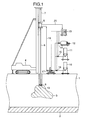
- Fig. 1 is a schematic illustration of a method of remedying contaminated soil according to one embodiment of the present invention.
- Fig. 2 is an enlarged view of the tip portion of the agitation rod of the device in Fig. 1 used for remedying contaminated soil.
- the soil to be remedied here consists of non aquifer 1, aquifer 2 and contaminated region 3.
- pollutants gradually penetrate from the surface layer of the soil to the underground with rainwater, and pollutants in the non aquifer 1 slowly diffuse toward the aquifer 2.
- pollutants in the non aquifer 1 slowly diffuse toward the aquifer 2.
- water-soluble pollutants having reached the aquifer 2 they will dissolve in groundwater, move with the groundwater current, and diffuse over a wide region.
- a soil remediation device of an embodiment of the present invention is described referring to Fig. 1.
- a rotary rod 6 attached to a motor 5 of a column unit 4 can be lowered into the soil while rotated by the motor 5 to excavate and stir the soil with a excavating and agitating means 8 mounted at the tip portion of the rotary rod 6.
- a suction means for collecting the pollutant in the soil is disposed on the very end of the rotary rod 6, and the pollutant is led through the inside of the rotary rod 6 via pipes 20 to a measuring and control means 13 for determining the concentration of the pollutant and/or oxygen (for example, a gas chromatograph) located on the ground.
- a measuring and control means 13 for determining the concentration of the pollutant and/or oxygen (for example, a gas chromatograph) located on the ground.
- a tank 10 contains a liquid agent containing a microorganism capable of degrading the pollutant in the presence of an inducer (for example, a microorganism strain J1 (FERM BP-5102) which expresses an oxygenase activity required for degrading trichloroethylene on exposure to an inducer), a tank 11 contains a liquid agent containing an inducer which makes the microorganism express the pollutant-degrading activity or promotes the degradation activity.
- Air compressor 12 as well as the tanks 10 and 11 are connected to the rotary rod 6 via a pump 17 so that the microorganism, the inducer and air (oxygen) for the microorganism can be introduced through the inside of the rotary rod 6 into the soil from the tip of the rotary rod.
- electromagnetic valves are disposed which can be opened and closed by the measuring and control means 13 to control the amounts of the microorganism, the inducer and air (oxygen) to be introduced into the soil depending on the pollutant concentration measured by the measuring and control means 13.
- the control means 13 can also control the rotation speed of the rotary rod, which enables the control of the descending speed of the rotary rod as well as the rotation speed of the agitating blades.
- the rotary rod 6 When such an apparatus is used in remediation of contaminated soil, the rotary rod 6 is lowered into the soil to excavate and stir the soil with continuous monitoring of the pollutant concentration, and when it is judged that the tip of the rotary rod has reached the top of the contaminated region, a predetermined amount of the microorganism as well as the inducer and air are introduced into the soil by the measuring and control means 13. At this point, the descending movement of the rod 6 may be stopped, and the still rotating agitating blades mix the introduced microorganism, inducer and air (herein after referred to as the treating agents) with the soil of the contaminated region. This ensures a high probability in contact between the pollutants in the contaminated region and consequently increases the soil remediation efficiency.
- the treating agents herein after referred to as the treating agents
- one treating cycle comprises lowering the rotary rod with monitoring the pollutant concentration to control the descending speed of the rotary rod and the rotation speed of the agitating blades according to the monitoring results, and introducing the treating agents into the contaminated region until the tip of the rod 6 reaches the outside of the contaminated region, and raising the rod 6 without or with rotating the agitating blades, for example, in the opposite direction during excavation until the rotary rod is drawn from the soil.
- the pollutant concentration in the contaminated region is still high, the same operation can be repeated at the same spot, or the rotary rod 6 may be moved up and down so as to stir the soil with the treating agents introduced thereto more thoroughly.
- the treating agents may be also supplied into the soil while the rotary rod is ascending in the soil with rotation of the agitating blades.
- the treating agents are introduced into the soil while the rotary rod is descending into the soil.
- the treating agents are introduced into the soil when the rotary rod is pulled up in the soil, and while the rotary rod is lowered into the soil, only the agitating blades are rotated to agitate the contaminated region.
- Fig. 2 is an enlarged view of the tip portion of the rotary rod of the soil remediation device shown in Fig. 1.
- the rotary rod 26 is provided with agitating blades 21, 22, 23 and 24, and the tip is provided with an agitating head 25 and an inlet 28 for sucking the pollutant.
- the rotary rod 26 is pressed against the ground by means of the wire 7 shown in Fig. 1, to excavate the soil by means of the rotating rotary rod and agitating head 25 driven by the motor 5.
- the agitating head 25 and the agitating blade 24 disposed directly above the agitating head 25 rotate in a direction opposite to that of the agitating blades 21 to 23.
- Such a constitution may suppress the co-rotation of soil (rotation of soil together with the rotary rod leading to insufficient soil disturbance), and accordingly the soil in the contaminated region can be well agitated.
- a preferred embodiment is to provide outlets 27 for the treating agents on the agitating blades (for example, the agitating blade 22 in Fig. 2) other than the agitating blade 24 disposed directly above the agitating head 25, from which the treating agents are introduced into the soil.
- the microorganism may be crushed by the friction between the soil particles and the excavation means, e.g., the agitating head 25, or between particles themselves, or the heat generated by such friction may kill the microorganism and decompose the inducer, resulting in unsatisfactory soil remediation.
- the diameter of the agitating blades varies depending on the area and situation (e.g., urban or rural) of the contaminated region to be remedied, but it can be selected within the range from 800 mm to 2000 mm.
- the inducer used for soil remediation in the embodiment described above with reference to Figs. 1 and 2 varies depending on the microorganism to be used, for example, methane for methanotrophs; toluene, phenol, cresol etc. for aromatic-assimilating bacteria; and ammonium salts for nitrifying bacteria.
- the treating agent containing the microorganism used for soil remediation in the embodiment described above may be prepared simply by dispersing a microorganism in water, where the microorganism inducibly or constitutively express an enzymatic activities to degrade the pollutant, but it is preferable to use a culture of the microorganism in a medium containing growth materials for the microorganism, and functional materials required for the microorganism to stably express pollutant-degrading activities.
- Growth materials are the nutrients for the microorganism, for example, carbon sources assimilable by the microorganism, as well as those contained in bouillon medium, M9 medium, L medium, malt extract, MY medium, nitrifying bacteria selective medium etc.
- Functional materials to maintain the degradation activities include the inducer.
- the soil remediation device of the present invention is not limited to the constitution of the embodiment described above with reference to Figs. 1 and 2 where the microorganism, air (oxygen) and the inducer are introduced into the soil from the end portions of the agitating blades.
- injection of the inducer is not necessary when a microorganism constitutively expressing pollutant-degrading capability is used for soil remediation, or when the liquid agent contains the inducer to make the microorganism fully express the pollutant-degrading activities beforehand.
- air (oxygen) is used as a nutrient for the microorganism, but the present invention is not limited to it.
- any carbon source which is assimilable by the microorganism may be introduced instead of air or with air in order to allow microorganism to survive or grow for a longer period of time in the soil. Otherwise, if the concentration of oxygen in the soil is sufficient for the microorganism, introduction of air can be omitted. Otherwise, if the long survival or growth of the microorganism in the soil is not desirable, no nutrients may not be introduced into the soil, which is also in a scope of the present invention.
- Assimilable carbon sources may be contained, for example, in bouillon medium, M9 medium, L medium, malt extract, MY medium, or nitrifying bacteria selective medium.
- microbial nutrients or an inducer which induces pollutant-degrading activities in them or both may be introduced into the soil, which is also in a scope of the present invention.
- a gas such as air or oxygen, and degradation-promoting substances may be mixed in the liquid agent after determining the pollutant concentration and oxygen concentration in the soil or ground water, as well as the concentrations of pollutant-degrading microorganism and carriers to immobilize the microorganism. If a sensor which can directly measure the pollutant is available, it may be directly mounted on the rotary rod.
- Volatile pollutants and degradation products can be collected by gas sampling through the rotary rod to directly determine the concentration by a measuring means such as a gas chromatograph and a detector tube.
- Non-volatile or hardly-volatile pollutants and degradation products can be determined by liquid chromatography or photometry after pre-treating the soil samples.
- the oxygen concentration can be determined with a gas chromatograph, a detector tube, or an oxygen sensor.
- the number of the pollutant-degrading microorganism can be counted by plate count method or flow cytometry, after treating the sampled carriers.
- the rotation speed of the agitating blades and the excavation- or extraction speed of the rotary rod not to mechanically damage the pollutant-degrading microorganism and carriers thereof.
- the optimal speeds also depends on the soil texture (gravel, sand, clay, etc.). When excavating hard soil, a considerable load is imposed on the agitating blades, which may damage the microorganism or carriers; in that case, it is desirable that the liquid agent is injected and mixed into the soil during the extraction of the rotating rod.
- the pollutant which can be purified according to the present invention are not particularly limited so long as they are organic compounds degradable by microorganisms; however, but exemplified by aromatic compounds (for example, phenol, cresol, pentachlorophenol, polybiphenyl chloride, etc.) and halogenated aliphatic hydrocarbon compounds (for example, dichloroethylene, trichloroethylene, tetrachloroethylene, etc.).
- aromatic compounds for example, phenol, cresol, pentachlorophenol, polybiphenyl chloride, etc.
- halogenated aliphatic hydrocarbon compounds for example, dichloroethylene, trichloroethylene, tetrachloroethylene, etc.
- any microorganism can be used in the embodiment of the present invention so long as it expresses inducibly or constitutively an enzyme which degrades the pollutant in the soil to be remedied. It may be a wild type, an artificial mutant derived from the wild type, or one having an artificially mutated gene of the wild type. However, in view of in situ soil remediation, it is preferable to select a microorganism whose impact on the ecosystem intrinsic to the environment is as little as possible, that is, a wild type or an artificial mutant thereof. In order to minimize the impact on the ecosystem, it is preferable to use the pollutant-degrading microorganism which is an inhabitant of the soil to be remedied.
- microorganisms capable of degrading the organic compounds mentioned above include those belonging to the genera Saccharomyces, Hansenula, Candida, Micrococcus, Staphylococcus, Streptococcus, Leuconostoa, Lactobacillus, Corynebacterium, Arthrobacter, Bacillus, Clostridium, Neisseria, Escherichia, Enterobacter, Serratia, Achromobacter, Alcaligenes, Flavobacterium, Acetobacter, Moraxlla, Nitrosomonas, Nitrobacter, Thiobacillus, Gluconobacter, Pseudomonas, Xanthomonas and Vibrio whose degrading activities have been already established.
- strain J1 capable of degrading aromatic compounds and organic chlorinated compounds with an inducer
- strain JM1 a mutant strain derived from strain J1 by mutagen treatment
- strain JM1 FERM BP-5352
- the microorganism may be suspended in a liquid agent after immobilized on carrier particles.
- Carrier particles are used to provide the microorganism with a comfortable habitat, to prevent predation by other microorganism and organisms and to prevent the diffusion and loss of the microorganism into groundwater. If the microorganism is directly introduced into the soil during soil agitation, cells are often broken to be killed due to the grinding of soil particles. In such a case, the microorganism may be immobilized on an appropriate carrier not to come into direct contact with the soil particles.
- granular carriers As a granular carrier, various types of microbial carriers can be used which have been utilized in pharmaceutical industries and food industries, or in bioreactors such as a waste-water treatment system.
- granular carriers such as porous glass, ceramics, metal oxide, activated carbon, kaolinite, bentonite, zeolite, silica gel, alumina and anthracite; gel carriers such as starch, agar, chitin, chitosan, poly(vinyl alcohol), alginic acid, polyacrylamide, carrageenan, agarose and gelatin; polymer resins and ion-exchange resins such as cellulose, glutaraldehyde, poly(acrylic acid) and urethane polymer.
- carriers have a particle diameter sufficiently small to be uniformly mixed with the soil. In view of handling of carriers and the immobilization rate of the microorganism on carriers, desirably the diameter is about 0.01 mm to about 1 mm.
- a soil remediation experiment was carried out in the same manner as Example 1 except that the ascending speed of the rotary rod was fixed at 100 mm/min and the liquid agents were discharged continuously during ascending.
- the results was that, the concentration of phenol was 0.2 ppm at each point, and the amount of the consumed liquid agent containing microorganism in this experiment was 4.25 liters.
- a soil remediation experiment was carried out in the same manner as Example 1 except that the ascending speed of the rotary rod was fixed at 100 mm/min, and the liquid agents of the tank 10 and the tank 11 were discharged continuously at a rate of 26 ml/min and of 234 ml/min, respectively.
- the total injection amount of the liquid agent of the tank 11 was adjusted so as to be almost the same as that used in Example 1.
- the average of the phenol concentrations at the points 35 cm deep and 50 cm deep from the surface of the soil was as high as about 3.2 ppm, which indicated that soil remediation was not completed.
- a soil remediation experiment was carried out in the same manner as in Example 1 except that the microorganism and nutrients for the microorganism were introduced into the soil during excavation, between 20 cm and 65 cm deep from the surface.
- Example 2 As in Example 1, the result showed complete soil remediation.
- the average concentration of strain J1 at the phenol concentration determination points was 8 ⁇ 10 6 cells/g soil by the plate count method.
- Example 1-(3) The device prepared in the Example 1-(3) was remodeled so that the liquid agents of the tanks 10 and 11 would be discharged from the tip of the rotary rod.
- a soil remedying experiment was carried out in the same manner as in Example 2 except that this remodeled device was used.
- the experimental results showed that the concentrations of phenol at the points 35 cm deep and 50 cm deep from the soil surface were 1.8 ppm and 2.2 ppm, respectively, indicating that soil remediation was not proceeded effectively.
- the average concentration of strain J1 was 1 ⁇ 10 6 cells/g soil. It was visually confirmed that porous cellulose carrier particles had been crushed in the soil.
- Example 3 A soil remediation experiment was carried out in the same manner as in Example 3 except that the ascending speed of the rotary rod was fixed at 60 mm/min and the liquid agent was discharged continuously during ascending. As a result, the TCE concentration was 0.1 ppm or less at each point, but the amount of the consumed liquid agent containing the microorganism was 4.25 liters.
- a soil remediation experiment was carried out in the same manner as Example 3 except that the ascending speed of the rotary rod was fixed at 100 mm/min, and the liquid agent of the tank 11 was discharged continuously at a rate of 160 ml/min.
- the total injection amount of the liquid agent of the tank 11 was adjusted so as to be almost the same as that used in Example 3.
- the average of the TCE concentrations at the points 35 cm deep and 50 cm deep from the surface of the soil was as high as about 1.8 ppm, which indicated that soil remediation was not completed.
- a soil remediation experiment was carried out in the same manner as in Example 3 except that the microorganism was introduced into the soil at a rate of 300 ml/min during excavation from a depth of 20 cm to a depth of 65 cm from the surface.
- the average concentration of strain JM1 at the TCE concentration determination points was 5 ⁇ 10 6 cells/g soil by the plate count method.
- a soil remediation experiment was carried out in the same manner as in Example 4 except that the device was that used in Comparative Example 3, and the liquid agent of the tank 11 was discharged from the tip of the rotary rod during excavation.
- the result was that the TCE concentrations at the points 5 cm deep and 50 cm deep from the surface were 2.4 ppm and 7 ppm, respectively, indicating that soil remediation was not proceeded effectively.
- the average concentration of strain JM1 at these points was 7 ⁇ 10 5 cells/g soil. Visual observation of the soil confirmed that porous cellulose carrier particles had been crushed. It is concluded from these results that strain JM1 introduced into the soil were crushed between the agitating head etc. and soil particles, and a considerable number of microorganism were killed.
- in situ remediation of soil contaminated with organic compounds can be performed very efficiently.
- introduction of a microorganism into soil can be carried out effectively, which allows to lower the cost of in situ remediation of the contaminated soil.
Landscapes
- Engineering & Computer Science (AREA)
- Life Sciences & Earth Sciences (AREA)
- Soil Sciences (AREA)
- Environmental & Geological Engineering (AREA)
- Microbiology (AREA)
- General Health & Medical Sciences (AREA)
- Mycology (AREA)
- Molecular Biology (AREA)
- Structural Engineering (AREA)
- Biotechnology (AREA)
- Biomedical Technology (AREA)
- Health & Medical Sciences (AREA)
- General Engineering & Computer Science (AREA)
- Civil Engineering (AREA)
- Paleontology (AREA)
- Agronomy & Crop Science (AREA)
- Mining & Mineral Resources (AREA)
- General Life Sciences & Earth Sciences (AREA)
- Processing Of Solid Wastes (AREA)
- Measuring Or Testing Involving Enzymes Or Micro-Organisms (AREA)
Applications Claiming Priority (4)
| Application Number | Priority Date | Filing Date | Title |
|---|---|---|---|
| JP35827097 | 1997-12-25 | ||
| JP35827097 | 1997-12-25 | ||
| JP27575998A JP3420949B2 (ja) | 1997-12-25 | 1998-09-29 | 土壌浄化装置及び汚染土壌の修復方法 |
| JP27575998 | 1998-09-29 |
Publications (3)
| Publication Number | Publication Date |
|---|---|
| EP0925849A2 true EP0925849A2 (de) | 1999-06-30 |
| EP0925849A3 EP0925849A3 (de) | 2000-04-05 |
| EP0925849B1 EP0925849B1 (de) | 2004-06-23 |
Family
ID=26551609
Family Applications (1)
| Application Number | Title | Priority Date | Filing Date |
|---|---|---|---|
| EP98310532A Expired - Lifetime EP0925849B1 (de) | 1997-12-25 | 1998-12-21 | Vorrichtung zur Reinigung von Böden und Verfahren zur Sanierung von kontaminierten Böden |
Country Status (5)
| Country | Link |
|---|---|
| US (1) | US6250846B1 (de) |
| EP (1) | EP0925849B1 (de) |
| JP (1) | JP3420949B2 (de) |
| CA (1) | CA2256533C (de) |
| DE (1) | DE69824692T2 (de) |
Cited By (3)
| Publication number | Priority date | Publication date | Assignee | Title |
|---|---|---|---|---|
| FR2899498A1 (fr) * | 2006-04-06 | 2007-10-12 | Cie Du Sol Soc Civ Ile | Procede de rehabilitation de sols et/ou d'eaux souterraines et equipement pour la mise en oeuvre de ce procede |
| WO2012123518A3 (en) * | 2011-03-14 | 2013-10-03 | Vlaamse Instelling Voor Technologisch Onderzoek | Soil treatment device and use thereof for treating contaminated soil and/or groundwater contained therein |
| CN107014665A (zh) * | 2017-04-13 | 2017-08-04 | 河南师范大学 | 一种实验室用土壤的处理装置 |
Families Citing this family (26)
| Publication number | Priority date | Publication date | Assignee | Title |
|---|---|---|---|---|
| US20060032012A1 (en) * | 2000-11-27 | 2006-02-16 | Buckner Lynn A | Mobile vacuum boring and mud recovery method having an articulated vacuum conduit boom with digging bucket |
| JP3658319B2 (ja) * | 2000-12-27 | 2005-06-08 | 不動建設株式会社 | 汚染地盤の浄化方法 |
| JP2003154352A (ja) * | 2001-09-10 | 2003-05-27 | Fuji Photo Film Co Ltd | 微生物による汚染土壌修復方法 |
| US20030185633A1 (en) * | 2002-03-29 | 2003-10-02 | Stefaan Vandycke | Process for immobilizing impurities present in silt |
| JP2004195407A (ja) * | 2002-12-20 | 2004-07-15 | Kyokado Eng Co Ltd | 有害物を含む地盤の無害化処理方法 |
| US20040229342A1 (en) * | 2003-05-16 | 2004-11-18 | Ken Lunde | Process for remediation of hydrocarbons |
| US7052172B2 (en) * | 2003-09-15 | 2006-05-30 | Omni International, Inc. | Combination low-shear mixer and high-shear homogenizer |
| JP2006326500A (ja) * | 2005-05-26 | 2006-12-07 | Shinsei Kaihatsu:Kk | 汚染土壌の浄化方法 |
| US7604301B1 (en) | 2006-12-07 | 2009-10-20 | Lang William J | Dual axis grinder blender |
| US20100059454A1 (en) * | 2008-09-08 | 2010-03-11 | Q Environmental, Inc. | Method for clean-up of an underground plume contaminated with hydrocarbon leakage, and the like |
| CN102251518B (zh) * | 2011-05-06 | 2013-04-03 | 洪子云 | 旋泵成孔桩机 |
| US20130075085A1 (en) * | 2011-09-23 | 2013-03-28 | E. I. Du Pont De Nemours And Company | Use of glutamate for microbial enhanced oil recovery |
| US8845233B2 (en) | 2011-10-13 | 2014-09-30 | Empire Technology Development Llc | Soil remediation |
| CN102921720B (zh) * | 2012-11-15 | 2014-02-26 | 华北电力大学 | 一种单井双灌生物强化喷淋土壤修复装置和方法 |
| JP6257903B2 (ja) * | 2013-03-11 | 2018-01-10 | 株式会社不動テトラ | 汚染土壌の浄化方法 |
| KR101275378B1 (ko) * | 2013-04-19 | 2013-06-17 | 코오롱워터앤에너지 주식회사 | 원위치 복합오염토양 교반을 이용한 하이브리드 정화방법 |
| CA2976207A1 (en) * | 2014-02-17 | 2015-08-20 | Agpw, Llc | Porous matrices for culture and formulation of agricultural biopesticides and chemicals |
| CN105642665A (zh) * | 2016-04-07 | 2016-06-08 | 北京中岩大地科技股份有限公司 | 一种采用搅拌注射系统原地原位修复重金属污染场地的方法 |
| EP4108350B1 (de) * | 2016-11-14 | 2024-10-02 | Takenaka Corporation | Verfahren zur konzentrationsverwaltung eines bodeninjektionsmittels |
| CN112304938A (zh) * | 2019-07-30 | 2021-02-02 | 浙江瑞坤生态科技有限公司 | 受损湿地健康诊断与恢复平台 |
| CN112646692A (zh) * | 2020-12-11 | 2021-04-13 | 中国人民解放军陆军军医大学第二附属医院 | 一种肠道菌液培养装置 |
| CN113522961A (zh) * | 2021-06-07 | 2021-10-22 | 广东石油化工学院 | 一种用于石油烃类有机物污染土壤修复装置和方法 |
| CN114541450A (zh) * | 2022-03-03 | 2022-05-27 | 北京中岩大地环境科技有限公司 | 一种阻隔墙施工装置及其施工方法 |
| CN114653745B (zh) * | 2022-03-30 | 2023-04-18 | 山西药科职业学院 | 一种土壤多环芳烃污染处理用的降解设备 |
| CN115532814A (zh) * | 2022-10-21 | 2022-12-30 | 云南圣清环境监测科技有限公司 | 用于深层粘性红壤污染原位修复的桩机钻头及其方法 |
| CN116441304B (zh) * | 2023-05-13 | 2025-04-29 | 昆明理工大学 | 多外场强化生物处理有机磷有机氯及苯污染土壤的装置及方法 |
Family Cites Families (24)
| Publication number | Priority date | Publication date | Assignee | Title |
|---|---|---|---|---|
| US935834A (en) * | 1909-01-12 | 1909-10-05 | William M Bates | Churn stand and power. |
| US1027531A (en) * | 1912-02-14 | 1912-05-28 | Alpheus Fay | Aerating butter-separator. |
| EP0193596A1 (de) | 1984-09-04 | 1986-09-10 | MANCHAK, Frank Jr. | Auf mülldeponien einsetzbare behandlungsvorrichtung und verfahren zu ihrer verwendung |
| DE4003362A1 (de) * | 1990-02-05 | 1991-08-08 | Keller Grundbau Gmbh | Verfahren und vorrichtung zur in-situ-sanierung kontaminierter bereiche |
| US5135058A (en) * | 1990-04-26 | 1992-08-04 | Millgard Environmental Corporation | Crane-mounted drill and method for in-situ treatment of contaminated soil |
| DE4028055C2 (de) | 1990-09-05 | 1996-05-09 | Lobbe Xenex Gmbh | Verfahren und Vorrichtung für die mikrobielle in situ-Entsorgung von kontaminiertem Erdreich |
| AU1364892A (en) * | 1991-01-25 | 1992-08-27 | Halliburton Nus Environmental Corporation | Method and apparatus for control of addition of modifying agent for in place treatment |
| US5347070A (en) | 1991-11-13 | 1994-09-13 | Battelle Pacific Northwest Labs | Treating of solid earthen material and a method for measuring moisture content and resistivity of solid earthen material |
| US5340570A (en) | 1991-11-18 | 1994-08-23 | Shiseido Co., Ltd. | Dispensing system for sprayable gel-type hair conditioner |
| US5242246A (en) * | 1992-02-18 | 1993-09-07 | Terranalysis Corporation | Surface remediator |
| US5277815A (en) * | 1992-05-04 | 1994-01-11 | E. I. Du Pont De Nemours And Company | In situ biodegradation of groundwater contaminants |
| US5342146A (en) * | 1993-01-12 | 1994-08-30 | Cooper Equipment Company | Method and apparatus for treatment of contaminated soil particles |
| US5348422A (en) * | 1993-02-25 | 1994-09-20 | Terranalysis Corporation | Methods for the formation and operation of an in situ process reactor |
| CA2117233A1 (en) | 1993-03-12 | 1994-09-13 | V. Dennis Millgard | Dynamic air remediation apparatus and method for in-situ treatment of contaminated soil |
| WO1994025191A1 (en) * | 1993-05-03 | 1994-11-10 | Bruso Bruce L | Method and apparatus for in situ soil remediation |
| US6017169A (en) * | 1993-08-30 | 2000-01-25 | Itex, Division Of Irm, L.P. | Remediation of earthen material |
| JP3354660B2 (ja) | 1993-10-19 | 2002-12-09 | 三菱重工業株式会社 | 排ガスの処理方法 |
| US5435176A (en) | 1993-11-01 | 1995-07-25 | Terranalysis Corporation | Hazardous waste characterizer and remediation method and system |
| US5511907A (en) * | 1995-05-12 | 1996-04-30 | Tabasco; Joseph J. | Mobile injection device and method for delivery of remediation materials to underground contaminated soils and water |
| US5639182A (en) * | 1995-10-12 | 1997-06-17 | Paris; James L. | In situ treatment of soil |
| US5690173A (en) * | 1995-10-13 | 1997-11-25 | General Motors Corporation | Apparatus for enhanced bioremediation of underground contaminants |
| US5678639A (en) * | 1996-03-01 | 1997-10-21 | Golden; Randy | Self-contained bioremediation unit with dual auger head assembly |
| JP3461238B2 (ja) * | 1996-04-11 | 2003-10-27 | キヤノン株式会社 | 有機化合物の生分解方法および環境修復方法 |
| US5988947A (en) * | 1997-11-04 | 1999-11-23 | Bruso; Bruce L. | Multi-section soil remediation device |
-
1998
- 1998-09-29 JP JP27575998A patent/JP3420949B2/ja not_active Expired - Fee Related
- 1998-12-18 CA CA002256533A patent/CA2256533C/en not_active Expired - Fee Related
- 1998-12-21 EP EP98310532A patent/EP0925849B1/de not_active Expired - Lifetime
- 1998-12-21 DE DE69824692T patent/DE69824692T2/de not_active Expired - Lifetime
- 1998-12-21 US US09/217,124 patent/US6250846B1/en not_active Expired - Lifetime
Cited By (6)
| Publication number | Priority date | Publication date | Assignee | Title |
|---|---|---|---|---|
| FR2899498A1 (fr) * | 2006-04-06 | 2007-10-12 | Cie Du Sol Soc Civ Ile | Procede de rehabilitation de sols et/ou d'eaux souterraines et equipement pour la mise en oeuvre de ce procede |
| EP1847329A1 (de) * | 2006-04-06 | 2007-10-24 | Compagnie du Sol | Verfahren zur Wiederherstellung von Erdböden und/oder unterirdischen Gewässern und Einrichtung zur Durchführung dieses Verfahrens |
| WO2012123518A3 (en) * | 2011-03-14 | 2013-10-03 | Vlaamse Instelling Voor Technologisch Onderzoek | Soil treatment device and use thereof for treating contaminated soil and/or groundwater contained therein |
| US10525514B2 (en) | 2011-03-14 | 2020-01-07 | Vlaamse Instelling Voor Technologisch Onderzoek (Vito) | Soil treatment device and use thereof for treating contaminated soil and/or groundwater contained therein |
| CN107014665A (zh) * | 2017-04-13 | 2017-08-04 | 河南师范大学 | 一种实验室用土壤的处理装置 |
| CN107014665B (zh) * | 2017-04-13 | 2023-03-17 | 河南师范大学 | 一种实验室用土壤的处理装置 |
Also Published As
| Publication number | Publication date |
|---|---|
| US6250846B1 (en) | 2001-06-26 |
| JP3420949B2 (ja) | 2003-06-30 |
| EP0925849B1 (de) | 2004-06-23 |
| CA2256533A1 (en) | 1999-06-25 |
| DE69824692T2 (de) | 2005-06-30 |
| JPH11239784A (ja) | 1999-09-07 |
| DE69824692D1 (de) | 2004-07-29 |
| EP0925849A3 (de) | 2000-04-05 |
| CA2256533C (en) | 2003-12-02 |
Similar Documents
| Publication | Publication Date | Title |
|---|---|---|
| US6250846B1 (en) | Apparatus for soil purification and remediation method for contaminated soil | |
| EP0785035B1 (de) | Verfahren zur Sanierung von Böden | |
| US5487834A (en) | Methods for microbial filtration of fluids | |
| EP0780166B1 (de) | Verfahren zum Einbringen von Mikroorgenismen in Böden zur Sanierung derselben | |
| JP3491929B2 (ja) | 土壌汚染による汚染地下水の浄化方法 | |
| JPH09276841A (ja) | 汚染土壌の浄化方法および浄化装置 | |
| Taylor et al. | In situ bioremediation of trichloroethylene-contaminated water by a resting-cell methanotrophic microbial filter | |
| EP0594125B1 (de) | Träger für Mikroorganismen, Bodenentgiftungsmittel die diesen Träger verwenden, und Methoden zur Entgiftung de Bodens | |
| JP3332600B2 (ja) | 汚染土壌・汚染地下水の浄化方法 | |
| US5512479A (en) | Method of degrading volatile organochlorides and remediation thereof | |
| JP3530588B2 (ja) | 原位置微生物分解領域の形成方法 | |
| EP0461144A1 (de) | Verfahren und mittel zur mikrobiologischen sanierung von verunreinigtem boden und mikroorganismen zur verwendung in diesem verfahren. | |
| US20030203475A1 (en) | Process for the biodegradation of hydrocarbons and ethers in subsurface soil by introduction of a solid oxygen source by hydraulic fracturing | |
| JP3693740B2 (ja) | 汚染土壌の浄化方法 | |
| JP3402699B2 (ja) | 微生物による土壌修復方法 | |
| JPH11179337A (ja) | 浮上性粒状担体を用いた汚染土壌と地下水の微生物学的浄化処理方法及び装置 | |
| JPH11207315A (ja) | 汚染土壌の微生物浄化方法及び浄化装置 | |
| JP3645651B2 (ja) | 汚染土壌の浄化方法 | |
| JP2003326244A (ja) | 微生物による汚染土壌のオンサイト修復方法及び修復装置 | |
| JP2000287679A (ja) | バイオリアクターによる気体状有機塩素化合物の分解方法ならびに装置 | |
| JPH09271750A (ja) | 土壌中への薬液注入方法 | |
| JPH11169839A (ja) | 土壌浄化方法および装置 | |
| JPH1080676A (ja) | 汚染土壌の浄化方法 | |
| JP3645650B2 (ja) | リアクタ型汚染土壌浄化方法及び装置 | |
| JP3504117B2 (ja) | 分解方法および微生物 |
Legal Events
| Date | Code | Title | Description |
|---|---|---|---|
| PUAI | Public reference made under article 153(3) epc to a published international application that has entered the european phase |
Free format text: ORIGINAL CODE: 0009012 |
|
| AK | Designated contracting states |
Kind code of ref document: A2 Designated state(s): DE FR GB NL |
|
| AX | Request for extension of the european patent |
Free format text: AL;LT;LV;MK;RO;SI |
|
| PUAL | Search report despatched |
Free format text: ORIGINAL CODE: 0009013 |
|
| AK | Designated contracting states |
Kind code of ref document: A3 Designated state(s): AT BE CH CY DE DK ES FI FR GB GR IE IT LI LU MC NL PT SE |
|
| AX | Request for extension of the european patent |
Free format text: AL;LT;LV;MK;RO;SI |
|
| 17P | Request for examination filed |
Effective date: 20000817 |
|
| AKX | Designation fees paid |
Free format text: DE FR GB NL |
|
| 17Q | First examination report despatched |
Effective date: 20020916 |
|
| GRAP | Despatch of communication of intention to grant a patent |
Free format text: ORIGINAL CODE: EPIDOSNIGR1 |
|
| GRAS | Grant fee paid |
Free format text: ORIGINAL CODE: EPIDOSNIGR3 |
|
| GRAA | (expected) grant |
Free format text: ORIGINAL CODE: 0009210 |
|
| AK | Designated contracting states |
Kind code of ref document: B1 Designated state(s): DE FR GB NL |
|
| REG | Reference to a national code |
Ref country code: GB Ref legal event code: FG4D |
|
| REF | Corresponds to: |
Ref document number: 69824692 Country of ref document: DE Date of ref document: 20040729 Kind code of ref document: P |
|
| ET | Fr: translation filed | ||
| PLBE | No opposition filed within time limit |
Free format text: ORIGINAL CODE: 0009261 |
|
| STAA | Information on the status of an ep patent application or granted ep patent |
Free format text: STATUS: NO OPPOSITION FILED WITHIN TIME LIMIT |
|
| 26N | No opposition filed |
Effective date: 20050324 |
|
| PGFP | Annual fee paid to national office [announced via postgrant information from national office to epo] |
Ref country code: DE Payment date: 20141231 Year of fee payment: 17 Ref country code: GB Payment date: 20141222 Year of fee payment: 17 |
|
| PGFP | Annual fee paid to national office [announced via postgrant information from national office to epo] |
Ref country code: NL Payment date: 20141103 Year of fee payment: 17 |
|
| PGFP | Annual fee paid to national office [announced via postgrant information from national office to epo] |
Ref country code: FR Payment date: 20141223 Year of fee payment: 17 |
|
| REG | Reference to a national code |
Ref country code: DE Ref legal event code: R119 Ref document number: 69824692 Country of ref document: DE |
|
| GBPC | Gb: european patent ceased through non-payment of renewal fee |
Effective date: 20151221 |
|
| REG | Reference to a national code |
Ref country code: NL Ref legal event code: MM Effective date: 20160101 |
|
| REG | Reference to a national code |
Ref country code: FR Ref legal event code: ST Effective date: 20160831 |
|
| PG25 | Lapsed in a contracting state [announced via postgrant information from national office to epo] |
Ref country code: GB Free format text: LAPSE BECAUSE OF NON-PAYMENT OF DUE FEES Effective date: 20151221 Ref country code: NL Free format text: LAPSE BECAUSE OF NON-PAYMENT OF DUE FEES Effective date: 20160101 Ref country code: DE Free format text: LAPSE BECAUSE OF NON-PAYMENT OF DUE FEES Effective date: 20160701 |
|
| PG25 | Lapsed in a contracting state [announced via postgrant information from national office to epo] |
Ref country code: FR Free format text: LAPSE BECAUSE OF NON-PAYMENT OF DUE FEES Effective date: 20151231 |