EP0926150B1 - Procédé pour la production de composés de métaux alcalines et cyclopentadiènes, et leur utilisation dans la production de zirconocènes - Google Patents
Procédé pour la production de composés de métaux alcalines et cyclopentadiènes, et leur utilisation dans la production de zirconocènes Download PDFInfo
- Publication number
- EP0926150B1 EP0926150B1 EP98310534A EP98310534A EP0926150B1 EP 0926150 B1 EP0926150 B1 EP 0926150B1 EP 98310534 A EP98310534 A EP 98310534A EP 98310534 A EP98310534 A EP 98310534A EP 0926150 B1 EP0926150 B1 EP 0926150B1
- Authority
- EP
- European Patent Office
- Prior art keywords
- cyclopentadiene
- group
- sodium
- zirconium
- methyl
- Prior art date
- Legal status (The legal status is an assumption and is not a legal conclusion. Google has not performed a legal analysis and makes no representation as to the accuracy of the status listed.)
- Expired - Lifetime
Links
- 0 CC(CC(*)C1)C1C1*CCCC1 Chemical compound CC(CC(*)C1)C1C1*CCCC1 0.000 description 3
Classifications
-
- C—CHEMISTRY; METALLURGY
- C07—ORGANIC CHEMISTRY
- C07F—ACYCLIC, CARBOCYCLIC OR HETEROCYCLIC COMPOUNDS CONTAINING ELEMENTS OTHER THAN CARBON, HYDROGEN, HALOGEN, OXYGEN, NITROGEN, SULFUR, SELENIUM OR TELLURIUM
- C07F17/00—Metallocenes
-
- C—CHEMISTRY; METALLURGY
- C07—ORGANIC CHEMISTRY
- C07F—ACYCLIC, CARBOCYCLIC OR HETEROCYCLIC COMPOUNDS CONTAINING ELEMENTS OTHER THAN CARBON, HYDROGEN, HALOGEN, OXYGEN, NITROGEN, SULFUR, SELENIUM OR TELLURIUM
- C07F1/00—Compounds containing elements of Groups 1 or 11 of the Periodic Table
- C07F1/02—Lithium compounds
-
- C—CHEMISTRY; METALLURGY
- C07—ORGANIC CHEMISTRY
- C07F—ACYCLIC, CARBOCYCLIC OR HETEROCYCLIC COMPOUNDS CONTAINING ELEMENTS OTHER THAN CARBON, HYDROGEN, HALOGEN, OXYGEN, NITROGEN, SULFUR, SELENIUM OR TELLURIUM
- C07F1/00—Compounds containing elements of Groups 1 or 11 of the Periodic Table
- C07F1/04—Sodium compounds
-
- Y—GENERAL TAGGING OF NEW TECHNOLOGICAL DEVELOPMENTS; GENERAL TAGGING OF CROSS-SECTIONAL TECHNOLOGIES SPANNING OVER SEVERAL SECTIONS OF THE IPC; TECHNICAL SUBJECTS COVERED BY FORMER USPC CROSS-REFERENCE ART COLLECTIONS [XRACs] AND DIGESTS
- Y10—TECHNICAL SUBJECTS COVERED BY FORMER USPC
- Y10S—TECHNICAL SUBJECTS COVERED BY FORMER USPC CROSS-REFERENCE ART COLLECTIONS [XRACs] AND DIGESTS
- Y10S526/00—Synthetic resins or natural rubbers -- part of the class 520 series
- Y10S526/943—Polymerization with metallocene catalysts
Definitions
- the present invention relates to a process for producing a soduim cyclopentadienylide which is the sodium salt of a disubstituted cyclopentadienyl anion and relates to a process for producing a dihalobis( ⁇ -substituted-cyclopentadienyl) zirconium from the soduim cyclopentadienylide obtained by the above process.
- the sodium cyclopentadienylide is useful as a cyclopentadienyl group introducing agent and a metallocene synthetic agent.
- the dihalobis( ⁇ -substituted-cyclopentadienyl)zirconium is useful as an olefin polymerization catalyst, an acetylene carbometallizing agent, a starting material for the synthesis of a monohydride homologue and a vulcanizing agent for a silicone material and a rubber.
- sodium hydride which is inexpensive and is easy to handle in the air reacts with a disubstituted cyclopentadiene at room temperature to about 150°C so that the disubstituted cyclopentadiene is anionized to enable obtaining sodium cyclopentadienylides with high yield, generally at least 85%.
- NaH sodium hydride
- the present invention has been completed on the basis of this finding.
- an object of the present invention is to provide a process for producing a sodium cyclopentadienylide, in which a disubstituted sodium cyclopentadienylide can be obtained with high yield by anionizing a disubstituted cyclopentadiene.
- Another object of the present invention is to provide a process for producing a dihalobis( ⁇ -substituted-cyclopentadienyl)zirconium, in which use is made of the sodium cyclopentadienylide obtained by the above process.
- the process for producing a sodium cyclopentadienylide comprises reacting in a solvent sodium hydride with a disubstituted 1,3-cyclopentadiene,
- the process according to the invention comprises reacting at a temperature of 50 to 100°C for a period of 5 to 48 hours in an ether solvent, sodium hydride with a disubstituted 1,3-cyclopentadiene represented by the general formula: wherein each of R 1 and R 2 is independently an alkyl group having 1 to 8 carbon atoms, an aryl group having 6 to 10 carbon atoms, an alkenyl group having 2 to 8 carbon atoms or an aralkyl group having 7 to 9 carbon atoms, thereby obtaining a sodium cyclopentadienylide represented by the general formula: wherein R 1 and R 2 are as defined above with respect to the general formula [I-a].
- the disubstituted 1,3-cyclopentadiene be a 1,3-cyclopentadiene having alkyl substituents at its 1- and 3-positions. It is especially preferred that the disubstituted 1,3-cyclopentadiene be a disubstituted 1,3-cyclopentadiene having a methyl group at its 3-position, represented by the formula: wherein R 4 is an alkyl group having 1 to 8 carbon atoms, an aryl group having 6 to 10 carbon atoms or an aralkyl group having 7 to 9 carbon atoms
- a novel compound according to the present invention is a sodium salt compound of a 1,3-disubs.tituted cyclopentadienyl anion represented by the following general formula [II-c]: wherein R 6 is an alkyl group having 1 to 6 carbon atoms.
- the process for producing a dihalobis( ⁇ -substituted-cyclopentadienyl)zirconium according to the present-invention comprises reacting a zirconium halide with the sodium cyclopentadienylide produced by the above process of the present invention, thereby obtaining a dichlorobis( ⁇ -substituted-cyclopentadienyl)zirconium represented by the general formula: wherein each of R 1 and R 2 is independently an alkyl group having 1 to 8 carbon atoms, an aryl group having 6 to 10 carbon atoms, an alkenyl group having 2 to 8 carbon atoms or an aralkyl group having 7 to 9 carbon atoms; X is a halogen atom.
- sodium hydride is reacted with a disubstituted 1,3-cyclopentadiene in a solvent.
- the disubstituted 1, 3-cyclopentadiene for use in the present invention is represented by the following general formula [I-a].
- each of R 1 and R 2 is independently an alkyl group having 1 to 8 carbon atoms, an aryl group having 6 to 10 carbon atoms, an alkenyl group having 2 to 8 carbon atoms or an aralkyl group having 7 to 9 carbon atoms;
- the alkyl group having 1 to 8 carbon atoms for R 1 or R 2 is, for example, a methyl group, an ethyl group, a n-propyl group, an isopropyl group, a n-butyl group, an isobutyl group, a t-butyl group, a n-pentyl group, an isopentyl group, a neopentyl group, a n-hexyl group, an isohexyl group, a n-heptyl group, a n-octyl group, a sec-butyl group, a sec-amyl group or a sec-pentyl group.
- the aryl group having 6 to 10 carbon atoms for R 1 or R 2 is, for example, a phenyl group, a tolyl group, a naphthyl group, a xylyl group, a mesityl group, an ethylphenyl group, a propylphenyl group, a butylphenyl group or a diethylphenyl group.
- the alkenyl group having 2 to 8 carbon atoms for R 1 or R 2 is, for example, a vinyl group, a 1-propenyl groups a 2-propenyl group (allyl group), an isopropenyl group, a 1-butenyl group, a 2-butenyl group, an isobutenyl group, a 3-hexenyl group, a 1-pentenyl group, a 2-pentenyl group or a 1-hexenyl group.
- the aralkyl group having 7 to 9 carbon atoms for R 1 or R 2 is, for example, a benzyl group, a phenethyl group or a phenylpropyl group.
- the above disubstituted 1,3-cyclopentadiene be a 1,3-cyclopentadiene having alkyl substituents at its 1- and 3-positions. It is especially preferred that the disubstituted 1,3-cyclopentadiene be a disubstituted 1,3-cyclopentadiene having a methyl group at its 3-position, represented by the formula: wherein R 4 is an alkyl group having 1 to 8 carbon atoms, an aryl group having 6 to 10 carbon atoms or an aralkyl group having 7 to 9 carbon atoms.
- the alkyl group having 1 to 8 carbon atoms for R 4 is, for example, a methyl group, an ethyl group, a n-propyl group, an isopropyl group, a n-butyl group, an isobutyl group, a t-butyl group, a n-pentyl group, an isopentyl group, a neopentyl group, a n-hexyl group, an isohexyl group, a n-heptyl group, a n-octyl group, a sec-butyl group, a sec-amyl group or a sec-pentyl group.
- preferred is an alkyl group having 1 to 6 carbon atoms and especially preferred is an alkyl group having 1 to 4 carbon atoms. .
- the aryl group having 6 to 10 carbon atoms for R 4 is, for example, a phenyl group, a tolyl group, a naphthyl group, a xylyl group, a mesityl group, an ethylphenyl group, a propylphenyl group, a butylphenyl group or a diethylphenyl group.
- the aralkyl group having 7 to 9 carbon atoms for R 4 is, for example, a benzyl group, a phenethyl group or a phenylpropyl group.
- Examples of the disubstituted 1,3-cyclopentadienes represented by the general formula [I-a] include:
- the sodium hydride can be used in the form of a mixture with a mineral oil as it is or in the form of powder obtained by removing the mineral oil from this mixture with the use of a solvent which is inert to the sodium hydride.
- Sodium hydride is inexpensive and is easy to handle in the air.
- the sodium hydride can be used in an amount of 0.9 to 2 mol, preferably, 1.0 to 1.5 mol per mol of the disubstituted or trisubstituted 1,3-cyclopentadiene.
- any ether solvent can be used in the present invention as long as it is inert in the reaction, preferred is an ether solvent which is inert in the reaction and which has a high dielectric constant.
- suitable ether solvents include tetrahydrofuran (THF), 1,3-dioxolane, dimethoxyethane (DME), dioxane, diethyl ether and dibutyl ether.
- the ether solvent can generally be used in an amount of 30 to 800 parts by weight, preferably, 40 to 400 parts by weight and, still preferably, 50 to 200 parts by weight based on 100 parts by weight of the disubstituted 1,3-cyclopentadiene.
- particularly preferred are saturated cyclic ether compounds having a 5- or 6-membered ring because they are easy to handle and are also economically excellent.
- the reaction between the disubstituted 1,3-cyclopentadiene and the sodium hydride is conducted at 50 to 100°C for a period of 5 to 48 hr, preferably, 5 to 26 hr.
- the reaction is preferably conducted in an atmosphere of inert gas such as nitrogen gas.
- the 1,3-cyclopentadiene is anionized with the result that a sodium cyclopentadienylide is formed.
- the yield is generally 80 to 100%, and in many cases, at least 85%.
- the product When, after the completion of the above reaction, any excess sodium hydride is removed by filtration, the product is obtained in the form of a colorless to red solution.
- the solution containing the product is colored red when oxygen is included in the reaction vessel but generally has the color of yellow to orange.
- the disubstituted sodium cyclopentadienylide can be isolated in solid form by heating the solution having been obtained by the filtration to evaporate the solvent therefrom.
- the thus obtained product is the sodium cyclopentadienylide represented by the following general formula [II-a] is obtained from the disubstituted 1,3-cyclopentadiene represented by the above general formula [I-a].
- R 1 and R 2 are as defined above with respect to the general formula [I-a].
- the sodium cyclopentadienylide represented by the general formula [II-a] is, for example, a sodium salt of any of the 1,3-cyclopentadienes listed as examples of the disubstituted 1,3-cyclopentadienes represented by the general formula [I-a] (sodium salt of disubstituted cyclopentadienyl anion).
- a 1,3-disubstituted compound wherein R 1 is an alkyl group having 1 to 6 carbon atoms, preferably an alkyl group having 1 to 4 carbon atoms, and R 2 is a methyl group is a novel substance which can specifically be represented by the following general formula [II-c]: wherein R 6 is an alkyl group having 1 to 6 carbon atoms. Examples of R 6 include those listed for R 1 above.
- sodium cyclopentadienylides are generally stored in the form of a solution and such a solution per se can be used in a subsequent reaction, for example, reaction for introducing a cyclopentadienyl in a carbonyl compound or an alkyl halide.
- a dihalobis( ⁇ -substituted-cyclopentadienyl)zirconium can be synthesized by the reaction between the sodium cyclopentadienylide produced by the above process according to the present invention and a zirconium halide.
- the zirconium halide includes halides of zirconium (II), (III) and (IV). Preferred are zirconium (IV) halides, and particularly preferred is zirconium tetrachloride.
- This reaction can generally be performed in a molar ratio of sodium cyclopentadienylide to zirconium halide of from 0.5 to 5.0, preferably, from 1.4 to 2.6.
- a solvent which is inert in the reaction can be used.
- the solvent for suspending the zirconium halide there can be used a solvent which is inert in the reaction, such as hexane, heptane or toluene, and also the above-mentioned ether solvent.
- the above reaction is preferably performed in an atmosphere of inert gas. This reaction is generally performed at -40 to 80°C, preferably, 0 to 70°C for a period of 10 min to 10 hr, preferably, 0.5 to 5 hr.
- the dihalobis( ⁇ -substituted-cyclopentadienyl)zirconium produced by the above process is represented by the following general formula [III] and is useful as an olefin polymerization catalyst, an acetylene carbometallizing reagent, a starting material for the synthesis of a monohydride homologue and a vulcanizing agent for a silicone material and a rubber.
- each of R 1 and R 2 is independently an alkyl group having 1 to 8 carbon atoms, an aryl group having 6 to 10 carbon atoms, an alkenyl group having 2 to 8 carbon atoms or an aralkyl group having 7 to 9 carbon atoms.
- R 1 and R 2 are those described for the above general formula [I], respectively.
- X is a halogen atom, and examples thereof include fluorine, chlorine, bromine and iodine. Particularly preferred is chlorine.
- the dihalobis( ⁇ -substituted-cyclopentadienyl)zirconium represented by the above general formula [III] is, for example, one produced by the reaction between any of the sodium cyclopentadienylides listed as examples of the sodium cyclopentadienylides of the general formula [II-a] and a zirconium halide.
- Preferred products are the corresponding zirconium dichloride compounds.
- the process for producing a sodium cyclopentadienylide according to the present invention enables performing the reaction between the disubstituted 1,3-cyclopentadiene and the sodium hydride at an easily controllable temperature such as room temperature to about 150°C, preferably, 50 to 100°C and further enables obtaining the alkali metal cyclopentadienylide with high yield.
- an easily controllable temperature such as room temperature to about 150°C, preferably, 50 to 100°C and further enables obtaining the alkali metal cyclopentadienylide with high yield.
- the process for producing a dihalobis( ⁇ -substituted-cyclopentadienyl)zirconium according to the present invention enables producing the dihalobis( ⁇ -substituted-cyclopentadienyl)zirconium with high yield.
- THF-d 8 was added to this solution, and the product was analyzed by 1 H-NMR. As a result, it was found to be sodium 1,3-dimethylcyclopentadienylide.
Landscapes
- Chemical & Material Sciences (AREA)
- Organic Chemistry (AREA)
- Engineering & Computer Science (AREA)
- Materials Engineering (AREA)
- Organic Low-Molecular-Weight Compounds And Preparation Thereof (AREA)
Claims (8)
- Procédé de préparation d'un cyclopentadiénylide de sodium de formule (IIa) :dans laquelle chacun de R1 et R2, qui sont identiques ou différents, est un groupe alkyle en C1-C8, aryle en C6-C10, alcényle en C2-C8 ou aralkyle en C7-C9, ledit procédé comprenant la mise en réaction ensemble, à une température de 50 à 100°C, pendant une durée de 5 à 48 heures, dans un éther en tant que solvant, d'hydrure de sodium et d'un 1,3-cyclopentadiène de formule (I-a) :
 dans laquelle R1 et R2 sont tels que définis ci-dessus.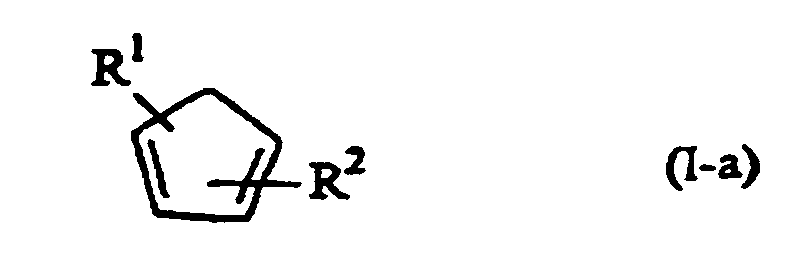
- Procédé selon la revendication 1, dans lequel, dans le 1,3-cyclopentadiène, R1 et R2 sont des groupes alkyle en C1-C8 aux positions 1 et 3 du cycle de 1,3-cyclopentadiène.
- Procédé selon la revendication 1, dans lequel le 1,3-cyclopentadiène a la formule suivante :dans laquelle R4 est un groupe alkyle en C1-C8, aryle en C6-C10 ou aralkyle en C7-C9.

- Procédé selon l'une quelconque des revendications 1 à 3, dans lequel le 1,3-cyclopentadiène et l'hydrure de sodium sont mis en réaction ensemble dans une atmosphère gazeuse d'azote.
- Procédé selon l'une quelconque des revendications 1 à 4, dans lequel le solvant est un éther cyclique saturé ayant un cycle à 5 ou 6 chaínons.
- Procédé selon l'une quelconque des revendications 2 à 5, dans lequel le solvant est utilisé en une quantité de 50 à 200 parties en poids pour 100 parties en poids du 1,3-cyclopentadiène.
- Procédé selon l'une quelconque des revendications 1 à 6, comprenant en outre l'étape de mise en réaction du cyclopentadiénylide de sodium avec un halogénure de zirconium pour obtenir un dihalogénobis(η-substitué-cyclopentadiényl)zirconium de formule [III] :dans laquelle R1 et R2 sont tels que définis dans la revendication 1 et X est un atome d'halogène.

- Composé de formule [II-c] :dans laquelle R6 est un groupe alkyle en C1-C6.

Applications Claiming Priority (2)
| Application Number | Priority Date | Filing Date | Title |
|---|---|---|---|
| JP35946097 | 1997-12-26 | ||
| JP35946097 | 1997-12-26 |
Publications (3)
| Publication Number | Publication Date |
|---|---|
| EP0926150A2 EP0926150A2 (fr) | 1999-06-30 |
| EP0926150A3 EP0926150A3 (fr) | 2000-12-27 |
| EP0926150B1 true EP0926150B1 (fr) | 2005-09-07 |
Family
ID=18464616
Family Applications (1)
| Application Number | Title | Priority Date | Filing Date |
|---|---|---|---|
| EP98310534A Expired - Lifetime EP0926150B1 (fr) | 1997-12-26 | 1998-12-21 | Procédé pour la production de composés de métaux alcalines et cyclopentadiènes, et leur utilisation dans la production de zirconocènes |
Country Status (4)
| Country | Link |
|---|---|
| US (1) | US6046346A (fr) |
| EP (1) | EP0926150B1 (fr) |
| CA (1) | CA2257015A1 (fr) |
| DE (1) | DE69831471T2 (fr) |
Cited By (1)
| Publication number | Priority date | Publication date | Assignee | Title |
|---|---|---|---|---|
| WO2008062958A1 (fr) * | 2006-11-23 | 2008-05-29 | Lg Chem, Ltd. | Procédé de synthèse de cyclopentadiénure métallique en vrac |
Families Citing this family (4)
| Publication number | Priority date | Publication date | Assignee | Title |
|---|---|---|---|---|
| US6197990B1 (en) * | 1997-01-14 | 2001-03-06 | Sumitomo Chemical Company, Limited | Process for the preparation of cyclopentadienyl metal salt and process for the preparation of derivative of cyclopentadiene using the same |
| KR100717224B1 (ko) * | 2000-04-05 | 2007-05-11 | 키폰 인크. | 골절되거나 병든 뼈를 치료하는 방법 및 장치 |
| JP4450149B2 (ja) * | 2002-06-20 | 2010-04-14 | 信越化学工業株式会社 | 有機珪素化合物、その製造方法、及びゴム用配合剤 |
| EP4633802A1 (fr) * | 2022-12-15 | 2025-10-22 | Chevron Phillips Chemical Company LP | Oligomérisation d'alpha-oléfines à l'aide de catalyseurs métallocènes supportés dans la production sélective de dimères de vinylidène |
Family Cites Families (5)
| Publication number | Priority date | Publication date | Assignee | Title |
|---|---|---|---|---|
| US4874880A (en) * | 1987-03-10 | 1989-10-17 | Chisso Corporation | Bis(di-, tri- or tetra-substituted-cyclopentadienyl)-zirconium dihalides |
| DE3840772A1 (de) * | 1988-12-03 | 1990-06-07 | Hoechst Ag | Verfahren zur herstellung einer heterogenen metallocenkatalysatorkomponente |
| DE4406963A1 (de) * | 1994-03-03 | 1995-09-07 | Basf Ag | Metallocenkomplexe mit heterofunktionellen Gruppen am Cyclopentadienylsystem |
| US6197990B1 (en) * | 1997-01-14 | 2001-03-06 | Sumitomo Chemical Company, Limited | Process for the preparation of cyclopentadienyl metal salt and process for the preparation of derivative of cyclopentadiene using the same |
| DE19835785A1 (de) * | 1998-08-07 | 2000-02-17 | Bayer Ag | Verfahren zur Polymerisation von Dienen mittels chlorierter Titanverbindungen |
-
1998
- 1998-12-11 US US09/209,752 patent/US6046346A/en not_active Expired - Lifetime
- 1998-12-21 EP EP98310534A patent/EP0926150B1/fr not_active Expired - Lifetime
- 1998-12-21 DE DE69831471T patent/DE69831471T2/de not_active Expired - Lifetime
- 1998-12-24 CA CA002257015A patent/CA2257015A1/fr not_active Abandoned
Cited By (2)
| Publication number | Priority date | Publication date | Assignee | Title |
|---|---|---|---|---|
| WO2008062958A1 (fr) * | 2006-11-23 | 2008-05-29 | Lg Chem, Ltd. | Procédé de synthèse de cyclopentadiénure métallique en vrac |
| KR100936349B1 (ko) * | 2006-11-23 | 2010-01-12 | 주식회사 엘지화학 | 새로운 금속 시클로펜타디엔나이드의 제조방법 |
Also Published As
| Publication number | Publication date |
|---|---|
| EP0926150A3 (fr) | 2000-12-27 |
| DE69831471D1 (de) | 2005-10-13 |
| EP0926150A2 (fr) | 1999-06-30 |
| CA2257015A1 (fr) | 1999-06-26 |
| DE69831471T2 (de) | 2006-06-22 |
| US6046346A (en) | 2000-04-04 |
Similar Documents
| Publication | Publication Date | Title |
|---|---|---|
| US5391790A (en) | Process for the preparation of bridged, chiral metallocene catalysts of the bisindenyl type | |
| AU601654B2 (en) | Process for the preparation of a chiral stereorigic metallocene compound | |
| EP0563365B1 (fr) | Preparation de complexes de coordination de metaux | |
| EP0763044B1 (fr) | Nouvelle synthese de catalyseurs constituee d'alliages organometalliques en anse | |
| US6043403A (en) | Process for the preparation of cyclopentadienyl compounds and compounds obtained therefrom | |
| JP2813057B2 (ja) | メタロセンの製造法 | |
| US5491246A (en) | Synthesis of group 4 metal diene complexes | |
| CA2144607C (fr) | Procede pour la synthese de monomethylmetallocenes et de dimethylmetallocenes; solutions de ces composes, destinees specifiquement a la polymerisation d'olefines | |
| US5831106A (en) | Preparation of bridged metallocene complexes | |
| EP0582114B1 (fr) | Procédé de préparation de métallocènes | |
| EP0926150B1 (fr) | Procédé pour la production de composés de métaux alcalines et cyclopentadiènes, et leur utilisation dans la production de zirconocènes | |
| JP3599810B2 (ja) | 架橋されたシクロペンタンジエニルマグネシウム−化合物、その製法およびメタロセンの製法 | |
| US4841084A (en) | New hexacoordinate silicon complexes, the process for their preparation and their application | |
| US4245131A (en) | Dimerization of olefins using tantalum and niobium catalysts | |
| Anselme et al. | Difluorenyl-and tert-butylfluorenyl (fluorenylidene) germenes: synthesis, stabilisation and first aspects of their reactivity | |
| US4231947A (en) | Tantalum and niobium catalysts or catalyst precursors | |
| US4042610A (en) | Process for preparing hydrocarbyl and silahydrocarbyl transition metal dihydrocarbylamides | |
| RU2337104C2 (ru) | СПОСОБ ДИАСТЕРЕОСЕЛЕКТИВНОГО СИНТЕЗА РАЦЕМИЧЕСКИХ ДИОРГАНОСИЛИЛБИС(2-МЕТИЛБЕНЗО[е]ИНДЕНИЛ)ЦИРКОНИЕВЫХ СОЕДИНЕНИЙ И РАЦЕМИЧЕСКОЕ СОЕДИНЕНИЕ ПЕРЕХОДНОГО МЕТАЛЛА | |
| US4944894A (en) | Ether free organometallic amide compositions | |
| JP2711770B2 (ja) | エーテルを含まない有機金属アミド組成物 | |
| US5164524A (en) | Process for preparing tetra (organyl) telluride compounds | |
| US6153777A (en) | Synthesis of ansa-metallocene catalysts | |
| KR100449473B1 (ko) | 티타노센의 방향족 유도체를 제조하기 위한 방법 | |
| JP3839176B2 (ja) | アルカリ金属シクロペンタジエニリド類の製造方法およびアルカリ金属シクロペンタジエニリド類を用いるジハロビス(η−置換シクロペンタジエニル)ジルコニウム類の製造方法 | |
| KR100988055B1 (ko) | 헤테로 원자를 포함하는 새로운 4족 전이금속 화합물 |
Legal Events
| Date | Code | Title | Description |
|---|---|---|---|
| PUAI | Public reference made under article 153(3) epc to a published international application that has entered the european phase |
Free format text: ORIGINAL CODE: 0009012 |
|
| AK | Designated contracting states |
Kind code of ref document: A2 Designated state(s): DE FR GB IT NL |
|
| AX | Request for extension of the european patent |
Free format text: AL;LT;LV;MK;RO;SI |
|
| PUAL | Search report despatched |
Free format text: ORIGINAL CODE: 0009013 |
|
| AK | Designated contracting states |
Kind code of ref document: A3 Designated state(s): AT BE CH CY DE DK ES FI FR GB GR IE IT LI LU MC NL PT SE |
|
| AX | Request for extension of the european patent |
Free format text: AL;LT;LV;MK;RO;SI |
|
| 17P | Request for examination filed |
Effective date: 20010305 |
|
| AKX | Designation fees paid |
Free format text: DE FR GB IT NL |
|
| 17Q | First examination report despatched |
Effective date: 20020315 |
|
| GRAP | Despatch of communication of intention to grant a patent |
Free format text: ORIGINAL CODE: EPIDOSNIGR1 |
|
| RTI1 | Title (correction) |
Free format text: PRODUCTION OF ALKALI METAL CYCLOPENTADIENYLIDES AND PRODUCTION OF DIHALOBIS(ETA-SUBSTITUTED-CYCLOPENTADIENYL) ZIRCONIUM F |
|
| GRAS | Grant fee paid |
Free format text: ORIGINAL CODE: EPIDOSNIGR3 |
|
| GRAA | (expected) grant |
Free format text: ORIGINAL CODE: 0009210 |
|
| AK | Designated contracting states |
Kind code of ref document: B1 Designated state(s): DE FR GB IT NL |
|
| PG25 | Lapsed in a contracting state [announced via postgrant information from national office to epo] |
Ref country code: IT Free format text: LAPSE BECAUSE OF FAILURE TO SUBMIT A TRANSLATION OF THE DESCRIPTION OR TO PAY THE FEE WITHIN THE PRESCRIBED TIME-LIMIT;WARNING: LAPSES OF ITALIAN PATENTS WITH EFFECTIVE DATE BEFORE 2007 MAY HAVE OCCURRED AT ANY TIME BEFORE 2007. THE CORRECT EFFECTIVE DATE MAY BE DIFFERENT FROM THE ONE RECORDED. Effective date: 20050907 |
|
| REG | Reference to a national code |
Ref country code: GB Ref legal event code: FG4D |
|
| REF | Corresponds to: |
Ref document number: 69831471 Country of ref document: DE Date of ref document: 20051013 Kind code of ref document: P |
|
| PG25 | Lapsed in a contracting state [announced via postgrant information from national office to epo] |
Ref country code: GB Free format text: LAPSE BECAUSE OF NON-PAYMENT OF DUE FEES Effective date: 20051221 |
|
| PLBE | No opposition filed within time limit |
Free format text: ORIGINAL CODE: 0009261 |
|
| STAA | Information on the status of an ep patent application or granted ep patent |
Free format text: STATUS: NO OPPOSITION FILED WITHIN TIME LIMIT |
|
| 26N | No opposition filed |
Effective date: 20060608 |
|
| GBPC | Gb: european patent ceased through non-payment of renewal fee |
Effective date: 20051221 |
|
| PG25 | Lapsed in a contracting state [announced via postgrant information from national office to epo] |
Ref country code: FR Free format text: LAPSE BECAUSE OF FAILURE TO SUBMIT A TRANSLATION OF THE DESCRIPTION OR TO PAY THE FEE WITHIN THE PRESCRIBED TIME-LIMIT Effective date: 20061020 |
|
| EN | Fr: translation not filed | ||
| PG25 | Lapsed in a contracting state [announced via postgrant information from national office to epo] |
Ref country code: FR Free format text: LAPSE BECAUSE OF FAILURE TO SUBMIT A TRANSLATION OF THE DESCRIPTION OR TO PAY THE FEE WITHIN THE PRESCRIBED TIME-LIMIT Effective date: 20051231 |
|
| PG25 | Lapsed in a contracting state [announced via postgrant information from national office to epo] |
Ref country code: FR Free format text: LAPSE BECAUSE OF FAILURE TO SUBMIT A TRANSLATION OF THE DESCRIPTION OR TO PAY THE FEE WITHIN THE PRESCRIBED TIME-LIMIT Effective date: 20050907 |
|
| PGFP | Annual fee paid to national office [announced via postgrant information from national office to epo] |
Ref country code: DE Payment date: 20131218 Year of fee payment: 16 |
|
| PGFP | Annual fee paid to national office [announced via postgrant information from national office to epo] |
Ref country code: NL Payment date: 20131210 Year of fee payment: 16 |
|
| REG | Reference to a national code |
Ref country code: DE Ref legal event code: R119 Ref document number: 69831471 Country of ref document: DE |
|
| REG | Reference to a national code |
Ref country code: NL Ref legal event code: V1 Effective date: 20150701 |
|
| REG | Reference to a national code |
Ref country code: NL Ref legal event code: V1 Effective date: 20150701 |
|
| PG25 | Lapsed in a contracting state [announced via postgrant information from national office to epo] |
Ref country code: NL Free format text: LAPSE BECAUSE OF NON-PAYMENT OF DUE FEES Effective date: 20150701 |
|
| PG25 | Lapsed in a contracting state [announced via postgrant information from national office to epo] |
Ref country code: DE Free format text: LAPSE BECAUSE OF NON-PAYMENT OF DUE FEES Effective date: 20150701 |