EP0926665A2 - Optisches Informationsaufzeichnungs-/-wiedergabegerät - Google Patents
Optisches Informationsaufzeichnungs-/-wiedergabegerät Download PDFInfo
- Publication number
- EP0926665A2 EP0926665A2 EP98111079A EP98111079A EP0926665A2 EP 0926665 A2 EP0926665 A2 EP 0926665A2 EP 98111079 A EP98111079 A EP 98111079A EP 98111079 A EP98111079 A EP 98111079A EP 0926665 A2 EP0926665 A2 EP 0926665A2
- Authority
- EP
- European Patent Office
- Prior art keywords
- photodetectors
- photodetector
- light beams
- parts
- receive
- Prior art date
- Legal status (The legal status is an assumption and is not a legal conclusion. Google has not performed a legal analysis and makes no representation as to the accuracy of the status listed.)
- Granted
Links
Images








Classifications
-
- G—PHYSICS
- G11—INFORMATION STORAGE
- G11B—INFORMATION STORAGE BASED ON RELATIVE MOVEMENT BETWEEN RECORD CARRIER AND TRANSDUCER
- G11B7/00—Recording or reproducing by optical means, e.g. recording using a thermal beam of optical radiation by modifying optical properties or the physical structure, reproducing using an optical beam at lower power by sensing optical properties; Record carriers therefor
- G11B7/12—Heads, e.g. forming of the optical beam spot or modulation of the optical beam
- G11B7/13—Optical detectors therefor
- G11B7/131—Arrangement of detectors in a multiple array
-
- G—PHYSICS
- G11—INFORMATION STORAGE
- G11B—INFORMATION STORAGE BASED ON RELATIVE MOVEMENT BETWEEN RECORD CARRIER AND TRANSDUCER
- G11B7/00—Recording or reproducing by optical means, e.g. recording using a thermal beam of optical radiation by modifying optical properties or the physical structure, reproducing using an optical beam at lower power by sensing optical properties; Record carriers therefor
- G11B7/08—Disposition or mounting of heads or light sources relatively to record carriers
- G11B7/09—Disposition or mounting of heads or light sources relatively to record carriers with provision for moving the light beam or focus plane for the purpose of maintaining alignment of the light beam relative to the record carrier during transducing operation, e.g. to compensate for surface irregularities of the latter or for track following
- G11B7/0901—Disposition or mounting of heads or light sources relatively to record carriers with provision for moving the light beam or focus plane for the purpose of maintaining alignment of the light beam relative to the record carrier during transducing operation, e.g. to compensate for surface irregularities of the latter or for track following for track following only
-
- G—PHYSICS
- G11—INFORMATION STORAGE
- G11B—INFORMATION STORAGE BASED ON RELATIVE MOVEMENT BETWEEN RECORD CARRIER AND TRANSDUCER
- G11B7/00—Recording or reproducing by optical means, e.g. recording using a thermal beam of optical radiation by modifying optical properties or the physical structure, reproducing using an optical beam at lower power by sensing optical properties; Record carriers therefor
- G11B7/08—Disposition or mounting of heads or light sources relatively to record carriers
- G11B7/09—Disposition or mounting of heads or light sources relatively to record carriers with provision for moving the light beam or focus plane for the purpose of maintaining alignment of the light beam relative to the record carrier during transducing operation, e.g. to compensate for surface irregularities of the latter or for track following
- G11B7/0908—Disposition or mounting of heads or light sources relatively to record carriers with provision for moving the light beam or focus plane for the purpose of maintaining alignment of the light beam relative to the record carrier during transducing operation, e.g. to compensate for surface irregularities of the latter or for track following for focusing only
-
- G—PHYSICS
- G11—INFORMATION STORAGE
- G11B—INFORMATION STORAGE BASED ON RELATIVE MOVEMENT BETWEEN RECORD CARRIER AND TRANSDUCER
- G11B7/00—Recording or reproducing by optical means, e.g. recording using a thermal beam of optical radiation by modifying optical properties or the physical structure, reproducing using an optical beam at lower power by sensing optical properties; Record carriers therefor
- G11B7/08—Disposition or mounting of heads or light sources relatively to record carriers
- G11B7/09—Disposition or mounting of heads or light sources relatively to record carriers with provision for moving the light beam or focus plane for the purpose of maintaining alignment of the light beam relative to the record carrier during transducing operation, e.g. to compensate for surface irregularities of the latter or for track following
- G11B7/0908—Disposition or mounting of heads or light sources relatively to record carriers with provision for moving the light beam or focus plane for the purpose of maintaining alignment of the light beam relative to the record carrier during transducing operation, e.g. to compensate for surface irregularities of the latter or for track following for focusing only
- G11B7/0916—Foucault or knife-edge methods
-
- G—PHYSICS
- G11—INFORMATION STORAGE
- G11B—INFORMATION STORAGE BASED ON RELATIVE MOVEMENT BETWEEN RECORD CARRIER AND TRANSDUCER
- G11B7/00—Recording or reproducing by optical means, e.g. recording using a thermal beam of optical radiation by modifying optical properties or the physical structure, reproducing using an optical beam at lower power by sensing optical properties; Record carriers therefor
- G11B7/08—Disposition or mounting of heads or light sources relatively to record carriers
- G11B7/09—Disposition or mounting of heads or light sources relatively to record carriers with provision for moving the light beam or focus plane for the purpose of maintaining alignment of the light beam relative to the record carrier during transducing operation, e.g. to compensate for surface irregularities of the latter or for track following
- G11B7/0943—Methods and circuits for performing mathematical operations on individual detector segment outputs
-
- G—PHYSICS
- G11—INFORMATION STORAGE
- G11B—INFORMATION STORAGE BASED ON RELATIVE MOVEMENT BETWEEN RECORD CARRIER AND TRANSDUCER
- G11B7/00—Recording or reproducing by optical means, e.g. recording using a thermal beam of optical radiation by modifying optical properties or the physical structure, reproducing using an optical beam at lower power by sensing optical properties; Record carriers therefor
- G11B7/12—Heads, e.g. forming of the optical beam spot or modulation of the optical beam
- G11B7/135—Means for guiding the beam from the source to the record carrier or from the record carrier to the detector
- G11B7/1356—Double or multiple prisms, i.e. having two or more prisms in cooperation
-
- G—PHYSICS
- G11—INFORMATION STORAGE
- G11B—INFORMATION STORAGE BASED ON RELATIVE MOVEMENT BETWEEN RECORD CARRIER AND TRANSDUCER
- G11B7/00—Recording or reproducing by optical means, e.g. recording using a thermal beam of optical radiation by modifying optical properties or the physical structure, reproducing using an optical beam at lower power by sensing optical properties; Record carriers therefor
- G11B7/12—Heads, e.g. forming of the optical beam spot or modulation of the optical beam
- G11B7/135—Means for guiding the beam from the source to the record carrier or from the record carrier to the detector
- G11B7/1381—Non-lens elements for altering the properties of the beam, e.g. knife edges, slits, filters or stops
Definitions
- the present invention generally relates to optical information recording/reproducing apparatuses, and more particularly to an optical information recording/reproducing apparatus which records information on and/or reproduces information from an optical recording medium.
- An optical disk unit is an example of a unit which uses an optical information recording/reproducing apparatus.
- the optical disk unit can be used as a storage unit of a file system or the like, and is suited for storing programs and large amounts of data.
- the Foucault technique is less affected by the external disturbance that occurs when a track on an optical disk is traversed, the birefringence of the optical disk. Accordingly, the mixture of the external disturbance into a focal error signal when the Foucault technique is employed is extremely small compared to the case where the astigmatism technique is employed.
- the Foucault technique detects a reflected light beam from the optical disk by a photodetector which is arranged in a vicinity of an image formation point of the optical beam, and for this reason, an abnormal offset is unlikely generated in the focal error signal even if the reflected light beam shifts from an optical axis. Because of these advantageous features obtainable by the Foucault technique, it is desirable to employ the Foucault technique as the focal error detection technique.
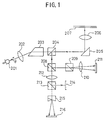
- a laser beam which is emitted from a laser diode 201 is formed into a parallel beam having an oval cross section in a collimator lens 202, and is thereafter formed into a light beam having a circular cross section in a true circle correction prism 203.
- the light beam from the true circle correction prism 203 is transmitted through a beam splitter 204, reflected by a mirror 205, and is converged on a disk 207 via an objective lens 206.
- a reflected light beam from the disk 207 enters the beam splitter 204 via the objective lens 206 and the mirror 205, but this time the reflected light beam is reflected by the beam splitter 204 and is directed towards a beam splitter 208.
- the beam splitter 208 splits the reflected light beam into two light beams, and supplies one light beam to a magneto-optic signal detection system and the other light beam to a servo signal detection system.
- the magneto-optic signal detection system includes a Wollaston prism 209, a lens 210 and a 2-part photodetector 211.
- One of the two light beams output from the beam splitter 208 is input to the 2-part photodetector 211 via the Wollaston prism 209 and the lens 210, and the 2-part photodetector 211 detects the magneto-optic signal, that is, the information signal, based on the input light beam.
- the servo signal detection system includes a condenser lens 212, a beam splitter 213, a 2-part photodetector 214, a composite prism 215 and a 4-part photodetector 216.
- the other of the two light beams output from the beam splitter 208 is input to the 2-part photodetector 214 via the condenser lens 212 and the beam splitter 213 on one hand, and is input to the 4-part photodetector 216 via the composite prism 215 on the other.
- the 2-part photodetector 214 forms a tracking error detection system in the servo signal detection system, and generates a tracking error signal by obtaining a difference between the outputs of the 2-part photodetector 214 according to the push-pull technique.
- the composite prism 215 and the 4-part photodetector 216 form a focal error detection system in the servo signal detection system, and generates a focal error signal based on outputs of the 4-part photodetector 216 according to the Foucault technique.
- a focus servo operation controls the relative positional relationship of the objective lens 206 and the disk 207 based on the focal error signal, so that an in-focus position is located on the disk 207.
- FIGS.2(a), 2(b) and 2(c) show the relative positional relationship of the light beam which is irradiated via the objective lens 206 and the track on the disk 207
- FIGS.3(a), 3(b) and 3(c) show a spot of the reflected light beam which is formed on the 2-part photodetector 214 in correspondence with FIGS.2(a), 2(b) and 2(c).
- FIG.2(b) shows a case where the spot of the light beam is positioned at the center of a guide groove 207a of the disk 207.
- the spot of the reflected light beam on the 2-part photodetector 214 is formed as shown in FIG.3(b), and a light intensity distribution b is symmetrical to the right and left.
- a tracking error signal TES is generated based on the following formula (1).
- TES A - B In this case, the tracking error signal TES is 0.
- the tracking error signal TES which is obtained in the above described manner changes to a more positive or negative value.
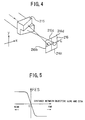
- FIG.4 shows an example of the shapes of the composite prism 215 and the 4-part photodetector 216.
- the 4-part photodetector 216 includes detector parts 216a, 216b, 216c and 216d.
- a focal error signal FES is generated from outputs A, B, C and D respectively output from the detector parts 216a, 216b, 216c and 216d of the 4-part photodetector 216, based on the following formula (2).
- FES (A-B)+(C-D)
- the focal error signal FES is 0 in a state where the spot of the light beam is in focus on the disk 207.
- the focal error signal FES having an S-curve as shown in FIG.5 is obtained depending on the distance between the objective lens 206 and the disk 207.
- the ordinate indicates the focal error signal FES
- the abscissa indicates the distance between the objective lens 206 and the disk 207.
- the origin (0) on the abscissa corresponds to the in-focus position, and the above distance becomes smaller towards the left and larger towards the right in FIG.5.
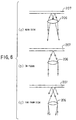
- FIGS.6(a), 6(b) and 6(c) show the relative positional relationship of the objective lens 206 and the disk 207.
- FIG.6(a) shows a case where the objective lens 206 is close to the disk 207 and the in-focus position is located above the disk 207 in the figure
- FIG.6(b) shows a case where the in-focus position is located on the disk 207
- FIG.6(c) shows a case where the objective lens 296 is far from the disk 207 and the in-focus position is located between the disk 207 and the objective lens 206 in the figure.
- FIGS.7(a), 7(b) and 7(c) show beam spots on the 4-part photodetector 216 for each relative positional relationship of the objective lens 206 and the disk 207 shown in FIGS.6(a), 6(b) and 6(c).
- FIG.7(a) shows the beam spots for the positional relationship shown in FIG.6(a)
- FIG.7(b) shows the beam spots for the in-focus positional relationship shown in FIG.6(b)
- FIG.7(c) shows the beam spots for the positional relationship shown in FIG.6(c).
- the beam spots on the 4-part photodetector 216 have oval shapes in the in-focus position, and a division line E of the 4-part photodetector 216 is positioned at the center of each oval beam spot.
- the distribution of the quantity of the light beam irradiated on the disk 207 may be unbalanced, and errors may exist in the mounting positions of the composite prism 215 and the 4-part photodetector 216.
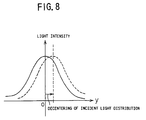
- the light intensity distribution of the light beam which is emitted from the laser diode 201 can generally be approximated by a Gaussian distribution.
- the optical axis of the light beam emitted from the laser diode 201 matches the optical axes of other optical parts, it is possible to obtain a Gaussian distribution in which the center of the light intensity of the light beam input to the objective lens 206 matches the optical axis (point 0) shown in FIG.8.
- the center of the light intensity of the light beam input to the objective lens 206 is shifted from the optical axis (point 0) in the Gaussian distribution as indicated by a dotted line in FIG.8.
- the "unbalanced distribution" of the light quantity of the light beam irradiated on the disk 207 or “decentering”, refers to such a difference between the optical axis and the center of light beam intensity distribution.
- the "mounting error" of the composite prism 215 refers to a positional error of the composite prism 215 in a y-direction in FIG.4. If such a mounting error exists, the composite prism 215 cannot accurately split the incident light beam into two equal light beams. Generally, if the division line E of the composite prism 215 shifts a distance ⁇ y in the y-direction from the center of the incident light beam, where the division line E extends in the x-direction in FIG.4, the value of the mounting error can be obtained from [ ⁇ y/(diameter of light beam)] ⁇ 100 (%).
- the focal offset means that the focal error signal FES described by the formula (2) becomes 0 at a position other than the in-focus position.
- the tolerable margin of the focal error detection system is extremely small with respect to the unbalanced distribution of the quantity of light beam irradiated on the disk 207, the mounting error of the composite prism 215 and the 4-part photodetector 216 and the like. Therefore, there is a problem in that it is extremely difficult to obtain an accurate focal error signal due to the above error factors.
- Another and more specific object of the present invention to provide an optical information recording/reproducing apparatus which can obtain an accurate focal error signal by setting a large tolerable margin of a focal error detection system with respect to the various causes of the above described errors.
- Still another object of the present invention is to provide an optical information recording/reproducing apparatus which records information on and/or reproduces information from an optical recording medium based on a reflected light beam from the optical recording medium, comprising a light splitting part having a plurality of light splitting stages which split the reflected light beam from the optical recording medium into a plurality of light beams, and a photodetector unit including n photodetectors which receive m light beams output from a last stage of the light splitting part, where m and n are positive integers satisfying m > n, where the n photodetectors of the photodetector unit include a plurality of photodetectors which are arranged to receive light beams used to detect a focal error, at least one photodetector which is arranged to receive a light beam used to detect a tracking error, and a plurality of photodetectors which are arranged to receive in common light beams used to detect optical information recorded on the optical recording medium, and the integers m and n are selected to satisfy
- the optical information recording/reproducing apparatus of the present invention it is possible to obtain an accurate focal error signal by making a tolerable margin of a focal error detection system large with respect to various causes of the errors described above.
- a further object of the present invention is to provide an optical information recording/reproducing apparatus which records information on and/or reproduces information from an optical recording medium based on a reflected light beam from the optical recording medium, comprising a light splitting part having a plurality of light splitting stages which split the reflected light beam from the optical recording medium into a plurality of light beams, and a photodetector unit including m photodetectors which receive m light beams output from a last stage of the light splitting part, where m is a positive integer, where the m photodetectors of the photodetector unit include a plurality of photodetectors which are arranged to receive light beams used to detect a focal error, at least one photodetector which is arranged to receive a light beam used to detect a tracking error, and a plurality of photodetectors which are arranged to receive in common light beams used to detect optical information recorded on the optical recording medium, the light splitting part comprises an analyzer which splits an incoming light beam into a plurality of
- the optical information recording/reproducing apparatus of the present invention it is possible to obtain an accurate focal error signal by making a tolerable margin of a focal error detection system large with respect to various causes of the errors described above.
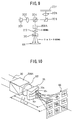
- FIG.9 is a diagram showing the first embodiment
- FIG.10 is a perspective view showing an important part of the first embodiment
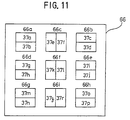
- FIG.11 is a plan view showing a photodetector unit of the first embodiment.
- those parts which are the same as those corresponding parts in FIG.1 are designated by the same reference numerals, and a description thereof will be omitted.
- the beam splitter 213 and the 2-part photodetector 214 shown in FIG.1 are unnecessary.
- an analyzer 208A is provided in place of the beam splitter 208.
- a composite prism 35 and a photodetector unit 36 are provided in place of the composite prism 215 and the 4-part photodetector 216.
- a central portion of the reflected light beam from the disk 207 is used for the detection of the tracking error using the push-pull technique.
- the composite prism 35 includes a first deflection surface 35a which is tapered, a second deflection surface 35b which is tapered in a direction different from the taper of the first deflection surface 35a, and a third deflection surface 35c having a slight curvature with respect to the optical axis of the reflected light beam from the disk 207.
- an analyzer 21 disclosed in a Japanese Laid-Open Patent Application No.63-127436 may be used as the analyzer 208A.
- the nine light beams from the composite prism 35 are irradiated on corresponding ones of nine photodetectors 66a through 66i which form the photodetector unit 66.
- FIG.11 shows a plan view of the photodetector unit 66.
- the focal error signal FES can be generated according to the Foucault technique based on outputs of the photodetectors 66a, 66b, 66d, 66e, 66g and 66h of the photodetector unit 66.
- the photodetectors 66a, 66d and 66g receive the three light beams from the first part of the composite prism 35, while the photodetectors 66b, 66e and 66h receive the three light beams from the second part of the composite prism 35.
- the image formation points of these six light beams match the positions of the photodetectors 66a, 66b, 66d, 66e, 66g and 66h.
- the tracking error signal TES can be generated according to the push-pull technique based on outputs of the photodetectors 66c, 66f and 66i.
- the photodetectors 66c, 66f and 66i receive the three light beams from the third part of the composite prism 35. The image formation points of these three light beams are deviated from the positions of the photodetectors 66c, 66f and 66i.
- the photodetector 66a includes photodetector parts 37a and 37b
- the photodetector 66b includes photodetector parts 37c and 37d
- ... the photodetector 66i includes photodetector parts 37q and 37r. Accordingly, if the outputs of these photodetector parts 37a through 37i are denoted by the same reference numerals as these parts, the focal error signal FES using the Foucault technique can be generated based on any one of the following formulas (3a) through (3d) by calculation.
- FES [(37a)+(37g)+(37m)+(37d)+(37j)+(37p)]-[(37b)+(37h)+(37n)+(37c)+(37i)+(37o)]
- FES [(37a)+(37p)]-[(37b)+(37o)]
- FES [(37m)+(37d)]-[(37n)+(37c)]
- FES [(37a)+(37d)+(37m)+(37p)]-[(37b)+(37c) +(37n)+(37o)]
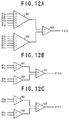
- FIG.12A is a circuit diagram showing a circuit structure for computing the formula (3a) to obtain the focal error signal FES.
- an adder adds the outputs of the photodetector parts 37a, 37g, 37m, 37d, 37j and 37p
- an adder 502 adds the outputs of the photodetector parts 37b, 37h, 37n, 37c, 37i and 37o.
- a subtracter 503 subtracts an output of the adder 502 from an output of the adder 501, and produces the focal error signal FES.
- FIG.12B is a circuit diagram showing a circuit structure for computing the fomula (3b) to obtain the focal error signal FES.
- an adder 511 adds the outputs of the photodetector parts 37a and 37p
- an adder 512 adds the outpputs of the photodetector parts 37b and 37o.
- a subtracter 513 subtracts an output of the adder 512 from an output of the adder 511, and produces the focal error signal FES.
- FIG.12C is a circuit diagram showing a circuit structure for computing the formula (3c) to obtain the focal error signal FES.
- an adder adds the outputs of the photodetector parts 37m and 37d
- an adder 522 adds the outputs of the photodetector parts 37n amd 37c.
- a subtracter 523 subtracts an output of the adder 522 from an output of the adder 521, and produces the focal error signal FES.
- FIG.12D is a circuit diagral showing a circuit structure for computing the formula (3d) to obtain the focal error signal FES.
- an adder adds the outputs of the photodetector parts 37a, 37d, 37m and 37p
- an adder 532 adds the outputs of the photodetector parts 37b, 37c, 37n and 37o.
- a subtracter 533 subtracts an output of the adder 532 from an output of the adder 531, and produces the focal error signal FES.
- the focal error signal FES obtained by the formula (3a) has a high signal-to-noise (S/N) ratio and is uneasily affected by external disturbances because all of the beams irradiated on the photodetector unit 66 is used and consequently a large amount of light is used to detect the focal error signal FES.
- S/N signal-to-noise
- the focal error signal FES obtained by the formula (3b) or (3c) enables easy and simple adjustments since only two beams are used to detect the focal error signal FES and thus only two beams need to be irradiated on corresponding two photodetectors 66a and 66h or, 66b and 66g, of the photodetector unit 66 so that each beam irradiates a division line separating the two photodetector parts forming each of the photodetectors 66a and 66h or, 66b and 66g.
- the focal error signal FES obtained by the formula (3d) can obtain, to a certain extent, the above described effects obtainable with respect to the focal error signals FES obtained by the formulas (3a) and (3b) or (3c).
- the required adjustments are simpler compared to the case of the focal error signal FES obtained by the formula (3a).
- the focal error signal FES obtained by the formula (3d) has a higher S/N ratio and is less affected by external disturbances as compared to the focal error signal FES obtained by the formulas (3b) or (3c).
- the focal error signal FES according to the above described formulas (3a) through (3d) can be generated by use of known adders and subtracter.
- the tracking error signal TES using the push-pull technique can be generated based on one of the following formulas (4a) and (4b) by calculation.
- TES [(37e)+(37k)+(37q)]-[(37f)+(37l)+(37r)]
- TES [(37e)+(37q)]-[(37f)+(37r)]
- FIG.13A is a circuit diagram showing a circuit structure for computing the formula (4a) to obtain the tracking error signal TES.
- an adder 541 adds the outputs of the photodetector parts 37e, 37k and 37q
- an adder 542 adds the outputs of the photodetector parts 37f, 37l and 37r.
- a subtracter 543 subtracts an output of the adder 542 from an output of the adder 541, and produces the tracking error signal TES.
- FIG.13B is a circuit diagram showing a circuit structure for computing the formula (4b) to obtain the tracking error signal TES.
- an adder 551 adds the outputs of the photodetector parts 37e and 37q
- an adder 552 adds the outputs of the photodetector parts 37f and 37r.
- a subtracter 553 subtracts an output of the adder 552 from an output of the adder 551, and produces the tracking error signal TES.
- the tracking error signal TES obtained by the formula (4a) has a high S/N ratio and is uneasily affected by external disturbances because all of the beams irradiated on the photodetector unit 66 is used and consequently a large amount of light is used to detect the tracking error signal TES.
- the tracking error signal TES obtained by the formula (4b) enables easy and simple adjustments since only two beams are used to detect the tracking error signal TES and thus only two beams need to be irradiated on corresponding two photodetectors 66c and 66i of the photodetector unit 66 so that each beam irradiates a division line separating the two photodetector parts forming each of the photodetectors 66c and 66i.
- a magneto-optic signal (information signal) MO which is recorded on the disk 207 can be reproduced based on one of the following formulas (5a) and (5b) by calculation.
- the tracking error signal TES can be generated by use of known adders and subtracter.
- MO [(37a)+(37b)+(37e)+(37f)+(37c)+(37d)]-[(37m)+(37n)+(37q)+(37r)+(37o)+(37p)]
- MO [(37a)+(37b)+(37c)+(37d)]-[(37m)+(37n) +(37o)+(37p)]
- FIG.14A is a circuit diagram showing a circuit structure for computing the formula (5a) to obtain the magneto-optic signal MO.
- an adder 561 adds the outputs of the photodetector parts 37a, 37b, 37e, 37f, 37c and 37d
- an adder 562 adds the outputs of the photodetector parts 37m, 37n, 37q, 37r, 37o and 37p.
- a subtracter 563 subtracts an output of the adder 562 from an output of the adder 561, and produces the magneto-optic signal MO.
- FIG.14B is a circuit diagram showing a circuit structure for computing the formula (5b) to obtain the magneto-optic signal MO.
- an adder 571 adds the outputs of the photodetector parts 37a, 37b, 37c and 37d
- an adder 572 adds the outputs of the photodetector parts 37m, 37n, 37o and 37p.
- a subtracter 573 subtracts an output of the adder 572 from an output of the adder 571, and produces the magneto-optic signal MO.
- the magneto-optic signal MO obtained by the formula (5a) it is possible to obtain an average signal amplitude which is relatively large.
- the magneto-optic signal MO obtained by the formula (5b) it is possible to obtain a relatively high resolution.
- the magneto-optic signal MO according to the above described formulas (5a) and (5b) can be generated by use of known adders and subtracter.
- the disk 207 is also recorded with positional information which indicates a track, sector and the like on the disk 207.
- This positional information is often referred to as an identification signal ID, and this identification signal ID can be recorded in the form of pits on the disk 207 as is well known.
- the identification signal ID can be reproduced based on the following formula (6) by calculation. In other words, the magneto-optic signal MO is reproduced by obtaining a difference between the outputs of the adders, while the identification signal ID is reproduced by obtaining a sum of the outputs of the adders.
- FIG.15 is a circuit diagram showing a circuit structure for computing the formula (6) to obtain the identification signal ID.
- an adder 581 adds the outputs of the photodetector parts 37a, 37b, 37e, 37f, 37c, 37d, 37m, 37n, 37q, 37r, 37o and 37p, and produces the identification signal ID.
- the identification signal ID according to the above described formula (6) can be generated by use of known adders.
- the magneto-optic signal detection system and the servo signal detection signal can be provided approximately on a single optical path, and it is therefore possible to further reduce both the size and cost of the optical information recording/reproducing apparatus.
- an image formation point of the light beam used to generate the focal error signal FES according to the Foucault technique using the composite prism, and an image formation point of the light beam used to generate the tracking error signal TES according to the push-pull technique are made mutually different.
- the method of making the image formation points of the light beams mutually different is of course not limited to the above described method using the composite prism, and it is possible to use a holographic optical element, for example.
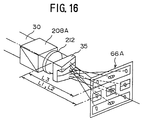
- FIG.16 is a perspective view showing an important part of the second embodiment
- FIG.17 is a plan view showing a photodetector unit of the second embodiment.
- those parts which are the same as those corresponding parts in FIG.10 are designated by the same reference numerals, and a description thereof will be omitted.
- FIG.17 shows a plan view of the photodetector unit 66A.
- the photodetector unit 66A includes 2-part photodetectors 66A-1, 66A-2 and 66A-3, and photodetectors 66A-4 and 66A-5.
- the 2-part photodetector 66A-1 includes photodetector parts A and B.
- the 2-part photodetector 66A-2 includes photodetector parts C and D.
- the 2-part photodetector 66A-3 includes photodetector parts E and F.
- the photodetector 66A-4 includes a photodetector part G
- the photodetector 66A-5 includes a photodetector part H.
- the focal error signal FES using the Foucault technique can be generated based on the following formula (7) by calculation.
- FES (A+C)-(B+D)
- the focal error signal FES according to the above described formula (7) can be generated by use of known adders and subtracter.
- the tracking error signal TES using the push-pull technique can be generated based on the following formula (8) by calculation.
- TES E-F
- the tracking error signal TES according to the above described formula (8) can be generated by use of a known subtracter.
- the magneto-optic signal MO G-H
- the magneto-optic signal MO according to the above described formula (9) can be generated by use of a known subtracter.
- the identification signal ID which is recorded on the disk 207 can be reproduced based on the following formula (10) by calculation.
- ID G+H
- the identification signal ID according to the above described formula (10) can be generated by use of a known adder.
- this embodiment can obtain the focal error signal FES, the tracking error signal TES, the magneto-optic signal MO and the identification signal ID by use of a smaller number of photodetectors (or photodetector parts) and a smaller number of adders as compared to the first embodiment.
- a stray capacitance of the photodetectors can be reduced compared to the eighth embodiment.
- a noise generated by the adders within a large scale integrated circuit (LSI) can be reduced compared to the first embodiment.
- the magneto-optic signal MO and the identification signal ID require higher frequency bands, and consequently, higher signal-to-noise (S/N) ratios.
- the stray capacitance and noise described above affect the S/N ratios of the magneto-optic signal MO and the identification signal ID, however, this embodiment can further improve the S/N ratios of the magneto-optic signal MO and the identification signal ID compared to the first embodiment due to the smaller number of photodetectors (or photodetector parts) and the smaller number of adders used to reproduce these signals MO and ID.
- FIG.18 is a perspective view showing an important part of the third embodiment
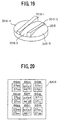
- FIG.19 is a perspective view showing a composite prism of the third embodiment
- FIG.20 is a plan view showing a photodetector unit of the third embodiment.
- those parts which are the same as those corresponding parts in FIG.10 are designated by the same reference numerals, and a description thereof will be omitted.
- a composite prism 35B and a photodetector unit 66B shown in FIG.18 are provided in place of the composite prism 35 and the photodetector unit 66 shown in FIG.10.
- the fifteen light beams from the composite prism 35B are irradiated on corresponding ones of nine photodetectors 66aa through 66ii which form the photodetector unit 66B.
- FIG.19 shows a perspective view of the composite prism 35B.
- the composite prism 35B includes tapered first and second parts 35B-1 and 35B-2, a central third part 35B-3 which has a convex surface with a slight curvature, and peripheral fourth and fifth parts 35B-4 and 35B-5 which have convex surfaces with a slight curvature matching that of the third part 35B-3.
- the third, fourth and fifth parts 35B-3, 35B-4 and 35B-5 are all parts of a single convex surface having a slight curvature.
- the first and second parts 35B-1 and 35B-2 function similarly to the first and second parts 35a and 35b of the composite prism 35.
- FIG.20 shows a plan view of the photodetector unit 66B.
- the photodetector unit 66B includes photodetectors 66aa through 66ii.
- the photodetector 66aa includes photodetector parts 37aa and 37bb
- the photodetector 66bb includes photodetector parts 37cc and 37dd, ...
- the photodetector 66ii includes photodetector parts 37qq and 37rr.
- the three light beams output from the third part 35B-3 of the composite prism 35B are respectively irradiated on the photodetectors 66cc, 66ff and 66ii.
- the three light beams output from the fourth part 35B-4 of the composite prism 35B are respectively irradiated on the photodetectors 66cc, 66ff and 66ii.
- the three light beams output from the fifth part 35B-5 of the composite prism 35B are respectively irradiated on the photodetectors 66cc, 66ff and 66ii.
- the three light beams output from the first part 35B-1 of the composite prism 35B are respectively irradiated on the photodetectors 66aa, 66dd and 66gg.
- the three light beams output from the second part 35B-2 of the composite prism 35B are respectively irradiated on the photodetectors 66bb, 66ee and 66hh.
- the image formation points of the six light beams output from the first and second parts 35B-1 and 35B-2 match the positions of the photodetectors 66aa, 66bb, 66dd, 66ee, 66gg and 66hh.
- the image formation points of the three light beams output from each of the third, fourth and fifth parts 35B-3, 35B-4 and 35B-5 are deviated from the positions of the photodetectors 66cc, 66ff and 66ii.
- the focal error signal FES using the Foucault technique the tracking error signal TES using the push-pull technique and the identification signal ID can be obtained by calculations similarly to the eighth embodiment described above based on the formulas (3a) through (3d), (4a), (4b) and (6).
- the magneto-optic signal MO recorded on the disk 207 can be reproduced based on one of the following formulas (11a) and (11b) by calculation.
- MO [(37aa)+(37bb)+(37ee)+(37ff)+(37cc)+(37dd)]-[(37mm)+(37nn)+(37qq)+(37rr)+(37oo)+(37pp)]
- MO [(37ee)+(37ff)]-[(37qq+(37rr)]
- the magneto-optic signal MO obtained by the formula (11a) it is possible to obtain an average signal amplitude which is relatively large.
- the magneto-optic signal MO obtained by the formula (11b) it is possible to obtain a relatively high resolution.
- the resolution obtainable according to the magneto-optic signal MO obtained by the formula (11b) is further improved compared to that obtainable according to the formula (5b). The reason for this further improved resolution of the magneto-optic signal MO using the composite prism 35B having the shape shown in FIG.19 may be understood from the teachings of the Proceedings of Magneto-Optical Recording International Symposium '96, J. Magn. Soc. Jpn., Vol.20, Supplement No.S1 (1996), pp.233-238.
- the magneto-optic signal MO according to the above described formulas (11a) and (11b) can be generated by use of known adders and subtracter.
- the photodetector unit 66A shown in FIG.17 in place of the photodetector unit 66B.
- the focal error signal FES, the tracking error signal TES, the magneto-optic signal MO and the identification signal ID can be obtained by calculations similarly to the second embodiment described above based on the formulas (7) through (10).
- the composite prism 35 or 35B between the analyzer 208A and the condenser lens 212, and the composite prism 35 or 35B, the condenser lens 212 and the analyzer 208A may be arranged in an arbitrary order.
- the image formation point of the light beam used to generate the focal error signal FES according to the Foucault technique and the image formation point of the light beam used to generate the tracking error signal TES according to the push-pull technique are made mutually different by use of the composite prism.
- the method of making the image formation points of the light beams mutually different is not limited to that using the composite prism, and it is also possible to use a holographic optical element, for example.
- FIG.21 is a perspective view showing an embodiment of the composite prism.
- the composite prism shown in FIG.21 may be used in place of the composite prism 35B shown in FIGS.18 and 19, for example, and substantially the same effects are obtainable as in the embodiments described above.
- a composite prism 135B includes tapered first and second parts 135B-1 and 135B-2, a central third part 135B-3 which has a concave surface with a slight curvature, and peripheral fourth and fifth parts 135B-4 and 135B-5 which have concave surfaces with a slight curvature matching that of the third part 135B-3.
- the third, fourth and fifth parts 135B-3, 135B-4 and 135B-5 are all parts of a single concave surface having a slight curvature.
- the first and second parts 135B-1 and 135B-2 function similarly to the first and second parts 35B-1 and 35B-2 of the composite prism 35B shown in FIG.19.
- FIGS.22(a) through 22(d) respectively are circuit diagrams showing circuit structures for computing the formulas (7) through (10) in the second embodiment.
- FIG.22(a) shows a circuit structure for computing the formula (7)
- FIG.22(b) shows a circuit structure for computing the formula (8)
- FIG.22(c) shows a circuit structure for computing the formula (9)
- FIG.22(d) shows a circuit structure for computing the formula (10).
- FIG.22(a) shows a circuit including adders 801 and 802 and a subtracter 803 which are connected as shown to generate the focal error signal FES based on the outputs of the photodetector parts A through D.
- FIG.22(b) shows a circuit including a subtracter 804 to generate the tracking error signal TES based on the outputs of the photodetector parts E and F.
- FIG.22(c) shows a circuit including a subtracter 805 to reproduce the magneto-optic signal MO based on the outputs of the photodetector parts G and G.
- FIG.22(d) shows a circuit including an adder 806 to reproduce the identification signal ID based on the outputs of the photodetector parts G and H.
- circuits for obtaining the focal error signal FES, the tracking error signal TES, the magneto-optic signal MO and the identification signal ID based on other formulas described above can similarly be constructed using known adders and subtracters, and the illustration of such circuits will be omitted in this application since the connections of the adders and subtracters are evident from the formulas.
Landscapes
- Physics & Mathematics (AREA)
- Optics & Photonics (AREA)
- Mathematical Physics (AREA)
- Optical Recording Or Reproduction (AREA)
- Optical Head (AREA)
Applications Claiming Priority (2)
| Application Number | Priority Date | Filing Date | Title |
|---|---|---|---|
| JP9346775A JPH11185279A (ja) | 1997-12-16 | 1997-12-16 | 光学的情報記録/再生装置 |
| JP34677597 | 1997-12-16 |
Publications (3)
| Publication Number | Publication Date |
|---|---|
| EP0926665A2 true EP0926665A2 (de) | 1999-06-30 |
| EP0926665A3 EP0926665A3 (de) | 2000-02-23 |
| EP0926665B1 EP0926665B1 (de) | 2008-07-02 |
Family
ID=18385743
Family Applications (1)
| Application Number | Title | Priority Date | Filing Date |
|---|---|---|---|
| EP98111079A Expired - Lifetime EP0926665B1 (de) | 1997-12-16 | 1998-06-17 | Optisches Informationsaufzeichnungs-/-wiedergabegerät |
Country Status (3)
| Country | Link |
|---|---|
| EP (1) | EP0926665B1 (de) |
| JP (1) | JPH11185279A (de) |
| DE (1) | DE69839663D1 (de) |
Family Cites Families (7)
| Publication number | Priority date | Publication date | Assignee | Title |
|---|---|---|---|---|
| US4983017A (en) * | 1988-08-02 | 1991-01-08 | Sharp Kabushiki Kaisha | Optical head device for reading information stored in a recording medium |
| JPH04364231A (ja) * | 1991-01-07 | 1992-12-16 | Toshiba Corp | 光学ヘッド装置 |
| US5353267A (en) * | 1992-06-02 | 1994-10-04 | Nec Corporation | Magneto-optical light detector apparatus |
| EP0630005B1 (de) * | 1993-06-21 | 2001-08-29 | Fujitsu Limited | Optisches Informationsaufzeichnungs-/wiedergabegerät |
| JPH0935284A (ja) * | 1995-07-17 | 1997-02-07 | Fujitsu Ltd | 光ディスク装置 |
| JP2748905B2 (ja) * | 1995-09-29 | 1998-05-13 | 日本電気株式会社 | 光ヘッド装置 |
| US5761162A (en) * | 1996-10-31 | 1998-06-02 | Eastman Kodak Company | Multi-element prism for optical heads |
-
1997
- 1997-12-16 JP JP9346775A patent/JPH11185279A/ja active Pending
-
1998
- 1998-06-17 DE DE69839663T patent/DE69839663D1/de not_active Expired - Fee Related
- 1998-06-17 EP EP98111079A patent/EP0926665B1/de not_active Expired - Lifetime
Also Published As
| Publication number | Publication date |
|---|---|
| DE69839663D1 (de) | 2008-08-14 |
| EP0926665B1 (de) | 2008-07-02 |
| JPH11185279A (ja) | 1999-07-09 |
| EP0926665A3 (de) | 2000-02-23 |
Similar Documents
| Publication | Publication Date | Title |
|---|---|---|
| US5610897A (en) | Optical information reproducing apparatus | |
| US5793725A (en) | Optical information recording/reproducing apparatus having a composite prism with a plurality of emission surfaces | |
| US7088659B2 (en) | Optical disk apparatus and tilt detection method | |
| JPS629537A (ja) | 光学式ピツクアツプ装置 | |
| US5508992A (en) | Magneto-optical recording/reproducing pickup head with a diffraction grating and a wollaston prism | |
| JPH0514968B2 (de) | ||
| EP0147749A2 (de) | Optischer Kopf | |
| US5742572A (en) | Optical information recording/reproducing apparatus which detects focal error | |
| US6185166B1 (en) | Optical information recording/reproducing apparatus | |
| US6091692A (en) | Optical information storage apparatus | |
| EP0908871A2 (de) | Optisches Informationsspeichergerät | |
| EP0630005B1 (de) | Optisches Informationsaufzeichnungs-/wiedergabegerät | |
| EP0926665A2 (de) | Optisches Informationsaufzeichnungs-/-wiedergabegerät | |
| JP3764134B2 (ja) | 光学的情報記録/再生装置 | |
| EP0910070A2 (de) | Optisches Informationsaufzeichnungs/-wiedergabegerät | |
| EP1030295B1 (de) | Vorrichtung zur optischen Aufzeichnung und Wiedergabe von Informationen | |
| US6094412A (en) | Optical information storage unit | |
| HK8296A (en) | Optical scanning device | |
| US6946634B2 (en) | Optical pickup device | |
| JP3360380B2 (ja) | 光ピックアップ | |
| US6577565B1 (en) | Optical pickup for performing recording or reading operation on recording medium having prepits | |
| JPH02218022A (ja) | 分離型光ピックアップ装置 | |
| JPH04301228A (ja) | トラッキングオフセットの検出装置 | |
| JPH06274929A (ja) | 光学ヘッド装置 | |
| JPH01125730A (ja) | 光情報記録再生装置の焦点検出装置 |
Legal Events
| Date | Code | Title | Description |
|---|---|---|---|
| PUAI | Public reference made under article 153(3) epc to a published international application that has entered the european phase |
Free format text: ORIGINAL CODE: 0009012 |
|
| AK | Designated contracting states |
Kind code of ref document: A2 Designated state(s): AT BE CH CY DE DK ES FI FR GB GR IE IT LI LU MC NL PT SE |
|
| AX | Request for extension of the european patent |
Free format text: AL;LT;LV;MK;RO;SI |
|
| PUAL | Search report despatched |
Free format text: ORIGINAL CODE: 0009013 |
|
| AK | Designated contracting states |
Kind code of ref document: A3 Designated state(s): AT BE CH CY DE DK ES FI FR GB GR IE IT LI LU MC NL PT SE |
|
| AX | Request for extension of the european patent |
Free format text: AL;LT;LV;MK;RO;SI |
|
| RIC1 | Information provided on ipc code assigned before grant |
Free format text: 7G 11B 7/09 A, 7G 11B 7/13 B, 7G 11B 7/135 B |
|
| AKX | Designation fees paid | ||
| 17P | Request for examination filed |
Effective date: 20000811 |
|
| RBV | Designated contracting states (corrected) |
Designated state(s): DE FR GB |
|
| RBV | Designated contracting states (corrected) |
Designated state(s): DE FR GB |
|
| 17Q | First examination report despatched |
Effective date: 20040224 |
|
| 17Q | First examination report despatched |
Effective date: 20040224 |
|
| 17Q | First examination report despatched |
Effective date: 20040224 |
|
| GRAP | Despatch of communication of intention to grant a patent |
Free format text: ORIGINAL CODE: EPIDOSNIGR1 |
|
| RIN1 | Information on inventor provided before grant (corrected) |
Inventor name: TEZUKA, KOICHI |
|
| RAP1 | Party data changed (applicant data changed or rights of an application transferred) |
Owner name: FUJITSU LIMITED |
|
| GRAS | Grant fee paid |
Free format text: ORIGINAL CODE: EPIDOSNIGR3 |
|
| GRAA | (expected) grant |
Free format text: ORIGINAL CODE: 0009210 |
|
| AK | Designated contracting states |
Kind code of ref document: B1 Designated state(s): DE FR GB |
|
| REG | Reference to a national code |
Ref country code: GB Ref legal event code: FG4D |
|
| REF | Corresponds to: |
Ref document number: 69839663 Country of ref document: DE Date of ref document: 20080814 Kind code of ref document: P |
|
| PLBE | No opposition filed within time limit |
Free format text: ORIGINAL CODE: 0009261 |
|
| STAA | Information on the status of an ep patent application or granted ep patent |
Free format text: STATUS: NO OPPOSITION FILED WITHIN TIME LIMIT |
|
| 26N | No opposition filed |
Effective date: 20090403 |
|
| PGFP | Annual fee paid to national office [announced via postgrant information from national office to epo] |
Ref country code: FR Payment date: 20090527 Year of fee payment: 12 |
|
| PGFP | Annual fee paid to national office [announced via postgrant information from national office to epo] |
Ref country code: GB Payment date: 20090625 Year of fee payment: 12 Ref country code: DE Payment date: 20090714 Year of fee payment: 12 |
|
| GBPC | Gb: european patent ceased through non-payment of renewal fee |
Effective date: 20100617 |
|
| REG | Reference to a national code |
Ref country code: FR Ref legal event code: ST Effective date: 20110228 |
|
| PG25 | Lapsed in a contracting state [announced via postgrant information from national office to epo] |
Ref country code: DE Free format text: LAPSE BECAUSE OF NON-PAYMENT OF DUE FEES Effective date: 20110101 |
|
| PG25 | Lapsed in a contracting state [announced via postgrant information from national office to epo] |
Ref country code: FR Free format text: LAPSE BECAUSE OF NON-PAYMENT OF DUE FEES Effective date: 20100630 |
|
| PG25 | Lapsed in a contracting state [announced via postgrant information from national office to epo] |
Ref country code: GB Free format text: LAPSE BECAUSE OF NON-PAYMENT OF DUE FEES Effective date: 20100617 |