EP0928071A1 - Entrelaceur pour turbo-codeur - Google Patents
Entrelaceur pour turbo-codeur Download PDFInfo
- Publication number
- EP0928071A1 EP0928071A1 EP98403283A EP98403283A EP0928071A1 EP 0928071 A1 EP0928071 A1 EP 0928071A1 EP 98403283 A EP98403283 A EP 98403283A EP 98403283 A EP98403283 A EP 98403283A EP 0928071 A1 EP0928071 A1 EP 0928071A1
- Authority
- EP
- European Patent Office
- Prior art keywords
- polynomial
- sequence
- equal
- binary data
- integer
- Prior art date
- Legal status (The legal status is an assumption and is not a legal conclusion. Google has not performed a legal analysis and makes no representation as to the accuracy of the status listed.)
- Granted
Links
- 238000000034 method Methods 0.000 claims abstract description 43
- 125000004122 cyclic group Chemical group 0.000 claims description 42
- 238000012545 processing Methods 0.000 claims description 32
- 230000005540 biological transmission Effects 0.000 claims description 23
- 230000001174 ascending effect Effects 0.000 claims description 12
- 230000001131 transforming effect Effects 0.000 claims description 10
- 238000004519 manufacturing process Methods 0.000 claims description 5
- 230000000694 effects Effects 0.000 claims description 4
- 238000012546 transfer Methods 0.000 claims description 3
- 230000015654 memory Effects 0.000 description 33
- 239000011159 matrix material Substances 0.000 description 19
- 238000012360 testing method Methods 0.000 description 11
- 230000008901 benefit Effects 0.000 description 8
- 238000010586 diagram Methods 0.000 description 7
- 230000006870 function Effects 0.000 description 6
- 238000004422 calculation algorithm Methods 0.000 description 5
- 230000010365 information processing Effects 0.000 description 4
- 238000004088 simulation Methods 0.000 description 4
- 238000004364 calculation method Methods 0.000 description 3
- 238000004891 communication Methods 0.000 description 3
- 238000012937 correction Methods 0.000 description 3
- 238000011156 evaluation Methods 0.000 description 3
- 230000009897 systematic effect Effects 0.000 description 3
- 239000000654 additive Substances 0.000 description 2
- 230000000996 additive effect Effects 0.000 description 2
- 230000000295 complement effect Effects 0.000 description 2
- 238000004590 computer program Methods 0.000 description 2
- 230000002093 peripheral effect Effects 0.000 description 2
- 238000003860 storage Methods 0.000 description 2
- 238000004458 analytical method Methods 0.000 description 1
- 230000015572 biosynthetic process Effects 0.000 description 1
- 238000013461 design Methods 0.000 description 1
- 238000009826 distribution Methods 0.000 description 1
- 230000008030 elimination Effects 0.000 description 1
- 238000003379 elimination reaction Methods 0.000 description 1
- 238000005516 engineering process Methods 0.000 description 1
- 238000012986 modification Methods 0.000 description 1
- 230000004048 modification Effects 0.000 description 1
- 230000000737 periodic effect Effects 0.000 description 1
- 230000008569 process Effects 0.000 description 1
- 230000003595 spectral effect Effects 0.000 description 1
- 230000001502 supplementing effect Effects 0.000 description 1
- 230000009466 transformation Effects 0.000 description 1
- 238000012795 verification Methods 0.000 description 1
Images




Classifications
-
- H—ELECTRICITY
- H03—ELECTRONIC CIRCUITRY
- H03M—CODING; DECODING; CODE CONVERSION IN GENERAL
- H03M7/00—Conversion of a code where information is represented by a given sequence or number of digits to a code where the same, similar or subset of information is represented by a different sequence or number of digits
-
- H—ELECTRICITY
- H03—ELECTRONIC CIRCUITRY
- H03M—CODING; DECODING; CODE CONVERSION IN GENERAL
- H03M13/00—Coding, decoding or code conversion, for error detection or error correction; Coding theory basic assumptions; Coding bounds; Error probability evaluation methods; Channel models; Simulation or testing of codes
- H03M13/29—Coding, decoding or code conversion, for error detection or error correction; Coding theory basic assumptions; Coding bounds; Error probability evaluation methods; Channel models; Simulation or testing of codes combining two or more codes or code structures, e.g. product codes, generalised product codes, concatenated codes, inner and outer codes
- H03M13/2957—Turbo codes and decoding
- H03M13/2993—Implementing the return to a predetermined state, i.e. trellis termination
-
- H—ELECTRICITY
- H03—ELECTRONIC CIRCUITRY
- H03M—CODING; DECODING; CODE CONVERSION IN GENERAL
- H03M13/00—Coding, decoding or code conversion, for error detection or error correction; Coding theory basic assumptions; Coding bounds; Error probability evaluation methods; Channel models; Simulation or testing of codes
- H03M13/27—Coding, decoding or code conversion, for error detection or error correction; Coding theory basic assumptions; Coding bounds; Error probability evaluation methods; Channel models; Simulation or testing of codes using interleaving techniques
- H03M13/2703—Coding, decoding or code conversion, for error detection or error correction; Coding theory basic assumptions; Coding bounds; Error probability evaluation methods; Channel models; Simulation or testing of codes using interleaving techniques the interleaver involving at least two directions
- H03M13/271—Row-column interleaver with permutations, e.g. block interleaving with inter-row, inter-column, intra-row or intra-column permutations
-
- H—ELECTRICITY
- H03—ELECTRONIC CIRCUITRY
- H03M—CODING; DECODING; CODE CONVERSION IN GENERAL
- H03M13/00—Coding, decoding or code conversion, for error detection or error correction; Coding theory basic assumptions; Coding bounds; Error probability evaluation methods; Channel models; Simulation or testing of codes
- H03M13/27—Coding, decoding or code conversion, for error detection or error correction; Coding theory basic assumptions; Coding bounds; Error probability evaluation methods; Channel models; Simulation or testing of codes using interleaving techniques
- H03M13/2771—Internal interleaver for turbo codes
Definitions
- the present invention concerns a coding device, a coding method, a decoding device and method and systems implementing them.
- the invention finds an application in the field of convolutional codes.
- these codes are greatly improved when their coders contain a permutation device.
- they are normally referred to as "turbocodes” and the corresponding iterative decoder is referred to as a “turbodecoder”.
- permutation devices are far from being perfectly mastered.
- this device uses square or rectangular matrices in which one row after another is written and one column after another is read. These matrices are generally very large, for example of a size 256 x 256.
- the evaluation of the corresponding turbocode consists of simulating its use on a transmission channel with different signal/noise ratio values and measuring the minimum value of this ratio for which a predetermined value of the probability of error on the binary values is reached.
- a possible method for remedying this situation is to produce a harmonious and conjoint design of the permutation device and the two convolutional coders in order to guarantee a reasonable uniformity of the error rate on the binary values after decoding, as a function of the position of the binary information in the permutation device.
- Another problem concerns the lack of algebraic tools for specifying the permutation devices. It will be useful to have available means for specifying a selection of permutation devices having a performance representative of the set of all the permutation devices.
- u (u 0 , u 1 , ..., u k-1 )
- u(x) u 0 x 0 + u 1 x 1 + ... + u k-1 x k-1 .
- first coder will be given to the elementary recursive convolutional coder which produces the sequence b and "second coder” will be given to the one which produces the sequence c .
- the polynomial divisions used are of the type consisting of division according to ascending powers, well known to persons skilled in the art. They use modulo 2 arithmetic.
- the sequences a , b and c are binary sequences and in the general case the divisions which define b and c have a remainder.
- This type of coding method has the advantage of lending itself to an iterative decoding which is powerful, relatively simple and inexpensive.
- turbocoders have two elementary recursive coders, the second of which uses a permutation a * of the sequence a , it is wished to guarantee that the polynomials a(x) and a*(x) representing the information sequence u(x) are simultaneously divisible by g(x) .
- This problem can give rise to disparities between the probabilities of errors after decoding of the different bits constituting u(x) .
- BATTAIL disclosed that, by arranging the terms of the sequence u , cyclically, in a number of columns equal to a multiple of the degree N0 of the polynomial of type x n - 1 of the lowest strictly positive degree which is divisible by g(x) , permutations internal to each of the columns thus formed mean that the sum of the remainder of the division defining the sequence b and of that of the division defining the sequence c is nil, so that the concatenation of the sequences is divisible by g .
- the present invention sets out to remedy these drawbacks by proposing on the one hand families of interlacers which guarantee return to zero at the end of the sequence c , when the sequence b returns to zero, and on the other hand proposing a choice of interlacers which is wider than that proposed by the articles cited above.
- the present invention relates to a coding method characterised in that:
- the present invention relates to a decoding method characterised in that:
- This second aspect of the invention has the same advantages as the first aspect.
- the coding method to which the present invention relates makes it possible to effect all the interlacings to j fixed in the same way. It is therefore simple to implement.
- the coding method to which the present invention relates includes an operation of transmitting on the one hand sequences a i , and, on the other hand, a sub-set of the data of the other sequences.
- the present invention relates to a coding device characterised in that it includes a processing means adapted to:
- the present invention relates to a coding device characterised in that it has a processing means adapted to:
- the present invention relates to a decoding method characterised in that:
- the present invention relates to a decoding method characterised in that:
- the present invention relates to a decoding device characterised in that it includes a processing means adapted:
- the present invention relates to a decoding device characterised in that it has a processing means adapted:
- the invention also relates to:
- these coding and decoding methods and these signal processing, data transmission and sequence processing devices and this network have the same particular characteristics and the same advantages as the coding method as briefly disclosed above, these particular characteristics and these advantages will not be repeated here.
- a length of sequence a equal to M.N0 is chosen, which amounts to determining the length (that is to say the number of binary data) of the sequence u incorporated in the sequence a as being equal to M.N0 minus the degree of g(x) .
- sequence a there is juxtaposed with the sequence u formed by k binary data u i to be transmitted, a number of additional binary data equal to the degree of the polynomial g(x) , the added data guaranteeing the absence of a remainder in the division of a(x) by g(x) .
- an interlacer In order to determine the sequence a * (x) , which has, after permutation, the same binary data as the sequence a , but in a different order, an interlacer is chosen, a representation of which can be given as follows: the binary data of the sequence a being arranged in a table of N0 columns and M rows, there is performed on these data at least one permutation in a set of permutations including, on the one hand, the automorphisms of the binary cyclic code of length N0 and with the generator polynomial g(x) , permuting with each other at least two of the N0 columns of the table and, on the other hand, the permutations operating solely on data in one and the same column and permuting with each other at least two of the said data items, and only one or more permutations of this set.
- the inventors have selected the following permutations, which have the advantage of constituting only a small family, all the members of which can be tested in order to choose the most effective permutation.
- M is chosen so as to be odd and g(x) such that the corresponding number N0 is also odd.
- the cycle of 2 modulo M.N0 By writing the successive powers of 2 modulo M.N0 , there is obtained what is called the cycle of 2, modulo M.N0 .
- f will be equal to 16 and the sequence a * begins with the binary data: a 0 ' a 16 , a 32 , a 13 , a 29 , a 10 ' etc ...
- the selection logic is as follows: first of all g(x) of degree m , not divisible by a square polynomial, is chosen. This choice fixes the value of N0 as being the smallest integer such that g(x) divides x N0 - 1 . In addition, the fact that the polynomial g(x) is not divisible by a square polynomial implies that N0 is an odd number. Then h 1 (x) and h 2 (x) are chosen of any degree but preferentially at most equal to the degree m of g(x) since the maximum of the degrees of these three polynomials g(x) , h 1 (x) and h 2 (x) is a determining factor in the complexity of the decoder.
- N0 147 and makes it possible to calculate the cycle of 2 modulo 147 as being (1, 2, 4, 8, 16, 32, 64, 128, 109, 71, 142, 137, 127, 107, 67, 134, 121, 95, 43, 86, 25, 50, 100, 53, 106, 65, 130, 113, 79, 11, 22, 44, 88, 29, 58, 116, 85, 23, 46, 92, 37, 74 ⁇ .
- the inventors have tested the polynomials a(x) divisible by g(x) and of weight equal successively to 2, 3, 4, 5, 6 and 7, and such that if this weight is greater than or equal to 5, then the weight of a(x) , denoted W(a(x)) , is equal to the weight of a(x) modulo x 15 +1.
- the numbers e , non-congruent at 1, modulo N0 can be used in particular.
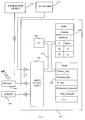
- FIG. 1 illustrates schematically the constitution of a network station or computer coding station, in the form of a block diagram.
- This station has a keyboard 111, a screen 109, an external information source 110 and a radio transmitter 106, conjointly connected to an input/output port 103 of a processing card 101.
- the processing card 101 has, connected together by an address and data bus 102:
- register designates, in each of the memories 104 and 105, both a memory area of low capacity (a few binary data) and a memory area of large capacity (making it possible to store an entire program).
- the random access memory 104 stores data, variables and intermediate processing results, in memory registers bearing, in the description, the same names as the data whose values they store.
- the random access memory 104 has notably:
- the read-only memory 105 is adapted to store, in registers which, for convenience, have the same names as the data which they store:
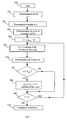
- the central processing unit 100 is adapted to implement the flow diagram described in Figure 2.
- the central unit 100 determines whether or not the integer number stored in the register " N o _ data " is equal to the product M . N0 from which the degree of g(x) is subtracted, M , N0 and the degree m of g(x) being values stored in the read-only memory 105.
- the operation 301 is reiterated.
- the result of the test 302 is positive, during an operation 303, the division of the polynomial u(x) associated with the sequence of binary data stored in the register " primary_data " by the polynomial g(x) is effected, up to the last term (of the highest degree) of u(x) , using, for this purpose, the register " intermediate_remainder ", the remainder of this division is stored in memory in the register " final_remainder ".
- the binary data stored in the register " final_remainder " are juxtaposed at the end of the sequence u in order to form the sequence a .
- the binary data of the sequence a are stored in memory in the register " a , b , c ".
- the binary data of the sequence a are successively read from the register " a , b , c ", in the order described by the table " interlacer " stored in the read-only memory 105.
- the data which result successively from this reading are stored in memory in the register " permuted_data " of the read-only memory 104.
- the division of the polynomial a * (x) associated with the sequence of permuted binary data stored in the register " permuted_data " by the polynomial g(x) is effected, using, for this purpose, the register " intermediate_remainder ".
- the result of this division is stored in memory in the register " a , b , c ", and corresponds to the binary data of the sequence c .
- sequences b and c are determined by effecting the product of the polynomials associated with the sequences b and c stored in the register " a , b , c " of the random access memory 104, and respectively the polynomials h 1 (x) and h 2 (x) .
- the sequences a , b , and c are sent, using for this purpose the sender 106.
- the registers of the memory 104 are initialised again, in particular the counter " N o _ data is reset to "0" and the operation 301 is reiterated.
- sequence a is sent as a whole, but only a sub-set, for example one data item out of two, of each of the sequences b and c is sent.
- This variant is known to persons skilled in the art as puncturing.
- Figure 3 depicts the steps of an algorithm determining the value of e specifying the interlacer to use. These steps can be performed by a computer of a known type (not depicted), in which the registers " N0 ", " M “, “interlacer”, “ d “, “ d max ", " e “ and “ j " are situated, in the random access memory.
- the divisions of the polynomials x i - 1 by g(x) are effected successively, commencing with a value of i equal to the degree m of g(x) and progressively incrementing i , with an incrementation step of 1, until the remainder of the division is nil, modulo 2.
- the value of i is put in the register N0 . It will be recalled that the division performed here is effected, modulo 2, on the coefficients of the ascending powers of x i - 1.
- f is equal to a power of 2 different from 1, modulo M . N0 , this permutation is indeed of the type stated.
- the central unit 100 determines the successive powers of 2 modulo M . N0 , in order to obtain what is referred to as the cycle of 2, modulo M . N0 , this cycle being completed as soon as one of the powers of 2 is equal to 1, modulo M . N0 .
- the number of terms j of this cycle is stored in the register " j' ".
- the process is limited to the analysis of the distance of the sequences with the nil sequence, the polynomials a(x) are enumerated by ascending weight, the sum of the weights of the sequences in one and the same triplet ( a , b , c ) is measured and a search is made for the minimum weight for a given e , for the sequences a of low weight, and, once all these minimum weights have been determined for e in the cycle of 2, for the value of e which corresponds to the highest weight.
- the distance is then stored in the register " d " of the random access memory 104.
- the value stored in the register " d ' is greater than the value stored in the register " d max "
- the value of the register " d max " is modified in order to take the value d and the value of the l -th element of the cycle considered is stored in memory in the register " e ".
- the triplet ( a , b , c ) is constructed as follows:
- passage at throughputs of a quarter or less, by adding one or more additional interlacers, is effected for each interlacer, by applying the principles set out above.
- puncturing can be used to raise the throughput of the code. It will be recalled that puncturing consists of transmitting only some of the check symbols.
- devices which are the object of the present invention are advantageously produced by implementing, in order to effect the arithmetic calculations, polynomial multiplication, polynomial division, the function of interlacing and the functions of elementary decoding, dedicated circuits not including a processor (such a processor can nevertheless be used for controlling the operation of these devices).
- dedicated circuits not including a processor (such a processor can nevertheless be used for controlling the operation of these devices).
- the use of such dedicated circuits makes it possible in fact to reach higher information flow rates.
- the throughput is, without puncturing, close to one third since, for a sequence of n - m symbols to be coded, there are two sequences of n check symbols.
- throughputs greater than 1/3 are considered, obtained without puncturing: for two sequences of n-m symbols to be coded, two sequences of n check symbols are for example supplied, that is to say a throughput close to one half.
- a class of algebraic interlacers to be used with turbocoders with a throughput close to one third is presented.
- the main advantage of these interlacers is to preserve the divisibility of the information polynomials by a given polynomial g(x) which partially characterises the coder. As a result the probability of error per coded information bit is better independent of the position of the bits in the information sequence.
- the algebraic description of these interlacers makes their enumeration and individual evaluation possible. In addition, it is hoped that the performance of this small set of interlacers is representative of the performance of all the interlacers.
- the second embodiment is concerned particularly with throughputs greater than or close to one half, without the use of puncturing methods.
- sequences rather than “polynomials” is written here, since the sums are not necessarily multiples of g and, if they are not, division by g makes a sequence infinite and ultimately periodic.
- the transformation at each sequence a i into the sequence a i * is referred to as "interlacing" (see for example the article by Messrs. C. BERROU and A. GLAVIEUX entitled " Near Optimum error-correcting coding and decoding : turbo-codes " published by IEEE Transactions on Communication , Volume COM-44, pages 1261 to 1271, in October 1996).
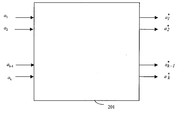
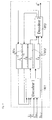
- Figure 4 gives an illustration of a coder performing this operation. In this figure, it will be observed that, for K sequences of symbols at the input, the coder sends, at the output:
- each sequence a i * can contains symbols of the sequence a j with j different from i .
- each interlacer I i has:
- N0 be the smallest integer such that g(x) divides x N0 + 1.
- n M . N0 .
- the polynomial g(x) is then a divisor of the polynomial x n + 1.
- n can be chosen amongst the values 15, 45, 75, ..., 225, ..., 405, ...
- ⁇ j n-m to n -1 ( u i ) j x j
- the resulting K -tuple a ( a 1 , ..., a K ) is then coded in order to produce two check sequences.
- n there are 42 numbers e which are each the residue, modulo 147, of a power of 2.
- e the corresponding turbocode was simulated on an additive white gaussian noise channel (known to persons skilled in the art under the English acronym “AWGN” standing for “Additive White Gaussian Noise”), for different values of the ratio between the energy per bit E b and the noise power per hertz (also referred to as the noise spectral density), N .
- AWGN additive white gaussian noise channel
- 3 x 5 turbocoder will for example be considered: where g is an irreducible polynomial with binary coefficients which is not divisible by a square polynomial.
- An element which influences the minimum distances of such a code is the minimum number of non-nil components of the 5-tuple v .
- any 5-tuple v ( v 1 , ..., v 5 ) of the turbocode contains at least three non-nil sequences v i .
- Each non-nil v in the code generated by G always contains at least N1 - K +1 non-nil components if, for each integer number r such that 1 ⁇ r ⁇ N1-K , each sub-matrix r x r of G extracted from its last N1 - K columns and where h i , j (x) is replaced by h i , j (x dj ) , has a non-nil determinant, modulo x N0 +1 .
- ⁇ (1,2) be the sub-matrix of the first two columns of ⁇
- ⁇ is a matrix 2 x K on GF (2 m ).
- e power of 2 modulo n any element in the second row of ⁇ will be replaced by its e th power and the transposed matrix of this matrix will be denoted ⁇ .
- this coder G can be used as a turbocoder. By simulation, it is then possible to choose the best value of e .
- N1 - K > 2 can be treated in a similar fashion.
- M1 N1 - K
- a matrix ⁇ is constructed of type M1 x N1 :
- the transposed matrix of this matrix is then denoted ⁇ , the elements of ⁇ are interpreted as polynomials of degree m -1 of indeterminate x , they are divided by g(x) and the resulting matrix of dimensions K x ( N - K ) is termed P(x) .
- the coders G [ I K P(x) ] obtained for different values of ( M1 -1)- tuple (e 2 , ..., e M1 ) are then analysed by simulations and the best can be selected.
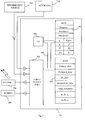
- FIG. 7 illustrates schematically the constitution of a network station or computer coding station, in the form of a block diagram.
- This station includes a keyboard 711, a screen 709, an external information source 710 and a radio transmitter 706, conjointly connected to an input/output port 703 of a processing card 701.
- the processing card 701 has, connected together by an address and data bus 702:
- register designates, in each of the memories 704 and 705, both a memory area of low capacity (a few binary data) and a memory area of large capacity (enabling an entire program to be stored).
- the random access memory 704 stores data, variables and intermediate processing results, in memory registers bearing, in the description, the same names as the data whose values they store.
- the random access memory 704 contains notably:
- the read only memory 705 is adapted to store, in registers which, for convenience, bear the same names as the data which they store:
- interlacers considered here are respectively of type " x to x e1 " and " x to x e2 " described above.
- the central processing unit 700 is adapted to implement the flow diagram described in Figure 8.
- the central unit 700 first of all constitutes the sequence u 1 and then the sequence u 2 , with the primary data coming from the information source 710.
- the central unit 700 determines whether or not the integer number stored in the register " No_data " is equal to the product M . N0 from which the degree m of g(x) , is subtracted M , N0 and the degree m of g(x) being values stored in the random access memory 705.
- the operation 801 is reiterated.
- the divisions of the polynomials u 1 (x) and u 2 (x) respectively associated with the sequences of binary data u 1 and u 2 stored in the register " primary_data ", by the polynomial g(x) are effected, up to the last terms (of the highest degrees) of u 1 (x) and u 2 (x) , using, for this purpose, the register " intermediate_remainder ".
- the remainders of these divisions are stored in memory in the register " final_remainder ".
- the binary data stored in the register " final_remainder " are respectively juxtaposed with the ends of the sequences u 1 , and u 2 in order to form the sequences a 1 and a 2 .
- the binary data of the sequences a 1 and a 2 are stored in memory in the registers " a 1 , b 1 , c 1 " and " a 2 , b 2 , c 2 ".
- the divisions of the polynomials a 1 * (x) and a 2 * (x) , respectively associated with the sequences of permuted binary data stored in the register " permuted_data ", by the polynomial g(x) are effected, using for this purpose the register " intermediate_remainder ".
- the results of these divisions are stored in memory in the register " a 1 , b 1 , c 1 " and " a 2 , b 2 , c 2 ", and correspond to the binary data of the sequences c 1 and c 2 .
- memory elements are saved by effecting the division by g(x) before the multiplications by h(x) or f(x) .
- the sequences a 1 , a 2 , b s and c s are transmitted, using for this purpose the transmitter 706.
- the registers of the memory 704 are once again initialised, in particular the counter No_data is reset to "0" and the operation 801 is reiterated.
- sequences a 1 and a 2 are sent as a whole, but only a subset, for example one data item out of two, of each of the sequences b s and c s is sent.
- This variant is known to persons skilled in the art as puncturing.
- a decoding device adapted to decode the sequences sent by the decoding device illustrated in Figures 4 to 8, has, essentially:
- the estimated sequence a ' is taken into account only following a predeterimed number of iterations (see the aritcle " Near Shannon limit error - correcting coding and decoding : turbocodes " cited above).
- the interlacers and deinterlacers used for decoding each have the same characteristics as the interlacers used for coding and preferentially, or of the type " x to x e ".
- the exponents e ij are equal.
- the value of the exponents e ij are all powers of 2.
Landscapes
- Engineering & Computer Science (AREA)
- Theoretical Computer Science (AREA)
- Physics & Mathematics (AREA)
- Probability & Statistics with Applications (AREA)
- Error Detection And Correction (AREA)
- Detection And Correction Of Errors (AREA)
Applications Claiming Priority (4)
| Application Number | Priority Date | Filing Date | Title |
|---|---|---|---|
| FR9716669 | 1997-12-30 | ||
| FR9716669A FR2773287A1 (fr) | 1997-12-30 | 1997-12-30 | Entrelaceur, dispositif de codage, procede de permutation, procede de codage, dispositif et procede de decodage et systemes les mettant en oeuvre |
| FR9814084A FR2785742A1 (fr) | 1998-11-09 | 1998-11-09 | Entrelaceur, dispositif de codage, procede de permutation, procede de codage, dispositif et procede de decodage et systemes les mettant en oeuvre |
| FR9814084 | 1998-11-09 |
Publications (3)
| Publication Number | Publication Date |
|---|---|
| EP0928071A1 true EP0928071A1 (fr) | 1999-07-07 |
| EP0928071B1 EP0928071B1 (fr) | 2007-02-14 |
| EP0928071B8 EP0928071B8 (fr) | 2007-04-25 |
Family
ID=26234037
Family Applications (1)
| Application Number | Title | Priority Date | Filing Date |
|---|---|---|---|
| EP98403283A Expired - Lifetime EP0928071B8 (fr) | 1997-12-30 | 1998-12-23 | Entrelaceur pour turbo-codeur |
Country Status (6)
| Country | Link |
|---|---|
| US (1) | US6370670B1 (fr) |
| EP (1) | EP0928071B8 (fr) |
| JP (1) | JP4124893B2 (fr) |
| KR (1) | KR100341266B1 (fr) |
| CN (1) | CN1213541C (fr) |
| DE (1) | DE69837077T2 (fr) |
Cited By (19)
| Publication number | Priority date | Publication date | Assignee | Title |
|---|---|---|---|---|
| WO2000019618A1 (fr) * | 1998-09-29 | 2000-04-06 | Nortel Networks Limited | Entrelaceur utilisant le partitionnement de co-ensembles |
| FR2785741A1 (fr) * | 1998-11-09 | 2000-05-12 | Canon Kk | Dispositif et procede de codage et d'entrelacement pour des turbocodes series ou hybrides |
| FR2785743A1 (fr) * | 1998-11-09 | 2000-05-12 | Canon Kk | Dispositif et procede d'adaptation des turbocodeurs et des decodeurs associes a des sequences de longueur variable |
| WO2000035101A1 (fr) * | 1998-12-10 | 2000-06-15 | Nortel Networks Limited | Mise en oeuvre efficace d'entrelaceurs de code turbo proposes destines a la troisieme generation d'acces multiple par repartition de code |
| EP1017176A1 (fr) * | 1998-12-30 | 2000-07-05 | Canon Kabushiki Kaisha | Dispositif et procédé de codage, dispositif et procédé de décodage et systèmes les mettant en oeuvre |
| FR2790621A1 (fr) * | 1999-03-05 | 2000-09-08 | Canon Kk | Dispositif et procede d'entrelacement pour turbocodage et turbodecodage |
| FR2792476A1 (fr) * | 1999-04-13 | 2000-10-20 | Canon Kk | Procede de type arq pour procede de transmission utilisant des turbo-codes, et dispositif associe |
| EP1098445A1 (fr) * | 1999-11-04 | 2001-05-09 | Canon Kabushiki Kaisha | Méthode d'entrelacement pour le turbocodage de données |
| FR2800950A1 (fr) * | 1999-11-04 | 2001-05-11 | Canon Kk | Procede d'entrelacement pour turbo-codage convolutif de donnees |
| FR2801446A1 (fr) * | 1999-11-18 | 2001-05-25 | Canon Kk | Procede et dispositif de codage, procede et dispositif de decodage, et systemes les mettant en oeuvre |
| FR2802735A1 (fr) * | 1999-12-20 | 2001-06-22 | Canon Kk | Procede et dispositif de codage, procede et dispositif de decodage, et systemes les mettant en oeuvre |
| FR2804806A1 (fr) * | 2000-02-08 | 2001-08-10 | Canon Kk | Procede et dispositif d'entrelacement, procedes et dispositifs de codage et de decodage et systemes les mettant en oeuvre |
| FR2805103A1 (fr) * | 2000-02-10 | 2001-08-17 | Canon Kk | Procede de permutation pour turbo-codage convolutif de donnees |
| FR2813723A1 (fr) * | 2000-09-04 | 2002-03-08 | Canon Kk | Procedes de turbocodage circulaire de haut rendement, et systemes pour leur mise en oeuvre |
| FR2815199A1 (fr) * | 2000-10-10 | 2002-04-12 | Canon Kk | Procedes de turbocodage circulaire de grande distance minimale, et systemes pour leur mise en oeuvre |
| FR2819955A1 (fr) * | 2001-01-23 | 2002-07-26 | Canon Kk | Procedes de turbocodage et turbodecodage (4,2), et systemes pour leur mise en oeuvre |
| FR2829329A1 (fr) * | 2001-09-05 | 2003-03-07 | Canon Kk | Procedes de turbocodage a entrelaceurs verrous, et systemes pour leur mise en oeuvre |
| US6993085B2 (en) | 2000-04-18 | 2006-01-31 | Canon Kabushiki Kaisha | Encoding and decoding methods and devices and systems using them |
| CN107039043A (zh) * | 2017-06-08 | 2017-08-11 | 腾讯科技(深圳)有限公司 | 信号处理的方法及装置、多人会话的方法及系统 |
Families Citing this family (6)
| Publication number | Priority date | Publication date | Assignee | Title |
|---|---|---|---|---|
| US6536001B1 (en) * | 1999-03-11 | 2003-03-18 | Globespanvirata, Inc. | Circuit and method for convolutional interleaving using a single modulo operation |
| JP4507443B2 (ja) * | 2001-04-19 | 2010-07-21 | 日本電気株式会社 | インターリーブ方法及びインターリーブ装置 |
| JP2004146982A (ja) * | 2002-10-23 | 2004-05-20 | Sony Corp | 符号化装置、符号化方法、符号化方法のプログラム、復号装置、復号方法、復号方法のプログラム |
| FR2860360B1 (fr) * | 2003-09-29 | 2005-12-09 | Canon Kk | Dispositif de codage /decodage utilisant un codeur/decodeur de reed-solomon |
| US7240236B2 (en) * | 2004-03-23 | 2007-07-03 | Archivas, Inc. | Fixed content distributed data storage using permutation ring encoding |
| US8478865B2 (en) * | 2007-10-09 | 2013-07-02 | Cleversafe, Inc. | Systems, methods, and apparatus for matching a connection request with a network interface adapted for use with a dispersed data storage network |
Citations (2)
| Publication number | Priority date | Publication date | Assignee | Title |
|---|---|---|---|---|
| US4567594A (en) * | 1983-06-07 | 1986-01-28 | Burroughs Corporation | Reed-Solomon error detecting and correcting system employing pipelined processors |
| US4907233A (en) * | 1988-05-18 | 1990-03-06 | The United States Of America As Represented By The Administrator Of The National Aeronautics And Space Administration | VLSI single-chip (255,223) Reed-Solomon encoder with interleaver |
Family Cites Families (7)
| Publication number | Priority date | Publication date | Assignee | Title |
|---|---|---|---|---|
| GB1500132A (en) * | 1974-03-07 | 1978-02-08 | Standard Telephones Cables Ltd | Multi-level data scramblers and descramblers |
| US4488302A (en) * | 1983-02-11 | 1984-12-11 | At&T Bell Laboratories | Burst error correction using cyclic block codes |
| US5438590A (en) * | 1993-05-24 | 1995-08-01 | Comstream Corporation | Transmitting and receiving apparatus and method including punctured convolutional encoding and decoding |
| US5844989A (en) * | 1995-06-05 | 1998-12-01 | Matsushita Electric Industrial Co., Ltd. | Data scrambling method, data scrambling apparatus, data descrambling method, and data descrambling apparatus |
| US5966447A (en) * | 1996-06-04 | 1999-10-12 | Matsushita Electric Industrial Co., Ltd. | Data scrambling method, data scrambling apparatus, data descrambling method, and data descrambling apparatus |
| US6034996A (en) * | 1997-06-19 | 2000-03-07 | Globespan, Inc. | System and method for concatenating reed-solomon and trellis codes |
| US6151296A (en) * | 1997-06-19 | 2000-11-21 | Qualcomm Incorporated | Bit interleaving for orthogonal frequency division multiplexing in the transmission of digital signals |
-
1998
- 1998-12-23 DE DE69837077T patent/DE69837077T2/de not_active Expired - Lifetime
- 1998-12-23 EP EP98403283A patent/EP0928071B8/fr not_active Expired - Lifetime
- 1998-12-30 KR KR1019980062589A patent/KR100341266B1/ko not_active Expired - Fee Related
- 1998-12-30 CN CNB981259502A patent/CN1213541C/zh not_active Expired - Fee Related
- 1998-12-30 US US09/222,849 patent/US6370670B1/en not_active Expired - Fee Related
-
1999
- 1999-01-04 JP JP00024199A patent/JP4124893B2/ja not_active Expired - Fee Related
Patent Citations (2)
| Publication number | Priority date | Publication date | Assignee | Title |
|---|---|---|---|---|
| US4567594A (en) * | 1983-06-07 | 1986-01-28 | Burroughs Corporation | Reed-Solomon error detecting and correcting system employing pipelined processors |
| US4907233A (en) * | 1988-05-18 | 1990-03-06 | The United States Of America As Represented By The Administrator Of The National Aeronautics And Space Administration | VLSI single-chip (255,223) Reed-Solomon encoder with interleaver |
Non-Patent Citations (4)
| Title |
|---|
| BARBULESCU ET AL.: "Interleaver design for turbo codes", ELECTRONICS LETTERS, vol. 30, no. 25, 8 December 1994 (1994-12-08), Stevenage, Herts , GB, pages 2107 - 2108, XP000501850 * |
| BERROU ET AL.: "Frame oriented convolutional turbo codes", ELECTRONICS LETTERS, vol. 32, no. 15, 18 July 1996 (1996-07-18), Stevenage, Herts, GB, pages 1362 - 1364, XP000625424 * |
| BERROU ET AL.: "Near Optimum error correcting coding and decoding : turbo codes", IEEE TRANSACTIONS ON COMMUNICATIONS, vol. 44, no. 10, October 1996 (1996-10-01), IEEE Transactions on Communications, pages 1261 - 1271, XP000629465 * |
| DIVSALAR ET AL.: "Turbo codes for PCS applications", PROCEEDINGS OF THE INT'L CONFERENCE ON COMMUNICATIONS, vol. 1, 18 June 1995 (1995-06-18) - 22 June 1995 (1995-06-22), Seattle, US, pages 54 - 59, XP000532968 * |
Cited By (30)
| Publication number | Priority date | Publication date | Assignee | Title |
|---|---|---|---|---|
| WO2000019618A1 (fr) * | 1998-09-29 | 2000-04-06 | Nortel Networks Limited | Entrelaceur utilisant le partitionnement de co-ensembles |
| US6427214B1 (en) | 1998-09-29 | 2002-07-30 | Nortel Networks Limited | Interleaver using co-set partitioning |
| FR2785741A1 (fr) * | 1998-11-09 | 2000-05-12 | Canon Kk | Dispositif et procede de codage et d'entrelacement pour des turbocodes series ou hybrides |
| FR2785743A1 (fr) * | 1998-11-09 | 2000-05-12 | Canon Kk | Dispositif et procede d'adaptation des turbocodeurs et des decodeurs associes a des sequences de longueur variable |
| US6560362B1 (en) | 1998-11-09 | 2003-05-06 | Canon Kabushiki Kaisha | Encoding and interleaving device and method for serial or hybrid turbocodes |
| US6766489B1 (en) | 1998-11-09 | 2004-07-20 | Canon Kabushiki Kaisha | Device and method of adapting turbocoders and the associated decoders to sequences of variable length |
| WO2000035101A1 (fr) * | 1998-12-10 | 2000-06-15 | Nortel Networks Limited | Mise en oeuvre efficace d'entrelaceurs de code turbo proposes destines a la troisieme generation d'acces multiple par repartition de code |
| US6625234B1 (en) | 1998-12-10 | 2003-09-23 | Nortel Networks Limited | Efficient implementations of proposed turbo code interleavers for third generation code division multiple access |
| US6578170B1 (en) | 1998-12-30 | 2003-06-10 | Canon Kabushiki Kaisha | Coding device and method, decoding device and method and systems using them |
| EP1017176A1 (fr) * | 1998-12-30 | 2000-07-05 | Canon Kabushiki Kaisha | Dispositif et procédé de codage, dispositif et procédé de décodage et systèmes les mettant en oeuvre |
| FR2790621A1 (fr) * | 1999-03-05 | 2000-09-08 | Canon Kk | Dispositif et procede d'entrelacement pour turbocodage et turbodecodage |
| US6625762B1 (en) | 1999-03-05 | 2003-09-23 | Canon Kabushiki Kaisha | Interleaving device and method for turbocoding and turbodecoding |
| FR2792476A1 (fr) * | 1999-04-13 | 2000-10-20 | Canon Kk | Procede de type arq pour procede de transmission utilisant des turbo-codes, et dispositif associe |
| US6857096B1 (en) | 1999-04-13 | 2005-02-15 | Canon Kabushiki Kaisha | Method of the ARQ type for a transmission method using turbocodes, and associated device |
| EP1098445A1 (fr) * | 1999-11-04 | 2001-05-09 | Canon Kabushiki Kaisha | Méthode d'entrelacement pour le turbocodage de données |
| US6404360B1 (en) | 1999-11-04 | 2002-06-11 | Canon Kabushiki Kaisha | Interleaving method for the turbocoding of data |
| FR2800950A1 (fr) * | 1999-11-04 | 2001-05-11 | Canon Kk | Procede d'entrelacement pour turbo-codage convolutif de donnees |
| FR2801446A1 (fr) * | 1999-11-18 | 2001-05-25 | Canon Kk | Procede et dispositif de codage, procede et dispositif de decodage, et systemes les mettant en oeuvre |
| US6842871B2 (en) | 1999-12-20 | 2005-01-11 | Canon Kabushiki Kaisha | Encoding method and device, decoding method and device, and systems using them |
| FR2802735A1 (fr) * | 1999-12-20 | 2001-06-22 | Canon Kk | Procede et dispositif de codage, procede et dispositif de decodage, et systemes les mettant en oeuvre |
| FR2804806A1 (fr) * | 2000-02-08 | 2001-08-10 | Canon Kk | Procede et dispositif d'entrelacement, procedes et dispositifs de codage et de decodage et systemes les mettant en oeuvre |
| FR2805103A1 (fr) * | 2000-02-10 | 2001-08-17 | Canon Kk | Procede de permutation pour turbo-codage convolutif de donnees |
| US6993085B2 (en) | 2000-04-18 | 2006-01-31 | Canon Kabushiki Kaisha | Encoding and decoding methods and devices and systems using them |
| FR2813723A1 (fr) * | 2000-09-04 | 2002-03-08 | Canon Kk | Procedes de turbocodage circulaire de haut rendement, et systemes pour leur mise en oeuvre |
| FR2815199A1 (fr) * | 2000-10-10 | 2002-04-12 | Canon Kk | Procedes de turbocodage circulaire de grande distance minimale, et systemes pour leur mise en oeuvre |
| US6993698B2 (en) | 2000-10-10 | 2006-01-31 | Canon Kabushiki Kaisha | Turbocoding methods with a large minimum distance, and systems for implementing them |
| FR2819955A1 (fr) * | 2001-01-23 | 2002-07-26 | Canon Kk | Procedes de turbocodage et turbodecodage (4,2), et systemes pour leur mise en oeuvre |
| FR2829329A1 (fr) * | 2001-09-05 | 2003-03-07 | Canon Kk | Procedes de turbocodage a entrelaceurs verrous, et systemes pour leur mise en oeuvre |
| CN107039043A (zh) * | 2017-06-08 | 2017-08-11 | 腾讯科技(深圳)有限公司 | 信号处理的方法及装置、多人会话的方法及系统 |
| CN107039043B (zh) * | 2017-06-08 | 2018-08-03 | 腾讯科技(深圳)有限公司 | 信号处理的方法及装置、多人会话的方法及系统 |
Also Published As
| Publication number | Publication date |
|---|---|
| CN1213541C (zh) | 2005-08-03 |
| JP4124893B2 (ja) | 2008-07-23 |
| EP0928071B8 (fr) | 2007-04-25 |
| CN1232323A (zh) | 1999-10-20 |
| US6370670B1 (en) | 2002-04-09 |
| KR19990063573A (ko) | 1999-07-26 |
| KR100341266B1 (ko) | 2002-09-18 |
| EP0928071B1 (fr) | 2007-02-14 |
| JPH11298339A (ja) | 1999-10-29 |
| DE69837077T2 (de) | 2007-06-21 |
| DE69837077D1 (de) | 2007-03-29 |
Similar Documents
| Publication | Publication Date | Title |
|---|---|---|
| EP0928071B1 (fr) | Entrelaceur pour turbo-codeur | |
| EP1001544B1 (fr) | Dispositif et procédé d'adaptation des turbocodeurs et des décodeurs associés à des séquences de longueur variable | |
| US6578170B1 (en) | Coding device and method, decoding device and method and systems using them | |
| US7069492B2 (en) | Method of interleaving a binary sequence | |
| US6993698B2 (en) | Turbocoding methods with a large minimum distance, and systems for implementing them | |
| Rankin et al. | Single parity check product codes | |
| US6304991B1 (en) | Turbo code interleaver using linear congruential sequence | |
| RU2316111C2 (ru) | Устройство и способ кодирования-декодирования блоковых кодов низкой плотности с контролем на четность в системе мобильной связи | |
| EP1601109B1 (fr) | Méthode et appareil de codage canal adaptifs | |
| US6323788B1 (en) | Interleaving apparatus and method for use in serial concatenated convolutional code encoder in a mobile communication system | |
| US6625762B1 (en) | Interleaving device and method for turbocoding and turbodecoding | |
| CN101924565A (zh) | Ldpc编码器、解码器、系统及方法 | |
| US6560362B1 (en) | Encoding and interleaving device and method for serial or hybrid turbocodes | |
| US6638318B1 (en) | Method and device for coding sequences of data, and associated decoding method and device | |
| US6993085B2 (en) | Encoding and decoding methods and devices and systems using them | |
| US6842871B2 (en) | Encoding method and device, decoding method and device, and systems using them | |
| HK1039411A1 (en) | Hybrid interleaver for turbo codes | |
| Bohulu et al. | Interleaver design for Turbo codes based on complete knowledge of low-weight codewords of RSC codes | |
| Trifina et al. | Permutation Polynomial Interleavers for Turbo Codes | |
| Martina et al. | Hardware design of a low complexity, parallel interleaver for WiMax duo-binary turbo decoding | |
| AU2023383315A1 (en) | Turbo code designing method, turbo code designing apparatus, and recording medium stored with turbo code designing program | |
| Qi et al. | Class of turbo code interleavers based on divisibility | |
| Kim et al. | Collision-free interleaver composed of a latin square for parallel-architecture turbo codes | |
| HK1139242B (en) | Interleaver | |
| FR2785742A1 (fr) | Entrelaceur, dispositif de codage, procede de permutation, procede de codage, dispositif et procede de decodage et systemes les mettant en oeuvre |
Legal Events
| Date | Code | Title | Description |
|---|---|---|---|
| PUAI | Public reference made under article 153(3) epc to a published international application that has entered the european phase |
Free format text: ORIGINAL CODE: 0009012 |
|
| AK | Designated contracting states |
Kind code of ref document: A1 Designated state(s): DE FI FR GB IT NL SE |
|
| AX | Request for extension of the european patent |
Free format text: AL;LT;LV;MK;RO;SI |
|
| AKX | Designation fees paid | ||
| REG | Reference to a national code |
Ref country code: DE Ref legal event code: 8566 |
|
| 17P | Request for examination filed |
Effective date: 20000308 |
|
| RBV | Designated contracting states (corrected) |
Designated state(s): DE FI FR GB IT NL SE |
|
| 17Q | First examination report despatched |
Effective date: 20041213 |
|
| GRAP | Despatch of communication of intention to grant a patent |
Free format text: ORIGINAL CODE: EPIDOSNIGR1 |
|
| RIC1 | Information provided on ipc code assigned before grant |
Ipc: H03M 13/29 20060101ALI20060516BHEP Ipc: H03M 13/27 20060101AFI20060516BHEP |
|
| GRAS | Grant fee paid |
Free format text: ORIGINAL CODE: EPIDOSNIGR3 |
|
| GRAA | (expected) grant |
Free format text: ORIGINAL CODE: 0009210 |
|
| AK | Designated contracting states |
Kind code of ref document: B1 Designated state(s): DE FI FR GB IT NL SE |
|
| REG | Reference to a national code |
Ref country code: GB Ref legal event code: FG4D |
|
| REF | Corresponds to: |
Ref document number: 69837077 Country of ref document: DE Date of ref document: 20070329 Kind code of ref document: P |
|
| RBV | Designated contracting states (corrected) |
Designated state(s): DE FR GB |
|
| PLBE | No opposition filed within time limit |
Free format text: ORIGINAL CODE: 0009261 |
|
| STAA | Information on the status of an ep patent application or granted ep patent |
Free format text: STATUS: NO OPPOSITION FILED WITHIN TIME LIMIT |
|
| 26N | No opposition filed |
Effective date: 20071115 |
|
| PGFP | Annual fee paid to national office [announced via postgrant information from national office to epo] |
Ref country code: GB Payment date: 20121219 Year of fee payment: 15 |
|
| PGFP | Annual fee paid to national office [announced via postgrant information from national office to epo] |
Ref country code: DE Payment date: 20121231 Year of fee payment: 15 Ref country code: FR Payment date: 20130118 Year of fee payment: 15 |
|
| REG | Reference to a national code |
Ref country code: DE Ref legal event code: R119 Ref document number: 69837077 Country of ref document: DE |
|
| GBPC | Gb: european patent ceased through non-payment of renewal fee |
Effective date: 20131223 |
|
| REG | Reference to a national code |
Ref country code: DE Ref legal event code: R119 Ref document number: 69837077 Country of ref document: DE Effective date: 20140701 |
|
| REG | Reference to a national code |
Ref country code: FR Ref legal event code: ST Effective date: 20140829 |
|
| PG25 | Lapsed in a contracting state [announced via postgrant information from national office to epo] |
Ref country code: DE Free format text: LAPSE BECAUSE OF NON-PAYMENT OF DUE FEES Effective date: 20140701 |
|
| PG25 | Lapsed in a contracting state [announced via postgrant information from national office to epo] |
Ref country code: FR Free format text: LAPSE BECAUSE OF NON-PAYMENT OF DUE FEES Effective date: 20131231 Ref country code: GB Free format text: LAPSE BECAUSE OF NON-PAYMENT OF DUE FEES Effective date: 20131223 |