EP0928146B1 - Sitzkissen für motorrad - Google Patents
Sitzkissen für motorrad Download PDFInfo
- Publication number
- EP0928146B1 EP0928146B1 EP97949367A EP97949367A EP0928146B1 EP 0928146 B1 EP0928146 B1 EP 0928146B1 EP 97949367 A EP97949367 A EP 97949367A EP 97949367 A EP97949367 A EP 97949367A EP 0928146 B1 EP0928146 B1 EP 0928146B1
- Authority
- EP
- European Patent Office
- Prior art keywords
- cells
- seat cushion
- air
- motor cycle
- cycle seat
- Prior art date
- Legal status (The legal status is an assumption and is not a legal conclusion. Google has not performed a legal analysis and makes no representation as to the accuracy of the status listed.)
- Expired - Lifetime
Links
- 239000004744 fabric Substances 0.000 claims description 11
- 230000002093 peripheral effect Effects 0.000 claims description 6
- 239000000463 material Substances 0.000 claims description 4
- 238000003491 array Methods 0.000 claims description 3
- 230000001788 irregular Effects 0.000 claims description 3
- 239000004800 polyvinyl chloride Substances 0.000 claims description 3
- 229920000915 polyvinyl chloride Polymers 0.000 claims description 2
- 230000000717 retained effect Effects 0.000 claims 1
- 210000004027 cell Anatomy 0.000 description 58
- 230000009977 dual effect Effects 0.000 description 4
- 230000004048 modification Effects 0.000 description 4
- 238000012986 modification Methods 0.000 description 4
- 210000001217 buttock Anatomy 0.000 description 3
- 239000011248 coating agent Substances 0.000 description 3
- 238000000576 coating method Methods 0.000 description 3
- 238000010276 construction Methods 0.000 description 3
- 210000002414 leg Anatomy 0.000 description 3
- 125000000391 vinyl group Chemical group [H]C([*])=C([H])[H] 0.000 description 3
- 229920002554 vinyl polymer Polymers 0.000 description 3
- 208000008765 Sciatica Diseases 0.000 description 2
- 210000003484 anatomy Anatomy 0.000 description 2
- 230000001413 cellular effect Effects 0.000 description 2
- 239000002131 composite material Substances 0.000 description 2
- 238000005516 engineering process Methods 0.000 description 2
- 239000000835 fiber Substances 0.000 description 2
- 239000002783 friction material Substances 0.000 description 2
- 229920000728 polyester Polymers 0.000 description 2
- 208000008930 Low Back Pain Diseases 0.000 description 1
- 239000004677 Nylon Substances 0.000 description 1
- 230000006978 adaptation Effects 0.000 description 1
- 210000002421 cell wall Anatomy 0.000 description 1
- 238000001816 cooling Methods 0.000 description 1
- 238000007598 dipping method Methods 0.000 description 1
- 208000028327 extreme fatigue Diseases 0.000 description 1
- 206010016256 fatigue Diseases 0.000 description 1
- 238000009408 flooring Methods 0.000 description 1
- 239000006260 foam Substances 0.000 description 1
- 239000011121 hardwood Substances 0.000 description 1
- 230000007794 irritation Effects 0.000 description 1
- 229920000126 latex Polymers 0.000 description 1
- 239000004816 latex Substances 0.000 description 1
- 239000010985 leather Substances 0.000 description 1
- 229920003008 liquid latex Polymers 0.000 description 1
- 238000004519 manufacturing process Methods 0.000 description 1
- 239000002184 metal Substances 0.000 description 1
- 238000000034 method Methods 0.000 description 1
- 238000000465 moulding Methods 0.000 description 1
- 229920001778 nylon Polymers 0.000 description 1
- 230000035699 permeability Effects 0.000 description 1
- 229920003023 plastic Polymers 0.000 description 1
- 239000004033 plastic Substances 0.000 description 1
- 239000002985 plastic film Substances 0.000 description 1
- 229920001084 poly(chloroprene) Polymers 0.000 description 1
- 229920002635 polyurethane Polymers 0.000 description 1
- 239000004814 polyurethane Substances 0.000 description 1
- 230000035939 shock Effects 0.000 description 1
- 239000007787 solid Substances 0.000 description 1
- 230000001225 therapeutic effect Effects 0.000 description 1
- 239000002023 wood Substances 0.000 description 1
Images

Classifications
-
- B—PERFORMING OPERATIONS; TRANSPORTING
- B62—LAND VEHICLES FOR TRAVELLING OTHERWISE THAN ON RAILS
- B62J—CYCLE SADDLES OR SEATS; AUXILIARY DEVICES OR ACCESSORIES SPECIALLY ADAPTED TO CYCLES AND NOT OTHERWISE PROVIDED FOR, e.g. ARTICLE CARRIERS OR CYCLE PROTECTORS
- B62J1/00—Saddles or other seats for cycles; Arrangement thereof; Component parts
- B62J1/18—Covers for saddles or other seats; Paddings
- B62J1/26—Paddings involving other resilient material, e.g. sponge rubber with inflatable compartments
-
- A—HUMAN NECESSITIES
- A47—FURNITURE; DOMESTIC ARTICLES OR APPLIANCES; COFFEE MILLS; SPICE MILLS; SUCTION CLEANERS IN GENERAL
- A47C—CHAIRS; SOFAS; BEDS
- A47C4/00—Foldable, collapsible or dismountable chairs
- A47C4/54—Inflatable chairs
-
- B—PERFORMING OPERATIONS; TRANSPORTING
- B60—VEHICLES IN GENERAL
- B60N—SEATS SPECIALLY ADAPTED FOR VEHICLES; VEHICLE PASSENGER ACCOMMODATION NOT OTHERWISE PROVIDED FOR
- B60N2/00—Seats specially adapted for vehicles; Arrangement or mounting of seats in vehicles
- B60N2/90—Details or parts not otherwise provided for
- B60N2/914—Hydro-pneumatic adjustments of the shape
-
- B—PERFORMING OPERATIONS; TRANSPORTING
- B62—LAND VEHICLES FOR TRAVELLING OTHERWISE THAN ON RAILS
- B62J—CYCLE SADDLES OR SEATS; AUXILIARY DEVICES OR ACCESSORIES SPECIALLY ADAPTED TO CYCLES AND NOT OTHERWISE PROVIDED FOR, e.g. ARTICLE CARRIERS OR CYCLE PROTECTORS
- B62J1/00—Saddles or other seats for cycles; Arrangement thereof; Component parts
- B62J1/12—Box-shaped seats; Bench-type seats, e.g. dual or twin seats
-
- B—PERFORMING OPERATIONS; TRANSPORTING
- B62—LAND VEHICLES FOR TRAVELLING OTHERWISE THAN ON RAILS
- B62J—CYCLE SADDLES OR SEATS; AUXILIARY DEVICES OR ACCESSORIES SPECIALLY ADAPTED TO CYCLES AND NOT OTHERWISE PROVIDED FOR, e.g. ARTICLE CARRIERS OR CYCLE PROTECTORS
- B62J1/00—Saddles or other seats for cycles; Arrangement thereof; Component parts
- B62J1/18—Covers for saddles or other seats; Paddings
Definitions
- This invention relates to motorcycle seat cushions and more particularly to a free standing pad which can be placed on existing motorcycle seats and which can be removed and carried with the user, but which remain firmly anchored in position on the seat when in use.
- motorcycles are generally provided with seats for either a single person, called a "solo" seat or a “dual” seat for both the rider and a passenger.
- the passenger seat is positioned behind the rider's seat and extends over the front portion of the rear fender.
- the rear fender remains generally uncovered.
- the removable motorcycle seat cushion of this invention can be positioned on either a solo or dual seat cycle.
- US-A-5,111,544 describes a cover for a seat cushion having a rectangular base and air cells projecting upwardly from the base to form an array of air cells.
- the cover comprises a top panel located over the upper ends of the cells and being formed from an elastic fabric, a bottom panel located under the base and covering substantially the entire base, said bottom panel being formed from a high friction material, and a side panel located between and connected to the top and bottom panels at the peripheral margins of the top and bottom panel.
- the side panel is formed from a flexible fabric, with a portion of the side panel divided into sections which are normally joined, but which may be detached to permit the cover to be removed from or fitted over the cushion.
- a seat cushion is described with a flexible modular air cell pad that has a flexible base and a series of upstanding air cells with side walls and a top surface.
- the air cells have flexible generally vertical side walls sealed to the bottom wall.
- the air cells are substantially frusto-pyramidal in shape, and have a substantially rectangularly shaped lower section defined by said flexible generally vertical side walls, and a frusto-pyramidal tapered upper section formed from side panels connected to the vertical side walls.
- the vertical side walls of adjacent cells are separated and spaced apart defining lateral and longitudinal paths and are independently upstanding when inflated.
- the pneumatically interconnected air cells are formed in lateral transverse rows.
- a cover comprises a top panel formed from an elastic fabric located over the upper ends of the cells, a bottom panel located under the base and covering substantially the entire base, a side panel located between and connected to the top and bottom panels at the peripheral margins of the top and bottom panel.
- the side panel is formed from a flexible fabric, with a portion of the side panel being divided into sections which are normally joined, but which may be detached to permit the cover to be removed from or fitted over the pad.
- the bottom panel is formed from a material with a higher coefficient of friction than top panel or side panel.
- a further object is to provide a motorcycle seat cushion which can be placed on the seats of existing cycles without their modification and which comprises an air cell pad formed with interconnected upstanding flexible air cells and a cover which has a smooth top surface to facilitate user transfer on and off the cushion and a friction generating bottom surface which retains the cushion in a predetermined position on the seat of the motorcycle.
- the invention comprises a motorcycle seat cushion for mounting on the seats of existing motorcycles without special mounting arrangements.
- the cushion comprises an air pad encased in a cover having a smooth relatively friction-free seating area and a friction generating under surface to fix the cushion on the seat of the motorcycle.
- the air pad comprises a series of upstanding interconnected air cells to isolate the anatomy of the user from vibration and shock and to provide uniform forces against that portion of the user's anatomy which rests on the cushion.
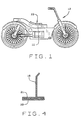
- Fig. 1 shows an elevational view of the composite motorcycle seat cushion 10 of this invention located on the seat I of a conventional "solo" motorcycle 12.
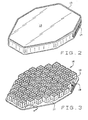
- Fig. 2 shows the motorcycle seat cushion 10 which includes a removable three piece octagonal shaped cover 13 having a reclosable opening 14 at its larger end 15.
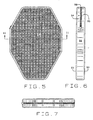
- an air cell pad 16 Positioned inside the cover 13 is an air cell pad 16 which includes a base 17, a series of interconnected upstanding air cells 18 and a fill tube assembly 19. This is shown in Fig. 3.
- the cover 13 is similar in construction to the cover shown in Robert H. Graebe Patent No. 5,111,544 which is incorporated herein by reference as fully as if it were set out in its entirety.
- the cellular cushion 16 embodies DRY FLOATATION® technology of ROHO, Inc. and the cells 18 themselves may be of a configuration shown in the air pads described in Graebe Patent Nos. 5,369,828; 4,541,136, etc.
- the inflatable cushion or module 16 is octagonal in shape and, as shown in Fig. 4, comprises a flexible base sheet 20 which has an octagonal shape and a formed flexible top sheet 21 which has the air cells 18 formed therein.
- the two sheets 20, 21 are cemented together at preselected areas to form the module 16.
- the sheets 20, 21 preferably are formed of latex and the top sheet 21 is made by dipping a mandrel into liquid latex.
- a detailed disclosure of a suitable fabrication process and apparatus is disclosed in Graebe Patent No. 4,541,136 incorporated herein by reference as fully as if set out in its entirety.
- the inflatable cellular cushion 16 also may be formed by vacuum or heat forming as set forth in Graebe Patent No. 5,561,875, or by molding in plastic such as polyvinyl chloride (PVC) or polyurethane.
- PVC polyvinyl chloride
- the base 17 is of octagonal shape and comprises a front edge 25 and a longer rear edge 26.
- Side edges 27, 27a are parallel to each other and perpendicular to the front and rear edges 25, 26.
- Connecting the rear edge 26 to the side edges 27, 27a are diverging edges 28, 28a.
- Connecting the side edges 27, 27a to the front edge 25 are converging edges 29, 29a.
- the edges 28, 28a are shorter than the edges 29, 29a.
- the air cells 18 are of pyramidal shape and have a square bottom, rectangular side edges 30, a tapered top formed of four inwardly inclined side walls 31 of substantially trapezoidal shape and a square substantially flat top 32.
- the purpose of the pyramidal shape is to provide a means to collapse the air cell in a controlled manner during the engagement phase by the person sitting on the points formed by the pyramid. The higher the point, the greater the engagement travel which gradually builds up the internal pressure of the cell giving a low force entry zone. This is useful to prevent bottoming out when the cycle is traveling over rough roads and the rider may bounce on the seat at frequent intervals.
- the air cells 18 are spaced from each other by lateral and longitudinal passages and stand independently of each other when erected and filled with air.
- the air cells 18 are configured in lateral rows and includes a rear array "R", a middle array “M” and a front array “F".
- the rear array “R” comprises three rows of cells 18 parallel to the rear edge 26 and spaced along the diverging edges 28, 28a. The rows are of diverging length from four cells 18 adjacent to the rear edge 26 to six cells 18 adjacent to the side edges 27, 27a.
- the middle array “M” comprises three rows of equal length which contain seven cells 18.
- the cell rows in the array "M” are parallel to the front and rear edges 25,26 and perpendicular to the side edges 27,27a.
- the array “M” also is coextensive with the side edges 27, 27a.
- the front array “F” comprises four rows of cells 18 parallel to the front edge 25 and spaced along the converging edges 29, 29a.
- the rows vary in length from six cells 18 adjacent to the side edges 27, 27a to three cells 18 adjacent to the front edge 25.
- the air cells 18 are interconnected pneumatically by a series of air passages in the base 17.
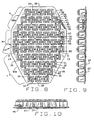
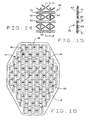
- the air passages include a first peripheral or circumferential series of passages 35 which connect the air cells 18 that are around the periphery of the air cell pad 16 (Figs. 8, 12 and 16), and a second lateral or transverse series of passages 36 which extend from side to side parallel to the front and rear edges 25, 26 and connect the air cells 18 in each row (Figs. 8, 11 and 16).
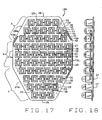
- An alternative construction is to eliminate two or more of the air passages 35 to form separate air chambers each of which would be provided with a fill tube assembly 19 (Figs 17,18).
- a further modification is to provide a manifold type on-off valve arrangement as shown in Graebe Patent Nos. 5,163,196 and 5,502,855.
- the areas of the base 17 between the air cells 18 are cemented together (Fig. 13).
- the end result is that the areas of the bottom sheet 20 that form the bases 37 of the cells 18 tend to bulge outwardly or downwardly (Figs. 9, 10, 13) when air is in the cells 18 and when the cushion is not on a smooth surface.
- Another feature of the air cell pad 16 is the fill tube assembly 19 which is connected to the outside side wall 38 of the outermost air cell 39 in the second row of air cells in the rear array "R".
- An outwardly projecting cylindrical sleeve 40 is molded into the air cell wall 38 and one end of a relatively stiff tubular member 41 is cemented into the sleeve 40.
- the tubular member 41 has an angularly inclined leg portion 42 designed to parallel the base edge 28.
- a fill nozzle 43 Connected to the end of the leg 42 is a fill nozzle 43 having a rotatable on-off valve 44.
- a hold down member 45 forms a loop 46 through which the leg 42 is loosely positioned (Fig. 10).
- the hold down member 45 is fastened to the air pad base 17 by a rivet 47 or other suitable fastener.
- the purpose of the retainer 45 is to position the nozzle 43 so that it is accessible to the user through the cover opening 14.
- the cover 13, as mentioned, contains subject matter in common with Graebe U.S. Patent No. 5,111,544.
- the flexibility of the base 17 allows it to fit over and conform to the often irregular shape of motorcycle seats, autos, truck or boat seats and saddles.
- the cover 13 fits over the seating surface formed by the dome-shaped ends of the cells 18, and also along the sides of the peripheral cells and under the base 17, generally encapsulating the pad 16. Yet, it does not impair the effectiveness of the pad 16, for the ends of the cells 18 are easily displaced toward the base to conform to the shape of the user's buttocks and the base 17 can conform to the shape of the motorcycle seat 11 or other seating surface to which it is applied. Moreover, the cover 13 is easily stripped from the pad 16 to enable the two to be cleaned separately.
- the cover 13 includes a top panel 50, a bottom panel 51 and a side panel 52 which extends between and is joined to the top and bottom panels 50 and 52 along stitch lines 53. Both the top and bottom panels 50 and 51 are octagonal in shape, and that shape matches the shape of the pad base 17.
- the side panel 52 is of a height that generally corresponds to the height of the cells 18 when they are fully extended.
- the stitch lines 53 connecting the lower panel 51 and the upper panel 50 to the side panel 52 extend along the full periphery of the cover and are continuous in the sense that no interruptions exist in the seam that they form.
- the side panel 52 is severed into two sections 54, 55 for a portion of its length around the rear edge 26 and the diverging edges 28, 28a.
- the sections 54, 55 carry a zipper 56 which normally joins them together as one.
- the top panel 50 preferably is formed from a highly elastic and porous fabric, i.e., one that stretches in any direction.
- the elasticity of the top panel 50 enables that panel to conform to the shape of the user's buttocks when the user sits upon the cushion 10.
- the top panel 50 simply follows the contour of the seating surface created by the cells 18 and imposes minimum shear on the user's skin. It detracts little from the capacity of the array of air cells 18 to conform to the shape of the user's buttocks.
- the top panel 50 is porous to vent away moisture. Plastic sheet material for the top panel 50 that has limited elasticity may be used when very good vapor permeability is desired, e.g., when limited cooling is desired.
- the bottom panel 51 is formed from a high friction material, such as the illustrated high friction mesh 60 (Figs. 13 and 14) known as vinyl coated scrim.
- the mesh 60 consists of polyester fibers woven into an open weave and a polyvinyl chloride coating covering the polyester fibers without obliterating the openings of the weave.
- the weave is such that the mesh 60 has relatively thick ribs 61 extending parallel between opposite edges of the panel 50 and thinner connecting segments 62 extending between the ribs 61 and oriented at right angles with respect to the ribs 61, with the spacing between the connecting segments 62 being about the same as the spacing between the ribs 61.
- the coating has a high coefficient of friction against traditional seating and saddle surfaces such as leather, vinyl, wood, metal or fabric, and the friction that develops is particularly effective along the thick ribs 61.
- the coefficient of friction between the coating and such surfaces is substantially greater than the coefficients of friction between the upper and side panels 50 and 52 and such surfaces.
- the mesh 60 is commonly used as an underlayment for throw rugs to prevent them from slipping on traditional flooring materials such as tile, vinyl and hardwood.
- the high friction mesh 60 of the bottom panel 51 prevents the cover, and the cushion over which it fits, from sliding around the motorcycle seat 11. In addition, it admits air to the interior of the cover 13 where the air can circulate through the array of air cells 18. Finally, it permits moisture to drain from the interior of the cover 13, when drain holes 65 are provided in the base 17 of the cushion between the cells 18.
- the bottom panel 51 also may have other mesh patterns and may even be a solid sheet of neoprene rubber or the like which would make the cushion warmer for cold weather use.
- the side panels 52 are formed from a more traditional fabric, i.e., one that has considerable flexibility, yet does not stretch easily. Typical nylon fabric is suited for this purpose.
- Figs 17 and 18 illustrate a modification of the invention in which the air cell pad 16A is divided into compartments "A", "B” and “C".
- the rear array “R” and the middle array “M” and the adjacent row of cells in the front array are all at about the same inflation even though the middle array "M” and the rear array “R” are separated and inflatable through separate nozzles designated by the numerals 43a and 43b.
- the front array “F” also is separated from the other two and is more highly inflated so that the air cells 18 are distended outwardly and upwardly (Fig. 18).
- the fill nozzle 43c is used to fill the cells in the front array "F".
- the raised front cells "F” tend to engage the user if the cycle stops suddenly and to hold and restrain the user from sliding off the seat. This adds to the safety of the cushion 10.
- Other combinations of air cell sections can be used depending on the result desired.
Landscapes
- Engineering & Computer Science (AREA)
- Mechanical Engineering (AREA)
- Aviation & Aerospace Engineering (AREA)
- Transportation (AREA)
- Mattresses And Other Support Structures For Chairs And Beds (AREA)
- Professional, Industrial, Or Sporting Protective Garments (AREA)
- Automatic Cycles, And Cycles In General (AREA)
- Seats For Vehicles (AREA)
Claims (19)
- Ein Motorradsitzkissen (10), umfassend:a) ein flexibles modulares Luftzellenpolster (16) mit einer flexiblen Basis (17) und einer Serie aufrechtstehender Luftzellen (18) mit Seitenwänden (31) und einer oberen Fläche (32), wobei die Luftzellen (18) flexible, im allgemeinen vertikale Seitenwände (31) aufweisen, die an der unteren Wand angeschlossen sind, wobei jede der besagten Luftzellen (18) im Wesentlichen stumpfkegelförmig ist und einen im Wesentlichen rechteckig geformten unteren Abschnitt aufweist, der durch besagte flexible, im allgemeinen vertikale Seitenwände definiert ist, und einen stumpfkegelförmigen, verjüngten oberen Abschnitt, der aus mit den vertikalen Seitenwänden verbundenen Seitenpaneelen gebildet ist, wobei die vertikalen Seitenwände (31) benachbarter Zellen (18) voneinander getrennt und mit Zwischenräumen versehen sind, um seitwärts- und längsgerichtete Pfade zu bilden und in aufgeblasenem Zustand unabhängig aufrechtstehend zu sein, wobei besagte Luftzellen in seitwärts gerichteten Querreihen ausgebildet sind, wobei manche der Reihen eine Anzahl von Luftzellen aufweisen, die sich von der anderer Reihen unterscheidet, wobei zumindest einige der Luftzellen pneumatisch miteinander verbunden sind, undb) einen Bezug (13), umfassend:(1) ein oberes Paneel (50), das sich über den oberen Enden der Zellen befindet und aus einem elastischen Stoff geformt ist;(2) ein Bodenpaneel (51), das sich unter der Basis (17) befindet und im Wesentlichen die gesamte Basis bedeckt, wobei besagtes unteres Paneel aus einem Material mit einem höheren Reibungskoeffizienten als das obere Paneel (50) oder das Seitenpaneel (52) gebildet ist; und(3) ein Seitenpaneel (52), das sich zwischen dem oberen und dem Bodenpaneel (50,51) befindet und an den Außenrändern des oberen und des Bodenpaneels damit verbunden ist, wobei besagtes Seitenpaneel aus einem flexiblen Stoff geformt ist, wobei ein Teilbereich des Seitenpaneels in Abschnitte (54,55) aufgeteilt ist, die normalerweise miteinander verbunden sind, die jedoch abgenommen werden können, um das Abnehmen des Bezugs (13) vom Polster (16) bzw. dessen Anbringen darüber zu gestatten.
- Das Motorradsitzkissen von Anspruch 1, das eine achteckige Form hat, wobei ein Ende (R) breiter als das andere (F) ist.
- Das Motorradsitzkissen von Anspruch 1, wobei die Luftzellen (18) im Wesentlichen quadratische flexible untere Abschnitte haben und die oberen Abschnitte im Wesentlichen trapezförmige Paneele mit im Wesentlichen flachen oberen Bereichen aufweisen.
- Das Motorradsitzkissen von Anspruch 1, wobei die Zellen (18) alle durch Durchlässe (35, 36) in der flexiblen Basis (17) pneumatisch miteinander verbunden sind.
- Das Motorradsitzkissen von Anspruch 4, das Luftdurchlässe (35) in der Basis (17) enthält, die die Zellen um den Umfang der Basis (17) herum verbinden, und seitlicher Luftdurchlässe (36), die die Zellen in jeder Querreihe verbinden.
- Das Motorradsitzkissen von Anspruch 1, das zumindest einer Luftfülleinheit (19) enthält, die mit der Seitenwand einer Randzelle verbunden ist.
- Das Motorradsitzkissen von Anspruch 6, wobei die Luftfülleinheit (19) einen Füllschlauch (40,41) umfasst, der innerhalb des Umfangs (38) der Polsterbasis (17) und parallel zu einer Kante gelegen ist und ein Ein-Aus-Ventil (44) am freien Ende besitzt.
- Das Motorradsitzkissen von Anspruch 7, wobei das freie Ende (43) des Füllschlauchs den abnehmbaren Seitenpaneelabschnitten (54,55) benachbart ist, um dem Benutzer des Kissens Zugang zu dem Füllschlauch zu verschaffen.
- Das Motorradsitzkissen von Anspruch 2, wobei das Luftzellenkissen (16) eine hintere Anordnung ("R"), eine mittlere Anordnung ("M") und eine vordere Anordnung ("F") von Zellen aufweist, wobei die Anzahl von Zellen in der hinteren Anordnung kleiner ist als die Anzahl von Zellen in der vorderen Anordnung, und wobei sich weniger Zellen in der äußersten Reihe von Zellen in der vorderen Anordnung befinden als in der äußersten Reihe von Zellen in der hinteren Anordnung.
- Das Motorradsitzkissen von Anspruch 1, wobei der Boden (51) des Bezugs ein Gitter (60) mit hoher Reibung ist.
- Das Motorradsitzkissen von Anspruch 10, wobei das Gitter (60) mit hoher Reibung flexibel ist und parallele Rippen (61) besitzt, wobei sich dünnere Verbindungssegmente (62) zwischen den Rippen erstrecken.
- Das Motorradsitzkissen von Anspruch 1, wobei das Seitenpaneel (52) aus einem hochflexiblen, jedoch im Wesentlichen nichtelastischen Stoff ausgebildet ist.
- Das Motorradsitzkissen von Anspruch 1, wobei das Luftzellenpolster (16) Abfuhröffnungen (65) in seiner Basis aufweist.
- Das Motorradsitzkissen von Anspruch 8, das ein Halteband (45,46) enthält, das um den Luftfüllschlauch (41) herum angebracht ist und an der Basis (17) des Polsters verankert ist, um Luftfüllschlauch und Mundstück in einer Position zu halten, wo es dem Benutzer des Kissens durch die Seitenwandpaneelsegmente (54,55) zugänglich ist.
- Das Motorradsitzkissen von Anspruch 11, wobei das Bodenpaneel (51) des Bezugs (13) mit Polyvinylchlorid beschichtet ist.
- Das Motorradsitzkissen von Anspruch 1, wobei die Seitenpaneelabschnitte (54,55) des Bezugs (13) mittels einer Reißverschlussanordnung (56) miteinander verbunden sind.
- Das Motorradsitzkissen von Anspruch 1, wobei die flexible Basis (17) des Luftzellenpolsters (16) und der Bezug (13) das Anpassen des Kissens an und sein Festgehaltenwerden auf unregelmäßigen Sitzen und Sattelflächen gestattet.
- Das Motorradsitzkissen von Anspruch 1, wobei das flexible modulare Luftzellenpolster (16) eine flexible Basis (17) von unregelmäßiger Form hat und die Luftzellen (18) in Anordnungen ("R", "M", "F") aufgeteilt sind, wobei die Zellen (18) in jeder Anordnung pneumatisch miteinander verbunden sind, wobei jede Anordnung in Bezug zu den anderen Anordnungen in unterschiedlichem Grad aufgeblasen werden kann.
- Das Motorradsitzkissen von Anspruch 18, wobei die Luftzellenpolsterbasis (17) und der Bezug (13) jeweils eine achteckige Form haben, wobei ein Ende (R) breiter ist als das andere (F), wobei das kleinere Ende (F) eine getrennte Anordnung ("F") von Luftzellen aufweist, die zur Vorderseite der Oberfläche hin gelegen sind, auf der sich das Kissen befindet, wodurch es mehr aufgeblasen werden kann, um die Vorwärtsbewegung des Benutzers des Kissens zu verzögern.
Applications Claiming Priority (3)
| Application Number | Priority Date | Filing Date | Title |
|---|---|---|---|
| US778303 | 1991-10-15 | ||
| US77830397A | 1997-01-02 | 1997-01-02 | |
| PCT/US1997/020183 WO1998029010A1 (en) | 1997-01-02 | 1997-11-03 | Motorcycle seat cushion |
Publications (3)
| Publication Number | Publication Date |
|---|---|
| EP0928146A1 EP0928146A1 (de) | 1999-07-14 |
| EP0928146A4 EP0928146A4 (de) | 2000-02-02 |
| EP0928146B1 true EP0928146B1 (de) | 2004-01-07 |
Family
ID=25112894
Family Applications (1)
| Application Number | Title | Priority Date | Filing Date |
|---|---|---|---|
| EP97949367A Expired - Lifetime EP0928146B1 (de) | 1997-01-02 | 1997-11-03 | Sitzkissen für motorrad |
Country Status (7)
| Country | Link |
|---|---|
| EP (1) | EP0928146B1 (de) |
| AT (1) | ATE257350T1 (de) |
| AU (1) | AU7887898A (de) |
| CA (1) | CA2257922C (de) |
| DE (1) | DE69727145T2 (de) |
| ES (1) | ES2214643T3 (de) |
| WO (1) | WO1998029010A1 (de) |
Families Citing this family (16)
| Publication number | Priority date | Publication date | Assignee | Title |
|---|---|---|---|---|
| ITVI20030193A1 (it) * | 2003-10-03 | 2005-04-04 | Selle Royal Spa | Struttura di supporto visco-elastica ad assorbimento |
| DE102004006887A1 (de) * | 2004-02-12 | 2005-09-01 | Bayerische Motoren Werke Ag | Motorradsitz mit gasdichten, aufblasbaren Elementen |
| USD648169S1 (en) | 2010-12-13 | 2011-11-08 | Roho, Inc. | Composite seat cushion |
| USD658396S1 (en) | 2011-05-17 | 2012-05-01 | Roho, Inc. | Motorcycle seat cushion |
| USD673785S1 (en) | 2011-11-16 | 2013-01-08 | Roho, Inc. | Motorcycle pillion cushion |
| USD672569S1 (en) | 2011-11-16 | 2012-12-18 | Roho, Inc. | Motorcycle operator's seat cushion |
| WO2014105316A1 (en) * | 2012-12-27 | 2014-07-03 | High End Seating Solutions | Motorcycle seat and method of making same |
| USD798634S1 (en) | 2016-08-26 | 2017-10-03 | Airhawk International, Llc | Air cushion |
| US10646049B2 (en) | 2017-10-31 | 2020-05-12 | Airhawk International, Llc | Seat cushion |
| USD979263S1 (en) | 2020-10-05 | 2023-02-28 | Airhawk International, Llc | Bicycle seat pan |
| USD979264S1 (en) | 2020-11-30 | 2023-02-28 | Airhawk International, Llc | Air cushion for a bicycle seat |
| USD979265S1 (en) | 2020-12-01 | 2023-02-28 | Airhawk International, Llc | Air cushion for a bicycle seat |
| USD979266S1 (en) | 2020-12-01 | 2023-02-28 | Airhawk International, Llc | Bicycle seat pan |
| DE102021103570B3 (de) | 2021-02-16 | 2022-06-23 | Jacques Nordmann | Fahrradsattel |
| EP4294710B1 (de) | 2021-02-16 | 2025-12-31 | Airhawk International, LLC | Fahrradsitzanordnung mit verbessertem komfort und verbesserter stütze |
| DE102021118969A1 (de) | 2021-07-22 | 2023-01-26 | Bayerische Motoren Werke Aktiengesellschaft | Sitzanlage für ein Kraftrad, Kraftrad sowie Verfahren zum Betreiben eines Kraftrads |
Family Cites Families (18)
| Publication number | Priority date | Publication date | Assignee | Title |
|---|---|---|---|---|
| GB420292A (en) * | 1933-02-28 | 1934-11-28 | David Moseley & Sons Ltd | Improvements in or relating to pneumatic seats, cushions or the like |
| US2343996A (en) * | 1941-05-16 | 1944-03-14 | Airtress Corp Of America | Pneumatic cushion |
| US2577274A (en) * | 1947-09-25 | 1951-12-04 | Sampson Rubber Products Corp O | Pneumatic cushion |
| US3296635A (en) * | 1964-11-17 | 1967-01-10 | O'hanlan Joseph Treacy | Inflatable seat cushion |
| US3253861A (en) * | 1965-10-20 | 1966-05-31 | Howe Plastics And Chemical Co | Inflatable cushion |
| US3503084A (en) * | 1968-10-18 | 1970-03-31 | Better Sleep Inc | Inflatable cushion |
| US4541136A (en) | 1983-09-01 | 1985-09-17 | Graebe Robert H | Multicell cushion |
| US4698864A (en) * | 1985-11-25 | 1987-10-13 | Graebe Robert H | Cellular cushion |
| US4779924A (en) * | 1987-08-19 | 1988-10-25 | Rudel Myron G | Seat for a motorcycle |
| US4864671A (en) * | 1988-03-28 | 1989-09-12 | Decubitus, Inc. | Controllably inflatable cushion |
| US5052068A (en) * | 1989-11-14 | 1991-10-01 | Graebe Robert H | Contoured seat cushion |
| US5163196A (en) | 1990-11-01 | 1992-11-17 | Roho, Inc. | Zoned cellular cushion with flexible flaps containing inflating manifold |
| US5502855A (en) | 1990-11-01 | 1996-04-02 | Graebe; Robert H. | Zoned cellular cushion |
| US5152023A (en) * | 1990-11-13 | 1992-10-06 | Graebe Robert W | Cellular cushion having sealed cells |
| US5111544A (en) | 1991-07-01 | 1992-05-12 | Graebe Robert H | Cover with elastic top and frictional bottom for a cushion |
| EP0585416B1 (de) | 1992-02-20 | 1999-10-13 | GRAEBE, Robert H. | Modulare kissenkonstruktion mit geschäumter unterlage |
| US5561875A (en) | 1992-02-20 | 1996-10-08 | Crown Therapeutics, Inc. | Vacuum/heat formed cushion supported on a fluid permeable manifold |
| US5634685A (en) * | 1995-03-20 | 1997-06-03 | Herring; Charles | Inflatable/deflatable motorcycle seat cushion |
-
1997
- 1997-11-03 CA CA002257922A patent/CA2257922C/en not_active Expired - Fee Related
- 1997-11-03 ES ES97949367T patent/ES2214643T3/es not_active Expired - Lifetime
- 1997-11-03 AU AU78878/98A patent/AU7887898A/en not_active Abandoned
- 1997-11-03 DE DE69727145T patent/DE69727145T2/de not_active Expired - Lifetime
- 1997-11-03 AT AT97949367T patent/ATE257350T1/de not_active IP Right Cessation
- 1997-11-03 WO PCT/US1997/020183 patent/WO1998029010A1/en not_active Ceased
- 1997-11-03 EP EP97949367A patent/EP0928146B1/de not_active Expired - Lifetime
Also Published As
| Publication number | Publication date |
|---|---|
| WO1998029010A1 (en) | 1998-07-09 |
| CA2257922A1 (en) | 1998-07-09 |
| AU7887898A (en) | 1998-07-31 |
| CA2257922C (en) | 2004-05-25 |
| DE69727145T2 (de) | 2004-11-25 |
| ATE257350T1 (de) | 2004-01-15 |
| EP0928146A4 (de) | 2000-02-02 |
| ES2214643T3 (es) | 2004-09-16 |
| EP0928146A1 (de) | 1999-07-14 |
| DE69727145D1 (de) | 2004-02-12 |
Similar Documents
| Publication | Publication Date | Title |
|---|---|---|
| CA2257922C (en) | Motorcycle seat cushion | |
| US5419612A (en) | Inflatable seat assembly | |
| US6223673B1 (en) | Floatable recreational park | |
| US6223678B1 (en) | Inflatable kayak | |
| US5318348A (en) | Cushioned sling chair | |
| US5634685A (en) | Inflatable/deflatable motorcycle seat cushion | |
| TWI596029B (zh) | 用於自行車、機車及/或其他踏板驅動機器的通風車座 | |
| US5524961A (en) | Pneumatic bicycle saddle | |
| EP0981475B1 (de) | Fahrradsitz und überzug | |
| US5122086A (en) | Towable riding apparatus | |
| US20030042770A1 (en) | Base of bicycle saddle | |
| EP0582381A1 (de) | Sitz für Fahrrad und Übungsgerät | |
| US20050121953A1 (en) | Motorcycle seat | |
| WO1996012426A1 (en) | Vacuum/heat formed cushion | |
| US6532613B2 (en) | Three dimensional star shaped pliable chair | |
| US2558389A (en) | Bicycle seat | |
| US5392477A (en) | Sleeping bag with inflatable wedge portion | |
| US20020069464A1 (en) | Saddle seat supplement and pad | |
| US5333930A (en) | Surface for a seat of a cycle | |
| WO1994008839A1 (en) | A seat cover | |
| WO2012177271A1 (en) | Inflatable device | |
| EP0706933B1 (de) | Motorradsattel | |
| US2672923A (en) | Vehicle seat | |
| JPH0433193Y2 (de) | ||
| JPH0634228Y2 (ja) | ゴムボート |
Legal Events
| Date | Code | Title | Description |
|---|---|---|---|
| PUAI | Public reference made under article 153(3) epc to a published international application that has entered the european phase |
Free format text: ORIGINAL CODE: 0009012 |
|
| 17P | Request for examination filed |
Effective date: 19981221 |
|
| AK | Designated contracting states |
Kind code of ref document: A1 Designated state(s): AT BE CH DE DK ES FI FR GB GR IE IT LI LU MC NL PT SE |
|
| A4 | Supplementary search report drawn up and despatched |
Effective date: 19991221 |
|
| AK | Designated contracting states |
Kind code of ref document: A4 Designated state(s): AT BE CH DE DK ES FI FR GB GR IE IT LI LU MC NL PT SE |
|
| 17Q | First examination report despatched |
Effective date: 20020318 |
|
| GRAH | Despatch of communication of intention to grant a patent |
Free format text: ORIGINAL CODE: EPIDOS IGRA |
|
| GRAS | Grant fee paid |
Free format text: ORIGINAL CODE: EPIDOSNIGR3 |
|
| GRAA | (expected) grant |
Free format text: ORIGINAL CODE: 0009210 |
|
| AK | Designated contracting states |
Kind code of ref document: B1 Designated state(s): AT BE CH DE DK ES FI FR GB GR IE IT LI LU MC NL PT SE |
|
| PG25 | Lapsed in a contracting state [announced via postgrant information from national office to epo] |
Ref country code: NL Free format text: LAPSE BECAUSE OF FAILURE TO SUBMIT A TRANSLATION OF THE DESCRIPTION OR TO PAY THE FEE WITHIN THE PRESCRIBED TIME-LIMIT Effective date: 20040107 Ref country code: LI Free format text: LAPSE BECAUSE OF FAILURE TO SUBMIT A TRANSLATION OF THE DESCRIPTION OR TO PAY THE FEE WITHIN THE PRESCRIBED TIME-LIMIT Effective date: 20040107 Ref country code: IT Free format text: LAPSE BECAUSE OF FAILURE TO SUBMIT A TRANSLATION OF THE DESCRIPTION OR TO PAY THE FEE WITHIN THE PRE;WARNING: LAPSES OF ITALIAN PATENTS WITH EFFECTIVE DATE BEFORE 2007 MAY HAVE OCCURRED AT ANY TIME BEFORE 2007. THE CORRECT EFFECTIVE DATE MAY BE DIFFERENT FROM THE ONE RECORDED.SCRIBED TIME-LIMIT Effective date: 20040107 Ref country code: FI Free format text: LAPSE BECAUSE OF FAILURE TO SUBMIT A TRANSLATION OF THE DESCRIPTION OR TO PAY THE FEE WITHIN THE PRESCRIBED TIME-LIMIT Effective date: 20040107 Ref country code: CH Free format text: LAPSE BECAUSE OF FAILURE TO SUBMIT A TRANSLATION OF THE DESCRIPTION OR TO PAY THE FEE WITHIN THE PRESCRIBED TIME-LIMIT Effective date: 20040107 Ref country code: BE Free format text: LAPSE BECAUSE OF FAILURE TO SUBMIT A TRANSLATION OF THE DESCRIPTION OR TO PAY THE FEE WITHIN THE PRESCRIBED TIME-LIMIT Effective date: 20040107 Ref country code: AT Free format text: LAPSE BECAUSE OF FAILURE TO SUBMIT A TRANSLATION OF THE DESCRIPTION OR TO PAY THE FEE WITHIN THE PRESCRIBED TIME-LIMIT Effective date: 20040107 |
|
| REG | Reference to a national code |
Ref country code: GB Ref legal event code: FG4D |
|
| REG | Reference to a national code |
Ref country code: CH Ref legal event code: EP |
|
| REG | Reference to a national code |
Ref country code: IE Ref legal event code: FG4D |
|
| REF | Corresponds to: |
Ref document number: 69727145 Country of ref document: DE Date of ref document: 20040212 Kind code of ref document: P |
|
| PG25 | Lapsed in a contracting state [announced via postgrant information from national office to epo] |
Ref country code: SE Free format text: LAPSE BECAUSE OF FAILURE TO SUBMIT A TRANSLATION OF THE DESCRIPTION OR TO PAY THE FEE WITHIN THE PRESCRIBED TIME-LIMIT Effective date: 20040407 Ref country code: GR Free format text: LAPSE BECAUSE OF FAILURE TO SUBMIT A TRANSLATION OF THE DESCRIPTION OR TO PAY THE FEE WITHIN THE PRESCRIBED TIME-LIMIT Effective date: 20040407 Ref country code: DK Free format text: LAPSE BECAUSE OF FAILURE TO SUBMIT A TRANSLATION OF THE DESCRIPTION OR TO PAY THE FEE WITHIN THE PRESCRIBED TIME-LIMIT Effective date: 20040407 |
|
| NLV1 | Nl: lapsed or annulled due to failure to fulfill the requirements of art. 29p and 29m of the patents act | ||
| REG | Reference to a national code |
Ref country code: CH Ref legal event code: PL |
|
| REG | Reference to a national code |
Ref country code: ES Ref legal event code: FG2A Ref document number: 2214643 Country of ref document: ES Kind code of ref document: T3 |
|
| PG25 | Lapsed in a contracting state [announced via postgrant information from national office to epo] |
Ref country code: LU Free format text: LAPSE BECAUSE OF NON-PAYMENT OF DUE FEES Effective date: 20041103 Ref country code: IE Free format text: LAPSE BECAUSE OF NON-PAYMENT OF DUE FEES Effective date: 20041103 |
|
| ET | Fr: translation filed | ||
| PLBE | No opposition filed within time limit |
Free format text: ORIGINAL CODE: 0009261 |
|
| STAA | Information on the status of an ep patent application or granted ep patent |
Free format text: STATUS: NO OPPOSITION FILED WITHIN TIME LIMIT |
|
| PG25 | Lapsed in a contracting state [announced via postgrant information from national office to epo] |
Ref country code: MC Free format text: LAPSE BECAUSE OF NON-PAYMENT OF DUE FEES Effective date: 20041130 |
|
| 26N | No opposition filed |
Effective date: 20041008 |
|
| REG | Reference to a national code |
Ref country code: IE Ref legal event code: MM4A |
|
| PG25 | Lapsed in a contracting state [announced via postgrant information from national office to epo] |
Ref country code: PT Free format text: LAPSE BECAUSE OF NON-PAYMENT OF DUE FEES Effective date: 20040607 |
|
| PGFP | Annual fee paid to national office [announced via postgrant information from national office to epo] |
Ref country code: DE Payment date: 20101126 Year of fee payment: 14 |
|
| PGFP | Annual fee paid to national office [announced via postgrant information from national office to epo] |
Ref country code: GB Payment date: 20101124 Year of fee payment: 14 |
|
| PGFP | Annual fee paid to national office [announced via postgrant information from national office to epo] |
Ref country code: FR Payment date: 20111128 Year of fee payment: 15 Ref country code: ES Payment date: 20111124 Year of fee payment: 15 |
|
| GBPC | Gb: european patent ceased through non-payment of renewal fee |
Effective date: 20121103 |
|
| REG | Reference to a national code |
Ref country code: FR Ref legal event code: ST Effective date: 20130731 |
|
| REG | Reference to a national code |
Ref country code: DE Ref legal event code: R119 Ref document number: 69727145 Country of ref document: DE Effective date: 20130601 |
|
| PG25 | Lapsed in a contracting state [announced via postgrant information from national office to epo] |
Ref country code: DE Free format text: LAPSE BECAUSE OF NON-PAYMENT OF DUE FEES Effective date: 20130601 |
|
| PG25 | Lapsed in a contracting state [announced via postgrant information from national office to epo] |
Ref country code: FR Free format text: LAPSE BECAUSE OF NON-PAYMENT OF DUE FEES Effective date: 20121130 Ref country code: GB Free format text: LAPSE BECAUSE OF NON-PAYMENT OF DUE FEES Effective date: 20121103 |
|
| REG | Reference to a national code |
Ref country code: ES Ref legal event code: FD2A Effective date: 20140305 |
|
| PG25 | Lapsed in a contracting state [announced via postgrant information from national office to epo] |
Ref country code: ES Free format text: LAPSE BECAUSE OF NON-PAYMENT OF DUE FEES Effective date: 20121104 |