EP0928305B1 - Lumineszenzfähige copolymere mit hohem wirkungsgrad - Google Patents
Lumineszenzfähige copolymere mit hohem wirkungsgrad Download PDFInfo
- Publication number
- EP0928305B1 EP0928305B1 EP97943059A EP97943059A EP0928305B1 EP 0928305 B1 EP0928305 B1 EP 0928305B1 EP 97943059 A EP97943059 A EP 97943059A EP 97943059 A EP97943059 A EP 97943059A EP 0928305 B1 EP0928305 B1 EP 0928305B1
- Authority
- EP
- European Patent Office
- Prior art keywords
- alkyl
- copolymer
- aryl
- copolymer according
- process according
- Prior art date
- Legal status (The legal status is an assumption and is not a legal conclusion. Google has not performed a legal analysis and makes no representation as to the accuracy of the status listed.)
- Expired - Lifetime
Links
Images
Classifications
-
- C—CHEMISTRY; METALLURGY
- C08—ORGANIC MACROMOLECULAR COMPOUNDS; THEIR PREPARATION OR CHEMICAL WORKING-UP; COMPOSITIONS BASED THEREON
- C08G—MACROMOLECULAR COMPOUNDS OBTAINED OTHERWISE THAN BY REACTIONS ONLY INVOLVING UNSATURATED CARBON-TO-CARBON BONDS
- C08G61/00—Macromolecular compounds obtained by reactions forming a carbon-to-carbon link in the main chain of the macromolecule
-
- C—CHEMISTRY; METALLURGY
- C09—DYES; PAINTS; POLISHES; NATURAL RESINS; ADHESIVES; COMPOSITIONS NOT OTHERWISE PROVIDED FOR; APPLICATIONS OF MATERIALS NOT OTHERWISE PROVIDED FOR
- C09K—MATERIALS FOR MISCELLANEOUS APPLICATIONS, NOT PROVIDED FOR ELSEWHERE
- C09K11/00—Luminescent materials, e.g. electroluminescent or chemiluminescent
- C09K11/06—Luminescent materials, e.g. electroluminescent or chemiluminescent containing organic luminescent materials
Definitions
- the present invention relates to conjugated semiconductive copolymers exhibiting high photoluminescent efficiencies, and to methods for their preparation.
- Conjugated polymers such as poly (arylene vinylene) polymers have been used as organic electroluminescent (EL) materials in a variety of devices, as demonstrated in our earlier patent, US 5,399,502.
- Poly(p-phenylene vinylene) [PPV] is one such polymer, which can be prepared via the Wessling precursor method. (See “Precursor Route to Poly(p-phenylene Vinylene) : (Polymer Characterisation and Electronic Properties" D.D.C. Bradley, J. Phys. D 20, 1389 (1987)).
- Poly(p-phenylene vinylene) is the most basic example of a poly (arylene vinylene); in which the arylene constitutes a para-phenylene group.
- arylene includes within its scope all types of arylenes including heteroarylenes as well as arylenes incorporating more than one ring structure, including fused ring structures, and substituted ring structures, and not just phenylene.
- the Wessling precursor method for preparing PPV involves the use of a tetrahydrothiophene based precursor with a halide counterion, for example, in the most basic case: It has been proposed that the polymerisation of the p-xylenebis(sulphonium halide) monomer occurs via a quinoid intermediate as described by in "The Polymerisation of Xylylene Bisdialkyl Solfunium Salts" R.A. Wessling, J. Pol. Sci. Pol. Symp. 72, 55-66. (1985).
- the PPV formed is insoluble and intractable and therefore a solution processable precursor is required.
- Device fabrication is carried out using the precursor material and the conjugated polymer is prepared in situ via a thermal conversion step.
- the precursor polymer is coated, by spin-coating or blade coating techniques, onto a transparent conductive oxide layer, for example Indium Tin Oxide (ITO).
- ITO Indium Tin Oxide
- the ITO is itself coated onto a suitable substrate which may be glass or plastic.
- the precursor polymer film is then converted on the ITO by suitable heat treatment. Following this, appropriate metal electrodes are deposited.
- a multi-layer structure is therefore obtained which consists of an anode, the conjugated polymer, and the cathode. Injection of positive and negative charge carriers at the anode and cathode respectively and following exciton recombination leads to light emission.
- the advantages of using a precursor conjugated polymers as active layers in EL devices include:
- copolymers are prepared either by copolymerising more than one bis(sulphonium) salt, effecting conversion of the precursor polymer, or by substituting the tetrahydrothiophene (THT)unit to provide groups that would survive the conversion process.
- THT tetrahydrothiophene
- copolymers are an improvement on the polyarylene vinylene conjugated monomers of the previous generation, these copolymers also have their drawbacks. For example, conversion of precursor homopolymer or copolymer systems on certain conductive oxide substrates can lead to undesirable interactions between the conductive oxide coating and the polymer that lead either to quenching of luminescence and/or to modification of the expected copolymer composition. Furthermore, the presence of certain functional groups in the copolymer are detrimental to the performance of the device, and in particular to the lifetime of the device.
- carbonyl refers to all alkyl or aryl based carbonyl groups such as alkyl and aryl ketones, aldehydes and carbonyl halides.
- At least one of R 1 ,R 2 ,R 3 and R 4 is not H.
- At least one of R 1 ,R 2 ,R 3 and R 4 is amine, nitrile, alkyl or aryl carboxylate, alkyl, aryl, carboxylic acid, carboxylic acid ester, amide, heterocyclic or amine.
- the alkyl based substituents have no more than 10 carbon atoms
- the aryl based substituents have 5 to 20 carbon atoms
- the substituents including both alkyl and aryl units have 6 to 30 carbon atoms.
- this monomer examples include styrene, alkyl(meth)acrylates, acrylonitrile, vinyl acetate, N-vinyl carbazole, and vinyl anthracene.
- a and B may represent the same cyclic group such as in the cases of acenaphthylene, N-alkyl or N-aryl maleimides, and maleic anhydride:
- this monomer would include vinylidene chloride, methyl styrene, alkyl (alk)acrylate (such as methyl methacrylate) etc.
- the groups A and B i.e. R 3 and R 4 ) may be the same or different.
- m may be zero.
- the copolymeric component Ar-CHNu-CH 2
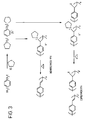
- the synthesis involves polymerising the bis(sulphonium halide) monomer in the presence of the unsaturated comonomer systems via a free-radical or ionic addition polymerisation.
- the precursor solution is neutralised with excess acid.
- acids include aliphatic carboxylic acids, such as formic acid or acetic acid, or unsubstituted and substituted aromatic carboxylic acids such as 2,6 dimethylbenzoic acid, and derivatives thereof.
- inorganic acids may be used such as HCl or HBr.
- the precursor solution is then purified by dialysis and when converted yields highly photoluminescent conjugated polymer as compared to the polymers of the prior art.
- each of L 1 and L 2 is a sulphonium leaving group.
- copolymers may be prepared that utilise a hybrid approach in that an addition-type copolymerisation or terpolymerisation is carried out and the proportion of non-conjugated segments in the copolymer is increased further by nucleophilic displacement of some of the remaining leaving groups.
- the resultant semiconductive conjugated copolymer is of the general formula detailed above, in which m is not zero.
- the concentration of non-conjugated segments may be increased to such a level that the emission spectrum is significantly blue shifted. In the extreme, blue emission is observed.
- copolymers may be prepared such that cross-linkable groups may be introduced into the polyalkylene vinylene copolymer. This may, for example, involve the terpolymerisation of vinyl anthracene and N-vinyl maleimide that would cross-link during conversion via a Diels-Alder reaction.
- a chromophore and/or a lumophore may be incorporated into the polyalkylene vinylene by nucleophilic displacement of the sulphonium group to yield a semiconductive copolymer containing lower band gap chromophores as compared to the polyalkylene vinylene.
- Exciton migration to the lower band gap component leads to efficient emission from the chromophore with the corresponding shift in emission spectrum. Hence, this method may be used to tune the emission of the polyalkylene vinylene.
- the present invention also provides a multilayer electroluminescent device incorporating the semiconductive conjugated copolymer described above as the emitting layer and an underlying electrode on which the conversion of the precursor copolymer system has been carried out. At least one other layer constituting the second electrode is present.
- the emissive copolymer exhibits enhanced photoluminescent efficiency in the presence or absence of ITO, enhanced EL efficiency and differential stability during device driving.
- one equivalent of p-xylenebis(tetrahydrothiophenium bromide) salt was taken with 10 equivalents of styrene and dissolved in 120ml 50/50 water/methanol solvent mixture. The solution was then deoxygenated for at least 20 mins with a nitrogen purge. Following this, a deoxygenated solution of 5 equivalents of potassium hydroxide in 20ml of 50/50 water/methanol was added to the monomer solution. When polymerisation was complete, neutralisation was carried out with 6ml concentrated hydrochloric acid.
- the product was then dialysed against 50/50 water/methanol until the dialate conductivity was ⁇ 1 ⁇ S/cm.
- the final dialysis was then carried out against neat methanol.
- the product is useable in the fabrication of EL devices of any conventional structure.
- the proportion of styrene functionality used in Example 1 may be modified by carrying out the synthesis as above but using different proportions of styrene in the monomer feed, using different types of emulsion or different solvents.
- the proportion of fumaronitrile functionality may be modified by carrying out the synthesis as above but using different proportions of fumaronitrile in the monomer feed.
- the product was then dialysed against 50/50 water/methanol until the dialate conductivity was ⁇ 1 ⁇ S/cm.
- the final dialysis was then carried out against neat methanol.
- the photoluminescent efficiency (in %) was evaluated on both glass and indium tin oxide and is recorded in Table 1.
- the product is useable in the fabrication of EL devices of any conventional structure.
- Example 6 was repeated except that neutralisation following polymerisation was carried out with 8ml formic acid instead of the hydrochloric acid.
- the product was then dialysed against 50/50 water/methanol until the dialate conductivity was ⁇ 1 ⁇ S/cm.
- Two final dialyses were carried out each against neat methanol. This produce is useable in the fabrication of an EL device as described in Example 8.
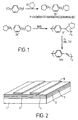
- device manufacture is carried out by coating by spin-coating the substituted precursor copolymer at a thickness of 100nm after conversion onto a semi-transparent indium tin oxide layer 2 on a glass substrate 1.
- the precursor copolymer film 3 is then converted at 150°C for 4 hours.
- a calcium electrode 6 is deposited by thermal evaporation and, following the application of a suitable voltage (5V), light emission is observed.
- Additional polymer layers 3 and 5 may be applied during manufacture of the device to act as charge transport layers.
Landscapes
- Chemical & Material Sciences (AREA)
- Organic Chemistry (AREA)
- Health & Medical Sciences (AREA)
- Chemical Kinetics & Catalysis (AREA)
- Medicinal Chemistry (AREA)
- Polymers & Plastics (AREA)
- Engineering & Computer Science (AREA)
- Materials Engineering (AREA)
- Polyoxymethylene Polymers And Polymers With Carbon-To-Carbon Bonds (AREA)
Claims (25)
- Ein halbleitendes konjugiertes Copolymer, das ein statistisches Monomer ist, das Monomereinheiten der folgenden allgemeinen Formel enthält:Ar substituiertes oder unsubstituiertes Arylen ist;Nu ein Nucleophil ist;X eine direkte Kohlenstoff-Kohlenstoff-Einfachbindung oder die Gruppe -CR5=CR6- ist;R1, R2, R3, R4, R5 und R6 unabhängig jeweils H, Amin, Halogen, CN, Alkyl, Alkoxy, Alkylcarboxylat, Carbonsäure, Alkylester, Carbonyl, Alkylether, Alkylthioether, Alkylamid, substituiertes oder nichtsubstituiertes Aryl, Aryloxy, Arylcarboxylat, Arylether, Arylester, Arylthioether, Arylamid, Arylketon oder heterocyclisch sind, wobei eines von R1, R2, R3 oder R4 wahlweise CQ=CH2 ist, wobei Q Halogen, Methyl, Nitril oder H ist;n und y ganze Zahlen sind; undm eine ganze Zahl oder Null ist.
- Copolymer gemäß Anspruch 1, wobei zumindest eines von R1, R2, R3 und R4 nicht H ist.
- Copolymer gemäß Anspruch 1, wobei zumindest eines von R1, R2, R3 und R4 Amin, Nitril, Alkyl- oder Arylcarboxylat, Alkyl, Aryl, Carbonsäure, Carbonsäureester, Amid, heterocyclisch oder Amin ist.
- Copolymer gemäß Anspruch 3, wobei die Substituenten auf Alkylbasis höchstens 10 Kohlenstoffatome aufweisen, die Substituenten auf Arylbasis 5 bis 20 Kohlenstoffatome haben und die Substituenten, die Alkyl- und Aryleinheiten beinhalten, 6 bis 30 Kohlenstoffatome haben.
- Copolymer gemäß einem der Ansprüche 1 bis 4, wobei x eine direkte Kohlenstoff-Kohlenstoff-Einfachbindung ist.
- Copolymer gemäß Anspruch 5, wobei R1=R2=R3=H.
- Copolymer gemäß Anspruch 6, wobei R4 Ph, CN, OOCCH3, N-Carbazol oder Anthracen ist.
- Copolymer gemäß Anspruch 5, wobei R1=R3=H.
- Copolymer gemäß Anspruch 8, wobei R2=CN und R4=COOH, R2=R4=COO-Alkyl, R2=R4=Ph, oder R2 und R4 bilden ein Ringsystem, das entwederist, wobei R Alkyl oder Aryl ist.

- Copolymer gemäß Anspruch 5, wobei R1=R2=H.
- Copolymer gemäß Anspruch 10, wobei R3=R4=Cl, R3=Me und R4=Ph oder R3=Alkyl und R4=COO-Alkyl.
- Copolymer gemäß einem der Ansprüche 1 bis 3, wobei X die Gruppe -CR5=CR6- ist.
- Copolymer gemäß Anspruch 12, wobei R1=R2=R3=R4=H.
- Copolymer gemäß Anspruch 12 oder Anspruch 13, wobei zumindest eines von R5 und R6 aus Halogenid, Alkyl oder Aryl ausgewählt ist.
- Copolymer gemäß Anspruch 12 oder Anspruch 13, wobei R5 und R6 beide H sind.
- Copolymer gemäß einem der vorhergehenden Ansprüche, wobei m Null ist.
- Ein Verfahren zur Herstellung eines halbleitenden konjugierten Copolymers, das die Copolymerisation eines ersten Comonomers der allgemeinen Formel L1CH2-Ar-CH2L2, wobei Ar substituiertes oder nichtsubstituiertes Arylen ist und L1 und L2 unabhängig Austrittsgruppen sind, mit einem zweiten Comonomer der allgemeinen Formel CR1R2=CR3R4 oder CR1R2=CR3-CR6=CR3R4 umfaßt, wobei R1, R2, R3, R4, R5 und R6 wie in einem der vorhergehenden Ansprüche definiert sind.
- Verfahren gemäß Anspruch 16, wobei jedes L1 und L2 eine Sulfoniumaustrittsgruppe ist.
- Verfahren gemäß Anspruch 17 oder Anspruch 18, wobei die Copolymerisation in einer Base erfolgt und danach mit einer Säure neutralisiert wird.
- Verfahren gemäß einem der Ansprüche 17 bis 19, wobei eine Vernetzungsgruppe in das Copolymer eingebaut ist.
- Verfahren gemäß einem der Ansprüche 17 bis 20, wobei ein Chromophor und/oder ein Lumophor durch nucleophile Substitution der Austrittsgruppe eingebaut ist.
- Verfahren gemäß einem der Ansprüche 17 bis 20, wobei ein Chromophor und/oder ein Lumophor durch direkte Polymerisation des ungesättigten Chromophors und/oder Lumophors in das Copolymer eingebaut ist.
- Ein halbleitendes konjugiertes Copolymer, das durch ein Verfahren gemäß einem der Ansprüche 17 bis 22 erhalten wird.
- Eine Lumineszenzvorrichtung, bestehend aus einem Substrat und einem Copolymer gemäß einem der Ansprüche 1 bis 11 oder 23, das von dem Substrat getragen wird.
- Eine Elektrolumineszenzvorrichtung, bestehend aus einer ersten Elektrode, einer zweiten Elektrode und zumindest einer Schicht, die eine Emissionsschicht zwischen den Elektroden umfaßt, wobei die zumindest eine Schicht ein Copolymer gemäß einem der Ansprüche 1 bis 11 oder 23 umfaßt.
Applications Claiming Priority (5)
| Application Number | Priority Date | Filing Date | Title |
|---|---|---|---|
| GBGB9620301.3A GB9620301D0 (en) | 1996-09-28 | 1996-09-28 | Semiconductive copolymers for use in electroluminescent devices |
| GB9620301 | 1996-09-28 | ||
| GBGB9622625.3A GB9622625D0 (en) | 1996-09-28 | 1996-10-30 | Semiconductive copolymers for use in electroluminescent devices |
| GB9622625 | 1996-10-30 | ||
| PCT/GB1997/002653 WO1998013408A1 (en) | 1996-09-28 | 1997-09-26 | High efficiency luminescent copolymers |
Publications (2)
| Publication Number | Publication Date |
|---|---|
| EP0928305A1 EP0928305A1 (de) | 1999-07-14 |
| EP0928305B1 true EP0928305B1 (de) | 2000-06-28 |
Family
ID=26310130
Family Applications (1)
| Application Number | Title | Priority Date | Filing Date |
|---|---|---|---|
| EP97943059A Expired - Lifetime EP0928305B1 (de) | 1996-09-28 | 1997-09-26 | Lumineszenzfähige copolymere mit hohem wirkungsgrad |
Country Status (4)
| Country | Link |
|---|---|
| EP (1) | EP0928305B1 (de) |
| JP (1) | JP4282766B2 (de) |
| DE (1) | DE69702400T2 (de) |
| WO (1) | WO1998013408A1 (de) |
Families Citing this family (2)
| Publication number | Priority date | Publication date | Assignee | Title |
|---|---|---|---|---|
| KR20060110323A (ko) | 2003-12-16 | 2006-10-24 | 마츠시타 덴끼 산교 가부시키가이샤 | 유기 전기발광 소자 및 그 제조 방법 |
| EP2216683B1 (de) * | 2009-02-08 | 2018-11-14 | Rohm and Haas Electronic Materials, L.L.C. | Mit einer Antireflexionszusammensetzung und einem Photoresist beschichtete Substrate |
Family Cites Families (2)
| Publication number | Priority date | Publication date | Assignee | Title |
|---|---|---|---|---|
| GB9201240D0 (en) * | 1992-01-21 | 1992-03-11 | Lynxvale Ltd | Conjugated polymer |
| US5589320A (en) * | 1993-07-21 | 1996-12-31 | Sumitomo Chemical Company, Limited | Polymeric fluorescent substance and organic electroluminescence devices using the same |
-
1997
- 1997-09-26 EP EP97943059A patent/EP0928305B1/de not_active Expired - Lifetime
- 1997-09-26 DE DE69702400T patent/DE69702400T2/de not_active Expired - Fee Related
- 1997-09-26 WO PCT/GB1997/002653 patent/WO1998013408A1/en not_active Ceased
- 1997-09-26 JP JP51542398A patent/JP4282766B2/ja not_active Expired - Lifetime
Also Published As
| Publication number | Publication date |
|---|---|
| JP4282766B2 (ja) | 2009-06-24 |
| EP0928305A1 (de) | 1999-07-14 |
| DE69702400D1 (de) | 2000-08-03 |
| WO1998013408A1 (en) | 1998-04-02 |
| JP2001500918A (ja) | 2001-01-23 |
| DE69702400T2 (de) | 2000-12-21 |
Similar Documents
| Publication | Publication Date | Title |
|---|---|---|
| US6942931B2 (en) | White electroluminescent polymer and organic electroluminescent device using the same | |
| KR100889514B1 (ko) | 폴리머 매트릭스 전계발광 재료 및 전계발광 소자 | |
| EP0988337B1 (de) | Fluoren enthaltende polymere und deren elektrolumineszierende vorrichtungen | |
| JP4622022B2 (ja) | 高分子発光素子ならびにそれを用いた表示装置および面状光源 | |
| US6368732B1 (en) | Light-emitting polymers having high efficiency and color tunable properties | |
| CN100482623C (zh) | 螺芴基聚合物和采用该聚合物的有机电致发光器件 | |
| US6720091B2 (en) | Polymeric fluorescent substance, polymeric fluorescent substance and polymer light-emitting device using the same | |
| EP1074600A2 (de) | Polymerische fluoreszente Substanz und organische elektrolumineszente Vorrichtungen | |
| US6521359B1 (en) | Polymeric fluorescent substance and polymer light emitting device | |
| EP0946615A1 (de) | Elektrolumineszenz in zersetzte polymere enthaltenden lichtemittierenden polymere | |
| US6602969B2 (en) | Polymeric fluorescent substance and polymer light-emitting device | |
| US6503643B1 (en) | Electro-luminescent arrangements with thiophene carboxylate metal complexes | |
| US6423428B1 (en) | Conjugated copolymers for use in luminescent devices | |
| US6590125B2 (en) | Blue light-emitting polymer prepared using a fluorinated tetraphenyl monomer and an EL device manufactured using the polymer | |
| JP2001076880A (ja) | 有機エレクトロルミネッセンス素子 | |
| US20020076577A1 (en) | Polymeric fluorescent substance and polymer light emitting device | |
| EP1709140A1 (de) | Organisches elektrolumineszenzpolymer mit 9,9-di(fluorenyl)-2,7-fluorenyleinheit und damit hergestellte organische elektrolumineszenzvorrichtung | |
| JP2001098023A (ja) | 新規なアリールアミン含有ビニルモノマー、そのポリマーおよびそれを用いた有機エレクトロルミネッセント素子 | |
| EP0928305B1 (de) | Lumineszenzfähige copolymere mit hohem wirkungsgrad | |
| KR100620468B1 (ko) | 전자 발광용 재료 및 전자 발광 소자 | |
| JP2001217075A (ja) | 有機エレクトロルミネッセンス素子の製造方法および有機エレクトロルミネッセンス素子 | |
| JP2002155274A (ja) | 高分子蛍光体および高分子発光素子 | |
| KR100388496B1 (ko) | 유기 전기발광 고분자 화합물 및 이를 포함한 유기전기발광 소자 | |
| WO2003065770A1 (fr) | Dispositif d'electroluminescence organique |
Legal Events
| Date | Code | Title | Description |
|---|---|---|---|
| PUAI | Public reference made under article 153(3) epc to a published international application that has entered the european phase |
Free format text: ORIGINAL CODE: 0009012 |
|
| 17P | Request for examination filed |
Effective date: 19990316 |
|
| AK | Designated contracting states |
Kind code of ref document: A1 Designated state(s): DE FR GB NL |
|
| GRAG | Despatch of communication of intention to grant |
Free format text: ORIGINAL CODE: EPIDOS AGRA |
|
| 17Q | First examination report despatched |
Effective date: 19990816 |
|
| GRAG | Despatch of communication of intention to grant |
Free format text: ORIGINAL CODE: EPIDOS AGRA |
|
| GRAH | Despatch of communication of intention to grant a patent |
Free format text: ORIGINAL CODE: EPIDOS IGRA |
|
| GRAH | Despatch of communication of intention to grant a patent |
Free format text: ORIGINAL CODE: EPIDOS IGRA |
|
| RAP1 | Party data changed (applicant data changed or rights of an application transferred) |
Owner name: CAMBRIDGE DISPLAY TECHNOLOGY LIMITED |
|
| GRAA | (expected) grant |
Free format text: ORIGINAL CODE: 0009210 |
|
| AK | Designated contracting states |
Kind code of ref document: B1 Designated state(s): DE FR GB NL |
|
| REF | Corresponds to: |
Ref document number: 69702400 Country of ref document: DE Date of ref document: 20000803 |
|
| ET | Fr: translation filed | ||
| PLBE | No opposition filed within time limit |
Free format text: ORIGINAL CODE: 0009261 |
|
| STAA | Information on the status of an ep patent application or granted ep patent |
Free format text: STATUS: NO OPPOSITION FILED WITHIN TIME LIMIT |
|
| 26N | No opposition filed | ||
| REG | Reference to a national code |
Ref country code: FR Ref legal event code: ST |
|
| REG | Reference to a national code |
Ref country code: FR Ref legal event code: RN |
|
| REG | Reference to a national code |
Ref country code: FR Ref legal event code: FC |
|
| REG | Reference to a national code |
Ref country code: GB Ref legal event code: IF02 |
|
| REG | Reference to a national code |
Ref country code: GB Ref legal event code: 732E |
|
| PGFP | Annual fee paid to national office [announced via postgrant information from national office to epo] |
Ref country code: NL Payment date: 20040829 Year of fee payment: 8 |
|
| PGFP | Annual fee paid to national office [announced via postgrant information from national office to epo] |
Ref country code: FR Payment date: 20040920 Year of fee payment: 8 |
|
| PGFP | Annual fee paid to national office [announced via postgrant information from national office to epo] |
Ref country code: GB Payment date: 20040922 Year of fee payment: 8 |
|
| PGFP | Annual fee paid to national office [announced via postgrant information from national office to epo] |
Ref country code: DE Payment date: 20041102 Year of fee payment: 8 |
|
| PG25 | Lapsed in a contracting state [announced via postgrant information from national office to epo] |
Ref country code: GB Free format text: LAPSE BECAUSE OF NON-PAYMENT OF DUE FEES Effective date: 20050926 |
|
| PG25 | Lapsed in a contracting state [announced via postgrant information from national office to epo] |
Ref country code: NL Free format text: LAPSE BECAUSE OF NON-PAYMENT OF DUE FEES Effective date: 20060401 Ref country code: DE Free format text: LAPSE BECAUSE OF NON-PAYMENT OF DUE FEES Effective date: 20060401 |
|
| GBPC | Gb: european patent ceased through non-payment of renewal fee |
Effective date: 20050926 |
|
| PG25 | Lapsed in a contracting state [announced via postgrant information from national office to epo] |
Ref country code: FR Free format text: LAPSE BECAUSE OF NON-PAYMENT OF DUE FEES Effective date: 20060531 |
|
| NLV4 | Nl: lapsed or anulled due to non-payment of the annual fee |
Effective date: 20060401 |
|
| REG | Reference to a national code |
Ref country code: FR Ref legal event code: ST Effective date: 20060531 |