EP0928679A2 - Procédé de fabrication de pneus - Google Patents
Procédé de fabrication de pneus Download PDFInfo
- Publication number
- EP0928679A2 EP0928679A2 EP98124005A EP98124005A EP0928679A2 EP 0928679 A2 EP0928679 A2 EP 0928679A2 EP 98124005 A EP98124005 A EP 98124005A EP 98124005 A EP98124005 A EP 98124005A EP 0928679 A2 EP0928679 A2 EP 0928679A2
- Authority
- EP
- European Patent Office
- Prior art keywords
- tread
- carcass
- vulcanization
- tire
- vulcanized
- Prior art date
- Legal status (The legal status is an assumption and is not a legal conclusion. Google has not performed a legal analysis and makes no representation as to the accuracy of the status listed.)
- Granted
Links
- 238000000034 method Methods 0.000 title claims abstract description 41
- 238000004519 manufacturing process Methods 0.000 title claims abstract description 20
- 230000008569 process Effects 0.000 title claims abstract description 18
- 238000004073 vulcanization Methods 0.000 claims abstract description 41
- 229920001971 elastomer Polymers 0.000 claims abstract description 39
- 239000000203 mixture Substances 0.000 claims abstract description 21
- 239000011324 bead Substances 0.000 claims abstract description 9
- 238000007493 shaping process Methods 0.000 claims abstract description 3
- 230000003014 reinforcing effect Effects 0.000 claims abstract 2
- 150000001875 compounds Chemical class 0.000 claims description 19
- 238000004132 cross linking Methods 0.000 claims description 7
- 238000001816 cooling Methods 0.000 claims description 4
- 230000002787 reinforcement Effects 0.000 claims description 4
- 238000003860 storage Methods 0.000 claims description 3
- 238000004140 cleaning Methods 0.000 claims description 2
- 238000007788 roughening Methods 0.000 claims description 2
- 239000000126 substance Substances 0.000 claims description 2
- 238000013329 compounding Methods 0.000 claims 2
- 230000001404 mediated effect Effects 0.000 claims 1
- 238000005507 spraying Methods 0.000 claims 1
- 238000012546 transfer Methods 0.000 description 9
- 238000010438 heat treatment Methods 0.000 description 8
- 230000032258 transport Effects 0.000 description 8
- 230000008901 benefit Effects 0.000 description 5
- 238000007872 degassing Methods 0.000 description 4
- 238000009417 prefabrication Methods 0.000 description 4
- 238000010301 surface-oxidation reaction Methods 0.000 description 3
- 230000006866 deterioration Effects 0.000 description 2
- 239000000463 material Substances 0.000 description 2
- 230000006855 networking Effects 0.000 description 2
- 230000002028 premature Effects 0.000 description 2
- 238000002360 preparation method Methods 0.000 description 2
- 238000004886 process control Methods 0.000 description 2
- 230000009467 reduction Effects 0.000 description 2
- 238000007789 sealing Methods 0.000 description 2
- 238000010792 warming Methods 0.000 description 2
- 239000004677 Nylon Substances 0.000 description 1
- 229910000831 Steel Inorganic materials 0.000 description 1
- 230000002411 adverse Effects 0.000 description 1
- 230000009286 beneficial effect Effects 0.000 description 1
- 230000005540 biological transmission Effects 0.000 description 1
- 229920005549 butyl rubber Polymers 0.000 description 1
- 238000010276 construction Methods 0.000 description 1
- 230000003111 delayed effect Effects 0.000 description 1
- 230000001419 dependent effect Effects 0.000 description 1
- 238000011161 development Methods 0.000 description 1
- 230000000694 effects Effects 0.000 description 1
- 239000007789 gas Substances 0.000 description 1
- 230000006872 improvement Effects 0.000 description 1
- 239000011261 inert gas Substances 0.000 description 1
- 238000003780 insertion Methods 0.000 description 1
- 230000037431 insertion Effects 0.000 description 1
- 238000009413 insulation Methods 0.000 description 1
- 230000003993 interaction Effects 0.000 description 1
- 238000012432 intermediate storage Methods 0.000 description 1
- 239000011159 matrix material Substances 0.000 description 1
- 229920001778 nylon Polymers 0.000 description 1
- 238000013021 overheating Methods 0.000 description 1
- 230000005855 radiation Effects 0.000 description 1
- 229920006395 saturated elastomer Polymers 0.000 description 1
- 239000010959 steel Substances 0.000 description 1
- 239000002699 waste material Substances 0.000 description 1
Images
Classifications
-
- B—PERFORMING OPERATIONS; TRANSPORTING
- B29—WORKING OF PLASTICS; WORKING OF SUBSTANCES IN A PLASTIC STATE IN GENERAL
- B29D—PRODUCING PARTICULAR ARTICLES FROM PLASTICS OR FROM SUBSTANCES IN A PLASTIC STATE
- B29D30/00—Producing pneumatic or solid tyres or parts thereof
- B29D30/0005—Pretreatment of tyres or parts thereof, e.g. preheating, irradiation, precuring
-
- B—PERFORMING OPERATIONS; TRANSPORTING
- B29—WORKING OF PLASTICS; WORKING OF SUBSTANCES IN A PLASTIC STATE IN GENERAL
- B29B—PREPARATION OR PRETREATMENT OF THE MATERIAL TO BE SHAPED; MAKING GRANULES OR PREFORMS; RECOVERY OF PLASTICS OR OTHER CONSTITUENTS OF WASTE MATERIAL CONTAINING PLASTICS
- B29B7/00—Mixing; Kneading
- B29B7/74—Mixing; Kneading using other mixers or combinations of mixers, e.g. of dissimilar mixers ; Plant
- B29B7/7476—Systems, i.e. flow charts or diagrams; Plants
- B29B7/7495—Systems, i.e. flow charts or diagrams; Plants for mixing rubber
-
- B—PERFORMING OPERATIONS; TRANSPORTING
- B29—WORKING OF PLASTICS; WORKING OF SUBSTANCES IN A PLASTIC STATE IN GENERAL
- B29D—PRODUCING PARTICULAR ARTICLES FROM PLASTICS OR FROM SUBSTANCES IN A PLASTIC STATE
- B29D30/00—Producing pneumatic or solid tyres or parts thereof
- B29D30/06—Pneumatic tyres or parts thereof (e.g. produced by casting, moulding, compression moulding, injection moulding, centrifugal casting)
- B29D30/52—Unvulcanised treads, e.g. on used tyres; Retreading
- B29D30/54—Retreading
-
- B—PERFORMING OPERATIONS; TRANSPORTING
- B29—WORKING OF PLASTICS; WORKING OF SUBSTANCES IN A PLASTIC STATE IN GENERAL
- B29C—SHAPING OR JOINING OF PLASTICS; SHAPING OF MATERIAL IN A PLASTIC STATE, NOT OTHERWISE PROVIDED FOR; AFTER-TREATMENT OF THE SHAPED PRODUCTS, e.g. REPAIRING
- B29C35/00—Heating, cooling or curing, e.g. crosslinking or vulcanising; Apparatus therefor
- B29C35/02—Heating or curing, e.g. crosslinking or vulcanizing during moulding, e.g. in a mould
- B29C2035/0283—Thermal pretreatment of the plastics material
-
- B—PERFORMING OPERATIONS; TRANSPORTING
- B29—WORKING OF PLASTICS; WORKING OF SUBSTANCES IN A PLASTIC STATE IN GENERAL
- B29C—SHAPING OR JOINING OF PLASTICS; SHAPING OF MATERIAL IN A PLASTIC STATE, NOT OTHERWISE PROVIDED FOR; AFTER-TREATMENT OF THE SHAPED PRODUCTS, e.g. REPAIRING
- B29C2791/00—Shaping characteristics in general
- B29C2791/001—Shaping in several steps
-
- B—PERFORMING OPERATIONS; TRANSPORTING
- B29—WORKING OF PLASTICS; WORKING OF SUBSTANCES IN A PLASTIC STATE IN GENERAL
- B29C—SHAPING OR JOINING OF PLASTICS; SHAPING OF MATERIAL IN A PLASTIC STATE, NOT OTHERWISE PROVIDED FOR; AFTER-TREATMENT OF THE SHAPED PRODUCTS, e.g. REPAIRING
- B29C35/00—Heating, cooling or curing, e.g. crosslinking or vulcanising; Apparatus therefor
- B29C35/02—Heating or curing, e.g. crosslinking or vulcanizing during moulding, e.g. in a mould
- B29C35/04—Heating or curing, e.g. crosslinking or vulcanizing during moulding, e.g. in a mould using liquids, gas or steam
- B29C35/049—Heating or curing, e.g. crosslinking or vulcanizing during moulding, e.g. in a mould using liquids, gas or steam using steam or damp
Definitions
- the invention relates to a method for producing pneumatic tires, which essentially Carcass body, side walls, reinforcement elements, with bead cores Have tire beads and a tread in which an already vulcanized and Carcass body containing at least the belt plies preheated, with uncured Rubber compounds for the tread and / or the sidewall or Shoulder areas covered, and then vulcanized.
- the invention also relates to a method for retreading tires and to Use of the method for producing in two separate from each other Process parts A and B manufactured new tires.
- the first is on a building drum Inner plate of a tire and then a carcass ply applied.
- the bead cores including the apex are placed. It the flip-up process follows by folding the carcass ply ends around the bead cores become. This process is carried out with the help of bellows.
- the tire carcass or the Carcass body is now finished except for crowning and vulcanization and can be from the Assembly drum, which is brought back into its original position, be removed.
- the further build-up to the finished raw tire begins with the transfer of the tire carcass a second building drum which comprises a crowning part.
- a second building drum which comprises a crowning part.
- Belt drums On a separate Belt drums become the belt layers, generally two or three rubberized ones Steel cord layers, applied and possibly with one or two layers of a nylon bandage Mistake.
- Belt buffer strips can be arranged between individual belt layers.
- On top of this belt bandage is placed the one with a base plate if necessary Tread applied.
- a support ring for the belt bandage association Comprehensive transfer device transports the belt tread bandage to Tire carcass and positions it above the tire carcass. This is already centered and pre-cambered and is now fully cambered with the belt tread package assembled, the tread after removing the transfer device rolled together with the belt package.
- the method described is the so-called two-stage structure. It is also common to use a one-step process in which the carcass is made and the finishing of the green tire is done on a single drum.
- the finished green tire is in a corresponding vulcanization form vulcanized and thus gets its final shape with molded tread pattern and labeled or decorative side walls.
- the green tires are vulcanized in a tire vulcanizing press using a bladder arranged inside the green tire.
- the bladder is under internal pressure, which means that the blank is cambered again and its Residual elevation ".
- the blank material intended and vulcanized for the tread is pressed into the surrounding shape, ie into the profiling die.
- Such vulcanization is usually carried out today using the steam inert gas process, in which after the vulcanizing press has been closed, the first folded "bladder is filled with an overheated steam and brought to the inside of the carcass, after which the green tire is pressurized with an operating pressure of approx. 20 bar.
- the energy for heating and initial cross-linking must be via the Steam and the bladder and thus depending on the heat transfer coefficient of the Bellows material and the heat transfer coefficient (inside / outside - Bladder; Tire blank) introduced and further through the subsequent rubber volumes be conducted so that the warming progress to the outside with increasing time can.
- the heated die segments are used on the outside of the blank such a temperature control that also on and starting from the On the outside of the green tire, there is increasing crosslinking and vulcanization.
- the required vulcanization time until pressure relief in the bladder, for Opening the press and ejecting the green tire is therefore too easy overcoming resistances in heat transfer and heat transfer undesirable long and the amount of energy introduced is relatively high.
- DE-PS 14 80 936 shows a tire in which a vulcanized race with belt-like reinforcement with an unvulcanized or only Pre-vulcanized tire body or a tire carcass is combined, after which the Vulcanized entire tires. Due to the vulcanization of the tread is the in the final vulcanization of both parts required thermal energy and thus the vulcanization time until sufficient crosslinking is shorter, but it shows the disadvantage of this method that the connection of the carcass and the tread As a rule, another layer must be inserted, which is the liability of the individual Secures parts with each other.
- DE-OS 27 44 391 describes a method for retreading tires, in which a already vulcanized tread is applied to an old carcass. For improvement An intermediate rubber layer is inserted between the two parts has high dielectric loss compared to the tread. The carcass will then heated from the inside with a bladder, while from the outside one Microwave radiation acts on the tire assembled in this way different dielectric loss factor of the intermediate layer in the microwave energy this area should be absorbed more than in the tread itself locally defined and rapid introduction of thermal energy without losses through Transmission and conduction and can be achieved without wasting time on vulcanization, such as also targeted vulcanization of the intermediate layer and good adhesion of the Tread.
- a disadvantage of this method is the relatively high production costs and the possibility of overheating the interfaces of the pre-heated vulcanized Carcass, which can adversely affect the adhesion to the carcass.
- Such a procedure can also arise the problems that the are known preheating processes, in which the preheating from all sides the carcass, also from the outside. These are shown essentially by a Damage to the roughened hub due to surface oxidation or deterioration binding of the tread during vulcanization due to premature Scorching phenomena of the mixtures, especially those for adhesion between Waste rubber and fresh rubber are decisive interfaces.
- the task for the invention was now, on the one hand, the heating and holding time at Shorten vulcanization to a noticeable extent and the necessary to be introduced
- the adhesion problems in the boundary layer area when using separately manufactured carcasses and / or treads avoid and otherwise specify a procedure in which the conventional Manufacturing process at least with regard to vulcanization processes and equipment can be essentially preserved and in which one for all dimensions without large Stock of special tools or equipment workable production method is the basis, and which, moreover, inexpensive and material-saving for everyone Dimension ranges and tire types can be used.
- a prefabricated, cambered and already vulcanized carcass body which essentially already has its final contour takes place in a first step the preheating of the vulcanized coated with unvulcanized rubber compounds Carcass body without shaping and from the inside of the carcass body so that the interface between the carcass body and the rubber compound on it a temperature is heated at which the unvulcanized rubber mixture is not yet becomes vulcanization active, and then in a second step the preheated one Carcass body with the rubber compounds placed in the outer profile and optionally introduced vulcanization mold forming the sidewalls of the tire, is molded and vulcanized.
- the particular advantage of this method is, on the one hand, that for heating one vulcanized carcass and already essentially finished in its contour Bladder is needed more, so that time and energy losses for u. a. the warming one up to 4 mm thick bellows wall made of butyl rubber no longer occur.
- Both surface oxidation of the individual tire components and the risk of premature vulcanization of the fresh mixture on the hot carcass avoided and nevertheless the vulcanization time can be significantly reduced.
- Preheating is advantageously carried out with steam at a temperature of from 100 ° C. to 170 ° C, whereby the temperature can be precisely adjusted, especially when using saturated steam is.
- superheated steam can also be used, but the Control effort to obtain suitable pressures and temperatures is much higher is.
- the temperature of 150 ° C to 170 ° C used in the production of new tires allows then a rapid heat transfer and reaching the necessary temperature in the boundary layer between the carcass and tread, in which a vulcanization activity of the unvulcanized tread.
- the heat transfer medium can be related to that associated with a bellows quite extensive handling mechanics for insertion into and removal from the Also avoid the carcass body.
- the unvulcanized rubber compounds for the tread degassed, so that on the one hand the process control with regard to the achievable Initial networking is secured and on the other hand a substantial reduction in Vulcanization time and thus a significantly earlier release from the mold is achieved. Since degas Mixtures are less prone to blistering (porosities) Cohesive forces in the rubber matrix at much earlier times sufficient to carry out the demolding, with a subsequent vulcanization afterwards can expire.
- the on-line delivers directly to the production line, so that intermediate storage or transport, at who usually have the possibility of repeated gas uptake by others Facilities would have to be prevented, eliminated.
- the tires after the second step vulcanization by warm storage at a temperature of 60 ° to 130 ° C, preferably at a temperature of 90 ° to 110 ° C.
- the rubber mixtures are sprayed on warm, wherein the rubber mixtures have a temperature of 80 ° to 120 ° C.
- the thermal energy introduced by preheating the carcass which are only transported through the carcass body to the underside of the tread must be influenced instead of the initial networking, but also by the im Tread itself heat energy already contained.
- the unvulcanized rubber mixtures are advantageously used in the Mix preparation adjusted so that their initial crosslinking (scorch) at 130 ° C. after a period of less than 5 minutes, preferably less than 3 minutes begins.
- their initial crosslinking corch
- a further reduction in vulcanization time can be achieved.
- the inventive method can also be advantageous for the retreading of Use tires, essentially by cleaning and roughening with the help chemical and / or mechanical means prepared for retreading Tire body (old carcass), in which the original tread and / or other near-surface and worn-out tire parts are replaced as Carcass body used, possibly with one or more inserted Liners with unvulcanized rubber compounds for the tread and / or the Sidewall or shoulder areas are covered and then vulcanized.
- the carcass body is also preheated with steam, but with a little lower temperature than with new tires. Again, depending on the pressure and Saturation of the steam use different steam states.
- a correspondingly set one Initial crosslinking and sufficient degassing can be the temperature of the Control preheating in such a way that even the used carcasses are safe Litigation is achieved in that damage to the rough hub by Surface oxidation, a deterioration in the tread bond during the Vulcanization and damage to the inner soul is safely avoided.
- Process part A essentially the carcass with the belt bandage or the carcass with the belt bandage and, if necessary, a belt bandage and as the radially outermost one Part of a tread base plate or base layer containing and constructed is then vulcanized in a vulcanization mold that covers both the surface and also impart a predetermined cross-sectional contour to the strength member (s), and wherein in process part B the partial tire by adding the tread or the Residual tread or the single or multi-part bandage and the tread into one Complete tires are built, which also undergoes a vulcanization process becomes.
- the production of the carcass body being different Prefabrication stages "can include, which can be completed in any way by applying the structural parts placed together with the tread in the second process part B, so that a unification of prefabricated parts is made possible without impeding any diversification of the finished tire.
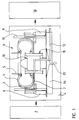
- FIG. 1 shows the method according to the invention in a semi-schematic manner, in which a Carcass body 1 with an unvulcanized rubber mixture Tread 2 is occupied and assembled with it in a prefabrication area 3. Then the transport takes place in the preheating area 4.
- the transport is usually carried out by an attacking on the beads Transport gripper 5, which transports the blanks into the preheating chamber 6 in overhead transport transported.
- the blank is - as already described above - the vulcanized one Carcass body with the unvulcanized rubber compound of the tread to watch.
- the blank is placed on a support plate 7 in the preheating chamber 6, which can be moved via the hydraulic cylinders 8 and 9.
- Centrally within the Preheating chamber 6 has a rim 10 which is not shown in detail here includes clamping segments distributed over their circumference, which by a annular, flexible sealing profile 11 are surrounded.
- a supply line 12 for the heat medium and Condensate drain line 13 is provided within the rim or the Preheating chamber.
- the heat chamber 6 is through the bottom 14 and the wall 15 formed in this case as a cylinder is limited.
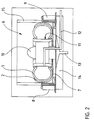
- the support plate 7 with the blank is lowered and the blank itself is clamped by the tensioning rim, as can be seen in FIG. 2. Then the blank is heated from the inside via the medium line 12, here one Direct heating is provided without the use of an internal bellows.
- the rim is relaxed, after which the heat medium can run out and discharged via the condensate line 13 becomes.
- the blank is then lifted again with the gripper and into the vulcanization 16 transported.
Landscapes
- Engineering & Computer Science (AREA)
- Mechanical Engineering (AREA)
- Heating, Cooling, Or Curing Plastics Or The Like In General (AREA)
- Moulds For Moulding Plastics Or The Like (AREA)
- Tyre Moulding (AREA)
Applications Claiming Priority (2)
| Application Number | Priority Date | Filing Date | Title |
|---|---|---|---|
| DE19800289 | 1998-01-07 | ||
| DE19800289A DE19800289C2 (de) | 1998-01-07 | 1998-01-07 | Verfahren zur Herstellung von Luftreifen |
Publications (3)
| Publication Number | Publication Date |
|---|---|
| EP0928679A2 true EP0928679A2 (fr) | 1999-07-14 |
| EP0928679A3 EP0928679A3 (fr) | 2000-03-29 |
| EP0928679B1 EP0928679B1 (fr) | 2003-08-27 |
Family
ID=7854078
Family Applications (1)
| Application Number | Title | Priority Date | Filing Date |
|---|---|---|---|
| EP98124005A Expired - Lifetime EP0928679B1 (fr) | 1998-01-07 | 1998-12-17 | Procédé de fabrication de pneus |
Country Status (2)
| Country | Link |
|---|---|
| EP (1) | EP0928679B1 (fr) |
| DE (2) | DE19800289C2 (fr) |
Cited By (15)
| Publication number | Priority date | Publication date | Assignee | Title |
|---|---|---|---|---|
| EP1077122A3 (fr) * | 1999-08-17 | 2002-08-21 | Kabushiki Kaisha Kobe Seiko Sho | Procédé et appareil de vulcanisation de pneus |
| EP1541324A2 (fr) | 2003-12-11 | 2005-06-15 | The Goodyear Tire & Rubber Company | Procédé et dispositif pour la vulcanisation de pneumatiques utilisant un seul poste de vulcanisation. |
| US7785061B2 (en) | 2007-12-21 | 2010-08-31 | The Goodyear Tire & Rubber Company | Apparatus and method for reorienting a tire and core assembly in a tire manufacturing line |
| US7802975B2 (en) | 2007-12-21 | 2010-09-28 | The Goodyear Tire & Rubber Company | Loading apparatus for assembly and disassembly of a tire curing mold |
| US7854603B2 (en) | 2007-12-21 | 2010-12-21 | The Goodyear Tire & Rubber Company | Tire building core assembly and disassembly station |
| US7874822B2 (en) | 2007-12-21 | 2011-01-25 | The Goodyear Tire & Rubber Company | Tire building core segment manipulator apparatus |
| US7887312B2 (en) | 2008-11-12 | 2011-02-15 | The Goodyear Tire & Rubber Company | Tire building core |
| US7891962B2 (en) | 2007-12-21 | 2011-02-22 | The Goodyear Tire & Rubber Company | Tire building core manipulator apparatus |
| US7896632B2 (en) | 2007-12-21 | 2011-03-01 | The Goodyear Tire & Rubber Company | Apparatus for disassembling a tire building core |
| US7910043B2 (en) | 2007-12-21 | 2011-03-22 | The Goodyear Tire & Rubber Company | Tire building and cure station coupling apparatus and method |
| US8113806B2 (en) | 2007-12-21 | 2012-02-14 | The Goodyear Tire & Rubber Company | Apparatus and method for assembling, disassembling and storing a tire building core |
| US8127434B2 (en) | 2007-12-21 | 2012-03-06 | The Goodyear Tire & Rubber Company | Apparatus assembly and disassembly of a tire curing mold |
| WO2012085714A1 (fr) * | 2010-12-22 | 2012-06-28 | Pirelli Tyre S.P.A. | Procédé et équipement pour confectionner des pneumatiques |
| US8431062B2 (en) | 2007-12-21 | 2013-04-30 | The Goodyear Tire & Rubber Company | Tire unloading apparatus and method in a curing line |
| CN104441722A (zh) * | 2013-09-16 | 2015-03-25 | 青岛天盾橡胶有限公司 | 螺旋式推入法制造矿用巨型轮胎整圆预硫化胎面的方法 |
Family Cites Families (8)
| Publication number | Priority date | Publication date | Assignee | Title |
|---|---|---|---|---|
| DE1480936A1 (de) * | 1964-04-27 | 1969-03-13 | Continental Gummi Werke Ag | Guertelreifen |
| GB1202702A (en) * | 1966-11-15 | 1970-08-19 | Dunlop Co Ltd | Improvements in or relating to pneumatic tyres |
| GB1317901A (en) * | 1969-07-01 | 1973-05-23 | Dunlop Holdings Ltd | Pneumatic tyres |
| SE441078B (sv) * | 1976-10-04 | 1985-09-09 | Elektra Regummeringsteknik | Sett att regummera fordonsdeck med anvendning av en forvulkad slitbana och ett bindgummi, och gummibindningsmaterial for anvendning vid regummering av fordonsdeck i enlighet med settet |
| SE8008885L (sv) * | 1980-12-17 | 1982-06-18 | Scan Rob Ab | Anordning vid regummeringsanleggning av typen med individuella vulkaniseringskamrar |
| DE4027261C1 (fr) * | 1990-08-29 | 1991-12-12 | Continental Gummi-Werke Ag | |
| DE19549502C2 (de) * | 1995-03-03 | 1999-03-18 | Continental Ag | Verfahren zur Herstellung eines Luftreifens |
| DE19710528C1 (de) * | 1997-03-14 | 1998-12-24 | Continental Ag | Verfahren zur Herstellung von Reifen |
-
1998
- 1998-01-07 DE DE19800289A patent/DE19800289C2/de not_active Expired - Fee Related
- 1998-12-17 EP EP98124005A patent/EP0928679B1/fr not_active Expired - Lifetime
- 1998-12-17 DE DE59809412T patent/DE59809412D1/de not_active Expired - Fee Related
Cited By (21)
| Publication number | Priority date | Publication date | Assignee | Title |
|---|---|---|---|---|
| EP1077122A3 (fr) * | 1999-08-17 | 2002-08-21 | Kabushiki Kaisha Kobe Seiko Sho | Procédé et appareil de vulcanisation de pneus |
| US6620367B1 (en) | 1999-08-17 | 2003-09-16 | Kabushiki Kaisha Kobe Seiko Sho (Kobe Steel, Ltd.) | Tire vulcanizing method and tire vulcanizer |
| EP1541324A2 (fr) | 2003-12-11 | 2005-06-15 | The Goodyear Tire & Rubber Company | Procédé et dispositif pour la vulcanisation de pneumatiques utilisant un seul poste de vulcanisation. |
| EP1541324A3 (fr) * | 2003-12-11 | 2006-02-01 | The Goodyear Tire & Rubber Company | Procédé et dispositif pour la vulcanisation de pneumatiques utilisant un seul poste de vulcanisation. |
| US7896632B2 (en) | 2007-12-21 | 2011-03-01 | The Goodyear Tire & Rubber Company | Apparatus for disassembling a tire building core |
| US8127434B2 (en) | 2007-12-21 | 2012-03-06 | The Goodyear Tire & Rubber Company | Apparatus assembly and disassembly of a tire curing mold |
| US7854603B2 (en) | 2007-12-21 | 2010-12-21 | The Goodyear Tire & Rubber Company | Tire building core assembly and disassembly station |
| US7874822B2 (en) | 2007-12-21 | 2011-01-25 | The Goodyear Tire & Rubber Company | Tire building core segment manipulator apparatus |
| US8431062B2 (en) | 2007-12-21 | 2013-04-30 | The Goodyear Tire & Rubber Company | Tire unloading apparatus and method in a curing line |
| US7891962B2 (en) | 2007-12-21 | 2011-02-22 | The Goodyear Tire & Rubber Company | Tire building core manipulator apparatus |
| US7785061B2 (en) | 2007-12-21 | 2010-08-31 | The Goodyear Tire & Rubber Company | Apparatus and method for reorienting a tire and core assembly in a tire manufacturing line |
| US7910043B2 (en) | 2007-12-21 | 2011-03-22 | The Goodyear Tire & Rubber Company | Tire building and cure station coupling apparatus and method |
| US8113806B2 (en) | 2007-12-21 | 2012-02-14 | The Goodyear Tire & Rubber Company | Apparatus and method for assembling, disassembling and storing a tire building core |
| US7802975B2 (en) | 2007-12-21 | 2010-09-28 | The Goodyear Tire & Rubber Company | Loading apparatus for assembly and disassembly of a tire curing mold |
| US7887312B2 (en) | 2008-11-12 | 2011-02-15 | The Goodyear Tire & Rubber Company | Tire building core |
| WO2012085714A1 (fr) * | 2010-12-22 | 2012-06-28 | Pirelli Tyre S.P.A. | Procédé et équipement pour confectionner des pneumatiques |
| CN103249534A (zh) * | 2010-12-22 | 2013-08-14 | 倍耐力轮胎股份公司 | 用于制造轮胎的方法和设备 |
| CN103249534B (zh) * | 2010-12-22 | 2016-06-22 | 倍耐力轮胎股份公司 | 用于制造轮胎的方法和设备 |
| RU2592528C2 (ru) * | 2010-12-22 | 2016-07-20 | Пирелли Тайр С.П.А. | Способ и устройство для изготовления шин |
| CN104441722A (zh) * | 2013-09-16 | 2015-03-25 | 青岛天盾橡胶有限公司 | 螺旋式推入法制造矿用巨型轮胎整圆预硫化胎面的方法 |
| CN104441722B (zh) * | 2013-09-16 | 2016-11-02 | 青岛天盾橡胶有限公司 | 螺旋式推入法制造矿用巨型轮胎整圆预硫化胎面的方法 |
Also Published As
| Publication number | Publication date |
|---|---|
| EP0928679A3 (fr) | 2000-03-29 |
| DE19800289A1 (de) | 1999-07-15 |
| DE19800289C2 (de) | 2000-03-16 |
| EP0928679B1 (fr) | 2003-08-27 |
| DE59809412D1 (de) | 2003-10-02 |
Similar Documents
| Publication | Publication Date | Title |
|---|---|---|
| DE19800289C2 (de) | Verfahren zur Herstellung von Luftreifen | |
| DE1729752C2 (de) | Verfahren zum Herstellen eines Gürtelreifens | |
| DE69618504T2 (de) | LKW-Luftreifen mit verbesserter vorvulkanisierter Lauffläche und Verfahren zu dessen Herstellung | |
| DE19549502C2 (de) | Verfahren zur Herstellung eines Luftreifens | |
| DE19905643C2 (de) | Verfahren zur Herstellung eines Luftreifens | |
| DE69903772T2 (de) | Verfahren und Vorrichtung zum Formen und Vulkanisiern von Luftreifen | |
| DE60005667T2 (de) | Verfahren und vorrichtung zum formen und vulkanisieren von fahrzeugluftreifen | |
| DE2659587A1 (de) | Elastischer formheizbalg fuer luftreifen sowie verfahren und vorrichtung zu dessen herstellung | |
| DE60216521T2 (de) | Verfahren und vorrichtung zum formen und vulkanisieren von fahrzeugreifen | |
| EP0182026B1 (fr) | Procédé et dispositif de vulcanisation de pneus | |
| DE1729633B2 (de) | Verfahren und vorrichtung zum herstellen eines luftreifens | |
| DE60000463T2 (de) | Verfahren und Vorrichtung zum Formen und Vulkanisieren von Luftreifen | |
| DE19507486C2 (de) | Verfahren zur Herstellung eines Reifens | |
| DE2644515C3 (de) | Verfahren zum Formen und Vulkanisieren eines Gürtel-Radial-Reifens | |
| DE2813702C2 (fr) | ||
| DE3888362T2 (de) | Herstellung von reifen. | |
| EP3475070B1 (fr) | Procédé de fabrication d'un bandage plein en caoutchouc, et bandage plein en caoutchouc fabriqué selon ledit procédé | |
| DE3401077C2 (fr) | ||
| EP2014451A1 (fr) | Procédé pour la fabrication d'un pneumatique radial | |
| DE102015210579B4 (de) | Verfahren zur Herstellung von Fahrzeugreifen | |
| WO2019011493A1 (fr) | Procédé et dispositif de rugosification d'une bande de roulement profilée destinée à un rechapage à froid | |
| DE69513524T2 (de) | Druckpressformwerkzeug zur herstellung von reifen | |
| EP0640470A2 (fr) | Procédé de fabrication de bandages pneumatiques utilisant de l'énergie à micro-ondes | |
| DE19710528C1 (de) | Verfahren zur Herstellung von Reifen | |
| DE2208341C2 (de) | Verfahren zur Herstellung eines Luftreifens |
Legal Events
| Date | Code | Title | Description |
|---|---|---|---|
| PUAI | Public reference made under article 153(3) epc to a published international application that has entered the european phase |
Free format text: ORIGINAL CODE: 0009012 |
|
| AK | Designated contracting states |
Kind code of ref document: A2 Designated state(s): DE FR GB IT |
|
| AX | Request for extension of the european patent |
Free format text: AL;LT;LV;MK;RO;SI |
|
| PUAL | Search report despatched |
Free format text: ORIGINAL CODE: 0009013 |
|
| AK | Designated contracting states |
Kind code of ref document: A3 Designated state(s): AT BE CH CY DE DK ES FI FR GB GR IE IT LI LU MC NL PT SE |
|
| AX | Request for extension of the european patent |
Free format text: AL;LT;LV;MK;RO;SI |
|
| 17P | Request for examination filed |
Effective date: 20000929 |
|
| AKX | Designation fees paid |
Free format text: DE FR GB IT |
|
| GRAH | Despatch of communication of intention to grant a patent |
Free format text: ORIGINAL CODE: EPIDOS IGRA |
|
| GRAS | Grant fee paid |
Free format text: ORIGINAL CODE: EPIDOSNIGR3 |
|
| GRAA | (expected) grant |
Free format text: ORIGINAL CODE: 0009210 |
|
| AK | Designated contracting states |
Designated state(s): DE FR GB IT |
|
| PG25 | Lapsed in a contracting state [announced via postgrant information from national office to epo] |
Ref country code: IT Free format text: LAPSE BECAUSE OF FAILURE TO SUBMIT A TRANSLATION OF THE DESCRIPTION OR TO PAY THE FEE WITHIN THE PRESCRIBED TIME-LIMIT;WARNING: LAPSES OF ITALIAN PATENTS WITH EFFECTIVE DATE BEFORE 2007 MAY HAVE OCCURRED AT ANY TIME BEFORE 2007. THE CORRECT EFFECTIVE DATE MAY BE DIFFERENT FROM THE ONE RECORDED. Effective date: 20030827 Ref country code: GB Free format text: LAPSE BECAUSE OF FAILURE TO SUBMIT A TRANSLATION OF THE DESCRIPTION OR TO PAY THE FEE WITHIN THE PRESCRIBED TIME-LIMIT Effective date: 20030827 Ref country code: FR Free format text: LAPSE BECAUSE OF FAILURE TO SUBMIT A TRANSLATION OF THE DESCRIPTION OR TO PAY THE FEE WITHIN THE PRESCRIBED TIME-LIMIT Effective date: 20030827 |
|
| REG | Reference to a national code |
Ref country code: GB Ref legal event code: FG4D Free format text: NOT ENGLISH |
|
| REF | Corresponds to: |
Ref document number: 59809412 Country of ref document: DE Date of ref document: 20031002 Kind code of ref document: P |
|
| GBV | Gb: ep patent (uk) treated as always having been void in accordance with gb section 77(7)/1977 [no translation filed] |
Effective date: 20030827 |
|
| PG25 | Lapsed in a contracting state [announced via postgrant information from national office to epo] |
Ref country code: DE Free format text: LAPSE BECAUSE OF NON-PAYMENT OF DUE FEES Effective date: 20040701 |
|
| PLBE | No opposition filed within time limit |
Free format text: ORIGINAL CODE: 0009261 |
|
| STAA | Information on the status of an ep patent application or granted ep patent |
Free format text: STATUS: NO OPPOSITION FILED WITHIN TIME LIMIT |
|
| 26N | No opposition filed |
Effective date: 20040528 |
|
| EN | Fr: translation not filed |