EP0929197A2 - Verfahren und Vorrichtung zur Betrachtung von Rundfunkprogrammen - Google Patents
Verfahren und Vorrichtung zur Betrachtung von Rundfunkprogrammen Download PDFInfo
- Publication number
- EP0929197A2 EP0929197A2 EP99100259A EP99100259A EP0929197A2 EP 0929197 A2 EP0929197 A2 EP 0929197A2 EP 99100259 A EP99100259 A EP 99100259A EP 99100259 A EP99100259 A EP 99100259A EP 0929197 A2 EP0929197 A2 EP 0929197A2
- Authority
- EP
- European Patent Office
- Prior art keywords
- viewer
- broadcast programs
- items
- information
- attribute information
- Prior art date
- Legal status (The legal status is an assumption and is not a legal conclusion. Google has not performed a legal analysis and makes no representation as to the accuracy of the status listed.)
- Granted
Links
Images




Classifications
-
- H—ELECTRICITY
- H04—ELECTRIC COMMUNICATION TECHNIQUE
- H04H—BROADCAST COMMUNICATION
- H04H60/00—Arrangements for broadcast applications with a direct linking to broadcast information or broadcast space-time; Broadcast-related systems
- H04H60/76—Arrangements characterised by transmission systems other than for broadcast, e.g. the Internet
- H04H60/81—Arrangements characterised by transmission systems other than for broadcast, e.g. the Internet characterised by the transmission system itself
- H04H60/93—Wired transmission systems
- H04H60/94—Telephonic networks
-
- H—ELECTRICITY
- H04—ELECTRIC COMMUNICATION TECHNIQUE
- H04H—BROADCAST COMMUNICATION
- H04H60/00—Arrangements for broadcast applications with a direct linking to broadcast information or broadcast space-time; Broadcast-related systems
- H04H60/02—Arrangements for generating broadcast information; Arrangements for generating broadcast-related information with a direct linking to broadcast information or to broadcast space-time; Arrangements for simultaneous generation of broadcast information and broadcast-related information
- H04H60/07—Arrangements for generating broadcast information; Arrangements for generating broadcast-related information with a direct linking to broadcast information or to broadcast space-time; Arrangements for simultaneous generation of broadcast information and broadcast-related information characterised by processes or methods for the generation
-
- H—ELECTRICITY
- H04—ELECTRIC COMMUNICATION TECHNIQUE
- H04H—BROADCAST COMMUNICATION
- H04H60/00—Arrangements for broadcast applications with a direct linking to broadcast information or broadcast space-time; Broadcast-related systems
- H04H60/27—Arrangements for recording or accumulating broadcast information or broadcast-related information
-
- H—ELECTRICITY
- H04—ELECTRIC COMMUNICATION TECHNIQUE
- H04H—BROADCAST COMMUNICATION
- H04H60/00—Arrangements for broadcast applications with a direct linking to broadcast information or broadcast space-time; Broadcast-related systems
- H04H60/35—Arrangements for identifying or recognising characteristics with a direct linkage to broadcast information or to broadcast space-time, e.g. for identifying broadcast stations or for identifying users
- H04H60/46—Arrangements for identifying or recognising characteristics with a direct linkage to broadcast information or to broadcast space-time, e.g. for identifying broadcast stations or for identifying users for recognising users' preferences
-
- H—ELECTRICITY
- H04—ELECTRIC COMMUNICATION TECHNIQUE
- H04H—BROADCAST COMMUNICATION
- H04H60/00—Arrangements for broadcast applications with a direct linking to broadcast information or broadcast space-time; Broadcast-related systems
- H04H60/61—Arrangements for services using the result of monitoring, identification or recognition covered by groups H04H60/29-H04H60/54
- H04H60/65—Arrangements for services using the result of monitoring, identification or recognition covered by groups H04H60/29-H04H60/54 for using the result on users' side
-
- H—ELECTRICITY
- H04—ELECTRIC COMMUNICATION TECHNIQUE
- H04N—PICTORIAL COMMUNICATION, e.g. TELEVISION
- H04N21/00—Selective content distribution, e.g. interactive television or video on demand [VOD]
- H04N21/40—Client devices specifically adapted for the reception of or interaction with content, e.g. set-top-box [STB]; Operations thereof
- H04N21/41—Structure of client; Structure of client peripherals
- H04N21/414—Specialised client platforms, e.g. receiver in car or embedded in a mobile appliance
- H04N21/4147—PVR [Personal Video Recorder]
-
- H—ELECTRICITY
- H04—ELECTRIC COMMUNICATION TECHNIQUE
- H04N—PICTORIAL COMMUNICATION, e.g. TELEVISION
- H04N21/00—Selective content distribution, e.g. interactive television or video on demand [VOD]
- H04N21/40—Client devices specifically adapted for the reception of or interaction with content, e.g. set-top-box [STB]; Operations thereof
- H04N21/45—Management operations performed by the client for facilitating the reception of or the interaction with the content or administrating data related to the end-user or to the client device itself, e.g. learning user preferences for recommending movies, resolving scheduling conflicts
- H04N21/4508—Management of client data or end-user data
- H04N21/4532—Management of client data or end-user data involving end-user characteristics, e.g. viewer profile, preferences
-
- H—ELECTRICITY
- H04—ELECTRIC COMMUNICATION TECHNIQUE
- H04N—PICTORIAL COMMUNICATION, e.g. TELEVISION
- H04N21/00—Selective content distribution, e.g. interactive television or video on demand [VOD]
- H04N21/40—Client devices specifically adapted for the reception of or interaction with content, e.g. set-top-box [STB]; Operations thereof
- H04N21/45—Management operations performed by the client for facilitating the reception of or the interaction with the content or administrating data related to the end-user or to the client device itself, e.g. learning user preferences for recommending movies, resolving scheduling conflicts
- H04N21/454—Content or additional data filtering, e.g. blocking advertisements
-
- H—ELECTRICITY
- H04—ELECTRIC COMMUNICATION TECHNIQUE
- H04N—PICTORIAL COMMUNICATION, e.g. TELEVISION
- H04N21/00—Selective content distribution, e.g. interactive television or video on demand [VOD]
- H04N21/40—Client devices specifically adapted for the reception of or interaction with content, e.g. set-top-box [STB]; Operations thereof
- H04N21/45—Management operations performed by the client for facilitating the reception of or the interaction with the content or administrating data related to the end-user or to the client device itself, e.g. learning user preferences for recommending movies, resolving scheduling conflicts
- H04N21/458—Scheduling content for creating a personalised stream, e.g. by combining a locally stored advertisement with an incoming stream; Updating operations, e.g. for OS modules ; time-related management operations
-
- H—ELECTRICITY
- H04—ELECTRIC COMMUNICATION TECHNIQUE
- H04N—PICTORIAL COMMUNICATION, e.g. TELEVISION
- H04N21/00—Selective content distribution, e.g. interactive television or video on demand [VOD]
- H04N21/40—Client devices specifically adapted for the reception of or interaction with content, e.g. set-top-box [STB]; Operations thereof
- H04N21/45—Management operations performed by the client for facilitating the reception of or the interaction with the content or administrating data related to the end-user or to the client device itself, e.g. learning user preferences for recommending movies, resolving scheduling conflicts
- H04N21/462—Content or additional data management e.g. creating a master electronic programme guide from data received from the Internet and a Head-end or controlling the complexity of a video stream by scaling the resolution or bit-rate based on the client capabilities
- H04N21/4622—Retrieving content or additional data from different sources, e.g. from a broadcast channel and the Internet
-
- H—ELECTRICITY
- H04—ELECTRIC COMMUNICATION TECHNIQUE
- H04N—PICTORIAL COMMUNICATION, e.g. TELEVISION
- H04N21/00—Selective content distribution, e.g. interactive television or video on demand [VOD]
- H04N21/40—Client devices specifically adapted for the reception of or interaction with content, e.g. set-top-box [STB]; Operations thereof
- H04N21/47—End-user applications
- H04N21/478—Supplemental services, e.g. displaying phone caller identification, shopping application
- H04N21/4782—Web browsing, e.g. WebTV
-
- H—ELECTRICITY
- H04—ELECTRIC COMMUNICATION TECHNIQUE
- H04N—PICTORIAL COMMUNICATION, e.g. TELEVISION
- H04N21/00—Selective content distribution, e.g. interactive television or video on demand [VOD]
- H04N21/80—Generation or processing of content or additional data by content creator independently of the distribution process; Content per se
- H04N21/83—Generation or processing of protective or descriptive data associated with content; Content structuring
- H04N21/84—Generation or processing of descriptive data, e.g. content descriptors
-
- H—ELECTRICITY
- H04—ELECTRIC COMMUNICATION TECHNIQUE
- H04N—PICTORIAL COMMUNICATION, e.g. TELEVISION
- H04N5/00—Details of television systems
- H04N5/76—Television signal recording
-
- H—ELECTRICITY
- H04—ELECTRIC COMMUNICATION TECHNIQUE
- H04N—PICTORIAL COMMUNICATION, e.g. TELEVISION
- H04N7/00—Television systems
- H04N7/08—Systems for the simultaneous or sequential transmission of more than one television signal, e.g. additional information signals, the signals occupying wholly or partially the same frequency band, e.g. by time division
Definitions
- the present invention relates to a broadcast-program viewing method and system and more particularly, to a viewing method and a viewing system of broadcast programs such as television (TV) programs capable of viewing the programs from a different angle from those transmitted by a broadcast station or stations according to a viewer's or subscriber's taste.
- broadcast programs such as television (TV) programs capable of viewing the programs from a different angle from those transmitted by a broadcast station or stations according to a viewer's or subscriber's taste.
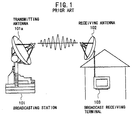
- Fig. 1 schematically shows a receiving method of TV programs transmitted from various broadcasting stations.
- a broadcasting station 101 transmits a radio wave conveying a lot of TV programs to the sky.
- the radio wave thus transmitted travels through the sky and then, is received by a receiving antenna 102 mounted by a viewer or subscriber.
- the radio wave thus received is sent to a broadcast receiving terminal, i.e., a TV set 103, provided by the viewer.
- the TV set 103 extracts the transmitted picture and sound information from the received radio wave and reproduces them at a screen and speakers of the TV set 103. Through these processes, the viewer becomes able to view the desired TV programs transmitted from the broadcasting station 101 as necessary.
- the transmitted TV programs may be recorded onto a video tape by the use of a video tape recorder (VTR).
- VTR video tape recorder
- the viewer is able to view the recorded programs at any time he wants.
- the contents of the TV programs have been fixed prior to the transmission from the broadcasting station 101, and it has been difficult for the viewers or subscribers to apply any revision and/or modification to the TV programs after the program editing has been completed. Therefore, it has been usual that the viewers view the TV programs without any change as transmitted from the broadcasting station 101.
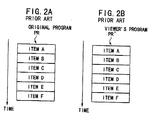
- Fig. 2A schematically shows the configuration of a TV program PR transmitted from the broadcasting station 101.
- This program PR may be termed an "original TV program”.
- Fig. 2B schematically shows the configuration of a TV program PR' viewed by the viewer.
- This program PR' may be termed a "viewer's TV program”.
- the original TV program PR contains items A, B, C, D, and E sequentially arranged with time. Also, as seen from Fig. 2B, the viewer's TV program PR' contains the same items A, B, C, D, and E as that of the original TV program PR, and the timing order or arrangement of these items A, B, C, D, and E is the same as that of the original TV program PR.
- the viewer needs to store the programs onto a video tape or tapes by using his VTR. Then, he needs to reedit the stored original TV programs as desired by fast-forwarding and/or rewinding the video tape or tapes and/or by selectively dubbing the necessary items of the programs from one of the stored tapes to another. Thus, it is essential for the viewer to carry out complicated and/or troublesome operations for this purpose.
- an object of the present invention is to provide a broadcast-program viewing method and a broadcast-program viewing system that make it possible to view broadcast programs transmitted by a broadcasting station or stations from a different angle.
- Another object of the present invention is to provide a broadcast-program viewing method and a broadcast-program viewing system capable of optionally viewing broadcast programs transmitted by a broadcasting station or stations according to a viewer's taste or desire.
- a broadcast-program viewing method is provided, which is comprised of the following steps (a) to (e).
- each of the received original broadcast programs contains the items having the attribute information, and the attribute information for the items is acquired and stored onto the information storage medium.
- the attribute information for the items of the received original broadcast programs is compared with the specified viewer's information, thereby designating at least one desired item in the items of the received original broadcast programs having the desired relationship with the specified viewer's information. Subsequently, the at least one desired item designated in the items of the received original broadcast programs is reproduced according to the specified viewer's information as the viewer's program.
- the viewer is able to view the original broadcast programs transmitted by the broadcasting station from a different angle.
- the viewer's program is readily varied by changing the viewer's information, the viewer is able to optionally view the original broadcast programs transmitted by the broadcasting station according to his taste or desire.
- the items of the received original broadcast programs are selected and/or rearranged along a time axis according to the specified viewer's information in the step (e).
- the attribute information for the items of the received original broadcast programs is acquired through a different path from a broadcasting wave conveying the original broadcast programs.
- the attribute information may be acquired through a communication line such as the INTERNET using a communication receiver such as a modem.
- the attribute information for the items of the received original broadcast programs is acquired through a broadcasting wave conveying the original broadcast programs.
- the attribute information is preferably transmitted from the broadcasting station transmitting the original programs and then, received along with the original broadcast programs.
- the attribute information may be transmitted from a different broadcasting station from the broadcasting station transmitting the original programs.
- the viewer's program is (i) a digest of at least one of the broadcast programs transmitted by the broadcasting station, (ii) a program obtained by reediting at least two ones of the broadcast programs transmitted by the broadcasting station, or (iii) a program obtained by rearranging the items of the broadcast programs transmitted by the broadcasting station along a time axis.
- a broadcast-program viewing system which is comprised of the following elements (a) to (e).
- the attribute information for the items of the received original broadcast programs is acquired by the attribute information receiver and stored onto the random-accessible information storage medium by the use of the information storage subsystem. Then, under the control of the controller, the attribute information for the items is compared with the inputted viewer's information to designate the at least one desired item in the items of the received original broadcast programs having the desired relationship with the inputted viewer's information. The at least one desired item designated in the items of the received original broadcast programs are reproduced by the output subsystem according to the inputted viewer's information as the viewer's program.
- the viewer is able to view the broadcast programs transmitted by the broadcasting station from a different angle.
- the viewer's program is readily varied by changing the viewer's information, the viewer is able to optionally view the broadcast programs transmitted by the broadcasting station according to his taste or desire.
- the items of the received original broadcast programs are selected and/or rearranged along a time axis according to the inputted viewer's information.
- the attribute information receiver acquires the attribute information for the items of the received original broadcast programs through a different path from a broadcasting wave conveying the original broadcast programs.
- the attribute information may be acquired through a communication line such as the INTERNET using a communication receiver such as a modem.
- the attribute information receiver acquires the attribute information for the items of the received original broadcast programs through a broadcasting wave conveying the original broadcast programs.
- the attribute information is preferably transmitted from the broadcasting station transmitting the original programs and then, received along with the original broadcast programs.
- the attribute information may be transmitted from a different broadcasting station from the broadcasting station transmitting the original programs.
- the controller controls the information storage subsystem and the attribute information receiver in such a way that the viewer's program is (i) a digest of at least one of the original broadcast programs transmitted by the broadcasting station, (ii) a program obtained by reediting at least two ones of the original broadcast programs transmitted by the broadcasting station, or (iii) a program obtained by rearranging the items of at least one of the original broadcast programs transmitted by the broadcasting station along a timing axis.
- the words “broadcast program”, “item”, “attribute information”, and “viewer's information”, has the following meanings.
- the "broadcast program” means a broadcast program such as a TV program transmitted from a broadcasting station with or without wire.
- a broadcast program such as a TV program transmitted from a broadcasting station with or without wire.
- any program such as "Seven O'clock News” and "Young's and Old's Songs” provided by the terrestrial or satellite broadcasting system or the cable television (CATV) system, e.g., the Nihon Hoso Kyokai (NHK), Sky PerfecTV!®, or the like.
- the “broadcast program” consists of elements or constituents that are sequentially arranged along the time axis.
- the “broadcast program” is the combination of the sequentially-arranged elements or constituents.
- Each of the elements or constituents of the “broadcast program” is optionally defined or partitioned by the "start time” or “start frame” and the "end time” or “end frame”.
- Each of the elements or constituents typically contains at least one scene.
- the “item” is equal to any one of the elements or constituents of the "broadcast program”. Therefore, similar to the elements or constituents of the "broadcast program", the “item” is optionally defined or partitioned by the "start time” or “start frame” and the "end time” or “end frame” in the "broadcast program” concerned.
- the TV program termed the "Seven O'clock News” is designed to be started at the time 7:00:00 (i.e., just seven o'clock) and ended at the time 8:00:00 (i.e., just eight o'clock) and ended at the time.
- the "weather forecast” is designed to be broadcasted from the start time 7:40:00 (i.e., 40 minutes past seven) to the end time 7:41:30 (i.e., 41 minutes and 30 seconds past seven) in the "Seven O'clock News"
- the "weather forecast” is an element or constituent of the "Seven O'clock News”. It can be said that the "weather forecast” is an "item” of the "Seven O'clock News”.
- a part of the "weather forecast” (for example, only one scene displaying a single weather map in the "weather forecast") may be defined as an "item" of the "Seven O'clock News". This is realized by changing the above-described start and end times.
- the "attribute information” means the information representing the content of the "item", which is defined to be able to be compared with the inputted or specified "viewer's information” for the purpose of designating the at least one desired item.
- the “attribute information” contains at least one "topic” or “subject” about the content of the "item", which serves as a keyword at the comparison with the "viewer's information”.
- the “attribute information” may contain some additional data indicating the "class” of the content of the "item”, such as the headline, show business, professional baseball, weather, and greetings.
- the "topic” or “subject” may be simply represented by the use of a character string.
- the additional data also may be represented by the use of a character string.
- the “viewer's information” means the information representing the taste or desire of the viewer.
- the “viewer's information” means the information specifying the "item or items” of the "broadcast program or programs” that the viewer wants or does not want to view.
- the "viewer's information” may simply contain any keyword and/or code. In this case, to compare the "viewer's information" with the “attribute information", the keyword and/or code of the "viewer's information” is compared with the "topic" or “subject” or “class” of the "attribute information”.
- Fig. 1 is a schematic illustration showing a receiving method of broadcast programs transmitted from a broadcasting station.
- Figs. 2A and 2B are schematic illustrations showing the configuration of an original TV program transmitted from the broadcasting station and that of a viewer's TV program viewed by the viewer, respectively.
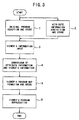
- Fig. 3 is a flowchart showing the steps of a broadcast-program viewing method according to a first embodiment of the present invention.
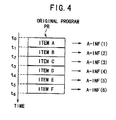
- Fig. 4 is a schematic illustration showing the configuration of an original TV program transmitted from a broadcasting station, in which the relationship between the timing arrangement of the items of the program and their attribute information are also shown.
- Fig. 5 is a block diagram showing the configuration of a broadcast-program viewing system according to the first embodiment of the present invention.
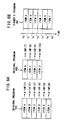
- Fig. 6 is a schematic illustration showing the configuration of a viewer's program viewed by the viewer, in which the items of the original TV program are selected.
- Fig. 7 is a schematic illustration showing the configuration of a viewer's program viewed by the viewer, in which the time order of the same items of the original TV program are rearranged.
- Figs. 8A and 8B are schematic illustrations showing the configuration of two original TV programs transmitted from the broadcasting station and that of a viewer's program viewed by the viewer, respectively, in which the items of the two original TV programs are selected and mixed in the viewer's program.
- Fig. 9 is a schematic illustration showing the program map or list for the viewer's program shown in Fig. 6.
- Fig. 10 is a schematic illustration showing the program map or list for the viewer's program shown in Fig. 7.
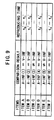
- Fig. 11 is a schematic illustration showing the program map or list for the viewer's program shown in Fig. 8.
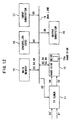
- Fig. 12 is a block diagram showing the configuration of a broadcast-program viewing system according to a second embodiment of the present invention.
- a broadcast-program viewing method is carried out according to an algorithm shown in Fig. 3 by the use of a broadcast-program viewing system shown in Fig. 5.
- the broadcast-program viewing system is comprised of a TV tuner 11, a hard disk drive 12, a modem 13, a main memory 14, a controller or Central Processing Unit (CPU) 15, an output subsystem 16 (i.e., a color display and speakers), and an input subsystem 17 (i.e., a keyboard and a mouse or a control pad).
- a TV tuner 11 a hard disk drive 12
- a modem 13 a main memory 14
- CPU Central Processing Unit
- an output subsystem 16 i.e., a color display and speakers
- an input subsystem 17 i.e., a keyboard and a mouse or a control pad
- a digital-modulated radio wave transmitted from a broadcasting station (not shown) and conveying various original TV programs is received by an antenna (not shown), thereby outputting a radio signal S1.
- the TV tuner 11 receives the radio signal S1 and selects a desired channel of a viewer to output a program signal S2 to the hard disk unit 12.
- the hard disk drive 12 stores the original TV programs of the desired channel that have been transmitted by the program signal S2 onto a hard disk 12a.
- the hard disk drive 12 is capable of random access to the disk 12a, i.e., the stored information.
- the modem 13 receives a communication signal S3 through a communication line 18 such as the INTERNET.
- the communication signal S3 contains the attribute information of the original TV programs of the desired channel that have been transmitted from the broadcasting station.
- the attribute information of the original TV programs is readily prepared by automatically extracting the predesigned keywords and/or codes from the original TV programs at the broadcast station itself or any other organization.
- the modem 13 sends the acquired attribute information of the original TV programs to the hard disk drive 12 as an attribute information signal S4.
- the attribute information is then stored onto the hard disk 12a in the hard disk drive 12.
- the attribute information contains at least one "topic” or “subject” about the content of the item, which serves as a keyword at the comparison with the viewer's information.
- the attribute information further contains an additional data indicating the "class” of the content of the "item”, such as the headline, show business, professional baseball, weather, and greetings.
- the "topic” or “subject” and “class” are simply represented by the use of a character string or strings.
- the input subsystem 17 is used to input the viewer's information according to the viewer's taste or desire into this broadcast-program viewing system.
- the input system 17 sends a viewer's information signal S5 according to the viewer's information thus inputted to the hard disk drive 12 through a bus line 19.
- the inputted viewer's information is then stored in the hard disk 12a of the drive 12.
- the controller or CPU 15 sends control signals SC to the TV tuner 11, the hard disk unit 12, and the modem 13, thereby controlling the whole operation of this broadcast-program viewing system.
- a viewer's program signal S5 reproducing a viewer's TV program according to the viewer's taste or desire is generated as an output signal of this broadcast-program viewing system by the use of the program signal S2, the attribute information signal S4, and the viewer's information signal S5.
- the viewer's program signal S5 is then sent to the output subsystem 16.
- the output subsystem 16 is used to reproduce the viewer's TV program produced in this broadcast-program viewing system.
- the output subsystem 16 typically contains a color monitor (not shown) and speakers (not shown).
- the reproduced pictures of the viewer's TV program are displayed on a screen of the color monitor and the reproduced sounds of the viewer's TV program are emitted by the speakers.
- the original TV programs transmitted by the broadcasting station are received by the antenna, and the desired channel or channels of the viewer is/are selected by the TV tuner 11.
- the selected original TV programs are stored onto the hard disk 12a in the hard disk drive 12.
- the original TV programs are transmitted by an analog-modulated radio wave
- the original TV programs are converted to digital data by a use of a suitable encoder (not shown) prior to the storage onto the hard disk 12a.
- Each of the received original broadcast programs contains at least one item having attribute information. Therefore, the attribute information for the item or items of the received original TV programs is acquired by the modem 13 through the communication line 18 and then, the acquired attribute information is stored onto the hard disk 12a in the hard disk drive 12 in the step 2.
- the attribute information may be acquired during, before, or after the broadcasting or receiving time of the original TV programs.
- the viewer's information according to the viewer's taste or desire is inputted by the viewer into this broadcast-program viewing system using the input subsystem 17.
- the stored attribute information for the items of the received original TV programs and the inputted viewer's information are compared under the control of the CPU 15. Specifically, the attribute information for the items of the received original TV programs and the viewer's information are read out from the hard disk 12a to thereby find the desired items of the received original TV programs that satisfy the viewer's information.
- a viewer's program map or list is formed and stored onto the hard disk 12a in the step 5.
- the viewer's information consists of at least one keyword or character string that specifies the desired items of the original TV programs.
- the viewer's information further consists of an additional data specifying the reproduction order or time arrangement of the desired items.
- the attribute information contains at least one "topic” or "subject” and "class” data about the content of the item. Therefore, the viewer's program map or list includes the items of the original TV programs relating to the viewer's information, the comparison result, and the reproduction order of the desired items.
- the desired items of the received original TV programs are reproduced by the output subsystem 16 according to the reproduction order in the program map formed in the step 5 as a viewer's program.
- Fig. 4 shows a configuration example of one of the received original TV programs, in which this original program PR contains six items A, B, C, D, E, and F arranged along a time axis.
- the first item A which starts at the time to and ends at the time t 1 , has attribute information A-INF(1).
- the second item B which starts at the time t 1 and ends at a time t 1 , has attribute information A-INF(2) .
- the third item C which starts at the time t 2 and ends at the time t 3 , has attribute information A-INF(3).
- the fourth item D which starts at the time t 3 and ends at the time t 4 , has attribute information A-INF(4).
- the fifth item E which starts at the time t 4 and ends at the time t 5 , has attribute information A-INF(5).
- the sixth item F which starts at the time t 5 and ends at the time t 6 , has attribute information A-INF(6).
- Fig. 6 shows a configuration of the viewer's program PR', in which the viewer's program PR' contains the four items A, B, D, and F of the original TV program PR shown in Fig. 4 while the reproduction order of these items A, B, D, and F is unchanged.
- the viewer's program PR' is obtained as a digest of the original TV program PR of Fig. 4.
- the viewer's program map or list for the viewer's program PR' of Fig. 6 is shown in Fig. 9.
- each of the six items A, B, C, D, E, and F of the original TV program PR are compared with the inputted viewer' s information V-INF and then, the comparison result for these items is listed in the program map along with their reproducing time. According to this map, the viewer's program is produced from the original TV program PR and played back at the output subsystem 16.
- the viewer's program PR' of Fig. 6 is effective for the case where the viewer wants to view only the news items relating to a desired foreign country.
- Fig. 7 shows another configuration of the viewer's program PR', in which the viewer's program PR' contains the six items A, B, C, D, E, and F of the original TV program PR shown in Fig. 4 while the reproduction order of these items A, B, C, D, E, and F is changed.
- the viewer's program PR' is obtained as an item rearrangement of the original TV program PR of Fig. 4.
- the viewer's program map or list for the viewer's program PR' of Fig. 7 is shown in Fig. 10.
- each of the six items A, B, C, D, E, and F of the original TV program PR are compared with the inputted viewer's information V-INF and then, the comparison result for these items is listed in the program map along with their reproducing time. According to this map, the viewer's program is produced from the original TV program PR and played back at the output subsystem 16.
- the viewer's program PR' of Fig. 7 is effective for the case where the viewer wants to view the news items of the news program according to his desired time order arranged dependent on the level of pleasure or enjoyment.
- Fig. 8B shows still another configuration of the viewer's program PR', in which the viewer's program PR' contains the six items A, H, C, I, G, and F of the two original TV programs PR1 and PR2 shown in Fig. 8A while the reproduction order of the items A, B, C, D, E, and F of the program PR1 and the items G, H, I, and J of the program PR2 is changed.
- the viewer's program PR' is obtained as an item selection and combination (or, cut and rearrangement) of the original TV programs PR1 and PR2 of Fig. 8A.
- the viewer's program map or list for the viewer's program PR' of Fig. 8B is shown in Fig. 11. As shown in Fig. 11, each of the ten items A, B, C, D, E, F, G, H, I, and J of the two original TV programs PR1 and PR2 are compared with the inputted viewer's information V-INF and then, the comparison result for these items is listed in the program map along with their reproducing time. According to this map, the viewer's program PR' is produced from the original TV programs PR1 and PR2 and played back at the output subsystem 16.
- the viewer's program PR' of Fig. 8B is effective for the case where the viewer wants to view only the desired news items (e.g., sport news) of the two news programs according to his desired time order.
- desired news items e.g., sport news
- the attribute information is comprised of at least one "row” describing the "start time", the "end time”, and the "content” of the item. Therefore, it is supposed that the original TV program PR is a "Seven O'clock News" having the following attribute information. Start time, End time, Content 07:00:00, 07:05:00, headlines X, Y, Z, 07:05:00, 07:06:00, T. Kimura/show business, 07:06:00, 07:07:30, S. Nagashima/baseball/sport/home run, 07:07:30, 07:10:20, weather forecast, 07:10:20, 07:11:00, end greeting,
- At least one word or character string listed in the "content" of the item is used as the viewer's information.
- the second item that starts at 07:05:00 and ends at 07:06:00
- at least one of the character strings “T. Kimura” and “show business” is specified by the viewer.
- the fourth item that starts at 07:07:30 and ends at 07:10:20, it is sufficient that a single character string "weather forecast" is specified by the viewer.
- the controller 15 controls to carry out a keyword retrieval or full-text retrieval to find the character string or strings thus specified to find the items including the specified string or strings, thereby forming the viewer's program map or list.
- the content of [row] is expressed by the combination of the start time and the end time of the item, the content information of the item, and the row-partitioning mark as
- any character or mark may be used according to the applied operating system (OS).
- each of the received original TV programs PR contains the items having the attribute information, and the attribute information for the items is acquired and stored onto the hard disk 12a in the hard disk drive 12.
- the attribute information for the items of the received original TV programs PR is compared with the specified viewer's information V-INF, thereby designating at least one desired item in the items of the received original TV programs PR having the desired relationship with the specified viewer's information V-INF. Subsequently, the at least one desired item designated in the items of the received original TV programs PR is reproduced according to the specified viewer's information V-INF as the viewer's program PR'.
- the viewer is able to view the original TV programs PR transmitted by the broadcasting station from a different angle.
- the viewer's program PR' is readily varied by changing the viewer's information V-INF, the viewer is able to optionally view the original TV programs PR transmitted by the broadcasting station according to his taste or desire.
- Fig. 12 shows a broadcast-program viewing system according to a second embodiment of the present invention.
- This viewing system has the same configuration as that of the broadcast-program viewing system according to the first embodiment shown in Fig. 5 except that the modem 13 is omitted and the attribute information is acquired by the TV tuner 11.
- the attribute information is transmitted as a signal S3' through a radio wave.
- the broadcast-program viewing system according to the second embodiment has the same advantages as those in the first embodiment. There is an additional advantage that the modem 13 can be omitted and therefore, the fabrication cost of the system is decreased.
Landscapes
- Engineering & Computer Science (AREA)
- Signal Processing (AREA)
- Multimedia (AREA)
- Databases & Information Systems (AREA)
- Circuits Of Receivers In General (AREA)
- Two-Way Televisions, Distribution Of Moving Picture Or The Like (AREA)
- Television Systems (AREA)
Applications Claiming Priority (2)
| Application Number | Priority Date | Filing Date | Title |
|---|---|---|---|
| JP1316198 | 1998-01-08 | ||
| JP01316198A JP3250509B2 (ja) | 1998-01-08 | 1998-01-08 | 放送番組の視聴方法および視聴装置 |
Publications (3)
| Publication Number | Publication Date |
|---|---|
| EP0929197A2 true EP0929197A2 (de) | 1999-07-14 |
| EP0929197A3 EP0929197A3 (de) | 2004-09-08 |
| EP0929197B1 EP0929197B1 (de) | 2007-03-14 |
Family
ID=11825459
Family Applications (1)
| Application Number | Title | Priority Date | Filing Date |
|---|---|---|---|
| EP99100259A Expired - Lifetime EP0929197B1 (de) | 1998-01-08 | 1999-01-08 | Verfahren und Vorrichtung zur Betrachtung von Rundfunkprogrammen |
Country Status (4)
| Country | Link |
|---|---|
| US (1) | US6314568B1 (de) |
| EP (1) | EP0929197B1 (de) |
| JP (1) | JP3250509B2 (de) |
| DE (1) | DE69935464T2 (de) |
Cited By (19)
| Publication number | Priority date | Publication date | Assignee | Title |
|---|---|---|---|---|
| EP1094409A2 (de) | 1999-10-22 | 2001-04-25 | Lg Electronics Inc. | Verfahren um Benutzeradaptive multiniveau Multimediaströme zu ermöglichen |
| EP1176820A1 (de) * | 2000-07-28 | 2002-01-30 | Sagem SA | Ton- und/oder Videoszenenauswahlanlage |
| FR2812499A1 (fr) * | 2000-07-28 | 2002-02-01 | Sagem | Dispositif d'enregistrement pour decodeur numerique |
| FR2820591A1 (fr) * | 2001-02-08 | 2002-08-09 | Sagem | Procede de production d'une sequence audio ou video et dispositif associe |
| WO2002051138A3 (en) * | 2000-12-21 | 2002-08-22 | Koninkl Philips Electronics Nv | System and method for accessing a multimedia summary of a video program |
| EP1322115A1 (de) * | 2001-12-20 | 2003-06-25 | Deutsche Thomson-Brandt Gmbh | Verfahren und Gerät zur wertgesteigerten digitalen Aufzeichnung |
| EP1158791A3 (de) * | 2000-05-25 | 2003-10-08 | Fujitsu Limited | Rundfunkempfänger, Rundfunksteuerverfahren und vom Computer lesbares Aufnahmemedium |
| EP1173013A3 (de) * | 2000-07-14 | 2004-04-21 | Sony Corporation | Fernsteueranlage für Aufnahme/Wiedergabegerät und Videosignalaufnahme/-wiedergabegerät |
| EP1304874A3 (de) * | 2001-10-12 | 2004-04-28 | Pioneer Corporation | Verfahren und Vorrichtung zur Wiedergabe einer Fernsehrundfunk-Programmzusammenfassung |
| EP1081951A3 (de) * | 1999-08-31 | 2004-08-11 | Sony Computer Entertainment Inc. | Verfahren und Vorrichtung zum selektiven Empfangen von Programmen, und Verfahren und Vorrichtung zur selektiven Aufzeichnung und Wiedergabe von Programmen |
| EP0939405A3 (de) * | 1998-02-26 | 2004-10-06 | Nec Corporation | Verfahren und Anordnung zum dynamischen Editieren von empfangenen Rundfunkdaten |
| EP1351505A3 (de) * | 2002-02-28 | 2006-01-18 | Kabushiki Kaisha Toshiba | Videostromverarbeitungssystem |
| EP1387575A4 (de) * | 2001-05-10 | 2006-04-26 | Sony Corp | Rundsendeprogrammverarbeitungsvorrichtung, computersystem, rundsendeprogrammbewertungssystem und computerprogramm |
| EP1423794A4 (de) * | 2001-08-06 | 2006-05-31 | Thomson Licensing | Verfahren, system und computerprogrammprodukt zur herstellung und verteilung von erweiterten medien |
| EP1161093A3 (de) * | 2000-05-27 | 2008-02-13 | Lg Electronics Inc. | Vorrichtung und Verfahren zur Abbildung von Objektdaten zum effizienten Vergleich zwischen Benutzerpräferenzdaten und Inhaltsbeschreibungsdaten |
| EP2271069A2 (de) * | 1999-08-09 | 2011-01-05 | British Sky Broadcasting Limited | Vorrichtung zur fernsehprogrammaufnahme unter verwendung einer elektronischen programmübersicht |
| EP2107810A3 (de) * | 2008-04-01 | 2011-05-25 | Canon Kabushiki Kaisha | Empfangsgerät und Steuerungsverfahren dafür |
| US9558786B2 (en) | 1998-12-18 | 2017-01-31 | Gvbb Holdings S.A.R.L. | Systems, methods, and computer program products for multiple aspect ratio automated simulcast production |
| US11109114B2 (en) | 2001-04-18 | 2021-08-31 | Grass Valley Canada | Advertisement management method, system, and computer program product |
Families Citing this family (44)
| Publication number | Priority date | Publication date | Assignee | Title |
|---|---|---|---|---|
| US6850252B1 (en) | 1999-10-05 | 2005-02-01 | Steven M. Hoffberg | Intelligent electronic appliance system and method |
| US5903454A (en) | 1991-12-23 | 1999-05-11 | Hoffberg; Linda Irene | Human-factored interface corporating adaptive pattern recognition based controller apparatus |
| USRE48056E1 (en) | 1991-12-23 | 2020-06-16 | Blanding Hovenweep, Llc | Ergonomic man-machine interface incorporating adaptive pattern recognition based control system |
| USRE46310E1 (en) | 1991-12-23 | 2017-02-14 | Blanding Hovenweep, Llc | Ergonomic man-machine interface incorporating adaptive pattern recognition based control system |
| US10361802B1 (en) | 1999-02-01 | 2019-07-23 | Blanding Hovenweep, Llc | Adaptive pattern recognition based control system and method |
| USRE47908E1 (en) | 1991-12-23 | 2020-03-17 | Blanding Hovenweep, Llc | Ergonomic man-machine interface incorporating adaptive pattern recognition based control system |
| US20060253884A1 (en) * | 1997-01-06 | 2006-11-09 | Gray James H | Methods and systems for network based capture of television viewer generated clickstreams |
| US7802276B2 (en) | 1997-01-06 | 2010-09-21 | At&T Intellectual Property I, L.P. | Systems, methods and products for assessing subscriber content access |
| US20060075456A1 (en) * | 1997-01-06 | 2006-04-06 | Gray James Harold | Methods and systems for collaborative capture of television viewer generated clickstreams |
| US7587323B2 (en) * | 2001-12-14 | 2009-09-08 | At&T Intellectual Property I, L.P. | System and method for developing tailored content |
| CA2285645A1 (en) | 1997-01-06 | 1998-07-16 | Bellsouth Intellectual Property Corporation | Method and system for tracking network use |
| US7020652B2 (en) * | 2001-12-21 | 2006-03-28 | Bellsouth Intellectual Property Corp. | System and method for customizing content-access lists |
| US7617508B2 (en) | 2003-12-12 | 2009-11-10 | At&T Intellectual Property I, L.P. | Methods and systems for collaborative capture of television viewer generated clickstreams |
| US8677384B2 (en) | 2003-12-12 | 2014-03-18 | At&T Intellectual Property I, L.P. | Methods and systems for network based capture of television viewer generated clickstreams |
| US8640160B2 (en) | 1997-01-06 | 2014-01-28 | At&T Intellectual Property I, L.P. | Method and system for providing targeted advertisements |
| US6983478B1 (en) | 2000-02-01 | 2006-01-03 | Bellsouth Intellectual Property Corporation | Method and system for tracking network use |
| EP0967745A3 (de) * | 1998-06-24 | 2005-03-30 | Matsushita Electric Industrial Co., Ltd. | Empfangsvorrichtung für den Empfang von mehreren digitalen Funkübertragungen mit Verwendung von mehreren Empfängern |
| KR100348265B1 (ko) * | 1999-12-30 | 2002-08-09 | 엘지전자 주식회사 | 디지털 방송 수신기의 비디오 편집 방법 |
| JP4517480B2 (ja) | 2000-01-31 | 2010-08-04 | ソニー株式会社 | 情報提供システム、情報端末装置、情報サーバ装置及び情報提供方法 |
| JP2001285900A (ja) * | 2000-03-31 | 2001-10-12 | Toshiba Corp | 視聴者嗜好番組の蓄積管理方法、その蓄積管理システム、インテリジェンス機能付き蓄積型tv、放送蓄積エージェント・システム、放送局向け番組放送システム、及び応答サーバ・システム |
| US6614438B1 (en) * | 2000-05-30 | 2003-09-02 | Koninlijke Philips Electronics N.V. | Data-processing arrangement for processing different types of data |
| US7421729B2 (en) * | 2000-08-25 | 2008-09-02 | Intellocity Usa Inc. | Generation and insertion of indicators using an address signal applied to a database |
| US20020065678A1 (en) * | 2000-08-25 | 2002-05-30 | Steven Peliotis | iSelect video |
| US7127736B2 (en) * | 2000-11-17 | 2006-10-24 | Sony Corporation | Content processing apparatus and content processing method for digest information based on input of a content user |
| JP2002320246A (ja) * | 2001-01-15 | 2002-10-31 | Matsushita Electric Ind Co Ltd | 視聴履歴利用システム及びそれに関する装置 |
| EP1364533A1 (de) * | 2001-02-20 | 2003-11-26 | Intellocity USA, Inc. | Inhaltsabhängige video-auswahl |
| JP2002290886A (ja) * | 2001-03-23 | 2002-10-04 | Sony Corp | コンテンツ記録再生制御装置、コンテンツ記録再生制御方法、及び記録媒体 |
| US7039940B2 (en) * | 2001-09-04 | 2006-05-02 | Clay Alan Weatherford | Method and system for distributing video content over a network |
| JP3906974B2 (ja) * | 2001-10-30 | 2007-04-18 | 船井電機株式会社 | ダイジェスト番組作成支援方法 |
| US9967633B1 (en) | 2001-12-14 | 2018-05-08 | At&T Intellectual Property I, L.P. | System and method for utilizing television viewing patterns |
| US20110178877A1 (en) | 2001-12-14 | 2011-07-21 | Swix Scott R | Advertising and content management systems and methods |
| US7212979B1 (en) | 2001-12-14 | 2007-05-01 | Bellsouth Intellectuall Property Corporation | System and method for identifying desirable subscribers |
| US7444658B1 (en) | 2001-12-14 | 2008-10-28 | At&T Intellectual Property I, L.P. | Method and system to perform content targeting |
| US7086075B2 (en) | 2001-12-21 | 2006-08-01 | Bellsouth Intellectual Property Corporation | Method and system for managing timed responses to A/V events in television programming |
| US8086491B1 (en) | 2001-12-31 | 2011-12-27 | At&T Intellectual Property I, L. P. | Method and system for targeted content distribution using tagged data streams |
| US20030172381A1 (en) * | 2002-01-25 | 2003-09-11 | Koninklijke Philips Electronics N.V. | Digital television system having personalized addressable content |
| JP4162459B2 (ja) * | 2002-09-26 | 2008-10-08 | 株式会社東芝 | マルチメディア情報再生装置およびマルチメディア情報再生方法およびプログラム |
| JP4222295B2 (ja) * | 2004-11-19 | 2009-02-12 | パナソニック株式会社 | ビデオサーバおよびこれを用いた映像配信システム |
| JP4768282B2 (ja) * | 2005-02-08 | 2011-09-07 | Necビッグローブ株式会社 | コンテンツ再生システム |
| KR100664255B1 (ko) | 2005-11-12 | 2007-01-04 | 엘지전자 주식회사 | 휴대단말기의 방송 스트림 편집장치 및 방법 |
| US20100049741A1 (en) * | 2008-08-22 | 2010-02-25 | Ensequence, Inc. | Method and system for providing supplementary content to the user of a stored-media-content device |
| US10210160B2 (en) | 2010-09-07 | 2019-02-19 | Opentv, Inc. | Collecting data from different sources |
| US9699503B2 (en) | 2010-09-07 | 2017-07-04 | Opentv, Inc. | Smart playlist |
| US8949871B2 (en) | 2010-09-08 | 2015-02-03 | Opentv, Inc. | Smart media selection based on viewer user presence |
Family Cites Families (15)
| Publication number | Priority date | Publication date | Assignee | Title |
|---|---|---|---|---|
| US4750213A (en) * | 1986-06-09 | 1988-06-07 | Novak Albert P | Method and system for editing unwanted program material from broadcast signals |
| JPS6410482A (en) * | 1987-07-03 | 1989-01-13 | Hashimoto Corp | Control system for vtr by computer |
| US5109482A (en) * | 1989-01-11 | 1992-04-28 | David Bohrman | Interactive video control system for displaying user-selectable clips |
| JPH02310877A (ja) | 1989-05-24 | 1990-12-26 | Matsushita Electric Ind Co Ltd | 録画番組自動編集システム |
| JP2960939B2 (ja) | 1989-08-24 | 1999-10-12 | 日本電信電話株式会社 | シーン抽出処理方法 |
| US5434678A (en) * | 1993-01-11 | 1995-07-18 | Abecassis; Max | Seamless transmission of non-sequential video segments |
| US5410344A (en) * | 1993-09-22 | 1995-04-25 | Arrowsmith Technologies, Inc. | Apparatus and method of selecting video programs based on viewers' preferences |
| US5619247A (en) * | 1995-02-24 | 1997-04-08 | Smart Vcr Limited Partnership | Stored program pay-per-play |
| JPH08235840A (ja) | 1995-03-01 | 1996-09-13 | Matsushita Electric Ind Co Ltd | 映像番組選択装置 |
| JP2914243B2 (ja) | 1995-08-31 | 1999-06-28 | 日本電気株式会社 | ノンリニア編集装置 |
| US6732369B1 (en) * | 1995-10-02 | 2004-05-04 | Starsight Telecast, Inc. | Systems and methods for contextually linking television program information |
| JP3113825B2 (ja) | 1995-11-14 | 2000-12-04 | 日立電子株式会社 | 放送番組の素材を記録しその内容を確認する方法、およびその方法を行うシステム |
| JPH09182019A (ja) | 1995-12-26 | 1997-07-11 | Sony Corp | 映像信号記録装置及び再生装置 |
| JP3484012B2 (ja) | 1996-05-21 | 2004-01-06 | 日本放送協会 | 統合放送受信機 |
| US6160570A (en) * | 1998-04-20 | 2000-12-12 | U.S. Philips Corporation | Digital television system which selects images for display in a video sequence |
-
1998
- 1998-01-08 JP JP01316198A patent/JP3250509B2/ja not_active Expired - Lifetime
-
1999
- 1999-01-06 US US09/226,763 patent/US6314568B1/en not_active Expired - Lifetime
- 1999-01-08 DE DE69935464T patent/DE69935464T2/de not_active Expired - Lifetime
- 1999-01-08 EP EP99100259A patent/EP0929197B1/de not_active Expired - Lifetime
Cited By (34)
| Publication number | Priority date | Publication date | Assignee | Title |
|---|---|---|---|---|
| EP0939405A3 (de) * | 1998-02-26 | 2004-10-06 | Nec Corporation | Verfahren und Anordnung zum dynamischen Editieren von empfangenen Rundfunkdaten |
| US10056111B2 (en) | 1998-12-18 | 2018-08-21 | Gvbb Holdings S.A.R.L. | Systems, methods, and computer program products for multiple aspect ratio automated simulcast production |
| US9711180B2 (en) | 1998-12-18 | 2017-07-18 | Gvbb Holdings S.A.R.L. | Systems, methods, and computer program products for automated real-time execution of live inserts of repurposed stored content distribution |
| US9558786B2 (en) | 1998-12-18 | 2017-01-31 | Gvbb Holdings S.A.R.L. | Systems, methods, and computer program products for multiple aspect ratio automated simulcast production |
| EP2271069A2 (de) * | 1999-08-09 | 2011-01-05 | British Sky Broadcasting Limited | Vorrichtung zur fernsehprogrammaufnahme unter verwendung einer elektronischen programmübersicht |
| EP1081951A3 (de) * | 1999-08-31 | 2004-08-11 | Sony Computer Entertainment Inc. | Verfahren und Vorrichtung zum selektiven Empfangen von Programmen, und Verfahren und Vorrichtung zur selektiven Aufzeichnung und Wiedergabe von Programmen |
| CN100348028C (zh) * | 1999-10-22 | 2007-11-07 | Lg电子株式会社 | 用于提供用户自适应的多级别提要流的方法 |
| US7082255B1 (en) | 1999-10-22 | 2006-07-25 | Lg Electronics Inc. | Method for providing user-adaptive multi-level digest stream |
| EP1094409A3 (de) * | 1999-10-22 | 2005-08-17 | Lg Electronics Inc. | Verfahren um Benutzeradaptive multiniveau Multimediaströme zu ermöglichen |
| EP1094409A2 (de) | 1999-10-22 | 2001-04-25 | Lg Electronics Inc. | Verfahren um Benutzeradaptive multiniveau Multimediaströme zu ermöglichen |
| EP1158791A3 (de) * | 2000-05-25 | 2003-10-08 | Fujitsu Limited | Rundfunkempfänger, Rundfunksteuerverfahren und vom Computer lesbares Aufnahmemedium |
| US7013477B2 (en) | 2000-05-25 | 2006-03-14 | Fujitsu Limited | Broadcast receiver, broadcast control method, and computer readable recording medium |
| EP1161093A3 (de) * | 2000-05-27 | 2008-02-13 | Lg Electronics Inc. | Vorrichtung und Verfahren zur Abbildung von Objektdaten zum effizienten Vergleich zwischen Benutzerpräferenzdaten und Inhaltsbeschreibungsdaten |
| US7623757B2 (en) | 2000-07-14 | 2009-11-24 | Sony Corporation | Remote control device for recording/reproducing apparatus and video signal recording/reproducing apparatus |
| EP1173013A3 (de) * | 2000-07-14 | 2004-04-21 | Sony Corporation | Fernsteueranlage für Aufnahme/Wiedergabegerät und Videosignalaufnahme/-wiedergabegerät |
| FR2812499A1 (fr) * | 2000-07-28 | 2002-02-01 | Sagem | Dispositif d'enregistrement pour decodeur numerique |
| EP1176820A1 (de) * | 2000-07-28 | 2002-01-30 | Sagem SA | Ton- und/oder Videoszenenauswahlanlage |
| FR2812498A1 (fr) * | 2000-07-28 | 2002-02-01 | Sagem | Dispositif de selection de sequence audio et/ou video |
| WO2002051138A3 (en) * | 2000-12-21 | 2002-08-22 | Koninkl Philips Electronics Nv | System and method for accessing a multimedia summary of a video program |
| EP1231784A1 (de) * | 2001-02-08 | 2002-08-14 | Sagem SA | Ton- und Bild-Folgewiedergabeverfahren und Gerät dafür |
| FR2820591A1 (fr) * | 2001-02-08 | 2002-08-09 | Sagem | Procede de production d'une sequence audio ou video et dispositif associe |
| US11109114B2 (en) | 2001-04-18 | 2021-08-31 | Grass Valley Canada | Advertisement management method, system, and computer program product |
| EP1387575A4 (de) * | 2001-05-10 | 2006-04-26 | Sony Corp | Rundsendeprogrammverarbeitungsvorrichtung, computersystem, rundsendeprogrammbewertungssystem und computerprogramm |
| US7913271B2 (en) | 2001-05-10 | 2011-03-22 | Sony Corporation | Broadcast program processing apparatus, computer system, broadcast program evaluation system, and computer program |
| EP1423794A4 (de) * | 2001-08-06 | 2006-05-31 | Thomson Licensing | Verfahren, system und computerprogrammprodukt zur herstellung und verteilung von erweiterten medien |
| EP1304874A3 (de) * | 2001-10-12 | 2004-04-28 | Pioneer Corporation | Verfahren und Vorrichtung zur Wiedergabe einer Fernsehrundfunk-Programmzusammenfassung |
| US7433577B2 (en) | 2001-10-12 | 2008-10-07 | Pioneer Corporation | Method and apparatus for reproducing television broadcast program digest |
| EP1322115A1 (de) * | 2001-12-20 | 2003-06-25 | Deutsche Thomson-Brandt Gmbh | Verfahren und Gerät zur wertgesteigerten digitalen Aufzeichnung |
| US7389035B2 (en) | 2002-02-28 | 2008-06-17 | Kabushiki Kaisha Toshiba | Stream processing system with function for selectively playbacking arbitrary part of ream stream |
| EP1351505A3 (de) * | 2002-02-28 | 2006-01-18 | Kabushiki Kaisha Toshiba | Videostromverarbeitungssystem |
| US10360944B2 (en) | 2002-05-09 | 2019-07-23 | Gvbb Holdings S.A.R.L. | Systems, methods, and computer program products for multiple aspect ratio automated simulcast production |
| US10546612B2 (en) | 2002-05-09 | 2020-01-28 | Gvbb Holdings S.A.R.L. | Systems, methods, and computer program products for automated real-time execution of live inserts of repurposed stored content distribution |
| US8316403B2 (en) | 2008-04-01 | 2012-11-20 | Canon Kabushiki Kaisha | Receiving apparatus and control method thereof |
| EP2107810A3 (de) * | 2008-04-01 | 2011-05-25 | Canon Kabushiki Kaisha | Empfangsgerät und Steuerungsverfahren dafür |
Also Published As
| Publication number | Publication date |
|---|---|
| EP0929197B1 (de) | 2007-03-14 |
| JPH11205704A (ja) | 1999-07-30 |
| DE69935464T2 (de) | 2008-01-10 |
| DE69935464D1 (de) | 2007-04-26 |
| EP0929197A3 (de) | 2004-09-08 |
| US6314568B1 (en) | 2001-11-06 |
| JP3250509B2 (ja) | 2002-01-28 |
Similar Documents
| Publication | Publication Date | Title |
|---|---|---|
| US6314568B1 (en) | Broadcast-program viewing method and system to allow customized viewing based on user input | |
| KR100711019B1 (ko) | 정보 수신 장치 및 방법과 방송 시스템 | |
| US8813122B1 (en) | Apparatus and method for selecting, scheduling, and reproducing programs while accounting for scheduling gaps | |
| JP3102407B2 (ja) | 受信放送データの動的編集方法及び受信放送データの動的編集装置 | |
| US7197758B1 (en) | Method and apparatus for indexing video programs | |
| US6601237B1 (en) | Apparatus and method for rescheduling program conflicts in a virtual channel scheduling gap | |
| JP3491431B2 (ja) | テレビジョン信号受信装置 | |
| JP4169181B2 (ja) | 一方向データ・ストリームに対して双方向接続性をシミュレーションするホスト装置 | |
| US7076205B2 (en) | Control method, control apparatus, data receiving and recording method, data receiver and receiving method | |
| US20180288469A1 (en) | Apparatus and method for providing information in conjunction with media content | |
| US20030188307A1 (en) | Digital broadcasting receiver | |
| US20030140342A1 (en) | System and method for preparing a TV viewing schedule | |
| US20020138829A1 (en) | Receiving apparatus and method thereof, and storage medium therefor | |
| DE69931329T2 (de) | Verfahren und vorrichtung zum empfang von daten | |
| JP2002300544A (ja) | 蓄積型マルチチャンネル放送方式及び受信機並びに同期再生制御プログラム | |
| JP4679232B2 (ja) | 記録装置 | |
| US6271886B1 (en) | Information transmitting unit and the method, information receiving unit and the method, and medium for the same | |
| JP3506308B2 (ja) | 記録再生装置、番組選択装置及び番組選択方法 | |
| JP3692020B2 (ja) | 録画予約装置 | |
| US20070162948A1 (en) | Personal video recorder apparatus providing an advertisement and method thereof | |
| JPH10336565A (ja) | 長時間再生ラジオ映像カセットレコーダーシステムとその操作方法 | |
| JP2003209792A (ja) | テレビ放送録画再生装置及び情報提供サービスシステム | |
| JPH0646366A (ja) | 放送受信記録再生装置 | |
| JP3525887B2 (ja) | 放送番組の視聴方法および視聴装置 | |
| JP2003046942A (ja) | 映像データ再生装置 |
Legal Events
| Date | Code | Title | Description |
|---|---|---|---|
| PUAI | Public reference made under article 153(3) epc to a published international application that has entered the european phase |
Free format text: ORIGINAL CODE: 0009012 |
|
| AK | Designated contracting states |
Kind code of ref document: A2 Designated state(s): AT BE CH CY DE DK ES FI FR GB GR IE IT LI LU MC NL PT SE |
|
| AX | Request for extension of the european patent |
Free format text: AL;LT;LV;MK;RO;SI |
|
| PUAL | Search report despatched |
Free format text: ORIGINAL CODE: 0009013 |
|
| AK | Designated contracting states |
Kind code of ref document: A3 Designated state(s): AT BE CH CY DE DK ES FI FR GB GR IE IT LI LU MC NL PT SE |
|
| AX | Request for extension of the european patent |
Extension state: AL LT LV MK RO SI |
|
| 17P | Request for examination filed |
Effective date: 20050305 |
|
| AKX | Designation fees paid |
Designated state(s): DE FR GB |
|
| 17Q | First examination report despatched |
Effective date: 20050527 |
|
| GRAP | Despatch of communication of intention to grant a patent |
Free format text: ORIGINAL CODE: EPIDOSNIGR1 |
|
| GRAS | Grant fee paid |
Free format text: ORIGINAL CODE: EPIDOSNIGR3 |
|
| GRAA | (expected) grant |
Free format text: ORIGINAL CODE: 0009210 |
|
| AK | Designated contracting states |
Kind code of ref document: B1 Designated state(s): DE FR GB |
|
| REG | Reference to a national code |
Ref country code: GB Ref legal event code: FG4D |
|
| REF | Corresponds to: |
Ref document number: 69935464 Country of ref document: DE Date of ref document: 20070426 Kind code of ref document: P |
|
| PLBE | No opposition filed within time limit |
Free format text: ORIGINAL CODE: 0009261 |
|
| STAA | Information on the status of an ep patent application or granted ep patent |
Free format text: STATUS: NO OPPOSITION FILED WITHIN TIME LIMIT |
|
| 26N | No opposition filed |
Effective date: 20071217 |
|
| REG | Reference to a national code |
Ref country code: FR Ref legal event code: PLFP Year of fee payment: 18 |
|
| REG | Reference to a national code |
Ref country code: FR Ref legal event code: PLFP Year of fee payment: 19 |
|
| REG | Reference to a national code |
Ref country code: FR Ref legal event code: PLFP Year of fee payment: 20 |
|
| PGFP | Annual fee paid to national office [announced via postgrant information from national office to epo] |
Ref country code: FR Payment date: 20171211 Year of fee payment: 20 |
|
| PGFP | Annual fee paid to national office [announced via postgrant information from national office to epo] |
Ref country code: DE Payment date: 20171228 Year of fee payment: 20 Ref country code: GB Payment date: 20180103 Year of fee payment: 20 |
|
| REG | Reference to a national code |
Ref country code: DE Ref legal event code: R071 Ref document number: 69935464 Country of ref document: DE |
|
| REG | Reference to a national code |
Ref country code: GB Ref legal event code: PE20 Expiry date: 20190107 |
|
| PG25 | Lapsed in a contracting state [announced via postgrant information from national office to epo] |
Ref country code: GB Free format text: LAPSE BECAUSE OF EXPIRATION OF PROTECTION Effective date: 20190107 |