EP0929582B1 - Precipitation dans des solutes salins de polymere cationique hydrosoluble - Google Patents
Precipitation dans des solutes salins de polymere cationique hydrosoluble Download PDFInfo
- Publication number
- EP0929582B1 EP0929582B1 EP97942430A EP97942430A EP0929582B1 EP 0929582 B1 EP0929582 B1 EP 0929582B1 EP 97942430 A EP97942430 A EP 97942430A EP 97942430 A EP97942430 A EP 97942430A EP 0929582 B1 EP0929582 B1 EP 0929582B1
- Authority
- EP
- European Patent Office
- Prior art keywords
- solution
- polymer
- salt
- water
- poly
- Prior art date
- Legal status (The legal status is an assumption and is not a legal conclusion. Google has not performed a legal analysis and makes no representation as to the accuracy of the status listed.)
- Expired - Lifetime
Links
Images


Classifications
-
- C—CHEMISTRY; METALLURGY
- C02—TREATMENT OF WATER, WASTE WATER, SEWAGE, OR SLUDGE
- C02F—TREATMENT OF WATER, WASTE WATER, SEWAGE, OR SLUDGE
- C02F1/00—Treatment of water, waste water, or sewage
- C02F1/52—Treatment of water, waste water, or sewage by flocculation or precipitation of suspended impurities
- C02F1/5236—Treatment of water, waste water, or sewage by flocculation or precipitation of suspended impurities using inorganic agents
- C02F1/5245—Treatment of water, waste water, or sewage by flocculation or precipitation of suspended impurities using inorganic agents using basic salts, e.g. of aluminium and iron
-
- C—CHEMISTRY; METALLURGY
- C08—ORGANIC MACROMOLECULAR COMPOUNDS; THEIR PREPARATION OR CHEMICAL WORKING-UP; COMPOSITIONS BASED THEREON
- C08F—MACROMOLECULAR COMPOUNDS OBTAINED BY REACTIONS ONLY INVOLVING CARBON-TO-CARBON UNSATURATED BONDS
- C08F20/00—Homopolymers and copolymers of compounds having one or more unsaturated aliphatic radicals, each having only one carbon-to-carbon double bond, and only one being terminated by only one carboxyl radical or a salt, anhydride, ester, amide, imide or nitrile thereof
- C08F20/02—Monocarboxylic acids having less than ten carbon atoms, Derivatives thereof
- C08F20/10—Esters
- C08F20/34—Esters containing nitrogen, e.g. N,N-dimethylaminoethyl (meth)acrylate
-
- C—CHEMISTRY; METALLURGY
- C02—TREATMENT OF WATER, WASTE WATER, SEWAGE, OR SLUDGE
- C02F—TREATMENT OF WATER, WASTE WATER, SEWAGE, OR SLUDGE
- C02F1/00—Treatment of water, waste water, or sewage
- C02F1/52—Treatment of water, waste water, or sewage by flocculation or precipitation of suspended impurities
- C02F1/54—Treatment of water, waste water, or sewage by flocculation or precipitation of suspended impurities using organic material
- C02F1/56—Macromolecular compounds
-
- C—CHEMISTRY; METALLURGY
- C02—TREATMENT OF WATER, WASTE WATER, SEWAGE, OR SLUDGE
- C02F—TREATMENT OF WATER, WASTE WATER, SEWAGE, OR SLUDGE
- C02F11/00—Treatment of sludge; Devices therefor
- C02F11/12—Treatment of sludge; Devices therefor by de-watering, drying or thickening
- C02F11/14—Treatment of sludge; Devices therefor by de-watering, drying or thickening with addition of chemical agents
- C02F11/148—Combined use of inorganic and organic substances, being added in the same treatment step
Definitions
- This invention relates generally to aqueous compositions of certain salts which contain precipitated, cationic, water-soluble polymers, methods for precipitating cationic, water-soluble polymers in aqueous solutions containing certain salts, methods for polymerizing monomers in aqueous solutions containing certain salts to form precipitated cationic, water-soluble polymers, optionally precipitated as polymer dispersions, and methods for using compositions of precipitated, cationic, water-soluble polymers in aqueous solutions of certain salts for various applications e.g. flocculation of suspended solids and soil conditioning.
- High molecular weight, water-soluble, cationic polymers are useful in a number of applications e.g. the flocculation of suspended solids, recovery of minerals from mining operations, papermaking, enhanced oil recovery, soil conditioning, etc.
- the polymers are supplied to the user in the form of substantially dry polymer granules.
- the granules may be manufactured by the polymerization of water-soluble monomers in water to form a water-soluble polymer solution, followed by dehydration and grinding to form water-soluble polymer granules.
- Another means for isolating the polymer from the polymer solution is to precipitate the polymer by mixing the polymer solution with an organic solvent e.g acetone or methanol that is a non-solvent for the polymer, then isolating the polymer by evaporation or filtration.
- organic solvent e.g acetone or methanol that is a non-solvent for the polymer
- ionene polymers Certain novel cationic polyelectrolytes, termed ionene polymers, were reported (D. Casson and A. Rembaum, Macromolecules, Vol. 5, No. 1, 1972, pp. 75-81) to be insoluble in either 0.4 M potassium iodide or 0.4 M potassium thiocyanate. Poly(allylammonium chloride) was reported (T. Itaya et al., J. Polym. Sci., Pt. B: Polym. Phys., Vol. 32, pp. 171-177, 1994, and references 3, 5 and 6 therein, also Macromolecules, Vol 26, pp.
- Water-soluble polymers may also be supplied in the form of a water-in-oil emulsion or microemulsion, wherein the polymer solution droplets are isolated from each other by the continuous phase e.g. oil, of the emulsion or microemulsion.
- the polymer emulsions may be utilized directly in the desired application. Although this mode of supply is convenient and may avoid the need for dehydration, the oil may be expensive and is often flammable; in addition, the oil may also present a secondary pollution problem.
- the emulsion may be precipitated into an organic liquid that is a solvent for the water and oil, but a non-solvent for the polymer, followed by isolation and drying to recover the substantially dry polymer.
- these precipitation methods may be disadvantageous for the same reasons mentioned above.
- a first water-soluble polymer may also be dispersed in the presence of a second water-soluble polymer to form aqueous polymer dispersions, as taught in U.S. Patent Nos. 4,380,600 and 5,403,883. Since the two polymers do not dissolve each other, the first water-soluble polymer reportedly forms small globules which disperse in the solution of the second water-soluble polymer.
- salt may be added to improve the flowability.
- the polymers may also be precipitated in an aqueous salt solution.
- U.S. Patent No. 3,336,270 discloses processes of polymerizing monomers to form water soluble polymers in aqueous solutions containing salt and tertiary butanol, wherein the polymer precipitates as it forms.
- U.S. Patents 4,929,655 and 5,006,590; as well as EP 0 183 466 B1 and EP 0 630 909 A1 describe the polymerization of cationic water-soluble polymers in an aqueous solution which contains a multivalent anionic salt and a polymer dispersant, without the requirement of tertiary butanol.
- the aqueous solution of the multivalent anionic salt is a non-solvent for the polymer, so that the polymer precipitates as it forms.
- the polymer dispersant operates within the precipitation system by stabilizing the particles, but has no effect of depositing the polymer.
- the precipitation of the polymer depends on the functional group of the polymer and on the amount and identity of the salt.
- Polymer structural units which contain benzyl groups are more easily precipitated in salt solution than (meth)acrylamide structural units, which are themselves more easily precipitated than structural units such as (methacryloyloxyethyltrimethylammonium chloride), herein below DMAEM.MeCl, which do not contain benzyl groups.
- Typical cationic water-soluble polymers e.g.
- poly(methacryloyloxyethyltrimethylammonium chloride), hereinbelow poly(DMAEM.MeCI) tend to be soluble at room temperature in aqueous solutions of multivalent anionic salts such as those used in U.S. Patents 4,929,655 and 5,006,590.
- aqueous solutions of multivalent anionic salts such as those used in U.S. Patents 4,929,655 and 5,006,590.
- the replacement of the oil by an aqueous salt solution was an advance in the art because the aqueous salt solution was not flammable and posed less of a secondary pollution problem.
- the presence of an aromatic benzyl group in the polymer may be a disadvantage from an economic and environmental perspective.
- hydrophobic groups e.g. benzyl may not themselves be hydrophobic because they may have a high degree of water solubility.
- polymers with hydrophobic groups tend to be more easily precipitated in salt solutions than polymers without hydrophobic groups.
- the benzyl group could be replaced by a hydrophobic alkyl group as in EP 0 525 751 A1, it would be clearly advantageous to eliminate the need for these hydrophobic groups entirely so as to avoid the expense and inconvenience of making the monomer which contains the hydrophobic group.
- compositions that may act as non-solvents for typical cationic water-soluble polymers presently used in applications such as water treating, mining, papermaking, oil recovery, etc., that are relatively non-flammable, inexpensive, and non-toxic.
- kosmotropic salts generally decrease the solubility of many substances in water.
- Hofmeister ranking apparently guided the choice of salts for precipitating cationic water soluble polymers, containing hydrophobic groups, in U. S. Patent Nos. 4, 929,655 and 5,006,590, as well as EP 0 630 909 A1, EP 0 525 751 A1, and EP 0 657 478 A2, as evidenced by their use of strongly kosmotropic salts containing sulfate and phosphate anions.
- chaotropic salts generally increase the solubility of substances in water.
- salts which contain anions such as sulfate, fluoride, phosphate, acetate, citrate, tartrate and hydrogenphosphate are kosmotropic.
- Representative salts which contain anions such as thiocyanate, perchlorate, chlorate, bromate, iodide, nitrate and bromide are chaotropic.
- the chloride anion is generally considered to be at about the middle of the Hofmeister ranking, being neither strongly chaotropic nor strongly kosmotropic.
- inorganic salts which contain the chloride anion are neither chaotropic nor kosmotropic.
- anionic organic salts such as hydrotropes and surfactants
- anionic organic salts also tend to increase the solubility of substances in water.
- the way that anionic organic salts act to increase the solubility of substances in water generally depends on the identity of the organic portion. Salts with smaller organic portions tend to function as hydrotropes, whereas salts with larger organic groups tend to function as surfactants.
- surfactants are defined as surface active agents that have the ability to reduce the surface tension at an interface without requiring concentrations so large that the distinction between solute and solvent is blurred.
- compositions comprising water, at least one chaotropic salt, or anionic organic salt, at least one kosmotropic salt, and at least one precipitated cationic, water-soluble polymer are also embodied in the instant invention.
- Compositions in which the precipitated polymer is dispersed in the form of small droplets so as to produce a polymer dispersion are preferred.
- These polymer dispersions may be stabilized by a dispersant, which may be a different water-soluble polymer, and the precipitated polymer is preferably formed by polymerization of monomers in the salt solution, optionally in the presence of said dispersant. Processes for using these compositions to concentrate dispersions of suspended solids and to condition soil are also disclosed.
- the present invention is thus directed to compositions of precipitated cationic polymers in solutions of chaotropic salts, and/or anionic organic salts, and kosmotropic salts, as well as processes for making and using the same.
- the cationic polymers may contain a hydrophobic group, but it is not required, so that modification of the polymer structure in order to bring about precipitation in the salt solution, as taught in the prior art, is not necessary.
- Compositions in which the polymer is dispersed in the form of small droplets are preferred, and methods of making these polymer dispersions which may include dispersants, are taught herein.
- a particularly preferred method is to form the polymer dispersion by polymerization of the monomers in solutions of the salts, optionally in the presence of one or more different water-soluble polymers which act as dispersants.
- Methods of using the compositions of the instant invention for applications such as flocculation of suspended solids, solid-liquid separations, mining, papermaking, soil conditioning, etc. are also embodied herein.
- Embodiments of the instant invention include compositions comprised of water, at least one precipitated cationic water-soluble polymer, an effective amount of at least one kosmotropic salt, and an effective amount of at least one chaotropic salt, wherein said chaotropic salt is present in an amount greater than 1%, by weight, based on the weight of said cationic water-soluble polymer; preferred compositions are comprised of water, at least one precipitated cationic water-soluble polymer, from 1% to 27% by weight, based on total weight, of a sulfate salt, and from 1% to 200% by weight, based on total polymer weight, of a thiocyanate salt, wherein said precipitated cationic water-soluble polymer is comprised of recurring units of a quaternary salt of a dialkylaminoalkyl(alk)acrylate.
- Further embodiments include processes comprising mixing, in any order, water, at least one cationic water-soluble polymer, an effective amount of at least one kosmotropic salt, and an effective amount of at least one chaotropic salt to form an aqueous composition comprising at least one precipitated cationic water-soluble polymer, wherein said chaotropic salt is present in an amount greater than 1%, by weight, based on the weight of said cationic water-soluble polymer;
- preferred embodiments include processes comprising mixing, in any order, a cationic water-soluble polymer comprised of recurring units of a quaternary salt of a dialkylaminoalkyl(alk)acrylate, from 1% to 200%, by weight based on total polymer weight, of a thiocyanate salt, and from 1% to 27%, by weight based on total weight, of a sulfate salt, to form an aqueous composition comprising at least one precipitated cationic water-soluble polymer.
- Processes comprising polymerizing at least one cationic monomer in an aqueous solution comprised of an effective amount of at least one chaotropic salt and an effective amount of at least one kosmotropic salt, to form an aqueous composition comprising at least one precipitated cationic water-soluble polymer, are also disclosed herein; preferred embodiments include processes comprising polymerizing monomers comprised of a quaternary salt of a dialkylaminoalkyl(alk)acrylate, in an aqueous solution comprised of (a) from 0.1% to 250%, by weight based on total monomer weight, of a thiocyanate salt and (b) from 1% to 28%, by weight based on total weight, of a sulfate salt, to form an aqueous composition comprising at least one precipitated cationic water-soluble polymer.
- Processes wherein said water-soluble cationic polymers are precipitated as a dispersion are preferred, optionally in the presence of a second water-
- Applications of the instant invention include processes of concentrating a dispersion of suspended solids which comprise dewatering a dispersion of suspended solids by adding to said dispersion an effective amount of an aqueous composition comprised of an effective amount of at least one chaotropic salt.
- preferred embodiments include processes of concentrating a dispersion of suspended solids which comprises dewatering a biologically treated suspension by adding to said suspension an effective amount of a composition comprised of at least one precipitated cationic water-soluble polymer, from 1% to 27% by weight, based on total weight, of a sulfate salt, and from 1% to 200% by weight, based on total polymer weight, of a thiocyanate salt.
- precipitated cationic water-soluble polymer is comprised of recurring units of a quaternary salt of a dialkylaminoalkyl(alk)acrylate.
- Other applications include processes of conditioning soil which comprises adding to the soil a soil-conditioning amount of an aqueous composition comprised of an effective amount of at least one chaotropic salt, an effective amount of at least one kosmotropic salt, and at least one precipitated cationic water-soluble polymer.
- compositions are first dissolved in water before being added to said suspension or said soil, as are processes wherein said water-soluble cationic polymers are precipitated as a dispersion, optionally in the presence of a second water-soluble polymer.
- Embodiments of this invention include compositions comprised of water, at least one precipitated cationic water-soluble polymer, an effective amount of at least one kosmotropic salt, and an effective amount of at least one anionic organic salt; preferred embodiments include compositions comprised of water, at least one precipitated cationic water-soluble polymer, from 1% to 27% by weight, based on total weight, of a sulfate salt, and from 0.5% to 35% by weight, based on total weight, of a sulfonate salt, wherein said precipitated cationic water-soluble polymer is comprised of recurring units of a quaternary salt of a dialkylaminoalkyl(alk)acrylate.
- Other embodiments include processes comprising mixing, in any order, water, at least one cationic water-soluble polymer, an effective amount of at least one kosmotropic saft, and an effective amount of at least one anionic organic salt, to form an aqueous composition comprising at least one precipitated cationic water-soluble polymer; preferred embodiments include processes comprising mixing, in any order, a cationic water-soluble polymer comprised of recurring units of a quaternary salt of a dialkylaminoalkyl(alk)acrylate, from 0.5% to 35%, by weight based on total weight, of a sulfonate salt, and from 1% to 27%, by weight based on total weight, of a sulfate salt, to form an aqueous composition comprising at least one precipitated cationic water-soluble polymer. Processes which comprise mixing in a second water-soluble polymer are also preferred.
- Further embodiments include processes comprising polymerizing at least one cationic monomer in an aqueous solution comprised of an effective amount of at least one anionic organic salt and an effective amount of at least one kosmotropic salt, to form an aqueous composition comprising at least one precipitated cationic water-soluble polymer; preferred embodiments include processes comprising polymerizing monomers comprised of a quaternary salt of a dialkylaminoalkyl(alk)acrylate, in an aqueous solution comprised of (a) from 0.5% to 40%, by weight based on total weight, of a sulfonate salt and (b) from 1% to 28%, by weight based on total weight, of a sulfate salt, to form an aqueous composition comprising at least one precipitated cationic water-soluble polymer. Processes wherein said water-soluble cationic polymers are precipitated as a dispersion are preferred. optionally in the presence of a second water-soluble polymer.
- Applications of the instant invention include processes of concentrating a dispersion of suspended solids which comprises dewatering a dispersion of suspended solids by adding to said dispersion an effective amount of an aqueous composition comprised of an effective amount of at least one anionic organic salt, an effective amount of at least one kosmotropic salt, and at least one precipitated cationic water-soluble polymer, and separating the resultant concentrated dispersion;
- preferred embodiments include processes of concentrating a dispersion of suspended solids which comprises dewatering a biologically treated suspension by adding to said suspension an effective amount of a composition comprised of from 1% to 27% by weight, based on total weight, of a sulfate salt, and from 0.5% to 35% by weight, based on total weight, of a sulfonate salt, and at least one precipitated cationic water-soluble polymer, and separating the resultant concentrated dispersion, wherein said precipitated cationic water-soluble polymer is comprised of recurring units of a quatern
- compositions comprised of an effective amount of at least one anionic organic salt, an effective amount of at least one kosmotropic salt, and at least one precipitated cationic water-soluble polymer.
- Processes in which said compositions are first dissolved in water before being added to said suspension or said soil are also preferred, as are processes wherein said water-soluble cationic polymers are precipitated as a dispersion, optionally in the presence of a second water-soluble polymer.
- a polymer is precipitated in a particular salt solution if the particular polymer does not dissolve to form a clear, homogeneous, solution when the particular polymer is stirred or agitated, for periods of up to about a week, in the salt solution at a particular temperature.
- a polymer is also considered to be precipitated when a solution of a polymer or polymers in the salt solution develops cloudiness or turbidity, when the temperature of the solution is changed. It is obvious from the foregoing that solubility of a polymer or polymers in a particular salt solution may be temperature dependent, so that a polymer may be precipitated in a particular salt solution at low temperatures, but dissolved at higher temperatures, or vice-versa.
- the polymer or polymers, salt or salts, and water may be mixed in any order, or polymerization may be conducted in the presence of the salts, or part of the salts, in order to determine the solubility of the polymer in the salt solution.
- the polymer may be considered to be precipitated if all or if only part e.g. 10% or more, of the polymer is precipitated.
- solubility of cationic, water-soluble polymers is often determined by measuring the cloud point of the polymer in salt solution.
- the cloud point of a particular polymer in a particular salt solution is defined, for the purposes of this invention, as the temperature at which a substantially clear solution of the polymer becomes cloudy as it is cooled.
- a composition comprised of at least one water-soluble, cationic polymer, water, and the salt mixture may be heated to dissolve the polymer, forming a substantially clear solution. The solution may then be allowed to cool slowly, until the polymer begins to precipitate or phase separate and the solution becomes cloudy or turbid.
- the temperature at which the solution begins to become cloudy is the cloud point.
- the reproducibility of cloud points determined in this way is generally about ⁇ 3°C.
- Polymers which are less soluble have higher cloud points, and polymers which are more soluble have lower cloud points.
- cloud points are difficult to measure conveniently, because the polymers are so insoluble that they cannot be solubilized by heating, even on heating to about 100°C or above. At ambient pressure, 100°C is close to the boiling point of the aqueous solution, so measurements at higher temperatures are impractical.
- some polymers are so soluble that they do not precipitate, even on cooling to below about 0°C, which is the practical limit for cloud point measurements because of freezing.
- the cloud point of a particular polymer in a particular salt solution is defined, for the purposes of this invention, as the temperature at which a solution of the polymer begins to become cloudy as it is heated.
- all cloud points were obtained on cooling, except as otherwise noted.
- Polymerization of the monomers may be conducted in the presence of the salt mixture. For instance, amounts of water, monomers and salts can be mixed together and subjected to polymerization conditions. Cloud points may then be determined as above. Polymerizing the monomers in the presence of the salts may be preferable, particularly at high polymer concentration or high polymer molecular weight, because of the difficulty of adequately mixing the polymer with the salt solution. This technique may also be preferable when the cloud point is above 100°C.
- the effective amounts of chaotropic salt, or anionic organic salt, and effective amounts of kosmotropic salt required to cause precipitation or phase separation of cationic water-soluble polymers depend on a number of factors, including the temperature, the inherent solubility of the polymer, the concentration of the polymer, the particular chaotropic salt, or anionic organic salt, used, and the particular kosmotropic salt used.
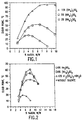
- the amount of chaotropic salt, or anionic organic salt also depends on the amount of kosmotropic salt. For example, Table 1 shows the cloud points of 0.5% poly(DMAEM.MeCl) as a function of sodium thiocyanate concentration and (NH 4 ) 2 SO 4 concentration, where the concentrations are expressed as weight percent on total.
- Table 1 shows that one can manipulate the amount of chaotropic salt, or anionic organic salt, the amount of kosmotropic salt, the temperature, or some combination thereof.
- the cloud points of poly(DMAEM.MeCl) reach a maximum of about 30°C at a NaSCN concentration of about 4%.
- further addition of chaotropic NaSCN increases the solubility of the polymer, as the cloud point decreases.
- there is an effective amount of sodium thiocyanate ranging from about 3% to about 5%, which causes precipitation of the polymer at room temperature. It is clear to one skilled in the art that the range may be broadened by reducing the temperature, or by increasing the concentration of (NH 4 ) 2 SO 4 .
- Tables 2 and 3 show that the particular type of kosmotropic salt and the particular type of chaotropic salt, respectively, may also influence the cloud points of poly(DMAEM.MeCl).
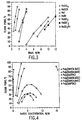
- the data from Tables 2 and 3 are plotted in Figures 2 and 3, respectively.
- Figure 2 shows that, for equal amounts by weight, Na 2 SO 4 tends to give higher cloud points than (NH 4 ) 2 SO 4 .
- (NH 4 ) 2 SO 4 tends to give higher cloud points than Al 2 (SO 4 ) 3 •18H 2 O, even when larger amounts, by weight, of Al 2 (SO 4 ) 3 •18H 2 O are used, depending on the concentration of NaSCN.
- Table 4 plotted in Figure 4, shows the cloud points of 0.5% solutions of various water-soluble, cationic polymers as a function of NaSCN concentration in 5% (NH 4 ) 2 SO 4 solution. Even though all of these polymers are highly water-soluble and not hydrophobic per se, some of the polymers may be considered more hydrophobic than others because they have a higher content of hydrophobic groups. In general, polymers which are more hydrophobic tend to have higher cloud points for a given combination of chaotropic salt, or anionic organic salt, and kosmotropic salt. For instance. Figure 4 shows that the cloud points of poly(DMAEM.BzCl), which contains hydrophobic benzyl groups, are quite high, even at very low NaSCN concentrations.
- Table 5 shows the cloud points of poly(DMAEA.MeCl) and a AMD/DMAEA.MeCl/EA terpolymer (obtained by polymerizing 45 mole % acrylamide (AMD), 45 mole % DMAEA.MeCl and 10 mole % ethyl acrylate (EA)) in 5% (NH 4 ) 2 SO 4 as a function of NaSCN concentration.
- ALD amle % acrylamide
- EA mole % ethyl acrylate
- Table 6 shows the cloud points of two polymers as a function of polymer concentration (0.5%, 5%, 15%, and 20%) and NaSCN concentration in 5% (NH 4 ) 2 SO 4 . This data shows that the cloud points may also be affected by the concentration and by the counterion of the cationic polymer.
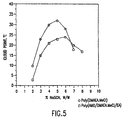
- Figure 6(a) shows the cloud points of poly(DMAEM.MeCl) as a function of NaSCN concentration in 5% (NH 4 ) 2 SO 4 .
- Poly(DMAEM.MeCl) is the polymer obtained by polymerizing the methyl chloride quaternary salt of dimethylaminoethylmethacrylate.
- FIG. 6(b) shows the cloud points of poly(DMAEM.DMS), which is the polymer obtained by polymerizing the dimethyl sulfate quaternary salt of dimethylaminoethylmethacrylate. Note that the change in the amount of NaSCN required to give a certain cloud point is different for the two polymers, which are substantially the same except for the identity of the counterion.
- Effective amounts of anionic organic salt which will insolubilize a particular cationic water-soluble polymer, in the presence of kosmotropic salt are generally in the range of from 0.1% to 40%, preferably from 0.5% to 35%, most preferably from 1% to 30%.
- effective amounts of chaotropic salt which will insolubilize a particular cationic water-soluble polymer, in the presence of kosmotropic salt are generally in the range of 0.5% to 250%, preferably in the range of 1% to 200%, more preferably in the range of 7% to 150%, most preferably in the range of 10% to 100%, by weight, based on the weight of the polymer.
- Effective amounts of kosmotropic salt useful in admixture with the anionic organic salt and/or the chaotropic salt are in the range of 0.1% to 30%, preferably from 1% to 27%, more preferably from 10% to 25%.
- the salts are soluble in the solution, so the upper limits to salt content are determined mainly by the capacity of the solution to dissolve the salt, which is, in turn, affected by the temperature and the amount of polymer in the composition.
- the effective amounts of chaotropic salt, or anionic organic salt, and effective amounts of kosmotropic salt useful for precipitating a particular polymer at a particular temperature may be found by routine experimentation, following the trends established in the results discussed herein.
- anionic organic salt which will insolubilize the resulting cationic water-soluble polymer, in the presence of kosmotropic salt, are generally in the range of from 0.2% to 50%, preferably from 0.5% to 40%, more preferably from 1% to 35%, most preferably from 5% to 25%.
- effective amounts of chaotropic salt which will insolubilize the resulting cationic water-soluble polymer, in the presence of kosmotropic salt are generally in the range of 0.1% to 250%, preferably in the range of 2% to 220%, more preferably in the range of 8% to 150%, most preferably in the range of 10% to 100%, by weight, based on the weight of the monomers.
- Effective amounts of kosmotropic salt useful in admixture with the anionic organic salt and/or the chaotropic salt are in the range of 0.5% to 30%, preferably from 1% to 28%, more preferably from 5% to 25%.
- the salts are soluble at the end of the polymerization, so the upper limits to salt content are determined mainly by the capacity of the solution to dissolve the salt, which is, in turn, affected by the temperature and the amount of polymer in the composition.
- the effective amounts of chaotropic salt, or anionic organic salt, and effective amounts of kosmotropic salt useful when conducting a polymerization of monomers at a particular temperature may be found by routine experimentation, following the trends established in the results discussed herein.
- the chaotropic salts useful in this invention may be any chaotropic salt including thiocyanates, perchlorates, chlorates, bromates, bromides, iodides and nitrates.
- the counterion to the anion has a relatively small effect on the solubility of the cationic polymer, and may be ammonium or any alkali metal cation such as lithium, sodium or potassium, or an alkaline earth metal cation.
- sodium perchlorate, sodium chlorate, sodium bromide, sodium iodide and sodium nitrate are preferred.
- Table 7 shows the cloud points of 0.5% poly(DMAEM.MeCl) as a function of the amount of Nal in a mixture of Nal and NaBr, in 20% (NH 4 ) 2 SO 4 .
- the cloud points did not follow the simple "rule of mixtures" behavior that would be expected if each chaotropic salt influenced the cloud point in proportion to its weight fraction in the solution; i.e., the cloud point curve is not linear as a function of the amount Nal in the mixture, and instead shows that cloud points which are advantageously higher than would be expected based on the "rule of mixtures" can be obtained by using a mixture of chaotropic salts.
- the kosmotropic salts useful in the instant invention can be any kosmotropic salt including sulfates, phosphates, fluorides, citrates, acetates, tartrates, and hydrogenphosphates.
- the counterion has a small effect on the solubility of the polymer as shown in Table 2 ( Figure 2), and may be ammonium or any alkali or alkaline earth metal such as lithium, sodium, potassium, magnesium, calcium, etc.
- the counterion may also be aluminum, as shown in Table 2 ( Figure 2), or may be a transition metal cation such as manganese or iron.
- Preferred kosmotropic salts are ammonium sulfate and sodium sulfate. Mixtures of kosmotropic salts are also effective and may be preferred.
- anionic organic salts such as anionic hydrotropic salts and anionic surfactants, also precipitate cationic polymers, when used in conjunction with kosmotropic salts.
- Anionic organic salts with the general structure R-A - M + , where R comprises ester, alkyleneoxy, alkyl, or substituted alkyl with from 1 to 22 carbons, or aryl or substituted aryl with from 6 to 22 carbons, A is an anionic group such as carboxylate, sulfonate, or sulfate group, and M is a metal or ammonium, are useful for the precipitation of cationic polymers, in the presence of kosmotropic salts.
- the R group may be straight or branched, and may be substituted with more than one anionic group A.
- the anionic group A may be substituted with more than one R group.
- Mixtures of anionic organic salts with each other, or with chaotropic salts, are also useful, in admixture with a kosmotropic salt or salts. Exceptions to the foregoing are the acetate, citrate and tartrate anions, which tend to be kosmotropic.
- Preferred anionic organic salts contain anions such as trichloroacetate and trifluoromethanesulfonate; also sulfonates and disulfonates such as methanesulfonate, ethanesulfonate, propanesulfonate, butanesulfonate, butanedisulfonate, pentanesulfonate, hexanesulfonate, hexanedisulfonate, and octanedisulfonate; also aryl and substituted aryl sulfonates and disulfonates such as benzenesulfonate, nitrobenzenesulfonate, xylenesulfonate, toluenesulfonate, benzenedisulfonate, naphthalenesulfonate, etc.
- anions such as trichloroacetate and trifluoromethanesulfonate
- organic salts contain anions such as dialkylsulfosuccinate, dicycloalkylsulfosuccinate and diarylsulfosuccinate, eg diisobutylsulfosuccinate, diisooctylsulfosuccinate, dimethylsulfosuccinate, diethylsulfosuccinate and diisopropylsulfosuccinate.
- Sodium hexanesulfonate, sodium benzenesulfonate, and sodium xylenesulfonate are more preferred.
- Sodium benzenedisulfonate, sodium butanedisulfonate, sodium hexanedisulfonate, sodium octanedisulfonate, and sodium decanedisulfonate are most preferred.
- Tables 8 and 9 show the cloud points of 0.5% poly(DMAEM.MeCl) as a function of anionic organic salt concentration, without (NH 4 ) 2 SO 4 (Table 8 and Figure 8) and with about 20% (NH 4 ) 2 SO 4 (Table 9 and Figure 9).
- Table 8 shows that, at concentrations of up to about 5% anionic organic salt, the naphthalenesulfonates, xylenesulfonate and nitrobenzenesulfonate cause precipitation of 0.5% poly(DMAEM.MeCI) in the absence of (NH 4 ) 2 SO 4 .
- Table 10 shows the cloud points of a copolymer comprised of 45 mole % acrylamide and 55 mole % poly(DMAEA.MeCI) as a function of DIBSS and (NH 4 ) 2 SO 4 concentration.
- concentration of the copolymer abbreviated as poly(45-AMD/55-DMAEA.MeCl). was 0.5%.
- increasing the (NH 4 ) 2 SO 4 concentration from 5% to 15% decreased the amount of DIBSS useful for insolubilizing the polymer.
- the effective amounts of kosmotropic salt and anionic organic salt, including anionic hydrotropic salts and anionic surfactants, useful to cause precipitation or phase separation depend on the temperature, the inherent solubility of the polymer, the concentration of the polymer, the particular anionic organic salt used, and the particular kosmotropic salt used.
- the effective amount of anionic organic salt also depends on the amount of kosmotropic salt. When used without a kosmotropic salt, a greater amount of anionic organic salt is generally necessary to bring about a particular level of polymer insolubility than when a kosmotropic salt is present.
- the effective amounts of anionic organic salt and effective amounts of kosmotropic salt useful for precipitating a particular polymer at a particular temperature may be found by routine experimentation, following the trends established in the results discussed herein.
- Polymers useful in the practice of this invention may be any water-soluble cationic polymer, including polymers made by the polymerization and copotymerization of cationic monomers, and polymers which become cationically charged after polymerization has occurred.
- the mole % of cationic recurring units, based on total moles of recurring units in the polymer, is generally from 1 mole% to 100 mole%, preferably from 10 mole% to 90 mole%, more preferably from 20 mole% to 80 mole%, most preferably from 30 mole% to 70 mole%.
- Polymers useful in this invention may include those having recurring units represented by the following general formula (I): where R 1 is either hydrogen or CH 3 , A is either an oxygen atom or NH, R 2 and R 3 are each, individually, an alkyl group having from about 1 to about 3 carbons, B is an alkylene or oxyalkylene group having 1 to 5 carbons, R 4 is an alkyl group or a substituted alkyl group having from about 1 to about 10 carbons, or an aryl or substituted aryl group having from about 6 to about 10 carbons, and X is an anionic counterion.
- R 1 is either hydrogen or CH 3
- A is either an oxygen atom or NH
- R 2 and R 3 are each, individually, an alkyl group having from about 1 to about 3 carbons
- B is an alkylene or oxyalkylene group having 1 to 5 carbons
- R 4 is an alkyl group or a substituted alkyl group having from about 1 to about 10 carbons, or an aryl or
- A is an oxygen atom
- B has two carbons
- R 2 and R 3 are methyl or ethyl
- R 4 is methyl, ethyl, or benzyl.
- cationic polymers are prepared from, or contain recurring units corresponding to, quaternary salts of dialkylaminoalkyl(alk)acrylate, including the methyl chloride, dimethyl sulfate, alkyl halide, and benzyl chloride quaternary salts of such monomers as dimethylaminoethyl(meth)acrylate, diethylaminoethyl(meth)acrylate, etc. and the like.
- Other cationic polymers and copolymers such as poly(diallydialkylammonium halide), polyamines, and condensation polymers made from monomers such as epichlorohydrin and dimethylamine are also useful in the practice of this invention.
- Monomers which may be copolymerized with the cationic monomers mentioned above may be cationic, nonionic or anionic.
- Cationic monomers include the monomers corresponding to (I) and other cationic monomers such as diallydimethylammonium chloride, diallydiethylammonium chloride, etc.
- Nonionic monomers may include substantially water- soluble monomers such as acrylamide, methacrylamide, and N-isopropylacrylamide, or monomers which are sparingly soluble in water such as t-butylacrylamide, N,N- dialkylacrylamide, diacetone acrylamide, ethyl acrylate, methyl methacrylate, methyl acrylate, styrene, butadiene, ethyl methacrylate, acrylonitrile, etc. and the like.
- Nonionic monomers may also include monomers which become charged at low pH, such as dimethylaminoethylacrylate.
- nonionic monomers are acrylamide, t-butyl acrylamide, methacrylamide, methyl methacrylate, ethyl acrylate and styrene.
- Anionic monomers may include acrylic acid, 2-acrylamido-2-methylpropane sulfonic acid, styrene sulfonic acid, their salts and the like.
- the polymer contains fewer anionic recurring units than cationic recurring units so that the polymer, although ampholytic, retains a net positive cationic charge.
- the polymer contains less than 10 mole% anionic recurring units, based on the total number of recurring units in the polymer.
- Polymers which become cationically charged e.g. by quaternization, after polymerization include homopolymers produced from such monomers as dimethylaminoethylacrylate, dimethylaminoethylmethacrylate, diethylaminoethylacrylate, diethylaminoethylmethacrylate and corresponding acrylamide derivatives such as methacrylamidopropyldimethylamine, as well as copolymers with any of the other monomers discussed hereinabove.
- Functionalized acrylamide polymers such as those Mannich or glyoxylated polymers produced in U.S. 5,132,023; 5,037,881; 4,956,399; 4,956.400; which are incorporated herein by reference, are also useful in the practice of this invention.
- the instant invention is most useful for precipitating polymers such as poly(DMAEM.MeCl) which do not contain hydrophobic groups e.g. benzyl groups which make it easier to precipitate the polymer, because such polymers may be difficult or impossible to precipitate using a kosmotropic salt alone.
- polymers such as poly(DMAEM.MeCl) which do not contain hydrophobic groups e.g. benzyl groups which make it easier to precipitate the polymer, because such polymers may be difficult or impossible to precipitate using a kosmotropic salt alone.
- mixtures of chaotropic salt, or anionic organic salt, and kosmotropic salt may also be used to precipitate polymers which may precipitate in kosmotropic salt alone.
- a salt mixture e.g chaotropic with kosmotropic may provide a benefit over the use of a kosmotropic salt alone because the salt mixture may precipitate the polymer more effectively e.g the cloud point may be higher, the overall salt level may be lower, the bulk viscosity may be lower e.g. of a polymer dispersion, etc.
- a 1% solution of a terpolymer prepared by polymerizing 20 mole% DMAEA.MeCl, 20 mole% DMAEA.BzCl (benzyl chloride quaternary salt of dimethylaminoethylacrylate), and 60 mole% AMD may be precipitated in a solution that contains 30% ammonium sulfate, but may be soluble in a solution that contains 25% ammonium sulfate. From a practical point of view, it may be disadvantageous to use salt levels in excess of 25% to precipitate the polymer. However, the total salt content may be drastically lowered by using a mixture of an chaotropic salt and a kosmotropic salt.
- a 1% solution of the same terpolymer may be precipitated in a solution that contains 10% ammonium sulfate and 0.75% NaSCN, a total salt level of only 10.75%, vs. a total salt level of about 30% for ammonium sulfate alone.
- Mixtures of one or more polymers may be precipitated by the practice of this invention.
- the polymers may be mixed together before, during or after being mixed with part or all of the salt solution.
- Mixtures of polymers may be separated from each other by utilizing a salt solution that tends to precipitate one or more polymers in the mixture, but is a solvent for one or more other polymers in the mixture. Additional salts may be added before, during or after the precipitation process.
- a polymer or copolymer may also be formed by polymerization of the monomers in the presence of another polymer or polymers, which themselves may be either precipitated or soluble in the salt solution.
- Polymerization of the monomers may be carried out in any manner known to those skilled in the art, including solution, bulk, precipitation, dispersion, suspension, emulsion, microemulsion, etc. Polymerization of the monomers may be carried out in the presence of part or all of the salt solution. Initiation may be effected with a variety of thermal and redox free radical initiators, including peroxides, e.g. t-butyl peroxide; azo compounds, e.g. azoisobisbutyronitrite; inorganic compounds, such as potassium persulfate and redox couples, such as ferrous ammonium sulfate/ammonium persulfate and sodium bromale/sulfur dioxide.
- peroxides e.g. t-butyl peroxide
- azo compounds e.g. azoisobisbutyronitrite
- inorganic compounds such as potassium persulfate and redox couples, such as ferrous ammonium
- Initiator addition may be may be effected any time prior to the actual initiation per se.
- Polymerization may also be effected by photochemical irradiation processes, such as by ultraviolet irradiation or by ionizing irradiation from a cobalt 60 source.
- the monomers may all be present when polymerization is initiated, or part of the monomers may be added at a later stage of the polymerization.
- Polymerization may be conducted in multiple stages. Additional materials such as pH adjusting agents, stabilizers, chelating agents, sequestrants, etc. may also be added before, during or after polymerization.
- the molecular weights of the polymers which are precipitated or phase separated by the practice of this invention are not particularly critical.
- the weight average molecular weights of the polymers may generally range from 1,000 to 100,000,000, preferably from 100,000 to 75,000,000, more preferably from 1,000,000 to 60,000,000.
- the concentration of the polymer in the composition may range from 0.01% to 90%, or occasionally even higher. It is generally preferred, for practical reasons such as the desire to keep production and shipping costs relatively low, for the level of polymer in the compositions to be as high as possible.
- compositions of the salt solutions, useful for precipitating cationic polymers may be prepared by simply dissolving the desired salts in water, preferably with agitation.
- Waters useful in the practice of this invention are not particularly critical and can be from any source of water e.g. distilled water, tap water, recycled water, process water, well water, etc.
- Precipitation of the cationic polymer in the salt solution may be carried out by mixing, in any order, the salt solution and the polymer solution or polymer emulsion.
- a second, different water-soluble polymer may be mixed in to stabilize the precipitated polymer droplets by slowing or preventing settling.
- Substantially dry polymer granules of water-soluble polymer may be added to the salt solutions to form compositions comprising salts, water and precipitated polymer.
- the cationic water-soluble polymer may be formed by polymerization of the monomers in the presence of the salts. All or part of the polymer may be precipitated.
- precipitated polymer is a polymer dispersion if some or all of the precipitated polymer is in the form of small droplets that are dispersed in the aqueous salt solution.
- the precipitated polymer droplets may contain salt and water. Some or all of the polymer may be precipitated.
- the droplet size may generally be in the range of from 0.1 micron to 1 millimeter, preferably from 0.1 micron to 100 microns, more preferably from 0.1 micron to 10 microns, and most preferably from 0.1 micron to 5 microns.
- the monomer or monomers and salt or salts may be added in stages during the polymerization or may all be present at the start. Initiation of polymerization may be conducted in any manner, as described hereinabove.
- the dispersed polymer droplets may tend to settle on standing. Surprisingly, it has been found that certain water-soluble polymers, which may be referred to herein as dispersants, tend to stabilize the droplets against settling.
- the polymer dispersant stabilizes the polymer dispersion, but does not cause the cationic water-soluble polymer to be precipitated. As discussed above, the salt combination causes the cationic water-soluble polymer to be precipitated. It has been found that polymers such as polyacrylamide and copolymers of acrylamide with amounts of cationic, nonionic and anionic monomers decrease the settling rate of dispersions.
- the polymerization of a mixture of 45 mole % acrylamide and 55 mole percent DMAEA.MeCl in the presence of about 6% sodium benzenedisulfonate and about 15% (NH 4 ) 2 SO 4 gives a polymer dispersion containing the precipitated copolymer of acrylamide and DMAEA.MeCl.
- the polymer droplets tend to settle with time and may merge to form a layer that is separate from the aqueous phase.
- another water-soluble polymer e.g. polyacrylamide, or copolymers of acrylamide with cationic, anionic or nonionic monomers, the rate of settling is dramatically reduced.
- the water-soluble polymer which may act as a dispersant, may be mixed in before, during or after mixing together cationic water-soluble polymer, water and salts.
- the polymerization of monomers in the presence of chaotropic salt, or anionic organic salt, and kosmotropic salt to form a precipitated water-soluble cationic polymer is conducted in the presence of one or more water-soluble polymers different from said cationic water-soluble polymer.
- Polymers useful as dispersants may include polyacrylamide and other nonionic polymers, e.g. poly(methacrylamide), poly(vinyl alcohol), poly(ethylene oxide), etc. and the like.
- dispersants are soluble or mostly soluble in the particular salt solution. It is generally preferable for the dispersant to have greater solubility in the particular salt solution than the precipitated polymer droplets which are being dispersed.
- Cationic polymers e.g. poly(MAPTAC), poly(DMAEA.MeCl), etc. and the like are useful as dispersants when the polymer to be precipitated is less soluble than the dispersant.
- Copolymers useful as dispersants may include copolymers of nonionic monomers e.g.
- acrylamide with up to 99 mole %, preferably up to 50 mole %, more preferably from 5 to 25 mole%, based on total moles of recurring units in the polymer, of a cationic comonomers e.g. DMAEA.MeCl, DMAEM.MeCI, diallydimethylammonium chloride, etc.
- a cationic comonomers e.g. DMAEA.MeCl, DMAEM.MeCI, diallydimethylammonium chloride, etc.
- Other copolymers useful as dispersants include copolymers of acrylamide with up to 30 mole % of an anionic comonomer such as sodium 2-acrylamido-2-methylpropane sulfonic acid, preferably from 5 to 20% comonomer, based on total moles of recurring units in the polymer.
- Anionic comonomers may include acrylic acid, styrene sulfonic acid, their salts and the like.
- Nonionic comonomers may include substantially water-soluble monomers such as methacrylamide, or monomers which are sparingly soluble in water such as t-butylacrylamide, diacetone acrylamide, ethyl acrylate, methyl methacrylate, methyl acrylate, styrene, butadiene, ethyl methacrylate, acrylonitrile, etc. and the like.
- Nonionic comonomers may also include monomers which become charged at low pH, such as dimethylaminoethylacrylate, dimethylaminoethylmethacrylate, diethylaminoethylacrylate, diethylaminoethylmethacrylate and corresponding acrylamide derivatives such as methacrylamidopropyldimethylamine.
- Preferred nonionic comonomers are acrylamide, t-butyl acrylamide, methacrylamide, methyl methacrylate, ethyl acrylate and styrene.
- Dispersants which have a block or graft structure are particularly preferred.
- those skilled in the art realize that copolymers prepared by polymerizing acrylamide in the presence of poly(vinyl alcohol), using certain initiators e.g. (NH 4 ) 2 Ce(NO 3 ) 6 , result in block or graft copolymers.
- the poly(vinyl alcohol) may constitute up to 50% of the weight of the copolymer, preferably from 5% to 30%.
- Dispersants are generally used in amounts ranging up to 25%, preferably 1% to 20%, more preferably 5% to 15%, based on the total weight of the precipitated cationic polymer droplets being dispersed.
- the dispersant is not used in amounts which cause the precipitation of the cationic polymer in the absence of chaotropic salts, or anionic organic salts, and kosmotropic salts.
- the weight average molecular weights of the dispersant polymers generally may range from 1,000 to 50,000,000, preferably from 50,000 to 10,000,000, more preferably from 100,000 to 5,000,000.
- Routine experimentation used to identify an effective combination of chaotropic salt, or anionic organic salt, kosmotropic salt, and temperature that will precipitate a particular concentration of a particular cationic, water-soluble polymer may be carried out in a number of ways.
- One way is by the cloud point technique described above. For instance, to determine the cloud points of 1% poly(DMAEM.MeCI) one could prepare 30 samples of 1% aqueous poly(DMAEM.MeCl), each containing either 0%, 5%, 10%, 15%, or 20% ammonium sulfate, and either 0%, 2% 4%, 6% 8% or 10% sodium thiocyanate, in all combinations.
- the samples having 0% salt are control samples.
- the cloud points of each solution might then be determined by heating each sample to dissolve the polymer, then cooling until the solution turned cloudy.
- the cloudiness would indicate precipitation, and the temperature at which it occurred would be the cloud point.
- the process could be repeated for any other polymer, polymer concentration or salts. Typically, some of the samples would remain clear, even down to 0°C or below, whereas others would remain cloudy on heating, even to 100°C or above. Although one would not obtain cloud point information from these samples, one would know the phase behavior of the particular polymer for that particular salt system.
- the cloud points might be determined by cooling the mixtures until the polymers dissolved, then heating to precipitate the polymer. In these cases, the cloud points would be the temperatures at which cloudiness was observed on heating.
- Examples 23-41 show that the total salt level useful for precipitating a cationic polymer may be lower when a mixture of chaotropic salt, or anionic organic salt, and kosmotropic salt is used, as compared to using a kosmotropic salt alone.
- Another routine experimental process for identifying effective amounts of salts that will precipitate a particular cationic polymer at a particular temperature is to polymerize the monomers in the salt solution, then determine the cloud points.
- This technique is preferred at high concentrations of polymer, because concentrated solutions of polymers, e.g. 10% or greater, may be difficult to manipulate e.g. stir.
- the process is similar to the cloud point process in that one might make a series of salt solutions into which the monomer or monomers would be dissolved at concentrations necessary to provide the desired concentration of polymer.
- the solutions might then be polymerized in a known manner, e.g. sparged with inert gas such as nitrogen, then polymerization initiated by a conventional free radical initiator, to form mixtures of the polymers and salts.
- the cloud points of the mixtures could then be determined as above.
- the precipitated polymer may be recovered from the salt solution by any means known in the art, including filtration, centrifugation, evaporation, spray drying, combinations thereof, etc.
- the recovered polymer granules typically contain cationic water-soluble polymer, residual salts, optionally residual dispersant, and water.
- the resulting polymer granules contain less than 30% water, more preferably from 0.1% to 20%.
- Substantially dry, i.e. containing less than about 10% H 2 O, free flowing polymer granules are preferred for handling purposes.
- Various pH adjusting agents, flow control agents, preservatives, particles size control agents, etc. that are known to those skilled in the art may be added, at any stage of the process, to give substantially dry granules containing cationic, water-soluble polymer.
- compositions and processes of this invention provide water-soluble cationic polymers that are useful in a number of applications e.g. the flocculation of dispersions of suspended solids, recovery of minerals from mining operations, papermaking, enhanced oil recovery, treatment of refinery waste, treatment of paper waste, treatment of food waste, etc.
- the dispersions of suspended solids may be biologically treated suspensions.
- compositions of precipitated polymer may be added directly to a dispersion of suspended solids to be treated, mixed, and the resultant concentrated dispersion separated by means known in the art such as centrifuge, belt press, filter press, filter, etc.
- the compositions are first diluted into water to form solutions having a cationic polymer concentration of 0.01 to 10%, preferably 0.05 to 5%, more preferably 0.1 to 3%.
- the dilute polymer solution may then be mixed in a known manner with the dispersion of suspended solids to be treated, and the resultant concentrated dispersion separated as above. It is known to those skilled in the art that the amount of dilute polymer solution effective for a particular application may be found through routine experimentation, as illustrated in Examples R and 20-22, below.
- a particularly preferred application is the treatment of dispersions of suspended solids which comprise a biologically treated suspension.
- Substantially dry polymer granules and polymer dispersions are preferred because the small granule or droplet size of the polymer encourages the polymer to dissolve more quickly on dilution. It is believed that the polymer dissolves, in spite of the presence of the salts which tend to precipitate it, because the salt concentration is reduced from the effective range for precipitation to a range that allows for the polymer to dissolve, by dilution.
- Another preferred application for the water-soluble cationic polymers of the instant invention is soil conditioning e.g. for the prevention of soil erosion.
- the process of irrigating a field may tend to cause the detrimental loss of valuable topsoil by erosion.
- Soil may be stabilized against erosion, particularly in situations wherein the soil is irrigated, by a process which comprises adding to the soil a soil-conditioning amount of an aqueous composition comprised of an effective amount of at least one chaotropic salt, or anionic organic salt, an effective amount of at least one kosmotropic salt, and at least one precipitated cationic water-soluble polymer.
- the addition of the polymer to the soil in a soil-conditioning amount tends to produce greater cohesiveness between the particles of soil, so that the soil is stabilized against erosion by wind, water, etc.
- the composition is dissolved in water to form a conditioning solution, which may then be applied to the soil, preferably in addition to, or substituted for, the water typically used to irrigate a field.
- a conditioning solution may then be applied directly to the soil.
- the polymer may form a conditioning solution when combined with water already present in the soil, or by the subsequent application of water to dissolve the polymer.
- soil-conditioning amounts generally range from 0.1 to 20 pounds (0.045-9 kg) of polymer per acre (0.4 ha) per year, preferably 0.5 to 10 pounds (0.23-4.5 kg) of polymer per acre (0.4 ha) per year.
- Soil erosion may also take the form of large scale movements of soil e.g landslides, where the soil is not typically irrigated. For instance, the destruction of vegetation on a hillside by e.g fire may leave the underlying soil unstable and prone to movement.
- means other than irrigation such as spraying, may be used to apply the conditioning solutions.
- polymer dispersions or dry polymer may be applied directly to the soil. In these cases, the polymer may form a conditioning solution when combined with water already present in the soil, or by the subsequent application of water to dissolve the polymer.
- Standard viscosity is the viscosity of a 0.096% solution of water-soluble polymer in 1N sodium chloride at 25°C. The viscosity is measured by a Brookfield LVT viscometer with a UL adapter at 60 rpm. The polymer solution being measured is made by diluting a polymer dispersion or solution to a concentration of 0.2% by stirring with the appropriate amount of deionized water during about twelve hours, and then diluting with the appropriate amounts of deionized water and sodium chloride.
- a 40% solution of poly(DMAEM.MeCl) was prepared as follows: 160 part of a 75% solution of DMAEM.MeCI, 140 parts of deionized water and 0.120 parts of 2,2'-azobis[2-(2-imidazdin-2-yl) propane] dihydrochloride, hereinbelow VA-044, an azo initiator, were added to an appropriate vessel. The solution was sparged with nitrogen gas and stirred for about one hour at ambient temperature. The nitrogen sparge was changed to a nitrogen purge, and polymerization was initiated thermally by raising the temperature of the solution to 44°C. Stirring and heating were continued for about 21 hours. The vessel was cooled to give a clear, viscous solution of poly(DMAEM.MeCl) having a standard viscosity of about 1.4x10 -3 Pa.s.
- a 20% solution of poly(DMAEM.MeCl) was prepared as follows: 80 parts of a 75% solution of DMAEM.MeCl, 220 parts of deionized water and 0.015 parts of VA-044 were added to a suitable glass vessel. The solution was sparged with nitrogen gas and the solution was stirred for about one hour at ambient temperature. The nitrogen sparge was changed to a nitrogen purge, and polymerization was initiated by exposing the glass vessel to a ultraviolet lamp. Stirring and heating were continued for about 3 hours to give a clear, viscous solution of poly(DMAEM.MeCl) having a standard viscosity of about 1.4x10 -3 Pa.s.
- the temperature dependent solubility behavior of poly(DMAEM.MeCl) prepared as in Example A was determined by measuring the cloud points in sodium thiocyanate solution as follows: The 40% poly(DMAEM.MeCI) polymer solution was diluted in deionized water to give a 1% solution. One part of the 1% polymer solution was added to a first clear glass vessel. A 3.24 % solution of NaSCN was prepared in a second vessel, and 1 part of the 3.24 % NaSCN solution was added to the first glass vessel containing 1 part of 1% poly(DMAEM.MeCl), with stirring. The resulting clear solution in the first vessel had a polymer concentration of 0.5% and a NaSCN concentration of 1.62 %.
- the first vessel was cooled in an ice bath, and the polymer was observed to precipitate, as evidenced by the appearance of turbidity in the vessel, at a temperature of 16°C.
- the cloud point of 0.5% poly(DMAEM.MeCI) in 1.62% NaSCN was 16°C.
- the cloud point of 0.5% poly(DMAEM.MeCI), prepared as in Example B, in 1.62% NaSCN was also 16°C.
- Example C The procedure of Example C was repeated, except that the concentration of NaSCN in the second vessel was adjusted so that the resulting NaSCN concentration in the first vessel was 3.24 %. In this case, turbidity indicative of precipitation was observed at ambient temperature. The first vessel was heated to dissolve the polymer, forming a clear solution. On cooling, turbidity indicative of precipitation was noted at 30°C. Thus, the cloud point of 0.5% poly(DMAEM.MeCl) in 3.24% NaSCN was 30°C.
- Example C The procedure of Example C was repeated, except that the solution in the second vessel contained 6.48 % NaSCN and 10% (NH 4 ) 2 SO 4 .
- the resulting concentration of NaSCN in the first vessel was thus 3.24%, and the resulting concentration of (NH 4 ) 2 SO 4 was 5%.
- turbidity indicative of precipitation was observed at ambient temperature.
- the first vessel was heated to dissolve the polymer, forming a clear solution. On cooling, turbidity indicative of precipitation was noted at 38°C.
- Example C The procedure of Example C was repeated, except that the solution in the second vessel contained 6.48 % NaSCN and 20% (NH 4 ) 2 SO 4 .
- the resulting concentration of NaSCN In the first vessel was thus 3.24%, and the resulting concentration of (NH 4 ) 2 SO 4 was 10%.
- turbidity indicative of precipitation was observed at ambient temperature.
- the first vessel was heated to dissolve the polymer, forming a clear solution. On cooling, turbidity indicative of precipitation was noted at 60°C.
- the cloud point of 0.5% poly(DMAEM.MeCl) in 3.24% NaSCN and 10% (NH 4 ) 2 SO 4 was 60°C.
- a 20% solution of poly(DMAEM.MeCl) was prepared in the presence of 5% NaSCN and 10% (NH 4 ) 2 SO 4 by adding 80 parts of a 75% solution of DMAEM.MeCI, 15 parts NaSCN, 30 parts (NH 4 ) 2 SO 4 , 175 parts of deionized water and 0.060 part VA-044 to an appropriate vessel.
- the solution was sparged with nitrogen gas and stirred for about one hour at ambient temperature.
- the nitrogen sparge was changed to a nitrogen purge, and polymerization was initiated thermally by raising the temperature of the solution to 44°C. Stirring and heating were continued for about 21 hours, then cooled to give a white, opaque mixture.
- the mixture was heated to dissolve the polymer and formed a clear solution.
- the temperature dependent solubility behavior of poly(DMAEM.MeCI) prepared as in Example A was determined by measuring the cloud points in sodium 3-nitrobenzenesulfonate solution as follows: The 40% poly(DMAEM.MeCl) polymer solution was diluted in deionized water to give a 1% solution. One part of the 1% polymer solution was added to a clear glass vessel. 0.04 part sodium 3-nitrobenzenesulfonate and 0.96 part deionized water was added to the glass vessel containing 1 part of 1% poly(DMAEM.MeCl), with stirring. The resulting mixture had a polymer concentration of 0.5% and a sodium 3-nitrobenzenesulfonate concentration of 2.0 %.
- the vessel was warmed to produce a clear solution, then allowed to cool.
- the polymer was observed to precipitate, as evidenced by the appearance of turbidity in the vessel, at a temperature of 26°C.
- the cloud point of 0.5% poly(DMAEM.MeCl) in 2.0% sodium 3-nitrobenzenesulfonate was 26°C.
- the temperature dependent solubility behavior of poly(DMAEM.MeCl) prepared as in Example A was determined by measuring the cloud points in a solution containing (NH 4 ) 2 SO 4 and sodium 3-nitrobenzenesulfonate as follows: The 40% poly(DMAEM.MeCl) polymer solution was diluted in deionized water to give a 1% solution. One part of the 1% polymer solution was added to a clear glass vessel. 0.04 part sodium 3-nitrobenzenesulfonate, 0.4 part (NH 4 ) 2 SO 4 , and 0.56 part deionized water was added to the glass vessel containing 1 part of 1% poly(DMAEM.MeCI), with stirring.
- the resulting mixture had a polymer concentration of 0.5%, a sodium 3-nitrobenzenesulfonate concentration of 2.0 %, and an (NH 4 ) 2 SO 4 concentration of 20%.
- the vessel was warmed to produce a clear solution, then allowed to cool. The polymer was observed to precipitate, as evidenced by the appearance of turbidity in the vessel, at a temperature of 81°C.
- the cloud point of 0.5% poly(DMAEM.MeCl) in 2.0% sodium 3-nitrobenzenesulfonate and 20% (NH 4 ) 2 SO 4 was 81°C, as compared to 26°C (Example F) when the (NH 4 ) 2 SO 4 was absent.
- a 15% solution of poly[3-acrylamido(3-methylbutyl)trimethyl ammonium chloride],or poly(AMBTAC), was prepared as follows: 15 parts of AMBTAC monomer and 83 parts of deionized water were added to an appropriate vessel. The solution was sparged with nitrogen gas and stirred for about one hour at ambient temperature. The nitrogen sparge was changed to a nitrogen purge, and polymerization was initiated by adding 0.33 part of nitrogen-sparged 1% ammonium persulfate solution by syringe and 0.33 part of nitrogen-sparged 1% sodium bisulfite solution by syringe.
- the temperature dependent solubility behavior of poly(AMBTAC) prepared as in Example G was determined by measuring the cloud points in a solution containing (NH 4 ) 2 SO 4 and sodium thiocyanate as follows: The 15% poly(AMBTAC) polymer solution was diluted in deionized water to give a 1% solution. One part of the 1% polymer solution was added to a clear glass vessel. 0.04 part sodium thiocyanate, 0.1 part (NH 4 ) 2 SO 4 , and 0.86 part deionized water were added to the glass vessel containing 1 part of 1% poly(AMBTAC), with stirring.
- the resulting mixture had a polymer concentration of 0.5%, a sodium thlocyanate concentration of 2.0 %, and an (NH 4 ) 2 SO 4 concentration of 5%.
- the vessel was warmed to produce a clear solution, then allowed to cool. The polymer was observed to precipitate, as evidenced by the appearance of turbidity in the vessel, at a temperature of 44°C.
- the cloud point of 0.5% poly(AMBTAC) in 2.0% sodium thiocyanate and 5% (NH 4 ) 2 SO 4 was 44°C.
- Example 5 The procedure of Example 5 was repeated, except that the sodium thiocyanate concentration was 3.0%. In this case, the polymer was observed to precipitate, as evidenced by the appearance of turbidity in the vessel, at a temperature of 70°C. Thus, the cloud point of 0.5% poly(AMBTAC) in 3.0% sodium thiocyanate and 5% (NH 4 ) 2 SO 4 was 70°C.
- a 40% solution of poly(DMAEA.MeCI), was prepared as follows: 160 parts of a 75% solution of DMAEA.MeCl (the methyl chloride quaternary of dimethylaminoethylacrylate), 140 parts of deionized water and 0.120 part of VA-044 were added to an appropriate vessel. The solution was sparged with nitrogen gas and stirred for about one hour at ambient temperature. The nitrogen sparge was changed to a nitrogen purge, and polymerization was initiated thermally by raising the temperature of the solution to 44°C. Stirring and heating were continued for about 21 hours. The vessel was cooled to give a clear, viscous solution of poly(DMAEA.MeCI) having a standard viscosity of about 2.3x10 -3 Pa.s.
- the temperature dependent solubility behavior of poly(DMAEA.MeCl) prepared as in Example H was determined by measuring the cloud points in a solution containing (NH 4 ) 2 SO 4 and sodium thiocyanate as follows: The 40% poly(DMAEA.MeCI) polymer solution was diluted in deionized water to give a 1% solution. One part of the 1% polymer solution was added to a clear glass vessel. 0.10 part sodium thiocyanate, 0.1 part (NH 4 ) 2 SO 4 , and 0.80 part deionized water were added to the glass vessel containing 1 part of 1% poly(DMAEA.MeCl), with stirring.
- the resulting mixture had a polymer concentration of 0.5%, a sodium thiocyanate concentration of 5 %, and an (NH 4 ) 2 SO 4 concentration of 5%.
- the vessel was warmed to produce a clear solution, then allowed to cool. The polymer was observed to precipitate, as evidenced by the appearance of turbidity in the vessel, at a temperature of 35°C.
- the cloud point of 0.5% poly(DMAEA.MeCI) in 5% sodium thiocyanate and 5% (NH 4 ) 2 SO 4 was 35°C.
- a 40% solution of poly(DMAEM.DMS) was prepared as follows: 160 parts of a 75% solution of DMAEM.DMS (the dimethyl sulfate quaternary salt of dimethylaminoethylmethacrylate), 140 parts of deionized water and 0.120 part of VA-044 were added to an appropriate vessel. The solution was sparged with nitrogen gas and stirred for about one hour at ambient temperature. The nitrogen sparge was changed to a nitrogen purge, and polymerization was initiated thermally by raising the temperature of the solution to 44°C. Stirring and heating were continued for about 18 hours. The vessel was cooled to give a clear, viscous solution of poly(DMAEM.DMS) having a standard viscosity of about 1.3x10 -3 Pa.s.
- the temperature dependent solubility behavior of poly(DMAEM.DMS) prepared as in Example I was determined by measuring the cloud points in a solution containing (NH 4 ) 2 SO 4 and sodium thiocyanate as follows: The 40% poly(DMAEM.DMS) polymer solution was diluted in deionized water to give a 1% solution. One part of the 1% polymer solution was added to a clear glass vessel. 0.10 part sodium thiocyanate, 0.1 part (NH 4 ) 2 SO 4 , and 0.80 part deionized water were added to the glass vessel containing 1 part of 1% poly(DMAEM.DMS), with stirring.
- the resulting mixture had a polymer concentration of 0.5%, a sodium thiocyanate concentration of 5 %, and an (NH 4 ) 2 SO 4 concentration of 5%.
- the vessel was warmed to produce a clear solution, then allowed to cool. The polymer was observed to precipitate, as evidenced by the appearance of turbidity in the vessel, at a temperature of 49°C.
- the cloud point of 0.5% poly(DMAEM.DMS) in 5% sodium thiocyanate and 5% (NH 4 ) 2 SO 4 was 49°C.
- a copolymer containing about 45 mole % DMAEA.MeCl, 42 mole % acrylamide (AMD) and 13 mole % ethyl acrylate (EA) was prepared by polymerizing the monomers in the presence of 15% (NH 4 ) 2 SO 4 and 6.75 % 1,3-benzenedisulfonate as follows: 16.8 parts of an 80% solution of DMAEA.MeCl, 8.6 parts of a 53% solution of acrylamide, 2.0 parts of ethyl acrylate, 15 parts of (NH 4 ) 2 SO 4 , and 7.94 parts of 85% 1,3-benzenedisulfonate and 44.66 parts of deionized water were added to a clear glass vessel, with stirring, to form a clear solution.
- a solution comprising 0.004 parts VA-044 per part of solution was added, along with 0.4 parts of a 5% solution of sodium ethylenediaminetetraacetate (EDTA) and 3.6 parts deionized water.
- EDTA is a chelating agent and was added to prevent inhibition of polymerization by metal ions.
- the resulting clear solution was nitrogen sparged, with stirring, for 30 minutes.
- the sparge was changed to a nitrogen purge, and polymerization was initiated by exposing the vessel to an ultraviolet lamp. Exposure to the lamp was continued for 45 minutes.
- the product was white and contained precipitated polymer with a standard viscosity of about 2.5x10 -3 Pa.s.
- a 10% solution of a copolymer containing about 55 mole % DMAEA.MeCI and 45 mole % acrylamide (AMD) was prepared as follows: 4.81 parts of an 80% solution of DMAEM.MeCI, 2.18 parts of a 53% solution of acrylamide (AMD), 0.63 parts of a solution comprising 0.002 part VA-044 per part of solution, 0.1 part of a 5% solution of sodium ethylenediaminetetraacetate (EDTA) and 42.28 parts of deionized water were added to a suitable glass vessel. The solution was sparged with nitrogen gas and stirred for about 15 minutes at ambient temperature.
- EDTA sodium ethylenediaminetetraacetate
- the nitrogen sparge was changed to a nitrogen purge, and polymerization was initiated by exposing the glass vessel to a ultraviolet lamp for about one hour.
- a 10% solution of a copolymer comprising 75 mole % DMAEA.MeCl and 25 mole % acrylamide (AMD) was prepared as follows: 5.57 parts of an 80% solution of DMAEM.MeCl, 1.03 parts of a 53% solution of acrylamide (AMD), 0.63 part of a solution comprising 0.002 part VA-044 per part of solution, 0.1 part of a 5% solution of sodium ethylenediaminetetraacetate (EDTA) and 42.67 parts of deionized water were added to a suitable glass vessel. The solution was sparged with nitrogen gas and stirred for about 15 minutes at ambient temperature.
- EDTA sodium ethylenediaminetetraacetate
- the nitrogen sparge was changed to a nitrogen purge, and polymerization was initiated by exposing the glass vessel to an ultraviolet lamp for about one hour.
- the temperature dependent solubility behavior of poly(55-DMAEA.MeCl / 45-AMD) prepared as in Example J was determined by measuring the cloud points in a solution containing (NH 4 ) 2 SO 4 and sodium 1,3-benzenedisulfonate as follows: The 10% poly(55-DMAEA.MeCl / 45-AMD) polymer solution was diluted in deionized water to give a 1% solution. 0.051 part sodium 1,3-benzenedisulfonate, 0.4 part (NH 4 ) 2 SO 4 , and 0.549 part deionized water was added to a clear glass vessel containing 1 part of 1% poly(55-DMAEA.MeCl/ 45-AMD), with stirring.
- the resulting mixture had a polymer concentration of 0.5%, a sodium 1,3-benzenedisulfonate concentration of 2.55 %, and an (NH 4 ) 2 SO 4 concentration of 20%.
- the vessel was warmed to produce a clear solution, then allowed to cool. The polymer was observed to precipitate, as evidenced by the appearance of turbidity in the vessel, at a temperature of 53°C.
- the cloud point of 0.5% poly(55-DMAEA.MeCl / 45-AMD) in 2.55% sodium 1,3-benzenedisulfonate and 20% (NH 4 ) 2 SO 4 was 53°C.
- the temperature dependent solubility behavior of poly(75-DMAEA.MeCl / 25-AMD) prepared as in Example K was determined by measuring the cloud points in a solution containing (NH 4 ) 2 SO 4 and sodium 1,3-benzenedisulfonate as follows: The 10% poly(75-DMAEA.MeCl / 25-AMD) polymer solution was diluted in deionized water to give a 1% solution. 0.051 part sodium 1,3-benzenedisulfonate, 0.4 part (NH 4 ) 2 SO 4 , and 0.549 part deionized water was added to a clear glass vessel containing 1 part of 1% poly(55-DMAEA.MeCl / 45-AMD), with stirring.
- the resulting mixture had a polymer concentration of 0.5%, a sodium 1,3-benzenedisulfonate concentration of 2.55 %, and an (NH 4 ) 2 SO 4 concentration of 20%.
- the vessel was warmed to produce a clear solution, then allowed to cool. The polymer was observed to precipitate, as evidenced by the appearance of turbidity in the vessel, at a temperature of 66°C.
- the cloud point of 0.5% poly(75-DMAEA.MeCl / 25-AMD in 2.55% sodium 1,3-benzenedisulfonate and 20% (NH 4 ) 2 SO 4 was 66°C, as compared to 53°C for the poly(55-DMAEA.MeCl / 45-AMD) of Example 10.
- a 40% solution of a copolymer comprising 55 mole % DMAEA.MeCl and 45 mole % acrylamide (AMD) was prepared as follows: 19.23 parts of an 80% solution of DMAEM.MeCl, 8.85 parts of a 52.21 % solution of acrylamide (AMD), 2 parts of a solution comprising 0.01 part VA-044 per part of solution, 0.4 part of a 5% solution of sodium ethylenediaminetetraacetate (EDTA), 2.5 parts isopropyl alcohol and 17.03 parts of deionized water were added to a suitable glass vessel. The solution was sparged with nitrogen gas and stirred for about 15 minutes at ambient temperature.
- EDTA sodium ethylenediaminetetraacetate
- the nitrogen sparge was changed to a nitrogen purge, and polymerization was initiated by exposing the glass vessel to a ultraviolet lamp for about one hour.
- the temperature dependent solubility behavior of poly(55-DMAEA.MeCI / 45-AMD) prepared as in Example L was determined by measuring the cloud points in a solution containing (NH 4 ) 2 SO 4 and sodium diisobutylsulfosuccinate as follows: The 40% poly(55-DMAEA.MeCl / 45-AMD) polymer solution was diluted in deionized water to give a 1% solution. 0.0404 part sodium diisobutylsulfosuccinate, 0,1 part (NH 4 ) 2 SO 4 , and 0.8596 part deionized water was added to a clear glass vessel containing 1 part of 1% poly(55-DMAEA.MeCl / 45-AMD), with stirring.
- the resulting mixture had a polymer concentration of 0.5%, a sodium diisobutylsulfosuccinate concentration of 2.02 %, and an (NH 4 ) 2 SO 4 concentration of 5%.
- the vessel was warmed to produce a clear solution, then allowed to cool. The polymer was observed to precipitate, as evidenced by the appearance of turbidity in the vessel, at a temperature of 55°C.
- the cloud point of 0.5% poly(55-DMAEA.MeCI / 45-AMD in 2.02% sodium diisobutylsulfosuccinate and 5% (NH 4 ) 2 SO 4 was 55°C.
- the temperature dependent solubility behavior of poly(55-DMAEA.MeCl/45-AMD) prepared as in Example L was determined by measuring the cloud points in a solution containing (NH 4 ) 2 SO 4 and sodium diisobutylsulfosuccinate as follows: The 40% poly(55-DMAEA.MeCl / 45-AMD) polymer solution was diluted in deionized water to give a 1% solution. 0.0132 parts sodium diisobutylsulfosuccinate, 0.3 part (NH 4 ) 2 SO 4 , and 0.6868 part deionized water was added to a clear glass vessel containing 1 part of 1% poly(55-DMAEA.MeCl/ 45-AMD), with stirring.
- the resulting mixture had a polymer concentration of 0.5%, a sodium diisobutylsulfosuccinate concentration of 0.66 %, and an (NH 4 ) 2 SO 4 concentration of 15%.
- the vessel was warmed to produce a clear solution, then allowed to cool. The polymer was observed to precipitate, as evidenced by the appearance of turbidity in the vessel, at a temperature of 50°C.
- the cloud point of 0.5% poly(55-DMAEA.MeCl / 45-AMD in 0.66% sodium diisobutylsulfosuccinate and 15% (NH 4 ) 2 SO 4 was 50°C.
- a dispersion of a polymer containing 55 mole% DMAEA.MeCI and 45 mole% AMD was prepared as follows: 19.3 parts 80% DMAEA.MeCl. 8.6 parts 53% AMD, 15 parts ammonium sulfate, 8.44 parts technical (80%) solid 1,3-benzenedisulfonate, 1 part of a solution containing 0.004 part VA-044 per part of solution, 0.4 part of a 5% solution of sodium ethylenediaminetetraacetate (EDTA), and 47.26 parts deionized water were added to a suitable clear glass vessel and stirred to form a clear solution. The solution was sparged with nitrogen gas and stirred for about 15 minutes at ambient temperature.
- EDTA sodium ethylenediaminetetraacetate
- the nitrogen sparge was changed to a nitrogen purge, and polymerization was initiated by exposing the glass vessel to a ultraviolet lamp for about one hour.
- the product was a white dispersion that displayed a yield stress, with a standard viscosity of about 2.2x10 -3 Pa.s.
- a 20% solution of a nonionic dispersant containing 98 mole% AMD and 2 mole% t-butyl acrylamide was prepared as follows: 36.42 parts 53% AMD, 0.7 parts t-butyl acrylamide, 3 parts isopropanol, 1 part of a solution containing 0.004 parts VA-044 per part of solution, 0.4 part of a 5% solution of sodium ethylenediaminetetraacetate (EDTA), and 58.48 parts deionized water were added to a suitable clear glass vessel and stirred to form a clear solution. The solution was sparged with nitrogen gas and stirred for about 15 minutes at ambient temperature.
- EDTA sodium ethylenediaminetetraacetate
- the nitrogen sparge was changed to a nitrogen purge, and polymerization was initiated by exposing the glass vessel to a ultraviolet lamp for about one hour.
- the product was a clear, viscous polymer solution, with a standard viscosity of about 1.4x10 -3 Pa.s.
- a dispersion of a polymer containing 55 mole% DMAEA.MeCl, 43 mole% AMD and 2 mole% t-butyl acrylamide was prepared in the presence of a dispersant prepared as in Example M as follows: 5 parts of a 20% polymer solution prepared as in Example M, 19.08 parts 80% DMAEA.MeCl, 8.26 parts 53% AMD, 0.36 part t-butyl acrylamide, and 42.9 parts deionized water were added to a suitable glass vessel and stirred to dissolve the polymer.
- a 20% solution of a nonionic polyacrylamide dispersant was prepared as follows: 37.24 parts 53% AMD, 3 parts isopropanol, 1 part of a solution containing 0.004 parts VA-044 per part of solution, 0.4 part of a 5% solution of sodium ethylenediaminetetraacetate (EDTA), and 58.36 parts deionized water were added to a suitable clear glass vessel and stirred to form a clear solution. The solution was sparged with nitrogen gas and stirred for about 15 minutes at ambient temperature. The nitrogen sparge was changed to a nitrogen purge. and polymerization was initiated by exposing the glass vessel to a ultraviolet lamp for about one hour. The product was a clear, viscous polymer solution, with a standard viscosity of about 1.4x10 -3 Pa.s.
- a dispersion of a polymer containing 55 mole% DMAEA.MeCl and 45 mole% AMD was prepared in the presence of a dispersant prepared as in Example N as follows: 6 parts of a 20% polymer dispersant solution prepared as in Example N, 9.61 parts 80% DMAEA.MeCl. 2.31 parts 53% AMD. and 57.94 parts deionized water were added to a suitable glass vessel and stirred to dissolve the polymer.
- Example 16 This experiment was conducted exactly as in Example 16, except that 6 parts deionized water was used instead of 6 parts dispersant. Both dispersions were initially stirrable, but the dispersion without the dispersant settled within a few hours, whereas the dispersion which contained the dispersant was still stirrable after 24 hours.
- a 20% solution of an anionic dispersant containing 99 mole% acrylamide and 1 mole% of sodium acrylamidomethylpropane sulfonate was prepared as follows: 18.54 parts 52.2% AMD, 0.63 part 50% sodium 2-acrylamido-2-methylpropane sulfonate, 1.5 parts isopropanol, 1.25 parts of a solution containing 0.002 part VA-044 per part of solution, 0.2 part of a 5% solution of sodium ethylenediaminetetraacetate (EDTA), and 27.88 parts deionized water were added to a suitable clear glass vessel and stirred to form a clear solution. The solution was sparged with nitrogen gas and stirred for about 15 minutes at ambient temperature.
- EDTA sodium ethylenediaminetetraacetate
- the nitrogen sparge was changed to a nitrogen purge, and polymerization was initiated by exposing the glass vessel to a ultraviolet lamp for about one hour.
- the product was a clear, viscous polymer solution, with a standard viscosity of about 1.5x10 -3 Pa.s.
- a dispersion of a polymer containing 55 mole% DMAEA.MeCl and 45 mole% AMD was prepared in the presence of a dispersant prepared as in Example O as follows: 6 parts of a 20% polymer dispersant solution prepared as in Example O, 15 parts ammonium sulfate, 7.91 parts technical (85%) solid sodium 1,3-benzenedisulfonate, 0.2 part of a 5% solution of sodium ethylenediaminetetraacetate (EDTA), and 45.89 parts deionized water were added to a first glass vessel and stirred to dissolve the polymer, forming a salt solution.
- EDTA sodium ethylenediaminetetraacetate
- a 20% solution of a cationic dispersant containing 90 mole% acrylamide and 10 mole% DEAEA.MeCl was prepared as follows: 14.22 parts 52.2% AMD, 2.57 parts DEAEA.MeCl, 1.5 parts isopropanol, 1.25 parts of a solution containing 0.002 part VA-044 per part of solution, 0.2 part of a 5% solution of sodium ethylenediaminetetraacetate (EDTA), and 30.25 parts deionized water were added to a suitable clear glass vessel and stirred to form a clear solution. The solution was sparged with nitrogen gas and stirred for about 15 minutes at ambient temperature.
- EDTA sodium ethylenediaminetetraacetate
- the nitrogen sparge was changed to a nitrogen purge, and polymerization was initiated by exposing the glass vessel to a ultraviolet lamp for about one hour.
- the product was a clear, viscous polymer solution, with a standard viscosity of about 1.4x10 -3 Pa.s.
- a dispersion of a polymer containing 55 mole% DEAEA.MeCl and 45 mole% AMD was prepared in the presence of a dispersant prepared as in Example P as follows: 6 parts of a 20% polymer dispersant solution prepared as in Example P, 10 parts ammonium sulfate, 7.12 parts technical (85%) solid sodium 1,3-benzenedisulfonate, 0.2 part of a 5% solution of sodium ethylenediaminetetraacetate (EDTA), and 51.68 parts deionized water were added to a first glass vessel and stirred to dissolve the polymer, forming a salt solution.
- EDTA sodium ethylenediaminetetraacetate
- a 20% solution of a copolymer containing about 55 mole % DMAEA.MeCI and 45 mole % acrylamide (AMD) was prepared as follows; 9.62 parts of an 80% solution of DMAEM.MeCI, 4.36 parts of a 53% solution of acrylamide (AMD), 1 part of a solution having 0.01 part VA-044 per part of solution, 0.2 part of a 5% solution of sodium ethylenediaminetetraacetate (EDTA) and 34.82 parts of deionized water were added to a suitable glass vessel. The solution was sparged with nitrogen gas and stirred for about 15 minutes at ambient temperature.
- EDTA sodium ethylenediaminetetraacetate
- the nitrogen sparge was changed to a nitrogen purge, and polymerization was initiated by exposing the glass vessel to a ultraviolet lamp for about one hour.
- a 0.2% solution of poly(55-DMAEA.MeCl / 45-AMD) was prepared by stirring 4.1 parts of a poly(55-DMAEA.MeCI / 45-AMD) solution prepared as in Example Q in 16.4 parts of water to form a clear 4% solution, then adding 389.5 parts deionized water and stirring.
- a 4% solution of poly(55-DMAEA.MeCI / 45-AMD) was prepared by stirring 4.1 parts of a poly(55-DMAEA.MeCl / 45-AMD) solution prepared as in Example Q in 16.4 parts of water. This solution was mixed with 20.5 parts of a solution containing 2.05 parts ammonium sulfate and 2.46 parts sodium benzenesulfonate to give a composition containing precipitated polymer and aqueous salt.
- composition which was 2% polymer, 5% ammonium sulfate and 6% sodium benzenesulfonate, was then diluted by stirring with 369 parts water to form a 0.2% solution of poly(55-DMAEA.MeCI / 45-AMD).
- the performance of the polymers prepared in Examples R and 20 was evaluated by measuring their ability to flocculate suspended solids in a biologically treated suspension (sludge). The solids level in the sludge was 1.88%.
- the evaluation procedure was performed as follows: 15 parts of the 0.2% polymer solution from Example R was vigorously mixed with 200 parts of the sludge for 5 seconds, then filtered. The number of parts of filtrate which drained freely through the filter in 10 seconds was measured and recorded (10 second free drainage). The procedure was repeated using 17, 19, 21 and 23 parts of 0.2% polymer solution, then repeated in an identical fashion for the 0.2% polymer solution from Example 20.
- Table 11 The 10 second free drainage for both polymers is shown in Table 11 and (plotted in Figure 11) as a function of the polymer dose, where the dose is expressed in units of pounds of polymer per dry ton of sludge (Ibs./DT).
- Table 11 Figure 11 shows that the flocculation performance of the precipitated polymer (Example 20) is comparable to the flocculation performance of the solution polymer (Example R) at lower dosages, but superior at higher dosages.
- a 2% solution of a copolymer containing about 20 mole % DMAEA.MeCl, 20 mole % DMAEA.BzCl, and 60 mole % acrylamide (AMD) was prepared as follows: 1.43 parts of an 80% aqueous solution of DMAEA.MeCl, 2.36 parts of a 53.45% aqueous solution of acrylamide, 1.99 parts of an 80% aqueous solution of DMAEA.BzCl, 0.8 part of a solution having 0.005 part VA-044 per part of solution, 0.4 part of a 1% solution of sodium ethylenediaminetetraacetate (EDTA) and 193.02 parts of deionized water were added to a suitable glass vessel.
- EDTA sodium ethylenediaminetetraacetate
- the solution was sparged with nitrogen gas for about 15 minutes at ambient temperature.
- the nitrogen sparge was changed to a nitrogen purge, and polymerization was initiated by exposing the glass vessel to a ultraviolet lamp for about 1.5 hours.
- the solubility behavior of 1% poly(20-DMAEA.MeCI / 20-DMAEA.BzCl / 60-AMD) terpolymer was determined as follows: 19 samples were prepared as shown in Table 12 by mixing 2% poly(20-DMAEA.MeCI / 20-DMAEA.BzCl / 60-AMD), prepared as in Example S, with various amounts of sodium thiocyanate and ammonium sulfate. After mixing, the concentration of poly(20-DMAEA.MeCI / 20-DMAEA.BzCl / 60-AMD) was 1%, and the concentrations of sodium thiocyanate and ammonium sulfate in each sample are shown in Table 12.
- the pH of the mixture was adjusted to 3.5 and the mixture was sparged with nitrogen for 15 minutes.
- the mixture was heated to 44°C in a heating bath and 0.9 parts of a 3.67% AIBN (2,2'-azobis 2-methylpropionitrile) solution was added.
- the temperature of the reaction mixture rose to 55°C over the course of an hour, then cooled to 45°C over the course of an hour, then stayed at this temperature for 2 hours as the bath temperature was held at 53°C.
- the reaction mixture was filtered to remove the resultant grainy polymer precipitate.
- the polymer was dried in a forced air oven at 105°C for three hours to yield substantially dry, free flowing polymer granules.
- the standard viscosity of the polymer granules was 1.8x10 -3 Pa.s.
- the cloud points of 0.5% poly(DMAEA.MeCl) as a function of wt. % NaSCN and wt. % (NH 4 ) 2 SO 4 were determined by preparing a series of samples which all contained 1.0 part of a 1% solution of poly(DMAEM.MeCl) (prepared as in Example A, then diluted with deionized water), and various amounts of NaSCN, (NH 4 ) 2 SO 4 , and water such that the final concentration of poly(DMAEM.MeCl) was 0.5% in each sample and so that the final concentrations of the salts in each sample were as shown in Table 1 ( Figure 1).
- the cloud points were determined by heating and stirring each sample to form a clear solution, then cooling until the solution became cloudy.
- the cloud point is the temperature at which cloudiness was observed.
- the resulting cloud points of 0.5% poly(DMAEM.MeCl) as a function of wt. % NaSCN and wt. % (NH 4 ) 2 SO 4 are given in Table 1 ( Figure 1).
- the cloud points of 5% poly(DMAEM.MeCI) as a function of wt. % NaSCN and type of kosmotropic salt were determined by preparing a series of samples which all contained 1.0 part of a 10% solution of poly(DMAEM.MeCI) (prepared as in Example A, then diluted with deionized water), and various amounts of NaSCN, water, and either (NH 4 ) 2 SO 4 , Na 2 SO 4 , or Al 2 (SO 4 ) 3 •18H 2 O, such that the final concentration of poly(DMAEM.MeCl) was 5% in each sample and so that the final concentrations of the salts in each sample were as shown in Table 2 ( Figure 2).
- the cloud points were determined by heating and stirring each sample to form a clear solution, then cooling until the solution became cloudy.
- the cloud point is the temperature at which cloudiness was observed.
- the resulting cloud points of 5% poly(DMAEM.MeCl) as a function of wt. % NaSCN and type of kosmotropic salt are given in Table 2 ( Figure 2).
- the cloud points of 0.5% poly(DMAEM.MeCl) as a function of wt. % chaotropic salt in 20% (NH 4 ) 2 SO 4 were determined by preparing a series of samples which all contained 1.0 part of a 1% solution of poly(DMAEM.MeCl) (prepared as in Example A, then diluted with deionized water), 0.4 part (NH 4 ) 2 SO 4 , and various amounts of chaotropic salts (and anionic organic salts, in the case of sodium benzenesulfonate) such that the final concentration of poly(DMAEM.MeCl) was 0.5% in each sample, the final concentration of (NH 4 ) 2 SO 4 was 20%, and so that the final concentrations of the chaotropic salts in each sample were as shown in Table 3 ( Figure 3).
- the cloud points were determined by heating and stirring each sample to form a clear solution, then cooling until the solution became cloudy.
- the cloud point is the temperature at which cloudiness was observed.
- the resulting cloud points of 0.5% poly(DMAEM.MeCl) as a function of wt. % chaotropic salt in 20% (NH 4 ) 2 SO 4 are given in Table 3 ( Figure 3).
- a 20% solution of poly(DMAEM.BzCl) was prepared as follows: 80 parts of a 75% solution of DMAEM.BzCl, 220 parts of deionized water and 0.060 parts of 2,2'-azobis[2-(2-imidazdin-2-yl) propane] dihydrochloride, hereinbelow VA-044, an azo initiator, were added to an appropriate vessel. The solution was sparged with nitrogen gas and stirred for about one hour at ambient temperature. The nitrogen sparge was changed to a nitrogen purge, and polymerization was initiated thermally by raising the temperature of the solution to 44°C. Stirring and heating were continued for about 21 hours. The vessel was cooled to give a clear, viscous solution of poly(DMAEM.BzCl) having a standard viscosity of about 1.3x10 -3 Pa.s.
- a 20% solution of poly(MAPTAC) was prepared as follows: 80 parts of a 75% solution of acrylamidopropyltrimethylammonium chloride (MAPTAC), 220 parts of deionized water and 0.060 parts of 2,2'-azobis[2-(2-imidazdin-2-yl) propane] dihydrochloride, hereinbelow VA-044, an azo initiator, were added to an appropriate vessel. The solution was sparged with nitrogen gas and stirred for about one hour at ambient temperature. The nitrogen sparge was changed to a nitrogen purge, and polymerization was initiated thermally by raising the temperature of the solution to 44°C. Stirring and heating were continued for about 21 hours. The vessel was cooled to give a clear, viscous solution of poly(MAPTAC) having a standard viscosity of about 1.5x10 -3 Pa.s.
- a 20% solution of poly(DEAEM.MeCl) was prepared as follows: 80 parts of a 75% solution of methacryloxyethyldiethylmethylammonium chloride (DEAEM.MeCl), 220 parts of deionized water and 0.015 parts of VA-044 were added to a suitable glass vessel. The solution was sparged with nitrogen gas and the solution was stirred for about one hour at ambient temperature. The nitrogen sparge was changed to a nitrogen purge, and polymerization was initiated by exposing the glass vessel to a ultraviolet lamp. Stirring and heating were continued for about 3 hours to give a clear, viscous solution of poly(DEAEM.MeCl) having a standard viscosity of about 1.4x10 -3 Pa.s.
- the cloud points of 0.5% cationic polymers as a function of wt. % NaSCN in 5% (NH 4 ) 2 SO 4 were determined by preparing a series of samples which contained either 1.0 part of a 1% solution of poly(DMAEM.BzCl) (prepared as in Example T, then diluted with deionized water), 1.0 part of a 1% solution of poly(DEAEM.MeCI) (prepared as in Example V, then diluted with deionized water), 1.0 part of a 1% solution of poly(AMBTAC) (prepared as in Example G, then diluted with deionized water), 1.0 part of a 1% solution of poly(DMAEM.MeCl) (prepared as in Example A, then diluted with deionized water), 1.0 part of a 1% solution of poly(DMAEA.MeCI) (prepared as in Example H, then diluted with deionized water), or 1.0 part of a 1% solution of poly(MAPTAC) (prepared as in Example U
- the cloud points were determined by heating and stirring each sample to form a clear solution, then cooling until the solution became cloudy.
- the cloud point is the temperature at which cloudiness was observed.
- the resulting cloud points of 0.5% cationic polymers as a function of wt. % NaSCN in 5% (NH 4 ) 2 SO 4 are shown in Table 4 ( Figure 4).
- a 10% solution of poly(AMD/DMAEA.MeCl/EA) was prepared as follows: 13.87 parts of 53.58% aqueous acrylamide (AMD), 25.31 parts of a 80% aqueous solution of ethacryloxyethyltrimethylammonium chloride (DMAEA.MeCl), 2.33 parts of ethyl acrylate (EA), 0.3 part EDTA, 258.16 parts of deionized water and 0.030 parts of VA-044 were added to a suitable glass vessel. The solution was sparged with nitrogen gas and stirred for about one hour at ambient temperature. The nitrogen sparge was changed to a nitrogen purge, and polymerization was initiated thermally by raising the temperature of the solution to 44°C. Stirring and heating were continued for about 21 hours to give a clear, viscous solution of poly(AMD/DMAEA.Mecl/EA) having a standard viscosity of about 2.0x10 -3 Pa.s.
- the cloud points of 0.5% poly(DMAEA.MeCl) and 0.5% poly(AMD/DMAEA.MeCl/EA) (45/45/10 mole%) as a function of wt. % NaSCN in 5 % (NH 4 ) 2 SO 4 were determined by preparing a series of samples which all contained either 1.0 part of a 1% solution of poly(DMAEA.MeCl) (prepared as in Example H, then diluted with deionized water), or 1.0 part of a 1% solution of poly(AMD/DMAEA.MeCl/EA) (45/45/10 mole%) (prepared as in Example W, then diluted with deionized water), water, 0.1 part (NH 4 ) 2 SO 4 , and various amounts of NaSCN such that the final concentration of polymer was 0.5% in each sample.
- the cloud points of 0.5%, 5%, 15% and 20% poly(DMAEM.MeCl) and poly(DMAEM.DMS) as a function of wt. % NaSCN in 5 % (NH 4 ) 2 SO 4 were determined by preparing a series of samples which all contained either 1.0 part of a 1%, 10%, 30% or 40% solution of poly(DMAEM.MeCl) (prepared as in Example A, then diluted with deionized water), or 1.0 part of a 1%, 10%, 30% or 40% solution of poly(DMAEM.DMS) (prepared as in Example I, then diluted with deionized water), 0.1 part (NH 4 ) 2 SO 4 , and various amounts of NaSCN and water such that the final concentration of (NH 4 ) 2 SO 4 was 5% In each sample, and so that the final concentrations of NaSCN and polymer in each sample were as shown in Table 6 ( Figure 6).
- the cloud points were determined by heating and stirring each sample to form a clear solution, then cooling until the solution became cloudy.
- the cloud point is the temperature at which cloudiness was observed.
- the resulting cloud points of 0.5%, 5%, 15% and 20% poly(DMAEM.MeCl) and poly(DMAEM.DMS) as a function of wt. % NaSCN in 5 %(NH 4 ) 2 SO 4 are shown in Table 6 ( Figure 6).
- the cloud points of 0.5% poly(DMAEM.MeCI) in 20% (NH 4 ) 2 SO 4 and 4% Nal/NaBr mixture as a function of the weight fraction of Nal in a Nal/NaBr mixture were determined by preparing a series of samples which all contained 1.0 part of a 1% solution of poly(DMAEM.MeCl) (prepared as in Example A, then diluted with deionized water), 0.4 part (NH 4 ) 2 SO 4 , and various amounts of Nal, NaBr, and water such that the final concentration of poly(DMAEM.MeCl) was 0.5% in each sample, the final concentration of (NH 4 ) 2 SO 4 was 20%, the final concentration of Nal and NaBr in each sample was a total of 4%, and the weight fractions of Nal in the Nal/NaBr mixture were as shown in Table 7 ( Figure 7)
- the cloud points were determined by heating and stirring each sample to form a clear solution, then cooling until the solution became cloudy.
- the cloud point is the temperature at which cloudiness was observed.
- the resulting cloud points of 0.5% poly(DMAEM.MeCl) in 20% (NH 4 ) 2 SO 4 and 4% Nal/NaBr mixture as a function of the weight fraction of Nal in the Nal/NaBr mixture are shown in Table 7 ( Figure 7).
- the cloud points of 0.5% poly(DMAEM.MeCI) as a function of wt. % anionic organic salt and wt. % (NH 4 ) 2 SO 4 were determined by preparing a series of samples which all contained 1.0 part of a 1% solution of poly(DMAEM.MeCl) (prepared as in Example A, then diluted with deionized water), and various amounts of anionic organic salt, water, and either no (NH 4 ) 2 SO 4 , or 0.4 part (NH 4 ) 2 SO 4 such that the final concentration of poly(DMAEM.MeCl) was 0.5% in each sample and so that the final concentrations of anionic organic salts in each sample were as shown in Table 8 and Figure 8 (no ammonium sulfate) and Table 9 and Figure 9 (20% ammonium sulfate).
- the cloud points were determined by heating and stirring each sample to form a clear solution, then cooling until the solution became cloudy.
- the cloud point is the temperature at which cloudiness was observed.
- the resulting cloud points of 0.5% poly(DMAEM.MeCI) as a function of wt. % anionic organic salt and wt. % (NH 4 ) 2 SO 4 are given in Tables 8 and 9 ( Figures 8 and 9, respectively).
- all of the anionic organic salts are anionic hydrotropic salts.
- the cloud points of 0.5% poly(DMAEA.MeCl/AMD) (55/45 mole%) as a function of wt. % DIBSS and wt. % (NH 4 ) 2 SO 4 were determined by preparing a series of samples which all contained 1.0 part of a 1% solution of poly(DMAEA.MeCl/AMD) (prepared as in Example Q, then diluted with deionized water), either 0.1 or 0.3 part (NH 4 ) 2 SO 4 , and various amounts of DiBSS and water such that the final concentration of poly(DMAEA.MeCl/AMD) was 0.5% in each sample and so that the final concentrations of the salts in each sample were as shown in Table 10 ( Figure 10).
- the cloud points were determined by heating and stirring each sample to form a clear solution, then cooling until the solution became cloudy.
- the cloud point is the temperature at which cloudiness was observed.
- the resulting cloud points of 0.5% poly(DMAEA.MeCl/AMD) (55/45 mole%) as a function of wt. % DIBSS and wt. % (NH 4 ) 2 SO 4 are shown in Table 10 ( Figure 10).
Landscapes
- Chemical & Material Sciences (AREA)
- Organic Chemistry (AREA)
- Water Supply & Treatment (AREA)
- Environmental & Geological Engineering (AREA)
- Life Sciences & Earth Sciences (AREA)
- Hydrology & Water Resources (AREA)
- Engineering & Computer Science (AREA)
- Inorganic Chemistry (AREA)
- Chemical Kinetics & Catalysis (AREA)
- General Chemical & Material Sciences (AREA)
- Health & Medical Sciences (AREA)
- Medicinal Chemistry (AREA)
- Polymers & Plastics (AREA)
- Addition Polymer Or Copolymer, Post-Treatments, Or Chemical Modifications (AREA)
- Compositions Of Macromolecular Compounds (AREA)
- Separation Of Suspended Particles By Flocculating Agents (AREA)
- Polymerisation Methods In General (AREA)
- Paper (AREA)
Claims (12)
- Procédé comprenant le mélange, dans n'importe quel ordre, d'eau, d'au moins un polymère cationique soluble dans l'eau, d'une quantité efficace d'au moins un sel cosmotropique et d'une quantité efficace d'au moins un sel chaotropique, pour former une composition aqueuse comprenant au moins un polymère cationique soluble dans l'eau précipité, dans lequel ledit sel chaotropique est présent en quantité supérieure à 1% en poids par rapport au poids dudit polymère cationique soluble dans l'eau.
- Procédé comprenant la polymérisation d'au moins un monomère cationique dans une solution aqueuse composée d'une quantité efficace d'au moins un sel chaotropique et d'une quantité efficace d'au moins un sel cosmotropique, pour former une composition aqueuse comprenant au moins un polymère cationique soluble dans l'eau précipité.
- Procédé comprenant le mélange, dans n'importe quel ordre, d'eau, d'au moins un polymère cationique soluble dans l'eau, d'une quantité efficace d'au moins un sel cosmotropique et d'une quantité efficace d'au moins un sel organique anionique, de formule R-A--M+, pour former une composition aqueuse comprenant au moins un polymère cationique soluble dans l'eau précipité, dans lequel R comprend un groupe ester, alkylèneoxy, alkyle ou alkyle substitué comportant de 1 à 22 atomes de carbone, ou aryle ou aryle substitué comportant de 6 à 22 atomes de carbone, A est un groupe anionique choisi parmi les groupes carboxylate, sulfonate et sulfate, et M est un métal ou un ammonium, et dans lequel le groupe R peut être substitué par plus d'un groupe anionique A, et le groupe anionique A peut être substitué par plus d'un groupe R.
- Procédé comprenant la polymérisation d'au moins un monomère cationique dans une solution aqueuse composée d'une quantité efficace d'au moins un sel organique anionique, de formule R- A--M+, et d'une quantité efficace d'au moins un sel cosmotropique, pour former une composition aqueuse comprenant au moins un polymère cationique soluble dans l'eau précipité, dans lequel R comprend un groupe ester, alkylèneoxy, alkyle ou alkyle substitué comportant de 1 à 22 atomes de carbone, ou aryle ou aryle substitué comportant de 6 à 22 atomes de carbone, A est un groupe anionique choisi parmi les groupes carboxylate, sulfonate et sulfate, et M est un métal ou un ammonium, et dans lequel le groupe R peut être substitué par plus d'un groupe anionique A, et le groupe anionique A peut être substitué par plus d'un groupe R.
- Procédé selon l'une quelconque des revendications précédentes, dans lequel une partie ou la totalité dudit polymère cationique soluble dans l'eau précipité est précipité sous forme d'une dispersion de polymère.
- Procédé selon la revendication 5 lorsqu'elle dépend de la revendication 4, dans lequel ladite polymérisation est réalisée en présence d'un polymère soluble dans l'eau qui stabilise les gouttelettes de la dispersion de polymère contre la sédimentation.
- Procédé selon l'une quelconque des revendications précédentes, dans lequel ledit polymère cationique soluble dans l'eau précipité contient des motifs récurrents de formule:dans laquelle R1 est un atome d'hydrogène ou un groupe CH3, A est un atome d'oxygène ou un groupe NH, B est un groupe alkylène ou oxyalkylène comportant 1 à 5 atomes de carbone, R2 et R3 sont chacun un groupe alkyle comportant de 1 à 3 atomes de carbone, R4 est un groupe alkyle ou alkyle substitué comportant de 1 à 10 atomes de carbone, ou un groupe aryle ou aryle substitué comportant 6 à 10 atomes de carbone, et X est un contre-ion anionique.

- Composition composée d'eau, d'au moins un polymère cationique soluble dans l'eau précipité, d'une quantité efficace d'au moins un sel cosmotropique et d'une quantité efficace d'au moins un sel chaotropique, dans laquelle ledit sel chaotropique est présent en quantité supérieure à 1% en poids par rapport au poids dudit polymère cationique soluble dans l'eau.
- Composition composée d'eau, d'au moins un polymère cationique soluble dans l'eau précipité, d'une quantité efficace d'au moins un sel cosmotropique et d'une quantité efficace d'au moins un sel organique anionique, de formule R-A--M+, dans laquelle R comprend un groupe ester, alkylèneoxy, alkyle ou alkyle substitué comportant de 1 à 22 atomes de carbone, ou aryle ou aryle substitué comportant de 6 à 22 atomes de carbone, A est un groupe anionique choisi parmi les groupes carboxylate, sulfonate et sulfate, et M est un métal ou un ammonium, et dans laquelle le groupe R peut être substitué par plus d'un groupe anionique A, et le groupe anionique A peut être substitué par plus d'un groupe R.
- Composition selon la revendication 8 ou 9, dans laquelle ledit polymère cationique soluble dans l'eau précipité contient des motifs récurrents de formule:dans laquelle R1 est un atome d'hydrogène ou un groupe CH3, A est un atome d'oxygène ou un groupe NH, B est un groupe alkylène ou oxyalkylène comportant 1 à 5 atomes de carbone, R2 et R3 sont chacun un groupe alkyle comportant de 1 à 3 atomes de carbone, R4 est un groupe alkyle ou alkyle substitué comportant de 1 à 10 atomes de carbone, ou un groupe aryle ou aryle substitué comportant 6 à 10 atomes de carbone, et X est un contre-ion anionique.

- Procédé de concentration d'une dispersion de matières solides en suspension qui comprend l'égouttage d'une dispersion de matières solides en suspension par addition à ladite dispersion d'une quantité efficace de la composition de la revendication 8, 9 ou 10.
- Procédé de conditionnement d'un sol qui comprend l'addition au sol d'une quantité permettant le conditionnement du sol de la composition de la revendication 8, 9 ou 10.
Applications Claiming Priority (9)
| Application Number | Priority Date | Filing Date | Title |
|---|---|---|---|
| US725436 | 1985-04-22 | ||
| US72543696A | 1996-10-03 | 1996-10-03 | |
| US726156 | 1996-10-03 | ||
| US726155 | 1996-10-03 | ||
| US08/720,830 US5733462A (en) | 1996-10-03 | 1996-10-03 | Cationic water-soluble polymer precipitation in salt solutions |
| US08/726,156 US5738794A (en) | 1996-10-03 | 1996-10-03 | Cationic water-soluble polymer preciptation in salt solutions |
| US08/726,155 US6013708A (en) | 1996-10-03 | 1996-10-03 | Cationic water-soluble polymer precipitation in salt solutions |
| US720830 | 1996-10-03 | ||
| PCT/US1997/016113 WO1998014490A1 (fr) | 1996-10-03 | 1997-09-17 | Precipitation dans des solutes salins de polymere cationique hydrosoluble |
Publications (2)
| Publication Number | Publication Date |
|---|---|
| EP0929582A1 EP0929582A1 (fr) | 1999-07-21 |
| EP0929582B1 true EP0929582B1 (fr) | 2001-11-14 |
Family
ID=27505550
Family Applications (1)
| Application Number | Title | Priority Date | Filing Date |
|---|---|---|---|
| EP97942430A Expired - Lifetime EP0929582B1 (fr) | 1996-10-03 | 1997-09-17 | Precipitation dans des solutes salins de polymere cationique hydrosoluble |
Country Status (16)
| Country | Link |
|---|---|
| EP (1) | EP0929582B1 (fr) |
| JP (1) | JP2001502727A (fr) |
| KR (1) | KR20000048831A (fr) |
| CN (1) | CN1232474A (fr) |
| AR (1) | AR018243A1 (fr) |
| AT (1) | ATE208797T1 (fr) |
| AU (1) | AU718992B2 (fr) |
| BR (1) | BR9711587A (fr) |
| CA (1) | CA2268070A1 (fr) |
| CO (1) | CO4990987A1 (fr) |
| DE (1) | DE69708315D1 (fr) |
| ID (1) | ID21521A (fr) |
| IL (1) | IL129197A0 (fr) |
| NO (1) | NO991541L (fr) |
| TW (1) | TW422850B (fr) |
| WO (1) | WO1998014490A1 (fr) |
Families Citing this family (5)
| Publication number | Priority date | Publication date | Assignee | Title |
|---|---|---|---|---|
| CN100348634C (zh) * | 2005-12-06 | 2007-11-14 | 河北工业大学 | 阳离子型聚电解质制备的沉淀聚合法 |
| JP6029203B2 (ja) * | 2012-09-10 | 2016-11-24 | ハイモ株式会社 | カチオン性高分子を利用した土壌浸食防止方法 |
| IL270823B2 (en) | 2017-06-02 | 2024-02-01 | Carbonet Nanotechnologies Inc | Insulating factors, kits for them, and methods for using insulating factors and kits for them |
| CN107058297B (zh) * | 2017-06-05 | 2018-01-16 | 陈礼平 | 一种离液剂以及使用该离液剂提取基因组dna的方法 |
| EP3891102B1 (fr) | 2018-12-03 | 2024-04-17 | Carbonet Nanotechnologies Inc. | Nanoréseaux pour l'élimination de contaminants de solutions aqueuses, trousses associées et leurs procédés d'utilisation |
Family Cites Families (1)
| Publication number | Priority date | Publication date | Assignee | Title |
|---|---|---|---|---|
| GB1498136A (en) * | 1975-04-04 | 1978-01-18 | Hercules Inc | Polymerization of unsaturated monomer with radiation in the presence of salt |
-
1997
- 1997-09-17 BR BR9711587A patent/BR9711587A/pt not_active Application Discontinuation
- 1997-09-17 ID IDW990192A patent/ID21521A/id unknown
- 1997-09-17 WO PCT/US1997/016113 patent/WO1998014490A1/fr not_active Ceased
- 1997-09-17 EP EP97942430A patent/EP0929582B1/fr not_active Expired - Lifetime
- 1997-09-17 CA CA002268070A patent/CA2268070A1/fr not_active Abandoned
- 1997-09-17 JP JP10516556A patent/JP2001502727A/ja active Pending
- 1997-09-17 KR KR1019990702829A patent/KR20000048831A/ko not_active Withdrawn
- 1997-09-17 IL IL12919797A patent/IL129197A0/xx unknown
- 1997-09-17 AT AT97942430T patent/ATE208797T1/de not_active IP Right Cessation
- 1997-09-17 CN CN97198491A patent/CN1232474A/zh active Pending
- 1997-09-17 DE DE69708315T patent/DE69708315D1/de not_active Expired - Lifetime
- 1997-09-17 AU AU44129/97A patent/AU718992B2/en not_active Ceased
- 1997-10-01 CO CO97057242A patent/CO4990987A1/es unknown
- 1997-10-02 TW TW086114385A patent/TW422850B/zh not_active IP Right Cessation
- 1997-10-02 AR ARP970104548A patent/AR018243A1/es not_active Application Discontinuation
-
1999
- 1999-03-30 NO NO991541A patent/NO991541L/no not_active Application Discontinuation
Also Published As
| Publication number | Publication date |
|---|---|
| ID21521A (id) | 1999-06-24 |
| AU718992B2 (en) | 2000-05-04 |
| EP0929582A1 (fr) | 1999-07-21 |
| NO991541D0 (no) | 1999-03-30 |
| BR9711587A (pt) | 1999-08-24 |
| KR20000048831A (ko) | 2000-07-25 |
| WO1998014490A1 (fr) | 1998-04-09 |
| TW422850B (en) | 2001-02-21 |
| CA2268070A1 (fr) | 1998-04-09 |
| NO991541L (no) | 1999-05-28 |
| DE69708315D1 (de) | 2001-12-20 |
| AR018243A1 (es) | 2001-11-14 |
| AU4412997A (en) | 1998-04-24 |
| CO4990987A1 (es) | 2000-12-26 |
| ATE208797T1 (de) | 2001-11-15 |
| CN1232474A (zh) | 1999-10-20 |
| IL129197A0 (en) | 2000-02-17 |
| JP2001502727A (ja) | 2001-02-27 |
Similar Documents
| Publication | Publication Date | Title |
|---|---|---|
| US5733462A (en) | Cationic water-soluble polymer precipitation in salt solutions | |
| US6013708A (en) | Cationic water-soluble polymer precipitation in salt solutions | |
| US5696194A (en) | Process for the preparations of aqueous dispersion polymers | |
| US4956399A (en) | Emulsified mannich acrylamide polymers | |
| KR20010032863A (ko) | 음이온 중합체 산물 및 제조방법 | |
| MXPA01003439A (es) | Dispersiones acuosas | |
| US5934839A (en) | Cationic water-soluble polymer precipitation in salt solutions | |
| EP0929582B1 (fr) | Precipitation dans des solutes salins de polymere cationique hydrosoluble | |
| US5725779A (en) | Anionic water-soluble polymer precipitation in salt solution | |
| US5137641A (en) | Cationic polymers for sludge dewatering | |
| US6369182B1 (en) | Cationic latex terpolymers for wasterwater treatment | |
| US5779396A (en) | Processes for conditioning soil with anionic water-soluble polymers | |
| US5889097A (en) | Anionic water-soluble polymer precipitation in salt solution | |
| CA1298088C (fr) | Floculant anionique de deshydratation des boues d'acierie | |
| AU728841B2 (en) | Anionic water-soluble polymer precipitation in salt solution | |
| MXPA99002785A (en) | Cationic water-soluble polymer precipitation in salt solutions | |
| KR100606434B1 (ko) | 폐수 처리용 분지형 아크릴아미드 공중합체 분산액의제조방법 | |
| USRE36780E (en) | Mannich acrylamide polymers | |
| MXPA99002789A (en) | Anionic water-soluble polymer precipitation in salt solution | |
| ZA200102232B (en) | Aqueous dispersions. |
Legal Events
| Date | Code | Title | Description |
|---|---|---|---|
| PUAI | Public reference made under article 153(3) epc to a published international application that has entered the european phase |
Free format text: ORIGINAL CODE: 0009012 |
|
| 17P | Request for examination filed |
Effective date: 19990420 |
|
| AK | Designated contracting states |
Kind code of ref document: A1 Designated state(s): AT BE CH DE DK ES FI FR GB GR IE IT LI LU MC NL PT SE |
|
| 17Q | First examination report despatched |
Effective date: 20000410 |
|
| GRAG | Despatch of communication of intention to grant |
Free format text: ORIGINAL CODE: EPIDOS AGRA |
|
| GRAG | Despatch of communication of intention to grant |
Free format text: ORIGINAL CODE: EPIDOS AGRA |
|
| GRAH | Despatch of communication of intention to grant a patent |
Free format text: ORIGINAL CODE: EPIDOS IGRA |
|
| GRAH | Despatch of communication of intention to grant a patent |
Free format text: ORIGINAL CODE: EPIDOS IGRA |
|
| GRAA | (expected) grant |
Free format text: ORIGINAL CODE: 0009210 |
|
| AK | Designated contracting states |
Kind code of ref document: B1 Designated state(s): AT BE CH DE DK ES FI FR GB GR IE IT LI LU MC NL PT SE |
|
| PG25 | Lapsed in a contracting state [announced via postgrant information from national office to epo] |
Ref country code: NL Free format text: LAPSE BECAUSE OF FAILURE TO SUBMIT A TRANSLATION OF THE DESCRIPTION OR TO PAY THE FEE WITHIN THE PRESCRIBED TIME-LIMIT Effective date: 20011114 Ref country code: LI Free format text: LAPSE BECAUSE OF FAILURE TO SUBMIT A TRANSLATION OF THE DESCRIPTION OR TO PAY THE FEE WITHIN THE PRESCRIBED TIME-LIMIT Effective date: 20011114 Ref country code: IT Free format text: LAPSE BECAUSE OF FAILURE TO SUBMIT A TRANSLATION OF THE DESCRIPTION OR TO PAY THE FEE WITHIN THE PRESCRIBED TIME-LIMIT;WARNING: LAPSES OF ITALIAN PATENTS WITH EFFECTIVE DATE BEFORE 2007 MAY HAVE OCCURRED AT ANY TIME BEFORE 2007. THE CORRECT EFFECTIVE DATE MAY BE DIFFERENT FROM THE ONE RECORDED. Effective date: 20011114 Ref country code: GR Free format text: LAPSE BECAUSE OF FAILURE TO SUBMIT A TRANSLATION OF THE DESCRIPTION OR TO PAY THE FEE WITHIN THE PRESCRIBED TIME-LIMIT Effective date: 20011114 Ref country code: FR Free format text: LAPSE BECAUSE OF FAILURE TO SUBMIT A TRANSLATION OF THE DESCRIPTION OR TO PAY THE FEE WITHIN THE PRESCRIBED TIME-LIMIT Effective date: 20011114 Ref country code: FI Free format text: LAPSE BECAUSE OF FAILURE TO SUBMIT A TRANSLATION OF THE DESCRIPTION OR TO PAY THE FEE WITHIN THE PRESCRIBED TIME-LIMIT Effective date: 20011114 Ref country code: CH Free format text: LAPSE BECAUSE OF FAILURE TO SUBMIT A TRANSLATION OF THE DESCRIPTION OR TO PAY THE FEE WITHIN THE PRESCRIBED TIME-LIMIT Effective date: 20011114 Ref country code: BE Free format text: LAPSE BECAUSE OF FAILURE TO SUBMIT A TRANSLATION OF THE DESCRIPTION OR TO PAY THE FEE WITHIN THE PRESCRIBED TIME-LIMIT Effective date: 20011114 Ref country code: AT Free format text: LAPSE BECAUSE OF FAILURE TO SUBMIT A TRANSLATION OF THE DESCRIPTION OR TO PAY THE FEE WITHIN THE PRESCRIBED TIME-LIMIT Effective date: 20011114 |
|
| REF | Corresponds to: |
Ref document number: 208797 Country of ref document: AT Date of ref document: 20011115 Kind code of ref document: T |
|
| REG | Reference to a national code |
Ref country code: CH Ref legal event code: EP |
|
| REG | Reference to a national code |
Ref country code: IE Ref legal event code: FG4D |
|
| REF | Corresponds to: |
Ref document number: 69708315 Country of ref document: DE Date of ref document: 20011220 |
|
| REG | Reference to a national code |
Ref country code: GB Ref legal event code: IF02 |
|
| PG25 | Lapsed in a contracting state [announced via postgrant information from national office to epo] |
Ref country code: SE Free format text: LAPSE BECAUSE OF FAILURE TO SUBMIT A TRANSLATION OF THE DESCRIPTION OR TO PAY THE FEE WITHIN THE PRESCRIBED TIME-LIMIT Effective date: 20020214 Ref country code: PT Free format text: LAPSE BECAUSE OF FAILURE TO SUBMIT A TRANSLATION OF THE DESCRIPTION OR TO PAY THE FEE WITHIN THE PRESCRIBED TIME-LIMIT Effective date: 20020214 Ref country code: DK Free format text: LAPSE BECAUSE OF FAILURE TO SUBMIT A TRANSLATION OF THE DESCRIPTION OR TO PAY THE FEE WITHIN THE PRESCRIBED TIME-LIMIT Effective date: 20020214 |
|
| PG25 | Lapsed in a contracting state [announced via postgrant information from national office to epo] |
Ref country code: DE Free format text: LAPSE BECAUSE OF FAILURE TO SUBMIT A TRANSLATION OF THE DESCRIPTION OR TO PAY THE FEE WITHIN THE PRESCRIBED TIME-LIMIT Effective date: 20020215 |
|
| NLV1 | Nl: lapsed or annulled due to failure to fulfill the requirements of art. 29p and 29m of the patents act | ||
| PG25 | Lapsed in a contracting state [announced via postgrant information from national office to epo] |
Ref country code: ES Free format text: LAPSE BECAUSE OF FAILURE TO SUBMIT A TRANSLATION OF THE DESCRIPTION OR TO PAY THE FEE WITHIN THE PRESCRIBED TIME-LIMIT Effective date: 20020530 |
|
| REG | Reference to a national code |
Ref country code: CH Ref legal event code: PL |
|
| PG25 | Lapsed in a contracting state [announced via postgrant information from national office to epo] |
Ref country code: LU Free format text: LAPSE BECAUSE OF NON-PAYMENT OF DUE FEES Effective date: 20020917 Ref country code: IE Free format text: LAPSE BECAUSE OF NON-PAYMENT OF DUE FEES Effective date: 20020917 Ref country code: GB Free format text: LAPSE BECAUSE OF NON-PAYMENT OF DUE FEES Effective date: 20020917 |
|
| PLBE | No opposition filed within time limit |
Free format text: ORIGINAL CODE: 0009261 |
|
| STAA | Information on the status of an ep patent application or granted ep patent |
Free format text: STATUS: NO OPPOSITION FILED WITHIN TIME LIMIT |
|
| EN | Fr: translation not filed | ||
| 26N | No opposition filed | ||
| PG25 | Lapsed in a contracting state [announced via postgrant information from national office to epo] |
Ref country code: MC Free format text: LAPSE BECAUSE OF NON-PAYMENT OF DUE FEES Effective date: 20030401 |
|
| GBPC | Gb: european patent ceased through non-payment of renewal fee |
Effective date: 20020917 |
|
| REG | Reference to a national code |
Ref country code: IE Ref legal event code: MM4A |