EP0930497A2 - Vorrichtung zur Messung der optischen Dichte - Google Patents
Vorrichtung zur Messung der optischen Dichte Download PDFInfo
- Publication number
- EP0930497A2 EP0930497A2 EP98308733A EP98308733A EP0930497A2 EP 0930497 A2 EP0930497 A2 EP 0930497A2 EP 98308733 A EP98308733 A EP 98308733A EP 98308733 A EP98308733 A EP 98308733A EP 0930497 A2 EP0930497 A2 EP 0930497A2
- Authority
- EP
- European Patent Office
- Prior art keywords
- light
- optical
- cell
- sample
- measuring
- Prior art date
- Legal status (The legal status is an assumption and is not a legal conclusion. Google has not performed a legal analysis and makes no representation as to the accuracy of the status listed.)
- Granted
Links
- 230000003287 optical effect Effects 0.000 title claims abstract description 179
- 230000031700 light absorption Effects 0.000 claims description 14
- 239000011521 glass Substances 0.000 claims description 4
- 230000001131 transforming effect Effects 0.000 claims description 2
- 238000005259 measurement Methods 0.000 abstract description 29
- 238000010276 construction Methods 0.000 description 18
- XLYOFNOQVPJJNP-UHFFFAOYSA-N water Substances O XLYOFNOQVPJJNP-UHFFFAOYSA-N 0.000 description 16
- 230000004048 modification Effects 0.000 description 10
- 238000012986 modification Methods 0.000 description 10
- 238000011088 calibration curve Methods 0.000 description 8
- 239000007787 solid Substances 0.000 description 8
- 238000001228 spectrum Methods 0.000 description 8
- 230000035515 penetration Effects 0.000 description 6
- 239000007788 liquid Substances 0.000 description 5
- 238000000034 method Methods 0.000 description 5
- 230000008901 benefit Effects 0.000 description 4
- 239000000126 substance Substances 0.000 description 4
- VYPSYNLAJGMNEJ-UHFFFAOYSA-N Silicium dioxide Chemical compound O=[Si]=O VYPSYNLAJGMNEJ-UHFFFAOYSA-N 0.000 description 3
- 230000004075 alteration Effects 0.000 description 3
- 238000006073 displacement reaction Methods 0.000 description 3
- 230000000149 penetrating effect Effects 0.000 description 3
- 230000006872 improvement Effects 0.000 description 2
- 238000004519 manufacturing process Methods 0.000 description 2
- 230000008569 process Effects 0.000 description 2
- 238000002835 absorbance Methods 0.000 description 1
- 230000003321 amplification Effects 0.000 description 1
- 230000005540 biological transmission Effects 0.000 description 1
- 230000008859 change Effects 0.000 description 1
- 238000004140 cleaning Methods 0.000 description 1
- 238000001739 density measurement Methods 0.000 description 1
- 230000008021 deposition Effects 0.000 description 1
- 230000000694 effects Effects 0.000 description 1
- 230000004907 flux Effects 0.000 description 1
- 230000001771 impaired effect Effects 0.000 description 1
- 230000002401 inhibitory effect Effects 0.000 description 1
- 238000007689 inspection Methods 0.000 description 1
- 230000007774 longterm Effects 0.000 description 1
- 239000000463 material Substances 0.000 description 1
- 238000003199 nucleic acid amplification method Methods 0.000 description 1
- 238000002360 preparation method Methods 0.000 description 1
- 210000001747 pupil Anatomy 0.000 description 1
- 230000009467 reduction Effects 0.000 description 1
- 239000004065 semiconductor Substances 0.000 description 1
- 230000035945 sensitivity Effects 0.000 description 1
Images




Classifications
-
- G—PHYSICS
- G01—MEASURING; TESTING
- G01N—INVESTIGATING OR ANALYSING MATERIALS BY DETERMINING THEIR CHEMICAL OR PHYSICAL PROPERTIES
- G01N21/00—Investigating or analysing materials by the use of optical means, i.e. using sub-millimetre waves, infrared, visible or ultraviolet light
- G01N21/17—Systems in which incident light is modified in accordance with the properties of the material investigated
- G01N21/25—Colour; Spectral properties, i.e. comparison of effect of material on the light at two or more different wavelengths or wavelength bands
- G01N21/27—Colour; Spectral properties, i.e. comparison of effect of material on the light at two or more different wavelengths or wavelength bands using photo-electric detection ; circuits for computing concentration
- G01N21/274—Calibration, base line adjustment, drift correction
- G01N21/276—Calibration, base line adjustment, drift correction with alternation of sample and standard in optical path
-
- G—PHYSICS
- G01—MEASURING; TESTING
- G01N—INVESTIGATING OR ANALYSING MATERIALS BY DETERMINING THEIR CHEMICAL OR PHYSICAL PROPERTIES
- G01N21/00—Investigating or analysing materials by the use of optical means, i.e. using sub-millimetre waves, infrared, visible or ultraviolet light
- G01N21/17—Systems in which incident light is modified in accordance with the properties of the material investigated
- G01N21/25—Colour; Spectral properties, i.e. comparison of effect of material on the light at two or more different wavelengths or wavelength bands
- G01N21/31—Investigating relative effect of material at wavelengths characteristic of specific elements or molecules, e.g. atomic absorption spectrometry
- G01N21/35—Investigating relative effect of material at wavelengths characteristic of specific elements or molecules, e.g. atomic absorption spectrometry using infrared light
Definitions
- the present invention generally relates to an optical density measuring apparatus for securing homogeneity of infrared measuring light which has a pair of cells being a reference cell and a sample cell in an infrared optical system thereof and which finds an optical density of a sample on a basis of a ratio between a pair of intensities of the infrared measuring lights passing through the pair of cells, and particularly relates to the optical density measuring apparatus therefor with a double-beam optical system which transforms the infrared measuring light emitted from a light source into a parallel infrared measuring light by a collimator lens, splits the parallel measuring light into two split parallel pencils of light, and makes the first pencil of light and the second pencil of light pass through the reference cell and the sample cell, respectively.
- the types of optical density measuring apparatuses are generally classified by their optical paths, or pencils of measuring light, into two types: a type with a single-beam optical system and a type with a double-beam optical system.
- the former type namely, the type with the single-beam optical system, which has been conventionally popularized for a long time, has a construction in which a cell is positioned in one pencil of light travelling from a light source to an optical receiver. With the construction, the cell is filled up preparatorily with pure water as a reference liquid, and the quantity of transmitted light of the measuring light that passes through the pure water is detected beforehand by the optical receiver. Then, after replacing the pure water inside the cell with a sample, the quantity of transmitted light of the measuring light that passes through the sample is detected, and the density of the sample is found or calculated from the ratio between the quantities of both of the transmitted measuring lights.
- This type of optical density measuring apparatus with the single-beam optical system which employs the single optical path or pencil of light, has an advantage that an optical identicalness is maintained or assured at time of measuring the reference cell and at time of the sample cell, except for the density of the sample inside the cell.
- the apparatus of the type with the double-beam optical system is intended for solving the aforementioned problems of the type with the single-beam optical system, thereby obviating the need to carry out the blank calibration employing the pure water.
- the type with the double-beam optical system includes a type of apparatus in which a measurement light emitted from a light source is directly split into two optical paths or pencils of light from the beginning, in which a reference cell and a sample cell are positioned in the first pencil of light and the second pencil of light, respectively, in which identical samples are put in both of the cells, and in which the lights that have passed through the cells are received by an optical detector or optical receiver (refer to Japanese Laid-Open Patent Publication No. 3-223654).
- This apparatus has an advantage that it necessitates no pure water for blank calibration, and an advantage that both of the cells are stationary (or fixed) and are provided with no movable portion.
- the apparatus directly splits the measuring light from the light source into the two partial lights (i.e. two pencils of light) even though the light source is identical. Therefore, the homogeneity or identicalness of the two diverged optical paths, or pencils of light, is not guaranteed at all. Therefore, a calibration curve must be prepared and made every time the light source is aged, or every time the light source itself is changed. As is well known, the preparation and making of the calibration curve is a troublesome work requiring many hours and much burden.
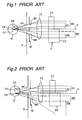
- This apparatus has an optical system including an infrared light source “O", a shutter “S” for taking part of light out from the light source “O", a mask “M” having two apertures “M1” and “M2”, a collimator lens “L2”, a reference cell “C1”, a sample cell “C2”, an interference filter (not shown), a focusing lens (not shown), and an optical receiver or optical detector (not shown).
- an infrared measuring light emitted from the light source "O” pass limitedly through a region of an opening "S1" of the shutter “S” located ahead. In the figures, the opening "S1" is located in an upper position.
- the infrared measuring light that has passed through the opening "S1" further passes through the first aperture "M1" of the mask "M"
- the travelling pencil of the infrared measuring light is transformed into a parallel pencil of light by the collimator lens "L2,” and then the parallel pencil of light passes through the reference cell C1.
- the two split parallel pencils of light which are derived from one pencil of light emitted forward from the light source "O," are used as a light that passes through the reference cell “C1" and a light that passes through the sample cell “C2", respectively, by employing at least an identical optical component. Therefore, the homogeneity, or identicalness, of both of the split parallel pencils of light is presumed to be guaranteed considerably.
- the light source has a specified area with respect to the entrance pupil diameter of the optical system. Therefore, the improvement of the accuracy of measurement cannot be realized unless the optical system is constructed by taking into consideration the fact that the optical information of the intensity, and so on, of the infrared measuring light emitted from each luminous point constituting the specified area differs at each luminous point.
- the light source "O” shown in Figs. 1 and 2 includes a filament “O1" that serves as an illuminant.
- the center of the filament “O1” having a specified area, and the point of center of symmetry of the two apertures "M1" and “M2,” are both located on an optical axis "P.”
- an infrared measuring light emitted from the point of the center “O2" of the filament “O1” is limited by the mask apertures "M1" and “M2,” and then the two split measuring lights are made to pass through the collimator lens "L2" so that the two split measuring lights are transformed into two split parallel pencils of light "B1” and “B2” symmetrical relatively to along the optical axis "P.” That is, in a certain measurement space of the cell "C,” the pencils of light “B1” and “B2” can be regarded as lights with an identical quality.
- the infrared measuring light emitted from an end "O3" of the filament "O1" is transformed into two split parallel pencils of light “D1” and “D2” in a similar manner, as shown in Figs. 1 and 2.
- the pencils of light “D1” and “D2” are not symmetrical relatively to the optical axis "P", and are unbalanced. That is, if a pair of apertures on the mask are arranged on the basis of a mere simple conception that only the symmetry of the apertures relative to the optical axis is essential, then the two pencils of light "D1” and “D2” may pass through asymmetrical areas (i.e. areas not symmetrical relative to the optical axis "P") of the measuring space in which the cells "C1" and "C2" are positioned.
- FIG. 2 shows a state in which the position of the filament "O1” is shifted from the state of Fig. 1.
- Fig. 2 illustrates a situation where an end “O4" of the filament "O1” is positioned on the center of the optical axis "P". In this case, the other end “O3" of the filament “O1” is largely displaced from the center of the optical axis "P.” Therefore, the pencils of light “D1" and “D2" that have been limited by the mask apertures "M1” and “M2” are more largely displaced or shifted from the optical axis "P" in the measuring space.
- the pencil of light "D2" that passes through the sample cell "C2" may include almost none of the optical information upon the end "O3" of the filament "O1.”
- the two pencils of light have optical information with utterly different qualities when the light source is replaced. Therefore, the relation between the density and the absorbance measured or calibrated on the basis of the optical information prior to the replacement of the light source becomes unusable, which in turn requires a remake (or reconstruction) of the calibration curve with respect to the replaced new light source.
- Another problem is a positional nonuniformity of optical penetration characteristics of an interference filter which is employed in this type of spectroscopic apparatus.
- the interference filter As a spectroscopic filter to selectively allow a specified wavelength to pass the filter, the interference filter is simple, convenient and thus widely used.
- its spectroscopic spectrum characteristics are not always uniform depending on each interference filter. This nonuniformity thereof is in connection with the problem concerning a manufacturing process of a multilayer deposition film, and even the spectroscopic spectrum characteristics of a plurality of interference filters manufactured through an identical manufacturing process have variations in the peak wavelength and half width thereof.
- the spectroscopic penetration spectrums are not necessarily the same, depending on what part of the filter the light passes.
- the positional nonuniformity of the interference filter is similarly included both at the sample measuring stage and at the reference measuring stage, causing no such problem as described above.
- the pencil of light is split into parts and that a difference in spectroscopic spectrum between both the optical paths is caused, a fatal error arises in the measurement result.
- an optical density measuring apparatus comprising: a light source for emitting an infrared ray as a measuring ray; a collimator lens for transforming the measuring ray emitted from the light source into a parallel measuring ray; an optical mask for splitting the parallel measuring ray into a first split parallel measuring ray and a second split parallel measuring ray; a reference means which is provided in a light pass of the first split parallel measuring ray; a sample cell which is provided in a light pass of the second split parallel measuring ray; an optical detector for detecting the first split parallel measuring ray which has passed through the reference means and the second split parallel measuring ray which has passed through the sample cell, so that an optical density of a sample in the sample cell is measured; and a first focusing lens for focusing the first split parallel measuring ray which has passed through the reference means on the optical detector and for focusing the second split parallel measuring ray which has passed through the sample cell on the optical detector, characterized in that there are provided: an optical mask for splitting the parallel measuring ray into a first split
- the optical mask for example, can be a plate-shaped mask with a pair of apertures for forming the first split parallel measuring ray and the second split parallel measuring ray in which the pair of apertures are juxtaposed symmetrically relative to an optical axis.
- the measuring ray (or measuring light) emitted from the light source is incident upon the collimator lens after the image of the light source is formed on the interference filter as a spectroscopic filter by means of the second focusing lens; the measuring ray is made parallel by the collimator lens; the parallel measuring ray is divided or split into the first split parallel measuring ray and the second split parallel measuring ray by means of the optical mask; one of the first split parallel measuring ray and the second split parallel measuring ray is selected by the optical shutter; the one thereof selected by the optical shutter is allowed to pass through either one of the reference means and the sample cell; and the density of the sample is measured and calculated on a basis of an amount of light passing through the reference means, and an amount of light passing through the sample cell.
- the optical information upon the light source namely the predetermined wavelength, selected by the interference filter, of the ray of light that is emitted from each luminous point of the light source is uniformly included in the first and second split parallel measuring rays (i.e. in a pair of split parallel pencils of light).
- the information upon fluctuation of the luminous point of the light source, and the positional nonuniformity of the optical penetration characteristics of the interference filter, are uniformly and equally included in both of the pencils of light.
- a high-accuracy measurement can be achieved, thus unnecessary to remake the calibration curve every time the light source is replaced by another light source.
- the spectroscopic spectra of both of the pencils of light coincide with each other. Therefore, the fluctuation factors such as the variation in quantity of light emitted from the light source, other than the optical density, is completely cancelled in the reference optical path and the measurement optical path (i.e. sample optical path).
- the reference means can include a reference cell.
- the reference cell and the sample cell as independent separate cells, similar to the conventional cells, in which pure water is put in the reference cell and a sample is put in the sample cell, or in which a sample is put in both the reference cell and the sample cell.
- the optical density measuring apparatus comprises a single cell housing by which the reference means and the sample cell are constituted, in which the cell housing has a first chamber and a second chamber that penetrate to each other inside, in which a cell length of the first chamber is shorter than a cell length of the second chamber, and in which a reference cell of the reference means corresponds to the first chamber while the sample cell corresponds to the second chamber.
- the sample is concurrently or simultaneously introduced into the first and second chambers without demarcation.
- the quantity of light that passes through the reference cell and the quantity of light that passes through the sample cell differ on a basis of difference in their cell lengths.
- the one single cell is divided by the two chambers into the reference cell and the ample cell; namely, they are not the mutually independent cells.
- the two cells have a positional relation in which the two paraxial split pencils of light penetrate or pass through the cells, and in which both the cells are close infinitely to each other.
- the sample is concurrently put into the two chambers, and the sample is concurrently discharged from the two chambers. This guarantees that the density of the sample in each of the chambers is identical.
- the cell is made of a single member as described above.
- an optical refraction adjustment block such as a block made of glass
- a cell housing having an identical (i.e. same or constant) thickness or length.
- an optical refraction index adjustment block that has a refractive index equal to or approximate to that of the sample and has a light absorption characteristic different from that of the sample, can be mounted (for example, inserted) in a first portion of the cell through which the aforementioned first split parallel pencil of light passes, and the cell length of the first portion thereof is made shorter than the other second portion of the cell by the thickness (i.e. by the length) of the optical refraction index adjustment block.
- the reference means and the sample cell can be constituted by mounting an optical refraction adjustment block partially inside a cell housing with a same length, in which a first chamber formed inside the cell housing has a cell length that is shorter due to intervention of the optical refraction adjustment block than a cell length, generally equal to the same length of the cell housing, of a second chamber formed inside the cell housing, and in which the optical refraction adjustment block has an index of refraction that is similar to an index of refraction of the sample and the optical refraction adjustment block has a light absorption characteristic that is different from a light absorption characteristic of the sample, and wherein a reference cell of the reference means corresponds to the first chamber while the sample cell corresponds to the second chamber.
- the two pencils of light penetrating or passing through the first portion and the second portion of the cell i.e. the light penetrating the reference cell and the light penetrating the sample cell
- the reference means may be a block made of glass.
- the reference means may be an atmosphere of air itself.
- Fig. 3 is an explanatory view showing an optical system of the optical density measuring apparatus of the preferred embodiment of the present invention.
- a reference numeral “O” denotes an infrared light source.
- a measuring light emitted from the light source “O” travels through a measuring area to an infrared light sensor or an optical receiver “R.”
- Optical lenses "L1,” “L2” and “L3” are arranged in this order with a line connecting the light source “O” to a center of the optical receiver “R” being as an optical axis, and other optical members are arranged along the optical axis.
- the measuring light emitted from the light source "O" reaches a focusing lens "L1,” and is then focused on an optical filter (interference filter) "F” by the lens "L1".
- This filter "F” is constituted by a rotation plate “F2” with a specified number of interference filters "F1.”
- This interference filter “F1" selects only a specified wavelength which is passed through and/or absorbed by a component of the sample to be measured.
- the rotation plate “F2” has a predetermined number of interference filters “F1” each of which has a particular light absorption characteristic which is selected for each of predetermined plural kinds of samples to be measured.
- the rotation plate “F2” can rotate about an axis of rotation “F3.”
- the rotation plate “F2” is adjustably rotated about the axis "F3" of rotation so that the light, emitted from the light source "O” and passed through the focusing lens "L1,” is focussed on a selected interference filter "F1" of the filter "F.”
- the collimator lens "L2" is positioned ahead of the filter “F” at a location at which the collimator lens “L2” is away from the selected interference filter “F1” with a distance corresponding to a focal length "f" of the collimator lens "L2.” With the arrangement, a pencil of light incident on the collimator lens "L2" is sent forward as a parallel light.
- an optical mask “M” Just ahead of the collimator lens “L2” is arranged an optical mask “M.”
- a front view of the mask “M” is shown in Fig. 8.
- the mask “M” is provided with a pair of apertures “M1” (which is a “first aperture”) and “M2" (which is a “second aperture”) so that a distance in diametrical direction between a center (which is coincident with the aforementioned optical axis) of the mask “M” and one "M1" of the apertures "M1” and “M2" is equal to a distance in diametrical direction between the center of the mask “M” and the other "M2" of the apertures "M1” and “M2.”
- the first aperture “M1” is an aperture (i.e.
- the second aperture “M2" is an aperture (i.e. diaphragm) for forming a sample pencil of light. That is, the parallel light that is formed by the collimator lens "L2" and that corresponds to the lens diameter, is split into a pair of small split parallel pencils of light by the pair of apertures "M1" and “M2.”
- the mask "M,” the first and second apertures "M1” and “M2,” are shown by chain lines, respectively.
- a shutter “S” Just ahead of the mask “M” is arranged a shutter “S.” A front view of this shutter “S” is also shown in Fig. 8.
- This shutter “S” has a first opening “S1” and a second opening “S2” which are located oppositely and asymmetrically relative to a center “S3" of rotation thereof in its diametrical direction.
- Fig. 8 shows a state in which the first aperture “M1" of the mask “M” and the first opening “S1” of the shutter “S” are aligned with each other, and the second aperture “M2" of the mask “M” is screened (or closed or blocked) by the shutter "S".
- a cell “C” is arranged in a measuring area provided ahead of the shutter “S.”
- This cell “C” is constituted by integrating the reference cell “C1” with the sample cell “C2" into one cell housing.
- the reference cell “C1” is arranged on one side of a center thereof (aligned with the optical axis), while the sample cell “C2” is arranged on the other side thereof.
- a chamber constituting the cell “C1” and a chamber constituting the cell “C2,” communicate with each other, and the same sample (liquid) is introduced into both of the chambers.
- the reference cell “C1” has a cell length of "b1,” while the sample cell “C2” has a cell length of "b2.”
- the cell length of the latter is made sufficiently greater than that of the former.
- the aforementioned focusing lens “L3” is arranged ahead of the cell “C,” and the aforementioned optical receiver “R” is arranged ahead of the focusing lens “L3” at a location at which the receiver “R” is away from the focusing lens “L3” with a distance corresponding to a focal length "f" of the focusing lens “L3.”
- the reference pencil of light and the sample pencil of light which are parallel lights, are focused on the optical receiver "R.”
- the apparatus of the preferred embodiment has a significant feature that the measuring light is split into the reference pencil of light and the sample pencil of light, only after the light emitted from the light source "O" is transformed into the parallel light by the collimator lens "L2.” It is to be noted that, according to the preferred embodiment of the present invention, the measuring light is not split into the reference pencil of light and the sample pencil of light, before the light emitted from the light source "O" is transformed into the parallel light by the collimator lens "L2.” The effect and function in accordance with the construction of the preferred embodiment will be described below in detail with reference to Figs. 4 through 7.
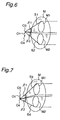
- Figs. 6 and 7 show fluctuations in solid angle of the pencils of light that are emitted from luminous points of the light source and that are made incident on the apertures "M1". and "M2" of the mask “M”; i.e., the figures show the fluctuations in luminous flux of light or the fluctuations in a unit ray of light. That is, Figs. 6 and 7 show a state in which one end "O3" of the filament "O1" is located on the optical axis. Fig. 6 illustrates the solid angles of the pencils of light emitted from the end "O3" of the filament "O1", while Fig. 7 illustrates the solid angles of the pencils of light emitted from an end "O4" of the filament "O1". By the way, Figs. 6 and 7 do not show the focusing lens "L1,” the interference filter “F1" and the collimator lens “L2" in comparison with Figs. 3 through 5.
- the solid angle " ⁇ 1" of the pencil of light "E1" i.e. pencil of light being incident on the aperture "M1
- the solid angle " ⁇ 2" of the pencil of light "E2” i.e. pencil of light being incident on the aperture "M2
- both of which are emitted from the luminous point "O3" locating on the optical axis, are equal to each other.
- a filament of light source can be considered as an aggregate of such plural luminous points which locate at different positions as described above. Therefore, accurately considering the arrangement shown in Fig. 3, the reference pencil of light and the sample pencil of light do not exactly coincide with each other in terms of light intensity etc. This means that the above “I1" and “I2" do not always coincide with each other.
- the measurement light emitted from the light source "O" having a specified area is first focused on the interference filter "F1" of the optical filter "F", and the diffused light from the body of the interference filter “F1” is transformed into the parallel light by the collimator lens "L2.” Thereafter, the parallel light is split into the two split parallel pencils of light: the reference pencil of light and the sample pencil of light. Namely, the light emitted from each luminous point of the light source passes through an identical point of the interference filter "F1" and reaches the measurement space.
- Figs. 4 and 5 corresponds to Figs. 1 and 2.
- Figs. 3 and 4 do not show the focusing lens "L1,” the optical filter “F” and the shutter “S”, it is possible to consider that the illustrated light source filament "O1" is actually superimposed or overlapped on the interference filter "F1".
- the measurement light emitted from the point of the center “O2" of the filament “O1” passes through the interference filter “F1" of the filter “F,” passes through the collimator lens "L2” where the light is transformed into the parallel light, and is limited by the pair of mask apertures "M1” and “M2” so that the light is split into two parallel pencils of light “B1” and “B2” symmetrical about the optical axis "P.” That is, it can be considered that the two parallel pencils of light “B1” and “B2” are the measuring lights with the same quality in the measuring space in which the cell "C" is positioned.
- the measuring light emitted from the end "O3" of the filament "O1" is transformed into the pair of split parallel pencils of light "D1" and “D2" in a similar manner, as shown in Fig. 4.
- the pencils of light “D1” and “D2” are superimposed or overlapped on the pencils of light “B1” and “B2” to become symmetrical relative to the optical axis "P," different from the conventional optical system explained above with reference to Figs. 1 and 2.
- the lights from the luminous points "O2" and "O3" of the light source are uniformly included in the two split parallel pencils of light.
- Fig. 5 which corresponds to Fig. 2, shows a state in which the filament position is shifted from the state shown in Fig. 4.
- the figure shows that the end “O4" of the filament "O1" is located on the center of the optical axis "P.”
- the end "O3,” opposite the end “O4,” of the filament “O1” is largely displaced or shifted from the center of the optical axis "P.”
- the lights emitted from the luminous points "O3” and "O4" are transformed into the parallel lights by the collimator lens "L2.” Therefore, the pencils of light “D1” and “D2” emitted from the luminous point "O4" coincide with the pencils of light "B1” and “B2” emitted from the luminous point "O3.”
- the lights emitted from the luminous points "O3” and “O4" are uniformly included in the two split parallel pencils of light similar to the case shown in Fig. 4.
- the measurement cell “C” (including the reference cell “C1” and the sample cell “C2") is filled with pure water having a density of zero, and then a value of Ib0/Is0 is measured.
- the calibration curve is made from the ratio between the quantities of light obtained by multiplying the quantities " ⁇ I1" and “ ⁇ I2” of lights that Penetrate the optical paths of the standard (or reference) unit pencil of light ⁇ I by " ⁇ " and “ ⁇ ,” respectively.
- the density is uniquely determined from the ratio between the quantities "I1" and "I2" of the transmitted light.
- I1' ⁇ ' ⁇ ⁇ I
- I2' ⁇ ' ⁇ ⁇ I
- the value of ⁇ '/ ⁇ ' can be obtained. And, if "K" in this state is corrected to: K ⁇ ⁇ '/ ⁇ ', then, the density can be obtained by means of the calibration curve including "K" that has previously been made, without remaking the calibration curve. This means that the measurement does not receive any substantial influence, by executing the calibration of pure water when the light source is replaced. This also means an overcoming of the fatal drawback of the conventional measuring apparatus of the type with the double-beam optical system.
- the apparatus of the present embodiment employs the cell of the type in which an identical sample is put in an identical cell housing. Therefore, the densities of the samples to be put in the reference chamber and in the sample chamber are, of course, identical.
- the problem arising in connection with this arrangement is a displacement (i.e. shift or swerve) of a focus being formed on the optical receiver "R," which is caused by a difference in refractive index (or index of refraction) of light due to the difference between the length of the reference cell and the length of the sample cell.
- the difference in refractive index between the two optical paths causes a difference between the quantities of refractions of the two pencils of light; consequently, there arises a difference in positions on the optical receiver "R" to which the beams of light reach via the two cells, as a result.
- the measurement accuracy and/or variation(s) thereof of the optical receiver "R” is affected by a positional nonuniformity that cannot be actually ignored, and it becomes one of inhibiting factors in the measurement accuracy. It is to be noted that this problem is mostly solved by putting the cell in the path of the parallel light. However, this displacement amounts to about 0.2 mm with respect to a difference of 10 mm in cell length for a measurement wavelength of 1.5 ⁇ m according to the present embodiment. Therefore, the spot position of light collected on the optical receiver "R” actually differs, depending on the reference optical path or the measurement optical path. Consequently, the reference accuracy cannot be satisfied for a longer period of time, in a field of measurement use in which its high accuracy is required.
- the lens in the optical system generates an aberration of the transmitted light; more strictly explaining, this is because the light that has passes the collimator lens "L2" includes a component that is not parallel relative to the optical axis "P". This aberration is a phenomenon that cannot be avoided so long as a general-purpose lens is used in the apparatus.
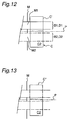
- Fig. 11 is a plan view of the cell according to the first modification which corresponds to the drawing of Fig. 3; Fig. 9 is a side view of the cell shown in Fig. 11; and Fig. 10 is a front view of the cell shown in Fig. 11.
- This cell "C” according to the first modification has a sample inlet “C3” and a sample outlet “C4" at the upper and lower portions of the cell housing, respectively.
- a refractive index adjustment block "A" having a refractive index identical or approximate to that of the sample (liquid) inside.
- the cell length of the reference cell “C1” is “b1,” while the cell length of the sample cell “C2” is “b2.”
- the housing of the reference cell “C1”, and the housing of the sample cell “C2” have the same thickness as shown in Fig. 11, and "cell length b2 minus cell length b1" is the thickness of the block "A.”
- the pencil of light that has passed through the reference cell and the pencil of light that has passed through the sample cell undergo a generally same refraction of light.
- a normal liquid sample for example, a semiconductor cleaning liquid
- a quartz glass reffractive index of light: 1.45
- a quartz glass refractive index of light: 1.45
- a precondition that these blocks can be employed in the apparatus is that the blocks have a light absorption characteristic different from that of the object component of the sample for the density measurement.
Landscapes
- Physics & Mathematics (AREA)
- Spectroscopy & Molecular Physics (AREA)
- Biochemistry (AREA)
- Health & Medical Sciences (AREA)
- Life Sciences & Earth Sciences (AREA)
- Chemical & Material Sciences (AREA)
- Analytical Chemistry (AREA)
- General Health & Medical Sciences (AREA)
- General Physics & Mathematics (AREA)
- Immunology (AREA)
- Pathology (AREA)
- Theoretical Computer Science (AREA)
- Mathematical Physics (AREA)
- Engineering & Computer Science (AREA)
- Investigating Or Analysing Materials By Optical Means (AREA)
Applications Claiming Priority (2)
| Application Number | Priority Date | Filing Date | Title |
|---|---|---|---|
| JP29690397A JP3792374B2 (ja) | 1997-10-29 | 1997-10-29 | 光学的濃度測定装置 |
| JP29690397 | 1997-10-29 |
Publications (3)
| Publication Number | Publication Date |
|---|---|
| EP0930497A2 true EP0930497A2 (de) | 1999-07-21 |
| EP0930497A3 EP0930497A3 (de) | 1999-09-08 |
| EP0930497B1 EP0930497B1 (de) | 2005-01-26 |
Family
ID=17839657
Family Applications (1)
| Application Number | Title | Priority Date | Filing Date |
|---|---|---|---|
| EP19980308733 Expired - Lifetime EP0930497B1 (de) | 1997-10-29 | 1998-10-26 | Vorrichtung zur Messung der optischen Dichte |
Country Status (10)
| Country | Link |
|---|---|
| US (1) | US5991031A (de) |
| EP (1) | EP0930497B1 (de) |
| JP (1) | JP3792374B2 (de) |
| KR (1) | KR100284184B1 (de) |
| CN (1) | CN1104641C (de) |
| CA (1) | CA2252019C (de) |
| DE (1) | DE69828765T2 (de) |
| MY (1) | MY114968A (de) |
| SG (1) | SG72882A1 (de) |
| TW (1) | TW408218B (de) |
Families Citing this family (15)
| Publication number | Priority date | Publication date | Assignee | Title |
|---|---|---|---|---|
| US6348965B1 (en) * | 1999-09-24 | 2002-02-19 | Henry Palladino | Solid state fluorescence and absorption spectroscopy |
| AT408488B (de) * | 1999-12-22 | 2001-12-27 | Scan Messtechnik Gmbh | Miniaturisiertes spektrometer |
| JP5537141B2 (ja) * | 2009-12-14 | 2014-07-02 | 株式会社東芝 | 自動分析装置 |
| EP2428791B1 (de) * | 2010-09-08 | 2013-03-27 | Sick Ag | Optisches Analysegerät |
| JP5947709B2 (ja) * | 2012-12-27 | 2016-07-06 | 株式会社堀場製作所 | 分光分析方法及び分光分析装置 |
| KR101456273B1 (ko) * | 2013-04-25 | 2014-11-03 | 전자부품연구원 | 가스 측정 광학계 |
| US9547231B2 (en) * | 2013-06-12 | 2017-01-17 | Avago Technologies General Ip (Singapore) Pte. Ltd. | Device and method for making photomask assembly and photodetector device having light-collecting optical microstructure |
| CN105527224B (zh) * | 2014-09-29 | 2019-02-22 | 安东帕有限公司 | 一种用于分析样品的设备和方法 |
| CN105021571A (zh) * | 2015-07-22 | 2015-11-04 | 哈尔滨工业大学 | 一种折光浓度计的光学系统 |
| TWI606232B (zh) * | 2016-01-25 | 2017-11-21 | 盟基生醫股份有限公司 | 微量核酸定量裝置 |
| CN106251750A (zh) * | 2016-10-08 | 2016-12-21 | 铜仁学院 | 一种开放式光电效应实验仪及其操作方法 |
| EP3529573A4 (de) | 2016-10-21 | 2020-05-20 | Rebellion Photonics, Inc. | Mobile gas- und chemikalienbildgebungskamera |
| CN106525736A (zh) * | 2016-12-27 | 2017-03-22 | 中国计量大学 | 一种测量氢气浓度的光纤型传感器 |
| CN107860718B (zh) * | 2017-12-08 | 2024-11-15 | 杭州清渠科技有限公司 | 一种水质分析装置 |
| CN111624182A (zh) * | 2019-12-28 | 2020-09-04 | 黄辉 | 一种毛细管光度仪 |
Family Cites Families (11)
| Publication number | Priority date | Publication date | Assignee | Title |
|---|---|---|---|---|
| US2858727A (en) * | 1954-06-30 | 1958-11-04 | American Cyanamid Co | Device for the measurement of absolute turbidity |
| JPS59107241A (ja) * | 1982-12-10 | 1984-06-21 | Mitsubishi Electric Corp | 水質計器 |
| JPH03223654A (ja) * | 1989-07-26 | 1991-10-02 | Yokogawa Electric Corp | 吸光光度計 |
| JPH0359445A (ja) * | 1989-07-28 | 1991-03-14 | Shimadzu Corp | 単光束測光装置 |
| US4999010A (en) * | 1989-07-31 | 1991-03-12 | Mattson Instruments, Inc. | Dual beam optical nulling interferometric spectrometer |
| JPH0726910B2 (ja) * | 1990-04-18 | 1995-03-29 | 倉敷紡績株式会社 | シリンダ型可変長セル |
| FR2671868B1 (fr) * | 1991-01-22 | 1993-04-30 | Aerospatiale | Dispositif interferometrique notamment stellaire, comportant une ligne a retard. |
| IT1249939B (it) * | 1991-06-28 | 1995-03-30 | Cselt Centro Studi Lab Telecom | Sistema di spettroscopia ad alta risoluzione. |
| JPH05332933A (ja) * | 1992-05-28 | 1993-12-17 | Anima Kk | 携帯用co2濃度検出装置 |
| US5260574A (en) * | 1992-06-26 | 1993-11-09 | The United States Of America As Represented By The Secretary Of The Air Force | Infrared densitometer |
| JP3462573B2 (ja) * | 1994-05-11 | 2003-11-05 | アークレイ株式会社 | 液体試料の成分濃度等を測定する方法及び装置 |
-
1997
- 1997-10-29 JP JP29690397A patent/JP3792374B2/ja not_active Expired - Fee Related
-
1998
- 1998-10-26 DE DE1998628765 patent/DE69828765T2/de not_active Expired - Fee Related
- 1998-10-26 EP EP19980308733 patent/EP0930497B1/de not_active Expired - Lifetime
- 1998-10-28 TW TW87117854A patent/TW408218B/zh not_active IP Right Cessation
- 1998-10-28 MY MYPI9804898 patent/MY114968A/en unknown
- 1998-10-28 SG SG1998004349A patent/SG72882A1/en unknown
- 1998-10-28 CA CA 2252019 patent/CA2252019C/en not_active Expired - Fee Related
- 1998-10-28 KR KR1019980045227A patent/KR100284184B1/ko not_active Expired - Fee Related
- 1998-10-28 US US09/179,821 patent/US5991031A/en not_active Expired - Fee Related
- 1998-10-29 CN CN98123824A patent/CN1104641C/zh not_active Expired - Fee Related
Also Published As
| Publication number | Publication date |
|---|---|
| HK1021230A1 (en) | 2000-06-02 |
| CN1104641C (zh) | 2003-04-02 |
| JPH11132951A (ja) | 1999-05-21 |
| CN1221876A (zh) | 1999-07-07 |
| SG72882A1 (en) | 2000-05-23 |
| KR100284184B1 (ko) | 2001-03-02 |
| JP3792374B2 (ja) | 2006-07-05 |
| CA2252019A1 (en) | 1999-04-29 |
| MY114968A (en) | 2003-02-28 |
| DE69828765D1 (de) | 2005-03-03 |
| EP0930497A3 (de) | 1999-09-08 |
| CA2252019C (en) | 2002-07-02 |
| DE69828765T2 (de) | 2006-01-12 |
| EP0930497B1 (de) | 2005-01-26 |
| TW408218B (en) | 2000-10-11 |
| KR19990037431A (ko) | 1999-05-25 |
| US5991031A (en) | 1999-11-23 |
Similar Documents
| Publication | Publication Date | Title |
|---|---|---|
| EP0930497B1 (de) | Vorrichtung zur Messung der optischen Dichte | |
| US6862092B1 (en) | Spectrometer | |
| US5623342A (en) | Raman microscope | |
| US7365842B2 (en) | Light scanning type confocal microscope | |
| US9528877B2 (en) | Spectrometer and a fluid analysis system | |
| JP3432222B2 (ja) | 多重波長検出用の毛管フローセル | |
| US20110299083A1 (en) | Sample analyzing apparatus | |
| WO1995014225A1 (de) | Anordnung zur analyse von substanzen an der oberfläche eines optischen sensors | |
| US20040239930A1 (en) | Spectroscopic device | |
| US5767966A (en) | Optical spectrum measuring device | |
| US6483588B1 (en) | Arrangement for detecting biomolecular reactions and interactions | |
| US5973780A (en) | Echelle spectroscope | |
| US10760968B2 (en) | Spectrometric measuring device | |
| KR102106861B1 (ko) | 광학식 높이 계측용 광모듈 | |
| KR101054017B1 (ko) | 분광기의 보정방법 | |
| US8541760B2 (en) | Method for calibrating a deflection unit in a TIRF microscope, TIRF microscope, and method for operating the same | |
| US20090173891A1 (en) | Fluorescence detection system | |
| HK1021413A (en) | Optical density measuring apparatus | |
| JP2001091357A (ja) | 多重光スペクトルの同時分析方法 | |
| US20160363481A1 (en) | Spectrometer and analysis apparatus | |
| US3515489A (en) | Optical apparatus | |
| US4165181A (en) | Optical arrangement in spectrophotometers | |
| EP0162973A1 (de) | Abstandsmessvorrichtung | |
| WO2001014860A1 (en) | Apparatus for measuring and applying instrumentation correction to produce standard raman spectrum | |
| DE4433753A1 (de) | Anordnung zur Analyse von Substanzen an der Oberfläche eines optischen Sensors |
Legal Events
| Date | Code | Title | Description |
|---|---|---|---|
| PUAI | Public reference made under article 153(3) epc to a published international application that has entered the european phase |
Free format text: ORIGINAL CODE: 0009012 |
|
| 17P | Request for examination filed |
Effective date: 19990212 |
|
| AK | Designated contracting states |
Kind code of ref document: A2 Designated state(s): DE FR GB IT NL |
|
| AX | Request for extension of the european patent |
Free format text: AL;LT;LV;MK;RO;SI |
|
| PUAL | Search report despatched |
Free format text: ORIGINAL CODE: 0009013 |
|
| AK | Designated contracting states |
Kind code of ref document: A3 Designated state(s): AT BE CH CY DE DK ES FI FR GB GR IE IT LI LU MC NL PT SE |
|
| AX | Request for extension of the european patent |
Free format text: AL;LT;LV;MK;RO;SI |
|
| AKX | Designation fees paid |
Free format text: DE FR GB IT NL |
|
| GRAP | Despatch of communication of intention to grant a patent |
Free format text: ORIGINAL CODE: EPIDOSNIGR1 |
|
| GRAS | Grant fee paid |
Free format text: ORIGINAL CODE: EPIDOSNIGR3 |
|
| GRAA | (expected) grant |
Free format text: ORIGINAL CODE: 0009210 |
|
| AK | Designated contracting states |
Kind code of ref document: B1 Designated state(s): DE FR GB IT NL |
|
| REG | Reference to a national code |
Ref country code: GB Ref legal event code: FG4D |
|
| REF | Corresponds to: |
Ref document number: 69828765 Country of ref document: DE Date of ref document: 20050303 Kind code of ref document: P |
|
| PGFP | Annual fee paid to national office [announced via postgrant information from national office to epo] |
Ref country code: GB Payment date: 20050906 Year of fee payment: 8 |
|
| PGFP | Annual fee paid to national office [announced via postgrant information from national office to epo] |
Ref country code: FR Payment date: 20051027 Year of fee payment: 8 |
|
| PGFP | Annual fee paid to national office [announced via postgrant information from national office to epo] |
Ref country code: NL Payment date: 20051031 Year of fee payment: 8 |
|
| PGFP | Annual fee paid to national office [announced via postgrant information from national office to epo] |
Ref country code: DE Payment date: 20051201 Year of fee payment: 8 |
|
| PLBE | No opposition filed within time limit |
Free format text: ORIGINAL CODE: 0009261 |
|
| STAA | Information on the status of an ep patent application or granted ep patent |
Free format text: STATUS: NO OPPOSITION FILED WITHIN TIME LIMIT |
|
| 26N | No opposition filed |
Effective date: 20051027 |
|
| ET | Fr: translation filed | ||
| REG | Reference to a national code |
Ref country code: HK Ref legal event code: WD Ref document number: 1021413 Country of ref document: HK |
|
| PGFP | Annual fee paid to national office [announced via postgrant information from national office to epo] |
Ref country code: IT Payment date: 20061031 Year of fee payment: 9 |
|
| PG25 | Lapsed in a contracting state [announced via postgrant information from national office to epo] |
Ref country code: NL Free format text: LAPSE BECAUSE OF NON-PAYMENT OF DUE FEES Effective date: 20070501 Ref country code: DE Free format text: LAPSE BECAUSE OF NON-PAYMENT OF DUE FEES Effective date: 20070501 |
|
| GBPC | Gb: european patent ceased through non-payment of renewal fee |
Effective date: 20061026 |
|
| NLV4 | Nl: lapsed or anulled due to non-payment of the annual fee |
Effective date: 20070501 |
|
| REG | Reference to a national code |
Ref country code: FR Ref legal event code: ST Effective date: 20070629 |
|
| PG25 | Lapsed in a contracting state [announced via postgrant information from national office to epo] |
Ref country code: GB Free format text: LAPSE BECAUSE OF NON-PAYMENT OF DUE FEES Effective date: 20061026 |
|
| PG25 | Lapsed in a contracting state [announced via postgrant information from national office to epo] |
Ref country code: FR Free format text: LAPSE BECAUSE OF NON-PAYMENT OF DUE FEES Effective date: 20061031 |
|
| PG25 | Lapsed in a contracting state [announced via postgrant information from national office to epo] |
Ref country code: IT Free format text: LAPSE BECAUSE OF NON-PAYMENT OF DUE FEES Effective date: 20071026 |