EP0930664B1 - Contrôle du gonflement dans les piles électrochimiques à métal alcalin - Google Patents
Contrôle du gonflement dans les piles électrochimiques à métal alcalin Download PDFInfo
- Publication number
- EP0930664B1 EP0930664B1 EP98308677.8A EP98308677A EP0930664B1 EP 0930664 B1 EP0930664 B1 EP 0930664B1 EP 98308677 A EP98308677 A EP 98308677A EP 0930664 B1 EP0930664 B1 EP 0930664B1
- Authority
- EP
- European Patent Office
- Prior art keywords
- anode
- cathode
- active material
- electrochemical cell
- cell according
- Prior art date
- Legal status (The legal status is an assumption and is not a legal conclusion. Google has not performed a legal analysis and makes no representation as to the accuracy of the status listed.)
- Expired - Lifetime
Links
Images



Classifications
-
- H—ELECTRICITY
- H01—ELECTRIC ELEMENTS
- H01M—PROCESSES OR MEANS, e.g. BATTERIES, FOR THE DIRECT CONVERSION OF CHEMICAL ENERGY INTO ELECTRICAL ENERGY
- H01M4/00—Electrodes
- H01M4/02—Electrodes composed of, or comprising, active material
- H01M4/06—Electrodes for primary cells
-
- H—ELECTRICITY
- H01—ELECTRIC ELEMENTS
- H01M—PROCESSES OR MEANS, e.g. BATTERIES, FOR THE DIRECT CONVERSION OF CHEMICAL ENERGY INTO ELECTRICAL ENERGY
- H01M4/00—Electrodes
- H01M4/02—Electrodes composed of, or comprising, active material
- H01M4/36—Selection of substances as active materials, active masses, active liquids
- H01M4/38—Selection of substances as active materials, active masses, active liquids of elements or alloys
- H01M4/381—Alkaline or alkaline earth metals elements
- H01M4/382—Lithium
-
- H—ELECTRICITY
- H01—ELECTRIC ELEMENTS
- H01M—PROCESSES OR MEANS, e.g. BATTERIES, FOR THE DIRECT CONVERSION OF CHEMICAL ENERGY INTO ELECTRICAL ENERGY
- H01M4/00—Electrodes
- H01M4/02—Electrodes composed of, or comprising, active material
- H01M4/36—Selection of substances as active materials, active masses, active liquids
- H01M4/48—Selection of substances as active materials, active masses, active liquids of inorganic oxides or hydroxides
- H01M4/483—Selection of substances as active materials, active masses, active liquids of inorganic oxides or hydroxides for non-aqueous cells
-
- H—ELECTRICITY
- H01—ELECTRIC ELEMENTS
- H01M—PROCESSES OR MEANS, e.g. BATTERIES, FOR THE DIRECT CONVERSION OF CHEMICAL ENERGY INTO ELECTRICAL ENERGY
- H01M4/00—Electrodes
- H01M4/02—Electrodes composed of, or comprising, active material
- H01M4/36—Selection of substances as active materials, active masses, active liquids
- H01M4/58—Selection of substances as active materials, active masses, active liquids of inorganic compounds other than oxides or hydroxides, e.g. sulfides, selenides, tellurides, halogenides or LiCoFy; of polyanionic structures, e.g. phosphates, silicates or borates
- H01M4/581—Chalcogenides or intercalation compounds thereof
- H01M4/5815—Sulfides
-
- H—ELECTRICITY
- H01—ELECTRIC ELEMENTS
- H01M—PROCESSES OR MEANS, e.g. BATTERIES, FOR THE DIRECT CONVERSION OF CHEMICAL ENERGY INTO ELECTRICAL ENERGY
- H01M6/00—Primary cells; Manufacture thereof
- H01M6/14—Cells with non-aqueous electrolyte
- H01M6/16—Cells with non-aqueous electrolyte with organic electrolyte
-
- H—ELECTRICITY
- H01—ELECTRIC ELEMENTS
- H01M—PROCESSES OR MEANS, e.g. BATTERIES, FOR THE DIRECT CONVERSION OF CHEMICAL ENERGY INTO ELECTRICAL ENERGY
- H01M6/00—Primary cells; Manufacture thereof
- H01M6/50—Methods or arrangements for servicing or maintenance, e.g. for maintaining operating temperature
- H01M6/5088—Initial activation; predischarge; Stabilisation of initial voltage
-
- H—ELECTRICITY
- H01—ELECTRIC ELEMENTS
- H01M—PROCESSES OR MEANS, e.g. BATTERIES, FOR THE DIRECT CONVERSION OF CHEMICAL ENERGY INTO ELECTRICAL ENERGY
- H01M6/00—Primary cells; Manufacture thereof
- H01M6/50—Methods or arrangements for servicing or maintenance, e.g. for maintaining operating temperature
- H01M2006/5094—Aspects relating to capacity ratio of electrolyte/electrodes or anode/cathode
-
- H—ELECTRICITY
- H01—ELECTRIC ELEMENTS
- H01M—PROCESSES OR MEANS, e.g. BATTERIES, FOR THE DIRECT CONVERSION OF CHEMICAL ENERGY INTO ELECTRICAL ENERGY
- H01M4/00—Electrodes
- H01M4/02—Electrodes composed of, or comprising, active material
- H01M4/62—Selection of inactive substances as ingredients for active masses, e.g. binders, fillers
- H01M4/621—Binders
- H01M4/622—Binders being polymers
- H01M4/623—Binders being polymers fluorinated polymers
-
- H—ELECTRICITY
- H01—ELECTRIC ELEMENTS
- H01M—PROCESSES OR MEANS, e.g. BATTERIES, FOR THE DIRECT CONVERSION OF CHEMICAL ENERGY INTO ELECTRICAL ENERGY
- H01M4/00—Electrodes
- H01M4/02—Electrodes composed of, or comprising, active material
- H01M4/64—Carriers or collectors
- H01M4/66—Selection of materials
- H01M4/661—Metal or alloys, e.g. alloy coatings
-
- Y—GENERAL TAGGING OF NEW TECHNOLOGICAL DEVELOPMENTS; GENERAL TAGGING OF CROSS-SECTIONAL TECHNOLOGIES SPANNING OVER SEVERAL SECTIONS OF THE IPC; TECHNICAL SUBJECTS COVERED BY FORMER USPC CROSS-REFERENCE ART COLLECTIONS [XRACs] AND DIGESTS
- Y02—TECHNOLOGIES OR APPLICATIONS FOR MITIGATION OR ADAPTATION AGAINST CLIMATE CHANGE
- Y02E—REDUCTION OF GREENHOUSE GAS [GHG] EMISSIONS, RELATED TO ENERGY GENERATION, TRANSMISSION OR DISTRIBUTION
- Y02E60/00—Enabling technologies; Technologies with a potential or indirect contribution to GHG emissions mitigation
- Y02E60/10—Energy storage using batteries
Definitions
- the present invention generally relates to the conversion of chemical energy to electrical energy, and more particularly, to an alkali metal electrochemical cell having an anode-to-cathode (A/C) capacity ratio specifically balanced to improve cell swelling without appreciably detracting from cathode efficiency.
- a preferred couple is an alkali metal/solid cathode active material and a most preferred chemistry is a lithium/transition metal oxide couple.
- Lithium-batteries have been successfully used to power implantable medical devices such as pacemakers, cardiac defibrillators, and the like.
- implantable medical devices such as pacemakers, cardiac defibrillators, and the like.
- this swelling must be accounted for so that enough void space is left for the battery volume change in order to prevent damage to the device circuitry. Consequently, the more swelling the battery experiences, the more void space that must be reserved, which directly impacts the device total volume. In the field of implantable medical devices, a smaller total device volume is desired.
- a chemistry that provides high discharge capacity and high energy current pulses required for powering cardiac defibrillators and other implantable medical devices is the lithium/silver vanadium oxide (Ag 2 V 4 O 11 , SVO) couple.
- U.S. Patent No. 5,458,997 to Crespi et al. describes an electrochemical cell having a lithium anode and a silver vanadium oxide cathode, wherein the cell is anode limited.
- This patent states that in the discharge of a conventionally balanced Li/SVO cell, the resistance increases as a function of time beginning at the second voltage plateau 310 on its discharge curve ( Fig. 5 of Crespi et al.). In that respect, Crespi et al.
- the rebalanced cell has the ratio of capacity (Q - ) of the anode divided by the capacity (Q + ) of the cathode between 0.45 and 0.70.
- This rebalancing allows discharge to occur only through the first voltage plateau and the first ramp to the start of the second voltage plateau, thus avoiding that portion of the discharge curve (the second voltage plateau region) in which resistance buildup occurs in conventionally balanced Li/SVO cells.
- the disadvantage of this approach is a loss of cell capacity by about 250 mAh ( Fig. 6 , line 370 vs. Fig. 7, line 385 in Crespi et al.).
- the cell of the present invention fulfills this need by utilizing both-voltage plateaus typical in the discharge of a Li/SVO cell for high discharge capacity while at the same time the effects of cell swelling are minimized through a rebalanced anode-to-cathode (A/C) capacity ratio.
- A/C anode-to-cathode
- the object of the present invention is, therefore, to improve the cell swelling performance of an alkali metal/transition metal oxide electrochemical cell such as a lithium/silver vanadium oxide cell or a lithium/copper silver vanadium oxide cell without appreciably detracting from the cell's discharge capacity.
- This goal is accomplished by rebalancing the anode-to-cathode capacity ratio of the cell (based on the gram amount of active material in the anode and in the cathode) such that the cell is still capable of delivering high discharge-capacity and high current pulses while at the same time minimizing case swelling typically associated with such power sources.
- the anode active material is lithium and the cathode active material is silver vanadium oxide, Ag 2 V 4 O 11 (SVO).
- the preferred electrolytes include 1.0M to 1.4M LiAsF 6 or LiPF 6 as an ion-forming alkali metal salt dissolved in solvents containing at least one high permittivity solvent such as propylene carbonate and at least one low viscosity solvent such as 1,2-dimethoxyethane. This chemistry provides a cell that delivers high discharge capacity interruptable from time to time to deliver current pulse discharges.
- the electrochemical cell of the present invention comprises an anode of lithium and its alloys and intermetallic compounds including, for example, Li-Si, Li-Al, Li-B and Li-Si-B alloys and intermetallic compounds.
- the preferred anode comprises lithium.
- An alternate anode comprises a lithium alloy such as a lithium-aluminum alloy. The greater the amount of aluminum present by weight in the alloy, however, the lower the energy density of the cell.
- the form of the anode may vary, but preferably the anode is a thin metal sheet or foil of the anode metal, pressed or rolled on a metallic anode current collector, i.e., preferably comprising titanium, titanium alloy or nickel, to form an anode component. Copper, tungsten and tantalum are also suitable materials for the anode current collector.
- the anode component has an extended tab or lead of the same material as the anode current collector, i.e., preferably nickel or titanium, integrally formed therewith such as by welding and contacted by a weld to a cell case of conductive metal in a case-negative electrical configuration.
- the anode may be formed in some other geometry, such as a bobbin shape, cylinder or pellet to allow an alternate low surface cell design.
- the electrochemical cell of the present invention further comprises a cathode of electrically conductive material which serves as the other electrode of the cell.
- the cathode is preferably of a solid material and the electrochemical reaction at the cathode involves conversion of ions which migrate from the anode to the cathode in atomic or molecular forms.
- the cathode comprises from about 80 to about 99 weight percent of the cathode active material.
- the cathode active materials prepared as described above are preferably mixed with a binder material such as a powdered fluoro-polymer, more preferably powdered polytetrafluoroethylene or powdered polyvinylidene fluoride present at about 1 to about 5 weight percent of the cathode mixture.
- a binder material such as a powdered fluoro-polymer, more preferably powdered polytetrafluoroethylene or powdered polyvinylidene fluoride present at about 1 to about 5 weight percent of the cathode mixture.
- a conductive diluent is preferably added to the cathode mixture to improve conductivity.
- Suitable materials for this purpose include acetylene black, carbon black and/or graphite or a metallic powder such as powdered nickel, aluminum, titanium and stainless steel.
- the preferred cathode active mixture thus includes a powdered fluoro-polymer binder present at about 3 weight percent, a conductive
- Cathode components for incorporation into the cell may be prepared by rolling, spreading or pressing the cathode active mixture of the present invention onto a suitable current collector selected from the group consisting of stainless steel, titanium, tantalum, platinum and gold.
- the preferred current collector material is titanium, and most preferably the titanium cathode current collector has a thin layer of graphite/carbon paint applied thereto.
- Cathodes prepared as described above may be in the form of one or more plates operatively associated with at least one or more plates of anode material, or in the form of a strip wound with a corresponding strip of anode material in a structure similar to a "jellyroll".
- the cathode is separated from the anode material by a suitable separator material.
- the separator is of electrically insulative material, and the separator material also is chemically unreactive with the anode and cathode active materials and both chemically unreactive with and insoluble in the electrolyte.
- the separator material has a degree of porosity sufficient to allow flow therethrough of the electrolyte during the electrochemical reaction of the cell.
- Illustrative separator materials include fabrics woven from fluoropolymeric fibers including polyvinylidine fluoride, polyethylenetetrafluoroethylene, and polyethylenechlorotrifluoroethylene used either alone or laminated with a fluoropolymeric microporous film, non-woven glass, polypropylene, polyethylene, glass fiber materials, ceramics, polytetrafluoroethylene membrane commercially available under the designation ZITEX (Chemplast Inc.), polypropylene membrane commercially available under the designation CELGARD (Celanese Plastic Company, Inc.) and a membrane commercially available under the designation DEXIGLAS (C.H. Dexter, Div., Dexter Corp.).
- fluoropolymeric fibers including polyvinylidine fluoride, polyethylenetetrafluoroethylene, and polyethylenechlorotrifluoroethylene used either alone or laminated with a fluoropolymeric microporous film, non-woven glass, polypropylene, polyethylene, glass fiber materials
- the electrochemical cell of the present invention further includes a nonaqueous, ionically conductive electrolyte which serves as a medium for migration of ions between the anode and the cathode electrodes during the electrochemical reactions of the cell.
- the electrochemical reaction at the electrodes involves conversion of ions in atomic or molecular forms which migrate from the anode to the cathode.
- nonaqueous electrolytes suitable for the present invention are substantially inert to the anode and cathode materials, and they exhibit those physical properties necessary for ionic transport, namely, low viscosity, low surface tension and wettability.
- a suitable electrolyte has an inorganic, ionically conductive salt dissolved in a nonaqueous solvent, and more preferably, the electrolyte includes an ionizable alkali metal salt dissolved in a mixture of aprotic organic solvents comprising a low viscosity solvent and a high permittivity solvent.
- the inorganic, ionically conductive salt serves as the vehicle for migration of the anode ions to intercalate or react with the cathode active material.
- the alkali metal salt of the electrolyte is a lithium based salt.
- Known lithium salts that are useful as a vehicle for transport of alkali metal ions from the anode to the cathode include LiPF 6 , LiBF 4 , LiAsF 6 , LiSbF 6 , LiClO 4 , LiAlCl 4 , LiGaCl 4 , LiC(SO 2 CF 3 ) 3 , LiN(SO 5 CF 3 ) 2 , LiSCN, LiO 3 SCF 2 CF 3 , LiC 6 F 5 SO 3 , LiO 2 CCF 3 , LiSO 3 F, LiB(C 6 H 5 ) 4 and LiCF 3 SO 3 , and mixtures thereof.
- Low viscosity solvents useful with the present invention include esters, linear and cyclic ethers and dialkyl carbonates such as tetrahydrofuran (THF), methyl acetate (MA), diglyme, trigylme, tetragylme, dimethyl carbonate (DMC), 1,2-dimethoxyethane (DME), 1,2-diethoxyethane (DEE), 1-methoxy, 2-methoxyethane (EME), diethyl carbonate and mixtures thereof, and high permittivity solvents include cyclic carbonates, cyclic esters and cyclic amides such as propylene carbonate (PC), ethylene carbonate (EC), acetonitrile, dimethyl sulfoxide, dimethyl formamide, dimethyl acetamide, ⁇ -valerolactone, ⁇ -butyrolactone (GBL) and N-methyl-pyrrolidinone (NMP) and mixtures thereof.
- THF tetrahydrofuran
- the preferred anode is lithium metal and the preferred electrolyte is 0.8M to 1.5M LiAsF 6 or LiPF 6 dissolved in a 50:50 mixture, by volume, of propylene carbonate as the preferred high permittivity solvent and 1,2-dimethoxyethane as the preferred low viscosity solvent.
- the percentage of cell swelling during discharge of the lithium/transition metal oxide couple is reduced over that known in the prior art by redesigning or re-balancing the anode-to-cathode (A/C) capacity ratio.
- A/C anode-to-cathode
- the amount of active material within the cathode determines the theoretical capacity of the cathode.
- For implantable device power supplies an indication of battery state of discharge is always desirable (sloped voltage profile, impedance change, etc.) so-that physicians and patients can decide when the battery needs to be replaced.
- SVO batteries which are typically used in today's implantable medical devices such as cardiac defibrillators, the beginning of.the second voltage plateau (2.6V) indicates the utilization of about 50% of the battery service life (40% of cathode efficiency).
- the ratio of capacity (Q - ) of the anode divided by the capacity (Q + ) of the cathode was calculated based on about 6.67 equivalents of lithium required to completely discharge one equivalent of SVO.
- the A/C ratio range of Crespi et al. is recalculated to 0.43 to 0.67 (instead of 0.45 to 0.70).
- the present A/C ratio range of 0.96 to 0.68 does not overlap with that of the prior art.
- the preferred form of the electrochemical cell is a case-negative design wherein the anode/cathode couple is inserted into a conductive metal casing such that the casing is connected to the anode current collector, as is well known to those skilled in the art.
- a preferred material for the casing is titanium although stainless steel, mild steel, nickel, nickel-plated mild steel and aluminum are also suitable.
- the casing header comprises a metallic lid having a sufficient number of openings to accommodate the glass-to-metal seal/terminal pin feedthrough for the cathode electrode.
- the anode electrode is preferably connected to the case or the lid. An additional opening is provided-for electrolyte filling.
- the casing header comprises elements having compatibility with-the other components of the electrochemical cell and is resistant to corrosion.
- the cell is thereafter filled with the electrolyte solution described hereinabove and hermetically sealed such as by close-welding a stainless steel plug over the fill hole, but not limited thereto.
- the cell of the present invention can also be constructed in a case-positive design.
- lithium/silver-vanadium oxide cells were constructed from lithium anode material pressed on nickel current collector screen and silver vanadium oxide cathode material pressed on titanium current collector screen.
- the cells were divided into five groups of three cells each delineated by their A/C capacity ratio (based on the gram amount of electrode active material in the cells).
- the electrodes were each assembled into a prismatic cell stack configuration with two layers of microporous membrane propylene separator sandwiched between the anode and the cathode.
- the electrode assemblies were then hermetically sealed in a stainless steel casing in a case negative configuration and activated with an electrolyte consisting essentially of 1.0M LiAsF 6 in a 50:50 mixture, by volume, of PC:DME.
- a constant resistance load of 3.57 k ⁇ was applied to all of the cells for 21 hours during an initial predischarge period.
- the predischarge period is referred to as burn-in and depleted the cells of approximately 1% of their theoretical capacity.
- the cells were subjected to-acceptance pulse testing consisting of four 10 second pulses (23.2 mA/cm 2 ) with a 15 second rest between each pulse.
- FIG. 1 shows the effect of anode-to-cathode (A/C) capacity ratio versus discharge capacity in the representative Li/SVO cells.
- curve 10 was constructed from a representation Li/SVO cell having an A/C ratio of 0.923
- curve 12 was constructed from a cell having an A/C ratio of 0.995
- curve 14 was constructed from a cell having an A/C ratio of 1.044
- curve 16 was constructed from a cell having an A/C ratio of 1.078
- curve 18 was constructed from a cell having an A/C ratio of 1.135. All of the cells with an A/C ratio from 1.135 to 0.923 followed the same voltage profile. However, when the A/C ratio is smaller, the cell reached 0.0V sooner.
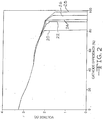
- Fig. 2 the x coordinate in Fig. 1 is changed from cell capacity to cathode efficiency.
- curve 20 was constructed from a representation Li/SVO cell having an A/C ratio of 0.923
- curve 22 was constructed from a cell having an A/C ratio of 0.995
- curve 24 was constructed from a cell having an A/C ratio of 1.044
- curve 26 was constructed from a cell having an A/C ratio of 1.078
- curve 28 was constructed from a cell having an A/C ratio of 1.135.
- the data suggest that with an A/C ratio of 1.135, only about 99% cathode efficiency can be delivered. This means that for efficient utilization of a SVO cathode, more anode capacity is needed in the cell active component balance. The same conclusion can be drawn for all other A/C ratio cells.
- Fig. 3 shows the correlation of A/C ratio with cell swelling.
- curve 30 was constructed from a representation Li/SVO cell having an A/C ratio of 0.923
- curve 32 was constructed from a cell having an A/C ratio of 0.995
- curve 34 was constructed from a cell having an A/C ratio of 1.044
- curve 36 was constructed from a cell having an A/C ratio of 1.078
- curve 38 was constructed from a cell having an A/C ratio of 1.135.
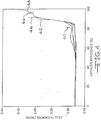
- Fig. 4 presents the relationship between cathode-efficiency and cell swelling.
- curve 40 was constructed from a representation Li/SVO cell having an A/C ratio of 0.923
- curve 42 was constructed from a cell having an A/C ratio of 0.995
- curve 44 was constructed from a cell having an A/C ratio of 1.044
- curve 46 was constructed from a cell having an A/C ratio of 1.078
- curve 48 was constructed from a cell having an A/C ratio of 1.135.
- Li/SVO cells start to swell between about 56% to 65% cathode efficiency.
- the middle-point is at about 61% cathode efficiency.
- This cathode efficiency represent the end of the second voltage plateau or the beginning of the second ramp (see Fig. 2 ), and is the lower limit for the rebalanced A/C ratio at which cell swelling can be completely prevented.
- the lower limit of the A/C ratio to achieve this cathode efficiency should be larger than 61%.
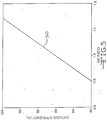
- the actual number is determined by the results of Fig. 5 .
- Fig. 4 also shows that from about 61% to about 85% cathode efficiency the SVO batteries only showed minimum swelling.
- the equation shown in Fig. 5 is an empirical equation derived from experimental data.
- the interception, 4.1806, and slope, 83.999, are the results of the linear mathematical fitting of the experimental data points.
- the lower cathode efficiency limit is estimated to be 61%.
- the lower limit for A/C is calculated to be 0.68.
- the calculated lower limit A/C ratio of the present invention is thus still larger than the recalculated A/C ratio range of 0.43 to 0.67 of the previously discussed Crespi et al. patent.
- Fig. 6 shows the relationship between cell potential and cell thickness.
- curve 60 was constructed from a representation Li/SVO cell having an A/C. ratio of 0.923
- curve 62 was constructed from a cell having an A/C ratio of 0.995
- curve 64 was constructed from a cell having an A/C ratio of 1.044
- curve 66 was constructed from a cell having an A/C ratio of 1.078
- curve 68 was constructed from a cell having an A/C ratio of 1.135.
- This graph indicates that when a Li/SVO cell starts to swell, the cell has already reached the end of the second plateau and the cell voltage is about 2.5V or below.
- the preferred A/C ratio for minimizing or preventing cell swelling in a Li/SVO cell is in the range of 0.68 to 1.00.
- a good cell design is predicated on utilizing cathode capacity as much as possible and at the same time minimizing the cell swelling. Therefore, the more preferred A/C ratio according to the present invention is in the range of 0.90 to 0.96 (corresponding to cathode efficiency of 80% to 85%).
- the cell potential is on the second ramp which can also be used as the cells's end-of-life (EOL) indicator.
Landscapes
- Chemical & Material Sciences (AREA)
- Chemical Kinetics & Catalysis (AREA)
- Electrochemistry (AREA)
- General Chemical & Material Sciences (AREA)
- Engineering & Computer Science (AREA)
- Manufacturing & Machinery (AREA)
- Inorganic Chemistry (AREA)
- Materials Engineering (AREA)
- Primary Cells (AREA)
- Battery Electrode And Active Subsutance (AREA)
- Electrotherapy Devices (AREA)
- Cell Electrode Carriers And Collectors (AREA)
Claims (17)
- Pile électrochimique, comprenant :a) une anode comprenant une matière active anodique ;b) une cathode comprenant une matière active cathodique, fonctionnellement associée à l'anode ;c) une solution d'électrolyte activant l'anode et la cathode, dans laquelle la matière active anodique de ladite anode et la matière active cathodique de ladite cathode sont présentes dans la pile selon un rapport de capacité anode/cathode de 0,68 à 0,96 basé sur la quantité en grammes de matières actives anodique et cathodique, et basé sur une capacité maximum théorique de la matière active anodique intercalée dans la matière active cathodique de 7,0, de telle sorte que le pourcentage total de changement d'épaisseur de la pile pendant toute la décharge est inférieur à 10 % ;dans laquelle la matière active anodique est le lithium ; et
dans laquelle la matière active cathodique est de l'oxyde d'argent et de vanadium de phase ε (Ag2V4O11). - Pile électrochimique selon la revendication 1, dans laquelle l'anode comprend une matière sélectionnée dans le groupe constitué du lithium et d'alliages et de composés intermétalliques de Li-Si, Li-Al, Li-B et Li-Si-B.
- Pile électrochimique selon la revendication 2, dans laquelle la solution d'électrolyte fonctionnellement associée à l'anode et à la cathode comprend un sel à base de lithium dissous dans un solvant non aqueux.
- Pile électrochimique selon l'une quelconque des revendications 1 à 3, dans laquelle l'anode comprend en outre un collecteur de courant sélectionné parmi le titane, le nickel, le cuivre, le tungstène ou le tantale.
- Pile électrochimique selon l'une quelconque des revendications 1 à 4, dans laquelle l'oxyde d'argent et de vanadium est présent dans la cathode dans une quantité de 80 % à 95 % en poids, le reste étant au moins l'un d'un matériau de liaison et d'un additif conducteur.
- Pile électrochimique selon la revendication 5, dans laquelle le matériau de liaison est une poudre de résine fluorée.
- Pile électrochimique selon la revendication 5 ou la revendication 6, dans laquelle l'additif conducteur est sélectionné parmi le carbone, la poudre de graphite ou le noir d'acétylène ou une poudre métallique sélectionnée parmi le titane, l'aluminium, le nickel, l'acier inoxydable, ou des mélanges de ceux-ci.
- Pile électrochimique selon l'une quelconque des revendications 1 à 7, dans laquelle la cathode comprend en outre un collecteur de courant sélectionné parmi le titane, l'acier inoxydable, le tantale, le platine ou l'or.
- Pile électrochimique selon l'une quelconque des revendications 1 à 8, dans laquelle le rapport de capacité anode/cathode est tel que durant la décharge de la pile, une matière cathodique lithiée ayant la formule générale LixAg2V4O11 est formée, dans laquelle x vaut de 6,7 à 4,8.
- Pile électrochimique selon l'une quelconque des revendications 1 à 9, dans laquelle la solution d'électrolyte comprend un sel de métal alcalin formant des ions dissous dans un solvant non aqueux, et dans laquelle le sel de métal alcalin est sélectionné parmi LiPF6, LiAsF6, LiSbF6, LiBF4, LiClO4, LiAlCl4, LiGaCl4, LiC(SO2CF3)3, LiN(SO2CF3)2, LiSCN, LiO3SCF2CF3, LiC6F5SO3, LiO2CCF3, LiSO3F, LiB(C6H5)4, LiCF3SO3, ou des mélanges de ceux-ci.
- Pile électrochimique selon l'une quelconque des revendications 1 à 10, dans laquelle la solution d'électrolyte comprend un sel de métal alcalin formant des ions dissous dans un solvant non aqueux, et dans laquelle le solvant non aqueux comprend au moins un solvant organique sélectionné parmi le tétrahydrofurane, l'acétate de méthyle, le diglyme, le triglyme, le tétraglyme, le carbonate de diméthyle, le 1,2-diméthoxyéthane, le 1,2-diéthoxyéthane, le 1-éthoxy-2-méthoxyéthane, le carbonate de diéthyle, l'acétonitrile, le sulfoxyde de diméthyle, le diméthylformamide, le diméthylacétamide, le carbonate de propylène, le carbonate d'éthylène, la γ-valérolactone, la γ-butyrolactone, la N-méthylpyrrolidinone, ou des mélanges de ceux-ci.
- Pile électrochimique selon la revendication 1, dans laquelle la solution d'électrolyte est capable de former catalytiquement du gaz propène pendant la décharge de la pile.
- Pile électrochimique selon l'une quelconque des revendications 1 à 12, dans laquelle un séparateur est présent entre l'anode et la cathode pour prévenir leur contact interne en court-circuit.
- Pile électrochimique selon l'une quelconque des revendications 1 à 13, logée dans un boîtier conducteur comprenant une matière sélectionnée parmi le titane, l'acier inoxydable, l'acier doux, le nickel, l'acier doux nickelé ou l'aluminium.
- Pile électrochimique selon l'une quelconque des revendications 1 à 14, dans laquelle l'anode se trouve en contact avec le boîtier dans une configuration dans laquelle le boîtier sert de borne négative.
- Pile électrochimique selon l'une quelconque des revendications 1 à 15, dans laquelle l'anode et la cathode sont activées avec la solution d'électrolyte comprenant 1,0 M de LiAsF6 dans un mélange 50:50, en volume, de carbonate de propylène et de 1,2-diméthoxyéthane.
- Procédé de fabrication de la pile électrochimique selon l'une quelconque des revendications 1 à 16, comprenant les étapes qui consistent à :a) fournir un boîtier ;b) fournir une anode comprenant une matière active anodique, dans laquelle la matière active anodique est le lithium ;c) fournir une cathode constituée d'une matière active cathodique, dans laquelle la matière active cathodique est l'oxyde d'argent et de vanadium de phase ε (Ag2V4O11) ;d) associer fonctionnellement l'anode et la cathode logées à l'intérieur du boîtier avec la matière active anodique de ladite anode et la matière active cathodique de ladite cathode selon un rapport de capacité anode/cathode de 0,68 à 0,96, basé sur une capacité maximum théorique de la matière active anodique intercalée dans la matière active cathodique de 7,0, et l'anode et la cathode étant connectées aux bornes respectives ; ete) activer l'anode et la cathode avec un électrolyte utilisé pour remplir le boîtier.
Applications Claiming Priority (2)
| Application Number | Priority Date | Filing Date | Title |
|---|---|---|---|
| US2534 | 1998-01-02 | ||
| US09/002,534 US6171729B1 (en) | 1998-01-02 | 1998-01-02 | Control of swelling in alkali metal electrochemical cells |
Publications (3)
| Publication Number | Publication Date |
|---|---|
| EP0930664A2 EP0930664A2 (fr) | 1999-07-21 |
| EP0930664A3 EP0930664A3 (fr) | 2002-08-14 |
| EP0930664B1 true EP0930664B1 (fr) | 2016-06-08 |
Family
ID=21701216
Family Applications (1)
| Application Number | Title | Priority Date | Filing Date |
|---|---|---|---|
| EP98308677.8A Expired - Lifetime EP0930664B1 (fr) | 1998-01-02 | 1998-10-23 | Contrôle du gonflement dans les piles électrochimiques à métal alcalin |
Country Status (4)
| Country | Link |
|---|---|
| US (1) | US6171729B1 (fr) |
| EP (1) | EP0930664B1 (fr) |
| JP (1) | JPH11265722A (fr) |
| AU (1) | AU743438B2 (fr) |
Families Citing this family (51)
| Publication number | Priority date | Publication date | Assignee | Title |
|---|---|---|---|---|
| US6623887B2 (en) * | 2000-04-06 | 2003-09-23 | Wilson Greatbatch Ltd. | Silver vanadium oxide cathode material for high discharge rate lithium cells |
| US6797017B2 (en) * | 2000-12-12 | 2004-09-28 | Wilson Greatbatch Ltd. | Preparation of ε-phase silver vanadium oxide from γ-phase SVO starting material |
| US7118829B2 (en) * | 2000-12-12 | 2006-10-10 | Wilson Greatbatch Technologies, Inc. | Preparation of copper silver vanadium oxide from γ-phase SVO starting material |
| US6803147B2 (en) | 2000-12-28 | 2004-10-12 | Wilson Greatbatch Technologies, Inc. | Silver vanadium oxide having low internal resistance and method of manufacture |
| JP2002231585A (ja) * | 2001-02-06 | 2002-08-16 | Nec Corp | 電気二重層コンデンサ |
| US20030113613A1 (en) * | 2001-12-17 | 2003-06-19 | Takeuchi Esther S. | High energy density rechargeable cell for medical device applications |
| US6926991B2 (en) * | 2001-12-26 | 2005-08-09 | Wilson Greatbatch Technologies, Inc. | SVO/CFx parallel cell design within the same casing |
| US6844106B2 (en) | 2002-03-29 | 2005-01-18 | Medtronic, Inc. | Electrochemical cell with reduced height fillport |
| US6849360B2 (en) * | 2002-06-05 | 2005-02-01 | Eveready Battery Company, Inc. | Nonaqueous electrochemical cell with improved energy density |
| US7045249B2 (en) * | 2003-07-02 | 2006-05-16 | The Gillette Company | Lithium cell with improved cathode |
| JP2005141998A (ja) * | 2003-11-05 | 2005-06-02 | Sony Corp | リチウム/二硫化鉄一次電池 |
| US7582387B2 (en) | 2004-10-29 | 2009-09-01 | Medtronic, Inc. | Lithium-ion battery |
| CN101048898B (zh) | 2004-10-29 | 2012-02-01 | 麦德托尼克公司 | 锂离子电池及医疗装置 |
| US8105714B2 (en) * | 2004-10-29 | 2012-01-31 | Medtronic, Inc. | Lithium-ion battery |
| US9077022B2 (en) | 2004-10-29 | 2015-07-07 | Medtronic, Inc. | Lithium-ion battery |
| US20080044728A1 (en) * | 2004-10-29 | 2008-02-21 | Medtronic, Inc. | Lithium-ion battery |
| US7641992B2 (en) * | 2004-10-29 | 2010-01-05 | Medtronic, Inc. | Medical device having lithium-ion battery |
| US7811705B2 (en) * | 2004-10-29 | 2010-10-12 | Medtronic, Inc. | Lithium-ion battery |
| US7337010B2 (en) * | 2004-10-29 | 2008-02-26 | Medtronic, Inc. | Medical device having lithium-ion battery |
| US7662509B2 (en) * | 2004-10-29 | 2010-02-16 | Medtronic, Inc. | Lithium-ion battery |
| US7635541B2 (en) * | 2004-10-29 | 2009-12-22 | Medtronic, Inc. | Method for charging lithium-ion battery |
| US7927742B2 (en) | 2004-10-29 | 2011-04-19 | Medtronic, Inc. | Negative-limited lithium-ion battery |
| US7563541B2 (en) * | 2004-10-29 | 2009-07-21 | Medtronic, Inc. | Lithium-ion battery |
| US9065145B2 (en) * | 2004-10-29 | 2015-06-23 | Medtronic, Inc. | Lithium-ion battery |
| US8980453B2 (en) | 2008-04-30 | 2015-03-17 | Medtronic, Inc. | Formation process for lithium-ion batteries |
| US7776470B2 (en) * | 2005-09-28 | 2010-08-17 | Greatbatch Ltd. | Anode-to-cathode capacity ratios for SVO/CF x hybrid cathode electrochemical cells |
| US20070202394A1 (en) * | 2006-02-28 | 2007-08-30 | Viavattine Joseph J | Separator systems for batteries |
| JP4963186B2 (ja) * | 2006-03-31 | 2012-06-27 | パナソニック株式会社 | 非水電解質二次電池 |
| DE102006021158A1 (de) | 2006-05-06 | 2007-11-08 | Biotronik Crm Patent Ag | Elektrode für eine Lithiumbatterie und Verfahren zur Herstellung derselben |
| US8119286B2 (en) * | 2009-11-24 | 2012-02-21 | The Gillette Company | Electrochemical cells with improved separator and electrolyte |
| US11081721B2 (en) | 2009-11-24 | 2021-08-03 | Duracell U.S. Operations, Inc. | Secondary electrochemical cells with separator and electrolyte combination |
| US8349493B2 (en) * | 2009-11-24 | 2013-01-08 | The Gillette Company | Electrochemical cells with improved separator and electrolyte |
| WO2011091176A1 (fr) | 2010-01-24 | 2011-07-28 | Medtronic, Inc. | Procédé de fabrication de pile comprenant l'application de boue de matériau de cathode à collecteur de courant |
| US9287580B2 (en) | 2011-07-27 | 2016-03-15 | Medtronic, Inc. | Battery with auxiliary electrode |
| US20130149560A1 (en) | 2011-12-09 | 2013-06-13 | Medtronic, Inc. | Auxiliary electrode for lithium-ion battery |
| US10008748B2 (en) | 2012-12-05 | 2018-06-26 | Duracell U.S. Operations, Inc. | Alkaline electrochemical cells with separator and electrolyte combination |
| US8920969B2 (en) | 2012-12-05 | 2014-12-30 | The Gillette Company | Alkaline electrochemical cells with separator and electrolyte combination |
| US9551758B2 (en) | 2012-12-27 | 2017-01-24 | Duracell U.S. Operations, Inc. | Remote sensing of remaining battery capacity using on-battery circuitry |
| US9478850B2 (en) | 2013-05-23 | 2016-10-25 | Duracell U.S. Operations, Inc. | Omni-directional antenna for a cylindrical body |
| US9726763B2 (en) | 2013-06-21 | 2017-08-08 | Duracell U.S. Operations, Inc. | Systems and methods for remotely determining a battery characteristic |
| US9882250B2 (en) | 2014-05-30 | 2018-01-30 | Duracell U.S. Operations, Inc. | Indicator circuit decoupled from a ground plane |
| US10297875B2 (en) | 2015-09-01 | 2019-05-21 | Duracell U.S. Operations, Inc. | Battery including an on-cell indicator |
| US10483634B2 (en) | 2016-11-01 | 2019-11-19 | Duracell U.S. Operations, Inc. | Positive battery terminal antenna ground plane |
| US10608293B2 (en) | 2016-11-01 | 2020-03-31 | Duracell U.S. Operations, Inc. | Dual sided reusable battery indicator |
| US10151802B2 (en) | 2016-11-01 | 2018-12-11 | Duracell U.S. Operations, Inc. | Reusable battery indicator with electrical lock and key |
| US10818979B2 (en) | 2016-11-01 | 2020-10-27 | Duracell U.S. Operations, Inc. | Single sided reusable battery indicator |
| US11024891B2 (en) | 2016-11-01 | 2021-06-01 | Duracell U.S. Operations, Inc. | Reusable battery indicator with lock and key mechanism |
| US11217846B2 (en) | 2017-03-16 | 2022-01-04 | Eaglepicher Technologies, Llc | Electrochemical cell |
| WO2018186561A1 (fr) | 2017-04-03 | 2018-10-11 | 주식회사 엘지화학 | Appareil de pré-lithiation, procédé de fabrication de partie d'électrode négative l'utilisant, et partie d'électrode négative |
| KR102253785B1 (ko) * | 2017-04-03 | 2021-05-21 | 주식회사 엘지화학 | 전리튬화 장치, 이를 이용한 음극부의 제조 방법 및 음극부 |
| US11837754B2 (en) | 2020-12-30 | 2023-12-05 | Duracell U.S. Operations, Inc. | Magnetic battery cell connection mechanism |
Family Cites Families (4)
| Publication number | Priority date | Publication date | Assignee | Title |
|---|---|---|---|---|
| US5434017A (en) * | 1993-11-19 | 1995-07-18 | Medtronic, Inc. | Isolated connection for an electrochemical cell |
| US5458997A (en) * | 1994-08-19 | 1995-10-17 | Medtronic, Inc. | Rebalancing of lithium/silver vandium oxide (Li/SVO) cells for improved performance |
| US5716728A (en) * | 1996-11-04 | 1998-02-10 | Wilson Greatbatch Ltd. | Alkali metal electrochemical cell with improved energy density |
| US5935728A (en) * | 1997-04-04 | 1999-08-10 | Wilson Greatbatch Ltd. | Electrochemical cell having multiplate and jellyroll electrodes with differing discharge rate regions |
-
1998
- 1998-01-02 US US09/002,534 patent/US6171729B1/en not_active Expired - Lifetime
- 1998-10-23 EP EP98308677.8A patent/EP0930664B1/fr not_active Expired - Lifetime
- 1998-11-25 AU AU94144/98A patent/AU743438B2/en not_active Ceased
- 1998-12-29 JP JP10377178A patent/JPH11265722A/ja active Pending
Non-Patent Citations (1)
| Title |
|---|
| None * |
Also Published As
| Publication number | Publication date |
|---|---|
| EP0930664A2 (fr) | 1999-07-21 |
| AU743438B2 (en) | 2002-01-24 |
| US6171729B1 (en) | 2001-01-09 |
| EP0930664A3 (fr) | 2002-08-14 |
| JPH11265722A (ja) | 1999-09-28 |
| AU9414498A (en) | 1999-07-22 |
Similar Documents
| Publication | Publication Date | Title |
|---|---|---|
| EP0930664B1 (fr) | Contrôle du gonflement dans les piles électrochimiques à métal alcalin | |
| EP1150366B1 (fr) | Structure cathodique sandwich pour cellule électrochimique à métal alcalin avec forte densité de puissance | |
| US6165638A (en) | Electrochemical cell having multiplate and jellyroll electrodes with differing discharge rate regions | |
| US6258473B1 (en) | Electrochemical cell having multiplate electrodes with differing discharge rate regions | |
| EP0780918B1 (fr) | Système à double piles à décharge intermédiaire et élevée et sa production | |
| US6228534B1 (en) | Annealing of mixed metal oxide electrodes to reduce polarization resistance | |
| US5667916A (en) | Mixed cathode formulation for achieving end-of-life indication | |
| US6221534B1 (en) | Alkali metal electrochemical cell having an improved cathode activated with a nonaqueous electrolyte having a carbonate additive | |
| US6677077B2 (en) | Electrochemical cell having multiplate electrodes with differing discharge rate regions | |
| US6692865B2 (en) | Double current collector cathode design using mixtures of two active materials for alkali metal or ion electrochemical cells | |
| EP1126539A2 (fr) | Batterie électrochimique pour la conversion de courant de basse intensité en courant de haute intensité par décharge en parallèle | |
| EP0829911A2 (fr) | Electrolyte nonaqueux organique à solvant ternaire pour piles électrochimiques à métal alcalin | |
| US20020090551A1 (en) | Double current collector cathode design for alkali metal electrochemical cells having short circuit safety characteristics | |
| EP1179871A2 (fr) | Pile secondaire multiplaques du type lithium-Ion comportant des régions à régime de décharge différent | |
| EP1310271B1 (fr) | Structure d'électrode pour applications de dispositifs implantables nécessitant l'indicateur de remplacement électif (ERI) | |
| US6607861B2 (en) | Application of γ-SVO and mixture of γ-SVO/ε-SVO in high rate electrochemical lithium cells containing SVO/CFx/SVO sandwich cathodes | |
| US7776470B2 (en) | Anode-to-cathode capacity ratios for SVO/CF x hybrid cathode electrochemical cells | |
| EP1324418A1 (fr) | Pile rechargeable à haute densité d'énergie pour applications medicales | |
| US20120133341A1 (en) | Control of Silver Vanadium Oxide Surface Areas as a Means of Controlling Voltage Delay and RDC Growth in an Electrochemical Cell | |
| EP1768203B1 (fr) | Electrodes de batterie | |
| US7056358B2 (en) | Method for using high rate lithium electrochemical cell containing SVO/CFchi/SVo sandwich cathodes having γ-SVO and mixture of γ-SVO/ε-SVO |
Legal Events
| Date | Code | Title | Description |
|---|---|---|---|
| PUAI | Public reference made under article 153(3) epc to a published international application that has entered the european phase |
Free format text: ORIGINAL CODE: 0009012 |
|
| AK | Designated contracting states |
Kind code of ref document: A2 Designated state(s): AT BE CH CY DE DK ES FI FR GB GR IE IT LI LU MC NL PT SE |
|
| AX | Request for extension of the european patent |
Free format text: AL;LT;LV;MK;RO;SI |
|
| PUAL | Search report despatched |
Free format text: ORIGINAL CODE: 0009013 |
|
| AK | Designated contracting states |
Kind code of ref document: A3 Designated state(s): AT BE CH CY DE DK ES FI FR GB GR IE IT LI LU MC NL PT SE |
|
| AX | Request for extension of the european patent |
Free format text: AL;LT;LV;MK;RO;SI |
|
| 17P | Request for examination filed |
Effective date: 20020911 |
|
| AKX | Designation fees paid |
Designated state(s): CH DE FR GB IT LI NL SE |
|
| 17Q | First examination report despatched |
Effective date: 20080220 |
|
| RAP1 | Party data changed (applicant data changed or rights of an application transferred) |
Owner name: GREATBATCH LTD. |
|
| RIC1 | Information provided on ipc code assigned before grant |
Ipc: H01M 6/50 20060101ALI20151204BHEP Ipc: H01M 4/38 20060101ALI20151204BHEP Ipc: H01M 4/06 20060101AFI20151204BHEP Ipc: H01M 4/58 20060101ALI20151204BHEP Ipc: H01M 4/48 20060101ALI20151204BHEP Ipc: H01M 6/16 20060101ALI20151204BHEP Ipc: H01M 4/62 20060101ALN20151204BHEP |
|
| REG | Reference to a national code |
Ref country code: DE Ref legal event code: R079 Ref document number: 69843544 Country of ref document: DE Free format text: PREVIOUS MAIN CLASS: H01M0006160000 Ipc: H01M0004060000 |
|
| GRAP | Despatch of communication of intention to grant a patent |
Free format text: ORIGINAL CODE: EPIDOSNIGR1 |
|
| RIC1 | Information provided on ipc code assigned before grant |
Ipc: H01M 4/48 20060101ALI20160211BHEP Ipc: H01M 4/38 20060101ALI20160211BHEP Ipc: H01M 4/58 20060101ALI20160211BHEP Ipc: H01M 6/16 20060101ALI20160211BHEP Ipc: H01M 6/50 20060101ALI20160211BHEP Ipc: H01M 4/62 20060101ALN20160211BHEP Ipc: H01M 4/06 20060101AFI20160211BHEP |
|
| INTG | Intention to grant announced |
Effective date: 20160229 |
|
| GRAS | Grant fee paid |
Free format text: ORIGINAL CODE: EPIDOSNIGR3 |
|
| GRAA | (expected) grant |
Free format text: ORIGINAL CODE: 0009210 |
|
| AK | Designated contracting states |
Kind code of ref document: B1 Designated state(s): CH DE FR GB IT LI NL SE |
|
| REG | Reference to a national code |
Ref country code: GB Ref legal event code: FG4D |
|
| REG | Reference to a national code |
Ref country code: CH Ref legal event code: EP |
|
| REG | Reference to a national code |
Ref country code: DE Ref legal event code: R096 Ref document number: 69843544 Country of ref document: DE |
|
| REG | Reference to a national code |
Ref country code: FR Ref legal event code: PLFP Year of fee payment: 19 |
|
| REG | Reference to a national code |
Ref country code: NL Ref legal event code: MP Effective date: 20160608 |
|
| PG25 | Lapsed in a contracting state [announced via postgrant information from national office to epo] |
Ref country code: NL Free format text: LAPSE BECAUSE OF FAILURE TO SUBMIT A TRANSLATION OF THE DESCRIPTION OR TO PAY THE FEE WITHIN THE PRESCRIBED TIME-LIMIT Effective date: 20160608 Ref country code: SE Free format text: LAPSE BECAUSE OF FAILURE TO SUBMIT A TRANSLATION OF THE DESCRIPTION OR TO PAY THE FEE WITHIN THE PRESCRIBED TIME-LIMIT Effective date: 20160608 |
|
| PG25 | Lapsed in a contracting state [announced via postgrant information from national office to epo] |
Ref country code: IT Free format text: LAPSE BECAUSE OF FAILURE TO SUBMIT A TRANSLATION OF THE DESCRIPTION OR TO PAY THE FEE WITHIN THE PRESCRIBED TIME-LIMIT Effective date: 20160608 |
|
| REG | Reference to a national code |
Ref country code: DE Ref legal event code: R097 Ref document number: 69843544 Country of ref document: DE |
|
| PLBE | No opposition filed within time limit |
Free format text: ORIGINAL CODE: 0009261 |
|
| STAA | Information on the status of an ep patent application or granted ep patent |
Free format text: STATUS: NO OPPOSITION FILED WITHIN TIME LIMIT |
|
| 26N | No opposition filed |
Effective date: 20170309 |
|
| REG | Reference to a national code |
Ref country code: CH Ref legal event code: PL |
|
| GBPC | Gb: european patent ceased through non-payment of renewal fee |
Effective date: 20161023 |
|
| PG25 | Lapsed in a contracting state [announced via postgrant information from national office to epo] |
Ref country code: LI Free format text: LAPSE BECAUSE OF NON-PAYMENT OF DUE FEES Effective date: 20161031 Ref country code: GB Free format text: LAPSE BECAUSE OF NON-PAYMENT OF DUE FEES Effective date: 20161023 Ref country code: CH Free format text: LAPSE BECAUSE OF NON-PAYMENT OF DUE FEES Effective date: 20161031 |
|
| REG | Reference to a national code |
Ref country code: FR Ref legal event code: PLFP Year of fee payment: 20 |
|
| PGFP | Annual fee paid to national office [announced via postgrant information from national office to epo] |
Ref country code: FR Payment date: 20170918 Year of fee payment: 20 |
|
| PGFP | Annual fee paid to national office [announced via postgrant information from national office to epo] |
Ref country code: DE Payment date: 20171018 Year of fee payment: 20 |
|
| REG | Reference to a national code |
Ref country code: DE Ref legal event code: R071 Ref document number: 69843544 Country of ref document: DE |