EP0930738A2 - Optimalen komplementäre punktierte Faltungskode für Verwendung im digitalen Tonrundfunk und für andere Verwendungen - Google Patents
Optimalen komplementäre punktierte Faltungskode für Verwendung im digitalen Tonrundfunk und für andere Verwendungen Download PDFInfo
- Publication number
- EP0930738A2 EP0930738A2 EP99300182A EP99300182A EP0930738A2 EP 0930738 A2 EP0930738 A2 EP 0930738A2 EP 99300182 A EP99300182 A EP 99300182A EP 99300182 A EP99300182 A EP 99300182A EP 0930738 A2 EP0930738 A2 EP 0930738A2
- Authority
- EP
- European Patent Office
- Prior art keywords
- codes
- code
- bandwidth
- rate
- bits
- Prior art date
- Legal status (The legal status is an assumption and is not a legal conclusion. Google has not performed a legal analysis and makes no representation as to the accuracy of the status listed.)
- Withdrawn
Links
- 230000000295 complement effect Effects 0.000 title claims abstract description 64
- 238000000034 method Methods 0.000 claims abstract description 36
- 238000004891 communication Methods 0.000 claims abstract description 22
- 238000010586 diagram Methods 0.000 description 6
- 238000013507 mapping Methods 0.000 description 4
- 239000000969 carrier Substances 0.000 description 3
- 230000010287 polarization Effects 0.000 description 3
- 238000012545 processing Methods 0.000 description 3
- 230000005540 biological transmission Effects 0.000 description 2
- 238000012937 correction Methods 0.000 description 2
- 125000004122 cyclic group Chemical group 0.000 description 2
- 230000000694 effects Effects 0.000 description 2
- 238000005516 engineering process Methods 0.000 description 2
- 230000015654 memory Effects 0.000 description 2
- 230000005236 sound signal Effects 0.000 description 2
- 238000001228 spectrum Methods 0.000 description 2
- 239000000654 additive Substances 0.000 description 1
- 230000000996 additive effect Effects 0.000 description 1
- 238000005562 fading Methods 0.000 description 1
- 238000005457 optimization Methods 0.000 description 1
Images


Classifications
-
- H—ELECTRICITY
- H03—ELECTRONIC CIRCUITRY
- H03M—CODING; DECODING; CODE CONVERSION IN GENERAL
- H03M13/00—Coding, decoding or code conversion, for error detection or error correction; Coding theory basic assumptions; Coding bounds; Error probability evaluation methods; Channel models; Simulation or testing of codes
-
- H—ELECTRICITY
- H04—ELECTRIC COMMUNICATION TECHNIQUE
- H04H—BROADCAST COMMUNICATION
- H04H20/00—Arrangements for broadcast or for distribution combined with broadcast
- H04H20/28—Arrangements for simultaneous broadcast of plural pieces of information
- H04H20/30—Arrangements for simultaneous broadcast of plural pieces of information by a single channel
-
- H—ELECTRICITY
- H04—ELECTRIC COMMUNICATION TECHNIQUE
- H04L—TRANSMISSION OF DIGITAL INFORMATION, e.g. TELEGRAPHIC COMMUNICATION
- H04L1/00—Arrangements for detecting or preventing errors in the information received
- H04L1/004—Arrangements for detecting or preventing errors in the information received by using forward error control
- H04L1/0056—Systems characterized by the type of code used
- H04L1/0059—Convolutional codes
-
- H—ELECTRICITY
- H04—ELECTRIC COMMUNICATION TECHNIQUE
- H04L—TRANSMISSION OF DIGITAL INFORMATION, e.g. TELEGRAPHIC COMMUNICATION
- H04L1/00—Arrangements for detecting or preventing errors in the information received
- H04L1/004—Arrangements for detecting or preventing errors in the information received by using forward error control
- H04L1/0056—Systems characterized by the type of code used
- H04L1/0067—Rate matching
- H04L1/0068—Rate matching by puncturing
- H04L1/0069—Puncturing patterns
-
- H—ELECTRICITY
- H04—ELECTRIC COMMUNICATION TECHNIQUE
- H04L—TRANSMISSION OF DIGITAL INFORMATION, e.g. TELEGRAPHIC COMMUNICATION
- H04L1/00—Arrangements for detecting or preventing errors in the information received
- H04L1/004—Arrangements for detecting or preventing errors in the information received by using forward error control
- H04L1/0056—Systems characterized by the type of code used
- H04L1/007—Unequal error protection
-
- H—ELECTRICITY
- H04—ELECTRIC COMMUNICATION TECHNIQUE
- H04H—BROADCAST COMMUNICATION
- H04H2201/00—Aspects of broadcast communication
- H04H2201/10—Aspects of broadcast communication characterised by the type of broadcast system
- H04H2201/20—Aspects of broadcast communication characterised by the type of broadcast system digital audio broadcasting [DAB]
Definitions
- the present invention relates generally to convolutional codes for use in communication systems, and more particularly to punctured convolutional codes optimized for use in conjunction with digital audio broadcasting and other types of communication system applications which utilize diversity in frequency, time, space, polarization or other system parameters.
- FIG. 1 shows a portion of a frequency spectrum in an exemplary In Band On Channel (IBOC) system for implementing digital audio broadcasting (DAB) in existing analog frequency modulation (FM) radio bands.
- IBOC In Band On Channel
- FM analog frequency modulation
- an analog FM carrier signal 10 serves as a "host" for transmission of digital audio information of CD-like quality.
- the same digital audio information is transmitted on both a lower sideband 12 and an upper sideband 14 of the analog host 10, using a multicarrier OFDM technique. This ensures that all of the digital information can be recovered when one of the sidebands is corrupted, or even completely lost, due to effects such as fading or interference in the crowded analog FM band.
- the digital audio subcarriers transmitted in region B of the lower and upper sidebands 12, 14 are generally less susceptible to interference from adjacent FM channels or the analog host 10 than the carriers in regions A or C.
- the subcarriers in region A of sidebands 12, 14 are more susceptible to adjacent channel interference, while those in region C are more susceptible to interference from the analog host 10.
- the transmission in region C may make use of precancellation techniques which allow the interference with the analog host 10 to be canceled. Additional details regarding this exemplary IBOC system can be found in B.W. Kroeger and A.J. Vigil, "Improved IBOC DAB Technology for AM and FM Broadcasting," SBE Engineering Conference, pp. 1-10, 1996.
- complementary convolutional codes be utilized for channel coding in DAB systems such as the IBOC system described in conjunction with FIG. 1.
- a pair of complementary codes can be used individually on both sides of the analog host 10 in the system of FIG. 1.
- a pair of complementary codes can be generating by "puncturing" a low-rate "mother” code to twice its original rate. Puncturing a mother code is a well-known technique for obtaining high-rate convolutional codes which exhibit good performance and which can be decoded using the same basic Viterbi algorithm that is used for the mother code. See, for example, G.C. Clark, Jr. and J.B. Cain, "Error Correcting Codes for Digital Communications," Plenum Press, 1981, S.
- Puncturing generally involves removing bits from the low-rate mother code such that the remaining code bits form one of the complementary codes, while the punctured bits form the other complementary code of the code pair.
- the resulting pair of codes which are referred to as complementary punctured-pair convolutional (CPPC) codes, are complementary in the sense that they are both of a rate which is twice that of the mother code obtained by combining the two codes.
- Increased puncturing leads to higher punctured code rates. It can be shown that punctured codes of a certain rate generally provide performance which is almost as good as that of optimal codes at the same rate.
- the conventional CPPC codes which have been proposed for use in the IBOC system described in the above-cited B.W. Kroeger and A.J.
- Vigil reference generally do not provide optimal or near-optimal performance, and in some cases are even catastrophic. This may be due in part to a perceived requirement that the code pairs be so-called “equivalent” codes, as defined in S. Kallel, "Complementary Punctured Convolutional Codes and Their Applications,” IEEE Transactions on Communications, Vol. 43, No. 6, pp. 2005- 2009, June 1995, which is incorporated by reference herein. However, this perceived requirement has had the effect of unduly restricting the scope of search for CPPC codes. A need therefore exists for improved punctured convolutional codes which can provide better performance than conventional codes in the above-described IBOC digital audio broadcasting system and other applications.
- the invention provides optimal punctured convolutional codes for use in digital audio broadcasting as well as other types of communication systems.
- Optimal punctured convolutional codes are provided for equal error protection (EEP) applications, and both rate-compatible and rate-incompatible codes for are provided for unequal error protection (UEP) applications.
- an optimal code is selected as a code which has the best free Hamming distance and the minimum information error weight from among a set of potential non-catastrophic codes for a given set of operating parameters.
- a set of potential non-catastrophic codes in accordance with the invention can include codes which are not equivalent in terms of their distance or performance properties.
- the selected optimal code thus provides performance advantages relative to a code selected from a set restricted to only equivalent codes.
- the techniques of the invention can be readily extended for use in selecting an optimal group of n complementary codes from a set of such groups.
- the invention may be implemented in an exemplary system in which digital audio information is transmitted on subcarriers in both an upper and a lower sideband of an analog carrier.
- an optimal complementary code pair is selected from a set of code pairs defined in the manner described above.
- the complementary codes in the selected code pair may each be, for example, a rate-4/5 half-bandwidth convolutional code which is generated by puncturing a rate-2/5 full-bandwidth convolutional code.
- the full-bandwidth code may itself be generated by puncturing a rate-1/3 mother code.
- the invention also provides an optimal bit assignment strategy for use in such a system. In accordance with this strategy, bits from a designated code generator may be assigned to the upper and lower sideband subcarriers which are located furthest from the analog carrier.
- FIG. 1 shows a portion of a frequency spectrum in a conventional In Band On Channel (IBOC) digital audio broadcasting system.
- IBOC In Band On Channel
- FIG. 2 is a block diagram of a communication system which may be configured to utilize complementary punctured convolutional codes in accordance with the invention.
- FIGS. 3A and 3B illustrate exemplary bit assignment patterns for use in implementing optimal complementary punctured codes in accordance with the invention.
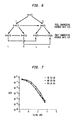
- FIGS. 4, 5 and 7 show plots of simulated bit error rate (BER) for a number of different punctured convolutional codes in accordance with the invention.
- FIG. 6 shows rate-compatibility relationships for an IBOC system configured with unequal error protection (UEP) in accordance with the invention.
- UDP unequal error protection
- the invention will be described below in conjunction with exemplary complementary punctured convolutional codes optimized for use in a particular digital audio broadcast system. It should be understood, however, that the coding techniques of the invention may be applied to many other types of communication systems. For example, although the digital audio broadcast system described herein utilizes a frequency diversity technique, the invention could also be implemented in systems which utilize time diversity, space diversity, polarization diversity, as well as other types of diversity techniques.
- the description of the exemplary embodiments will use the term "optimal" to refer to a code which has the best free Hamming distance and the minimum information error weight from among a set of potential non-catastrophic codes for a given set of operating parameters.
- a code is considered "catastrophic" if its state diagram contains a loop of zero weight other than the self-loop around the zero state.
- the concepts of free Hamming distance, information error weight and non-catastrophic codes are described in greater detail in, for example, S. Lin and D.J. Costello Jr., "Error Control Coding: Fundamentals and Applications,” Prentice-Hall, 1983, and G.C. Clark, Jr. and J.B. Cain, "Error Correcting Codes for Digital Communications," Plenum Press, 1981, which are incorporated by reference herein.
- Complementary codes in a given pair or other group of codes are considered “equivalent” if their puncturing patterns are cyclic permutations of one another, as described in S.
- Optimal codes in accordance with the invention may be equivalent or non-equivalent.
- FIG. 2 is a block diagram of an exemplary communication system 20 in which CPPC codes in accordance with the invention may be utilized.
- the system 20 includes a transmitter 22 and a receiver 24.
- the transmitter 22 includes an audio coder 25 for generating a digital bit stream from an analog audio signal.
- the digital bit stream from audio coder 25 is applied to a convolutional encoder 26 which utilizes CPPC codes, which will be described in greater detail below, to encode the bit stream into a sequence of symbols.
- CPPC codes which will be described in greater detail below
- the modulator 28 may perform several stages of modulation such as, for example, modulating the interleaved symbols onto one or more sub-carriers, and then frequency modulating the sub-carriers onto a radio frequency (RF) carrier.
- the modulated carrier is transmitted via transmit antenna 29 to the receiver 24.
- the transmitter 22 may include additional processing elements, such as multiplexers, upconverters and the like, which are not shown in the FIG. 2 embodiment.
- the receiver 24 receives the transmitted signal via receive antenna 30, and performs demodulation operations in demodulator 31 to recover the interleaved symbols.
- the symbols are deinterleaved in a deinterleaver 32, and the resulting symbol sequence is converted to a digital bit stream in decoder 33 using a soft Viterbi decoding process.
- the digital bit stream is then decoded in audio decoder 34 to reconstruct the original audio signal.
- the receiver 24 may include additional processing elements which are not shown in FIG. 2. It should also be noted that various elements of the system 20, such as the interleaver 27 and the deinterleaver 32, may be eliminated in alternative embodiments.
- various elements of the system 20 may be implemented using portions of an application-specific integrated circuit, microprocessor or any other type of digital data processor.
- Various aspects of the invention may also be implemented in the form of one or more software programs executed by a central processing unit (CPU) or the like in the digital data processor.
- the code rate is the ratio of input bits to output bits for the convolutional encoder.
- a rate-1/3 encoder generates three output bits for each input bit.
- a group of three coded output bits is referred to as a symbol.
- the value of K refers to the number of uncoded input bits which are processed to generate each output symbols.
- the adder corresponding to generator g 0 generates the first bit of each output symbol as the modulo-2 sum of the bits in the first, third, fourth, sixth and seventh bit positions in the shift-register, with the first bit position containing the latest input bit.
- the generators g 1 and g 2 generate the second and third bits, respectively, of each output symbol as modulo-2 sums of the bits in the positions designated by the respective generator values.
- the optimal CPPC codes are determined in this embodiment by first calculating the pairs of free distances and information error weights of all non-catastrophic complementary codes that combine to one of the two rate-2/5 codes noted above.
- the worst-case free distance of the complementary pair is the minimum of the pair of free distances.
- the worst-case information error weight ( c worst ) is the maximum of the pair of information error weights.
- the free distances and information error weights may be calculated using an augmented-metric Viterbi algorithm. Other optimization criteria may be used in alternative embodiments of the invention.
- Puncture Pattern d f c d f /P Complementary Pattern d f c d f /P (0110, 1001, 0010) 4 2.50 (1001, 0110, 1000) 4 2.50 (0110, 1001, 1000) 4 12.00 (1001, 0110, 0010) 4 12.00
- the IBOC system described in conjunction with FIG. 1 utilizes a multicarrier modulation technique, with varying amounts of interference susceptibility on the different digital audio subcarriers in portions A, B and C of the upper and lower sidebands. More particularly, the subcarriers farthest away from the analog host are most susceptible to interference.
- the mapping of code bits to subcarrier frequencies can affect performance.
- the invention provides a mapping of code bits to subcarriers which improves performance relative to conventional mappings. This mapping is determined by puncturing each sideband of the full-bandwidth codes in an RCPC fashion while keeping all of the bits in the other sideband.
- the two complementary codes from the top line of TABLE 2 are the respective lower sideband and upper sideband half-bandwidth codes. Since the outermost subcarriers on each sideband are most susceptible to interference, the bits from the third generator g 2 are mapped to these frequencies. Thus, if both outer regions A in the upper and lower sidebands of FIG. 1 are corrupted or lost, the remaining code would be an industry-standard rate-1/2 code. At each puncturing step, the punctured bit is assigned to the outermost unassigned subcarrier.
- the optimal puncture patterns for the lower sideband (LSB) and upper sideband (USB) are shown in TABLES 3 and 4, respectively.
- FIGS. 3A and 3B illustrate the above-described optimal bit assignment strategy for the lower sideband and upper sideband, respectively.
- the notation G0 i , G1 i , and G2 i refers to the ith bit, modulo 4, from the generators g 0 , g 1 and g 2 , respectively.
- the second bit modulo 4 from the third generator g 2 is assigned to the outermost subcarrier of the lower sideband, and the zeroth bit modulo 4 from the third generator g 2 is assigned to the outermost subcarrier of the upper sideband.
- This bit assignment optimizes performance in the presence of interference for the exemplary IBOC system of FIG. 1.
- the bit assignment techniques of the invention could also be used to provide similar improvements in other types of communication systems.
- the full-bandwidth code may be the full, un-punctured, rate-1/3 mother code described above.
- the half-bandwidth codes which will be referred to as "half-bandwidth+" codes, will then each have a rate of 2/3.
- TABLE 5 below gives the optimal code pairs for two different compatibility constraints.
- the code pair on the top line of TABLE 5 is the best punctured pair overall.
- the pair on the second line is the best pair that is rate-compatible with the optimal rate-4/5 code pair from TABLE 2.
- Another aspect of the invention relates to providing unequal error protection (UEP) in a DAB or other communication system.
- UEP unequal error protection
- the invention satisfies this requirement through the use of time multiplexing.
- the time multiplexing will be illustrated for a case in which two classes of information bits are to be unequally protected.
- Class I bits are the most important bits and must be protected with a low-rate (i.e., high redundancy) code.
- Class II bits are the less important class of bits. Generalization to three or more classes of bits is straightforward, and will not be described in detail herein.
- a full-bandwidth code with a set of rates satisfying equation (1) can be constructed by puncturing a common convolutional mother code. Furthermore, if one wants to avoid inserting termination bits between the Class I and Class II bits, the mother code needs to be punctured in a rate-compatible manner, as described in the above-cited J. Hagenauer reference. More particularly, the Class I bits should follow the Class II bits, and the unpunctured bits in the Class II code must be a subset of the unpunctured bits in the Class I code. TABLES 6 and 7 below show candidate punctured convolutional codes for Class I and Class II bits, respectively, in the IBOC system.
- the mother code used to generate the punctured codes in TABLES 6 and 7 is the same rate-1/3 convolutional code used in the previously-described equal error protection (EEP) examples.
- the average rate of the full-bandwidth code is 2/5 and therefore satisfies the rate requirements for the exemplary IBOC system.
- FIG. 4 shows plots of simulated bit error rate (BER) performance for full-bandwidth EEP and UEP code examples given above. It is assumed for these plots, and the BER plots of FIGS. 5 and 7, that the information source is a sequence of 10 6 pseudo-randomly generated bits, and the channel is an additive white Gaussian noise (AWGN) channeL
- the EEP code used in the plots is the above-noted full-bandwidth Kroeger rate-2/5 (i.e., 4/10) code with a puncture pattern of (1111, 1111, 1010), or FFA in hexadecimal notation.
- the UEP codes are the best full-bandwidth Class I (rate-4/11) and Class II (rate-4/9) codes taken from the top lines of TABLES 6 and 7, respectively. These codes in hexadecimal notation may be written as FF FF EE and FF FF 88, respectively. It can be seen that the rate-4/11 Class I code provides the best BER performance, followed by the rate-2/5 EEP code, with the rate-4/9 Class II code providing the worst BER performance of the three full-bandwidth codes.
- half-bandwidth codes for an IBOC system with UEP can be formed by puncturing the full-bandwidth codes given in TABLES 6 and 7.
- Half of the bits for each of the Class I and Class II full-bandwidth codes may be placed in the upper sideband half-bandwidth codes and the other half may be placed in the lower sideband half-bandwidth codes.
- the half-bandwidth code rates are twice the full-bandwidth code rates, so if the full-bandwidth code rates satisfy rate equation (1) above, the half-bandwidth code rates will also satisfy equation (1).
- the half-bandwidth codes and full-bandwidth codes should both be rate compatible.
- the complementary pairs on the first two lines of TABLE 8 thus combine to form the optimal Class I full-bandwidth codes (1111 1111, 1111 1111, 1110 1110) and (1111 1111, 1111 1111, 1110 1101) from the first two lines of TABLE 6. It can be seen from TABLE 7 that there is only one optimal rate-4/9 code, shown on the first line of TABLE 7, and the corresponding optimal complementary pair is shown on the third line of TABLE 8. The complementary pair on the third line of TABLE 8 thus combine to form the optimal Class II full-bandwidth code (1111 1111, 1111 1111, 1000 1000) on the first line of TABLE 7. Optimal Half-Bandwidth Complementary Code Pairs for UEP.
- Puncture Pattern d f c d f /P Complementary Pattern d f c d f /P (0000 0110, 1101 0101, 0110 1010) 5 7.125 (1111 1001, 0010 1010, 1000 0100) 5 7.000 (0011 1011, 1100 0100, 1000 1001) 5 9.500 (1100 0100, 0011 1011, 0110 0100) 5 8.750 (0011 1100, 1100 0011, 0000 1000) 3 2.000 (1100 0011, 0011 1100, 1000 0000) 3 2.000
- FIG. 5 shows plots of simulated BER performance for half-bandwidth EEP and UEP complementary code examples given above.
- the EEP code pair used in the plots is the half-bandwidth rate-4/5 (i.e., 8/10) code pair from the top line of TABLE 2.
- the codes of this code pair are equivalent, and therefore only one BER curve is plotted for this code pair.
- the EEP code for which the BER curve is plotted is (0110, 1001, 0010), or 692 in hexadecimal notation.
- the UEP codes are the best half-bandwidth Class I (rate-8/11) and Class II (rate-8/9) codes taken from the first and third lines, respectively, of TABLE 8.
- the codes of the Class II code pair are also equivalent, and therefore only one BER curve is plotted for the Class II pair.
- This code is (0011 1100, 1100 0011, 0000 1000) or 3C C3 08 in hexadecimal notation.
- the complementary half-bandwidth Class I codes in hexadecimal notation may be written as 06 D5 6A and F9 2A 84. It can be seen that the rate-8/11 Class II complementary codes provides the best BER performance, followed by the rate-8/10 EEP code, with the rate-8/9 Class II code providing the worst BER performance of the exemplary codes plotted in FIG. 5.
- FIG. 6 illustrates an exemplary set of rate-compatibility constraints.
- the top line of the diagram in FIG. 6 represents the rate-1/3 mother code.
- a code at the tail end of a given arrow in FIG. 6 can be punctured to yield the code at the head of that arrow.
- the middle line of the diagram shows the full-bandwidth Class I (rate-4/11) and Class II (rate-4/9) codes generated by puncturing the rate-1/3 mother code, with the Class I code on the left and the Class II code on the right.
- the average rate of these Class I and Class II codes is 2/5.
- the bottom line of the diagram shows the half-bandwidth codes generated by puncturing the full-bandwidth codes of the middle line.
- the lower sideband code is shown to the left of the corresponding full-bandwidth code, and the upper sideband code is shown to the right of the full-bandwidth code.
- the average rate of the half-bandwidth codes is 4/5.
- the dashed arrows in FIG. 6 show the rate compatibility required to avoid the need for extra termination bits between the Class II and Class I codes. Codes connected by lines instead of arrows are complementary codes.
- TABLE 9 shows an exemplary set of fully-compatible codes satisfying the compatibility relationships set forth in FIG. 6. Only the rate-8/11 complementary code pair is sub-optimal. The rate-4/11 code is equivalent to the rate-4/11 code on the top line of TABLE 6. The complementary rate-8/11 codes in TABLE 9 are equivalent. Both have a free distance d f of 5 and an information error weight c d f /P of 12.25. Fully-Compatible UEP Code Set.
- Puncture Pattern Rate Complementary Pattern Rate (1111 1111, 1111 1111, 1011 1011) 4/11 N/A - (1111 1111, 1111 1111, 1000 1000) 4/9 N/A - (0011 1100, 1100 0011, 0010 1001) 8/11 (1100 0011, 0011 1100, 1001 0010) 8/11 (0011 1100, 1100 0011, 0000 1000) 8/9 (1100 0011, 0011 1100, 1000 0000) 8/9
- FIG. 7 shows plots of simulated BER performance for one of the codes in the equivalent pair of fully-compatible rate-8/11 complementary codes from TABLE 9, along with the best (but not fully-compatible) rate-8/11 code pair from the top line of TABLE 8.
- the code from the pair of fully-compatible rate-8/11 codes is expressed in hexadecimal notation as 3C C3 29.
- the codes of the best rate-8/11 code pair from TABLE 8 are expressed in hexadecimal notation as 06 D5 6A and F9 2A 84. It can be seen from the BER plots for these three codes in FIG. 7 that the performance penalty associated with the use of the sub-optimal but fully-compatible rate-8/11 code pair is only approximately 0.4 dB.
Landscapes
- Engineering & Computer Science (AREA)
- Signal Processing (AREA)
- Computer Networks & Wireless Communication (AREA)
- Physics & Mathematics (AREA)
- Probability & Statistics with Applications (AREA)
- Theoretical Computer Science (AREA)
- Error Detection And Correction (AREA)
- Detection And Prevention Of Errors In Transmission (AREA)
Applications Claiming Priority (2)
| Application Number | Priority Date | Filing Date | Title |
|---|---|---|---|
| US6570 | 1998-01-13 | ||
| US09/006,570 US6347122B1 (en) | 1998-01-13 | 1998-01-13 | Optimal complement punctured convolutional codes for use in digital audio broadcasting and other applications |
Publications (2)
| Publication Number | Publication Date |
|---|---|
| EP0930738A2 true EP0930738A2 (de) | 1999-07-21 |
| EP0930738A3 EP0930738A3 (de) | 2005-04-13 |
Family
ID=21721523
Family Applications (1)
| Application Number | Title | Priority Date | Filing Date |
|---|---|---|---|
| EP99300182A Withdrawn EP0930738A3 (de) | 1998-01-13 | 1999-01-12 | Optimalen komplementäre punktierte Faltungskode für Verwendung im digitalen Tonrundfunk und für andere Verwendungen |
Country Status (4)
| Country | Link |
|---|---|
| US (2) | US6347122B1 (de) |
| EP (1) | EP0930738A3 (de) |
| JP (1) | JP3284105B2 (de) |
| KR (1) | KR100370689B1 (de) |
Cited By (10)
| Publication number | Priority date | Publication date | Assignee | Title |
|---|---|---|---|---|
| WO2002007327A1 (en) * | 2000-07-17 | 2002-01-24 | Koninklijke Philips Electronics N.V. | Coding of data stream |
| WO2001035555A3 (en) * | 1999-11-11 | 2002-04-11 | Ibiquity Digital Corp | Method and apparatus for forward error correction coding for an am in-band on-channel digital audio broadcasting system |
| WO2003024043A1 (fr) * | 2001-08-24 | 2003-03-20 | Linkair Communications, Inc. | Procede et systeme de decodage de canal base sur la combinaison d'un code de convolution discontinu et d'une modulation d'amplitude en quadrature |
| EP1014590A3 (de) * | 1998-12-21 | 2003-05-07 | Lucent Technologies Inc. | Optimale komplementäre punktierte Faltungskodes |
| US6768778B1 (en) | 1998-01-13 | 2004-07-27 | Lucent Technologies Inc. | Optimal complementary punctured convolutional codes |
| EP1198100A3 (de) * | 2000-10-13 | 2006-10-04 | Agere Systems Guardian Corporation | Kanalkodierung mit versteckter Punktierung für Teil-Band störbehaftete Kanäle |
| EP1226663A4 (de) * | 1999-11-04 | 2006-12-06 | Xm Satellite Radio Inc | Verfahren und vorrichtung zur verketteten faltungskodierung und verschachtelung |
| US7653088B2 (en) | 1999-05-26 | 2010-01-26 | Xm Satellite Radio Inc. | Method for concatenated convolutional encoding and interleaving |
| WO2012163099A1 (zh) * | 2011-05-27 | 2012-12-06 | 华为技术有限公司 | 语音信号处理方法、装置和接入网系统 |
| WO2022070179A1 (en) * | 2020-09-30 | 2022-04-07 | Elbit Systems C4I and Cyber Ltd. | Transmission device and method for transmitting punctured data messages having common input bits and reception device and method for reassembling an encoded data message based on punctured data messages |
Families Citing this family (49)
| Publication number | Priority date | Publication date | Assignee | Title |
|---|---|---|---|---|
| KR100295760B1 (ko) * | 1998-12-31 | 2001-09-06 | 윤종용 | 디지털시스템의길쌈부호처리장치및방법 |
| JP3728578B2 (ja) * | 1999-03-31 | 2005-12-21 | 富士通株式会社 | マルチキャリア伝送における不均一誤り保護方法並びにその符号器及び復号器 |
| US6650717B1 (en) * | 1999-04-19 | 2003-11-18 | Lucent Technologies Inc. | Asymmetric pulse amplitude modulation transmission of multi-stream data embedded in a hybrid IBOC channel |
| US6430724B1 (en) | 1999-05-28 | 2002-08-06 | Agere Systems Guardian Corp. | Soft selection combining based on successive erasures of frequency band components in a communication system |
| US6603826B1 (en) * | 1999-09-15 | 2003-08-05 | Lucent Technologies Inc. | Method and receiver for dynamically compensating for interference to a frequency division multiplex signal |
| US7974255B2 (en) * | 1999-09-15 | 2011-07-05 | Alcatel-Lucent Usa Inc. | Method and apparatus for multi-stream transmission with time and frequency diversity in an orthogonal frequency division multiplexing (OFDM) communication system |
| US7054377B1 (en) * | 1999-12-15 | 2006-05-30 | Paradyne Corporation | Space diversity trellis interleaver system and method |
| US6981202B2 (en) * | 2001-01-08 | 2005-12-27 | Nokia Corporation | Method and system for allocating convolutional encoded bits into symbols before modulation for wireless communication |
| CA2405465C (en) * | 2001-02-07 | 2007-09-25 | Samsung Electronics Co., Ltd. | Apparatus and method for generating codes in a communications system |
| US7293224B2 (en) * | 2001-03-20 | 2007-11-06 | Samsung Electronics Co., Ltd. | Encoding/decoding apparatus and method in a CDMA mobile communication system |
| US7131007B1 (en) * | 2001-06-04 | 2006-10-31 | At & T Corp. | System and method of retrieving a watermark within a signal |
| US7966497B2 (en) * | 2002-02-15 | 2011-06-21 | Qualcomm Incorporated | System and method for acoustic two factor authentication |
| US7170946B2 (en) * | 2002-03-04 | 2007-01-30 | Lucent Technologies Inc. | System and method for reviving catastrophic codes |
| US7225392B2 (en) * | 2002-03-04 | 2007-05-29 | Lucent Technologies Inc. | Error correction trellis coding with periodically inserted known symbols |
| US7043681B2 (en) * | 2002-05-03 | 2006-05-09 | Ibiquity Digital Corporation | Digital audio broadcasting method and apparatus using complementary pattern-mapped convolutional codes |
| US7401224B2 (en) * | 2002-05-15 | 2008-07-15 | Qualcomm Incorporated | System and method for managing sonic token verifiers |
| US7349481B2 (en) * | 2002-07-01 | 2008-03-25 | Qualcomm Incorporated | Communication using audible tones |
| US8272020B2 (en) | 2002-08-17 | 2012-09-18 | Disney Enterprises, Inc. | System for the delivery and dynamic presentation of large media assets over bandwidth constrained networks |
| EP1530880A4 (de) * | 2002-08-21 | 2005-12-28 | Disney Entpr Inc | Digitale zu hause filmsammlung |
| KR20050059208A (ko) | 2002-09-27 | 2005-06-17 | 아이비큐티 디지털 코포레이션 | 디지털 신호의 비트를 인터리빙하는 장치 및 방법, 디지털정보를 방송하는 장치 및 방법, 디지털 신호의 비트를디인터리빙하는 장치 및 방법, 및 디지털 정보를 수신하는장치 및 방법 |
| US7602696B2 (en) * | 2003-06-27 | 2009-10-13 | Intel Corporation | Adaptive guard intervals in OFDM systems |
| KR100520159B1 (ko) * | 2003-11-12 | 2005-10-10 | 삼성전자주식회사 | 다중 안테나를 사용하는 직교주파수분할다중 시스템에서간섭신호 제거 장치 및 방법 |
| US7853859B2 (en) * | 2004-01-23 | 2010-12-14 | Broadcom Corporation | Convolutional coding method for multi-band communications |
| US7680201B2 (en) * | 2004-01-26 | 2010-03-16 | Ibiquity Digital Corporation | Forward error correction coding for AM 9kHz and 10kHz in-band on-channel digital audio broadcasting systems |
| US7340010B2 (en) * | 2004-01-26 | 2008-03-04 | Ibiquity Digital Corporation | Forward error correction coding for hybrid AM in-band on-channel digital audio broadcasting systems |
| KR100589680B1 (ko) * | 2004-07-26 | 2006-06-19 | 한국전자통신연구원 | 이동통신 시스템의 신호 전송 방법 및 그 장치와, 수신방법 및 그 장치 |
| US20060218459A1 (en) * | 2004-08-13 | 2006-09-28 | David Hedberg | Coding systems and methods |
| WO2006020934A2 (en) * | 2004-08-13 | 2006-02-23 | Conexant Systems, Inc. | Systems and methods for decreasing latency in a digital transmission system |
| US7434148B2 (en) * | 2004-12-30 | 2008-10-07 | Freescale Semiconductor, Inc. | Track buffer in a parallel decoder |
| KR100758306B1 (ko) * | 2005-12-08 | 2007-09-12 | 한국전자통신연구원 | 소프트 비트 매트릭 발생 장치 및 그 방법과 그를 이용한다치 레벨 qam 수신시스템 |
| WO2007066985A1 (en) * | 2005-12-08 | 2007-06-14 | Electronics And Telecommunications Research Institute | Apparatus and method for generating soft bit metric and m-ary qam receiving system using the same |
| KR100727896B1 (ko) * | 2006-01-24 | 2007-06-14 | 삼성전자주식회사 | 디지털 통신 시스템의 채널 코딩 방법 및 이를 이용한 채널코딩 장치 |
| KR100836623B1 (ko) * | 2006-02-20 | 2008-06-10 | 한국전자통신연구원 | 자원 블록을 통한 데이터 전송 장치 및 방법 |
| TWI315144B (en) * | 2006-05-02 | 2009-09-21 | Accfast Technology Corp | Method for calculating equal error protection profile |
| KR101330633B1 (ko) * | 2006-06-08 | 2013-11-18 | 삼성전자주식회사 | 무선 통신 방법 및 장치 |
| US8219896B2 (en) * | 2007-10-23 | 2012-07-10 | Telefonaktiebolaget L M Ericsson (Publ) | Reduced-complexity decoding algorithms for tail-biting convolutional codes |
| US8375280B2 (en) * | 2007-11-02 | 2013-02-12 | Telefonaktiebolaget L M Ericsson (Publ) | Optimum distance spectrum feedforward tail-biting convolutional codes |
| US8397147B2 (en) * | 2007-11-02 | 2013-03-12 | Telefonaktiebolaget L M Ericsson (Publ) | Optimum distance spectrum feedforward low rate tail-biting convolutional codes |
| US8261165B2 (en) * | 2008-11-14 | 2012-09-04 | Silicon Laboratories Inc. | Multi-syndrome error correction circuit |
| US8726137B2 (en) | 2009-02-02 | 2014-05-13 | Telefonaktiebolaget L M Ericsson (Publ) | Encoding and decoding methods for expurgated convolutional codes and convolutional turbo codes |
| US8407560B2 (en) | 2010-07-14 | 2013-03-26 | Hewlett-Packard Development Company, L.P. | Systems and methods for encoding information for storage in an electronic memory and for decoding encoded information retrieved from an electronic memory |
| US9270403B2 (en) | 2014-02-03 | 2016-02-23 | Valens Semiconductor Ltd. | Indicating end of idle sequence by replacing expected code words while maintaining running disparity |
| US9401729B2 (en) | 2014-02-03 | 2016-07-26 | Valens Semiconductor Ltd. | Maintaining running disparity while utilizing different line-codes |
| US9270411B2 (en) | 2014-02-03 | 2016-02-23 | Valens Semiconductor Ltd. | Indicating end of idle sequence by replacing certain code words with alternative code words |
| US9270415B2 (en) | 2014-02-03 | 2016-02-23 | Valens Semiconductor Ltd. | Encoding payloads according to data types while maintaining running disparity |
| US9407394B2 (en) | 2014-02-03 | 2016-08-02 | Valens Semiconductor Ltd. | Frequent flow control by replacing certain idle words with bitwise complement words |
| US9594719B2 (en) | 2014-02-03 | 2017-03-14 | Valens Semiconductor Ltd. | Seamless addition of high bandwidth lanes |
| US10333549B1 (en) * | 2017-03-08 | 2019-06-25 | iDensify LLC | System and components for encoding integers |
| EP3619812A1 (de) * | 2017-05-05 | 2020-03-11 | Telefonaktiebolaget LM Ericsson (PUBL) | Adaptive auswahl und effiziente speicherung von informationsbitorten für polare codes |
Family Cites Families (9)
| Publication number | Priority date | Publication date | Assignee | Title |
|---|---|---|---|---|
| US5844922A (en) * | 1993-02-22 | 1998-12-01 | Qualcomm Incorporated | High rate trellis coding and decoding method and apparatus |
| US5396518A (en) * | 1993-05-05 | 1995-03-07 | Gi Corporation | Apparatus and method for communicating digital data using trellis coding with punctured convolutional codes |
| US5668820A (en) * | 1995-01-23 | 1997-09-16 | Ericsson Inc. | Digital communication system having a punctured convolutional coding system and method |
| US5910182A (en) * | 1996-05-03 | 1999-06-08 | Ericsson Inc. | Data communications systems and methods using interspersed error detection bits |
| US5949796A (en) * | 1996-06-19 | 1999-09-07 | Kumar; Derek D. | In-band on-channel digital broadcasting method and system |
| JPH11513211A (ja) | 1996-06-26 | 1999-11-09 | コーニンクレッカ、フィリップス、エレクトロニクス、エヌ.ヴィ. | レートコンパティブルなパンクチャリングされた畳み込み符号を用いるトレリス符号化qam |
| US6005894A (en) * | 1997-04-04 | 1999-12-21 | Kumar; Derek D. | AM-compatible digital broadcasting method and system |
| US6347122B1 (en) | 1998-01-13 | 2002-02-12 | Agere Systems Guardian Corp. | Optimal complement punctured convolutional codes for use in digital audio broadcasting and other applications |
| US5909454A (en) * | 1998-01-20 | 1999-06-01 | General Instrument Corporation | Intermediate rate applications of punctured convolutional codes for 8PSK trellis modulation over satellite channels |
-
1998
- 1998-01-13 US US09/006,570 patent/US6347122B1/en not_active Expired - Lifetime
- 1998-12-21 US US09/217,655 patent/US6768778B1/en not_active Expired - Lifetime
-
1999
- 1999-01-11 JP JP00430999A patent/JP3284105B2/ja not_active Expired - Fee Related
- 1999-01-12 KR KR10-1999-0000512A patent/KR100370689B1/ko not_active Expired - Fee Related
- 1999-01-12 EP EP99300182A patent/EP0930738A3/de not_active Withdrawn
Non-Patent Citations (10)
| Title |
|---|
| CLARK G C ET AL: "Error Correction Coding for Digital Communications, APPENDIX B. CODE GENERATORS FOR CONVOLUTIONAL CODES" ERROR CORRECTION CODING FOR DIGITAL COMMUNICATIONS, NEW YORK, PLENUM PRESS, US, 1981, pages 399-407, XP002234271 * |
| CUPO R L ET AL: "AN OFDM ALL DIGITAL IN-BAND-ON-CHANNEL (IBOC) AM AND FM RADIO SOLUTION USING THE PAC ENCODER" IEEE TRANSACTIONS ON BROADCASTING, IEEE INC. NEW YORK, US, vol. 44, no. 1, March 1998 (1998-03), pages 22-27, XP000834308 ISSN: 0018-9316 * |
| HAGENAUER J ET AL: "THE PERFORMANCE OF RATE-COMPATIBLE PUNCTURED CONVOLUTIONAL CODES FOR DIGITAL MOBILE RADIO" IEEE TRANSACTIONS ON COMMUNICATIONS, IEEE INC. NEW YORK, US, vol. 38, no. 7, 1 July 1990 (1990-07-01), pages 966-980, XP000159539 ISSN: 0090-6778 * |
| HAGENAUER J: "RATE-COMPATIBLE PUNCTURED CONVOLUTIONAL CODES (RCPC CODES) AND THEIR APPLICATIONS" IEEE TRANSACTIONS ON COMMUNICATIONS, IEEE INC. NEW YORK, US, vol. 36, no. 4, April 1988 (1988-04), pages 389-400, XP000670428 ISSN: 0090-6778 * |
| KALLEL S: "COMPLEMENTARY PUNCTURED CONVOLUTIONAL (CPC) CODES AND THEIR APPLICATIONS" IEEE TRANSACTIONS ON COMMUNICATIONS, IEEE INC. NEW YORK, US, vol. 43, no. 6, 1 June 1995 (1995-06-01), pages 2005-2009, XP000510831 ISSN: 0090-6778 * |
| KALLEL S: "Complementary punctured convolutional (CPC) codes and their use in hybrid ARQ schemes" COMMUNICATIONS, COMPUTERS AND SIGNAL PROCESSING, 1993., IEEE PACIFIC RIM CONFERENCE ON VICTORIA, BC, CANADA 19-21 MAY 1993, NEW YORK, NY, USA,IEEE, 19 May 1993 (1993-05-19), pages 186-189, XP010141632 ISBN: 0-7803-0971-5 * |
| SAMIR KALLEL ET AL: "GENERALIZED TYPE II HYBRID ARQ SCHEME USING PUNCTURED CONVOLUTIONAL CODING" IEEE TRANSACTIONS ON COMMUNICATIONS, IEEE INC. NEW YORK, US, vol. 38, no. 11, 1 November 1990 (1990-11-01), pages 1938-1946, XP000178962 ISSN: 0090-6778 * |
| SHU LIN ET AL: "Error Control Coding -Fundamentals and Applications , PASSAGE" ERROR CONTROL CODING. FUNDAMENTALS AND APPLICATIONS, ENGLEWOOD CLIFFS, PRENTICE HALL, US, 1983, pages 329-337, XP002234094 * |
| SUN F-W ET AL: "AN ALGORITH FOR IDENTIFYING RATE (N-1)/N CATASTROPHIC PUNCTURED CONVOLUTIONAL ENCODERS" IEEE TRANSACTIONS ON INFORMATION THEORY, IEEE INC. NEW YORK, US, vol. 42, no. 3, May 1996 (1996-05), pages 1010-1013, XP000963279 ISSN: 0018-9448 * |
| YASUDA Y ET AL: "HIGH-RATE PUNCTURED CONVOLUTIONAL CODES FOR SOFT DECISION VITERBI DECODING" IEEE TRANSACTIONS ON COMMUNICATIONS, IEEE INC. NEW YORK, US, vol. COM-32, no. 3, March 1984 (1984-03), pages 315-319, XP000758563 ISSN: 0090-6778 * |
Cited By (18)
| Publication number | Priority date | Publication date | Assignee | Title |
|---|---|---|---|---|
| US6768778B1 (en) | 1998-01-13 | 2004-07-27 | Lucent Technologies Inc. | Optimal complementary punctured convolutional codes |
| EP1014590A3 (de) * | 1998-12-21 | 2003-05-07 | Lucent Technologies Inc. | Optimale komplementäre punktierte Faltungskodes |
| US7653088B2 (en) | 1999-05-26 | 2010-01-26 | Xm Satellite Radio Inc. | Method for concatenated convolutional encoding and interleaving |
| US8290000B2 (en) | 1999-05-26 | 2012-10-16 | Sirius Xm Radio Inc. | Method and apparatus for concatenated convolutional encoding and interleaving |
| US8667344B2 (en) | 1999-05-26 | 2014-03-04 | Sirius Xm Radio Inc. | Method and apparatus for concatenated convolutional encoding and interleaving |
| EP1226663A4 (de) * | 1999-11-04 | 2006-12-06 | Xm Satellite Radio Inc | Verfahren und vorrichtung zur verketteten faltungskodierung und verschachtelung |
| US6523147B1 (en) | 1999-11-11 | 2003-02-18 | Ibiquity Digital Corporation | Method and apparatus for forward error correction coding for an AM in-band on-channel digital audio broadcasting system |
| WO2001035555A3 (en) * | 1999-11-11 | 2002-04-11 | Ibiquity Digital Corp | Method and apparatus for forward error correction coding for an am in-band on-channel digital audio broadcasting system |
| WO2002007327A1 (en) * | 2000-07-17 | 2002-01-24 | Koninklijke Philips Electronics N.V. | Coding of data stream |
| EP1198100A3 (de) * | 2000-10-13 | 2006-10-04 | Agere Systems Guardian Corporation | Kanalkodierung mit versteckter Punktierung für Teil-Band störbehaftete Kanäle |
| WO2003024043A1 (fr) * | 2001-08-24 | 2003-03-20 | Linkair Communications, Inc. | Procede et systeme de decodage de canal base sur la combinaison d'un code de convolution discontinu et d'une modulation d'amplitude en quadrature |
| WO2012163099A1 (zh) * | 2011-05-27 | 2012-12-06 | 华为技术有限公司 | 语音信号处理方法、装置和接入网系统 |
| CN103782518A (zh) * | 2011-05-27 | 2014-05-07 | 华为技术有限公司 | 语音信号处理方法、装置和接入网系统 |
| US9171540B2 (en) | 2011-05-27 | 2015-10-27 | Huawei Technologies Co., Ltd. | Method, apparatus, and access network system for speech signal processing |
| US9177548B2 (en) | 2011-05-27 | 2015-11-03 | Huawei Technologies Co., Ltd. | Method, apparatus, and access network system for speech signal processing |
| CN103782518B (zh) * | 2011-05-27 | 2017-02-22 | 华为技术有限公司 | 语音信号处理方法、装置和接入网系统 |
| WO2022070179A1 (en) * | 2020-09-30 | 2022-04-07 | Elbit Systems C4I and Cyber Ltd. | Transmission device and method for transmitting punctured data messages having common input bits and reception device and method for reassembling an encoded data message based on punctured data messages |
| US11411674B2 (en) | 2020-09-30 | 2022-08-09 | Elbit Systems C4I and Cyber Ltd. | Transmission device and method for transmitting punctured data messages having common input bits and reception device and method for reassembling an encoded data message based on punctured data messages |
Also Published As
| Publication number | Publication date |
|---|---|
| JP3284105B2 (ja) | 2002-05-20 |
| JPH11284520A (ja) | 1999-10-15 |
| KR19990067841A (ko) | 1999-08-25 |
| EP0930738A3 (de) | 2005-04-13 |
| US6347122B1 (en) | 2002-02-12 |
| KR100370689B1 (ko) | 2003-02-05 |
| US6768778B1 (en) | 2004-07-27 |
Similar Documents
| Publication | Publication Date | Title |
|---|---|---|
| US6347122B1 (en) | Optimal complement punctured convolutional codes for use in digital audio broadcasting and other applications | |
| KR100247373B1 (ko) | 신호 송신 장치, 신호 수신 장치, 및 신호 송수신방법 | |
| EP0991221B1 (de) | Ungleicher Fehlerschutz für digitalen Rundfunk mit Kanalklassifizierung | |
| US6985537B1 (en) | Symbol self synchronous interleaving method and apparatus for OFDM-based communication system | |
| KR100407342B1 (ko) | 부호분할다중접속 통신시스템의 통신장치 및 방법 | |
| CA2482992C (en) | Digital audio broadcasting method and apparatus using complementary pattern-mapped convolutional codes | |
| CA2266114C (en) | Technique for communicating digitally modulated signals over an amplitude-modulation frequency band | |
| US6108810A (en) | Digital audio broadcasting method using puncturable convolutional code | |
| JP5153036B2 (ja) | 通信システムにおける多重レベル符号化方法及び多重レベル復号化方法並びに通信システムにおける多重レベル符号化装置並びに通信システムにおける多重レベル符号化方法のソフトウェアを記憶した装置 | |
| US7827457B1 (en) | Decoding data from multiple sources | |
| KR101463623B1 (ko) | 데이터 처리 장치 및 방법 | |
| JP2001500713A (ja) | 直交周波数分割多重通信方式によるデジタル信号の送信 | |
| JPH06205054A (ja) | 誤り訂正連接符号化方式 | |
| RU2214677C2 (ru) | Устройство и способ для сверточного кодирования в цифровой системе | |
| US6684367B1 (en) | Channel coding based on hidden puncturing for partial-band interference channels | |
| US7853859B2 (en) | Convolutional coding method for multi-band communications | |
| EP1014590B1 (de) | Optimale komplementäre punktierte Faltungskodes | |
| KR100781375B1 (ko) | 예비 비트를 이용한 데이터 패킷 구성 방법 | |
| US6874115B1 (en) | Multi-mode decoding for digital audio broadcasting and other applications | |
| Narayanan et al. | Physical layer design for packet data over IS-136 |
Legal Events
| Date | Code | Title | Description |
|---|---|---|---|
| PUAI | Public reference made under article 153(3) epc to a published international application that has entered the european phase |
Free format text: ORIGINAL CODE: 0009012 |
|
| AK | Designated contracting states |
Kind code of ref document: A2 Designated state(s): AT BE CH CY DE DK ES FI FR GB GR IE IT LI LU MC NL PT SE |
|
| AX | Request for extension of the european patent |
Free format text: AL;LT;LV;MK;RO;SI |
|
| PUAL | Search report despatched |
Free format text: ORIGINAL CODE: 0009013 |
|
| AK | Designated contracting states |
Kind code of ref document: A3 Designated state(s): AT BE CH CY DE DK ES FI FR GB GR IE IT LI LU MC NL PT SE |
|
| AX | Request for extension of the european patent |
Extension state: AL LT LV MK RO SI |
|
| RIC1 | Information provided on ipc code assigned before grant |
Ipc: 7H 04L 1/00 B Ipc: 7H 03M 13/23 B Ipc: 7H 03M 13/00 B Ipc: 7H 04H 1/00 A |
|
| 17P | Request for examination filed |
Effective date: 20050530 |
|
| AKX | Designation fees paid |
Designated state(s): DE FR GB |
|
| 17Q | First examination report despatched |
Effective date: 20050930 |
|
| 17Q | First examination report despatched |
Effective date: 20050930 |
|
| RAP1 | Party data changed (applicant data changed or rights of an application transferred) |
Owner name: AGERE SYSTEMS, INC. |
|
| STAA | Information on the status of an ep patent application or granted ep patent |
Free format text: STATUS: THE APPLICATION HAS BEEN WITHDRAWN |
|
| RAP1 | Party data changed (applicant data changed or rights of an application transferred) |
Owner name: INFINEON TECHNOLOGIES AG |
|
| 18W | Application withdrawn |
Effective date: 20090323 |