EP0930739A2 - Méthode à établissement d'une connection dans un réseau synchrone numérique et élément de réseau - Google Patents
Méthode à établissement d'une connection dans un réseau synchrone numérique et élément de réseau Download PDFInfo
- Publication number
- EP0930739A2 EP0930739A2 EP99440006A EP99440006A EP0930739A2 EP 0930739 A2 EP0930739 A2 EP 0930739A2 EP 99440006 A EP99440006 A EP 99440006A EP 99440006 A EP99440006 A EP 99440006A EP 0930739 A2 EP0930739 A2 EP 0930739A2
- Authority
- EP
- European Patent Office
- Prior art keywords
- broadcast
- connection
- network element
- network
- transmission capacity
- Prior art date
- Legal status (The legal status is an assumption and is not a legal conclusion. Google has not performed a legal analysis and makes no representation as to the accuracy of the status listed.)
- Withdrawn
Links
- 230000001360 synchronised effect Effects 0.000 title claims abstract description 11
- 238000000034 method Methods 0.000 title claims description 41
- 238000004891 communication Methods 0.000 title description 11
- 230000005540 biological transmission Effects 0.000 claims abstract description 66
- 230000001419 dependent effect Effects 0.000 claims description 2
- 241001136792 Alle Species 0.000 description 6
- 238000012790 confirmation Methods 0.000 description 4
- 230000015572 biosynthetic process Effects 0.000 description 2
- 238000011084 recovery Methods 0.000 description 2
- 230000011664 signaling Effects 0.000 description 2
- 238000012360 testing method Methods 0.000 description 2
- 230000002457 bidirectional effect Effects 0.000 description 1
- 230000000903 blocking effect Effects 0.000 description 1
- 238000010276 construction Methods 0.000 description 1
- 238000001514 detection method Methods 0.000 description 1
- 238000011161 development Methods 0.000 description 1
- 230000003993 interaction Effects 0.000 description 1
- 238000012423 maintenance Methods 0.000 description 1
- 238000012544 monitoring process Methods 0.000 description 1
- 230000003287 optical effect Effects 0.000 description 1
- 230000004044 response Effects 0.000 description 1
- 210000002023 somite Anatomy 0.000 description 1
- 238000012546 transfer Methods 0.000 description 1
Images


Classifications
-
- H—ELECTRICITY
- H04—ELECTRIC COMMUNICATION TECHNIQUE
- H04J—MULTIPLEX COMMUNICATION
- H04J3/00—Time-division multiplex systems
- H04J3/02—Details
- H04J3/08—Intermediate station arrangements, e.g. for branching, for tapping-off
- H04J3/085—Intermediate station arrangements, e.g. for branching, for tapping-off for ring networks, e.g. SDH/SONET rings, self-healing rings, meashed SDH/SONET networks
-
- H—ELECTRICITY
- H04—ELECTRIC COMMUNICATION TECHNIQUE
- H04J—MULTIPLEX COMMUNICATION
- H04J3/00—Time-division multiplex systems
- H04J3/02—Details
- H04J3/12—Arrangements providing for calling or supervisory signals
-
- H—ELECTRICITY
- H04—ELECTRIC COMMUNICATION TECHNIQUE
- H04L—TRANSMISSION OF DIGITAL INFORMATION, e.g. TELEGRAPHIC COMMUNICATION
- H04L45/00—Routing or path finding of packets in data switching networks
-
- H—ELECTRICITY
- H04—ELECTRIC COMMUNICATION TECHNIQUE
- H04Q—SELECTING
- H04Q11/00—Selecting arrangements for multiplex systems
- H04Q11/04—Selecting arrangements for multiplex systems for time-division multiplexing
- H04Q11/0428—Integrated services digital network, i.e. systems for transmission of different types of digitised signals, e.g. speech, data, telecentral, television signals
- H04Q11/0478—Provisions for broadband connections
-
- H—ELECTRICITY
- H04—ELECTRIC COMMUNICATION TECHNIQUE
- H04J—MULTIPLEX COMMUNICATION
- H04J2203/00—Aspects of optical multiplex systems other than those covered by H04J14/05 and H04J14/07
- H04J2203/0001—Provisions for broadband connections in integrated services digital network using frames of the Optical Transport Network [OTN] or using synchronous transfer mode [STM], e.g. SONET, SDH
- H04J2203/0051—Network Node Interface, e.g. tandem connections, transit switching
- H04J2203/0055—Network design, dimensioning, topology or optimisation
-
- H—ELECTRICITY
- H04—ELECTRIC COMMUNICATION TECHNIQUE
- H04J—MULTIPLEX COMMUNICATION
- H04J2203/00—Aspects of optical multiplex systems other than those covered by H04J14/05 and H04J14/07
- H04J2203/0001—Provisions for broadband connections in integrated services digital network using frames of the Optical Transport Network [OTN] or using synchronous transfer mode [STM], e.g. SONET, SDH
- H04J2203/0064—Admission Control
- H04J2203/0067—Resource management and allocation
-
- H—ELECTRICITY
- H04—ELECTRIC COMMUNICATION TECHNIQUE
- H04J—MULTIPLEX COMMUNICATION
- H04J2203/00—Aspects of optical multiplex systems other than those covered by H04J14/05 and H04J14/07
- H04J2203/0001—Provisions for broadband connections in integrated services digital network using frames of the Optical Transport Network [OTN] or using synchronous transfer mode [STM], e.g. SONET, SDH
- H04J2203/0089—Multiplexing, e.g. coding, scrambling, SONET
Definitions
- the invention relates to a method for establishing a connection between a sending and a selected network element in a digital Message transmission network according to the preamble of claim 1 and a network element according to claim 16.
- the network node with the lower one NID to the sending network node there is a physical connection between two network nodes, the network node with the lower one NID to the sending network node, the other to the selected one.
- the NID of the selected network node i.e. he signals its neighboring network node the NID of the selected one Network node as target signature.
- the neighboring network nodes distribute the target signature further. If the selected network node reaches such a target signature, so this shows that an alternate path to restore the failed connection exists.
- the selected network node now sends a confirmation via the replacement path identified in this way. Due to the Confirmation becomes a physical connection in all transit network nodes switched on the replacement path.
- this distributed method of pathfinding in addition to restoring failed connections for others Applications, such as to switch one Connection as requested by a user, for network monitoring and to avoid overload. It can also include a weight factor be calculated by the utilization of network nodes and connections taken into account in order to determine a charge.
- the known method has the disadvantage that the free Transmission capacity in the network is not optimally used because only Signaling is possible between neighboring network nodes, i.e. just Transmission capacity at the physical level between neighboring ones Network elements stand as a replacement line system for the construction of a new one Connection available.
- Another disadvantage is that only through A confirmation of the path found must be traced, since it per se even after the selected network node has received the target signature, is not known. It can also be disadvantageous that between some identifying possible paths and switching the connection Time can pass. Therefore it can happen that an identified path is already occupied when the selected network element receives the confirmation sends back and thus the connection establishment fails.
- Known methods are also protected connections and point-to-multipoint connections unsupported.
- An object of the invention is to provide a method for building a Connection in a synchronous digital communication network to indicate which uses the free transmission capacity of the network better.
- a Another object of the invention is to provide a network element which for Execution of the method is suitable.
- the invention has the advantage that connections are automatic and fast, compared to the previously established central connection setup become. This enables better customer service. Likewise, through the invention speeds up the recovery of failed connections. Another advantage is that a faster response to changing Network utilization, for example through ATM traffic, is possible.
- Another advantage is that the network load through control information, so-called overhead is reduced.
- the invention establishes a connection by user (customer) selection, for example by Request connection over the Internet or the World Wide Web (WWW).
- the method according to the invention enables one simplified connection establishment between two or more different Network operators or between different subnets.
- a synchronous digital message transmission system usually exists from a number of different, to a message transmission network interconnected network elements such as add / drop multiplexers (ADM) and cross-connect devices (CC).
- the different network elements are from several (e.g. two) hierarchically arranged Management devices M1, M2 controlled.
- Such one Message transmission network is shown in Figure 1. It is common that several network elements each to form rings (ring A - ring E) or part are connected. Multiple network elements of the same type in each ring or Subnetworks are created by a separate management facility M1, a lower one Hierarchy level controlled, while a management facility M2 one upper hierarchy level for the control of the management device M1 lower hierarchy level is provided and the interaction of each Rings and part nets regulates.
- Connections between network elements are included solid lines drawn, connections between the Management device M1 and the network elements with dashed lines and connections between the management device M2 and the Management facilities M1 with dash-dotted lines. Double arrows denote the access points at which the network is accessed from outside can be entered or on which messages to be transmitted become.
- Cross-connect devices are designated CC, add / drop multiplexers are drawn as triangles.
- the tasks of the management devices M1, M2 are the network too configure, set up and clear connections, maintenance of Hardware and software as well as the handling of exceptional situations.
- a The basic idea of the invention now consists in connections without one Participation of the management institutions M1, M2 to build up.
- the Message transmission network receives a request for a new connection to build up, seeks and finds one by means of the method according to the invention suitable path through the network and builds the required path via this path Connection on. A connection newly established in this way can Management facilities are then notified.
- a protocol is used in the communication network, according to which the network is logically structured in several multiplex layers.
- FIG 2 is the multiplex structure according to the for synchronous digital hierarchy (SDH) shown protocol schematically, which in the Embodiments is used.
- the basic transmission unit is a frame structure called a synchronous transport module STM-N.
- N stands for one of the numbers 1, 4, 16 or a larger multiple of 4 and denotes the transmission capacity (size) of the transport module.
- STM-1 synchronous transport module
- the invention is with any other transport module also executable.
- the invention is not based on the multiplex structure limited by SDH, rather any other protocol can be used for synchronous digital communication networks with hierarchical multiplex structure are used, such as the protocol for SONET (synchronous optical network).
- a transport module of type STM-1 can have a virtual container VC-4 transport.
- three subunits of the type TUG-3 are packed, each again seven sub-units of the type TUG-2 may include.
- This is through this multiplex structure Message transmission network logically in the multiplex layers mentioned STM-N, VC-4, TUG-3 and TUG-2 structured. More about this Multiplex structure is implemented in ITU-T Recommendation G.707 (3/96).
- the method according to the invention is based on a model of the Communication network, which is based on the following Embodiments and Figures 3 and 4 is explained, and described multiplex structure.
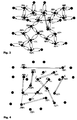
- Figures 3 and 4 show the same network as Figure 1
- the direct, physical connections are first in the model considered between the network elements. These are shown as arrows in FIG. 3 shown. These are direct physical connections for existing connections of the lowest multiplex layer STM-N. With A are the access points of the network, which are shown in Figure 1 as double arrows were drawn. Add / drop multiplexers are designated ADM in FIG. 2, Cross-connect facilities with CC. Since the direct, physical connections are bidirectional connections an arrow in each between two interconnected network elements Drawn towards. Management facility of the Message transmission network are not shown in Figures 3 and 4.
- connections considered in the model i.e. all existing Connections in all multiplex layers, in the following with the English term called Arc.
- Arc The connections considered in the model, i.e. all existing Connections in all multiplex layers, in the following with the English term called Arc.
- For each arc there can be one free Transmission capacity can be calculated as the difference from the total Transmission capacity of an Arc, as described in ITU-T Recommendation G.707 (3/96) is defined for the respective multiplex layers, and the momentary load of the Arc. Now put all the graphs on top of each other and takes into account the free transmission capacity of each individual arc, so get you have a multilayered graph that shows all the currently possible paths in the Communication network reflected in all multiplex layers.
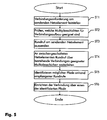
- FIG a first embodiment The method according to the invention is shown in FIG a first embodiment described in detail.
- a connection request to a network element detected This network element thus becomes the sending network element, the network element to which the connection is to be made to selected network element.
- the sending network element checks in one second step ST2, which of the multiplex layers for the to be built Connection are suitable. It is compared how much Transmission capacity is required for the connection to be set up and how much transmission capacity a container or transport module provides the respective multiplex layer.
- the sending network element sends one Broadcast to all other network elements of the message transmission network.
- connection information is advantageously transmitted indicates which of the multiplex layers is suitable for establishing the connection are. This can e.g. in such a way that in the broadcast the for the Establishing the connection required transmission capacity is specified.
- the broadcast is over all existing connections of everyone Multiplex layers to which the sending network element has access, that for the Establishing the connection are suitable and the enough free Have transmission capacity sent out. I.e. he will be with all arcs enough free transmission capacity is sent out by the sending Network element terminated.
- This is the broadcast to all other network elements sent does not mean that all other network elements are inevitable receive the broadcast. Rather, this means that the destination address is not one specific network element is entered, but the target address is: "to all".
- a fourth step ST4 network elements that receive the broadcast direct this via suitable arcs. This can be done in each receiving Network element in turn for each suitable multiplex layer at each output check whether there is a path with free transmission capacity. It is advantageous to only forward the broadcast via such paths. It can also be specified that all or only certain broadcasts over certain Outputs or arcs are not to be forwarded. Furthermore, it is advantageous in Dependence on another criterion such as one in the Network element stored routing table, the broadcast over certain arcs not forward. For example, the routing table can indicate that a Broadcasting to a specific destination via specific arcs is not needs to be forwarded as there is no path to the via these arcs selected network element can be found, for example because of the Arc leads away from the goal.
- the broadcast in the communication network is over different paths forwarded.
- the broadcast reaches via a first path the selected network element, this is the first path as for the Appropriately identified connection establishment.
- the selected network element can now start a timer and a specified period of time for others Broadcasts that are transmitted on other paths are waiting. Is the Time period has elapsed, then a fifth step ST5 becomes one of the as appropriately identified paths selected for the connection establishment.
- a sixth step ST6 is the desired connection via the selected path expanded. This is advantageously done by the selected one Network element.
- a is in the broadcast Transfer cost parameters. Every network element that forwards the broadcast calculates the connection costs incurred by him and adds them to that Cost parameters. The selected network element can then be based on this Cost parameters decide which of the identified paths for the Establishing a connection is the cheapest and select it. The connection costs are calculated depending on the current one Use of connections and network elements. An arc that has little left Free transmission capacity is more expensive than a free or almost free one Arc. A busy arc receives the value infinity as a cost parameter. It can also use other criteria for calculating the cost parameter can be used as the number of lying in a path Network elements or a load distribution in the network sought by the network operator.
- each broadcast has a unique transaction number.
- the broadcast is preferably transmitted in the so-called DCC, one for SDH networks defined as bytes in the header information of SDH frames Service channel.
- the blocking in the network elements is linked to the unique process number, the transaction number and this is the same for the first and the second broadcast.
- a particular advantage of the method according to the invention is that restricting the multiplex layers permitted for path search is possible. This can be used for building virtual private networks from Be interested. This enables a network provider to serve its customer provide a virtual network that the customer can access, for example Configure multiplex layers TUG-2 and TUG-3 according to your own wishes can. Access to the underlying multiplex layers remains However, customers are denied. A transparent network is then available for the customer that he can configure at his own discretion. Of the Network operator needs the configuration requests of its customer no longer care.
- the network element advantageously has a processor that is used to process the Connection requests is responsible, and one assigned to this processor Storage. This means that all broadcasts and messages with the Connections have to be processed by this processor become.
- the processor knows all connections with its network element have to do, i.e. all arcs that the network element terminates. Based on already existing connections can be made using an appropriate Software module calculates the possible paths from the point of view of the network element become. Is e.g. no usable VC-4 with free for establishing a connection Transmission capacity available, one is reserved and at Established connection.
- the processor advantageously has a direct one Access to the communication channels of the network element.
- the processor is composed of the information which he receives through the broadcasts, a list of possible further ones Builds paths.
- a list is called a routing table.
- On Request i.e. when there is a connection request or a broadcast received, he only needs to read the list from the memory and receives information about which arcs are used to send a broadcast or is to be forwarded.
- Such a routing table can also have a Management facility created, updated and distributed. It is further possible that the network elements share their routing tables exchange and compare.
Landscapes
- Engineering & Computer Science (AREA)
- Computer Networks & Wireless Communication (AREA)
- Signal Processing (AREA)
- Data Exchanges In Wide-Area Networks (AREA)
Applications Claiming Priority (2)
| Application Number | Priority Date | Filing Date | Title |
|---|---|---|---|
| DE19801875 | 1998-01-20 | ||
| DE19801875A DE19801875A1 (de) | 1998-01-20 | 1998-01-20 | Verfahren zum Einrichten einer Verbindung in einem synchronen digitalen Nachrichtenübertragungsnetz und Netzelement |
Publications (2)
| Publication Number | Publication Date |
|---|---|
| EP0930739A2 true EP0930739A2 (fr) | 1999-07-21 |
| EP0930739A3 EP0930739A3 (fr) | 2005-05-11 |
Family
ID=7855075
Family Applications (1)
| Application Number | Title | Priority Date | Filing Date |
|---|---|---|---|
| EP99440006A Withdrawn EP0930739A3 (fr) | 1998-01-20 | 1999-01-19 | Méthode à établissement d'une connection dans un réseau synchrone numérique et élément de réseau |
Country Status (4)
| Country | Link |
|---|---|
| US (1) | US6714518B1 (fr) |
| EP (1) | EP0930739A3 (fr) |
| CA (1) | CA2257567A1 (fr) |
| DE (1) | DE19801875A1 (fr) |
Families Citing this family (5)
| Publication number | Priority date | Publication date | Assignee | Title |
|---|---|---|---|---|
| WO2002003220A2 (fr) * | 2000-07-05 | 2002-01-10 | Ernst & Young Llp | Procede et dispositif pour fournir des services informatiques |
| CN1820438B (zh) * | 2003-08-05 | 2010-09-22 | 意大利电信股份公司 | 在通信网中向附加业务路径提供连接保护的方法、相关网络 |
| US7391720B1 (en) * | 2004-02-02 | 2008-06-24 | Ciena Corporation | Local span mesh restoration (LSMR) |
| US7847174B2 (en) * | 2005-10-19 | 2010-12-07 | Yamaha Corporation | Tone generation system controlling the music system |
| US8352537B2 (en) * | 2008-09-08 | 2013-01-08 | Futurewei Technologies, Inc. | Object modeling scheme for next generation network wavelength division multiplexing |
Family Cites Families (13)
| Publication number | Priority date | Publication date | Assignee | Title |
|---|---|---|---|---|
| JPH0624366B2 (ja) * | 1988-11-24 | 1994-03-30 | 日本電気株式会社 | ネットワーク障害回復方式 |
| JP3120157B2 (ja) * | 1991-07-08 | 2000-12-25 | 株式会社日立製作所 | 環状論理通信路制御方法 |
| JP3071007B2 (ja) * | 1991-10-22 | 2000-07-31 | 富士通株式会社 | 通信ネットワーク制御方式 |
| DE4343839A1 (de) * | 1993-12-22 | 1995-06-29 | Philips Patentverwaltung | Lokales Netzwerk mit einem Datenaustausch über Funkübertragungswege |
| DE4407544C2 (de) * | 1994-03-07 | 1996-05-30 | Ulrich Altvater | Verfahren zum Übertragen von Datenpaketsätzen und Endgerät dafür |
| US5495471A (en) * | 1994-03-09 | 1996-02-27 | Mci Communications Corporation | System and method for restoring a telecommunications network based on a two prong approach |
| SE515058C2 (sv) * | 1994-10-04 | 2001-06-05 | Telia Ab | Anordning för styrning av ett telenäts kapacitet |
| US5815490A (en) * | 1995-11-20 | 1998-09-29 | Nec America, Inc. | SDH ring high order path management |
| US5884017A (en) * | 1995-12-29 | 1999-03-16 | Mci Communications Corporation | Method and system for optical restoration tributary switching in a fiber network |
| DE19608621C2 (de) * | 1996-03-06 | 1998-03-19 | Nokia Telecommunications Oy | Telekommunikationsnetzwerk |
| US5872523A (en) * | 1996-03-12 | 1999-02-16 | Motorola, Inc. | Target device and method for establishing a communication path in a networked communications system |
| US6256292B1 (en) * | 1996-07-11 | 2001-07-03 | Nortel Networks Corporation | Self-healing line switched ring for ATM traffic |
| US6052722A (en) * | 1997-03-07 | 2000-04-18 | Mci Communications Corporation | System and method for managing network resources using distributed intelligence and state management |
-
1998
- 1998-01-20 DE DE19801875A patent/DE19801875A1/de not_active Withdrawn
-
1999
- 1999-01-18 CA CA002257567A patent/CA2257567A1/fr not_active Abandoned
- 1999-01-19 EP EP99440006A patent/EP0930739A3/fr not_active Withdrawn
- 1999-01-19 US US09/233,124 patent/US6714518B1/en not_active Expired - Fee Related
Also Published As
| Publication number | Publication date |
|---|---|
| DE19801875A1 (de) | 1999-07-22 |
| CA2257567A1 (fr) | 1999-07-20 |
| EP0930739A3 (fr) | 2005-05-11 |
| US6714518B1 (en) | 2004-03-30 |
Similar Documents
| Publication | Publication Date | Title |
|---|---|---|
| DE69735084T2 (de) | Leitwegumlenkungsverfahren in hierarchischen strukturierten Netzwerken | |
| DE60200530T2 (de) | Mechanismus und Verfahren zur Bestimmung und schnellen Wiederherstellung einer minimalen Kapazität in einem vermaschten Netz | |
| DE69326903T2 (de) | Verfahren zur überlastabwehr in frame-relay-netzen und ein knoten in einem solchen netz | |
| DE69637290T2 (de) | Verbindungsreservation in Kommunikationsnetzwerken | |
| DE4430993C1 (de) | Verfahren zur adaptiven Wegesuche in einem Kommunikationsnetz | |
| DE69728630T2 (de) | Verfahren und System zur Steigerung der Dienstleitungsqualität bei oder unter einem Grenz-Tarif | |
| DE60116879T2 (de) | Apparat und verfahren zum optischen kommunkationsschutz | |
| DE69331013T2 (de) | System und verfahren für ruf-zu-ruf leitweglenkung mit auf regeln basierter rücklenkung | |
| DE69732676T2 (de) | Selbstheilendes Netzwerk, und Umschaltungsverfahren für Übertragungsleitungen und Übertragungseinrichtung dafür | |
| DE60022602T2 (de) | Verfahren, Vorrichtung und Computerprogramm um Topologiedaten eines Link State Routing Netzwerkes aktuell zu halten | |
| DE69924345T2 (de) | Verfahren und Netzwerkknoten zum verbesserten Leitweglenkungs- und Reservierungsprotokoll | |
| DE69328178T2 (de) | Mikrozellulares funknetzwerk | |
| DE69816053T2 (de) | Telekommunikationsnetzwerk mit Überlastungssteuerung | |
| DE60011719T2 (de) | Verfahren zum Senden von Routingdaten durch ein Netzwerk und Netzwerksknoten, der das Verfahren verwendet | |
| EP0902600B1 (fr) | Procédé d'établissement de connexions logiques dans un réseau de communication de données synchrone et digitale, l'élément de réseau et système de gestion | |
| DE2603262B2 (de) | Einrichtung zur vermittlung von daten | |
| DE69129952T2 (de) | Vorrichtung zur Paketübermittlungsregulierung | |
| DE69731469T2 (de) | Atm telekommunikationssystem und verfahren zur leitweglenkung von schmalbandverkehr | |
| DE69220657T2 (de) | Umschaltungsverfahren zwischen Vermittlungsanlagen für mobile Dienste von einer aktiven Verbindung zu einem mobilen Endgerät | |
| DE69819088T2 (de) | Umweglenkung | |
| EP0871344A2 (fr) | Réseau local avec capacité de reconfiguration dans le cas d'une rupture d'une ligne ou de defaillance d'un noeud | |
| EP0579980B1 (fr) | Système de communication à ATM | |
| DE60206338T2 (de) | Verbindungsaufbau-Strategien in optischen Transportnetzwerken | |
| DE60119848T2 (de) | Mehrprozessor Steuerblock zur Verwendung in einer Vermittlungsstelle sowie entsprechendes Verfahren | |
| EP0930739A2 (fr) | Méthode à établissement d'une connection dans un réseau synchrone numérique et élément de réseau |
Legal Events
| Date | Code | Title | Description |
|---|---|---|---|
| PUAI | Public reference made under article 153(3) epc to a published international application that has entered the european phase |
Free format text: ORIGINAL CODE: 0009012 |
|
| AK | Designated contracting states |
Kind code of ref document: A2 Designated state(s): AT BE CH CY DE DK ES FI FR GB GR IE IT LI LU MC NL PT SE |
|
| AX | Request for extension of the european patent |
Free format text: AL;LT;LV;MK;RO;SI |
|
| PUAL | Search report despatched |
Free format text: ORIGINAL CODE: 0009013 |
|
| AK | Designated contracting states |
Kind code of ref document: A3 Designated state(s): AT BE CH CY DE DK ES FI FR GB GR IE IT LI LU MC NL PT SE |
|
| AX | Request for extension of the european patent |
Extension state: AL LT LV MK RO SI |
|
| RIC1 | Information provided on ipc code assigned before grant |
Ipc: 7H 04J 3/08 B Ipc: 7H 04L 12/56 B Ipc: 7H 04L 12/437 B Ipc: 7H 04Q 3/00 B Ipc: 7H 04J 3/12 A |
|
| STAA | Information on the status of an ep patent application or granted ep patent |
Free format text: STATUS: THE APPLICATION IS DEEMED TO BE WITHDRAWN |
|
| AKX | Designation fees paid |
Designated state(s): DE FI FR GB IT SE |
|
| 18D | Application deemed to be withdrawn |
Effective date: 20050801 |