EP0930746A1 - Concentrateur pour système d' ordinateur - Google Patents
Concentrateur pour système d' ordinateur Download PDFInfo
- Publication number
- EP0930746A1 EP0930746A1 EP98309625A EP98309625A EP0930746A1 EP 0930746 A1 EP0930746 A1 EP 0930746A1 EP 98309625 A EP98309625 A EP 98309625A EP 98309625 A EP98309625 A EP 98309625A EP 0930746 A1 EP0930746 A1 EP 0930746A1
- Authority
- EP
- European Patent Office
- Prior art keywords
- port
- ports
- hub
- network
- criterion
- Prior art date
- Legal status (The legal status is an assumption and is not a legal conclusion. Google has not performed a legal analysis and makes no representation as to the accuracy of the status listed.)
- Withdrawn
Links
- 238000000034 method Methods 0.000 claims abstract description 32
- 238000004891 communication Methods 0.000 claims description 5
- 230000005540 biological transmission Effects 0.000 claims description 4
- 238000007726 management method Methods 0.000 claims description 4
- 238000005070 sampling Methods 0.000 claims description 3
- 230000001419 dependent effect Effects 0.000 claims 1
- 238000003379 elimination reaction Methods 0.000 abstract description 7
- 230000008030 elimination Effects 0.000 abstract description 6
- 230000009849 deactivation Effects 0.000 abstract 3
- 230000000750 progressive effect Effects 0.000 abstract 1
- 238000013480 data collection Methods 0.000 description 7
- 206010009944 Colon cancer Diseases 0.000 description 6
- 238000012544 monitoring process Methods 0.000 description 6
- 238000012360 testing method Methods 0.000 description 5
- 238000001514 detection method Methods 0.000 description 4
- 230000002950 deficient Effects 0.000 description 3
- 238000013459 approach Methods 0.000 description 2
- 238000001914 filtration Methods 0.000 description 2
- 230000000415 inactivating effect Effects 0.000 description 2
- 230000002123 temporal effect Effects 0.000 description 2
- 238000009954 braiding Methods 0.000 description 1
- 230000001351 cycling effect Effects 0.000 description 1
- 230000007547 defect Effects 0.000 description 1
- 230000001934 delay Effects 0.000 description 1
- 238000003745 diagnosis Methods 0.000 description 1
- 230000000694 effects Effects 0.000 description 1
- 230000001771 impaired effect Effects 0.000 description 1
- 230000006855 networking Effects 0.000 description 1
- 238000005192 partition Methods 0.000 description 1
- 230000002093 peripheral effect Effects 0.000 description 1
- 238000013102 re-test Methods 0.000 description 1
- 238000000638 solvent extraction Methods 0.000 description 1
Images


Classifications
-
- H—ELECTRICITY
- H04—ELECTRIC COMMUNICATION TECHNIQUE
- H04L—TRANSMISSION OF DIGITAL INFORMATION, e.g. TELEGRAPHIC COMMUNICATION
- H04L41/00—Arrangements for maintenance, administration or management of data switching networks, e.g. of packet switching networks
- H04L41/50—Network service management, e.g. ensuring proper service fulfilment according to agreements
- H04L41/5003—Managing SLA; Interaction between SLA and QoS
- H04L41/5019—Ensuring fulfilment of SLA
-
- H—ELECTRICITY
- H04—ELECTRIC COMMUNICATION TECHNIQUE
- H04L—TRANSMISSION OF DIGITAL INFORMATION, e.g. TELEGRAPHIC COMMUNICATION
- H04L12/00—Data switching networks
- H04L12/28—Data switching networks characterised by path configuration, e.g. LAN [Local Area Networks] or WAN [Wide Area Networks]
- H04L12/44—Star or tree networks
-
- H—ELECTRICITY
- H04—ELECTRIC COMMUNICATION TECHNIQUE
- H04L—TRANSMISSION OF DIGITAL INFORMATION, e.g. TELEGRAPHIC COMMUNICATION
- H04L41/00—Arrangements for maintenance, administration or management of data switching networks, e.g. of packet switching networks
- H04L41/24—Arrangements for maintenance, administration or management of data switching networks, e.g. of packet switching networks using dedicated network management hardware
-
- H—ELECTRICITY
- H04—ELECTRIC COMMUNICATION TECHNIQUE
- H04L—TRANSMISSION OF DIGITAL INFORMATION, e.g. TELEGRAPHIC COMMUNICATION
- H04L43/00—Arrangements for monitoring or testing data switching networks
-
- H—ELECTRICITY
- H04—ELECTRIC COMMUNICATION TECHNIQUE
- H04L—TRANSMISSION OF DIGITAL INFORMATION, e.g. TELEGRAPHIC COMMUNICATION
- H04L43/00—Arrangements for monitoring or testing data switching networks
- H04L43/08—Monitoring or testing based on specific metrics, e.g. QoS, energy consumption or environmental parameters
- H04L43/0823—Errors, e.g. transmission errors
- H04L43/0847—Transmission error
-
- H—ELECTRICITY
- H04—ELECTRIC COMMUNICATION TECHNIQUE
- H04L—TRANSMISSION OF DIGITAL INFORMATION, e.g. TELEGRAPHIC COMMUNICATION
- H04L43/00—Arrangements for monitoring or testing data switching networks
- H04L43/10—Active monitoring, e.g. heartbeat, ping or trace-route
-
- H—ELECTRICITY
- H04—ELECTRIC COMMUNICATION TECHNIQUE
- H04L—TRANSMISSION OF DIGITAL INFORMATION, e.g. TELEGRAPHIC COMMUNICATION
- H04L43/00—Arrangements for monitoring or testing data switching networks
- H04L43/16—Threshold monitoring
Definitions
- the present invention relates to a hub for a computer network, for example for providing automated port disablement to eliminate loops and other network-performance related problems.
- Networks provide for communications among computer-related node devices, for example, computers, computer peripherals (e.g., printers), and various types of instrumentation (e.g., medical instrumentation). While there are peer-to-peer networking systems, most sophisticated networks require one or more network hubs that are external to the computers and help manage inter-device communications.
- a typical hub has three or more ports, each of which can be coupled to a node device or another hub by a suitable cable.
- hubs There are many types of hubs, including repeaters, switches, and routers. Routers and switches direct what is received only out the port or ports required for the data to reach its destination. Repeaters broadcast whatever is received at one port out the remaining ports. Unlike switches and routers, repeaters do not analyze through-going data to determine where to send it. Accordingly, they tend to be simpler and faster. As a result, they are the numerically most prevalent type of hub. Although all types of hubs are addressed herein, repeaters are the primary focus herein
- network hubs typically include a number of counters that detect and count events bearing on network performance. Some counters are dedicated to respective ports, while others count events regardless of the receiving port. For example, one type of port-dedicated counter detects and counts received packets that are longer than permitted by the network protocol. By sampling such a counter at two different times, a measure of the frequency of excessively long packets is derived. If this frequency is itself excessive, it indicates that a connected node has a problem. For example, either an included network interface card (NIC) or a software driver for the card is defective.
- NIC network interface card
- a collision counter can be used to indicate a condition in which network bandwidth is being exceeded.
- Sophisticated network protocols can handle many concurrent transmissions and the assignment of priority according to data type. In general, data is transmitted one packet at a time. If two packets happen to be transmitted on the same cable concurrently, they are said to "collide". Sophisticated networks detect such collisions and require the transmitters to re-send the colliding packets at different times. An excessive frequency of collisions indicates that the network capacity is being exceeded.
- Other examples include the use of late-event counters to indicate the presence of excessively long cables or an excessive number of repeaters connected in series, and the use of counters that detect various types of packet defects to indicate a defective cable.
- a network problem of particular interest herein is the elimination of network loops. Since a hub can include many ports, it can and does happen that a first port will be cabled directly to a second port of the same hub. In the case of a repeater loop, data received at the first port is transmitted out the second port; the same data is received again at the first port and is transmitted again out the second port and so on. This condition is known as a "local loop". Unless othenvise addressed, a local loop causes collisions to occur with every packet and re-sending does not avoid this problem. This condition can result in complete failure of the network (or network segment). Local loops are readily detectable since every packet results in a collision.
- Modern repeaters include hardware that automatically autopartitions ports to break local loops so that a network can sometimes continue operation.
- a packet received at an autopartitioned port is not transmitted out the remaining ports; however, the port is monitored for collisions. If this monitoring suggests the absence of problems, the autopartition can be automatically terminated (as specified in IEEE Std. 802.3). However, this automatic termination of partitions sometimes occurs when a loop is still present; thus, reliable network operation is not enabled in the presence of loops.
- non-local "indirect" loops that involve a hub and at least one other device.
- two hubs can be coupled to each other at two different ports.
- a cabling error can cause a group of hubs that are supposed to be daisy-chained to be arranged into a loop.
- loops There are innumerable other types of loops, including loops that extend through node devices in various ways.
- indirect loops In part due to the variety of indirect loops, they can be hard to detect. While they tend to involve large numbers of collisions, there are other causes of collisions. Thus, while many hubs include counters that count collisions, the cause of the collisions is not readily determined. In part due to packet transit delays through other devices, it is more difficult to determine when a collision involves a packet colliding with itself. Thus, autopartitioning may not be activated in the event of an indirect loop. Accordingly, indirect loop detection has been the province of a network administrator using specialized network monitoring tools.
- Network monitoring tools tend to be difficult to set up and difficult to use.
- specialized network diagnostic hardware is required.
- a general-purpose workstation is configured with special software as a network administration station.
- the network software tends to be arcane, requiring specially skilled network administrators to operate.
- the present invention seeks to provide an improved hub.
- a hub for a computer network there is provided a hub for a computer network.
- the preferred embodiment provides for a hub that automatically restricts a port when it determines that doing to is likely to maintain network performance at an acceptable level.
- a port is "restricted" when some or all of the data available for reception at that port for transmission from one or more other ports is prevented from being so retransmitted. Restriction can involve filtering some data, or partitioning of the port, or disabling the port.
- the preferred embodiment can implement the restriction in a manner that best preserves the functionality of the network. Often a problem affects more than one hub and sometimes affects more that one port of a hub. Instead of restricting all ports involved in a problem at once, it is preferable to restrict one port at a time, and checking to determine if the problem persists before restricting another port. There are two aspects to this preferred objective: 1) only one port involved in a problem should be restricted at a time (“ordered restriction”); and 2) less important ports should be restricted before more important ports (“prioritised restriction”). The following discussion focuses on disabling ports involved in loops; however, it should be understood that the invention provides analogously for less severe restrictions and problems other than loops.
- the preferred embodiment provides for "ordered restriction". Thus, if a hub includes two ports involved in a loop, only one is disabled. If further checking indicates that the loop remains in effect despite shutdown of the first port, the second port can then be shut down.
- a loop is identified by monitoring counters that track events associated with loops (as well as other network problems). For example, an excessive number of packets occurring over a fixed-time interval can be used to indicate the presence of a loop.
- the preferred embodiment provides that the time intervals at which the ports are sampled are staggered so that only one port is being evaluated for disabling at a time.
- a further preferred challenge is to prevent two ports belonging to different hubs from being turned off at the same time.
- One way to do this is for two hubs to coordinate their port shutdown procedures.
- the preferred embodiment minimises the likelihood of two ports of two different hubs being disabled concurrently even where the port shutdown procedures of the respective hubs are not coordinated.
- One approach takes to the ordered shutdown of ports is to stagger the times loop determinations are made for corresponding ports of different hubs. For various reasons, including human and device proclivities, certain ports of one hub are more likely to be coupled to certain ports of another hub. Thus, for example, the port 1s of the hubs of a network are more likely to be coupled to other hubs than are the port 4s of the hubs. If all the port 1s are checked for loops concurrently, there is a greater likelihood that two will be shutdown concurrently than there would be if not all concurrently-checked ports have the same port number.
- the preferred embodiment provides randomising selection of the first port to be checked for each hub so that the chances of corresponding ports being checked concurrently are low.
- randomisation is achieved by generating a pseudo-random number based on a seed that is unique or at least not widely shared, such as all or part of a media access control address. This, in combination with the next technique described, renders negligible the likelihood of two corresponding ports of the respective hubs being disabled concurrently.
- the preferred embodiment provides for dividing a time interval over which a port is monitored for loop indications into a first long interval and a second brief interval. If the counts for the first long interval indicate the presence of a loop, the brief re-poll is conducted to determine whether or not the loop still appears to be present. If turning off a port of one hub breaks a loop, the re-poll prevents a concurrently checked port of a second hub from being shut down.
- randomised port checking and quick re-polling work together to minimise the likelihood that more than one port is shut down at a time, even for a network with many hubs.
- Prioritised shutdown is achieved in part by distinguishing between ports that are coupled to hubs and ports that are coupled to mode devices.
- the presence of a remote hub can be determined directly.
- a hub can detect when multiple node devices seem to be transmitting to the same port.
- a "cascade" counter can be used to count instances in which a source address is changed.
- the ports involved in the loop typically appear cascaded, i.e., coupled to multiple node devices. However, if the loop results from a recent problem associated with a node device, the port coupled to that device will appeared to have been cascaded more recently than ports coupled to hubs. Thus, the preferred embodiment provides for shutting down recently cascaded ports before ports that have been cascaded for a longer time.
- ordered shutdown is implemented using a temporal ordering, while prioritised shutdown relies on a priority ordering.
- the preferred embodiment iterates the temporal ordering at successively more relaxed priority levels. For example, during a first iteration, only ports that have not been acting as if they were cascaded recently can be considered for shutdown (depending on the confidence level of the loop indications); during a second iteration, weakly cascaded ports also can be considered for shutdown; and during a final iteration, all ports, including those that have been cascaded for a long time (and are thus, almost definitely coupled to other hubs) can be considered for shutdown.
- prioritised and ordered port shutdown can be applied to determinations of a bad driver or network interface card based on a count of excessively long packets.
- prioritised and ordered port restriction can be applied to determinations of an excessive frequency of broadcast packets; in this case, the solution can be simply to filter out the broadcast packets.
- the preferred method for port restriction is built into network hubs and restricts one port at a time and favours restriction of less important ports before more important ports.
- impact of the detected problem on network functionality is minimised.
- the restriction of one port at a time can be achieved even for networks with two or more hubs and without coordination of the loop elimination method across hubs. Problem elimination is achieved quickly and with minimal impact on network functionality without dedicated external hardware, external software, expertise, and specialised setup procedures.
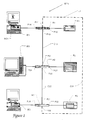
- a network system AP1 includes three repeater hubs H1, H2, and H3, three computer workstations W1, W2, and W3, a monochrome laser printer P1, a color laser printer P2, and a color inkjet printer P3, and nine cables. Six of the nine cables are coupled to the six node devices W1, W2, W3, P1, P2, P3; the other three cables C12, C23, and C31, couple hubs. Cable C31 is shown dashed to indicate that it is recently coupled so as to complete a network-impairing loop.
- Hub H1 has four ports, P11, P12, P13, and P14.
- Port P11 is recently coupled to hub H3 via cable C31.
- Port P12 is coupled to printer P1.
- Port P13 is coupled to hub H2 via cable C12.
- Port P14 is coupled to workstation W1.
- Hub H2 has four ports, P21, P22, P23, and P24.
- Port P21 is coupled to port P13 of Hub H1 via cable C12.
- Port P22 is coupled to printer P2.
- Port P23 is coupled to hub H3 via cable C23.
- Port P24 is coupled to workstation W2.
- Hub H3 has four ports, P31, P32, P33, and P34.
- Port 31 is coupled to port P23 via cable C23.
- Port 32 is coupled to printer P3.
- Port 33 is recently coupled to port P11 of hub H1 via cable 31.
- Port 34 is coupled to workstation W4.
- Loop L1 includes an original, non-problematic, data path out from hub H1 through its port P13, through cable C12, to hub H2 via its port P21, from hub H2 through its port P23, through cable C23, to hub H3 via its port P31.
- This data path is two-way, so that the foregoing order can be reversed.
- Cable 31 completes the unwanted loop by connecting hub H3 via its port P33 to hub H1 via its port P11.
- any data transmitted by any workstation W1, W2, W3, will be broadcast repeatedly by each hub H1, H2, H3.
- Inactivating any of ports P11, P13, P21, P23, P31, or P33 can break the loop.
- the preferred embodiment gives preference to inactivating a recently cascaded port such as P11 or P33, which restores the intended configuration of network AP1.
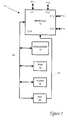
- Hub H1 comprises a repeater circuit 12, a processor 14, volatile random access memory (RAM) 16, nonvolatile flash memory 18, and a media access controller (MAC) 20, all coupled to each other by a bus 22, as shown in FIG. 2. All four ports P11, P12, P13, P14, are coupled to repeater circuit 12.
- Repeater circuit 12 includes groups CT1, CT2, CT3, CT4 of counters, respectively dedicated to counting events received at ports P11, P12, P13, and P14.
- Flash memory 18 includes a hub-control program and stores a media-access control address for hub H1.
- port utilization counters for counting readable frames (rptrMonitorPortReadableFrames) and for counting readable octets (rptrMonitorPortReadableOctets), and "port cascade” counters for counting source address changes (rptrTrackSourceAddressChanges).
- the port counters are all defined in IETF RFC 2108, which references IEEE 802.3. Processor 14 maintains a "cascade" counter which measures the length of time the address change counter has been incrementing.
- Repeater circuit 12 also includes a group of counters CTH that count events regardless of the receiving port; these counters include "hub utilization" counters (based on IETF RFC 1757) for counting frames (etherStatsPkts) and for counting octets (etherStatsOctets).
- the hub-control program is executed by processor 14, using RAM 16 for fast temporary storage, e.g., of counter data, and the results of operations performed on counter data.
- Media-access controller 20 allows processor 14 (and, thus, hub H1) to communicate with other network devices, especially a workstation W1, which serves as a network administration workstation.
- Repeater circuit 12, processor 14, RAM 16, flash memory 18, and media access controller 20 communicate with each other over an internal bus 22.
- Media access controller 20 also communicates to repeater circuit 12 via a communication link 24 that is similar to the links between the repeater circuit and the ports.
- the hub-control program embodies a loop elimination method M1 flow-charted in FIG. 3.
- the hub is initialized, e.g., as power is applied.
- a pseudo-random number generator selects a starting port number using the media-access control address as a seed. Ports are sequenced in order modulo four. Thus, if port P13 is selected as the starting port, the utilization counters are polled in the order P13, P14, P11, P12, P13, and so on.
- Count data is collected at step S3.
- Hub utilization data is collected for 1-second intervals.
- Port utilization data and port cascade data are collected over 25-second intervals. The data collection periods for respective ports are staggered one second apart.
- a test is run to determine whether or not a loop is indicated on the hub. This test uses the hub utilization as a preliminary test and then proceeds to examine packet contents for duplication. If a loop is not indicated (sufficiently strongly), method M1 returns to data collection step S3. If a loop is indicated, ports are examined for involvement in the loop at step S5. The port for which the most recent data has been collected is examined first. Other ports are examined in succession. If it is determined that none of the ports being examined should be disabled, method M1 returns to data collection step S3. Otherwise, the port is disabled at step S6.
- Loop test step S4 is shown in greater detail in FIG. 4.
- hub utilization data collected during step S3 is examined relative to a hub utilization criterion.
- This criterion includes both a utilization threshold and a hysteresis status.
- the hysteresis status is memorialized by a flag setting. This flag is set whenever a warning is issued at substep S43 below. The flag is reset upon initialization, upon shut down of a port at step S6, or whenever hub utilization falls below a hysteresis threshold.
- This hysteresis threshold can be set at or below the most sensitive level at which the hub utilization can be set.
- the hysteresis flag is set, then the hub utilization data is compared with the hysteresis threshold. If the hub utilization is below the hysteresis threshold, the hysteresis flag is reset, otherwise, the hysteresis flag is not reset. In either case, method M1 returns to data collection step S3.
- the hub utilization data is compared with a utilization threshold at or above the hysteresis threshold. If the utilization threshold is not met, then method M1 returns to data collection step S3. If the utilization threshold is met or exceeded, method M1 proceeds to substep S42 to determine whether a warning should be issued.
- warning-check substep S42 16,384 packets are acquired. Statistics are kept for up to the first 128 unique CRC error detection codes found in the packets. These statistics are composed of: 1) the number of duplicate CRC codes, i.e., individual CRC codes that occurred more than once; and 2) the total number of duplicate packets, i.e. , packets that contained these re-occurring CRC codes. Two ratios are derived from these statistics: 1) a ratio of duplicate CRCs stored to the total number (up to 128) of CRCs stored; and 2) a ratio of duplicate packets stored to the total number (16,384) of packets seen. A "duplicate ratio" equal to the higher of these two ratios is used to indicate the likelihood of a network loop. If the duplicate ratio falls below a warning threshold, method M1 returns to collection step S3. If the warning threshold is met but the higher disable threshold is not met, a warning is issued to network administration workstation W1 at substep S43.
- the warning of substep S43 is issued as a "simple network management protocol" (SNMP) trap addressed to network administration workstation W1. Included as part of the trap is a network address in the form of a world-wide web page address. This address is a subpage of a world-wide web page that is the home page embedded in hub H1. The address is entered into an alarm log of a network administration program running on workstation W1.
- SNMP simple network management protocol
- the network administration program preferably presents the address as a hypertext link. A network administrator has but to click on this link to access the subpage. Alternatively, the address can be accessed by selecting a menu item that calls for accessing the address. The network administration program can call (launching if necessary) a web browser through which the subpage is accessed.
- hub H1 When hub H1 receives the address, it generates a sub page with a description of the problem (in this case a loop) that is the cause of the alarm. In other words, hub H1 runs an expert system that diagnoses the problem and offers solutions.
- a port can be disabled (or a disabled port can be re-enabled), or a retest can be initiated, or a hysteresis flag can be reset.
- a retest can be initiated, or a hysteresis flag can be reset.
- step S44 If the duplicate ratio meets the warning threshold, a further determination is made to see if it is high enough that the individual ports should be examined for shutdown at step S44. If the duplicate ratio is not that high, method M1 returns to step S3. If the port disable threshold is met, method M1 continues to port-examination step S5.
- Port examination step S5 is detailed in the flow chart of FIG. 5.
- the port for which utilization and cascade data have been most recently collected is selected as the present port for examination.
- the data for the present port is compared to respective utilization and cascade thresholds. Initially, the cascade threshold is set to 3. If the utilization is below threshold and/or if the cascade count is at or above threshold, the port "passes" and method M1 skips to port count substep S54. If the utilization is at or above threshold and the cascade level is below threshold, the method proceeds to re-poll substep S53.
- re-poll substep S53 utilization data is collected for a brief period of 50-100 milliseconds. If a corresponding re-poll utilization threshold is met or exceeded, the port fails the test and the port is disabled at step S6. If the threshold is not met, method M1 proceeds to port count substep S54.
- This quick re-poll substep prevents the port being examined from being inactivated in the event the loop is eliminated by deactivating a port on another hub before the re-poll is taken. Even if the re-poll begins before the other port is deactivated, the corresponding re-poll threshold may not be met so the local port being examined is not deactivated.
- the port count is initially zero. After the first port is tested but not deactivated, the port count is incremented to 1 at substep S54. Thus, for the first iteration of substep S54, the port count becomes 1. Each subsequent iteration of port count substep S54 increments the port count. When the port count is not divisible by 4, method M1 skips to wait-next-port substep S56.
- non-cascaded ports and recently cascaded ports are considered for disablement.
- the port count reaches 4; at the port count of 4, method M1 continues to substep S55 at which the cascade threshold is increased from 3 to 31.
- moderately cascaded ports as well as non-cascaded ports can be considered for disablement.
- the port count reaches 8; at step S55, the cascade threshold is increased from 31 to 255, at which level all ports can be considered for disablement.
- the cascade metric is determined as follows.
- the cascade metric is an eight-bit value, initially equal to zero. It is determined by examining changes in a counter that tracks address changes received at a port. If, for a 25-second monitoring period, the number of changes is two or more, the port count is shifted left, the former most significant bit is dropped and a 1 is added as the new least significant bit. If for that period, the number of address changes is less than two, the metric is decremented by one. Thus, if a port is cascaded for eight consecutive poll periods, its cascade value is 255. Thus, a port can quickly reach a maximum cascade value and slowly age back toward being a node.
- step S56 method M1 continues to wait-next-port substep S56. This step simply involves plaiting until the 25-second period of data collection is completed for the next port to be examined. If the next port is the port selected in step S1, this wait can is the remainder of the present 1 second interval plus 21 seconds; otherwise, the wait is the remainder of the present 1 second interval. An alternative is to collect data for shorter intervals or for overlapping intervals for each port so that in every case the wait is less than 1 second.
- hubs with greater numbers of ports are accommodated. Many different approaches to ensuring that corresponding ports of different hubs are examined at different times.
- the preferred embodiment also provides for networks in which loop elimination is coordinated among hubs.
Landscapes
- Engineering & Computer Science (AREA)
- Computer Networks & Wireless Communication (AREA)
- Signal Processing (AREA)
- Small-Scale Networks (AREA)
- Data Exchanges In Wide-Area Networks (AREA)
- Monitoring And Testing Of Transmission In General (AREA)
Applications Claiming Priority (2)
| Application Number | Priority Date | Filing Date | Title |
|---|---|---|---|
| US986077 | 1997-12-05 | ||
| US08/986,077 US6079034A (en) | 1997-12-05 | 1997-12-05 | Hub-embedded system for automated network fault detection and isolation |
Publications (1)
| Publication Number | Publication Date |
|---|---|
| EP0930746A1 true EP0930746A1 (fr) | 1999-07-21 |
Family
ID=25532055
Family Applications (1)
| Application Number | Title | Priority Date | Filing Date |
|---|---|---|---|
| EP98309625A Withdrawn EP0930746A1 (fr) | 1997-12-05 | 1998-11-24 | Concentrateur pour système d' ordinateur |
Country Status (3)
| Country | Link |
|---|---|
| US (2) | US6079034A (fr) |
| EP (1) | EP0930746A1 (fr) |
| JP (1) | JPH11317761A (fr) |
Cited By (2)
| Publication number | Priority date | Publication date | Assignee | Title |
|---|---|---|---|---|
| EP1760968A1 (fr) * | 2002-11-20 | 2007-03-07 | 3COM Corporation | Unités de réseau pour utilisation dans et organisation de systemes en cascade |
| EP2219327A4 (fr) * | 2007-12-14 | 2011-07-20 | Sony Corp | Appareil électronique et procédé pour déterminer une boucle dans un appareil électronique |
Families Citing this family (37)
| Publication number | Priority date | Publication date | Assignee | Title |
|---|---|---|---|---|
| US7027406B1 (en) * | 1998-04-16 | 2006-04-11 | Avaya Communication Israel Ltd. | Distributed port-blocking method |
| US6477486B1 (en) * | 1998-09-10 | 2002-11-05 | Dell Usa, L.P. | Automatic location determination of devices under test |
| US6393473B1 (en) * | 1998-12-18 | 2002-05-21 | Cisco Technology, Inc. | Representing and verifying network management policies using collective constraints |
| US6608819B1 (en) | 1999-01-12 | 2003-08-19 | Mcdata Corporation | Method for scoring queued frames for selective transmission through a switch |
| US7382736B2 (en) | 1999-01-12 | 2008-06-03 | Mcdata Corporation | Method for scoring queued frames for selective transmission through a switch |
| US6611502B1 (en) | 1999-01-15 | 2003-08-26 | 3Com Corportion | Spanning tree with rapid propagation of topology changes |
| US6771610B1 (en) | 1999-01-19 | 2004-08-03 | 3Com Corporation | Spanning tree with protocol for bypassing port state transition timers |
| US6535490B1 (en) * | 1999-03-04 | 2003-03-18 | 3Com Corporation | High availability spanning tree with rapid reconfiguration with alternate port selection |
| US6891930B1 (en) * | 1999-12-17 | 2005-05-10 | Sbc Properties, Lp | Method and system of providing cataloging and detecting network faults |
| KR20020037619A (ko) * | 2000-11-15 | 2002-05-22 | 윤종용 | 임베디드 시스템에서 주변장치 종류 자동인식 방법 |
| US7016358B2 (en) * | 2001-05-14 | 2006-03-21 | Canon Kabushiki Kaisha | Interface device with network isolation |
| US7330481B2 (en) * | 2001-08-31 | 2008-02-12 | Ciena Corporation | Highly channelized port polling in a telecommunications switch |
| US7197558B1 (en) * | 2001-12-17 | 2007-03-27 | Bellsouth Intellectual Property Corp. | Methods and systems for network element fault information processing |
| KR100878764B1 (ko) * | 2002-07-06 | 2009-01-14 | 삼성전자주식회사 | 사용자의 익명성보장을 위한 무선 랜 시스템 및 사용자의익명성 보장방법 |
| JP3947146B2 (ja) * | 2003-09-18 | 2007-07-18 | 富士通株式会社 | ルーティングループ検出プログラム及びルーティングループ検出方法 |
| US7339900B2 (en) * | 2003-09-26 | 2008-03-04 | Sun Microsystem, Inc. | Method and apparatus for preventing spanning tree loops during traffic overload conditions |
| US7515530B2 (en) * | 2004-03-25 | 2009-04-07 | Alcatel-Lucent Usa Inc. | Detecting loops between network devices by monitoring MAC moves |
| JP2006013737A (ja) * | 2004-06-24 | 2006-01-12 | Fujitsu Ltd | 異常トラヒック除去装置 |
| JP2006033275A (ja) * | 2004-07-14 | 2006-02-02 | Fujitsu Ltd | ループフレーム検知装置およびループフレーム検知方法 |
| JP4390649B2 (ja) * | 2004-07-14 | 2009-12-24 | 富士通株式会社 | ネットワークループ検知装置 |
| US8639828B1 (en) * | 2004-10-13 | 2014-01-28 | Symantec Corporation | Accelerated TCP network communications |
| KR100759796B1 (ko) * | 2004-11-10 | 2007-09-20 | 한국전자통신연구원 | 데이터 루핑 현상 검출 장치 및 그 방법 |
| JP4667849B2 (ja) * | 2004-12-13 | 2011-04-13 | 富士通株式会社 | ループ検出方法及び装置 |
| JP4704120B2 (ja) * | 2005-06-13 | 2011-06-15 | 富士通株式会社 | ネットワーク障害検出装置及びネットワーク障害検出方法 |
| JP4614846B2 (ja) * | 2005-08-15 | 2011-01-19 | 日本電信電話株式会社 | ループ制御ブリッジ装置およびそれを用いるシステムにおける単数および複数ループ検出時の制御方法 |
| JP4816161B2 (ja) * | 2006-03-10 | 2011-11-16 | 日本電気株式会社 | 無線通信装置、macアドレス管理システム、無線通信方法及び無線通信プログラム |
| US8437352B2 (en) * | 2006-05-30 | 2013-05-07 | Broadcom Corporation | Method and system for power control based on application awareness in a packet network switch |
| US20070280238A1 (en) * | 2006-05-30 | 2007-12-06 | Martin Lund | Method and system for passive loop detection and prevention in a packet network switch |
| US20080267081A1 (en) * | 2007-04-27 | 2008-10-30 | Guenter Roeck | Link layer loop detection method and apparatus |
| JP4974294B2 (ja) * | 2007-11-21 | 2012-07-11 | Kddi株式会社 | ループトポロジ予測回避方法、管理装置、通信装置及びプログラム |
| JP5147950B2 (ja) * | 2007-12-14 | 2013-02-20 | トムソン ライセンシング | 可変帯域幅のチャンネルを介してサイマル放送を行う装置および方法 |
| EP2225840A1 (fr) | 2007-12-18 | 2010-09-08 | Thomson Licensing | Appareil et procédé d'estimation de taille de fichier sur des réseaux de diffusion |
| US7453812B1 (en) | 2008-01-27 | 2008-11-18 | International Business Machines Corporation | Method for detecting and correcting publish-subscribe looping in a messaging network |
| DE102008017192A1 (de) * | 2008-04-04 | 2009-10-08 | Siemens Aktiengesellschaft | Verfahren zum Aufbau eines Netzwerks |
| US20100275146A1 (en) * | 2009-04-24 | 2010-10-28 | Dell Products, Lp | System and method for managing devices in an information handling system |
| US8982711B2 (en) | 2012-04-20 | 2015-03-17 | Allied Telesis Holdings Kabushiki Kaisha | Self-healing communications network |
| GB2517844B (en) * | 2014-02-25 | 2015-09-09 | Cambridge Silicon Radio Ltd | Thwarting traffic analysis |
Citations (3)
| Publication number | Priority date | Publication date | Assignee | Title |
|---|---|---|---|---|
| EP0495575A1 (fr) * | 1991-01-18 | 1992-07-22 | National Semiconductor Corporation | Contrôleur d'interface pour répéteur |
| GB2268033A (en) * | 1992-04-17 | 1993-12-22 | Canai Computer And Network Arc | Rooted broadcast tree data communications network |
| WO1996008898A1 (fr) * | 1994-09-12 | 1996-03-21 | Amberwave Systems, Inc. | Commutateur ethernet a traitement reparti, a mode de commutation adaptative a traversee transparente |
Family Cites Families (25)
| Publication number | Priority date | Publication date | Assignee | Title |
|---|---|---|---|---|
| JP2682847B2 (ja) * | 1988-07-21 | 1997-11-26 | 株式会社日立製作所 | パケット交換網の中継ループ迂回方法 |
| US5084870A (en) * | 1988-07-25 | 1992-01-28 | Digital Equipment Corporation | Network topology control method and apparatus |
| GB8927623D0 (en) * | 1989-12-06 | 1990-02-07 | Bicc Plc | Repeaters for secure local area networks |
| US5315590A (en) * | 1990-02-15 | 1994-05-24 | Advanced Micro Devices Inc. | Selectable repeater port reconnection method and apparatus |
| US5226120A (en) * | 1990-05-21 | 1993-07-06 | Synoptics Communications, Inc. | Apparatus and method of monitoring the status of a local area network |
| US5727157A (en) * | 1990-09-17 | 1998-03-10 | Cabletron Systems, Inc. | Apparatus and method for determining a computer network topology |
| US5321812A (en) * | 1991-04-29 | 1994-06-14 | International Business Machines Corp. | Loop detection and dissolution in a focal point network |
| CA2064541C (fr) * | 1992-03-31 | 1998-09-15 | Thomas A. Gray | Comptage cyclique des erreurs pour la maintenance d'une liaison |
| US5535335A (en) * | 1992-12-22 | 1996-07-09 | International Business Machines Corporation | Method and system for reporting the status of an aggregate resource residing in a network of interconnected real resources |
| US5392285A (en) * | 1993-03-31 | 1995-02-21 | Intel Corporation | Cascading twisted pair ethernet hubs by designating one hub as a master and designating all other hubs as slaves |
| US5511168A (en) * | 1993-07-01 | 1996-04-23 | Digital Equipment Corporation | Virtual circuit manager for multicast messaging |
| EP0701349A1 (fr) * | 1994-09-07 | 1996-03-13 | T.R.T. Telecommunications Radioelectriques Et Telephoniques | Système et noeud de transmission de données avec surveillance de l'engorgement |
| EP0706297A1 (fr) * | 1994-10-07 | 1996-04-10 | International Business Machines Corporation | Procédé pour contrÔler la congestion de trafic dans un réseau de communication et système pour la mise en application de ce procédé |
| US5568476A (en) * | 1994-10-26 | 1996-10-22 | 3Com Corporation | Method and apparatus for avoiding packet loss on a CSMA/CD-type local area network using receive-sense-based jam signal |
| US5506838A (en) * | 1994-12-29 | 1996-04-09 | Emc Corporation | Packet propagation and dynamic route discovery apparatus and techniques |
| US5535193A (en) * | 1995-02-09 | 1996-07-09 | Wandel & Goltermann Technologies, Inc. | Multiport analyzing with time stamp synchronizing |
| US5832503A (en) * | 1995-02-24 | 1998-11-03 | Cabletron Systems, Inc. | Method and apparatus for configuration management in communications networks |
| US5790808A (en) * | 1995-07-06 | 1998-08-04 | 3 Com | Active topology maintenance in reconfiguring bridged local area networks with state transition with forgetting interval |
| US6021116A (en) * | 1996-03-28 | 2000-02-01 | Lucent Technologies, Inc. | Method and apparatus for controlling data transfer rate using virtual queues in asynchronous transfer mode networks |
| US5751715A (en) * | 1996-08-08 | 1998-05-12 | Gadzoox Microsystems, Inc. | Accelerator fiber channel hub and protocol |
| US5881237A (en) * | 1996-09-10 | 1999-03-09 | Ganymede Software, Inc. | Methods, systems and computer program products for test scenario based communications network performance testing |
| US5812754A (en) * | 1996-09-18 | 1998-09-22 | Silicon Graphics, Inc. | Raid system with fibre channel arbitrated loop |
| US6044090A (en) * | 1996-12-30 | 2000-03-28 | Motorola, Inc. | Method and apparatus for channel management in a communication system |
| US5944798A (en) * | 1997-02-19 | 1999-08-31 | Compaq Computer Corp. | System and method for arbitrated loop recovery |
| US5959968A (en) * | 1997-07-30 | 1999-09-28 | Cisco Systems, Inc. | Port aggregation protocol |
-
1997
- 1997-12-05 US US08/986,077 patent/US6079034A/en not_active Expired - Lifetime
-
1998
- 1998-09-24 US US09/160,054 patent/US6298456B1/en not_active Expired - Fee Related
- 1998-11-24 EP EP98309625A patent/EP0930746A1/fr not_active Withdrawn
- 1998-12-07 JP JP34677498A patent/JPH11317761A/ja active Pending
Patent Citations (3)
| Publication number | Priority date | Publication date | Assignee | Title |
|---|---|---|---|---|
| EP0495575A1 (fr) * | 1991-01-18 | 1992-07-22 | National Semiconductor Corporation | Contrôleur d'interface pour répéteur |
| GB2268033A (en) * | 1992-04-17 | 1993-12-22 | Canai Computer And Network Arc | Rooted broadcast tree data communications network |
| WO1996008898A1 (fr) * | 1994-09-12 | 1996-03-21 | Amberwave Systems, Inc. | Commutateur ethernet a traitement reparti, a mode de commutation adaptative a traversee transparente |
Cited By (4)
| Publication number | Priority date | Publication date | Assignee | Title |
|---|---|---|---|---|
| EP1760968A1 (fr) * | 2002-11-20 | 2007-03-07 | 3COM Corporation | Unités de réseau pour utilisation dans et organisation de systemes en cascade |
| US7522589B2 (en) | 2002-11-20 | 2009-04-21 | 3Com Corporation | Network units for use in and organisation of cascade systems |
| EP2219327A4 (fr) * | 2007-12-14 | 2011-07-20 | Sony Corp | Appareil électronique et procédé pour déterminer une boucle dans un appareil électronique |
| US8059550B2 (en) | 2007-12-14 | 2011-11-15 | Sony Corporation | Electronic apparatus and method for detecting loop in electronic apparatus |
Also Published As
| Publication number | Publication date |
|---|---|
| US6298456B1 (en) | 2001-10-02 |
| JPH11317761A (ja) | 1999-11-16 |
| US6079034A (en) | 2000-06-20 |
Similar Documents
| Publication | Publication Date | Title |
|---|---|---|
| US6079034A (en) | Hub-embedded system for automated network fault detection and isolation | |
| US6978302B1 (en) | Network management apparatus and method for identifying causal events on a network | |
| US5097469A (en) | Passive monitor for broadcast communication network | |
| US7934254B2 (en) | Method and apparatus for providing network and computer system security | |
| US6804712B1 (en) | Identifying link failures in a network | |
| US6633230B2 (en) | Apparatus and method for providing improved stress thresholds in network management systems | |
| EP0925666B1 (fr) | Procede et systeme de detection d'une situation d'erreur imputable a une liaison par cable defectueuse dans un reseau ethernet | |
| US12355563B2 (en) | Correlating transceiver parameters for insight into transceiver health | |
| US6538990B1 (en) | Method and system for congestion flow control in a high speed network | |
| CN114629822B (zh) | 链路检测方法、装置、电子设备及存储介质 | |
| JP2009504104A (ja) | ネットワーク環境を動的に学習して適応型セキュリティを実現するシステムおよび方法 | |
| US6665275B1 (en) | Network device including automatic detection of duplex mismatch | |
| US8015279B2 (en) | Network analysis | |
| US6522661B1 (en) | Method for improving fairness in use of network | |
| Wu et al. | Passive and accurate traffic load estimation for infrastructure-mode wireless lan | |
| US6601085B1 (en) | Collision live lock avoidance for multi-mac chips | |
| EP0425655B2 (fr) | Moniteur passiv de reseau et procede de monitorage correspondant | |
| GB2362062A (en) | Network management apparatus with graphical representation of monitored values | |
| CN106603335B (zh) | 私有软件流量监控方法和设备 | |
| JP4972154B2 (ja) | デュプレックス不整合検出 | |
| CN119363567B (zh) | 故障处理方法、装置、电子设备及存储介质 | |
| CN113037584A (zh) | 一种节点状态检测方法、装置、设备及存储介质 | |
| CN115865612B (zh) | 网络故障处理方法及装置、存储介质及电子设备 | |
| US20070064593A1 (en) | Method and system for automatically resetting a cable access module upon detection of a lock-up | |
| GB2362061A (en) | Network management apparatus and method using an adjustable threshold |
Legal Events
| Date | Code | Title | Description |
|---|---|---|---|
| PUAI | Public reference made under article 153(3) epc to a published international application that has entered the european phase |
Free format text: ORIGINAL CODE: 0009012 |
|
| AK | Designated contracting states |
Kind code of ref document: A1 Designated state(s): AT BE CH CY DE DK ES FI FR GB GR IE IT LI LU MC NL PT SE |
|
| AX | Request for extension of the european patent |
Free format text: AL;LT;LV;MK;RO;SI |
|
| AKX | Designation fees paid | ||
| REG | Reference to a national code |
Ref country code: DE Ref legal event code: 8566 |
|
| STAA | Information on the status of an ep patent application or granted ep patent |
Free format text: STATUS: THE APPLICATION IS DEEMED TO BE WITHDRAWN |
|
| 18D | Application deemed to be withdrawn |
Effective date: 20000122 |