EP0931471A2 - Eine Befestigung - Google Patents
Eine Befestigung Download PDFInfo
- Publication number
- EP0931471A2 EP0931471A2 EP99300480A EP99300480A EP0931471A2 EP 0931471 A2 EP0931471 A2 EP 0931471A2 EP 99300480 A EP99300480 A EP 99300480A EP 99300480 A EP99300480 A EP 99300480A EP 0931471 A2 EP0931471 A2 EP 0931471A2
- Authority
- EP
- European Patent Office
- Prior art keywords
- fastener
- plane
- engagement
- fastening
- members
- Prior art date
- Legal status (The legal status is an assumption and is not a legal conclusion. Google has not performed a legal analysis and makes no representation as to the accuracy of the status listed.)
- Ceased
Links
Images

Classifications
-
- A—HUMAN NECESSITIES
- A44—HABERDASHERY; JEWELLERY
- A44B—BUTTONS, PINS, BUCKLES, SLIDE FASTENERS, OR THE LIKE
- A44B17/00—Press-button or snap fasteners
-
- A—HUMAN NECESSITIES
- A44—HABERDASHERY; JEWELLERY
- A44B—BUTTONS, PINS, BUCKLES, SLIDE FASTENERS, OR THE LIKE
- A44B11/00—Buckles; Similar fasteners for interconnecting straps or the like, e.g. for safety belts
Definitions
- the present invention relates to fastenings.
- the present invention relates to an improved type of snap fastener which exhibits enhanced resistance to accidental opening.
- Surface fasteners are used to fasten together two overlapping surfaces, for example, so called snap or pop fasteners. These types of fastener comprise first and second fastener parts which are capable of being releaseably engaged with one another at a plane of engagement. The fastener parts are attached to each of the surfaces and the fastener parts are engaged by pushing them together generally in a direction perpendicular to the plane of engagement.
- the fastener parts are separated by pulling them apart in a direction generally perpendicular to the plane of engagement. Ideally, this type of fastener should not open when the surfaces are pulled in directions which are generally parallel to the plane of the surfaces.
- these types of fastener are often used to secure flexible members such as a strap to a surface, e.g. on dungarees, knapsacks etc., they are constantly subjected to forces within the plane of the surfaces which tend to flex so that there is a resultant force tending to separate the fastener parts.
- the present invention provides a fastening comprising substantially flat first and second members, and a snap fastener, wherein the snap fastener comprises a first snap fastener part and a corresponding second snap fastener part,
- the present invention provides a fastening for attaching generally flat, flexible first and second members, the fastening comprising a first fastener part and a second fastener part, the first fastener part having a first abutment surface for abutting the first member, the second fastener part having a second abutment surface for abutting the second member,
- the plane of engagement is tilted such that it is closest to at least one of the members at the side of the snap fastener beyond which the member extends.
- the present invention provides a method of attaching first and second generally flat members by means of a snap fastener, the snap fastener comprising a first snap fastener part and a corresponding second snap fastener part, the first fastener part being releaseably engageable with the second fastener part, such that the fastener parts engage at a plane of engagement and are separable by a force acting generally perpendicular to the plane of engagement,
- the first fastening part may be attached via a fixing member e.g. a rivet.
- the two members generally are two non rigid pieces of material.
- one of the members may be a rigid member, for example, a buckle, and a strap or the like is secured to the buckle.
- the rigid member, the first fastener part and the fixing member can be formed as three separate parts. This has the advantage that they can be easily made from different coloured plastics for aesthetic reasons or for easier fastening as the first fastener part can be more easily distinguished from the rigid member. However, it is more preferable if the three parts are integral with one another. A possible method of achieving this is by injection molding. Thus, one single manufacturing step is required. The formation of one integral member also has advantages in terms of strength and reliability of the fastener.
- the fastening according to the present invention can be conveniently used on children's clothing and on bags. It is preferable that the rigid member is slightly curved.
- the curvature can be either across the rigid member in a direction parallel to one of the extension direction or perpendicular to one of the extension directions. It should be noted that the curvature is slight. It has also been found that this curvature which is in addition to the tilt of the first fastener part can increased the strength of the fastener.
- the plane of engagement is tilted between 5° and 20° from at least one of the members being coupled. It is more preferable if the plane of engagement is tilted between 10° and 15° from at least one member.
- FIG. 1a The conventional type of snap fastener is shown in Figure 1a.
- a flexible lower member 1' is attached to a flexible upper member 3' by snap fastener 5'.
- the snap fastener 5' comprises an upper first part 7' which is attached flat against the lower surface 9' of upper member 3'.
- the snap fastener further comprises a lower second part 11' which is attached to the upper surface 13' of the first member 1'.
- the upper part 7' and the lower part 11' engage at a plane of engagement 6'.
- the upper part 7' and the lower part 11' are separable by applying a force substantially perpendicular to the plane of engagement 6'.
- the fastener 5' is under tension in the plane of the members 1', 3' i.e. directions 15' and 17' respectively.
- the present invention compensates for this effect as shown in Figures 1c and 1d.
- the plane of engagement 6 is tilted with respect to the member 3.
- the upper first part 7 is attached directly to member 3 which is a sheet material.
- member 3 which is a sheet material.
- upper member 3 could be a buckle which is attached to a strap etc.
- Figures 1e and 1f shows a further fastening arrangement according to the present invention where the plane of engagement 6 is tilted with respect to both the upper 3 and lower 1 members.
- the fastener 5 tilts as shown in Figure 1f.
- the plane of engagement 6 twists so that the component of the force separating the fastener is minimised compared to the situation where the plane of engagement 6 is flat with respect to both members.
- upper member 3 can be a buckle which is attached to the material. Such an arrangement is shown in Figure 2.
- Strap 21 is attached to surface 23 via buckle 25.
- the buckle 25 has a snap fastener part (not shown) on its underside.
- the snap fastener part is fixed to the buckle via rivet 27.
- Strap 21 is fed around bar 29 of the buckle 25 and back through adjuster 31.
- the combination of adjuster 31 and buckle 25 allow the length of strap 21 to be adjusted.
- the force (15, 17 on Figure 1) will be in the plane of the paper along direction 33 i.e. in the direction of the strap.
- Surface 23 can be part of a bag, the bib part of a pair of dungarees, etc.
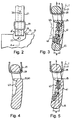
- Figure 3 shows a cross-section along line A-A' of Figure 2.
- the strap 21 is looped around the bar 29 of buckle 25.
- the surface 23 and the part of the fastener attached to the surface are not shown in Figure 3 for clarity.
- Figure 3 shows the buckle 25, a rivet 41 and an upper fastener part 43.
- the first upper fastening part 43 is formed so that it engages a complementary lower fastener part (shown in outline 44) at a plane of engagement.
- the upper fastener part is held in place by the fixing member 41.
- the fixing member 41 is a rivet.
- the upper part 43 is riveted in place on the buckle 25 such that the snap fastener part 43 is tilted along plane T which is parallel to the plane of engagement.
- the plane of the first member 25 is indicated by the dotted arrow A.
- the angle of the tilt is ⁇ .
- ⁇ is in the range from 10° to 15°.
- the rivet 41 and the upper part 43 are separately formed, they can be easily formed out of different coloured plastics which make the fastening more appealing to the eye. Also this may aid fastening as the upper part 43 can be easily distinguished from the buckle 25 and rivet 41.
- Figure 4 shows a variation on the fastening of Figure 3.
- the buckle 25 and rivet 41 or other fixing member and the upper part 43 are integral with one another. This can be achieved by injection molding, with a suitably shaped mold. This has the advantage that the labour intensive and time consuming operation of assembling the parts can be avoided. Also, in this example, as the first fastener part 43 is formed as part of the buckle 25 it is less prone to breaking off and hence a stronger fastening is produced.
- FIG. 5 A further variant on the fastening is shown in Figure 5.
- the buckle 25 and the rivet or fixing member 41 are formed integral with one another. Again, this arrangement can be achieved by injection molding. Upper part 43 is then formed separately and attached to the fixing member 41. The upper part 43 can be made in a different colour to the rest of the fastening. Thus, it can be easily seen. Also, this arrangement is easier to manufacture than the example shown in figure 3, as the buckle 25 and fixing member 41 are formed at the same time. However, it has the advantage that different types of fastener part can be used with the same buckle 25
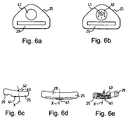
- FIG. 6b shows a view of the top side of the buckle 25. Only the buckle 25 and the rivet 41 are visible from this angle. This is how the buckle 25 will be most often seen in use. The upper part 43 is hidden from sight.
- the fastening can be used on Children's' clothing. Therefore, the edges of the fastening are rounded so that there are no sharp corners on which a child could hurt itself.
- Figure 6b is a view of the underside of the buckle 25 upper part 43.
- the rivet 41 can be seen in the centre of the upper part.
- a strap for example (as shown in figure 2) can be threaded under the bar 29 shown the figure 6b.
- Figure 6c shows a side view of the buckle 25.
- rivet 41 can be seen protruding above the plane of the buckle 25.
- the upper part 43 can just be seen.
- the pin 42 of rivet 41 can also be seen.
- Axis X corresponds to the direction of the pin 42 of the rivet 41.
- Axis X is perpendicular to the T axis shown in Figure 3.
- the buckle 25 is shown with a slight curvature.
- Figure 6d shows another side view of the buckle 25.
- the bar 29 is seen at the front of the figure and rivet 41 can be seen protruding above the plane of the buckle 25.
- Axis X shows the position of the pin 42 of the rivet.
- the buckle 25 is also slightly curved when viewed from the side shown in this figure.
- Figure 6e is almost identical to Figure 3.
- axis X is marked and it can be clearly seen that this fixes the tilt of the upper part 43 and hence the plane of engagement.
Landscapes
- Slide Fasteners, Snap Fasteners, And Hook Fasteners (AREA)
Applications Claiming Priority (2)
| Application Number | Priority Date | Filing Date | Title |
|---|---|---|---|
| GB9801418 | 1998-01-22 | ||
| GB9801418A GB2333553A (en) | 1998-01-22 | 1998-01-22 | Snap fastening mounting |
Publications (2)
| Publication Number | Publication Date |
|---|---|
| EP0931471A2 true EP0931471A2 (de) | 1999-07-28 |
| EP0931471A3 EP0931471A3 (de) | 1999-11-10 |
Family
ID=10825743
Family Applications (1)
| Application Number | Title | Priority Date | Filing Date |
|---|---|---|---|
| EP99300480A Ceased EP0931471A3 (de) | 1998-01-22 | 1999-01-22 | Eine Befestigung |
Country Status (2)
| Country | Link |
|---|---|
| EP (1) | EP0931471A3 (de) |
| GB (1) | GB2333553A (de) |
Family Cites Families (9)
| Publication number | Priority date | Publication date | Assignee | Title |
|---|---|---|---|---|
| US4409706A (en) * | 1981-04-20 | 1983-10-18 | Clendinen Charles D | Stud and eyelet fastener |
| EP0065868B1 (de) * | 1981-05-19 | 1985-11-13 | Hideo Kurashima | Manschettenknopf |
| JPS61147510A (ja) * | 1984-12-21 | 1986-07-05 | Taamo:Kk | 永久磁石を使用した止具 |
| US4599768A (en) * | 1985-05-13 | 1986-07-15 | Illinois Tool Works Inc. | Spin welded fastening assembly |
| JPH0735800Y2 (ja) * | 1989-08-03 | 1995-08-16 | 日本精工株式会社 | シートベルト用バックルストーク |
| FR2678326A1 (fr) * | 1991-06-29 | 1992-12-31 | Bock Martin | Dispositif de fixation destine a la fixation reciproque par encliquetage de deux pieces moulees et corps moule notamment pour assise ou dossier de chaise, comportant une pluralite de ces dispositifs. |
| US5560089A (en) * | 1993-08-09 | 1996-10-01 | Tarmo Co. Ltd. | Fastener means |
| US5642558A (en) * | 1995-06-23 | 1997-07-01 | Bodkin, Sr.; Lawrence Edward | Jewelry clasp |
| US5778498A (en) * | 1996-08-16 | 1998-07-14 | Laks; David A. | Releasable fastener for foot apparel |
-
1998
- 1998-01-22 GB GB9801418A patent/GB2333553A/en not_active Withdrawn
-
1999
- 1999-01-22 EP EP99300480A patent/EP0931471A3/de not_active Ceased
Also Published As
| Publication number | Publication date |
|---|---|
| EP0931471A3 (de) | 1999-11-10 |
| GB2333553A (en) | 1999-07-28 |
| GB9801418D0 (en) | 1998-03-18 |
Similar Documents
| Publication | Publication Date | Title |
|---|---|---|
| US8240772B2 (en) | Seatbelt holding structure | |
| US4644618A (en) | Lock for safety bells | |
| US6017087A (en) | Child restraint with a rotary coupling | |
| EP2918183B1 (de) | Gurtbefestigungssystem mit Schnallenmechanismus | |
| US5327620A (en) | Fastening means for connecting a gaiter to a roller skate | |
| WO1987003790A1 (en) | Buckle type fastener | |
| GB2320518A (en) | Releasably securable clip | |
| WO2011100069A2 (en) | Method for constructing a product and fastener therefore | |
| US20080115269A1 (en) | System and method of assembling a nursery device for supporting a baby occupant | |
| US4937923A (en) | Positive-lock quick-release buckle | |
| US5778498A (en) | Releasable fastener for foot apparel | |
| US20080179936A1 (en) | Safety Device for a Seat Belt Buckle | |
| JP3429481B2 (ja) | バックル | |
| EP0331299B1 (de) | Kinder-Sicherheitssitz | |
| CA2342044A1 (en) | Tether latch for securing a child vehicle seat to an anchorage | |
| GB2333553A (en) | Snap fastening mounting | |
| US4443916A (en) | Latching devices | |
| TW201029594A (en) | Fastener element for concealed slide fasteners | |
| US5048865A (en) | Buckle stalk for seat belt system | |
| US20090070970A1 (en) | Clasp | |
| EP0211988B1 (de) | Schnalle mit Gleitsteg | |
| USRE26754E (en) | Safety belt buckle | |
| US11814124B1 (en) | Securement apparatus for connecting riders together on a vehicle | |
| CN222988132U (zh) | 可自动展开的安全带系统 | |
| US3439388A (en) | Buckles for safety straps and harnesses |
Legal Events
| Date | Code | Title | Description |
|---|---|---|---|
| PUAI | Public reference made under article 153(3) epc to a published international application that has entered the european phase |
Free format text: ORIGINAL CODE: 0009012 |
|
| AK | Designated contracting states |
Kind code of ref document: A2 Designated state(s): DE ES FR GB IT |
|
| AX | Request for extension of the european patent |
Free format text: AL;LT;LV;MK;RO;SI |
|
| PUAL | Search report despatched |
Free format text: ORIGINAL CODE: 0009013 |
|
| AK | Designated contracting states |
Kind code of ref document: A3 Designated state(s): AT BE CH CY DE DK ES FI FR GB GR IE IT LI LU MC NL PT SE |
|
| AX | Request for extension of the european patent |
Free format text: AL;LT;LV;MK;RO;SI |
|
| RIC1 | Information provided on ipc code assigned before grant |
Free format text: 6A 44B 17/00 A, 6A 44B 11/00 B |
|
| 17P | Request for examination filed |
Effective date: 20000303 |
|
| AKX | Designation fees paid |
Free format text: DE ES FR GB IT |
|
| 17Q | First examination report despatched |
Effective date: 20010427 |
|
| GRAG | Despatch of communication of intention to grant |
Free format text: ORIGINAL CODE: EPIDOS AGRA |
|
| STAA | Information on the status of an ep patent application or granted ep patent |
Free format text: STATUS: THE APPLICATION HAS BEEN REFUSED |
|
| 18R | Application refused |
Effective date: 20020815 |