EP0932060A2 - Wählbares Wellenlängenkanalfilter für optische WDM Systeme - Google Patents
Wählbares Wellenlängenkanalfilter für optische WDM Systeme Download PDFInfo
- Publication number
- EP0932060A2 EP0932060A2 EP98118666A EP98118666A EP0932060A2 EP 0932060 A2 EP0932060 A2 EP 0932060A2 EP 98118666 A EP98118666 A EP 98118666A EP 98118666 A EP98118666 A EP 98118666A EP 0932060 A2 EP0932060 A2 EP 0932060A2
- Authority
- EP
- European Patent Office
- Prior art keywords
- filter
- wavelength
- reflector
- output
- light
- Prior art date
- Legal status (The legal status is an assumption and is not a legal conclusion. Google has not performed a legal analysis and makes no representation as to the accuracy of the status listed.)
- Withdrawn
Links
Images



Classifications
-
- G—PHYSICS
- G02—OPTICS
- G02B—OPTICAL ELEMENTS, SYSTEMS OR APPARATUS
- G02B6/00—Light guides; Structural details of arrangements comprising light guides and other optical elements, e.g. couplings
- G02B6/10—Light guides; Structural details of arrangements comprising light guides and other optical elements, e.g. couplings of the optical waveguide type
- G02B6/12—Light guides; Structural details of arrangements comprising light guides and other optical elements, e.g. couplings of the optical waveguide type of the integrated circuit kind
- G02B6/12007—Light guides; Structural details of arrangements comprising light guides and other optical elements, e.g. couplings of the optical waveguide type of the integrated circuit kind forming wavelength selective elements, e.g. multiplexer, demultiplexer
-
- G—PHYSICS
- G02—OPTICS
- G02B—OPTICAL ELEMENTS, SYSTEMS OR APPARATUS
- G02B6/00—Light guides; Structural details of arrangements comprising light guides and other optical elements, e.g. couplings
- G02B6/24—Coupling light guides
- G02B6/26—Optical coupling means
- G02B6/28—Optical coupling means having data bus means, i.e. plural waveguides interconnected and providing an inherently bidirectional system by mixing and splitting signals
- G02B6/293—Optical coupling means having data bus means, i.e. plural waveguides interconnected and providing an inherently bidirectional system by mixing and splitting signals with wavelength selective means
- G02B6/29304—Optical coupling means having data bus means, i.e. plural waveguides interconnected and providing an inherently bidirectional system by mixing and splitting signals with wavelength selective means operating by diffraction, e.g. grating
- G02B6/29316—Light guides comprising a diffractive element, e.g. grating in or on the light guide such that diffracted light is confined in the light guide
- G02B6/29317—Light guides of the optical fibre type
- G02B6/29319—With a cascade of diffractive elements or of diffraction operations
-
- H—ELECTRICITY
- H04—ELECTRIC COMMUNICATION TECHNIQUE
- H04B—TRANSMISSION
- H04B10/00—Transmission systems employing electromagnetic waves other than radio-waves, e.g. infrared, visible or ultraviolet light, or employing corpuscular radiation, e.g. quantum communication
- H04B10/60—Receivers
- H04B10/66—Non-coherent receivers, e.g. using direct detection
- H04B10/67—Optical arrangements in the receiver
- H04B10/671—Optical arrangements in the receiver for controlling the input optical signal
- H04B10/675—Optical arrangements in the receiver for controlling the input optical signal for controlling the optical bandwidth of the input signal, e.g. spectral filtering
-
- H—ELECTRICITY
- H04—ELECTRIC COMMUNICATION TECHNIQUE
- H04J—MULTIPLEX COMMUNICATION
- H04J14/00—Optical multiplex systems
- H04J14/02—Wavelength-division multiplex systems
Definitions
- the present invention relates to optical communication systems, and more particularly, to an apparatus having one or more narrow band, selectable output wavelengths.
- Communication transmission systems based on the modulation of a light signal provide substantially higher bandwidth than systems based on metallic conductors.
- fiber optic cables are replacing coaxial cable in applications requiring high bandwidth.
- the capacity of an optical fiber may be further enhanced by multiplexing a number of communication channels on the same fiber utilizing light sources of different wavelengths. In such an arrangement, a number of closely spaced optical channels are transmitted on a single fiber. Each channel carries a separate data stream. Since the wavelengths of the carriers are different, the data streams do not interfere with each other and can simultaneously propagate along a single optical fiber.
- the maximum number of channels is typically determined by the width of the individual channels and the maximum range of wavelengths that can be amplified by repeaters on the fiber.
- the channel widths and interchannel gaps are determined by the width of the spectrum generated by the light source that provides the carriers for the channels.
- the distance between individual channels is ultimately set by the width of the modulated spectrum on each of the optical carriers in the individual channels.
- gain element In many systems some form of gain element must be utilized to amplify the light signals in the fiber in order to compensate for transmission losses. Optical amplifiers are utilized for this function. To minimize distortions, the gain as a function of wavelength for these amplifiers needs to be constant. This condition will only be satisfied for some limited portion of the optical spectrum for any given amplifier design. Accordingly, there is a maximum number of channels imposed by the amplifiers for any given channel spacing. Hence, narrow band sources and filters are needed.
- a narrow band light source is needed for each channel. Data is transmitted on any given channel by modulating the output of the light source for that channel and then introducing the modulated light into the optical fiber.
- the light source should be capable of generating the carrier for any channel, the precise wavelength generated at any given time being selectable by a signal applied to the light source.
- Light sources having fixed output wavelengths and sufficiently narrow wavelength spreads are known to the art. For example, U.S. Patent 5,268,910 describes a superluminescent optical source for generating an optical carrier from a doped fiber.
- the present invention is a filter for generating an output light signal having one or more output spectral lines selected from a pluarality of potential spectral lines contained in an input light signal.
- the filter includes a channel filter for filtering the input light signal to create a notched light signal having a spectrum devoid of light at a first wavelength.
- the filter also includes a variable wavelength reflector for reflecting light having a wavelength equal to a reflection wavelength, the reflection wavelength being selectable from the first wavelength and a second wavelength equal to the wavelength of one of the spectral lines.
- the output of the channel filter is coupled to the input of the variable wavelength reflector.
- the output of the variable wavelength reflector includes the output light signal.
- the channel filter can be constructed using a number of known optical components such as fiber Bragg reflectors, array waveguide filters, Mach Zehnder filters, or absorption filters.
- the variable frequency reflector is preferably constructed from one or more variable frequency fiber Bragg reflectors.
- the present invention may be viewed as an optical filter for separating light of one or more wavelengths from a broadband source having a plurality of wavelengths including the desired wavelength.
- the manner in which the present invention operates may be more easily understood with reference to Figure 1, which is a block diagram of a filter 100 according to the present invention.
- Filter 100 takes the output 111 of a broad-spectrum light source 101 and converts it to a signal 113 having one or more discrete spectral lines at selected wavelengths.
- the output of light source 101 is applied to a channel filter 103.
- the output of channel filter 103 is a signal having a spectrum comprising a series of discrete spectral lines as shown at 112. This spectrum includes the spectral lines that are to be included in the output signal 113 as well as a number of lines or spectral regions that are not to be included in the output signal.
- channel filter 103 The output of channel filter 103 is applied to a channel selector 105.
- Channel selector 105 separates the desired spectral lines from the output of channel filter 103 to generate the output signal 113.
- Channel filter 103 can be constructed from any device that will isolate the desired output lines.
- channel filter 103 may be constructed from a series of fiber Bragg reflectors and an appropriate routing device or an array waveguide filter. Since fiber Bragg reflectors are well known to the art, they will not be discussed in detail here.
- a fiber Bragg reflector may be viewed as a grating that has been induced in the core of an optical fiber.
- the grating consist of periodic alterations in the index of refraction of the core of the fiber. Such alterations may be induced by illuminating the core with an UV light pattern having regularly spaced maxima of sufficient intensity to damage the core. The pattern is typically generated by the interference of two UV light beams.
- FIG. 2 is a schematic drawing of a filter 10 according to the present invention.
- Filter 10 is constructed from an optical circulator 12 and two banks of optical Bragg reflectors shown at 20 and 30, respectively.
- Bank 20 acts as the channel filter
- bank 30 acts as the channel selector.
- Optical circulator 12 provides the coupling functions.
- an optical circulator is a device having a plurality of ports and a defined direction of travel indicated by the arrow. Light entering any port travels in the direction of the arrow until it reaches the next port in that direction at which it exits. Hence, light entering port 13 of optical circulator 12 exits via port 14. Light entering port 14 will exit via port 15. Similarly, light entering port 15 will exit via port 16.
- Optical circulators may be purchased commercially, and hence, the detailed construction of optical circulators will not be discussed in detail here.
- Reflector bank 20 includes one fiber Bragg reflector for each wavelength that is to be included in the output of the channel filter. Exemplary reflectors are shown at 21-23. Denote the number of such reflectors by N.
- the output of reflector bank 20 is an optical signal having a spectrum that consists of N lines. Each line is generated by one of the Bragg reflectors in bank 20. The light that is not reflected is either discarded or transmitted for additional use.
- the channel selection function is performed by a reflector bank 30, which is constructed from a plurality of VFBRs. Exemplary VFBRs are shown at 31-33.
- the number of VFBRs must be at least as large as the number of spectral lines that are to be included in the output of the filter 10.
- Each line that is to appear in the output signal is generated by a reflection from a corresponding VFBR in reflector bank 30. If only one line was ever required, then only one VFBR would be needed.
- Such an embodiment will function properly provided the reflection wavelength of that VFBR could be varied sufficiently to cover the entire spectral range of the input signal to reflector bank 30 so that the desired spectral line could be selected by moving the reflection wavelength to the line's wavelength.
- the degree of variation in the reflection wavelength that can be obtained by heating or stretching an optical fiber Bragg reflector is limited.
- the channels have closely spaced wavelengths. The spacing between any two channels is sufficient to provide channel isolation.
- the total wavelength range across all of the channels is preferably kept to a minimum to allow a single optical amplifier to be used to maintain the signal strength in the network at each amplification station.
- the degree of variation in the reflection wavelength of the VFBR is sufficient to move the reflection wavelength from a value between two channels to a value on one of the adjacent channels.
- the light in a single channel can be selectively reflected by heating or stretching a corresponding VFBR to move its reflection wavelength from a value between two channels to the channel value.
- the preferred embodiment of the present invention utilizes one VFBR in reflector bank 30 for each Bragg reflector in reflector bank 20.
- This arrangement assures that each spectral line that is generated by reflector bank 20 can be included in the output signal. Furthermore, all of the spectral lines, or any subset thereof, can be included in the output signal.
- the corresponding VFBR has its reflection wavelength set to a value between two channels. Since there is no light in this spectral region, the VFBR will not provide any light to the output signal when "parked" in this manner.
- the manner in which filter 10 extracts a particular wavelength from a broadband input light signal will now be summarized.
- the input light signal 41 enters optical circulator 12 at port 13 and exits via port 14 into reflector bank 20.
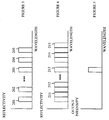
- the reflectivity of filter 10 as a function of wavelength is shown in Figure 3. There is one reflector in filter 10 for each possible output line. The reflectivity of representative reflectors is shown at 201-205.
- Reflector bank 20 converts the broad input spectrum to a spectrum consisting of N discrete lines as shown at 42, each line being generated by a reflection from one of the reflectors in filter 10. One of these lines corresponds to the desired output wavelength. The remainder of the input signal is transmitted to fiber 25.
- the output of reflector bank 20 is reflected back to optical circulator 12.
- This light signal exits optical circulator 12 on port 15 and forms the input to reflector bank 30 whose reflectivity as a function of wavelength is shown in Figure 4.
- the reflectivity functions of the reflectors in filter 20 corresponding to reflectors that generated reflectivities 201-205 shown in Figure 3 are shown at 211-215, respectively, in Figure 4.
- each filter is parked at a wavelength between two of the wavelengths at which reflector bank 20 reflects.
- the wavelengths of the lines generated by filter 10 are shown as dotted lines in Figure 4.
- Reflector bank 30 selects the line corresponding to the desired wavelength from the N discrete line input spectrum. This is accomplished by moving the reflection wavelength of a VFBR in reflector bank 30 from a value between two of the spectral lines generated by reflector bank 20 to the wavelength of the desired line as shown at 213 in Figure 4. The remaining VFBRs do not reflect light, and hence, the unselected spectral lines exit reflector bank 30 and are transmitted to fiber 35.
- the selected spectrum consists of the single line shown in Figure 5 which corresponds to the wavelength at which both reflector banks reflect light.
- filter 10 can be operated to generate an output consisting of any subset of the N spectral lines generated by reflector bank 20.
- a multi-line spectrum is useful in optical networks in which signals are switched between linked communication paths based on the wavelength of the carrier. By modulating a multi-line source, a light signal can be broadcast to many linked communication paths. For each desired output wavelength, the reflection wavelength of one of the VFBRs in reflector bank 30 is set to match the wavelength of the input spectral line generated by reflector bank 20.
- the channel filter may also be constructed from an array waveguide filter as shown in figure 6.
- This filter is constructed by splitting the optical signal onto multiple planar waveguides, each having a well defined optical delay. The multiple waveguides are then combined to create a single output whose filtering characteristics depend on the optical delays and the distribution of powers on the multiple waveguides.
- an array waveguide filter can generate a spectrum consisting of regularly spaced spectral bands similar to those generated by reflector bank 20 in Figure 2.
- the channel filter can also be constructed using other types of periodic transmission filters such as Mach Zehnder interferometers, Fabry-Perot filters and tapered fiber filters.
- FIG. 6 A schematic drawing of an embodiment 50 of a filter according to the present invention that utilizes an array waveguide filter is shown in Figure 6.
- a broad band input signal is filtered by a tapered fiber filter 70 to generate an output signal 93 which is coupled to a VFBR bank 80 by an optical circulator 52.
- Bank 80 operates in a manner analogous to reflector bank 30 as discussed above.
- its reflection wavelength is adjusted to a value between two of the spectral bands generated by tapered fiber filter 70.
- Light that is not reflected by reflector bank 80 is transmitted to fiber 85.
- the light that is reflected by bank 80 re-enters optical circulator 52 via port 54 and exits via port 55 to become the output signal.
- the width of the spectral lines in the output spectrum in both of the embodiments discussed above may be set by the VFBRs in the channel selector banks, i.e., banks 30 and 80 shown in Figures 2 and 6, respectively.
- the channel filter need only generate a spectrum which has narrow empty bands at the wavelengths where VFBRs are "parked" when not being used to generate a contribution to the output spectrum.
- any form of "notch" filter for removing a band corresponding to each of the VFBRs can be utilized.
- a number of absorption filters connected in series can provide the required spectrum.
- optical circulators for the coupling functions
- other forms of couplers may be utilized.
- the optical circulators could be replaced by conventional optical directional couplers, which are normally utilized for coupling light between two optical fibers.
Landscapes
- Physics & Mathematics (AREA)
- Engineering & Computer Science (AREA)
- Computer Networks & Wireless Communication (AREA)
- Signal Processing (AREA)
- General Physics & Mathematics (AREA)
- Optics & Photonics (AREA)
- Microelectronics & Electronic Packaging (AREA)
- Spectroscopy & Molecular Physics (AREA)
- Electromagnetism (AREA)
- Optical Communication System (AREA)
- Light Guides In General And Applications Therefor (AREA)
Applications Claiming Priority (2)
| Application Number | Priority Date | Filing Date | Title |
|---|---|---|---|
| US09/014,148 US6549701B1 (en) | 1998-01-27 | 1998-01-27 | Selectable wavelength channel filter for optical WDM systems |
| US14148 | 1998-01-27 |
Publications (2)
| Publication Number | Publication Date |
|---|---|
| EP0932060A2 true EP0932060A2 (de) | 1999-07-28 |
| EP0932060A3 EP0932060A3 (de) | 2001-04-18 |
Family
ID=21763813
Family Applications (1)
| Application Number | Title | Priority Date | Filing Date |
|---|---|---|---|
| EP98118666A Withdrawn EP0932060A3 (de) | 1998-01-27 | 1998-10-02 | Wählbares Wellenlängenkanalfilter für optische WDM Systeme |
Country Status (3)
| Country | Link |
|---|---|
| US (1) | US6549701B1 (de) |
| EP (1) | EP0932060A3 (de) |
| JP (1) | JPH11248962A (de) |
Cited By (1)
| Publication number | Priority date | Publication date | Assignee | Title |
|---|---|---|---|---|
| WO2003103192A1 (en) * | 2002-05-30 | 2003-12-11 | E.I. Du Pont De Nemours And Company | Closed-loop control of tunable optical wavelength filters |
Families Citing this family (4)
| Publication number | Priority date | Publication date | Assignee | Title |
|---|---|---|---|---|
| AUPP617198A0 (en) * | 1998-09-25 | 1998-10-22 | University Of Sydney, The | High q optical microwave processor using hybrid delay-line filters |
| WO2003009508A1 (en) * | 2001-07-19 | 2003-01-30 | Novx Systems Inc. | Optical add/drop switch |
| US7154082B2 (en) * | 2004-08-20 | 2006-12-26 | Pgs Americas, Inc. | Frequency division and/or wavelength division multiplexed recursive fiber optic telemetry scheme for an optical sensor array |
| KR100767726B1 (ko) | 2006-09-12 | 2007-10-17 | 한국과학기술연구원 | 광학적인 마이크로 미러 어레이를 이용한 가변 초고주파필터 |
Family Cites Families (13)
| Publication number | Priority date | Publication date | Assignee | Title |
|---|---|---|---|---|
| US5283686A (en) * | 1992-07-27 | 1994-02-01 | General Instrument Corporation, Jerrold Communications | Optical systems with grating reflector |
| EP0665874A1 (de) | 1992-10-13 | 1995-08-09 | The Procter & Gamble Company | Flüssige oder gelhaltige waschmittelzusammensetzung für geschirrspülmittel das polyhydroxyfettsäureamid und bestimmte elemente enthält |
| EP0612164A1 (de) | 1993-02-19 | 1994-08-24 | AT&T Corp. | Schnell abstimmbarer breitbandiger intergrierter optischer Filter |
| US5579143A (en) | 1993-06-04 | 1996-11-26 | Ciena Corporation | Optical system with tunable in-fiber gratings |
| US5493625A (en) * | 1993-11-16 | 1996-02-20 | At&T Corp. | Fast tunable channel dropping filter |
| JP3250206B2 (ja) * | 1994-02-14 | 2002-01-28 | 住友電気工業株式会社 | 光ファイバ増幅器 |
| US5446809A (en) | 1994-09-23 | 1995-08-29 | United Technologies Corporation | All fiber wavelength selective optical switch |
| FR2731082B1 (fr) * | 1995-02-28 | 1997-04-04 | France Telecom | Multiplexeur optique a insertion-extraction utilisant des circulateurs optiques et des reseaux de bragg photoinscrits |
| US5608825A (en) * | 1996-02-01 | 1997-03-04 | Jds Fitel Inc. | Multi-wavelength filtering device using optical fiber Bragg grating |
| US5774606A (en) * | 1996-05-17 | 1998-06-30 | Lucent Technologies, Inc. | Optical fiber transmission system with a passive optical router |
| US5699468A (en) * | 1996-06-28 | 1997-12-16 | Jds Fitel Inc. | Bragg grating variable optical attenuator |
| US5841918A (en) * | 1996-08-26 | 1998-11-24 | Jds Fitel Inc. | Wavelength and bandwidth tunable optical system |
| US5706375A (en) * | 1996-09-10 | 1998-01-06 | Jds Fitel Inc. | Variable-attenuation tunable optical router |
-
1998
- 1998-01-27 US US09/014,148 patent/US6549701B1/en not_active Expired - Lifetime
- 1998-10-02 EP EP98118666A patent/EP0932060A3/de not_active Withdrawn
- 1998-12-28 JP JP10373096A patent/JPH11248962A/ja not_active Withdrawn
Non-Patent Citations (1)
| Title |
|---|
| MICROWAVE AND OPTICAL TECHNOLOGY LETTERS 7, P.499-501, 5 August 1994 * |
Cited By (1)
| Publication number | Priority date | Publication date | Assignee | Title |
|---|---|---|---|---|
| WO2003103192A1 (en) * | 2002-05-30 | 2003-12-11 | E.I. Du Pont De Nemours And Company | Closed-loop control of tunable optical wavelength filters |
Also Published As
| Publication number | Publication date |
|---|---|
| JPH11248962A (ja) | 1999-09-17 |
| US6549701B1 (en) | 2003-04-15 |
| EP0932060A3 (de) | 2001-04-18 |
Similar Documents
| Publication | Publication Date | Title |
|---|---|---|
| US6459516B1 (en) | Dense WDM add/drop multiplexer | |
| US6185023B1 (en) | Optical add-drop multiplexers compatible with very dense WDM optical communication systems | |
| US6339474B2 (en) | Interferometric optical device including an optical resonator | |
| US6363202B1 (en) | Management and control of the power levels of wavelength multiplexed optical signals | |
| US4441181A (en) | Optical wavelength-division multiplex system | |
| KR20030065487A (ko) | 양방향 광분기 결합기를 갖는 양방향 wdm 광 통신 시스템 | |
| US6567196B1 (en) | Dense WDM optical multiplexer and demultiplexer | |
| JPH08265299A (ja) | 複数チャンネルの光ファイバー通信 | |
| US4571024A (en) | Wavelength selective demultiplexer tuner | |
| US6373609B1 (en) | Wavelength tailored dispersion compensation apparatus | |
| US6904240B1 (en) | Optical multiplexing apparatus and optical multiplexing method | |
| GB2320152A (en) | A low loss optical demultiplexer | |
| US6516112B1 (en) | Optical wavelength filter and demultiplexer | |
| US6205269B1 (en) | Optical add/drop multiplexer | |
| US6549701B1 (en) | Selectable wavelength channel filter for optical WDM systems | |
| US20020027683A1 (en) | Optical device, terminal apparatus, and system for wavelength division multiplexing | |
| EP0953854A1 (de) | Ringkoppler für optische Netzwerk | |
| US6456754B1 (en) | WDM transmitter and receiver | |
| US20030108283A1 (en) | Optical demultiplexer module | |
| JP3308148B2 (ja) | 波長多重通信方式用光海底ケーブル分岐装置およびそれを用いた波長多重光海底ケーブルネットワーク | |
| US20030091276A1 (en) | Grating-based MUX/DMUX with expanded waveguides | |
| US20030068120A1 (en) | Optical interleaver | |
| KR100264950B1 (ko) | 궤환잡음이 없는 파장다중방식(wdm) 통신용 파장가변광 추출/투과필터 | |
| GB2351625A (en) | Wavelength selective power level control using a plurality of attenuators | |
| US5548671A (en) | Programmable, differential wavelength discriminator |
Legal Events
| Date | Code | Title | Description |
|---|---|---|---|
| PUAI | Public reference made under article 153(3) epc to a published international application that has entered the european phase |
Free format text: ORIGINAL CODE: 0009012 |
|
| AK | Designated contracting states |
Kind code of ref document: A2 Designated state(s): DE FR GB |
|
| AX | Request for extension of the european patent |
Free format text: AL;LT;LV;MK;RO;SI |
|
| PUAL | Search report despatched |
Free format text: ORIGINAL CODE: 0009013 |
|
| RAP1 | Party data changed (applicant data changed or rights of an application transferred) |
Owner name: AGILENT TECHNOLOGIES, INC. |
|
| AK | Designated contracting states |
Kind code of ref document: A3 Designated state(s): AT BE CH CY DE DK ES FI FR GB GR IE IT LI LU MC NL PT SE |
|
| AX | Request for extension of the european patent |
Free format text: AL;LT;LV;MK;RO;SI |
|
| RIC1 | Information provided on ipc code assigned before grant |
Free format text: 7G 02B 6/293 A, 7H 04J 14/02 B, 7H 04Q 11/00 B, 7G 02F 1/01 B |
|
| RAP1 | Party data changed (applicant data changed or rights of an application transferred) |
Owner name: AGILENT TECHNOLOGIES INC. |
|
| RAP1 | Party data changed (applicant data changed or rights of an application transferred) |
Owner name: AGILENT TECHNOLOGIES INC. A DELAWARE CORPORATION |
|
| RAP1 | Party data changed (applicant data changed or rights of an application transferred) |
Owner name: AGILENT TECHNOLOGIES, INC. (A DELAWARE CORPORATION |
|
| 17P | Request for examination filed |
Effective date: 20010903 |
|
| 17Q | First examination report despatched |
Effective date: 20011030 |
|
| AKX | Designation fees paid |
Free format text: DE FR GB |
|
| STAA | Information on the status of an ep patent application or granted ep patent |
Free format text: STATUS: THE APPLICATION HAS BEEN WITHDRAWN |
|
| 18W | Application withdrawn |
Effective date: 20050905 |