EP0932109A2 - Ein Verfahren für die Beglaubigung von Elementen - Google Patents
Ein Verfahren für die Beglaubigung von Elementen Download PDFInfo
- Publication number
- EP0932109A2 EP0932109A2 EP99400130A EP99400130A EP0932109A2 EP 0932109 A2 EP0932109 A2 EP 0932109A2 EP 99400130 A EP99400130 A EP 99400130A EP 99400130 A EP99400130 A EP 99400130A EP 0932109 A2 EP0932109 A2 EP 0932109A2
- Authority
- EP
- European Patent Office
- Prior art keywords
- tree
- authenticated
- search
- directory
- user
- Prior art date
- Legal status (The legal status is an assumption and is not a legal conclusion. Google has not performed a legal analysis and makes no representation as to the accuracy of the status listed.)
- Withdrawn
Links
Images
Classifications
-
- H—ELECTRICITY
- H04—ELECTRIC COMMUNICATION TECHNIQUE
- H04L—TRANSMISSION OF DIGITAL INFORMATION, e.g. TELEGRAPHIC COMMUNICATION
- H04L9/00—Cryptographic mechanisms or cryptographic arrangements for secret or secure communications; Network security protocols
- H04L9/32—Cryptographic mechanisms or cryptographic arrangements for secret or secure communications; Network security protocols including means for verifying the identity or authority of a user of the system or for message authentication, e.g. authorization, entity authentication, data integrity or data verification, non-repudiation, key authentication or verification of credentials
- H04L9/3236—Cryptographic mechanisms or cryptographic arrangements for secret or secure communications; Network security protocols including means for verifying the identity or authority of a user of the system or for message authentication, e.g. authorization, entity authentication, data integrity or data verification, non-repudiation, key authentication or verification of credentials using cryptographic hash functions
-
- H—ELECTRICITY
- H04—ELECTRIC COMMUNICATION TECHNIQUE
- H04L—TRANSMISSION OF DIGITAL INFORMATION, e.g. TELEGRAPHIC COMMUNICATION
- H04L9/00—Cryptographic mechanisms or cryptographic arrangements for secret or secure communications; Network security protocols
- H04L9/32—Cryptographic mechanisms or cryptographic arrangements for secret or secure communications; Network security protocols including means for verifying the identity or authority of a user of the system or for message authentication, e.g. authorization, entity authentication, data integrity or data verification, non-repudiation, key authentication or verification of credentials
- H04L9/3263—Cryptographic mechanisms or cryptographic arrangements for secret or secure communications; Network security protocols including means for verifying the identity or authority of a user of the system or for message authentication, e.g. authorization, entity authentication, data integrity or data verification, non-repudiation, key authentication or verification of credentials involving certificates, e.g. public key certificate [PKC] or attribute certificate [AC]; Public key infrastructure [PKI] arrangements
-
- H—ELECTRICITY
- H04—ELECTRIC COMMUNICATION TECHNIQUE
- H04L—TRANSMISSION OF DIGITAL INFORMATION, e.g. TELEGRAPHIC COMMUNICATION
- H04L2209/00—Additional information or applications relating to cryptographic mechanisms or cryptographic arrangements for secret or secure communication H04L9/00
- H04L2209/30—Compression, e.g. Merkle-Damgard construction
-
- H—ELECTRICITY
- H04—ELECTRIC COMMUNICATION TECHNIQUE
- H04L—TRANSMISSION OF DIGITAL INFORMATION, e.g. TELEGRAPHIC COMMUNICATION
- H04L9/00—Cryptographic mechanisms or cryptographic arrangements for secret or secure communications; Network security protocols
- H04L9/50—Cryptographic mechanisms or cryptographic arrangements for secret or secure communications; Network security protocols using hash chains, e.g. blockchains or hash trees
Definitions
- the present invention is in the general field of digital signature for authentication purposes.
- a certificate is a message signed by a publicly trusted authority (the certification authority, whose public key authenticity may be provided by other means) which includes a public key and additional data, such as expiration date, serial number and information regarding the key and the subject entity.
- a typical application is a credit card system where the credit company may revoke a credit card, temporarily or permanently, prior to its expiration, e.g. when a card is reported stolen or according to its user's bank account balance.
- a CRL is a signed list issued by the CA identifying all revoked certificates by their serial numbers.
- the list is concatenated with a time stamp (as an indication of its freshness) and signed by the CA that originally issued the certificates.
- the CRLs are sent to the directory on a periodic basis, even if there are no changes, to prevent the malicious replay of old CRLs instead of new CRLs.
- the directory supplies the most updated CRL (the complete CRL is sent to the merchant).
- a reasonable validity expiration period should be chosen for certificates. If the expiration period is short, resources are wasted reissuing certificates. If the expiration period is long, the CRL may get long, causing high communication costs and difficulties in CRL management Kaufman et al. [15, Section 7.7.3] suggested reissuing all certificates whenever the CRL grows beyond some limit.
- certificates are marked by a serial number instead of an expiration date. (Serial numbers are incremented for each issued certificate. Serial numbers are not reused even when all certificates are reissued.)
- the CRL contains a field indicating the first valid certificate. When all certificates are reissued, the CRL first valid certificate field is updated to contain the serial number of the first reissued certificate.
- Micali [18) suggested the Certificate Revocation system (CRS) in order to improve the CRL communication costs.
- CRS Certificate Revocation system
- the underlying idea is to sign a message for every certificate stating whether it was revoked or not, and to use an off-line/on-line signature scheme [11] to reduce the cost of periodically updating these signatures.
- the directory is updated daily by the CA sending it a number C for each certificate as follows:
- the most updated value for C serves as a short proof (that certificate x was or was not revoked) that the directory may present in reply to a user query x.
- CRS CRS proof ofthe validity of his certificate. Directory accesses are saved when users hold such proofs and presents them along with their certificates.
- a CRT is a hash tree with leaves corresponding to a set of statements about certificate serial number X issued by a CA, CA X.
- the set of statements is produced from the set of revoked certificates of every CA. It provides the information whether a certificate X is revoked or not (or whether its status is unknown to the CRT issuer).
- the CRT issuer builds a binary hash tree [17] with leaves corresponding to the above statements
- a proof for a certificate status is a pah in the hash tree, from the root to the appropriate leaf (statement) specifying for each node on the path the values of its children.
- CA Certification Authority
- a CA preferably, but not necessarily, does not provide on-line certificate information services to users. Instead, it updates a directory on a periodic basis). As will be shown below in some embodiments directories are not used.
- a CA issues certificates for users by a message containing the certificate serial number relevant data and an expiration date.
- the certificate is sent to a directory and/or given to the user.
- the CA may revoke a certificate prior to its expiration date.
- Certificate is by no means bound to the latter definition and may encompass data pertain to e.g. one or more (such as range of) public key(s), credit card number(s), and others; presented either in explicit form or after having been subject to a function such as encoding or encryption. (the term item and certificate are used in the specification interchangeably)
- Directory - One or more non-trusted parties that get updated certificate revocation information from the CA and serve as a certificate database accessible by the users.
- User - A non-trusted party that receives its certificate from the CA and issues queries for certificate information. User should be construed as encompassing among others:
- Search free - A well known data structure that is associated with search scheme which enables to construct a search path in the tree, from the root to a sought item (associated with a leaf).
- the search path exploits search values that reside in the tree nodes and possibly also in the links.
- Search tree is inherently designed to handle update transactions (i.e. delete and/or insert items to the tree).
- update transactions i.e. delete and/or insert items to the tree.
- search trees being: 2-3 tree, Btree, Btree+, TriS, treaps and others.
- Cryptographic hash function- includes:
- the present invention incorporates the utilization of conventional authentication trees as well as conventional search trees such as 2-3 tree or Btree.
- the utilization of search trees enables to authenticate an item (or items) whilst obviating the need to transmit a large amount of data to this end.
- the utilization of the authentication tree according to the prior art, enables to transmit a series of revoked, (or otherwise) valid items.
- a conventional authentication tree is "superimposed" on conventional search tree (bringing about authentication search tree) benefiting thus both from the inherent advantages of the authentication tree insofar as authenticating items is concerned and from the limited changes that are imposed on the tree nodes due to the search tree structure.
- the present invention provides for a memory containing an authenticated search tree that serves for authenticating membership or non membership of items in a set; the authenticated search tree, comprising:
- the invention provides for a method for authenticating membership or non membership of items in a set; comprising:
- the invention provides for a method for updating at least one item of a set in an authenticated search tree, comprising:
- the invention further provides a system for authenticating/updating mutatis mutandis.
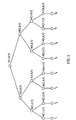
- FIG. 1 illustrating an authentication tree according to the prior art e.g as disclosed in the specified Merkle patent, the contents of which are incorporated herein by reference.
- certificates Y 1 to Y 8 stand for a certificate list (CL) of all valid credit cards.
- CL certificate list
- a user wants to use his credit card Y 5 in a commercial transaction vis-a-vis a merchant.
- the merchant addresses a directory that holds the authentication tree (i.e. authentication tree in respect of valid credit cards Y 1 to Y 8 ) of the kind disclosed in Fig. 1. It is recalled that the directory is an un-trusted party and therefore the merchant wants to verify that Y 5 indeed appears in the tree.
- the collision intractable function h() serves for authenticating item(s) (credit cards) Y 1 to Y 8 sorted according to credit card number, e.g. in ascending order.
- Y 5 it is sufficient for the directory to transmit to the merchant tree leaf and node values Y 5, H(6,6,Y), H(7,8,Y) and H(1,4,Y), assuming that the root value H(1,8,Y) was previously authenticated, e.g. using a digital signature.
- additional tree values may be transmitted but as will be appreciated from the description below transmitting additional tree values is absolutely redundant.
- the merchant (knowing a priori H()) calculates the authentication path, namely, H(5,5,Y) (on the basis of Y 5 ) and on the basis of H(5,5,Y) and the so received H(6,6,Y), the merchant calculates H(5,6,Y).
- H(5,5,Y) on the basis of Y 5
- H(5,5,Y) on the basis of H(5,5,Y)
- the merchant calculates H(5,6,Y).
- the latter along with so received H(7,8,Y) give rise to H(5,8,Y).
- the latter along with the so received H(1,4,Y) give rise to H(1,8,Y) which is subject to PKI technique (e.g. applying the public key n ), and the result is compared to the previously authenticated H(1,8,Y) value and in the case of match, it is assured that the item Y 5 belongs to the list of valid credit cards.
- PKI technique e.g. applying the public key n
- the advantage of the authentication tree is, of course, that only few tree node values were transmitted to the user which could nevertheless authenticate the item Y 5 of interest
- the specified description for authenticating items in respect of prior art authentication tree applies also to the search authenticated tree of the invention.
- the major drawback of the authentication tree of Fig. 1 arises when the latter is subject to modify transaction, e.g. when new credit card is added to the list at the CA.
- new item Y 4' such that Y 4 ⁇ Y 4' ⁇ Y 5 is added.
- the resulting authentication tree (not shown) will necessitate extensive update of most of the nodes in the tree and undue transmission overhead of the updated information, which is obviously undesired, particularly when bearing in mind that the rate of updating the CA with new items is as a rule quiet high.
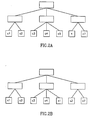
- a search authenticated tree utilizing e.g. a 2-3 search tree with a CRL (e.g. a list of revoked credit cards held at the leaves, See Fig. 2A-B.)
- CRL e.g. a list of revoked credit cards held at the leaves, See Fig. 2A-B.
- any manner of holding the items in the leaves is applicable, e.g. as records, link list, tree, of blocks (in the case of long item) etc. This statement is likewise valid to the authentication tree.
- a 2-3 tree is maintained with leaves corresponding to the revoked certificates' serial numbers (c1-c7) in increasing order.
- every interior node has two or three children and the paths from root to leaves have the same length).
- Testing membership and modifying, i.e. inserting, deleting or updating a single element are done in logarithmic time, where the modification affects only the nodes on the modification path.
- the property of 2-3 trees is that test and modification involve only changes to nodes on a search path, i.e. every change is local and the number of affected paths is small.
- the tree may be created either by inserting the serial numbers of the revoked certificates one by one into an initially empty 2-3 tree, or, by sorting the list of serial numbers and building a degree 2 tree with leaves corresponding to the serial numbers in the sorted list (because the communication complexity is minimal when the tree is of degree 2).
- Every tree node is assigned a value according to the following procedure:
- modified node During tree update, some new nodes may be created or some nodes may be deleted due to the balancing of the 2-3 tree. These nodes occur only on the search path for an inserted/deleted node (hereinafter: modified node).
- the certification authority authenticates the tree by authenticating the root and to this end, only the search path that is induced by the modified nodes should be computed.
- Treaps are binary trees whose nodes are associated with (key, priority) pairs.
- the tree is a binary search tree with respect to node keys (i.e. for every node the keys in its left (resp. right) subtrees are small (resp. greater) than its key); and a heap with respect to node priorities (i.e. for every node its priority s higher than its descendents' priorities).
- Every finite set of (key, priority) pairs has a unique representation as a treap.
- random treaps priorities are drawn at random from a large enough ordered set (thus, they are assumed to be distinct).
- Seidel and Aragon [2] present simple algorithms for membership queries, insert and delete operations with expected time complexity logarithmic in the size of the set S stored in the treap.
- Random treaps may be easily converted into authenticated search data structures similarly to 2-3 trees.
- the communication costs of these schmes is similar since the expected depth of a random treap is similar to its 2-3 tree counterpart.
- the directory need not send the node values on the path from root, but only those which are required for the user to compute the entire search path.
- the latter was exemplified in reference to Fig. 1 where, as recalled, only Y5, H(6,6,Y), H(7,8,Y) and H(1,4,Y) were required in order to authenticate the search path of Y5.
- the user first verifies the CA's signature on the certificate and checks the certificate expiration date. Then, the user issues a query by sending the directory the certificate serial number s. Upon receiving the directory's answer to a query, the user verifies the CA's signature on the root value, tree height and time stamp.
- the communication costs of verifying that a certificate was not revoked may be twice the communication costs of verifying that a certificate is in the list.
- the tree may be built such that every node corresponds to two consecutive serial number thus having to send only one path in either case. Since the number of bits needed for holding the value of a tree node, i.e. the hash function security parameter (l hash in the notation below) is more than twice the bits needed for holding a certificate serial number, this does not influence the tree size. In this connection it is recalled that certificate or item embrace, amongst the other, range of values.
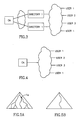
- Fig. 4 illustrating a system configuration according to another embodiment of the invention.
- some protocols avoid the need for a revocation system by using short-term certificates.
- e.g. micropayments protocols when a certificate owner may cause a limited damage [13] These certificates are issued daily and expire at the end of the day of issue.
- the main limit is due to the increase in the certification authority computation (certificates for all users have to be computed daily) and communication (certificates should be sent to their owners) short-term certificates cause.
- An on-line/off-line digital signature scheme (like CRS) will reduce the computation the CA has to perform, but, it will not reduce significantly the communication costs, since the CA has to send different messages to different users, making the CA a communication bottleneck.
- This calls for a solution where the CA performs a simple computation (say, concerning only new users and users whose certificates are not renewed) and sends a common update message to all users. Using this message, exactly all users with non-revoked certificates should be able to prove the validity of their certificates.
- a simple modification to the certificate revocation scheme is proposed to yield an efficient certificate update scheme in which the CA sends the same update message to all users.
- there is no assumption of the existence of a directory See Fig. 4) with information about all certificates, but of local directories that may hold the latest messages that are sent by the directory.
- the scheme is based on a tree of revoked certificates (or, otherwise, valid certificates) created by the certification authority presented above. Since there is no way to extract certificates from a directory, every user gets an initial certificate that may be updated using the CA's messages. Specifically, the CA augments every issued certificate with the path proving its validity, this is the only part of the certificate that is updated periodically.
- the CA updates its copy of the tree, and publishes the tree paths that where changed since the previous update (constituting one, non limiting form of induced sub-tree). (see Fig. 5A). Every user holding a non-revoked certificate intersects its self path with the induced tree preferably by locating the lowest node, v, on a path that coincides with the self path, and updates his path by copying the new node values from v up to the root) . All users holding a revoked certificate can not update their path, unless they crack the one way characteristics of the function hl. As shown in Fig.
- the user bring into coincidence the self path with the induced sub tree and seeks for the lower most discrepancy node (desgnated by dot 100 in Fig. 5A). What remains to be done is to update the nodes from the so detected node to the root and to authenticate the root and verify it vis-avis the authenticated root value transmitted from the CA. The latter procedure is obviously very cost effective in terms of the computation overhead that is posed on each user.
- the CA, directory and user may be interlinked by any available communication network, e.g. the Internet.
- any available communication network e.g. the Internet.
- each of the specified constituents may be implemented on e.g. conventional P.C. computer, mainframe computer or network of computers, all as required and appropriate, depending upon the particular application.
- the CA sends the difference lists of total daily length of n.p.l sn / 365+ T.l sig
- the proposed scheme costs are lower than CRL costs both in CA-to-directory and in directory-to-users communication.
- the CA-to-directory costs are much lower than the corresponding CRS costs but, the directory-to-user (and thus the over all) communication costs are increased. Note that in practice, due to communication overheads, the difference between CRS and the proposed method in Directory-to-users communication may be insignificant.
- the proposed scheme is more robust to changes in parameters than CRL and CRS. Since these are bound to change in time or due to the specific needs of different implementations, it is important to have a system that is robust to such changes.
- Changes will occur mainly in the total number of certificates ( n ) and the update rate ( T ).
- changes in n are moderated by a factor of p .
- Changes in T are moderated by the fact that the update communication costs are not proportional to nT but to T .
- Figure 8 shows how the CA-to-directory update communication costs of the three methods depend on the update rate (all other parameters are held constant).
- the update communication costs limit CRS to about one update a day (Another factor that limits the update rate is the amount of computation needed by a user in order to verify that a certificate was not revoked).
- the proposed scheme is much more robust, even allowing once per hour updates.
Landscapes
- Engineering & Computer Science (AREA)
- Computer Security & Cryptography (AREA)
- Computer Networks & Wireless Communication (AREA)
- Signal Processing (AREA)
- Storage Device Security (AREA)
- Information Retrieval, Db Structures And Fs Structures Therefor (AREA)
Applications Claiming Priority (2)
| Application Number | Priority Date | Filing Date | Title |
|---|---|---|---|
| US09/010,571 US6226743B1 (en) | 1998-01-22 | 1998-01-22 | Method for authentication item |
| US10571 | 1998-01-22 |
Publications (2)
| Publication Number | Publication Date |
|---|---|
| EP0932109A2 true EP0932109A2 (de) | 1999-07-28 |
| EP0932109A3 EP0932109A3 (de) | 2003-06-18 |
Family
ID=21746367
Family Applications (1)
| Application Number | Title | Priority Date | Filing Date |
|---|---|---|---|
| EP99400130A Withdrawn EP0932109A3 (de) | 1998-01-22 | 1999-01-21 | Ein Verfahren für die Beglaubigung von Elementen |
Country Status (4)
| Country | Link |
|---|---|
| US (1) | US6226743B1 (de) |
| EP (1) | EP0932109A3 (de) |
| JP (1) | JPH11289329A (de) |
| IL (1) | IL128040A (de) |
Cited By (17)
| Publication number | Priority date | Publication date | Assignee | Title |
|---|---|---|---|---|
| US6546376B1 (en) * | 1999-06-25 | 2003-04-08 | Institute For Information Industry | Electronic payment device using balanced binary tree and the method of the same |
| WO2003096616A1 (en) * | 2002-05-09 | 2003-11-20 | Matsushita Electric Industrial Co., Ltd. | Public key certificate revocation list generation apparatus, revocation judgement apparatus, and authentication system |
| WO2003107589A1 (en) * | 2002-06-17 | 2003-12-24 | Koninklijke Philips Electronics N.V. | Method for authentication between devices |
| WO2005055515A1 (en) * | 2003-11-21 | 2005-06-16 | Errikos Pitsos | Methods and systems for providing integrity and trust in data management and data distribution processes |
| WO2005029445A3 (en) * | 2003-09-19 | 2005-07-28 | Docomo Comm Lab Usa Inc | Method and apparatus for efficient certificate revocation |
| WO2005076522A1 (en) * | 2004-02-10 | 2005-08-18 | Cryptico A/S | Methods for generating identification values for identifying electronic messages |
| GB2422746A (en) * | 2004-12-24 | 2006-08-02 | British Telecomm | Radio frequency identification transponder security |
| WO2007004107A3 (en) * | 2005-06-30 | 2007-03-22 | Koninkl Philips Electronics Nv | Method and apparatus for managing digital right licenses |
| RU2411668C2 (ru) * | 2005-07-14 | 2011-02-10 | Майкрософт Корпорейшн | Расширение информации сопоставления пользователя для протоколов |
| US7940179B2 (en) | 2005-01-12 | 2011-05-10 | British Telecommunications Public Limited Company | Radio frequency identification tag security systems |
| US8006086B2 (en) | 2004-08-31 | 2011-08-23 | Ntt Docomo, Inc. | Revocation of cryptographic digital certificates |
| US8035489B2 (en) | 2005-01-12 | 2011-10-11 | British Telecommunications Public Limited Company | Radio frequency identification transponder security |
| CN102930185A (zh) * | 2012-11-28 | 2013-02-13 | 中国人民解放军国防科学技术大学 | 运行时程序安全关键数据的完整性验证方法及装置 |
| EP2338127A4 (de) * | 2008-08-29 | 2013-12-04 | Univ Brown | Kryptografische akkumulatoren für authentifizierte hashtabellen |
| CN103941719A (zh) * | 2014-03-21 | 2014-07-23 | 上海富欣智能交通控制有限公司 | 安全关键数据的反向验证方法 |
| WO2015020599A1 (en) | 2013-08-08 | 2015-02-12 | Enigio Time Ab | Method for creating signals for time-stamping of documents and method for time-stamping of documents |
| CN111400752A (zh) * | 2020-03-12 | 2020-07-10 | 杭州城市大数据运营有限公司 | 一种基于区块链的数据查询方法、系统及电子设备 |
Families Citing this family (63)
| Publication number | Priority date | Publication date | Assignee | Title |
|---|---|---|---|---|
| US5903651A (en) * | 1996-05-14 | 1999-05-11 | Valicert, Inc. | Apparatus and method for demonstrating and confirming the status of a digital certificates and other data |
| US6901509B1 (en) * | 1996-05-14 | 2005-05-31 | Tumbleweed Communications Corp. | Apparatus and method for demonstrating and confirming the status of a digital certificates and other data |
| US6826687B1 (en) * | 1999-05-07 | 2004-11-30 | International Business Machines Corporation | Commitments in signatures |
| US6701434B1 (en) * | 1999-05-07 | 2004-03-02 | International Business Machines Corporation | Efficient hybrid public key signature scheme |
| US6393420B1 (en) * | 1999-06-03 | 2002-05-21 | International Business Machines Corporation | Securing Web server source documents and executables |
| AU6097000A (en) * | 1999-07-15 | 2001-02-05 | Frank W Sudia | Certificate revocation notification systems |
| KR100392792B1 (ko) * | 1999-08-21 | 2003-07-28 | 주식회사 다날 | 제 2접속경로를 이용한 사용자인증시스템 및 사용자인증방법 |
| US6769068B1 (en) * | 1999-09-02 | 2004-07-27 | International Business Machines Corporation | Dynamic credential refresh in a distributed system |
| US6757824B1 (en) | 1999-12-10 | 2004-06-29 | Microsoft Corporation | Client-side boot domains and boot rules |
| US6816900B1 (en) * | 2000-01-04 | 2004-11-09 | Microsoft Corporation | Updating trusted root certificates on a client computer |
| US7269726B1 (en) | 2000-01-14 | 2007-09-11 | Hewlett-Packard Development Company, L.P. | Lightweight public key infrastructure employing unsigned certificates |
| US7340600B1 (en) * | 2000-01-14 | 2008-03-04 | Hewlett-Packard Development Company, L.P. | Authorization infrastructure based on public key cryptography |
| JP2001308841A (ja) * | 2000-04-21 | 2001-11-02 | Sony Corp | 送信装置および送信方法、受信装置および受信方法、ならびに、送受信システムおよび送受信方法 |
| US7047404B1 (en) * | 2000-05-16 | 2006-05-16 | Surety Llc | Method and apparatus for self-authenticating digital records |
| JP3588042B2 (ja) * | 2000-08-30 | 2004-11-10 | 株式会社日立製作所 | 証明書の有効性確認方法および装置 |
| KR100731491B1 (ko) * | 2000-10-12 | 2007-06-21 | 주식회사 케이티 | 인증서 폐지목록 분산 관리 방법 |
| US20020053028A1 (en) * | 2000-10-24 | 2002-05-02 | Davis Steven B. | Process and apparatus for improving the security of digital signatures and public key infrastructures for real-world applications |
| KR100923805B1 (ko) * | 2001-03-29 | 2009-10-27 | 파나소닉 주식회사 | 데이터를 암호화하여 데이터를 보호하는 데이터 보호시스템 |
| US20020147904A1 (en) * | 2001-04-10 | 2002-10-10 | Moritaka Nakamura | Electronic notarization on net system |
| US7043024B1 (en) * | 2001-04-18 | 2006-05-09 | Mcafee, Inc. | System and method for key distribution in a hierarchical tree |
| US7590247B1 (en) * | 2001-04-18 | 2009-09-15 | Mcafee, Inc. | System and method for reusable efficient key distribution |
| WO2003028284A1 (en) * | 2001-09-26 | 2003-04-03 | Synchron Networks | Secure broadcast system and method |
| US7194004B1 (en) * | 2002-01-28 | 2007-03-20 | 3Com Corporation | Method for managing network access |
| US7240194B2 (en) | 2002-03-22 | 2007-07-03 | Microsoft Corporation | Systems and methods for distributing trusted certification authorities |
| US20030236976A1 (en) * | 2002-06-19 | 2003-12-25 | Microsoft Corporation | Efficient membership revocation by number |
| US7451310B2 (en) * | 2002-12-02 | 2008-11-11 | International Business Machines Corporation | Parallelizable authentication tree for random access storage |
| US7543140B2 (en) * | 2003-02-26 | 2009-06-02 | Microsoft Corporation | Revocation of a certificate and exclusion of other principals in a digital rights management (DRM) system based on a revocation list from a delegated revocation authority |
| WO2005027008A1 (en) * | 2003-09-10 | 2005-03-24 | Ntt Docomo, Inc. | Method and apparatus for secure and small credits for verifiable service provider metering |
| JP3894181B2 (ja) * | 2003-10-10 | 2007-03-14 | 株式会社日立製作所 | 公開鍵証明書検証の高速化方法、および装置 |
| JP4646509B2 (ja) * | 2003-10-27 | 2011-03-09 | 株式会社東芝 | 情報保管サーバおよび情報保管プログラム |
| US7551056B2 (en) * | 2003-12-15 | 2009-06-23 | Nxp B.V. | Use-authorization device for security-related applications |
| US7698557B2 (en) * | 2003-12-22 | 2010-04-13 | Guardtime As | System and method for generating a digital certificate |
| CN1910591A (zh) * | 2004-01-23 | 2007-02-07 | 运通卡国际股份有限公司 | 为金融交易卡生成无冲突标识符的系统和方法 |
| CN100349407C (zh) * | 2004-02-19 | 2007-11-14 | 华夏银行 | 电子保管箱及其管理方法 |
| US20070226793A1 (en) * | 2004-05-28 | 2007-09-27 | Matsushita Electric Industrial Co., Ltd. | Parent-Child Card Authentication System |
| US20060036627A1 (en) * | 2004-08-06 | 2006-02-16 | Roger Deran | Method and apparatus for a restartable hash in a trie |
| US7657756B2 (en) * | 2004-10-08 | 2010-02-02 | International Business Machines Corporaiton | Secure memory caching structures for data, integrity and version values |
| US8954751B2 (en) * | 2004-10-08 | 2015-02-10 | International Business Machines Corporation | Secure memory control parameters in table look aside buffer data fields and support memory array |
| US7266692B2 (en) * | 2004-12-17 | 2007-09-04 | Ntt Docomo, Inc. | Use of modular roots to perform authentication including, but not limited to, authentication of validity of digital certificates |
| US7315941B2 (en) | 2004-12-17 | 2008-01-01 | Ntt Docomo Inc. | Multi-certificate revocation using encrypted proof data for proving certificate's validity or invalidity |
| KR100670010B1 (ko) * | 2005-02-03 | 2007-01-19 | 삼성전자주식회사 | 하이브리드 브로드캐스트 암호화 방법 |
| JP2006287455A (ja) * | 2005-03-31 | 2006-10-19 | Nec Corp | 証明書検証装置及び方法並びに証明書検証サーバ |
| US8874477B2 (en) | 2005-10-04 | 2014-10-28 | Steven Mark Hoffberg | Multifactorial optimization system and method |
| US7853018B2 (en) * | 2005-11-10 | 2010-12-14 | Atallah Mikhail J | Method and apparatus for hiding a private key |
| US7716180B2 (en) * | 2005-12-29 | 2010-05-11 | Amazon Technologies, Inc. | Distributed storage system with web services client interface |
| US8589574B1 (en) | 2005-12-29 | 2013-11-19 | Amazon Technologies, Inc. | Dynamic application instance discovery and state management within a distributed system |
| US7702640B1 (en) * | 2005-12-29 | 2010-04-20 | Amazon Technologies, Inc. | Stratified unbalanced trees for indexing of data items within a computer system |
| US7836313B2 (en) * | 2006-03-21 | 2010-11-16 | Oracle America, Inc. | Method and apparatus for constructing a storage system from which digital objects can be securely deleted from durable media |
| US20080201260A1 (en) * | 2007-02-16 | 2008-08-21 | Toby Unwin | Internet micro payments system |
| IL187037A0 (en) * | 2007-10-30 | 2008-02-09 | Sandisk Il Ltd | Fast update for hierarchical integrity schemes |
| IL187041A0 (en) * | 2007-10-30 | 2008-02-09 | Sandisk Il Ltd | Optimized hierarchical integrity protection for stored data |
| US8676855B2 (en) * | 2009-05-01 | 2014-03-18 | Brother Kogyo Kabushiki Kaisha | Distributed storage system, management apparatus, node apparatus, recording medium on which node program is recorded, page information acquisition method, recording medium on which page information sending program is recorded, and page information sending method |
| JP2010267028A (ja) * | 2009-05-13 | 2010-11-25 | Brother Ind Ltd | 管理装置、管理処理プログラム、ノード装置、ノード処理プログラム、及び有効期限切れレコード判定方法 |
| US9477947B2 (en) | 2009-08-24 | 2016-10-25 | International Business Machines Corporation | Retrospective changing of previously sent messages |
| US8254580B2 (en) * | 2009-09-30 | 2012-08-28 | Telefonaktiebolaget L M Ericsson (Publ) | Key distribution in a hierarchy of nodes |
| US9584322B2 (en) * | 2010-03-08 | 2017-02-28 | Intel Corporation | System and method for hypervisor-based remediation and provisioning of a computer |
| US8572699B2 (en) * | 2010-11-18 | 2013-10-29 | Microsoft Corporation | Hardware-based credential distribution |
| US8538920B2 (en) * | 2011-08-08 | 2013-09-17 | Hewlett-Packard Development Company, L.P. | System and method for storage service |
| CN102546108A (zh) * | 2011-12-28 | 2012-07-04 | 深圳市新为软件有限公司 | 一种通过树形结构对网络资源进行传输的方法和装置 |
| CA2877839C (en) * | 2012-06-28 | 2021-07-27 | Ologn Technologies Ag | Secure key storage systems, methods and apparatuses |
| US10333696B2 (en) | 2015-01-12 | 2019-06-25 | X-Prime, Inc. | Systems and methods for implementing an efficient, scalable homomorphic transformation of encrypted data with minimal data expansion and improved processing efficiency |
| US20240248624A1 (en) * | 2023-01-24 | 2024-07-25 | VMware LLC | Tiered memory data structures and algorithms for dynamic searching via treaps |
| CN116204907B (zh) * | 2023-03-07 | 2026-04-21 | 新晨科技股份有限公司 | 一种分布式可验证可撤销可扩展的凭证管理方法和系统 |
Family Cites Families (4)
| Publication number | Priority date | Publication date | Assignee | Title |
|---|---|---|---|---|
| US4309569A (en) * | 1979-09-05 | 1982-01-05 | The Board Of Trustees Of The Leland Stanford Junior University | Method of providing digital signatures |
| US5231666A (en) * | 1992-04-20 | 1993-07-27 | International Business Machines Corporation | Cryptographic method for updating financial records |
| US5826254A (en) * | 1995-04-18 | 1998-10-20 | Digital Equipment Corporation | System for selectively browsing a large, distributed directory tree using authentication links |
| US5903651A (en) * | 1996-05-14 | 1999-05-11 | Valicert, Inc. | Apparatus and method for demonstrating and confirming the status of a digital certificates and other data |
-
1998
- 1998-01-22 US US09/010,571 patent/US6226743B1/en not_active Expired - Lifetime
-
1999
- 1999-01-14 IL IL12804099A patent/IL128040A/en not_active IP Right Cessation
- 1999-01-21 EP EP99400130A patent/EP0932109A3/de not_active Withdrawn
- 1999-01-22 JP JP11053084A patent/JPH11289329A/ja active Pending
Cited By (30)
| Publication number | Priority date | Publication date | Assignee | Title |
|---|---|---|---|---|
| US6546376B1 (en) * | 1999-06-25 | 2003-04-08 | Institute For Information Industry | Electronic payment device using balanced binary tree and the method of the same |
| WO2003096616A1 (en) * | 2002-05-09 | 2003-11-20 | Matsushita Electric Industrial Co., Ltd. | Public key certificate revocation list generation apparatus, revocation judgement apparatus, and authentication system |
| US7373503B2 (en) | 2002-05-09 | 2008-05-13 | Matsushita Electric Industrial Co., Ltd. | Public key certificate revocation list generation apparatus, revocation judgement apparatus, and authentication system |
| WO2003107589A1 (en) * | 2002-06-17 | 2003-12-24 | Koninklijke Philips Electronics N.V. | Method for authentication between devices |
| WO2005029445A3 (en) * | 2003-09-19 | 2005-07-28 | Docomo Comm Lab Usa Inc | Method and apparatus for efficient certificate revocation |
| US7840994B2 (en) | 2003-09-19 | 2010-11-23 | Ntt Docomo, Inc. | Method and apparatus for efficient certificate revocation |
| US8321664B2 (en) | 2003-09-19 | 2012-11-27 | Ntt Docomo, Inc. | Method and apparatus for efficient certificate revocation |
| WO2005055515A1 (en) * | 2003-11-21 | 2005-06-16 | Errikos Pitsos | Methods and systems for providing integrity and trust in data management and data distribution processes |
| WO2005076522A1 (en) * | 2004-02-10 | 2005-08-18 | Cryptico A/S | Methods for generating identification values for identifying electronic messages |
| US8209531B2 (en) | 2004-08-31 | 2012-06-26 | Ntt Docomo, Inc. | Revocation of cryptographic digital certificates |
| US8006086B2 (en) | 2004-08-31 | 2011-08-23 | Ntt Docomo, Inc. | Revocation of cryptographic digital certificates |
| US8024562B2 (en) | 2004-08-31 | 2011-09-20 | Ntt Docomo, Inc. | Revocation of cryptographic digital certificates |
| US8156327B2 (en) | 2004-08-31 | 2012-04-10 | Ntt Docomo, Inc. | Revocation of cryptographic digital certificates |
| GB2422746A (en) * | 2004-12-24 | 2006-08-02 | British Telecomm | Radio frequency identification transponder security |
| GB2422746B (en) * | 2004-12-24 | 2009-06-17 | British Telecomm | Radio frequency identification transponder system |
| US7940179B2 (en) | 2005-01-12 | 2011-05-10 | British Telecommunications Public Limited Company | Radio frequency identification tag security systems |
| US8035489B2 (en) | 2005-01-12 | 2011-10-11 | British Telecommunications Public Limited Company | Radio frequency identification transponder security |
| WO2007004107A3 (en) * | 2005-06-30 | 2007-03-22 | Koninkl Philips Electronics Nv | Method and apparatus for managing digital right licenses |
| RU2411668C2 (ru) * | 2005-07-14 | 2011-02-10 | Майкрософт Корпорейшн | Расширение информации сопоставления пользователя для протоколов |
| EP2338127A4 (de) * | 2008-08-29 | 2013-12-04 | Univ Brown | Kryptografische akkumulatoren für authentifizierte hashtabellen |
| US8726034B2 (en) | 2008-08-29 | 2014-05-13 | Brown University | Cryptographic accumulators for authenticated hash tables |
| US9098725B2 (en) | 2008-08-29 | 2015-08-04 | Brown University | Cryptographic accumulators for authenticated hash tables |
| CN102930185A (zh) * | 2012-11-28 | 2013-02-13 | 中国人民解放军国防科学技术大学 | 运行时程序安全关键数据的完整性验证方法及装置 |
| CN102930185B (zh) * | 2012-11-28 | 2015-07-29 | 中国人民解放军国防科学技术大学 | 运行时程序安全关键数据的完整性验证方法及装置 |
| WO2015020599A1 (en) | 2013-08-08 | 2015-02-12 | Enigio Time Ab | Method for creating signals for time-stamping of documents and method for time-stamping of documents |
| US10146825B2 (en) | 2013-08-08 | 2018-12-04 | Enigio Time Ab | Method and system for providing a way to verify the integrity of a document |
| US10803049B2 (en) | 2013-08-08 | 2020-10-13 | Enigio Time Ab | Method for creating signals for time-stamping of documents and method for time-stamping of documents |
| CN103941719A (zh) * | 2014-03-21 | 2014-07-23 | 上海富欣智能交通控制有限公司 | 安全关键数据的反向验证方法 |
| CN103941719B (zh) * | 2014-03-21 | 2017-03-15 | 上海富欣智能交通控制有限公司 | 安全关键数据的反向验证方法 |
| CN111400752A (zh) * | 2020-03-12 | 2020-07-10 | 杭州城市大数据运营有限公司 | 一种基于区块链的数据查询方法、系统及电子设备 |
Also Published As
| Publication number | Publication date |
|---|---|
| JPH11289329A (ja) | 1999-10-19 |
| EP0932109A3 (de) | 2003-06-18 |
| IL128040A (en) | 2004-01-04 |
| US6226743B1 (en) | 2001-05-01 |
| IL128040A0 (en) | 1999-11-30 |
Similar Documents
| Publication | Publication Date | Title |
|---|---|---|
| US6226743B1 (en) | Method for authentication item | |
| Aiello et al. | Fast digital identity revocation | |
| US5774552A (en) | Method and apparatus for retrieving X.509 certificates from an X.500 directory | |
| US9654298B2 (en) | Signature # efficient real time credentials for OCSP and distributed OCSP | |
| EP1117207B1 (de) | Infrastruktur für öffentliche Schlüssel | |
| US6442689B1 (en) | Apparatus and method for demonstrating and confirming the status of a digital certificates and other data | |
| US6301658B1 (en) | Method and system for authenticating digital certificates issued by an authentication hierarchy | |
| US6901509B1 (en) | Apparatus and method for demonstrating and confirming the status of a digital certificates and other data | |
| US6397329B1 (en) | Method for efficiently revoking digital identities | |
| EP1706954B1 (de) | Signatureffiziente echtzeit-berechtigungsnachweise für ocsp und verteiltes ocsp | |
| US20020046337A1 (en) | Tree-based certificate revocation system | |
| Micali | Enhanced certificate revocation system | |
| US20020107814A1 (en) | Certificate revocation system | |
| CN110851859B (zh) | 一种具有(n,t)门限的分布式权威节点区块链系统的认证方法 | |
| Wang | Generic non-repudiation protocols supporting transparent off-line TTP | |
| Munoz et al. | Certificate revocation system implementation based on the Merkle hash tree | |
| Nissim et al. | Certificate Revocation and Certificate Update. | |
| Kikuchi et al. | Performance evaluation of public-key certificate revocation system with balanced hash tree | |
| Koga et al. | A distributed online certificate status protocol with a single public key | |
| CN116389111B (zh) | 基于标识的强权限控制模式下联盟链身份认证方式 | |
| Faldella et al. | Efficient handling of certificates within public-key infrastructures | |
| Muñoz et al. | ℋ-OCSP: A protocol to reduce the processing burden in online certificate status validation | |
| Long et al. | An Improved Needham-Schroeder Session Key | |
| Micali | E cient certificate revocation | |
| Smith | Public Key Cryptosystems, Certificates, and Certification Authorities. |
Legal Events
| Date | Code | Title | Description |
|---|---|---|---|
| PUAI | Public reference made under article 153(3) epc to a published international application that has entered the european phase |
Free format text: ORIGINAL CODE: 0009012 |
|
| AK | Designated contracting states |
Kind code of ref document: A2 Designated state(s): AT BE CH CY DE DK ES FI FR GB GR IE IT LI LU MC NL PT SE |
|
| AX | Request for extension of the european patent |
Free format text: AL;LT;LV;MK;RO;SI |
|
| PUAL | Search report despatched |
Free format text: ORIGINAL CODE: 0009013 |
|
| RIC1 | Information provided on ipc code assigned before grant |
Ipc: 7H 04L 9/32 B Ipc: 7G 06F 17/30 A |
|
| AK | Designated contracting states |
Designated state(s): AT BE CH CY DE DK ES FI FR GB GR IE IT LI LU MC NL PT SE |
|
| AX | Request for extension of the european patent |
Extension state: AL LT LV MK RO SI |
|
| 17P | Request for examination filed |
Effective date: 20030909 |
|
| AKX | Designation fees paid |
Designated state(s): CH DE DK FI FR GB GR IE IT LI LU NL SE |
|
| RBV | Designated contracting states (corrected) |
Designated state(s): DE DK FI FR GB GR IE IT LU NL SE |
|
| STAA | Information on the status of an ep patent application or granted ep patent |
Free format text: STATUS: THE APPLICATION IS DEEMED TO BE WITHDRAWN |
|
| 18D | Application deemed to be withdrawn |
Effective date: 20060502 |