EP0932178B1 - Hochfrequenzschalter - Google Patents
Hochfrequenzschalter Download PDFInfo
- Publication number
- EP0932178B1 EP0932178B1 EP19990100446 EP99100446A EP0932178B1 EP 0932178 B1 EP0932178 B1 EP 0932178B1 EP 19990100446 EP19990100446 EP 19990100446 EP 99100446 A EP99100446 A EP 99100446A EP 0932178 B1 EP0932178 B1 EP 0932178B1
- Authority
- EP
- European Patent Office
- Prior art keywords
- high frequency
- impedance
- movable contact
- switching device
- segment
- Prior art date
- Legal status (The legal status is an assumption and is not a legal conclusion. Google has not performed a legal analysis and makes no representation as to the accuracy of the status listed.)
- Expired - Lifetime
Links
Images


Classifications
-
- H—ELECTRICITY
- H05—ELECTRIC TECHNIQUES NOT OTHERWISE PROVIDED FOR
- H05K—PRINTED CIRCUITS; CASINGS OR CONSTRUCTIONAL DETAILS OF ELECTRIC APPARATUS; MANUFACTURE OF ASSEMBLAGES OF ELECTRICAL COMPONENTS
- H05K1/00—Printed circuits
- H05K1/02—Details
- H05K1/0213—Electrical arrangements not otherwise provided for
- H05K1/0237—High frequency adaptations
- H05K1/0243—Printed circuits associated with mounted high frequency components
-
- H—ELECTRICITY
- H01—ELECTRIC ELEMENTS
- H01H—ELECTRIC SWITCHES; RELAYS; SELECTORS; EMERGENCY PROTECTIVE DEVICES
- H01H50/00—Details of electromagnetic relays
-
- H—ELECTRICITY
- H01—ELECTRIC ELEMENTS
- H01H—ELECTRIC SWITCHES; RELAYS; SELECTORS; EMERGENCY PROTECTIVE DEVICES
- H01H50/00—Details of electromagnetic relays
- H01H50/10—Electromagnetic or electrostatic shielding
-
- H—ELECTRICITY
- H01—ELECTRIC ELEMENTS
- H01P—WAVEGUIDES; RESONATORS, LINES, OR OTHER DEVICES OF THE WAVEGUIDE TYPE
- H01P1/00—Auxiliary devices
- H01P1/10—Auxiliary devices for switching or interrupting
- H01P1/12—Auxiliary devices for switching or interrupting by mechanical chopper
- H01P1/127—Strip line switches
-
- H—ELECTRICITY
- H05—ELECTRIC TECHNIQUES NOT OTHERWISE PROVIDED FOR
- H05K—PRINTED CIRCUITS; CASINGS OR CONSTRUCTIONAL DETAILS OF ELECTRIC APPARATUS; MANUFACTURE OF ASSEMBLAGES OF ELECTRICAL COMPONENTS
- H05K2201/00—Indexing scheme relating to printed circuits covered by H05K1/00
- H05K2201/10—Details of components or other objects attached to or integrated in a printed circuit board
- H05K2201/10227—Other objects, e.g. metallic pieces
- H05K2201/10295—Metallic connector elements partly mounted in a hole of the PCB
- H05K2201/10303—Pin-in-hole mounted pins
-
- H—ELECTRICITY
- H05—ELECTRIC TECHNIQUES NOT OTHERWISE PROVIDED FOR
- H05K—PRINTED CIRCUITS; CASINGS OR CONSTRUCTIONAL DETAILS OF ELECTRIC APPARATUS; MANUFACTURE OF ASSEMBLAGES OF ELECTRICAL COMPONENTS
- H05K2201/00—Indexing scheme relating to printed circuits covered by H05K1/00
- H05K2201/10—Details of components or other objects attached to or integrated in a printed circuit board
- H05K2201/10227—Other objects, e.g. metallic pieces
- H05K2201/10371—Shields or metal cases
-
- H—ELECTRICITY
- H05—ELECTRIC TECHNIQUES NOT OTHERWISE PROVIDED FOR
- H05K—PRINTED CIRCUITS; CASINGS OR CONSTRUCTIONAL DETAILS OF ELECTRIC APPARATUS; MANUFACTURE OF ASSEMBLAGES OF ELECTRICAL COMPONENTS
- H05K2201/00—Indexing scheme relating to printed circuits covered by H05K1/00
- H05K2201/10—Details of components or other objects attached to or integrated in a printed circuit board
- H05K2201/10613—Details of electrical connections of non-printed components, e.g. special leads
- H05K2201/10954—Other details of electrical connections
- H05K2201/10969—Metallic case or integral heatsink of component electrically connected to a pad on PCB
-
- H—ELECTRICITY
- H05—ELECTRIC TECHNIQUES NOT OTHERWISE PROVIDED FOR
- H05K—PRINTED CIRCUITS; CASINGS OR CONSTRUCTIONAL DETAILS OF ELECTRIC APPARATUS; MANUFACTURE OF ASSEMBLAGES OF ELECTRICAL COMPONENTS
- H05K2203/00—Indexing scheme relating to apparatus or processes for manufacturing printed circuits covered by H05K3/00
- H05K2203/11—Treatments characterised by their effect, e.g. heating, cooling, roughening
- H05K2203/1147—Sealing or impregnating, e.g. of pores
-
- H—ELECTRICITY
- H05—ELECTRIC TECHNIQUES NOT OTHERWISE PROVIDED FOR
- H05K—PRINTED CIRCUITS; CASINGS OR CONSTRUCTIONAL DETAILS OF ELECTRIC APPARATUS; MANUFACTURE OF ASSEMBLAGES OF ELECTRICAL COMPONENTS
- H05K3/00—Apparatus or processes for manufacturing printed circuits
- H05K3/30—Assembling printed circuits with electric components, e.g. with resistors
- H05K3/32—Assembling printed circuits with electric components, e.g. with resistors electrically connecting electric components or wires to printed circuits
- H05K3/34—Assembling printed circuits with electric components, e.g. with resistors electrically connecting electric components or wires to printed circuits by soldering
- H05K3/3447—Lead-in-hole components
Definitions
- the present invention is directed to a high frequency switching device, and more particularly to a miniature switching device such as a relay for switching high frequency signals.
- a known high frequency switching device has a contact block having fixed contacts and a movable contact which is driven to open and close a current path between the fixed contacts.
- the fixed contacts and the movable contact are surrounded by an electromagnetic shield which is supported on a conductor base and is grounded therethrough.
- the fixed contacts are formed respectively on one ends of terminal pins provided for electrical connection to an external load circuit operating on high frequency signals.
- the terminal pin extends through an insulation ring fitted in the conductor base so as to be electrically insulated therefrom.
- the device has been demanded to be made compact enough to be incorporated into small electronic devices, such as portable cellular phones, while retaining minimum return loss, i.e., having VSWR as nearly to unity as possible.
- minimum return loss i.e., having VSWR as nearly to unity as possible.
- Z specific impedance
- the signal path along the terminal pin suffers from varying impedance at this particular segment surrounded by the insulation ring.
- the impedance at this segment will be considerably lowered with respect to the other portion of the signal path.
- the impedance (Z) at this segment is adjusted to the optimum impedance of about 50 ⁇ by suitably selecting dielectric constant ⁇ r, thickness (d) of the base and diameter (D) of the insulation ring, all the attempts are found not practically acceptable for the following reasons.
- the dielectric constant ⁇ r is substantially fixed because of limited availiablity of the dielectric material as the insulation ring.
- the thickness (d) of the conductor base should not be made so small in order to retain mechanical strength.
- the diameter (D) should not be made so large as to be consistent with the miniaturization of the device. Consequently, no effective scheme has been found to combine the miniaturization of the relay and the over-all optimum impedance of the signal path.
- the switching device of the present invention includes a contact block having fixed contacts and a movable contact which is driven to open and close a current path between the fixed contacts.
- the fixed contacts and the movable contact are surrounded by an electromagnetic shield which is supported on a conductor base to be grounded therethrough for isolating the current path from a surrounding electromagnetic field.
- the fixed contacts are formed respectively on one ends of terminal pins provided for electrical connection to an external load circuit operating on high frequency signals.
- the terminal pin extends through an insulation ring fitted in the conductor base so as to be electrically insulated therefrom and form a signal path flowing a high frequency current.
- An impedance compensating structure is provided in the contact block for differentiating a first impedance at a first segment of a limited length along the terminal pin from a second impedance inherent to a second segment immediately adjacent the first segment so as to give a target over-all impedance, which is between the first and second impedances, over the full length of the terminal pin.
- the above compensation is validated to give an optimum over-all impedance based upon the finding that a variation of the impedance at a first segment of limited length along the signal path can be successfully compensated by counter-variation of impedance at an immediately adjacent second segment of also limited length, specifically when the two segments are of the length not greater than one hundredth of a wavelength ⁇ for the high frequency current.
- the impedance compensating structure is realized by a cut-out which is formed in the shield immediately adjacent to the conductor base to give an open window located around the terminal pin for increasing the first impedance at the first segment corresponding to the cut-out, beyond the target optimum over-all impedance. More specifically, the cut-out gives the first impedance at the first segment which is greater than the second impedance given to second segment of the terminal pin surrounded by the insulation ring.
- the conductor base is formed with through-holes into each of which the insulation ring fits snugly with upper and lower surfaces of the insulation ring being in flush with the upper and lower surfaces of the conductor base. It is preferred that the conductor base has a thickness (d) which is smaller than a diameter (D) of the insulation ring in order to minimize the reduction of the second impedance at the second segment, enabling easy impedance compensation by the cut-out.
- the electromagnetic shield has side walls which enclose therebetween the fixed contacts as well as the movable contact.
- the side walls may be shaped from a metal sheet of uniform thickness and formed at portions respectively adjacent the fixed contacts with flattened shoulders on which opposite ends of the movable contact rest when the movable contact is in an open condition.
- Each of the flattened shoulders is shaped by partially deforming the side wall inwardly over a limited length in parallel with the movable contact so that the movable contact has its opposite ends in constant contact with the shoulders over substantially the entire length thereof when the movable contact is in the open condition.
- the end of the movable contact is kept as close as possible to the side wall of the shield in the open position so as not to make itself a floating electrode which would otherwise see a ground current in the open condition and bring about an antenna effect of lessening the isolation of the fixed contacts from the ground. Consequently, the isolation can be improved by provision of the flattened shoulders which are shaped easily from the shield.
- the conductor base has first and second lower surfaces of different levels.
- the first lower surface is adapted in use to be surface mounted on a printed board so as to be electrically connected to a ground conductor on top of the printed board.
- the second lower surfaces are provided to pass the terminal pins therethrough and is positioned in a level higher than the first lower surface so as to form a clearance between the second lower surface and the printed board. The clearance enables the terminal pins to be soldered on a conductor circuit on top of the printed board. Consequently, the contact block of this configuration can be successfully surface-mounted on the printed board having the ground conductor and the conductor circuit both on top of the board.
- the clearance may be effective to compensate for the above impedance reduction at the second segment of the terminal pin surrounded by the insulation ring in cooperation with the cut-out so as to provide an optimum over-all impedance for the terminal pin.
- the fixed contact terminals can have the individual upper segments of uniform length measured from the conductor base to the soldering connections so that the impedance of the upper segments can be made uniform for easy impedance matching in designing the over-all optimum impedance.
- the conductor base carries a plurality of ground pins for connection with the ground conductor on the printed board.
- Each of the ground pins is formed at its upper end with an enlarged head and extends through a corresponding through-hole in the conductor base with the enlarged head being engaged with an inner flange formed at the lower end of the through-hole.
- the enlarged head is secured to the inner flange by a solder filled in the through-hole at a portion adjacent to the inner flange.
- the contact block of the above structure can be incorporated in an electromagnetic relay including an electromagnet block which carries an excitation coil and an armature.
- the armature is coupled to open and close the movable contact from and to the fixed contacts upon energization of the excitation coil.
- a casing is provided to receive the electromagnet block as well as the contact block.
- the casing is molded from an electrically insulating plastic material and is deposited thereon with a ground layer of electrically conductive material.
- the electromagnetic block includes parts of electrically conductive material which are exposed on the electromagnetic block and are electrically connected to the ground layer, thereby successfully isolating the signal path of the contact block from the electromagnet block for reliable operation of the high frequency load circuit connected to the relay.
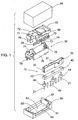
- the relay is in use mounted on a printed board 80 within a device operating on a high frequency current, for example, a portable cellular phone utilizing a high frequency signal of up to 3 GHz.
- the relay is composed of a contact block 10 and an electromagnet block 50 .
- the contact block 10 includes a conductor base 40 carrying three horizontally spaced terminal pins 21 each defining a fixed contact 22 at its upper end, and a pair of movable contacts 24 each in the form of a spring leaf extending horizontally across the two adjacent fixed contacts 22 .
- the terminal pins 21 is electrically insulated from the conductor base 40 by means of an insulation ring 44 of dielectric material fitted around an intermediate portion of the terminal pin 21 .
- the center one of the fixed contacts 22 defines a common contact (COM), while the remaining two fixed contacts 22 define normally-open (NO) contact and normally-closed (NC) contacts, respectively.
- the movable contacts 24 are driven by the electromagnet block 50 to give two alternate contact positions, as shown in FIGS. 3 and 4. In one position, the left-hand movable contact 24 is spaced away from the two adjacent contacts 22 (NO) and (COM), while the right-hand movable contact 24 interconnects the two adjacent contacts 22 (COM) and (NC). In the other position, the above relation is reversed.
- Mounted on the conductor base 40 is an electromagnetic shield 30 which surrounds the fixed contacts 22 as well as the movable contacts 24 in order to isolate the current path between the contacts from the electromagnet block 50 .
- the electromagnet block 50 includes an excitation coil 70 secured to a casing 60 and an armature 72 which is movably supported by a return spring 62 to the casing 60 .
- the armature 72 has a pair of props 73 of electrically insulating material each carrying the movable contact 24 .
- the armature 72 Upon energization of the coil 70 , the armature 72 is driven to move against the bias of the return spring 62 to move the movable springs 24 into position of FIG. 4.
- the armature 72 Upon deenergization of the coil 70 , the armature 72 returns to the position of FIG. 3 by the action of the spring 62 .
- the coil 70 is wound around a core 74 connected to a yoke 76 having two pole ends.
- the core 74 defines at its end a center pole which is cooperative with the respective pole ends to form individual magnetic gaps for receiving pole plates 78 at one end of the armature 72 .
- a permanent magnet 77 is held between the pole plates 78 to give a magnetic circuit which holds the armature 72 in one position when the coil 70 is not energized, thereby giving a polarized mono-stable operation to the relay.
- the coil 70 has its opposite ends connected to coil terminals 79 which extend through the bottom of the casing 60 at portions remote from the coil block 10 .
- the coil block 10 is received in a coil compartment 63 formed along one lateral end of the casing 60 , while the electromagnet block 50 is received in a magnet compartment 64 separated from the coil compartment 63 by a partition 65 .
- the coil compartment 63 has its bottom open so that the conductor base 40 is entirely exposed to the bottom of the casing 60 .
- the base 40 carries a plurality of ground pins 46 for electrical connection of the base 40 to a ground conductor 81 formed on top of the printed board 80 on which the relay is mounted, as shown in FIG. 2.
- Through-holes 83 for the ground pins 46 are filled with solders for electrical connection to the ground conductor 81 .
- Formed on the bottom of the printed board 80 is a conductor circuit 82 which constitutes a load circuit to be switched by the relay.
- the terminal pins 21 passing through corresponding through-holes 85 are soldered to corresponding lands of the conductor circuit 82 for electrical connection of the contact block 10 to the load circuit.
- the terminal pin 21 which is gold-plated has a diameter of about 0.40 mm and is insulated from the base 40 by the insulation ring 44 having a diameter (D) of about 1.35 mm.
- the insulation ring 44 is made of polybutaziene terephthalate (PBT) having a dielectric constant of about 3.1 to 3.4 and fits closely in a through-hole 43 of the base 40 over the full depth (d) of the base 40 , as shown in FIG. 5.
- the depth (d) or the thickness of the base 40 is selected to be about 1.0 mm in order to minimize the bulk of the relay, yet retaining sufficient mechanical strength required.
- diameter (D) of the insulation ring 44 is selected be minimum to for the miniaturization but at the same time for assuring sufficient isolation of the pins 21 from the base 40 .
- the reduced impedance at this first segment of limited length (d) can be found to be successfully compensated for by an increased impedance at an immediately adjacent second segment provided that the second segment has a length L within about a hundredth of wavelength ⁇ , i.e., ⁇ /100 for the high frequency current. That is, for a high frequency current of 3 GHz, length L will be about 1.0 mm. Therefore, in order to compensate for the impedance reduction, the second segment of the limited length L of 1.0 mm or less is selected immediately above the base 40 and is made to have the increased impedance of about 70 to 80 ⁇ by the provision of a cut-out 34 in the lower end of the shield 30 .
- the terminal pin 21 can have an optimum over-all impedance of about 50 ⁇ over the entire length thereof.
- the shield 30 is shaped from an electrically conductive thin metal plate such as a Be-Cu alloy plate into a top-open rectangular box having opposed side walls 31 , opposed end walls 32 , and a bottom wall 33 .
- the bottom wall 33 is opened at portions corresponding to the insulation rings 44 and is welded to the base 40 .
- each of the cut-outs 34 immediately upward of the corresponding insulation ring 44 gives an open circumference around the second segment of each terminal pin 21 , thereby increasing the impedance at the second segment to the above intended value.
- the side wall 31 of the shield 30 is partially bent inward to form flattened shoulders 35 on which the opposite longitudinal ends of the movable spring 24 rest when the movable contact is in the open position of being disconnected from the corresponding fixed contacts 22 .
- the flattened shoulder 35 is shaped to have a close contact with the end of the movable contact 24 in the open position to leave no substantial gap between the distal end of the movable contact 24 and the shoulder 35 , as best shown in FIG. 6.
- the casing 60 is molded from a dielectric plastic material and is deposited with a ground layer 61 on its interior, for example, the bottom of the magnet compartment 64 . Electrically connected to the ground layer are the metal components of the electromagnet block 50 which include the core 74 , the yoke 76 , and the return spring 62 .
- the return spring 62 is connected to an end plate 66 also of metal conductor which is inserted into a mount hole 67 in the end of the casing 60 .
- the mount-hole 67 is formed on its interior with a like ground layer which may be electrically interconnected to the ground layer on the bottom of the casing 60 .
- all the metal components forming the electromagnet block 50 are grounded so as to improve isolation of the contact block 10 from the electromagnet block.
- the casing may be also formed on its exterior with another ground layer.
- a cap 68 which fits over the casing 60 to enclose all the parts of the relay therebetween is molded from a dielectric plastic material and may be deposited on either interior or exterior surface with a like ground layer for isolation of the relay from an external electromagnetic field.
- the contact block 10A in accordance with a second embodiment of the present invention is substantially identical to the previous embodiment except that a conductor base 40A is formed in its bottom with recesses 41 around the terminal pins 21A .
- Like parts are designated by like numerals with a suffix letter of "A".
- the portions of the base 40A other than the recesses 41 define first surfaces on the bottom of the base for direct contact upon a printed board 80A .
- the recesses 41 define on their bottoms second surface which is spaced away from the printed board 80A to thereby give individual clearances 42 between conductors 82A on top of the printed board 80A and the base 40A .
- the terminal pins 21A are allowed to be soldered to the conductors 82A on the top side of the printed board 80A by solder filled in corresponding through-holes 85A .
- the conductor circuit 82A can be formed on top of the printed board to keep an point of electrical connection of the pin 21A to the conductor 82A at the top of the printed board, which eliminate a possibility of extending a current path to a segment of the pin 21A where it is surrounded by the printed board 80A and therefore avoids the otherwise undesired impedance reduction at such segment.
- the recess 41 may be utilized to compensate for the impedance reduction at the segment surrounded by the insulation ring 44A either alone or in combination with the cut-out 34A of the shield 30A .
- each of the ground pins 46A has an enlarged head 47 which is engaged with an inner flange 49 at the lower end of the through-holes 48 .
- Solder 84 is filled in the through-holes 48 from the bottom of the printed board to occupy the gap between the pin and the inner flange. By application of heat the solder 84 is melted to secure the pin 21A to the base 40A as well as to the ground conductor 81A on top of the printed board.
- the terminal pin 21B may be shaped to have bent foot 23 which is placed upon corresponding conductors 82B on the printed board 80B for soldering connection thereto.
- the terminal pin 21C may be further shaped to have a T-shaped foot 23C , as shown in FIG. 13.
Landscapes
- Physics & Mathematics (AREA)
- Electromagnetism (AREA)
- Engineering & Computer Science (AREA)
- Microelectronics & Electronic Packaging (AREA)
- Details Of Connecting Devices For Male And Female Coupling (AREA)
- Waveguide Switches, Polarizers, And Phase Shifters (AREA)
Claims (10)
- Hochfrequenzschaltvorrichtung, die einen Kontaktblock umfaßt, wobei der Kontaktblock (10) umfaßt:dadurch gekennzeichnet, daßwenigstens ein Paar fester Kontakte (22), von denen jeder an einem Ende von Anschlußstiften (21) ausgebildet ist;einen beweglichen Kontakt (24), der so gesteuert ist, daß er einen Pfad zwischen den festen Kontakten (22) schließt und öffnet;eine Leiterbasis (40) aus elektrisch leitendem Material, die Isolationsringe (44) aufweist, durch die jeweils jeder der Anschlußstifte hindurchragt, um die festen Kontakte oberhalb der Leiterbasis, elektrisch isoliert zu dieser, anzuordnen, wobei die Anschlußstifte und die beweglichen Kontakte so zusammenwirken, daß sie einen Signalpfad für den Fluß eines hochfrequenten Stromes definieren; undeine elektromagnetische Abschirmung (30), die von der Leiterbasis hervorsteht, so daß sie die festen Kontakte (22) und den beweglichen Kontakt (24) umschließt, wobei die Abschirmung (30) elektrisch mit der Leiterbasis (20) verbunden ist,der Kontaktblock (10) ein impedanzkompensierendes Mittel (34) zum Differenzieren einer ersten Impedanz an einem ersten Segment einer begrenzten Länge entlang des Anschlußstifts (21) von einer zweiten Impedanz umfaßt, die zu einem zweiten Segment einer begrenzten Länge gehört, die unmittelbar angrenzend an das erste Segment entlang des Anschlußstifts angeordnet ist, so daß über die gesamte Länge jedes Anschlußstifts eine Zielgesamtimpedanz erreicht wird, die zwischen der ersten und der zweiten Impedanz liegt.
- Hochfrequenzschaltvorrichtung nach Anspruch 1, wobei das erste Segment und das zweite Segment eine limitierte Länge aufweisen, die nicht größer ist als ein Hundertstel der Wellenlänge λ (λ/100) für den Hochfrequenzstrom.
- Hochfrequenzschaltvorrichtung nach Anspruch 1, wobei das impedanzkompensierende Mittel durch einen Ausschnitt (34) definiert ist, der in der Abschirmung (30) unmittelbar angrenzend an die Leiterbasis (40) ausgebildet ist, so daß offene Fenster erzeugt werden, die um den Anschlußstift (21) herum angeordnet sind, um die erste Impedanz an dem ersten Segment entsprechend den Ausschnitten im Hinblick auf die zweite Impedanz zu erhöhen.
- Hochfrequenzschaltvorrichtung nach Anspruch 3, wobei das zweite Segment des Anschlußstifts über die limitierte Länge vollständig von dem Isolationsring umgeben ist, so daß dieser auf die zweite Impedanz eingestellt wird.
- Hochfrequenzschaltvorrichtung nach Anspruch 4, wobei die Leiterbasis (40) mit Durchführungen (43) ausgebildet ist, wobei in jeder Durchführung ein Isolationsring (44) so passend angeordnet ist, daß die obere und die untere Oberfläche des Isolationsrings und die obere und untere Oberfläche der Leiterbasis auf einer Höhe liegen, wobei die Leiterbasis eine Dicke (d) aufweist, die geringer ist als der Durchmesser (D) des Isolationsrings.
- Hochfrequenzschaltvorrichtung nach Anspruch 1, wobei die elektromagnetische Abschirmung (30) Seitenwände (31) aufweist, die die festen Kontakte (22) sowie den beweglichen Kontakt (24) umschließen, wobei die Seitenwände (31) aus einem Metallblech mit gleichmäßiger Dicke gebildet sind und an Bereichen jeweils angrenzend an die festen Kontakte (22) mit abgeflachten Schultern (35) versehen sind, auf deren gegenüberliegenden Enden die beweglichen Kontakte (24) ruhen, wenn der bewegliche Kontakt sich in einem offenen Zustand mit Abstand von den festen Kontakten befindet, wobei jede der abgeflachten Schultern (35) durch teilweises Verformen der Seitenwand nach innen über eine begrenzte Länge parallel mit dem beweglichen Kontakt so geformt ist, daß die gegenüberliegenden Enden des beweglichen Kontakts (24) mit den Schultern (35) über deren im wesentlichen gesamte horizontale Länge in dauerhaftem Kontakt ist, wenn sich der bewegliche Kontakt in dem geöffneten Zustand befindet.
- Hochfrequenzschaltvorrichtung nach Anspruch 1, wobei die Leiterbasis (40A) eine erste und eine zweite untere Oberfläche auf unterschiedlichen Niveaus aufweist, wobei die erste untere Oberfläche bei der Verwendung so ausgestaltet ist, daß sie auf der Oberfläche einer Leiterplatte (80A) so befestigt ist, daß sie elektrisch mit einem Masseleiter (81A) auf der Oberseite der Leiterplatte verbunden ist, wobei sich die zweite untere Oberfläche, durch die sich die Anschlußstifte (21A) erstrecken, in einem entsprechenden Niveau befindet, das höher liegt als das der ersten Oberfläche, so daß ein Freiraum (42) zwischen der zweiten unteren Oberfläche und der Leiterplatte (80A) gebildet wird, der es ermöglicht, daß die Anschlußstifte (21A) auf einem Leiterschaltkreis (82A) auf der Oberseite der Leiterplatte (80A) verlötet werden.
- Hochfrequenzschaltvorrichtung nach Anspruch 7, wobei der Anschlußstift (21B) an seinem unteren Ende mit einem abgeflachten Fuß (23B) ausgebildet ist, der so ausgebildet ist, daß er bei der Verwendung an dem Leiterschaltkreis (82B) der Leiterplatte (80B) für eine verlötete Verbindung mit diesem anliegt.
- Hochfrequenzschaltvorrichtung nach Anspruch 7, wobei die Leiterbasis (40A) eine Vielzahl von Massestiften (46) für eine Verbindung mit dem Masseleiter (81A) auf der Leiterplatte (80A) trägt, wobei jeder Massestift (46) an seinem oberen Ende mit einem vergrößerten Kopf (47) ausgebildet ist und sich durch eine entsprechende Durchführung (48) in der Leiterbasis (40A) erstreckt, mit dem vergrößerten Kopf (47) in Eingriff mit einem inneren Flansch (49) an dem unteren Ende der Durchführung, wobei der vergrößerte Kopf (47) mittels eines Lötmaterials (84), das an einem Bereich angrenzend zu dem inneren Flansch (49) in die Durchführung (48) gefüllt worden ist, an dem inneren Flansch (49) befestigt ist.
- Hochfrequenzschaltvorrichtung nach Anspruch 1, die einen elektromagnetischen Block (50), der eine Erregerspule (70) und einen Anker (72) trägt, der mit dem beweglichen Kontakt (24) verbunden ist, so daß der bewegliche Kontakt mit den festen Kontakten (22) durch einen Anregung der Erregerspule geschlossen oder geöffnet wird, umfaßt, wobei die Vorrichtung ferner ein Gehäuse (60) zur Aufnahme des elektromagnetischen Blocks (50) sowie des Kontaktblocks (10) umfaßt, wobei das Gehäuse aus einem elektrisch isolierenden Kunststoffmaterial gebildet und mit einer Masseschicht aus elektrisch leitendem Material versehen ist, wobei der elektromagnetische Block Teile (74, 76, 62, 66) aus elektrisch leitfähigem Material umfaßt, die auf dem elektromagnetischen Block angeordnet und elektrisch mit der Masseschicht verbunden sind.
Applications Claiming Priority (8)
| Application Number | Priority Date | Filing Date | Title |
|---|---|---|---|
| JP1364198A JPH11213834A (ja) | 1998-01-27 | 1998-01-27 | 高周波リレー |
| JP1364198 | 1998-01-27 | ||
| JP01954298A JP3944989B2 (ja) | 1998-01-30 | 1998-01-30 | 高周波信号開閉装置 |
| JP01954198A JP3834986B2 (ja) | 1998-01-30 | 1998-01-30 | 高周波信号開閉装置 |
| JP1954298 | 1998-01-30 | ||
| JP1954198 | 1998-01-30 | ||
| JP14907798 | 1998-05-29 | ||
| JP14907798A JPH11339619A (ja) | 1998-05-29 | 1998-05-29 | 高周波リレー及びその製造方法 |
Publications (3)
| Publication Number | Publication Date |
|---|---|
| EP0932178A2 EP0932178A2 (de) | 1999-07-28 |
| EP0932178A3 EP0932178A3 (de) | 2000-04-05 |
| EP0932178B1 true EP0932178B1 (de) | 2005-06-22 |
Family
ID=27456046
Family Applications (1)
| Application Number | Title | Priority Date | Filing Date |
|---|---|---|---|
| EP19990100446 Expired - Lifetime EP0932178B1 (de) | 1998-01-27 | 1999-01-11 | Hochfrequenzschalter |
Country Status (5)
| Country | Link |
|---|---|
| US (1) | US6100606A (de) |
| EP (1) | EP0932178B1 (de) |
| KR (1) | KR100296456B1 (de) |
| CN (1) | CN1124631C (de) |
| DE (1) | DE69925873T2 (de) |
Families Citing this family (14)
| Publication number | Priority date | Publication date | Assignee | Title |
|---|---|---|---|---|
| US6329891B1 (en) | 1999-11-25 | 2001-12-11 | Matsushita Electric Works, Ltd. | High frequency relay |
| JP3843678B2 (ja) * | 1999-12-22 | 2006-11-08 | 松下電工株式会社 | 高周波リレー及び高周波リレーの製造方法 |
| FR2819624B1 (fr) * | 2001-01-15 | 2003-04-25 | Sagem | Actionneur electromagnetique |
| DE10102201C2 (de) * | 2001-01-18 | 2003-05-08 | Epcos Ag | Elektrisches Schaltmodul, Schaltmodulanordnung und verwendung des Schaltmoduls und der Schaltmodulanordnung |
| US7492565B2 (en) * | 2001-09-28 | 2009-02-17 | Epcos Ag | Bandpass filter electrostatic discharge protection device |
| US20050059371A1 (en) * | 2001-09-28 | 2005-03-17 | Christian Block | Circuit arrangement, switching module comprising said circuit arrangement and use of switching module |
| US7343137B2 (en) * | 2001-09-28 | 2008-03-11 | Epcos Ag | Circuit, switching module comprising the same, and use of said switching module |
| DE10246098A1 (de) | 2002-10-02 | 2004-04-22 | Epcos Ag | Schaltungsanordnung |
| ITPC20050006U1 (it) * | 2005-03-10 | 2006-09-11 | Electrica Srl | Rele' voltmetrico con base sagomata che presenta incavi atti a costituire sedi per l'inserimento di attacchi tipo "faston" |
| JP4888094B2 (ja) * | 2006-12-07 | 2012-02-29 | オムロン株式会社 | 高周波リレー及びその接続構造 |
| CN102698019B (zh) * | 2012-06-21 | 2014-07-30 | 李春华 | 一种治疗烧伤的中药组合物及其制备方法 |
| CN103943384B (zh) * | 2014-04-29 | 2016-03-16 | 常熟开关制造有限公司(原常熟开关厂) | 一种多极切换开关装置的转换触头 |
| WO2020212819A1 (en) * | 2019-04-15 | 2020-10-22 | Telefonaktiebolaget Lm Ericsson (Publ) | Integrated antenna and filter unit (iafu) for 5th generation advanced antenna system (aas) systems |
| TWI855075B (zh) | 2019-05-20 | 2024-09-11 | 美商安芬諾股份有限公司 | 連接器模組、連接器、電子組件、電連接器以及連接器模組的薄片 |
Family Cites Families (15)
| Publication number | Priority date | Publication date | Assignee | Title |
|---|---|---|---|---|
| DE1919548B1 (de) * | 1969-04-17 | 1970-08-20 | Rohde & Schwarz | Durch einen Stellmotor betaetigter Hochfrequenzschalter sowie damit aufgebaute Eichleitung |
| US3764939A (en) * | 1972-06-12 | 1973-10-09 | Gen Electric | Rf matching system for high frequency relays |
| US4613840A (en) * | 1984-12-14 | 1986-09-23 | Matsushita Electric Works, Ltd. | Relay for high-frequency circuits |
| JPH0624088B2 (ja) * | 1989-08-30 | 1994-03-30 | エルメック株式会社 | 超高周波スイッチ装置 |
| JP2890554B2 (ja) * | 1989-11-27 | 1999-05-17 | 松下電工株式会社 | 高周波リレー |
| JPH05205597A (ja) * | 1991-05-30 | 1993-08-13 | Matsushita Electric Works Ltd | リレー |
| EP0544538B1 (de) * | 1991-11-27 | 1997-03-12 | Shinko Electric Industries Co. Ltd. | Anordnung für eine Koaxialleitung |
| JPH06196075A (ja) * | 1992-12-22 | 1994-07-15 | Matsushita Electric Works Ltd | 高周波リレー |
| JP2874496B2 (ja) * | 1992-12-26 | 1999-03-24 | 株式会社村田製作所 | 高周波スイッチ |
| JP3319814B2 (ja) * | 1993-05-26 | 2002-09-03 | 松下電工株式会社 | 高周波リレー |
| JPH0765684A (ja) * | 1993-08-31 | 1995-03-10 | Matsushita Electric Works Ltd | 電磁リレー |
| JP3251801B2 (ja) * | 1995-03-03 | 2002-01-28 | ヒロセ電機株式会社 | 基板実装用高周波切換器 |
| US5742103A (en) * | 1995-10-27 | 1998-04-21 | Dell U.S.A., L.P. | External line harmonics reduction module for power supplies |
| US5757628A (en) * | 1996-01-31 | 1998-05-26 | Tohoku Ricoh Co., Ltd. | Stabilized high frequency switching power supply with suppressed EMI noise |
| JP3744050B2 (ja) * | 1996-03-15 | 2006-02-08 | オムロン株式会社 | 高周波リレー |
-
1999
- 1999-01-06 US US09/225,495 patent/US6100606A/en not_active Expired - Lifetime
- 1999-01-11 DE DE69925873T patent/DE69925873T2/de not_active Expired - Lifetime
- 1999-01-11 EP EP19990100446 patent/EP0932178B1/de not_active Expired - Lifetime
- 1999-01-15 KR KR1019990000914A patent/KR100296456B1/ko not_active Expired - Fee Related
- 1999-01-21 CN CN99100357A patent/CN1124631C/zh not_active Expired - Fee Related
Also Published As
| Publication number | Publication date |
|---|---|
| EP0932178A3 (de) | 2000-04-05 |
| CN1224912A (zh) | 1999-08-04 |
| HK1019507A1 (en) | 2000-02-11 |
| DE69925873T2 (de) | 2006-02-23 |
| CN1124631C (zh) | 2003-10-15 |
| DE69925873D1 (de) | 2005-07-28 |
| EP0932178A2 (de) | 1999-07-28 |
| US6100606A (en) | 2000-08-08 |
| KR19990067906A (ko) | 1999-08-25 |
| KR100296456B1 (ko) | 2001-07-31 |
Similar Documents
| Publication | Publication Date | Title |
|---|---|---|
| EP0932178B1 (de) | Hochfrequenzschalter | |
| KR100441727B1 (ko) | 필터 내장 유전체 안테나, 듀플렉서 내장 유전체 안테나 및 무선 장치 | |
| EP1753079A1 (de) | Mehrbandantenne, schaltungssubstrat und kommunikationseinrichtung | |
| KR20000017328A (ko) | 유전체 공진 안테나 | |
| KR970063821A (ko) | 표면실장형 안테나 및 이 안테나를 사용하는 통신기기 | |
| EP1278223B1 (de) | Hochfrequenzrelais | |
| KR100376364B1 (ko) | 고주파 릴레이 | |
| US4496806A (en) | Electric contact switching device | |
| KR100376363B1 (ko) | 고주파 릴레이 | |
| HK1019507B (en) | High frequency switching device | |
| US6150906A (en) | HF filter using resonators having convex-concave structure | |
| US6955553B2 (en) | Non-reciprocal device | |
| US5132644A (en) | Microwave cavity switch | |
| JPH0612957A (ja) | リレー | |
| JP3944989B2 (ja) | 高周波信号開閉装置 | |
| JPH06231665A (ja) | 電磁リレー | |
| EP1267481B1 (de) | Mehrfrequenz-Oszillator mit resonantem Dielektrikum | |
| USRE34642E (en) | Electric contact switching device | |
| JP3663338B2 (ja) | 高周波リレーの実装方法および高周波リレーの実装に用いるケース | |
| JPH11339619A (ja) | 高周波リレー及びその製造方法 | |
| KR0164092B1 (ko) | 소형화한 유전체 공진기 필터 | |
| JPH05205597A (ja) | リレー | |
| JP3834986B2 (ja) | 高周波信号開閉装置 | |
| KR100299052B1 (ko) | 무선통신시스템용대역통과필터 | |
| JP2004509434A (ja) | リード片を用いない表面実装用リードリレー |
Legal Events
| Date | Code | Title | Description |
|---|---|---|---|
| PUAI | Public reference made under article 153(3) epc to a published international application that has entered the european phase |
Free format text: ORIGINAL CODE: 0009012 |
|
| AK | Designated contracting states |
Kind code of ref document: A2 Designated state(s): DE FR GB IT |
|
| AX | Request for extension of the european patent |
Free format text: AL;LT;LV;MK;RO;SI |
|
| PUAL | Search report despatched |
Free format text: ORIGINAL CODE: 0009013 |
|
| AK | Designated contracting states |
Kind code of ref document: A3 Designated state(s): AT BE CH CY DE DK ES FI FR GB GR IE IT LI LU MC NL PT SE |
|
| AX | Request for extension of the european patent |
Free format text: AL;LT;LV;MK;RO;SI |
|
| 17P | Request for examination filed |
Effective date: 20000606 |
|
| AKX | Designation fees paid |
Free format text: DE FR GB IT |
|
| GRAP | Despatch of communication of intention to grant a patent |
Free format text: ORIGINAL CODE: EPIDOSNIGR1 |
|
| GRAS | Grant fee paid |
Free format text: ORIGINAL CODE: EPIDOSNIGR3 |
|
| GRAA | (expected) grant |
Free format text: ORIGINAL CODE: 0009210 |
|
| AK | Designated contracting states |
Kind code of ref document: B1 Designated state(s): DE FR GB IT |
|
| REG | Reference to a national code |
Ref country code: GB Ref legal event code: FG4D |
|
| REF | Corresponds to: |
Ref document number: 69925873 Country of ref document: DE Date of ref document: 20050728 Kind code of ref document: P |
|
| REG | Reference to a national code |
Ref country code: HK Ref legal event code: GR Ref document number: 1019507 Country of ref document: HK |
|
| ET | Fr: translation filed | ||
| PLBE | No opposition filed within time limit |
Free format text: ORIGINAL CODE: 0009261 |
|
| STAA | Information on the status of an ep patent application or granted ep patent |
Free format text: STATUS: NO OPPOSITION FILED WITHIN TIME LIMIT |
|
| 26N | No opposition filed |
Effective date: 20060323 |
|
| REG | Reference to a national code |
Ref country code: GB Ref legal event code: 746 Effective date: 20060706 |
|
| PGFP | Annual fee paid to national office [announced via postgrant information from national office to epo] |
Ref country code: IT Payment date: 20080129 Year of fee payment: 10 Ref country code: GB Payment date: 20080109 Year of fee payment: 10 |
|
| PGFP | Annual fee paid to national office [announced via postgrant information from national office to epo] |
Ref country code: FR Payment date: 20080108 Year of fee payment: 10 |
|
| GBPC | Gb: european patent ceased through non-payment of renewal fee |
Effective date: 20090111 |
|
| REG | Reference to a national code |
Ref country code: FR Ref legal event code: ST Effective date: 20091030 |
|
| PG25 | Lapsed in a contracting state [announced via postgrant information from national office to epo] |
Ref country code: GB Free format text: LAPSE BECAUSE OF NON-PAYMENT OF DUE FEES Effective date: 20090111 |
|
| PG25 | Lapsed in a contracting state [announced via postgrant information from national office to epo] |
Ref country code: FR Free format text: LAPSE BECAUSE OF NON-PAYMENT OF DUE FEES Effective date: 20090202 |
|
| PG25 | Lapsed in a contracting state [announced via postgrant information from national office to epo] |
Ref country code: IT Free format text: LAPSE BECAUSE OF NON-PAYMENT OF DUE FEES Effective date: 20090111 |
|
| PGFP | Annual fee paid to national office [announced via postgrant information from national office to epo] |
Ref country code: DE Payment date: 20160105 Year of fee payment: 18 |
|
| REG | Reference to a national code |
Ref country code: DE Ref legal event code: R119 Ref document number: 69925873 Country of ref document: DE |
|
| PG25 | Lapsed in a contracting state [announced via postgrant information from national office to epo] |
Ref country code: DE Free format text: LAPSE BECAUSE OF NON-PAYMENT OF DUE FEES Effective date: 20170801 |