EP0932321A2 - Procédé et dispositif pour l' élimination sélective des cellules ATM - Google Patents
Procédé et dispositif pour l' élimination sélective des cellules ATM Download PDFInfo
- Publication number
- EP0932321A2 EP0932321A2 EP99101220A EP99101220A EP0932321A2 EP 0932321 A2 EP0932321 A2 EP 0932321A2 EP 99101220 A EP99101220 A EP 99101220A EP 99101220 A EP99101220 A EP 99101220A EP 0932321 A2 EP0932321 A2 EP 0932321A2
- Authority
- EP
- European Patent Office
- Prior art keywords
- atm
- cell
- layer
- packet
- physical layer
- Prior art date
- Legal status (The legal status is an assumption and is not a legal conclusion. Google has not performed a legal analysis and makes no representation as to the accuracy of the status listed.)
- Withdrawn
Links
Images




Classifications
-
- H—ELECTRICITY
- H04—ELECTRIC COMMUNICATION TECHNIQUE
- H04L—TRANSMISSION OF DIGITAL INFORMATION, e.g. TELEGRAPHIC COMMUNICATION
- H04L12/00—Data switching networks
- H04L12/54—Store-and-forward switching systems
- H04L12/56—Packet switching systems
- H04L12/5601—Transfer mode dependent, e.g. ATM
-
- H—ELECTRICITY
- H04—ELECTRIC COMMUNICATION TECHNIQUE
- H04Q—SELECTING
- H04Q11/00—Selecting arrangements for multiplex systems
- H04Q11/04—Selecting arrangements for multiplex systems for time-division multiplexing
- H04Q11/0428—Integrated services digital network, i.e. systems for transmission of different types of digitised signals, e.g. speech, data, telecentral, television signals
- H04Q11/0478—Provisions for broadband connections
-
- H—ELECTRICITY
- H04—ELECTRIC COMMUNICATION TECHNIQUE
- H04L—TRANSMISSION OF DIGITAL INFORMATION, e.g. TELEGRAPHIC COMMUNICATION
- H04L12/00—Data switching networks
- H04L12/54—Store-and-forward switching systems
- H04L12/56—Packet switching systems
- H04L12/5601—Transfer mode dependent, e.g. ATM
- H04L2012/5629—Admission control
- H04L2012/5631—Resource management and allocation
- H04L2012/5636—Monitoring or policing, e.g. compliance with allocated rate, corrective actions
-
- H—ELECTRICITY
- H04—ELECTRIC COMMUNICATION TECHNIQUE
- H04L—TRANSMISSION OF DIGITAL INFORMATION, e.g. TELEGRAPHIC COMMUNICATION
- H04L12/00—Data switching networks
- H04L12/54—Store-and-forward switching systems
- H04L12/56—Packet switching systems
- H04L12/5601—Transfer mode dependent, e.g. ATM
- H04L2012/5638—Services, e.g. multimedia, GOS, QOS
- H04L2012/5646—Cell characteristics, e.g. loss, delay, jitter, sequence integrity
- H04L2012/5647—Cell loss
-
- H—ELECTRICITY
- H04—ELECTRIC COMMUNICATION TECHNIQUE
- H04L—TRANSMISSION OF DIGITAL INFORMATION, e.g. TELEGRAPHIC COMMUNICATION
- H04L12/00—Data switching networks
- H04L12/54—Store-and-forward switching systems
- H04L12/56—Packet switching systems
- H04L12/5601—Transfer mode dependent, e.g. ATM
- H04L2012/5678—Traffic aspects, e.g. arbitration, load balancing, smoothing, buffer management
- H04L2012/5681—Buffer or queue management
Definitions
- the present invention relates to an ATM (Asynchronous Tranfer Mode) communication system for , and more specifically, to a technology for discarding an ATM cell which is generated because of a loss of an ATM cell in a congested condition, in order to prevent a confusion of a network.
- ATM Asynchronous Tranfer Mode
- a packet data (data + control information) is divided (and if necessary, control information is added), and stored in a payload of 48 bytes, and then, a header of 5 bytes is added to form an ATM cell, so that the packet data is transferred in units of ATM cell.
- the packet data is regenerated from the received ATM cells.
- Fig. 6 illustrates this relation between the packet data and the ATM cells.
- Fig. 7 is a diagram illustrating an ATM protocol structure in the ATM machine.
- each of the transmitting terminal apparatus and the receiving terminal apparatus includes a physical layer, an ATM layer and an ATM adaptation layer (AAL), and an ATM switch includes a physical layer and an ATM layer.
- the physical layer includes a converting function between the ATM cell and an electric signal of a communication line, and the ATM layer has a transfer control function (translation function of VPI/PCI, etc.) of the ATM cell.
- the ATM adaptation layer (AAL) includes a conversion control function between the packet data and the ATM cell.
- Each of the transmitting terminal apparatus, the receiving terminal apparatus and the ATM switch includes at least the physical layer and the ATM layer, similarly to each other. But, each is constituted of a combination of independent LSI circuit blocks individually corresponding to the respective layers.
- the ATM switch is constituted of independent physical LSI devices and switch devices (ATM layer and switch function), and each of the terminal apparatuses includes physical LSI devices and SAR devices (ATM layer, AAL, and the other functions).
- the control of the ATM cells is conducted in the ATM layer or in an upper layer superior to the ATM layer, and the physical layer includes the function of a transfer control of the ATM cell, generation and sending of an empty cell (idle cell) for replenishing a shortage of the number of ATM cells to be sent, and for controlling a band, a reception of the cells from a transmission channel, and a discarding of the idle cell. Whether or not the ATM cell is the idle cell, is discriminated from the header information of the ATM cell.
- the packet data to be transmitted is divided into ATM cells, which are transmitted, and an original packet is regenerated from the received ATM cells in the receiving side. Therefore, if only one of the cells which constitute one packet, is lost between the transmitting side and the receiving side, it is no longer possible to regenerate the original packet. If the packet is not received, the ATM protocol does not require a re-sending of the packet data, but a software operating on the ATM protocol requires the re-sending of the packet data. Therefore, it is reported that, when an IP packet is transferred in the ATM mode as in the TCP/IP on the ATM, the transmission rate often becomes slower than that of the IP transfer in units of an ordinary packet.
- Fig. 8 is a diagram illustrating the cell discarding in units of packet.
- the physical layer receives the cells included in all the packets, and sends all the received cells to the ATM layer.
- the ATM layer is the first to discard the cell in units of packet, in order to increase the number of regenerateable packets and therefore to elevate the effective transfer capability by suppressing the generation of the request of the re-sending, thereby to control the congestion.
- PPD Partial Packet Discard
- EPD Arally Packet Discard
- the cell discarding in units of packet is effective when the loss of the cell occurs in units of packet.
- the loss of the cell occurs at random, such as the loss of cells caused because of a simple overflow in a cell receiving processing at the physical layer or the ATM layer, even if the number of lost cells is the same, the number of discarded packets increases.
- Figs. 9A and 9B are diagrams illustrating the cell discarding in units of packet in different situations.
- Fig. 9A shows the case in which a plurality of cells belonging to the same packet are lost. In this case, the discarded packet is one packet.
- Fig. 9B shows the case in which a plurality of cells belonging to different packets, respectively, are lost at random. In this case, a plurality of packets are discarded. Namely, if the cell lost situation is different, the number of discarded packets is different.
- JP-A-09-261244 proposes an ATM communication network configured to systematically conduct the control of a cell selective discarding in the ATM switch.
- Fig. 10 is a diagram illustrating the construction of the ATM communication network disclosed in JP-A-09-261244.
- This ATM communication network includes a plurality of cascade-connected ATM switches each composed of the physical layer and the ATM layer. If a cell is discarded because of congestion at an ATM switch positioned downstream of a cell flow, the cells transferred by an ATM positioned upstream of the cell flow are invalidated in part. Since the transfer of these wasteful cell lowers the throughput of the ATM switch, in the shown ATM communication network an ATM switch 3 positioned downstream of the cell flow notifies generation of the discarding of the cell to upstream ATM switches 1 and 2, and in respond to the notification, each of the ATM switches 1 and 2 stops to transfer a corresponding cell to the downstream ATM switch 3.
- Japanese Patent Application Pre-examination Publication No. JP-A-07-327038 and its corresponding US Patent 5663948 proposes to a buffer management method configured to control the cell discarding in the physical layer of the ATM switch and the like.
- this buffer management method is featured at least to ensure the data stored in the FIFO memory.
- a write address of the FIFO memory is updated to a heading address of a received cell data being currently written, so that only the data to be written into the FIFO memory of the physical layer is discarded.
- the loss of the cell is attributable to the overflows in a buffer circuit such as a FIFO memory in the physical layer and the ATM layer.
- a buffer circuit such as a FIFO memory in the physical layer and the ATM layer.
- the physical layer since the physical layer only restores the ATM cell on the basis of signals from a communication line, the physical layer can conduct a high speed processing, however, since the ATM layer controls the transfer, the operating speed of the ATM layer is relatively low, so that the ATM layer becomes a bottleneck and therefore, the loss of cells occurs.
- the loss of cells occurs in the physical layer.
- the overflow occurs in the physical layer when the cell receiving processing becomes short in the physical layer with the result that the overflow occurs, or when the processing speed of the ATM layer is not satisfactory and therefore requests the physical layer to stop the sending of the cells, with the result that the physical layer cannot send the cells to the ATM layer.
- the loss of cell in these situations occurs at random, and therefore, even if the selective cell discard control is conducted in the ATM layer, the loss of cell becomes a cause of a significant confusion in the network.
- the ATM communication network disclosed in JP-A-09-261244 carries out the cell discard control in a plurality of ATM switches each composed of the physical layer and the ATM layer, thereby to prevent the throughput of the ATM switches.
- the ATM switch in this ATM communication network is similar to the prior art in that the cell discard control is conducted in the ATM layer.
- the cell flow is indiscriminately stopped in all the downstream ATM switches, with the result that the throughput is not necessarily elevated in the whole of the ATM communication network.
- the buffer management method disclosed in JP-A-07-327038 and US Patent 5663948 carries out the cell discard control in the physical layer of the ATM switch.
- This buffer management method only ensures the data stored in the FIFO memory when the overflow occurs in the physical layer, and therefore, does not discard the cell in units of packet. Therefore, it is impossible to prevent the confusion of the network caused of the congestion mentioned above.
- Another object of the present invention is to provide selective ATM cell discard control method and apparatus capable of suppressing an at-random property of cell loss, thereby to prevent confusion of a network.
- a method for selectively discarding an ATM cell on an ATM protocol having a physical layer and an upper layer superior to the physical layer wherein on the basis of a selective packet discarding information notified from the upper layer, the physical layer discards from received ATM cells an ATM cell belonging to the packet to be discarded.
- the upper layer starts the control of the notification of the selective packet discarding information to the physical layer.
- the selective packet discarding information is a VPI/VCI information of the ATM cell belonging to the packet which cannot be regenerated in the upper layer.
- the selective packet discarding information is a VPI/VCI information of the ATM cell belonging to the packet which is received at that moment or after that moment.
- the selective packet discarding information is a VPI/VCI information of the ATM cell belonging to the packet.
- a physical layer apparatus having a buffer for sending an ATM cell received from a communication line, to an ATM layer apparatus, wherein on the basis of a selective packet discarding information notified from the ATM layer apparatus or an upper layer superior to the ATM layer apparatus, an ATM cell belonging to the packet to be discarded is discarded.
- the physical layer apparatus further includes a pattern table storing the selective packet discarding information, wherein the ATM cell is discarded by referring to the pattern table when the buffer is written.
- the physical layer apparatus discards the ATM cell by referring to the pattern table even when the buffer is read out.
- the selective packet discarding information is a VPI/VCI information.
- the cell discarding conducted in the ATM layer in the prior art for controlling the congestion is conducted even in the physical layer, so that the overflow of the buffer is prevented in the physical layer and in the ATM layer.
- the at-random property of the cell loss is suppressed, so that the performance of the overall network is elevated, and the confusion of the network is prevented.
- FIG. 1 there is shown a block diagram of an embodiment of the selective cell discarding method and apparatus in accordance with the present invention.
- the shown embodiment includes a physical layer and an ATM layer, and the ATM layer has a construction o notifying a header information of a cell to be discarded, to the physical layer as a selective cell discard information.
- the ATM layer 1 receives ATM cells belonging to a plurality of different packets "PACKET 1" to "PACKET 4", and determines to discard an ATM cell belonging to a specified packet, and then, notifies to the physical layer 2 a header information stored in the ATM cell corresponding to the specified packet.
- the physical layer 2 compares a heater of a received cell with the header information from the ATM layer 1, cell by cell, and discards the cell having the notified header information in the physical layer 2.
- the determination of the header information in the ATM layer can be conducted by a cell discarding algorithm such as PPD and EPD. For example, when a buffer overflow occurs in the ATM layer, the header information is determined to preferentially discard only the ATM cells belonging to a specified packet. Alternatively, the header information is determined to discard the ATM cells belonging to the packet which has been already found to have destroyed in part. Furthermore, since it is possible to discriminate from a VPI/VCI of the cell, whether or not the cell belongs to the packet to be discarded, a VPI/VCI pattern of the cell belonging to the packet to be discarded is notified to the physical layer as the header information.
- a cell discarding algorithm such as PPD and EPD.
- Fig. 2A illustrates a FIFO memory provided in the physical layer and a cell writing control and a cell reading control.
- a memory capacity value is set to be smaller than the full memory capacity of the FIFO memory, so that the memory capacity value is used as a threshold recognizable when the stored amount reaches the memory capacity value. If the stored amount exceeds the memory capacity value, it is judged as the congested condition, so that an overflow condition is indicated. In addition, a small margin is ensured to be able to succeedingly store the cells which are not required to be discarded even if the overflow occurs.
- Fig. 2B illustrates an operation of discarding the cell in the FIFO memory.
- the cell discarding can be conducted in only the writing operation to the FIFO memory, or alternatively, as shown in (2) of Fig. 2B, the cell discarding can be conducted in only the reading operation from the FIFO memory.
- a VPI/VCI discriminator is provided, so that the cell discarding is carried out in the writing operation in such a manner that when the data is received, the VPI/VCI of the received data is compared with the VPI/VCI of the cell to be discarded, notified from the ATM layer, and when both are coincident, the writing to the FIFO is not conducted, and when both are not coincident, the writing to the FIFO is conducted.
- the reading operation of the FIFO memory is carried out at an operating time of the ATM layer.
- the cell discarding in the writing operation is indispensable, and the cell discarding in the operation for reading the cell form the FIFO is optional.
- the data is read out from the FIFO memory, and the VPI/VCI of the read-out data is compared with the VPI/VCI of the cell to be discarded, notified from the ATM layer, and when both are coincident, the reading is skipped so that the read-out cell is not sent to the ATM layer, and when both are not coincident, the read-out cell is sent to the ATM layer.
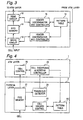
- Fig. 3 is a diagram illustrating a concrete construction concerning the write and read operations of the FIFO memory, of the physical layer in the embodiment in accordance with the present invention.
- the shown physical layer includes a FIFO memory writing and reading circuit composed of a FIFO memory 11, a write circuit 10 receiving a cell from a communication line for writing the received cell into the FIFO memory 11, and a read circuit 12 reading the cell from the FIFO memory 11 for sending the read-out cell to the ATM layer.
- the shown physical layer also includes a pattern table 13 for holding the VPI/VCI of the cell to be discarded, notified from the ATM layer, and header discriminating and controlling circuits 14 and 15 for detecting the header of the cell and comparing the detected header with the VPI/VCI pattern of the pattern table 13 so as to control the FIFO memory writing and reading circuit.
- the pattern table 13 holds the VPI/VCI notified from the ATM layer, simply as the pattern.
- the header discriminating and controlling circuits 14 and 15 compare the VPI/VCI pattern of the header of the cell with the VPI/VCI pattern held in the pattern table 13, when the cell received from the communication line is written by the write circuit 10, and when the cell is read out from the FIFO memory 11, respectively, so that the above mentioned write and read control of the FIFO memory is executed.
- the cell discarding in the physical layer based on the simple header patter comparison can be considered to be comparable with a discarding of an idle cell which is an inherent function of the physical layer. As a result, the load of the ATM layer can be reduced.
- the ATM layer or a upper layer superior to the ATM layer sends a canceling signal (or a canceling command) for canceling the notified VPI/VCI, so that the physical layer removes the VPI/VCI from the pattern table 13 in response to the canceling signal
- the discarding of the cell belonging to the packet which has been determined to be discarded in the ATM layer or the upper layer because of the cell loss can be conducted for the cells stored in the FIFO memory in the physical layer, so that the cell discarding can be quickly carried out.
- Figs. 4 and 5 show examples of setting the header information of the cell be discarded.
- Fig. 4 illustrates an example of generating the header information in the ATM layer when it is judged as the congested condition.
- the physical layer 2 includes a FIFO memory 21, a pattern table 22, a cell discard controller 23 and a threshold detector 24, and the ATM layer 1 includes a cell controller 25 having therein a cell discard algorithm controller 26.
- the FIFO memory 21 sequentially writes the received cells, and sends the cell to the ATM layer 1 in the writing order.
- the threshold detector 24 detects that the amount of cells stored in the FIFO memory reaches a predetermine threshold, and notifies it to the cell discard algorithm controller 26.
- This cell discard algorithm controller 26 responds to the notification from the threshold detector 24 to start the algorithm of the selective cell discard control. Namely, if the cell discard algorithm controller 26 receives the notification from the threshold detector 24, the cell discard algorithm controller 26 outputs the VPI/VCI of a packet which is previously known to be not so important from the cell discarding algorithm such as EPD or PPD. This VPI/VCI is written into the pattern table 22.
- the cell discard controller 23 compares each of the received cells with the header infonnation stored in the pattern table 22, so as to control the writing and reading of the FIFO memory and to discard unnecessary cells.
- the threshold detector 24 detects it and notifies to the cell discard algorithm controller 26, which then controls the patter table 22 so as to remove the VPI/VCI from the pattern table 22.
- the notification signal from the threshold detector 24 directly controls to remove the VPI/VCI from the pattern table 22.
- Fig. 5 illustrates an example of setting the pattern table in the physical layer on the basis of the cell discarding algorithm such as EPD and PPD in the ATM layer or an upper layer superior to the ATM layer.
- cell header information detectors 35 and 37 are associated to a cell controller 34 and a packet controller 36, respectively, so that a discard cell header information is outputted from both or one of the cell header information detectors 35 and 37.
- the cell header information detectors 35 and 37 detect the header information (VPI/VCI) on the basis of the lost cell or the packet which cannot be regenerated, which are detected in accordance with the EPD and PPD in the ATM layer or an upper layer superior to the ATM layer.
- the cell header information detectors 35 and 37 set the detected header information in a pattern table 32 of the physical layer 32.
- a cell discard controller 33 conducts the cell discard control on the basis of the header information which is notified from the ATM layer or an upper layer superior to the ATM layer and which is stored in the pattern table 32.
- the cell discard control is carried out in the physical layer.
- the cell discard control can be conducted in the ATM layer on the basis of EPD or PPD.
- the at-random property exists in the cell discard and loss because of the overflow of the buffer (FIFO) in the physical layer and in the ATM layer.
- the cell discard is controlled so as to minimize the amount of discarded data and the amount of re-sent data, so that the performance of the overall network can be elevated, and the confusion of the network can be prevented.
- the physical layer since the physical layer has a selective cell discard function for a congestion control, it is possible to avoid the overflow of the buffer in the physical layer, and to ensure a margin in the processing of each layer.
- the ATM layer has a large processing load since the ATM layer analyzes the content of the cell header so as to control the transfer, but since the unnecessary ATM cells having the cell header information (VPI/VCI) notified to the physical layer are prevented from being supplied to the ATM layer, the load of the ATM layer is reduced. In addition, the overflow is prevented in both the physical layer and the ATM layer. This advantage is also true in an upper layer superior to the ATM layer. Furthermore, since only effective cells are sent to the ATM layer, the performance of the ATM layer can be elevated.
- the cell discard is conducted in an internal device of the ATM switch or the like, but is not conducted in an upstream ATM switch in the flow of ATM cells. Therefore it is possible to minimize influence of the cell discard to other ATM switches in the ATM communication network, similarly to the cell discard control based on the cell discard algorithm such as EPD and PPD in the prior art, which are conducted in the ATM layer.
Landscapes
- Engineering & Computer Science (AREA)
- Computer Networks & Wireless Communication (AREA)
- Signal Processing (AREA)
- Data Exchanges In Wide-Area Networks (AREA)
Applications Claiming Priority (2)
| Application Number | Priority Date | Filing Date | Title |
|---|---|---|---|
| JP2408098A JP3152296B2 (ja) | 1998-01-22 | 1998-01-22 | 選択的atmセル廃棄方法及び装置 |
| JP2408098 | 1998-01-22 |
Publications (2)
| Publication Number | Publication Date |
|---|---|
| EP0932321A2 true EP0932321A2 (fr) | 1999-07-28 |
| EP0932321A3 EP0932321A3 (fr) | 2002-09-18 |
Family
ID=12128443
Family Applications (1)
| Application Number | Title | Priority Date | Filing Date |
|---|---|---|---|
| EP19990101220 Withdrawn EP0932321A3 (fr) | 1998-01-22 | 1999-01-22 | Procédé et dispositif pour l' élimination sélective des cellules ATM |
Country Status (3)
| Country | Link |
|---|---|
| EP (1) | EP0932321A3 (fr) |
| JP (1) | JP3152296B2 (fr) |
| KR (1) | KR19990068004A (fr) |
Cited By (1)
| Publication number | Priority date | Publication date | Assignee | Title |
|---|---|---|---|---|
| WO2010025509A1 (fr) * | 2008-09-03 | 2010-03-11 | Zigmantas Leonas Budrikis | Procédé et appareil pour multiplexage statistique de paquets |
Families Citing this family (1)
| Publication number | Priority date | Publication date | Assignee | Title |
|---|---|---|---|---|
| JP2009290297A (ja) * | 2008-05-27 | 2009-12-10 | Fujitsu Ltd | 通信装置および通信装置の制御方法 |
Family Cites Families (3)
| Publication number | Priority date | Publication date | Assignee | Title |
|---|---|---|---|---|
| US5689499A (en) * | 1993-03-26 | 1997-11-18 | Curtin University Of Technology | Method and apparatus for managing the statistical multiplexing of data in digital communication networks |
| EP0671860A1 (fr) * | 1994-03-04 | 1995-09-13 | ALCATEL BELL Naamloze Vennootschap | Arrangement de tampon FIFO avec expulsion retardée |
| GB9511314D0 (en) * | 1995-06-05 | 1995-08-02 | Gen Datacomm Adv Res | ATM network switch with congestion control |
-
1998
- 1998-01-22 JP JP2408098A patent/JP3152296B2/ja not_active Expired - Fee Related
-
1999
- 1999-01-20 KR KR1019990001565A patent/KR19990068004A/ko not_active Ceased
- 1999-01-22 EP EP19990101220 patent/EP0932321A3/fr not_active Withdrawn
Cited By (2)
| Publication number | Priority date | Publication date | Assignee | Title |
|---|---|---|---|---|
| WO2010025509A1 (fr) * | 2008-09-03 | 2010-03-11 | Zigmantas Leonas Budrikis | Procédé et appareil pour multiplexage statistique de paquets |
| AU2009251167B2 (en) * | 2008-09-03 | 2010-04-01 | Zigmantas Leonas Budrikis | Method of and apparatus for statistical packet multiplexing |
Also Published As
| Publication number | Publication date |
|---|---|
| JPH11215155A (ja) | 1999-08-06 |
| KR19990068004A (ko) | 1999-08-25 |
| JP3152296B2 (ja) | 2001-04-03 |
| EP0932321A3 (fr) | 2002-09-18 |
Similar Documents
| Publication | Publication Date | Title |
|---|---|---|
| US6144636A (en) | Packet switch and congestion notification method | |
| JP3518209B2 (ja) | Atm交換機および輻輳制御方式 | |
| US6847646B1 (en) | Network coupling device with small cell memory | |
| KR100329014B1 (ko) | 패킷스위치를통한자료셀흐름제어장치및그방법 | |
| KR100229558B1 (ko) | 비동기 전송방식용 저지연 또는 저손실 스위치 | |
| JP2757779B2 (ja) | バッファ優先権制御方式 | |
| JPH08265333A (ja) | Atm通信網におけるセル転送速度規制方法 | |
| JP2836606B2 (ja) | Atmセル転送装置 | |
| WO2001067672A2 (fr) | Regulation du debit dans un canal virtuel | |
| EP0932321A2 (fr) | Procédé et dispositif pour l' élimination sélective des cellules ATM | |
| US20130121144A1 (en) | Multiplexing apparatus and discard method | |
| JPH03135248A (ja) | パケット交換網での選択式パケット廃棄方式 | |
| JP3001964B2 (ja) | バッファ制御装置 | |
| JP2002217969A (ja) | データ中継装置及びデータ中継方法 | |
| JP3637879B2 (ja) | Atm通信方式におけるパケット廃棄方法及びatmスイッチ装置 | |
| JP2947229B2 (ja) | Atmネットワークの輻輳制御システム | |
| JP3075182B2 (ja) | Cbrデータの順序性保障のatm伝送方式 | |
| JP3656295B2 (ja) | Atmセル廃棄率低減方式 | |
| US6151303A (en) | Method of asynchronous transfer mode (ATM) switching and an ATM switching equipment | |
| JP2000115191A (ja) | シェーピング装置及びシェーピングシステム | |
| JP2828139B2 (ja) | Atm通信装置およびセル廃棄方法 | |
| JP2842512B2 (ja) | セル多重化装置 | |
| JPH09321770A (ja) | Atmセルスイッチング装置 | |
| JP3324568B2 (ja) | 通信制御装置 | |
| JP2001339433A (ja) | パケット交換装置及びパケット交換方法 |
Legal Events
| Date | Code | Title | Description |
|---|---|---|---|
| PUAI | Public reference made under article 153(3) epc to a published international application that has entered the european phase |
Free format text: ORIGINAL CODE: 0009012 |
|
| AK | Designated contracting states |
Kind code of ref document: A2 Designated state(s): AT BE CH CY DE DK ES FI FR GB GR IE IT LI LU MC NL PT SE |
|
| AX | Request for extension of the european patent |
Free format text: AL;LT;LV;MK;RO;SI |
|
| PUAL | Search report despatched |
Free format text: ORIGINAL CODE: 0009013 |
|
| RIC1 | Information provided on ipc code assigned before grant |
Free format text: 7H 04Q 11/04 A, 7H 04L 12/56 B |
|
| AK | Designated contracting states |
Kind code of ref document: A3 Designated state(s): AT BE CH CY DE DK ES FI FR GB GR IE IT LI LU MC NL PT SE |
|
| AX | Request for extension of the european patent |
Free format text: AL;LT;LV;MK;RO;SI |
|
| 17P | Request for examination filed |
Effective date: 20020808 |
|
| 17Q | First examination report despatched |
Effective date: 20021128 |
|
| RAP1 | Party data changed (applicant data changed or rights of an application transferred) |
Owner name: NEC ELECTRONICS CORPORATION |
|
| STAA | Information on the status of an ep patent application or granted ep patent |
Free format text: STATUS: THE APPLICATION HAS BEEN WITHDRAWN |
|
| AKX | Designation fees paid |
Designated state(s): DE FR GB IT |
|
| 18W | Application withdrawn |
Effective date: 20030509 |