EP0932342B1 - Procede de preparation d'une denree alimentaire contenant des matieres grasses - Google Patents
Procede de preparation d'une denree alimentaire contenant des matieres grasses Download PDFInfo
- Publication number
- EP0932342B1 EP0932342B1 EP98917790A EP98917790A EP0932342B1 EP 0932342 B1 EP0932342 B1 EP 0932342B1 EP 98917790 A EP98917790 A EP 98917790A EP 98917790 A EP98917790 A EP 98917790A EP 0932342 B1 EP0932342 B1 EP 0932342B1
- Authority
- EP
- European Patent Office
- Prior art keywords
- fat
- aqueous phase
- phase
- evaporator
- process according
- Prior art date
- Legal status (The legal status is an assumption and is not a legal conclusion. Google has not performed a legal analysis and makes no representation as to the accuracy of the status listed.)
- Revoked
Links
Images

Classifications
-
- A—HUMAN NECESSITIES
- A23—FOODS OR FOODSTUFFS; TREATMENT THEREOF, NOT COVERED BY OTHER CLASSES
- A23C—DAIRY PRODUCTS, e.g. MILK, BUTTER OR CHEESE; MILK OR CHEESE SUBSTITUTES; PREPARATION THEREOF
- A23C1/00—Concentration, evaporation or drying
- A23C1/12—Concentration by evaporation
-
- A—HUMAN NECESSITIES
- A23—FOODS OR FOODSTUFFS; TREATMENT THEREOF, NOT COVERED BY OTHER CLASSES
- A23C—DAIRY PRODUCTS, e.g. MILK, BUTTER OR CHEESE; MILK OR CHEESE SUBSTITUTES; PREPARATION THEREOF
- A23C11/00—Milk substitutes, e.g. coffee whitener compositions
- A23C11/02—Milk substitutes, e.g. coffee whitener compositions containing at least one non-milk component as source of fats or proteins
- A23C11/04—Milk substitutes, e.g. coffee whitener compositions containing at least one non-milk component as source of fats or proteins containing non-milk fats but no non-milk proteins
-
- A—HUMAN NECESSITIES
- A23—FOODS OR FOODSTUFFS; TREATMENT THEREOF, NOT COVERED BY OTHER CLASSES
- A23C—DAIRY PRODUCTS, e.g. MILK, BUTTER OR CHEESE; MILK OR CHEESE SUBSTITUTES; PREPARATION THEREOF
- A23C9/00—Milk preparations; Milk powder or milk powder preparations
- A23C9/15—Reconstituted or recombined milk products containing neither non-milk fat nor non-milk proteins
- A23C9/1508—Dissolving or reconstituting milk powder; Reconstitution of milk concentrate with water; Standardisation of fat content of milk
-
- A—HUMAN NECESSITIES
- A23—FOODS OR FOODSTUFFS; TREATMENT THEREOF, NOT COVERED BY OTHER CLASSES
- A23L—FOODS, FOODSTUFFS OR NON-ALCOHOLIC BEVERAGES, NOT OTHERWISE PROVIDED FOR; PREPARATION OR TREATMENT THEREOF
- A23L33/00—Modifying nutritive qualities of foods; Dietetic products; Preparation or treatment thereof
- A23L33/10—Modifying nutritive qualities of foods; Dietetic products; Preparation or treatment thereof using additives
- A23L33/115—Fatty acids or derivatives thereof; Fats or oils
Definitions
- the present invention relates to a process of preparing a fat-containing foodstuff. More in particular, it relates to a process of in-line adding a fat phase to an aqueous phase in such a manner that a dry, powdered foodstuff, especially an infant formula, is obtained which meets strict standards as to microbiological safety, while sensitive components in the product remain undamaged.
- a process for preparing milk concentrates by adding a fraction of the fat phase to the milk liquid within one or more effects of an evaporator, rather than to the milk liquid prior to the evaporation step, is described in EP-A-624317.
- This process uses a liquid container downstream of the evaporator for accommodating fluctuations in the composition of the mixture and for adding further components.
- Such a downstream container requires low temperatures for minimising microbial growth and increases the risk of microbial contamination. It is therefore either uneconomical from an energy point of view or of insufficient microbial safety, or both.
- a greater proportion of fat has to be added, this may cause clogging and fouling problems in the subsequent stages of the evaporator.
- a complete mixing of the fat fraction and the aqueous phase with optimum particle size distribution is not always possible.
- GB-A-2273234 discloses a process for producing a cream product, not a dry solid, by adding a vegetable fat to skimmed milk, heating and homogenising in two stages.
- GB-A-1122179 discloses a process of concentrating a solution using two or more evaporators and regulating the concentration process by adding a diluent. Further components such as milk fat may be added, without a homogenation being provided.
- EP-A-0639333 describes the preparation of a milk powder comprising adding a fat phase to concentrated skim milk followed by homogenising and spray-drying.
- SU-A-1500236 describes a similar process.
- a process has been found which allows the preparation of a food product comprising an aqueous phase and a fat phase, having the following advantages:
- the present invention provides a process for the preparation of a food product as defined in the appending claims.
- the process of the invention comprises the addition of a fat phase to an aqueous phase and dehydrating the aqueous phase, as such and/or as part of an emulsion, by means of a series of evaporator effects.
- the fat phase is added in a line connecting two consecutive evaporator effects, and the mixture is homogenised immediately downstream of the point of addition by means of a homogeniser or other high-shear device.
- a pump is located immediately before the point of fat addition, in the line conducting the aqueous phase.
- the fat phase to be added may be the entire fat phase of the final food product or a major part (at least 35%, preferably at least 50% by weight) of the fat phase comprising sensitive fatty components such as long-chain poly-unsaturated fatty acids (fish oil and the like). Most preferably, essentially the entire fat phase is added in-line, for example after UHT treatment of the aqueous phase.
- the addition of the fat phase between two evaporator effects rather than before or within one of the effects themselves was found to result in an optimum balance between fat quality (a heat-sensitive fat requiring exposure to heat being minimised), a total microbial safety, a homogeneous distribution of the fat phase in the aqueous phase and a saving in energy consumption required for complete homogenation.
- the process avoids creaming-up (e.g. after coalescence) of the fat phase after its addition to the aqueous phase, and thus further increases product homogeneity.
- no storage container is present before the spray-drying step and after the evaporator, other than an optional flow buffering unit.
- Such a unit is not used for adding or mixing components as is the case with prior art containers, but rather serves to accommodate minor capacity changes or other fluctuations.
- the average residence time in such a buffering unit (including the connecting lines) is less than 50 minutes, preferably less than 20 minutes, more preferably less than 10 minutes; for a large-scale installation these preferences correspond to a tank volume of less than about 2000 l and 1000 l, respectively.
- the treatment according to the invention results in an emulsion with sufficiently small fat particles. This avoids clogging of process lines and devices and contributes to a high degree of homogeneity of the product.
- the particle size distribution of the fat phase in the aqueous phase has a D(4,3) of less then 0.8 ⁇ m and more than 0.3 ⁇ m; most preferably, the D(4,3) is below 0.6 ⁇ m.
- Preferably less than 2%, especially less than 1%, of the fat particles will have a particle size of more than 3 ⁇ m.
- the product obtained according to the invention is further characterised by a low oxidation state of the fat phase, in particular by a peroxide value of less than 1 meq, especially less than 0.8 meq per kg fat.
- the fat phase is preferably added to the aqueous phase when the latter has a water content of between 48 and 92 % by weight, more preferably between 55 and 90% and especially between 60 and 85 % by weight. If the evaporator system comprises more than two effects, the fat may be added between the first and the second evaporator effect or between two later evaporator effects.
- the fat phase is added to the aqueous phase according to a predetermined ratio between fat phase and aqueous phase, allowing a perfectly matched fat addition which is adapted to possible fluctuations in the composition of the aqueous phase.
- This is achieved by in-line measurement of the composition of the aqueous phase and the composition of the fat phase, feeding the measured data to a data processor and controlling the fat addition on the basis of the output of the data processor, e.g. by means of a processor-controlled pump.
- the composition of either phase can be determined by measuring its (volume) flow or mass flow and its density and/or dry substance content. As the density of the fat phase will usually be constant, its measurement can be dispensed with. If necessary a temperature correction can be applied. It will be obvious to the skilled person that the flow, mass flow, density and dry substance content are measured by equipment that actually measures other physical parameters such as refractive index, changes in coriolis tube frequencies and electric field changes.
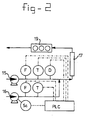
- the aqueous phase can be the concentrated phase issuing from a first effect of an evaporator, which is conducted by means of pump 15.
- the flow or mass flow, density or dry solids content and, if necessary, the temperature are measured.
- This amount of fat Flow f is pumped by pump 16 to the static mixer 17.
- the amount of fat actually pumped is checked by measurement of the flow and the temperature, and a programmable logic controller (PLC) will instruct the speed control Sc to adapt the speed of the pump 16, in order to maintain the flow as accurately as possible to the setting by applying methods (e.g. PI D regulation) known in the art.
- PLC programmable logic controller
- the aqueous phase is prepared by using techniques that are known in the art. Milk, skimmed milk or solutions of caseinates, whey, demineralised whey, whey protein concentrates and/or other protein concentrates in water are used as basis for the aqueous phase. Appropriate amounts of water-soluble components such as lactose or other carbohydrates, minerals, trace elements, emulsifiers and/or some vitamins are dissolved in this liquid and homogeneously mixed in tank 1. Whole milk can be selected as a basis ingredient, if butter oil must be an important part of the fat composition in the final product.
- a fat phase that is suitable for manufacturing according to the invention is prepared under conditions that prevent deterioration of the fat by using methods that are known in the art.
- the fat phase may comprise vegetable oils like soybean oil, rapeseed oil, palm kernel oil, coconut oil, sunflower oil, evening primrose oil, maize oil and/or fats from animal origin like butter oil or fish oil and/or structured fats and/or oils derived from microorganisms such as algae.
- the fat phase may also comprise emulsifiers like soy lecithin and/or fat soluble vitamins and/or antioxidants, added separately or as premix, or other compounds.
- vessel 1 is for storing and supplying the aqueous phase of the food product to be prepared
- 2 is a pump for the aqueous phase
- 3 is a heat exchanger, for example a steam infusion heater or steam injection heater for pasteurising or sterilising the aqueous phase
- 11, 21 and 31 are evaporator effects for stepwise dehydrating the aqueous phase
- 12, 22 and 32 are separators
- 14 is a buffer tank
- 19 is a homogeniser producing an emulsion which is fed to the next evaporator effect (21)
- 2 and 15 are pumps for the aqueous phase
- 16 is a pump for supplying the fat phase of the food product
- 25 and 35 are pumps for the concentrated emulsion, with 35 pumping the concentrate to the spray-drier (not shown), optionally through a buffer tank and a preheater, but without a storage tank.
- An infant formula is prepared from an aqueous phase and a fat phase.
- Table 1 lists the amounts of ingredients can be present in the aqueous phase of the infant formula.
- List of ingredients of aqueous phase Ingredient Amount in kg per 1000 l skimmed milk protein 50-60 demineralised whey powder 50-60 lactose 100-130 calcium carbonate 2.0-4.3 calcium phosphate 0.2-3.5 calcium chloride 0.5-2.3 magnesium chloride 0.5-1.4 sodium chloride 0.2-1.0 other sodium salts 1.0-2.2 potassium hydroxide 0.1-1.3 other potassium salts 0.4-2.5 choline chloride 0.1-0.8 vitamin premixes (B1, B2, B6, B12, folic acid, pantothenic acid, niacin, biotin, ascorbate, taurine) 0.7-3.0 trace element premixes (Fe, Cu, Zn, Mn, Mo, Se, Cr, I) 0.1-0.6
- the aqueous phase as produced in vessel 1 may be chilled for storage purposes or be used directly. It is heated in heat exchanger 3.
- the heating treatment that is applied must be sufficient to kill microorganisms that are present in the aqueous phase.
- Typical conditions are 70-150°C for 0.2 sec - 15 min, preferably 100-140°C for 1 sec - 5 min and most preferably 125-135°C for 2-30 seconds.
- Part of the water is subsequently evaporated from the aqueous phase in 11 until a dry solids content of 12-40% and more preferably 15-30% is obtained.
- the vapour separator 12 will separate the vapour (steam) from the product.
- a fat phase that is suitable for manufacturing the infant formula is prepared under conditions that prevent deterioration of the fat by using methods that are known in the art.
- Table 2 provides a list of fat ingredients for a typical infant formula.
- the fat phase can be stored under appropriate conditions to prevent deterioration (such as creating a nitrogen blanket above the fat) or be used directly.
- An appropriate amount of the fat phase is dosed to the aqueous phase that flows from the first evaporator effect 11 and the vapour separator 12, using the system as described above with reference to figure 2.
- Step 12 is equipped with a buffer tank 14 in order to prevent homogeniser 19 from running dry.
- Fat composition of infant formula Ingredient Amount in kg per 1000 kg fat palm oil 200-400 rapeseed oil (low erucic acid) 180-350 sunflower oil (high oleic acid) 150-250 coconut oil 150-250 fish oil 1-50 butter oil 1-10 lecithins 1-100 vitamin premix (vitamins D, E, K, A + stabilisers, e.g. ascorbyl palmitate) 0.1-0.5
- aqueous phase and fat phase are mixed together to obtain a final fat content of 20-35 % (w/w, dry substance basis).
- Mixing occurs by pumping the mixture through a static mixer 17.
- homogeniser or other high-shear device 19 After mixing the mixture is immediately homogenised by homogeniser or other high-shear device 19, using conditions that are known in the art: if a two-stage homogeniser is used, the temperature will normally be in the range of 50-70°C and the pressure will be 100-250 bar in the first stage and 15-40 bar in the second stage.
- the emulsion is further concentrated in one or more evaporator effects (21 and/or 31) in order to obtain a solids content that is suitable for direct spray-drying; this emulsion can directly be pumped to the spray-drier.
- evaporator effects 21 and/or 31
- an additional homogenising step before the spray-drier may be advantageous.
- Various prior art spray-drying techniques can be applied.
Landscapes
- Life Sciences & Earth Sciences (AREA)
- Chemical & Material Sciences (AREA)
- Engineering & Computer Science (AREA)
- Food Science & Technology (AREA)
- Polymers & Plastics (AREA)
- Mycology (AREA)
- Oil, Petroleum & Natural Gas (AREA)
- Health & Medical Sciences (AREA)
- Nutrition Science (AREA)
- Edible Oils And Fats (AREA)
- Fats And Perfumes (AREA)
- Freezing, Cooling And Drying Of Foods (AREA)
- Dairy Products (AREA)
Claims (6)
- Procédé de préparation de produit alimentaire sec comprenant l'addition d'une phase grasse à une phase aqueuse pour produire une émulsion, l'évaporation de la phase aqueuse dans une pluralité d'effets d'un évaporateur et en fin le séchage par vaporisation de l'émulsion, caractérisé par la mesure en continu des fluctuations de la composition de la phase aqueuse en aval d'au moins un effet de l'évaporateur, l'addition en continu de la phase grasse à la phase aqueuse liquide selon un rapport prédéterminé entre la phase grasse et la phase aqueuse prenant en considération lesdites fluctuations, et l'homogénéisation du mélange de la phase grasse et de la phase aqueuse, lesdites mesure, addition et homogénéisation étant appliquées dans une ligne reliant deux effets d'évaporateur consécutifs.
- Procédé selon la revendication 1, dans lequel la teneur et /ou la densité en substance sèche, le débit de la masse ou du volume et éventuellement la température de la phase aqueuse sont mesurés avant l'addition, ainsi que le débit de la masse ou du volume et éventuellement la densité et /ou la température de la phase grasse avant l'addition.
- Procédé selon la revendication 1 ou 2, dans lequel le produit alimentaire homogénéisé est séché immédiatement en aval du dernier effet de l' évaporateur ou de l'étape d' homogénéisation.
- Procédé selon l'une des revendications 1 à 3 , dans lequel est appliqué un temps de résidence moyenne entre le dernier effet d'évaporateur et le séchage par vaporisation inférieur à 50 minutes, de préférence inférieur à 20 minutes.
- Procédé selon l'une quelconque des revendications 1 à 4, dans lequel l'effet de l'évaporateur en amont de l'addition de la matière grasse est équipée d'un réservoir tampon situé près de la sortie dudit effet d'évaporateur.
- Procédé selon l'une quelconque des revendications 1 à 5, dans lequel la phase aqueuse à laquelle la phase grasse est ajoutée à une teneur en eau comprise entre 48 et 92 % en poids.
Priority Applications (1)
| Application Number | Priority Date | Filing Date | Title |
|---|---|---|---|
| EP98917790A EP0932342B1 (fr) | 1997-04-21 | 1998-04-21 | Procede de preparation d'une denree alimentaire contenant des matieres grasses |
Applications Claiming Priority (4)
| Application Number | Priority Date | Filing Date | Title |
|---|---|---|---|
| EP97201170A EP0873690A1 (fr) | 1997-04-21 | 1997-04-21 | Procédé de préparation d'un produit alimentaire contenant de la graisse |
| EP97201170 | 1997-04-21 | ||
| EP98917790A EP0932342B1 (fr) | 1997-04-21 | 1998-04-21 | Procede de preparation d'une denree alimentaire contenant des matieres grasses |
| PCT/NL1998/000222 WO1998047384A1 (fr) | 1997-04-21 | 1998-04-21 | Procede de preparation d'une denree alimentaire contenant des matieres grasses |
Publications (2)
| Publication Number | Publication Date |
|---|---|
| EP0932342A1 EP0932342A1 (fr) | 1999-08-04 |
| EP0932342B1 true EP0932342B1 (fr) | 2004-09-29 |
Family
ID=8228226
Family Applications (2)
| Application Number | Title | Priority Date | Filing Date |
|---|---|---|---|
| EP97201170A Withdrawn EP0873690A1 (fr) | 1997-04-21 | 1997-04-21 | Procédé de préparation d'un produit alimentaire contenant de la graisse |
| EP98917790A Revoked EP0932342B1 (fr) | 1997-04-21 | 1998-04-21 | Procede de preparation d'une denree alimentaire contenant des matieres grasses |
Family Applications Before (1)
| Application Number | Title | Priority Date | Filing Date |
|---|---|---|---|
| EP97201170A Withdrawn EP0873690A1 (fr) | 1997-04-21 | 1997-04-21 | Procédé de préparation d'un produit alimentaire contenant de la graisse |
Country Status (6)
| Country | Link |
|---|---|
| EP (2) | EP0873690A1 (fr) |
| AU (1) | AU7084998A (fr) |
| DE (1) | DE69826627T2 (fr) |
| DK (1) | DK0932342T3 (fr) |
| NZ (1) | NZ333483A (fr) |
| WO (1) | WO1998047384A1 (fr) |
Families Citing this family (1)
| Publication number | Priority date | Publication date | Assignee | Title |
|---|---|---|---|---|
| EP1127494A1 (fr) * | 2000-02-22 | 2001-08-29 | Société des Produits Nestlé S.A. | Procédé de préparation de lait en poudre |
Family Cites Families (15)
| Publication number | Priority date | Publication date | Assignee | Title |
|---|---|---|---|---|
| CH378661A (de) * | 1959-04-04 | 1964-06-15 | Nestle Sa | Verfahren zur Herstellung eines Vollmichpulvers |
| FR90428E (fr) * | 1966-02-02 | 1967-12-08 | Procédé de réglage de la concentration dans les évaporateurs, en particulier dans les évaporateurs à plusieurs effets | |
| GB1232640A (fr) * | 1968-08-19 | 1971-05-19 | ||
| SE374989B (fr) * | 1973-05-29 | 1975-04-07 | Alfa Laval Ab | |
| DE2628226A1 (de) * | 1976-06-23 | 1977-12-29 | Stromag Maschf | Verfahren und vorrichtung zur herstellung von standardisiertem rahm fuer die kaeseherstellung mit einem vorgegebenen verhaeltnis von fettgehalt zu gehalt an trockenmasse |
| DE2628225A1 (de) * | 1976-06-23 | 1978-01-05 | Stromag Maschf | Verfahren und vorrichtung zur herstellung von rahm mit standardisiertem fettgehalt |
| DE2631703C3 (de) * | 1976-07-14 | 1981-01-29 | Gebrueder Ott Ag, Worb, Bern (Schweiz) | Verfahren und Anlage zur Regulierung des Fettgehaltes von Milch |
| US4434186A (en) * | 1982-04-19 | 1984-02-28 | The Pillsbury Company | Stable aerated frozen food product |
| GB8531391D0 (en) * | 1985-12-20 | 1986-02-05 | Unilever Plc | Food product |
| SU1500236A1 (ru) * | 1987-03-24 | 1989-08-15 | Научно-производственное объединение масложировой промышленности "Масложирпром" | Состав жировой основы "Зацемол" дл заменител цельного молока |
| NL8801848A (nl) * | 1988-07-21 | 1990-02-16 | Stork Amsterdam | Werkwijze en inrichting voor het bereiden van melk met een voorafbepaald vetgehalte. |
| IE71915B1 (en) * | 1991-05-17 | 1997-03-12 | Bailieboro Tech Ltd | A method for producing skimmed milk powder |
| GB2273234B (en) * | 1992-12-11 | 1997-03-26 | Waterford Creamery Ltd | Dairy products |
| NL9300848A (nl) * | 1993-05-14 | 1994-12-01 | Friesland Frico Domo Coop | Werkwijze voor de bereiding van lang houdbare melkconcentraten en melkpoeders. |
| EP0937408B1 (fr) * | 1993-08-20 | 2004-02-11 | Societe Des Produits Nestle S.A. | Produit laitier comprenant une composition lipidique nutritionnelle |
-
1997
- 1997-04-21 EP EP97201170A patent/EP0873690A1/fr not_active Withdrawn
-
1998
- 1998-04-21 DE DE69826627T patent/DE69826627T2/de not_active Revoked
- 1998-04-21 DK DK98917790T patent/DK0932342T3/da active
- 1998-04-21 WO PCT/NL1998/000222 patent/WO1998047384A1/fr not_active Ceased
- 1998-04-21 NZ NZ333483A patent/NZ333483A/xx not_active IP Right Cessation
- 1998-04-21 EP EP98917790A patent/EP0932342B1/fr not_active Revoked
- 1998-04-21 AU AU70849/98A patent/AU7084998A/en not_active Abandoned
Also Published As
| Publication number | Publication date |
|---|---|
| DE69826627T2 (de) | 2005-10-06 |
| DK0932342T3 (da) | 2005-01-24 |
| AU7084998A (en) | 1998-11-13 |
| NZ333483A (en) | 2000-08-25 |
| EP0873690A1 (fr) | 1998-10-28 |
| WO1998047384A1 (fr) | 1998-10-29 |
| DE69826627D1 (de) | 2004-11-04 |
| EP0932342A1 (fr) | 1999-08-04 |
Similar Documents
| Publication | Publication Date | Title |
|---|---|---|
| US4583453A (en) | Process for the preparation and heat treatment of food products and apparatus for performing said process | |
| US11985998B2 (en) | Process for preparing infant formula using a static mixer | |
| EP1221859B1 (fr) | Production d'un produit proteine en poudre | |
| JPH0789864B2 (ja) | 牛乳非含有クリーム | |
| DE60123292T2 (de) | Uht-milchkonzentratspackung und verfahren zu ihrer herstellung | |
| EP0603981B1 (fr) | Procédé de préparation d'une émulsion dont la viscosité est ajustable; l'émulsion ainsi préparée et aliment obtenu en utilisant cette émulsion | |
| US4418091A (en) | Process for preparing a dry, powdery milk product | |
| EP3175717B1 (fr) | Produits alimentaires à base d'amande avec caractéristiques de goût améliorées | |
| JP2000333602A (ja) | 水中油型乳化油脂組成物 | |
| EP0932342A1 (fr) | Procede de preparation d'une denree alimentaire contenant des matieres grasses | |
| EP0662284B1 (fr) | Procédé de préparation d'une bouillie de lait stérile | |
| US6706308B2 (en) | Process for the manufacture of an evaporated milk substitute | |
| EP3043659B1 (fr) | Procédé amélioré de préparation d'une formule pour nourrisson au moyen d'un mélangeur statique | |
| WO2018039037A1 (fr) | Composition nutritive et son procédé de préparation | |
| CN121057507A (zh) | 乳制品和方法 | |
| WO2024115304A1 (fr) | Produit laitier concentré et son procédé de production | |
| EP2168444A1 (fr) | Formule nutritionnelle acidifiée | |
| AU2019408023B2 (en) | Process for preparing an infant formula using freeze-drying | |
| RU2055479C1 (ru) | Способ производства пищевых эмульсий | |
| EP3338556B1 (fr) | Methode de production d'un mix pour kulfi | |
| WO2026003333A1 (fr) | Processus et systèmes de préparation de compositions nutritionnelles | |
| Persico et al. | Technology, modeling and control of the processing steps | |
| WO2016102993A1 (fr) | Composition comprenant un mélange de protéines | |
| JPS6185141A (ja) | 油中水滴型エマルジヨン組成物 | |
| BR112020011876A2 (pt) | Processo para fabricar um produto de fórmula infantil, produto de fórmula infantil e sistemas modulares |
Legal Events
| Date | Code | Title | Description |
|---|---|---|---|
| PUAI | Public reference made under article 153(3) epc to a published international application that has entered the european phase |
Free format text: ORIGINAL CODE: 0009012 |
|
| 17P | Request for examination filed |
Effective date: 19981222 |
|
| AK | Designated contracting states |
Kind code of ref document: A1 Designated state(s): CH DE DK FR GB IE LI NL |
|
| 17Q | First examination report despatched |
Effective date: 20020913 |
|
| GRAP | Despatch of communication of intention to grant a patent |
Free format text: ORIGINAL CODE: EPIDOSNIGR1 |
|
| GRAS | Grant fee paid |
Free format text: ORIGINAL CODE: EPIDOSNIGR3 |
|
| GRAA | (expected) grant |
Free format text: ORIGINAL CODE: 0009210 |
|
| AK | Designated contracting states |
Kind code of ref document: B1 Designated state(s): CH DE DK FR GB IE LI NL |
|
| REG | Reference to a national code |
Ref country code: GB Ref legal event code: FG4D |
|
| REG | Reference to a national code |
Ref country code: CH Ref legal event code: EP |
|
| REG | Reference to a national code |
Ref country code: CH Ref legal event code: NV Representative=s name: A. BRAUN, BRAUN, HERITIER, ESCHMANN AG PATENTANWAE |
|
| REG | Reference to a national code |
Ref country code: IE Ref legal event code: FG4D |
|
| REF | Corresponds to: |
Ref document number: 69826627 Country of ref document: DE Date of ref document: 20041104 Kind code of ref document: P |
|
| REG | Reference to a national code |
Ref country code: DK Ref legal event code: T3 |
|
| ET | Fr: translation filed | ||
| PLBI | Opposition filed |
Free format text: ORIGINAL CODE: 0009260 |
|
| PLAX | Notice of opposition and request to file observation + time limit sent |
Free format text: ORIGINAL CODE: EPIDOSNOBS2 |
|
| 26 | Opposition filed |
Opponent name: FRIESLAND BRANDS B.V. Effective date: 20050629 |
|
| NLR1 | Nl: opposition has been filed with the epo |
Opponent name: FRIESLAND BRANDS B.V. |
|
| PLBB | Reply of patent proprietor to notice(s) of opposition received |
Free format text: ORIGINAL CODE: EPIDOSNOBS3 |
|
| PGFP | Annual fee paid to national office [announced via postgrant information from national office to epo] |
Ref country code: NL Payment date: 20070228 Year of fee payment: 10 |
|
| PGFP | Annual fee paid to national office [announced via postgrant information from national office to epo] |
Ref country code: IE Payment date: 20070424 Year of fee payment: 10 |
|
| PGFP | Annual fee paid to national office [announced via postgrant information from national office to epo] |
Ref country code: DK Payment date: 20070426 Year of fee payment: 10 |
|
| PGFP | Annual fee paid to national office [announced via postgrant information from national office to epo] |
Ref country code: DE Payment date: 20070430 Year of fee payment: 10 |
|
| PGFP | Annual fee paid to national office [announced via postgrant information from national office to epo] |
Ref country code: CH Payment date: 20070501 Year of fee payment: 10 |
|
| PGFP | Annual fee paid to national office [announced via postgrant information from national office to epo] |
Ref country code: GB Payment date: 20070502 Year of fee payment: 10 |
|
| RDAF | Communication despatched that patent is revoked |
Free format text: ORIGINAL CODE: EPIDOSNREV1 |
|
| RDAG | Patent revoked |
Free format text: ORIGINAL CODE: 0009271 |
|
| STAA | Information on the status of an ep patent application or granted ep patent |
Free format text: STATUS: PATENT REVOKED |
|
| 27W | Patent revoked |
Effective date: 20071129 |
|
| GBPR | Gb: patent revoked under art. 102 of the ep convention designating the uk as contracting state |
Free format text: 20071129 |
|
| PGFP | Annual fee paid to national office [announced via postgrant information from national office to epo] |
Ref country code: FR Payment date: 20070426 Year of fee payment: 10 |
|
| REG | Reference to a national code |
Ref country code: CH Ref legal event code: PL |
|
| NLR2 | Nl: decision of opposition |
Effective date: 20071129 |
|
| PLAB | Opposition data, opponent's data or that of the opponent's representative modified |
Free format text: ORIGINAL CODE: 0009299OPPO |